Nigel Robinson
CEO at CENTRAL ASIA METALS PLC
Replay available
Interim Results hosted by Central Asia Metals (LSE:CAML) on Investor Meet Company, held 2024-09-10.
On 6ix: 6ix.com/event/central-asia-metals-plc-caml-interim-results-1
Automated transcript · Written by software from the replay's audio. It can mishear names and figures; the replay is the record.
0:01 Good afternoon, and welcome to the CENTRAL ASIA METALS PLC interim results investor presentation. Throughout this recorded presentation, investors will be in listen only mode. Questions are encouraged, and they can be submitted at any time using the q and a tab situated on the right hand corner of your screen. Simply type in your questions and press send. The company may not be in a position to answer every question received during the meeting itself. However, the company can review all questions submitted today and publish responses where it is appropriate to do so. Before we begin, I would like to submit the following poll. And I would now like to hand you over to CEO, Nigel Robinson. Good afternoon to you.
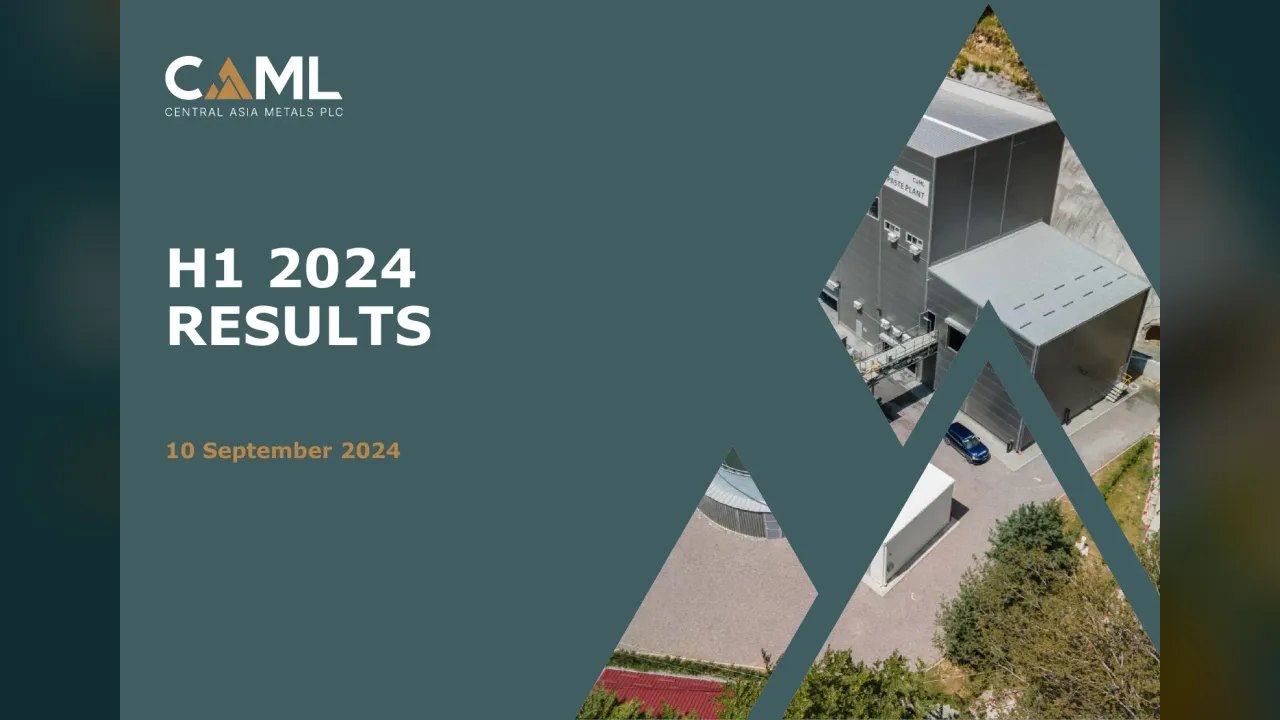
0:38 Good afternoon. Thank you, and good afternoon to everybody on the call. Welcome to our interim results for the six month period ending 06/13/2024. Got the standard disclaimer, obviously, as ever. And then if just go to the next slide, please, Richard. Just the highlights of the results we announced this morning. First of all, on the revenue side, we generated gross revenue of $103,800,000 in the first six months, with an associated EBITDA, that's earnings before interest tax, depreciation, and amortization of $49,100,000. That's a margin of 4047%. That generated for us a free cash flow in the period of $30,000,000 and enabling us to, as a board, announce an interim dividend this morning of 9p, per share.
1:27 We have a strong balance sheet still. We have cash in the bank of 56,300,000 as of the half year with no debt on the books. And also we produce metal in the first six months in a very safe manner. We did have one LTI sadly, but our LTIFR, as you can see in the bottom right hand corner there, is naught point eight and we did set ourselves a target this year of 1.2.
1:48 And then just onto the next slide, quickly to remind people, we did announce just post the period end on the July 4 our succession plan, which we've been working on for a while, for me to actually hand over the reins as the CEO of CAML to Gavin, who's with me here, and also in that movement as well, Louise has been promoted up to the CFO and the chief financial officer. So I'm delighted we've made those appointments internally. It's been a pleasure and it's been a privilege for me to serve as the CEO of the company for the past six and a half years and prior to that as the CFO for the previous nine years. And I'm delighted that I think I'm leaving the company in a strong position and Gavin and Louise will hopefully emphasize that during the results presentation here. And without any further ado, I'd like to hand over to Gavin to talk us through some of the operational and sustainability aspects of the period. Yeah. Thanks very much, Nigel. And before I do dive into the the operations, I think Nigel deserves a big thanks from all of us here at CAML and also all stakeholders, including shareholders and staff on-site and the local communities for all of the hard work he's done over the past seventeen years Yeah. Some different.
2:59 So Some that's fantastic and does leave the business in in fantastic shape for for Luisa and myself. So if we look at the operations, you know, starting on the top right, Kunrad is in Central Kazakhstan, is effectively the foundation of our business. It's been in production for twelve years now, and the life of operation continues out to 2034 when the license expires. We produced 6,608 tons of copper in the first half and are on track to achieve our guidance of 13,000 to 14,000 tons of copper for the year. On the left hand side, Sasa is an underground lead zinc mine that we bought in 2017. It's situated in Eastern North Macedonia. The life of mine there is out to 2039, and in h one, we produced just over 9,000 tons of zinc and just under 13,000 tons of lead.
3:50 Our production guidance of 19,000 to 21,000 tons of zinc and 27,000 to 29,000 tons of lead is achievable, and we're definitely on track to meet that guidance. So just looking at each asset in its... In isolation. Kunrad, you know, the histogram there displays some very steady production that we've we've achieved since our expansion in 2015. We've produced over a 160,000 tons of high quality copper cathode now and look to continue producing copper of that quality for at least the next ten years. We have around 98,000 tons of copper left in those dumps, but we are constantly looking at ways to improve recoveries and enhance our production at Kunrun. This has been evidenced by the sort of extended run of production out of what we call the Eastern Dumps, which when we originally started the operation, we're forecast to actually be closed around three or four years ago, and we've managed to eke out much more copper than we thought there, and we'll continue with those initiatives to to increase the efficiencies of operation there.
4:57 At SASSA, this has been a fairly sort of challenging year for us as we transition to what we call pastel mining methods, and that's illustrated in the first line of that table on the right hand side where you can see compared to the prior period, we're around 30,000 tons down on ore mined. Now that's as a consequence of, as I said, switching mining methods. We're moving from what's called a sublevel cave method, which is a semi bulk mining method, to a paste fill method. So there's two methods there. There's cut and fill and long hole stoping. Those are much more precise selective mining methods. And as we have crews rolling out these new methods, we did expect that the operation should run at a lower rate through H1. We expect that rate to increase in h two, and we're already achieving much higher production rates in h two up to the sort of annualized rate of 830,000 tons in h two, which is what we expected. But what we do expect, therefore, if we multiply those production figures from H1 by two, you clearly look like you're going to miss those guidance figures. But given that increased production in H2, we're confident that we're going to achieve guidance there.
6:09 Part of the reason I can say that is if we look through that table, things like grades, recoveries have been fairly consistent if you compare them to the prior period. It's really just those tonnages that are down for that first period, and we are already experiencing higher tonnage extraction rates in H2. So let's talk about the transition given that we're pointing fingers at it a little bit. But I think, look, let's remind ourselves why we're doing these things. Firstly, using cut and fill and long hole stoping allows us to extract the resource far more efficiently than if we'd continued with the sublevel cave, and this is partly due to increased stresses as we go deeper within the mine. The new mining methods are far safer than sublevel cave. We aren't exposing our miners to any sort of unsupported ground using these new methods.
7:01 So that's a huge benefit. And lastly, we're going to be emplacing over the life of the mine around 40% of our tailings underground as paste fill, which brings us on to the paste backfill plant. That's been in consistent operation all the way through the first half of the year. We completed construction back end of twenty twenty three, commissioned in the first couple of months of twenty twenty four, and since then have placed a 130,000 tons of tailings underground. That is around about a third of the tailings that we've produced have gone back underground in various forms. We've also been testing the cement recipe. We've ranged that from point 5% cement up to 10% cement, and that depends where we are placing this... Placing the paste, where we are going into old historical mined out voids. We use a lower proportion of cement, and where we're going into areas that we are now implementing these new mining methods and we need the cement to cure far more quickly to relieve the stresses and allow us to mine up and down around those mined areas, we're using the higher proportions of cement and that's all going very well.
8:06 Dry stack tailings. Where we are with that is a new plant being constructed. You can see the framework going up. That's still open because we're putting equipment in via cranes. So once we've in placed all that equipment and installed the equipment, we will clad that building. It will become a closed building so we can operate it year round without any problems. In the next couple of months, we'll complete that construction and start commissioning that plant, with the aim of placing filter cake onto the dry stack landform, by the end of the year. The third element to the transition projects has been a new access into the mine, which we call the Central decline. That's a wider and larger tunnel than we currently have that goes right down into the depths of the ore body. We expect that to connect with the seven fifty meter level, which is our lowest mining level at the moment at the end of the year. That's going to improve haulage efficiencies, getting larger equipment. We'll be testing larger equipment up and down that tunnel later this year,
9:03 but does decrease haulage distances significantly. It improves ventilation and also allows our staff to spend more time or a greater proportion of their shifts at mining phases. So we've done about 3,300 meters of development there to date, which is on track, as I said, for completion by the end of the year. We move on to our sustainability initiatives. It's something that CAML takes very seriously, we've established five pillars to our sustainability strategy. These are delivering value through stewardship, maintaining health and safety, focusing on our people, caring for the environment, and creating value for our communities. Now during the first half of twenty twenty four, we have achieved a number of things in relation to these strategies. So we've published our fifth annual sustainability report. Our third climate change report came out at the same time.
9:53 We started a comprehensive review of the group's health and safety culture. We've committed to conducting a human rights impact assessment, and that'll continue to be done every three years now. And we're also concluding an internal assessment of our supply screening process and supplying a supplier code of conduct to all of our suppliers, which brings them in line with sort of the norms that we would apply to our own staff here at CAML. At CAML, the sustainability activities sort of are... The the most important one there really is that we've had no lost time injuries since May 2018. We're running a very safe operation there. The solar power plant, which we completed construction of in November 2023 and started producing power almost immediately from then on, this is the first reporting period that it's been in operation for the whole time, and we're very pleased to report that it's produced around 15% of the plant's power consumption during the half.
10:53 Kazakhstan was afflicted by some severe flooding. We took the decision to donate a $100,000 for flood relief activities there as well. Even though it didn't affect our immediate communities, we just think it's an important aspect of our sustainability program to operate in that country. And closer to home, we have the CAML Foundation. And what that does is we allocate around 0.5% of our revenue every year to that foundation and seek initiatives that impact the local community in a more sustainable way. And what we've done in the last six months is we've supported a local science, technology, engineering, arts program in the local schools. That means sponsoring teachers and equipment to support those particular subjects, which we believe are relevant to our industry plus other industries around the country. We've donated some medical equipment to the local hospital, mainly to do with pregnancy and and antenatal and postnatal monitors.
11:54 We've donated music equipment to the schools, and also we are renovating a large youth center, which is currently underway as well. And that's in addition to all of the taxes that we pay as part of the normal course of business. At SASSA, we've had the one LTI that Nigel mentioned. And whilst our LTIFR remains below target, we take each of these incidents very seriously and try to learn as much as we can from all of them and implement new safety protocols and more training if we need to. But I think the most important thing at SASSA, we're very pleased and very proud to have achieved conformance with what's called GISTM. That is the global industry standard for tailings management. This is a voluntary initiative that was embraced by our staff on-site and head office, we're very proud of what our guys have achieved there. We now know that we are operating the tailings at SASSA in line with industry best practice internationally, which is fantastic result.
12:49 Again, we have a foundation at SASSA which applies a similar amount of our revenue towards sustainable initiatives. And in these cases, we've renovated the local kindergarten in town and also donated an x-ray machine to the local clinic, which means people don't have to travel very far to have sort of some of those x rays done helping out the local community as well. At this point, I'm very pleased to hand over to Louise who will be talking you through the financial aspects of the results. Thanks Gavin. So I think initially, we'll start with looking at the market conditions, which obviously had an impact on the results that we've announced this morning. So starting with commodity markets, we've had generally supportive commodity prices during the first half of this year. There was particularly positive sentiment in copper and that was also specifically from financial markets as well. And so all in all, the average price that we received in the first half of this year versus the first half of twenty twenty three was up 6% for copper, up 3% for lead and down 1% for zinc.
13:54 In terms of inflation, what what we're starting to see is the global inflation that rose significantly in 2022 now beginning to slow down for the countries in which we operate. So we saw inflation for the first half of this year in Kazakhstan of just over 8% and just over 3% in North Macedonia. In terms of currencies, a couple of key points there. We had a generally weak Kazakh tenge in the first half of the year and that typically is positive in terms of our Kunrat operating costs when we report them in dollar terms. We also saw a weak US dollar against the pound. And that adversely affects our UK admin costs and also the cost of our dividend as well.
14:40 We move over to look at the income statement and for the first half of twenty twenty four, we've delivered an almost identical EBITDA to the first half of last year at 49,100,000 that was at a margin of 47%. A couple of key differences though, we had gross revenue, which was up 4%, on the previous corresponding period versus cost of sales that were up 5%. In terms of the gross revenue, that's pretty much all related to CAMRAS. We sold slightly more copper, about a 100 tons more copper. And also we sold it at, as I said, an average 6% higher than the previous corresponding period of 2023. In terms of SASS revenue, the increase in lead revenue is pretty much exactly offset by a decrease in zinc revenue.
15:30 Cost of sales, I'll cover in more detail on two separate slides covering our operations. And so just to quickly touch on our group admin costs, which were up 12% or up $1,500,000 versus h 01/2023. There's two key aspects really in there to point out. One is an increased spending on business development and that also includes naught 300,000 new costs on general exploration as well related primarily to CAMLEX. There was also a higher than normal employees national insurance charge on share option payments, which came to a naught $600,000. And we'd also point out a positive swing of foreign exchange of 3,400,000 and that's primarily owing to the weakness of the Kazakh tenge against the US dollar that I also already mentioned.
16:24 And concluding this slide, just to highlight that we reported EPS of 13.14¢, which was a 15% increase on the first half of twenty twenty three.
16:38 This slide just shows graphically what I've just discussed and we can see that quite clearly the impact of increased copper and lead revenue and the decrease of the zinc revenue that I also touched on. And what we can also see here is a naught point 6% positive movement in what we'll call realization costs related largely to SASSA, which is a naught 200,000 for reduced treatment charges and also naught 400,000 for reduced freight. We then see the rest of the progress towards the h one twenty twenty four EBITDA, which we discussed of $49,100,000 up ever so slightly from 48,900,000 for the first half of twenty twenty three.
17:26 Looking at the two operations in a little bit more detail, if we look at CUNRAD C1 copper cash cost, we reported that cost of 78¢ per pound for the first half of this year. In absolute terms, that's up about $1,300,000 and almost 40% of that is related to payroll. And that's related to increased salaries rather than headcount. And actually, this comes down to the point of inflation, which which we also mentioned. In 2022, Kazakh inflation was running about 20%. It was running at about 10% in 2023 and then for the first half of this year at over 8%. So we've really felt it's important to make sure that our employees have been looked after in times of increasing prices that they have suffered.
18:13 And we also had other increases in some of the key reagents that we use for our solvent extraction processes as well. And also, just a 1¢ per pound higher electricity cost. This is a good result for us because actually first half twenty twenty three electricity prices versus the first half of this year, they've risen 33%. So the reason we've only got a 1¢ increase is because of the contribution of the solar power plant, which we installed towards the end of last month. All in all, remains an extremely high margin operation at 72% for the first half of this year.
18:54 Looking at SASSA, where we report on a run of mine cost basis. So we've reported run of mine costs of $63 per ton. And that looks like a significant increase on $56 per ton for the first half of twenty twenty three. However, $4.6 per ton of that $7 increase is actually related to the lower volumes, lower throughput that Gavin mentioned earlier as we go through the transition. And actually, the key increase in cost that we have
19:25 seen, which has been relatively small is, you can almost entirely put towards, running the new paste backfill plant and associated reticulation for a full six months of this year. And that amounted to naught $800,000. All in all, the c one cost base in absolute terms remained almost identical at SASSA compared to the first half of last year. And that takes into account these slightly higher costs on-site versus the slightly lower realization costs as well in terms of treatment charges and freight. Looking at our CapEx spending for the year. So far for the first half of the year, we spent $8,300,000 on our group CapEx.
20:14 Of that, we can break that down into $3,100,000 for the capital projects at SASA and $5,200,000 for sustaining CapEx. That covers SASA, Kunrad and also a very small amount for CAMLEX, our exploration of our business in Kazakhstan. In terms of the development project, there was a small amount on completing the commissioning of the paste backfill plant during the period of 600,000. And then we spent 1,200,000 on both the dry stack tailings plant and landform and on developing further towards the deeper areas of the mine, the new central decline. We gave guidance for CapEx at the beginning of the year in January of effectively 22 to $25,000,000 that was broken down into development projects and sustaining CapEx.
21:03 But even though we've only spent the 8,300,000 in the first half of the year, we do still expect to spend between 14 and 17,000,000 in the second half because there's some key work streams that are still underway, not least the dry stack tailings part of the capital projects we've been working on and also some additional purchases that we have to make. So we are still reiterating the same CapEx guidance as we did in January. In terms of our balance sheet, we like to think the most exciting thing that's happened to this balance sheet in quite some years is the investment in Aberdeen Minerals, where we announced that we had acquired a 28.7% stake at the end of May this year. This is shown on a new line on our balance sheet named investment in associate and the $3,800,000 there is exactly the £3,000,000 investment in reported in dollars.
22:01 We could also seen other assets that there's the warrant, which you may remember that we also were granted as part of that Aberdeen investment. We can... That warrant allows us to invest another £2,000,000 into the project. It's been valued, the same way that Aberdeen valued it with the Black Shoals method and that is included within other assets as well. I think the main point, to finish off on this slide
22:25 is the fact that we've got minimal debt. It's really a working capital overdraft facility of $400,000 from our North Macedonian banks that we have relationships with two banks, which actually give us helpful facilities just over $10,000,000 which we can use if necessary.
22:48 And finally, for me, talking through our cash flows for the first half of this year, we started January with $57,200,000 in the bank. We generated cash from our operations of $42,000,000 The $20,100,000 of dividends that you see there is us paying the final dividend for 2023 in the first half of this year and that was 9p per share.
23:14 The next item on the waterfall chart of 8,200,000 is related to income tax and withholding tax paid. And importantly, this is $10,000,000 less than it was for the first half of last year, which is obviously a material improvement in terms of our cash flow. The 3,900,000 that you see relates to the investments in Aberdeen, which we've just discussed. And there's also another 3,900,000, which relates to the cash settlement of some share options. They appear in cash flows from financing activities, so they don't affect our free cash flow. And then we ended the period on the June 30 with $56,300,000 of cash in the bank. And we've announced free cash flow for the first half of the year of exactly $30,000,000 I'll now hand back to Gavin to run through the rest of the presentation.
24:09 Thanks, Louise. So let's have a look at what we're trying to do going forward here. So clearly, we've spoken about growth a little bit and growth opportunities now. The search for the big transformational opportunity continues. During the first half, we reviewed around 23 potential acquisitions, and we've got quite a good pipeline of opportunities that's currently under review. I think the the key thing you should take away from from this is that each of these opportunities is assessed in terms of its accretion to our current shareholder base. So if it's not accretive, it goes straight in the bin. And, you know, we do have some some accretion. You know, we look at the accretion across the whole income statement in order to make sure all of these deals make sense, and then we'll pursue them. What we've done on those 23 opportunities that vary, some of them have been just a short review, and we thought it's not for us. Others, we've signed NDAs and got into more detailed due diligence, which in certain cases have actually included site visits and some engagement with management as well. So,
25:06 unfortunately, you know, these things are, you know, sort of... It is a volatile little sort of activity to undertake. We do do our best. We do apply a lot of diligence to these things. We are disciplined in terms of our approach. So, you know, rest assured that, you know, when we do announce something, it's going to make sense for for the business and for for the shareholders. Louise spoke a little bit through what we've done in Scotland and in Kazakhstan. I think what we're doing there is starting to generate a pipeline of opportunities that'll hopefully come to fruition over a longer period. I won't go into the details again, but, you know, with the ability to go to 37.8% holding within Aberdeen, you know, this is, to to my mind, a very exciting opportunity. It was identified by our technical team, and the deal executed by the sort of business as a whole really.
26:02 It took about three months from initial contact through to close there. And already the money that we've invested has been used to fund the drilling program, the results of which we haven't received in terms of assays yet, but certainly visual inspection of this core is showing that there'd be large intercepts of massive sulfides. So very encouraging early on there. In terms of the Kazakh exploration activity, CAMLEX is the company that we've established there. We're backing a very experienced team of explorers within that within that vehicle. Work to date is focused primarily on target generation and identifying areas that we'd like to to apply for the licenses. We have made some applications and have been granted three licenses so far.
26:49 Work on those licenses have been of a very early stage nature. You can see in that photograph on the bottom right, not a lot on the ground to deal with. The guys are looking for the alteration minerals that may indicate some mineralization there. So what we're doing in Kazakhstan is not necessarily looking for the large porphyries that the country is known for, We're really looking at the smaller mineral deposits that occur on the peripheries of these big systems that would represent much more sort of CAML style mineralization and much more sort of affordable from a capital expenditure perspective there. So early days yet, but encouraged by the fact that we've managed to go through the licensing process, peg land, and we continue to look for more prospective areas and deploy the team into the field for a full season next summer.
27:40 In terms of returns to shareholders, the 9p dividend that we announced this morning takes us to around $360,000,000 of dividend that CAML has paid to its shareholders, which is a lot more than we've ever raised from the market. I don't think there's very many junior companies certainly and and probably not many other companies that can make that claim. As Nigel said earlier, we're debt free. That means that we can be flexible with our balance sheet and finance and support our future growth aspirations. But we are committed to returning capital to shareholders, and that, again, is reflected in that 9p interim dividend that we announced this morning. And to summarize, we've had a really solid H1 from a financial perspective and an operating perspective. Looking ahead, both assets are on track to achieve our production guidance.
28:32 The transition at SASSA to the pasteful mining methods and that central decline are nearing completion. You know, that is including the central decline, the dry stack, and we're looking to place dry tailings on surface by year end. We'll continue to invest in the business whilst continuing a disciplined search for growth opportunities, and we're advancing our long term growth through those exploration programs I mentioned earlier. That h one dividend of nine p just shows our commitment to to shareholder returns as well. $56,300,000 in the bank, debt free with strong cash flows, leaves the business in a great place. I think Nigel is largely responsible for that, and Luis and I look forward to continuing, you know, running a very strong and robust business from that point onwards.
29:21 At that point, we'll close the sort of formal part of the presentation. And I see we've already got a few questions coming in on the system, which we're happy to address now. That's great. Gavin, Nigel, Louise, thank you very much indeed for your presentation. Ladies and gentlemen, please do continue to submit your questions using the q and a tab situated on the top right corner of your screen. While the company take a few moments to review those questions submitted today, I would like to remind you that a recording of this presentation along with a copy of the slides and the published q and a, can be accessed via investor dashboard. As you can see, we have received a number of questions throughout today's presentation. And Richard, if I may now hand back to you to chair the q and a and kindly ask you to read out the questions to the team where appropriate to do so, and I'll pick up from you at the end. Thank you. Our first question is from Christopher f, and he asks, rather than look around the world for a new project, doesn't it make more sense to stick to Kazakhstan, a country where you already operate, have good political relations, is very underexplored and rich in a vast array of minerals, including zinc, lead, and copper. Plus, the country has recently revised its mining code.
30:28 Yeah. Thanks, Christopher. Think it's a good question. And I think the easy answer is this is why we established CAMLEX. CAMLEX's objective is to start building a pipeline of projects within Kazakhstan, exploiting that new mining code and also the geological prospectivity of the country. So we still believe that it's a good place to be. We've operated successfully there for fourteen... Well,
30:53 operated slightly prior to that, we were building it since 2010. So it's been... We've had a, you know, a really good experience in Kazakhstan, and we'll continue to invest in it. You know, it's building up that that pipeline of of opportunities. Alright. Next question is from Dave S, and he asks, there is a fair amount of m and a in your sector, CENTRAL PLC,
31:19 METALS Yeah. Thanks for the question, Dave. We are seeing M and A sort of increasing in the sector, particularly in the gold sector. And I think it's probably overdue in the junior base metal sector, and we've been working hard on that as well. As I said earlier, we do take a very disciplined approach to it, and we do do detailed due diligence on things that we are really interested in.
31:47 Generally, what are the blockages here? It's either valuation that we can't meet the expectations of of the vendor or we find something in our due diligence that is... You know, that we're not willing to or comfortable living with. So we'll, you know, disengage on on that basis. In terms of your second question, look, we have the stated sort of the strategic limitations we've set ourselves is the European time zone plus Kazakhstan. And I think we've generated quite a few opportunities within that. But if something does crop up outside of those limits, we certainly take a look at it. I think probably, you know, the Australasian region is is probably too far. You know, I think from a management bandwidth perspective and time zone perspective, very difficult to manage from there. But we we have taken a brief look at things in South America and in North America.
32:40 And
32:42 I think that's probably the only couple of areas that we've looked at outside of the strategic boundaries in the last six months of business. Know, certainly, you know, we're dealing with mother nature here. I always say that. So, you know, you can't necessarily limit yourself too much here. But just as a starting point that that European time zone plus Kazakhstan has worked quite well for us over the last last year. Alright. Next question from David s. He he asks, the dividend exceeded the policy of between 3050% of free cash flow. How do you look to balance this with rewarding shareholders and ensuring that you have sufficient capital for future opportunities and or acquisitions?
33:22 Kevin again? Yes. Thank you very much, David. I think that's a again a good question and something that does receive robust discussion at board level, but the board is comfortable paying outside of the policy right now in the absence of a transformational deal. We take forward looking projections in terms of commodity prices, production, various other things to... You know, over a twenty four month period and and further in certain cases and look at what, you know, the likelihood of doing a larger transaction is, you know, where we need to preserve capital for, you know, investing in our own business, CapEx at SASSA, for example, also these these new exploration programs we've spoken about today. And in the context of all of that, then decide how much cash do we need to sustain the business as it is, plus also return money to shareholders. And I think we're very comfortable at the moment paying outside of that policy. The only time we'd look at revising that strategy and indeed maybe the policy is if we did do a transformational transaction.
34:24 But I think as a as a business, we'd always like to keep an eye on on shareholder returns and ensuring that we can pay something to to shareholders in future regardless of what the deal looks like. K. Next question, question, Stefan Florian. He's asking about the regions that we're looking at, which I think we've already covered. But he also asks, would you take on debt for investing in case it's accretive and and a bigger opportunity?
34:51 Yes, Stefan, I think that's a good question. Again, look at... Do other countries that we blacklist? I don't think we have a... We don't necessarily have a blacklist, but we are fairly selective in terms of, you know, what sort of political risk we'd like to assume. So again, I think we've used the word disciplined a few times, and that's one of the areas that we focus on quite carefully. Would we take on debt? Short answer is yes. We certainly have done so in the past when we bought SASSA around seven years ago. That deal was structured on almost a 50% debt, 50% equity basis. You know, the the board is... Does have the appetite to take on that debt. And, you know, what we don't want to do is definitely overleverage the business. So, you know, again, we apply, you know, conservative assumptions when we're looking at taking on debt.
35:40 You know, if that's what what what we... And you you put the word accretive in there. You know, for the larger acquisitions, yes, we would certainly look at debt because I think our ability to raise debt and pay cash for things certainly sets us aside from many of our peers that may be competing for similar assets. So, you know, cash is king, and we're... We've got the ability to raise it. Alright. Next question is David m who writes, whilst pleasing, it could be argued that you have too much cash on the balance sheet. What is the company's view for such a large balance?
36:15 Thanks, David. I think there's a lot of Davids asking questions. This is great. Look, I think $56,300,000 is is not an outrageous amount of money for a company of our size to be carrying on the balance sheet. You know, we don't have a... Any kind of internal policy around how much money we need to keep on the balance sheet. But when we speak amongst amongst ourselves here as an executive, we do, as a rule of thumb, like to have at least sort of three to four months worth of working capital in the bank at any one time.
36:46 You know, you could figure out for yourselves from the financials what that is, but, you know, that $56,000,000 is maybe slightly higher than that requirement, but gives us a little bit of a buffer. And certainly, if we rewind the clock back to 2020 when we had the COVID pandemic, we were fairly pleased that we did have a decent cash balance to see ourselves through. So I don't think it's a bad thing to hold that amount of cash. Conversely, we also don't have a policy to pay out everything above a certain number. I know mining companies in the past have had policies that do do that. But rest assured that, you know, whenever we think about shareholder returns and what to do with our cash, you know, the dividend is paramount in our minds at the moment. So, you in terms of capital allocation, there's a slide in the deck there that sort of goes through the priorities and how we set that out.
37:43 And it is investing in the business, looking at the future opportunities and and shareholder returns. You know, those are the three main pillars to our capital allocation strategy. Just one one other thought on that as well, actually, is that, obviously, the cash position at the end of the period looks very similar to the beginning. But, obviously, when we pay our debt... Dividend, we'd be down to, you know, in the thirties millions as well because the the dividend will cost us 20,000,000. So the cash position can vary quite considerably within the period because of the dividends that we pay as well.
38:15 K. Next question. I think this one probably for you, Louise, from mister p. With 56,300,000 in the bank at the end of June and two months good cash flow since, how will the high capital expenditure in the second half affect the projected year end cash balance?
38:31 And, yeah, it's an interesting question. Obviously, we we can't give you any guidance on what we expect our year end cash balance to be. But what I can point out is obviously we do expect higher CapEx in the second half versus the first half. But as Gavin made the point, we also expect higher production at SASSA in the second half versus the first half as well. So I don't think there's anything to worry about in terms of our cash flow and our cash position towards the end of the year. K. And another question from Neil m. If an opportunity was larger than CAML Group Finance itself, would we consider a joint venture?
39:15 I mean, it's an it depends answer I think, I'm afraid, Neil. But we have... An example with SASSA, that acquisition was slightly larger than our market cap when we bought that. But with that debt and equity split I spoke about earlier, we made that affordable. I don't think we're a company to be building mega projects,
39:41 billion dollar project, that sort of thing. If we've been flying there, that sort of 500,000,000 would be sort of out the limit of where we could start getting very uncomfortable. But joint ventures on those sorts of things, they're difficult to manage. They are quite complex beasts within themselves. You know, you might have different capital allocation priorities to your joint venture partners. So, you know, you start generating all those sort of internal conflicts. So Yeah. It's not something we actively pursue.
40:11 What we do tend to think about in terms of partnerships is, you know, if if there's synergies between us and someone else that would allow us to purchase an asset, then certainly we'd consider that. And I wouldn't necessarily talk about, you know, other strategic investors. It may be private equity firms that we have relationships with or traders that we've worked with in the past, those sorts of things, potentially partner up with those. I think there's less potential for conflict if you all want the same thing out of something or different different priorities.
40:45 That's great. Gavin, Louise, Nigel, thank you very much indeed. I believe you have addressed all those questions for investors today. And, of course, the company can review all questions submitted today, and we'll polish those responses on the investment Company platform. Before redirecting investors to provide you with their feedback, which I know is particularly important to the company, Gavin, could I please ask you for a few closing comments?
41:06 Well, firstly, thanks to everybody for attending. It's our pleasure to present these results to you. We think they're a good set and a solid set of h one results. If there are any further questions, please feel free to contact us via our info at email address. I'm very happy to to field questions via that channel. And you can see Richard's set himself up there. He's got his his email address up in up in lights. So he's also your point man if you if you need any other questions answered. But, again, thanks very much. You know, pleasure speaking to you, see you next time. Perfect, Gavin, Nigel, Louise. Thank you once again for updating investors today. Could I please ask investors not to close this session as you will now be automatically redirected to provide your feedback in order that the board can better understand your views and expectations?
41:54 This might only take few moments to complete, and I'm sure we'll be greatly valued by the company. On behalf of management team of CENTRAL ASIA METALS PLC, we'd like to thank you for attending today's presentation, and good afternoon to you all.
Follow Central Asia Metals PLC into a list and get an email when it puts out news.
CEO at CENTRAL ASIA METALS PLC
CEO at CENTRAL ASIA METALS PLC
CFO at CENTRAL ASIA METALS PLC
at CENTRAL ASIA METALS PLC