Bill Waljasper
Executive Advisor and former Chief Financial Officer
Replay available
Caseys General Stores (NASDAQ:CASY) Q4 2020 earnings call, held 2020-06-09. Watch the replay and read the transcript on 6ix.
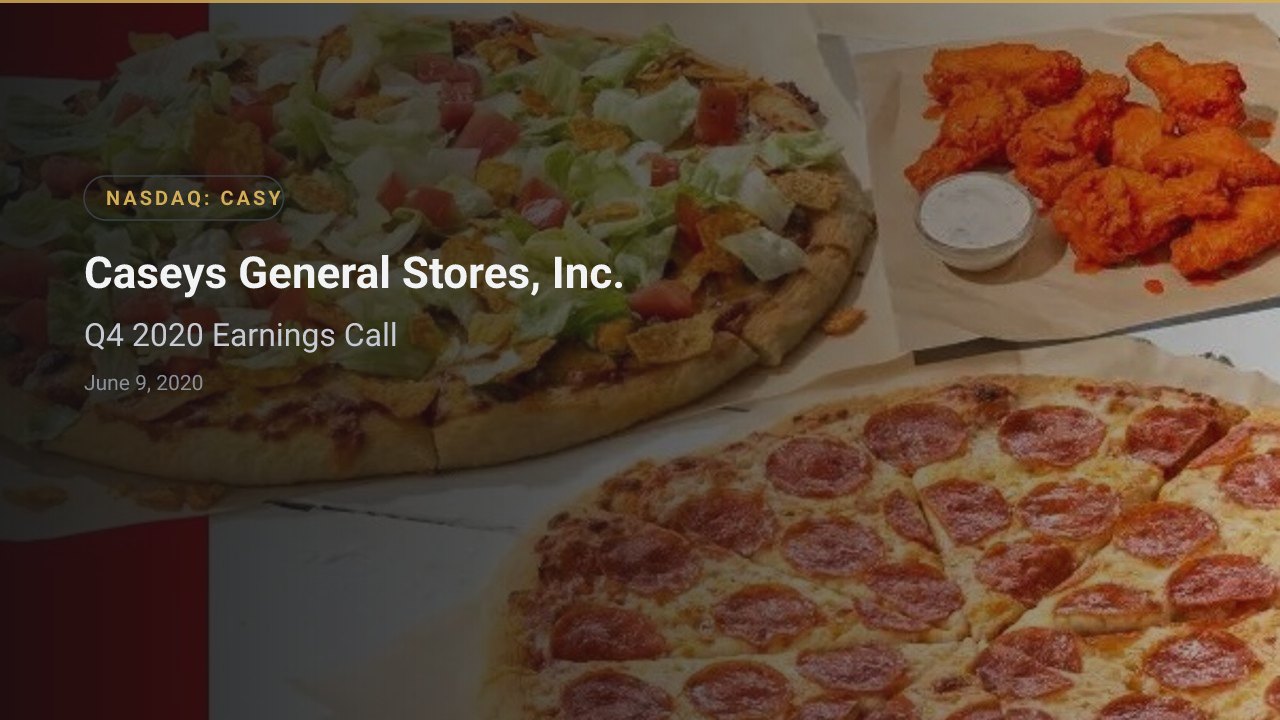
On 6ix: 6ix.com/event/caseys-general-stores-inc-casy-q4-2020-earnings-call
Automated transcript · Written by software from the replay's audio. It can mishear names and figures; the replay is the record.
0:00 Ladies and gentlemen, thank you for standing by and welcome to the fourth quarter fiscal year 2020 Casey's General Store earnings conference call. At this time, all participants are in listen-only mode. After the speaker's presentation, there will be a question and answer session. To ask a question during the session, you'll need to press star 1 on your telephone. As a reminder, today's program is being recorded. I would now like to introduce your host for today's program, Bill Waljasper, Chief Financial Officer. Please go ahead, sir.
0:30 Good morning, and thank you for joining us to discuss Casey's results for the quarter ended April 30th. I'm Bill Wall, Jasper, Executive Advisor and former Chief Financial Officer. Darren Rebelez, Chief Executive Officer, and Steve Bramlage, Chief Financial Officer, are also here. Before we begin, I'll remind you that certain statements made by us during this investor call may constitute forward-looking statements within the meaning of the Private Securities Litigation Reform Act of 1995. These four looking statements include any statements relating to expectations for future periods, possible or assumed future results of operations, financial conditions, liquidity and needs, the company's supply chain, business strategies, growth opportunities, performance at our stores, and the potential effects of the COVID-19 outbreak.
1:21 There are a number of known and unknown risks, uncertainties, and other factors that may cause our actual results to differ materially for many future results expressed or implied by those forward-looking statements, including but not limited to our ability to execute on the strategic plan, the impact and duration of the COVID-19 outbreak, and related governmental actions, or to realize benefits from that strategic plan, as well as other risks, uncertainties, and factors which are described in our most recent annual report on Form 10-K and quarterly reports on Form 10-Q as filed with the SEC and available on our website. Any forward-looking statements made during this call reflect our current views as of today with respect to future events, and Casey disclaims any intention or obligation to update or revise forward-looking statements, whether as a result of new information, future events, or otherwise.
2:14 This morning, we'll first take a few minutes to update you on our response to the coronavirus pandemic, highlight a few trends that we experienced during the fourth quarter, and then summarize the results of the quarter, followed by a question-and-answer session. I would now like to turn the call over to Darren.
2:29 Thanks, Bill, and good morning, everyone. We hope that you and all of your families are doing well and are safe during this time. Given the current environment, before we discuss the results of our fourth quarter and recent trends, I'd like to take a few minutes to update all of you on our response to COVID-19. I'd first like to say how grateful I am to all of our team members and their efforts throughout this crisis. This is arguably one of the most challenging environments our industry has ever faced, and I couldn't be more proud of the way our team has responded. I would also be remiss in not recognizing the tremendous efforts of all the everyday heroes across our country, especially the medical professionals. We're very grateful for everything they do for our communities. As we begin to navigate through this pandemic, our top priority has always been the health and well-being of our team members, our guests and the communities that we serve.
3:21 As a result, we've implemented the following changes across our company. We increased pay and provided free meals for all store and distribution center team members, provided additional operational bonuses for key field and support team members, provided additional paid leave for impacted team members, provided personal protective equipment for team members, installed plexiglass shields at our cash registers, enhanced cleaning and hygiene practices, implemented health checks in all our distribution centers, designated exclusive shopping times for higher risk guests, established six-foot markings in our stores to encourage social distancing and implemented contactless delivery. We've also recognized the increased need in our communities during this crisis.
4:08 Within our communities or with our communities facing new challenges as a result of the coronavirus, we identified two significant ways to make an immediate impact for our neighbors. First, we launched the Slice of Thanks program to recognize and show gratitude to essential workers during the crisis. Since April, Casey's team members and our partners have donated nearly 15,000 slices of pizza for health care workers and first responders. Second, in May, we announced a year-long partnership with Feeding America that will focus on having a local impact in our communities through food banks that serve the neighborhoods we call home. Through this partnership, we aim to make a positive impact on hunger needs for children, families, and rural communities.
4:54 I look forward to sharing more on these efforts as our partnership continues this year. Moving forward, Casey's will continue to engage our guests, partners, and team members to demonstrate that we are here for good in our communities. Now before I provide a few comments on the fourth quarter results, I'd like to take a moment to reflect on my first year with the company. When I started with Casey's, I mentioned to all of you how excited I was about the opportunity to be part of such a successful organization and how I admired the three distinct elements of our business model, fuel, convenience and food service. This diversity in our business puts us in the unique position of having multiple levers to pull to manage through challenging times such as the one we're currently experiencing and continue to drive shareholder value.
5:42 Even though we have near-term uncertainty, I feel even better about our long-term outlook and our ability to execute on our strategic initiatives. I'm confident that we're on the right path forward and we will come out of this pandemic in excellent financial position with better capabilities and be an even stronger company. We will continue to be disciplined in our capital spending to drive long-term value for our shareholders. With that, I'll now walk you through the results of the fourth quarter. As you've seen in the press release, diluted earnings per share for the fourth quarter were $1.67 compared to 68 cents a year ago. The results were primarily impacted by a significantly higher fuel margin versus the fourth quarter year ago, offset by the adverse impact in guest traffic related to COVID-19.
6:31 However, as with many companies, our fourth quarter was the tale of two periods within the quarter. We started the quarter with strong momentum as many of our strategic initiatives were gaining traction. This momentum continued and actually accelerated through the first two weeks of March with inside same-store sales up in the mid single digits and same store gallons up in the low single digits, excluding the extra day for leaf year. However, as COVID-19 restrictions became more prevalent starting in the middle of March, we began to experience a rapid decline in our guest traffic, resulting in compression of our same store sales. This compression had the most impact in the month of April, where we experienced the following results in same store sales.
7:18 Fuel gallons were down 34%, but were more than offset by an unprecedented average fuel margin of 63 cents per gallon. Grocery and other merchandise was down 9%, and prepared food and fountain was down 30%. In response to the adverse impact on our business, we made significant adjustments in our operations to mitigate the impact, which we'll discuss later in our prepared remarks. Since the middle of April, we've seen a steady improvement in comps across our business as these adjustments gain traction, weather improves, and state and local restrictions ease. I will provide additional details on the current trends we're experiencing as we discuss each category. Year-to-date saluted earnings per share were $7.10, up 29% from the same period a year ago.
8:10 As we navigate through this near-term challenge, We've made numerous adjustments in our business to maintain flexibility to ensure our continued long-term success. Some of these actions include deferring some discretionary capital spending, adjusting store hours to meet guest demand to optimize profitability, expanding third-party delivery opportunities, expanding delivery items beyond prepared foods, expanding online assortment available for sale, and modifying prepared food production to reduce food waste. In parallel with these changes, we continue to move forward in executing on key elements of our long-term strategic plan, which will position us well for future growth. I would now like to go over our results and some of the details in each of the categories.
8:57 During the quarter in the fuel category, we experienced an unprecedented environment in both fuel demand and margin. As a result of the decrease in demand beginning in mid-March due to various state and local restrictions, Same sort gallons in the quarter were down 14.7%. As indicated earlier, we experienced the largest impact in April with the trough being down between 35 and 40%. Same sort gallons stabilized during the middle of April and have been steadily moving upwards since. At the same time the pandemic began to impact our business, the macro environment for fuel supply was disrupted, creating a significant fuel margin benefit throughout the industry. Our average fuel margin in the fourth quarter was 40.8 cents per gallon.
9:45 Fuel margins peaked around the first of April and moderated throughout the rest of the month. The average retail price of fuel during the fourth quarter was $2.05 a gallon compared to $2.46 a gallon a year ago. Total gallons sold for the quarter were down 10.7% to 488 million gallons, while gross profit dollars increased 96% due to the margin environment discussed previously. For the fiscal year, same-store gallons were down 5.1%, while gross profit dollars in the fuel category were up 32% compared to the same period a year ago. During the quarter, we completed the conversion of our stores to digital price signage. This sign conversion is the final step in our plan that will allow us increased flexibility in adjusting retail prices to react more quickly to the changing fuel environment.
10:38 We are also pleased with the progress we made in fuel procurement in the fourth quarter, allowing us to finish the fiscal year with approximately 50% of our total fuel volume under contract. Lastly, in the fuel category, we continue to gain traction in our fleet card program. Over the course of the fourth quarter, we continue to add new cardholders. To date, we now have over 8,100 accounts and 20,000 cardholders. We remain optimistic about the potential of all of these initiatives going forward. Same store gallons have improved sequentially throughout the first quarter and for the past 14 days are trending down in the mid teens while the average fuel margin is trending in the low to mid 30 cents per gallon range.
11:23 We anticipate same store gallons to continue to improve as we head into the summer months and the state of Illinois recently lifted their stay at home mandate in June. For context, Illinois represents approximately 20% of our store base. Moving to inside the store, total sales in the grocery and other merchandise category were $568.1 million, up slightly from a year ago in the fourth quarter. Same store sales were down 2% during the quarter, adversely impacted by stay-at-home restrictions related to COVID-19. To put this in perspective, for the first six weeks of the quarter, same-store sales in this category, excluding the extra day for leap year, were up over 5%, compared to the last six weeks where we saw a decline in comps by approximately 9%.
12:15 There were several subcategories that were more resilient during this time, such as beer and alcohol, as well as tobacco. The average margin in the quarter was 30.4%, down 110 basis points from a year ago in the same period, due primarily to an adverse product-mix shift to lower margin items related to COVID-19. As a result, gross profit dollars for the quarter in the category were down slightly to $173 million. For the fiscal year, same store sales were up 1.9% with an average margin of 32%. As you may recall, the year-to-date margin was adversely impacted by a $6.6 million one-time adjustment that occurred in the first quarter. Without that adjustment, the margin was 32.3%.
13:03 Same-store sales have improved sequentially throughout the first quarter and for the past 14 days are trending positive in the low single digits. Given the current environment and recent regulatory changes in tobacco, during the fourth quarter we paused on the rollout of additional items to the price optimization platform inside our stores. We'll update you on this area as we continue to navigate through the current environment. The prepared food and fountain category has been one of the areas most impacted by the effects of the coronavirus pandemic. Through the first six weeks of the quarter, excluding the extra day for leap year, we experienced same store sales of 5.5%. The last six weeks, we saw a decline of approximately 30%, resulting in same store sales down 13.5% for the fourth quarter.
13:53 Historically, whole pies make up about 25% of this category, with the remainder coming from items that are primarily self-serve offerings, either in our food warmers, our bakery cases, or from our coffee and fountain. Our whole pie business as a destination item has been very resilient during this time, showing significant double-digit same-store sales gains. In contrast, the remaining 75% of this category is more dependent upon everyday traffic that comes from people commuting to and from work or other activities. As a result, this is where we have experienced the greatest adverse impact in prepared foods from the pandemic. Also during this time, several areas in our footprint restricted our ability for self-service food items, as well as our coffee and fountain offerings.
14:43 In addition to this, to protect the well-being of our guests, we voluntarily suspended self-service across our entire chain for a period of time. We have since reopened our self-service platform were allowed as restrictions began to ease across our territory. Subsequently, we have seen gradual improvement in self-service items while maintaining strong double-digit sales for whole pies. As a result of these events, total sales for the quarter were down 9.5% to $230 million. The prepared food margin in the quarter was down 220 basis points to 60% due to an increase in promotional activity and higher commodity costs. We were pleased with the acceleration in our comps prior to the impact of COVID-19 in the quarter as many of our initiatives were maturing and gaining momentum.
15:33 Despite the current environment, we're excited about the traction we're gaining with our digital platform and how our guests are responding to our rewards program. We currently have over 2.2 million active members enrolled, compared to just under 1 million members five months ago when we launched the program, and this number continues to climb. Approximately 50% of all pizza orders are conducted digitally now, and over 20% of all of our transactions have a rewards participant. We look forward to the opportunity to learn more about our guest preferences, which will allow us to serve them even better. We believe that our new suite of digital platforms will continue to drive additional traffic. Year-to-date, same-store sales were down 1.5%, with an average margin of 60.9%.
16:19 The margin was down from a year ago, primarily due to higher cheese costs and the adverse impact from a special promotion we ran in November to launch our new coffee program. The average cost of cheese for the fourth quarter was $2 per pound, compared to $1.73 in the same quarter last year. With cheese costs currently trending down, we are successful in locking in a portion of our cheese costs through the end of the calendar year. We'll continue to monitor the market closely, looking for additional buying opportunities. Same-store sales have improved sequentially throughout the first quarter and for the past 14 days are trending down in the low teens. We anticipate same-store sales to continue to improve as additional areas in our territory ease self-service food restrictions, we head into the summer months, and the state of Illinois recently lifted their stay-at-home mandate in June.
17:15 Currently, we still have approximately 25% of our store base adversely impacted by self-service restrictions. Again, Illinois represents approximately 20% of our store base. We continue to move forward with our Culinary Innovation Initiative as part of our long-term strategic plan. We completed the initial phase of this plan with the hiring of our new Vice President of Food Service, Michelle Wickham. Michelle is a 30-year veteran of the food service industry, and we look forward to her energy and passion to enhance our already successful food service business. I'd now like to turn the call over to Bill to discuss operating expenses and the financial statements.
17:56 Bill? Thanks, Darren. In response to COVID-19, we made numerous adjustments in our business operations outlined previously, intended to help protect our team members and guests in navigating through this crisis. As a result of these changes and operating 61 more stores this period compared to a year ago, total operating expenses in the quarter were up 6.2% to $367 million. This includes additional COVID-related expenses of approximately $12.5 million. Despite these added expenses, we were able to drive same-store operating expenses down 2% for the quarter, driven by refinements made to store hours and labor scheduling to better align with the changes in consumer demand caused by the pandemic.
18:41 Same-store labor hours were down 10.3% during the quarter. We will continue to monitor the environment closely and make the necessary adjustments as appropriate. Year-to-date, our operating expenses were up 7.7%. On the income statement, total revenue in the quarter was down 16.8% to $1.8 billion, primarily due to lower retail fuel prices from a year ago and the adverse impact from COVID-19. Depreciation in the quarter was up 3.7%. The effective tax rate for the quarter was 21%, up from a year ago, primarily due to a lower benefit from federal tax credits in this period. We expect our effective tax rate for fiscal 2021 to be between 24% and 26%.
19:28 Our balance sheet continues to be strong. Our net debt to EBITDA at the end of the year was 2.1 times, while our cash and cash equivalents at April 30th were $78.3 million. Long-term debt net of current maturities was down to $715 million as our $569 million bullet payment due this August moved to the current liability earlier in the year. Over the past quarter, we have been finalizing the no purchase agreement for the refinancing of our 569 bullet payment due this August. As mentioned in our last call, the blended interest rate for this refinancing was 2.9%. With this refinancing, the average pre-tax cost of our long-term debt will decrease from 4.4% to approximately 3.3%. For the fiscal year, we generated $504 million in cash flow from operations and had capital expenditures of $472 million and Kory Ross. I'd now like to turn the call back over to Darren to update you on our unit growth. Darren? Thanks, Bill. For fiscal 2020,
20:49 We completed 60 new store constructions, acquired 18 stores, and had two additional stores under agreement to purchase. Thus far in the first quarter, we've opened six new stores and have eight stores under construction. Given the current environment, as we head into fiscal 2021, we'll be focused on liquidity and maintaining a strong balance sheet. With that in mind, we'll continue to be prudent in our capital spending in order to maintain flexibility until we have more certainty around what the new normal may look like. Because of this uncertainty caused by these unprecedented times, we will not be providing guidance at this time for the fiscal year ending April 30th, 2021. This will be reevaluated as conditions warrant. Before I close and open for questions, I'd like to briefly outline some of the recent changes we've made within the Executive Leadership Team.
21:40 The additions include Ena Williams as Chief Operating Officer, Steve Bramlage as Chief Financial Officer to fill the role vacated by the retirement of Bill Waljasper, which was announced earlier this year, and Adrian Butler as Chief Information Officer, which is a newly created role. We're excited to have such talented leaders join our team to strengthen our efforts in executing on our strategic plan. In conjunction with these changes, Brian Johnson, a 17-year veteran of the company, will take on the responsibility of leading investor relations in addition to the new mergers and acquisitions team. Many of you are already familiar with Brian as he helped lead investor relations previously in his former role as Vice President of Finance. In closing, despite uncertainty around the near-term impact of COVID-19, we believe, given our strong liquidity and balance sheet, we are positioned extremely well to successfully navigate through this crisis, continue to execute our strategic plan, and take the appropriate actions that allow us to emerge even stronger.
22:44 We'll now open it up for questions. Ladies and gentlemen, if you have a question at this time, please press star then 1 on your touchtone telephone. If your question has been answered and you'd like to remove yourself from the queue, please press the pound key. Our first question comes from the line of Chris Mandeville from Jefferies. Your question, please.
23:04 Hey, good morning, guys. Darren, I appreciate all the color this morning. I was hoping maybe if there's an ability for you to do so, to help us try and better understand the impact of the self-serve restrictions. Is there any way of parsing out or splitting performance maybe throughout the back half of the quarter or even quarter to date for those stores that are now fully reopened and have all of their offerings accessible to the consumer versus those that might still have some restrictions?
23:36 Yeah, Chris. We've done a fair amount of analysis on that, and I'd say it is somewhat of a moving target because we're There's a lot of different types of restrictions, and these things have come on and off. But what I would say, generally speaking, between the two groups, we saw, you know, same store comps drag kind of in the mid or rather the high single digits between the two. So when we go to full service, that hits us in the high single digits versus being self-serve.
24:10 Okay. That's very helpful. I think you've now got a few weeks' worth of DoorDash under your belts. I was hoping if you could maybe offer up some color on performance that you've seen thus far, how we should maybe be thinking about the impact of the P&L near term, and then also how should we be thinking about product expansion through that platform? I think you have maybe close to north of 100 SKUs available now?
24:36 Yeah, that's right. We've added 600 stores to that platform, I'm going to say end of April, I believe it was. It's about end of April. And we've seen some nice growth there. And a good portion of that is incremental. It's not all incremental. In some stores, we were not delivering before, so it was 100% incremental. In others, we had delivery, and this just complemented it. So give or take on a On a given day, we're getting about 2,000 orders across those stores. So it's been a nice uplift, and we're starting to see some good traction with the additional items outside of the pizza business as well.
25:26 Perfect. And then the last one for me before I hop back in the queue here is just on your comments around having contracted out some portion of your cheese costs, can you just put a A finer point on that, maybe in terms of the percentage that has been contracted and at what price?
25:43 Yeah, Chris, this is Bill. Roughly 70% of our cheese has been contracted out at a price just south of $2 per pound. Currently, cheese is trending from all-in basis for us just slightly over $2 a pound. So we will start seeing a tailwind here as we head into the back half of this quarter and into the second quarter. So that will be a nice plus for us. Perfect. Thank you, guys. You bet. Thanks, Chris. Thank you. Our next question comes in the line of Karen Short from Barclays. Your question, please.
26:14 Hi. Thanks very much. And, Bill, I just want to check, is this the last time we'll be talking to you on earnings calls?
26:20 Well, you know, you might have another call with me in a couple days here, but this will be officially my last earnings call, yes. Don't get misty-eyed on me, Karen.
26:30 It's been great working with you.
26:31 Yeah, great working with you. It's been great support.
26:34 So I just wanted to talk about the fuel a little bit. Maybe you gave the updated percent on contract, so it's up a little bit sequentially from the end of 3Q. I wanted just to find out a little bit, does this higher percent or just the 50% contract, does that help or hurt you in the volatile environment? Meaning, could your margins actually have been even higher if you had been on spot entirely? I just want to talk through that generally because it seems like we could be in a volatile environment going forward for a while.
27:06 Yeah, this is Darren, Karen. Yeah, we definitely anticipate being in a volatile environment for a while. But actually, the way the contracts are structured, they're indexed off of a benchmark price. And so as costs come down, it tends to be that index price minus. A certain cents per gallon, depending on the contract and where we are. So if it goes up, we're below that index. If it goes down, we're below that index. So the volatility is still there. We're moving with that index, but we'll always be at a favorable price versus what we would have been otherwise if we were just buying off the rack.
27:48 Okay, that's helpful. And then in terms of the, you walked through all the like many, many changes you've had from an operations and it mostly sounds like OpEx perspective. Can you talk a little bit about what the actual dollar buckets were for expenses related to all these investments, whether it be, you know, in plexiglass and things like that, but versus the offset in reduced hours, because presumably those expenses go away. as we go into 2021. And then I'm not sure where you're at on the reduced hours. So just wondering if you could give a little more detail on that.
28:23 Yeah, I'll give you some buckets and then Bill can get you in the details. But I think there's probably two big buckets. The one is around increased pay for our team members working in our field operations and our distribution centers. So that's one bucket. And that's probably the bigger bucket. And then there's another bucket around or call it safety precautions. And that's everything from PPE to things that we're doing more recently in the store support center as we start to plan for people to come back into this facility. So those are probably the two buckets on the bill if you want.
29:03 Yeah, maybe just to be a little more granular with that. So that first bucket, that special pay that Darren was referring to, that represents about $10 million of that $12.5 million. and then the remaining piece of that ran the gamut from plexiglass to personal protective equipment. We did have a handful of stores that had COVID outbreak and so we had to clean the stores and so some cleaning around that. And so right now our special pay is intended to at this point to go through middle of June and we'll evaluate that on ongoing basis.
29:37 And where are you at with respect to the hours?
29:41 The hours reduction in the quarter came down on the same store basis a little over 10%, but at certain points within the quarter, we were down upwards of 25% on store labor hours. For us, it was really a matter of being more flexible to align our labor scheduling to meet that consumer demand. As Darren mentioned on the onset of this call, obviously very proud of the team. So the operational team did an outstanding job of reacting very quickly to ebb and flow the schedules accordingly. And so as our business is picking back up due to a number of things we mentioned in the call, we are readjusting those hours accordingly.
30:19 Okay. And then just last question for me. As you're reintroducing self-serve, I'm actually just curious what your observation is in terms of The customers coming in and their willingness to engage in self-serve, I mean, I think anyone who's in the tri-state areas thinks that that will never be something that anyone will engage in again, but I don't know that that's necessarily how the whole country's thinking about that. I'm wondering if you could just give any color on how quick that was to kind of recover once it was reintroduced.
30:52 Yeah, Karen, that's an interesting one, and I've been out into a lot of our stores around our footprint, and I can tell you when we made the shift to full service, our guests did not like that. Although we had people with masks and gloves on handing them their food, they didn't like having to wait. They were accustomed to doing it themselves. Part of being a convenience store is being able to get in and out really quickly and do things for yourself. That was something that our guests did not like and we started to see that come around when we started to loosen up those restrictions and our guests have enjoyed that again. I don't have any empirical data to share with you in terms of a percentage that like it or don't like it. All I can tell you is people were complaining when we made the change.
31:51 People were happy when we changed it back. Our sales have started to improve, so I would say at least in this part of the world, people are preferring the self-service model.
32:02 I would agree with that, Karen. As Darren mentioned, as we move from a full-service to a self-service model, depending on the category that the self-service, we see an uptick anywhere from 10% to 15% improvement on a category. Again, it depends on a localized basis. So definitely, there seems to be an overwhelming desire to have that self-service impact, at least in our market area.
32:24 Great, thanks. I'll get back in the queue. You bet. Thank you. Our next question comes from the line of Bobby Griffin from Raymond James. Your question, please. Good morning, everybody. Hey, Bobby.
32:35 Good morning.
32:36 Your families are staying safe. Appreciate you taking my questions.
32:40 I guess first I wanted to just circle back, Bill, in your comments about locking in the cheese prices for prepared food. With that now locked in, is that pretty much the big driver to reverse the trajectory of the margins that have been going on there? or are there some other factors that we should keep in mind as we model that business segment out going forward?
32:58 Well, there's a couple things to think about there, Bobby. That's definitely one. So when you think about the fourth quarter, we had about, the average cost of cheese was a little over $2 compared to a year ago, that's $1.73. So just by way of context there, about every 10 cents per pound is about 35 basis points of the overall prepared food margin. And so that's the majority of that. But also promotional activity. Obviously, as we head into a COVID-related environment, discretionary income becomes constrained, as you might imagine. And so with that, we are always looking for a value proposition with our guests. And so with that, we certainly are looking to be more promotional in trying to drive business, especially in the environment we have right now. So those would be two of the factors that I would say would be causing us there.
33:44 I would also keep in mind, we didn't really touch on that, but From a comp perspective, as you know, we have a little, until the rewards program gets up and fully operational, there is a drag on that rewards of about 90 basis points to the comp in the fourth quarter. So I just wanted to point that out as well. But cheesecloth traditionally have been probably the biggest drag on the margin side.
34:05 Okay, that's very helpful. And I guess, Darren, maybe to pivot, I mean, Just curious from like a high level, you know, seeing how the business kind of reacted to this environment that's very challenging. Any of the big initiatives that we talked about in January at the investor day that maybe you saw could be accelerated or need to be accelerated that you kind of learned from this environment or anything interesting to point out there?
34:27 Yeah, there's a couple things that we pulled forward, particularly in the digital space. Well, the first one was the DoorDash initiative. Delivery. We had a small pilot going on and had a plan to do a larger rollout later in the year and we pulled that forward and within a couple weeks we were live at 600 stores. Expanding the online assortment outside of prepared foods was something that was on our roadmap, but we didn't have it queued up earlier in the year and we pulled that forward and have expanded that. were in the process of piloting curbside delivery, which was something we didn't have on our roadmap, actually, but identified that as a guest need in the current environment and pulled that forward. So there's a few of those things like that that we accelerated. But, you know, Bobby, what I feel really good about is that plan that we laid out in January for everybody, when we took a look through all those initiatives and everything that we had planned to do, All of that stuff still holds true today, and in some cases, even more important. So we're very committed to continuing to execute on that strategic plan in spite of the current environment.
35:49 Perfect. That's very helpful. And I guess if I could sneak one modeling question in here real quick. When we tried to tune up our models for gallons here in the first quarter, Should we think about May as basically in between the April being down 34 and the last two weeks being down mid-teens where we kind of drew up to current trends?
36:11 Yeah, I think that would be a safe range to put it in. Again, as we mentioned, every week it continues to improve, not just fuel gallons, but every category continues to improve. State of Illinois, as Darren mentioned, went off their state restrictions June 1, roughly. And so we just have really one week of that eased restriction for visibility at this point. But if that follows suit from the other states, it will continue to improve. Obviously, the summer months and the driving season is another factor that helps as well.
36:47 Okay, perfect. And Bill, I think we are talking maybe one more time, but if not, best of luck in retirement, and it's been good getting to know you here over the years.
36:55 Yeah, thanks, Bob. I appreciate it. Great chatting with you over the years. Yeah. Thank you. Our next question comes from the line of Ben Biavenu from Stevens, Inc. Your question, please.
37:08 Hey, thanks. Good morning, everybody. Good morning. Hey, Ben. I'll echo my sentiments, Bill. It's been a pleasure. We'll miss you, and we wish you the best. Thank you very much, Ben. I want to ask, Darren, you made some comments on kind of the deferral of capital spend, but I'm curious, in the broader context of the industry, you guys are still in a really strong position financially. You've got a flexible balance sheet. We've talked in the past about how incremental investments in stores for independent operators could drive more operators out of the industry and accelerate your opportunity for M&A. I'm curious, in the COVID environment, particularly as tool margins normalize and gallons are still down a bit, though recovering, has that accelerated the opportunity for M&A for you all?
38:02 And would you be willing to accelerate that activity despite some of the deferrals you've made on the capital investment side of things?
38:11 Yeah, Bobby, thanks for that question. And yeah, absolutely. We expect that we'll be able to accelerate M&A in this environment. I kind of look at this fuel margin as maybe a little bit of a short respite for some of these operators that were kind of on the cusp and so got a little bit of breathing room with some margins, but I wouldn't anticipate that these types of margins last forever. And that'll create that opportunity. And that's why because that was something we outlined in our investor day with standing up a dedicated M&A team. We have done that, and as I mentioned in my remarks, we've put Brian Johnson, who was our head of overall store development, he'll be handling investor relations, but a big part of his job is going to be fully focused on M&A.
39:00 And so his team is already building out a pipeline of potential opportunities, and we're talking to a lot of folks right now We'll have to see how that plays out in the near term, but I'm absolutely bullish in the long term that we have a great opportunity there. Now we have a dedicated team focused on executing against that.
39:19 All right, great. I want to ask about the prepared food and fountain margins and then also just the mix of the business. You noted that you had an uptick in whole pies. I'm curious what impact that has had on the margins of the business. And then as you reopened, has that percentage of whole pie increased? and many more.
39:58 Approximately 25% of the paired food business is whole pies. Now, that has accelerated here in the fourth quarter. We're probably just slightly north of 30% as contribution in the fourth quarter because of the activities that we have done with respect to DoorDash, with respect to increased promotional activity. And whole pie would be an item that's a higher margin than the category as a whole. But one of the things that offsets that is actually probably even a larger decline in the bakery case. We talked about the self-service restrictions. The dynamic is we're also having a decline, even a larger decline in the bakery cases as well. It's kind of an offsetting phenomenon, quite frankly. If things can continue to move in the direction that we are going, I think that will be a positive impact once we get the other categories back into more of a normal.
40:50 If we can maintain the momentum in the pizza category, I think there is opportunity for to elevate that margin, especially in a positive cheese environment since we've locked
41:01 in. Yeah, Bobby, the only thing I'd – or Ben, rather, I'm sorry. The only thing I'd add to that is that, you know, we've had great momentum with the whole pie business. We think we can continue to grow that momentum while we're still starting to recapture that slice business because those are really different occasions. I mean, think about how our slice business works. It's A lot of commuter traffic going to and from work in the morning or at lunchtime. And then that whole pie business is primarily a dinner day part business. So they really don't compete with each other. They're really complimentary. So we're optimistic that we'll hold on to that whole pie business and get our slice business back.
41:44 Okay, perfect. And then last question, just a quick housekeeping. Bill, the credit card fees for the quarter, if you could disclose those, that'd be helpful.
41:53 Yeah, they were $33.5 million.
41:54 Okay, thanks. Best of luck.
41:59 You bet. Thanks. Thanks, Ben. Thank you. Our next question comes from the line of Chuck Sarankowski from North Coast Research. Your question, please.
42:09 Good morning, everyone. I'd like to... I'd like to get into the deferred capital spending a little bit, exactly how much you've slowed down new store openings and M&A. Would you just flat out be opportunistic on M&A should opportunities present themselves?
42:33 Yeah, Chuck. We're not really slowing down on M&A. As you know, getting a deal done is a challenge. just in the base case under normal circumstances. And then you layer on things like coronavirus. It's a little more challenging in the near term just getting people's attention and being able to sit down and work through these deals. So we have not slowed down from our perspective, but it just takes a little bit longer. On the organic growth side, some of that pause is really – kind of occurred naturally. When you think about how we approach development, when we go out to buy real estate, we don't actually close on a deal until we have permits in hand. Now, in the last couple of months, a lot of municipalities were shut down, so permitting wasn't taking place, and so we've kind of had a natural lag, which at a point in time, a month or so ago, when things were very volatile and very unpredictable, We were happy to see that pause and just give ourselves a little bit of flexibility and optionality as we work through things.
43:46 And now that things have stabilized a bit more, still unpredictable about the future, but stabilized to the point where we're continuing on. But we will have a little bit of a delay on some properties that we would have otherwise have closed on because of the pandemic.
44:03 Ed, would you hazard a guess? Go ahead. I'm sorry.
44:06 I'm just going to add to that just a little bit. I don't think this will affect our long-term outlook for unit growth that we outlined in January. One of the things that Darren outlined in his comments is liquidity and a strong balance sheet are going to be critical because we do believe that once we come out of this crisis, there might be some opportunities on the M&A front, and so we want to make sure that we're positioned well for that. So it just might be a little bit different structure getting into that long-term unit growth.
44:35 How about the new distribution center? Is that still on track to open? I forget the opening date.
44:43 Yeah, we haven't changed our approach to that distribution center. We have run into some weather challenges down there that may cause it to slip a little bit. But other than that, we're still moving forward with that. And if you recall, Building that distribution center will immediately be able to service around 500 stores in our existing footprint, and it becomes quickly accretive because of all the miles driven that we're taking off the road. So that's one that we see as a really good investment, so we're continuing to move forward with that one. Thank you. Good luck the rest of the year.
45:21 Thank you, John. Thank you. Our next question comes from the line of John Royal from J.P. Morgan. Your question, please.
45:30 Hey, good morning, guys. Thanks for taking my question. So on fuel same-store gallons, you mentioned a trough of down 35% to 40%. I think industry demand on a national basis troughed closer to 50%. So do you think that outperformance was more regional or something specific to your business? I mean, I would imagine the breadth of your grocery offering was somewhat of a factor. But anything else going on there?
45:57 Yeah. This is Darren. Yeah, I would say that that was probably driven by a regional situation. You know, as you well know, the coasts kind of went into shelter-in-place orders pretty quickly and probably more severely than the Midwest did. And so I think we benefited from not having to be in it as quickly or as long as some of the other areas. So I think that's what you're seeing in the national OPUS numbers.
46:30 Great, and then on the grocery side, you mentioned that margins were down on mixed effects, and I think tobacco was called out, but can you elaborate on were there other items, other key items there that were dragging on that, and do you expect any long-term effects there post-COVID, or was it more of just a COVID type thing?
46:53 Yeah, I think it was more of a COVID-related situation. What we really saw There was, yeah, tobacco kind of hung in there, but there was a shift from single packs to cartons, and so the margin there, about a 400 basis point shift, completely away from packs and into cartons, and so there's some margin erosion there. Similarly with alcohol, we saw significant growth in the alcohol category, both beer and spirits, but those categories have a lower margin rate than the rest of the store, so that kind of has an impact on that. And inside of that category, we're selling more take-home packages versus single-serve beer in particular. So that, again, had an impact on the margin.
47:40 And then when you looked at our packaged beverage business, which tends to have a higher margin rate, we were selling a little bit more on the take-home packages, which have very low margins, but not as much on the single-serve, again, with the reduced traffic. So that impacted the margin as well.
48:02 Great. Thank you. That's it for me.
48:04 Thank you. Thanks, John. Thank you. Our next question comes from the line of Irene now from RBC Capital Markets. Your question, please.
48:13 Good morning, everyone. And, Bill, you know that I wasn't going to let this call go by without saying thank you for all your help over the years. I thought if you wouldn't mind just spending a minute on the prepared food offering and how, if at all, you've sort of been rethinking your offering in maybe certain categories in light of some of the restrictions that came in or the shifts that you were seeing in demand.
48:47 Yeah, Irene, I'll take that. I would say that we were already – going down that road anyway. And we outlined in our plan that we were going to launch Casey's Food 2.0 as we referred to it. And that was in part by building out a robust culinary team and food service team that had deep experience in the restaurant industry, and then really doing a deep dive on our entire offer, but building off of that great credibility and Kory Ross, Sanjeev Satturu. The virus has created a greater sense of urgency around that plan, but we're still moving forward in that direction.
49:59 That's great. Thank you. But I guess what I was getting at a little bit more was as you go through all of that, do you think, you know, does it cause you to think a little bit about the self-serve versus the sort of the grab and go in a little bit of a different fashion and around maybe because it's reasonable to think that we're going to keep getting more waves of the virus. And if it's not this one, it's going to be another one. And I think there's going to be a lingering sensitivity around certain elements.
50:31 Well, Irene, as I mentioned before, I think if you'd asked me that question two months ago, I probably would have told you, yeah, I think we ought to rethink our self-serve model. Having experienced it now and seeing what guest preference is, I don't know that that's the right answer. I think the guest is going to make that decision. And clearly where they have been voting so far is that they like that self-service. Now, that being said, there's things we can do to make that more palatable for folks that may not be as comfortable. And so we'll take a look at all of those things. But for now, we don't have any guest insights or data that would suggest that we should move away from that.
51:17 That's very helpful, thank you. And as we think sort of past the current crisis and what will likely be a recession that's really going to hit hardest as we move through the summer and some of the support payments roll off, are you thinking about sort of, or I know you're thinking about, what are you anticipating around promotional intensity and bundling and the like?
51:44 Yeah, I I would anticipate that we'll certainly be in a recessionary environment, and when you're in that environment, the focus on value from the guests becomes that much more intense. And so when I look back at our strategic plan, we had a couple of pillars there. We said we were going to reinvent our guest experience, and there's a couple of ways we were going to do that. That was through some of our digital offerings, through our product assortment, but we were also going to established our private brands in a much bigger way. And so that work is underway as we speak, which will enable us to broaden some assortment and lower retail prices with higher margin rates. And so we think that's part of the solution for the value proposition. On the prepared food side, we've already been going down that path on our whole pie business through our digital efforts and We're learning a lot with the new digital platform in terms of what works, what doesn't, what drives incrementality, and so we'll continue on that vein.
52:52 And at the same time, we said we were going to create capacity through efficiencies, and we've launched our initiative around centralized procurement so that we can take costs out of our entire operation to be able to help offset some of the investment in some of those areas. So I think... We do see a more value-oriented environment coming, and we've got the initiatives in place to address it.
53:19 That's great. Thank you. Thank you. Our next question comes from the line of Anthony Liebenszynski from Sedodian Company. Your question, please.
53:30 Yes, good morning. Thank you, and best of luck, Bill, in your retirement. Certainly a pleasure working with you all these years. You as well.
53:39 Great.
53:40 So, actually, I just wanted to follow up on the previous answer to the question. So, as far as the centralized procurement, Darren, maybe you could talk about the opportunity of that. I mean, how should we think about the potential margin expansion as you centralize more of your procurement?
54:00 Hey, Anthony, this is Bill. I'll go ahead and start leading that one off here. So, obviously, that's one of the One of the key initiatives that we outlined back in January at Investor Day. And so as we think through the cadence of this next three years, you know, there are a couple things that we're going to take cost out of the system and create more efficiency. Centralized procurement was one of those. Also standing up an asset protection team is going to be the other. Those both are moving on pace right now in accordance with what we outlined back in January. We're towards the tail end right now of hiring a vice president of procurement. We've been working very diligently over probably the last two to three months with a consultant in-house looking at a variety of things from value capture to inventory optimization to payment terms and standing up and creating the operating model. We haven't outlined exactly what the entire benefit will be.
54:52 We certainly have an indication coming into the strategic plan, but we are right on track with that. We've actually accelerated a few components of that based on some of the findings that we've had. So more to come on that going forward.
55:10 Got it. Okay. Thanks for that. And so once you open the Joplin, Missouri Distribution Center, what's going to be the capacity in terms of number of stores that you'll be able to serve from the three distribution centers?
55:24 Yeah, so currently we're at capacity here in the Antony Distribution Facility. We're roughly about 60-65% capacity down in Terre Haute, Indiana. And as Darren mentioned in answering one of his questions, once the new facility is up in Joplin, Missouri, which weather can be a factor, but right now we're planning roughly around the beginning of next fiscal year for that opening. We'll shift about 500 locations to that immediately to take pressure off the two facilities immediately. and from that, you know, I don't necessarily look at it from a number of stores because it's hard to gauge because you could have your business accelerate in certain aspects and all of a sudden you come to capacity. Now I would say the Joplin facility is being built a little bit smaller than the facility in Terre Haute with the opportunity to expand that.
56:13 And so I would say it's more talking about years. It's probably four to five years before we would take a look at another. Now, having said that, If acquisition activity accelerates, that could change the thought process relative to distribution facilities.
56:31 Understood. Okay. And lastly, for me, as far as the expansion of delivery programs, obviously you announced DoorDash. Are you still looking at the other programs, perhaps with Uber Eats or Grubhub?
56:46 Yeah. This is Darren Anthony. And, yeah, we are talking with Uber Eats as we speak and looking at Grubhub as well. And part of the process there is working on the technology integration to make sure we can make that as seamless for our teams in the kitchens as possible. So we're working through that process as we speak.
57:09 Got it. All right. Thank you, and best of luck.
57:11 Thanks, Anthony. Thanks, Anthony. Thank you. As a reminder, ladies and gentlemen, if you have a question at this time, please press star then 1. Our next question comes from the line of Kelly Banya from BMO Capital. Your question, please.
57:25 Hi, good morning. Thanks for taking my question. And Bill, definitely want to wish you all the best and thank you for all the help over the years.
57:35 Oh, you bet. Good to work with you, Kelly.
57:40 Not sure if this is the right quarter to kind of evaluate some of the things given all the volatility, but just wanted to see if there's an update or if you learned anything over the past several months, maybe even in the early part of the quarter with the, I think it was around 400 stores that you were doing multi-week deliveries. I was just curious how your thoughts are progressing there and then just any more details on The Menu Rationalization and Innovation and where you think that could be going with those initiatives.
58:15 Yeah, Kelly, I'll take that. This is Darren. Yeah, when we started to get into the height of the crisis, we actually suspended that multiple delivery per week test. And frankly, that was just out of the fact that our traffic and our volumes had reduced to the point where it wasn't It wasn't going to pay out, and we needed to make sure we could maintain the efficiency of the distribution centers. So we went ahead and suspended that. We have not determined a date that we would reinstitute that, but we expect to at some point. And so we'll learn a little bit more there. In terms of menu rationalization, I still continue to believe we have a big opportunity there, but the team is doing the work right now.
59:07 If you do that work right, it takes some research and some turf analysis and some other things to really get to the right answer. And so now that we have the team in place that knows how to do those things, they're beginning that work. And so we'll have more to report on that later, but we don't have anything to talk about right now other than that we're moving down the path with that.
59:29 Okay, that's fair. And maybe just another one on the delivery and the partnerships. Doordash, Uber, and Grubb. You talked about the impact there a little bit on the top line. How should we think about that on the margins, particularly relative to your own in-house delivery service?
59:52 Yeah, Kelly, this is Bill. So generally speaking, when you go through a Doordash or an Uber Eats or any third-party aggregator, it will be a lower margin type transaction. Obviously, anytime we can do it in-house, we generally have a higher margin, but Probably the key here is more incrementality of gross profit dollars. We believe a good share of what we are seeing and probably most of what we are seeing coming through the DoorDash platform is incremental to our business, albeit maybe at a lower margin, but nevertheless an incremental gross profit dollar. At the end of the day, that's how we look at our business and try to drive gross profit dollars.
1:00:32 Okay. That's helpful. You know, maybe just too early to tell, but what's your take on just how your local kind of mostly farming communities are doing, or any color you can share, I guess, for some of us in different parts of the country, what you're seeing and hearing from the main driver of the economy there?
1:01:01 Yeah, I can start with that, and then Bill can can chime in. We have been taking a look at our stores in those towns that have less than 25,000 people versus more than 25,000 people. And as we've gone through this crisis, we've started to see a divergence in the performance between those two with the smaller communities rebounding faster than the larger ones. And so I think some of that is just natural where some of the larger population centers have held on to Thank you. Our next question comes to the line. Paul Trussell from Deutsche Bank. Your question, please. Yes. Good morning, and my best wishes to you, Bill, as well. Thanks, Paul. I'm Wanted to talk maybe first about fuel margins.
1:02:07 Obviously, it's been a unique environment, and you made a comment earlier that you certainly don't expect, you know, the averages to, you know, sustain at the levels that they've transpired over the last few weeks. But just curious if the needle has moved at all in terms of how you're thinking about what the go-forward steady state of fuel margin is. will be.
1:02:36 Wow, Paul, this is Darren. You know, if I could predict fuel margin, I probably wouldn't have to do this job, you know, over the long term. But, yeah, it's a tricky one. And, you know, obviously there's a lot of factors. I think in this case what we had was somewhat of the perfect storm between a real demand shock to the negative, which created a supply glut in fuel, and that was compounded by a spat in OPEC between the Saudis and the Russians, which put even further pressure on supply. So we had a very unique situation in terms of the margin environment.
1:03:24 I have a hard time envisioning that scenario replicating itself. Where the new normal is is really unpredictable. And this gets to one of the reasons why we haven't issued guidance. If you take a look at what a penny of fuel margin means to us from an EBITDA perspective, it's about $22 to $23 million. And so with margins the way they are, it wouldn't take a lot of change in that margin environment to create a pretty big gap in terms of what we can forecast. That's a really big sensitivity and very difficult to predict at this point. The one thing I would say, though, in addition to that was over the past year, we've put a lot of effort and made investment into our fuel team and our fuel price optimization.
1:04:19 And it wasn't that long ago that we handled this in a decentralized way. Now that we've got that team centralized, they have the right tools, they have great visibility to what's going on in the environment, I think it gave us the ability to maximize that opportunity where perhaps maybe 12, 14 months ago we would not have been in the position to take advantage of the macro situation as well as we did. Thank you. That's helpful, Cutler. Just circling back to maybe some of the more near-term performance comments you made, are you able to maybe dig in a little bit more and help us think about how the business is performing excluding the state of Illinois?
1:05:11 Or even just maybe some additional comments regarding those doors that opened up Self-Service, you know, in the first wave or batch of stores that open, what's kind of transpiring there?
1:05:30 Yeah, hey, Paul, this is Bill. Just to provide just a little bit more color on that, the first part of your question about Illinois, it's a little bit harder to gauge one state to another state simply because even though a state may have eased their stay-at-home restrictions, they may have in pockets of the state Self Service mandates on products, so it's kind of hard to kind of gauge that. But as we talked about on the – we'll start with the state of Illinois relative to the chain in general, and you're talking 300,400 basis points differential. It really depends on the category, however. But on the self-serve side, you know, you can see 10% to 15% differential depending on the category. So we definitely see once those restrictions have ease, and we saw this – roughly starting about mid-April.
1:06:19 That's roughly, first of all, when we started to pull back our voluntary ban on self-service. And then towards, I would say, roughly the first part to the middle of May is when we first started seeing the states in our area start to ease their restrictions. And so we definitely see an acceleration when both of those things happen. So that's our comments about, you know, we believe we're going to see continued improvement in same-store sales. as these things start to transpire over the course of the upcoming months. Thank you. My best.
1:06:54 Yes, thanks, Paul. Thanks, Paul. Thank you. Our next question is a follow-up from the line of Chris Mediville from Jefferies. Your question, please.
1:07:03 Hey, guys. Just two ones here. So, Bill, we've talked about the in-store margins fairly considerably. We could just boil it down in terms of quantifying the actual buckets of impact within grocery and sub-food between cost, mix, promos, etc.
1:07:19 Yeah, so on the prepared food side of it, you can figure roughly about, oh, you're probably somewhere in that 100 to 110,120 basis points roughly is going to be just on a commodity cost differential. This is talking about a quarter right now. The remaining piece of that really is going to be more of the promotional activity. There was a period of time, I'm going to say roughly about a week, maybe two week period of time where we did see our stale or food waste go a little bit higher than what we normally would see. And that was just due to the rapid decline in guest traffic. We made a relatively quick adjustment and got that back into play towards the end of the quarter. So those would be the two main factors on the margin side in the quarter.
1:08:07 From the quarter and the grocery and general merchandise side, as Darren mentioned, it was really a product mix shift. You had a decrease in certain high-margin items like packaged beverages that are probably more geared towards more commuter-type traffic. And then you had an increase in lower-margin items, for instance, cigarettes. Cigarettes, as Darren mentioned, we had a shift from pack purchasing more to the carton purchasing, which is a significantly lower-margin item. also in the beer and alcohol category, specifically the beer category. Beer in general is accelerating. It's a lower margin item in the category as a whole. But in this case, we saw people gravitate away from the single serve and go into the, I'll call them the suitcases or the larger pack products which have a lower margin.
1:08:53 I think as things start to, as you look forward, as those start to shift back, I think you'll see a natural progression back to a different margin structure. As indicated, again, back in January with our strategic plan, we fully anticipate every category, ex-COVID, to have sequential movement upward in margin due to the initiatives that we outlined.
1:09:16 Okay. And then the last one, just being on the time and motion study, I think I recall you having completed that at the end of this past fiscal year, so I was just curious to How are you thinking about that going into fiscal 21 and if there's any ability to maybe quantify the expected savings there?
1:09:34 Yeah, so we are progressing forward with that. That's going to be a Q1 like we had talked about to stand up. At least that's the plan at this point. As far as the impact, it's hard to tell at this point, and here's why. I think what we're going to find is this. You're going to find stores that quite frankly did not have enough hours to adequately serve the guest. And we'll probably see a shift upward in those hours, which would mean obviously a revenue movement for those stores upward. And in some cases, we're going to see stores that probably were a little bit heavy on the hours relative to the guest traffic. And so I think instead of an operating expense, you may see a revenue lift more so than an operating expense reduction, but don't have anything detailed to give at this point.
1:10:22 I assume that's going to be a future commentary as we move forward throughout the fiscal year. Okay. Thanks, guys. I'll leave it there. Yeah. Thanks, Chris. Thank you. This does conclude the question and answer session of today's program. I'd like to hand the program back to Darren for any further remarks.
1:10:42 Okay. Thank you. And thanks, everybody, for your time this morning. Just as a few of you mentioned, this is Bill's last earnings call. After a 30-year career at Casey's, just about 17 of which is a CFO, and I've got to believe that's some kind of record somewhere, Bill. I don't know. If it's not, it should be. You know, Bill's been really an institution here at Casey's, and I know with the investment community as well, and I'm sure as he was thinking about his last year here, Thank you all for joining us today. He's up to the task in spite of the fact he's got some pretty big shoes to fill.
1:11:49 So with that, I'm going to turn it over to Bill to make a few comments, if you like, Bill.
1:11:55 Yeah, absolutely. So as obviously indicated on the call, this will be my last earnings call. We were talking earlier today about how many of these earnings calls I've actually been on, and it started getting to be a pretty large number, and so... I would say that's had a great career with Casey's, 30 years with the company, as Darren mentioned, coming up 16, 17 years of CFO. And so I just want to thank everybody on the phone. It's been fantastic to get to know each and every one of you. I appreciate all your support. I feel really good about leaving the company in the position that it is. I think we have a very strong outlook, as we indicated in the investor day back in January. I feel real excited about Steve joining the company. I think he will really enjoy Steve's presence.
1:12:40 and so with that, again, just a very heartfelt sense of gratitude for all of you. So wish you all the best as well.
1:12:48 Yeah, thanks, Bill. And just to wrap things up, I'd like to thank everybody for joining us this morning. And even though we've had to make some adjustments in our business related to COVID-19, I'd like to close the call by reiterating the strength of our brand and our balance sheet. Those combined with our dedicated team really leave me confidence in our ability Thank you, ladies and gentlemen, for your participation at today's conference. This does conclude the program. You may now disconnect. Good day.
Follow Caseys General Stores, Inc. into a list and get an email when it puts out news.
Executive Advisor and former Chief Financial Officer
Chief Executive Officer
Analyst, Barclays
Analyst, Jefferies
Analyst, Raymond James
Analyst, Stevens Inc.
Analyst, North Coast Research
Analyst, J.P. Morgan
Analyst, RBC Capital Markets
Analyst, Sedodian Company
Analyst, BMO Capital Markets