Darren Rebelez
President and Chief Executive Officer
Replay available
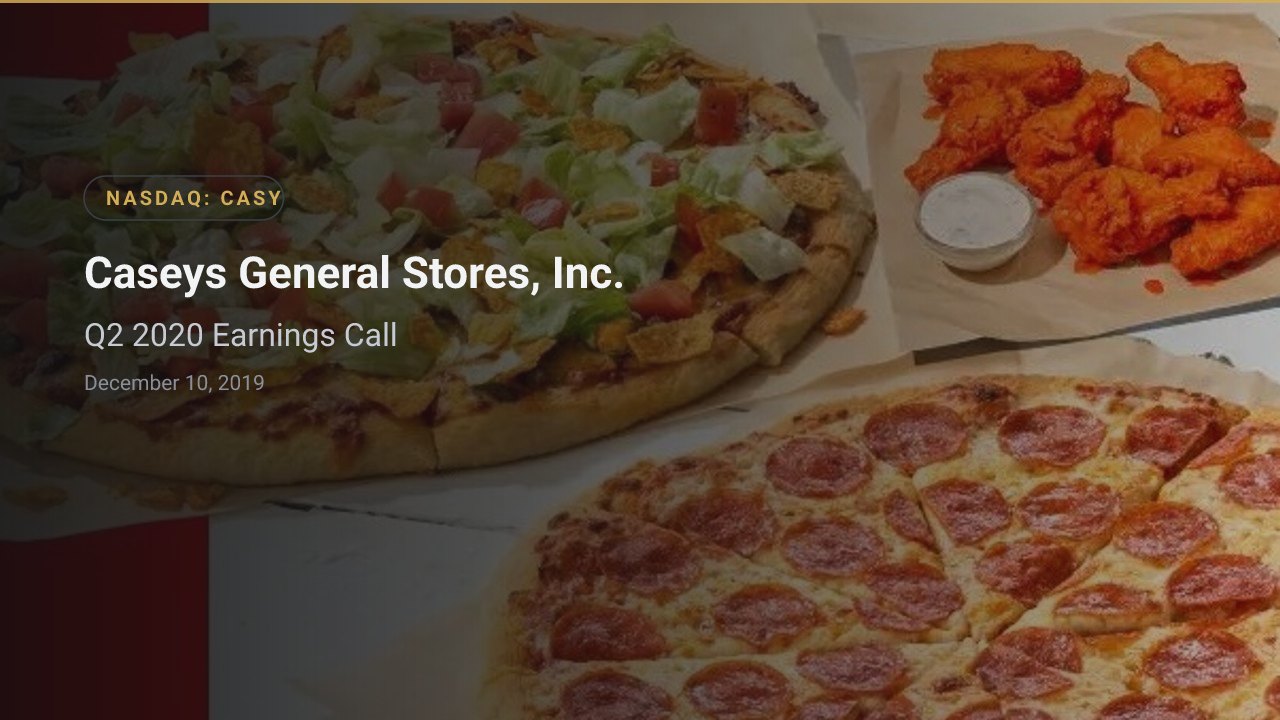
Caseys General Stores (NASDAQ:CASY) Q2 2020 earnings call, held 2019-12-10. Watch the replay and read the transcript on 6ix.
On 6ix: 6ix.com/event/caseys-general-stores-inc-casy-q2-2020-earnings-call
Automated transcript · Written by software from the replay's audio. It can mishear names and figures; the replay is the record.
0:01 Ladies and gentlemen, thank you for standing by, and welcome to the Q2 Fiscal 2020 Casey's General Stores Earnings Conference Call. At this time, while participant lines are in the listen-only mode, after the speaker's presentation, there will be a question-and-answer session. To ask a question during the session, you will need to press star 1 on your telephone. Please be advised that today's conference is being recorded. If you require any further assistance, please press star 0. Bill Wall Jasper, Chief Financial Officer
0:55 may constitute forelooking statements within the meaning of the Private Securities Litigation Reform Act of 1995. These forelooking statements include any statements related to our possible or assumed future results of operations, business strategies, growth opportunities, and performance improvements at our stores. There are a number of known and unknown risks, uncertainties, and other factors that may cause our actual results to differ materially from any future results expressed or implied by those forward-looking statements, including our abilities to execute on the Value Creation Plan or to realize benefits from the Value Creation Plan, as well as other risks, uncertainties, and factors which are described in our most recent annual report on Form 10-K and quarterly reports on Form 10-Q as filed with the SEC and available on our website.
1:42 Any forward-looking statements made during this call reflect our current views as of today with respect to future events, and Casey's disclaims any intention or obligation to update will revise forward-looking statements, whether as a result of new information, future events, or otherwise. This morning will take a few minutes to summarize the results of the second quarter and then open for questions about those results. I would now like to turn the call over to Darren to discuss the results of the quarter.
2:07 Thanks, Bill, and good morning, everyone. As you've seen in the press release, diluted earnings per share from the second quarter were up 23% to $2.21 compared to $1.80 a year ago. The results were driven primarily by a stronger fuel margin versus the second quarter last year, continued operating expense control, and sales gains inside the store. Year-to-date, diluted earnings per share are $4.52, up over 22% from the same period a year ago. Excluding the one-time impact from tax reform, this quarter marks the sixth consecutive quarter of double-digit earnings growth per share compared to prior year quarters. We continue to execute on key elements of our long-term plan this past quarter, positioning us well for future growth. I would now like to go over our results and some of the details in each of the categories.
3:02 During the quarter in the fuel category, we experienced a favorable fuel margin environment combined with our ability to leverage the implementation of price advantage, which is our fuel price optimization tool. These factors enable us to achieve an average fuel margin of 22.9 cents per gallon up nearly 3 cents per gallon from the same period last year. As a result, gross profit dollars increased nearly 19% in the quarter in the fuel category. Same-store gallons sold were down 1.8% in the quarter. This is primarily due to our efforts to optimize gross profit dollars in the category by striking the appropriate balance between gallon growth and fuel margin. The average retail price of fuel during this period was $2.47 a gallon Thank you for joining us.
4:15 Gross profit dollars in the fuel category are up 20.5% compared to the same period a year ago. Our effort in price optimization continues to have a positive effect on our fuel margin gains. By the end of this quarter, we anticipate to have all of our stores fully integrated at the point of sale with the price advantage tool. We also currently have approximately 400 stores without a digital price sign. We are on schedule to have these converted to a digital format by the end of the fiscal year. This integration and sign conversion will allow us to increase flexibility in adjusting retail prices to react more quickly to the changing fuel environment. We are also pleased with the progress we've been able to make in fuel procurement in second quarter. Currently, our contracted fuel volume represents about 37% of our total fuel volume. As we continue to build out this team, we expect to have approximately half of our overall fuel volume under contract by the end of the fiscal year.
5:18 Lastly, in the fuel category, we continue to gain traction in our fleet card program. Over the course of the second quarter, we added over 3,000 new cardholders. To date, we now have 2,500 accounts and 15,500 cardholders. This combined with our additional efforts in other types of fleet cards have driven the universal fleet program 8% in the second quarter. We remain optimistic about the potential of all these initiatives going forward. As a result of our efforts with price optimization and the expected opportunity of fuel procurement, we adjusted our fiscal year same-store gallon guidance range downward to minus 1% to a positive 0.5%, and moved our annual fuel margin guidance range up to 21 to 23 cents per gallon.
6:09 Same store gallons are currently trending below our current annual guidance, while the average fuel margin is trending toward the upper end of our current annual guidance range. Moving to inside the store, total sales in the grocery and other merchandise category were up 6.8% to $660.6 million in the second quarter. Same-store sales were up 3.2% during the quarter in line with our annual guidance. Excluding cigarettes, same-store sales were up 5.8%. The average margin in the quarter was 33.3% of 90 basis points due primarily to a favorable product mix shift to higher margin items. Gross profit dollars for the quarter in the category were up nearly 10% to $220.1 million.
7:01 For the first six months, same-store sales were up 3.1%, with an average margin of 32.3%. As you may recall, the year-to-date margin was adversely impacted by a $6.6 million one-time adjustment that occurred in the first quarter. Without that adjustment, the margin would have been 32.8%, and gross profit dollars for the first six months would have been up over 8% to $442 million. are currently trending ahead of our annual guidance. During the second quarter, we continue to integrate our price optimization platform inside our store. We completed the rollout of the center store products and are currently in the final stages of adding the beer and alcohol categories.
7:47 As we move into the back half of the fiscal year, we will look to integrate cigarettes and prepared foods onto this platform as well as promotion analytics. with a limited amount of data at this point from the early rollout. We do not have any results to share, but should be in a position to update you at our next earnings call. In the prepared food and fountain category, total sales were up 5.2% to $297.8 million for the quarter. Same store sales were up 1.9%. Even though this was below our annual guidance, we were pleased with the acceleration in our comps towards the back half of the quarter resulting in a strong sequential increase in our two-year stacked comps for the month of October and for the quarter.
8:33 We continue to gain traction in our digital engagement with our guests. As part of this digital engagement, we completed an employee pilot and recently rolled out a soft launch of our loyalty program at the beginning of this month. We currently have a planned global launch of the program at the start of the new calendar year. We believe that Casey's is at the heart of every community we serve with our purpose being to make life better for communities and guests every day. With that spirit in mind, we wanted to create a partnership opportunity with our guests through the loyalty program. The program will allow members to accumulate points for their purchases at Casey's that can be redeemed for in-store purchases or fuel discounts. Unique to Casey's, our rewards program also allows our guests to convert their points into cash that they can donate to their local schools.
9:25 This concept tested extremely well with our guests, and we believe this will differentiate our rewards program from our competitors. We're excited about the opportunity to learn more about our guests' preferences, which will allow us to serve them even better. We believe that the combination of the new suite of digital platforms will increase our basket size and drive additional traffic. The average margin for prepared food in the quarter was down 150 basis points to 60.9% versus the second quarter a year ago, primarily due to the rise in cheese costs. The average cost of cheese for the second quarter was $2.18 per pound compared to $1.86 in the same quarter last year. Cheese cost is currently trending up. We are currently purchasing on the spot market and monitor this closely for buying opportunities.
10:19 In the quarter, prepared food gross profit dollars rose 2.7% to $181.5 million. As you've seen in the press release, we adjusted our annual same-store sales guidance range for prepared foods downwards to 1.5 to 4%. Same-store sales are currently trending within our annual guidance. As many of you have seen already, we recently onboarded Tom Brennan as our new Chief Merchandising Officer who brings to Casey's a wealth of experience in the convenience store and restaurant industries. He's held leadership roles in merchandising, category management, store development, and operations, and I know that with his broad background and track record of success, he'll help us accelerate our prepared food program and overall merchandising strategy.
11:07 We're also currently searching for a new head of food service to help with that acceleration. With the addition of these new leaders, the continued traction in our digital platform, including the upcoming launch of our loyalty program, we're optimistic about this category moving forward. I would now like to turn the call over to Bill to discuss operating expenses and the financial statements. Bill?
11:29 Yeah, thanks, Darren. We continue to stay focused on controlling operating expenses. Over the quarter, total operating expenses increased 8.5% to $373.4 million. The increase was mainly driven by operating 84 more stores this quarter than a year ago. Same-store operating expenses were up 2.6%. Year-to-date, our operating expenses were up 7.1%, which includes the impact of senior leadership transition costs as we bring on new talent. For the fiscal year, we anticipate these costs to have an adverse impact of approximately $6 million, or 12 cents, on earnings per share. On the income statement, total revenue in the quarter was down slightly to $2.5 billion, primarily due to lower retail fuel prices from a year ago, Offset by operating more stores compared to the same period a year ago and sales gains inside the store.
12:21 Depreciation in the quarter was up 2.5%. The change in the annual guidance range is primarily due to the positive impact of depreciation from the one-time adjustment related to the useful lives of the underground storage tanks and the deferral of some store replacement activity. The effective tax rate for the quarter was 24.2%. Thank you for joining us. move to current liability.
13:12 As interest rates move down, we'll be looking to refinance all or a portion of this debt. We do not anticipate a risk in our ability to refinance this debt. Our trailing 12-month net debt to EBITDA ratio is 2.1 times. We anticipate this moving downwards as we continue to execute on our fiscal 2020 operating plan. For the six months we generated $312 million in cash flow from operations, and capital expenditures were $248.7 million compared to $201 million a year ago in the same period. Adjusted EBITDA grew 10.5% in a quarter compared to the same period a year ago. Our capital expenditure estimate for fiscal 2020 remains at $516 million. I would now like to turn the call back to Darren to update you on our unit growth.
14:00 Thanks, Bill. Our target this fiscal year is to build 60 stores and acquire approximately 25 additional stores. Through the second quarter, we have opened 36 new stores, acquired five stores, and have 12 additional stores under agreement to purchase. Currently, we have 97 sites in our pipeline, including 31 under construction, which positions us well for future growth. As mentioned in an earlier press release, we're excited to announce our third distribution center to be located in Joplin, Missouri. We plan on breaking ground later this month with an estimated completion date in the spring of 2021. Upon completion, we plan to immediately serve approximately 500 stores from this center, which will allow our network to operate more efficiently and alleviate pressure off of our current distribution centers. It will also give us the ability to efficiently expand into new markets.
14:55 In closing, we have recently completed a comprehensive strategic planning process to more clearly define the direction of the business over the next three years. We will continue to execute on our current initiatives we have underway. At the same time, we believe we have a tremendous opportunity to enhance current capabilities and stand up new capabilities that will accelerate business performance. We'll be hosting an investor day in January to announce and discuss this strategic plan in more detail. We continue to take transformational steps to enhance store performance and deliver long-term profitable growth. We'll continue to review and add skill sets to successfully execute on driving significant long-term shareholder value. With that, we will now take your questions.
15:43 As a reminder, to ask a question, you will need to press star 1 on your telephone. To withdraw your question, press the pound key. Please stand by while we compile the Q&A roster. And our first question is from Casey Short from Barclays. Your line is now open.
16:02 Hi, Karen Short. How are you all? How are you, Karen? Good. Just wanted to talk about prepared food for a second. So, I mean, I appreciate on the last call you talked about the fact that the trends had accelerated kind of sequentially to end August pretty strong, and you didn't quantify that. But I guess I would characterize prepared food to be lower than expected. So maybe a little color there in terms of what you think the real pain points are, I guess.
16:35 Yeah, Karen, this is Darren. I think – If you look through the quarter, we had a couple of good months and one bad one, I guess is how I'd characterize second quarter. We did end the quarter strong with some nice momentum, and then moving into this quarter, we're seeing that momentum carry forward. So, again, I think the sequence or the cadence of the months through second quarter didn't quite work out. as well as we had hoped, although we did accelerate. And then as we move forward, we're expecting the launch of the rewards program to have an impact on prepared foods. If you recall, we had originally planned to launch that program earlier in the year, and then we ended up pushing that out.
17:26 So we expected that to somewhat soften the prepared food comps as we move through the year.
17:33 But any color is specifically also the impact of the app, because I think you thought that the app would also help accelerate the prepared food comp.
17:41 Yeah, the app is having an impact, and actually about 27% of our whole pizza orders are coming in through the app at this point. And so that is having a positive impact. We are seeing a little bit of softness inside the store that's somewhat offsetting that. So We're still optimistic that the app, along with the loyalty program, will continue to help build that momentum.
18:10 Okay. And then in terms of the price zones in general, I think on the last call you said it was more of a margin lift versus a sales lift. But I guess maybe clarify that a little bit. Is that just a function of the fact that you have for every item or SKU you have that you could think you can raise prices, you have a similar number that can lower? It's less of a lift to sales, but maybe a little clarification on that and how that impacted this quarter.
18:38 Yeah, when we think about price optimization, it's not about price increases necessarily. It's about optimizing the right retail price to strike the right balance between volume and margin. So depending on the category and depending on the geography, that may cause us to move up or down. on those prices, but we're trying to strike that right balance. And so price optimization won't always translate into increased retail prices. It'll just be more of a right sizing of the prices to optimize gross profit dollars.
19:18 Yeah, Karen, this is Bill. Maybe just to add a couple of pits of color on a couple of those questions here. First of all, your first question is, Just to make sure everyone understands the cadence of the digital transformation that we're undergoing. So there's two pieces to the platform that we have currently underway, with the third being the loyalty program that Darren spoke about. But the e-commerce platform just kicked off at the beginning of the fiscal year. The mobile app that you referenced, we actually integrated roughly towards the end of the first quarter. So we really only have that up and operational for one quarter at this point. And so what we have seen thus far is certainly continued traction on a number of fronts, which we're encouraged by, and I think that's reflected in Darren's comments relative to the sequential movement of comps and prepared food.
20:03 We continue to see our basket rings move forward, conversion rates to move forward, inside customer traffic continuing to get better and better over each month. And then as Darren mentioned, into this so far, at least quarter to date, we're seeing that continued improvement. I think we're encouraged by that traction. So hopefully that adds a little more color.
20:25 Okay, yeah, and then just last, I think that's helpful, and then just last question. X tobacco, so you gave the grocery comp X tobacco, but I just feel like I've gotten a lot of questions on Juul specifically. Can you maybe just parse out what exactly the impact would be or is from Juul, and if there was a more broad-based removal, what that would do to the comp?
20:49 Well, We haven't seen a lot of erosion in Juul with the recent changes. And what I'd have everybody keep in mind is that Juul, while it has been a growth category for us, it's a relatively small part of our overall mix. It's about 1.8% of our grocery and other merchandise sales and about 1.2% of our overall merchandise sales. So while It has shown positive growth. It's really not as large a category or large an impact as one might expect. Bill, I don't know if you want to add anything else.
21:29 Yeah, the only other comment I'd add to that is to maybe more direct to your question. If you look at our comps that we've been able to put up here in the second quarter and first quarter, you're roughly between 100 and 150 basis points of that due to the acceleration of the Juul product. We have cycled over the rollout of that product, and it continues to be a very popular product. But to Darren's comment, I want to reiterate that it's a very small overall piece to the equation with respect to grocery and general merchandise.
21:58 Okay, that's helpful. I'll get back in the queue. Thanks. You bet. Thank you. Our next question is from Chris Mandeville from Jefferies. Your line is now open.
22:10 Hey, good morning. Bill, could you unpack that 150 basis points of prep food margin erosion a little bit more? Sure. I guess just based on that 218 and pricing for cheese, I'm not quite getting to that magnitude of compression. So is there anything else that we should be aware of, whether it be increased shrink or greater promos or something you can provide some color there on?
22:33 Yeah, so there's really two major components that would make up that differential. Obviously, the biggest one is the cheese cost differential. Just by way of reminder, about every 10 cent per pound swing in the cost of cheese is roughly about 35 basis point adverse impact to the overall prepared food and fountain margin. The remaining piece of that, to get to your question, is going to be from additional promotion activity that we are doing with our digital team. Obviously, as you know, it's been a competitive landscape over the last 12 to 18 months, albeit we haven't seen any increased acceleration in that competitive landscape here in the quarter. We continue to be more promotional and try to obviously provide value opportunities for our guests, and the rest of that would be centered around that.
23:19 Okay. Is anything on the coffee front, I suppose? I guess it's a much more moderated input, but nonetheless, pricing has risen to some extent recently, so just trying to think if that has any influence as well.
23:33 Yeah, not in the second quarter. But as we head into the first quarter, we did launch a new coffee program, obviously new flavor profiles, new packaging, and we did have some special pricing promotions in the month of November to introduce that new product to our guests. And so that will be playing in, and we'll talk more about that in the Q3 results.
23:54 Okay. And then maybe turning to the OPEX, you just referenced what credit card fees were in the quarter, and just based on the year-to-date performance, Is there any reason to believe that you can't necessarily manage to take the low end of your guidance, or is there anything that we should be thinking about? Can you provide any real update on just that time and motion study?
24:17 Yeah, so to answer your first part, $39 million was the credit card fee cost in the second quarter. With respect to the second quarter, up 8.5%, you notice we did not change, obviously, the range for operating expenses. We anticipate an acceleration. We were slightly behind in Q1 with respect to new store openings, and so we were catching up on that. Intuitively, we will have more operating expenses in the back half year relative to that activity. A couple other call-outs I would say from the Q2 OPEC. We mentioned a little bit on the senior leadership transition costs for the year. This has spread out throughout the course of the year, so roughly about $1 million came into the second quarter for that. We did have a store manager bonus that was a little higher than we had in previous quarters. That's due to the performance of the company and the new bonus program. Just a couple call-outs there.
25:15 We continue to move forward on the time and motion study that you mentioned. Right now we're looking at Q3, Q4 to have that completed and rolling out. So I would not necessarily see a tremendous impact from that in this next quarter. You might see some tail-end impact in the fourth quarter of this fiscal year probably more so of a next fiscal year impact. But we're right on track with that, Chris.
25:37 Okay. And then just the last one for me, since cost controls have really become a greater focus over the last year or so, when you look at some of the newer stores that have been opened with the greater emphasis on that line item, how are those returns looking relative to older vintages? and maybe if there's any update with respect to how the returns profile is trended on the stores that eliminated the likes of delivery and or 24-hour model.
26:06 All right, I may not get all of it. You had a lot of sub-questions in there, so I'll try to gather all of those. But I think your ultimate question is new stores and how they might be ramping up relative to some of the previous stores that we've built in general. And if that's the question, I would say that, and Darren kind of alluded to it, obviously the new store contribution continues to perform well. Thank you for joining us. Okay, great.
26:56 I'll leave it there. Thanks, guys.
26:58 Thanks. Thanks. Thank you. Our next question is from Bobby Griffin from Raymond James. Your line is now open.
27:06 Good morning. This is Alessandra Jimenez on for Bobby Griffin. Thank you for taking our questions.
27:11 You're welcome.
27:13 First, did the fuel procurement strategy of moving towards more contract purchasing have a noticeable impact on fuel margins during the quarter?
27:23 Yeah, so it would have, I would say when you roll up the fuel margin for the quarter, the predominant, when it comes to the initiatives that we're undertaking, the predominant impact came from price optimization as opposed to fuel procurement. So we have been successful during the course of the second quarter in increasing the number of our fuel gallons under contract, but just by the nature of the timing of when those were executed, those will be more balanced to the back half of the year.
27:49 Okay, that's helpful. and then at the midpoint of guidance, the guidance implies the second half fuel margins are relatively flat to modestly higher year over year. Is the industry pricing environment starting to slow down?
28:04 Well, I would characterize that. If you go back and look at our historical Q3 and Q4 fuel margins, you will typically see a drop in our fuel margins in every fiscal year that we've had probably in the last 10 years. It's a function of the structural dynamics of that particular category. So it's not necessarily that we have. Now, to that degree, I think we have opportunity to offset some of that with some of the initiatives we have going on with price optimization and procurement.
28:30 Okay. And then lastly for me, can you expand on some of the labor initiatives you're working on and how much more of an opportunity do you see from labor allocation?
28:40 Great question. I kind of touched on it a little bit in the last answer with this time and motion study. And just to reflect as a reminder of what that is, it's really – All of our tasks are reputable across our 16-state area. And so with that, we can certainly provide an opportunity to have the time it takes to, say, make a pizza, to take out the garbage, whatever it is. That should be the same in every store. And so then we'll layer that on top of the scheduling tool that we have, which will be able to assist the store operations individuals to better move their schedule with the movement of their store. So as... Traffic increases, we have the ability to increase the scheduling and vice versa. So I think we're excited about that opportunity as we head primarily into next fiscal year. But along those same lines, we continue to always have an emphasis on looking at our labor hours in the store. Our labor hours in the store continue to be down.
29:34 We are cycling over here in Q2, Q3, and Q4 some significant labor hour reductions that we took last year. So it will continue to be an area of focus.
29:47 Okay, thank you, and good luck on the balance of the year.
29:49 Thank you. Thanks. Thank you. Our next question is from Paul Trussell from Deutsche Bank. Your line is now open.
30:01 Good morning. Thanks for taking our question. Maybe let's just touch on the grocery category. You know, you had nearly a 6% comp, I think, X6, cigarettes. Maybe just talk a little bit about the puts and takes there along with the margin performance of that category and what kind of mixed shifts you're seeing to drive that year-over-year gain.
30:28 Yeah. Well, there's a couple call-outs from a same-store sales perspective in the grocery and general merchandise. We touched on one of those earlier with the vapor product, specifically Juul being very popular and continues to be very popular. And so that's part of the lift. But also there are several other categories that continue to gain some pretty significant traction. That would be like in the packaged beverage category. The energy drink, for instance, with the advent of bang and rain. So those two categories are doing very well. Then the alcohol and beer category continues to make great strides as well. And there's a couple things to call out there. We had a few state law changes that allowed us to sell a stronger alcohol content beer, which those intuitively are moving forward. But we're also looking at additional store resets of wine as well as additional resets of alcohol. That seems to be doing very well and resonating with our consumer.
31:20 Now, the margin side of that, all those products I just mentioned are higher margin items, and certainly as you make a product mix shift, that's the predominant reason that you see that margin. But also, as you may recall, Paul, the state of Illinois had a cigarette tax increase back in the first quarter, and with that they did not tax the inventory on hand. and so the inventory that we have currently in our warehouse is now funneling through through a sales aspect in the second quarter and so there is a benefit to the margin that's running through there of roughly about 30 basis points.
31:52 Got it. That's helpful. Then maybe just touch on the fleet program. You know, you remain optimistic about the potential there, you know, adding a lot of cardholders. Maybe just give an update on what you're seeing.
32:10 Yeah, we've had some great traction this last quarter. We've had a couple larger accounts come on and continue to be very diligent in bringing on new accounts to our specific fleet card. But probably the bigger story here, Paul, is looking at our universal fleet program, of which a component is that fleet card that I think you're referring to. So I'm confident we'll continue to gain traction on the fleet card program, but starting about the beginning of the fiscal year, roughly maybe even back in the fourth quarter, we made some changes to the overall universal fleet program that Thanks for the color. Best of luck. Thanks, Paul. Thanks. Thank you. As a reminder, to ask a question, you will need to press star 1 on your telephone. To withdraw your question, press the pound key.
33:20 Our next question is from Ben Bienvenu from Stevens. Your line is now open.
33:27 Hey, thanks. Good morning. Hi, Ben. I want to ask first about fuel, and you touched on it earlier with some of the progress that's been made in procurement, and that should be more impactful to the back half of the year. I wanted to get a sense of Based on those changes, what percentage of your fuel mix is procured via contract? And I think you had previously referenced that 30% of the mix would ultimately be procured under contract by the end of the fiscal year. Is that still a reasonable watermark for us to think about in terms of the mix of procurement?
34:02 Yeah, Ben, this is Darren. If you look through second quarter, we're actually at 37% of our overall volume is under contract at this point, and that was building throughout the second quarter. So as we look to the balance of the year, we're expecting to get roughly 50% of our overall volume under contract by the end of the fiscal year.
34:26 Okay, great. And then following up on cheese, obviously the commodity market, Price inflation is causing some margin pressure on prepared food. It looks like you've, to this point, chosen to absorb the majority of that, if not all of that, versus passing along pricing increases. Is that how you'd expect to continue to handle it? Are you waiting to see what the competitive response is among your peers before you make a decision around passing along higher prices? How should we be thinking about how you navigate this environment?
35:00 Yeah, this is Darren again. We're kind of taking that day by day, to be frank, looking at the commodity market and looking at the competitive environment as well and trying to strike that right balance. We expect that the cheese costs will start to come down at some point, and so we don't want to put ourselves in a competitive disadvantage from a value proposition standpoint. So we're continuing to monitor that. and we'll see how we go. But at this point, we've elected to not pass that on to the consumer and we're looking for opportunities to opportunistically procure the cheese at a more advantageous price.
35:45 Okay, great. And then one last one for me. Congratulations on the distribution center announcement. I know when you guys built the Terre Haute facility, there was a significant reduction in stem miles in addition to opening up some and other contiguous geographies that you could build into. When you think about the benefits that this Joplin facility provides, if you could give us a sense of how much of it is continued stem mile reduction and efficiencies in transportation versus opening up new geographies kind of more southwesterly, that'd be helpful.
36:23 Yeah, sure. I would say that The bulk of it is really from improved efficiency within our distribution network. Right now, that southwestern part of our geography is being serviced out of Ankeny, Iowa, and Terre Haute, Indiana. So that's a pretty long haul. When we open up that facility in the spring of 21, we'll immediately be able to service about 500 stores out of that facility, which will really start to right-size our distribution infrastructure and reduce the overall cost to serve those stores. That being said, it does expand our ability to reach into some new geographies that we're not currently in. So the immediate impact would be on the efficiency side and perhaps a little bit longer term would be on the development side.
37:14 Great, thanks. Best of luck with the rest of the year. Thanks. Thanks, Ben. Thank you. Our next question comes from the line of Kelly Bonia from BMO Capital. Your line is now open.
37:29 Good morning. Thanks for taking my questions. Just wanted to ask about traffic. I think, Bill, you may have mentioned that it was sequentially improving, but just can you help us understand where that lies and what you're seeing? And then on the loyalty program, can you help us understand kind of what you experienced in the test? It sounds like the acceleration that you're hoping for here in prepared foods rests largely on the loyalty program. So maybe just help us understand what you've seen so far with the test there.
38:06 Yeah, I'll try to get to all those questions answered between Darren and I. Let's make sure that we gather them. So on the loyalty side, I'll start on the loyalty side. With respect to that, we certainly see that we are in a position now that we believe that we, in some cases, have the – well, take a step back. I think we've seen that the Fuel Saver program that's been out for probably six, seven years now, how that resonated with our consumers. And so that's a form of a loyalty program. We see many of our larger regional players have loyalty programs coming on board to the success that they have, obviously. And so we believe certainly this is going to be a positive impact for us. But I don't want to – have you come away from this call thinking that that's the only thing that's going to be driving prepared foods going forward. So as Darren mentioned, we'll be having an investor day here in January, and there are a number of other opportunities that we think outside of loyalty that we have in play coming up in the next fiscal years to drive that program forward. So more to come on that.
39:05 The first-party question, Kelly, if you could repeat that for me.
39:07 Oh, just kidding.
39:08 Traffic count. Yeah, traffic count. So right now, traffic count inside the store is roughly flat. And we have actually, that's an improvement as we've been actually slightly negative here for the prior quarters. And we have been seeing a gradual increase over probably the last three to four quarters. So we're encouraged by that. We believe some of the things that we are doing with respect to the digital transformation are helping that. Did I miss anything there?
39:35 No, that was helpful. Thank you. And I guess just another one, as I think about what you're talking about in grocery, some real favorable mix shift, some higher margin categories, I guess there was some impact from the cigarette tax, but still some, it sounds like favorable mix shift and just seems to be very different from what's happening in the prepared food side where you're doing more promotions and and it just seems to be characterized as a tougher environment. So just curious if you had any thoughts on kind of the differences in the two categories.
40:15 Yeah, Kelly, this is Darren. I think if you look at those two categories, I mean obviously in our prepared foods category we've got a big reliance on our pizza product and we have a high mix of that and cheese being and many more. tend to be declining, and that's been a trend that's been going on for a while now, and they're shifting over to energy drinks. Well, the energy drinks have a higher margin than the carbonated soft drinks. If you look at the cigarette category, people are smoking less combustible cigarettes and moving over to the electronic cigarettes, which have higher margins. So you're seeing those behaviors with the consumer where they're shifting away, not because of pricing pressures, but they're shifting away out of preference to the products that are naturally higher margin.
41:33 Bill mentioned earlier the development of our liquor and wine categories. Again, premium beers are starting to decline. Craft beers are growing. Liquor and wine is growing. All of those are favorable shifts from a margin standpoint. So there's some natural margin accretion there.
41:57 Thanks. That's helpful. And I guess just maybe one more, just on retention levels and turnover both in the store and at the DCs, just a general update on what you're seeing there. Thanks.
42:12 Well, at the store level, I mean, it continues to be. Anytime you're in entry-level retail, it's always going to be a competitive landscape. Rate pressure, obviously, we have seen that in the second quarter. That's part of the operating expense question that was asked earlier. We continue to evaluate our markets to make sure that we're competitive on our rates, but it's still very challenging, especially with the low unemployment that we have experienced throughout the Midwest here. With respect to the corporate offices here or distribution, we generally tend to have very low turnover right there, so there's nothing really to call out at this point.
42:49 Thank you. Thank you. Our next question is from Chuck Serenkowski from North Coast Research. Your line is now open. Good morning, everyone.
43:02 A couple of questions. Looking at the Joplin, Missouri, distribution center, what kind of operating radius will that have, and what's the total number of stores you expect it to be able to support after the initial 500 startups?
43:22 Yeah, Chuck, this is Darren. We typically operate our distribution centers with a 500-mile radius, so that gives us a pretty broad swath of stores that we can service. Our optimal efficiency range is a little bit south of that, but we currently support stores within a 500-mile radius there.
43:48 And how many could it support over time? Is it 1,000 or more than that?
43:55 Yeah, I mean, our initial push on store count will be 500, but we could service upwards of 1,000 stores out of that distribution center. So we have plenty of room to grow. I guess the other thing that I'd point out is that in addition to the existing facility that we're designing, and we're designing this to be – to be more automated and more efficient than perhaps our other two distribution centers. We also have additional land adjacent to the site that we could expand if we need to. So we've got a couple of levels there.
44:34 Great. Yeah, I think I remember at the press release, the acreage purchase sounded a little high, so that covers that. I think, Bill, you mentioned some store projects that were deferred that led to – The DNA reduction. Can you talk about that a little bit?
44:51 Yeah, absolutely. So coming into a fiscal year, we certainly have an idea of how many stores that we feel are candidates to replace over the course of the year. And so once we make that decision to replace a store, it changes the useful life of that. So we have to accelerate the depreciation very quickly. And so as we were looking at our plan about halfway through the fiscal year, we made a decision to defer roughly about four of those sites Thank you very much. Thanks, Chuck. Thank you. Our next question is from John Royal from J.P. Morgan. Your line is now open.
45:39 Hey, good morning, guys. Thanks for taking my question. Good morning. The first one's on uses of cash. You guys have had enough free cash flow to pay down some debt in the first half, and you're sitting in the low twos on leverage right now. So any thought at this point to utilizing the buyback in the near future?
46:01 You know, John, we always keep that option available to us. I think you know we have a $300 million authorization for those share buybacks. So We'll always take a look at our cash balance and opportunistically, when there's an opportunity we see that makes some sense, we can deploy that extra cash. So we'll continue to look for those opportunities, and you'll see it if we do it.
46:30 Yeah, also, John, on our debt right now, we have make-hole provisions, so there would be prepayment penalties to accelerate any payments on the current debt that we have. But as we look to refinance, that's certainly an opportunity for us to – and therein lies the comment that we made that we will look to refinance all or a portion of the upcoming debt. Hope that helps. Yeah, it does. Thank you. And then on the distribution center, is there a total cost number you guys can share with us at all or maybe how much is in this year's budget for it, if not?
47:05 Yeah, we're – We've budgeted about $63 million for the construction of that facility. Okay, and then maybe the sequencing, you said you're starting in 21, so how much maybe should we expect next year?
47:24 Yeah, just to clarify, we'll be breaking ground later this month on that facility, and it'll give or take about 18 months to build, so we'll – were targeting somewhere late spring of 2021 to have that facility fully operational. Understood. Thank you. Thanks. Thank you. Our next question is from Karen Short from Barclays. Your line is now open.
47:56 Hi. Sorry, I just had a couple follow-ups. With respect to the loyalty program, how many employees did you have on the test? If you gave that, I missed it.
48:07 Yeah, so when we did test it, it was really centered around here at the corporate facility. And then we just, as Darren mentioned, we put out a soft launch here roughly the beginning of this month. And then the cadence then will go to a global launch. And we'll get more details on that at the analyst day.
48:29 Yeah, Karen, it was about 2,000 employees ultimately that were on the program in our beta test. and now it's open to the entire system.
48:41 And just to clarify, the test for the employees was really intended to be making sure that the mechanics behind the loyalty program were working properly, the discounts were being done, and so that's what we wanted to make sure. We did not want to make a global launch and have a nuance occur, only to have maybe a poor experience with our guests. And then the part that also pushes certainly – You know, to put media around a loyalty launch, I'm not sure you'd get the value out of that media here around the holiday season, and so we want to get past the holiday season for a global launch.
49:14 Right, but initial test was more the functionality and mechanics, not the substance necessarily.
49:19 That's correct. That's right.
49:21 Okay, and then in terms of the second half implied range, it's a pretty wide range in terms of grocery comps and prepared food comps. Maybe a little color on how to think about that. And then the second part would be, you know, we haven't really necessarily talked about in-store gross profit dollar growth versus S-chain A growth, but can you maybe give some context on how you think about that more generally?
49:49 Yes. Yes, I'll start, and Darren. So as far as the guidance range is, you know, in the past we have narrowed the guidance range as we get further into the fiscal year. We just made a decision to keep those ranges intact unless there was something like from the prepared food category where we did not think the upper end of the range was attainable in the back half of the year given what the results were at the six-month mark. And so I'm not sure there's anything to read necessarily into that other than that. And as far as gross profit, you know, inside the store, you know, for us, we often are trying to drive gross profit. We stock short of giving any targets relative to gross profit increase. But we are seeing gross profit dollar increases either high single digits or low double digits inside the store, depending on the category you're looking at.
50:37 Right, but gross profit does, or SG&A growth seems to be exceeding gross profit dollar growth. I'm wondering, and I mean, depending on how you're including DNA and credit card fees and things like that. Yeah, I'm not sure.
50:49 Yeah, so when we look at our total gross profit, we show it exceeding the total operating expense growth. and you might be getting confused with or maybe with the same store operating expense. The same store operating expense we're up 2.6%. We happen to reference excluding credit card fees up a little over 3%. So our inside growth would be right comparable with that.
51:17 Yeah, maybe I'll take that one because I think we're looking at that.
51:20 And we do expect acceleration in both those. Thank you. At this time, I'm showing no further questions. I would like to turn the call back over to Darren Rebelez, President and CEO, for closing remarks.
51:46 Okay. I'd like to thank everyone for joining us this morning and close the call by reiterating our key initiatives are designed to position Casey's Thank you, everyone. Ladies and gentlemen, this concludes today's conference call. Thank you for participating. You may now disconnect.
Follow Caseys General Stores, Inc. into a list and get an email when it puts out news.
President and Chief Executive Officer
Analyst, Barclays
Chief Financial Officer
Analyst, Jefferies
Analyst, Stephens
Analyst, Deutsche Bank
Analyst, North Coast Research
Analyst, BMO Capital Markets
Analyst, Raymond James & Associates