Transcript
Automated transcript · Written by software from the replay's audio. It can mishear names and figures; the replay is the record.
0:03 Say good morning, good afternoon, or good evening, depending on where in the world you're signing in from today. I've got with me today, Graham Downs, CEO of Cascadia Minerals. Here's how today's going to work for folks in the room. First, we're going to go through a brief presentation, then I've got some questions for Graham, and then we're gonna get into audience questions. So this is an interactive event. There is a... There's an earthquake, unfortunately, so I might have to step out very quickly. But importantly, this is an interactive event. There's a chat button at the bottom of the screen. Please do ask questions at any point during today's event. We'll get to as many as we can. If for whatever reason I don't get to your question, whether that's because we ran out of time or it's a little off topic, also make sure that the Cascadia team gets it following today's event. So please do make sure that it still gets into the chat. We'll get to addressing it as quickly as we can. Also, today's event is being recorded and available for replay probably at about 3 p.m. Eastern today. So quite quickly after the event, it'll pop right into your inbox. It'll also be available on Six's YouTube channel. At that point, feel free to share it. But without further ado, we'll get into the good stuff. Graham, I'll let you get started on your presentation.
1:07 All right, thank you so much. That's one of my more unique starts to the presentation. So hopefully, Romeo's doing good there. But thank you, everyone, for joining this presentation. It's a really exciting time for us and
1:22 we just wanted to get this out there. We just announced the commencement of our exploration at our Carmax Copper Gold project in central Yukon. As many of you know, we also recently announced a strategic alliance with the Neko Eagle Mines and the concurrent financing with them. So we just got started drilling. We're down to 200 and I think almost 50m on our first hole. You can see there on the front page of our presentation, that's our camp at Carmacks, central Yukon, obviously road accessible. You can see one of the 147 deposit up to the very top of the hill there. The overall deposit is made up of 3 deposits over a couple of kilometres coming down through camp and up the hill behind us.
2:11 Some beautiful Copper mineralization, all of them come to the surface. It's a unique deposit with a Copper equivalent over 1% Copper. So we're in a great place and excited to get started. I'll probably make some forward-looking statements. This is on our website, so you can go see this after the presentation and read that in more detail. I'm going to go through the presentation pretty quick so we can get some questions and answers. Some of you might know myself and the team from our years past in a company called A-Tech Resources. We sold that to Hecla Mining in 2023. We did some more exploration after that and spun out Cascadia. That's where we're from.
2:57 Then we found an opportunity last year and merged with Granite Creek Copper to pick up the Carmix Copper deposit. That's why you see about 206M shares outstanding, 277M fully diluted. We're fully cashed up with over 15M in cash. We've even had more cash come in in the last couple of weeks with the exercise of warrants. The majority of those warrants you see there are primarily Hekla Mining and Agnico and quite a few warrants that were arranged up from the Granite Creek merger. We've got some great shareholders. We've got Nico, obviously, Michael Gentile has been supporting us from day 1 of the spin out. McKenzie Investments, a key resource fund out of Canada. Hecla Mining is there.
3:46 We're putting in as much as we can. Barik is actually also a shareholder, smaller shareholder as well from the ATAC days. So, great registry. We've got a highly technical team. We've been working in the Yukon and Yukon. I started in 94 and Andrew's been working up there for his entire career. We've just got a great team. Our technical committee's worked up there for a long time. We brought on a new chairman recently, Robert Dixon, out of Toronto, has been in this space for a really long time and great to have on the board. So today, really just wanna really focus in on a couple of things here, the CarMax property, that is our flagship, so that is our main exploration work that we'll be doing this year.
4:32 Again, you can see on that map there that we're right, I'll get my cursor down there, we're right down just northwest of a town called Carmax, it's kind of the hub of Yukon. You'll note some notable names there, Selkirk Copper Mines just to the north of us, Western Copper and Gold. That's where the proposed road will be going out to that project. So again, a really great opportunity. We have an incredibly good foundation for a deposit, 651Mlbs Copper, over 300,000oz Gold. PEA was done in 2023, $330M post-tax MCPV, that was done at 425,000 and 2000 Gold. We'll touch on that in a bit.
5:18 Importantly, we picked up the deposit, but not only that, we have 180km2 of very fertile ground in the Minto Copper belt. Low-cost drilling, most of our micro-reusable helicopters, we've got drilling down to close to 360,370m all in. It's incredible. 15,000m of drilling has already started. That's the largest program in 20-years. We're looking to bump that to 20. Keeping in mind that to define the resource there already was only 44,000 meters total. So we're, you know, we're might do close to half of what's been historically done there this year, let alone what we have planned to do next year. And again, because the resource is mostly measured and indicated, we want to target pre-feasibility as soon as possible in 2028.
6:10 Again, Agnico, a great partner. We've known the good folks at Agnico for a long time and we'll be working with them on a strategic alliance where they can fund early stage exploration in the Stikine terrain, which is the same package of rocks that comes up through the Golden Triangle up in the Yukon. So we're looking forward to continuing that with them. We're going to have 2 dedicated teams, 1 for each. So we're going to be able to do both quite easily. Zooming in on the project, you know, I mentioned CarMax, that's the central area. You drive up the Freegold Road and then up 10k, 13k up to the Carmax. This is a great slide because you can see the grid power that goes along the Klondike Highway, just 10k to the east of the Carmax project. So for Yukon, we've got great infrastructure.
7:02 We're within the traditional territory of Little Salmon CarMax and Sulkirk First Nations. Sulkirk First Nations is partnered with the Sulkirk Copper Mine, so they're involved there and we're continuing to build our relationship with Little Salmon CarMax First Nation as well. I've talked about the infrastructure.
7:24 We have a very large portion of the Minto Copper Belt. There's near deposit potential, which I'll get into on another map further along. Tenure class for exploration. This is really, really actually quite good since it's quite difficult to get a class for exploration permit takes time and have credit Granite Creek for doing a great job getting that ready. So we have a long runway to move this forward quickly. There's a resource I've talked about it already. It's around 0.81% copper, 0.26 Gold. Again, this is a great foundation. Our goal is to go and double this or more. So that's our goal. And we're looking to do that in the next year or 2.
8:11 We finished the transaction late last year, but we've got in there quickly to do close to 4,000 meters. And it's just some of these grades. And I invite you to look on our website, but 42m of 1% Copper, 25, 21 of over 1%, 26 of 1.5, so it's very nice grades of Copper and really nice Gold, Silver and Molykicker. So there's, in my opinion, there's really not that many of these deposits with that kind of grade in a friend of jurisdiction.
8:44 This is kind of a look at the actual deposits and we talked about the PEA. The base case was done at $375M. I think it's more realistic even though the prices of both Gold and Copper are much higher than this, actually right off the sensitivity table, but $330M NPV. It should be about a $220M capex and we expect that to go up. But again, like I said, it's an incredibly good foundation to move forward on. We could go out and do a new PEA but I think we want to be able to just build the resource even further and really get to Prefusability and really hit this one out of the park. You can use whatever sensitivities that's still on the chart here and choose what you like. The key thing also here is that a lot of people don't understand is that the resource is made up of the 3 deposits, but this zone 2000S, which has an incredible grade, was not put into the PEA because of prices a couple of years ago.
9:48 And so we're looking to build that and we're seeing evidence that we might be able to connect these deposits as well, which I'll get into. So again, improved metal prices, resource growth, talked about that, let alone what we might be able to find elsewhere on the property. Moving on here, this is a really good slide that just kind of demonstrates how much of the historical work was really targeting the oxide. You'll see that the main focus was over on the 147 zone. That's where the bulk of the drilling was done. But again, keeping in mind that because it was looked at as an oxide operation, a lot of the holes, quite a lot of the holes when they hit Sulphide mineralization, they just stopped. We see evidence, especially in zone 12-13, where a lot of the holes just weren't looking for Sulphide.
10:39 That's where the potential really exists here is the Sulphide. We haven't found a bottom to any of these. And we wanna follow these along the strike end at depth and we'll be doing that this year. And again, these grades are quite phenomenal grades in all of these zones.
11:03 I like this slide because it just really demonstrates kind of, you know, up until when we merged with Granite Creek, there really hadn't been a lot of work done for the last 15 years prior. Markets were bad. And then prior to that, it was just looked at as an oxide. They were really focused on just going after the oxide. So that's where we have an opportunity. For example, that 1213 I was just talking about, if you just look just to the east, 500m, we're talking to old GOEs, you've got to go out there because they hit 16m of over a percent Copper and almost 80m of 0.23, but it was all Sulphide so they walked away. We're going to be doing some drilling out here. That's the fabric of these lenses through the Minto Copper belt. We're excited to get out there, like we talked about, near surface.
11:52 2024, that was the last drilling that was done by Granite Creek Copper. They hit 27m, 0.5% Copper over here, some shorter, higher grades, but there's a real opportunity with the pricing where things are at that these can come together. I think there's only 4 holes really done in this gap zone. The Sour Tote target, I'll have some geophysics I can talk about there in a little bit here, But really, I think there's a huge opportunity to bring in the 2000oz into the pre-feasibility study and make these much bigger.
12:30 This is from last year's drilling. Like I said, we got a few holes, I think it was 11 holes. This is a perfect example. The modelling they had doesn't really look right where we drilled underneath existing to build resources. 1.19% Copper over 42m, that's an incredibly good grade. What's nice about this is this 1-4-7 section is higher like I showed you on the beginning of the presentation, so we have an opportunity to, depending on when we do pre-feasibility and where this lays out in a pit, or if you go underground, the geometry of the lenses through this deposit are very favourable. You could decline from the camp or from anywhere along that hillside that's appropriate, but we'll leave that to the mining engineers.
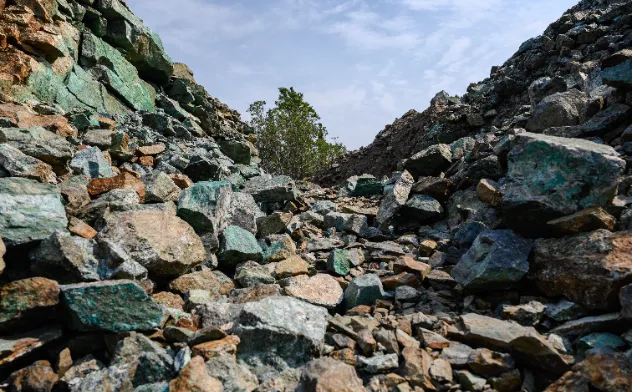
13:20 But the key thing here is we can make it bigger. We've proven that and we're going to continue to do that this year. You have to have pictures of rocks in here. It's just such a beautiful, really nice sulfides, coarse-grained, chalcopyrite plus boronite. It's just beautiful. The contacts on the mineralization are nice and clean. So from a mining perspective, it should make things easier.
13:47 It's just beautiful, beautiful core. Okay, just get into this a little bit here. This is some previous geophysics and you can see this here is the deposit as we know it, the 147. The geophysics and IP can really direct you into where the mineralization is proven to work. I talked about the Sourtoe zone just over to the west of 147, that's over here, that's an anomaly here that's never been drilled. Then you've got the gap zone, got a few holes in there. And then this is an anomaly over here by the 1213, that's where the geophysics worked to hit, where they got to 16m of over 1% Copper as well.
14:35 So a lot of these targets just haven't had the ability to get drilled or have not been drilled. And we'll be testing that. Roughly 10,000 of the 15,000m
14:44 is going to go into the 3 key zones, and then another 5,000 at near deposit targets. And then I'll talk about one of the most exciting areas of the project a little bit later. So the key here is IP works, we're going to do more IP throughout the property, and we're going to test them as we move along this year. Here's, I think this is really key, everything I've been talking to you about so far is really this small area around Carmax. Again, like I said before, we own almost half the Minto Copper Belt to the north of us as a Salford Copper mine. You can see that we've got a road that goes right up through Carmax, right up to as far as a little bit further than zone A. But again, this is a key thing that's really important is that back in the 80s, you've got zone A and they
15:39 drilled up there 25m of 2% Copper and over almost 2g Gold, 22m of over 2% Copper, 2g gold. So that really has been drilled for a very long time. We need to go back up there, understand it, and we're gonna put some more holes up there as well. So the key thing here is it's not just CarMax. CarMax itself will be robust, but what else can we find in this belt that's on a road and you've got the power right along the Klondike Highway. So, you know, just kind of wrapping it up a little bit here, we really want to move forward with this as efficiently,
16:26 continue to work with communities, the government, get baseline work going. We've acquired Granite Creek. We did our initial drilling. We've proven that we can make it bigger. We're going to do 15,000 this year. I suspect it's probably going to reach up to 20,000. Doing that this year and next year, update the resource and then do the network, obviously all the environmental and we continue our work with the communities and then target our pre-feasibility by 2028. So, we're all very well funded for that for this year and well into next. It's really exciting that we're up there and getting going and we'll start work on the strategic alliance in the coming weeks on a couple of our other properties. So this is kind of some of the initial properties that were staked and
17:24 our team will be going out and doing some early stage work on those in the coming weeks. So, you know, We've got the foundation of CarMax, the flagship, and then we've got this other non-dilutive exploration work that we're doing with Agnico. We're really pumped on this year's working and moving forward. I think I wrapped that up. Like I said, we're moving forward with the CARMAC, which is our flagship, and the Strategic Alliance, start working on that. And Yeah, it's really good times. So thank you so much for listening to the story.
18:09 Awesome. Thank you, Graham. Appreciate you running through a presentation for everybody. It was just an earthquake test, so I'm totally fine. My house remains in stable condition. But I've got some questions for you if you don't mind. Just before we get into some of the questions that have already been in by the audience. Before I get into that, there is a request meeting button at the bottom of the screen. For everybody who's in the room, I know there's quite a few of you, please feel free to press that button at any point during today's event. And I'll connect you with the Cascadia team following today's webinar, and hopefully you guys can get in touch. So it's just at the bottom of your screen, right next to the comments button. But Graham, if you don't mind, let me get into some of the content we went over today, because I just want to give a bit more context for investors if possible. Carmax Deposit hosts an M&I resource of 651 million pounds of copper and 302,000 ounces of gold. And as you went through the 2023 PEA, you used 3.75 per pound copper for base case. Like you said, we're off the sensitivity charts already today with Copper trading around $5.85, I think.
19:06 We're off the chart. How does that change the way you're thinking about project economics right now? How has that impacted how the team thinks about CarMax? I think it just gives us the confidence to move forward. You know what I mean? Like, We could, like I said, go out and do a PEA and splash it out there, but some people have confidence and some don't. We internally have a lot of confidence because we have that huge buffer of pricing. You never know what pricing is going to do. I think we all believe even if gold came back to $4, you know, or $5, you know, and gold came back to 3, like we're still in a good place. So it just gives us the comfort to really get after it and know that it should be robust. And I think people will look at that when they look at that table.
19:52 Great. And there is a question in the chat looking for you to crystal ball Gazebo with the copper price. So I'll prepare you for that in advance. But I do want to say Most of the drilling historically at CarMax does seem to have targeted the oxide mineralization. And a lot of those holes end the moment they hit the sulfides. But I know your 2025 program went after that sulfide story directly. CD2533 returned 26 meters at 1.53%
20:16 copper, and 25040 hit 21 meters at 1.25% copper. Oh, sorry. And 25035 returned 25 meters at 1.36% copper. So what is all this coming together to tell you about the the size and grade of the system that the original operators didn't get around to or left untested? You know, the big thing really is, is that oddly, you know, in the 90s and, you know, really 2000, it's just the CEO at the time was just ultra focused on the oxide for good or bad. That's what they went for. They even cleared a heap leach pad for the darn thing. Because they didn't really probably understand the significance of the amount of sulphide that was there.
21:02 We have to give credit to Granite Creek, they were getting on the right track. This sulphide is great, the metallurgy is good. This is what we should be going after.
21:12 And then the continuity, which is something I don't know if I really touched on, is what's so predictable nature of this. It's funny when we were there last year, it's like, well, we should hit mineralization within 5-10m. Boom, it's there. And I think the intervals that you mentioned, if I recall correctly, were really nice kind of higher grade sections within larger sections of closer to 1%. So what's really nice about this is for underground mining, you've got that confidence and you've got grade. Yeah, great. I know zone 1213 stands out because it hosts shallow sulphide mineralization that has seen very, very limited drilling. I'd love if you could just walk through the investors in the room why that zone in particular is high on the priority list for the 15,000m you've got planned this year.
21:57 Just because that's the majority of those holes, we're really the ones that stopped. I think it's probably the sequencing of the years of when they did the drilling. It just happened to be the one that's like, okay, well, we're not doing Sulphide, so let's move on.
22:13 It's really nice that they all come to surface as well. The majority of the bulk of this deposit is sulphide. So the more sulphide we get, the better. And the shallower, the better. And that's what 1213 is. Awesome. And I want to talk about the whole region for a second, because I know Carmack sits 40km southeast of the past producing Minto mine, which like I said Selkirk recently acquired. So for investors who aren't familiar with the Minto Copper Belt generally, and I know there's some of them in the room, what does Minto's production history tell us about the type of system Cascadia is dealing with. And does having an active operator next door, functionally next door, change anything strategically for you? Or is that just an amusing curiosity? No, I think it's really great. And they've got a really good team over there.
23:00 And it struggled as a one-mine operator with companies that were chronically underfunded. That was one of the issues. The open pit was pretty easy, then it got a little bit more challenging with the underground, but it's the same style of mineralisation and having them there successfully mining is going to be a plus for everyone, the community,
23:20 the Selkirk First Nation, potentially, you know, and we've got a good relationship with them as well, so we can kind of talk about if there's any synergies, not necessarily right now, but when we do have a road that goes quite close to them, and right now they're going over the Yukon River, maybe it makes more sense just to put in a road where they don't have to have seasonality with the Yukon River. I just, I think it's, it'd be on an environmental front, that'd be good as well. So it's great having a partner there that is going to likely move things forward and get into production. Sure. I appreciate that. I know the 180 square kilometre land package covers a pretty meaningful chunk of the Minto Copper Belt, as we saw in the maps you had earlier. But the resource today is concentrated at the CarMax main deposit across 3 zones. What are the regional targets that you're chasing with this year's geophysics and step-out drilling? And this is just a strategic question. How are you balancing expansion across discovery work across the rest of your property? Just want to get in your head a little bit for that. Sure.
24:20 I mean, we want to find as much
24:22 as we can as quickly as we can. I mean, the explorationist wants to go running around with another drill everywhere. I mean, we didn't have enough time to go through all of the different targets, but a lot of those have geophysics over them. Some of them don't. They all deserve drill holes and zone A is really intriguing just because it has some of the highest grades, Copper-Gold ratio on the property that I've seen. But I think we have to be realistic. I'd love to just get Carmax proper over 1 billion pounds. I think that's just kind of a nice number. Let's get it to 1, 1.5, get as big as we can. And then hopefully, concurrently, we have a set of second drills coming up pretty quickly. We can get one on the other zones as well. So I mean, this could be a bit of a hub kind of thing because of the size of the property where CarMax is a core and you just start bringing in or from any of the other satellite deposits that we hopefully find.
25:21 I appreciate it. Going back to that older PEA, I know current PEA, but released a while ago, it outlines that 7,000 ton per day open pit with conventional flotation and a nine-year mine life. But as you build towards updated PA and the PFS in 2029, is there a realistic path that you believe in to a longer mine life if the resource keeps growing the way that you anticipate?
25:45 You know, I think that's a big piece to this and getting it over 1 billion closer to, can we get it close to 2Bn? I think for me personally, it's more about getting the mine life up closer to 20 and let the engineers figure out the right tonnage per day. That'll get worked out, But can we get enough here that it's gonna look like we're closer to 20 year mine life, 15, 20 million year mine life. I mean, let's hit this one out of the park and that's what we're focused on. Awesome, I appreciate that. I'm just gonna rattle off a couple of facts about the project and then ask you a question. I know you're on Little Salmon, Carmex, and Selkirk First Nations traditional territory, as you mentioned. Road accessible, which people always say a highway or a road is sexier than invisible gold. I tend to agree. You're 10 kilometers from a power grid and you've already secured Class 4 exploration approval that runs all the way through to 2035.
26:38 Can you give us a sense, just for the investors in the room, where that positions Cascadia on permitting timelines relative to other Copper developers, either in the region or across Canada right now? The way I feel about the Carmax deposit, it's a little bit more nimble than some of these big global porphyries. Would I like to have a 1% 10Blb porphyry? Sure. But that comes with a lot of cap-adds, a lot of things. Can Carmax be an intermediate deposit in a friendly jurisdiction that gets put to production sooner? It was permitted at one point, it was a heat leach, it just never got its water license. So the big thing here is, I think it's gonna fit that intermediate.
27:25 Could it work well, synergies with Selkirk, who knows? The key thing here is make it bigger and make sure that we're talking to the First Nations and communities about what this looks like and how it can benefit them. So we need to put all of that work in, do all of the environmental work. It will get done when it gets done And we'll just do what we can to move it forward as quickly as possible. But you have to put the holistic approach together for that, which we're committed to. I appreciate that, Graham. Now, if you don't mind, we're into the crystal ball gazing territory of my questions, because I do want to ask about the M&A picture in the region, which of course will take a bit of guesswork. The region that hosts Carmex also hosts Red Cryst, Shaft Creek, KMS, KSM, Galore Creek, Denham, BC.
28:14 With copper, let's say, structurally tight, which I assume you agree with, and majors actively looking for scalable Copper-Gold assets right now. If you would, with me, gaze into your crystal ball. Where do you see Carmex fitting into that M&A picture over the next couple of years? You know, it's a really good question. It depends, you know, how tight it really gets and the demand for and I Really don't know but you do see Some of these companies coming in for smaller like 30 40 million ton projects like for an I mean, you know, I and you know there's Firefly Resources out east. There's a lot of these smaller mid-sized projects that are getting great valuations. And I think we could be one of them. Who comes? That's a good question. I don't know, but what I can say is in my opinion, I find these type of deposits that are that kind of great at surface on a road near power, there's just not that many of them. So, you know, I don't think we need to look over our back right now, but All we can do is focus on generating as much value as we can. And I think one of the challenges with CarMax, it was just flying under the radar for so long. Nobody really knew it. It was this obscure kind of thing that was an oxide thing. And now we're just starting to get the word out. I mean, I think we only have a $60 million market cap. We need to get that up.
29:36 Get that up over some of our peers in the area. We have a resource on a road near power. I think we can be closer to $100 million more. And that's our job. And that's where we're trying to get the word out. Great. No, it makes sense. Last question for me, then we'll get into the questions that are into the chat. Looking out 12 to 18 months, as for the investors watching, or maybe new to the story, or for those who are already invested, What specific catalysts should they be watching for during that time period? What does a successful 26, 27 look like to you by the time you publish that updated MRA? I mean, I just think now that we've got the first drill going, the second drill coming in very quickly, We're going to have lots of results. We got a somewhat early start. We got in there before Frechette, so hopefully we can get some news out sooner than later.
30:27 Our hit ratio was 10 out of 11 last year, so hope to get something similar as we continue on. We'll have some misses this year because that's just, we want to test some limits, but I think we're going to do very well and get a lot of, we're stepping up 50m, but with those kinds of grades, you're building resources quickly. Lots of news on the drilling front. We'll do exploration around regional exploration. Who knows what we're going to find? And then the Agnico thing, it'll be a bit earlier stage, but that's the beauty of the Yukon. A couple of those projects we landed on, you're like, here's a copper showing. It's like, nobody's landed on this thing. Like it's wild. And I think that's, what's exciting about this is that, we're, there's new areas, that have just never been walked on before.
31:15 And we proved the concept last year and the years before. So it'll be fun. Oh, excited. So stay tuned, watch the space. Looking forward to it. There's one thing actually I also meant to ask just before I jump into audience questions. Obviously it was big news fairly recently is your strategic partnership with Agnico. Just wondering if you could touch on how that works on the day to day and what it means for the company just before we get into the question from the chat. I think it's just a vote of confidence. You know, we've been working up in the Yukon for a long time. We've know the team at Agnico and they're just great. And We're very happy to have them as a partner day-to-day. It's really just good grassroots exploration, good science, roots on the ground, back to really looking for something new. We're testing the Stikine in the Yukon.
32:03 It's going to be our team out there, but we have lots of really good meetings and interactions with the Agnico dedicated team to this project. And, you know, keep it simple, good grassroots work, which we've been doing for decades. And you usually find something. Exciting. So a couple of questions in the chat, but I will remind people before I get into those, the request meeting button is at the bottom of the screen. Please do feel free to click that. If you'd like to meet with the Cascadia team, I'll make sure they get in touch with you following today's event. One quick question. WG asked, right as soon as you walked in the door, are you funded through to the end of the year? So he was eager to know. So I'll throw that question to you right now. Yes. Absolutely. He's perfect. Speedy, right? I think we've already tackled the Indigenous groups that you're working with, so I can skip that question.
32:50 But Mauricio asked, and I warned you this one was coming, do you see Copper prices holding or increasing through to production for Cascadia? Yeah, that is crystal ball. I mean, I should say no so that it goes the other way. I've read a number of articles that come out weekly on this. I truly do believe that we are going to have a shortage and everything is costing more money. I think we all know that. To be honest with you, it just feels like the world is becoming a smaller place and people are becoming more protective of their materials. That's where I come from on it. Knowing how hard it is to find these deposits and being around the business so long, seeing some of these deposits is still not permitted.
33:48 It's not easy. I think we're fortunate We have one that's been around a while and it can become bigger and it's in a friendly jurisdiction. So I think we're gonna, I don't know what the upside is going to be. I'd love it to be whatever it is, but if we could just stabilize around 5, 6 bucks, we're probably pretty good. I really don't see it going back too far. There you go. We're already off your chart. So how much past the chart do people want to be? Exactly. Well, Graham, thanks so much, not just for a presentation, but letting me grill you afterwards. Thanks everybody in the room. If everybody thinks of the perfect question to ask as soon as we end today, as I often do, please do feel free to send through. I'll make sure the Cascadia team gets it and I get back to you at their leisure.
34:33 But everybody, thank you so much. And Graham, particularly, thank you for your time and run through presentation with everybody in the room.