Joe Oatley
Chair of the Board
Replay available
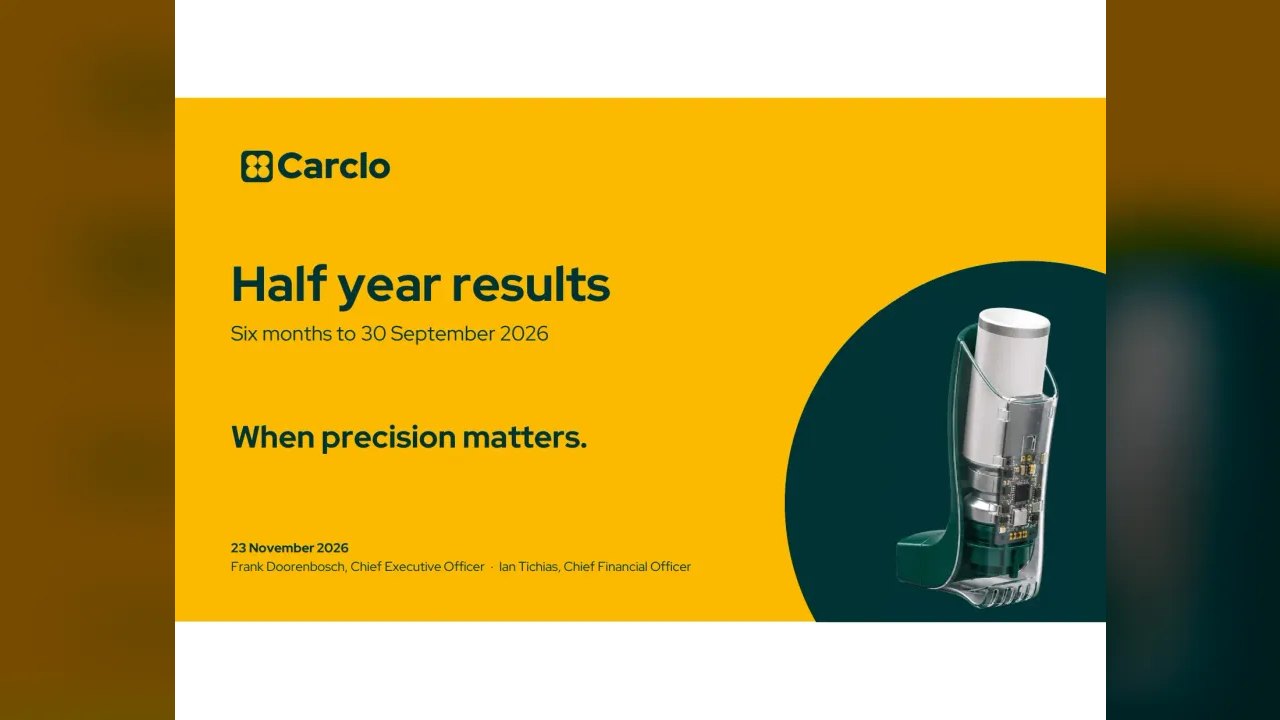
Carclo (LSE:CAR) Q2 2027 earnings call, held 2026-11-23. Watch the replay and read the transcript on 6ix.
Automated transcript · Written by software from the replay's audio. It can mishear names and figures; the replay is the record.
0:00 Thank you for joining us for CAATLO's industry results investment presentation. Throughout the presentation you'll be in listen only mode but please do submit questions you can submit at any time through the Q&A function and then we'll deal with them at the end. By way of introduction my name is Joe Oatley I'm the chair of the board sitting to my left Frank Doorenbosch the CEO and to his left Ian Tichias the CFO. As you'll hear from Frank and Ian in a moment We've delivered a strong performance on both profit and cash in one of the mixed market conditions and against some pretty challenging cost pressures. You can see that the work we've done over the years to build a more resilient car flow is paying off. On behalf of the board, I'd like to thank all our colleagues across the group for the hard work in delivering that. Looking ahead, our strategy remains unchanged.
0:49 We keep our focus on operational excellence, maintain our conventional discipline, as we build our pipeline of future opportunities in life sciences, aerospace, and other new markets. As Frank will explain, success in these regulated markets takes time, given the length of development of the development and approval process. Once they're qualified, though, product life cycles tend to be very long. Frank, can I hand over to you to state the message through the presentation?
1:16 Yeah. Thank you, Gary, and all welcome to the podcast after your results. So, let me start with one sentence. We are proud of this half year. Since 2023 we have built the Resilient Carpet. Today we show you what we did and what it delivers. There are three parts. First, what Carpet is, what we make, our markets and how our business runs. Then Ian takes us through the half year and I come back with how we grow and what you can hold to us. We keep time for questions at the end as The whole view in one line.
2:04 A resilient first half with improved profitability, strong cash generation and strong progress towards our position 2030 objectives. Three points. First, what we deserve. The underlying profit is £6.7 million, up 21.8% and cash generated from operations is £7.9 million, more than double last year. On the line earnings per share, 3 pence, from £0.9, and revenue on sales over the last 12 months is 12.3%. Second, revenue. The revenue is £55.5 million, 3.1% lower, on the softer demands in diagnostics.
2:52 We'll talk to you about the slower first quarter in our 8pm update in September. 40 we increased in the second quarter and speciality grew on aerospace demand. So profit grew by more than a fifth in a half year with slightly lower revenues. That is the result of the work since 2022. Third, what comes next? We want new customers in both divisions. The board reaffirms its expectation for the full year of profit and cash generation and at the bottom of the page You do see our Precision 2030 targets and where we stand. Returns are above the minimums. Net debt excluding leases is 17.9 million.
3:38 Growth accelerated in the late 80 years on the plan and I will share you why. The question the investor asks is mostly a simple one. What does Cardstock do? These three pages give you the answer. We make parts inside diagnostic tests, injection pans and aircraft controls. Small parts in products that have to work every time. Life Sciences is our largest market in the CTP division. Parts of diagnostic tests, inhaler and injection pans and pharmaceutical packaging. Aerospace is in the Speciality division. Control cables, wire and precision machine components for aircraft and helicopters.
4:27 Safety and Security is in the CTP Division, with helmets, visors, lenses and components for cash machines. In numbers, we had a £112m revenue over the last 12 months, 11 sites in 6 countries. We have deliberately manufactured in the region and for the region. Our supply chains are under pressure across the world, and our customers value supply costs close to their factories. I have more than 900 colleagues, and I thank each of them. The results are their work. We just have to print them to present them. In 2023, the car club was a religion player. We had a return on sales of 4.7%.
5:12 We made a choice. We deliberately chose markets where quality is the key determinant of success. All these markets are highly regulated. When a customer changes supplier, the customer validates the part again. They are non-cumulatized, and some parts get one chance. A test result as a doctor acts on, a dose from an injector pen, a control cable in flight, and a visor at impact. And they are growing, life science ahead of GDP over the medium term, and aerospace is robust. We completed the realignment of our portfolio in FY25. The return on status went from 4.7% to 12.3%.
6:04 How the business runs. This is the most important page for understanding CarPlay. It shows how revenue comes into our business. The customer qualifies us as a design space. We design the department and factor together with the customer. Then we do the tooling and validation. And in CDP, it can take up to 18 months before manufacturing revenue begins. After that, volume builds. Once we are qualified, the customer usually stays with us for the life of the product. However, customer tenure is more than 15 years. So each new program adds a long-term revenue to a stable base. It takes time before you see a win in our numbers, and then it is there for the life of the product.
6:54 With a picture in mind, Ian will take you through the heart here.
6:59 Thank you Frank, and good morning everybody. The important message from our H1 results is not simply that profit has increased again, it is that we generated more profit and cash from a lower revenue base. Over the following slides, I'll explain to the drivers and show how that performance is translating into lower bank debt while we continue to invest in our business. Starting with the group results, the revenue was 55.5 million, a reduction of 3.1%. Despite this drop, underlying operating profit increased by 21.8% to 6.7 million. This increase is driven entirely by self-help activities, showing the impact of the quality of revenue and earnings coupled with a focus on cost control.
7:53 As we previously presented, Our refined portfolio and a move away from being a volume player has delivered better returns and increased margins. Operating margin is now 12.1% for the period, driven by the improved divisional trading performance and lower central costs. This improved profit, coupled with the targeted lowering of our effective tax rate to under 32%, has helped drive our underlying earnings per share to three pounds. Importantly, this is not just an earnings story, as cash generated from operations hasn't more than doubled. Both return on sales and return on capital employed are above our precision 2030 minimum, providing another measure of progress.
8:43 Taken together, these measures show why it's vital to look beyond the revenue headline when assessing the progress of the business overall. So looking at revenue, the bridge shows the different elements to H1 trading. TTP manufacturing solutions reflects the softer diagnostics demand, mainly in the US and China, which resulted in reduced revenue by 2.6 million. This stems from a lower first quarter, as we have previously reported, followed by improving volumes in the second quarter. Our design and engineering business was broadly stable, And conversely, speciality added in £1 million, growing 12.1% driven by the robust aerospace demand.
9:31 So the overall headline reduction masks both an improving quarterly picture in diagnostics and growth elsewhere. We remain focused on opportunities that offer attractive returns rather than pursuing volume simply to make the revenue of line look better. This slide puts the H1 performance in context over a longer period. On a trained 12-month basis, return on sales has risen from 3.2% three years ago to 12.3%, improving at every reporting period. Three things sit behind that. One, the choice we made to operate in regular, non-commoditized markets where quality matters.
10:16 Two, reshaping the portfolio towards higher returns. And finally, improving efficiency. This half has provided a useful test of that progress. TTP increased its margin despite lower revenue and heavily from higher raw material prices, and we remain above our stated aim of the minimum 10% return. This profit bridge makes clear where the improvement came from. Our speciality business contributed an additional 0.6 million in the period and central costs fell from 3 to 2.4 million. CTP's profit was slightly lower but remained resilient given the revenue decline.
11:02 It's important to point out this result is a combination of stronger speciality performance with cost discipline across the business and margin improvement in CTP. Together, both factors lifted group underlying operating profit to 6.7 million. We'll now look at each division in turn. For CTP, the key takeaway is resilience, alongside an improving demand picture as the half progressed. Revenue fell 5.6% to 46.5 million, yet underlying profit was almost unchanged to 6.7 million. That took the margin to 14.5%. The softer diagnostics demand was concentrated in the US and China early in the period.
11:53 As I said earlier, volumes did improve in the second quarter and we expect that improvement to be maintained in the second half. EMEA in India were broadly in line with expectations and last year. And looking ahead, two projects for new customers in new sectors are expected to enter production in the second half, which gives us confidence Speciality shows a pleasing story, growth combined with better returns. Revenue increased 12.1% to 8.9 million, while underlying operating profit grew over 35% to 2.3 million. Profit growing faster than sales reflects the operating leverage and a favourable product mix, taking margin to 26.1%.
12:44 With robust aerospace demand, we have secured two significant new customers, both tier 1 suppliers to aircraft manufacturers. At the same time, we have also increased machining capability in France to support the growth. So the message here is not just one of a strong six months. We are adding customers and capability alongside the current trading performance. Selling out cash. and how the trading performance has delivered cash generation. Underlying EBITDA was 9.7 million with cash generated from operations reaching 7.9 million. The cash conversion therefore improved to 81.9% supported by the active management of inventory and receivables and this focus on working capital has to fit alongside the margin story.
13:37 Better earnings alone would not deliver the same balance sheet progress If more cash were tied up in the business. With lower bank interest cash outflows, net cash from operating activities increased to 4.1 million from 0.4 million last year. That gives us the cash to meet our commitments shown on the next slide. And the takeaway here is that cash conversion is a central part of delivering our strategy, not simply a supporting financial metric. The coverage shows how that cash was used. We funded capital expenditure, pension contributions, interest, tax and lease payments while reducing net debt excluding leases to 17.9 million or 0.9 times training 12 month EBITDA.
14:31 It's important to distinguish this to net debt including leases which is now 26.2 million or 1.3 times EBITDA. And this follows the lease renewal for our Greensburg facility in the period. Those measures demonstrate different elements and the lease renewal should not assure a reduction in bank debt. Our financing facility runs to April 28 and we remain on track for our precision 2030 target of net debt below 0.5 times the EBITDA by FY31. So finally looking at the pension scheme deficit, this remains a significant commitment but one with an agreed funding schedule. The technical provisions deficit is estimated at £49.6 million down from £52.9 million at March and separately the IAS 19 accounting liability is £42.1 million again reduced from March by £4.7 million.
15:37 Importantly, pension cash costs now represent 18% of EBITDA, compared to 30% in FY22. So, my closing message is one of stronger margins, better cash conversion and lower bank debt, while continuing to meet our obligations and positioning ourselves for growth. Back to Frank now for the remainder of the story looking at the growth plan. Thank you.
16:07 You have seen what the business delivers today. Now is the next step. How do we grow, and what you can offer us today. This page shows where we meet the customers at CDP. Until 2023, we came at the end. The design was finished, and our job was to make the parking volume. Today, we sit at the table at the start, when the customers design the products. That meant us for one reason. The design stage is where the customer chooses the supplier. And, as I showed you, the supplier who qualified in there, usually stays in for the life of the product. So, we've built up three things to be at that stage.
16:52 The commercial team that finds the programs early, and will be strengthened in this half, and the proposal activity is higher. Engineers, who take a customer from the first design to a further production line. That's our design engineering teams. Each project they pay becomes manufacturing volume. And a place to do the work together. At the Lidl Innovation Centre in Techea, customers develop their products side by side with our engineers. And you've seen the results in our margins. 4.7% return on sales then, 12.3% now. As you see in the wind, The first half, CTP won new customers, very importantly, in new market sectors.
17:43 This page shows how we win. This page shows when we win within the CTP outcomes revenue. Take the two projects we won with the new customers in new market sectors. They started as proposals, and this half, they achieved their qualification testing. Production is expected to commence in the second half of this financial year and from there the boarders will build for the life of the project. So we'll win at revenue step by step, year after year. Our markets support that. Life science is stable in the near term, with growth ahead of GDP on the medium term. And this is the reason that our medium term target, organic growth of 8% a year, is weighted to the later years of Precision 2030.
18:32 The pipeline we build this half supports the growth of those years Speciality as Ian said had the knowledge from half The revenue grew by 12.1% to 8.9 million and operating margin became 26.1% from 21.6% Within Speciality we approach the aerospace market in three ways Direct sales to aircraft manufacturers Then through tier 1 suppliers who build systems for various manufacturers And the last for aircrafts in service, maintenance and vintage Since FY22 we nearly tripled our overall aerospace sales With the share through tier 1 suppliers moving up from 12% to 17% The route through tier 1 suppliers was an established route And we would have deliberately increased focus on it alongside direct sales This half we won two significant new Tf1 customs.
19:36 We increased machine capability in France, and our Indian operations achieved full manufacturing and assembly AAS9100 certification. That is the quality of management standard in the aerospace industry, a requirement to deliver that market. It's a key milestone in delivering our expansion strategy. What chicken holders do? First, there are three things. First, returns. Return on sales is 12.3% against our minimum of 10. Return on capital unemployed is 29.1% against our minimum of 25% all over the last 12 months. Margin increased in both divisions, CDP of 14.5% from 13.8% and specialty LFB, as mentioned, 26.1%.
20:29 At the return of capital of 29%, growth is worth investing in. That's why the board puts capital into growth first. Second, debt and pension. In many of our meetings, we hear the same remark. Come on Frank, the business is better, and the pension deficit is still there. So we show you a post on one page, and I tell you how we look at it. and the pension deficit are claims to cash this business generates. What matters is the size against our earning power. Both move in the same direction. The claims are smaller. In FY22 the net debt and the pension deficit together were 112 million pounds. Today they are almost a third lower.
21:22 Our earnings are larger. Our EBITDA went from 13 million to almost 20 million pounds on a 12 month basis Meaning significantly, they both reduced in both absolute and relative terms As debt and pension deficits come down, a larger part of the enterprise value of this business is there for our shareholders Third, our records Every company shows a plan Our simple request is justice on what we have delivered. So, our record. In 2023, we set four objectives, and we've delivered on all four. A safer company came first, because a safe plan is a well-run plan.
22:11 Our internet frequency rate went from 2.7 to 0.4. Financial resilience. Net debt to EBITDA, including leases, went from 2.5 to 1.3 times. And we set clear return targets. 10% upon sales and 25% capital employed, where at that moment they were 4.7% and 6.1% in FY22. Today we are at 12.3% and 29.1%. The corporate motto is, we say what we do, and we do what we say. The next step is position 2030. Minimum return is at 10% of sales, 25% of capital employed.
22:56 Net debt below $0.5 billion on FY23 and organic revenue growth above 8% a year over the plan related towards the late years. These are the questions you're going to have to ask us most. I'll take two and the others are on the page. How concentrated are our customers? A significant portion of our revenue comes from a smaller number of large customers. These are close, long-term partnerships. Average customer tenure exceeds 15 years. And realize, with these large customers, we supply many programs. Each one qualified on its own.
23:41 And we're widening the base. As stated earlier, this half we want new customers in both divisions, both in new market sectors
23:50 and New Roots Democrat.
23:53 Second, one I want to address is capital allocation. We already have a question from a Chair for the Diffident, so let's answer that here. The Board reviews capital allocation regularly. Today, with the return of capital employed of 29%, it sees investment in profitable growth as the best use of capital. For this half, the Board has chosen that the investment over a diffident. Three things to check when we report the full year. One, profit and cash generation in line of expectations. Two, the two new customer projects in production.
24:38 And three, returns at or above 10% return on sales and 25% return on capital. Stating that the report remains confident in delivering the medium-serving sustainable profit growth in line with the Precision 2030 targets. So, two clubs. Profit up 21.8%. Cash generation more than doubled. New customers won in both our divisions. I am proud of what our colleagues have delivered since 2023. We have built a resilient pathway, with reserves ahead of targets, and a record of doing what we say. The next step is great, and we will invite you all on that journey.
25:24 Thank you very much.
25:25 and we will take your questions from here. Thank you everybody. We have had a few questions in, please do continue to submit questions as we go through these. Before I read them out and provide answers, could I just say Mahesh, if you intended to submit a question, all that's come through to me is a full stop. So if you still have a question, please put it in there and resubmit it if you will. First from Peter, and Frank has alluded to this already was can you see any future time scale for the reintroduction of dividend payments as Frank said we have excellent retail and capital employed we have a lot of investment opportunities for companies so looking forward that's where we intend to invest our capital so in the near to the near horizon I wouldn't see a reintroduction of dividends in the short term Rob, it's quite a long question Rob, I will do my best to read it out and then Frank I think I will hand this one to you to answer.
26:32 So regarding CAATO's strategic indie facility, in fact actually you might be able to broaden the answer to cover other places as well. Has the targeted investments and related work been completed in the science of diversification towards high volume diagnostic and disposables and drug delivery systems and as a direct result of the Related Work and Site Diversification, how to secure new contracts and new additional customers, and are these new contracts supporting your expectation of the demand to strengthen through the year? It's a quite a long question. So if you could handle that one, please, Frank.
27:07 Yeah, I think it's great. In the end, it's a very important market for us. There is a great importance in life science, and there is a great, especially where we are in Bangalore, in the aerospace industry, so we're addressing both. We've put capacity in for life science projects. We have taken two life science customers. We are currently working with a bigger program to see what we can bring that into India. We think India is very important for our growth. There's a lot of people living in the country. The GDP is increasing and we need that higher GDP for the growth of the rest of the life. the investment in those pieces were that we already have capability to produce new machines in so if we win we will only need to produce or put new machines into the building which is already there and the we might if we win a bigger project within the aerospace that our metal operation needs to extend and that's what we're going to do well we're very happy about our Indian facility yes we're diversifying what we came from because it was doing one product and is now doing multiple products and I think that's important for for all the businesses to have a balanced portfolio.
28:20 Thank you Frank and then one from Tim which I think actually has been addressed in the presentation it was asking what's happening with the net debt bridge so it looks like you're on track but the cash flow only led to a reduction of one million in net debt can you discuss the bridge or part of your presentation was indeed that bridge so I hope we have addressed If you still have some more questions after that, please read some of the questions and we'll address it now. And that is all I've had through on questions to date. I'll give everyone another minute or so just in case there's an outstanding one. And then after that we'll close the meeting.
Follow Carclo PLC into a list and get an email when it puts out news.
Chair of the Board
CFO
CEO