Byron Coombs
CEO at CAMELLIA PLC
Replay available
Company Presentation hosted by Camellia (LSE:CAM) on Investor Meet Company, held 2025-05-21.
Automated transcript · Written by software from the replay's audio. It can mishear names and figures; the replay is the record.
0:01 Good morning, ladies and gentlemen, and welcome to the CAMELLIA PLC investor presentation. Throughout this recorded presentation, investors will be in listen only mode. Questions are encouraged. They can be submitted at any time via the Q and A tab that's just situated on the right hand corner of your screen. Please just simply type in your questions and press send. The company may not be in a position to answer every question it receives during the meeting itself. However, the company can review all questions submitted today, and we'll publish those responses where it's appropriate to do so on the Investor Meet company platform. And before we begin, we would just like to submit the following poll. And if you could give that your kind attention, I'm sure the company would be most grateful. And I would now like to hand you over to the executive management team from CAMELLIA PLC. Byron, good morning, sir.
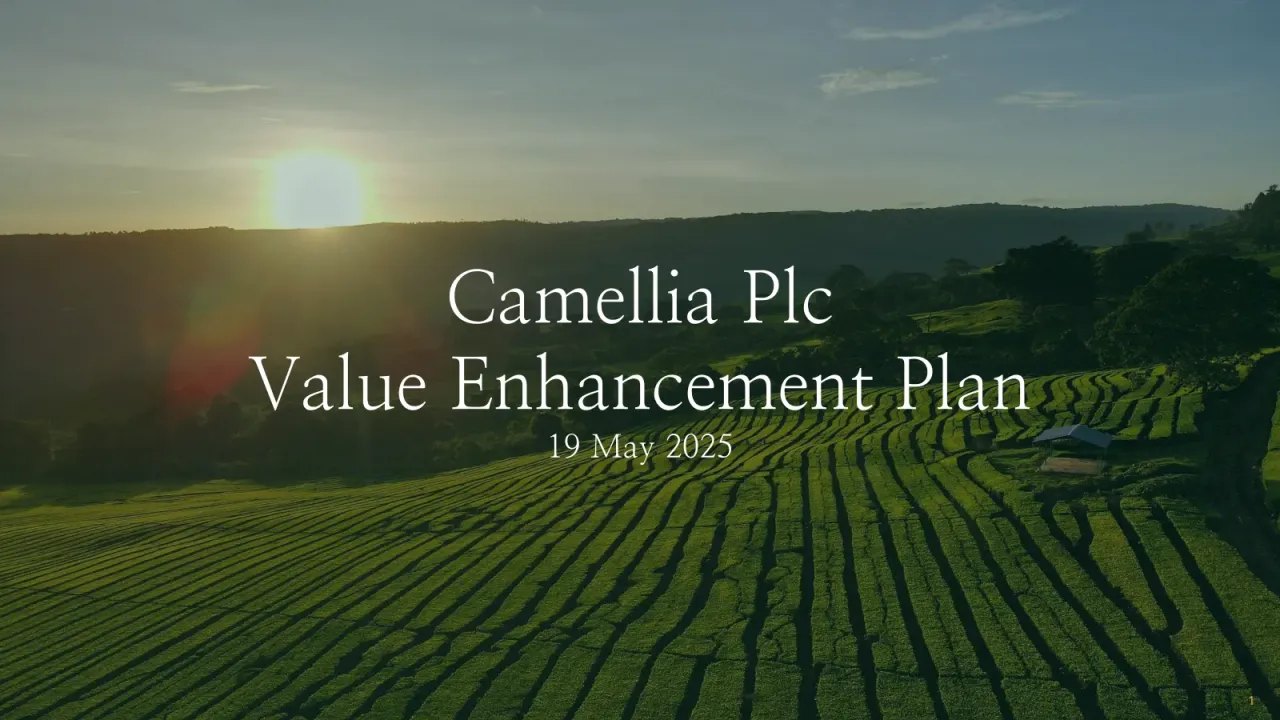
0:44 Good morning. Welcome to this presentation on CAMELLIA, a long established UK company which may be new to you. My name is Byron Coombs. I'm the CEO of CAMELLIA, and I'm joined here today by Oliver Capeon, chief financial officer. Over the next twenty minutes, Oliver and I will provide a brief overview of CAMELLIA and its future opportunities. The following disclaimers are standard but important. CAMELLIA is named after the tea bush CAMELLIA SINENSIS. That reflects the strength of our global tea business. The company was formed in 1889 and listed on the London Stock Exchange in 1982.
1:33 While the company has been around for many years, there have been some important changes in the leadership of CAMELLIA over the past eighteen months. In addition to Simon Turner, CAMELLIA's chair, and I taking on our roles in late twenty twenty three, we've seen the arrival of Oliver as chief financial officer, Nish Hendia as general counsel, and two new independent nonexecutives, Alison McFadden and Alec Hayley. These new additions to the CAMELLIA leadership build upon the strong and experienced teams that we have in The UK and around the world. Very briefly, CAMELLIA is headquartered in The UK, it has investments in 11 operating companies and also owns a range of non operating assets.
2:23 Eight of the 11 operating companies are involved in large scale agriculture. The remaining three are a UK engineering company, a UK luxury tea business, and a South African vineyard. CAMELLIA's principal agricultural products are tea, avocados and macadamia nuts, but it also produces soya and other arable products, rubber and forestry to name a few things. Importantly, CAMELLIA was founded with a clear purpose, to marry commercial success with profitability, with a strong social conscience and with care for the environment. I think it's helpful to put the CAMELLIA of today in its historic context.
3:11 CAMELLIA's oldest businesses have deep roots in the Indian and Bangladesh tea industry, But in the 1970s and 1980s, CAMELLIA grew into a small UK conglomerate with exposure to a wide range of businesses, including financial services, fisheries, cold store logistics and engineering to name a few. Then in the mid-2010s, the company began a gradual streamlining of its operations, with further progress made over the last couple of years. The current management team are expediting the streamlining focusing of the business and expect to complete the transition to an international agricultural business in line with the timing of the value enhancement plan.
4:01 At the heart of CAMMELLIA today are the eight large scale agricultural businesses. The India operation comprises 28 tea gardens and factories, an instant tea manufacturing plant and a branded packet tea business. The operation produces some of the best known and highest quality teas in the world. For example, Bannantan Castleton teas are sold as single estate teas at Fortnans and Harrods. Duncan Brothers in Bangladesh with 15 tea gardens is another Revea name in tea history and a strong brand in the Bangladesh tea market. Eastern Produce Tea business in the Nandy Hills in Kenya is a highly efficient operation with some of the best yielding tea gardens in the world.
4:50 Also in Kenya, CAMELLIA has a 51% stake in Kakuzi, a Kenyan listed farm, producing avocados and macadamia nuts for international markets and cattle and forestry for the local market. The business is also in the early stages of developing a commercial blueberry operation.
5:10 Our Malawi business is both a substantial tea producer and a sizable macadamia farm, while our South African operation focuses solely on growing macadamia nuts. The last of the eight businesses is our arable farm in Brazil, a highly mechanized operation with soybeans as its main crop. The farm earned several awards in 2024 for the quality of its products and for its operational efficiency. The farm has 15 reservoirs and is in the process of raising its proportion of irrigated land to over 60%.
5:49 Before turning to the company's 2024 results, I'd like to put where we are today in some context. Between 2021 and 2023, these were very challenging years for CAMELLIA, with all three of our main crops, tea, avocado and macadamia, facing weak market demand. Alongside weak pricing, our operating companies faced a hangover from the COVID related business disruption, and subsequently the input price pressures arising from the Ukraine war. One issue specific to 2024 was the closure of the Red Sea. This event required a change in our avocado harvesting and packing protocols to allow for the longer transportation around The Cape.
6:42 We have now fully adapted to this longer term delivery. These factors are increasingly behind us with markets generally improving and cost pressures generally easing.
6:53 And with our renewed focus, we have renewed confidence in the prospects for CAMELLIA. With that, let me hand over to Oliver. Thank you, Byron. I'll start with looking at the 2024 financial highlights, which we have recently announced and published on our website. These results reflect an improvement in market conditions in the group's core agricultural products in 2024 versus 2023, albeit trading conditions remain difficult across many markets. Revenue was slightly ahead of last year, and while still loss making, the trading results show improvements year on year with a net trading loss of 5,500,000. The net cash, as you probably know, is very healthy with GBP 125,000,000 at the end of the year, which was up from GBP 32,000,000 at the end of twenty twenty three.
7:47 The bulk of this increase is driven by the proceeds of the BF and M sale in late twenty twenty four. The board have proposed restarting the dividend at £2.60 We recognize this is uncovered by profits at the moment, but the board and the executive have confidence in the value enhancement plan and believe that in the medium term, the dividend will be covered by income from subsidiaries and from any new investments that are made.
8:19 The 2024 operational highlights. Over 2024, the Board and the leadership team undertook a comprehensive review of the group to determine the steps required to maximize the value to shareholders. The value enhancement plan is the outcome of this extensive review. We also revisited the company's purpose, values and business model, which are all disclosed in the annual report and available on the website. We invested in strengthening some of the operating company boards and management teams to align with the future requirements as well. We continue to simplify the portfolio. The major step in 2024 was the completion of the sale of the last of the associates, being BF and M in Bermuda and the two finance companies in Bangladesh.
9:06 These both strengthened the balance sheet and simplified the business.
9:10 2024 also saw the final closure of Bartsley and the shutting of the business. While clearly this transaction is a difficult one for the company and the shareholders, closing it down prevented further losses and was done in a highly professional manner. There's also investment in businesses in the year in both maintenance and growth capital, the largest element of the latter being the planting out of avocado orchards in Tanzania, where we're planting about 100 hectares per annum of new avocado trees. I'll now hand back to Byron. Thank you, Oliver. Let me now turn our attention to our plans for enhancing the value of the CAMELLIA business.
9:59 Our plan for value enhancement comprises three components: firstly, improving the company's operating results on an annual basis secondly, reducing portfolio risk and, over time, dampening earnings volatility and three, growing revenues and earnings through increased organic and inorganic investment. Let's focus a little on the improving operating results. CAMELLIA's management have two principal levers they can pull to improve operating results. Firstly, more active management of the group's assets, essentially disposing of low yielding underperforming assets and redeploying the capital to more profitable activities. Management have identified many low yielding assets and are taking action to dispose of them.
10:50 Secondly, improving operating company financial performance. CAMELLIA has been working with the operating companies over the past year or so to help clarify and prioritize their business improvement plans. While each company has different levers it can pull, some of the more common ones include investing in new bearer plants to reduce vacancy rates in the gardens, thereby increasing
11:15 revenues per hectare and exploring options for commercializing currently underutilized farmland, using surplus factory and packing facilities by using third party crops and processing, selling underperforming business units and non core assets, investing in factory power supply to reduce intermittency and thereby adding additional and and by adding additional processing lines to improve consistency of product quality, improving productivity through the gradual and careful application of mechanization and other technology, and by improving crop marketing and sales strategy. Turning to the matter of risk. A key task for management over the next few years will be to reduce CAMELLIA's risk profile and in doing so, reduce some of the earnings volatility that is common to the agricultural sector.
12:15 Clearly at the forefront of our risk discussions are changes in weather patterns and the rising global temperatures. A few years ago, CAMELLIA sold its Horizon Farm in the Central Valley Of California, a well run and very profitable business, but one which was very exposed to the loss of its water supply. Today, CAMELLIA is building a large avocado farm at 6,000 feet in the Southern Highlands of Tanzania, which we believe will be less affected by the rising temperatures. These are the kinds of long term decisions which we believe will ensure CAMELLIA's long term sustainability. Beyond climate, the percentage of our revenues from TIA over 70% is higher than we would like. Over the next few years, CAMELLIA will look to further diversify its sources of earnings, broadening the range of crops it grows and generating more of its revenues from ancillary services such as farm management, which are directly which are less directly affected by the weather.
13:17 Finally, turning to our goal of growing the business. This task is critical to ensure the long term sustainability of the company and future value creation. CAMELLIA has two means by which it can generate growth over the coming years. The first is investment in crop production and infrastructure. There is some baked in growth that will come from investments already made. This growth will show through as the plants grow to maturity over the next few years and as the farm infrastructure helps improve yields. Further growth will come as more investments are made. For example, Kikuzi has recently announced its ambition to increase avocado production from 3,000,000 to 5,000,000 cartons and increase its macadamia nut production from 900 tons to 1,500 tons over the next ten years.
14:12 The second means of generating growth is through acquisition of established operations, both agricultural and associated businesses. This approach with its faster revenue generation is complementary to the longer term time frames of building farms from a greenfield site. We'll look carefully at opportunities which offer attractive returns from the operations and where the operations are well aligned with our existing operations and which can employ our established skills and experience. We anticipate investing 15,000,000 to $25,000,000 in growth projects per annum.
14:53 To bring this to life, here are some of the recent investments we have made in the area of efficiency and sustainability. We have begun to invest in solar panels. To support crop diversification, we are building a commercial scale blueberry operation in Kakuzi. And to generate medium and long term growth, we are building a new avocado farm in Tanzania, complete with a large reservoir and full crop irrigation and a pack house, which can provide services to other growers in the region. We have now planted four fifty of the six fifty hectares, and the dam construction is underway with a completion plan for October of this year. The farm will reach full production around 2030. Let me hand over to Oliver to talk you through our capital allocation priorities.
15:43 Thank you, Byron. The Board and the Executive have three priorities for capital allocation. Firstly, maintaining a strong balance sheet. Agriculture is a volatile business, and the group needs to be able to sustain annual price yield shocks, much of which are outside of our control. The strong balance sheet enables us to survive these market shocks. The board have allocated a strategic reserve to be maintained based on the volatility and correlation of the crops that we farm. This will help to protect the company over the long term. Secondly, we need to be able to provide a sustainable dividend for the shareholders, which in the medium term will be covered by earnings. We believe the 2.60 proposed dividend achieves the right balance and is sustainable with the expectation of growth as the value enhancement plan is implemented and the benefits realized.
16:37 Thirdly, it's vital that we invest in the business. The board have allocated £23,000,000 to £35,000,000 per annum, covering maintenance capital and organic and inorganic growth. These amounts are guides and dependent on high quality projects being found, and all investments will be assessed against industry and country return on investment benchmarks.
17:04 We're also announcing a tender offer, which should be based on at general meeting after the AGM on the June 5. This provides an opportunity for liquidity at a premium for investors who want to sell their shares. The pricing is a premium of 17% over the three month volume weighted average price and premium to the last days close as well. The Board does not anticipate further tender offers or restarting the on market share buyback at this time. I'll now hand back to Byron for the investment case of CAMELLIA. So let me conclude this presentation with a summary of the investment case as we see it for CAMELLIA. Firstly, CAMELLIA is endowed with a number of high quality investments. These are nurtured and developed over many years.
17:51 These businesses have proven management teams and are seen as leaders in their respective markets. They operate at scale and to high standards of environmental and community care. With further investment there is potential for improvement in both profitability and business growth. Secondly, CAMELLIA is underpinned by 90,000 hectares of valuable hard assets. With continued investment in these assets, they will rise in value over time and will reduce crops and enjoy enduring demand well into the future. Thirdly, there's the expectation of earnings growth, driven by prior year's investment in new crops and supporting infrastructure and by future investment in both organic and inorganic business opportunities.
18:41 Finally, following the recent and ongoing divestment of non core businesses and assets, the company has a strong and liquid balance sheet that can support it through any difficult economic times and provide it with the resources to generate longer term earnings growth and a sustainable dividend. We believe the successful implementation of our plan will create value for shareholders through sustainable profitability over the longer term. That concludes the formal presentation. Let me now open up the meeting for some questions. Perfect. Byron, Oliver, if I may just jump back in there. Thank you very much indeed for your presentation this morning. Ladies and gentlemen, please do continue to submit your questions just by using the Q and A tab situated on the right hand corner of your screen. But just while the team take a few moments to review those questions that have been submitted already, I'd just like to remind you that a recording of this presentation along with a copy of the slides and the published q and a can all be accessed via your investor dashboards.
19:41 Guys, we have received a number of questions that were both presubmitted ahead of today's event as well as a number that have made their way through this morning as well. So firstly, thank you to all of those on the call for taking the time to submit their questions. And, guys, perhaps if we dive straight into it, the first question that we have here reads as follows. Is the board planning to preserve the dividend of £2.60? Yes. And the board board set the level of dividends such that it will be sustainable over time. It is not covered by earnings at the present, as I said, but we believe that successful delivery of the value enhancement plan will enable this to be covered in the future. Obviously, we can't guarantee this, but there's the expectation this is a sustainable dividend that hopefully will grow over time.
20:28 Perfect. Thank you. And just sticking with the dividend, another question that we have here asks, is the board planning to pay out an interim dividend like previous years? The the board's discussed this quite a lot over the last several months, and the answer is is no. We feel that the the business the the way in which the business is run and the fact that the crops come to maturity really in the second half of the year lends itself to paying one annual dividend a year at the point of which we really understand what that year has achieved. So, no, we'll we'll be sticking with a single annual dividend every year. Thank you. Just turning to the next question. In the 2024 annual report, there is an emphasis on the importance of quality and the role that CAMELLIA PLC plays, in producing high quality commodity goods and services.
21:22 Please could the management team explain how CAMELLIA plans to improve the company's ability in capturing value for quality when selling a commodity?
21:35 So I think it's it's important to note that we are selling commodity products, but there is always a quality differential in the pricing. So the higher quality product you make, the higher price you're gonna get in the market. Clearly, the volatility on the overall market is there, but as long as you preserve that quality differential, you will get a higher price. So we think that quality is the heart of what we do, and we have a reputation for high quality products. One of the one of things we're trying to do is improve that quality over time. So one example of this is improving the power and resiliency across our t factories in particular, where if you have power outages in a t factory, the quality drops down very quickly. So we're investing at the moment in new generators and new transmission systems to make sure we get that that power consistently through the through the operations, such we can improve the quality over time.
22:31 So, yes, we're a commodity, but there is also a quality differential which we're trying to get. And that quality differential can be quite sizable in some markets. It can be up to 25%, 30% above the base commodity price. Thank you. That's great. We have a question here which asks, can you provide more details on the majority shareholder objectives?
22:55 How is it controlled? If an offer was made at a significant premium, does the shareholder have capacity to engage with a prospective purchaseraccept an offer? So the the the background to our majority shareholder is that the one of the founding architects of CAMELLIA has, at an earlier point in time, essentially transferred his shares in the group to to a charitable trust. That's for the benefit of a number of charities both here in The UK and abroad. And some of the commitments that the charity has underpins some of the hospitals and schools that operate within our our gardens in in Durham, Bangladesh.
23:44 The foundation has a board of trustees, is chaired by Stephen Buckland. As far as my understanding is that the foundation has given no indication it would engage with any prospective buyer for for PLC. It is it views the holding in PLC as a long term commitment, and that's probably as much as I can say about it. And we can't talk on behalf of the foundation. It is a fully separate legal entity and operates as such. Thank you. The next question asks, is the majority of investment properties now Lynton Park? Can you comment on current status? Were any offers received? What's the realistic value for the asset?
24:33 So, no, the the majority is not the Linden Park main house. That is a proportion of the the value of the the investment properties which we put on we we stated in the annual report was about £25,000,000 at the end of last year. So Lyndon Park is a is a large chunk of this, but not the majority. Lyndon Park is currently being marketed as a separate single house. Previously, it was marketed as an estate with all the out outhouses as well. Last year, we decided to remarket and change the way we market it such that Lynton Park was marketed on its own, and the rest of the houses have been gradually sold off. So we've had success with that strategy. We've also got property in London and Bristol as well. So these are all for sale, but we're selling them slowly. We're not forced sellers, and we're trying to get the best price for these. Obviously, we can't talk about an offer on that, so it's confidential information.
25:32 Thank you. The next question that we have here is regarding the tender offer. I know you've touched on this in the presentation, but perhaps if there's anything further to add. With the premium on the tender so thin, do you see a risk that it is not taken up? What action would be considered then? How do you see the tender offer price versus fair value? So first of I'm not awfully sure I see the tender offer price as thin, if I'm if I'm if I'm honest. The tender offer price was set at a premium of 17% to the three month average over the last three months. It's close to a two year high. It's also more than 30% above the low point of the last several weeks or so, 6% above the closing price before we made the announcement. So first of all, I think it's a good price.
26:20 Obviously, when the board considers the pricing of a tender offer such as this, it's trying to weigh up a number of factors, the interests of of a number of different investors, and that was the price that was that was arrived at. It's also a price that and and a a proposition which we think will enjoy support at the Annual General Meeting or after the Annual General Meeting on the June 5. This handle was offered to make good on the board's indication that we returned some of the cash received from the BF and M sale to shareholders and to provide liquidity to larger shareholders who wanted an exit. So this is designed to cater to a particular interest within the investor base.
27:10 It's priced at a good price, I think, and we believe that we'll get approval at the AGM. Thank you. How much cashmarketable securities sits at the holding level versus within subsidiaries? The the vast bulk of the cash that we have on the balance sheet is sitting at not so much CAMELLIA level, but the the two UK holding company levels for the two UK holding companies that we have. We do maintain some cash balances at the local level. This is particularly where we there's issues in terms of withholding tax, getting that money out of the country, and where we see there are good prospective investment cases in that country.
27:56 So we do balance between the holding company and the subsidiaries, but the vast bulk is sitting at the holding company level. Perfect. Thank you. Just turning to the next question. How much do you think it would cost in both time and money for someone else to replicate your core agricultural business? I think it would take an enormous amount of time and money to build the types of business that we have within our core agricultural operations. Finding land at this sort of scale is very difficult. To build out the infrastructure, whether it's dams and irrigation, pack houses, tea processing factories is a very expensive proposition.
28:43 Perhaps most importantly, building up the reputation that we have in in almost all of our markets for the quality of the product that we produce and for the way in which we manage the local communities, social, and land issues that we manage. It takes years to build that out. On top of that, acquiring the management skill, the kind of quality and depth that we have, it takes a very long time. These are these are difficult organizations to build in these markets. I think it's it's it's sometimes easy to forget the scale of what we're dealing with here. So so 90,000 hectares is the size of Berlin. It's over 200 Clarksons farms. So these are huge operations that we deal in. And so buying that land is very difficult to do. So replication is not easy, and I think there are significant barriers to doing that.
29:39 Thank you. With several noncore assets sold, is there scope for cost efficiencies at the holding level? Yes. I think there is. We first of all, we're actively managing the holding company costs all of the time. And as the organization becomes a little more streamlined and a little more efficient, there will be an opportunity, I think, to reduce some of the costs here in The UK. There are some costs, of course. You know, as we go through the transition, that costs a little bit of money, and some of the cost savings can't be had until some of these noncore assets are disposed of. But certainly, some progress is being made already, and there's much more that can be achieved, I think, over the next couple of years or so.
30:30 Thank you. On the portfolio of listed assets, can you provide more detail on investments by sector? How are stocks selected? Why does it include Japanese equities? Does this not create unnecessary currency exposure? The the the history or the the rationale for the investment portfolio was as follows, really. CAMELLIA has always been an organization that is exposed to quite a lot of annual and perhaps biannual operational risks and market volatility, market cycles, and so on. And so certainly, prior management teams felt the need to have major strategic reserve.
31:18 That reserve was expected to be around for a period of time, and so that reserve was invested in equities to capture the equity risk premium that they offer. Most of the stocks were bought really on the basis of a value type investing, which fits very much with CAMELLIA's ethos. In terms of the exposure to the Japanese markets, think that was that was in large part done because we're an investor in in emerging markets, a lot of emerging currencies, and Japanese currency is seen really as a hard currency around the world and was a natural offset and an effective form of diversification portfolio. Thank you. We have a question here, which asks, what's the strategy for sale on heritage assets?
32:08 Can you give a view on the on market versus book value? So they're all for sale, but clearly, them quickly is not something we want to do. So they will take a very measured approach when selling these assets with some of these assets are relatively illiquid with few buyers in the market, so we will take our time to sell these assets. But they're all for sale. In terms of value, we have a book value, which we think is still robust, but we don't have an idea on we don't well, I haven't disclosed the market value for them. But the book value is about £7,000,000 for our heritage assets. We've also asked our operating companies to look at their heritage assets as well. So they also have particularly pictures that they're looking for sale. So we're asking all our companies to look at their their asset base, particularly assets which deliver no return and look to sell this.
33:08 Thank you. Considering the value of cash securities, Linton Park, Jing Engineering, does this imply agricultural assets are valued close to zero? And how do you explain the sum of the parts valuation? Well, I mean, clearly, at the moment, the share price of CAMELLIA is is well below price price to book, so I I think that some of this is fairly obvious to most investors at this point. I think Oliver's job, my job, really, is to make a really good business out of CAMELLIA. The share price will, in the end, be set by investors, and we view that the share price as being still good value at this point, but that's up to shareholders to make up their minds.
33:59 Clearly, there is value inside the business in terms of the embedded assets, and our job is to make good income out of those assets, and that's what we're focused on. I would probably add, we've not done a formal sum of the parts valuation, and we would view the process as being subject to quite a range of of different outcomes. Yeah. We're not we're not a venture capital investor. We are a manager of assets, so we don't do an annual revaluation of the the assets in the in the portfolio. Clearly, as part of the year end accounting, we do impairment reviews of where we are, so we view the net asset and the book value being a a good bottom case where of the value of the business, but we also think there is upside above that.
34:48 Thank you. We have a similar question here. I know you've just touched on, but perhaps if there's anything further to add. How do you view the reliability of the trading value of listed subsidiaries, CAMCOOZY and Goodrich? What does this imply for the sum of the parts value versus trading value? So well, we account for CACUSI and Goodrich, both of which are listed on on exchanges in their in their respective companies on on a consolidated accounting basis. And the valuation of their shares in those markets is what it is. You know, those are both illiquid stocks in relatively small markets, and local shareholders will make up their minds how they see the value. I would say that we see more value in those businesses than is necessarily implied in the stock, but that's a matter for other investors to make up their minds on.
35:49 Thank you. Just turning to the next question. What is the board planning to do with all the cash, which is more than the share price at the moment? I think we've laid that out in the capital allocation priorities under the value enhancement plan. So it's we still need a strong balance sheet. We want to have a sustainable and growing dividend, and we need to invest for growth. Thank you. Why did the business have a GBP 30,400,000 listed equity portfolio as of the 12/31/2024? And what are your plans for this going forwards? Well, I think to some extent, we've sort of answered this, but the a lot of these assets come out of a strategy that was built a few years ago. Clearly, there is a need within the company to hold a strategic reserve.
36:38 It was deemed that rather than just hold that reserve in cash, that there was some value to be gained from investing in securities. I think that's proven to be the case, and I think I'll just leave it at that, really. Thank you. We have a question here which asks, please, could you provide more insight into the hurdle rates for your organic investment plans? So for commercial reasons, we don't disclose our hurdle rates. But we see that the 5% return on capital is the initial target under the value enhancement plan, which gets us to a covered dividend. As we progress over the next year, we will update the investors on our targets going forward.
37:25 It's important to note that we don't revalue on our land and assets annually, and so we need to make sure we're bearing this into mind. There is value over and above income that we see in P and L that we're creating by basically developing our land going forward. Thank you. Can you provide an update on the status of marketing of South American wine assets? It's South African. Apologies. Yes. You know, that that that that business is is not deemed to be core. We're looking at the options. And when we have something more to say about it, we'll let the market know. Thank you. What went wrong with Bardsley?
38:14 And given the plan for inorganic investments, what measures are now in place to ensure that shareholders do not suffer a similar fate again? Well, first of all, think we can probably all agree that the Varsity acquisition was not a success. There were a pretty wide range of factors as to why that is, including, you know, the Ukraine war and the subsequent increases in cost of labor, fuel, electricity, and so on. I think more important at this stage is the fact that, actually, the board recognized the new board, anyway, recognized fairly early on that this business, you know, was not gonna perform as we expected, and it made you know, it it was quite decisive in making the decision to to close down the risks and and execute the strategy that we executed. Definitely not a not a not a good investment, but I think in the end, the board did take some decisive action and contained the exposure that it had to it.
39:22 I think so in terms of going forward, we clearly will be looking for inorganic investment again. But we will tread very carefully and make sure they're complementary to our existing businesses, so across all countries that we know very well, that we understand the risks we're taking and particularly the downside risks and the tail risks that are that are in those projects, and that we're fully compensated for those risks. The other key thing is we're not in any urgency to invest. If the deals aren't there, we will not be doing them. We need to wait for the right deals to come along that really makes sense for CAMELLIA. Thank you. We have another question here on the tender offer. I think we may have covered this already, but perhaps if there's anything further to add. Why is the tender being pitched at such a huge discount to tangible book value?
40:11 So so I think the the key thing about the tender offer is it needs to have a 75% vote at the at the at the the meeting. So it has to balance both the needs of those wishing to participate and also those that wish to stay in the company. So it's a it's a balancing act between the two. It was debated long and hard at the board, and the board said that this is a reasonable place to be compensating the both those people who want to stay in, keep their shares, and those who want to get out. Perfect. Thank you. Just turning to the next question here. Pessimists might say that the value enhancement plan looks like more of the same, potentially another 100,000,000 sunk in an agricultural division, which has never earned its cost of capital.
40:59 Why is this time different? Well, think, first of all, actually, history shows that some of these businesses have had periods of significant success. And I think the last couple of years, for sure, has been a difficult period of time. But we have really good quality assets here that have been built up over many years, and they operate at scale. They're commercially successful. They've got good management teams. They are producing crops that have enduring demand around the world, and that's so we have confidence that actually run well with focus and where we're utilizing the assets to the optimal amount, these businesses can generate a decent return. Perfect. Thank you. And that actually concludes the questions for this morning. So thank you both for being so generous of your time and addressing all of those questions that came in.
41:53 And, of course, if there are any further questions that do come through, we'll make these available to you immediately after the presentation has ended just for you to review and to then add any additional responses, of course, where it's appropriate to do so. And we'll publish all those responses out on the platform. But, Byron, perhaps before really now just looking to redirect those on the call to provide you with their feedback, which I know is particularly important to yourself and the company, I if could please just ask you for a few closing comments just to wrap up with, that would be great. Okay. Thank you. So let me just go back and summarize the case for CAMELLIA. First of all, CAMELLIA owns some high quality assets developed and nurtured over many years. These businesses operate at scale and are leaders in their local markets. And with investment, there is potential for long term growth from them.
42:40 CAMELLIA's businesses are underpinned by 90,000 hectares of hard assets and investment in farm infrastructure such as dams and irrigation. These assets tend to rise in value over time. Thirdly, there's an expectation of earnings growth driven by prior year's investment in new crops supporting infrastructure and by future investment in both organic and inorganic business opportunities. And finally, the company has a strong and liquid balance sheet that it can use to support it through difficult economic times and can provide a bit of resources to generate both longer term earnings and a sustained dividend. I think that's a strong investment case, and we will leave that with the investors.
43:28 On behalf of the board, thank you for listening to our presentation. Perfect, Byron. That's great. And thank you once again for updating investors this morning. Could I please ask investors not to close this session as you will now be automatically redirected for the opportunity to provide your feedback in order that the management team can really better understand your views and expectations? This will only take a few moments to complete, but I'm sure will be greatly valued by the company. On behalf of the management team of CAMELLIA PLC, we would like to thank you for attending today's presentation. That now concludes today's session. So good morning to you all.
Follow Camellia PLC into a list and get an email when it puts out news.
CEO at CAMELLIA PLC
CFO at CAMELLIA PLC