Transcript
Automated transcript · Written by software from the replay's audio. It can mishear names and figures; the replay is the record.
0:08 Hello, everyone, and welcome to Oriel Resources Live Investment Summit today, hosted by 6. I'm pleased to introduce our speakers for today. We have Tim Livesy, CEO, Bob Sweetin, CFO, and Claire Bay, VP Exploration and Business Development. Our speakers are going to walk us through a company presentation and then we'll be accepting questions live. So as a reminder, you can submit your questions at any time on the Q&A panel on the right hand side of the screen and we'll get to them after the presentation. And as always, the summit is being recorded
0:39 and will be available on SIX.com afterwards. So without any further ado, I'll hand it over to you, Tim. Thanks very much, Tasha. Well, good morning, good afternoon, good evening, depending on where you're dialing in from. Thanks for taking a bit of time to listen to our presentation. We've just put out our annual results for 2020, So we're going to cover some of those and we're going to cover just a general update on where we are, who we are, where we are, what we're doing. I'm going to start off obviously with the typical disclaimer. This is going to be available, it is available on our website and it's going to be available on video after this. I'll take your time to read through that at your leisure. Who are we? Well, Oriel is a UK-listed, AIM-listed junior exploration group.
1:31 We've been around under the banner Oriel since September 2018. Prior to that, we were under the incarnation of Stratex Resources.
1:45 Myself and Bob Smeaton came into the company in 2018 with a remit to try and get the company back focused on early stage exploration, do a bit of a turnaround. To that end, we brought in 2 new non-execs, John McGloin, who's also our chairman, and David Pellham. Both John, David, and myself have geological backgrounds, and we've all had experience working in gold and extensive experience in Africa. Between us, probably knocking on the door of probably nearly 100 years of experience in this sector and in this part of the world. Joining us today also is Claire Bay, our VP Exploration Business Development.
2:33 And Claire has really been a key driver in the exploration efforts of the company for well over a decade. And also throughout that time, a key driver not only as our QP signing off on our regulated statements and releases, but also deeply involved in our mergers and acquisitions, dealings with our joint venture partners, and setting up of joint ventures and so on. So on the call today, myself, Bob, and Claire, and we're going to run you through, hopefully, an interesting 40 minutes or an hour or so. Everybody asks, you're an exploration company, what do you do? Where are you operating? Well, we're primarily African-focused. Our real gem, as it were, is Cameroon, where we are putting the majority of our efforts at the moment.
3:26 We have what we believe within Cameroon, first mover advantage. Cameroon is probably a little bit behind some of the typical West African gold mining jurisdictions. You'll have heard of Senegal, Mali, Burkina Faso, Ghana, et cetera, as gold mining hubs. But a lot of these really only came to prominence over the last 20, 25 years. Cameroon is trailing behind a little bit in that, but that's where the opportunity lies, we believe, because it's equally prospective, but it's not had a huge amount of work done on it. So the opportunity is there for a good technical team such as ours to get in and make some success. We also have outside of Cameroon where we have the 2 licenses we've had been working on the last 3 years and a new central license package, all of which we'll be talking about through this presentation.
4:19 We also have a license in Senegal in the middle of what we call the KK inlier. And this license is surrounded by a huge amount of Prospectivity, operating mines, multimillion ounce mines with a few big names in there, Barrick Gold, Iron Gold. We have typically a light touch in Senegal because we are partnered there with Iron Gold. Iron Gold are actually earning in on our license and so we are free carried in Senegal. We're simply watching them develop the asset on our behalf, so to speak. Outside of these areas, which are our main focus, we have some investments over in East Africa.
5:08 And we also have some what we call legacy assets in predominantly in Turkey, where we're in a royalty position on a number of different projects. And we're going to cover all of that broadly over the next half hour or 3 minutes or so. So in brief, we are a very technically focused, very experienced team of explorationists and developers. I've been in the business over 30 years now, predominantly in Africa, a little bit of time in Europe and the Middle East. We know what we're looking for. We know where to look for it, and we're well positioned to do that work. We've got a fantastic team working below us and alongside us and we're well financed and we're in a really good position to have success.
6:01 Looking at Cameroon as the main growth story within the company right now, as I mentioned, we have 2 licences in the North, Bibbime and Wapusi. We also have a central licence package, a new licence package of 8 contiguous licences. Bibbime and Wapusi, which Claire is going to talk about in a bit more detail just now, these licences were originally held by a company called Reservoir Minerals Cameroon. And prior to my joining Oriel, I was the chief operating officer at Reservoir Minerals, which was a Canadian registered entity. So I was aware of these licenses before I joined Oriel. And the licenses became available around about the time I was joining, so we were able to evaluate them again on behalf of Aurel, bring them on board and we've significantly advanced the exploration there in the last 3 years.
7:01 People always ask why projects get held up, why it takes so long to develop some of these things. These 2 licenses and the Gold exploration, the Gold that was identified on them by Reservoir Minerals, unfortunately at the same time there was the discovery here, There was also a discovery of a very high-grade copper gold project in Serbia. All of our efforts at Reservoir went into that, and all of our investor focus went into that. On the sale of the company for a little over $360 million back in 2016, these assets went back into the hands of the local partner. And so it was the local partner, our friend Emmanuel at BEIG3, who we approached and engaged to bring these under Oriol's control back in 2018.
7:49 The new licenses, again, I'm gonna expand on those in a minute. This is a new license package in central Cameroon. And we believe Cameroon has a huge potential for exploration, gold exploration in particular. There's very little in the way of official mining in Cameroon. There's a limited amount of alluvial gold mining, dredging of rivers effectively on the eastern border. But the source of that gold has really not been identified up until now. We are very keen to be working hand in hand with the government and the ministry in Cameroon on opening up access to Cameroon for investment. Cameroon has been working with the World Bank funding for the last 4 or 5 years now on a pre-CASM program, which is a Cameroon-wide prospectivity analysis.
8:42 And that is the interest generator that's hopefully going to bring in more and more investors into the exploration and mining sector in Cameroon. So we'll dive into that in a bit more detail. I'll hand on over to Claire and she will run us through the activities we've been carrying out at Bibbany, where we had our best results from our early stage programs, 135 grams a tonne from grab samples and just over 3 grams a tonne over 9 meters from some early trenching in 2018-2019.
9:17 Thanks Jan. So in our Cameroonian portfolio, Bibimi has been the focus of our exploration, the primary focus of our exploration to date. That, if you look at the grayscale image in the centre, is the southernmost red outline. Within that there's a grey rectangle which is the central portion which we refer to as the Bokassi zone. And that is the subject of the geological map on the right hand side. When we signed the agreement with the BEIG 3 in 2018, our first step was to really undertake a really detailed geological mapping program and selective rock chip sampling over the entire Bokassi zone. And what the geology told us, what the mapping told us was that we have a significant northeast trending shear zone outcropping over more than 5 kilometers strike length.
10:10 And what we mean by shear zone is a zone of intense structural deformation at the contact of 2 different rock types. To the west, we've got this pink felsic rock, which is kind of granites and granodiorites. And to the east, we've got more ductile, sorry, the granodiorites are competent, and we've got less competent mafictious rocks on the eastern portion. And at this contact zone, you get the formation of quartz veins. And that's possible because the deformation has created fluid pathways for the hydrothermal fluids to bring up silica and other minerals, including gold, into these VAMESS. That's what we're targeting when we say we're targeting shear-hosted, orogenic gold systems.
10:57 In that context, we then computed 454 rock chip samples over the entire zone. And in addition to the 135 gram per tonne sample that Tim just mentioned,
11:11 more than 40 samples graded greater than a gram per tonne and 10 sample, 16 samples graded greater than 10 grams per tonne. So what that told us is that we are definitely in a very prospective part of the crust. But that's a bit meaningless from selective samples. It gives us pointers of where to go. And what we've done subsequently is follow up systematic with systematic trench sampling. We conducted a program of 12,500 meters of trenching across the entire length of that zone. And it returned some of the intersections that Tim's highlighted, 9 meters of plus 3 grams per ton. Because in this part of the world, we don't have a deep weathering profile and we don't have an iron crusted cement surface known also as a lateritic cover, we were able to get really high quality geological information, which helped us to develop our model and also identify some of the structures that are controlling the grade distribution across this zone.
12:15 We've been able to identify 4 different quartz veins within the system. And 2 of them have been found to be strongly mineralized with respect to gold. And What we're seeing is that mineralization is hosted in highly fractured quartz veins and often with an association of tourmaline mineralization, which is indicative of high temperature fluids coming through the crust. In addition to that, we have noted that not only do we have the steeply dipping veins that are forming right at the contact of these 2 rock types, these are the steeply dipping ones that trend across the Northeast orientation, and they're the ones that we can map along strike. We're also getting what we're referring to as stacked vein systems.
13:05 And I'll just go on to explain these. They're really indicative of how an orogenic system forms. In these systems, you've got a significant amount of strain at the contact zone. And when the fluids, the hydrothermal fluids come up through these zones, it creates overpressuring of the rocks causing them to fracture. The fluids then push out into these fractures, which are lower pressure, causing the silica and effectively gold to drop out the solution and we get these horizontal veins forming alongside and at right angles to these steeply dipping zones. And why that's important is because if you get stacking of these vein systems, plus the vertical systems, you then suddenly start to get a volume of rock where you've got quartz vein and gold distribution right through the profile.
13:57 And that's quite important for building a bulk tonnage near surface target. And it was from one of these zones that we got about 9 meters at 3 grams per ton intersection. And this is what we're targeting as part of the drilling program. You can see evidence in the field, in the pitch, There's Tim there with our country manager, Abdul, just reviewing some of these shallow, flat-lying veins.
14:28 Prior to commencing the drilling programme, while we were mobilising the drill rig, the team tracked further to the southwest, because the system was open to the southwest, and they've identified 2 further targets, Lower West and Lower East, that have added a further 3 kilometers to the strike length of the system. These appear to be related to an East-North-East trending structure, which appears to be related to a granitic intrusion, that circular feature in the Southwest of the MAG image there, and ties together connect the Bacchusy zone 1 and Bacchusy zone 2 targets. Again, we're seeing multi-gram intersections, plus 10 grams per tonne at both prospects, and this is really a follow-up target for us as part of the ongoing drilling campaign.
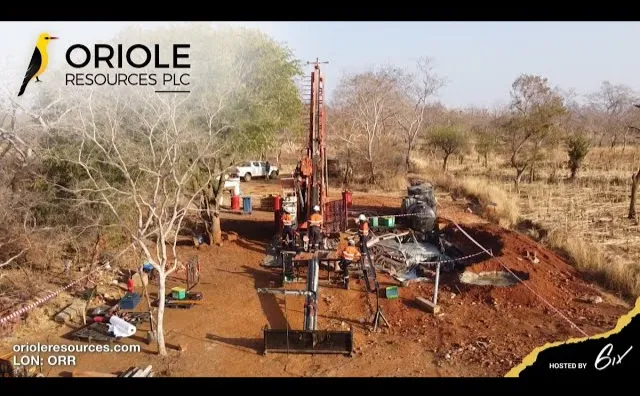
15:21 At this zone, Tim mentioned artisanal mining predominantly in the east. We do have artisanal workings here as well, but they're predominantly shallow workings either targeting the flat-lying veins or the river sediments. But it's a good indicator that we've got gold in the system. So the maiden drilling program itself is a 28-hole program for a planned 3080m. There are 4 holes being planned for the Lower West, Lower East and Bekasi Zone 2 targets. The rest of the holes are being focused on Bekasi Zone 1, which is where we've got the laterally most extensive mineralisation to date.
16:08 Capital Drilling are undertaking the work, they're exceptionally good, producing very high quality core, greater than 94% recovery across all of the holes so far. We're fully orientating the core, which is enabling us to get good quality structural information. And really enabling us to adapt the program on a hole by hole basis, based on the visual geology we're seeing to make sure that we're intersecting those structures at the preferred orientation and getting as much geological data as we can get on the program.
16:43 Sorry, results are expected in the next couple of days from the first hole. They'll be with us any day now. We've also got another 5 holes in preparation at the moment, 2 are arriving to the lab in the next day or 2. Then we've got 3 following up the rear. We are halfway through the programme so far. It's moving at a very good pace and we're really pleased with how the whole programme is coming together and all the mineralisation that we're seeing down the hole. We don't know what the grades are yet, but we're really encouraged by everything we're seeing so far. I'm now going to hand back to Tim to cover some other assets that we've got in Cameroon. Thanks very much, Claire.
17:30 Yeah, it is really encouraging to see the program at Bimimi developing so well. We initially got in there with soil sampling and rock chip sampling and then trenching and now drilling. So, the typical progress of a steady exploration program. The Wapusi project, which is just 20km to the north of the Bibimi license, we also have had, when we first got the project, evidence of Gold in the area. We initially went in, we're a couple of steps behind Bivermeet in the exploration process. We initially went in here and did some rock chip sampling and some soil sampling, broad-spaced soil sampling, to get an idea of the scale of potential mineralisation along these quartz vein systems and shear systems.
18:21 We identified over 13km of anomalous Gold in 3 main bands cutting through the area, indicated on the map here on the right. 1 sort of long trend about 8km and then 2 shorter trends to the southeast. We did some infill soil sampling in this area and we were able to tie together some of that anomalism into really cohesive small areas. So, unlike Bibbimi where we already had 2 phases of trenching on the lead up to drilling, we've only just started trenching Wapusi. We put 3 small trenches in the centre of that main 8km zone over the end of the year and into 2021.
19:15 We're expecting results back from those and we'll obviously be using those results plus what we learn from the geology at Bibbimi to take the next steps at Wabuzie and ultimately what we're trying to do is work up some drill targets. But the important thing here is not to rush into, drilling is expensive and we don't want to rush to put drilling into areas where we haven't fully tested with cheaper methods to confirm anomalism and to give us the confidence that when we do drill, we'll be able to get that verticality to the deposit. So, pilot trenching has been done, we'll wait for the results on that and then we'll move forward a step or 2 behind Bibermeet on the exploration process.
20:02 Now, I suppose the key new exciting thing about Cameroon is this central license package. You know, I mentioned earlier that Cameroon was probably 20 years or so behind in the exploration process as compared to Senegal, Mali, Burkina Faso. Simply, that's just due to a lack of investment in exploration. It's always very easy as a junior company to try to put a license next door to an existing deposit somewhere in a well-known jurisdiction. You don't need to do very much necessarily to get the investor's interest. But what is much more challenging, but ultimately much, much more rewarding, is to try and hunt out new districts, new frontiers for Gold exploration.
20:53 This is exactly what we've done in Cameroon. Back in 2019, after having spent a year and a half already working in Cameroon with our teams working on the ground at Bibbimie and Wapuzi, and with the ongoing relationship developing with the ministry and our confidence growing that we can operate in a very responsible manner, a very transparent manner in Cameroon. We undertook a Cameroon-wide prospectivity analysis of our own based on publicly available data. And this ultimately ended up in a week-long session with nearly 10 geologists, 9 or 10 geologists sitting around in a room, looking at all the aspects in Cameroon, all the potential opportunities in Cameroon, and trying to find where would be the best places to be.
21:45 We ended up with some simple selection criteria that is typically used in orogenic systems. We ended up identifying 7 different areas within Cameroon that looked to be of interest. The advantage of Cameroon, as I mentioned earlier, is a lot of this ground has never been looked at before. So when we ranked our 7 targets, we identified that our rank one and rank 2, our best looking targets, were actually open ground. Nobody had been here before. And What we're looking at here on these 8 licenses marked on the map here on your screens is an area of a display of a major crustal lineament, major crustal suture, splaying off the Central Cameroon Shear Zone, which is by its own nature, literally crosses continents. This is the compression zone and the extension zone between the Congo Craton and the West African Craton.
22:46 And This structure, the Central Cameroon Shear Zone, if you were to bring South America back against Africa, it runs right across into Brazil. So this is really a global suture. Just off this to the north is the Cholere Banyo Shear zone, which runs right through the middle of this license package here. Now, this is ultimately, this trends right up through the Bibimi and Wakuzi areas and right up to the Poieme deposit in Chad. So, it's known for having Gold mineralization along it. And The selection criteria here, we're looking at the right type of rocks, by age of rocks, typically Paleo-Neoproterozoic.
23:26 In the eastern side of the licenses here, the 3 marked up in red, which are under Oriel Cameroon, a subsidiary we put together last year. These are predominantly granodiorites, gneisses, that sort of thing. And then in the West, we have a little bit of Cenozoic cover from some more recent volcanics, but again, good host underneath that. So really a great area to be exploring. And this 8 license package, which was granted to us just in February, just last month, this now we've got full tenure on this for the licensing period and we have the ability to now come in and carry out a really extensive exploration program over the whole area. This is a district-scale package. This is just the kind of ground package that mid-tiers and major companies would be fighting over to try and get control of. And it sits here directly under our control.
24:27 If we zoom into that area and look at the structure in that area and why we think this is such a hotspot for investment. On this image, you can see, I'll just bring your eye to some little yellow stars and also to some red dots. We've got a number of these things here, some little red star, another one here, here. Then these, sorry, I'll just undo that. My drawing skills are pitiful, I'm afraid. Then these red dots in the center here, in a line almost running up here. The yellow stars are target areas that we've identified through this remote structural interpretation, remote sensing work.
25:20 The pink dots, the red dots, are evidence of gold mineralization from previous work by BRGM in the 1960s and 70s, the first phase of countrywide geological mapping. BRGM obviously renowned for their identification of targets, which later became mines in Senegal, Mali, Burkina Faso, etc. So what we have here is a major structural trend. On the western side, those are bimodal volcanics, which are really indicative of an extensional regime. So as Claire was saying, the compression and extension, the squeezing and then the relaxation of pressure is what allows these deep fractures to form. When you relax that pressure, your fluid comes up and you deposit out silica, other alteration, and also along with it, metals and minerals.
26:20 To us, these are all the right things, all the right geological criteria stacking up with the right geology, the right rock types, and historical evidence of Gold mineralisation. More recently, as I said, we only got these licenses last month, so we did this initial structural interpretation straight away. We've also been able to get on the ground here and done a bit of field checking. And we have discovered in the Eastern licenses, we've discovered artisanal mining, small scale, and again, shallow, as we see up in the North. All of the larger artisanal activities in Cameroon seem to be focused on the river systems on the eastern border with Chad and the Central African Republic, because quite simply getting gold out of a river system is much easier than crushing it out of hard rock.
27:15 We believe this area is potentially a source for a lot of that gold. And as Claire says, the best indicator for finding gold in an area is, guess what, finding gold in an area. And we have evidence here with the artisanal workings. So we're very excited about this central licensing package. We're excited that the government has put its trust in us. We've spent a long time building trust with the ministry and handed these licenses to us to explore. But What we've also noticed more recently is a lot of other companies are now starting to focus on Cameroon. We've started to notice that people are picking up ground around us, which we obviously feel very pleased about because it means that our targeting that took us into this area with our 9 geologists in the room, including Dr. Bob Foster, for example, a world-renowned expert on orogenic systems, in on that session.
28:12 Other companies trying to pick up licenses around us, we believe, is vindication that we're in the right place. We think we've got first mover advantage because we were able to target these areas and pick them up first. Effectively, everybody who's coming after us is trying to get the stuff around us, but they're not obviously getting these real gems. Cameroon to us is really exciting. We've got the drill programme at Bivermey, so results coming out of there. We've got secondary exploration at Wapuzi and then we've got this programme in the central licence package, which we've started already. We put a field team out last week to do an orientation survey on stream sediment sampling, which is a very quick and easy method of doing a first pass. This is a 3,500 square kilometre block of ground, contiguous ground, you know, licence to licence.
29:05 That's about half the size of the KK inlayer in Senegal, which Claire's going to show you next. This is a really significant land holding and The stream sediment sampling is a really quick and easy way to work your way through it and to define targets and rapidly move those targets along to the next exploration steps. So Cameroon, you know, central licence package, we think it really is a fantastic area to be. But, you know, outside of Cameroon, we have value in other assets. And I'm going to hand over to Claire now and she's going to run us through Senegal.
29:43 Thanks, Tim. So, the Senala project in Senegal has been in the portfolio for a number of years and has followed across from the days of Stratex. We've got just over 470 square kilometres in a highly prospective region in the southeast of Senegal. The region, as Tim referenced previously, is the KKI or the Kalibukiniba Inlaya, and it's really a hotspot for gold M&A activity on the basis of the multiple million ounce gold deposits, which really are world class and has given the endowment of the region more than 445 million ounces of gold. Most recently, the Endeavor Mining Group bought out Turenga Gold's Sabadana project over the west.
30:32 But importantly for us, we've got BOTO 2.5 million ounce BOTO gold development project, which is owned by IAMGOLD. Just on the right hand side of the map, you can see that it lays within 5 kilometers of our Medina Bafe target in the south of the prospect. And they've also acquired this little strip of land in between called Boto West. But between 2011 and 2016, Stratix previously undertook a number of surface and drilling campaigns, which identified 5 geochemical targets from north to south, and progressive programs really focused on developing Fari and Medina Balfa as the priority targets.
31:17 And you can see on the map some of the intersections that were received from those campaigns, 20 metres at 30 grams per tonne at Fari from diamond drilling,
31:27 9.6 metres at 16 grams per tonne from Medina Bafe. So we really do have some exceptional intersections at this project. In early 2018, we signed a JV agreement with IAMGOLD for their earnings of the project.
31:46 Under the terms of the deal, Irongold has the option to spend $4 million over an initial 4 years to 151%, and then they have the option to increase to 70% interest by spending a further $4 million over a subsequent 2 years. They're currently in year 4 of that programme. The first 2 years of the programme progressed well. They were really focusing on the southernmost targets, the ones that are, I meant highlighted earlier, Medina Bafe and also Serugia, because of their proximity to Boto, the development project. Iron Gold is currently spending 25 million on investment before an investment decision there. It's already an economic deposit, but any additional ounces they find in other licences could potentially provide tropical feed for that development for the Bote mine project. They don't have to build a new mine
32:42 plantation, processing plant on our licence effectively. So the year 1 and 2 programs were focused there. They started by undertaking an air core program. This is effectively a proxy for soil sampling. It's just a sample taken at the subsurface to get an understanding of the geochemical footprint of the mineralisation. Thereafter, they followed up on targets with RC drilling and diamond drilling, and have progressively worked up the licence so that last year, year 3, they were focusing on the Faroe target. That sets up the label. Let me see if I can do the drawing.
33:25 There. And you can see it sits, although the dominant structural trend is Northeast, You can see that there are cross-cutting northwest structures which trend all the way from other properties to the east of us, such as Chester Resources. The programme during year 3 comprised air core drilling for just over 6,000 meters. The results confirmed and enhanced previous gold and soil anomalism that Stratix identified and showed us that we weren't operating in a transported regime, but the soil anomalism that had been identified, the results of that work could be trusted as in situ.
34:13 So on that basis, Ion Gold has
34:16 confirmed its intention to proceed with the Year 4 work programme, and that will continue to focus on Farae. I'll come on to that programme in a second, but at the end of the Year 4 period, should they complete that work, they will then have the option to invest at 51% of the project and then embark on the further 4 million spend over 2 years to get to 70%. Something I didn't mention earlier, but last year, sorry 2019, we were able to with our partners reapply for the license, the entire license footprint for up to a further 10 years. And so that really secures the future of the exploration programs here and gives Iron Bulb the confidence to proceed with their earning.
35:07 So, as I said, the programme is going to focus on FARAE. Unlike the mine trackable feed that was being targeted at Medina Bafe and Cerudia, at FARAE we believe there's standalone resource potential And why we think this is because we're getting high grades over significant intervals, and those intervals are close to the surface.
35:31 Within this area, we have a deep weathering profile and oxidation down to 80 meters. The importance of the deep weathering profile is that it really makes it very friable material near surface, which in addition to the high grades and significant mineralised widths, means that it's just all pointing positively to an open pit potential and making it an economic deposit to ultimately exploit. We obviously have to do a lot more work to get it to that point, but we think all the early indications are there.
36:16 So the year 4 program, on the basis of the AC, of the airport drilling results from last year, the work will focus on follow-up reverse circulation, RC, and diamond drilling over key anomalies at FARAE, targeting the highest anomalies and also the highest grades that were achieved previously from Stratix's drilling programs. That work is due to commence in the next couple of weeks and we'll be expecting results from that work into Q3. Further to that program, that will take up approximately a million dollars of the $1.8 million plan budget. And then thereafter, there will be a phase 2 program. Provisionally, I am going to start with the follow-up work at Medina Bate.
37:06 There has been recent artisanal working over previous high-grade intersections, including the 9m at 16g per tonne that Stratex previously reported. And they want to go back and reinvestigate that area. So they've planned 5,000 meters of RC drilling and 600 meters of diamond drilling, although they do reserve the right to direct that funding to FARE. So we wait to see as that program develops. I'll now hand over to Bob to discuss other projects and investment opportunities we have in the portfolio. Thanks, Claire. So as Tim mentioned, Oriel came into being in 2018, but it actually had a 12-year legacy before that, running as Stratix International.
37:57 And because of that, we've actually got significant value in the legacy assets that were operational then. And we have an active asset realization program, which raised a quarter of a million pounds in 2020, mainly through the sale of Canadian enlisted timber. We had a small investment in that and we got 2 small royalty sales away as well in 2020. And there's these sort of pots of value available to us that we actively try and realise. It's worth bearing in mind in looking at the valuation of the company. So starting in Turkey, which is actually where Stratex started, probably the most valuable asset in the portfolio is the Muradaya Copper Gold Coffee System, which our partner has progressed nicely along and it's about to get its environmental impact assessment second reading effectively. So we're hoping we'll get that through in 2021.
39:00 And this is a big asset. It's a mine current mine plan for it. The last one we saw was 400 million metal, metal value in the plan. We've got a 1.2% royalty on that. So it's a significant asset from our point of view. Elsewhere in Turkey, we've got potential for $700,000 to come in from the Hassan Chalabi license, which we partnered out a couple of years ago. 500,000 of that would come through a success-based payment once that asset gets to EIA, environmental impact stage. And that's the partners currently drilling that at the moment to come up with a resource estimation.
39:47 So we get 500 from that and just over 200,000 when it gets into the kind of mine construction phase, which is probably not 2021, but maybe it's 2022. Also a payment due at mine construction phase would be on the garage license where we're due 250,000, again linked to a royalty sale we did. And alongside that, there's a debt. In fact, there's in total 1.4 million of debts owed by former Turkish partners that we are currently pursuing through the courts and Turkish justice seems to, you know, incredibly slowly but we're very confident the right is on our side and at some point we should recover most if not all of that.
40:39 Elsewhere, Stratix also operated in East Africa, so we have 25% investment in tiny Stratix resources in Egypt, where they recently signed an agreement with Red Sea Resources who were going to come in and earn into that license. And we would expect a fairly aggressive drill program to kick off there quite shortly. And it's pretty interesting because there's 2 targets on the license which cover, which have already got calculated 700,000 ounces of gold resources on them, some JARC, some non-JARC. But obviously, with Red Sea actively pursuing a drill campaign, we're going to see some value add to that.
41:25 As in Djibouti, where our 11% holding in tiny Stratix Djibouti is undergoing a pretty aggressive drill campaign at the moment. The main shareholder and operator of EMR $12.5 million for drilling at the Pandora projects in Djibouti. Whilst we've suffered dilution in both Egypt and Djibouti, we think the value they'll add from those aggressive jewel campaigns will more than compensate it for it and also give us somewhere down the line, give us a route to cash basically, a route to value. So they're both pretty exciting. So moving on from the asset portfolio and into the annual results presentation, which we won't dwell on too much. I think most people have probably seen these figures.
42:21 And this is the profit and loss account for the past 4 years. And the reason we do 4 years is, obviously, 2017 was the last full year of Stratex. 2018 was a year of transition when Tim and I joined and John and David came on board and we changed the name of the company. So 2019 and 2020 have been proper Oriole years effectively. And whilst if you just look at the bottom line, very heartening figures from an accountant's point of view, 6.4 million lost down to a £370,000 loss in 4 years is pretty exceptional. But in all honesty, there was a lot of one-off items in 2017, 2018, and then there's a bunch of items that are outside the control of management, sort of the results of the associate companies, and then the fluctuations of exchange gains and losses, the Sonala asset I just talked about, is denominated in our books in Euros, so we tend to get this big P&L swing as and when the Euro shifts.
43:30 So those results, as I say, impacted by the one-offs and those things outside our control. You know, the one-offs include the aborted acquisition cost in 2017, which led to the change of the company, various investment write-offs through that period, a long and sorry saga about VAT rebates where we had to make a provision, we had to pay some money to HMRC, and then a year later we got it all back. So those first couple of years, a little bit jumbled up. So in order to actually measure our progress, we tend to normalize the P&L, whereby we strip out all of those one-off items, all of those exchange gains and losses, all that sort of thing.
44:17 And it's still a pretty pleasing picture. We've got a 2.4 million loss going down to a 650,000 pound loss in 2020. So that's a 75% reduction in the running costs of the business. And this is effectively the cash running costs of the business. It excludes any of the sort of direct exploration costs. And we very much see our job as minimize the running costs and spend as much as we can on the exploration. Obviously results driven exploration. And how we've done it is effectively we've been very very cost conscious. A good example would be when the world started going into lockdown with Covid, by the end of the first week of the COVID lockdown, that the entire team had decided voluntarily to go on part-time wages.
45:10 And there was in certain times, it was vital we went to cash conservation strategy and reduced our costs accordingly till we knew what the world would look like for a junior explorer. So we've been very cost conscious, we've been innovative, we believe we're the first junior explorer to make use of the HMRC's research and development tax credit scheme. We've had in over £300,000 in in 2 and a half years to 31 December 2020, so it's been a significant source of cash for us. And then at the same time our Turkish team who were there, you know, when I talked about all the value in the Turkish assets, it's about easily 4 million value we need to manage in Turkey and realize somewhere.
46:01 Having a Turkish team there is absolutely invaluable, even more so now that they've developed a consultancy business that basically pays for them. So they've turned from being a loss center to a profit center, a small profit, but having that resource there is really helpful for us in realizing that value. So that's how we've got down to the 600,000 cost base. And this is a slide we put together to show where we spend it, basically, where the 600,000 goes. The gold bar on the bottom is the compliance and legal professional. And it sits at a kind of stubborn 250,000 to 300,000 each year.
46:49 Compliance because we're aim listed so we need all of the sort of regulatory stuff like more rights and brokers that go around being a name company. And legal and professional because we're multi-jurisdictional. We're operating in Cameroon, Senegal, Turkey, the UK, lots of places, and we need legal representation there. So the fees to those advisors wax and wane, depending on what's going on there, but it's a fairly stubborn 250 that we have as a base cost there. The green and light blue represent the UK directors and UK staff, and as you can see, we've reduced those down. I think it's a 56 percent reduction over the course of the 4 years.
47:35 And then there's very little on top of that. The slug of orange costs that was 300,000 pounds in 2017 is now a small profit. That's our Turkish team. The other costs, which in the dark blue, now include the research and development tax credit, so again, have become a positive in 2020. So we've basically pulled the cost down as much as we can, and at the same time, become a very active exploration company. So as you can see from the line I've just added, 2017, we weren't really an exploration company, working out what to do with Sonalo in many ways, Dallefina as it was at the time, and dealing with a lot of other corporate issues.
48:23 Tim and I arrived in 2018 and pick up the land Tim talked about in his presentation coming in, and immediately we started ramping up the exploration spend. And you know in all truth those 2 lines should cross the bar chart at some point, be higher than the bar chart, probably now in 2022 as a drug program. Obviously 2021 we were hit by COVID which kind of limited what we could do, but I'd argue we still made pretty good use of the year. We were active in January, February, people on the ground doing mapping and thinking about the drill program, where would we put the holes? And then as soon as we could get back into Cameroon after the rainy season and COVID restrictions eased, October, November, December, we were back on the ground, planning for the drill campaign, building the camp, and basically getting ready to kick off, which we did very early in 2021.
49:26 So I would expect, well, certainly the expenditure in 2022 on exploration will be significantly more than it was in 2021. But we may be near to the year. So this is a little slide in our corporate profile. We don't have any notifiable interest shareholders. We don't have any shareholders over 3% of the current market time. We show this graph as fully diluted, mainly to try and show the directors who are all mutually trying to build a stake in it. So we've all participated in the various placings and we all sacrificed 4 months of salary at the end of 2019-2020.
50:12 Actually before COVID, more about cash conservation in light of Brexit. We sacrificed 4 months of salary to make sure we were fully aligned with shareholders, so those share options are in existence there. And we've went into, well we closed the year with £1.8 million of cash in the bank, having just completed a fund raise in October. Now in that fund raise we also included some warrants, some shareholder warrants, which have actually been, there's been a steady stream of exercises this year. So we've raised, since that year end point, we've had £700,000 come in from the warrants.
50:59 The warrants themselves had an accelerator provision, which has actually been satisfied now because of share price rise. But at the moment, we're sort of content with letting the warrants naturally exercise themselves as we go through the year. We've got plenty of cash in the bank. We've had this 700,000 come in, which is very helpful. And potentially the warrants themselves over the next year and a half maybe give us another 1.4 million pounds of cash, which will mean we can keep pushing ahead in Cameroon where we've got follow up work on the 2 Northern licences and the initial work on the central licences to push ahead with. So we're in a pretty well funded position for Junia coming out of a difficult global year.
51:50 And on that, I will hand over to Tim, who's going to talk through Newsflow. Thanks very much, Bob. So yeah, just to wrap up, really. Obviously, Cameroon is going to be front and centre of the news flow, results from the maiden drilling at Bibimi, as Claire mentioned, Q1. Well, that finishes in 2 days' time, so we can expect those pretty soon. They may drift across a day or 2 into Q2, but we should be starting to see the results over there. We have a progressive programme so those results will drift out through the whole of Q2. The key thing obviously for us in new ground in Cameroon, the package-wide stream sediment sampling programme in that central licence package is really important to us.
52:38 Confirmation of the 51% ownership of Bibbime and Wapuzi, we're at that point already, we'll be transferring that over, Administration's underway to resolve that right now and then potentially up to 90% at the end of the drill program. Senegal, as Claire mentioned, ongoing exploration work from Iron Gold, we're free carried. They're targeting the Farae potential standalone and also Medina Barfa down near their Boto Mine development project. So lots to come out of there, big program, a lot of spend going on there, nearly $2M. And then as Bob mentioned, we have a lot of other assets, a lot of other investments. It's just a matter of as and when those come through, we'll be updating the market.
53:23 The majority of those are around cash coming into the company. A lot of the times, we're a little bit like a duck in the river, very calm on top with the feet paddling like crazy underneath. People don't see what's happening with those assets, but rest assured that we're looking to sort of recoup as much value as we can as soon as we can on those to ensure that we can continue to fund the ongoing program in programs, rather, in plural, in Cameroon. So that's about it. We'll hand back to Darsha for Q&A. Great, thank you so much. We don't have too much time here for questions, so I'm going to jump right in. And if you haven't submitted a question, now is your time to do so.
54:11 But to kick things off, are you pleased with what you're seeing from the current drill program at Bimbebe? And what is the timescale for follow-up work on the defined targets and what will those follow-up programs look like? We're very pleased with what we're seeing. Obviously as Claire says we're only seeing it in the core, we're not seeing the assay results yet but yeah we're very pleased with what we're seeing. Claire, do you want to talk to what the programme may look like? Yeah, absolutely. So, we're hoping to get all the results during the next quarter and then over the what is the rainy season in West Africa, we will be compiling all those results, planning our next steps. It will all be results-driven and as Tim says, although we've got visual indications of the mineralisation, we don't know what the grades are yet, So we'll have to put all of that into context.
55:03 But typically, we would look to undertake further diamond drilling if we need to better refine the structural controls, or we could progress to start drilling it out and move to reverse circulation drilling. So it will all be dependent on RC drilling but our intention would be to restart the program as soon as the next dry season starts in October. Great, Thank you. With the new license in central Cameroon, how will you manage exploring such a large land package? And how long is it going to take you to explore them all? Are you focusing on certain ones first? It's a pretty prescribed process of exploration.
55:48 We have started at sort of satellite level. And it's all a matter of just getting tighter and tighter and tighter to the targets. Stream sediment sampling is the phase we're doing now. We'll be taking approximately 1,400 stream sediment samples over the next 2 to 3 months and that will really define whereabouts in those 8 licenses in that 3,500km which stream and river basins have got evidence of gold mineralisation. The next step is then to zoom into those and do some mapping, do some rock chip sampling, perhaps some soil sampling and then zoom in again, maybe do some geophysics. It's a step-by-step process. The good thing is that most of the early work on these things is very, very cheap and very quick. We've got great access.
56:41 The main highway through North to South through Cameroon runs right through the middle of this license package. We have different geology in the 5 licenses in the east to the 3 in the west, where they have that sort of more recent volcanic cover. So that may dictate how we progress things, but we're pretty confident we can move through these very, very quickly. But we do have the benefit of having the licenses only being granted a month ago. So we've got long tenure on these. Great. All right. Well, Paul is asking, is Oriel looking at new projects that could excite and deliver nearer term value? He says the main asset appears to be the geologist skill set with teaming up with another company at project level either way forward, for example.
57:28 Interesting idea. I don't necessarily think that chasing a more advanced level project is off the cards, but at the same time, we add value at the beginning of the exploration chain. You get certain peaks in the value addition chart and we're focused on that early stage. The fastest rise is when you have discovery, and then from discovery, you have resource definition and then you start going on to developing economic models and feasibilities, pre-feasibility, feasibility, and then construction and development. So, those early de-risking stages are, first of all, cheaper, and secondly, typically give you a much steeper curve, a much more faster return on your invested dollar.
58:16 And That's where we have a lot of skill set. We do have skills throughout the chain. I've spent half my career on advanced projects, large advanced projects, multi-billion dollar projects. The key thing is what is appropriate to the stage that we are at as a company. We never say no to looking at new assets, new opportunities, but we also don't want to overstretch ourselves and not be able to deliver on the fantastic ground that we have, for example, in Cameroon. Great. So I think we have time for just one more question here. So all being well, IMGold will get 51% of Sinala at the end of their four-year program. What will be the next for the project and what will Oriel's role be?
59:03 Well, the next step, you know, as Claire mentioned, that once they reach 51%, they have an option to continue to 70%. And that costs them $4 million of earning over the next 2 years. If they elect to do that, then we continue to be free carried. If they elect not to give away that right to go to 70%, then they stay at 51% and we have a larger ownership. And then we start working together on programs rather than being in the hands of IAMGOLD. What's next for us? Being a minority partner to a company like IAMGOLD in an extremely prospective area where they already have operating mines and mine development projects is a very stable place to be. So we're very content to just be carried along for now.
59:59 Great, well, Thank you so much. That's all the time we have for today. I'd like to thank you, Tim, Claire, Bob, for taking us through your presentation and the Q&A session. I also want to thank everyone who joined us today and submitted questions. I know we didn't get a chance to get all of your questions answered right now, but we will be sending out a short survey and you'll have the opportunity to leave your contact details and ask your questions directly to the Oriel Resources team and they will follow up with you directly. You can also find more information on their website and at www.orielresources.com. So to close things off I'll hand it back to you Tim. Well thanks very much And thanks everybody for dialing in and listening. Obviously, reach out to us through the website and we hope that you're able to share success with us in the coming years.