Miroslava Minkova
Director of Investor Relations and Corporate Development
Replay available
Bruker (NASDAQ:BRKR) Q2 2020 earnings call, held 2020-08-03. Watch the replay and read the transcript on 6ix.
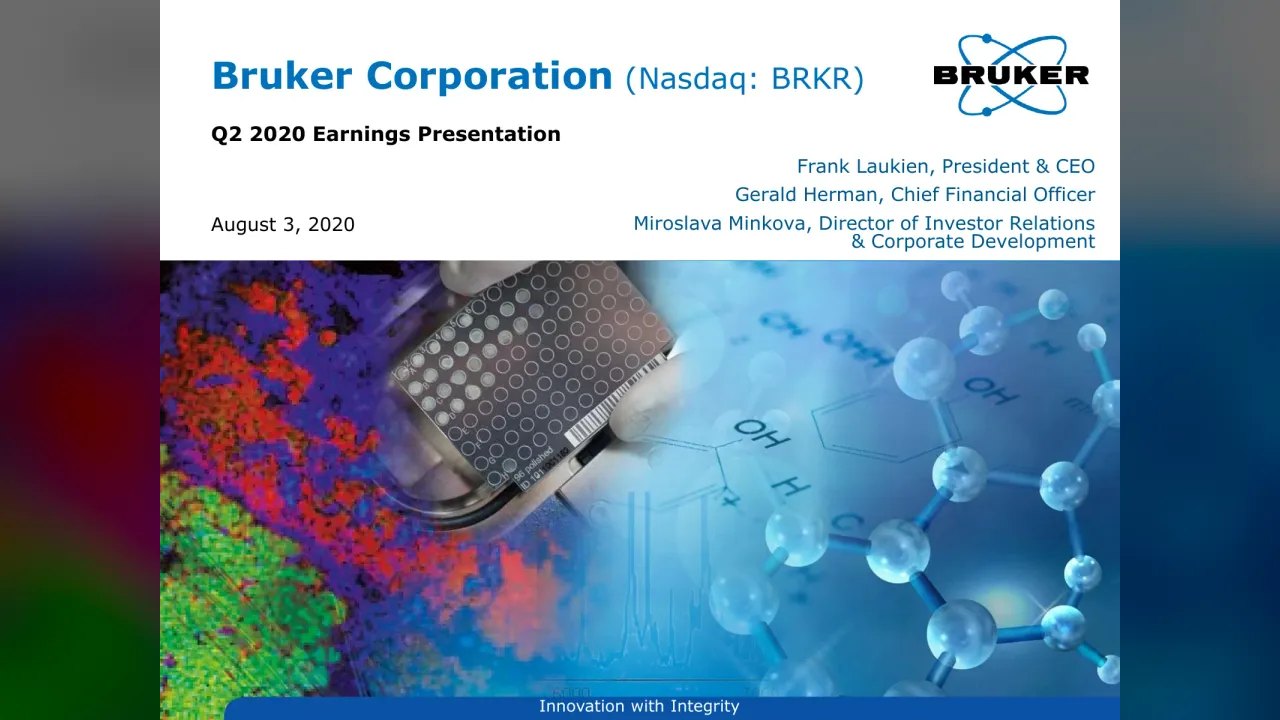
On 6ix: 6ix.com/event/bruker-corporation-brkr-q2-2020-earnings-call
Automated transcript · Written by software from the replay's audio. It can mishear names and figures; the replay is the record.
0:00 Good afternoon and welcome to the Brewker's second quarter 2020 conference call. All participants will be in a listen-only mode. Should you need assistance, please signal a conference specialist by pressing the star key followed by zero. After today's presentation, there will be an opportunity to ask questions. Please also note today's event is being recorded. At this time, I'd like to turn the conference call over to Miroslava Minkova, Director of Investor Relations and Corporate Development. Ma'am, please go ahead.
0:31 Good afternoon. I would like to welcome everyone to Burkhard's second quarter 2020 earnings conference call. My name is Miroslava Minkova, Director of Investor Relations and Corporate Development. Joining me on today's call are Frank Laukien, our President and CEO, and Gerald Herman, our Chief Financial Officer. In addition to the earnings release we issued earlier today, during today's conference call, we'll be referencing a slide presentation. The PDF of this presentation can be downloaded from the latest results section on Brooker's Investor Relations website. During today's call, we'll be highlighting non-GAAP financial information. Reconciliations of our non-GAAP to GAAP financial measures are available in our earnings release and are posted on our website at ir.brooker.com.
1:25 Before we begin, I would like to reference Brooker's safe harbor statement, which is shown on slide 2. during the course of this conference call will make forward-looking statements regarding future events and the financial and operational performance of the company that involve risks and uncertainties, including new risks and uncertainties related to COVID-19 and the COVID-19 pandemic. The company's actual results may differ materially from projections or scenario estimates described in past statements. Factors that might cause such differences include, but are not limited to, those discussed in today's earnings release and in our Form 10-K and subsequent Form 10-Q filings, all of which are available on our website and on the SEC's website.
2:15 Also note that the following information is related to current business conditions and to our outlook as of today, August 3rd, 2020. Consistent with our prior practice, we do not intend to update our forward-looking statements based on new information Future Events or Other Reasons prior to the release of our third quarter 2020 financial results expected in early November 2020. Therefore, you should not rely on these forward-looking statements as representing our views or outlook as of any date subsequent to today. We'll begin today's call with Frank providing a business summary. Gerald will then cover the financials for the second quarter 2020 in more detail.
3:00 Now, I would like to turn the call over to Bruker's CEO, Frank Laukien.
3:05 Thank you, Miroslava. Good afternoon, everyone, and thank you for joining us on today's call. I hope you and your families are well. These are challenging times as we all manage through a global pandemic that has upended economies and daily lives. At Bruker, as you can see on our slide three, we remain focused on our key priorities, Number one, the health and safety of our employees, customers, and partners. Number two, maintaining service levels for our customers. Number three, carefully managing our cost structure while continuing to invest in important long-term project accelerate and operational excellence initiatives. And number four, delivering enabling research and diagnostic products that support essential priorities of our society and help fight the pandemic.
4:01 I am very proud of how our leadership team and our 7,000 employees worldwide have delivered. Our organization has continued to support our customers globally with exemplary dedication while adhering to appropriate health and safety protocols. Over the last few months, we have supported various initiatives aiming to understand The characteristics of the SARS-CoV-2 virus and of the COVID-19 disease. For example, we are supporting the COVID-19 NMR Initiative, which is a consortium of 140 scientists in 30 research groups across 15 countries who are working to determine the DNA and protein structures of the SARS-CoV-2 virus in order to investigate the drug ability of such structures with pharmaceutical inhibitors.
5:03 Between late March and the end of June, we continuously rent our Bruker Hein deliveries of nucleic acid extraction kits and of COVID-19 PCR test kits to customers in Europe and Africa. In Q2 2020, we reached 7 million in COVID-19 related testing revenues. These revenues came from the sale of liquid handling robots from about half a million nucleic acid extraction kits and about a quarter million COVID-19 PCR assays in the second quarter of 2020. We intend to ramp this further in the second half of 2020 and into 2021, and we are presently evaluating additional COVID-19 related tests for our assay portfolio.
5:55 Just last week, we announced our second-generation CE-IVD-marked fluorotype SARS-CoV-2 plus PCR test for the detection of COVID-19. The new test targets two independent genes on the SARS-CoV-2 genome, while at the same time differentiating the SARS-CoV-2 virus from four common human coronaviruses. The test is available on our novel Bruker Heim Glurocycler XT real-time PCR system as well as on other commonly available thermocyclers. From an operational standpoint by now all of our major manufacturing sites have returned to the new normal operations with expanding capacity and productivity levels and we are currently not facing any Bruker factory disruptions anymore as we did in April and into May at certain sites affected by full or partial site closures.
6:59 Several of our European factories continue to use the short-time work approach to reduce their capacities and cost structures during reduced demand. Generally, our teams have done an excellent job in managing our costs and objects in the second quarter, which is why our second quarter non-GAAP operating margin has improved sequentially by 390 bids compared to the first quarter of 2020 despite similar revenues. Financially, our second quarter 2020 revenues declined less than the minus 15 to minus 25% year-over-year revenue decline scenarios that we outlined during our last earnings call. We also mitigated The negative impacts of the pandemic on our profitability and cash flow through successful cost control and cost reduction measures while continuing to invest in our key dual strategic priorities of project accelerate and operational excellence.
8:09 Exiting the second quarter 2020, Brooker maintains a healthy balance sheet and we believe Brooker is well positioned for sequentially improving business conditions in the second half I now go to slide 5, where we show the financial highlights for the second quarter of 2020. Brokers Q2 2020 revenues declined 13.4% year-over-year to $425 million. Acquisitions added 0.4% to revenue growth, while foreign currency translation was a headwind of 1.1%. On an organic basis, Brooker's second quarter 2020 revenues declined 12.7% year over year, and the reported and organic revenue declines primarily reflect COVID-19 related disruptions to our customers and certain of our operations, along with software instrument demand by academic, industrial, and applied customers due to the pandemic.
9:17 Our second quarter 2020 non-GAAP gross margin decreased 440 bps year-over-year to 45.1%, while our non-GAAP operating margin declined 350 bps year-over-year to 11.5%. The margin decline reflects primarily lower revenues and reduced productivity due to disruption from the pandemic, partially offset by cost control and reduction measurements, as Gerald will discuss. Two of 2020, Bruker reported GAAP diluted EPS of 16 cents per share compared to 23 cents in the second quarter of 2019. On a non-GAAP basis, second quarter 2020 EPS of 21 cents compared to 33 cents in the second quarter of 2019.
10:10 On slide six, we show Bruker's performance for the first half of 2020. Our revenues decreased by $103 million year-over-year or by 10.8% to $849 million. On an organic basis, revenues declined 10.3% year-over-year in the first half, comprised of a 10.5% organic decline in the scientific instruments business and an 8.5% organic decline at best net of interest company eliminations. Acquisitions added 0.6% to our top line while foreign exchange was a 1.1% Edwin. First half 2020 order bookings for Brooker's three scientific instrument groups declined in the mid to high single digits organically.
11:00 In our Q1 2020 earnings call, we shared our expectation that order bookings would soften during the second quarter due to customer closures and disruptions from the pandemic, and this was indeed the case. However, our BSI book-to-bill ratio of approximately 1.1 for the first half of 2020 implies the order rate held better than the first half 2020 revenue declines would suggest. Towards the end of the second quarter, academic laboratories began gradually, began to reopen gradually, and this continues, and a process that continues albeit with reduced capacities compared to pre-pandemic levels.
11:45 The operations of our industrial and applied customers also continue to normalize, although with a more uncertain spending outlook. Biopharma markets and order rates remained robust while the semiconductor metrology markets have continued to rebound. Our life science mass spectrometry and infectious disease diagnostics businesses are growing. Although the environment remains challenging, we continue to anticipate gradual sequential improvements in business conditions as we move into the back half of the year compared to the first half of 2020. Our first half 2020 non-GAAP gross margin decreased 330 basis points compared to the first half of 2019, while non-GAAP operating margins declined 470 basis points year-over-year.
12:38 We were able to partially offset the impact of the lower revenue and reduce productivity on our operating margin by controlling and reducing expenses. On a GAAP basis, broker EPS of 22 cents in the first half of 2020 compared to 43 cents in the first half of 2019. Our first half 2020 non-GAAP EPS of 35 cents compared to 61 cents in the first half of 2019. All right, please turn to slide seven and eight now, where I provide further highlights on the first half 2020 performance of our three scientific instruments group and of our BEX segment, all on a constant currency basis and in comparison to the first half of 2019.
13:30 First half 2020 BioSpin group revenue declined low double digits to 246 million. The revenue decline at BioSpin was due to COVID-related customer lab closures and installation delays, as well as the temporary closure of one of BioSpin's manufacturing sites. We have since reopened that site, while BioSpin's academic customers have been gradually returning to their labs, and international tenders in applied and clinical markets are resuming. of 2020, BioSpin received customer acceptance for the world's first 1.2 gigahertz NMR system, which was successfully installed at the CIRM of the University of Florence in Italy. This was a remarkable achievement, capping a decade of R&D into groundbreaking 1.2 gigahertz materials and magnet technology.
14:21 As we indicated on our Q1 conference call, during Q2 of 2020, We recognize revenue on just the NMR console and probes for this particular Italian 1.2 GHz system, while the Florence Magnet is subject to a multi-year lease contract. During the first half of the year 2020, BioSpin's NMR and PCI systems revenue declined significantly year over year due to delivery and installation delays caused primarily by customer disruptions. BioSpin's aftermarket revenue held steady year-over-year, with software revenues higher, although off a low base.
15:06 Moving on to the CALID group, the first half of 2020 CALID group revenues declined low single digits to $273 million. The modest decline at CALID reflects a significant revenue decline in molecular spectroscopy compared to the first half of 2019, which was partially offset by continued growth in our Daltonics Life Science Mass Spectrometry, Microbiology, and Infectious Disease Diagnostics business. Kallitz Microbiology and Infectious Disease Consumables, which include our multi-biotyper consumables and Bruker Hein nucleic acid extraction and COVID-19 PCR assays, grew significantly year over year.
15:51 In Life Science Mass Spectrometry, our Tims Toft Proteomics business saw continued growth despite the challenging business conditions for instruments and customer site installation delays. Revenues for our FTIR, Nirai, Raman molecular spectroscopy products declined substantially year over year due to COVID-19 related disruptions to customer operations, lower demand, and a temporary factory slowdown. Please turn to slide eight now. Brooker Nano revenues were down mid-teens year-over-year to $246 million in the first half of 2020. The decline in Nano revenues was due to worldwide academic customer closures due to the pandemic, weaker industrial markets demand, and temporary factory closures at some of Nano's businesses, which also were reopened by the end of May.
16:50 Nanos X-ray, nanosurface, and nanoanalysis tools all declined compared to the first 2019 due to academic customer closures and significantly slower industrial research demand. Semiconductor metrology revenue for the nano group held steady year over year, with order rates improving as semi-metrology equipment markets appear to be in a rebound. Finally, best revenue in the first half of 2020 declined high single digits, net of intercompany eliminations due to weakening superconductor demand by MRI companies and government research lab disruptions from COVID-19. So, despite the challenges created by COVID-19, Bruker continues its track record of meaningful innovation, which we believe will position the company well for recovery as global market conditions improve.
17:48 Turning to slide nine, during the recent ASMS Reboot virtual conference in early June, I believe we were the clear innovation leader as we introduced instrument and workflow innovations for our flagship TIMSTOFT mass spectrometry platform for high throughput, high sensitivity spatialomics, discovery proteomics, and targeted proteomics. Our TIMSTOFT platform actually maintained a healthy double digit year-over-year order growth rate even during the difficult first half of 2020. If you take a quick look at slide number nine, you will see at ASMS we had a very major innovation with a MALDI-2 source that is really taking, is a next generation MALDI source that provides one to two orders of magnitude increase in sensitivity for many small molecules and lipids.
18:44 And it greatly increases the applications range of MALDI mass spectrometry and MALDI mass spectrometry imaging. Both of them very important to our business. In parallel, in 4D proteomics and also 4D metabolomics, for that matter, on our GIMSTOP platform, we introduced targeted so-called PRM passive methods, high throughput, short gradient, diapassive methods. We did a lot of work on fly constellation analysis, which is very important for viral antigens. whether you're developing SARS-CoV-2 vaccines or serology assays, you need antigens with a proper glycosylation patterns.
19:32 And that's another area where the TeamSTOCK platform excels. Moreover, taking this really this fourth dimension that we keep mentioning in 4D proteomics, we've shown and some of our collaborators have shown the use of very large-scale accurate collision cross-sections using the iMobility spectrometry capabilities of our TIM system that are completely unique and that moreover in addition to measuring tens and hundreds of thousands of collision cross-sections routinely and at scale also allow excellent machine learning and prediction. So it's really changing the way proteomics is done Fundamentally, it's allowing about an order of magnitude more information content and peak capacity, which is tremendously important for the future of high-throughput and in-depth proteomics.
20:24 We also introduced together with a partner company the run-and-done IP2 GPU 40 proteomics analysis software, something that has previously not been done and, again, addresses the bottleneck in high-throughput proteomics. If you go to slide 10, as we've said already earlier, we are pleased to announce the customer acceptance of a second 1.2 GHz NMR system at the Eichgenössische Technische Hochschule, or ETH, in Zurich, Switzerland, which was in July, and that revenue, therefore, is anticipated for Q3. It was not in Q2. We continue to ramp our GHz class production and testing capacity at our Swiss Biospin We've already shipped an additional system to the Max Planck Institute in Germany. And so our Gigahertz and Gigahertz Plus business is really running very nicely, and we're very, very pleased with how this has gone so far this year.
21:28 Moreover, as I mentioned earlier, and you'll be seeing more news of that in future weeks, NMR is really quite important in COVID-19 research. I had mentioned earlier the International COVID-19 NMR Consortium with the website being given here on slide 10, which is very important for functional structural biology and for studying how pharmaceutical inhibitor binding can bind to the SARS-CoV-2 RNA or proteins. Moreover, we're making very good progress in our collaboration with Murdoch University and the Australian National Phenome Center in Perth, Western Australia, in studying what will soon be called, in my opinion, the post-COVID-19 syndrome that comes after the active infection, whether it's asymptomatic or with severe symptoms. And we are using some very unique NMR and mass spec combined plasma Metabolomics Methods to study the long-term effects, which are really quite considerable, even for patients who barely had any symptoms or had very mild symptoms.
22:39 So, if you like, that will be, in some ways, the third wave of post-COVID-19 syndrome effects that we're only beginning to see now. This is the other sixth, seventh of the iceberg that has not emerged yet, and I believe NMR and MassVac with metabolomics will play a very important role as a screening tool for this next focus of our COVID pandemic health concerns. Anyway, let me conclude by reiterating that Bruker remains fundamentally healthy and we continue to invest in our key project, Accelerate, and operational priorities that we believe will position the company well for the future. While we anticipate that the pandemic will continue to negatively impact Our third quarter financial results year over year. We expect sequential improvements in our financial performance from the second quarter to the third quarter of 2020, provided, of course, that the present second wave increase in infections can be contained.
23:42 With that, let me now turn the call over to our CFO, Gerald Herman, who will review our Q2 and first half 2020 financial performance in more detail. Gerald.
23:53 Thank you, Frank. Hello, everyone. I'm pleased to walk you through Brooker's second quarter 2020 financial highlights, starting on slide 12. Brooker's reported revenue decreased 13.4% year over year to $425 million in the second quarter of 2020, which reflects an organic revenue decline of 12.7%, favorable to the revenue decline scenarios we outlined in our Q1 earnings call. We reported gap EPS of $0.16 per share Thank you very much. Thank you very much.
25:20 Thank you. Thank you. Thank you. and our share repurchase activity. In Q2 2020, we repurchased 1.2 million shares of Bruker stock for a total of $50 million. As of June 30th, we have $107.7 million remaining on our share repurchase authorization, which is valid until mid-May 2021.
26:13 At the end of Q2 2020, our working capital to revenue ratio was slightly higher than a year ago. as we carried higher inventory levels to address supply chain risks related to the pandemic. Slide 13 shows the revenue bridge for Q2 2020. As noted earlier, organic revenue in the quarter declined 12.7%. We had a positive revenue contribution from acquisitions of 0.4%, which was more than offset by a foreign currency headwind of 1.1%. From an organic DSI revenue perspective, Q2 2020 biospin revenues declined in the high teens year over year. Calid revenues declined low single digits, and nano revenues were down mid-teens.
27:02 Brooker's biopharma revenues, multibiotyper consumables, Brooker-Hein molecular diagnostic consumables, and Timstock proteomics revenues all grew in the second quarter. while our academic and industrial research revenues were pressured by customer closures, lower demand and installation delays related to the pandemic. Second quarter semiconductor metrology revenues grew year over year. For our three BSI groups, second quarter systems revenue declined in the high teens while aftermarket revenue grew low single digits year over year. Despite the revenue declines we've experienced since the start of the pandemic, we exited Q2 with our BSI backlog approximately 9% above the Q2 2019 ending backlog.
27:56 Past revenues were down 12.5% net of intercompany eliminations. Geographically, and on an organic basis in Q2 2020, European revenues declined mid-single digits. North American revenues was down high teens. Asia Pacific revenues declined low double digits, including steep declines in Japan and the rest of the APEC markets. Our China Q2 2020 revenue declined low single digits year over year as China began to recover from its lockdown. Slide 14 shows our P&L results for the second quarter of 2020 on an on-gap basis.
28:41 Q2 2020 non-GAAP gross profit margin of 45.1% decreased 440 basis points from 49.5% in Q2 2019, driven principally by lower volume, reduced productivity and factory inefficiencies from COVID-19 disruptions to our operations and those of our customers. This was partially mitigated by our cost reduction measures. Q2 2020 non-GAAP operating expenses declined 16% compared to Q2 2019. In March, as COVID-19 spread further into Europe and North America, we took cost reduction actions to support the profitability and cash flow of the company.
29:26 These included previously planned restructuring actions, primarily within the BSI nano segment, as well as additional temporary cost measures due to the pandemic throughout Brooker. We expect continued cost savings over the balance of 2020, but we will relax certain temporary cost measures as our revenue and profitability declines were not nearly as severe as potentially feared a few months ago. In Q2 2020, our non-GAAP operating margin declined 350 basis points compared to Q2 2019, as cost actions partially mitigated the impact of the revenue, volume, and productivity declines. For the second quarter of 2020, our non-GAAP effective tax rate of 22.6% was 70 basis points below the prior year quarter due to a more favorable jurisdictional mix.
30:22 Weighted average diluted shares outstanding in the second quarter of 2020 were 154.7 million, a reduction of approximately 2.9 million shares from Q2 2019 following our share repurchase activity. Finally, Q2 2020 non-GAAP EPS of 21 cents decreased 36% year-over-year, driven by lower revenue and margins. Slide 15 shows the year-over-year revenue bridge for the first half of 2020. Revenue was down $103 million, or 10.8%, reflecting a first-half 2020 organic decline of 10.3%. This included a 10.5% organic decline at the three BSI groups collectively, while the best segment declined 8.5% net of intercompany eliminations.
31:17 Geographically, and on an organic basis in the first half of 2020, Booker's European revenue was down mid-single digits. North American and Asia Pacific revenues declined low double digits, including a high teens decline in China. which had a particularly weak Q1. On slide 16, our first half 2029 gap gross profit margin of 45.9% decreased 330 basis points. Lower volume, reduced productivity and unfavorable mix caused the decline relative to the first half of 2019. First half 2020 operating expenses were down 7% year over year All in, our non-GAAP operating margin in the first half of 2020 of 9.6% was 470 basis points below the prior year period on lower revenue and margin performance partially offset by cost reduction measures.
32:21 Finally, non-GAAP EPS of 35 cents per share declined 43% relative to the first half of 2019, reflecting our revenue decline and weaker margins. Turning now to slide 17, our free cash outflow in the first half of 2020 of approximately $4 million was similar to that of the first half of 2019. This reflects a lower forecast taxable income, and our continued CapEx investments in higher productivity and higher capacity facilities. Our cash conversion cycle at the end of Q2 2020 of 281 days worsened from 237 days a year ago. with the step up driven primarily by an increase in DIO as we carried higher inventory balances due to supplier and customer lab disruptions from the pandemic and some modest increase in DSO.
33:31 Turning now to slide 19, in March, we suspended our guidance for 2020 due to the uncertain business conditions created by COVID-19. Business uncertainties related to the pandemic remain substantial in many parts of the world Frank Laukien, Brent Alldredge Although to a lesser extent than in Q2, as our academic and government customers continue to reopen.
34:23 Similar to Q2 2020, we believe it's better to think about a range of scenarios for the third quarter of 2020 with the potential for a 6% to 10% year-over-year revenue decline. On a sequential basis, we expect Q3 2020 financial performance to improve relative to Q2 2020. Please note that, of course, actual results may be outside these scenario ranges, but this gives you our good faith estimates at this time based on the information currently available to us. Our working assumption is that business conditions and the disruptive impact of the pandemic will continue to gradually improve in the second half of 2020, although an economic recovery is not anticipated until 2021 or later.
35:11 Directionally, based on the limited level of visibility we have today, we currently anticipate revenues to decline in Q4 2020 year over year, but continue to improve sequentially versus Q3 2020. These scenarios also assume that any potential future waves of infections will not lead to new significant lockdowns. In conclusion, Thank you very much. And with that, I'd like to turn the call over to Miroslava to start the Q&A session.
36:08 Thank you very much.
36:09 Thanks, Gerald. I would now like to turn the call over to the operator to begin the Q&A portion. As a reminder, in order to allow everyone time for questions, we ask that you limit yourself to one question and a follow-up. Operator, we are ready to begin the Q&A. Ladies and gentlemen, we'll begin the question and answer session. To ask a question, you may press star and then 1. If you are using a speakerphone, we do ask that you please pick up the handset before pressing the keys. To withdraw your questions, you may press star and 2. Once again, we do ask that you please limit yourselves to a single question and one follow-up. Our first question today comes from Patrick Donnelly from Citigroup.
36:54 Please go ahead with your question.
36:57 Great, thanks, guys. Frank, maybe just on the academic government market there, you know, obviously one a lot of your peers have called out as being slow to come back online as well. Can you just talk through the trends you're seeing there throughout the quarter and maybe even into July? Any geographies particularly weak or strong? And then with that one, is that kind of the primary reason you guys are thinking 4Q probably still declines? That market is just very slow to come back?
37:23 Yeah, good questions, Pat. Well, obviously China – began to open first, but the opening in China is not that fast. It's not that they had a V-shaped recovery or reopening. Europe is ahead of the United States. Also, the infection rates are now generally lower in Europe. As you have seen, the U.S. academic and government customers are all cautiously gradually reopening. Of course, I'm aware that not all students are coming back. but that doesn't really affect us. It's the grad student, postdocs and professors, the research part of the academic enterprise and they're all opening and reopening gradually just obviously under all these new normal conditions that are different from working previously.
38:09 So access to labs is improving. Same is true in Japan. There's some geographies like India or parts of Australia are still quite difficult and there are sometimes additional Thank you very much. Thank you. Thank you.
39:21 It certainly seemed pretty effective, kept margins more resilient than we had expected. How should we be thinking about the durability of those cost savings? How aggressive you guys will be in the back half? Again, kind of expecting negative growth both quarters. Any helpful commentary you could have on the margin cadence there for the remainder of the year would certainly be helpful.
39:39 Sure. Well, so we're quite pleased, actually, with the overall actions that we took and the results that we achieved. I think, as I said in my earlier notes, that... The cost reduction actions I think were quite effective for the second quarter. We made very significant progress I think with respect to that area in the second quarter and we expect to be able to carry a number of those elements in to the third and the fourth quarter. However, I would not expect the level of savings, cost savings to necessarily translate you know one for one especially as we move into the third and the fourth quarter we are as I noted earlier we are expecting to see sequential improvement both in our revenue performance and we would expect that to translate into better financial performance all the way down the line so I think that's probably the best I can say relative to Q3 and we don't have particularly good visibility as Frank just mentioned as it goes forward to Q4, but our expectation would be the same, relatively speaking, there.
40:47 Understood. Thank you. You're welcome. Our next question comes from Taika Peterson from J.P. Morgan. Please go ahead with your question.
40:59 Thanks. I guess another question about just the back half of the year as we think about the industrial trends. Can you talk a little bit about, you know, to what degree you're baking in some improvement there on the industrial side and where you're seeing it?
41:14 Well, it's hard to disentangle, Falko. You know, we think other industries like automobile industry, we're not heavily exposed to them, but they're getting out of their own disruptions. So to the extent that the disruptions for these industries are going away and that were due to lockdowns or supply side disruptions, we expect that to improve. What the We're taking a cautious look at industrial and applied markets. We expect them to continue to be down even as the disruptions per se, you know, are hopefully taken care of by a large barring, you know, a second wave of lockdowns.
42:27 So we don't have numbers for that, but we expect that industrial and supply demand will be down.
42:35 And then you highlighted NMR for COVID. Just curious about how you think about, you know, COVID-related research on the overall proteomics portfolio. And you alluded to some incremental investments. Can you maybe just talk to how you're thinking about that going forward?
42:49 Yes. So proteomics for us is almost all the PIMSTOP platform, mass spectrometry platform. We, you know, we just announced a lot of new capabilities on that platform at the ASMS conference. There is a UPRO meeting, of course all virtual, coming up in the middle of October. We'll have more innovations and workflows for that and we continue to invest in the capabilities of that 4D proteomics platform for more and more different workflows and additional capabilities. You'll see more of that as we proceed during the year and then of course also into next year. So that remains a high priority for continued investments and also investments in collaborations with with industrial and academic partners.
43:36 Somewhat separate from that, on the ultra-high field NMR side and for functional structural biology, which is primarily where we are involved with NMR and which distinguishes NMR from cryo-EM or X-ray crystallography, i.e. they can look at functional and binding and dynamic information and so on. That's going technically so well that we also decided to make incremental investments in our factory and testing capacity in Switzerland. So both of these are part of the ongoing project accelerate investments that we have not slowed down or deprioritized at all.
44:19 Okay, and then just one clarification before I hop off on your comments on Europe. You know, we did see the Horizon funding get cut. Is your view that that's not necessarily going to be disruptive in the back half of the year, or how material could that be if it is?
44:31 Oh, I think that – well, it's disappointing, but it's much more of a multi-year effect, so I don't expect that to – Europe is one of our better performers so far this year. We expect that to continue to be the case. and also, you know, fortunately not all funding, R&D funding for academia in Europe comes from the European budget. Very large amounts come from the national budgets, the German, the UK, the French budgets and they were actually a bit more optimistic as there are some sizable investments planned and in priorities that align with what we can offer for spatialomics, proteomics, metabolomics, and other priority areas.
45:16 But, you know, the horizon slowdown, the horizon budgets for the future being approved at a level, which is what you're referring to, lower than what has been asked for with the disappointment, it's kind of like we have much more of a multi-year effect. And we think it will be mitigated by national R&D budgets.
45:35 Okay. Thank you. Our next question comes from Doug Shankle from Callen. Please go ahead with your question.
45:45 Hi. Thanks for taking my question. This is Chris for Doug today. First, can you just provide a bit more detail on order trends and demand from the U.S.-based academic government customers? Given that this is the last fiscal quarter for the NIH budget, have you seen any indications that this customer base could accelerate spending before the end of the NIH fiscal year?
46:07 Good question, Chris. For us, the budget slush or something like that is not such a significant factor that may have a bigger impact on some consumables companies. So for us, that's not a big question. We don't really experience that in other years so much either. U.S. academic orders have been coming back more slowly than European academic orders. So that has been notable as the and the reopening of U.S. academic sites has been slower because of higher infection rates or perhaps for other reasons. So, you know, while we expect federal funding for Life Science R&D, NIH, NSF, DOE or other wide funded to be strong and perhaps even to go up in future years, there is, you know, up in the U.S.
46:59 there's some concern, some private universities are having reduced tuition and housing income, or if you have a big research hospital on campus that may be losing money at this point. So U.S. academic spending is a bit of a concern, despite probably pretty good federal investment priorities. And again, as I look under the hood, rather than just as the tide go up or down, the trends for spatialomics, proteomics, post-translational modifications, glycomics, all related to proteomics, and Metabolomics I think are very good. I think there is an increasing investment in these scientifically and for disease research, very, very important areas that are now becoming accessible from using our TIMSTOP technology and other technologies out there beyond just next-generation sequencing and transcriptomics.
47:50 So that's the somewhat mixed picture for the US.
47:55 Got it. Very helpful. And then just for my follow-up question, Another question on COVID-19 tailwinds. I think you talked about evaluating additional hind assays addressing COVID-19. Are these molecular-based or serology-based and what would be your go-to-market strategy? And just on the financial side, I think you mentioned that COVID-19 tailwinds approximated 7 million in Q2. What are you expecting in Q3 and Q4? Thank you.
48:23 Yeah, all good questions. Let me take it in reverse order. If you recall, our COVID-related Nucleic Acid or COVID PCR assays were really quite de minimis in Q1. So the 7 million is not a big number. We realize that. It doesn't offset some of the other headwinds that we're facing, but it's a huge improvement for us. And yes, so there's further development in more refined molecular tests, so PCR tests. We have released second generation tests. We're looking at expanding the geographic coverage of where we sell them with our go-to-market strategy. We're looking at additional capacity ramp up for those. And we're also looking at additional, let me keep it broad, content by additional refinements and additional capabilities and molecular tests.
49:13 So that's all ongoing with geographic capacity and content. Investments and further plans to broaden that. And correctly, we're also looking and we're in the pilot phase for two additional types of tests that are Bruker Hein related. One of them is indeed is serology tests so that we're targeting Europe, Europe and Africa in this particular case. And so we're in the pilot phase where we're evaluating the performance, workflow, Economics and Customer and Market Acceptance for that in Europe. And we also have a similar pilot project for active disease antigen testing from nasal swabs as an alternative screen compared to PCR for faster point of care on-site testing. So some very interesting additional things.
50:15 And last but not least, this is not Bruker Hein related, but Bruker BioSpin related. We are very seriously looking at the needs of what NMR mass spec combined tests may be needed in the future as a risk screen for this very serious phenomenon that's only beginning to be understood now, namely what I think will soon be called post-COVID-19 syndrome, where there are multiple systemic effects that are detectable via metabolic signatures that from not only lung damage but potential neurological, kidney, diabetic, liver, organic and systemic problems, there is something else emerging that comes after the viral infection that's actually pretty scary. And I believe that at least in the research side and possibly also moving eventually towards diagnostic screenings, that some of our neither serology nor molecular but in fact NMR mass spec metabolic tests or screens at least can play a significant role.
51:23 It's a little bit longer term, but it may become very, very important. Great. Thank you.
51:30 You're welcome. Our next question comes from Dan Leonard from Wells Fargo. Please go ahead with your question.
51:39 Thank you. I guess first off, can you elaborate on bookings trends in the quarter? Is it right that the bookings decline was down pretty comparable to the revenue decline? And Frank, can you comment on your ability to build an order book for 21 and beyond while labs are operating at reduced capacity?
51:58 Yeah, both astute observations, Dan. Yeah, indeed. Bookings were down similarly to 2021. to revenue. Although if we look at BSI, then for BSI, the instrument segment, then also we build a little bit of backlog both in Q1 and Q2 where our book-to-bill ratio was close to 1.1 simply because not all labs are open and also because in April some of our facilities we had to close down temporarily or take, for economic and cost reasons, take early vacation and things like that. So, indeed, as your second question implies, we are looking to gradually build some backlog, actually, and we'll probably not be able to consume all of that, so to speak, in the second half of the year.
52:50 And we're trying to have good sequential improvements. We're very much focused on our investment on bookings and go-to-market strategies and then hopefully setting ourselves up for a much healthier 2021.
53:06 And then as a follow-up, Frank, could you elaborate a bit more on your comment around ramping your ultra-high field manufacturing capacity? Should we think about an acceleration in your annual placement rate of the 1.2 gigahertz magnets as a result?
53:25 Well, yeah. So, you know, this year would tend to be and about deliveries, not necessarily all acceptance and revenue, but deliveries of probably four systems. And this is not only 1.2 gigahertz and sometimes it's also 1.1 or 1.0. We call that the gigahertz class and they all take somewhat similar amounts of work. So we're trying to bring that up so that hopefully by 2021 and certainly 2022, we can deliver and hopefully get into revenue more than three to four systems a year. Thank you. And our next question comes from Derek DeBruin from Bank of America.
54:14 Please go ahead with your question.
54:18 Hi, good afternoon. Hey, just a couple of clarifications. The down six to down 10 guide for the third quarter, that's total revenues are organic.
54:31 It'll be very similar, but it is the guidance. It is formally for total. Just to clarify that, we're not guiding.
54:41 We're just providing some scenarios.
54:43 Scenarios are becoming a little narrower in the second quarter, at least.
54:47 Indeed, and those are scenarios for reported revenue.
54:50 For reported revenue. Gotcha. So, basically, Flattish FX in the third quarter, and then Fourth quarter, any idea given how rates are over the place?
55:02 Well, that's an interesting question because, to be honest, the volatility for foreign exchange and some of the major currencies against the U.S. dollar has been pretty significant in the second quarter, and we're watching it closely. Yeah, I mean, our expectation, as you perhaps know if you follow us, is that the foreign exchange impact down to the bottom line will be Thank you very much. Well, it's up to the volatility and hopefully we'll start to see more stability as we move through the following quarters of the third and the fourth but you know, it's not exactly that's not exactly clear yet.
56:00 But the scenarios were for reported revenue, not organic in this case.
56:04 And that would imply, you know, improvement, improved financial results at the operating margin level and at the EPS level.
56:14 Great. I think you answered this a little bit, but I just want to get a little more clarity just to make sure I understand. So some SG&A, I mean, we were spot on in our R&D estimate on the quarter. We were way off in the SG&A. So the question is you're going to add some SG&A expenses back or some costs back into it but not – That's
56:41 correct. I mean, the way we're thinking about this at the moment is, and this is largely dependent on the business conditions, as the conditions dictate, you know, some of our operations will will move more quickly back to a more sort of new normal cost structure, and others will remain at a relatively lower cost structure, depending on what happens at the moment.
57:04 Also, as an example, I mean, travel and entertainment will continue to be down. We don't even have to do all that much that's always inevitable on the marketing and sales side, and all the conferences are virtual, as you know. But some of the temporary salary and compensation reductions Thank you very much. Thank you. We really appreciated the leadership and the solidarity by many of our employees, but we're also relaxing some of these temporary compensation reductions that they had volunteered to take or that we made them take, and so some of these things will go away in Q3 or Q4. Great.
58:06 I can squeeze one more in. You talked about the metrology markets picking up a bit. Could you Elaborate a little bit more, and obviously there's a lot of emphasis on people reshoring and bringing semiconductor manufacturing back to the U.S. What are you sort of seeing in terms of trends in the metrology market in general?
58:26 Yeah, I mean, you know, because of IT infrastructure, because we're on calls and Zoom meetings and Teams meetings and whatnot, obviously that's really doing quite well. Plus it was overdue for a bit of recovery anyway, even before the pandemic. So those markets look pretty healthy in terms of order patterns and they were a drag on us last year, actually a pretty significant drag in the second half of last year. So that headwind is going away and it's probably turning into a small tailwind for the year and probably continuing into next year. So if you recall in 2019, our semiconductor metrology revenue was about 6% of our revenue and rather than declining, we expect that to become and it already is a mild tailwind and it may become a stronger tailwind along with, you know, diagnostics and trauma, biopharma, proteomics and so on.
59:23 So it's good to have as industrial markets, the remaining industrial markets are expected to be weak, certainly also at the beginning of next year, not as weak as in Q2 of this year, but you know, we're in an economic recession. The metrology piece is actually a good guy, so to speak, and it's going to, you know, not have a different pattern, which actually could be quite healthy, and it also has very nice incremental margins for us, so that may really help us a little bit next year, and a little bit this year already. Thanks. You're welcome. Our next question comes from Hanit Suda from SBB Lyric. Please go ahead with your question.
1:00:08 Yeah, Frank, thanks. First question, I just want to clarify on COVID testing, and I'm wondering if you can provide us, as a number of peers have provided, in terms of the capacity that they have for COVID testing, and in your case, the Mines PCR assay and extraction kit, can you provide sort of what's the capacity currently and sort of what is the capacity growth that you can potentially expect here you know, into the second half. And also, can you elaborate if those kits are mostly OUS? It seems that's the case, but if those are getting shipped to U.S. as well.
1:00:48 No, it's OUS only. That's the easy part for me. Our capacity, you know, which was still pretty modest, right, but you heard that about half a million nucleic acid extractions, a quarter million PCR assays. and we're continuing to increase that for the second half and into next year. We're not prepared to give numbers of where that will be, but we're expecting that to continue to move even within March through June. It has continued to increase. And so far, you know, we've been pretty much able to sell anything, sell and ship anything we're able to. We were capacity limited there.
1:01:33 and even though it remains OUS we're also looking at broadening the geographic markets outside of the United States but so far we've only been really going up to selected countries and could sell everything we wanted to or could produce there. So you know it's obviously at a modest level, more modest level than some companies that are much larger into that but we hope to be reasonably clever in the capabilities that we're offering and we're going to ramp that further along with looking at as I said earlier, COVID-19 related assays that are not only molecular and PCR. So this is part of our broader Maldi BioCypher and infectious disease diagnostics franchise, which of course has been healthy and continues to be quite healthy.
1:02:20 So both Maldi BioCypher and other viral infectious disease consumables are growing very nicely and they've also helped us to make Rooker High and quite profitable.
1:02:32 That's great. And then I have a couple of questions around Tim's talk. If I could wrap it up into one. You're obviously seeing a good uptake here for the instrument. Can you elaborate a bit? Is that what you saw in the quarter? Was that coming from pharma or academic index? With the academic situation in U.S. right now, do you expect, you know, continued growth for Tempstop and even into, you know, sort of fourth quarter? And then appreciate the comments on Maldi. I mean, obviously, you're the market leader there for almost a decade now in Maldi, so it makes sense that you're launching the next-gen source. But could you elaborate sort of the mix of customers would be that are interested in Maldi Optionality versus the traditional ESI.
1:03:24 And I'm just trying to understand, you know, what is the opportunity here, you know, if you can size the opportunity for MALDI on TIMSTOP. Thanks.
1:03:35 Right. Okay. Yeah, so the TIMSTOP, primarily proteomics, but some of it also metabolomics and some of it also imaging. The growth on the platform has been good in the double digits, both in orders and in revenue in the first half, which was obviously in that existing environment was really quite good. The growth came primarily from Europe and primarily from pharma, not so much from the US and not so much from Asia or from China as they're recovering. Good first half-year growth primarily driven by Europe and by pharma adoption. That was one of your questions.
1:04:25 Yes, we expect continued growth in our proteomics platform. We just think that 4D proteomics technology, high throughput, deep proteomics with so many other attributes, I don't want to rattle off a long list, is just really at some point driving the inflection point of proteomics to become much, much more important than it has been traditionally in disease and other research and maybe cancer proteomics in particular. So we continue to be generally optimistic there. I think over time, the US and Americas and Asia and China will also continue to grow again. That was more of a quarterly perhaps aberration and so on. Yeah, but so far it's been Europe and Pharma primarily in the first half.
1:05:12 And then to your last question, Maldi, If you can do something with MALDI without any GC or LC chromatography, if you can do something in a less than one minute experiment, perhaps in a few seconds, you're going to solve every problem you can with MALDI. It's incredibly robust, it's incredibly fast, and by the way, it can do imaging, so it can do things in pathology research or in spatialomics that you inherently cannot do or cannot easily do with any time you need electrospray and chromatography. So broadening, increasing the sensitivity, but also broadening the range of molecular classes that are amenable to this. Very robust, very fast, very high throughput, and very easy to use.
1:05:58 MALDI technology is fantastic news as more of the mass spec market and in some of its applications, maybe applied markets or diagnostic markets can then, or screening markets can shift to MALDI, which is always desirable. So I think the MALDI 2 innovation, which is also on the Tim Stop platform, as you know, is really like a generational, once every three decades kind of big push to make MALDI that much more applicable. It's not going to displace everything else, but it's going to make that MALDI opportunity where we are the market leader that much more attractive, including, and very importantly in mass spec imaging, which is where MALDI 2 will also play quite a role on the TIMSTOP Flex. Sorry, a bit of a long answer but in addition to proteomics which will not be done by MALDI but proteomics, metabolomics will be done with LC, electrospray, collision cross-section MSMS, the TIMSTOP platform but it's nice to have that second growth driver or the third growth driver MALDI Biotopper being the second very nice growth driver, a third one with MALDI probably going through a renaissance and expanding its scope.
1:07:17 So that's sort of the big picture strategy for Lifesize Mass Spectrometry for us. Okay. That's very helpful. Thanks. MALDI had not been growing fast. We think MALDI will become a growth area again. Maybe that would have been the shorter answer. Looks great. Thanks, Frank. Our next question comes from Brandon Colliard from Jefferies. Please go ahead with your question.
1:07:42 Hey, thanks for having me. Gerald, as far as the third quarter guidance goes, can you quantify the 1.2 gigahertz in the mark placement that you had in July and any color as far as your expectations for each of the BSI segments in the third quarter, particularly which ones you think get directionally better?
1:08:01 Well, I was just going to say, so we're not really providing guidance. specifically by groups, the business groups to begin with. But I guess what I can say more generally is that the overall performance is expected to improve sequentially. I don't – I mean, clearly, as you already know, some of our businesses, particularly those that are in the industrial or applied markets, are going to have more challenges than others, some of them. areas that Frank has already described around BioSpin and Kellogg clearly have performed stronger because of the portfolio that they're working with. And the other industrial and applied markets are clearly, you know, have a headwind that they're pushing up against, maybe with the exception of the semi space.
1:08:52 So, I mean, that's probably...
1:08:55 I mean, what that translates into very broadly is for the third quarter and really for the second half of the year, is that Calis, including life science, mass spectrometry, and diagnostics will be the strongest. BioSpin probably going to get stronger in the second half of the year. And Nano and Best will be, relatively speaking, weaker within the mix because they have more of an industrial and applied exposure.
1:09:25 And with the small bright spot, I would say, around semi-metrology, which...
1:09:30 and also fluorescence microscopy but it's growing from a small basis that's within the nano group that's also very important in life science research.
1:09:40 Super and then one more Frank just generally in terms of your forward outlook you know assuming the COVID pandemic is somewhat contained here how are you feeling about the 21 outlook is there picked up demand at To what extent from the stimulus plans that you've seen so far, could they be meaningful opportunities for you either in the back half or more so next year?
1:10:04 I mean, the stimulus plans this time are not so clear how they're going to target or whether they're going to be helpful for our industry. Of course, for COVID testing, there's a big bowl that governments will spend just about anything on PCR testing, on the vaccine development and remdesivir and so on. Beyond that, the stimulus plans that we have emerged in Europe or maybe elsewhere, sometimes they're very diffused and they just reduce the general sales tax for a while and stuff like that. So those are not necessarily targeted plans yet. They're immediate economic band-aids that are not particularly helpful for our industry. We hope that... people think forward and particularly some of the proposals that are at least being discussed in this country were significant increases in NIH and NSF budgets could occur that that could become a trendsetter but so far there's not a lot of visibility on targeted stimulus programs so that's not good news or at least not good news yet.
1:11:08 There's a general feeling that a lot more needs to be invested in life science research so we're The next pandemic will be better prepared in many levels, but that still, in most countries, still needs to, you know, resolve in concrete programs. And they're being discussed, but they haven't really generally been enacted yet, at least not outside the U.S. So... Super. Thank you. Yeah. That's, I think, what we have to say on that right now, yeah. We're observing that, but it really hasn't come clear yet how that might play itself out in Japan and China. I think it's just still a little bit early, quite honestly. Everybody's just still fighting the pandemic, and as it becomes endemic and we just deal with it, what do we really do about it strategically?
1:11:56 That's not all clear yet what the strategic responses are. Thank you. Our next question comes from Vijay Kumar from Evercore ISI. Please go ahead with your question.
1:12:11 Hey, guys. Thanks for taking my question. Just two quick ones, and I'll roll them up. One question, Frank. One, on the academic in-markets, has your expectations changed? We're sort of from early July, you know, when you were saying, you know, most of the academic labs could be perhaps open by August. I'm just curious. Has anything changed for you? and on the order side, the book-to-bill, when do orders get converted to revenues? Is that 1.1 book-to-bill? Should we be thinking about this as some of those orders getting booked up for revenues in back half or is this more of a 21 phenomena? Thank you.
1:12:54 A little of both, Vijay. Of course, we expect a sequential improvement in the back half, Q3 better than Q2, Q4 better than Q3. Some of that will also go into 21. I think that's also fair to say. Do I feel differently at the end of July than in early July? I mean, at a societal level, obviously, there is much more of a second wave in the U.S. and a few places like Victoria, Australia, and a few other places. It is unpleasant. Will it have an economic effect? So far, other than very, very selected local areas, I don't really see anybody driving for complete lockdowns and economic shutdown again.
1:13:45 I just don't think anybody's prepared to do that from what I can see so far. So no, I don't really have any different view on that. I took the conservative view that academia and government labs would open gradually. and that they wouldn't all be open come August 1st or at full capacity. So in that sense, we're building probably a little bit of buffering that accommodates some of these, you know, wrinkles. So no change in outfit from my point of view, at least not for the business.
1:14:18 Thanks. Thank you. And our next question comes from Dan Brennan from UBS. Please go ahead with your question.
1:14:31 Thanks for the questions. So not to be the dead horse, Frank, I'm academic. So what are you assuming it grows? Well, first of all, what did it grow in the second quarter? I know you kind of gave a qualitative comment. Is there a number that you have and kind of what's assumed in the back half of the year? And then also I know earlier in the conversation you discussed while stimulus from the federal level looks healthy, you still have some pressure on universities. It's something we've tried to tackle. Could you just speak to maybe amongst your customers how that split works out between federal funding and university funding in any color about how we think about the trajectory of both of those.
1:15:09 Yeah, so good questions, right? Academic government, I think it was down in the high teens in the second quarter, right?
1:15:19 Yeah, high teens in the second quarter.
1:15:22 Down high teens in the second quarter. So clearly one of the weakest areas and and as we've noticed also Europe Europe better than the US better than Japan very very weak and you know India and places like this very very weak so the big geographic differences and China coming back but not China not roaring back China coming back not coming back all that quickly so if anything the Europe was the highlight in academic government believe it or not in Q2 and actually looks pretty healthy for Q3 as well the A lot of the questions that you're asking are very applicable to the United States where you have federal and state government and endowments and tuition and housing and things like that paying for universities and some universities have a big hospital and that contributes to Stanford's budget or this year probably bring a shortfall to Stanford's budget to pick on a particular university.
1:16:28 Those patterns are really almost unknown outside of the United States. So academic funding outside of the United States generally is very, very robust. And so 80% of our academic and government research markets are outside of the United States. And in the U.S., it's more of a mixed picture, yes. And without repeating... What I said earlier and what you kind of even put into your question, in the U.S., it's going to be more of a big picture. Some smaller universities, some state-funded universities, some universities with a big shortfall at their big hospital, they will be putting – they will be putting – they're cutting budgets and they may slow down a little bit and even in academic hiring or in – and, of course, when they get federal – when they get federal grants, they will – they will absolutely take them so it will be a mixed picture it won't be all negative but it also won't be all positive whereas I think outside of the United States the academic funding may have been disrupted but I think it's incredibly solid and beyond temporary effects that are really related to the pandemic in Q2 and Q3 maybe a little bit into Q4 I think will be largely gone and will be back at solid academic budgets outside of the United States which is 80% of the academic market.
1:17:50 In the U.S., it will be more mixed. There will be winners and losers in terms of budget and ability to pay. But I think in the U.S. that ultimately, it's hard to predict U.S. politics, isn't it? But ultimately, it seems that there will be bipartisan support, I predict, for significant investments in NIH, NSF, and even DOE, R&D, and so on. So thank you for that. Gerald isn't so bad because mostly outside the United States it will go away.
1:18:20 Great and then maybe one follow for Gerald. I know Gerald you kind of commented on margins I think to Derek's question, but can you elaborate a little bit? Maybe any color on COGS, OPEX growth in the back half of the year, incremental margins, anything that any inputs that might help us give us insight about modeling second half margins. Thank you.
1:18:41 Sure, well just generally My view is that what we've modeled in our forecasting is that we'll see sequential improvement both at the revenue line as well as in the gross margin line. A lot of the volume and disruptive activities that we had in the second quarter we don't expect to see necessarily in the third and the fourth quarter. And of course, that may be partially offset by some of our cost reduction measures as we relax Some of them. So I do think we'll see sequential improvement and that's probably the best I can say. Likely stronger in the fourth quarter than in the third quarter.
1:19:22 Okay, great. Thank you.
1:19:23 You're welcome. And ladies and gentlemen, with that, we'll conclude today's question and answer session. I'd like to turn the conference call back over to management for any closing remarks.
1:19:39 Thank you for joining us today and apologies to those whose questions we didn't get to answer today. During the third quarter, Burkhard will participate in the 2020 Wells Fargo Virtual Healthcare Conference. We hope you stay healthy and well and we invite you to reach out to us for a virtual meeting during the quarter. Thank you and have a good evening. Ladies and gentlemen, with that, we'll conclude today's conference call. We do thank you for joining. You may now disconnect your lines.
Follow Bruker Corporation into a list and get an email when it puts out news.
Director of Investor Relations and Corporate Development
Chief Financial Officer
Analyst, Jefferies
Analyst, Bank of America
Analyst, SBB Lyric
President and CEO
Analyst, Wells Fargo
Analyst, J.P. Morgan
Analyst, Evercore ISI
Analyst, UBS
Analyst, Callen
Analyst, Citigroup