Håkon Nilsen
Equity Research Analyst, Fearnley Securities
Replay available
Bouvet (Oslo:BOUV) reported Q3 2026 results on this call. Replay available.
On 6ix: 6ix.com/event/bouvet-asa-0hdul-q3-2026-earnings-call
Automated transcript · Written by software from the replay's audio. It can mishear names and figures; the replay is the record.
0:00 Yes, welcome to the results of the third quarter in Bove. Welcome to those of you who have taken the trip here, on the Sørkedagsveien. And welcome to those of you who are sitting at home on stream. We do this in an ordinary way. I have Steffen with me, so I will tell you about what we have done this quarter. And then Steffen will tell you a little more, go deeper into and the numbers. And then we do it as usual, we run the presentation and then we take questions until the end, and then everyone gets questions and answers in the end. Yes, third quarter, 2026. Good quarter for BOV. We have been a quarter marked by a good growth in the number of employees and many new contracts.
0:53 We have won contracts with the Norwegian Communication Authority, the state-graded platform, the state highway, more of which I will talk about later, and many more. The operating revenues came in at 865 million, and the EBIT at just under 81 million. So that gives an EBIT margin, an operating margin of 9.3. A little about the number of employees and new employees. From the same period last year, we have grown with 77 new colleagues in BOV. We are happy about that.
1:40 and we are 2,431 employees. And then, based on the status of the company and future prospects, we have managed an additional exchange rate for the year 2025 of 70 euros. for payment later this November. I would like to say that we are happy and proud of these results. It is a good quarter. However, there is a slightly slower start after the summer holidays.
2:25 A bit because of the new employees and a bit because of the start-up in deliveries. But new contracts, an increase in the number of employees and new employees, that is what we look forward to in the future and the coming quarters. A very good quarter. And then I would like to say thank you to all those who are behind creating this. 2431 colleagues. So thank you very much for that job. I will tell you a little bit about the operations. I will start with the number of employees.
3:11 We have had growth since last quarter at 28. and from the same period last year, the third quarter of 2025, to 77. And that gives us 2,431 new employees. What comes in this quarter is a good mix of new employees. We are a company that focuses on new employees and a mix of experienced employees. And then we need each and every one of these. Because as we experience the question, we need each and every one of these on board the team. So I just want to take a little perspective on what 77 means. Because some of what we have worked a lot with in the last quarter, as you can see down to the right, we have gotten better speed on the recruitment activity.
4:09 So it is clear that in a company like ours with 2400, let's say about 10% turnover, it says that we recruit, so net on that 12-month period, on top of 300 new employees who come into BOVE. So it tells about the pressure we have on recruitment now and in the future. So it is positive, happy, new colleagues, new competence, everything is good with that. The sectors are relatively the same as we saw last quarter. Renewable oil and gas accounts for 44%. We have a growth of 6.5%. The big drivers are Equinor, Aker BP and Vår Energi.
5:06 The activity level and speed at Equinor is stable. Where we see the biggest growth here now is Ake BP. And that is the deliveries we are in, especially linked to the Yggdrasil expansion. That is good. The sector we grow most in is public and defence. And there it is especially defence. And I will come back to that and talk more about it. But there we see increased activity and increasing leverances within customers as defence. UDI, the tax state, and then we also see a lot of the municipal sector with Asker and Bærum municipality. So they are the big drivers in public and defense.
5:53 As you can see, there is about 20%, so you can expect that well beyond that is the activity on the defense. And then we have energy supply, which is down by 30% from the same period last year, now exceeding 13%. This is exactly the same situation as I described in the previous quarter's forecast, and this comes from the situation where we had a very dominant position on Statnet. and then we have spread the numbers to several suppliers. This is the same effect that we see in these quarters.
6:38 It is not only down on Statnet, but it is also up, and we will tell you much more about that. Tjenesteytene accounts for 5-6% of our turnover. The biggest companies are Innovation Norge, KS Digital and Offshore Norge. KS Digital is the one that drives most of that development. And that goes well with the activity we see in the municipal sector at Asker and Bærum municipality. KS Digital builds services for municipalities all over the country. So that is what is on our sectors. A little more about the customer composition.
7:30 Something down on the 10 and the 20 largest customers. The background for that. can we link to the decline on the state network. It gives a lot. At the same time as our turnover for quarters is relatively flat, it means that the growth we have had in our customer base is, as you can see, Not so many completely new names, but in the core of customers, so we deliver more to existing customers under exactly the 10 and 20 largest. The split in relation to public and private, the same effect actually, that is power supply, the decline there, that is what makes the decline in the public.
8:30 And then we have the turnover of completely new customers. When you have a lot to do with existing customers, there is not so much capacity for completely new ones, but it is customers like Multikonsult, a joint order for AFP, and a new contract that we won in Sør, which is new roads. So that's your new customer, but it is still relatively marginal. So what we see from the shift in our turnover is a decline in one sector and that we sell and deliver broader to larger parts of our customer base. So that's a little bit about the numbers, and then Steffen will come back to that.
9:18 And then I would like to talk, as we always do, about some of our deliveries. And here are also some quite important messages. Equinor. They are our biggest customers. We have had the pleasure of working with Equinor for 20 years. An enormous social commitment. They deliver, as you all know, 30% of Europe's gas comes from Equinor's fields, slightly below 10% of Europe's energy. come from Equinor. What Equinor stands for, the digitalization and the role it plays, is crucial. Now that large fields are facing a decline, the future of Equinor is very much about building new fields in connection with existing infrastructure. in Nordsjøen, and that is very much about digitization.
10:23 Kind of what AkeBP does at Yggdrasil. Automation and digitization. And this is a company that is very far ahead. You have to be careful with arranging and distributing medals, but Equinor is a company that leans far ahead in the use of digital technology, and especially in artificial intelligence. We are in the middle of that, it challenges us, and it develops us. In a previous quarter presentation, I described what artificial intelligence means to us. It means a lot, we work with it in almost all deliveries, but mainly it is within three areas. It is within what we can optimize our own operations, I will come back to that in a moment, So you have what is about how we deliver to our customers.
11:10 But then a third thing that is very important is that it opens up new opportunities for us. And that is one of the descriptions I want to share here. Because some of what we work with at Equinor is also about modernizing legacy. IT solutions have been developed here in Norway for the past 30 years. Modernizing these solutions is also what we are working on at Equinor. These are solutions that have had a long lifespan. They are closely integrated into the business, with great complexity. These are things that have been outside our range before.
11:56 These are solutions that have such a complexity that it takes 10 years plus to reinvent it. We are modernizing that. And we modernize it on a fraction of the time it would have taken to develop it. AI makes our deliveries more efficient. Sometimes we get fewer teams, sometimes we have to put our teams together differently, but it also opens up completely new opportunities. This is an example of how we, within our range, get more to work with through AI. Some of the projects we work with at Equinor are and here we build a lot of good experience by working with such modernization. So important experience and important opportunity areas for Bove in the future and actually as a total for the industry in the future.
12:58 That was about Equinor and the possibilities through AI. And then we have the defence. We have previously described how we work with command and control systems in the Norwegian defence. Command and control is about the control and coordination of operations in the defence, land, sea and air. And the system we are talking about here, called Norskis, is the Norwegian defence's command and control systems. And we have had the pleasure of working with the defence on this since 2011. A long journey and a well-developed solution.
13:46 And now it has been decided that Norskis will be adopted by NATO. NATO is in a very good state of emergency. Coordinated operations are on top of the list. And then Norskis has decided to be adopted by NATO, and they will use it where they find it appropriate. So I think this is a very recognition of the digitalisation work that has been done in the Norwegian defence. and it is also an acknowledgement of the journey we have been on. This means that for us, we expect that it will require more work, it will be further developed, it will be adapted, fit into NATO. In addition, I indicated, I wrote in the report, that in the fourth quarter, and we take that up in the fourth quarter, we have had new agreements with NATO, specifically on command and control.
14:47 So this is an area where we have great domain competence, and we are working with those who use the command and control system in Norwegian defence and in NATO. A very exciting area, and an exciting task for residents to be involved in. We work with energy security, we work with the Norwegian defence, and we work with NATO and the European ones. But we also work with many actors within the total defence. And one contract we got in this quarter was a contract with the state's graded platform services.
15:34 And this is a state-owned defence department, and they deliver secure communication to all Norwegian total defence, especially those who are subject to the security law in Norway. So an important component, building blocks in the Norwegian total defence. At the same time as we described last quarter that we have won a contract with Kartverket, the state-graded platform services are equally an important building block in the Norwegian total defence. So, as I said, to this new contract, we are going to deliver a wide range of services to state-level platform services. And again, I think this is recognition of the long journey we have had, and all those years, and the breadth we have worked with, with very many actors within the Norwegian total defence.
16:32 So exciting. And then, the quarter also meant that we also got a contract with the state road force, also a not insignificant actor in the Norwegian total defence. And the social mission here is of course to build, but also to monitor and keep control of the major transport disorders in Norway. And then we deliver a solution here that helps the state road service to monitor through all these road cameras that are around, just outside of the preparedness view, monitor and have an overview of how the traffic flows.
17:18 These are important elements in Norway's total responsibility. We have been here for many years, and this means that we will be working much more with the State Department in this area in the future. These were four important areas for us, both delivery areas and contracts, in the third quarter. And finally, before I give the floor to Steffen, the third quarter is also a quarter where we mark a partnership in Bové. Bové is a company that is built around the idea that people are central. We are no other than good people who work well together.
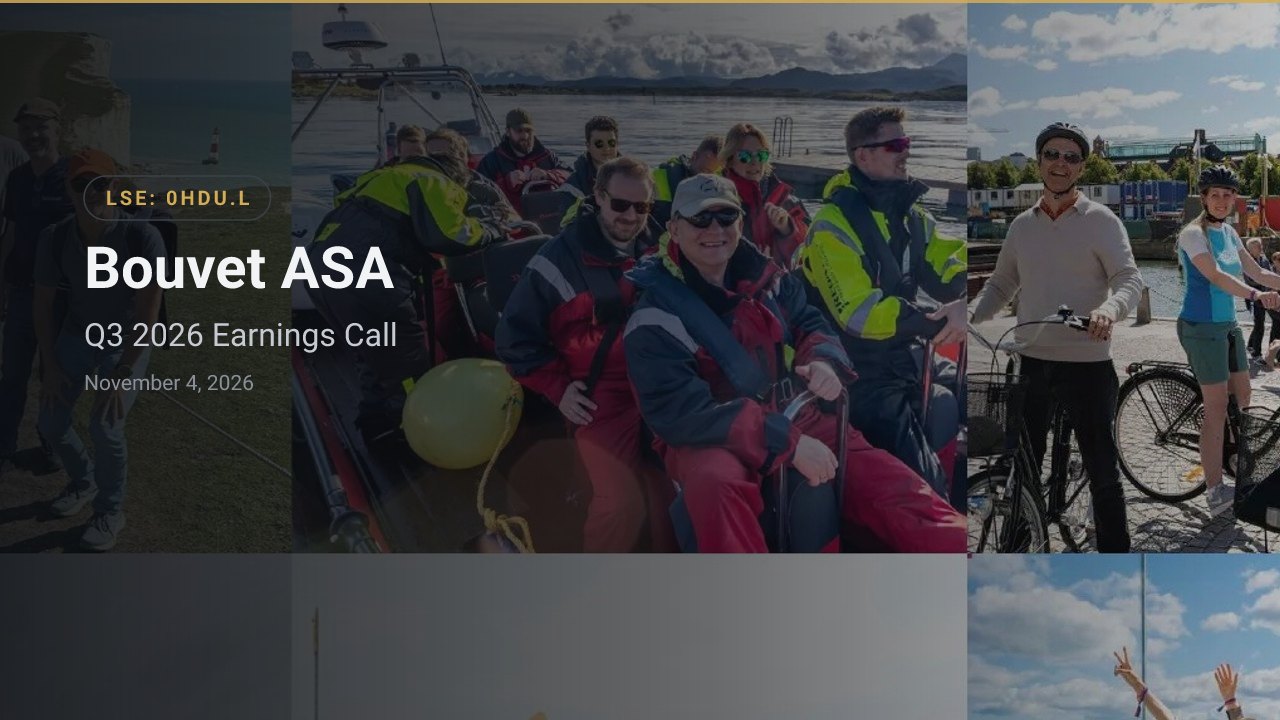
18:13 So every third quarter we mark this community, and in this quarter the regions traveled to slightly different destinations. This is a clear expression that the community culture in Bovee is important. We invest in that. It's about people enjoying themselves, having a good development, and having a working environment where people are looking for themselves. We will have exciting tasks that make people have a learning development, but this is the very foundation. So now there are many who are financially interested. This is the best money we use on people in BOV, all year round actually, especially in the third quarter.
19:00 So this is a highlight. So, with those words, I'll pass the baton over to Steffen.
19:08 Thanks for that, thanks for that. Yes, then we'll take a closer look at the financial development in the third quarter and the new first months of the year. And as usual, we start with the quarter. Here you can see that the operating revenues in the third quarter were 865.4 million kroner, a decline of 0.6%, compared to the same quarter last year. EBIT came to 80.5 million kroner, against 91.6 million kroner last year. And that corresponds to an EBIT margin of 9.3%, compared to 10.5%. Resultatet etter skatt ble 59,5 millioner kroner og en utvannet resultat per aktie på 58 øre.
19:54 Og så ser vi på ebitpron, så bidro økt bemanning, høyere timepris og marginalt høyere faktoriensgrad positivt. Gjennomsnittlig antall ansatte økte med 2,9%, timeprisen med 1,9% og faktoriensgraden var 0,1% høyere enn i 3. kvartal i fjor. Unfortunately, the positive effects were more than affected by other conditions. Reduced use of subconsulants gave a lower result contribution. Holiday and other expenses reduced the result by 10 million kroner, and that is mainly due to increased sick leave in the quarter. The staff costs also had a negative effect on the amount of 10 million kroner, and this can be seen in connection with the fact that the average number of employees increased by 2.9 percent, and the general wage growth in the last 12 months was 3.4 percent.
20:56 Other cost effects reduced the result by around 6 million kroner, among other things due to the reduction of social costs and some higher software costs. Antall arbeidsdager var det samme som i tredje kvartalet i fjor. Let's look at the first nine months of the year. The operating revenues were 2.87 million kroner, a decline of 1.3 percent from the same period last year. EBIT was 329.8 million kroner, with 370.1 million kroner last year. The EBIT margin was 11.5 percent, the combined net with 12.7 percent. Resultatetterskatt 249,6 million kroner, og utvandret resultat per aktie 2,41 kroner.
21:47 Genomsnittlig antall ansatte økte med 2,2% og timeprisen med 2,1%. Det ga positive bidrag i EBIT-pronet. Faktureningsgraden var samtidig 1% lavere enn i samme periode i fjor, og har vært en negativ driver for resultatet hittil i år. and Anta Arbeidstager. The decline in the total turnover must also be seen in connection with significantly lower use of subconsultants. The income from subconsultants has been reduced by 68 million kroner so far this year, and as you can see, the EBIT-pro is giving lower use of subconsultants a negative effect with a margin of 18 million kroner. Holiday and other expenses have reduced the results by a margin of 13 million kroner, mainly as a result of increased sick leave.
22:39 The holiday expenses are on the same level as before. The staff costs reduce the results by at least 30 million kroner. This has to be seen in light of 2.2% more employees on average and a general wage growth of 3.4%. Other cost effects reduce the results by at least 9 million kroner, mainly due to increased IFRS 16 reviews and higher software costs. So then we look a little closer at the revenue and result development. As you can see here, the operating revenues, as we have already said, were reduced by 5.1 million kroner compared to the third quarter of last year. And then it is important, behind this nearly stable combined revenue, there is immediately a positive development in the core business.
23:28 The 100-year revenue from employees increased by 19.4 million kroner, 2.5% to 812.7 million kroner. At the same time, the revenues from the sub-consultants were reduced by 37.1% to 42.2 million kroner. The sub-consultants' share of revenue was thus 4.9% against 7.7% in the same quarter last year. This is in line with the strategy of prioritising deliveries with own employees. EBIT was reduced by 11.1 million kroner. Total operating costs increased by 0.8 percent, while personal costs increased by 3.7 percent. The general wage growth was 3.4 percent in the last twelve months.
24:17 At the same time, the costs to subconsulants and further-factored costs fell by 36.1 percent. Let's take a look at the cash flow. It looks like this. The cash flow from sales was 79.9 million kroner in the third quarter against 12.1 million kroner in the same quarter last year. The correlation is mainly influenced by the new order for the employee's tax return. From 2026, the tax return is paid monthly to the tax authority in connection with the salary payment against earlier payment per term. In the third quarter of 2026, it was therefore paid 57 million kroner less in tax returns than in the third quarter of 2025.
25:06 Last year's quarter included payment of two terms, while this year's quarter included three monthly payments. This timing effect has a positive effect on the operational balance sheet with the corresponding budget. For the rest, the development of the labour capital was within normal season variations. The cash flow from investment activities was minus 6 million kroner, while the cash flow from financing activities was minus 23 million kroner, mainly related to interest rates and deductions on rental obligations. Operational cash flow in the last 12 months was 340 million kroner, against a result after a tax of 322 million kroner. This gives, in my view, a better picture of the underlying cash generation than the isolated quarter.
26:03 Then we conclude with a few words about the balance and the financial position. Bovee still has a strong financial position. During the week and a quarter, the company had liquid funds of 211 million kroner, no external interest on loan obligations, and an unused cash credit of 100 million kroner. The equity capital was 334.4 million kroner, corresponding to an equity capital share of 23.4%, unchanged from the same time last year. The liquidity rate was 1.16 against 1.17 at the beginning of Q3 2025. Styrer har vedtatt et tilleggsutbytte på 70 øre per aksje for regnskapsåret 2025.
26:51 Aksjen handlas eksklusiv utbytte fra 6. november, og utbetalingen skjer 20. november. Totalt har vi dermed betalt 3 kroner og 70 øre per aksje i utbytte for regnskapsåret 2025, og det er på samme nivå som året før. I give the floor back to you, Per Gunnar. Thank you.
27:31 I want to share some reflections about what we have in front of us. A bit of a busy slide. You have to bear with that. A lot is happening in our industry, and a lot is happening in our company. I thought I would talk a bit about that. The first topic, and I hope I have made it clear in some of the topics I have brought up around defence and total defence, is high activity. High activity with our customers, and also high activity with requests and new opportunities. So that is a clear driver for us in the future.
28:18 Then, the next, Digital sovereignty, everything that happens through shooting units, control of our own environment, our own data, that is a driver for us. We will certainly talk more about this in the fourth quarter, based on some contracts and so on, that we are winning. But that is a clear driver. And then it is important to think about BOV, where we also have our focus within application development, application management and data-driven businesses and solutions for that. But also this which is about more underlying platforms and infrastructure services, which is also a growth and investment area for us.
29:10 So that is again, but all that is driven by the trend we know in the market around digital sovereignty. And that is exciting, and that is opportunities, and there are deliveries in it for us. These two plus the general market situation make what I talked about earlier around the focus on recruitment within the right competence categories a priority activity for us. There is a strong focus on AI adoption. We have used the opportunity to put this in perspective with where we are. We are now in the third quarter, or actually in the fourth quarter of 2026.
29:55 A year ago we were at the end of 2025. A completely different situation. Much more uncertainty around what AI meant. How big are the possibilities for companies like ours? What 2026 has brought has been Delivery and experience, modesty with customers and our delivery models are also developed. So where we are now, we know how we create value. Customers see how this creates value in the business. So now it is with a completely different security that we move forward and see how we use AI to create opportunities for Bove and value for our customers. So actually a completely different stand than we were just a year ago. And that makes it very strong, of course, strong focus among our customers on value creation, delivery quality and not least safety. And all the customers I'm talking about, safety is number one priority all the time.
31:02 And then with the delivery experience to Bove, and security consultants on a large scale, it is a strength in exactly what the market demands now. And then, Last but not least, competence work has never been more important. The development is very fast. To be relevant, we have to prioritize competence work a lot, but nevertheless, what drives and is one of the most important drivers of competence work is of course that we work with customers who are also very far ahead.
31:47 And we take those experiences into competence work at Bove, and then we spread it to other and other customer engagements. But Bove is in a very good position when we look at which customers we work with and where AI and new technology are on the agenda for those customers. And then, the last point, that we operate well. Important. We are an organization and a business that has grown rapidly. We work continuously with always having as a starting point and competition starting point that we will operate well. We have always done that, and we will always do that. Here, AI also comes in. I talked about how AI affects us with regard to new opportunities, which I described, among other things, in Equinor's deliveries.
32:38 AI is a part of everything we do in most of our customer engagement, and it is also about taking the medicine itself and creating that efficiency internally with us. And it is not necessarily that it will be less, it is about working even better and increasing the quality of the structure capital and how we sell and deliver. We take that medicine. With those words, a lot is happening in our industry, a lot is happening with us. And with the pace we have had through this quarter, and what has been described by new contracts and the growth in the number of employees, we sum up by saying that we look forward to that future.
33:25 So with those words, that concludes the presentation. We probably have some hands held here if anyone wants to ask any questions.
33:37 You have room noise today.
33:38 You have room noise today? Yes, then we have that.
33:43 Yes, Håkon Nilsson in Fernandes. I have a question about the activity, because you say that you have increased the activity, and then you have increased the number of employees, and then the utilization is a little higher. At the same time, and your team prices, That should indicate that it is not an activity. So I'm just wondering if you can explain a little bit about when that time frame can come up? How should we answer that, Steffen? This is a thing we do a lot.
34:14 We have to admit that over the last few quarters, you have asked that question before too, We have made a mistake when it comes to growth in hourly prices in relation to growth in wage development. We have had this in some periods. We work with it in several ways. We always try to work with category changes. We work with it to drive better. But it is clear that many of our agreements are adjusted according to KPI indexes. So it is a demanding thing.
35:08 And that is something you see in the pressure on profitability. It is what we call the high heft in this. It is not to our advantage now. So we just have to work with it. An important point is that our agreements are adjusted to KPI, but we also have other means of working with that. So how we work with our agreements with category changes is a work that we have a lot of focus on in order to seek to counteract exactly this effect.
35:53 So I don't have any other promises to make. It is of course very high on our list, but we work with it. And we have several routes we work with, so we do as well as we can.
36:08 There is one more tool for the employees. Of course, people get a fixed salary, and it has increased by 3.4%, as I mentioned. But in addition, we have a surplus allocation, as we call it, a result allocation, a bonus arrangement, and it follows the economic results. So when it goes well, it becomes a lot bigger, and when it goes and a little bit more, the pot will also be smaller. And we are in many ways so sure that we can maintain a good result, even though we are now in a challenging situation where the hourly prices rise less than the wage growth. It's like a safety valve that we have internally.
36:54 We should put it the other way around.
36:56 What I'm really wondering about is, will this lead to a little bit of increased activity, since you say that increased activity will lead to more?
37:05 In the previous quarter, we said that the 12-month average wage growth was at 3.9 percent. This quarter, it has dropped to 3.4 percent. The reason for the decline is that we managed to win our employees by the 77 that have come in. They are younger, they will receive a pension first next year, and so on. So the fact that we are able to continue to grow is part of getting more balance in what you are asking about. So we work on many fronts to get the balance back where we want it to be.
37:54 Øystein Lundgaard from ABG. You said in the previous quarter that you expect a gradually positive development in utilization rate over the next two and a half years. Now, compared to last year, it is flat at the same level as Q3 last year. Do you still see that development in Q4, a sequential improvement in it? Does that mean that we should think of higher utilization rate now in Q4 than it was in Q4 last year?
38:22 We are very careful about the future, you know that. But I can say that the development, what I said in Q1, was that we had had a positive development through that quarter. In Q2 it was very clear that we had had a very positive development through Q2. What we have experienced through Q3 has been a positive development from what I described as a slow start. We have July, August and September. Holidays are holidays, but August was slower than we wanted. So now we are well into Q4, but what we have seen through Q3 has been a very positive development in utilization.
39:17 And then we get to look at Q4. But it is not wrong to read what I say as if we have good speed into Q4.
39:24 You have had a couple of quarters now where you have gradually seemed a little more and more positive to the market, and especially talked about much more to do. and several inquiries, as you say. When will it start to hit the numbers? What is the lead time here? Are there things that should start to contribute next year, or are there things that you already see in the fourth quarter?
39:48 We thought that some of that we might have seen better in Q3. But I'm going to be careful when talking about Q4. But what you, your background and what you observe with and your starting point is completely correct. It is that we are in a positive development and we see positively on the quarters in front of us. And we think we have a good hold on that. And then we have the whole industry and the whole situation around new technology and artificial intelligence, which has been significantly changed from what we saw last year and what we have experienced through 2026. And when we win contracts and employ people, that is the basis for us to communicate that we see the positive in the future.
40:53 And the quarters that lie ahead of us. So that's right.
40:59 Question, do you have any... First from customers on how to change their invoicing models and how to price projects with AI with fixed price on projects, less time-based, etc. There is no such type of...
41:18 I can say that with some customers it is on the agenda, but we don't see any big influence of it. But it is on the agenda, and with the customers we work closest with, it is clear that we are exploring ways to get paid. who take care of both the customer's and our interests. So that is on the agenda. And of our biggest customers, we are talking about that. But nevertheless, you should remember that many of our deliveries are shoulder-to-shoulder deliveries, together with the customers, so there is a certain complexity in doing that. So there are not very many deliveries we have that we just sit and develop something and hand it over. So there are a lot of common supplies.
42:03 There are some challenges in that, but there are also some possibilities. But what you see in our numbers, there is almost nothing of it. That is true. So, of course, there has been a lot of talk about AI and how it should affect this. I have expressed some of it before and talked about it, but that is probably a little longer way there. But we will probably see it in some smaller deliveries to start with. Yes?
42:50 Nothing more? No? Then... Then we thank you for us, and thank you for coming here to Sørkenhardsveien, and thank you for following us, and we'll see you again in Q4. Thank you for now.
Follow Bouvet ASA into a list and get an email when it puts out news.
Equity Research Analyst, Fearnley Securities
Equity Research Analyst, ABG Sundal Collier
Chief Executive Officer
Chief Financial Officer