David Thomas
Chief Executive Officer
Replay available
Barratt Redrow (LSE:BTRW) Q4 2026 earnings call, held 2026-09-16. Watch the replay and read the transcript on 6ix.
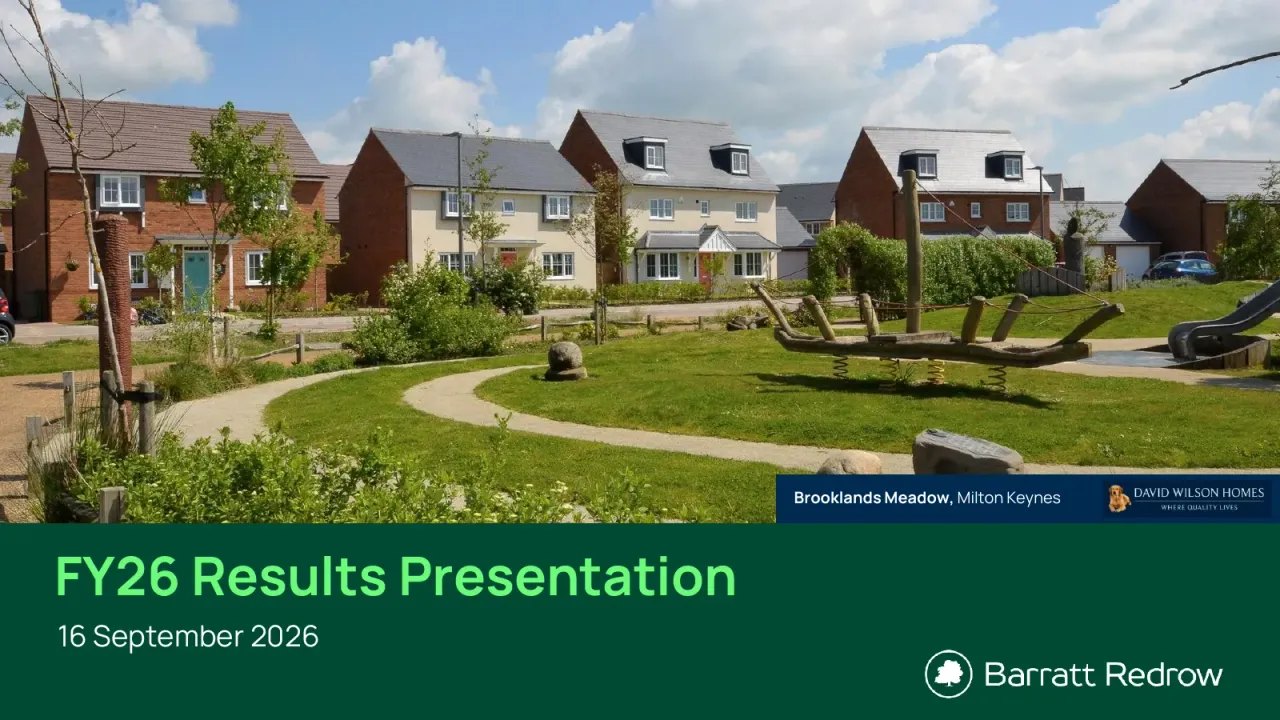
On 6ix: 6ix.com/event/barratt-redrow-plc-bdev-q4-2026-earnings-call
Automated transcript · Written by software from the replay's audio. It can mishear names and figures; the replay is the record.
0:00 Hi, good morning everyone. I think we're ready to start. So first of all, as usual, I'm joined by Mike Roberts, our Chief Operating Officer. And Mike is going to cover our operational performance. Also, John Messinger, our Investor Relations Director. And John will update you with regard to our financial performance. And then I'll update you in terms of the market. current trading and synergies and just set out how i feel that we're we're well positioned for the future many of you will be aware that dean banks our incoming chief executive has joined us this morning and also rebecca napier are CFO and Rebecca started with us at the beginning of August, so welcome to Dean and Rebecca.
0:52 So I think first of all I'd just like to take you through some of our key messages. The market conditions have clearly been challenging. I think we've all seen that play out, particularly since the end of February. Barrett Redrow has delivered a very solid performance over the year both operationally and financially I think that performance reflects the strength of our brands but it also reflects our strategy and the sheer hard work and determination of our teams and our supply chain The customer is understandably subdued, so we've made tactical decisions to drive sales and proactively manage our cost base so that overall performance has been in line with expectations.
1:46 The early signs from our Redrow dual and triple branded sites are encouraging, reinforcing our conviction regarding the multi branded approach. and our balance sheet remains robust facilitating an enhanced capital return which I will talk about shortly. Our focus is now on disciplined execution to deliver the potential we've created through the combination with Redrow and navigate the market as it evolves in FY27. Here are some of the operational highlights from the year. First, the integration of Redrow is now complete. We are already seeing the benefits of that reflected in our performance with the good progress on cost synergies and the future benefits from revenue synergy outlets.
2:42 We have maintained a strong land bank position with 5.2 years of supply. This is a key advantage. This has enabled us to tactically reduce land investment given the increased market uncertainty, but without impacting our near-term growth plans. And we completed 17,667 homes, which was towards the top end of our September 25 guidance range. I would also like to, as ever, highlight some of our externally accredited awards in the period. Our unique record with 17 years as a five star house builder and 122 NHBC pride in the job awards, which is a testament to the dedication of our teams across the business.
3:40 as well as the quality of the training that we provide them and the customer first culture we maintain across the group. The quality is also reflected in our Trustpilot scores given by our customers which award all three of our brands the highest rating of excellent. John is going to cover our financial performance in more detail but just to pull out a few highlights. The adjusted PBT was lower than last year at 572.8 million due to higher net interest costs and lower joint venture profits. So return on capital employed was lower than last year at 9.2%.
4:28 All of the 100 million cost synergy target was confirmed in the second half with a 73 million benefit in the profit loss in FY26. and finally we finished the year with a solid net surplus position of 61.4 million which is net cash adjusted for land creditors this compares to a net indebtedness position of 37 million last year before I hand over to John I'd like to talk you through our capital allocation framework we have three clear priorities maintaining a strong balance sheet investing in our business and delivering sustainable returns to shareholders the board regularly reviews the balance between these to ensure that we are well placed to deliver our strategy so when we look at our balance sheet we consider not just the year end position but the seasonal nature of our business where average net cash is typically much lower than the year end.
5:39 We target minimal year end net indebtedness which takes account of net cash and line creditors and we are mindful of our building safety obligations which represents a further significant liability for the business. We also recognise that continuing to invest in the business is critical That's why leveraging our multi-brand opportunities which enables us to grow outlet numbers but requires less incremental capital investment is an important focus for us and we continue to be very selective on land opportunities. Our updated shareholder return program is also set out here and I'll now take you through the background to that.
6:29 When it comes to shareholder returns, we have a strong track record of evolving our position, reflecting the macro environment and the views of our shareholders. Over the last 10 years we have returned nearly $3.5 billion to shareholders, with $1 billion returned through share buyback or special dividends. As we set out in July with our shares trading at a significant discount to tangible net asset value, we saw an opportunity to increase shareholder returns with a larger buyback. As a result, except for a one penny nominal dividend, our ordinary distribution, which is equivalent to 50% of adjusted net earnings, will now be delivered by way of a share buyback, starting with the FY26 final distribution.
7:25 This will be supplemented by an additional buyback of at least 100 million. for FY27 the total capital return will be 400 million with 386 million delivered through a share buyback. I'm going to pause there and hand over to Mike who's going to take you through the operational performance.
7:58 Thanks David and good morning everyone. Today as David said I'll be taking you through our operation performance for the year. Starting here with a private reservation mix on slide 9. As you can see 88% of our private reservations were generated by individual home buyers with 12% coming from PRS and other multi-unit sales. Our first time buyer share of reservations remained stable at 30% and home movers including those choosing to use our part exchange service accounted to 48% of reservations marginally lower than 50% in FY25. As you remember from the half year we've seen a significant increase in the customers using Part Exchange at 21% of all non-affordable reservations in FY26 up 14% in the prior year.
8:48 This partially reflected a slower market ahead of the November budget when Part Exchange provided customers with greater certainty at a time when buyers had real concerns over conveyancing chains and we've also introduced our Part Exchange capabilities into Redrow in the year. Part Exchange has been a highly effective sales tool, and one we've used for 55 years. Importantly, it's an alternative, not an additional incentive, and our Part Exchange stock is very well managed. Of the £228 million value of Part Exchange properties held on the balance sheet at the year end, all but £22 million have now been sold on. PRS and other multi-unit sales were at a similar level to last year. This follows a strengthening in the sector of the market in the second half.
9:34 and finally the percentage of customers relying on a mortgage remained unchanged at 75% turning to completions we delivered 17,667 homes an increase of 5% on the performance in FY25 private completions were flat but affordable completions were up 27% reflecting the timing of delivery and overall they accounted for 22% of the total wholly owned completions We expect affordable volumes will return to our more normal levels of around 20% of completions in FY27. PRS completions were 20% ahead reflecting the order book strength entering into the year and joint venture completions were 566, 5.2% ahead of last year.
10:23 We anticipate this will increase slightly to around 600 units in the current year. and in terms of pricing the wholly owned average selling price was up 2.2% to £351,700 more detail on that is provided in the appendix but this increase was driven by a combination of product and geographic mix with a slightly larger average unit size and a greater contribution from regions with higher average selling prices Based on our matching plots analysis, the majority of our regions saw only minimal underlying price increases, all less than about 1%. Prices in our London division were notably down, consistent with a broader commentary on the London market. And our southern division also experienced some deflation.
11:10 But overall, we estimate the underlying selling price deflation was just under 1% for the year. Turning to sales performance on slide 11. The underlying private reservation rate was slightly ahead of the aggregated position in FY25 at 0.56 reservations per outlet per week. This good performance was supported by a targeted use of sales incentives to maintain sales momentum in what was a very uncertain macro environment. John will provide more details on this shortly. Customers also benefited from an improvement in mortgage product availability. We're seeing greater competition by mortgage vendors and an increase in higher loan to value mortgages which have helped in what remains an affordability challenge market.
11:57 PRS and other multi-unit sales has an improved second half and our strong relationships with PRS providers such as Lloyds Living supported our good reservation rate overall. across the year we operate from an average of 405 sales outlets very much in line with our plans and our guidance and the private forward order book at the end of june whilst lower than last year at 4570 has provided a solid start to fy27 david will cover our view on future sales outlet evolution later in the presentation based on our revised average sales outlet guidance at 405 and the encouraging trading performance we've seen in the first 10 weeks of the year we are confident with the guidance for total completions of between 17,500 and 17,900 in the current year we want to give you a bit more flavor on how our home brands are distributed and how our newest multi-brand developments are performing Here you can see that the multi-branded outlets account for 44% of the total at the end of the financial year. We're seeing more and more opportunities to create dual branded combinations and we now have three triple branded developments.
13:11 The trading performance from these has been really encouraging. Over the first 10 weeks of the year the blended sales rate across our triple branded developments has been in line with the underlying rate for the whole group. Each development is selling more than one and a half homes per week compared to around 0.5 prior to the triple branding. This performance reinforces our conviction in the strength of the multi-brand approach which enables us to optimise land opportunities. Each development is unique and maximising value is done by pricing in the location, the careful plotting of our homes by brand and house type to deliver value and choice for each customer whilst maximising our returns both around margin and return on capital. Of course it's early days and this is just a small sample. We've previously talked about potential for reservation rates to moderate slightly with the addition of further brand outlets but this has not been our experience to date.
14:11 I want you to say a few words on bill cost inflation. This is a challenge for the whole industry and we've not been immune. As you'd expect we continue to see inflationary pressure on the more energy and oil dependent products such as plastics. But even here we've been able to negotiate some improvement where suppliers have held their price on the back of volume. Where required we're tending to agree surcharges with suppliers which will flex as energy costs move. Other materials worthy of note are timber, which is seeing above average inflation across both engineered and unengineered elements, and blocks and plasterboard, both of which are slightly above the overall average. Importantly, as size and scale are real benefits here, as are the strong relationships we've built up with suppliers over many years.
15:03 we've guided to three to four percent inflation for the year and as you can see on the slide this is weighted towards materials which is the greater components of our costs we do expect labor to be lower compared to given the spared capacity in the industry in a more subdued market as well as subcontractors desire to lock in future workload we can only give guidance on what we're seeing today clearly the macroeconomic backdrop is highly unpredictable so we'll continue to evolve our expectations and finally as you're aware we're really proud of our industry leading credentials around design build quality and customer service these continue to underpin our brands and can continue contribute to our sales resilience in a more challenging market As David said, we've achieved a five-star rating for customer service in HBF survey for the 17th consecutive year. And our site managers have secured an industry-leading total of 122 pride in the job awards this year.
16:05 So on that note, I'll pass over to John for an update on the financials. Thank you.
16:18 Thank you, Mike, and good morning, everyone. Today I'll take you through our FY26 performance and update two on our land bank and on building safety Here is the overview of our FY26 performance. We've set out the three profit measures adjusted PBT before PPA impact the adjusted PBT after and then finally the statutory reported pre-tax profit after adjusted items Consistent with the approach adopted at the half year both adjusted measures are now stated prior to the impact of the non-cash interest charges on legacy property provisions. We also show both the aggregated comparable which includes Redrow in the seven and a half weeks prior to the acquisition on the 21st of August back in 2024 and the reported comparables.
17:11 I'll focus on our performance relative to the aggregated performance in FY25. I'll now take you through the P&L on the next slide. Here on slide 17 we detail profitability and margin performance in more detail. There are several points to highlight. Firstly the increase in home completions coupled with an increase in our average selling price increased revenues to more than £6 billion. However, the adjusted gross margin was lower at 15.3%, giving an adjusted gross profit of £926.6 million. There were three drivers behind the movement. First, we benefited from the growth in completion volumes and higher average selling prices, although we did experience softer underlying pricing, as Mike mentioned. Second, the targeted use of incentives.
18:09 with financial incentives impacting the top line and non-financial incentives such as customer upgrades impacting cost of sales but both having a negative impact on the gross margin third we experienced underlying bill cost inflation across the year of two percent net of procurement synergies note this was closer to three percent in the second half and this effectively offset the usual benefit of second half completion volume gearing adjusted operating profit was slightly ahead at 598.1 million pounds revenue growth the benefit of integration cost synergies and business as usual cost discipline moderated the year-on-year margin impact to 60 basis points giving an operating margin of 9.9 percent adjusted finance charges at 31.5 million pounds compared to finance income last year at 4.9 million This change encompassed lower cash balances, the utilisation of our RCF for part of the year and higher interest rates supplied to new land creditors relative to the rates on those that were being settled in the year.
19:24 Including JV income, PBT before the impact of PPA adjustments was the £572.8 million David mentioned at the start. In summary, we saw good momentum on home completions, the cost synergy benefits of the Redrow integration as well as our own cost reduction actions coming through to the bottom line looking now at the movements in our adjusted operating margin aggregated on a pre-PPA basis this was 10.5% in FY25 in FY26 we then saw a benefit of 20 basis points due to the gearing of effective higher volume then the combination of softer pricing underlying build cost inflation and targeted use of additional non-financial incentives created a negative net impact of 200 basis points acquisition related cost synergies added 90 basis points and our business as usual cost reduction actions including our recruitment freeze as well as reduced performance related pay and one-offs delivered a further 60 basis point benefit the resulting operating margin before PPA impacts was 9.9% and 9.1% after PPA The movement in our administrative expenses
20:55 from £398.5 million last year to the £329.8 million is set out on this slide. You can see the various drivers but I would highlight firstly the positive impact of acquisition related cost synergies at £37 million there. below target employee performance pay reduced expenses by 15.3 million pounds and business as usual cost savings mentioned earlier contributed another 14.3 million we then had 17.3 million pounds of one-off positive items 10.1 million related to the re-measurement of cost accruals and 7.2 million pounds reflecting a year-on-year decline in internal project activity where internal project teams redeployed on completing the Redrow integration and these internal resources have been deployed back into the operations in FY27.
21:54 In the current year we expect administrative expenses will move to approximately £360 million taking account of the absence of the one-off items underlying cost inflation residual synergy savings and assuming a return to on-target levels of performance pay. Now to look at our land bank. A slower pace of land acquisition has seen the duration of our owned and controlled land bank move down to 5.2 years at the year end. This remains a strong position and is very consistent with our plans to optimise our capital employed as David will cover later. and we remain above our medium term target of four and a half years and our detailed consented plot to sales rate outlet ratio sat at 135 at the end of the year and we are looking to ensure our land bank is efficient with sales outlets sized to drive sales over a typical three to four year period.
22:58 Finally with 118 strategic land applications covering more than 31,000 plots submitted to local planning authorities we expect to see significant conversions and drawdowns from our strategic land bank portfolio into our current land bank over the coming years. Now to look at our lambank gross margin and how that's moved over the six months since December. There are three moving parts to flag in terms of the movement. First, we've seen a positive 50 basis point impact reflecting the plot mix traded out through completions in the second half of the year at a 14.5% gross margin after PPA impacts.
23:43 Second, We've had a negative impact of 220 basis points from the flow through of softer pricing, build cost inflation and incremental sales incentives. And thirdly, a 10 basis point improvement from the modest amount of land plots acquired in the half at a 23% gross margin. These plots were just over 2,800. In combination, the embedded gross margin ended the year 160 basis points lower at 17.3% relative to the 18.9 reported at the end of December. Improving the embedded gross margin is a clear priority. With little movement on pricing, we have to focus on self-help, which David will come back to later.
24:36 Turning to legacy building safety where we've seen little change to the net provision position but there are some moving parts to flag. Here tabled are the movements on the two portfolios where we recorded a net adjusted item charge of 96.8 million pounds there. In our building safety provision we've taken a charge of 105 million pounds. covering cost inflation and scope revisions at two active developments in our reinforced concrete frame provision we saw a net release of 8.2 million pounds this included firstly the release of a provision on several developments where further investigation concluded remediation works were not required and an additional provision on one building where additional remediation works were identified Completing the picture is the unwanted imputed cash interest, non-cash interest of 40.5 million and the provision utilization of 153.8 million pounds.
25:42 We ended FY26 with a total provision of 1.05 billion and we expect to spend approximately 300 million pounds in FY27 and 450 million pounds in FY28. on our direct remediation related works as well as payments the building safety fund at cash flow here we set up the cash flow bridge and a few points to highlight first cash outflows included payments around tax an interest of 84 million outflows on trade receivables and payables totaling ninety million pounds and the building safety expenditure which you've seen already second we saw the reversal of all of our first half construction whip outflow so a disciplined performance and an underlying improvement up and above the typical sales cycle and construction seasonality that you'd expect from Barrett Redrow thirdly our reduced investment in land and locked 328 million pounds of cash fourth we increased our investment in JVs at a net 102 million pounds this encompassed our building investment in the made partnership and our new JV with places for people at Gilston in East Hertfordshire finally after the dividend payment of 242 million pounds and share buybacks of 101 million including taxes the net movement in cash was broadly flat We currently anticipate that
27:15 FY27 year-end cash will be between £400 million and £500 million, subject of course to any changes in land activity and guidance on that as the year develops. Here is our usual balance sheet breakout. Just a couple of points on this one. You can see our gross land investment reduced by £464 million and then with land creditors £98 million lower, our net land investment position reduced by 366 million pounds and stood at 3.93 billion land creditors funded 15.3 percent of our land bank this is below our target range of 20 to 25 percent and we expect this to remain the case over the coming year as we limit our investment in land longer term it remains a clear intention to manage our land bank more efficiently including land cost deferral using land creditors but this will depend on the scale of land buying and the deferral terms available in the land market as we move forward.
28:23 Finally I am really pleased that we have been able to announce that we have amended and extended our revolving credit facility with our existing providers. We have increased the RCF from 700 million pounds to 900 million pounds and if you remember Redrow's old facility of £350 million was cancelled at acquisition. We've also now extended this facility to July 20, 2031 with two potential extensions subject to lender approval which would take the facility through to July 2033. So to summarise, our financial performance in the year has been resilient and that's despite the macro uncertainties faced. our balance sheet remains strong and the cost synergies from the Redrow acquisition are making a positive impact on performance turning to guidance you will see find a detailed slide in the appendices but I thought it helpful to have the key points here and then finally on the key movements around cash up and above the seasonal cash flow movements in our house building operations we do expect to spend approximately 300 million pounds on legacy property remediation and 340 million pounds settling line creditors and to finish the year with between 400 and 500 million pounds of net cash subject to the land market and opportunities happy to take questions later but I'll now hand back to David thank you
30:01 Thanks John and thanks to Mike as well. So I'd like to start this section with an overview of the housing market. I think everyone recognises that the fundamentals that underpin our market are strong. There is a desperate need for housing across all tenures on a nationwide basis. This should be driving a very active and efficient industry creating value for all shareholders. however this year the macro backdrop has clearly been very challenging with consumers cautious and interest rates at best expected to remain stable home buyers particularly first-time buyers face severe affordability challenges and the industry remains constrained by an under-resourced an unresponsive planning system combined with excessive red tape regulation and taxation.
31:09 We do welcome the steps that the government has taken to improve the planning policy environment as a whole. In time we believe that these reforms will enable the industry to operate more efficiently with shorter overall land banks and an ability to accelerate growth. but the pace of delivery so far on the ground has been frustratingly slow. On the demand side we're doing what we can to support our customers. Mike and John have both touched on how we've deliberately stepped up our incentive levels in the face of increased hurdles for people who are taking out mortgages.
31:55 We continue to tailor incentives particularly for first-time buyers and also for key workers. While we believe that more decisive action from government is required to deliver a strong and sustained recovery in the market, this is not how we are planning or operating the business. In the current environment, proactively managing our business is critical. This means delivering cost efficiencies On the slide I've set out three key areas of focus. The first is overheads and here as you know we've made good progress. Our administrative expenses for the year came in lower than our original guidance and it represents a 90 million saving compared to the standalone business, businesses back in FY24.
32:51 We have also just completed a significant project to streamline our house types. The number of house types over the last few years has proliferated as new policies at both a national and a regional level have required multiple variations of our core ranges, taking the total number of house types just for the Barrett and David Wilson brands to more than 500. This streamlining project will reduce Barrett and David Wilson to under 100 house types, all of which are future home standard compliant and deliver significant economies in terms of procurement and build time without materially reducing house price choice for customers.
33:45 As Mike has already set out, we're also benefiting from our size and scale to generate efficiencies throughout our supply chain. Build cost inflation is a challenge for the whole industry but scale is a clear advantage in purchasing and our streamlined house type range will deliver benefits for our subcontractors through greater standardisation and repeatability and ultimately should benefit our build costs. Irrespective of today's challenges, these actions will drive plotting and build efficiency, ensuring our build operations are best placed to perform over the long term. Turning to capital employed, as you know we have been disciplined in terms of our land investment, with just over 3,000 plots approved for purchases in FY26.
34:40 This is net of nearly 5,000 plots which we cancelled. We are guiding towards higher levels of approvals in the current year at between 6000 and 8000 plots, but only if we see sufficiently attractive opportunities. We have assembled a strong land bank which gives us the flexibility to manage our investments in more challenging times. At the same time, we're continuing to evaluate our existing land bank for opportunities to right size our holdings, driving an improvement in capital employed. We've already made some targeted land sales in FY26, which will continue in FY27 with potentially some additional land swaps.
35:30 And finally, we are leveraging opportunities we have across the portfolio to drive multi branding. This enables us to open new outlets without investing so much capital, which John has already touched on. As we've set out on previous occasions, by working through developments quicker, we can improve our return on capital employed. To give a brief update on our synergy sales outlets, Our target as you know is to open 45 incremental sales outlets following the Redrow acquisition. 12 of these were launched in FY26, a further 18 are due in FY27 and the balance of 15 will become active in FY28.
36:21 Identifying opportunities for dual or triple branding is now business as usual for us. and we can look at how larger developments can be optimized around both margin and speed of development to improve rocket. Wrapping this into the broader position on outlets, on this slide you will see that we have held steady in FY26. We now anticipate that average outlets will be stable at approximately 405 again in FY27. When we last updated in July, we were expecting average outlets for FY27 to be around 415. Our divisional teams are still working hard to get these outlets open, but the pace of planning approvals has slowed.
37:14 Looking forward, these sales outlets will be open in FY28 and we will benefit from a strong strategic land position with 118 planning applications pending. So the next two years are primarily about using the land we already have either under our ownership or under our control. To complete the picture on synergies all 100 million cost synergies were confirmed in the second half and the cumulative profit loss impact through to the end of FY26 was 73 million of which 53 million was delivered through administrative expense savings we would expect most of the outstanding synergies to be delivered in FY27 taking the annual profit loss contribution to approximately 95 million In summary the Redrow acquisition has more than delivered on the cost synergies identified at the time of the acquisition.
38:17 The focus going forward will be on driving our business as usual discipline on costs to ensure that as the cycle evolves our cost base is optimized around the market in which we operate. Looking at trading since the start of FY27 Arnett's private reservation rate is strong given the market backdrop and has benefited from PRS and other multi-unit sales. The underlying private reservation rate was notably resilient. Year-to-date completions were behind last year but FY26 did benefit from some completions delayed from FY25 that we outlined at the time.
39:06 and encouragingly our forward sales position is up 6% giving us confidence in our guidance volume for FY27 but obviously the market will remain sensitive to macro uncertainties as we've talked about so pulling this all together we operate in a market with strong fundamentals Housing is clearly cyclical but we remain confident that Barrett Redrow is well placed to navigate the current market and capitalize on underlying demand. Fundamental to this are our three high quality and differentiated brands providing the widest customer reach and allowing us to develop land more effectively and efficiently.
39:58 Our customer focus has been established by our numerous third party credentials over the long term. We are the reliable partner of choice across the private and public sector, allowing us to lead and innovate. And finally, we remain financially strong with a robust balance sheet, plenty of liquidity, and that is a key strength in this market. and it will underpin our current shareholder return program so to wrap up as Barrett Redrow we are stronger more efficient and an agile business that is well placed for the future just to pause at that point I think as some of you know I am retiring as chief executive of Barrett Redrow next week I am yeah I was a bit uncertain about actually saying anything about it at all but I just thought I would say a few words I mean look it's been it's been a huge privilege for me to be CFO for Barrett Redrow for six years and then chief executive for Barrett Redrow for 11 years it is an absolutely fabulous business and we've always sought to lead the future of the home building industry
41:29 we build fantastic homes we have amazing people who are really committed hard working and tremendously talented i think you just need to go out and visit our sites to really get that feel We also have amazing support from our subcontractors and from our supply chain. So I have really wonderful memories of my career in home building. It has been eventful and in my time as CEO I've had seven prime ministers of which I've only met five but a couple of them weren't there very long. um and um you know we we've had brexit and i understand you know everyone's had these things it's not unique to me uh so we've had brexit covered the war in ukraine the conflict in the middle east and of course scotland qualified for the world cup um thank you And yeah, we did a placing and rights issue within about three months of me starting, and we've made three acquisitions, Oregon, Gladman, and Redrow.
42:38 I'm hugely proud of everything that the team has achieved over the 17 years. So 17 years as a five star house builder. Somebody asked me yesterday if that was connected to the fact that I'd been here 17 years but just to be clear that's not connected to the fact that I'd been here 17 years. 22 years with more NHBC pride in the job awards. I think sometimes we're modest about our achievements as a business. CDPA rated on carbon you know ranked globally in terms of our CB CDP ranking and as you know something very close to my heart we've donated more than 25 million pounds to charity in the last six years we have said I know it's hard to believe given current backdrop but we have set a few annual records for both profit and cash returns and I think we've always understood our place in the community and our place in society this is my 25th year as a plc director and today's presentation just coincidentally it wasn't planned this way is my 50th either half year or full year presentation when i said that to the team yesterday they said well why are you not better at it I thought it was harsh. A very long time ago when I started as a plc director somebody said to me which is probably
44:08 one of the best bits of advice I've ever had is don't spin things to the analysts and the investors because you're going to come across them again time and again in your career. So I've always sought to be transparent, straightforward, consistent and I think we as a company at Barrett Redrow have always strived to be very clear in terms of our guidance. I count many of you in this room and I'm sure dialed in as friends, even the ones that have published sell notes or have sold shares. and we've had some really great times together but things move on so I'm going to spend more time with Janet my wife which she is very worried about and also my children and my four grandsons and those of you that play golf know that I'm going to play a lot more golf I would just like to wish the very best to the board of Barrett Redrow to Dean our incoming CEO and Rebecca our CFO and to all of the team so we're now going to move to questions and I'm going to chair and John is going to compare thank you okay we'll take it away
45:44 Thanks, Will Jones from Rothschild & Co. Redburn and congratulations David and best of luck. Three questions if I could please. First is just around trading in the year today. It looks a fairly resilient ex-bulk sales rate but maybe you could give us some color on how the months have trended and particularly with that first couple of weeks of September under your belt. Second was around margin Clearly no firm guidance the year ahead as normal, but if there's any of the moving parts Perhaps you could comment on we've got the bill cost for you is there anything on mix to be aware of and Presumably the balance for us all to think around is just where we land on price and the last one was just around policy yesterday we had the report out on the help to buy scheme as was which concluded fairly favorably just wondered what your opinion was on that and whether you think it changes any of the potential for demand side support from the new leadership thanks
46:45 Okay, thanks Will. So I'll pick up in terms of current trading and pick up in terms of policy and then John will talk through in terms of margin guidance. I think we'll pick up inflation probably as a later question in terms of topic. So just in terms of trading, I think we've always been pretty strict about not starting to disaggregate the current trading period because 10 weeks it's a relatively short period. But what I would say is that we are very pleased in that period and one thing I would say is that we haven't seen any weakening as we've progressed through that 10 week period. So I think from that point of view that is a positive.
47:31 is the first point the second point is I think the regional variations are quite similar and therefore where affordability is most challenged so particularly in London in the southeast the market is difficult and that remains to be the case but we're very comfortable that when we look at the way that we're trading in terms of private and the way that we've supplemented that with multi-unit sales then we're comfortable with our full year guidance position and I think we have good visibility on that. In terms of policy, I think two sides to it. I know that we've adjusted our outlet numbers today and we've adjusted them previously.
48:17 So that seems slightly contradictory to be positive about the government position on the supply side. But I think if you step back and look at the changes in terms of the planning and infrastructure bill and the national planning policy changes, the framework changes that have been made, they are creating a fundamentally different environment from a planning perspective whether you're looking for planning on residential commercial retail whatever it's a fundamentally different environment so I think our frustration has been more about the speed of change because the the act didn't go live until December 25 and the second iteration of the planning policy framework was not until two weeks ago three weeks ago but that is going to bring benefits the only thing that government really do need to address is resourcing at a local authority level so 320 local authorities you can get your planning ticket but then you've got to get the 106 agreed and you've got to get your pre-commencement conditions cleared and there's a finite resource at a local authority level On the demand side, we covered it a little bit in the presentation and the announcement, but we strongly believe that the government should put demand side support in place.
49:35 We were very pleased to see the publication of the government's report in relation to Help to Buy, which I think was hugely supportive of the Help to Buy programme, despite criticism from various quarters that it allowed nearly 400,000 people to buy a home 300,000 first-time buyers buy a home total benefit to the economy was estimated at 25 billion you know I benefited I know I'm older than all of you in the room but I benefited from a government support program when I bought my first house the Meyers program the Meyers program was a massive support program across both new build and second hand but if the government want growth they need us to be building more homes so I'm sure the government are looking at that on the basis that they have a stated growth agenda and also I think a growth agenda that isn't just going to be about a particular part of the country the whole country can benefit from more house building
50:40 John you want to talk a bit more yes thanks David I guess two or three things one on the selling price a couple of things to flag first is We obviously had some benefits of mix that we've highlighted in this year. There's a little bit of that still to flow through so a couple of percent is around mix and geography in terms of the ASP and that's a positive on the selling price. Second thing to bear in mind on pricing is the affordable where we're expecting that to move back down towards 20% so that has an effect in terms of the overall ASP that you'll see. Those are the two things I'd flag on the selling price movement. And obviously, we flagged previously that the underlying pricing in the order book is of the order of 1.4% lower back in July, and that hasn't really changed. Turning then to think about the margin movements over the year ahead.
51:27 Sorry, I'm going to be too close. Basically, the big item will clearly be bill cost inflation, so around the gross margin. And that's for, I guess, everyone in the room to take a view. Obviously, we've guided to the 3% to 4%. but think you build cost in total being 60% of revenue should help people think about how that will calibrate through and obviously we've guided on the admin expenses when you think about what that does down at the operating level I think those are the key components there just to bear through I think that covers it thanks Sean should we go for Ainsley
52:07 Ainsley Laman from Investec. Just two questions for me. Just on the guidance, obviously very minimal change. It looks like it's more related to site numbers. What's the underlying assumption for underlying sales rates for this year? Is it flat at 0.55? And just given what we're seeing with swap rates and confidence going into the autumn, where's your confidence around that? that guidance i guess or the risks to it and then second question um relates to that just on swap rates how sensitive do you think the underlying sales rate would ease to interest rate moves is it more confidence if we were to get mortgage rates 25 bits higher is that a big impact and you know are you seeing any interest rate hikes mortgage rate hikes at the moment
52:52 John will pick up in terms of sales rate and outlook on that I think in terms of the interest rates I think the issue which we've seen over a long period of time you know if you look over two three decades I don't think that the issue is about the interest rate per se I think the issue in consumer confidence is about the certainty of what is going to happen and so we came from a position in February where I think a base rate cut at the end of March was 80% likely to happen and because of the conflict in the Middle East it didn't happen and I think that dents consumer confidence hugely now there are interest rate increases priced in and that's clearly pricing into the two year or the five year fixes and as i say i think we've been very encouraged about the the reservation levels over the last 10 weeks so it's more about does it play out in the way that people expect it to play out i think that that is what will solidify confidence or will impact confidence so we would also prefer that there was no rate increases but from where we are today that looks tough and that's not the way the market is pricing in and we have definitely seen movements if you look over the last six months there's been substantial movements in terms of the
54:26 two-year and the five-year mortgage rates
54:31 Just picking up on the reservation rate for the balance of the year Ainslie, if we look obviously at the 0.53 underlying for the 10 weeks, if we look at where we will be for the remainder, we need a sales rate of about 0.63 to 0.64 to meet the midpoint of our guidance range. Now clearly that is an all-in sales rate including multi-unit sales as well as the underlying and we would expect the seasonal kind of movement in the year to occur with the strongest spring selling season.
54:59 Okay, thanks.
55:02 um ami i'll work along the road and thanks amigala from ubs uh three questions from me one was in current trading uh given where what west swap rates currently said are you seeing any behavioral shifts from institutional investors on the multi-unit sales and the mortgage lenders in terms of how they are looking at potential buyers and assessing the affordability metrics the second question was on whip if you could give us some directional color of how we should think about whip investment in 27 and 28 especially given the sort of outlet guide that you're giving and the last one was just on land land availability and pricing how are you seeing that end of the market shift okay thanks amy um so john will pick up on whip and mike will pick up in terms of land availability and what we're seeing in pricing so
55:59 I think in terms of multi-unit sales we need to go back really to the budget in 25 and bear in mind that in the run up to the budget in 25 there was a huge amount of speculation about what was going to happen ranging from rent controls to stamp duty to mansion tax and so on and it was all a bit of a mess to be honest and I think what that meant was that the institutional investors backed away from the market particularly London but I think generally their appetite softened and where they were doing deals in the second half of 25 they were tending to be deals that were at quite substantial discounts So what we've seen in 26 is I think a renewed interest from institutional investors in the market, mainly looking at single family.
56:53 But I would say there's a higher level of interest in London than we've seen probably over the last two or three years. So we work with a number of partners. We've been very public about the fact that we work with Lloyd's Living and they have a big appetite to grow their portfolio and we see them as being a great partner and we obviously have other partners as well. We said last year that we'd want to do about five to 10% and I think that still is our aspiration. We don't really want to be above 10, we'd prefer not to be below 5% in terms of completions. in terms of mortgage lenders I would say that generally the mortgage lending environment is continually improving so the regulator has allowed more lending to take place I think the banks and the lending banks are keen to lend but the affordability particularly for first time buyers is the main challenge so people who are able to afford and therefore for us for first time buyers our lead offer is deposit match so if you have a deposit of 5% we will match that deposit and I think that is quite a powerful offer because in a lot of cases it's allowing first time buyers to access a 90% loan to value and therefore better affordability than accessing a 95% loan to value
58:27 and on work in progress obviously with the adjusted guidance when you think about the profile we're expecting a pretty tight control of whip this year because there isn't really step up now towards the back end of the year clearly we are looking for outlet growth so there will be investment going in to get those sites ready and to be up and running but I think the whole effort inside the group is to really keep a tight lid and control on whip so I don't see any significant step up and clearly there's a big focus internally on driving efficiency and moving that whip lower if we possibly can
58:59 so land obviously I sort of our intake profile of land is changing in that we're looking more at our strategic portfolio and trying to make use of that through the planning opportunities that we've got so as David noted we've got 118 strategic applications live that are going through and that will give us better visibility of land going forward what it does give us is a bit of flexibility in terms of where we where we look to buy instant land in the market in a more competitive environment that land is still coming to the market we see prices pretty flat in terms of land coming through I think there's less bidders there's more opportunities or more bidders on smaller sites as you'd expect but I think where we've got larger sites our three brand sort of USP gives us that opportunity to really tackle those and be competitive and economical on those bids
59:54 Rebekah
59:58 Hi, Rebecca Parker from Goldman. Just wanted to ask a question on bill cost inflation. What conversations are you having with suppliers given the more recent spike in energy costs and what are you assuming in your bill costs inflation guidance? And then secondly, on the planning challenges that you've cited in terms of that outlet guidance, could you provide more colour on those and confidence of growing your outlets into 28 and 29?
1:00:29 okay thanks Rebecca so I'll pick up on planning and outlets and Mike will cover in terms of bill cost inflation and what we're seeing generally so I think in terms of outlets the key point is that we have really good visibility so across our 32 divisions Refusal is becoming a less common thing giving the planning backdrop We'll either get planning or we'll get planning on appeal so I think what it is more to do with is can we get a planning committee convened can we get the 106 signed and can we then get our pre-commencement conditions agreed and that is more about I would say admin rather than points of planning principle so in looking at the portfolio we feel we are going to see some slippage as we move through FY27 and hence we've adjusted the guidance slightly on that basis but it's not about we don't have the outlets we've got to go out and secure the outlets we absolutely have the
1:02:03 outlets
1:02:07 Yes, I'm Bill Costa.
1:02:10 It's worth recognising for the current year we're already 20% through the year so we're getting a clearer picture on it on a monthly basis. As we said in the presentation we have really strong ongoing partnerships and we engage with the supply chain on a regular basis. our deals aren't done the first of January for every material so they're done through the year so there's regular touch points where we see and we're talking to the supply chain about how that's working and how they see the picture evolving I think the current assessment takes account of the size of the business we talk a lot about the buying power that we've got and the relationship so it takes all that into account i think really positive we have a really strong group procurement team we have set individual sector managers that are regularly talking to the various um supply supply partners and we're getting regular updates as i say from from them from a from a holistic basis about what what inflation is looking like um so we're really confident on the on the guidance that we've given i think it's worth it's worth noting with i was with the supplier last night and we're talking about sort of innovation and how we can how we can manage potential inflation measures around installed costs rather than just pure supply costs so we're working together as a team as a broader team to try and manage those processes and we've also got as we always have got sort of cost initiatives and whatever through the business that will try and offset any inflationary pressures so overall we're getting regular updates we're 20 through the year and we're really really confident with the
1:03:41 forecast that we've got at the minute
1:03:44 Zain, I'll come across to you on the other side in a moment.
1:03:50 Zain Bikar, JP Morgan. Thanks for taking my questions. The first, maybe to John, I think on slide 21 you presented the land bank gross margin. Just curious to get your thoughts as to the sub 10%, when do you think that could fall off? And maybe just to come back on bill cost inflation, I think in the presentation you referenced the fuel surcharges. any indication as to what the contribution is that you know if we were to paint a scenario where maybe those were to come offline where do you think that three to four percent bill cost inflation falls to thank you okay so if john if you pick up in terms of land bank might you pick up on the surcharges
1:04:35 Yes, so just looking at the land bank, when you look at the part sub 10, are you here thinking about impairments, Zayn, or are you just looking at this from the profile? Because obviously that is coming through. It's partly geographic. It's partly about the time when the land was acquired. So those are the kind of the two big drivers as well as obviously the way the market has moved since. But from the point of view of those plots coming through, we're expecting those to come through pretty much. They're the more mature plots that come quicker in the process. So they will work through the next two and a half to three years. But from the point of view of the 10% gross margin, Obviously there's a mix in there. I probably wouldn't go any further in terms of giving you more detail. But we expect those to pretty much burn through in the next three years because they tend to be the older plots. Does that help?
1:05:21 Yeah. Thanks.
1:05:23 Okay, on the surcharge, I guess it's worth noting again that it's only one of the areas that we're, it's only one of the tactics that we're employing in terms of trying to manage our overall inflation with pressures. We've put that into place really so that we can be agile around moving prices back down when prices normalise a little bit more. I think what we're seeing, it's difficult to do the 3-4%, we've taken that view and and that's all rolled into the three to four percent that we've that we've guided on we are seeing our supply chain both labor and material actually sort of take and absorb some of the price increases that are out there really to secure workload for the future and that comes back to our sort of volume and ability to engage and and guarantee volume going forward for them so it's it's there's a number of items that we're looking at in terms of blending that so it's difficult to ascertain the surcharge but we forecast that through and all that's baked into the three to four percent as best we can knowing what we know today
1:06:28 Clintus great Thank You Clintus Johnson Jefferies um two but there's a few bits in the first one um standard housing types and three questions one the what have you done to the Barrett range are you moving at lower pricing given the speculation that any help to buy would be perhaps tied to size of home or number of bedrooms David Wilson vs. Redrow are you increasing the differentiation between those with the change in the David Wilson housing type 3 the proliferation the 500 was a little bit of a higher number than I would anticipate I remember the conversation three four five years ago when there was proliferation again how do you stop the proliferation how are you trying to put in controls to stop that creep that seems to be a three four year creep and then the second question the right sizing of the land bank can you talk us a little bit through what actually you're trying to do is it that you're trying to reduce the sites that are bigger than 750 units down to speed through is it geographical is it about product type that it needs to be fitting the three brand or it's not interesting just a little bit of color about that okay um thanks i'm disappointed glenn is that it wasn't five questions to sign off um yeah so
1:07:48 I was talking briefly about this the other day I mean one of the first things that we did when I became chief exec was to slim down the house type range and we published information at that time which was back in 2016 So I think two slightly different things. We have very strong controls over the creation and implementation of house types. So the divisions can't just create house types. But the reality is that the national standards and the local standards will require iteration of individual house types. They've got to have perhaps different room sizes, different requirements at a local level. So what we've done is we've consolidated all of that to, and we've had to adapt the house sizes slightly to ensure that rather than having maybe five iterations that addresses the same point, that we have one iteration that addresses everything on a national basis. So that's the first point.
1:08:52 Secondly, I would say we're not consciously trying to reduce house sizes. when we've seen demand-side support previously it's tended to be focused on number of bedrooms I mean that's been the main restriction so first by going back a number of years ago as a demand-side mechanism you could only have one more bedroom than your need and that was the rules under the scheme so if you're a couple with one child you could only buy a three bedroom home and with help to buy that was removed and therefore took away that restriction. I think it's very unlikely that there would be a square footage restriction, I think more a bedroom restriction.
1:09:39 David Wilson and Redrow, we've published information historically in terms of the difference in the the house sizes I think we're comfortable with the range I don't know if you want to comment on that in a moment Mike but you know I think we're comfortable with the differential and the range I think they're very different homes both externally and internally so I think we're very comfortable with that do you want to just talk a bit more about that Mike
1:10:06 Yeah, I suppose just a bit of clarity on the 500 houses. The 500 houses, 100 houses, five versions of each because of local standards. So it's not 500 different houses, they're iterations of, so they've either grown in size for bedroom size or somebody wants larger downstairs toilets whatever it is so that the work that we've done really is to look up those five houses for any particular house type and bring that back to one solution fits all so we now have one house type that fits m42 ndss lifetime homes and also accommodates the future home standards so that proliferation will undoubtedly stop for at least four or five years until new regulations come through and what have you so that clarifies that I think what we've seen in the difference between the Barrett and it was focused in Barrett and David Wilson what we've seen in the Redrow product is because it's generally larger it accommodates all of those requirements without much change so we've not had to look at the Redrow product in the same way I think David's absolutely right if you look at the three brands actually they are very different street scenes they are very different solutions in terms of what the customer choice is providing so we see an absolute brand differential between Redrow and David Wilson as it stands at the minute and similarly with Barrett and David Wilson so all three different brands and what we have done I suppose on the new house types is whilst we've got 100 types we've got three alternative four alternative elevations for each type so again that will that will play
1:11:37 to local requirements around variations so there'll be standard variations that will control rather than divisional specific elevations that are planning driven so we're confident that we'll drive efficiencies around that in terms of not having the number of different house types that we've got to build and we'll also just a final point we'll also sort of MMC ready with a new house type so there's a bit more standardization in terms of bathroom layouts and the like so that as and when that comes through in the next two three four years we'll be able to drop that in really efficiently
1:12:13 I'm digressing slightly but I'm allowed to digress I did once make a point to a government minister some time ago that you know if it was BMW or Audi they don't say well actually we want this type of BMW in Birmingham but we'll have this type in Manchester and they just kind of smiled and sort of said we'll just get on with it so the reality is the iteration of standards at a local level is one of the biggest hurdles that we face and we and that's not just about sizing that's also increasingly about the sustainability agenda and decarbonization and so on whether you need solar panels etc etc i mean So the government are trying to get more control around that, but it is a big, big challenge.
1:13:00 So whilst we're a standard manufacturing operation, it is a local level. It's not a national level. In terms of the land bank, you know, I think when we look at capital allocation, The land bank is the big big challenge for all house builders. We can buy bricks if we want to buy 73 million bricks we can buy exactly 73 million bricks but if we want to buy sites that are say 300 plots being optimal well we're not going to buy very many sites if we say we're only going to buy between 275 and 325 so what we have to do is we have to get the right utilization of the land and you can approach that in different ways clearly some of our peers would approach that in the way of having a single brand and bringing other house builders onto the site or selling part of the site so they would do swaps or sales we've taken the approach over a long period of time that we would rather dual brand and dual branding with Barrett and David Wilson I think has been successful bringing Redrow in for triple branding Redrow is at a more premium price point so I would say as a general guide if we're not at about £400 a square foot Redrow won't work in that marketplace it needs to have that premium price point but there are plenty of markets in the UK where we can get
1:14:31 400 pounds a square foot as Redrow have demonstrated over a long period of time but you can see from their original footprint that there were certain markets where they were more difficult for them to operate so triple branding is a real thing I mean we are on triple branded sites with other house builders or quadruple branded sites with other house builders. So we think we can get some good optimal mixes there. And John highlighted, which we've highlighted before, is looking at that ratio in terms of looking at the way that the land bank is utilised. The efficiency of the land bank ultimately will drive the return on capital employed. So we've got to keep pushing for that land bank efficiency.
1:15:15 It's quite exciting about reducing the number of single branded sites.
1:15:25 I think generally buying bigger sites because it's much more difficult to buy sites where you're looking at sites that are say less than 150 plots because you bring in all of the market subject to the fact that you would have regional house builders in the marketplace So clearly, if you're looking at larger sites, that could be 500 plots, 1,000 plots through the MAID partnership. There's obviously a limited number of house builders that are prepared to deal with land in that scale.
1:16:08 Chris, you next door.
1:16:14 Morning, yeah, Chris Millington at Deutsche. I've kind of got a two-part question on land, first of all, and it really relates to what you think land prices have done over the last couple of years. I see you're talking about intake margins of 23% gross on new land, but obviously the intake price is roughly about 5% less than what you've been putting through the P&L at the moment. And just looking back at history, 23% has been quite a tall order for Barrett to hit, so just really wondering about the rigour there and really the confidence thereon. Next one sorry to kind of return to current trading but it does feel as we're approaching autumn we should probably start seeing a bit of a ramp up in inquiry levels visitor levels as people kind of ready themselves for that seasonal uptick has there been any evidence of that at the moment and yeah just wondering about your thoughts on those lead indicators
1:17:03 yeah okay well if I am just pick up on both of those but I'm gonna I'm gonna pass the land pricing bit to John as well because John's got a few stats I know up his sleeve somewhere so you know I think I think on current trading first of all I mean I said earlier you know Chris we're not going to start disaggregating it but what I did say is it's not been a position that's got worse so if you look at the 10 weeks we've we've seen a position that's been stable or better rather than has been worse and I think that's very encouraging going into the autumn season now we're obviously measuring that on a year-on-year basis in terms of our performance and you know we know that last year it really went south because we got closer and closer to the budget which I think was late November and the market is growing to a halt so our comps are weakening and therefore we would expect to see year on year improvements arise but you know let's see what happens we haven't actually seen a lot of budget speculation this year I think the government have kept that pretty tight learned the lesson and the only two things that they have said publicly is are one there will be no rent control and two there will be no stamp duty changes Now the reality is they could do either of
1:18:33 them, but at least they've said it's not going to happen and therefore it's dampened down the speculation. There's been no chat about mansion taxes or all sorts of stuff as there were. So I think current trading, we're fine with what we're seeing in September. In terms of land prices, well, land prices are falling. I mean, that is factual. I think that land prices never fall as fast as we would like. And typically, there's probably about an 18-month lag because the landowner doesn't want to sell because they believe it should be a million pounds an acre or whatever they believe. And we don't want to buy because we don't believe it's a million pounds an acre. So there will be a lag.
1:19:18 And the only other point for our password to John would say that we know that we have a lot of land in planning all the house builders have a lot of land in planning all the land traders have a lot of land in planning so as we move through 27 and 28 there will be a lot of land coming to the market and that should help from our pricing point of view and just chris i think you've got some of the data anyway
1:19:46 but if we look at Savills and you can see it in the back of the deck so we obviously give you the land index there it's down about 11 on the national index behind it there are some quite significant moving parts in the Scotland with very different planning regime land values have hardly dropped at all but if we look at the south of the country they're down about 17 or 18 percent cumulatively from the peak which was back in September 2022 so different moving parts in there but I think David's point in particular about supply demand and how things will look over the next couple of years will be key, as will landowners' views about where the government and where policy is going to go over the longer term, which if the government talks about more affordable, ultimately that will be a tax on land. So landowners should, in theory, look at that and think, well, maybe more sensible to sell today rather than waiting and then finding there's a bigger affordable content in that mix, because it ultimately will come through on land value.
1:20:41 So, Charlie? Charlie Campbell from Stiefel. Two very quick questions, just clarification. Slide 21, the gross margin plots, does that include anything at all for new house types? And then slide 19 on the admin costs, the 330 moving up to 360, is that just basically the absence of one-off benefits
1:21:06 in 26? In terms of on slide 21, Apologies, can you just remind me sorry? Yes Oh In terms no at the moment obviously the land that's coming through Sites that are going into planning effectively with the new house tabs on them or if they go in for a read a read Visitation on planning that would start to feed through but in terms of the current land bank The new house types are really flowing through in the next six months, and we'll go into sites then. There is going to be some replotting, so we're going to try and introduce these into sites that are already there. The issue will be in terms of phasing to think about, look, in terms of the sales rate on that site, can we take some of those plots back to get them replotted with new house types? But as a general rule, this is going to be rolled out, and we'll be coming through over the next couple of years in terms of making an impact.
1:22:02 When we look at the second one on the admin side, Obviously 3.30 we're flagging that pre the one off the base starting point is 3.47 Charlie. We then have basically an assumption that we're going to have 15 million or thereabouts in terms of the reversal of the bonus kind of cutback that benefited in FY26. Inflation will be coming through of the order of 7 or 8 million. We expect synergies of 7 or 8 in the other direction. And when you put the various pieces together, we should go from around 347, including the one offside or back, to around 360. Thank you. Lewis at the back.
1:22:46 Bruce Roxburgh, good body. My question is just on buyer type. Have you seen, you know, any change in behavior there? I think on slide nine, you see a slight pickup and mix in terms of port exchange. I think that's quite interesting. So any comments there would be helpful. And, you know, how does that how does buyer type generally just fit into the context of your dual triple branded approach, you know, to first timers always go for the product or I imagine it's more nuanced than that. So just any comments on that would be great.
1:23:18 yeah so I suppose through by a type that the the part exchange piece really is around people's ability and confidence in their conveyance chain so that as a reason it's a really good incentive for us because if somebody comes along and says actually I want your house if they're not in a position to proceed we can put them in a position to proceed and they can reserve otherwise they've got to go away and try and sell their product so I think that's the slowness of the market generally second hand as well is driving that PX sort of increase and the sort of popularity of px through the buyers biotypes is interesting i i think between barrett and david wilson because both brands have product through the ranges david wilson slightly larger but david wilson has product that is first time buyer as well then the buyer type is very similar across that I think Redrow is slightly different that doesn't really get into the first time buyer and actually we will see less of that going forward I think because now we've got the three brands Redrow won't need to comply with housing mixes and the like because we'll put Barrett or David Wilson into that through a dual brand so Redrow will naturally go a bit bigger going forward just to add on that the downsizers
1:24:40 or you know I think everyone would like downsizers to be a bigger part of the market but a little bit like first-time buyers that when the market's challenging consumer confidence isn't high the downsizers can just sit it out so Redrow historically if you went back to 21 22 Redrow was doing about 40 cash sales primarily to downsizers So I think a lot of those downsides are sitting tight just now to see what happens. And likewise, first time buyers can carry on living at home or can continue to rent. So those two parts sit out, which is why I think you end up with some take up in second time movers and part exchange becomes more important.
1:25:24 Just one one final thing about doing it. but actually the other point when we look at our triple branded sites the interesting feature there is that there is almost I think a benefit back for example to Redrow where more people are then visiting the site because there are two alternative products there as well so we're actually finding it it actually does actually benefit back onto the Redrow brand maybe because people didn't feel there was a product that would suit them and then with the extra product they go along and think actually they go and look at all three and suddenly they're plumb for the Redrow great conscious I think we're about to finish but I'll hand over to Emily is it a question or are you picking up on other things I actually asked Clyde to say a few words as well because I was conscious that I was only around for sort of 75% of David's tenure and Clyde actually remembers Barrett pre David Thomas so he might be able to provide a bit more context but before I hand over to Clyde I just really wanted to say thank you from all of us I had a go at working it out yesterday and I think that if you include all the pre-closed calls and all the quarterly calls you've actually spoken to the analyst community about a hundred times which I think also means you probably faced something in the sort of mid single digit thousands when it comes to the number of questions probably only about a third of those have been about current trading so I just um yeah I wanted to say thank you and thank you for the patience that you've shown us
1:26:54 and your openness and you said that you wanted to be straightforward when you spoke earlier and I definitely think you'll leave with that reputation um yeah thank you for all of us um yeah I'll hand over to Clyde but thanks so much thank you Yeah, as the old man in the sector, I get to do these sort of things. But I mean, I first remember meeting you back in 2009, I think for a coffee around the corner from the head office in Oxford Circus. And I'm thinking, he's come out of counting Xbox sales, Nintendo, Wii's and... Donkey Kong consoles and God knows what and I'm thinking how how is he gonna handle the whole the host buildings exactly and You know to be fair you you joined at a very interesting time your predecessor had I think politely tapped out after sort of you know 2006-7-8 I think it's pretty challenging and period for for Mark.
1:27:57 But I think all of us in this room, I think would sort of echo Emily's comments about how you've grown into the role you clearly one of the most influential and leading people in the sector. um you've become a master a jedi master even at handling these meetings the confidence the calmness of of how you've you've dealt with all the difficult questions even the naughty ones you you've sort of you you've managed to to make the asker look sort of you know good with the question despite you know asking maybe the most obvious question on the planet but the other skill has been your ability to duck very deftly those really really tricky ones where we all would desperately hear the answer and you slip sort of quietly um a side of that but i think you know when we look at your commitment to the business i think it's been phenomenal no doubt that you've given it 100% you know anybody who sleeps under canvas the number of times that you've done for the charities the number of Labour Party conferences that you've attended to me deserves a real badge I think in in in my sense but I think the probably the most impressive thing is the fact that you've been in the industry so long you've created so much impression that you've now got your own Wikipedia page and you know you're up there with the industry greats you know whether it's Steve Morgan
1:29:30 Tony Pitchley Laurie Barrett and of course Greg Fitzgerald I'd like to wish you all the best for your retirement. I'm finally, hopefully going to get a game of golf with you after nagging you for so long. And maybe in some of your other spare time, you might get a chance to go onto that Wikipedia page and embellish it like somebody else has done as well. But David, all the best for retirement and I'm sure you'll enjoy it. So thank you very much.
Follow Barratt Redrow PLC into a list and get an email when it puts out news.
Chief Executive Officer
Chief Operating Officer
Investor Relations Director
Analyst – Rothschild & Co. (Redburn)
Analyst – Investec
Analyst – UBS
Analyst – Goldman Sachs
Analyst – J.P. Morgan
Analyst – Jefferies
Analyst – Deutsche Bank
Analyst – Goodbody
Analyst