Replay available
Bachem Holding (SIX Swiss: BANB) Q2 2026 Earnings Call
Bachem Holding (SIX Swiss: BANB) Q2 2026 earnings call, held 2026-07-30. Watch the replay and read the transcript on 6ix.
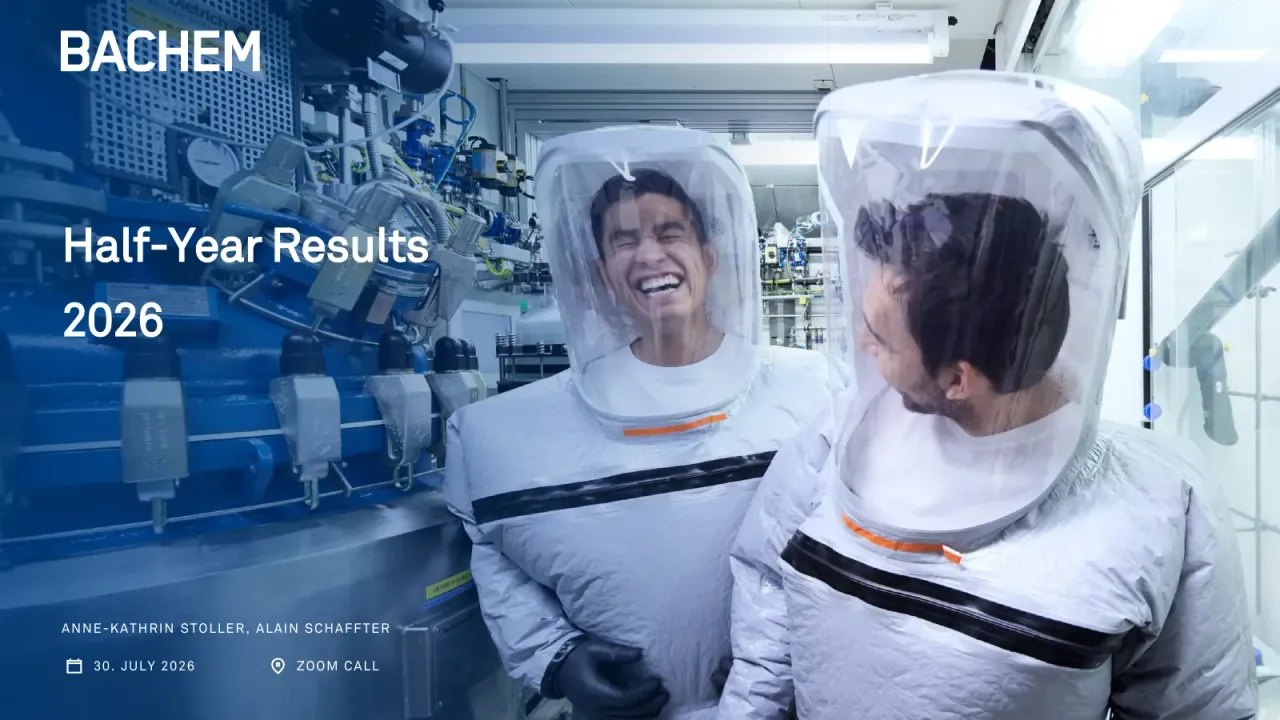
- Company
- Bachem Holding AG (SIX:BANB)
- Period
- Q2 2026 earnings call
- Date
- Thu, Jul 30, 2026, 4:00 AM ET
- Replay
- Watch the replay on this page · 55 min
On 6ix: 6ix.com/event/bachem-holding-ag-0qnd-q2-2026-earnings-call
Replay
Transcript
Automated transcript · Written by software from the replay's audio. It can mishear names and figures; the replay is the record.
0:01 Good morning, everyone. Welcome to our Half Year twenty twenty six Results Call. Joining us on the call are our CEO, Anne Katrin Stoller and our CFO, Anna Schaffter. My name is Barboura Bachem, responsible for Investor Relations, and I will walk you through the call. Before we begin, a brief housekeeping note. There will be enough time for questions after the presentation and if you would like to ask a question, you can use the raise hand feature in Zoom during the Q and A. And as always, this call is being recorded and a replay will be available on our webpage. A few words on the agenda.
0:48 Anne will start with an overview of our half year results 2026. Alain will then review the financial performance and Anne will conclude the presentation with an update on market development and our business outlook. Following the presentation, we will be happy to take your questions. We expect today's call to last approximately sixty minutes. And with that, over to you, Anna. Thank you very much, Barbara, and good morning to everyone. Also from me, it is my pleasure to talk about our half year results today. So let's look and start with the look at the team.
1:33 So as Barbara mentioned today, Alain and I will be here on the call to guide through the results. And I'm very happy to draw your attention to our newest member of our executive team, Boris Corporatore. Boris is not new to Bachem. In fact, he's been with Bachem for more than twenty years. But we were very happy to appoint him to our new Chief Commercial Officer starting in this position on August 1. I personally worked together with Boris for many years and I'm extremely pleased that we found such a capable internal candidate for this position. So let's look at our half year results.
2:21 We achieved million sales in the first half of the year, which is a growth of 4% compared to the first half of twenty twenty five. And in local currencies, it's actually a growth of 7.3%. We also achieved EBIT of million, and we invested almost CHF150 million in CapEx. And Alain will talk more about the EBITDA EBITDA and the CapEx numbers in his part of the presentation. Let me put the first half year sales into perspective.
3:06 So if we go to the next slide, we see the first half sales results of the previous years. And some of you may still remember that the first half of twenty twenty five was an unusually high first half of the year. And we are very pleased that despite this fact that we are having a very, very strong reference first half year to compare to, we still achieved a growth of 4%, even without contributions of Building K. So we are very happy with the sales of our first half year. And if we look where these sales are coming from, you see here that we had a very strong growth in CMC development, where we achieved more than half of our first half year sales.
4:02 Commercial API was a bit lower than the first half of twenty twenty five. And again, this is according to our expectations because the building case sales, which we always said we would expect in the second half of the year, are contributing primarily in the commercial API sales category. So, with this, I think we are exactly where we expected to be with respect to our first half year sales and also with the contributions of these individual categories. We are very pleased with the growth that we have seen in the CMC development based on the strong pipeline, and we expect commercial APIs to be then much stronger in the second half of the year.
4:53 Let's look a little bit into where we invested and where we continue to expand our capacity across our set site network. So in Ubbendorf, we talked a lot about it already, we are ramping up our Building K production. We could produce first commercial GMP material in the first half of this year and we are very pleased with how the ramp up is proceeding. Along the rest of the site in Buebindorf, we are working on several CapEx projects to reduce specific bottlenecks, and we are also continuing with our operational excellence initiative to unlock further capacity.
5:43 We were also extremely pleased to announce last week that we are now moving our Zistepelt project ahead and that we are really bringing it to life. We signed an agreement with the partner to supply large volumes of peptides as part of a strategic collaboration. And we will invest more than 500,000,000 and we expect commercial production in 2030 out of our Cisnerfeld site. We are also continuing to invest in our US sites, both in high volume capacity that is primarily at our Vista site, and we are also modernizing and automating our small volume production at our Torrance site.
6:32 So overall, we are very pleased with our progress, both in terms of sales as well as our site advancements. And I will then here hand over to Alain to talk a little bit more about the financial numbers. Yes, happy to do so. So on the first, we see the usual table with the key figures. Already talked about the €326,400,000 that we have achieved on the sales top line in the first half of the year. The EBITDA margin of 25.4%, we go in a little bit deeper later. On the net income, we have stabilized this number, so we have a slight increase compared to the previous year. The cash flow from the operating activities resulted in $104,700,000 and there were also more than 200 new colleagues joining Bachem in the first half of twenty twenty six.
7:28 So when we go to the EBITDA margin and the drivers behind, we have overall a dilution of three seventy bps compared to the previous year, as Arne mentioned, a very strong first half in 2025. So we did grow on the top line, but what we see is the dilution from the costs that are necessary to cover the future growth of the company. And that is mainly happening in the COGS area. So, we have added new people to absorb all the future growth. We have added or invested in maintenance. We have invested also in smaller capacity increases, optimization of the overall organization.
8:13 So we see these 2.1 percentage points that the COGS has an impact on the margin dilution in the first half. The marketing and sales numbers or cost expenses have been stable. So there is no impact from this side. On the G and A other income, we also see a dilution of 0.6 percentage points, which is mainly driven by strengthening our global organizations. We added specific support functions to absorb the growth of the company. And it's also we had some shifts between different areas from a cost per se, where we recognize the costs now.
8:58 The R and D, we see also the dilution is 0.5 percentage points, but it's still in the bandwidth or the range we gave that we invest one point two one point five to 2% of our overall sales into R and D, which is a very important factor. We do our own innovations. We have a look on process optimization, and it's a very important factor to keep our leadership as an expert in the tight business. At the end, we still have the Swiss the strong Swiss franc, which also impacted on the currency side by 0.6 percentage points, which led us to the reported 25.4% EBITDA margin that we have achieved.
9:48 In local currency, the margin was 25.9%. As you have now seen, the U. S. Dollar and also the euro are getting stronger versus the Swiss franc. We expect the top line impact from the currency effect to be about €20,000,000 with two thirds of that impacting the EBITDA. Let's have a look at the cash flow starting from the EBITDA of €82,800,000 We paid our taxes €9,300,000 in the first half of twenty twenty six. The change in receivables is not material. So this is also based on the slightly higher top line, no big impact. And then we see the inventory change, 80,900,000 impact on the cash flow. One third of that number is related to raw materials, but also supplies, which is very important because we need that material to progress now also in Building K with the higher demand in production capacity.
10:51 Two thirds is lying in the work in progress, semi finished and finished goods. So this is all material products that will be supplied to our customers in the next few months. Also important, the part with the raw material is partially pre financed by customers through their contribution as prepayments, which you see we have added another €86,200,000 from our customers in prepayments mentioned support to our working capital, but also our future CapEx initiatives that we will still have in the next few years. The change in payables is reflecting mainly two points. It's the growing company and on the second, also the higher activity on purchasing materials, but also other costs overall to support the company's growth.
11:51 The operating cash flow ends up with €104,700,000 What did we do with that money? We spent more than this $166,200,000 in capacity increase, 90 a big number of that is going into direct capacity, be it buildings, be it equipment. And this is where we also will spend in the future our main part of our cash. On the financing side, we paid out €67,500,000 as dividend from the last year '25 financial year, and we had drawdown loans from banks of €150,700,000 in the period. All of this leads us to a net increase of cash in €20,600,000 in the first six months of the year.
12:43 Looking at some key numbers on the balance sheet, we just talked about the drawdown of the bank loan. So we had €52,000,000 cash and cash equivalents at the end of June, but we also had outstanding borrowings, loans from the banks and also the main shareholder of $2.00 €8,000,000 which leads us into €157,000,000 net debt, which is representing a leverage ratio of 0.8 times, also reflecting and showing that Bachem still has a financial flexibility in that sense to grow the company. The prepayments, we added the €86,000,000 so the balance by the end of June was $455,000,000 from the customer side, 142,000,000 out of that is declared as a current position, which means this money will flow back to the customers in the next twelve months based on the supply of products.
13:46 And the balance sheet and the equity ratios of the equity summed up to 1,500,000,000 by the end of June, which is representing an equity ratio of 62%. Now, the last slide on the CapEx overview, we spent 45% of our overall sales into capacity. So, we invested $148,000,000 in the first six months. And we will continue to invest there. It's a main factor for growth of the company for the higher market demand. So, will invest in further capacity increases. 90% of these 148 was invested in capacity, as mentioned, building and equipment in the first six months. The outlook now '26, we estimate CapEx of $350,000,000 to €400,000,000 It's a little bit a lower number than we anticipated a few months ago.
14:51 And the main reason there is that the Fiservfeld now we started it, Andre mentioned, we announced it last week. But first, earlier this year, we thought that it's going to be a little bit earlier, and that's now why we spend a little bit less. Overall, on the midterm, the overall CapEx is not changing. And with that, looking forward, what's coming, the outlook back for Anne. Thank you very much, Alain. So let's start the outlook by looking a little bit into the market. We are still in the phase of strong growth, both as a company, but also the market. And a lot of that growth is still driven by what is very often nowadays called diabetes, so type two diabetes and obesity.
15:44 And if you look primarily at The US, you still see that there is still a very large growth expected in number of patients, and also not all patients currently are having access to medications. So with this growth, both in The U. S, as well as in the rest of the world, we still see an unprecedented demand for peptides. And that means as a CDMO and CMO, we are still having the responsibility to look into large scale capacity expansions, but also into advanced manufacturing technology to unlock further capacity.
16:35 And a lot of this growth is actually also then spilling over into other areas outside of diabetes and obesity. And if we look at the next slide, we see an overview of the peptide pipeline. And a lot of that pipeline, especially the late phase pipeline, the phase three, is actually driven by metabolic diseases. You can see here 37% is in metabolic areas, meaning it has overtaken the historically strong oncology area. But we see also still growth in other areas, and you can see here also the peptide pipeline per se is still growing overall.
17:20 And we see with recent approvals that also other indications and other disease areas are being treated by peptides and the interest in peptides as a modality goes far beyond metabolic diseases. The same is true for oligonucleotides. So looking at the oligonucleotide pipeline, you can see here it's a less mature pipeline, less it's mature modality, but we see a really strong growth in Phase one and Phase two projects. And over the next few years we expect this then also to reflect in Phase three and approved products. The distribution between different disease areas is much more diverse for oligos, but also here you can see that metabolic and cardiovascular indications are on the rise.
18:19 And with that, we expect that also some larger indications and respectively some larger volumes will drive the oligonucleotide markets in the next couple of years. So, what does it mean for us as a CMO and CDMO for the priorities of the remaining year of 2026? We are in a very strong position with respect to orders. We have all orders for the remaining year of 2026 in our book. So the main priority and the main focus is actually on the seamless and high quality execution of the existing orders, of the existing contracts to make sure that our customers are in a position to ensure the safety of patient supply.
19:19 We talked about the successful ramp up of Building K, so we expect this to continue in the second half of the year And we are also continuing to work on the construction of the second phase, while we continue production of the first phase, and we expect then to see a strong contribution from Building K for the second half of the year. With the announcement of last week, we now also expect to really advance the Zistrafelt project to accelerate it and to really bring it to life from an also construction point of view. And in parallel to all these activities, we are working on our strategy update, which will then be the ground for Bachem's next chapter, and we are looking forward to presenting that at the Capital Markets Day in November.
20:17 With that, we are already at the outlook for the year, the full year 2026. We expect our sales to grow 35% to 40% in local currencies. This is a refined guidance from the guidance of 35% to 45%, which we gave earlier this year. And this new guidance is now actually reflecting that we have much better visibility on our protection plan for the rest of the year, and we are very confident that we are achieving this still very, very strong growth of 35% to 40%. For the profitability, we expecting our EBITDA margin to be in low 30s in local currency, so unchanged to what we communicated earlier this year.
21:18 And with this, I think I hand it back to Barbara to start our Q and A session. Thank you, Anne, and thank you, Ola. Let's move directly to the Q and A. And let's start with the first question with Daniel Yelofcan. Your line will be unmuted now. Hello, you hear me? Yes. Yes. Very good, thank you. So three questions, when I may.
22:09 The first one, I was a bit puzzled in your main segments with the development. Of course, I understand the dynamics in Building K ramp up, but the commercial API down close to 20%. Why was that? I mean, is the base business not growing? It's this this one is typically growing somewhere mid single digits, so that's why it was quite below my my estimates, to be honest. Maybe I ask one by one. Thanks. Yeah. So the base business is still growing, but we will see the the base business growing primarily in the second half of the year. So we had a very strong growth in our development area and our pipeline, which we're very happy about.
23:01 But the contribution for the commercial APIs will be primarily in the second half of the year, and we expected it that way. But we also expect that for the full year, the distribution between commercial API and CMC development will be not fundamentally different compared to what we have seen last year. So a much stronger contribution to our commercial API business in the second half of the year. Okay. Fair enough. And also related to commercial, when you talked on slide 18, the 94 approved peptides. Do you disclose in how many you're involved?
23:49 I mean, probably similar to your market share or maybe I'm on the No, wrong we we're not disclosing that information. So the 94 is peptides that are approved worldwide. Some of them are chemically manufactured. Some of them are made recombinantly, but we don't disclose which ones and and how many of those we we are making. Okay. But on a follow-up on the 94, probably, there is there are not so many fermented. Right? It's probably most are chemical synthesis. Is that correct? To be honest, I I couldn't answer that question for sure. I I'm sure we can look into that with the marketing department, but I cannot, from the top of my head, tell you what is the number of chemically synthesized versus recombinant e manufactured products.
24:50 Alright. Okay. Yeah. And the last one on inflation, raw mats and so on. How is that developing now and going forward? Maybe a question to Alain. Yes. It's a good question, but we don't see a big impact from there. So the inflation and the costs on raw material, of course, it's fluctuating. It's sometimes higher, sometimes lower, but we don't see a big impact from that side, also not the salary point at the moment from inflation in Switzerland. It's not something material for the company. Also going forward, maybe more the price pressure on top line than the costs on the COGS side. Yeah. Okay. And and supply chain wise, Street of also coming from China, or is that not an issue?
25:41 We didn't we didn't see a a huge impact for us because we we were already having other ways around the suite of Hormuz. So we did not have issues on getting the material that we have asked for to secure production. Okay. Thanks a lot. Good. Thank you, Dani. And the next question comes from Zain Ebrahim. Zain, your line will be unmuted now. Good morning. Thanks, everyone, for taking my questions. Zane Ebrahim, JPMorgan. Two from me, please. My first question is just on the full year guidance and just to understand the reason for the revision more on the sales guidance from 35% to 45% to 35 to 40%. Is that reflecting maybe lower contribution from Building K?
26:31 And why is that given that you mentioned the first half is developed in line with your expectations? So that's the first question. And then second question is just be to understand how when you mentioned the Building K ramp up in the second half, to the guide, is that mainly from the first manufacturing lines? Or does the second phase contribute partially to the end of this year as well? Maybe I start with the second question. So yes, the contribution from Building K comes from the first phase, from the first line. We are still finalizing construction for the second phase, and that will then start to contribute next year. And to the first question, yes, the first half went very well, and we also have very strong expectations for the second half of the year.
27:25 The challenge that you have every year at the beginning of the year is that you need to make a rougher accurate prediction on the full year sales. And at that time, you have a good idea on what are the products, what is the product mix, what runs on which manufacturing line. But we are now in a much better position to know exactly what the production schedule for the second half will look like. So we know the products, what lines they're running and what are the number of changeovers. And based on this much better visibility on our production schedule on the detailed production schedule, we are now in a much better position to say exactly which of the products that we manufacture this year will actually go out and will be delivered and sold this year, and which maybe will then be delivered and sold in the beginning of twenty twenty seven.
28:20 So it's really no material change. It's just a much better visibility on the detailed production schedule. Very okay. Thanks very much. You're welcome. Thank you, Ryan. And the next question comes from Tanja Hanzalik. Tanja, your line will be un mute. Hi, good morning. Can you turn it? Okay. Yeah. Okay, great. Yeah, I have maybe two or three. Then the first question is, I don't know if you can answer it, On the Building K on the first part, can you confirm if you've been able to book revenues for these customers already?
29:10 That would be the first question. And then the second question is you left the EBITDA guidance unchanged. So I'd like to know, you know, what are the important factors to consider here and and how confident are you in the Building K output and yields? And then the third question was on the pricing discount letter sent by a big GLP player to suppliers. Would be interesting to understand for the large scale contracts, the price and minimum commitments for these five year agreements, are these binding or are these based on moving forecasts adjusted based on demand?
29:58 Thank you. So maybe I start with the first question on Building K. So I think we said earlier this year and we can confirm this now that the sales out of Building K will contribute only in the second half of the year. So yes, production was already happening in the first half, but there was no sales contribution out of Building K in the first half. That will be then only in the second half. And maybe I'll also take the third question and then let Alan comment more on the EBITDA question. So we don't disclose any details on our contracts with respect to what prices are fixed or not fixed. You can generally take into account that prices are usually a question of volume, so very much volume linked.
30:57 But other than that, I cannot confirm or comment on any pricing mechanisms on individual contracts. And maybe before taking the second question, add to this third question, if the difference is you have minimum order quantities or the minimum order values and both contracts are values. So even if the price changes, it's just the quantity differs and not the value of the minimum order in that sense. And on the EBITDA margin, we gave a certain range, which is low 30s, 30 to 33 maybe. And if we achieve the top line now, this huge growth of around 60% in the second half, the economy of scale, the operational excellence and also keeping the M marketing sales, the G and A, the overhead costs stable.
31:55 As long as we achieve and we are confident, as Anders mentioned, top line growth, the EBITDA margin will follow there. We still have ramp up costs for the next phase of the building. So we are hiring more and more people also now for the second phase. So this will be a constant hiring process and always having some growth costs in our P and L in there. But we are confident to achieve this profitability guidance that we gave you. Thank you. Thank you, Tanja. And let's take the next question from Finn Schatzle. Finn, your line will be unmuted. Yes. Hi, good morning and thanks for taking my questions. Finn Schatzle from Deutsche Bank. I have two on Sislafeld.
32:45 So essentially, can you tell us anything else on the contract that you won that was not already in the press release? So whether it's a new product, an existing product, a new customer, whether it's multiple products. So any additional color here would be helpful. Or maybe you could comment on the CapEx phasing of the project. And then related to that, on Sisterfeld, my understanding is that the demand that you have there is quite large. So my question is, are you essentially happy for now with the large contract that you won? Or should we expect that you are looking for additional contracts in similar magnitude in the near term? Thank you. Yes, so we are very happy with the contract that we recently signed with this partner.
33:38 However, this does not mean that this is the last contract that we expect to see for this. Are still in discussions with a number of other potential partners. But I think this is a very, very meaningful first step in this. As you mentioned, we the land that we acquired is very large. So there's much more space for future additions and future buildings. But we are very happy with this very first step that we do in this lapel. And unfortunately, there's not more that we can disclose on either the partner, the product or other contractual terms as we agreed to keep those confidential with this partner.
34:27 Maybe I can answer the question of the phasing of the CapEx. So we are now ramping up. We're also hiring many people for Sistefeld as we have signed this contract. And the team will grow there. Those are in house hours that are capitalized. So we see now start of those CapEx. And I would say, distribute then within the 27 to 2,030 equally the CapEx may be a little bit lower at the end. But in the three years between, I think it's an equal portion of the CapEx there. Thank you. Thank you, Fin. And let's take the next question from Sibyl Bachemberger.
35:15 Sibyl, your line will be unmuted. Thank you very much. Good morning, everyone. Thank you for taking my questions. So I have also a question about Sislerfeld. I remember a couple of years ago, you expected to invest EUR 1,200,000,000, partly financed by customers, partly financed by you. Is this still the plan? Or did you change the strategy and now you start investing step by step depending the contract? So you start now with the CHF 500,000,000. If there are new customer contracts signed, then you will increase the size? And then I have another question, so maybe one by one. Yes. So the overall investment in the SISFL side, once it's fully built out, and we are talking a very long timeframe, it will probably be way be way more than 1,200,000,000.
36:14 But this first step, the 500,000,000 really allows us a significant growth and even has room within this building for additional brightness. And ultimately, of course, we always said we grow in line in lockstep with the market. If then this first building indicates that it's not large enough, then of course, we will add further buildings. But again, we will do that together with partners in making sure that we have volume commitments for those buildings. But there's a lot more space for a lot more buildings in this self. But I think it's important that we make this first step happening.
36:59 And we are very excited that we now can do that. And then about CapEx in the first half of twenty twenty six. How much was it Sisselfeld and how much was it at Building K? Could you say something about that? Sisselfeld was mid single digit. And the most part is Building K? The bigger part the biggest part is is Building K. Yes. I think it was about 70% was spent in Bovendorf, which is not only Building K. We have also, as Andre mentioned, debottlenecking and other projects on the comp books, but about 70% of that investment has been done in Buebendorf. And then the main part is Building K.
37:44 And since it failed, it was not that much. It was the energy tunnel because we said we just go ahead with the bigger CapEx investments until we have signed the contract and a partner supports there also financially and for the future production. Okay, thank you. And the other question is about oligonucleotides. Could you say something about the development? Yeah, again, here we're very pleased and very happy with the development in our oligonucleotide oligonucleotide pipeline, both in terms of numbers and quality of projects, but also from a contribution. So we see also here that oligonucleotides are proceeding very well from a sales and also profitability point of view. There also the main contribution for oligonucleotides we see in the second half of the year. But again, here we have the orders for the full year already in house also for oligonucleotides.
38:49 Thank you very much. Thank you, Cecile. And let's take the next question from Charles Pigman King. Charles, your line will be unmuted. Charles Stoecking from Exane. Two from me. One, mostly, I think, a bit clarification. So just in terms of the FY 'twenty six reduction of CapEx spend to three fifty million to 400,000,000 Can you just confirm that this relates to the push out of the Sistophel? You mentioned due to the delay on Sistophel spend, is this because it took you longer than expected to find the contract with the anchor customer? And can you just maybe give us a little bit more information around the discussions you're having? Are decisions from customers being pushed out because of macro or other changes in the market? Any detail there would be helpful.
39:43 And then just the second question. Following the recent announcement of Samsung Biologics to enter the synthetic peptide market versus virus like peptides, I'm just wondering how you're thinking about the potential for rising competition within this market given their cash pressures delays to be resolved, but also if you can give any detail on how you're thinking about high volume versus small volume given that Connect is more of a small volume provider. And you mentioned in the release today an intention to expand in The U. S. With some small volume capacity solutions. Maybe I'll start with the CapEx, the lower guidance or outlook that we gave now is yes, mainly it's the lower CapEx now anticipated for Sisterfeld, but it's also on some of the projects we had contingency include there early this year, which is now not being used.
40:38 So it's not because we are heavily delayed or we did not pursue CapEx projects. It's really mainly depending on unused contingency and the CISA failed, which now is later. And maybe why did we have expected it earlier this year or it became later than we originally anticipated is that was a big contract and it's also even on the other side, maybe it's a big, big company. It takes some time to go all through levels and to negotiate these contracts. I think from a timing wise, we were still pretty fast, even if we cannot say more than that on the timing. But it always takes some time. And now we are happy that we signed now and announced that last week.
41:26 But this is always difficult to look into the future, even if it's January to July is only five to six months, which is like tomorrow. But many things are happening in negotiation. I'm sure everyone is aware that this can happen. And maybe for the other, I hand back to Anne. Thank you, Alain. Yes, and maybe just to add to what you mentioned, I fully agree. I think given the size of the deal, I think the negotiations were extremely fast and efficient. And the primary deals or deal structure was actually agreed pretty early on. But as you can imagine, with a contract of that size, it takes a little bit of time to get through all formal approval processes within the two companies to get them to the final signature stage.
42:17 On the question on the potential Samsung polypeptide acquisition, we always are consistent that we don't comment on individual competitors. I think what is fair to say is that we see the competitor landscape in our business changing. So, we have consolidation happening. We have new entries entering the peptide market, which is not very surprising. And so it keeps us on our toes, right? We are not afraid of competition. Competition is entering the market competition in the markets is changing or consolidating. We just need to make sure that our offering remains very attractive and competitive.
43:09 And Alain commented earlier on our R and D activities. So, we are still very much believing that a strong focus on innovation, manufacturing technology, having the best processes at the best equipment is what will ensure that we are successful in the long term. Thank you, Charles. And let's take the next question from Chris Richardson. Chris, your line will be unmuted now. Hi, thanks very much for taking my question. It's Chris Richardson from Jefferies. Maybe just the first one, assuming the H2 business or sorry, the base business in H2 grows to a similar extent or even a bit higher as it did in H1.
44:00 The implied contribution from customer A and Building K is roughly CHF 200,000,000. Can we expect that kind of run rate per half year from customary and Building K? Or is there some nuance to that? I've got a couple more questions, but maybe I'll ask them individually. Yeah. So I think we need to be a bit careful with conclusions of that nature because keep in mind, we always said the sales will only contribute in the second half. That does not mean that we didn't produce in the first half of the year, right? So you cannot make the assumption that next year it will just be double that, because we a lot of the production actually happened or started in the first half of the year. It just didn't hit the sales or the top line.
44:49 So I think you need to be a bit careful with making just the conclusion that next year, we will do the same in both half years. Is it fair to assume maybe sorry, just as a follow-up, that it's ramped up in quite a linear fashion so that the average utilization rate is hence 50% from the year going from naught to a 100% through the year? Yeah. Utilization rates of a 100% are are usually not realistic. So in an ideal plant, we usually target 85% utilization and the ramp up is very much dependent on the project. So there are no general utilization ramp up rates, right? It depends on what the customer expects.
45:37 It depends on the process and what the rate and scale up is. Super. And then maybe just a question on how the other lines in Building K are progressing in terms of the future next couple of years worth of expansion? And then maybe how customer B and that planning is progressing and whether validation is planned for 2H twenty six or early next year? Yeah. So for for this year, we plan that the construction activities will be completed and then ramp up in the phase two will happen next year. And I think we always said it will then take two to three years to reach full utilization. Super. And maybe just finally, appreciate you can't comment on the global pipeline and your exposure to it, but can you maybe clarify how many Phase III projects and how that number has changed since year end when I believe you had 16?
46:35 Yes. We don't disclose pipeline results at the half year. So the only number that I have for you is the same you just mentioned, which is what we published for the full year 2025. Wonderful. Actually, sorry, maybe I'll just ask a quick follow-up on Sorry, given the CapEx change was due to a delay rather than any change of scope of Sistefelt from a larger project, as some have already mentioned on the call, is it fair to assume that maybe a $500,000,000 Sistefelt expansion was the plan as of full year? Yes, that is correct. It was about the 500,000,000. Okay, super. Thank you so much. Thank you, Chris. And Tanja Hanzalik, she has a follow-up question.
47:21 Tanya, your line will be on mute. Yes, thanks for taking my follow-up. One was on the CECL filed as well. Could I ask about the CapEx guide until the end of the decade? I think you previously had said around 400,000,000 400,000,000 until 2030. And this was with 800,000,000 to 1,000,000,000 investment in fixed lease out. So I appreciate now we've got the first part and hopefully there'll be more. But yes, what does this mean in terms of the midterm CapEx guide? Yes. So maybe I need to disappoint you a little bit. We will give you an update at the Capital Market Day at the end of November. Right now, I would not change the forecast or the outlook we gave earlier this year or even last year because CISA sales was always a part in the outlook.
48:21 But you will see or hear more on the Capital Market Day for another five years looking into the future. Okay, great. Thank you. Thank you, Tanja. And another follow-up question is coming from Daniel Yelofczern. Daniel, your line will be unmuted. Olbora? Yep. Yep. Yes. Yeah. Just on the prepayments, I'm not sure if you have ever disclosed that, but I guess it's only probably one or two customers with that methodology? And do you disclose the, let's say, until the end of the decade, the percentage of CapEx with prepayments? I mean, other industry players talk about 25% to 30% of CapEx is financed with prepayments.
49:20 Is that ballpark the right number? Or maybe you have disclosed it somewhere in the past? No. We have never disclosed it. The point of the why don't we I mean, there's two factors. One is I mentioned CapEx contribution, and on the other hand, it's working capital contribution. And there is more than just one or two or three customers now because also prepayments in the biotech industry or with smaller customer is just a given in the industry that you always ask for a little bit upfront money to also secure your costs in the future. So that's totally normal. When we talk about the big numbers, as mentioned, the working capital contribution, which comes in once a year and we pay our bills for raw material and utilities, that's a percentage of the order confirmation that the customer gives us. So we calculate the working capital contribution.
50:14 As a prepayment, this is like a rolling twelve months. And then on the CapEx, we don't say how much or how many in percentage of the total CapEx, because we don't want to reflect this to the outside. If other people do, that's fine. We just see another benefit of announcing such numbers publicly, but maybe the numbers you have is from others are not totally wrong as a as a median median number. Okay. Because thanks. Because it's quite relevant. I mean, it's it's your operating cash flow will not cover the CapEx over the next few years. So it's I understand We expect we expect free free cash flow positive in '29.
51:04 Okay. And you're still looking for non dilutive? Yes. So we have we have signed this 500,000,000 credit facility that we announced in April, and we have other options to finance our growth. Very confident there to get that no sleepless nights because of that equity linked increase or equity linked instruments are not planned at the moment. Okay. Thanks. Thank you, Dani. And I see a last follow-up question from Zain. Ebrahim, Zain, your line will be unmuted. Great. Thanks for taking my follow-up. A follow-up was just on orals in terms of oral peptides that you talked about them as a key growth driver overall. But can you talk a little bit more about your exposure, like whether you're exposed to any of the oral GLP-1s, not necessarily commercially, but even just like clinically, how we should think about that. And I think you mentioned oligonucleotides have made more second half weighted. Just wanted to understand what's driving that being more second half weighted. Is that just customer need? Or is that partially Building K related as well? So my assumption is that the building k deferral into h two is mostly peptide related, so I just wanted to clarify that.
52:21 Yes. That is correct. The oligonucleotide phase is not related in any way to building K. It's just basically phasing of customer demand or orders. And on the oral question, there is no such thing as an oral peptide right there. For us, we are manufacturing peptides and some of the peptides in our pipeline have are intended for dual a dual mechanism. So some some of them have plans for both injectable and oral applications. But for us, we basically deliver a peptide to a customer.
53:07 And then the customer decides if and to what extent this peptide that we deliver goes into an injectable or into an oral application. But in in the end, for us, the peptide that we manufacture is exactly the same peptide. Understood. That makes sense. And another sort of follow-up and final follow-up was just on, I think inventories increased quite significantly in h one twenty twenty six. Can you just comment on, I think, about just over 500,000,000? How much of that is finished goods versus raw materials and work in progress? I don't know, to be honest, on the top of my head. It's it's I I saw the difference where it increased.
53:55 But to be honest, I we can we can send it up if it's not in the half year report. Okay. Very helpful. Thanks a lot. I think about 20% is in raw materials, and most of the rest is semi work in progress, semi and finished, but we can send you the table. Okay. Thank you, Zain. And I don't see any other questions. So before we close this session, let me briefly highlight our next event, which is the Capital Markets Day on November 26. And please also refer to the legal disclaimer on the screen.
54:41 And with that, I would like to thank everyone for your interest and see you at the CMD in November. Have a nice day. Thank you. Thank you very much, everyone. Thank you very much.
Follow Bachem Holding AG into a list and get an email when it puts out news.
Latest news releases
- SIX Swiss: BANB — Bachem Confirms Growth and Expects a Strong Second Half 2026 · Thu, Jul 30, 2026
- SIX Swiss: BANB — Bachem confirms growth and expects a strong second half 2026 · Thu, Jul 30, 2026