Neil Herbert
Executive Chairman at ATLANTIC LITHIUM LIMITED
Replay available
Investor Presentation hosted by Atlantic Lithium (LSE:ALL) on Investor Meet Company, held 2023-03-27.
On 6ix: 6ix.com/event/atlantic-lithium-limited-all-investor-presentation
Automated transcript · Written by software from the replay's audio. It can mishear names and figures; the replay is the record.
0:02 Good morning, ladies and gentlemen. Welcome to the ATLANTIC LIFHIUM LIMITED investor presentation. Throughout this recorded presentation, investors will be in listen only mode. Questions are encouraged. They can be submitted at any time via the Q and A tab that's just situated on the right hand corner of your screen. Please just simply type in your questions and press send. The company may not be in a position to answer every question it receives during the meeting itself. However, the company will review all questions submitted today and publish responses where it is appropriate to do so.
0:32 Before we begin, I would like to submit the following poll. If you could give that your kind attention, I'm sure the company would be most grateful. And I'd now like to hand you over to CEO, Len Colff. Good morning, sir. Good morning. Thank you, Jake. And, good morning, ladies and gentlemen, investors, and welcome to our second investor meets. We think this is a great platform to reach out to all our shareholders and other investors. So, welcome and looking forward to take you through an update of ATLANTIC LITHIUM and the AWEA project. So just quick introductions. We've got Amanda Harsis here, our finance director, who you, would remember from the last meeting. And, we got a new face here, which is Keith Muller, who joined us in November as, COO.
1:20 So Keith comes with a wealth of experience, but importantly, he's actually built and operated hard rock spodumene pegmatite deposits, and in particular, Mt Cattlin in Australia. So it's ideally suited to build the Awoyan mine and get it into operations.
1:37 So I'll just let Keith give a little bit of a background on himself and then come back on. Excellent. Thanks for that opportunity, LIM. As LIMITHIUM my experience is in running and operating spodumene mines. My most recent experience was at one of all operations here in WA, the Mount Cattlin mine. I was initially engaged there as general manager for a few years, and then later on moved into a more strategic role as executive looking after the Australian operations. And I look forward to helping ATLANTIC bring this project into production. Thanks, LIMITHIUM. Great. Thanks, Keith. Now it's remiss of me to just state apologies from our chairman who's at an appointment currently, but he will be joining the meeting in the next fifteen minutes to half an hour. So he'll be ready and waiting for all the q and a that I'm sure we're going to have.
2:38 So, since we had our last investor meets, we've come a long way and derisked the project further.
2:45 And I'll just go into the slides. So, we're looking forward to give you an update of where we've come up to and where we're going to. So just a standard disclaimer. So, yeah, just looking at this slide here. So we're currently sitting at a 35,300,000 ton resource at 1.25, and a large portion, almost 80% of that is in the measured and indicated categories. So that's a a really solid foundation to build this project on and our core focus of building the Awuya mine. Obviously, we're in a pro mining jurisdiction of Ghana, and they're extremely excited to see a lithium project come on on stream, having been a long term gold producer, so very supportive government.
3:32 Project has got excellent ESG credentials, and it really is a standard amongst our peers. So this really is a a project for our shareholders, for Ghana and all Ghanaians. The economics speak for themselves. We've had several groups try to, build their own, financial models to try and kill the project, so to speak, but were unable to. They really are exceptional. So we'll continue to grow on that as we, derisk the project further and go from PFS to DFS, and rerun the model with the delivery of the DFS. And, hopefully, we should see improved financial outcomes, once the DFS is out.
4:17 And we're on track. So end of q two this year, so around that mid, June timing, we should have have a a study delivered to the market. And in addition to that, we we have lodged our mining license application, and we've got our partner in Piedmont in place for 50% of the offtake.
4:43 So with that, I'll quickly hand over to Amanda to go over the corporate snapshot. Thanks, Lynn. So basically, we've got 605,000,000 shares, on issue at the moment. We have a market cap of, just over 300,000,000 Australian. That's on a $50.50 cent share price in Australia. And we currently or at December, we had, 19,000,000 Australian dollars in the bank. The top 20 shareholders, and you'll obviously all remember that we've a lot of nominee holders, sit at about 68% of, the holdings. Our main holder is ASOR International Limited who, at the end of last year purchased another 3%, and are now sitting at 25%, on our holdings. We've got Piedmont Lithium at 9.39%, and they've been there since we did our joint venture arrangement with Piedmont. DGR sold down to 3.46% at the moment.
5:43 That kind of only had a little change since, probably three, four months ago. And we've, the directors have recently bought on market, and we've kind of the board of manager up to nine point, sorry, at 22.09%.
6:00 So this kind of details the share purchases that, Neil, Len, and myself did in the last week. This is the announcement we've made. We've obviously had a slight dip in share price, due to our, short short attack that we had. And so we've taken the opportunity to, increase our holdings in the company. And so yeah. So that's where we sit at the moment at 2.09%. And this is our board and management. So we obviously have Neil Herbert, the executive chairman. LIMITHIUM is our CEO. Myself, Shu Crow is our senior nonexec director, and our two nominee directors from ASOR International Holdings, Kieran Daly and Christel. And our management, we've got Keith who's recently joined us or in in November now who's kind of adding to our project.
6:49 Rue to Blanche, who is our project manager who on the mine build. And obviously, our exploration team, Ewan Williams and Razak, and now Razak is now our country manager.
7:02 Great. Okay. There you go, Lynn. Thanks very much, Amanda. So our vision's unchanged. You know, this project, we want to build a stable or sustainable lithium supply with positive social impact to support the global transition to a carbon neutral future. And we think the AWOYA project, you know, is on an excellent platform to deliver on our vision. So we'll go through the reasons why we think that is the case. So first and foremost, our resource is now increased to 35,300,000 tons of 1.25% lithium oxide. Through each of our resource upgrades, grade has remained pretty much consistent, and that's important because it demonstrates the the good, the continuity of mineralization and grade through the through the resource, and it gives confidence when you come to the mining stage.
8:01 So, the other important aspect of our resource upgrade is the huge increase in indicated and measured. So now almost 80% of our resource is in indicated and measured, and we successfully met all of our milestones with the resource upgrade with the first one and a half to two years in the measured category, and that will support mine planning, with a high degree of confidence and the lion's share of our resource now indicated, again, increasing confidence around the mine plan. So in terms of our project, this really is a best in class project when we compare to our peers globally. So we're in a strategic location. You really can't find a better located, predevelopment project in the world than Awia.
8:47 Close proximity to the National Highway and very close to the operating deep sea port of Takaradi with direct access into our offtake partner in The US and future markets in The UK
9:00 and just poor poor access generally. It's a very sustainable project. So it's got a very low carbon footprint, and that's really driven by its simple mineralogy, its ease to to beneficiate and process to a spodumene concentrate through low powered man, and its proximity to port from a trucking distance point of view. So all of this will will flow into what we believe is one of the lower carbon footprint projects potentially out there. Again, water is very low component to our project, and that's equally as important as your carbon footprint. So it's got a very low water water use footprint.
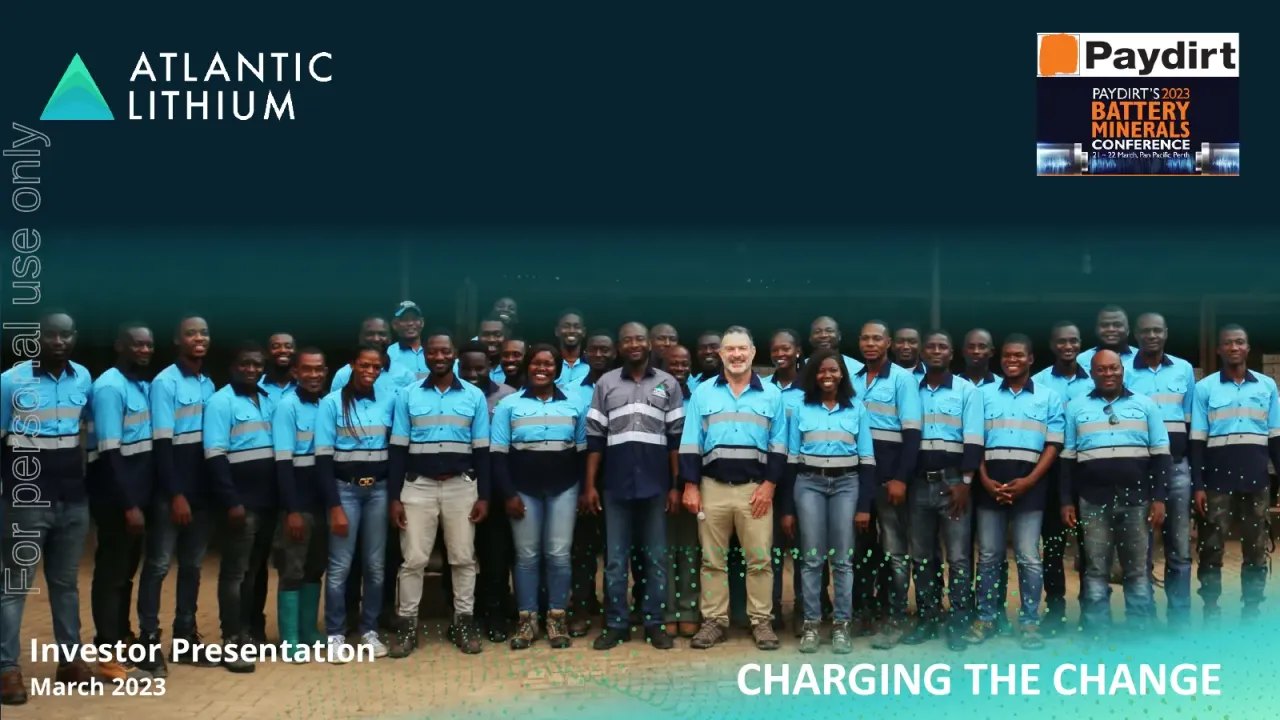
9:48 And we employ a large portion of our workforce is Ghanaian. So overwhelmingly, we've got Ghanaian in senior roles on the on the project footprint, and over 98% of our team in Ghana is Ghanaian with only one expat currently in Ghana, and a large portion of those are employed from the communities around the actual deposit footprint. So we were very well entrained into the community. So all of these things deliver really robust exceptional financial like outcomes with life of mine revenues exceeding 4,800,000,000. And mind you, this is based on the PFS, which was based on a smaller resource and relative conservative s c six pricing.
10:38 Post tax NPV eight of $1,300,000,000, internal rate returns over 200%, and this is over a life of mine of twelve and a half years with a CapEx of around about 125,000,000 US at the time of the PFS and paid back within twenty weeks. I mean, you don't often see projects like this, and this is really a function of where we are in these current times in terms of spodumene pricing and just the very robust fundamentals of this project, which we'll get into more detail as the presentation progresses.
11:13 So in terms of, you know, the what drives those those robust fundamentals, number one is mineralogy. So what we've got in Ghana is very simple mineralogy. The majority or the lion's share of our spodumene or our lithium credits are in spodumene, mineralization. So the coarser grain that spodumene is and the more lithium credits you have in spodumene within that pegmatite, the easier it is to process. And in our case, we've demonstrated we're able to process and produce a spodumene concentrate through simple DMS, so that's gravity only flow sheet, dense media separation, which means low CapEx and low OpEx. We produce a very clean concentrate, which is low in very low in contaminants, so less than 1% iron and less than 3% combined sodium potassium.
12:08 And we've also successfully demonstrated that we can convert this material to battery grade carbonate and hydroxide. So simple process flow sheet, exceptional mineralogy, and it lends itself to very low CapEx and OpEx. With any mining project, logistics is key, and this project really stands proud amongst its peers in that regard. So the deposit footprint itself is within a kilometer to the Takoradi Highway, which you can see in the top left photo there, And that highway is in a 110 kilometers to the operating deep sea port of Takaradi, which you can see there in the photo. This dedicated minerals handling port, bulk bulk commodities export and import.
12:55 And they're currently exporting manganese and bauxite, and they've recently upgraded the port infrastructure. So there are now dedicated ship loading facilities. We've got grid power that runs over the deposit footprints, and that's fed from the Akasombo Dam Hydro Dam in addition to solar input roughly 40 kilometers up the road with two twenty megawatt solar plants feeding into that grid as well. So all of this combines to low, CapEx as well and low OpEx. So those, characteristics of unique simple mineralogy, exceptional location to operational infrastructure delivered, a very robust or or even exceptional, prefeasibility study. So you can see the economic outcomes on the left there. So based on a 2,000,000 ton per annum ROM throughput over a 12.5 life of mine, at an annualized average s e six price of 1,359, dollars per ton, which is pretty conservative given current pricing upwards of $5,000 per ton s e six.
14:13 We generate these really high, economic parameters. So NPV eight in excess of $1,000,000,000 post tax, IRR over 200%, paybacks less than twenty weeks on a on a CapEx of a 125,000,000, and we're producing 255,000 tons per annum of s e six at the average life of mine off OpEx of just under $280 per ton after byproduct credits. So really robust project economics on this this project, which coming into the DFS will then be looking at a larger resource. So going from
14:56 31.3, which this study was sorry, 30,100,000 tons, which this study was based on, and an s c six price annualized average of $1,359 per ton. We'll be working off a larger resource of 35,300,000 tons at a similar grade and pricing yet to be determined. But in current market, s e six pricing is significantly higher than the the these conservative pricing we used for that PFS.
15:30 Okay. So here I'll hand over to Amanda again. Hi. Thanks, Len. So I'm just gonna take you through, really, you know, it's kind of how ATLANTIC was created when we went into the Piedmont deal was really the ATLANTIC LITHIUM name came about from our going into our partnership with our US partner, Piedmont LITHIUM. The agreement that we have with them is to includes an off take agreement for 50% of all the offtake we have at market prices. And we have another, 50% available, of that offtake. So at the moment, under the PFS, we've got 255,000 tons. When we come to DFS, we're expecting that to increase. We have a lot of interest in that offtake both, from the OEMs, from the car manufacturers themselves, from the battery factories, plus a lot of trader interest. So a lot of the traders, supply the OEMs with multiple different minerals, and they're looking also to supply lithium.
16:31 So we have a lot of interest from that space plus the chemical producers themselves. So we're we're in discussions all the time in kind of friendly discussions. We do wanna get to DFS stage or have the mining license to derisk the project again because I think that's where we'll get the most amount of value from, this 50% available offtake. Obviously, Piedmont LITHIUM at the moment has a, offtake agreement with Tesla and LG Chem. So, our spodumene will be going into into Tesla's cars, as we speak, and then we'll have another 50% available as well. Going elsewhere. So talking about the Piedmont, partnership. So this is a slide that's been, we've had for quite a long time. But what I'll do is I'll explain quickly the Piedmont, arrangement again for anyone that's new, to this this deal that we did. So back in 07/01/2021, we announced that we were entering into, negotiations around a deal with Piedmont.
17:34 They it was completed by the August 31 where they came in, at 9.9% of the company with the 16,000,000 US. So that was stage one that was done. Stage two is, the funding of regional exploration plus the d f up to DFS stages up to, US 18,000,000. Now that has,
17:55 the the money has been spent to date, and we're now in a fifty fifty, arrangement for spend. But the DFS hurdle the final hurdle will be by the end of this quarter where, Piedmont will earn into 22 and a half percent of the Ghana portfolio. And that's through an intermediary subsidiary. It's not in Ghana itself. Stage three then is Piedmont will fund the first 70,000,000, US of, CapEx. And based on the PFS numbers, that would mean 70 plus another 27,500,000, which is 50% of the remainder, and then we will pay the other 50%. Once that is funded and the mine is in operation, then Piedmont will have the right to earn another 27 and a half percent of the Ghana portfolio, which means there'll be a 50 partner in Ghana with ATLANTIC.
18:48 So, basically, that's the kind of the arrangement we have. And once that's all done, then people won't have an offtake agreement with us for 50% of the s e six production. That is at market prices. And, yeah, any spend we do, over and above what's in the agreement for self funding, we share fifty fifty. Great. So this slide really just kinda gives a little, you know, taster for what economic contribution to Ghana, the ATLANTIC's main or particularly the Oya project. So this is based on our PFS numbers. So we have, total projected revenue of 4,800,000,000 and life of mine at 12,500,000,
19:34 again, based on the PFS. The so on the calculations, total economic benefit to Ghana is 3,000,000,000, and that's through their 10% free carry profit share through 35% tax rate, 5% royalties. And, obviously, we have a local partner who has a royalty as well. We have a community fund that will be funded out of that as well. And then Ghana has strong local content regulations, we fully abide, you know, abide by and agree with, which is why we have a pretty much 98% Ghanaian workforce. So all of the goods and services that we buy and indirect taxes and wages will add up to another 1,400,000,000, basically, economic benefit for Ghana.
20:22 We think that there'll be direct jobs of more than 500 created. We do believe the Feltzbar will also then have this carry on to create a ceramic industry as well in Ghana. And this kind of adheres to the local content guidelines, and that's, something that in our vision and what we've worked with, and kind of where we are today is really the having that kind of force and and and working closely with Ghana. I think it's over to you now, Len. Great. Thank you, Amanda. Okay. So, yeah. So this is something that's really core to our values in the way we operate. So it's about acting in the best interests of the local communities.
21:06 We are guests in our host community, and as such, we we need to treat our communities as you would anywhere in the world with respect and integrity and honesty. And so we have very regular community consultations, which is with the whole with all of the the relevant communities within the project footprint. And here you can see some of those traditional leaders asking some questions in the top left corner of one of those meetings. We also have set up two nurseries which are managed by the communities, and we use that for regenerative pro purposes on our on our disturbed ground. So that's drilling pads and access to stabilize those areas in terms of surface runoff erosion.
21:54 And, obviously,
21:56 our workforce, as we mentioned earlier, overwhelmingly Ghanaian and overwhelmingly from within the communities where we operate. So those direct benefits go to our staff and the communities in and around the project. We support a lot of university programs given the the interest in the warrior lithium peptide discovery and geologically. So we have a lot of touring universities.
22:22 And then obviously with our environmental social impact assessments, we've completed baseline data now for over a year of continuous monitoring. And in the case of that weather station, you can see there in the top right, that's been continuously collecting data for over three years. So we really stepped in early to to to get all of those foundations done correctly and in the right way. We sponsor a lot of local community events and try to secure as much as we can in Ghana, whether it's our large drilling contracts or earthworks contracts through to key inputs into the studies through the universities there that provide specialist services. And we also support communities through medical donations, most recently being a dentist's chair.
23:14 So, yeah, all of this is in our DNA. And as Mando mentioned earlier, we've set up as part of our project a community development
23:23 fund outside of the royalty flow to the government of Ghana. And this will be 1% of, gross revenue from the mine, which will be managed by the community and representatives from the mine and, government for the community. And I think that's really important, and will benefit directly around the the deposit footprint.
23:50 Okay. So I'm just touching now on the exploration programs. So you would have seen we announced recently our planned exploration program. So we got a a big year ahead of us with programs kicking off now. On the regional front, we we're currently completing a 20,000 meter order drilling program with most of that activity currently acting happening directly to the north of the current resource footprint. So just to the north of the Campo Crom Corridor target there.
24:27 And we've also signed up to do a passive seismic geophysics survey. So this is exciting new technology that came from the military sphere, and it's been successfully used on other lithium pegmatite projects to define blind or concealed, pegmatite deposits that we haven't seen at surface. All of our exploration activities focused on drilling
24:51 pegmatites that outcrop will come to surface in some form. And so it's very possible that we could have missed pegmatites that are blind and don't come to surface. So, all of that, drilling's just been going into those surface deposits and and may have missed something that's lurking just beneath. So that's what, passive seismic survey is designed to test for, and we're excited to to get that program underway.
25:21 And then based on the the results of the auger program and the passive seismic survey, we've got six and a half thousand meters of follow-up drilling planned to test any targets that come out of that program. We're also currently completing a regional soil grid geochemistry program over the the Cape Coast license,
25:46 which is underway now. Then in parallel with the exploration program, we've also got our resources program. So this is consists of approximately 10,000 meters of infill and extensional RC and diamond drilling. 3,000 meters of that program is designed to infill the Awuya South 2 deposit, which occurs directly south of the Awuya main deposit. And this is really to get it from inferred to indicated, so to that higher confidence category,
26:18 to then provide us with more options around, initial mining areas. So it just provides us with more flexibility with where and when we can start mining options. In addition to that infill, we've also got 7,000 meters of step out drilling plan. So that's for extensional strike along the current resource as well as, stepping back at depth along the current resource. And that's targeted at Awia Main, Awia Northeast,
26:48 and the Campo Crom Corridor where mineralization is still open in the resource model and would be targeted in in Whittle Shell optimizations at the pricing that we've been using. So they're pretty exciting projects that will hopefully well, will certainly lead to increased confidence in the resource and hopefully deliver resource upgrades as we have over our last four resource upgrades since the project commenced.
27:21 We've also got some studies drilling, so 2,000 meets of specific diamond drilling, and that's really for metallurgical test work, twinning of RC, and it will also dovetail into geotech work as needed. So an exciting exploration program, the final bit was on the feldspar. So feldspar is an important aspect of this project going forward and one that has potentially a large impact on our community in terms of a
27:54 separate industry on the side of the the lithium mining operation. And in order to to support, the, valuations on the Feldspar, we're reanalyzing, existing pulps and or course rejects from drilling, to get the necessary, chemistry to define the Feldspar main resource estimate.
28:19 So that's, on the exploration program. And mostly, that program will be focused in and around, the Western license portfolio here, which is directly adjacent to and stepping out from the Awia resource, which sits within that the white box on the figure on the left. But we do also have additional exploration upside on our Eastern portfolio and in particular, the Edgesemanko Hill lithium occurrence, which has got outcropping spodumene pegmatites, which is still under application here. So there's significant potential to to grow out the resource not only within our current mine footprint as I call it, so within and around directly around the current resource footprint, but also within the broader exploration portfolio to the north, south, and west of the
29:13 current resource and this separate portfolio 40 kilometers to the east with a historic outcropping spodumene pegmatite. So exciting times there. So now I'll hand over to Keith to to go through some of the mind specific studies that are certainly developing there. Thank you, LIM. So what we've opted to do with our development program is we wanted to be very particular around what do we wanna do immediately and what do we wanna study in the future, and that's really just to focus our energy and our efforts on what is important right now and what will bring us into production as soon as possible.
29:58 So we've split the development into two stages. The first stage is what we will incorporate as part of our DFS, and that's really to bring the DMS, the main industrial DMS into production.
30:11 So we've now defined that flow sheet and we will use three different size fractions. That really enables us to optimize on recovery on those different size fractions. We've also incorporated a circuit to extract some of the natural occurring fines in the stream. So a DMS works really well with particle size of one and larger. Particle size is smaller than that.
30:39 It's not as efficiently separated in the DMS. However, they still contain a relatively high head grade, so we've opted to extract that material flow and either sell it as DSO initially or we can stockpile it for later beneficiation. We're also modeling various throughput scenarios. So as our PFS stated, we at the moment have a 2,000,000 ton per annum throughput that was at the 30,000,000 tonne resource level. Now at 35,000,000 tonnes and also at 80% of that 35,000,000 tonne resource sitting in measured and indicated, we feel that it's prudent to look at various throughput scenarios, and this will be delivered as part of our DFS as well. What we're then doing in the stage two scoping studies, and these stage two scoping studies will be run independently of delivering the DFS, and it will also not delay or impact the time frame in which we deliver the DFS.
31:39 But firstly, what we're looking at is, is
31:41 there any opportunity for early production and particularly early s e six production? We can certainly do early DSO sales, but that's not a philosophy that that we we wanna wanna adopt. We're a spodumene concentrating mine, so we really wanna see if we can concentrate spodumene early in the pits, and we're looking to accomplish this by potentially investing in modular DMS units. These modular DMS units are used around the world. They're used in some other up and coming spodumene mines as well. I don't believe they are very robust. They won't last you ten years or more as we wanna build a mine, but they certainly can get you in production quite quickly and early. And they can very much be discarded after a year or two or refurbished for other purposes.
32:32 We can also use those modular DMS units to test our feldspar philosophy and potentially process some feldspar at a later stage to see what we can do from a marketing perspective from that feldspar production. We're also looking at opportunities to beneficiate those natural occurring fines, both from gravity and other beneficiation methods because we really see a lot of value in there. There's still about 12% of our metal currently not being beneficiated, really bypassing the DMS, if you will. So we think there's opportunity in capturing 12% of our metal credits by further beneficiation. Both and then lastly, the third component of our scoping study stage two is looking at what can we do with Feldspar.
33:23 It sort of tacks on to what Glenn just mentioned in terms of exploration. So we wanna build an MRE model in the first instance to understand what's the quality and quantity of Feldspar we've got available to us, And then we also wanna build a processing facility that can beneficiate that feldspar ready for the ceramic industry in Ghana. And those three components combined can be delivered independent of each other, and they are all designed in such a manner that they are complete bolt ons to the existing DMS facility. So we don't have to store. We don't have to stop. We don't have to redesign. We are leaving footprint spaces within our DMS plant at the moment that can facilitate bringing online any one of these opportunities at the later stage as we advance those studies and we prove up the concepts.
34:18 Our feed is progressing well. This week, we had our 75% completion review with Primero. Everything going well there. The feed will be finished in April following and leading into our DFS, which we are still aiming to publish at the end of quarter two this year. And just in terms of the flow sheet, as I mentioned, we have now finalized our flow sheet, which has three different size fractions ranging from one to 10 millimeters in the DMS. Of not quite equal proportion, but we've used particle size distribution of the feed presented to the plant to optimize each one of those three circuits for both maximum throughput and more importantly, maximum recovery out of those individual circuits.
35:14 As you can see presented on the slide here, the bottom to the right stream one and stream two, those are our feed streams to both future beneficiation of the natural occurring fines as well as to the fellspar circuit. And as I mentioned, these can be bolt on at any stage and could potentially be built concurrently with the main DMS plant should the pre feasibility and the scoping and then working towards the FS on that stage two if it's done in time. And as those studies develop, we can bring them online at any stage. And just in terms of timeline, this year, our priority is to complete our permitting.
36:04 Really, that is the critical path for us at the moment. We submitted our mining lease application to Mincom in October. We've already done one round of feedback to the department. We're now busy with the final round, and we're still optimistic to receive that permit and that email this quarter, this coming quarter in the April quarter, so in q two. That will trigger the EPA process. So we've done a lot of the baseline work, but the engagement with community can really only officially start once your mining lease is granted. So we're looking to start that as soon as possible over the next few months. That could be a five to a six months process.
36:50 You know, permitting is always a little bit hard to predict on exactly how long it's gonna take, but we envisage just about a six month process. And then shortly following that is the ratification of our mining lease in parliament. And then once we've obtained both our EPA permit and that ratification, it's time to apply for our mine operating permit. And really, that's just a rubber stamp by the Minerals Commission to verify that all the steps has been followed and that it's a nice and coherent application. So therefore, we're looking to be in production within the next two years. So that means if we finalize our permitting towards the end of this year, construction starts early next year at a twelve month process, and this is notwithstanding the work we're doing currently on our modular units. That might bring that time frame a little bit forward, Although that won't be at the full throughput capacity, that will only be at a a very small marginal component through those modular units.
37:55 Thank you, LIMITED. Over to you. Great. Thanks very much, Keith. So just wrapping up. So 2023 is gonna be a big year for us. We got the exploration and the resource programs underway and upside coming out of those results dependent. And, obviously, our DFS due out in q two this year, which will incorporate the increased resource and look at various throughput scenarios to maximize value out of a. We got the mining lease grant other permitting milestones as we basically transition from explorer to developer and commensurate with that build out the leadership team of which, you know, Keith is the first, you know, key member to come on board there alongside Roo's project manager.
38:47 And so with that, we now have got just summary slides. So that kind of concludes the presentation. And I noticed now that Neil, our Executive Chairman, has joined. So perfect timing there, Neil, as we move into Q and A and obviously address a lot of questions there from shareholders and in particular around the Blue Walker report. So I suggest we come on to the questions and let you run through those and back them off accordingly. Thank Ladies Okay. And gentlemen, please do continue to submit your questions just by using the Q and A tab that situates on the right hand corner of your screen. But just while the team take a few moments to review those questions that were submitted already, I would like to remind you that a recording of this presentation along with a copy of the slides and the published Q and A can be accessed via your investor dashboard.
39:50 Guys, we did receive a number of pre submitted questions ahead of today's event. And as you can see there in the Q and A tab, we've also received a number of questions throughout your presentation this morning as well. So firstly, thank you to all of those on the call for taking the time to submit their questions. And then perhaps if I may hand over to you to chair the Q and A session with the team, and then I'll pick up from you at the end. Thank you. Thank you very much, Jake. So Amanda, will you or should we let Neil as the Chairman come in and take those questions? Yeah. Go on. I'll take the questions. I think that's a good idea. Hi, everybody. Sorry I'm late. I had a medical appointment this morning I couldn't avoid. Okay. Take it from the top. I see there's a number of questions about the BlueOrca short sellers attack.
40:37 So for those of you who don't know, about two weeks ago or so, a company called BlueOrca wrote a report, if I if I could consider it that, which attacked Piedmont LITHIUM. And they say right at the top of the report what their intent is, a short settlement, hoping that people will sell the Piedmont stock, and indeed that the share price will go down so they can cash in on their short. So, you know, fair enough. They did that to Piedmont, but unfortunately for them, the Piedmont price wasn't effective because in The US, people have become very accustomed to these not terribly high quality attacks by short sellers. And unfortunately, when it reached London and Australia, it did have a very negative effect on us. So what they say in the report is they refer to a transaction called the Joy Transporters transaction, which was an exploration property acquisition that we made some two years ago.
41:32 On a standard we have a standard package effectively, which what we do is we pay some cash and shares and indeed give people a royalty. So what they say in the report is that this is obviously corruption, but they provide no evidence of corruption whatsoever. The only thing that that they state is one of the two owners of Joy Transporters happens to be related to a senior opposition member of parliament. That in itself is true, but obviously, it's not illegal to be related to a senior politician. They don't go on to say is that that politician will be benefiting for tens of millions in royalties in the future from the mine, and therefore, the mine license will never be granted. Well, there, they got their facts completely wrong because these are exploration licenses. They don't form part of our mineral resource. They don't form part of our mine license application.
42:23 And indeed, as you may have seen, there's been no reaction in country at all, where people are just, generally speaking, rather than used by the whole thing. I fully expect to see that our mining license will be approved by the ministry next quarter. And obviously, I've been buying quite a lot of shares myself as are other members of the team here. So you can see we are very confident that this has no impact on us whatsoever. The facts are basically wrong. The accusations are unfounded, and indeed, no evidence is provided. And on top of that, the premise is just entirely false. So I hope that answers people's questions. People are asking, is MIFT still intending to invest? Well, you'll see that MIFT made an intention made a statement of intention recently in the last month that they were intending to invest again. We believe that MIF obviously is managing its own cash flows, so its timing is limited by its own cash flow requirements. And so we do expect them to come forward and invest.
43:20 However, it may well be that we'll get that mining license approved by the ministry in the course of the next quarter. And I'm to ask Len just to comment on the licensing process there and what our timing and expectations are for the rest of the process. Yes. So the the main step in terms of the process the ML application, obviously, is the submission of the mining license application, which happened in October. Had you review through MINCOM, which is division of the Ministry of Mines in Ghana. So they reviewed the technical veracity of the report and come back with any questions or feedback, which they duly did, which were answered and addressed, and the submission updated accordingly.
44:09 And that's now currently with Mingcom for technical sign off ahead of the minister actually signing it once he's received that stamp of approval from his technical team. From there, that then allows us to kick off our environmental and social, and in particular, our social baseline aspect in terms of community engagement and landholder compensation. And that is a best case scenario of five month timeline to an EPA permit. And then once that's been granted along with the approved mining license, it then goes to government to be ratified. And that's a three month process. So all going well, pending approval from the minister of mines, the EPA being granted and the ratification happening, we could be permitted at the end of this year.
45:06 Okay. Thank you, Len. We have a question from Jake, Amanda, regarding the Ghana Stock Exchange listing. Is it likely to go ahead? Will this delay anything? How much will this likely cost? So the part of the local content regulations in Ghana is that any company that goes into mining will be listed on the Ghana Stock Exchange within five years of mining commencing. And so we have known that all along and we fully support, that going ahead. How much it will cost? Well, it's always a legal, exercise. So I would say, at least $200,000, but, who knows? It'll happen in a few years once we're actually in production. So when we're ready to go ahead, we will list on the Ghana Stock Exchange.
45:54 We're in discussions with the Ghana Stock Exchange. Really, it's about educating the, investors in Ghana as well around us, and so we'll continue with those discussions. Okay. Thank you. One for you, Keith, from Jake again. What volume impact would occur if the LCE product is reduced from 6% to 5.5%? Sure. Thanks, Neil. Just so you know, Neil, that Jake is asking all the questions. That's actually the pre submitted questions. It's not all coming from Jake. But happy to answer that. I'll work I'll work down. Let's have a look. So, look, the plant is designed to process and produce anything in the range of five to 6.2%.
46:40 So really, for us, it's a great recovery trade off on that curve. At the moment, we're still aiming to produce a 6% product. As lithium prices are at the moment, there's quite an incentive to produce a lower grade product like a 5.5, which many of our peers are doing at the moment. In fact, I don't think, with the exception of perhaps green bushes, there's any spodumene miner at the moment that's producing a 6%. So we can certainly lower that final product rate to 5.5%. It's a little bit early for me to say exactly what the benefit is, but I can tell you what we've seen in the preliminary test work. There's about a 10% to 15% improvement in metal recovery as you reduce that final product grade.
47:31 What we need to be careful of is what contaminants that brings in and what it introduces to our concentrates. So in particularly, the iron content, we don't have a lot of control over what happens with dilutants as we lower the final product rate. It's almost a matter of you drag in whatever is present. So we need to work closely with our offtakers, which we still haven't identified for the other 50% and as well with Biedmont for the 50% that they are already entitled to. So look, let's say somewhere between 10% in metal recovery, and then there's a short penalty that you pay on producing that lower grade to compensate the converters for the increased operating costs that they will incur with a lower feedstock grade.
48:20 Okay. Thank you. So I'll take a question from somebody else. So from Ben. ESG is a stated priority for the company, but its governance structure does not appear to fully reflect this as the company considered appointing an independent director with relevant expertise and the dedicated committee to oversee its ESG commitments. Increasingly, the share of the company held by institutions is critical to achieving its realistic valuation, but many institutions are still wary of investing in mining due to ESG concerns. Has the company considered signing up the Digby platform to secure independent validation of its ESG credentials? Well, that's a very specific question. Yes, we are talking to Digby. And in fact, I saw Jamie Strauss the other day and I know that we had a meeting in Perth only last week. So yes, we're under discussion how we best achieve this. And yes, you'll hear more from us as we go into the future.
49:16 Can the company please provide an update on DGR's shareholding? Has the company considered approaching DGR about the possibility of arranging an off market transaction with another party such as MIRFOR ASSO to offload its remaining shares? Shall I answer that? I'll let you answer that one, Amanda. Thanks very much. So I think we we gave the latest number, which is around 3.4% that DGR is sitting at at present. There's been a number of approaches to DGR over the last few years on taking packages of shares. None of those have been forthcoming. Really, we sit to be we're kind of like the ATM for DGR at the moment when they need to pay their bills or invest into other companies.
50:04 I'm unsure how that's gonna continue, but I really think they will stay above 3%. Their shareholders like their investment in ATLANTIC, so I suspect that they will stay on the register. That is my hint there. Okay. Cool. We have a question again about the mining license coming faster, but the investment by Ghana State seems slower than the state did. I think actually that Lent sort of answered the timing regarding the licensing. In terms of MIP, we do think it's just down to them managing their own cash flows. So I mean you will have seen, as I said, only last month, making another statement, their intention to invest.
50:50 They've been very active working with us on the Feldspar opportunity for the ceramics industry and country, which is a value add that the government likes a great deal. I think really the only reason for the delay is their own financing situation. But I did see them a couple of weeks ago, and some of you have seen that after the Blue Orca attack, actually, they were actively rebuffing that on Twitter. Okay. So another question from John G. Some time ago, you said that Canaccord appointed its financial advisers to assist evaluating the merits of numerous approaches related to the remaining 50% of uptake. This seems a bit out of kilter now. Can you update, please? So ultimately, as our intention to take the project forward to mining, as you can see, we're building out the team to do just that.
51:43 I'm not sure what else we could say about that one, Amanda, in terms of where are we with the offtake discussions. Yes. So I took everyone through the offtake before in terms of the discussions we have. It's not we haven't appointed Canaccord as the financial adviser on the offtake. They were really part of the potential approaches for the whole company last year, so that kind of is is not continuing. So the offtake's really approaching us directly. And we are in discussions with probably six to eight parties who are keen to join the discussion when we're ready. Okay. Fantastic. A question from John G. The fall in the price of lithium since November 2022 seems to have taken the market by surprise. Does this affect the viability of the project?
52:29 Keith, would you like to take that one? Yes, of course. Thanks, Neil. So look, maybe if I could just point everyone in the pricing deck that we used in our PFS. We used an average price of 1,359 US dollars a ton and a long term pricing of a thousand 200 US dollars per ton. So even though we have seen a suppression in the market in recent times, we haven't even contemplated that pricing deck in our PFS. In fact, if we were to plug in the most recent pricing is even after the decline, I think you would see even much better project evaluation.
53:15 So no, it certainly hasn't affected the viability of the project. Our long term pricing forecast used in our own models is still extremely conservative against what we are seeing. In fact, if you look at most of the price decks that's available out there, UBS benchmark, fast markets, RCA equity, everyone that produces any range of spodumene pricing, even the lowest of those is still higher than what we've used in our PFS, and we prefer to be conservative in that manner. Thank you. Len, we have a question from Paul. With a Feldspar MRE, where do you perceive the ceramic market for your cons to be located?
54:03 So currently, Ghana does actually have an artisanal ceramics factory and it's within the project area where we are currently with indeed those ceramics factories, in and around the Takaradi area. So there is an existing ceramics industry in Ghana. It's at the small end currently. However, that region of Ghana through to the coastline of Nigeria is, you know, argued is potent or is one of the fastest growing population centers on the planet, and we'll have a significant growing demand in ceramics of which a large portion are currently imported. So, yeah, we we believe there's a strong argument to for Ghana to to grow a ceramics industry.
54:52 It's not something that that we would champion, but we would certainly support as a a longer term benefit to this project and indeed the communities where the project is in Ghana, generally. K. Thank you. Question, Amanda. What is the budget of of the the 2023 exploration and resource program? And how much of that is paid for by Piedmont? So at the moment, I think it's around $6,000,000 but Len might be able to kind of comment further on that. Yep, good. And so that is $50.50 between ourselves and Piedmont. So we've agreed to the plan for this year, and we'll be paying 50% each of that exploration program. Okay. Thank you. Question from Graham.
55:40 Len or Keith. Core noted that the fleet space work was providing results down to 500 meters. How deep can ATLANTIC realistically mine? Yeah. I'll jump in there. So so, yeah, this is around the passive seismic. So CORE LITHIUM was one of the companies that successfully used passive seismic and defined some pegmatite targets as a result of that that that aren't visible at surface. So, really, how deep that survey sees is dependent on the array at surface. So where these geodes, which are about the size of a old school mobile phone, where you place them on the surface and in what pattern. So that really dictates how far down they can look and what passive seismics is is is like a seismic surveys, but rather than using an an active energy source that like explosives that are used in the oil industry or Vibra trucks, It just uses the ambient noise around the project footprint. So in our case, that'd be traffic going up and down the Takaradi Highway.
56:52 We'll be drilling at the time of the survey, so the drill rig will be a good source of noise in the area. And it measures that twenty four seven for one to two week duration and transmits that data in real time from that geoid or what I'm I refer to as about the size of a old school mobile phone in real time to a satellite at surface and then a satellite in space and then sends that data in real time back to fleet's operational center in Adelaide. So they're getting mass data flow, which they then process and generate target maps based on on the data that comes through. So in our case, we we haven't finalized our array, I e what depth we will look at.
57:40 We probably wouldn't go down to 500 meters, but currently look more down towards that two, three hundred meter depth slice, which is which is constant or constant with our Whittle Shell optimizations in terms of mining depth in an open pit scenario. So that would be prize number one. Now if we do start to see something that's big and we wanna resolve that at greater depth because it could potentially in the futures support an underground mining operation, then we could adjust our array accordingly to look deeper and resolve that target better. But, yeah, I think our first prize is on material that's open pit bull. Okay. Thank you.
58:29 Amanda, one from Nathan. Please, can you confirm some of the specifics of the market pricing mechanism in the Piedmont 50% offtake agreement? Is it contract pricing form? And if so, on what basis? If not, then can you please shed some further light? So the pricing is based on the Asian Metals pricing, which is kind of a three month look back, but it's something that is readily available. And what Asian Metals is a pricing agency, and they look at the current prices and basically define what the price is going forward. So that's what I call a kind of spot price that that goes forward. So that's the market price that's used. It is the probably one of the leading print pricing agencies that accumulates the biggest amount of data into on pricing.
59:16 Was there another part of that question now? I think that basically answered the question. It's based on Asian markets price. Yeah, that's right. Straight. It basically all it does is remove the freight and insurance component of that price and then Piedmont pay the freight and insurance. We don't pay that. So it's pretty much, yeah, off market. Okay. Thanks. Keith, a question from Val. Is production envisaged as early as Q1 twenty twenty five from the main mine assuming all goes to plan or later? Yeah. That's right. No. Look, I don't think it will be earlier. Think if we get our permit, our email granted this coming quarter, that five to six time frame for the EPA, that's really the next key milestone and probably the longest single item that we gotta work through. So I don't see anything earlier from the main BMS before q one twenty twenty five.
1:00:16 Certainly, from our modular units, if that proves up, you know, we still gotta work through it to make sure that the fundamentals are sound. That could potentially come earlier as we break ground and use those units concurrently with constructing the main areas. Okay. Thank you. We also have a question from Fabian. Are ASO continuing to buy? ASO have actually been consistent supporters of the lithium project, and you've seen in the last quarter, again, they increased their stake. They're allowed to increase their stake by, I think, it's 3% every six months, Amanda? That's correct. Yes. So they have taken advantage of that and I wouldn't be surprised at all to see them to continue to do so. Troy.
1:01:05 Amanda, how close are we to an MOU on the other 50%? I'd say we're at early stages of that. It may be something that we see in the next few months, especially as we, you know, derisk further with the mining license and DFS coming through. I really would like to have the higher throughput from DFS in our discussions when we go and we sign an MOU. Yes. I think it's fair to say that in the course of the next six months that you can see action on our offtake, and we're certainly no shortage of potential takers for that. And perhaps if I can add to that, we know that if there's any risk in a project, that risk is priced in. We certainly don't need the funding from an offtake agreement at the moment. So holding out on this as we derisk the program through permitting, I think that will give us better value long term.
1:02:02 Okay. Thank you. I have a question from Shane. Even though there's been some director share purchases in the past week, there is still a very low director ownership. Why is this? Well, I guess we don't have enough money. The the company was founded about nine years ago, and and as some of you will know, is unfortunately, our founder, who did have a significant stake, had a heart attack last year and passed away. So since then, obviously, there has been some director buying in recent weeks. Myself and two of the other directors here have also been buying. I'm afraid it's just the history of the company. What will kick in, we hope, time is obviously there are options available to management. And as those come into the money, then obviously, there's opportunity for those to be exercised and the stake to be increased.
1:02:53 But yes, it's true. We don't own an awful lot of the company. Have a question about MIF. Just wondering how we're doing for time as well, how much longer we're allowed to keep up with the question. I think we're up. We're in twenty second hour. So I don't thought so. Okay. I think we're Sorry. I'll just jump in there as well. I thought there was a good question there from Andrew. Why was the Joy Transporters land acquired particularly as it doesn't have modeled mining potential? And it's a question I get asked quite often, but and I guess it ties into the exploration side. So the the portfolio, which is all the licenses together, was built on the basis of we want to make a lithium pegmatite discovery, and that portfolio was built even before we made the WIA discovery. So it's part of a broader exploration package, which then ultimately delivered a discovery which happened to sit on the the Berari license, which is unrelated to Joy Transporters.
1:03:57 So it's part of the exploration portfolio and part of any operating exploration or explorer. To increase your chances of success, you build a portfolio that's based on the the right ingredients from a geological prospectivity point of view. And the droid transporters license certainly falls into that with this sitting in the same rocks, in the same geological and structural positions, and hence why it was secured in those early years back in 2018. So I think, yes, it's just important to point that out. No. I think it's a very good observation. Thanks, LIMIT. I think it's fair to say is that those guys actually took it on for its fell spot potential. Indeed, there's quite a lot of fell spot quarrying in the area. So I mean, the transaction was entirely legitimate, and there's no evidence that it wasn't whatsoever.
1:04:50 Okay. I guess we should bring this to a close then. Neil, Len, Keith, Amanda, absolutely, if I may just jump back in there. Thank you very much indeed for being so generous of your time and addressing all of those questions that came in from investors this morning. And of course, if there are any further questions that do come through, we'll make these available to you immediately after the presentation has ended for you to review to then add any additional responses, of course, where it's appropriate to do so, and we'll publish all those responses on the investor meet company platform. But, Len, just really before redirecting those on the call to provide you their feedback, which I know is particularly important to yourself and the company. If I could please just ask you for a few closing comments to wrap up with, that'd be great. Sure. Okay. Thank you very much. Yeah. And thank you shareholders and listeners.
1:05:38 It's a really good opportunity. As I said earlier, we like this platform to interact with the the team here, which is sitting in front of you, and to provide you with an update of the AWIA project. We're certainly moving on our timeline in terms of transitioning from explorer to developer with a core focus of building the Awuya mine and key managerial appointments, including Keith and Rue as we transition from an explorer to mine builder and mine operator. So a very exciting time to be a shareholder, a good opportunity post this short seller attack, we look forward to updating you all again in the near future. So thank you.
1:06:24 LIMITHIUM that's great. And Keith, Amanda, and Neil as well, thank you once again for updating investors this morning. Could I please ask investors not to close this session as you'll now be automatically redirected for the opportunity to provide your feedback in order that the management team can better understand your views and expectations. This will only take a few moments to complete, but I'm sure will be greatly valued by the company. On behalf of management team of ATLANTIC LIFHIUM LIMITED, we would like to thank you for attending today's presentation. That now concludes today's session. So good morning to you all. Thank you. Thank you.
Follow Atlantic Lithium Limited into a list and get an email when it puts out news.
Executive Chairman at ATLANTIC LITHIUM LIMITED
Head of Business Development & Chief Geologist at ATLANTIC LITHIUM LIMITED
Finance Director & Company Secretary at ATLANTIC LITHIUM LIMITED
CEO at ATLANTIC LITHIUM LIMITED
Corporate Communications at ATLANTIC LITHIUM LIMITED