Tim McCarthy
Host, LifeSci Advisors
Replay available
Athenex (ATNX) Q4 2018 earnings call, held 2019-03-11. Watch the replay and read the transcript on 6ix.
On 6ix: 6ix.com/event/athenex-inc-atnx-q4-2018-earnings-call
Automated transcript · Written by software from the replay's audio. It can mishear names and figures; the replay is the record.
0:00 Fourth Quarter and Fiscal 2018 Earnings Call. At this time, all participants are in a listen-only mode. A question-and-answer session will follow the formal presentation. If anyone should require operator assistance during the conference, please press star zero on your telephone keypad. Please note this conference is being recorded. I will now turn your conference over to your host, Tim McCarthy, with LifeSci Advisors. Thank you. You may begin. Good morning and thank you for joining our conference call as we provide an update on the finance business as well as a review of financial results for the fourth quarter and full year 2018. The news release detailing the fourth quarter results crossed the wire earlier this morning and is available on the company's website.
0:45 A replay of this call will also be archived on the company website. During the course of this conference call, the company will be making projections or forward-looking statements regarding future events including statements about financial and clinical milestones anticipated in fiscal year 2019 and beyond. We encourage you to review the company's past and future filings with the SEC, which identify specific factors that may cause the actual results or events to differ materially from those described in the forward-looking statements. You can find our SEC filings in the EDGAR databases at SEC.gov or in the investor relations section at our website at athenx.com. This morning, we are joined by Dr. Johnson Lau, Chief Executive Officer, Jeff Yorden, Chief Operating Officer, Dr. Rudolph Kwon, Chief Medical Officer, and Randall Zee, Chief Financial Officer, and several other executives who will be available to answer questions after the prepared remarks. With that, I'll turn the call over to Johnson for introductory comments.
1:44 Thank you, Tim, and good morning, everyone. We're still early in 2019. but this is already shaping up to be another very exciting year for Apnex, with potential for further transformation of the company and value creation. We have important Phase 3 clinical announcements from both our Oral Discovery and Sarcinase programs. Our pipeline is advancing and continues to generate very promising data that validates our technology. Beginning with Oral Discovery, the most important milestone for Afinex in 2019 will most likely be the planned announcement of top-line results from our ongoing phase 3 trial for orexo for the treatment of metastatic breast cancer.
2:31 We announced that we reached the target enrollment of 360 patients in early January and the results should be available mid-year. We believe that a successful outcome will serve as a major validation for our technology and will potentially set us on a path to commercialize our first oral discovery product. Besides breast cancer, we are testing OREXO in other indications and in combination with targeted therapy and immunotherapy. We are also making important progress in our other oral discovery programs. The data we've generated so far provide additional evidence that our technology works and is capable of delivering various chemotherapy agents orally.
3:19 Importantly, we believe that if we demonstrate the safety and effectiveness of our oral absorption technology with ORAXO, we'll be able to advance the other drug candidates paired with this technology in a more efficient and expedited development process. We have submitted a number of abstracts on our ORAXO program and other pipeline programs to ASCO the American Society of Clinical Oncology meeting. And in fact, this year's ASCO will probably be the busiest one that a phoenix had today. We will be presenting data on six of our products at this meeting. The second phase three clinical announcement this year, which occurred just over a week ago at the beginning of March, was the presentation of positive top line results from our two phase three studies of case two 391 ointment in the treatment of actinic keratosis.
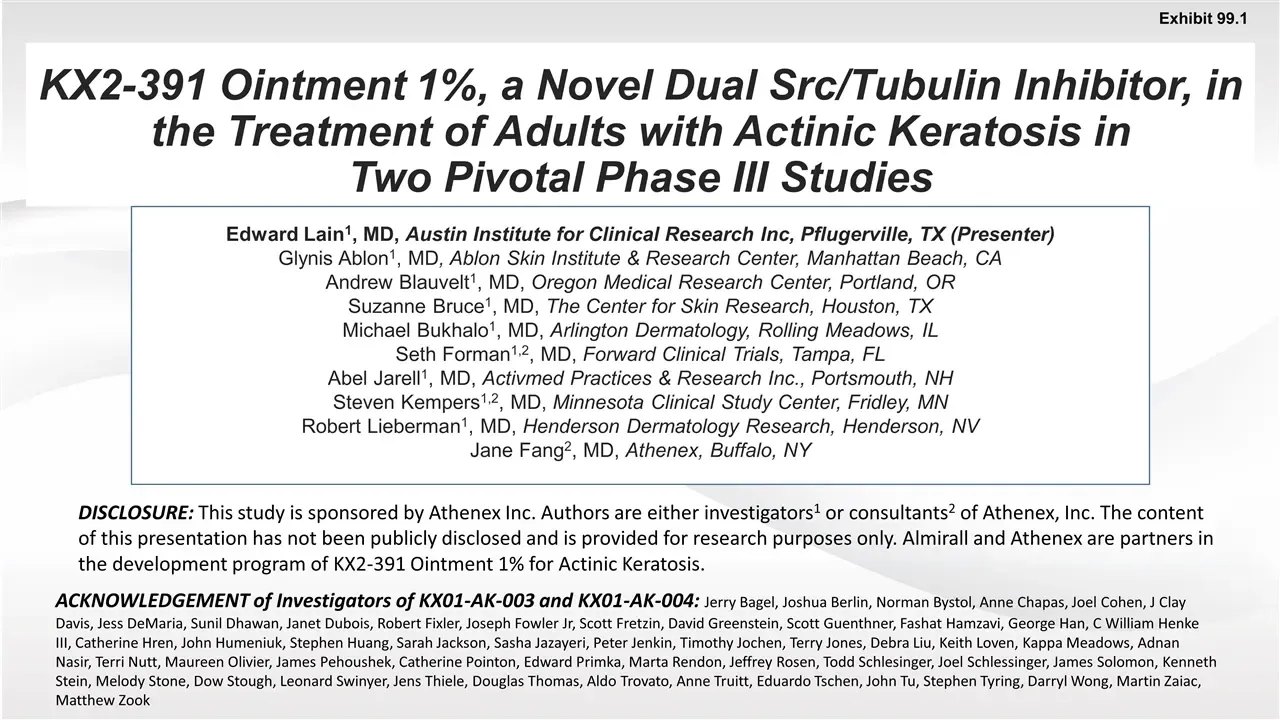
4:19 The results were featured in a late-breaking oral presentation at the 2019 American Academy of Dermatology annual meeting in Washington, D.C. These studies both met their primary endpoints with statistical significance, demonstrating excellent activity for 391 in the treatment of actinic keratosis on the face or scalp. The safety profile of this product is excellent. It has been shown to be well tolerated and compliance rate was over 99%. We believe that, once approved, this will serve to differentiate 391 from existing treatments. Our medical officer, Dr. Rudolph Kwan, will provide you with details of the results, but suffice to say This product has demonstrated what we believe to be a very competitive efficacy and safety profile in the clinic.
5:16 We are commercializing this product in collaboration with Emerald. We think that Emerald is the ideal partner. They are the one that leads the independent dermatology companies in the US and Europe and they are leader in the AK market. They have recently increased their U.S. footprint by acquiring the dermatology assets of Allergan in the U.S. The economics of this partnership are very favorable to Affinex, with development and sales milestone payments that could potentially be in the hundreds of millions of dollars in addition to commercial royalties. I want to mention briefly a strategic agreement that was signed with Chongqing Jingdong Pharmaceutical in December 2019 to license and commercialize CAKES2-391 in China.
6:09 You probably have seen our announcement last week that we have decided not to proceed with this collaboration and have regained the rights to commercialize CAKES2-391 in Mingling, China. The excellent profile of CAKES2-391 in adenocaritosis and the additional dermatology and oncology indications that we are planning will better position us to capture the market opportunity in China. Full-year revenue for 2018 was $89.1 million, up significantly from the $38 million we reported in 2017. Although this was below our most recent guidance, the shortfall was due to us not receiving an expected licensing fee of $14.5 million from Chongqing Jingdong Pharmaceutical at the end of the year.
6:59 Importantly, Our operating business continues to perform well. Reproduct sales up 56% year-over-year. Our CFO, Mr. Randall Zee, will expand on our financials as well as provide update guidance for 2019. I will now turn the call over to our Chief Medical Officer, Dr. Rudolph Kwan, to provide you with an update on our clinical pipeline.
7:25 Rudolph. Thank you, Johnson. Now for a review of our clinical development activities. We begin with our KX2391 program for actinic keratosis. We presented positive data from our two pivotal Phase III studies in a late breakout session at the American Academy of Dermatology Association Conference in Washington, D.C. on March 2nd. We had previously announced that both studies successfully matched their primary endpoints which was 100% clearance of AK lesions by day 57. The results presented at AAD showed for the first time the percentage of patients in each trial who achieved 100% clearance that was 44% and 54% of patients respectively in studies 003 and study 004.
8:24 These results were both higher than the 43% we reported in Phase 2. Also presented were the data on various patient subgroups, and again, for each subgroup, there was statistical significant clearance rate in favor of KX2391 versus vehicle. Safety results shows that KX2391 ointment was well tolerated, and based on the data, appears to have a very clean safety profile. This is particularly important. And we believe it may become a key competitive advantage for this drug, given that the existing field treatment for AK are associated with very troublesome side effects. Of note was a very high compliance rate, with over 99% of patients completing treatment.
9:16 Our discussion with dermatologists indicate that this is something they care about. Last Monday, we hosted a conference call to discuss this data and were joined on a call by Dr. Seth Foreman, a highly regarded dermatology expert and major contributor to the AK program, having been involved as an investigator in our Phase II and Phase III studies. Dr. Foreman gave an overview of the current treatment landscape for AK and stated that, in his opinion, and based on the clinical data, KH2391, had the potential to change the clinical practice and treatment of AK if approved.
10:01 Both Phase III studies are still ongoing to complete the one-year follow-up of the patients who had complete responses. We will be submitting a request to the FDA for a pre-new drug application, or NDA, submission meeting to discuss the data and regulatory submission timelines. We turn to our oral discovery platform, where our leading candidate, Orexo, is currently in an ongoing phase 3 trial for metastatic breast cancer. As Johnson stated, we successfully completed target enrollment of 360 patients in the trial in January. The study is designed to compare the safety and demonstrated superiority of Orexo over IV Prachatexo And the primary endpoint is based on confirmed response rate as assessed by the resist criteria.
10:57 It has already passed two independent data safety monitoring board reviews where, in each case, the board recommended unanimously that the study continued. We expect that the top line results from this study will be available mid-year. As we hope to submit this data for presentation at a major medical meeting, and for peer-reviewed publications, we may limit the announcement to the primary endpoint at that time. In October, we presented encouraging efficacy and safety data of orexo in the treatment of metastatic breast cancer patients obtained from a Phase II clinical trial. With results from 24 patients reported, 11 patients achieved partial remission, and another 10 patients had stable disease.
11:48 There were no dose-limiting neuropathies observed. This data provides further confidence in our ORAXO Phase III clinical program. We were granted orphan drug destination for angiosarcoma for ORAXO last year and have commenced Phase I clinical trial. Our abstract summarizing the preclinical ORAXO data in angiosarcoma has been accepted for post-surgery sessions at the forthcoming American Association for Cancer Research, or AACR, meeting in May. Moving on to our combination studies with orexo. In November, we initiated a Phase I-II clinical study to assess the safety, tolerability, and activity of orexo in combination with anti-PD-1 antibody, pembrolizumab, in patients with advanced solid malignancies in collaboration with the Mayo Clinic.
12:50 In December last year, our global phase 1B clinical trial of orexo plus remesirumab, a monoclonal antibody to VGFR2, in gastric cancer patients who failed previous chemotherapies, completed the second cohort of patients, and we are progressing well with the third cohort. In our Oratecan and Oradoxo programs, We have identified our dosing regimen for phase II development and plan to initiate these studies in the first half of 2019. For oral TCAN, we believe that we can identify phase II dose that will produce a similar exposure as IV irinotecan. And for oral DOXO, which is the oral formulation of docetaxel, we believe that we can achieve similar exposure to IV docetaxel with one or two days of dosing every three weeks.
13:48 Our other oral discovery programs are continuingly as planned. In summary, we believe our oral discovery platform will establish a new paradigm in the use of oral anti-cancer drugs for cancer treatments. Not to be overlooked, we have several other early stage programs in phase one development. including our TCRT program, which has the potential to provide a potent and selective directed response to cancer cells. We're very pleased to report that our partner in China for the TCRT program has successfully submitted their company-sponsored IND with the China Healthcare Regulatory Authorities, setting the stage superbly for our planned U.S. IND submission before the middle of this year.
14:41 We are also on track to file an IND for peptomarginase in the first half of 2019. Peptomarginase is an enzyme capable of depleting tumors of the amino acid arginine, a key resource for the cancer cell growth and survival. Therefore, by mid this year, we may potentially expand our pipeline to include 10 clinical oncology candidates. We see our early programs as an important part of our long-term strategy. As Johnson mentioned, we have submitted a number of abstracts to ASCO for consideration for presentation in the forthcoming annual meeting in early June.
15:27 These abstracts cover all of our platforms, not only oral discovery, including our early stage programs. I will now turn the call over to our Chief Operating Officer, Mr. Jeff Yoden.
15:42 Thank you, Rudolph. Given the great progress of our clinical programs, our plan at the Phoenix is to continue building a fully integrated pharmaceutical company. And we believe that the groundwork we've established today in terms of creating a global supply chain and building capabilities on the commercial side will ultimately give us a competitive advantage and help us maximize value. Our proprietary products address large markets, and if they are successful in the clinic, we believe they will have enormous commercial potential. But in order to really capitalize on these opportunities, it is critical that the commercial and manufacturing elements are in place well in advance of product approvals and launches.
16:31 Our marketing plan for Araxol is now well advanced under the leadership of Mr. Tim Cook, who joined us as Senior Vice President Global Oncology in 2018. Tim joined us from Eli Lilly, where he was formerly Vice President and Chief Operating Officer of Oncology. As we work on this plan, the operations of our APT subsidiary have been instrumental in developing relationships with the healthcare community, specifically with various gatekeepers, influencers, and prescribers. Our commercial and clinical groups are closely aligned and are already conducting work with payers and advocacy groups.
17:19 Almirall is leading the marketing initiatives for KX2-391, and we are supporting them. We are in charge of the regulatory submission in the U.S., and we look forward to sharing the clinical data with the FDA in a pre-NDA meeting. We believe that the timing of the NDA filing will likely be in early 2020. Almirall will be responsible for seeking approval in the EU and other territories. On the manufacturing front, the exterior construction work on our 415,000 square foot biopharma production plant in Dunkirk, New York is now substantially complete. This is the facility we intend to use for CGMP-compliant drug manufacturing.
18:10 We will eventually be manufacturing proprietary products there. The next stage will be completion of the interior, and while this interior work is in progress, equipment will be installed and the validation process, including an inspection by the FDA, will take place. As a reminder, this plant is being funded through a strategic public-private partnership with the state of New York. Empire State Development has agreed to fund the cost of construction and all equipment for the facility, as well as our corporate headquarters, including our state of the art lab, up to an aggregate of $225 million. We have also made progress with our API facility in China, which has received similar financial support from the Chongqing government.
19:03 This will be critical for ensuring sufficient capacity to support our clinical trials and eventual product launches, assuming regulatory approval. APD currently markets 28 products with 53 SKUs. APS markets six products with 16 SKUs. We expect that our commercial platform will launch an additional 12 products in 2019. Ondansetron was probably our most important product in 2018. This is the highest unit oncology product in the United States, and we were the principal supplier during a nine-month shortage in 2018.
19:50 This is a very good example of a product that is helping us build very strong relationships with oncology providers. We have also been one of the major suppliers for vancomycin which was on the shortage list for most of the year and is a critical antibiotic used in acute situations throughout the hospital. Other key products include levothyroxine, which we expect to be a significant contributor in 2019, and sodium bicarbonate, which is a significant shortage product, which we will continue to supply through at least the end of Q2 2019. We learned on March 1st that the FDA has indicated not to include vasopressin on the 503B API bulk list.
20:47 In response to the FDA's decision, we have filed a complaint against the FDA. The Department of Human and Health Services and certain government officials requesting that the FDA be enjoined from not including vasopressin on the 503B API bulk list. On March 7th, the FDA agreed that it won't take any action against the Phoenix's compounded vasopressin product until the court decides if the FDA was wrong in deciding not to include vasopressin on the 503B API bulk list. The court is expected to hold a hearing in late April or May, and we expect to have the court's decision in June.
21:35 unless the judge rules from the bench, which we believe is highly unlikely. We intend to continue selling vasopressin until then, and if the court decides the FDA was wrong in not including vasopressin on the list, we will continue to sell it indefinitely. I will now turn the call over to Mr. Randall Z to discuss our financials in more depth. Thank you, Justin.
22:03 We now go through our fourth quarter financials first. Revenue for Q4 2018 was 21.3 million, as compared to 14.9 million for Q4 2017, an increase of 6.4 million. Product sales were 19 million and 14.1 million in Q4 2018 and Q4 2017, respectively. There was a 2 million licensing fee revenue in Q4 2018, pursuant to a licensing arrangement we enter into with PharmaEssentia in December 2018 for rights to Orodoxitexel in certain Asian territories. Cost of sales increased from 10.1 million in Q4 2017 to 14.3 million in Q4 2018, primarily as a result of change in our product mix.
22:58 As we continue to develop our product portfolio, Our growth margin might fluctuate over time. R&D expenses for Q4 2018 totaled 20.8 million. Our various clinical programs accounted for a majority of our R&D expenses. The R&D expenses in Q4 2018 was in line with the 20.8 million reported for the same period in 2017. SG&A expenses for Q4 2018 totaled $11.6 million, slightly lower than the $12.3 million for the same period in 2017. Net loss attributable to Ethenix for Q4 2018 was $27.1 million, or $0.41 per diluted share, compared to a net loss of $28.3 million, or $0.49 per diluted share, in the same period last year.
23:57 Next, I'm going to go through a few major P&L items for the full year 2018. There is a significant increase in revenue from 38 million in 2017 to 89.1 million in 2018. As mentioned earlier, product sales increased significantly from 36.1 million in 2017 to 56.4 million in 2018. The increase was also attributable to the outlicensing of KS2-391 to AMRO, in which we received a $30 million upfront payment in 2018. Net loss attributable to Athenex for the full year 2018 was $117.4 million, or $1.82 per dilute of shares. Compared to net loss of $131.2 million, or $2, 63 cents per diluted share for 2017.
24:56 Excluding the non-cash licensing fee of $24.5 million in connection with the establishment of Access Therapeutics, which is our TCRT entity, in July 2018, the net loss attributable to Athenix for 2018 was $92.9 million, or $1.44 per diluted share. At the end of year 2018, we had cash, cash equivalents, and short-term investment, aggregating $107.4 million, compared to $51 million at the end of 2017. Based on the current operating plan, we expect our cash, cash equivalents, and short-term investments at December 31st, together with cash to be generated from operating activities, will enable us to fund our operations through at least the fourth quarter of 2019.
25:59 For more detailed discussion on our financials, including those specific factors that contributed to the changes in line items on our income statement, please refer to Form 10-K that was filed with SEC earlier this morning. Now turning to our guidance, going forward, The company's revenue guidance will be on product sales only and will exclude estimates for license and collaborative fees. More importantly, we will provide regular updates on our clinical progress and results and business activities, which remain to be the core value drivers of our company. Product sales have exceeded guidance. As mentioned earlier on the call, we had previously provided guidance for full-year 2018 revenue to be close to $100 million, and this was inclusive of licensing fee revenue.
26:51 In our licensing fee revenue guidance, we accounted for an upfront payment of $14.5 million from Chongqing Jingdong Pharmaceutical. These discussions had started two quarters ago. However, as announced last week, the agreement with Chongqing Jingdong Pharmaceutical was terminated by mutual consent, leading to our 2018 reported revenue. In 2019, we anticipate there will be a year-over-year increase of 25% to 30% for product sales, from 56.4 million in 2018. With that, I'll turn it back to Johnson for some final comments. Johnson.
27:33 Thank you. Our mission at Acenex is to build a global biopharmaceutical company that will improve the lives of cancer patients by bringing more effective, safer, Inc. Inc. Inc. Inc. Inc. and experience product commercialization team who are building infrastructure that leverages both our global facilities and collaborative relationships in order to achieve global distribution of any approved products.
28:29 We're making excellent progress on building this commercial and manufacturing infrastructure, which we believe will allow us to capture the entire value chain. And finally, is important to understand the market and trends. Combination therapy is now becoming the standard for cancer treatment, and through our clinical development efforts, we're exploring how best to combine our products with immunotherapy. We're also thinking about metronomic dosing, or maintenance therapy, which remains a largely untapped opportunity. If we can be successful on the different components of our strategy, we see a great opportunity to serve the oncology community and at the same time creating value for our shareholders. With that, I'll conclude the presentation and open the floor for Q&A. Thank you.
29:26 Thank you. If you would like to ask a question, please press star 1 on your telephone keypad. A confirmation tone will indicate your line is in the question queue. You may press star 2 if you would like to remove your question from the queue. For participants using speaker equipment, it may be necessary to pick up your headset before pressing the start keys. Our first question is from Kenan McKay with RBC Capital Markets. Please proceed.
29:53 Hi. Thank you for taking the questions and congrats on the quarter. Maybe first just a couple of housekeeping questions. I was wondering, on the pre-NDA for KX2-391, was that something that you had said was filed, or is that planning to be scheduled in Q2? And then a question, again, just housekeeping for Jeff. I was wondering if you could help us understand how much came from VASA press and sales. ENDP had put out some pretty solid growth numbers here, so It hadn't seemed like a major impact, but just wondering if that's because you're currently not marketing this heavily because of the ongoing litigation or if there was any color you could help us with there.
30:41 And then lastly, a housekeeping question for Randall. I was just wondering if you could help us understand what we could think about as a revenue number from milestones and fees if everything sort of does go according to plan, especially as it relates to the relationship with Almirall. I certainly understand excluding that given, for instance, what we saw in Q4 and that milestone not getting recognized. But that would be terrific. Thank you.
31:14 Ken, let me answer the question regarding the KX2391 pre-MDA meeting question. We are completing the follow-up of the 12-month follow-up for the complete responders, and that is targeted towards second quarter. And once that is completed, then we will submit a pre-MDA request. So the pre-MDA request will be submitted following the completion of the 12-month follow-up sometime around the end of the second quarter or the third quarter.
31:56 Kennan, vasopressin. First of all, let me explain to you that it takes about eight to ten weeks for a hospital to convert from the previous product to our product. We have been marketing the product, and you should be aware that about 50% of the hospitals, before they make the commitment to switch, want to make sure that it's going to stay on the list. The revenue for 2018 was about $5.6 million, and we anticipate that we will surpass that easily in the first couple of months of this year.
32:41 Hi, Kenneth. On the milestone payment, maybe let me just give you a bit more background. So given the advanced stage of this KX2391 program, And since signing an AMRO deal back in December 2017, we have been exploring different opportunities. And obviously, we've received a lot of very positive interest in various major markets, including China, over the course of last year. So Jingdong Pharmaceutical, they demonstrate a very strong experience in the pharmaceutical sector with a sizable sales force. And that's why, back then, we considered them to be a very good partner for this potential partnership. But unfortunately, as announced in March, earlier last week, we mutually terminated the agreement as a result of unseeable events on their end. And looking out in terms of the potential milestone payment, one thing that we would like to talk to the street about is if you go to the AMRO transaction, There is this close to 20 million milestone payment coming in, and that's going to be either coming in this quarter or next quarter. So that would be our, I would say, near-term guidance on the milestone payments with regard to the licensing arrangement.
34:10 Patrick, thank you very much for the help there. And then maybe just a couple questions on Iraq. So I was wondering maybe for Rudolph, if You could just clarify whether the confirmed overall response rates that I resist, that is the primary endpoint, is that a landmark analysis of confirmed response rate at four months, or is that sort of the best response through four months? And then also, at least relating to the Raxall program, I was wondering if you could help us understand what percentage of the current API manufacturing business is going towards manufacturing of paclitaxel for the ARAXAL trials.
34:56 How much of the capacity there is going towards essentially feeding clinical trial product into that, and maybe what the value of that paclitaxel would be if it were sold? commercially. And then maybe a final question for Johnson. You had sort of concluded the call sort of hinting that maybe you'd be evaluating some maintenance indications given the sort of enticing efficacy that could be seen there from metronomic dosing. Can you maybe elaborate on what the first indications that we could see there could be from a maintenance perspective? Thanks so much for taking the questions.
35:39 Kenneth, let me answer the question on ORACSO. Indeed, it is a confirmed overall response rate at least four months. So the study design is such that we'll look for 16 weeks of response rate. If the first response occurs in week 16, it will be confirmed at week 19. And if the first response occurs at week 19, it can be confirmed at week 21 or week 22. But it has to be a confirmed one. It's not the best overall response.
36:18 Ken, this is Jeff. In terms of your question on API paclitaxel, about one-third of our capacity is being used for clinical studies. I would value that at about $6 million, which would have been obviously revenue. With the new facility coming on board and when it's completely on board, it will give us significantly more capacity and we'll be able to contribute much more on the revenue line.
36:53 For your third part of the question, I believe you have two questions. One is additional Oncology Indications for KX2391 and also for ORAXO, the potential for metronomic dosing. To answer the first part of your question is that the KX2391, obviously we believe that it has not just activity against adenine keratosis and based on our preclinical studies and a lot of other We believe that it will have potential for other dermatological oncology indications and we have been very excited with that and we see that as another potential opportunity for us to capture, given the advancement of the 391 program, that we will be able to extend to other skin oncology indications relatively easily and we are in the process of doing that.
37:58 For the other part of your question with regard to metronomic dosing, obviously we share with the investment committee before that a fair number of our patients with our Phase 3 program are receiving therapy well beyond 40 weeks and some patients well beyond a year, so therefore Obviously, this will translate into potential opportunity for maintenance therapy and metronomic dosing. Dr. Kwan, our chief medical officer, is actively evaluating the best option in terms of proving the point, and certainly the follow-up of all the patients that are carrying on the drug will be already a very good indicator or important piece of clinical information that can help us pushing forward.
38:45 And I hope I answered your questions.
38:48 Yep, sure did. Thank you very much and congrats on the progress. Thank you.
38:54 Our next question is from Chad Messer with Needham and Company. Please proceed.
39:00 Great. Good morning and thanks for taking my questions. Could we just start? I just wanted to confirm the timelines for KX2391 going forward. I believe, Rudy, you said we're waiting on Safety follow-up data in second quarter, and then you're going to request a pre-NDA meeting. Obviously, you have to have that meeting, and then filing, you expect in early 2020. Is that all complete and accurate?
39:30 Yes, that's what is the plan.
39:34 All right, great. Thank you. Can you just remind us of Almoral's commercial presence in the U.S., and are you aware of any plans to expand that for this product?
39:48 Yes. Johnson here. Let me answer your question. Our partner has been very aggressive in positioning this product as the key driver for their future value creation going forward. Emerald's brand in the US is called Aqua, A-Q-U-A, which is actually one of the top five in the US. And the other thing that you should be aware of is that we share with the investment community and so as Emerald that when they launch our product, they will try to rebrand Aqua back to Emerald US. I mean, that's their plan. The other piece of information that we can share is that The Emerald was then very successful in advancing their pipeline here by acquiring the dermatology franchise or portfolio from Elegant for $650 million.
40:46 And if you look into their press release, we were happily surprised when they even indicated in their press release when they were acquiring the Elegant asset that They felt that that was actually a very important move for them to position the company in the U.S. and with the right team to ensure that they can capture the full opportunity as presented with the KIX-2391 that is our compound in that press release. And they also indicated in their conference call that they feel that this will be the future, an important component of their future product sales in the U.S. And I think all this indicated that Admiral is fully committed in terms of making sure that CASE 2391 will become an important product for them, both in EU as well as in the US.
41:41 All right, great. Thank you for that. And then just looking for a little help on a P&L item, cost of sales was a lot higher in 4Q. Is there an explanation for that?
42:03 Yes. As I mentioned earlier on the call, obviously, we're still in the process of developing the product portfolio for our commercial platform. And that's why from time to time, the margin might fluctuate. If you remember, earlier last year, we did actually capitalize on some of the very high margin shortage products. So we will continue to explore opportunities to capitalize on these shortage and high margin products going forward.
42:34 Yeah, let me also add that we have backloaded some of the payments, the licensing payments. And for example, about three years ago, we had purchased 14 products from Amphistar. That was back-loaded, and the actual upfront payments were made in 2018. So some of that also is a reflection on deals that we've made, upfront payments.
43:06 All right, thanks. I appreciate that. Thanks, guys. Thank you.
43:12 Our next question is from Yael Chen with Laidlaw & Company. Please proceed.
43:18 Good morning, and thanks for taking the questions, and congrats on the progress so far. A lot of the questions have been answered, but I have two here. The first one is for the KX2-391. You mentioned that you will have probably NDA meetings, pre-NDA meetings with the agency probably in mid-year and file for approval. in early 2020. My question is, is there any other gating factors before you're filing for the approval after the meetings with the agency?
44:08 We are planning to submit a request for pre-empt gating meeting once we get the response 12-month response rate from the completion of the ongoing follow-up studies. We do not see any additional issues that will limit our filing of an MDA.
44:33 Okay, that's good to know. I appreciate that. And would the Admiral will file for the U.S. as well as the Europe, or there's a slight time difference between the
44:44 two filings. We are responsible for filing in the U.S. and Emeril is responsible for filing in Europe. They are in active discussion with the EMA regarding the filing. I think I will leave it at that.
45:07 Okay, great. And maybe the last question here is that You have mutually terminated the agreement for the China licensing commercialization from 399,391. Are you seeking other partnership for this asset going forward or you have other plans?
45:34 Thank you for the question. The full story was like this. We were in active discussion with a number of potential partners since early third quarter last year. And then through a lot of due diligence, we felt that Chung Hsing Chinh Tung would potentially be a good partner because they have a very large sales force and we felt that for the long-term benefit to the company and also for our overall strategy and also their corporate mentality, We felt that they would be a good partner. And after that, there were certain challenges that they were facing which led them to not be able to complete certain of their promises or commitment.
46:20 And as a result of this and as a result of the fact that we know we have very good data and also the recent piece of information that we may have other very nice dermatological oncology opportunities We felt that it would be to the best interest of our shareholders to discontinue the contract since they were not able to fulfill certain of their commitments. They are very nice to us and they felt that they were not able to deliver and they accepted our request with regard to termination of the agreement. The question would then be, what next?
47:06 Obviously, now that we have a very good asset, our clinical data looks very good, there's no issue with our clinical data and all these other things, and we now have even additional dermatologic oncology opportunities, we feel that we are in a very good position to reconsider the best approach in terms of capturing the maximum value of this particular program in Asia, and the management team is in active pursuit of this program. right now in terms of having discussions and also having internal evaluation as to the best approach to capture the full value of this program in Asia.
47:43 Okay, great. That's very helpful. And maybe just tag on one more question here, which is that the Australia rights, I believe you guys retain that, correct me if I'm wrong, and just curious what's the future plans there at this moment?
48:00 Actually, we're in active discussion with a number of potential partners, but having said that, Australia and New Zealand, they're well known for very high incidence of Atenic Keratosis in their geographic region, to the point that the government consider it to be a major issue for the healthcare of their citizens. Now, obviously, the easy way out is to engage a partner and try to create partnership, but Australia also represents a very interesting opportunity because the major bulk of the population of Australia are focused in five major cities. And therefore, even to capture this opportunity is actually, or I would say can be, within the reach of a Phenix in terms of the O4 opportunity. We're still in active discussion, certainly.
48:52 We're balancing between the terms sheet that is on table versus whether we would like to do it ourselves in terms of having opportunity to extend the geographic outreach of a phoenix. So that is actively being considered right now.
49:09 Okay, great. Thanks a lot and congrats on the progress and look forward to see the top-line data shortly.
49:17 Thank you.
49:19 Our next question is from Matt Kaplan with Ladenburg Thalman. Please proceed. Matt, please check and see if your line's muted.
49:32 Hi, good morning. Can you hear me now?
49:34 Yes.
49:35 Great, thank you. Good morning. Just wanted to focus on the pipeline a little bit. I guess first with Aroxyl, beyond the Phase 3 program, where are you focused as a company in terms of the continued development of the product?
49:55 Yes, Matt. It's Rudolph here. The continuation of the program is in two directions, as we indicated previously. So apart from the Phase III monotherapy, metastatic breast cancer, we're pursuing an orphan drug indication for angiosarcoma. So that study has started, as we announced previously. And the second line of development is in combination therapy. And we have two combination studies ongoing. One is a combination from the Serumet, a targeted therapy in gastric cancer. And the other is a combination with the anti-PD-1.
50:40 So that is the line of development we are focusing right now.
50:47 OK, very good. And then in terms of those programs, should we expect any data from them potentially later this year?
50:58 Yeah, both programs are evolving in active recruitment. So we already announced some data regarding the combination of remicirumab and gastric cancer, and we are completing the third cohort as we speak. So stay tuned. The data will come out as soon as we complete that. The anti-PD-1 combination That's ongoing with Mayo Clinic. We have initiated enrollment in the initial cohort in the three Mayo Clinic centers. So again, stay tuned with data as we come out of that one. Angiosarcoma study, again, as we announced previously, we have started enrollment. And all those, you will expect to hear progress and when their results coming out during the course of the year.
52:00 Okay, great.
52:01 Thank you. And then, with respect to the Or Discovery platform, what are the next milestones for products beyond Oraxel and that platform?
52:17 The milestone for Oraxel clearly is to get the top line result for the metastatic breast cancer middle of this year. That will be an important milestone. Regarding the other milestones for the program, the platform, certainly we want to advance to Phase II, the oral TCAM, and the oral doxetaxel program. And we are certainly starting the irribilin topo-TCAM programs in Phase I as well.
52:51 Let me add a little bit of favor here is that I would like to say thank you to Dr. Kwan for a very good design of the clinical programs because you can imagine that the most important point that we have to prove is to prove that orexo is superior to intravenous placatexel and to find an indication that we will be able to do head-to-head comparison one-to-one, not as a monotherapy, I think is really, really critical. And that results, the top-line data will be available in the middle of this year. I think this is very important. And once you prove that this is better, let me emphasize again, this is better, then the combination studies as well as all the other indications will be much easier to conduct because once you prove once and for all that this is better, then when you have combination studies, the confidence of the institutions, the oncologists, as well as the investment community, will be much higher.
53:55 And then the speed of progress, as well as value creation, will be much easier. So that is the design created by Dr. Kwan and the kindergarten team to ensure that we capture the maximum value through this particular process. And I think that is a key point I want to bring to your attention.
54:16 Great, great. And then last question for Dr. Conrad Rudolph. The TCRT program, can you help us think about 2019 for that program and kind of the next milestones we should look for there as well?
54:38 Matt, the TCRT program, we are actively transferring the technology from our China colleagues And since they already submit the company-sponsored IND in China, we are actually currently translating all those documentation into English and planning for the submission of the US IND. So stay tuned. You'll see our plan for submission of the IND in the US announced as soon as we are ready.
55:11 Great. Thanks for taking all the questions. Thank you.
55:17 As a reminder, it's Star 1 on your telephone keypad if you would like to ask a question. Our next question is from Jack Hu with Deutsche Bank. Please proceed.
55:27 Oh, hi. Good morning. I have one housekeeping question and another question for Dr. Kwon. The first one is on ORAC, so Phase III full data. You mentioned that we are going to see top line data, but when are we going to see, actually, would you present the full data, actually, and also at what value? And also, when should we expect NDA filing for Raxo? That's my first question. My second one is for Dr. Kwon. Can you maybe, you know, at your capacity as an expert, a medical expert, can you share your view on Niporexo? or DHP107, or another name is RMX3001, I'm sure you're familiar with. Why was this drug approved in Korea in 2016, but still not launched yet? And why wasn't this program got reactivated in China recently? Thank you.
56:28 Okay. Let me answer the first question, the Orexo Phase 3 program. The study has shown The primary endpoint being confirmed overall response rate, and that endpoint is the first readout that will anticipate by the middle of this year. Now, the full study will continue to continue as you would expect of any oncology compounds that are successful, and in terms of the progression-free survival, overall survival. So those data continue to be collected because the patients are surviving. And so the full data set actually will not come out until those data will continue to be improved. But the top line data, including the confirmed overall response rate, including the safety comparison, will be available by middle of this year.
57:29 Now, we may not disclosed more than just the top line result simply for the reason the medical journals' acceptance of publication and the presentation either in ESCO or ESMO will require that they need new data. So we will be announcing the top line result, but we'll be preserving the data set for acceptance for those meetings. In terms of MDA filing, obviously once we got the primary endpoint, we will be planning to discuss with the FDA about the timing of the submission timeline. So stay tuned, that will happen in 2019. Regarding the question on the DHP-107, sorry I forgot about the second question, I think there is obviously a challenge for that compound to move beyond Korea The fact that it is approved in 2016 and still not making much progress either in clinical, in registration of clinical studies beyond Korea speaks to the challenge of making that compound to be a mainstream development candidate.
58:45 I can give you a little bit more color is that the company was using some type of lipid to dissolve, like oil to dissolve the powder. and then give the oil emulsion to the patient orally which my understanding based on what I heard were associated with a lot of nausea and vomiting and at the same time the absorption was far below our technology based on the data that is in literature. So it was a Korean company and it was a powder mixed with lipid and Korean health authority approved it but My understanding is that they are facing lots of challenges because of the low absorption side effect and also that their path in terms of data package will not be as comprehensive as what we have and we have a technology according to the data in the literature which is far superior in terms of oral bioavailability and therefore we can understand the challenges that they are facing when they are talking or meeting with in other geographic areas outside Korea. That will be our understanding.
1:00:02 Thank you.
1:00:05 Thank you.
1:00:08 Ladies and gentlemen, we have reached the end of our question and answer session. I would like to turn it back over to management for closing remarks.
1:00:17 Thanks again for the time that you spent with us. 2019 will be an exciting year for ePHENIX. We expect some exciting data to come out in the middle of the year, and we look forward to sharing all these exciting data with you within the next six months or so. And stay tuned with 18X. Thanks for your time and your attention.
1:00:43 Thank you. This concludes today's conference. You may disconnect your lines at this time, and thank you for your participation.
Follow Athenex Inc into a list and get an email when it puts out news.
Host, LifeSci Advisors
Chief Executive Officer
Chief Medical Officer
Chief Operating Officer
Chief Financial Officer
Analyst, RBC Capital Markets
Analyst, Needham & Company
Analyst, Laidlaw & Company
Analyst, Ladenburg Thalmann
Analyst, Deutsche Bank