Eric Heilengren
Vice President of Investor Relations and Finance, Atara Biotherapeutics
Replay available
Atara Biotherapeutics (NASDAQ:ATRA) Q2 2020 earnings call, held 2020-08-05. Watch the replay and read the transcript on 6ix.
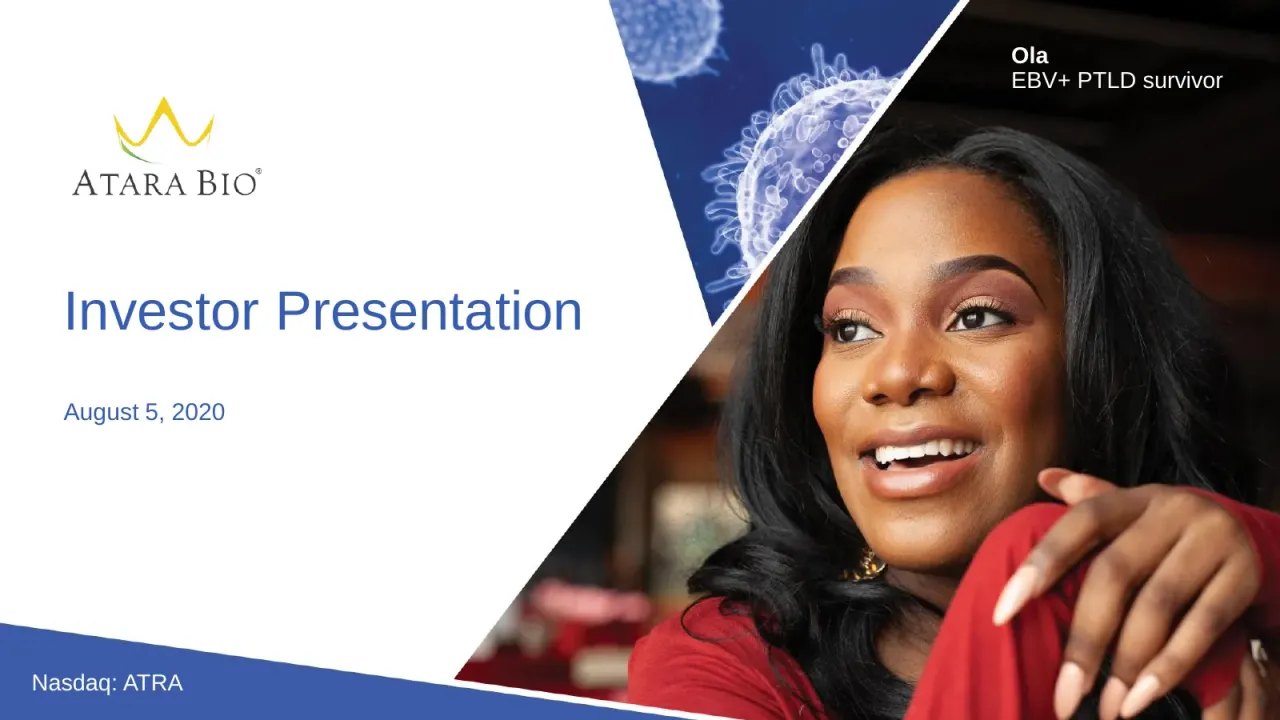
On 6ix: 6ix.com/event/atara-biotherapeutics-inc-atra-q2-2020-earnings-call
Automated transcript · Written by software from the replay's audio. It can mishear names and figures; the replay is the record.
0:00 Ladies and gentlemen, thank you for standing by and welcome to the Atara Biotherapeutics Second Quarter 2020 Financial Results Conference Call. At this time, all participant lines are in a listen-only mode. After the speaker's presentation, there will be a question and answer session. To ask a question during the session, you will need to press star 1 on your telephone. Please be advised that today's call is being recorded. I'd now like to hand the call over to Eric Heilengren, Vice President of Investor Relations and Finance at Atara Biotherapeutics. Thank you. Please go ahead, sir.
0:33 Thank you, operator. Good afternoon, everyone, and welcome to ATARA's second quarter 2020 conference call. On today's call, members from the ATARA executive team will provide an update on our financial results and operational progress and also review our upcoming key milestones and objectives for 2020. Earlier today, we issued a press release announcing our second quarter 2020 financial results and operational progress. This press release and an updated investor presentation are now available in the Investor and Media section at atarabio.com. Joining me on today's call are Dr. Pascal Tuchon, President and Chief Executive Officer, Dr. Jacob DuPont, Executive Vice President and Global Head of Research and Development, Upal Kopikar, Chief Financial Officer, Joe Newell, Chief Operations Officer, Dr. A.J. Joshi, Chief Medical Officer, and Kristen Urema, Chief Commercial Officer.
1:30 We will begin with prepared comments from Pascal and Jacob, then open the call up for your questions. We would like to remind listeners that during the call, the company's management will be making forward-looking statements. Actual results could differ materially from those stated or implied by our forward-looking statements due to risks and uncertainties associated with the company's business. These forward-looking statements are qualified in their entirety by the cautionary statements contained in today's press release and the company's SEC filings. These statements are made as of today's date, and the company undertakes no obligation to update these statements. Now I'd like to turn the call over to Pascal. Pascal?
2:10 Thank you, Eric, and thank you all for joining us this afternoon.
2:14 As we know, we're all living and operating day to day amid a global pandemic never seen before in our lifetimes. And yet, at the same time, we at Atara remain committed to serving the patient in need and deliver on expectations. Our mission, indeed, is to improve patient lives and we are focused on bringing transformative therapies to those in need with even stronger commitment and resiliency. To date, we have seen a relatively limited impact of COVID-19 pandemic on our business. We have worked with our clinical trial sites to implement remote study visits Leverage telemedicine, home healthcare, and other methods to ensure continuity of care for patients and to preserve key endpoint data.
3:07 From a supply chain perspective, we continue to deliver product to patients from our inventory on time, which is a clear advantage of such off-the-shelf allogeneic EBVT cells. Most importantly, we remain on track to initiate a BLA submission for TAP cell for patients with EBV-positive PTLD by the end of 2020 with more details to follow in this course. The COVID-19 pandemic is continuously evolving, and going forward, we will closely monitor the situation and continue to assess its potential impact on our business and operations, including the timing and execution of clinical and preclinical studies.
3:54 During the second quarter of 2020, we continued to make tremendous progress in delivering on our strategic priorities, TAP-Cell, AT188 in multiple sclerosis, and our emerging CAR-T portfolio. Starting with TAP-Cell, as I mentioned, we remain on track to initiate the BLA submission by the end of the year. As a next step, we will conduct an interim analysis of the phase three study in the third quarter of 2020, and then discuss the totality of TAP-cell data with the FDA in a pre-BLA meeting, after which we expect to initiate the BLA submission if the FDA is supportive. We believe that TAP-cell has the potential to transform the treatment of EBV-positive PTLD and offers a compelling value proposition for patients and, very importantly, healthcare systems.
4:49 As a reminder, relapsed refractory EBV-positive PTLD is an aggressive, often deadly cancer with no approved therapy and median survival in the HCT and SOT populations is only 1.7 and 3.3 months respectively. With TAP cell, to date, we have seen a high and durable treatment effect with few treatment-related serious adverse events. In addition, we expect to be able to deliver TAP cell to patients in need within three days from inventory. and with a low burden of administration on the patients and treatment centers. If confirmed for the pivotal study, such a compelling value proposition could lead to significant business potential for TAP-Cell plan first indication.
5:39 In terms of potential labor expansion for TAP-Cell, we remain on track to initiate enrollment in the second half of 2020 in a phase two multicore study with the goal of expanding a TAP cell label in PTLD and closely related diseases. We will focus on extending further into immunodeficiency-associated lymphoproliferative disease, or IALPDs, given the commonality of their EBV-driven mechanism of disease in immunocompromised patients, high and met medical need, and positive clinical data to date with TAP cells. We are very excited about this potential opportunity for TAP-Cell, as this population represents altogether an additional few thousand patients with serious and addressable EBV-driven disease in the U.S.
6:31 alone. Therefore, to maximize TAP-Cell business potential, our near-term focus will be the successful initiation and fast enrollment of this Multicore Phase II study on top of the planned BLA initiation in EBV-positive PTLD by the end of this year. Now, moving on to AT188, or EBVT cell immunotherapy for multiple sclerosis. We strongly believe in the potential for AT188 to become a transformative therapy, improving lives of MS patients. There remains a significant unmet need, in particular for progressive MS patients, with approximately one million patients living with such a progressive form of the disease.
7:19 Patients and caregivers are in need of new approaches with novel mechanism of action in order to truly improve clinical outcomes and reduce disability. We believe ATO and AT8 could have the potential to be such a therapy, creating tremendous value for patients, healthcare systems, and our shareholders. Beyond TAP-Cell and ATO and AT8, we're also creating potential value for an exciting portfolio of innovative and differentiated allogeneic CAR-T programs. These are based on our EBV T-cell platform and our ability to leverage new innovative technologies like 1XX and PD-1D-NR licensed from Memorial Sloan-Kettering to improve efficacy, persistence, and durability of response and to tackle both hematologic and solid tumors.
8:13 We believe we are strongly positioned to provide patients with meaningful clinical benefit and create significant value. With that hand, I am excited to report that our collaborators at MSK have recently submitted an IND application to the FDA for next-generation mesothelin-targeted autologous CAR T immunotherapy, ATA 2271. We also continue to advance on our off-the-shelf allogenic T cell immunotherapy manufacturing platform. We are completing the manufacturing process validation activities for PapCell while building inventory according to our commercial product supply strategy. Our eBVT cell manufacturing platform continues to evolve and scale up at our Wally-owned facility in Thousand Oaks, California.
9:06 We have generated data confirming the use of steel tank perfusion bioreactors to improve yield. Importantly, These data confirm that ATA-188 can be manufactured in such steertank perfusion bioreactors with the potential to produce up to 40,000 doses per one donor leukocerosis. Our scale-up manufacturing technology is a key enabler to deliver biologic-like cost of goods manufactured and will be leveraged across our portfolio, including for allogeneic CAR-T programs. Now onto our financial results. We ended the second quarter of 2020 with $347.7 million in cash, cash equivalents, and short-term investment.
9:55 This is an increase from the prior quarter and reflects aggregate net proceeds of $189.3 million from our recent public offering, including the full exercise of the option to purchase additional shares by the underwriters. Cash used from operating activity was 56.6 million for the second quarter of 2020 as compared to 54.6 million for the same period in 2019. We believe that our cash, cash equivalents, and short-term investment as of June 30, 2020 are sufficient to fund planned operation into 2022. In the second quarter, we also successfully onboarded two well-known scientific leaders in the field of cell engine therapy. Dr. Jacob Dupont was named Global Head of R&D and Dr. Maria Grazia Roncarolo was appointed to the Board of Directors.
10:53 Both have deep and diverse expertise in cell engine therapies and I am delighted to welcome them to our team. In summary, I am extremely proud of how ATARA's team members are continuing to make excellent progress against our key objectives. As a company, we remain committed to our mission and I want to personally thank all of our employees, contractors, collaborators and of course the patients we seek to serve for all they do. I hope that everyone on this call today is staying safe and healthy and I look forward to sharing our progress with you in the weeks and months ahead. I will now turn the call over to our new Head of Research and Development, Dr. Jacob Dupont, to review further detail of our program.
11:39 Jacob?
11:42 Thanks Pascal. and good afternoon, everyone. I'm excited to be part of the ATAR team and to provide an update on our innovative portfolio of programs. As Pascal mentioned, we continue to advance TabCell in phase three for PTLD, for which we have obtained breakthrough therapy designation in the United States and prime designation in Europe. This quarter, we have made significant progress in working with our existing clinical trial sites to enroll and treat new patients in our pivotal study. We've opened several new sites in Europe, notably in Spain, Austria, and Belgium. As a result of the hard work of ATARA staff, with the cooperation of our partners at our clinical sites, we are on track to conduct the interim analysis of our phase three trial in PTLD in the third quarter of this year. Following the interim analysis, we intend to meet with the FDA at a pre-BLA meeting in the fourth quarter of this year to discuss the totality of the data, and if the FDA is supportive, we plan to initiate the BLA by the end of this year.
12:55 As a reminder, in Europe, we are in active discussions with the Pediatric Committee of the European Medicines Agency regarding a Pediatric Investigational Plan, or PIP. following discussions with the PRIME team, and after EMA approval of the PIP, we plan to submit an EU market authorization application for patients with EBB-positive PTLD in 2021. Looking ahead, we are on track to initiate enrollment in the Phase III multi-cohort study in the second half of this year. and are eager to study TAB cell in these patient populations with such high unmet need. We're exploring six populations in the multi-cohort study with a focus on extending further into immunodeficiency associated lymphoproliferative diseases, otherwise known as IALPD.
13:55 In particular, this study will evaluate both treatment naive and previously treated patients in four patient populations with IALPDs, including two cohorts addressing frontline EBV positive PTLD patients with significant unmet need. An additional two cohorts addressing EBV positive LPDs arising out of primary or acquired immunodeficiencies will also be studied and represent an additional few thousand patients with addressable EBV-driven diseases in the United States alone. We expect the first cohorts to enroll in approximately two years, with data expected in 2023. In addition, we believe there is the potential to file either by cohort or for tumor agnostic designations.
14:50 As a reminder, previously reported clinical data from other EBV-driven diseases at ASH in 2018 in frontline and second-line CNS, PTLD, and at ESMO 2018 in leiomyosarcoma suggests the TAB cell may provide clinical benefit for these patients. We've also seen relevant clinical data through our TAB cell expanded access program in AEID, LPD, and PID-LPD, and we will present these as an e-poster which has already been accepted to the European Society of Medical Oncology meeting in a few weeks' time in Spain.
15:36 Our Phase 1b program of TAB cell in combination with pembrolizumab and nasopharyngeal cancer, or NPC, successfully achieved its safety endpoints in stable disease in a subset of patients. We will look to present these data at an upcoming appropriate forum. Following a strategic review and prioritization of our tab cell programs, we decided not to progress with the Phase II portion of the study at this time, but instead to generate additional translational data from this NPC study to further inform our strategies for this patient population with an evolving medical need. Turning now to our existing program, ATA-188 for multiple sclerosis. As most of us know, multiple sclerosis patients remain underserved with the current treatment options, especially as their disease progresses. Sadly, a continued decline in their disease is expected in progressive MS. The current treatment options offer a modest efficacy benefit at best. They only delay progression by a few months, and clearly do not alter the course of disease.
16:51 We believe there's tremendous opportunity to develop a transformative therapy to help patients in need. We have seen early but encouraging data with ATA-188. Recall we presented important Phase Ia data for ATA-188 at the EAN conference in May, where seven patients showed sustained disability improvement and three out of six patients showed SDI at six months that was confirmed at 12 months with our Cohort 3 dose. We are now retreating patients in the Phase 1a using the Cohort 3 dose in the open label extension of the study, and we expect to present preliminary OLE data in an appropriate form in the second half of this year.
17:38 In addition, we also expect to present 12-month clinical results for Cohort 4 in our Phase 1a study in an appropriate form in the second half of this year. In June, we enrolled our first patient in our double-blind randomized placebo-controlled study using the cohort three dose. This study is designed to evaluate the efficacy and safety of ATA-188 in patients with progressive forms of multiple sclerosis. This is certainly an exciting time for this very innovative program, and we look forward to continuing to share our clinical results in the future. We are also planning to discuss with the FDA the full data set from our Phase IH study to explore possible accelerated regulatory pathways.
18:28 Moving on to our CAR-T portfolio, as Pascal mentioned, we continue to make significant progress on all fronts, even in the midst of COVID-19. We are pleased to announce our collaborators at Memorial Sloan Kettering have recently submitted an IND application to the US FDA for our next-generation mesothelin-targeted autologous CAR-T immunotherapy that we call ATA2271. This marks a significant milestone in the evolution of the program, and we look forward to initiating a Phase I study in solid tumors with our collaborators in the very near future. As a reminder, ATA2271 is designed to improve efficacy, persistence, and durability of response using a novel 1XX CAR co-stimulatory domain and a cell intrinsic checkpoint inhibition technology with a PD-1 dominant negative receptor. The 1XX technology was innovated by Dr. Michelle Satterlain, and the ATA2271 program and PD-1 DNR technologies are led by Dr. Prasad Adesimili at MSK. Data from IND-enabling studies of ATA2271 were presented at AACR in June of this year. This is the first application of the combination of 1XXCAR co-stimulatory domain and cell intrinsic
19:59 checkpoint inhibition technology with PD-1 DNR. This construct is associated with less cell exhaustion, improvements in functional persistence, serial cell killing, and in vivo efficacy, which is maintained through multiple tumor rechallenges when compared to first-generation CD28, CD3 zeta-based mesothelin CAR. At ATARA, we are also making progress through IND-enabling studies with our allogeneic mesothelin CAR-T program, which we call ATA3271. This also utilizes the same 1XX and PD1DNR technologies leveraged by our differentiated EBV T-cell platform.
20:48 We are also executing on preclinical IND enabling studies of our off-the-shelf allogeneic CD19 targeted CAR T, which we call ATA3219. This program utilizes our next-generation CAR-T technologies and EBV T-cell platform. The ATA3219 is supported by the initial proof of principle from an academic off-the-shelf allogeneic EBV CD19 CAR-T clinical study that was presented at the 2020 TCT meeting. These data show the longest median duration of response in advanced B-cell malignancies for an allogeneic CD19 CAR T of 26.9 months. This data gives us further conviction that our EBV T-cell platform has the potential to generate off-the-shelf allogeneic CAR Ts with high response rates, durability, and low risk of toxicity.
21:51 We've seen the EBV T-cells offer numerous advantages as the basis of our allogeneic platform. as they are potent cell killers that specifically target disease cells, are safe, traffic to the sites of disease, expand, and persist in the patient. Most notably, we believe that ATA3219 has the potential to be a best-in-class, off-the-shelf allogeneic CD19 CAR-T therapy utilizing the next-generation 1XX CAR-T co-stimulatory domain and our EBV T-cell platform. As I noted, preclinical studies are underway, and we now expect to file an IND in 2021. Finally, I would also like to extend our sincere thanks to our staff, collaborators, patients, and caregivers.
22:43 We've accomplished much in this quarter thanks to you, and I look forward to providing updates on our continued progress in the near future. I will now turn the call back to the operator to begin the QA portion of the call. Operator? As a reminder, to ask a question, you will need to press star 1 on your telephone. To withdraw your question, press the pound key. Please stand by while we compile the Q&A roster. Our first question comes from the line of John Newman from Canaccord. Your line is now open. Pardon me, John. Please check your line is now open. John Newman from Canaccord, please check your mute button.
23:41 Gigi, let's take the next call and we'll see if John can get back in the queue, please. Our next question comes from the line of Kaleem Syed from Mizuho. Your line is now open.
23:53 Great. Thanks so much for the call, guys. A few from me on multiple sclerosis, if I can, on ATA-188. One, I believe the deadline to submit the late-breaking abstract for ACT-RMS is August 13th, so Pascal or AJ or Jacob, can you just confirm if you've submitted the abstract already, or if not, if you plan on doing it by that deadline? Number two, on the cohort four data that we're going to get later this year, I'm curious what your thinking is around moving to a cohort four dose for the randomized portion? What's your criteria versus cohort three? If it's equivalent but marginally better, are you thinking you're going to move to that cohort four dose or stay at cohort three?
24:40 How are you thinking about that? And then lastly, on the OLE, can you just give us a little bit more color about how many patients we can expect to see and from which of the cohorts are those patients coming from?
24:54 Thank you. Thank you, Salim. AJ, do you want to answer these?
24:58 Sure. So, Suspeem, I think at this point we're still going to not be specific about where we're planning on presenting these data. We are going to reaffirm that we will present the data in the second half of this year. In terms of the cohort four dose and what does that look like, What good would look like there for us? Was that your question? I apologize if you can repeat that.
25:22 Yeah, that was basically the question. Like what is good and then what's the criteria you have in mind to actually use that as the dose going forward versus sticking with cohort three?
25:32 Sure. It's a good question. And obviously, you know, we want to see safety. And certainly what we've seen in the previous cohorts is when we have sustained disability, we continue to see that. So you'd certainly want to see that. But then beyond that, you know, we have to see the whole data set. We've talked before a little bit about, you know, stable disease is really transformational here in addition to sustained disability improvement. So we'd be looking at all those factors, you know, and kind of put that all together to decide whether we want to add the cohort four dose into the study. And as you recall, our adaptive design lets us do that right away so it doesn't really slow the study down in any way, shape, or form. and then when you think about the open-label extension data, right now we're not in a position to comment on the exact numbers that we're going to have available when we talk about it, but I think a way to look at it is that remember when we picked the cohort three dose as the right dose to move forward, then we really opened it up to all the patients in the prior cohorts who were able to move into open-label extension. As you might imagine, a lot of the cohort three patients, because they were so active right then and there in the study, were the most rapid patients to kind of roll over into it. But we are going to, you know, we are seeing patients from across all four cohorts move on into the open label extension.
26:55 Just not able to comment now on which cohorts we'd be able to present at the right form in the second half of the year.
27:04 Okay, but the Cohort 3 patients were the ones that rolled over first, so it's possible we can get 15-month data for Cohort 3?
27:13 You'll definitely have some patients from Cohort 3 in that population. Okay, got it.
27:18 And maybe one other point to make here is that, just so you know, for the OLE, we did roll patients into that Cohort 3 dose. So even if there are patients at the earlier cohorts, At lower doses, they're now being treated in the OLE at the cohort three dose, as I mentioned in my presentation.
27:43 Understood. Appreciate it.
27:44 Also, Salim, to add that at the time we present the cohort four 12-month data, we should be able to clarify whether we believe that these data justify the need to add these dose to the RCP or not. So be ready for that at the time.
28:00 Got it. Thanks, Pascal. Appreciate the call, guys. Thank you. Thank you. Our next question comes from the line of Ben Burnett from Stiefel. Your line is now open.
28:11 Hey, thank you so much. I appreciate you taking the questions. I guess just a question on TAP cell and PTLD. I guess since your last update at ASH last year, have you enrolled any new patients into that EAP, and when will we next see an update from that study?
28:31 Thank you, Ben. Jacob, do you want to take that question?
28:36 Yes, certainly. So we're obviously focused on the pivotal study, the 302 study, and to continue to get that enrollment. And as you heard, we've achieved the sample size that now allows us to initiate the interim analysis, which is great. and we do continue to see interest in the EAP and the SPU programs as well. Obviously, we would prefer to divert patients to the pivotal studies so that we can achieve as much enrollment as possible, but as Pascal mentioned, these are quite sick patients where there can be times when the EAP or the SPU is a better solution for those patients in urgent need.
29:27 and clearly Beth, the next time you can expect data on TAP-Cell is in September at ESMO where, as Jacob has said, we have an e-poster accepted that is going to present data with TAP-Cell from the EAP in this new patient population, very exciting, a new patient population of PID and AID LPDs.
29:52 Got it. Okay. That's very helpful. and maybe just a follow-up question maybe also for Dr. DuPont. You know, one thing we've heard about is just discussions around the logistics of running a second-line PTLD study, some of the challenges associated with enrolling such a rapidly progressing disease. I guess thinking about the multi-cohort IALPD study, how does this compare to how does second-line PTLD compare in terms of disease severity and time sensitivity for treatment compared to frontline PTLD and some of these other EBV-positive disorders?
30:31 Yeah, maybe I'll start, and then we can have AJ add some additional color on the multi-cohort study. We do have six distinct patient populations that are included in the multi-cohort study. trial, and I think there is definitely different tempos of disease here. So you think about the AIDs, so AIDS-associated lymphoproliferative disorder, or the pediatric immunodeficiency patients, or the primary ones, I should say. These are populations where we're zeroing in on sites that have these specialty clinics, for sure, and I think It is a more prevalent couple of disease states as we articulated.
31:22 So just focusing on these patients, we think we can add, you know, some thousands of additional patients that we think are, you know, does represent a good addition to the opportunity for Tab-cells. Then there are going to be other indications of the six populations that include leiomyosarcoma, which may be less rapidly growing. Again, each patient's tumor is a bit different in this regard, but you can think of some leiomyosarcomas that are a bit more indolent, where the urgency is not quite as great in terms of treatment. So I think there's going to be particulars for each of these six populations, but there are certainly all very high unmet need, and some of them do obviously progress rapidly. The CNS PTLD, for example, is, you know, that's quite a medical emergency.
32:17 But, AJ, anything further that you want to add?
32:22 Yeah, maybe just two additional points, I guess. You know, to Jacob's point, there is a high unmet medical need, particularly, for example, in an AID, PID setting when you're in the refractory. You have a pretty similar aggressive progression that you do with PTLD, so that's a space you want to get in as rapidly as possible. And then when you think about the CNS-PTLD, whether it's first-line or in the refractory setting, those patients also tend to progress rapidly because if you think about the first-line therapies, they don't really penetrate the CNS as well as you'd like. So that's actually an area that may even be a sweet spot for TAP-SALF So again, even in that first line setting, you'll see CNS-PTLD progress rapidly.
33:07 Certainly not as rapidly as when it's relapsed refractory, but you still have good rapid progression there.
33:14 Okay. Okay. That's all very helpful. Thanks very much. Thank you. As a reminder, to ask a question, you will need to press star 1 on your telephone. To withdraw your question, press the pound key. Our next question comes from the line of Mark Fram from Cowan & Company. Your line is now open.
33:33 Thanks for taking my questions. I guess maybe to start off with, just with the planned interim analysis and then the BLA meeting, can you review what your plans are for the disclosure strategy, one for the underlying data, but also just around, you know, will you plan on informing investors when the interim analysis has occurred and likewise when the BLA meeting is happening?
33:57 Yeah, Jacob, do you like to start and I'll add anything that is needed there.
34:02 Yeah, absolutely. So thanks for the question. And as we've described, we have achieved the enrollment to activate the interim analysis, which is great news. And as we also have disclosed, it is an analysis which is upcoming quite soon. So in Q3 of this year, after we've had the appropriate follow-up of these patients, so it's a near-term thing. We do plan to request a pre-BLA meeting to discuss the totality of the data, as I mentioned. This is going to be not only the data from the 302 pivotal study, but we've also been working very hard on some of the legacy tab cell programs from Memorial Sloan Kettering Phase II studies there. We've already mentioned the EAP and the SPU programs, so we really intend to and so forth.
35:23 I think I'll leave it to Pascal to comment on the disclosure aspect. We don't want to disclose too early from the perspective that we don't want to undermine the integrity of the ongoing study. Obviously, this is an interim analysis, but Pascal, if you want to lend color to the disclosures along the way.
35:47 Yeah, I think there are two aspects in terms of disclosure. In terms of the data themselves, We will seek guidance from the FDA during that pre-BLA meeting on the appropriate time to share such information to ensure the integrity of the ongoing trial. So that's once we align with them, we can then clarify where we're going to communicate in terms of the appropriate Congress, for example. Now, disclosure will be also led by the importance of material events there. And we believe that the initiation of the BLA is clearly a material event at which we plan to communicate. and hopefully with this alignment with the FDA, we could not only communicate that we've initiated the BLA but hopefully some top-line data. But again, that will be based on having an alignment with the FDA because we want to make sure that we preserve the integrity of the ongoing trial.
36:41 Okay. And then maybe to follow up on earlier discussion of the multi-cohort trial, you mentioned gave the guidance that you think kind of across these cohorts it's maybe a few thousand patients that you could potentially ultimately add to the label. Can you give us at least a qualitative level kind of the rough breakdown between the cohorts or is one or two of those really the primary driver of that couple thousand patients and the ones that we should be most focused on in terms of the market opportunity?
37:12 Yeah, I think that's a great question. I mean, clearly the two cohorts with PID and AIDs are the cohort with the most patients there. And we have slide 27 on the new deck that we just posted that gives you an idea of the of patients there. There are about 170,000 patients with autoimmune disease and HIV, 35,000 with primary immune deficiency in the U.S. So it's about 205,000 patient population at risk in the U.S. The disease incidence is low single digit for AIDLPD and high single digits with PIDLPD. and the EBV positive rate is about 30% to 50% in AID and PD and 30% to 75% in PID and PD. So altogether, it leads to a few thousand first-line and second-line patients only in these two cohorts.
38:02 Then the other cohort of interest is, of course, the first-line cohort in PTLD, the first-line EBV positive PTLD that are patients where the current therapies are inappropriate and then the CNS, both first-line and second-line. and then there will be much rarer disease like EDV-positive sarcoma including LMS and CIEBV. So that's the kind of order of importance of the potential number of patients. And the first two are really the ones that have the most patients and that's why this is also priority in terms of enrollment and speed of enrollment once we start to initiate that study.
38:41 Okay, great. Thank you very much.
38:43 And by the way, not only are we going to present data on these two particular cohorts in September's ESMO. But the reason we are focusing on these is really that the disease itself is very similar to what we see in PTSD. So it's a very nice possible label expansion from our point of view to address a real important medical need in a population of a few thousand patients in a disease that is very similar to the one for which we have a large set of data already in PTRD. So that's also very positive for us to really focus our allocation of resources into this particular phase two medical study, specifically in this cohort with a number of patients and important medical needs.
39:37 Thank you. Our next question comes from the line of John Newman from Canaccord. Your line is now open. John Newman from Canaccord, please check your mute button. Your line is now open. Pardon me, John Newman from Canaccord, your line is now open.
40:06 It seems like John's having some technical difficulties. Hey, guys. Oh, there's John. Great.
40:12 This is John. Sorry, guys. Sorry about that. Thanks for taking the question. So the question I had is just if you could talk a little bit about the longer-term view for Tapsil. I know that we're all very focused on the interim analysis, and that makes sense. It's a material event for the company. But you are starting to run a study where you're looking at other – EBV-positive malignancies. And I just wondered if you could talk about the longer-term opportunity here, because it's one thing to talk about EBV-positive PTLD, but it's interesting to start to think about all these other areas. So I just wondered if you could talk a little bit about that opportunity. Thanks.
40:53 Yeah, maybe I start, and then, AJ, you can add anything specific on the way we see that multi-call study. But from an opportunity point of view, we think it's a great opportunity due to the criminality of this EBV-driven mechanism of disease in immunocompromised patients due to high unmet medical need. And this body of positive clinical data today that we have already from EAP and SPUs, we know from this early data that the therapy seems to be working in these patients, and it's certainly safe there. So we have that as a very clear opportunity to develop the potential of TAP cells. And these should not take too long because, as we say, we believe that by 2023 we should have data available in at least the first cohort, the ones that are the most important ones there. Now, from a regulatory point of view, maybe AJ wants to comment on the possibility that we have either to have specific cohort SBL type of indication or tumor agnostic label.
41:58 AJ, do you want to comment on that?
42:00 Yeah, sure. You know, as Pascal mentioned, we would expect the larger cohorts, the AID and PID, to enroll more rapidly than some of the others. But as we start looking at that common mechanism and you look at the six different cohorts that we have, they all have, you know, several of them have immunodeficiency associated and they're driven by EBV. So when you look at it from that perspective, It's certainly possible that the data that we generate off of AID-PID as well as whatever data we have off of the additional cohorts would enable a tumor agnostic label when you think about adding that information from the multi-cohort to the information we'll already have on PTLD. So there's certainly good possibility for that as well, and we'll, of course, assess that when we get close to that 2023 timeframe that Pascal mentioned.
42:51 Okay, great. One additional question. Not sure if you've mentioned this earlier on the call, but can you talk about plans going forward in terms of when you might put the EBD CAR-T against CD19 into the clinic that uses your 1XX co-STEM domain? I'm not sure if you've given timing on that as of yet. Thanks.
43:23 Yeah, so this is Jacob. I can mention that. As we've noted, we are in the midst of the IND-enabling studies currently at ATTARA, and we have disclosed that we are heading towards an IND filing in 2021. So work is progressing well in that regard. Okay, great. Thank you. Thank you. Our next question comes from the line of Yagal Notramovitz from Citi. Your line is now open.
44:01 Hi, this is Samantha for Yagal. Thanks very much for taking our questions. For me, I wanted to start with, can you expand more on your decision to focus on the additional EBV-positive cancers now versus back in 2018 when you first generated the data for ASH and Esmo presentations. What's different now versus then that makes it more attractive to pursue?
44:28 Yeah, maybe I can start, and then, Jay, you might want to comment on that. I think clearly at the time, we had only presented a few data, one from the legacy data at ASH-18 on the CNS PTLD. Then at ASH-2019, we presented Efficacy data on PTLD, but safety data on 61 patients, as you remember, that included not only PTLD, but other disease. So we have now this efficacy data on EAP, and this efficacy data is extremely encouraging, and that's one of the reasons we have accelerated our plan. We have moved ahead, and we are going to initiate that study very soon. is really based on data because it's very rare to be able to go directly into a phase two in the way we are planning to do so. And again, there is a slide that explains the protocol on our new investor deck based on already existing clinical data that clearly is showing that there is some efficacy in a few patients and an acceptable safety as presented at ASH 2019.
45:34 So it's based on data that we want to accelerate. At the same time, we know that there is a significant population out there in need of an innovative therapy like TAP-Cell. So there is a medical need. We have early data, encouraging data. That's why we're accelerating there to make sure that we can propose, hopefully, a solution for this patient. AJ, anything to add?
45:56 Yeah, maybe just one additional point. If you take a look at the data that we presented earlier, that was pretty much on the LMS population. and CNS PTLD population. Notice that we haven't presented data on AID PID and that's coming in September. So as we developed more and more data on AID PID, as you've already heard, that is the largest opportunity for us. So that's also part of the factor in accelerating this program because those data have supported moving the program forward much more rapidly.
46:30 Got it. That's helpful. And then just to follow up, I guess he maybe sort of answered this, but what is more attractive about the CBB, the IALPD versus what you saw in the nasal pharyngeal cancer trial? And I guess what factors would need to fall into place where you would consider pursuing nasal pharyngeal cancer again?
46:52 Jacob, do you want to take that
46:55 one? Yes, certainly. So thank you for the question. So with the... AID and PID LPDs, I think AJ explained well the value proposition there and the opportunity with the new data that we've generated. Now, with the NPC study, we did achieve our goals of understanding the safety and seeing some stable disease at that point. and we really want to generate more translational data here from that particular trial because this is a co-administration of cell therapy with a checkpoint inhibitor.
47:40 It is actually a very active area of scientific research in the field right now to understand is it better to give a checkpoint inhibitor concomitantly with a cell therapy or do you give the checkpoint inhibitor before The Cell Therapy or After. So there's actually a lot of these interesting scientific questions that need to be answered. So from that perspective, we think the prudent thing to do here is actually to work with our partners at Merck, who are very engaged as well, to answer some of these translational questions so that we can build the proper study going forward. As mentioned here, the multi-cohort study is quite a straightforward experiment from the perspective. These are all EBV-driven tumors we're treating with Tab-Cell. We have excellent clinical data to this point, so we think that's the right opportunity and the priority opportunity to focus on while we are working with our partners at Merck to really understand some of these aspects of co-administration and the best way to go about that.
48:48 We think it's important also as we were to answer these types of questions for the field in general because we are just at the beginning of these clinical experiments combining a checkpoint inhibitor with a cell therapy as well.
49:05 So clearly we think that we can go faster to address an important medical need with a relatively large population of a few thousand patients in the U.S. with a multi-cohort, particularly the AIDP-ID cohort there, and we want to go fast. That's why we're focusing on that.
49:22 Got it. Understood. Thanks very much for taking the question.
49:26 Thank you. Thank you. Thank you. Our next question comes from the line of Matt Phipps from William Blair. Your line is now open.
49:36 Hi there. Rob Andrew. I'm from Matt Phipps here. Thanks very much for taking the question. Apologies if I'm repeating prior question years. I switched between calls here this evening. Just maybe on the multi-cohort study, you know, looking forward to some additional data at ESMO. Perhaps, given the rarity of some of these diseases, can you talk about the ease or the strategy for identifying the patients? Are they being treated by the same docs that are treating the PTLD population? Does that mean that the enrollment centers for the upcoming study are likely to be the same? And how... Thank you, Rob, for your question. AJ, you want to answer this one? Sure. So maybe just a couple of points. You talked about the testing.
50:22 The testing is actually fairly routine.
50:35 It's not done as aggressively as it is in the transplant population because you literally track that from the moment that transplant is done. You want to make sure that their EBV viral load isn't going up. But in these populations, when they develop tumors, it's fairly standard to check for EBV. So there's really not much of a concern in terms of a diagnostic there. The second piece you were asking about is where do these patients show up? And certainly when you're taking a look at the kind of larger transplant centers, they almost all will have a dedicated group that's looking at these LPDs for AID, PID. So not that there's 100% overlap, but there's significant overlap at the large centers with PTLD as well as AID, PID. There will be some separate centers, but there's a large group that do overlap. And you also get the other populations, the LMS population, we have the CAEBB population, a few others that show up at those centers. So I would say there's significant overlap.
51:33 We'll have some kind of unique centers that we'll also add in. But from an operational perspective, there are advantages to that commonality of occurrence.
51:45 Okay, great. That's helpful. Thank you. And then maybe if I can just squeeze in a quick follow-up on the pre-BLA meeting prior to the BLA filing. You know, just assume you're not really envisaging any difficulties in getting this kind of thing organized with the FDA, just given the focus on COVID and kind of likelihood of a slew of vaccine data kind of in the fall there.
52:08 Jacob?
52:12 So thank you, William, for the question. Thank you for your question. Obviously, COVID-19 is a major concern at this point in the world, as Pascal has alluded to as well. I think the very fortunate position that we're in at Atara with TabCell is that we have a fee designation, so that will really have frequent and excellent engagements with the FDA. And similarly, in Europe, we have prime designation, which really allows us to have an excellent dialogue. And I do think that the agencies have really prioritized discussions for programs that have breakthrough therapy and prime designation.
53:00 So we've actually had very good engagement from the agency, even during this period of COVID.
53:09 Great, thanks very much. Thank you. Our next question comes from the line of Michael Diofri from Evercore ISI. Your line is now open.
53:21 Hi, guys. Thanks so much for taking my question. One question on ATA-188 regarding the durability and non-responders to therapy. I was wondering if there's any developments or updated thinking about using and HLA Restriction Switch to rescue non-responders and also perhaps patients who may lose response. And along those lines, is there a mechanism in the current randomized Phase I Part II trial for this rescue? And what's the FDA's views on allowing that to be employed in the context of a pivotal trial or any trial for that matter?
54:03 Yeah, AJ? Sure. Part of the question there is what is a non-responder? So for us, as we talked about this notion of transformational therapy, if you can halt progression or reverse progression, that's transformational. So the vast majority of the patients so far really have maintained their disability status. So it's really hard to identify who a non-responder is at this point. So I wouldn't expect immediately to be able to provide information on that just because we don't have someone who I would officially say is a pure non-responder based on that definition. That said, there's already built-in mechanisms that are part of the trial, both in the open label extension, that allow switch for anyone who is felt to be a non-responder. And in terms of your question around how FDA feels about that, That concept of restriction switch is already built into our Phase 3 TAPSEL program, so they're very familiar with it and very comfortable with the concept.
55:05 So we're just simply applying it similarly to the 188 program. So it's really more we need more longer observation before we can, you know, get some of that experience on switch because we still haven't, in my mind, seen really much to be able to say we definitely need to switch somebody.
55:22 Great. That's helpful. And just a quick follow-up. for just wondering how we should think about the placebo response rate in the current Phase I, Part II MS trial. We've seen from the med day experience how this could blow up in Phase III, and if you could just give us a refresher on what the typical placebo response rates are in the primary progressive population, that would be helpful.
55:50 Sure. Sure. So if you were to base it off, the best study is, of course, the Med Day study because they are using a similar, we're using a similar endpoint to what they did, slightly different time points, but quite similar. And for them, one of their studies had a 0% sustained disability improvement rate for placebo, and the other study had about a 9.2%. So I think that's a, we all think that's a pretty good benchmark for what we would expect in our study, so somewhere between a 0 and 9% placebo rate. and what's a little bit different from their study versus ours, which might argue for even a placebo rate on the lower end for our study, is that in their study they did allow whatever medications that the patients were on, they were allowed to stay on, and the med day treatment was an add-on on top of that.
56:37 Versus our study, we're looking at pure placebo. So the likelihood is that we'd be on the lower end of that placebo range that they saw between the 0% and 9%.
56:47 Very helpful. Thank you.
56:48 And, of course, that compares favorably to what we've seen so far in our Phase I experience.
56:56 Got it. Thanks so much. Thank you. Our next question comes from the line of Anupam Rama from J.P. Morgan. Your line is now open.
57:08 Hey, guys. This is Tessa on the call this evening for Anupam. Thanks for taking our question. Just two quick ones from me. We talked a bit about the ESMO update in the prepared remarks and in some of the earlier questions. Can you just give us a bit more granular on how you would define a win at the conference? And then my second question, a prior question alluded to this, but around the decision to discontinue development in MPCs, What were the levers that went into making that decision? Was this efficacy driven at all? And can you discuss a bit further the translational work that you plan to do? Thanks so much.
57:53 Thank you. Thank you for your question. I mean, I'll start with the first one, the second one, sorry, and then ask Jacob before we talk about ESMO, I guess it's your question. So on the NPC, just want to correct, we're not discontinuing the development. We're just not moving into the phase two. as it was initially planned because we want to do this additional work to clarify what is the best path to develop and create some value there for the patient and for TAP cell there. So we are still working on that with our collaborators at Merck. Jacob, do you want to comment further on what led to that decision?
58:31 Yeah, absolutely. So as Pascal noted, we did actually achieve the goals of the phase one portion of the study. We saw very good safety results. We also saw stable disease, and we were able to combine the drugs successfully. But as mentioned, we really wanted at this point in terms of prioritization to focus on the resources of Atara on indications where we felt that we could create a lot of rapid value. There's another aspect here with the evolving treatment landscape in nasopharyngeal cancer as well, So with the uncertainties of the shift in the landscape and also wanting to understand this key scientific question of checkpoint inhibitor with cell therapy combination, we really wanted to do more translational work. So that is an effort that we've undertaken at ATARA, obviously working with colleagues at Merck as well.
59:44 So we have a number of patient samples from the clinical trial where we're looking at the phenotypes of the cells before and after treatment with just cellular therapy with the combination of the checkpoint inhibitor as well. So we'll be able to do a very nice series of experiments both at ATARA and then also with our collaborators at Merck as well. But it really was not as and Pascal noted a decision to discontinue the program. It was just to do more work and figure out how to do the right type of experiment in the future if we choose to do so.
1:00:29 And in terms of resource allocation, we really need to invest where we can create value as rapidly as possible. And as hopefully we explained in the call and in answering questions, we believe that that opportunity in the multi-cohort study with various cohorts, particularly those in immunocompromised patients with lymphoproliferative disorders that are very similar to PTLD and for which we have a very clear path to potential regulatory submission in a very rapid way. This is where we believe we should invest right now while we continue to work with Merck on clarifying a path for NPC. Now, your question, Esmo, I guess, is around what type of data are we going to present that? there. AJ, do you want to answer that one?
1:01:17 Yeah. You were asking what we would consider good for that population. I think maybe a way to look at this is when you think about the non-PTLD data that we've publicly presented to date, we've generally looked at any routine, and in one population it was 17% response rate, and in another population it was 20% response rate, and these are all settings that were relapsed refractory. So these are fairly sick populations with really no other treatment alternatives. The AID, PID population we'll be presenting on is similar to that group where you're going to have that same relapsed refractory setting. So data like that or better would be a real win here because of the aggressiveness of the disease in these patients once you fail existing therapy.
1:02:02 And note that is a little bit different than what we're going to study in the multi-cohort because we will study both a relapsed refractory setting as well as the first line setting.
1:02:12 Great. Thank you for the clarification and the color, guys. Appreciate it.
1:02:19 Thank you. Thank you. Thank you. Our next question comes from the line of Maury Raycroft from Jefferies. Your line is now open.
1:02:29 Hi. This is Kevin for Maury tonight. I just wanted to circle back briefly to the TabCell EBB-positive PTLD readout. So a quick question just about given the sample size is smaller than what you had initially planned, do you think that affects your ability at all to hit the desired response rate? And then a quick follow-up on the meeting, the pre-BLA meeting with the FDA. I know you talked about what's going into that data package. Can you talk about briefly what The FDA's expectations might be in terms of that data.
1:03:13 Jacob?
1:03:15 Yeah, absolutely. So thanks, Kevin, for the question. In terms of sample size, I think we're actually operating here according to plan because the study does actually have a pre-specified interim analysis, which is actually what we're doing. So that's part of the study design, actually. And so we are generating that data, as I mentioned, here in Q3. and we're also providing data from other historical sources. So we've spoken about the Memorial Sloan Kettering Phase II studies in the past in PTLD, also the EAP and the single patient use or the SPU as well.
1:04:04 So I think there's a lot of informative data there that certainly the FDA wants to see because it does provide insights into the overall safety and efficacy of the clinical benefit equation for Tapsil in this high unmet need. So again, I think we have a lot of rich information to provide and we are bringing that together actively now at ATTARA. I don't think we'll comment on the specifics of the data package here. that we will supply. And in terms of likelihood of success, I just wanted to speak to that directly. So again, I think that the likelihood of success here is really very much according to plan because, again, the interim analysis was built into the study design as planned.
1:05:01 And in terms of the FDA expectations, obviously, we have breakthrough therapy designation. for the program, which was established a little while ago, which was based on the data that we had generated in the past, which includes those response rates in PTLD in the range of 50% to 80%, depending on which patients you're looking at across the diversity of our clinical experiment thus far. We have also publicly disclosed the 37% response rate as a target here, obviously with some durability information as well. So I think that response rate is certainly one that we've discussed with the agency as well, but I think things are tracking very well from our perspective. As I mentioned, the interim analysis is coming up quite shortly, and we're also making good progress bringing in the historical data and making sure that's in a good format for discussion with the agency as well.
1:06:10 Great. That's helpful. Thank you. Sure. Thank you. This concludes our question and answer session for today. Thank you for joining the Atara Biotherapeutics Second Quarter 2020 Financial Results Conference Call. You may now disconnect.
Follow Atara Biotherapeutics, Inc. into a list and get an email when it puts out news.
Vice President of Investor Relations and Finance, Atara Biotherapeutics
President and Chief Executive Officer, Atara Biotherapeutics
Executive Vice President and Global Head of Research and Development, Atara Biotherapeutics
Chief Medical Officer, Atara Biotherapeutics
Analyst, Mizuho Securities
Analyst, Stiefel
Analyst, Cowen & Company
Analyst, Canaccord Genuity
Analyst, Citi
Analyst, William Blair & Company
Analyst, Evercore ISI
Analyst, J.P. Morgan