Alberto Lavandeira
CEO at ATALAYA MINING COPPER, S.A.
Replay available
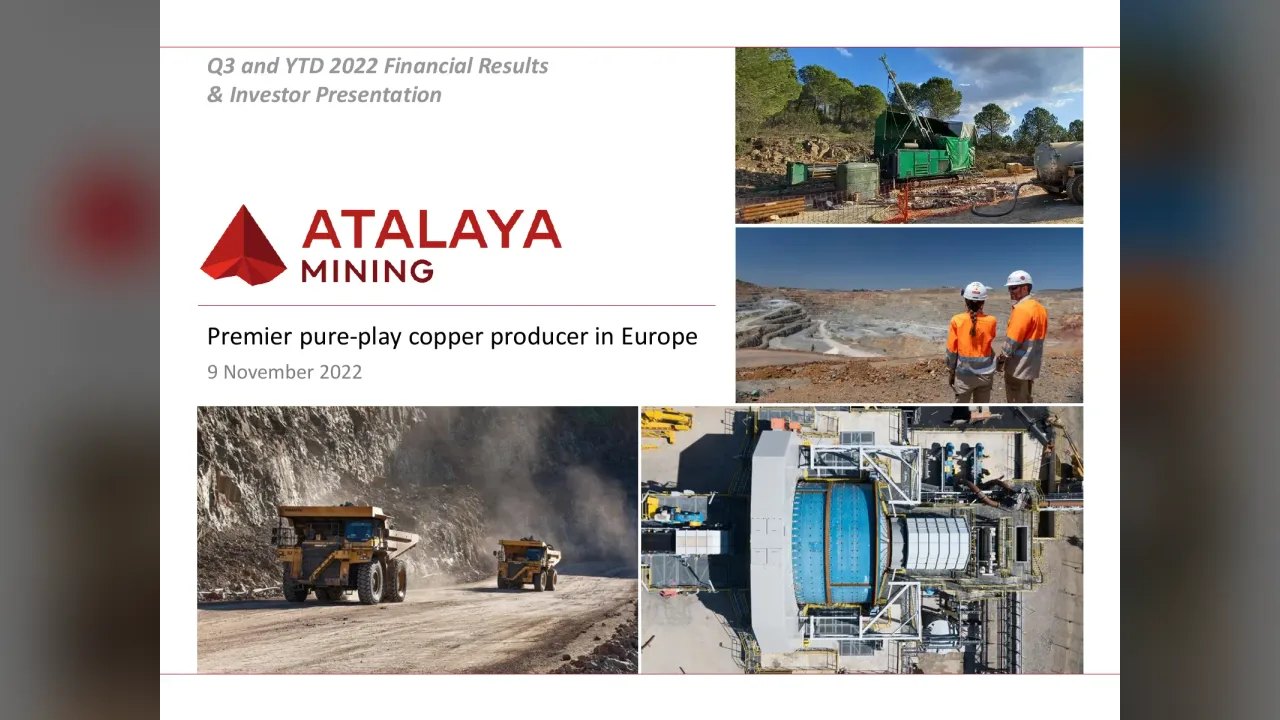
Q3 2022 Results hosted by Atalaya Mining Copper (LSE:ATYM) on Investor Meet Company, held 2022-11-09.
On 6ix: 6ix.com/event/atalaya-mining-copper-sa-atym-q3-2022-results
Automated transcript · Written by software from the replay's audio. It can mishear names and figures; the replay is the record.
0:01 Good afternoon, ladies and gentlemen, and welcome to the ATALAYA MINING PLC investor presentation. Throughout this recorded presentation, investors will be in listen only mode. Questions are encouraged. They can be submitted at any time via the q and a tab that's just situated on the right hand corner of your screen. Please just simply type in your questions and press send. The company may not be in a position to answer every question it receives during the meeting itself. However, the company will review all of the questions submitted today and publish responses where it is appropriate to do so. Before we begin, I would like to submit
0:32 the following poll. And if you could give that your kind attention, I'm sure the company would be most grateful. And I'd now like to hand you over to CEO, Alberto Lavendera. Good afternoon, sir. Good afternoon. Thank you very much. And thank you very much to everybody that's taking the time to be with us today. I'm going to go through a presentation highlighting and summarizing the results of the Q3 of this year. And also, what's more important, how are we addressing the future in the near term and in the long term. You have a copy of this presentation in the web page and I'm going to be following up the slides as we speak. And after the presentation, I will be responding to lots of questions that have been coming through and I believe we will be responding to each and all of them.
1:30 In general, I believe that the company is well known for most of the investors, but in so I will not go into any detail. And if there is any question required by somebody because he's not so familiar, please feel free to ask anything at the end of the presentation. In summary, we are going to be looking at the results of Q3 and year to date. And I won't read everything, but I will go directly to the main points. The main points are that from the operational point of view, the production of copper up to 38,000, a bit more than 38,000 tons accumulated every year is taken us to the high end of our last guidance, which will be around 54,000 tons of copper.
2:22 This production level is consistent with good performance in the operations from the production point of view. And we likely will be able to recover part of the lost production that we had in the first quarter of this year due to our national wide strike in Spain. All in costs were high. All in costs were very high at $347,000,000 due to extreme conditions in Spain, mainly high electricity prices and other inflation, but specifically high electricity prices, which has a lot of influence, as I will speak later, in other costs besides electricity.
3:07 These were specifically high due to the high demand of gas and electricity during the summer period in Spain. We're looking very positively to Q4 and especially to 2023, because we are getting a new power agreement, which is going to be at much reduced rate. And also, we are building a solar plant for self consumption, which will reduce our electricity bill. Still, even with all these difficulties of this extremely complicated year, we still have a €37,000,000 positive EBITDA through the year, although the results during the quarter have been negative.
3:56 We have continued to invest heavily in the LX and in the solar plant, but still we are maintaining a very decent balance sheet with a net cash position of EUR55 million and over EUR100 million in cash and with some liquidity additional liquidity through loans that we have not been borrowing.
4:24 Another important thing that has we have seen in these last few months, following the decrease in our share price due to the decrease of the copper price, is that our liquidity, the liquidity of the shares have increased a lot. And this is something that we are very happy for because that was one of the problems in the past. And besides that, the rest is, we have already announced in the past, increases in resources in San Dionisios, San Antonio, Massa Alberde, Cerro Colorado. So basically, additional resources for the future of this company. All of them have been submitted in a technical report that has been filed in October. And we are in the process of doing additional work, preliminary studies for these properties that will be published in the first part of twenty twenty three.
5:19 We also published during this year the first sustainability report of the company. So, going this is a summary. Now, going directly to the points. How was the quarter in production? Well, it was back to normal, slightly lower production, 13,400 tonnes of copper, slightly lower than one year ago. Similar throughput, similar recovery, a few points lower, but slightly higher rate, concentrate rate. So basically, a production level that which is basically back to normal since our last four years, three years.
6:04 But the financial results were poor. And you can see very clearly, and this will respond some of the questions that we have received, the first in the revenue, having produced the same copper, we had lower sales of EUR82 million versus EUR107 million, which means basically it's around EUR25 million, euros which is also dollars. Lower revenues have been produced less. That is as a result of lower copper price. So one of the questions people say, well, lower salts, how much is due to operating costs, how much higher operating costs and how much is of lower revenue? The first part is around EUR 25,000,000 less revenue in a quarter, which is equivalent to 100,000,000, if you think on an annualized basis, so a big amount comes from lower copper price.
7:02 And operating costs last year, treating the same tons as we said, 3,900,000 tons, we those tons were treated at EUR 55,000,000. This year, we had EUR 84,000,000. That means EUR 30,000,000 extra in a quarter is a huge number, it's equivalent to EUR 120,000,000 a year, although the first two quarters were not that bad and the last quarter is not going to be that bad. Basically, that's adding up those EUR 25,000,000 in lower revenue and higher EUR 30,000,000 roughly, slightly less than EUR 30,000,000 in higher operating costs results in a difference of EBITDA from almost EUR 49,000,000 positive in last year to negative EUR4.3 million in this year, very simple maths.
7:56 As a result of that,
8:00 thing happens with profits and the same thing happened with cash flow. So in summary, the lower results of this quarter are due to lower metal prices and higher operating costs. Being higher operating costs, roughly 60% of the effect and 40% would be related to metal prices. Does this worry us long term? No. Short term? Yes, of course. If you look at the lower part of the graph in this Slide eight, you will see that we have shown this graph in the past that we have been working seven years with negative working capital. So we are used to tough times And right now, it's the opposite. We are in a very good position from our cash flow point of view and from our working capital point of view. We know this is a hiccup of one quarter and we only have one point five months to go to get in 2023.
9:01 Looking at the balance sheet, I mean, and looking at specifically what shown in the lower part of the Slide nine, you will see that we still have our working capital surplus of EUR106 million. So gets us in a very good position. Similar debt that we had last year, similar cash and similar net cash position. So although a very difficult year due to lower operating lower copper prices and much higher operating costs, we're still having a very decent balance sheets. When you look at year to date, you will see exactly the same things that I mentioned when I was speaking in the quarter. In the upper part of the Slide nine, you would see that the revenue this year has been $2.62 so far, three quarters, which is roughly $40,000,000 less than previous year and the operating costs are $124 versus 156 so roughly $70,000,000 more.
10:15 And as a result of that, last year we had an extraordinary year where we had $104,000,000 profits by this time of the year versus this year, we only have EUR 23,000,000, which is still a very decent number in spite of the difficulties, but roughly EUR 75,000,000 more or less or less than last year 80,000,000 less than last year. So why was this? Are we doing something wrong? Well, Probably not preventing, not having seen this in the past, because in 2020, if we consider what's shown in Slide 10, the cost of the main inputs, you will see explosives, diesel, tires, electricity, steel and live. All starting in basically at the end of twenty twenty with a level of 100.
11:16 Explosives basically have doubled the price, So from 100 to 200 in relative terms. Steel balls, same thing a little bit worse from 100 to 100 sorry, diesel going from 100 to a little bit that 250. Although we are seeing a descent, tires 50% higher, steel balls 100 to 170, and line from 100 to a little bit less than 200. I left on purpose the case of electricity, which is in the bottom left corner of the slide, which has gone from 100 to 3 to basically 400. So we're talking about four times.
12:03 From all the cost increases that we have experienced this year and specifically this quarter, 80% of this is due to electricity. And I want to go through a little bit more in detail of the electricity and what we are seeing in the future. Electricity is higher due to the gas prices. The gas prices are higher and they set the marginal cost of production in Spain and they set the marginal price for Spain. And I believe this is the same case in Europe. But also higher gas prices have an influence on the price of explosives, because explosives form or fabricated from ammonium nitrate, ammonia, which is produced from natural gas, and also high gas prices have an influence in the production of lime as well as electricity, because lime is produced by burning with gas stones of limestone.
13:09 And also has an influence in steel balls because not only is the price of the steel, but the price of hardening the steel balls is done with induction furnaces, electricity or with gas. So you can see what's the big influence of the gas in our company. So what are we seeing for before we get into the markets, what are we seeing for this last quarter and beyond? We believe we are going to end the year, as I said before, in the high end of 54,000 tonnes of copper. We believe that the electricity prices are going to be going down, substantially down from $2.90 that were the average in the quarter three.
14:01 We have seen the prices of electricity being less than half of this during the last four weeks. And going beyond that, in 2023, we are kicking in with a new power purchase agreement, the PPA, and building our solar plant, which we are starting to get the materials now. So in the future, no matter what happens with electricity prices and the gas prices, these high peaks of this year are not going to be there. We are seeing for the whole year all in sustaining costs between $325,000,000 and $345,000,000 due to the high influence of this quarter, hopefully in the low end of that. So let's look at the big influence of our higher costs and how do we see it from in the future.
14:59 In the lower part of Slide 13, you will see the evolution of the year in detail each quarter. There's a big spike at the left, which is the invasion of Ukraine by Russia. And in the there's another spike in September, August, which was the moment where the gas pipes in in the northern, in the Baltic, were blown in addition to coincident with the August season, holiday season in Spain with lots of people and a huge heat wave that you may also remember because it also was felt all over Europe.
15:47 In those moments, the prices the average prices in Spain were EUR $4.50 per megawatt hour. Remember that what we had last year was €60 will also see in that graph in the bottom part of the graph that we have been around €100 to €120 in the last four weeks. So we are looking with optimism in the remaining of the quarter. If you look at the upper part of the slide, you will see some shaded areas where you can see the average prices that have been experienced in Spain since 2016, always between $50.70, 60 that has been the tendency, with a lower spot in 2020 due to the recession.
16:36 And in 2021, we had a long term agreement of 60, which was well below what was experienced in the market. In 2022, we were exposed to the market. But the most important thing is what you see in the right part of that graph. You will see two lines there, two lines there in reddish and orange that go between fifty and seventy, which means that we have a power purchase agreement with our supplier for ten years, for one third roughly of our consumption at 54%.
17:22 The rest will come from the market. And in addition to that, starting in 2023, we'll have a solar plant, which will give us another 20% of our needs, basically at zero price, which means that no matter what happens in the rest of our hours, it means we'll have a much lower
17:49 average electricity price than we had these years. Even if the electricity price stayed as it was in 2021, 2022, we will still have enjoyed a very low average of sub EUR100 per megawatt hour, which is a huge reduction in costs for our company. Looking at the gas, I told you, I just said that the gas has a big influence in the price of electricity for Europe, for Spain specifically, but also has a big influence in lime, cost of lime and explosives. Prices evolution of prices since 2020 are shown in the graph.
18:39 In orange is the prices in Spain, in black the prices in Europe. You can see that in the last part of 2022, in last six months, the prices in Spain have been substantially lower than the rest. And this is due to the fact that Spain has lots of availability of LNG tankers that are coming from every place. We are not connected almost not connected at all or influenced at all by the gas coming from Eastern Europe and from Russia specifically. So with those conditions, actually the prices of gas have even reached very low levels, almost back to normal levels that were experienced in mid-twenty twenty one.
19:33 We see this going like this during this winter and let's hope that the situation of in Russia and Ukraine is sorted out before the next winter. So this will have a positive effect in other consumables like explosives and lime and a little bit in steel balls. Although, we are taking actions by importing balls from other places like Canada and Australia, where the prices of gas and steel are not as high as in Spain.
20:11 Why we believe that the prices in the long term in Spain are going to be much better electricity? Well, you can see in the lower part of graph Slide 15, how since 2018, the compounded growth of installation of solar and wind has been growing
20:33 at very high levels in the last five years, and it continues to do that in Spain. So you understand this graph or you understand the importance of this graph, this means that almost this is equivalent to building almost a nuclear plant every year. So in two or three years, Spain, in theory, should be in a very good position due to the strong prevalence of solar and wind in Spain. Actually, if you look at the upper graph, you will see that actually the influence of gas is not that important.
21:22 The import has been around 33% in 2021 and year to date 38%, but has been going down. So I think Spain is a unique position to experience low electricity prices in the future, which would have an influence in the 50% of the hours that we have not already agreed to with our power purchase agreement and with the solar plant. What's the influence of this electricity? Well, you can see it in Slide 16. The influence of electricity alone was an increase of 280%.
22:10 And basically itself alone meant almost $1 per pound in our cash costs, all in cash costs, which means that you are telling you here the huge potential of reduction of costs and cash generation, of course, as soon as we have this wind sorry, as soon as we have this solar and the power purchase agreement in place.
22:46 So what are we doing? I just mentioned it. We are advancing fast track our solar plant. We are also evaluating other alternatives, which are I will show you a little bit like wind. We are also building the Helix Phase one, doing some studies for longer term deposits of growth in San Ignacio, Massa Alverde. In Toro, we continue with the permitting. Those measures from their cost reduction are going to lower our cost structure, besides lowering our carbon footprint. Put into production, the San Dimitri satellite will mean high grade, high grade means lower costs, means higher production, higher capital and extended
23:47 By building total and by putting production in Massapelle Verde, we get a multi asset distribution with higher production and more diversification, which will result in reduced cash costs, all in costs, and of course, higher profits. If you look at some of you know this is next. Constructed or very almost constructed, which by the way is the largest self consumption station in Spain.
24:48 In addition to that, we don't stop. I mentioned before in previous quarters that we were looking at wind also, there is some wind in our area. The pre feasibility study that we have completed is showing that there is good potential to construct four wind towers, so for us around six megawatt each. And for that, we have already installed big measuring antenna or device, I don't know how you call it, tower, 100 meters high, which what you see in the Slide 20 in the right side, which are taking measurements at different levels to correlate to the twenty years measurements that we have on ground level.
25:35 And that we believe we will be able to get a decision, if not this year, early next year. We believe that this is there is potential to produce another 15% of our needs from these wind turbines for self consumption, which is cheaper, no taxes, no access to the net and so on. In the past, we have also talked about LX. LX, for those of you who do not know, is a system that we have been working for six years with a lady that discovered this, building a pilot plant and finally we decided to go ahead in September, no end of August, there was nothing there where I'm showing the site I'm showing now in the picture.
26:30 This is a building of 130 meters long, so it's not a small building. You can see how advanced it is. And we believe we are going to be able to put this into commissioning in the first quarter of twenty twenty three. Things are going very fast. What this will do is be able to produce metal directly, copper or zinc, or both or separate. We will start with zinc, which right now we are not getting any value at all, zinc containing our concentrates as a byproduct, but we are leaving room to expand and produce also copper. So as you can see, we don't waste time and things are advancing and moving extremely fast.
27:18 I talked about San Ignacio, this slide in 2022 showing you where is the San Ignacio, it's basically expansion of existing pit of ATALAYA, push it back at mine, the high grade zone that was left there. We continue doing drill holes in Balverde, as well as a preliminary study in permitting. And in Slide 24, there is a slide that shows something that I spoke before. What's the effect of bringing in San Dionisio and San Antonio? San Dionisio and San Antonio are satellite deposits that are besides existing pits. San Dionisio is open pit with a grade of around 0.8%, San Antonio is underground with a rate of 1.5.
28:12 And that slide in '24 shows that by bringing in one third of the San Dionisio in with Cerro Colorado, gives you a production of an uplift of 16,000 to 21,000 tons of extra copper, which means that in two years from now, our company will be able to be producing from Rio Tinto, from this site, over 70,000 tonnes of copper from the 56,000 tonnes that we produced in 2021 or the 55 that we are likely going to be producing in 2022. So this is a big addition with our existing installations without any further big investment. And that shows you a little bit the potential of this San Ignacio deposit.
28:58 Atoro, just as more reminder, what was there. This is a brownfield site. What you see in the upper slide is the old mine, which has been partly restored. In the lower slide, you see the actual quarry where they are mining the waste for aggregate. And why we got a negative environmental impact declaration in our permitting attempt in back in 2020 was due to the legacy water legacy situation with acid waters from previous operators. What we did is, you know what, let's fix it, let's show the administration that can be fixed and we did that before advancing.
29:44 What you see in the right part of the pictures in the Slide 26, is the dirty water from the river coming in red color and the lower right picture, the same water coming out absolutely clear. The administration there in Galicia is extremely pleased with what we have done. The rivers have recovered back the the color and the quality, and I'm very sure that this will serve to demonstrate with modern techniques and would being professional, the history or the bad history of the previous operators doesn't need to be an impediment, doesn't need to be a problem for a modern mine, and we believe we are going to be getting the permits.
30:31 So with that, I will pass it I will get into the question and answer session. And Alberto, if I may just jump back in there and thank you very much indeed for your presentation this afternoon. Ladies and gentlemen, please do continue to submit your questions just by using the Q and A tab that's situated on the right hand corner of your screen. But just while Alberto takes a few moments to review those questions that were submitted already, I would like to remind you that a recording of this presentation along with a copy of the slides and the published q and a, can be accessed via your investor dashboard. Alberto, we did receive a number of presubmitted questions ahead of today's event. And as you can see in the q and a tab, we have received a number of questions during the presentation itself.
31:17 So firstly, thank you to everyone on the call for taking the time to submit their questions. And Alberto, if I could just hand back to you to address those questions where it's appropriate to do so, and then I'll pick up from you at the end. Thank you. Thank you, Jake. I will try to respond all the questions. There are lots of questions and some of them I see that I have already replied, but as usual, I will reply each and all. First one, I see a big decrease in EBITDA. How much is the decrease is from cost increases and how much is lower cover price. I think I mentioned that roughly 40% is due to lower cover price, 60% is due to the cost increases. What next question, what would cash cost be if electricity go back to normal?
32:04 It looks like there is solar inflation, not just electricity. That's perfect. I've shown that the electricity actually is a big issue. If electricity went back to normal, normally, our electricity was around $0.15 per pound. When you go to $300 it's $1 per pound. So there is a potential of around zero eight zero dollars saving just in electricity. Other costs are linked with the cost of explosives are not that high, although the price of explosive has doubled due to the price of nitrogen and ammonium nitrate. That's only part of the equation, so it's not that influential.
32:53 I would roughly say that from the spike in costs, 70% will be electricity and 30% all others. And by the way, there is possibility of bringing lime from import, which we are looking at it right now. There's possibility to bring in both from other places of the world. And diesel is still high. It looks like it's going down, but still high. But there is no possibility of reduction of electricity cost except the way we are doing. Next question is, when did you plan to give another update on exploration results? Actually, before the year end sorry, before the end of this month, we'll give an update of the exploration results.
33:40 I don't know if it's in two weeks or in that order or three weeks, but normally on or around before end of November.
33:50 If you get total permits, that's the next question, what are your plans for electricity there? Is solar possible? It looks cloudy in the photo. It's true that the price of electricity is important. And are we going to build a solar plant? Yes. We are going to be putting a smaller plant of around 20 megawatts on top of the old tailings. If I give you an idea of what's the we have already the studies of the generation of electricity in this area. And if the cost of electricity in Spain with the precision in this part of the South Of Spain was around EUR €2.28 megawatt hour, there would be around €35 So, it's not that sunny, but still very positive.
34:43 The rest of the electricity will come from the Porto De Moroz Dam, which is a dam from the old Fenosa, an Atorgi, which is just 14 kilometers away, which is all hydro. So actually, the case of Toro will be a place where basically we'll be getting 100% of the warrantied 100% renewable electricity. Next question is, what is your view of the copper price in the future? I see CapEx blowouts in projects from Teck and TSX coal miners. This is a very good question. I've been advocating that the copper price will have to go up in order to incentivize prices. The case of Teck with Quebrada Blanca is one more of the cases. Even a company like Anglo American, where they recently finished the project of Quellaveco and they said it was on time on budget.
35:34 This is it was on time and on budget after the last budget had been made, but the reality is this probably took fifteen years to construct. The case of Quebrada Blanca is the same thing. I think there's huge CapEx blowouts in these places, not so much for the inflation of materials, but especially due to travel complications, infrastructure complications. Most of the projects are in the middle of nowhere and they require huge infrastructure spendings, still limited traveling and this is a problem for new projects, which means that the copper price will have to go exponentially high in order to get these mines up and running.
36:20 I've seen lots of I don't know when it's going to go up, but I'm 100% sure the prices of copper will go well over $5 per pound. I'm not sure if it's going to be in 2023 due to the semi recession that we are seeing, but we will have to go substantially higher in order to incentivize these new projects in Indonesia and British Columbia, Peru and Chile, some parts of Africa, I mean, nothing is easy. Whatever is left is not that easy. Another question is, what will LX produce, copper, zinc or both? Yes, correct. It's both. Initially, it is actually the way it does, it dissolves copper concentrates, which contain zinc, but it could also be copper zinc concentrates.
37:12 The way it works more or less is that zinc dissolves much faster, like 100 times faster than copper, which means if you don't apply very strict conditions, you get dissolved all of the zinc without touching the copper. So you could produce zinc without touching the copper in the steel cell copper concentrates. And that's how we will start. But having said that, we will be producing also copper in the future and copper cathodes in the future. Another question is, since you installed the water plant at Toro, has the community view on the price change? Absolutely 100. We have a huge support from the community and we have visitors from the municipalities around coming and seeing the project, taking picture. Have been in the newspapers.
37:58 We have been we have absolutely full support of the community. I think actually we always had it and this was more of a political issue with some of political parties, small political parties making using the total flag against the conservative government. But I think the situation is changing, it has changed. And right now, there are not that many industrial projects being built in Galicia. And we believe that this project is going to go ahead, because simply there's no reason why not. The next question is solar plant, do we have an exact date when this will come online or we know currently second half of twenty twenty three? Yes, that's what we are saying because still could be some small issues. There are two parts. One is what we have to do and the other thing is what the electrical company has to do, building some connections and some changes in their substation.
38:59 And we don't like to give specific dates. We expect it to be around June, but we don't want to give specific dates because remember three years ago that we had a delay of the electrical company by supply to supply the electricity for the new expansion. And they were delayed like we were delayed like three months due to the electrical company being a little bit slower than we were. So we believe it's going to be, let's say, the first part of the second half of twenty twenty three. We are pushing as you know, we always go very fast, but it's a little bit out of our control. The important thing here is that this is something that goes forever and it has a life of twenty years, so it's done in once in forever.
39:47 The next question is, carbon credit, do we qualify? Are we trading this credit or will be able to trade this when solar and wind fully come online? My question my response is, don't know. And I will ask, it's a very good question and I really don't know. AIM, another question is AIM, when do we exit? You mentioned liquidity increase. This would help our application to the main board. This is correct. The liquidity important, the size of the company, which since our share price decrease has not been so good. But yes, I think we will apply to the main board. When do we exit? I think by the end of this year, we'll have all the everything ready to have moved from Cyprus and it will be sometime in the first part of twenty twenty three.
40:41 The other question is in Spanish, but I will translate it to English. Hello, Alberto and Cesar. Years before, we had a very simple calculation, sales in pounds multiplied by the price and all in by the difference in price in the obtained price and all in costs. This calculation was more or less coincidence with EBITDA accounting EBITDA. In this year, it's not like that. The EBIT, not EBITDA, is lower. What is the reason? Is this recurrent?
41:29 Well, it should be similar. I don't know why it is different. So we'll try to answer you, Walter. I really don't know. It should be the same. I really don't know. Our numbers are quite simple. So I really don't know. Unless it's due to the difference between the obtained price and the adjustment of sales of the quarter of the previous quarter that are adjusted in the next quarter, maybe that's the difference, but I really don't know. I don't think it should be a big difference. But we will come back to you, Walter. When do we look at other verticals with cost of transportation and our over reliance on China, we would not supply car manufacturers directly with copper wire?
42:31 I don't think so. The reason why I don't think so is that the manufacturing of wire from what I know is a very specialized business because it requires not only pure copper, but some additional materials that are going into the mix in order to the very fine wires not to break. The way they fabricate the wires is basically taking a thicker wire and extending it at a constant speed. And it's very tricky that these wires do not break, especially when you get to the millimeters and lower. So it's very difficult to go directly into the manufacturers chain. And by the way, we don't feel that we'll get a big advantage because we get paid the LME with minimum discounts and the smelters sell them the pure metals with a small premium.
43:32 Acquisitions, any update on opportunities better to buy when assets are depressed? Well, we continue to look at things. Values have been going down, but there's we have been looking at lots of things, but there are not that many good opportunities around there, especially that they are very close to production. We believe that the best opportunity right now so far, although we are looking at things, are the development of San Dionisio and the Toro that will create a huge value to this company. I have another question here. Said, will you consider entering into electricity derivative contracts as a way to hedge or stabilize your future electricity costs?
44:18 Or do you consider this too late to execute this and prices can only go down? Actually, this is a very good point because actually the PPA that we have has been created because we forced the supplier to use a long term contract when we saw there was a decrease in price back in February. We have been looking at the future prices that are in OMIP. There was a decrease in fifteenth, fourteenth, September 15, where the prices of the future for ten years went down to 65 or around that. That was a good opportunity, but the opportunity was a very small window. And now if one wanted to get into ten years contract starting in 2023, you will be seeing €85 which is €20 more.
45:08 We believe the market is going to be much lower than that in the long term. So as we approach 2023, the prices started going up. So it's true that it's a little late to execute this. But yes, we are looking at that constantly, almost actually daily. Thanks for the presentation. When is ATALAYA expecting to release the result for the PAs of Sandnesia and MASA Auverde? I would say first quarter. We are forcing the consultants to try to have the results ready by the end of the year, January, so the first quarter of twenty twenty three will be okay. Another question is expected first power date from the solar plant, how far along on construction to date storage batteries for wind and solar?
45:57 Well, I mentioned before, we're talking about the second part of the year, likely the first part of the second part. We have basically the panels arriving and in theory, the construction including substation is eight months. So we are around there. We look at the storage batteries. We spoke with vanadium flow suppliers. They are not economic to the amounts that we are talking about. We will be looking at producing hydrogen, because we have some ideas, but and also we are looking at a water battery, which is basically pump and storage. And we have had several studies already by putting a small installation where we can pump water in this basically, call it, free periods in the mid of the day when the electricity prices goes down big time and then generating electricity in eight or nine, basically when the sun goes down and when the sun goes up. But this is with pumped storage water between two dams that we have here to that supply us water.
47:10 The potential there for our installation will be like seven megawatts constant will be produced this way, but something that's still under study and we have an engineering company doing that. Another question is, can you provide more detail on where the zinc containing feed to the LX arises and the approximate grade in expected recovery? Our concentrates right now have around 5% of zinc that's not paid and it's also not penalized with around 21%, 22% copper. We have been making tests on our which means, if you multiply like 250,000 tons of concentrate, basically, it means that we have roughly 10,000 tons 10,000 to 12,000 tons of zinc in our concentrate that right now are lost and not paid.
48:02 At current prices, this means around $25,000,000 to $30,000,000 which are not penalized, but also not paid. Our recovery in zinc is very high in LX, it's, I would say, higher than 95%. I want to be a bit careful there, but it's very high in that range. Another one is we see two main shareholders in the company, Eurione and Jangkun Copper. Is that correct? The shareholder structure is therefore stable. Are these two long term holders? Well, I think you're looking at probably an old slide or maybe we or an old presentation and sorry if we have not updated that. URION is Trafigura and these are 22% shareholders.
48:47 Have been here for six years. And the company is in mining, but also in trading. So at the right time, have always been very supportive. They are the shareholders that had 50% of Matza, which in the last year well, in the early this year, they had 50% and the other 50% was Mubadala from Abu Dhabi. And they sold this to Sunfire for EUR 1,800,000,000. Well, this thing could also happen in our case, so it's their problem. Then Juuk Copper is a smelter that's no longer shareholder. They were it's a big smelter that was got into problems with real estate and debt. And their shares were liquidated, I would say, months ago.
49:37 And now our second shareholders is a Spanish fund or group of funds called COBAS, that you well know, Marcos, headed by Paco Parames, which has roughly 10%. Other big shareholders around 45% are Fairfax from Canada, which is like similar to Merge Hathaway, Conwave, Polar, Black Rock, Fidelity. In Spain, we have others like Mufa, Marianas, Oros.
50:25 Yes, in general, nobody can save their long term holders. We are quite happy with the existing shareholder base. Another question is, can you please remind us of the dividend guidance? Is there a for 2022? Is there a dividend guidance for 2023? The dividend guidance policy has not changed. We will distribute 30% to 50 between 3050% of free cash flow. We hope that we can generate some cash flow during this quarter and then we'll probably apply another extra dividend in corresponding to the year. In 2023, we'll go back again to the same guidance. We will distribute between 3050% of the excess cash flow.
51:14 What percent of the total have we earned it in? Do any of our projects have royalties payable in future production? Right now, have in total, have a 10%, but we carry all the costs and we have a right at any time to get first to another to 40% upon permits, another 30% up to 70% paying small amounts once we start construction. So this 60% additional is basically all limited to the risk of the project. So we will not pay anything, but we have the right to do it at any time, unless we get the permits.
51:59 And then we have another extra 10% in exchange of our royalty. So they will keep up royalty of 0.75%. And we will have the right to buy this royalty out and to get to 80%. So total, will end up having 80% and having paid, if I remember well, 18,000,000 to get to this 80%. All these payments are linked to permits. All these payments are linked to permits and construction. And we don't have any other royalties in Rio Tinto. M and A opportunities pipeline, well, I mentioned before, we have been looking at lots of things and we are looking at lots of things. But the pipeline right now is full with our opportunities. Those are the near term are getting San Dionisio up and running in less than two years, if possible something already next year and getting the permits of Toro during 2023.
53:00 Next question is, can you remind us again what steps need to be taken and what's the potential timeline for the permits of Toro project? They are not the permits are not dependent on us. We believe or we have been told or we have seen the signs that we'll get the permits of this total project during 2023 and early part of twenty twenty three. And as soon as we get those, we will start construction. Steps basically, it's in the side of the local authorities, regional authorities, which basically have to submit a positive environmental impact declaration following the modifications we have done to the project improvements that we've done to the project.
53:49 And well, we are quite confident we'll get it this year. Next question is, do you have a view on the copper price for '23? It's a crystal ball. Who knows what's happening with the recession? I think at the moment China starts moving a little bit, it's not only China, it's the rest of the world. You have seen what has happened the moment that China gave some indications that we're open a little bit the lockdowns, the copper prices spiked, because the physical copper market is very tight. Right now, there's no copper whatsoever. And also, if there is any problem in the suppliers, we will really be very tight and the copper price can go to at any moment.
54:37 Any comments around the announcement that came while you were presenting about Mr. De Gallo selling all his shares to the company? Well, it's a private reason and I can tell you I know the reason because he wants to buy a house for one of his daughters and he needed the cash. That's all. I don't think there's more more to say. And I think it's the same question that that comes later. The reason where he gave this is basically he sold it is that he was waiting for the the blackout period. And the moment we had the announcement out, he didn't want to take advantage of the share price going up. So actually, sold it at the weakest moment after bad results, which I think speaks well on what was his intentions.
55:28 Any range in cash cost for Masa Valverde San Denizio? How much reduction would add with higher copper price? Congratulations to keep a strong balance sheet in a tough situation. Well, no, no indication for MASA A HOLBERDE yet. In San Dimitio, yes, we have certain indications because we know and they are very easy to calculate. San Dimitio will be blended with existing Federal Colorado. It has a much higher grade and has higher stripping costs. But due to the higher production and higher grade, the cash costs are going to go down significantly. And production, we will probably add another 20,000 tons of copper, 15,000 tons of copper.
56:22 Is there value in historic tailings using new mining techniques? We don't think so at this stage, but we keep an eye because the old gold the old tailings are basically gold and silver. There's not much left in the copper. We are leaving our tailings with 0.06% copper, But the old tailings have around 0.5 grams of gold, actually 0.4 grams of gold and 35 grams of silver. We have done lots of test work and these are highly refractory. So we don't see that gold and silver prices, they're economic. But in theory, it is like a 1,000,000 ounce equivalent in those 29,000,000 tons of tailings. And if the prices of gold and silver weren't high enough, then it would be economic.
57:10 Is there another question is, is there a long term strategy to become a clean power supplier beyond mine life? Beyond mine life, yes. And actually, we have certain plans that we have not published yet. But certainly, we see that the future of this, once this area is mined out, there is a good possibility of having a huge solar plant in our installations or around our installations. But certainly, I think that's fifteen to twenty years away from us. So it's just future. Next question and final is, Alex, you are building the plant.
57:56 Could this be copied by others? Will you be able to monetize this outside of Spain? Well, we are a first commerce and the patent is held by the owner of the technology. We have the exclusivity in the part belt, that's where it can be better, can be copied by us, it can, but it's not going to be so easy. This is the first time it's done in the world. So of course, the same way that a telephone is copied, I think they will be able to copy it, but it will not be so easy. Will we be able to monetize this out of Spain? Yes, because we can apply this technique to other projects that are complex.
58:41 Why I said this is that I don't think this LX is going to be a game changer in EC deposits. So, copper deposit that has a smelter very close by, I don't think this will be better. But this will be very interesting for projects that have high arsenic or high antimony or mercury or very remote and for those we have also the right of refusal if this lady sells the technology. So yes, I think we will be able to monetize this by providing these techniques in other deposits. And that's part of the game that we are doing right now by looking at other companies where we can apply this knowledge or this investment that we have done along this in this past five years.
59:31 Well, lots of questions. And I think I will pass it to you, Giulio. Alberto, absolutely. And thank you for being so generous of your time there and addressing every single question that came in from investors this afternoon. And, of course, if any further questions do come through, we'll make these available to you immediately after the presentation's ended for you to review and then add any additional responses where it's appropriate to do so. Alberto, perhaps before redirecting those on the call provide you their feedback, which I know is particularly important to yourself and the company, if I could please just ask you for a few closing comments to wrap up with, that'd be great. Yes. I think I would summarize that has been a very tough quarter. I say a very tough year for us, for Europe, for Spain.
1:00:18 The way I see it is that the worst is behind us. We are looking forward only a month and a half to get into 2023. We have passed very difficult moments in the past, so I think we will also pass this one. It's the first time we have a negative EBITDA in the seven years we have been operating even with tough situations. It's out of our control, but we are doing what we can. But this is a long term project. This is a project that initially had twelve years life. We have consumed seven and we still have another fifteen ahead of us. So I'm sure we'll have some difficult times ahead.
1:01:05 But what I'm sure is that we'll have lots of good times. And since we believe that the copper price is going to be high for longer, we're in a very good position and we have if we have been able to pass these difficult times, we will be able to enjoy that in the good times. So we're just looking forward to take away 2022 and start in 2023. And I thank everybody to the support. I've received lots of support from shareholders from of all types for hard work and that helps us a lot to continue that way. So thanks very much for your attention. Alberto, that's great. And thank you for updating investors today. Could I please ask investors not to close this session as you'll now be automatically redirected for the opportunity to provide your feedback in order that the management team can better understand your views and expectations.
1:01:59 It's gonna take a few moments to complete, but I'm sure it'll be greatly valued by the company. On behalf of the management team of ATALAYA MINING PLC, we would like to thank you for attending today's presentation. That now concludes today's session. So good afternoon to you all.
Follow Atalaya Mining Copper SA into a list and get an email when it puts out news.
CEO at ATALAYA MINING COPPER, S.A.
CFO at ATALAYA MINING COPPER, S.A.
Other at ATALAYA MINING COPPER, S.A.