Alberto Lavandeira
CEO at ATALAYA MINING COPPER, S.A.
Replay available
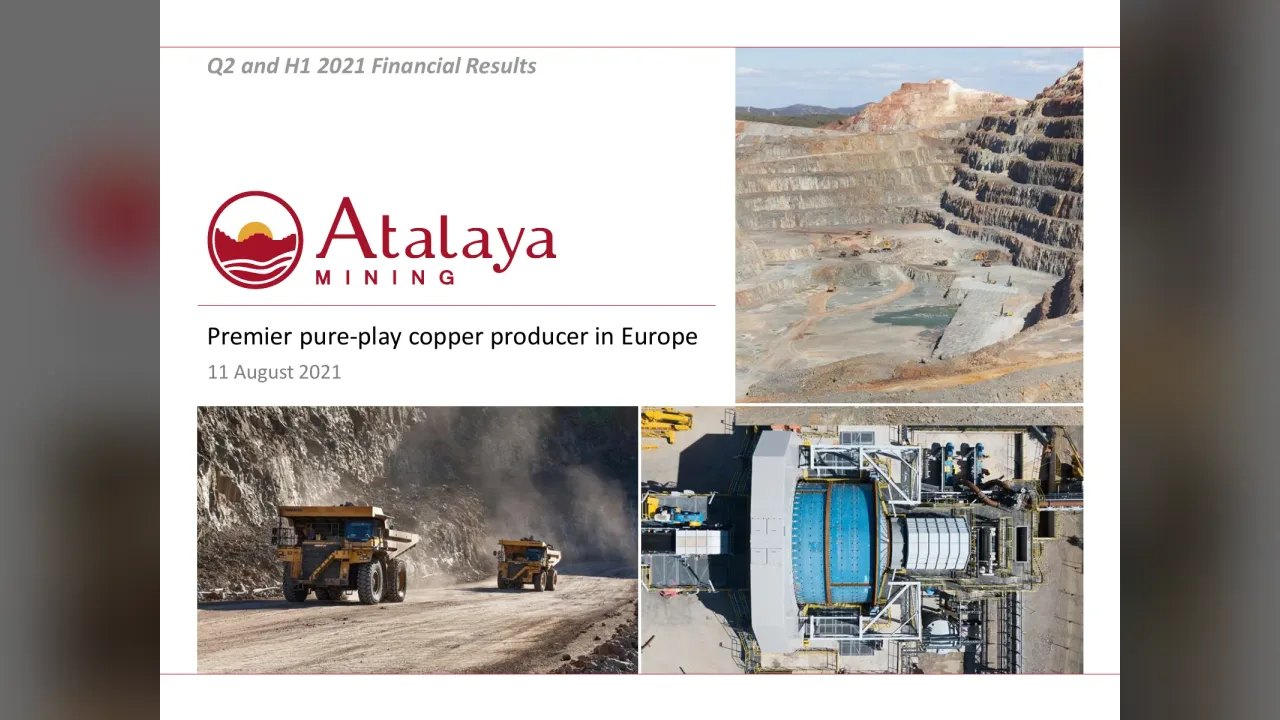
Q2 results presentation hosted by Atalaya Mining Copper (LSE:ATYM) on Investor Meet Company, held 2021-08-11.
On 6ix: 6ix.com/event/atalaya-mining-copper-sa-atym-q2-results-presentation
Automated transcript · Written by software from the replay's audio. It can mishear names and figures; the replay is the record.
0:02 Good afternoon, ladies and gentlemen, and welcome to the ATALAYA Mining PLC Q2 Results Presentation. Just click q and a, type in your question, and press send. The company may not be in a position to answer every question received during the meeting itself. However, we'll respond to, all questions submitted today, where appropriate to do so. And these responses will be available via your Investor Me company dashboard, and you'll be notified once they're ready
0:33 for your review. I'd also like to remind you this presentation is being recorded. Before we begin, we'd like to submit the following poll. I'd now like to hand you over to Alberto Lavendera, CEO and Cesar Sanchez, CFO of ATALAYA MINING. Good afternoon. Okay. Thank you very much. Welcome, everybody, to this presentation. That's the first time we do, thanks to this technology. With me, I have Cesar Sanchez, our CFO, which is somewhere down south of the mine, and Mike Restainer, which is somewhere in London. And I'm sitting in the North Part of Spain close to the total project that is staged.
1:21 So I'm going to make a brief presentation of the company assuming that some people that may be interested in this company are not shareholders and do not know the company. Sorry for those that know the company, but at least I would like to have this short introduction. And after that, we'll have some time for questions. So I suppose everybody has the presentation in front of them or can access through the the Internet. So, in the first page, you will see what we are mining right now. It's in Spain. It's called Cerro Colorado. It's an open pit producing copper in the North part of Spain.
2:05 And we are located, in slide five, we are located in very close to Seville, about one hour from Seville. We have another project about twenty minutes from Santiago, the capital of Galicia in the North part of Spain. You won't find mines assets so close to places where you can fly in from London and be there at the mine in less than one hour. We are copper producer in a fantastic country with consistency, and I would try to emphasize that. Always we almost always perform our targets. Some people say we are boring. Well, we like to be boring. Boring new investment is a quite good thing. Always no surprises, especially no bad surprises.
2:58 We have a long life, strong pipeline of growth, and we have delivered before. So trust me, we will continue to be delivered. And we will do that because we have a a fantastic team, people that have built several mines in Spain and in Africa, and they've done it before, and this this has been the key to the success of this company. And just in the same page file, I'm going to ask you to point to the figure of market cap of the company. Enterprise value is around $550,000,000. That figure is important because we will see what is the type of cash that we are generating compared to this figure.
3:45 So turning into the next page, which is six, we'll see what are our assets. We have a producing mine with 700,000 tons of copper. We have another deposit besides it, which has around 800,000 tons of copper plus over over 1,000,000 tons of zinc. And then about 25 kilometers from now, we have another 400,000 tons of copper and similar amount of zinc. So in our reserves, in our valuation, in our mine life, we always have the first 700,000 tons of copper enough for twelve years. Trust me that this rest of these resources are not going to stay in the ground. So the mine life is not going to be twelve years. It's going to be much more than that. In the North, it's around 700,000 tons of copper when you consider the copper prices who will stay as we are right now. So if I pass to to page seven briefly, it just shows a picture of what the installation of Retinta looks like. There was nothing there four years ago. All that has been constructed from scratch.
4:57 That shows you the capability. In that picture, you will see timeline. Timeline was in 2015, we started with first production. I joined the company with my team in mid two thousand fourteen. After, I would say, ages of permitting, we got that up and running in less than one year. One year later, we expanded the first time, and two years later, we expanded the second time. And we tripled the production from that asset. If I turn to page eight, you will see how the growth of production of of ore tons treated through our installations have grown from fifteen, sixteen at the different stages of expansions. You will see there two important things. One is the consistency.
5:50 We always deliver going upwards. And second, a figure that for some of you that are not familiar with it, which is a capital intensity, that the capital cost investment divided by the copper production. And that is very important because it tells you how efficient you are with your capital. It it may be low because you are in a fantastic location with, with a very good infrastructure like we are. It may be low because you care with the money, because you look at the best offers, because you don't give it to a turnkey contractor to do everything by themselves. Our cost of less than $5,000 per ton is one third one third at least of what it costs to replace production.
6:39 In other words, somebody could pay double by our share price and say, look. I would like to pay for this company x million, and it will still be cheaper than building new production. This is like the price of, let's say, a house or apartment in the center of London. When you see that it costs less than the bricks is there, it's a good thing. These people are doing a good job. I think that that picture of how we care of the CapEx and how consistent we are is essential to to be able to invest in our company. And what do we have besides Rio Tinto? Well, if you look at page nine, you will see a map. In that map, you will see some red stain in the center, which is called Project Rio Tinto. That's where we are.
7:34 Left south, which is West south, is Masha Valverde, 29 kilometers, and to the right, an area dashed with green. Those are our mineral rights. In red, stars arrows are existing deposits. That's the Pirate Belt. It's full of deposits. West of us, that's left in the picture, you will see Agustinidas, Bahraina, Sotil. Those are mines being managed and operated by Mugala and Trafigura, which right now they are on sale, by the way, for a price tag of 1.5 to $2,000,000,000. They have a center hub for the transport. They are from the two other mines, south and west to a central mine in Agustin Hills.
8:21 We are going to do exactly the same thing. So our future expansion does not need a new installations. We already have set the foundations for that further expansion of whatever we find in the concessions that are shown in green. That's the key of our pipeline. Why I insist so much in a pipeline? That's in in page 10. I insist so much because
8:53 investing in a in a mining company requires long life because that means optionality. It means you will have lots of years where you will still enjoy some good prices. Remember, for those of you that that are not familiar with our company, when we came here in 2015, the mine life was twelve years. We have been producing six years, and the mine life of Rutintos is still twelve years. By doing that, by extending the mine life and spending the exploration like we did, we now are enjoying still lots of years on wood prices. It's very important that the mine life is low because that's the essential sustainability of a mining company. And that's why we show in page 10.
9:46 We have Rio Tinto producing in the right side. We have Toto getting permits with the facility study completed. Something called ELIX, which is basically a system to add value to other assets. Then further to the left, we have in permitted NPA, what we call MASAVALVERDE, San Dionisio, and San Antonio, which are additional deposits, which are going to pass through the same stages that we went through with Rio Tinto. And then further to the left, have Massa Valverde, Baja Vales, are new discovery, and the whole concessions of of what we call Rio Tinto East. It's essential that the mine life goes beyond fifteen years, twenty years, the maximum possible.
10:38 That will give you time to find more and to create value to the shareholders. We love copper, and all these concessions contain mainly copper. If we go to page 11, you will see why we left love copper. I'm not sure how familiar you are with copper, and that's excuse me if I state the obvious, but copper has only one way to go.
11:05 Up. And the reason is look at where is supply coming from. Peru, political problems. Chile, they're going to implement a huge tax. Zambia, Congo, the port I lived there seven years, one of the most unstable places in the world. Permitting is getting more difficult all over the place, not only in Spain, in The US, in Chile.
11:31 There are no new discoveries because companies have not invested in the last year when the prices were low. So at the end, what means that bringing new mines in production is very difficult. Just takes time. But on the other hand, we have politicians saying, hey. We need to have more copper because we want clean energies. We want green energies. So at the end, we want more copper. We need to get the stimulus. We need to do something to fight the COVID. We need to do investments. If you do investments, you need electricity. You need electricity, you need copper. You need everybody likes to live in towns, so towns require more copper.
12:17 Electric vehicles, where the hell are we going to get the copper for the motors and the grids to load them. So then we have a lower supply, higher demand globally, and that means that copper price will have to go up significantly in order to maintain to maintain, production and also to incentivize new products coming on stream. And before getting into the results itself, which is the main purpose of this call, and before getting into questions, let me show you in page 12 where we are versus others. First, I will show you in in page 12
13:00 how we are in size, but especially what's the bit what the market is telling us, the consensus of what the beta should be in the in this year. They're saying that we are going to have, based on consensus, 200,000,000 US dollars. Remember, that figure I told you in the first slide, it was our enterprise value is 550. So we're going to have an EBITDA of just shy of less than two times, well, a little bit more than two times EBITDA. And their free cash flow, they are saying we are going to have around 93,000,000. Well, that means the rate use if you go we go to next next page 13, the radius of enterprise value versus EBITDA is 2.7 times, and, free cash flow yield is 17%.
13:57 And compared to what other peers have in our universe, like Euro Copper, Taseko, Central Asia, Copper Mountain, all of them much higher than us. But that's based on consensus. The reality is that the results have been much better than that. So if I summarize what has what we we have been doing in the first part of two thousand one before letting Cesar go through the results, I would say that during the first quarter, first half of the year, we continued performing. Consistent, consistent, consistent. In good copper prices and with very good controls of cost. If you look at the our expenditures, it had been very consistent and similar to the previous quarter.
14:54 As a result of that, with higher copper price, more cash flow. And, of course, our position of net cash position, it continues to grow. We continue to deliver it. Delivery, delivery. That's important thing. We have additional reserves. We highlighted what we have in San Luisio. We are already reducing their costs by installing water thickeners, by installing, solar plant.
15:31 And what are we doing in the future? Well, finalizing all these reports that are needed to give full value to the reserves and resources at San Dimitio Planets in San Antonio. So we have started for the three one zero one technical reports in all of them, which as soon as they are available, it will be given to the market. And, of course, we continue to like what we have in Total, and we are doing make effort in Total. And I'm strong believer that we will get the permits of Total this time. And now I may pass it to Teshar, to speak a little bit about the financial results and economic results that are shown in page sixteen and and seventeen.
16:25 Tessa, do you want to go? Yeah. Thanks. Thank you, Alberto. Hello, everyone. So on on on page 16, we have a summary of the h one twenty twenty one production result. We also have some historical production metrics since we start the operation in in q one two thousand and sixteen for the ore throughput for the copper recoveries and the for the copper production. As you will see, we have been since we started consistent in our production, as you can see in the trends, in the metrics on the graph on the right hand side, we have
16:58 been producing steadily since the beginning of 2000 and sustained. Growth, we have done two plant expansion from 5,000,000 tons per annum in 2016 to nine and a half million tons per annum and then to 15,000,000 tons per annum to get to the sustained 28,300 tons of copper production in in h one twenty twenty one. And and and and we also deliver copper production. So we have delivered since we beginning with no assumptions, not even when we were in the transactions when we were funding the plant. So as Albert already mentioned, it's almost boring to keep the the the production levels very quite steady. In in terms of guidance that you you have on the bottom, the guidance that we have released at the beginning of the year, which remain unchanged, but given the production level during the h one twenty twenty one, we expect it to be towards the end of the productions and and therefore, towards the the lower end, of cost.
18:03 But, again, we are being conservative. We still keep an eye on on on COVID for for example. On slide 17, that's on the next slide, we have if someone can just click for the next slide, please. Thank you. On the next slide, we have a summary of the financial results of ATALAYAFOH1 2021. So we had two continuous quarter delivering production, as I mentioned. So good production levels together with high copper prices means high revenues, which amounted to a 197,100,000. ATALAYA has a high leverage to copper price. So if you're bullish on copper price as we are in the future, revenues level will continue or even increase the level that we have in first half of twenty twenty one.
18:52 So good revenues followed by good cost control policy means better EBITDA, which amounted to €99,400,000 for the six months and a net profit of €66,000,000. On the cash flows, we have generated 71,000,000 in operation cash flow. And as we don't have to invest much annually to run the plans, we have good level of free cash flow amounted to $3,100,000 So representation sorry, it's a representation of a good level of cash generating ratio from EBITDA.
19:27 As you can see the impact of the cash generated by ATALAYA on the bottom right graph, where we have the net cash debt position of the company since Q1 twenty sixteen showing a negative working capital of around $40,000,000 which increased to a negative working capital of about CHF 50,000,000 in Q4 twenty sixteen and Q2 twenty seventeen. You can also see the improvement due to the equity raise that we did in December 2017, where we raised £31,000,000 then progressively improving all the way through to get to a positive net cash position of £37,800,000 as of 06/30/2021. Now if you see the cash generated by ATALAYA in Q1 and Q2, you will easily get to the expected cash balance at the end of the year as we're building up cash at a very high speed.
20:20 So in summary, the main metrics for the balance sheet are on the bottom left where we have cash of 92,900,000 and continue growing. We have 55,000,000 in borrowings that will be repaid over the next three years up to December 2024. By the way, these borrowings are unsecured and have an average rate of 2%. This gives us a net cash position of $37,800,000 and a working capital surplus of 90,900,000 as I already noted. In the slide 18, we have Let me no. Cesar, let me in the slide 18, I think most of the question most of the targets here where we mentioned our priorities are related to questions that that have come, and I think we it may be better that we answer them because people are asking out Alex are asking about Remos Remosalin to The UK and all these things.
21:19 So maybe I can summarize here and get
21:22 it to the questions directly so that because we have some very interesting questions and we may get much more. But in summary, 2001, let me summarize one thing. I I forgot to say that if you look at the the the as professor, he has mentioned the the cash generation of 53,000,000 in one half, which means analyze of €100,000,000, which is roughly $120,000,000, is 20% higher, the reality, than what the consensus is believing. So those numbers based on consensus, actually, the reality for the first six months are are are are low. So what our plan for 02/2021?
22:07 Not to continue. To continue, production and probably go to the high end of the guidance, to continue to get growth options. Capital returns, we are going to get to that because lots of questions about dividends and capital returns. I'm sure this will be decided this year.
22:30 Near term, continue growing, continue growing, continue delivering. As a corporate level, we get to to The UK, to pass to the main board if possible, and also to improve liquidity. We have been working on that for a long time and we slowly slowly we are improving that liquidity. And long term, we would like to have a couple assets. Of course, the best one would be in Spain, with Total, but if not, we'll find it in the in any other place. So that's more or less in a nutshell, without getting into details because I I love to get them as much more time to reply to to to the very interesting questions that we have received. That sounds that sounds fantastic. Yeah. We'll we'll move on to those. Alberto says, you very much indeed for the presentation.
23:19 As Alberto said, ladies and gentlemen, do please continue to submit your questions using the q and a tab situated on the right hand corner of your screen. Just click q and a, type in your question and press send. But just while the team take a few moments to review those investor questions submitted already, I'd like to remind you that recording of the presentation along with a copy of the slides and the published Q and A can be accessed via your investor dashboard on the Investor Me Company platform. I'd also like to remind you that your feedback is important to the company. And immediately after the presentation has ended, you will be redirected for the opportunity to provide feedback in order that the management team can better understand your your views and expectations.
23:56 Alberto, Cesar, as as Alberto, you said, we did receive a number of pre submitted questions along with having questions submitted during today's event. So perhaps we can start with the pre submitted. If I may, I'll just read out the first one and we can work through them. The first one reads as follows. What are the criteria around paying a dividend to shareholders, and what time frames are you considering? Okay. Yes. We have discussed this at the board level the last time yesterday, actually. And, of course, the common sense tells us that, without having a formal decision done, so I cannot announce a formal decision, obviously, with this platform. But just saying that we will end up we'll end up the year with over a $150,000,000 if things go correctly.
24:44 We have two shareholders sitting at the board with hold 2044% of shares. They are not going to leave that money. They are sitting down just for the sake of sitting down. We don't have any special need even if we got permits for total. You have seen, all of you, how frugal we are with with construction, with capital expenditures. We don't we do not, overspend, and we have not, issued lots of shares to dilute. So this attitude is not going to change.
25:20 The money will be returned to the shareholders starting, I would say, this year. I cannot say specifically when because it would be insider information, But, certainly, the common sense tells you that we are not going to be sitting there. Remember, that's only the second quarter that we have cash in our balance sheet, but things are growing extremely fast as we have seen in the slide eight seventeen. Suspected sometime this year. As a lot amount, also not a specific number approved, but the logic tells you that looking at what the market is doing between 3050% of the free cash flow available normally is returned to the shareholders. What I mean available is that's not going to be needed next year.
26:08 And if there's an extra that's the normal dividend. We believe that dividends should be sustainable, not extraordinary dividends. And if the year continues as it's going or things go up or even copper price continues to go up, there's no reason why an extraordinary uptick of the dividends could be given as a extraordinary dividend at the end of the year or starting over the next year. Alberto, thank you very much indeed. And the next question we have here is what other expansion plans ATALAYA are currently considering its existing assets around Rio Tinto? And is there anything you can do to improve the grade?
26:46 Look, I think both are linked. Both both are the because when we are limited, we are limited by water and power as we attempt to solve. Remember, this point was going to be 9,000,000 tons per year. We are in 15,000,000 tons per year. It's not much more than we can do with our existing installations. So how can we expand? Well, we expand by bringing in higher value materials, higher grade, and zinc. So if you look at the grades of San Dionisio deposit, they contain around point 7% copper and around, similar rates, slightly higher or 1% of zinc. So by some of the tons that go into the mill from Cerro Colorado by few tons coming from this subminisio will improve the grade by producing more copper and produce a byproduct of zinc, which means it will be a byproduct. So, basically, this is like a copper equivalent will be higher.
27:51 It means with the same installation, we are going to be producing more. We're not treating more tons, but treating more tons with quality. That's the the the closest expansion that we see in Grutinto, bringing in San Dionysio. San Dionysio open pit is around 150,000,000 tons of the sorry, 52,000,000 tons. San Antonio is around nine. So we have, like, 50% more tons with high grade around existing pit. So the logical thing to be mining this at the same time and improve the grade. Fantastic. Thank you, Alberto. Next question we have here is what are your plans for the ELEX system, and how will this technology benefit ATALAYA?
28:37 ELEX is a is a I think it's a fantastic system that, I think it will be almost a change in the world. So we have the luxury of being able to be participate in the development. I would tell you first what I want. It doesn't mean it's going to happen because we have to agree with the owners and also agree with with our board to do it. But I would love to to to build a demonstration plant, not a pilot plant like we have right now, which is quite big, but a real plant, to treat some tones with, basically to take out the teething the teething problems because this is a new system. And I would like to have this, up and running next year with a very modest investment, like we do things, and, to demonstrate that we can do it.
29:23 We have looked at the numbers, the numbers look good. What is the benefit that can bring to to ATALAYA? The benefit is that this is a system that leaches copper and and zinc very well, very fast, and produces, and is able to produce metal directly. This has the potential, especially, to be able to treat, complex sulfides with copper, zinc, and lead that are combined, intermingled, they're combined. And in this way, you get better recovery. So the benefit comes from better recoveries and lower costs. And what we assisted a lot when we finance this the owner of this technology was to have a exclusivity in the parent belt because this can be applied for lots of the deposits that are available in the parent belt that always have a a combination of copper, lead, zinc in the ores, which often, if you want to separate them with differential flotation, you lose some of them.
30:20 For example, just to give an idea, if you do differential flotation to a copper copper and zinc, you get 75% copper, and another 75% zinc. If you produce a global flotation and you treat with the system, you can get 90% of each. So you get from the same tons to the mill, you get more metal. That's the beauty of the system. Basically, dissolves out the copper in the sink.
30:49 Fantastic, Alberto. Yep. Next one we've got here is around What is the current situation at Toro? Can you describe the new development plans you're submitting?
31:00 Look. Total got stopped due to a negative environmental by declaration, although the main reason was political. There were some anti mining groups making a lot of noise. And we're in a moment where there were local elections, and the the government decided to say, look. That there's a risk of lots of noise. Everybody had seen this disaster of Rubadinho tailings in Brazil with the videos of that wall of mud going down and killing 200 people, and this was sent all over the nets. So at the end, they said, look, there's too much risk. We don't want to approve this in the middle of election. What things have changed? Well, there's no election until three years, first thing. Second thing, the the party that was opposing the project, which was the very left wing party called Podemos in Spain disappeared from the local parliament.
31:53 They had 15 seats from 75 and now they have zero. The third thing is that we have now a a group, a kind of very large group promoting the mining. So if if I went to to the page of total where this is this is shown, you will see that there is a group of demonstrators, and actually, they are not opposing the mine. They are they are saying, yes, we want the mine. That's that's showed in in the slide 31. So that's people making the same noise that in the past, the anti mining groups did. Now they're making the noise, we want the mine. We have polls saying we want the mine.
32:39 They are asking us to push ahead in motorbike. So that's from the demand side. And from our side, what we have done to to change the mind of the local government is if you think the water on top of the tailings was a problem if it before it breaks, because if it breaks, it can create a disaster. What we will do is remove the water on top of the tailings. So we our tailings will be plastic lined. It will not be without water because it rains a lot, but we'll have a system of pumping where the water will be pumped out to a mined out pit under the level of the rock, which means under the level of the ground, which means if there is no water on top of the tailings, it's impossible to create create a mud rush in the event of failure. Although, this is impossible to fail because this is constructed with a rock wall same like you construct a water dam.
33:33 So what we have done is change the product, make it more safer, and have now a proactive people saying that they want the project, and the people that are anti project, they have basically disappeared. So we are quite hopeful, although you never know with politicians. But technically, this project has no issue at all to be permitted. Thank you, Alberto. But it takes time. Thank you. The next question we've got here, which I remember on your final slide there. The company has been considering a main market listing for a while. What's your current thinking? Would you consider a dual listing in Spain? Look. Dual listing in Spain, we have not considered, to be honest. I mean, people have asked us, but there's no tradition in Spain for mining companies, although Berkeley was there for a while. It's funny because we have probably around 25% of our shareholders or 20% of the Spanish funds, Cobas, Maragallanes, Surquijo, Sabadel, S. A. D. A.
34:38 I could name lots of them. Some of them with two or 3%, and one of them with 9%. So all of these Spanish funds that I have, all of them visited the mine, all of them had been on-site, so they have seen how we control and how we do things. All of them are investors already through Abe. So I don't think we are looking at Madrid. But, yes, we would love to be in the main listing, in the main board, and liquidity has improved, which is a key point. And one of the first things we're doing is read the most read the most domiciling the company from Cyprus, which is only one office with one person and a half right now, sending that to London to be seen as a London company.
35:26 But this, as you well know, is a heritage of the old times of MINING where the founder Harry Adams was Cypriotic Australian, and they decided to to stay there for probably tax reasons or whatever. But we are doing all the steps to to be set in London. Perfect. Thank you so much. We've got another question here. Are you looking at overseas copper interests, or are you focused on being a Spanish European pure play? Well, actually, we are looking look. If you look at my history, when I mean, say, mine, it's also my team, of course. We've been on several mines. We started in a in a gold mine in Spain, Vale, which is now twenty five years later still mining. It's in in Orwana. Then we did another mining in in the top part in Spain, nickel and copper, and then another mining in Noritanya, which is now Kinross in Gold Bank. Huge. And we also also bought 20% of our company in Peru, which is Minajusta, which is now being started up, production basically one month ago.
36:38 And we also bought 18% of another company, Allegiance Mining, in Tasmania or nickel. So and then I moved to Congo, seven years after we were bought by Lundin. So there's no problem at all going outside if we can add value. So the places we are looking is places where we can add value, which I believe are South America and Central America because of the language. Language is important, so places like Peru, Ecuador, Chile, would would have a certain advantage, versus other Australian, British, Canadian companies. That's all. And, yes, we are concentrating in base metals, mainly copper. I personally like also nickel, but, copper is is the main case for South America.
37:28 But we have also been looking in everything that moves in Spain and Portugal and also everything that has been available in in Europe. What would you it's easier to say places where we are not going to go, which are most of the places of Asia, Asia, Africa, and North America because we wouldn't be able to compete with Canadians which are fantastic or Americans. Only in places where we can add some value. Thank you very much. Next one we have here is as follows. It looks like Liberty Metals is selling its position. Do you think this is an overhang to your share price? And the second part is how confident are you of attracting new institutional investors to take Liberty's stake?
38:15 I'm sure it's an overhang in Sapiti. Sapiti, they have been selling, and they resigned from the board specifically not to be insiders. And since then, they have already sold around 3,000,000 shares, and I'm sure they continue. It is a bit because they continue to be changing the the the selling point, because we have had some brokers sending them offers for blocks. So, yes, it's an overhang. Yes. They are selling. We don't know when. They are not selling through through the three brokers that are, let's say, making them offers. And I can tell you that I have confirmation that we have at least $50,000,000 or $40,000,000 of demand of shares from institutions if they wanted to sell.
39:05 So, hopefully, one day this will be out. As soon as there is as there is a block available, it's it's followed by by an institution. Thank you. And, the next one we've got here is you're perceived to be a high cost producer. Is this accurate, or is there a difference, with how you report your costs versus peers? That's a very good point. It's a very good point. I always insist and compare with others. I say, look. Just go and compare what what others do from cash flows. I think the problem is that we have is that, all the people there's no standards for reporting. And if I direct you to the page of the presentation that's in page 36, which I'm not sure if this is in euros per whatever.
39:59 It's total cash cost per sustaining CapEx in dollars per pound. I'm not sure if it's euro or the scale is right. But whatever it is, this is coming from Wood Mackenzie. And we are there located in the center with costs just slightly higher than Freeport, but lower than Barrick, like Aerocopper, BHP, KGM, ChEM, the producers of Antofagasta, First Quantum. So we are lower overall cost than all these people. And that's the reason why you see that we being how come that we are high cost producer and we produce such a high cost, cash? The reason is that the way we report all in cost is that we include everything, including DNAs, including interest, including everything, while all the people forget those costs.
40:45 Another thing is that we have a contractor that mines for us, so we don't have to buy equipment every year. We don't need to make huge capital investments in replacing the fleet. So it would be like if a taxi driver said, look, my cost per mile, whatever it is, is 10, and he's forgetting the price of the car that he has to change is two years. Same thing. People post their operating costs, and then they forget that each year they had to put 50,000,000, 40,000,000 to buy new diggers, new excavators, and so on, and new trucks and so on. And that's what happened with other peers. So, yes, we are high cost. We are no low no we're not low cost for sure because we have very low grade. But we are quite efficient, and we have a quite good margin.
41:34 So the reality is that look at the cash flow yield. Maybe other people that have low cost, how come they have lower low if they have lower costs, how come they have lower cash flow yield than us? Something's not matching. So we are right in our reports, and we are honest, and we have very good yield. As you can see, we are giving almost 30% of cash flow a year. Perfect. Thank you. We probably got time for a few more questions, but if you could just, review, if you just go through the q and a tab and just review, the questions there. Just if there's anything thank you. If you could just read them out, please, that'd be great.
42:25 Yes. I have a couple of interesting questions which we have not touched on. One is that we are seeing cost inflation coming back across the mining industry. You reiterated your cost guidance for this year, but can you comment on the situation in Spain? Are you experiencing cost pressures at all? Is COVID having an impact on costs? Well, let me start by the back end. COVID is not having any any impact. We are taking all kinds of measures. We are not the important thing different from us from other producers. We are not remote. Everybody goes back to sleep in their own house, and 80% of our workforce is living around around the mine.
43:11 In other places, they're going to camps in the middle of the Andes, in the middle of Indonesia, in the middle of the jungle. The camp is a perfect perfect place for COVID. That's why you are seeing these outbreaks in Australia or in other producers, especially copper producers in the Chile. So COVID is not having an impact right now. About, the inflation, so far not much, but I expect it to be a little bit. Let me show you. The main components for our costs are energy, manpower, or by by that order, energy, manpower, mining, of course, steel, balls, and and liners, and then reagents which are lime, the main one.
43:59 Labor is not changing at all. Inflation is less than 1%. Energy, we have a fixed price so far on the next year. Let's see what happens with next year. Right now, the daily average is very high in Spain, but, the old expectations are to be going to be low. But the things that where we are seeing a slightly higher price demanded by suppliers is balls, steel balls and chrome balls for for the milling and lime. Because lime, as you know, is burning limestone, which creates CO two and the rights of CO two are are a crazy thing in Europe, and the prices are very high and everybody is demanding higher prices. We have overcome that by having lots of stocks from the past at fixed prices.
44:49 In the case of lime, we are going to small suppliers that do not have to pay the c o two rights so that, basically, we're keeping the big suppliers honest by buying to the small suppliers. But those are the places where I, we have seen higher prices. But higher prices, like, in the range of one or 2%, not talking about more than that. In this five or six years that we have been running, our cost per ton have been going down all the time. And this year is basically the same as last year, but until now, we have been able to control the costs. In the future, if things continue, we'll see maybe up to 5% in some cases. And then, there's another interesting question here Can you please share your capital raise plans in relation to developing total the total mine?
45:42 Well, we won't have any any any issue of of of capital, I believe. We don't need to. We were if I go back to to some slides and let me back a little bit. Let's show you in the slide. Let me show you history. Show you the history, and this is this is we don't plan because we always try not to dilute, and we have the cash. And we have been able to build this mine and these suspensions without cash. If we go back to slide 17, in the bottom part of that graph, as as I showed, you will see that there was net negative cash during two periods. Those were the two periods with expansion.
46:29 What does it mean? It means that we were able to build the mine without having positive working capital by using the cash flow from the mine, which at that time was just starting, and using, contracts with suppliers to pay them later. As soon as we finish the first phase, then you saw that immediately we start producing cash flow. And in December in December 2017, we made the next placement to make the final expansion and immediately our cash position went down again during the expansion. And immediately as soon as we finished the expansion, we started producing cash again. And what happened there? We had a capital expenditure of around 90,000,000, and we only raised half of that, which means if we don't need it, we will not use it.
47:23 Right now, having more than 100,000,000, let's call it, euros in the bank at the end of the year will have. And if things continue like they are, even if we get the permits at the end of this year, we will have enough cash to start building. And remember, we don't have any significant debt. We also financed the three expansions without debt, so I don't see why we wouldn't do it again. The only reason I could see to issue some shares is to try to to improve the liquidity, But I will rather try to buy one of the existing blocks, for example, Liberty as an example, and then redistribute the gain, which achieves the same thing without diluting the shareholders.
48:11 And that's what I have here. There was a question of about dividends, which I believe has been withdrawn because we had a reply. But I'm happy to receive that to answer any more questions if if needed. Fantastic. Thank you, Alberto, for answering all the questions that we've had come through so far. And if there are, of course, any other questions, that do come in, you can review those, and we can put responses, where appropriate to do so. And these will be published on the investor meet company platform. As we are drawing to the close of the meeting, perhaps if we don't get any further questions through, Alberto, if I may just ask you just for a few final words just to wrap up before we redirect the attendees to give you some feedback, please. Well, yes. I would like to thank everybody. Thanks, for those that are shareholders or have been shareholders for a while for their patience. I mean, I'm a shareholder myself.
49:07 I believe in this company, and and we have a great future. We will our team is very proud of delivering. We will always like to do that. We are committed to the long term, success of this company. And, no. That's all I can say. Normally, when we say we are going to be doing something, we'll do it. We don't like to promise. We don't like to say we're not promoters. And at the end, the true value would prevail. So I think there is a reason why maybe this, maybe our share price is low, maybe because of the pressure of the selling, maybe because people didn't believe our numbers. Until now, they are seeing them.
50:02 So slowly, slowly, we're getting we're getting there. And the main question here is that there is no liquidity, so people try to buy stock and there's not and the stock's not available. But, anyway, we will continue pushing and never give up give up. And thanks, to all for your support and especially for the long ago shareholder that once in a while send us a message to of of of support. Thanks a lot then. Thank you very much. Alberto Cesar, thank you for updating investors today. Could I please ask investors not to close the session as you'll be automatically redirected for the opportunity to provide your feedback in order that the management team can better understand your views and expectations?
50:49 This will only take a few moments to complete and is greatly valued by the company. On behalf of the management team of ATALAYA MINING PRC, we'd like to thank you very much for attending today's presentation. That concludes today's session.
Follow Atalaya Mining Copper SA into a list and get an email when it puts out news.
CEO at ATALAYA MINING COPPER, S.A.
CFO at ATALAYA MINING COPPER, S.A.