Deborah Pawlowski
Investor Relations
Replay available
Astronics (NASDAQ:ATRO) Q2 2026 earnings call, held 2026-08-11. Watch the replay and read the transcript on 6ix.
On 6ix: 6ix.com/event/astronics-corporation-atro-q2-2026-earnings-call
Automated transcript · Written by software from the replay's audio. It can mishear names and figures; the replay is the record.
0:01 Greetings, and welcome to the Astronics Corporation Second Quarter Fiscal Year twenty twenty six Financial Results Conference Call. At this time, all participants are in a listen only mode. A question and answer session will follow the formal presentation.
0:22 As a reminder, this conference is being recorded. It is now my pleasure to introduce Deborah Pawlowski, Investor Relations for ATRO. Please go ahead. Thanks, Joe, and good afternoon, everyone. We certainly appreciate your time today and your interest in Astronics. On the call with me here are Peter Gunderman, our Chairman, President and CEO and Nancy Hedges, our Chief Financial Officer. You should have a copy of our second quarter twenty twenty six financial results which crossed the wires after the market closed today. If you do not have the release, you can find it on our website at astronics.com. As you are likely aware, we may make some forward looking statements during the formal discussion and the Q and A session of this conference call. These statements apply to future events that are subject to risks and uncertainties as well as other factors that could cause actual results to differ materially from what is stated here today.
1:15 These risks and uncertainties and other factors are provided in the earnings release as well as with other documents filed with the Securities and Exchange Commission. You can find those documents on our website as well as at sec.gov. During today's call we will have some non GAAP measures that we'll discuss which we believe will be useful in evaluating our performance. You should not consider the presentation of this additional information in isolation or as a substitute for GAAP results.
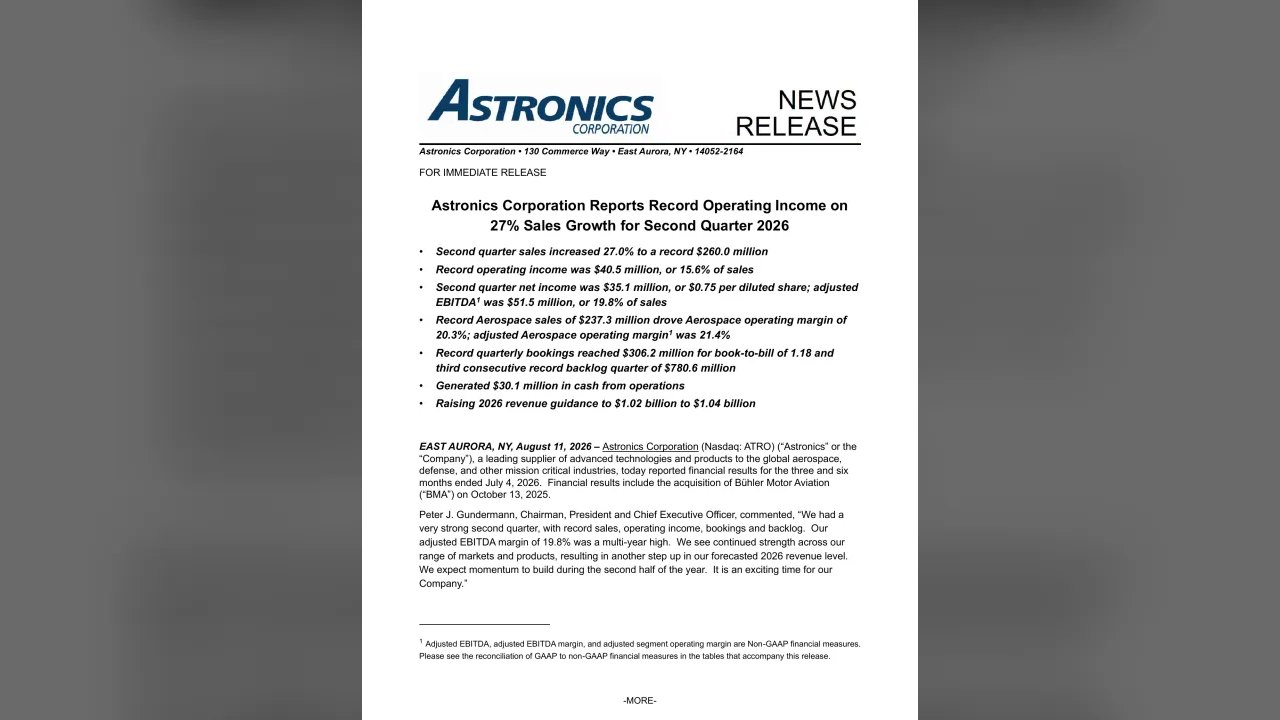
1:44 We have provided reconciliations of non GAAP measures with comparable GAAP measures in the tables that accompany today's release. So with that, I will turn it over to Pete to begin. Thanks Debbie and hello everybody and welcome to the call. We're here to talk about our second quarter results and our outlook for the remainder of 2026. Nancy and I will do our usual back and forth and then open up the lines for questions. In summary, the second quarter was very strong for Astronics. We set records all over the place for revenue, for operating profit, for bookings, for backlog and more. Our adjusted EBITDA was just shy of 20% of sales, which is a modern day high. It was a very good quarter from every angle and we feel good about it.
2:34 It also puts us in a great position as we enter the second half of the year. We have strong momentum and are raising our revenue guidance to 1,020,000,000 to $1,040,000,000 We'll talk more about this at the end of our presentation, but we are excited to finally be crossing the $1,000,000,000 threshold. Nancy will talk through Q2 numbers in due course, but first I want to focus a little on margins. We've been working on our margin profile heavily and we have made significant progress. Our adjusted EBITDA margin, for example, was in the low to mid teens just one year ago in the first half of twenty twenty five and practically all of 2024 for that matter.
3:22 And now we are pushing 20%. There are a number of levers that we have used to accomplish this and I'll discuss them one by one. The first lever and arguably the most important is the strong market demand that we see for our products as evidenced by the bookings trends we have been experiencing. A few years ago at the height of the pandemic, we average bookings of $100,000,000 to $150,000,000 per quarter. Since then our bookings level has risen steadily culminating in our Q2 bookings of $3.00 $6,000,000 which is an all time high. Indeed over the last four quarters, our sequential booking totals have been in order $210,000,000 $257,000,002 $90,000,000 and now $3.00 $6,000,000 Bookings can be lumpy of course and we can't count on that type of progression indefinitely, but the overall trend is prominent and unmistakable.
4:26 In our first quarter call, I discussed the range of factors driving our bookings. I'm not going to go into a lot of detail here to repeat all that, but to recap, they were first, increasing aircraft production rates Second, airline passengers desire to be entertained and connected at all times. Third, the growth of our flight critical power franchise for smaller and emerging aircraft. Fourth, the trend towards high end aircraft seating that uses our seat motion systems. And fifth, the expected growth in our test business based on the U. S. Army radio test program that we have been talking about for some time. Interested listeners who want to review that discussion to check out the transcript that's available on our website.
5:17 Higher bookings, of course, leads to higher shipments and higher shipments leads to better overhead absorption and increased profitability. I have said many times in recent years that we were not sized to be profitable at the reduced revenue levels we saw during the pandemic. Now we are growing into our cost structure and our income statement is responding well. In the second quarter, there were a couple of bookings that deserve special mention. The first was a $27,000,000 booking for FLRAA MD75 development work, which is a follow on to a $57,000,000 order we received back in 2025. We expect another relatively small order in early twenty twenty seven, which should carry us to completion of the engineering development phase of the program.
6:10 The MD-seventy five is the U. S. Army's planned replacement for the Black Hawk helicopter and promises to be the largest military program our company has ever seen. I don't intend to go into more details on it now, but I recommend that interested listeners who are unfamiliar do some research and look that one up. The MD75 will be a big deal in our future. The other significant booking in the quarter was the long awaited production go ahead for our radio test program with the U. S. Army called 4549T. The order was for $45,000,000 and will cover deliveries over the next eighteen months. We expect similar orders annually for the next four to five years under an IDIQ award we received back in 2024.
7:02 The production award was not a significant factor to our Q2 results, but will begin to be so as production ramps up in the second half of this year. When it is in full swing, we expect margins in our Test business to be comparable with what we get from our Aerospace segment today. The second margin lever we have been using is pricing. About one third of our volume involves deliveries that are tied to long term contracts typically with terms of three to five years. On these contracts, our pricing suffered when inflation picked up during the pandemic. Inflation has since cooled down generally and we have been able to reprice most of the effective long term contracts, which has certainly benefited our overall profitability.
7:52 We estimate that we are still waiting to reprice about one quarter of our long term contracts, which will come due over the next twelve to eighteen months. The majority of our business is shorter term in nature and we have learned to price the value more than to cost, which has also driven increased profitability. We believe that the cumulative effect of pricing actions has been and will continue to be an important aspect of our margin improvement journey.
8:26 Discussion is organizational efficiency and the point here is that we have suffered very high employee turnover during the pandemic at times approaching 20% in a year. High turnover meant that we had a workforce that was relatively inexperienced in their jobs and that in turn hurt our efficiency and our quality. Today our employee turnover rate has dropped to about half of what it was and in many of our locations it's well below 10%. As our workforce has become more stable it has also become more effective and competent. I'm describing the well known learning curve principle and while it is hard to measure, we certainly see our workforce becoming more efficient and predictable, which helps deliver better margins.
9:18 The final lever with respect to margins that I want to discuss is structural to our organization, which some might call simplification or portfolio shaping, which we have done a fair amount of in recent years. As evidence, we have shut down and consolidated seven production sites in recent years and discontinued or limited a number of product lines and or businesses. This activity helps us stay focused on the product lines and customers that matter to us the most. And there's more to do on this front. As our business accelerates and we continue to evaluate our market goals and competitive positioning, we will work to make sure our organization is structured appropriately to align with those goals.
10:06 So those are the four levers that are driving our improving margins volume, pricing, efficiency and simplification. What's exciting is that each of these levers has room to run. In other words, the actions we have taken continue to be active and we expect will lead to further margin improvement in the coming periods. So we are not at the end of our margin journey at all, but methodically moving along the process. Finally, before I turn it over to Nancy, there are a couple of other topics from our second quarter worthy of discussion. The first is the B share distribution that we did during the quarter announced on June 1 and executed on June 29. It was a 20% distribution of B shares to all shareholders of record and was intended to reward shareholders and encourage long term interest in the company.
11:00 B shares have been an important part of our capital structure since the early 1980s and because they don't trade but are convertible to common at any time, the share count drops over time as investors transition their holdings. The recent distribution was to replenish and rebalance the share count to historical norms. We have done approximately 20 share distributions over the years, about half of which have involved B shares. The final issue on my list is a decision by the UK Court of Appeals and our long running patent dispute with Lufthansa Technik. This was a dispute that has been grinding its way through the courts in The U.
11:45 S,
11:46 UK, France and Germany since 2010. We won in The US and the matter there is closed and final. The UK was the second jurisdiction to hear the case and we feel good about where that is headed. The damages case heard in late twenty twenty five went our way and this most recent ruling altered the original ruling for the better. A final appeal to the UK Supreme Court is possible if the court agrees to hear it, which at this point is uncertain.
12:24 There will be an appeal in France in October of a lower court's ruling invalidating the subject patent while Germany waits in the background. So the battle continues but it is exciting to think that with a little luck, we may have line of sight to conclusion of the matter in The U. S, The UK if there is no appeal to the Supreme Court, and France if the lower court's nullification of the patent is upheld. All this could happen by the end of the year.
12:57 With all that being said, I'll turn it over to Nancy now to review second quarter accounting results. Nancy? Thanks Pete and good afternoon everyone. I'll walk through our second quarter results in more detail, provide color on our product lines and segments, review cash flow and the balance sheet and then close with our outlook. As Pete noted, the second quarter was an important proving ground for the profitability of our operating model and the organization delivered. Sales reached a record $260,000,000 up 27% from the prior year period. Higher volume, improving productivity and continued execution across the organization drove significant margin expansion, record operating income and an adjusted EBITDA margin of 19.8%.
13:43 We also delivered record bookings and backlog providing strong visibility as we move through the balance of the year. Gross profit increased to $86,900,000 or 33.4% of sales compared with 52,800,000 or 25.8% of sales in the prior year period. The seven sixty basis point expansion reflects higher volume, improved productivity, and a $2,000,000 IEFA tariff refund recognized during the quarter. The refund contributed about 70 basis points of margin and somewhat offset what we now view as an ongoing tariff run rate at current volumes of about 3,000,000 to $4,000,000 per quarter prior to any mitigation. Also for context, the prior year quarter was adversely impacted by a $5,800,000 charge associated with aerospace simplification initiatives and a $6,900,000 impact from unfavorable revisions to estimated costs to complete certain long term mass transit contracts in our Test Systems segment.
14:44 R and D expense was $10,900,000 down modestly from $11,600,000 in the prior year quarter. We continue to expect R and D to run roughly about 10,000,000 to $12,000,000 per quarter. However, it can fluctuate based on project and customer activity. SG and A expense was $35,600,000 down about $900,000 year over year and declined to 13.7% of sales from 17.8%. Lower litigation related expense was largely offset by higher wages and benefits, higher incentive compensation costs associated with improved profitability and incremental expenses related to BMA which we acquired last October. Income from operations was a record $40,500,000 or 15.6% of sales.
15:33 Given the factors affecting last year's quarter, the comparison on a GAAP basis isn't truly meaningful. Looking sequentially though, operating income increased $13,200,000 over our first quarter this year, driven by the $29,000,000 increase in revenue. I'll note though that the second quarter did have the benefit of the $2,000,000 tariff refund. On an adjusted basis, operating income was $43,200,000 and adjusted operating margin was 16.6%, which compares with 8.9% in the prior year period. An approximate $800,000 or 24.7% decline in interest expense reflects the lower interest rates following our September 2025 refinancing activities. Tax expense was $2,800,000 in the quarter, reflecting the benefit of a partial reversal of our valuation allowance as well as the expected expensing of R and D costs that are now permitted under the new tax law.
16:30 Based on our current outlook, we expect to release the portion of our valuation allowance associated with deferred tax assets that are expected to be realized from our 2026 income. The benefit of that release will continue to be reflected in normal course during the second half of twenty twenty six. As we move through the third and fourth quarters, we'll also continue to evaluate the potential for an additional valuation allowance release of approximately 40,000,000 to $50,000,000 Any such release would be recognized in the period when we have objectively verifiable evidence of sufficient future taxable income beyond 2026 to support realization of those deferred tax assets. Our strong performance in the quarter dropped through to the bottom line with net income of $35,100,000 or $0.75 per diluted share and adjusted net income of $32,600,000 or approximately $0.70 per diluted share.
17:24 The weighted average share counts for all periods reflect the 20% Class D stock distribution that was done in June. Adjusted EBITDA was $51,500,000 more than double the $25,400,000 reported in the prior year quarter and up 36% or 13,600,000 over the trailing first quarter. Adjusted EBITDA margin also expanded three forty basis points compared with the first quarter to 19.8% of sales. This performance reflects the operating leverage in our model as volume grows along with the ongoing benefits of our productivity and simplification efforts. Turning to Aerospace. Segment sales were a record $237,300,000 an increase of $43,700,000 or 22.6% from the prior year period.
18:13 We had growth across all our markets which include commercial transport, military aircraft and general aviation. I'll review our major product lines starting with our largest category, in flight entertainment and connectivity, which had sales growth of 19% to $126,000,000 Growth was driven by continued demand for our connectivity and passenger power products, including strength in our commercial transport and VVIP applications. Planning and safety sales increased 5.5% to $59,200,000 This product line continued to grow on solid underlying demand from improving aircraft build rates. Flight critical electrical power sales increased 49.4% to $23,700,000 reflecting stronger demand for airframe power products, particularly in the military aircraft market.
19:06 With the finalization of the engineering contracts for the MV75 flare program, we're expecting to achieve approximately $35,000,000 in revenue on that program in 2026. Heat Motion sales increased $12,000,000 to $22,200,000 The increase reflects strong market demand as well as the $5,900,000 contribution from the BMA acquisition. Aerospace segment operating profit was $48,300,000 or 20.3% of sales, measurably improved over $18,000,000 or 9.3% of sales in the prior year quarter, which granted did have a lot of noise. The improvement in profitability reflects leverage on higher volume, improving production efficiencies, the $2,000,000 tariff refund, lower litigation related expense and the absence of current year simplification charges.
19:57 The strong operating leverage inherent in the aerospace business is best analyzed sequentially where operating leverage excluding the tariff refund benefit was 47%. On an adjusted basis, aerospace operating profit was $50,700,000 and adjusted aerospace operating margin was 21.4%, an increase of five ten basis points from the prior year period. Aerospace bookings were $243,100,000 for a book to bill ratio of 1.02. During the quarter, as Pete mentioned, the contract for the current engineering phase of the MV75 FLRAA program was finalized, resulting in a $27,400,000 booking. Aerospace backlog ended with the quarter at a record $657,200,000 Turning to Tech Systems. Sales were $22,700,000 up $11,600,000 from the prior year period.
20:54 The comparison also reflects the $6,400,000 reduction in the prior year revenue resulting from revisions to estimated cost to complete certain long term mass transit contracts. Segment operating profit was $600,000 compared with an operating loss last year. Current quarter profitability was impacted by approximately $4,100,000 of zero margin revenue related primarily to raw material purchases for the U. S. Army and U. S. Marine Corps radio test programs. Because those programs are revenue recognition over time, we recognize revenue as costs are incurred rather than upon shipment. Likewise, margin on that raw material related revenue will be recognized as production progresses through the remainder of 2026. While ramping, the program won't necessarily demonstrate the solid margin profile of the program, but should begin to be realized as we exit the year.
21:46 Test Systems bookings were $63,100,000 for a book to bill ratio of 2.78. That included the $44,700,000 order from the U. S. Army initiating full rate production for the 40 five-forty nine program, which is expected to support deliveries over the next eighteen months. Test Systems backlog ended the quarter at 123,300,000 Turning to cash flow on the balance sheet. We generated $30,100,000 in cash from operations during the second quarter, reflecting higher cash earnings partially offset by higher working capital requirements, including inventory to support our expected growth. Capital expenditures were $5,700,000 in the quarter and $16,900,000 year to date. We continue to make the necessary catch up investments in the business, including the consolidation of operations and capacity improvements at our Seattle facility.
22:38 We continue to expect full year CapEx to be in the range of 40,000,000 to $45,000,000 with the Seattle consolidation, which is concluding here in the third quarter. We expect to be free cash flow positive for the remainder of the year.
22:53 Long term debt decreased by $24,100,000 from year end to $310,300,000 at the end of the quarter. Our capital priorities are internal investments and debt reduction at this time. Although acquisitions, if the right fit and price, are not out of the question. We believe we have the financial flexibility with our available liquidity, which was $253,200,000 at quarter end. We also continued to advance our global ERP implementation. Through the first half of the year, we incurred approximately $700,000 in incremental operating expense and capitalized approximately $4,000,000 in costs related to the project. Visibility on our spending on the project is pretty straightforward. You can find the capitalized amount on the cash flow statement under cloud computing implementation costs and we adjust out the external expenses from adjusted EBITDA.
23:44 Turning to our outlook, I'll briefly summarize what we expect for our third quarter. We expect third quarter sales to be in the range of $265,000,000 to $275,000,000 which would represent another quarterly sales record. We expect fourth quarter revenue rate to improve modestly from there. Regarding margins, second quarter demonstrated progress toward our high teens adjusted operating margins. We'll benefit at some point from the estimated 6,000,000 to $8,000,000 of future IEPA tariff refunds, though timing of any receipts remains uncertain.
24:15 Continued volume leverage and the addition of the U. S. Army radio test program should contribute while mix can add some variability as well. We're pleased with the progress made during the first half of the year. Our focus remains on executing against the opportunities in front of us, supporting growth while maintaining the discipline necessary to sustain strong profitability and cash generation. And with that, I'll turn it back to Pete for final comments.
24:42 Thanks Nancy. I'd just like to reiterate what Nancy said about the second half of twenty twenty six. We're pleased with our second quarter results and with the first half for that matter And we're entering the second half of the year with lots of momentum. Our forecast has us crossing the billion dollar threshold for the first time and we look forward to living on the other side of that line. And that ends our prepared remarks. Joe, we can open it up for questions now. Thank you, sir. And a confirmation tone will indicate your line is in the question queue. You may press star two if you would like to remove your question from the queue.
25:37 And our first question comes from the line of Greg Palm with Craig Hallum. Please proceed. Hey, this is Jackson Trader on for Greg Palm. First off, congrats on the quarter. More impressive results. I just wanted to see if you could start out on what really surprised you in the quarter relative to when we were going into it, so that the end markets customers, I mean, whatever segments you want say, but really just surprised in the quarter.
26:04 I don't know if there were any real surprises. We went in with a certain forecast and actually what has become kind of routine is we beat our internal forecast. I didn't do this in preparation for this call, but I think if we go back and look at like the last 1.5 or so every quarter, we come in right at the top of the range or a little bit beyond it. So I wasn't very surprised by that at all, nor was I surprised by the two big bookings that we talked about. We've been anticipating the radio test booking for the US Army forever. I mean, we thought we were going to get that last fall.
26:49 And then a bunch of things happened like the government shutdown, so on and so forth. But momentum was building and we were trying to lean into that a little bit in our first quarter call and then actually came up like the next day or pretty close to it.
27:08 And then similarly with the Flera NV75, that program is getting a lot of attention in our company. It's going very well and we have a very constructive working relationship with Bell. We were expecting though that that would happen a little bit sooner than it did. So again, big orders tend to take longer than you would think originally. But beyond that, I can't say there was anything that was a real big surprise. I mean, like I spelled out in my little speech here, higher volume is a major driver for higher margins. And we've been seeing our volume increase and as our volume increases our margins increase.
27:56 So it's a good virtuous cycle there. Nancy, don't know if there's any surprises you'd like to point to. No, I agree with that. It's just general strength in the industry.
28:07 Perfect. And maybe if could talk more on like these emerging aircraft trends thinking EV tolls, some of the drones and other opportunities in defense. How are you guys kind of playing into that? Is there anything from like a product development perspective you can touch on and where you kind of stand for demand in there? Yes, I don't know if there's much we can say that we haven't already said. We are quite involved and invested in the EVTOL market. And some of our technologies, on the power generation side, play very nicely in the drone unmanned or autonomous aircraft side. Those programs are progressing, EV tall aircraft are moving closer to certification and actually flying missions.
28:56 So we're excited about those things. We do not have a big commitment to those in our 2026 forecast. It's more of an if come I would say in 2027. So we're going to start our 2027 roundup planning over the next couple of months. And I think it'll be a bigger
29:20 role for those programs in 2027. But at this point, it's still pretty preliminary and there's not much more to say than what I just said. I appreciate all that there. Thank you. Thank you.
29:37 The next question comes from the line of John Tanwanteng with CJS Securities. Please proceed. Hey, this is Will on for John. Thanks for taking our questions. How should we think about your test segment margins as you ramp up production for the Army Radio Test business over the next two to three quarters? Well, I'm pretty optimistic about it. So I think you should be too. It's a really well priced program and we're going to get into it as quickly as we can. However, we're going to walk before we run. So the exact pace of implementation is a little bit hard to predict. I think it's safe to say that as we exit the fourth quarter, we'll be at full run rate production that once we get into full run rate production that $44,000,000 order should be should last about a year of effort.
30:42 So depending on how quickly we can accelerate and get going in the third quarter here and the fourth quarter, I expect there will be good it will reflect well in our financials. Once we're in full rate production, we are expecting that the margin profile in our Test business should start to approach what we routinely get out of our Aerospace business. Maybe not up at the 20% EBITDA level, but pretty close.
31:16 So we'll know for sure as that program ramps and we'll be sure to talk about it on these calls. I think by the time the fourth quarter is done and we're moving into the first quarter, we'll have a really good idea of where that's going to end up. Nancy, would you say anything different? No, I would agree with that.
31:35 That is very helpful. Thank you. And just one more for me. Can you talk about the transition to LEO satellite connectivity and how you're seeing that play out in your markets and opportunity set? I'm optimistic about the transition to LEO. There's not much I can say about it today, but we are working the situation pretty hard. The short term impact though is disruption for some of our GEO customers and GEO programs. So it's probably worth pointing out that parts of our business, I mean, we're doing pretty well overall, but there certainly are parts of our business that are a little bit under the weather and the geo part of our business is one of those.
32:23 Think of it as maybe a $60,000,000 piece of business at this point on an annualized basis. But I think the opportunity that's out there for LEO for us more than offsets the short term pain that the geo market is experiencing. So not much official we can say today, but we are working it hard and we're optimistic about the prospects.
32:53 Thank you. I'll leave it there. All right. The next question comes from the line of Gautam Khanna with TD Cowen. Please proceed. Hey, thank you. I was I had a couple of questions. Was first curious on your pricing comments.
33:15 How much of that has already manifested in the stuff you've repriced in the Q2 numbers?
33:22 And should we think that in the second half, we're going to have higher pricing than what was experienced in second quarter?
33:30 And then I have a follow-up. I would say not materially, but I think what you see now is what we're going to get with respect to pricing. The answer to your first question is a little bit hard to quantify, but I guess our feeling is that we're like 75% or 80% of the way through the big price adjustment journey that we were on as a result of the inflation that hit during the pandemic. But there is still more to go and over the next twelve to eighteen months the remaining part of our long term contracts should be renegotiated. That will be helpful. And we do have a fair amount of our business that is more short term oriented. So there is pricing flexibility there in the sense that you don't get locked long term pricing. So if we get a disruption on the cost side, certainly we can adjust there more quickly, whereas the long term contracts are more difficult to manage in a changing environment. So I feel pretty good about where we are a year ago was much more of a challenge, two years ago was a real problem.
34:48 I think we feel like we're on the other side of the near the end of the tunnel with respect to pricing now. That's helpful. And then just curious about your expectations for second half mix, if anything. I know you called out the 2,000,000 refund, but anything else in kind of the margin expectations in the second half that you could give us? Go ahead. And the big thing there is the radio test program for the U. S. Army that we're talking about just layering in that in the second half should pretty significantly change the margin profile in our test business, which has been hurting us more than helping us over the last few years.
35:42 That's the big mix issue. There will be other puts and takes in the aerospace part of our business. But at this point, I don't feel like there's anything that's too noteworthy that we know for sure that we can talk about. Okay, and last one on MD75. How much visibility do you have with TxFront, the prime on what you got it? Because I know the funding concern if it's not done by September 30, but just do you guys have orders beyond September 30 to work on it? We do. We have orders and we do work very closely with Bell.
36:28 I can't say that we know anything about the funding status that's not generally known out there in the world. They've done a pretty good job in my view of being transparent to the extent they can about the situation. But they've been covering us and so we feel good about that. We also recognize that our portion of the development cost of this program is probably pretty small compared to some other companies. So maybe we're not involved in some of the discussions that other companies are. I can't tell you that for sure. But we're overall, we remain highly enthusiastic about program. We feel like our part of it is going very well and we get supported well by Bell. So it's all good.
37:19 Thank you very much. Thank you. And the next question comes from the line of Alexandra Mandery with Truist Securities. Please proceed. Hey, Pete and Nancy, great results and thanks for taking my question. So how has the acquisition of BMA performed relative to your expectations and what is your appetite for M and A going forward? Are there any capabilities you look to add or geographies to expand into or increase content in? We're pretty pleased with the BMA acquisition so far.
38:06 It's a smaller operation and it was part of a private company. So bringing it up to public company standards in terms of accounting and The U. S. GAAP rules are quite different than the company's located in Germany. So it's used to private company German accounting. So there's some transition there. It also had a parent that was involved in the German automotive industry primarily, but also some other industrial areas and that's been a difficult environment for a while. So they were a little bit capital starved. We're fixing that. We think they have good technology, good products, good relationships with customers.
38:55 They're not as profitable as the rest of our aerospace business. So we're going to work on that. That's another part of the long term contracting challenge with pricing frankly. But I'd say overall, it's going pretty well. We have it reporting through our French operation. Those two companies were competitors. Now they're learning to work together. And that seems to be going pretty well too, both our French team and PGA and Chateau the BMA group at Lake Constance want to make that work. We're encouraged by how that process is playing out also. As for your second question, we have done a number of acquisitions over the years.
39:48 We've been pretty quiet on acquisitions over the last few years during the pandemic because our balance sheet frankly wouldn't allow us to do much and there wasn't much to do. I mean, there wasn't a whole lot of movement in the commercial aerospace market in terms of M and A activity during that period of time. We think our balance sheet is largely fixed now and we think that M and market is opening up. So we're seeing a steady flow of opportunities. And we are looking, but we are also mindful that we have just a great opportunity set ahead of us in terms of generic internal growth.
40:34 So our first priority is definitely to execute on those programs. If M and A comes up, we'll take a look. I think we're capable and qualified to do that at this point. But that isn't we're not a company that's going to depend on M and A for a big part of our growth opportunity going forward. That's more I would call that more incidental if and when it happens. Does that make sense? No, totally. And I appreciate that color. And I guess one follow-up. So you mentioned labor has improved and there are continued opportunities for improvement. What are the efforts you've taken to retain labor thus far and finding new labor? Alex, I don't know if it's you or it's me, but that was really choppy and I couldn't really hear you.
41:25 Hopefully you can hear me a bit better now. Just wanted to see if you had any color on the efforts you've taken to retain labor and finding new labor. Joe, is there any way you can clear her line more? I'm not sure, but I think Alexandra's question was, is there any way you retain labor or Okay. Now you're choppy too, Joe. So maybe it's on our line. Alexandra, can you repeat your question one more time? Yeah, just wanted to see if you guys had any color on the efforts you've taken to retain labor thus far and finding new labor.
42:21 We're going to try to call in on a cell phone momentarily. Okay, ladies and gentlemen, please stand by as we try to fix this tentacle issue. Thank you. Okay, everybody.
43:58 The speakers are back in. Alexandra, if you're still there, can you restate your question, please? Hey, hopefully you guys can hear me now. I just wanted to see if you've had any color on, you know, the efforts you've taken to retain labor thus far in finding new labor. Sure, and we can hear you Alex, Sorry about that. You know, it's interesting as kind of an armchair economist. We're a smaller company, but we run operations really all across our country Seattle, LA, Florida, New Hampshire, New York, Chicago. And it's interesting that there are pressures in different places at different times, but for the most part, the markets all kind of move together.
44:53 So during the great resignation, during the pandemic, we had trouble hiring everywhere. And today the labor market has, from my perspective, kind of bounced back and people have become much more available, including a lot of people who left who decided maybe the grass wasn't greener on the other side and are interested in coming back. So, at this point, we don't feel that hiring is a major issue. There are retention challenges in the sense that especially for certain production related jobs, If you have 10 openings, you might have to hire 14 people to get 10 that's sick. So, our turnover metrics still don't look the way they did prior to, you know, the pandemic.
45:46 But we went from 3,000 people down to 2,200. And as you climb back up to 3,000, you know, instead of hiring 800, you got to hire, I don't know, 1,200 or something to make that work. So, it's never easy. It's always a challenge. But I would say that we feel much better about labor availability than we did at any other time during the last three or four years. Again, Nancy, would you change that at all? No, I wouldn't. Okay, that's what I like about Nancy. She very rarely changes what I say. Does that answer your question, Alex? Yeah, perfect. Thank you so much. All right, thank you. Thank you. Ladies and gentlemen, this concludes question and answer session.
46:36 And this also concludes today's conference. You may disconnect your lines at this time. And we thank you for your participation.
Follow Astronics Corporation into a list and get an email when it puts out news.
Investor Relations
Chairman, President & CEO
Chief Financial Officer
Analyst, Craig-Hallam & Co.
Analyst, TD Cowen
Analyst, Truer Securities