Roger Dassen
Chief Financial Officer
Replay available
ASML Holding (Euronext:ASML) Q1 2026 earnings call, held 2026-04-15. Watch the replay and read the transcript on 6ix.
On 6ix: 6ix.com/event/asml-holding-nv-asml-q1-2026-earnings-call
Automated transcript · Written by software from the replay's audio. It can mishear names and figures; the replay is the record.
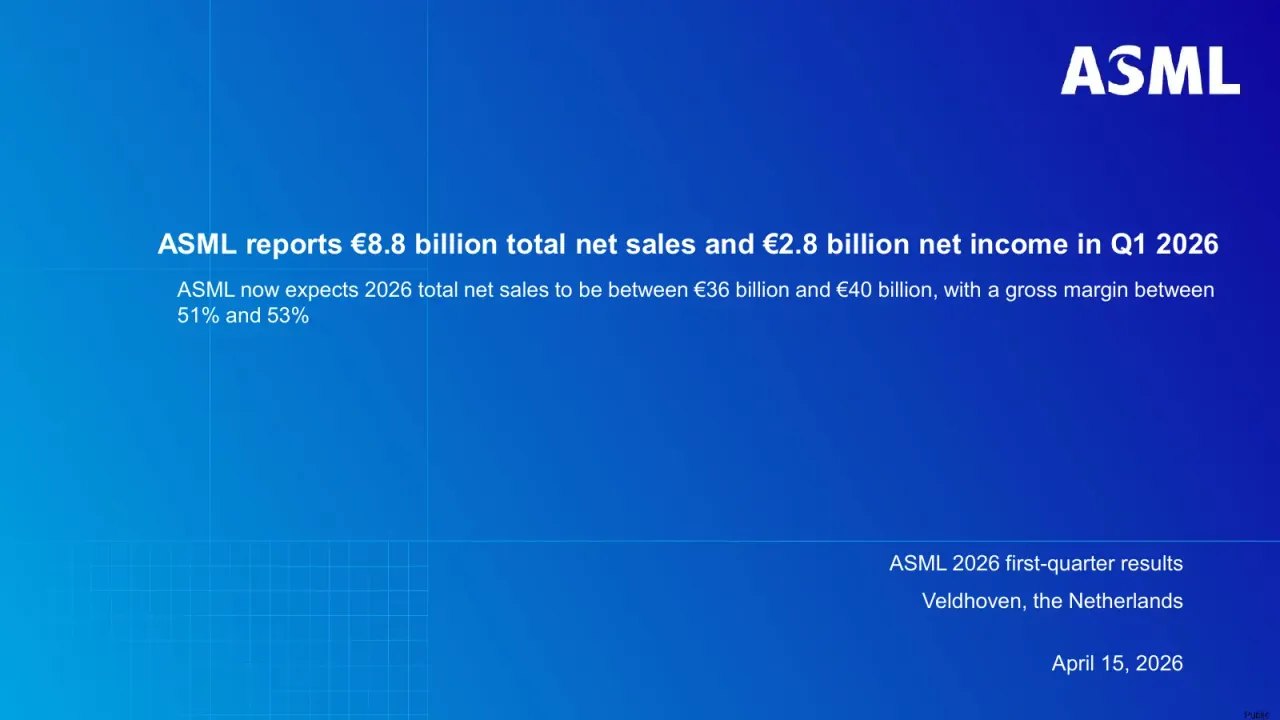
0:00 Hello and welcome to ASML's Q1 twenty twenty six results video. Welcome Christophe and Roger. Roger, if I could start with you and ask you to give us a summary of our Q1 twenty twenty six results. For the quarter, total net sales came in at CHF8.8 billion. That was within guidance. Included in the CHF8.8 billion was CHF2.5 billion for installed base revenue. That was a little bit above the guidance. If you look at the gross margin for Q1, 53%. That was at the high end of the gross margin that we guided. If you look at the installed base business, as I just mentioned, the installed base business was higher than we anticipated. But also, if you look at the components in the installed base business, there were components in there that actually commanded quite some strong gross margins. As a result of that, pretty high gross margins, 53%.
0:50 Net income for the quarter, CHF2.8 billion. Can you also provide us with a guide for Q2 twenty twenty six results, please? For Q2, we CHF8.4 billion to CHF9 billion of total net sales included in there, again CHF2.5 billion of installed base business. We expect the gross margin to be between 5152%. Christoph, I can switch to you and can I ask you to give us an outlook on the market and how you're seeing things at the moment? Well, think we see that the semiconductor industry growth continued to solidify. This is still very much driven by investment in AI infrastructure. So this translates into a lot of demand for advanced memory, for advanced logic and we expect in fact that the supply will not meet the demand for the foreseeable future. So this is creating a strong constraint in the end markets from AI to mobile and PC and as a result our customer is strongly invited to create more capacity.
1:59 So if we look at memory, what our customer tell us is that they are sold out for 2026 and their supply constraint will last beyond 2026. For advanced logic, we see our customer building capacity for several nodes, while they also continue to ramp two nanometer in order to address the AI products. So then I guess it's fair to say a lot of those capacity additions are adding positively to our own outlook? Well, absolutely. We see our memory and logic customer increasing their capital expenditure and trying to accelerate basically their capacity ramp in 2026 and beyond. What's also very interesting is that a lot of this demand is supported by long term commitment at their customer.
2:46 On top of that, we see both memory customer, DRAM customer and advanced logic customer continuing to increase their adoption of EUV, but also immersion. So this translates basically into higher litho intensity and higher litho demand for ASML. So we're going to continue to work very closely with our customers to increase our capacity. We are doing that in 2026. We'll continue to do that in 2027. And then maybe, Roger, just adding on to that, can you provide a little bit more color or details on what we are actually going to do in terms of adding capacity to support market demand? So I think Christophe said it right. We're very clearly working with our customers, fully aligned with customers to give them what they need, and that is in a combination of capacity in terms of new shipments, making sure that the performance of systems is upgraded as best as we can and also provide installed base products.
3:39 So in that combination, we try to give customers what they need. Specifically, when it comes to our own capacity, what we're looking at for this year, for 2026, we believe we can drive an output for this year of at least 60 systems for EUV, low NA. That's what we currently have. That's what we're currently driving. And added to that, we're looking at Deep UV for 2026. As I mentioned a couple of months ago, when it comes to immersion Deep UV, we actually had a bit of a slow start because in the course of last year, we decided to actually we were looking at a significantly lower demand for immersion. That has now reversed itself. And I would say, in spite of that slow start, we're still, for this year, expecting to get pretty close to the immersion sales that we had last year in terms of unit numbers.
4:34 So that's for 2026. When it comes to 2027 in terms of capability, we're increasing our move rate really quarter on quarter. And then when you look specifically at EUV low NA, we expect that we're able to get to an output for 2027. Again, if customer demand really underpins that, think that we can get to at least 80 low NA EUV units. And we're also looking at having the non EUV business being in line with what customers are asking for all of their nodes. And then specifically on 2026, can you give us an update then on our own business then for the full year?
5:22 Yes. So clearly, 2026 is spanning out very nicely. It's a very strong year. We're looking at a strong growth year. And based on all the customer dynamics that Christophe was talking about, we are actually narrowing the window and also increasing the window of our expectation to 36,000,000,000 to $40,000,000,000 for this year. If you look at the different moving parts, as we already expected, EUV strong this year. So EUV in combination of low NA and high NA, strong year there. On the non EUV business, previously, we're expecting that to be flat in comparison to last year. Right now, what we're looking at is, in fact, an increase of demand there as well.
6:07 So increased revenue on the non EUV business is what we're expecting. I already mentioned what we're doing on immersion, but also the dry business is doing quite nicely and also the application business. So we believe, in contrast to where we were a couple of months ago, we're looking at an increase for the non EUV business. When it comes to the installed base business, strong growth there because, obviously, it is a very fast way for our customers to increase their capacity to cater to the demand that Christophe was talking about. And I would say that within the guidance that we provided, the 36,000,000,000 to $40,000,000,000 we believe we can accommodate potential outcomes of the export control discussions that are currently ongoing. And how about the gross margin then for 2026? For the gross margin, we maintain our expectation of 51% to 53%.
6:58 Switching gears a bit to technology, Christoph, can you give us some insights and latest updates on how we're progressing with the technology in our roadmap? Yes, think we continue to execute very nicely on our technology roadmap. I think earlier we used the SPIE conference to give a bit of an update to the entire world about what we have achieved. A few, I think, important news this year. The first one was our demonstration of a 1,000 watt source and this is very important because it means that we can secure the extendibility of low NA EUV for many, many years. It means in fact that in 2031, we'll be able to run those tool at three thirty wafer per hour, which is a major step up from what we have today.
7:43 Now the progress on EUV also has a good impact on the short term. We have been able to increase the throughput of our NXE 3800E from two twenty to two thirty wafer per ounce, which is also helping on the short term with capacity. Our customers are very happy to be able to get more wafer out on any tool. And we are also increasing the spec of our next system, the NXE38F, to two sixty wafer per hour. It used to be two fifty wafer per hour. And this will help us also with capacity around twenty twenty eight. And I think also at SPIE, there were some updates on our INA platform progress. Can you share a little there? Yes. And I think what was good about SPIE is that our customers start to talk about INA.
8:34 And they reported a few things. The first thing is, of course, the fact that INA can allow them to reduce the number of masks significantly. The Arab logic customer, we're talking about going from three to one mask for EUV using INA. And they also mentioned that this can reduce the number of process step from 100 to 10, which is of course significant. That's of course the reason why we have INA. I think we have seen also great progress on the ecosystem, some good presentation with some of our RECIST partner, pointing to the fact that INA can be extended when it comes to logic to 18 nanometer line and space pitch and when it comes to memory to 28 nanometer whole size. So it means basically that not only INA is getting ready for prime time, but we already know that INA can be extended mostly for free, for nodes, which is, of course, very, very important for our customer.
9:30 And finally, maturity of the tool is important. We continue to see better availability of the data, more wafer per day, more wafer out. And this is just, of course, becoming more and more important as we see our customers starting to test RNA on real product. So I'd like to thank you both for joining us today and yes, thanks very much. Pleasure.
Follow ASML Holding NV into a list and get an email when it puts out news.
Chief Financial Officer