Mike Brown
Vice President, Investor Relations
Replay available
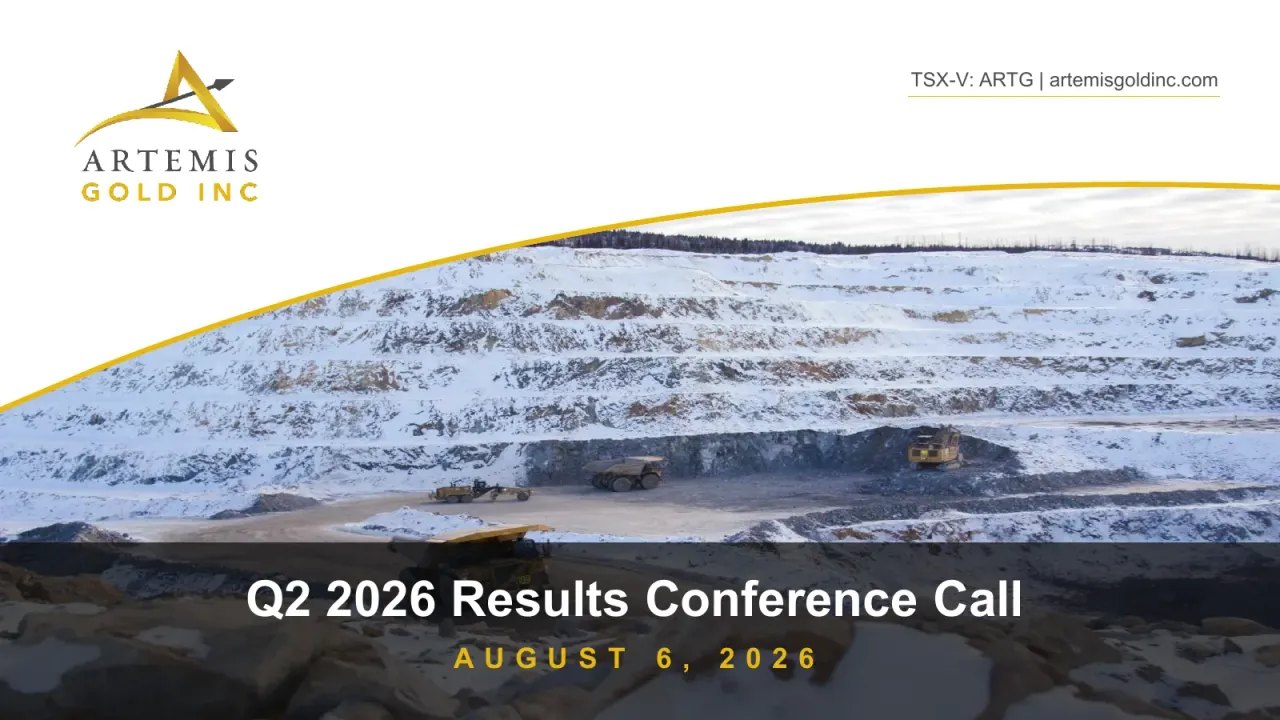
Artemis Gold (TSXV:ARTG) Q2 2026 earnings call, held 2026-08-06. Watch the replay and read the transcript on 6ix.
On 6ix: 6ix.com/event/artemis-gold-inc-argtf-q2-2026-earnings-call
Automated transcript · Written by software from the replay's audio. It can mishear names and figures; the replay is the record.
0:00 Thank you for standing by. This is the conference operator. Welcome to the Artemis Gold Second Quarter twenty twenty six Results Conference Call. As a reminder, all participants are in listen only mode and the conference is being recorded. After the presentation, there will be an opportunity to ask questions.
0:27 I would now like to turn the conference over to Meg Brown, Vice President, Investor Relations. Please go ahead. Thank you, operator. Good morning, everyone and thank you for joining our Q2 earnings conference call and webcast. Before we begin, I would like to remind everyone that certain statements made on today's call may be forward looking. We encourage you to refer to our public filings and disclosures, including the cautionary language in yesterday's news release for a more detailed discussion of potential risks and uncertainties related to these statements. I will now hand the call over to Artemis Gold's CEO, Dale Andres. Over to you, Dale. Thanks, Meg, and thank you all for taking the time to join this call. In addition to myself on the call today, we have our new CFO, Eric Marchand our Chief ESG Officer, Candace Alderson
1:22 our Chief Business Development Officer, Tony Scott and unfortunately our President Jeremy Langford is on a plane right now and unable to join us, but he will be available for Q and A in the coming days as needed. And as you can imagine, it's a busy time right now for Jeremy and he and his team are making excellent progress. I will take you through the highlights of the quarter then turn the call over to Eric to review the financials before we open up the call for your questions. On Slide four, Q2 was a record quarter on many fronts, including record production, record revenue and record operating cash flow.
2:08 And of course, this was helped by a low all in sustaining cost of US95 dollars per ounce of gold sold. We reached a remarkable milestone with declaration of an inaugural quarterly dividend yesterday. So now rewarding our shareholders with capital returns and with more to come in the future. This is after just over a year of being in production and in the middle of executing on our transformational growth And I think this demonstrates our confidence in the strength and sustainability of our operating cash flows and our confidence in delivering the 1A and EP2 expansion projects as planned. Phase 1a is now 57% complete and on track for tie in and commissioning before the end of the year, adding 33% capacity to plant.
3:04 That means that in only a few months, we will start delivering the benefits of that project. The much larger EP2 project is progressing very well and we recently commenced the start of major works construction and that's ahead of schedule. We are in a very strong financial position as well, but we did take prudent steps this quarter to further protect the balance sheet during the EP2 construction period.
3:33 On Slide five, the inaugural base quarterly dividend of $05 per share announced yesterday will be paid on September 9 to shareholders of record on August 19. This is consistent with our progressive dividend policy that we announced and introduced earlier in the year, and we expect the quarterly base dividend will increase to $08 per share in 2027, taking that up to 32%, $0.32 per share on an annual basis. Further beginning in 2028, we expect to top up the quarterly base dividend by a variable amount, such that the total amount of dividends will approximate 40% of free cash flow.
4:20 This positions Artemis Gold among leading peers who balance reinvestment for growth with shareholder returns and in our case doing so halfway through our first full year in operation, which I think might be an unprecedented, either way it's a great milestone. On Slide six, this shows our operating highlights for the quarter. We achieved new records for grades, recoveries, production and sales demonstrating the potential of this asset to outperform. All of this was achieved with a record 8,000,000 worked without a lost time incident. This is an outstanding result and reflects the strong safety culture that has been established across the entire organization.
5:06 And that's something I think we can all be proud of as the team here at Blackwater and Artemis. On Slide seven, this shows a recent drone photo of the open pit, which is progressing well. The first tranche of additional mining equipment to support higher mining and processing rates is being assembled on-site with a new shovel and five new haul trucks expected to be in service by September and '3 of those trucks are already in service. Recoveries reached a record 92.2% in the quarter as a result of ongoing improvements in ore blending and continued optimization of the mill circuit. And we are well set up for the rest of the year from an ore delivery perspective.
5:52 We are working to debottleneck and improve the performance of the existing crushing, grinding and leach circuits in anticipation of Phase 1A coming on stream later this year. On Slide eight, this shows a drone shot of the low and medium grade stockpile, which now sits at about 23,000,000 tons. The grade control drilling reconciliation continues to show more low and medium grade ore tons than predicted in the mineral resource and the stockpile capacity is being expanded to accommodate. On the right is a photo of one of our newly assembled two forty ton haul trucks and again with three of the five additional trucks already in service.
6:40 On Slide nine, although we have put this slide up a few times showing our industry leading growth profile over the next two years, I'd like to highlight again the phase 1A expansion, which is now only a few months away from commissioning. The phase 1A expansion represents a capital efficient step change opportunity that we're executing on to upgrade the current Black water processing plant. We're increasing the nameplate capacity by 33% from 6,000,000 ton per annum process to 8,000,000 ton per annum, and phase 1A will add materially to our production and cash flow profile starting in 2027. And we do expect well above reserve grade material until the much larger EP2 project comes online in 2028.
7:32 Beyond EP2, we believe Blackwater offers tremendous potential and we continue to advance on all of these fronts. For Phase 1a, you would have seen our news release earlier this week, detailing the progress being made. At the end of Q2, twenty twenty six Phase 1a was 57% complete and is on the schedule for commissioning during Q4 twenty twenty six. To date, we have completed a number of important construction milestones on this project, including significant progress on both the vertical grinding mill installation and the new tanks in our CIL circuit.
8:17 After finalizing the scope, including additional spares for operating, phase 1a is now expected to be completed at a capital cost of 120,000,000. This is up slightly from the previous 110,000,000, but still represents a very low capital intensity of $60 per additional annual ton of processing capacity and with clear potential for further optimization above 8,000,000 ton per annum. Slide 11 shows the Vertimill building construction well underway and on the right you can see the foundations for our shear reactors, which are going to be located right next to our detox circuit. It is worth noting that the various upgrades to the plant, including the shear reactors as well as the additional oxygen generators and the reagent system upgrades are expected to help both throughput and recovery, as well as improved unit costs.
9:19 Turning to EP2 on slide 12, this expansion represents a 13,000,000 ton per annum increase to our plant capacity above 1A growing from 8,000,000 ton per annum at the end of this year to 21,000,000 ton per annum by the second half of twenty twenty eight. And as a reminder, EP2 increased its gold production to over 500,000 ounces per year and the economies of scale provide for lower unit operating costs, which will cement Blackwater's position as one of the lowest cost and highest margin gold operations globally. So that will continue as it is today. Early works construction began in January and is nearing completion.
10:05 Earlier this week, we announced the start of major works construction. This was ahead of schedule and with the first pour of concrete on our ball mill foundation complete. This was the largest single pour on the whole EP2 project at about 900 cubic meters of concrete and this was successfully completed ahead of schedule. Same theory and bulk earthworks for the processing plant expansion is advancing ahead of plan and as shown in the drone photo on this slide, showing those earthworks. I think it's worth just pausing to reflect on that photo. I think you can see the sheer size and scale of the PT project compared to Phase 1a, which is in the middle of the photo there.
10:58 All our long lead equipment has been ordered. Completion of the six twelve bed construction count expansion is nearing completion and expected to come online fully in the coming days. We have now secured supply assurances from DC Hydro that ensure the continued supply of low cost renewable hydropower at the expanded throughput capacity. So that's a great outcome. On slide 13, this shows a couple of additional drone shots, including the bulk earthworks for the new primary crusher, which is progressing well, and the first concrete pour for the EP two ball mill foundation, as I mentioned earlier. In summary, on EP two, I can say that although still at an early stage, EP2 is progressing extremely well.
11:50 The EPCM contractor is in place. Our project delivery team has been expanded with several key additions and they're great additions. Our early work strategy is definitely helping to set this project up for success and significantly de risk the schedule going forward.
12:10 I will now turn the call over to Eric Marchand, our recently appointed CFO to talk about our quarterly financials. Eric, over to you. Thanks, Al. The second quarter delivered record financial results. We generated record revenue of 433,600,000 record adjusted net income of approximately $200,000,000 and record adjusted EBITDA of $285,000,000 We sold a record 78,126 ounces of gold during the quarter. Approximately 49,000 ounces were sold into the spot market at an average realized price of CAD 6,119 per ounce with the balance delivered under our stream and hedge commitments, including approximately 23,000 ounces delivered under the mandatory and discretionary hedge programs at a weighted average price of CAD2995.
13:09 Looking ahead, we expect to deliver similar amounts in the third quarter on our hedge program, including the remaining 7,000 ounces outstanding under the discretionary hedge program. As Phase 1a ramps up later this year, a significantly greater proportion of our production will be sold into the spot market, increasing our exposure to the current strong gold price environment. Additional details on our hedge commitments are provided in Note 16 to the financial statements. Even after the impact of our streaming and hedging commitments, we generated an AISC margin of 71%. While stronger gold prices certainly contributed, our low cost operation remains the key differentiator with AISC of just US95 dollars per ounce during the second quarter.
14:03 These margins translated into record operating cash flow of $2.00 $8,000,000 in the quarter. Strong cash flows are expected to continue providing the financial flexibility to fund both Phase 1a and EP2, all while commencing the return of capital to shareholders through the declaration of our inaugural quarterly dividend.
14:26 Total growth capital was $131,600,000 during Q2. As planned, spending will increase in the second half of twenty twenty six with the commencement of EP2 major works. I'll discuss this further on the next slide covering our full year capital guidance. And this spending strategy was also a key driver of our decision to implement the put option strategy that Dale mentioned earlier.
14:52 Turning now to guidance, we are maintaining our previously announced annual production and unit cost guidance at Blackwater. I will point out and as previously announced, AISC for 2026 is expected to trend towards the higher end of the annual guidance range, primarily due to general inflationary pressures, including higher oil prices, which the company expects to partially offset through continuous improvement initiatives. Turning to our annual capital guidance, there are no changes except for a $10,000,000 increase to the Phase 1a capital estimate as a result of scope review on this fast track project, which now includes additional operating spares. So we have approximately $110,000,000 to complete the $120,000,000 Phase 1a expansion in 2026.
15:43 This increase is not material in relation to our total growth capital guidance of between $685,000,000 and $755,000,000 in 2026, which we expect to fund out of operating cash flows.
15:58 Turning to the balance sheet, we ended the quarter with an exceptionally strong financial position. At quarter end, we had total available liquidity of approximately $879,000,000 including $179,000,000 of cash and the full $700,000,000 available under revolving credit facility.
16:17 During the quarter, we also derisked EP2 significantly by implementing a gold put option strategy to protect operating cash flows for the first year of EP2 major works construction. The program covers 172,500 ounces at a strike price of CAD 5,300 per ounce from July 2026 through June 2027, providing downside protection should gold prices decline, all while retaining full upside exposure to higher gold prices.
16:49 Overall, our balance sheet positions us to deliver self funded growth while preserving substantial liquidity, all while continuing to return capital to shareholders. With that, I'll turn the call back to Dale. Thanks, Eric. In addition to Phase 1a and EP2, we are working on multiple fronts to show the full potential of Blackwater. Our resource expansion diamond drill program is progressing well with two diamond drill rigs active in the second quarter and a third rig now being mobilized to expand the program. Blackwater is a very large mineralized system and we are testing well beyond the depths previously defined with some holes extending beyond a thousand meters.
17:36 We will provide updates on this program as assay results come in and as you can imagine these are long holes and it does take some time and a new resource model update will follow later in the year with and incorporate this new information. On the mining side, we see various potential options for pushing our unit rate lower in the long term on costs and technology is changing on this front quite rapidly and we are evaluating
18:07 many different options, including electrification and automation options that may be able to take advantage of our cheap hydro cost. On the processing side, the studies are more focused on growth beyond EP2. And the first step of that is to show what can be done to maximize both the 1A and EP2 builds and infrastructure. And then beyond that, we'll see what the right size expansion for a potential phase three looks like. The regional exploration program has also resumed after a winter and spring break with initial drilling this year planned in the Top Lake area with one reverse circulation rig following up from previous anomalies identified in Q4 last year, and the rig will then move on to targets in the Van Tyne area.
19:11 To summarize and wrap things up, I would like to highlight again the record results and terrific progress we made on our phase 1A and EP2 projects during the quarter. And I think this speaks to both the performance and the quality of our operating and project execution teams.
19:31 Our low all in sustaining costs helped to drive record cash flows and liquidity, and we further protected the balance sheet with the put options that Eric walked through, which provide downside price protection during the twelve months of high capital spend, the first year of EP2 spend without giving away any upside. EP2 is off to a great start and I'd like to remind everyone that phase 1A is now just around the corner, which will significantly increase both production and cash flow in 2027. And importantly, we have now graduated to being a dividend paying company with plans to progressively increase the return of capital to shareholders in the near term.
20:19 That concludes our presentation and now back to you operator for the Q and A. Thank you. We will now begin the question and answer session. To join the question queue, you may press star then one on your telephone keypad. You will hear a tone acknowledging your request. If you're using a speakerphone, please pick up a handset before pressing any keys. To withdraw your question, please press star then 2. The first question comes from Lane Lam with TD Securities. Please go ahead. Yeah, thanks. Good morning, guys. We have some great quarter. I just wanted to better understand the driver of the higher grades this quarter and whether you see potential for that to be kind of sustained over the coming quarters?
21:11 Yeah, Thanks for the question, Wayne. Grade was six, I would say very high in the second quarter on for the first half of the year, we averaged just over 1.7 gram per ton. We do have a lot of flexibility in the mine plan with our stockpiling strategy and we were able to take advantage of that in the first half of the year, in particular in the second quarter. I do anticipate the grades to temper somewhat, so slightly less
21:41 still in that 1.5 gram per ton range for the remainder of the year and higher throughput for the second half as well. So those two will offset each other and yeah, we're very well positioned to meet our guidance for 2026. Okay, perfect. And just wondering on the work being done around the upcoming resource update. Obviously, you guys already have a very large resource and a long mine life. So just wondering if that additional material on a lower cut off just adds to the low and medium grade ounces that we process in the later years to extend out the mine life or does that also give you a bit of a bit more flexibility and upside to process grades in the medium term in being able to front load bit more of that higher grade bucket?
22:35 Yeah, that's a good question, Wayne. And for additional resources and low and medium grade, as I mentioned, we do have optimization potential beyond the 8,000,000 ton per annum rate with 1A and beyond the 21,000,000 ton per annum rate with EP2. So the additional resources and stockpiled material definitely play into that and allow us to
23:06 further optimize production. It does provide additional flexibility and I think I may have mentioned this before, but if we're able to segregate as we expand the foundation and the footprint for our low and medium grade stockpile and segregate the highest grade portions of that, that really does open up opportunities in the near term for production optimization, even at the stated capacities, you know, the nameplate capacities of both phase 1A and EP2 without further optimization on throughput rates. So there's a bunch of different levers that we're looking to pull as we optimize our plans over the next number of months and we'll update the market as we complete those.
24:02 Okay, great, thanks. And then maybe just lastly on the scope changes with the upgrades to the phase 1a expansion like the Vertamil, does that need to be replicated for phase two as well given the two designs were supposed to be pretty similar and would that be accounted for within the EP2 budget? Yeah, again, and I'll make the comment. I think I mentioned it in my comments, but phase 1A was a fast track project that we put in advance of the announcement of EP2. There was limited upfront engineering on that and so we went straight into ordering the equipment required and execution of 1A in a very quick way.
24:57 So when we talk about scope changes, a lot of it was the additional operating spares. Those have been fully accounted for in EP2. Just a reminder, EP2 is similar, but a slightly different processing train and for phase one, it will have a two stage crushing with a SABC circuit. So, SAGMO ball mill and double crusher, which is a bit different than our phase 1a and phase one design, which has three stage crushing and a single ball mill without any double crusher. So there is differences. There is no read through at all from the $10,000,000 increase on 1A to EP2. We're still very comfortable with our budget and schedule on EP2.
25:49 Okay, perfect. Looks like things are humming along quite nicely. Congrats on a good quarter and best of luck in the months ahead. Thanks, Wayne. The next question comes from Harrison Reynolds with RBC. Please go ahead. Hi, good morning, Artemis team. Congrats on a good quarter. Appreciate the detail provided and great to see the projects progressing. On 1A, when do you expect to see that 30% throughput lifts come into effect once it's commissioned and tied in? What's the timeline on ramping up that capacity to the new nameplate? Thanks, Harrison. Q4 is when we plan to commission and ramp up phase 1a.
26:39 I think as we flagged previously, there is an eight day shutdown that's currently planned for the tie in of that upgrade of the of the Vertamill and the new cyclone pack that's required to feed it. And then we'll start to, you know, Commission. It should be a fairly quick ramp up is the Vertamill and the additional tanks and other upgrades are fairly straightforward. And so that means the full so those two offset each other with the downtime required to tie in and then starting the roundup of the throughput, we expect to see the full benefit in 2027. So full year at that 8,000,000 ton per annum rate or above that if we're able to optimize.
27:30 That's helpful, thanks. And maybe just a follow-up on 1A, you mentioned these options to debottleneck above the consolidated 21,000,000 tons per annum. You know, do you see any bottlenecking opportunities at 1A, you know, concurrently, you know, before EP2 comes online? Like, are there any studies you could look to put in place, you know, in 2027 or 2028 to get more throughput out of 1A? Yeah, definitely like first and foremost is to get it up and running at design capacity. We think that should be straightforward and fairly quick to do. In 2027, we'll be driving that and we won't be waiting for EP2 drive optimization efforts above 8,000,000 ton per annum.
28:21 I would make some comments around the 1A, but we're primarily making upgrades to the wet side of the circuit and the dry side really just straight deboning. I think didn't need any major capital upgrades and we're already pursuing those optimization opportunities at the front end and making sure that we have the crushing capacity to go at first 8,000,000 ton per annum and to go above that. And we're seeing really good progress on that work. So I'm feeling good about at this stage our ability to try and drive higher than 8,000,000 tons as twenty twenty seven progresses. But let's stay tuned. We first have to get it built up and running and commissioned and then that'll be our main focus together with finishing AT2.
29:16 That's great. Thanks for taking my questions. Thanks, Chris. The next question comes from Don DeMarco with National Bank Financial. Please go ahead. Thank you, operator, and good morning to Steven and Dale and the rest of the team. Steven, I'll start with an update that was provided earlier that BC Hydro provided assurance to provide power for the two run rates. I'm just curious, what does this entail? I mean, because BC Hydro, will they be increasing power distribution in mind? Does it require upgrading their power facilities? And what will the company be doing as part of the EP2 CapEx to ensure to move up to that higher power delivery? Yeah, thanks, Don.
30:03 Maybe I'll kick in and I'll ask Candace to comment if she thinks she can add to that. I would state that, know, BC Hydro is twinning the line, the North Coast transmission line and that's scheduled for completion to 2030. We have contracted power out to when that 20 of the line will be in place for the EP2 run rate. The assurances we were looking for from BC Hydro extend beyond that if there is any delay putting in that infrastructure, which is on DC Hydro, that's not us doing that work.
30:48 And they've given us those assurances. So that's the assurances we're referring to. Just from a delivery, a power delivery perspective, we're still running the final details on DC Hydro's Glenanan substation. We don't think there's anything major to be done on that And our transmission line that we put in for phase one is fully capable of willing in the power we need for EP2. So there's no upgrade to that transmission line that we need. So everything's just on our end it's really at the mine site itself not with the power delivery to site.
31:33 Hopefully that gives you some color. Yes, that's helpful. Thank you. Now, I also saw the commentary in the Q2 print about the variable dividend, 40% of free cash flow after 2028. Are you also considering buybacks? And how do you plan to deploy free cash flow and capital allocation after the hedges come off, you know, before 2028? Yeah, appreciate that. And if you look at, the slide we walked through, we did flag potential for an NCIB or potential share buybacks as early as 2027. I think it's, you know, we just declared our first quarterly inaugural dividend.
32:20 We do plan to increase that dividend starting in 2027 updates and to share from the current $05 and we will look at that. The board will look at that on as things progress both R1A ramp up and progression on our project build with EP2. They'll look at that in 2027. As we head into 2028, we're just flagging that in addition to the base quarterly dividend, we will target 40% of free cash flow. So to show that disciplined development, we are continuing to look at what's beyond DP2 and we'll weigh that those opportunities for further growth and investment both organically and maybe beyond in addition to paying 40% of that free cash flow back to shareholders.
33:18 And if there is nothing that we want to invest back into growth at that time, we will consider additional dividends and or share buybacks in addition to that 40% distribution of free cash flow. That's how that's what's articulated in our dividend policy and our shareholder return framework that we outlined earlier this year, Don. Okay, thanks very much, Dale. That's all for me. Thanks for taking my question. Thank you. The next question comes from Jeremy Hoy with Canaccord Genuity. Please go ahead. Thanks for taking my questions. I think I'll focus on the EP2 expansion.
34:08 The contingency in the 1,440,000,000 budget, is that enough to absorb any current inflationary pressures we're seeing that are impacting operating costs? Yeah, thanks Jeremy. And I flag a bunch of things that we've done a very clear strategy we had with EB-two that's slotted in nicely with executing on our phase 1a project to get immediate cash flow and immediate production increase. But it was doing our early works program and if you recall, we ordered a ball mill that was already manufactured and a SAG mill back in September when we announced the phase 1A project. So pricing was locked in then.
34:58 Our early works program advanced engineering and procurement and we did state in our recent release that we've ordered all the long lead equipment. So again, that derisks us from a inflationary perspective, having those orders and pricing locked in. I mean, obviously we're still faced with inflationary pressures along with everyone else, and that would be primarily related to, you know, fuel price transportation, things like that. But we've got sufficient contingency in our capital estimate at this stage to absorb that and that we've pawned for that with a contingency and we're continuing to look for cost improvement opportunities to absorb any areas in the project that may be seeing inflationary pressures. So at this age we're very comfortable with the 1,440,000,000 estimate that we've put out there and importantly the schedule.
36:06 And as you know, on these projects, keeping the schedule is your best way to control cost and things are going really well on that front to date. Very pleased. Thanks Dale for the color. Pushing on that same theme, and you highlighted the scale of this expansion and that we're sort of well advanced. Can you just remind us what the degree of investigation for geotech was done and so I guess the degree of certainty of earth quantities and, and, you know, how far you are through earth moving percentage wise? Jeremy and his team did a lot of work on this and optimization together with contractors and consultants.
36:56 And I think we did a great job of optimizing the earthworks. We're planning to finish all the bulk earthworks by the end of the third quarter, so that's over the next two months. I don't know if the exact percentage on that, but it's where you know the majority of the bulk earthworks are done and we're well advanced. I think you can see in the photos that we showed the plant site. You know, we've already excavated for the SAG mill, big concrete pour that'll be poured. We expect this quarter as well as the ball mill raft pour that we flagged and SAG mill is the second biggest pour on the project.
37:41 Just getting those two out of the way. Typically the ball and SAG mills are the you know the biggest pieces of equipment and we've taken that right off the critical path. And so I think that's great. And then we showed another photo showing the earthworks around the crushing system with the new primary crusher and that's progressing well. So I don't know if that exact percentage we can follow-up with you Jeremy, but yeah, it should all be finished by the end of September. That's great detail. Thanks very much. Final one for me is on throughput rates. There's been a debottlenecking program ongoing, you mentioned crushing milling circuits are the focus.
38:27 Grades one in the back half of the year, you said about 1.5. Could I ask what's critical to getting to nameplate in terms of throughput? And there, what was I gonna ask now? So, yeah, what's critical to get into nameplates and what are you running at currently? Yeah, and as you would have seen in our Q2 results, we're running at about in Q2 at an annualized rate of about 5,500,000 tons. So that's slightly less than our design of 6,000,000 tons. Various and we obviously offset that with much higher grade and significant improvement to recoveries. So we were over 92% in our recoveries and actually made up for very, very strong production and sales quarter.
39:27 You know, as a result of those higher grades We cited earlier in the year some of the unplanned downtime that we've had. Some of this is back to design challenges and flaws in as one example, the CIL circuit with our tanks and particular our agitators and gearboxes that drive those agitators. We're needing as so this is a concrete example, we're needing to change out all of those agitators and gearboxes to bigger units. We're needing to put in some structural steel upgrades on our tanks. Obviously, the new tanks that are going in for phase 1a are already at that bigger size and have the appropriate steel and structure in place.
40:17 But we're needing to methodically go through our existing 11 tanks that were built with phase one. So that's everything from our pre aeration, our leach tanks, or 60 IL tanks and our two detox tanks and replace those do some structural upgrades to allow for bigger agitators and gearboxes. So that's being done. We're working our way through that. It's taking a little bit longer because we have to order this equipment. We have to wait till it comes in, but it's an you can't take the whole circuit down. We were still operating and we're operating well, but that's one concrete example of what we're doing. We do expect that work to be done largely complete before the end of the year.
41:03 And then we do get the additional tanks with 1A. So we don't anticipate any kind of I think it's just a steady improvement from where we are today right through to the startup of 1A over the next four or five months. Understood. Okay, well, thanks for taking my questions and the detailed answers. I'll step back in queue. Thanks, Jerry. The next question comes from Andrew with BMO Capital Markets. Please go ahead. Hi, team. Congratulations on a really strong Q2 and a great trajectory. Just one circumstantial question. We're all facing across Canada and The U. S.
41:50 Variations on fire risk from forest fires. And I'm sure everyone on the call remembers that the last couple of summers you guys have dealt with that. So I think from memory the site itself is now fairly burnt around it so there's no further likely risk around the site. But what are you seeing in terms of risk to your access road and risk to your power line in terms of what you're seeing in terms of fire activity in the region? Thanks Andrew and I think that's an insightful comment and question in the sense that at the site and especially with our EGD project quite a bit of the areas cleared and it has as you pointed out we get impacted by fires for a couple seasons, not last year but previous two years.
42:46 And then I'll find some wood around me here because I'll try and knock on it. To date, we've made out very well. You'll see a lot of comments in Canada and The US with big fires. We haven't been faced with those kind of fires in our immediate vicinity. There's been a couple small ones, you know, 20 kilometers away that were handled and put out very quickly. I don't want to say we're out of the woods yet. Things can change. It was a dry winter and low snowpack and a quick melt and so things can dry up in a hurry. But through June and July, we've made out very well.
43:34 And, you know, we've actually had cooler weather and rain. And if anything, we've you some of the rain has impacted our mining and our roads and our traction and things like that as opposed to worrying about fires at the current time that can change. We're well prepared. We're in regular contact with the DC Wildfire Service. They know us well. We work closely together and I think we're well prepared to manage anything that we may face over the next couple of months. But so far so good. And I think we've made out, you know, really, really well compared to unfortunately some other areas in the province and the region that, you know, haven't haven't been as lucky. So, so far so good.
44:25 Okay, thanks for that update and again congratulations on the great trajectory here. Keep doing the right things. I'll sign off. Appreciate that. Thanks Sandra. This concludes the question and answer session. I would like to turn the conference back over to Dale Anders for any closing remarks. Please go ahead. Thank you, operator and thanks again to everyone who joined the call. I hope we've been able to answer all your questions. We are available if there are any follow-up questions including Jeremy and we do look forward to reporting on our optimization and growth progress. Thank you all. This brings to a close today's conference call.
45:10 You may disconnect your lines. Thank you for participating and have a pleasant day.
Follow Artemis Gold Inc into a list and get an email when it puts out news.
Vice President, Investor Relations
President and Chief Executive Officer
Chief Financial Officer
Analyst, TD Securities
Analyst, RBC Capital Markets
Analyst, National Bank Financial
Analyst, PMO Capital Markets
Analyst