Transcript
Automated transcript · Written by software from the replay's audio. It can mishear names and figures; the replay is the record.
0:09 Hello and welcome everyone to Arizona Gold and Silver's inaugural event. We're delighted to have you all here today. I'm pleased to introduce Mike Stark, President and CEO, who will provide insights into yesterday's press release. For those of you who joined us, please feel free to submit your questions throughout the chat, throughout the conversation rather, with the chat button in the bottom right corner of your screen.
0:29 Also, please note that this session is being recorded and will be available for view and shortly after we conclude. Mike, thank you for joining us today. Yesterday's release highlighted that all holes reached their intended targets with anticipated thickness or better. Could you elaborate on the original target thickness and help us understand the significance of encountering the larger widths? Sure, thanks Kyle and thanks for the first time I've ever done this so looking forward to it. But yeah we were extremely pleased and as the entire membership team is extremely, management team excuse me, is very pleased with what we're seeing. We have indicated again we're waiting for the lab results as we know but we have hit the target twice on the red hills and 6 more times on the horizontal.
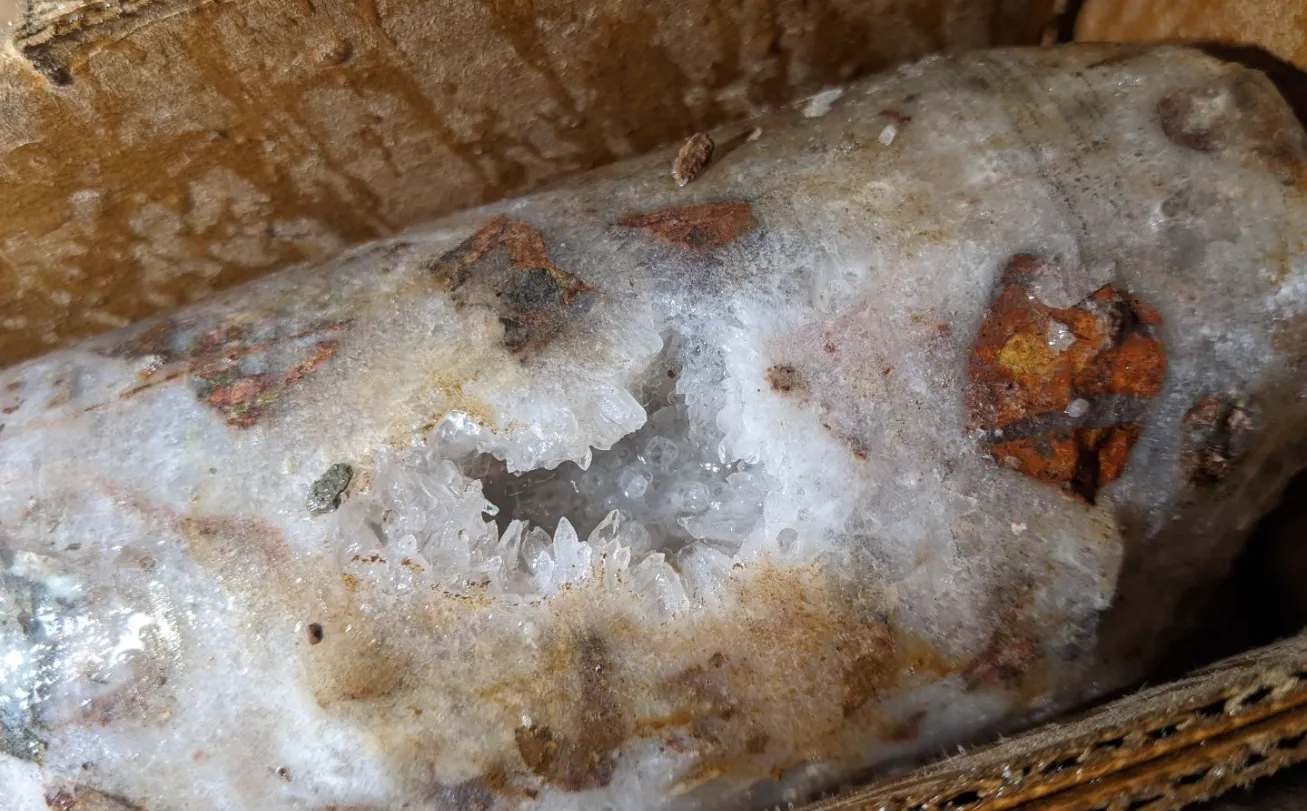
1:16 The horizontal drill is drilling in an area where we have to infill to prepare for a 43-101 in the future. The Red Hill, mind you, is a target that is about a hundred meters thick, and we've exceeded that. Matter of fact, it's public statement 130 meters. Now the question is, what's the grade? But we're delighted with this. We've hit it on both holes. The third hole is now underway. If we hit the target again, this just simply gets bigger and bigger and bigger. Thank you. For preparing for this we've got some drill core here so I might as well throw that up on screen while we discuss so people can watch. Can you confirm this is in presenter view right now? You see it just fine?
2:02 I see it fine I hope everybody else can. Yeah if you see it everyone does. I just wanted to have it up there for when we chat Feel free to let me know if you want to transition at all through them. Sure one thing we're always looking for and it's a big signal in the Oatman District which is our district is green and yellow courts. The history of this shows that's where most of the high grade is found. So the target that we're aiming at here is above a hill or sorry on the side
2:32 of the hill and we're watching for where This maybe this plume is coming up But more importantly some of these pieces of core are just simply outstanding I'll give you a quote from one of our our drillers and that's Isaac Thank you for allowing me the opportunity to work here. This is some of the nicest core I've ever seen. I love that statement. I love it. Amazing. As you can see there, there's the yellow and yellow court, excuse me. And there's some green sections as well. But yeah, we're definitely into something here that looks very, very attractive. And this was all made available because of the addit that we found earlier this year, January in 2024. And it allowed Greg to walk into the guts of the of the internal workings of this system.
3:21 So it's really helped us on where to drill and how to how to maybe define this size of this deposit even better. So we're very, very fortunate, Very fortunate.
3:33 Excellent. Now, you've noted fine-grained visible gold in both the Red Hills and Rising Fawn Quart veins. Could you help investors understand what these visual indicators combined with the substantial intercept widths suggest about the style of mineralization you're dealing with? And how does this compare to your initial model of the system? Well first of all, seeing it is the biggest delight. I mean obviously it tells you you're in something, right? We're in what we're looking for. When it comes to defining fine Gold, this particular system, when we hit this back in 2022, we didn't even see the Gold. So we sent in a section of core, excuse me, section of RC, not necessarily knowing what we were going to see in return.
4:23 And lo and behold, it was mineralized both top and bottom still. So Greg sent in another bunch of samples, and they were mineralized. So it's a step-by-step learning process. So where we saw light green tinge mud came back at over 1 gram and yet you could not see the gold.
4:41 In the TR2 you could maybe define that there was a little bit of indication that there was gold in it but you couldn't see it with the naked eye and again that was one of our better holes it ran 115 meters of 1.34 grams just a little subsequent to that was a hundred and 10 or me 110 meters of 1.5 So you have to be very careful that even though you don't see it, it might be there. And that's a wonderful situation. I mean, how better does it get? You don't see it, but it's there. When you see it, you know you're in higher grade. Now, at Red Hills, like you just mentioned, you're following up on previous RC drilling. It showed 100 plus metre thick intercepts of 1.3 grams per tonne gold. What geological features or indicators made you choose these specific locations for these new core holes?
5:33 What might the visible gold you're seeing tell us about the system? All right this goes right back to the model that Greg has been working on for several years now. We believe this is the heat source where the mineralization has come from. So we're on the outer fringe of it right now. There's a good hyperspectral here that I provided to show and that will indicate, there you go, so we're on BLM 1, pad 1, and you can see we're still on the western edge of this but we're actually now allowing ourselves to get deeper into the system and test down dip. Because this vein or excuse me this this oxidized material, sorry that's wrong, because of the system it's dipping at a 70 degree angle and therefore you've got to step back in order to hit it. You just can't simply keep on hitting it from the same pad. Fortunately for here, we have the ability to drill right to a vertical, and then we can turn the drill rig around and go deeper into the system. So this is gonna be an ongoing,
6:40 perhaps even more than like a year of drilling on this one location alone. But what we're seeing is making us very excited What do we have on the second one here? Yeah So In the rise in Fon area you mentioned preliminary grade model and suggests a potential plunge to mineralization Could you explain what geological features or data points led to this interpretation and how your current drilling pattern is designed to test this theory?
7:15 Exactly. I mentioned the adit. That was part of the reason that we're looking at this. We've got some very strong grades at the surface. Obviously that had to come from somewhere, obviously from below. And that's why we're stepping out further to the south towards the shark fin, you may have heard that comment before, but the shark fin is quite a distance away, but we're working our way along the side of the mountain, testing down dip as we go, and what we're looking for is maybe a plunge or a high-grade vein coming up that's come up through the system. And by doing that, we're figuring this out. Again, this is very early stage, but it hasn't been disappointing. Every hole is hit, and we know that we're in some really nice material here on the rising fawn.
8:04 Well like you say it's early stage and right here this WV3 hyperspectral survey you've identified additional targets right so how are these new targets compared to Red Hills and rising fawn in terms of geological signatures? Well I'm gonna step that back a bit This is all part of what we believe is where the heat and the material is coming from. I'll let you use the other slide if you don't mind. The one with the more red on it. Yeah. Yeah, that one there. So this is what's kind of like a mushroom cap. And it's been capsulated for years. It never got to the surface. When you walk over the top of this mountain, it's dead. There is nothing there. It's clay. It's just dead material. But once you get below that clay cap, it's like a pressure cooker. Underneath it is where the mineralization is. And I'm gonna step out on my own here a bit, but along the Arabian Fault, when that happened, the fluids were allowed to come up there and that's where we've got this long 1.6 kilometers of continuous strike of mineralization because it was allowed to come up.
9:11 Imagine a bunch of pressure trying to go somewhere and it can't and then something opens up
9:16 the pressure is allowed to come up well that's where the fluids come up and then ran that entire length we have 1.6 sorry 1.5 kilometers still to the south on this Arabian fault that we haven't even tested yet So there's a tremendous amount of upside here. So with 7 holes heading to the lab and results expected to flow in over the next, say 4 to 5 months, what are the key technical milestones or decision points you're looking at for advancing the project in 2025? Well, just on that alone, I mean, we're continuing to drill, so that could even be extended further into 4 or 5 months, to 6 months, to 7 months. Look, as long as we continue to hit, I want to just keep it going. We've been very fortunate and I think that trend is going to continue because Greg has got a great model here and this is just the outer edges of it. It's got a lot of potential to be quite an enormous deposit.
10:15 An individual upon registration asked more about the endgame with Arizona Gold and Silver. The individual asked how much more drilling if all new holes proved as expected or above would you anticipate an offer from a mining company would come?
10:32 You know I'm not gonna go over my skis too far there, but I certainly do know we do have several CA signed on the company right now. Obviously, we're doing something right. We do have 2 mines that are in care and maintenance at this point, but they're fully capable of taking our material. And again, that would be another situation altogether. But the fact of the matter is, this is getting to be too big of a deposit not to develop. That will not happen for us. We will not be the developer. And when it comes to Greg, Mark and I, just the 3 of us, it's too much to take on. However, there's nothing saying that a major may not come along and have a look at this on a serious way and build their own plant on the property, which is certainly possible to do as well.
11:19 This is now getting to some really good size with huge amounts of upside still here yet to come. Now, The press release mentions you're drilling ahead of an initial resource calculation, right? So what factors will determine when you've gathered enough data to move forward with that said resource estimate? There's a number in our mind, and I'm not afraid to share it, but we're looking probably in the neighborhood of around 200 holes. That's much faster than a previous deposit, or sorry, previous 43-101 that Greg and I experienced. Matter of fact, we did that and it ended up by being 430 ounces on a project, we also had 432 holes into the project. We've only got 142 holes so far, and I'm not afraid to say that this is much larger already. So This is one of the biggest and best projects that Greg has ever had the chance to work on.
12:20 So one of the things that I'm hesitant, and I will be that way continuously, is why do a 43-101 just to establish, I'm just gonna use fictitious number, 1, 2, or 3 million ounces, when you're continuously hitting?
12:36 Really, let's see some outer edges of this deposit before we do that. I don't want to spend shareholders money. And then 2 months later, you got to do it again because you're increased the deposit size by significant amount on the results of the drilling that you just did. So I'm careful about it, but I mean, we get to 200, I think it's, I think it'll be an overwhelming size at that point. And yeah, that would be the time to do it. But it could happen sooner. Again, we're all subject to what the market wants and market is doing. And again, I'll leave it at that. But right now we have not seen any limitations to this system. I believe it's going to get much, much larger. It gets much, much larger through drilling. So how is the Treasury currently as it stands?
13:24 Very fortunate there as many should know we just did a financing and that came in at 4.6 million Delighted to have our new participant and that was Sprock and we had Rick Rule come in as well. And then very, very nicely, and this is an ongoing story, management, friends and family came in for over 2.4 of that. And that speaks volumes about the commitment from our shareholders, family and friends, shareholders. Delighted to share this pie chart with you. We have Florian, our institutional investor, maintains his 9.99 0.5 percent in the company at all times. It's listed at 9 only because we couldn't do the 0.5 on the chart. But solid investor, never sold a share. Management has never sold a share.
14:13 How better does that get? Honestly, we're really pleased. Management has been involved in the company, obviously, since the inception. But let me bring that point up. I think this is worth mentioning. When we formed the company back in November 2016, we did a financing, and we did that financing with no warrants. Management took down the majority of that financing. The second financing came along and again we did it without a warrant. And nobody disputed it, nobody had a problem with it because we were keeping the share structure tight. The share price started to rise, we did another financing again, no warrant. So I'm really proud of this. We've established an extremely tight structure now, only 92 million out.
15:00 Majority of it is held by family and friends, as you can see. Management has a significant piece of the pie and never sold a share. And again, to me, this is what most investors should be looking for, is commitment, and more importantly, a project that's growing with every drill hole. Do you mind just telling me what those first 3 finances were, no warrant, but what price was that? The first one was done at 10 cents, and that's important, I should have brought that up. A lot of companies, and no disrespect, a lot of guys do this and I have no problem with it either. But we started the company at 10 cents. Everybody bought 10 cents shares. Nobody got a 2 cents IPO. Nobody got any seed shares whatsoever.
15:45 I'm proud of that. Again, it shows that management's been committed since day 1. The financing, and I'm sorry, I don't have this on the top of my head, but the first one was 10. You can look back, it's on CDAR, it's all there. But I think the next one was done obviously a little bit higher, 17 perhaps, and I think the next one after that was about 22. Don't quote me please, but I believe that's the rough numbers roughly in that area. And again, the fact that we've never sold a share shows that commitment from management, that's for sure. I mean, So in terms of news flow, as we wrap up here, unless anyone wants to squeeze in a little question, please feel free to submit it in the chat. As we wrap up here, upcoming catalysts, news flow for the next coming months, What can we expect in the new year in 2025?
16:34 Well, I'm hoping right off the beginning of the new year we'll have a drill result. I'm looking forward to the first hole, which will be the Red Hills. And after that, if everything goes right, we talk to the lab. The lab is doing a section of core for another company and then they're switching to us so they're going back and forth. But that's good news to me, that tells me there's only 2 people in the queue right now that can change daily, but right now being that there's only 2, that means things are moving along quite well. The reason for the news and the update to shareholders I believe for complete transparency at all times I wanted to let them know things are good and we're just anxiously awaiting the results on the first first hole of course but from there it should roll very, very quickly.
17:20 These 7 holes should all be out, I would hope, before the end of February, and I hope I'm not guessing too bad. But hopefully with that, we'll have those initial 7, and then we've got obviously a 16-hole program so we have a lot more to show after that. Where are they being processed, the assays? ALS has them and then the final process is done here in Vancouver And I do know that one of the holes is already here in Vancouver. So that's why I'm anticipating seeing this very quickly. Excellent. Well, Mike, thank you so much. Appreciate the update. We'll be looking forward to catching up with you in the new year though. Other than that, if you came in late, everyone, This is being recorded. It will be made available on YouTube and on Six.com within the next couple of hours here, so look out for that.
18:09 But happy holidays everyone. Mike, thank you for doing this. If you have any closing remarks, now's the time, but really appreciate it. No, I think you