Jeff Hibson
Host
Replay available
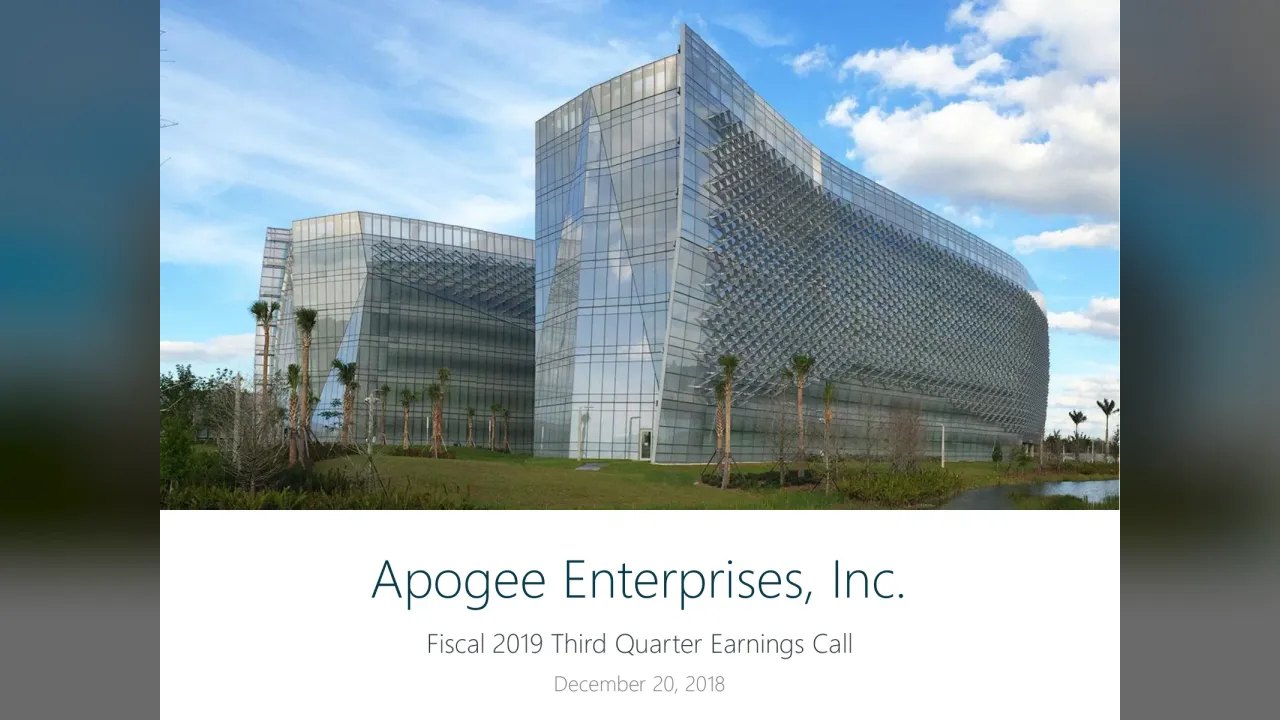
Apogee Enterprises (NASDAQ:APOG) Q3 2019 earnings call, held 2018-12-20. Watch the replay and read the transcript on 6ix.
On 6ix: 6ix.com/event/apogee-enterprises-inc-apog-q3-2019-earnings-call
Automated transcript · Written by software from the replay's audio. It can mishear names and figures; the replay is the record.
0:00 Good day, ladies and gentlemen, and welcome to the Apogee Enterprises third quarter 2019 earnings conference call. At this time, all participants are in a listen-only mode, so if anyone should require assistance during the call, please press star, then zero on your touch-tone telephone to reach an operator. Later, we will conduct a question-and-answer session, and instructions will follow at that time. As a reminder, today's conference may be recorded. I'd now like to introduce your host for today's conference, Mr. Jeff Hibson. Sir, please go ahead.
0:28 Thank you. Good morning and welcome to Apogee Enterprises' fiscal 2019 third quarter earnings call. With me today are Joe Pushis, Apogee's chief executive officer, and Jim Porter, chief financial officer. I'd like to remind everyone that there are slides to accompany today's remarks, which are available in the investor relations section of Apogee's websites. During this call, we will reference certain non-GAAP financial measures. Definitions of these non-GAAP measures and a reconciliation to the nearest GAAP measures is provided in the earnings release we issued this morning and is available on our website. Also, I'd like to remind everyone that our call will contain forward-looking statements reflecting management's expectations, which are based on currently available information.
1:15 Actual results may differ materially. More information about factors that could affect Apogee's business and financial results can be found in our SEC filings. And with that, I'll turn the call over to you, Joe.
1:28 All right. Thanks, Jeff, and thank you, everyone, for joining us. This morning, I'd like to discuss some of the trends we're seeing in our end markets, review the quarter's highlights across our business segments, look at the quarter in the context of our long-term strategy, and I'll turn it over to Jim for more details on the quarter and the outlook. So for in-market trends, overall conditions continue to be positive. Market indicators such as the architectural billing index, new construction starts, employment growth and office vacancy rates remain favorable. In fact, the most recent ABI, which was released just Tuesday of this week, reflected one of the highest scores of growth and many years.
2:17 At almost 55, it reflected regional growth in most regions in the U.S. and in all sectors, largest being in commercial, which is our primary market as you know. So it's a great indicator for the long-term health of future projects and future holes in the ground. Specific to Apogee, bidding and quoting activity remain solid across our segments. Orders in the glass segment remain strong in Q3 following the historical record levels we saw in the second quarter. And architectural services continue to increase its backlog in spite of a huge revenue quarter.
3:03 These trends are encouraging and bode well for Apogee's future. In framing systems, however, we were experiencing some near-term revenue issues. In the third quarter, we saw timing delays in some of our markets we serve. This slowed framing systems order flow in Q3 as customers made less progress than expected at their job sites and pushed out project schedules. These are delays and we are not seeing project cancellations, nor have we lost work that we thought we had won. At this point, we expect these timing delays to impact the year. Looking at the longer term, we're confident in our strong market position and see numerous opportunities to drive growth in our framing system segment.
3:54 Let me turn to highlights across our four segments. Our results were led by another terrific quarter for architectural services. This segment is certainly firing on all cylinders. Impressive organic revenue growth, strong margin gains, and several new project wins which contributed to an adding to the backlog. With the strong orders during the quarter, services backlogged now stretches well into fiscal 2021. In fact, our backlog for the second year out is heavier than usual. I couldn't be more proud of what this team has accomplished. Our strategies to optimize project selection, drive efficiency in manufacturing operations and improve are all showing up in their results.
4:47 There will always be quarter-to-quarter variability in this segment, and due to the nature of the large project-based business that it is, but there is no question this is a stronger and better-performing business than it was a few years ago. We will continue to manage this business for profitability over growth as we work to optimize our project management capacities. In architectural glass, the plans we put in place last quarter are delivering results. Despite continued tight labor markets, we've been having good success adding new employees and ramping up production. In fact, we've now successfully added 400 new jobs in our large factory since the second quarter started.
5:34 Our revised training programs and focused operational improvement efforts drove better results in key operational metrics in Q3. We saw higher throughput in our factories, improved labor efficiency, gains in on-time and complete shipments, and we had better quality with lower scrap rates and rework rates. These improvements showed up in the segment's financial results. Revenue increased 12% compared to the second quarter. The segment returned to year-over-year revenue growth for the first time since the first quarter of fiscal 2018. and margins were up 390 basis points sequentially. We have a good roadmap to further top-line margin improvements in Q4 and beyond.
6:21 Just as importantly, customer commitments and order flow remain strong with good pricing. We continue to win in mid-size markets and have regained share in large projects. As a reminder, we do not report backlog for the glass segment. We often engage with customers however on potential projects well in advance of construction. This offers our glass business added long-term potential revenue visibility. Based on awards in hand, at this point we are encouraged with the outlook for this segment and expect revenue growth to continue in the fourth quarter and extend into next fiscal year. With that said, we still have work ahead of us to continue improving Our operational performance. We have productivity initiatives underway to return this segment to double-digit operating margins achieved in recent periods.
7:17 We believe this margin improvement opportunity is largely under control and represents a significant driver of potential earnings and cash flow growth. We now expect our efforts to return architectural glass to targeted margin levels will likely extend into the first part of fiscal 2020. We anticipate showing continued progress, however, in Q4. In framing systems, revenue and profit were down year over year largely due to timing delays I mentioned earlier. We continue to make progress in our initiatives to improve operational performance and drive synergies across this framing segment. Unfortunately, this progress was offset by the impact of lower volumes.
8:03 Based on a more cautious outlook for framing systems and remaining work to be done in glass, we have updated our full-year guidance, which Jim will go over in great detail. Longer term, we continue to be optimistic about framing systems' competitive position and organic growth potential. We remain confident that there is substantial opportunity to improve framing systems' profitability, including the recently acquired EFCO business. Thank you for joining us. Thank you for joining us.
9:31 to strengthen and diversify our company. We continue to see numerous opportunities to drive further organic growth. As I stated earlier, overall market indicators remain favorable. Our backlog and customer commitments provide good visibility in the longer lead time portions of our business. And we're pursuing opportunities to expand in new geographies and new market segments. And on top of that, we have a very healthy pipeline of new products. We're now over five years into our journey to drive Apogee's lean enterprise approach into our businesses. While we've had some near-term profitability challenges, we stand on a much stronger foundation today than we did just a few years ago. And this year will be the second highest year in earnings for Apogee in our 70-year history.
10:24 Finally, strong cash flow and a healthy financial position have long been hallmarks of our company. This solid financial position has enabled Apogee to pursue a balanced capital deployment strategy, investing in our businesses to drive growth, improve productivity, and return cash to shareholders. We've continued this approach for the first three quarters of fiscal 2019. Our balance sheet is extremely strong. Year-to-date cash flow is up compared to last year. We're making high return capital investments, and year-to-date we've returned and over $23 million to our shareholders through share buybacks, a 60% increase compared to this point last fiscal year.
11:12 And I can assure you that we are laser focused internally on improving operations and acting with a tremendous sense of urgency. Let me now turn it over to Jim who will provide more details on the quarter and the outlook. and before we take questions, I'll come back online for a few more comments. Jim.
11:32 Thanks, Joe, and good morning, everyone. I'll begin with our consolidated results, which you can see on slide five of our earnings presentation. Total revenue was $357.7 million, up from $356.5 million in last year's third quarter. Total company operating income decreased to $31.4 million driven by lower margins in architectural framing systems along with lower year-over-year margins in architectural glass, which offset margin gains in architectural services. Adjusted operating income was $32.1 million, which backs out the amortization of short-lived intangibles from the SOTAWALL and EFCO acquisitions.
12:19 Adjusted EBITDA came in at $44 million compared to $52.6 million in last year's third quarter. Earnings per diluted share were $0.78 versus $0.82 in the prior year period, and adjusted earnings per share was $0.80. Now I'll cover segment results, which are recapped on slide six. Architectural Framing Systems revenue was $181.3 million, down from $194.2 million last year, primarily driven by the timing delays that Joe mentioned. adjusted operating income decreased to $13.6 million for an adjusted operating margin of 7.5% compared to 11% last year.
13:06 The lower margin was primarily due to negative operating leverage on the reduced volumes, along with less favorable sales mix. Framing Systems ended the quarter with $408 million in backlog. Looking at the recently acquired businesses within the Framing Systems segment, Sotawal saw an uptick in both sales and operating income as they ramped up production on projects that were booked in recent quarters. EFCO's results were down from the prior year, primarily due to lower volumes and less favorable mix that I mentioned. But EFCO continues to make steady progress on its initiatives to drive long-term operational improvements and growth. We remain confident that over time, EFO can achieve performance levels similar to our legacy framing systems businesses.
13:59 As Joe described, Architectural Glass made solid sequential improvements compared to the second quarter, with revenue increasing 12% and operating margin increasing sequentially by 390 basis points. The segment made solid progress improving productivity but is still below prior year levels. Relative to the prior year, Revenue grew 2% and operating margin was lower at 5.9%. Architectural services turned in another great quarter. Revenue increased 48% to $72.8 million. And operating income grew to $8.7 million, more than triple last year's level. And operating margin improved to 11.9%, driven by leverage on volume and strong execution.
14:49 In addition, the segment had strong order flow again in the quarter, which increased backlog to $419 million, well above the $346 million a year ago. This increased backlog bodes well for this segment's future. However, I'd like to repeat Joe's comments about the inherent lumpiness in this segment's results that are driven by project timing. Although we're still early in our planning process for fiscal 2020, Based on the visibility of anticipated project schedules, we currently expect a modest dip in architectural services revenue next year, but our sizable backlog provides good long-term visibility and at this point supports growth in fiscal 2021.
15:37 The large-scale optical segment continued to deliver solid performance. Revenue of $23.3 million was lower than last year's third quarter, but segment operating margin improved nicely. to 28.4% compared to 25.9% last year. Turning to slide seven, the company's financial position remains strong. Total debt stands at $233 million, or roughly 1.4 times trailing 12-month EBITDA. We continue to generate solid cash flow with year-to-date cash from operations of $70.6 million, which is 7% above last year's level. Free cash flow stands at $36.8 million compared to $27.3 million through the third quarter last year.
16:26 During the third quarter, we repurchased 600,000 shares of stock for $23.3 million. And year-to-date, we've now returned over $36 million of cash to our shareholders through share buybacks and dividend payments. Looking ahead, we now expect our full-year capital expenditures to be approximately $60 million as we invest in a number of good return projects to drive strategic growth and capacity and improve productivity. In the fourth quarter specifically, we'll be continuing work underway on our investments to improve operations at EFCO along with other strategic projects to enable growth. We also plan to buy back more shares in the fourth quarter using free cash flow at what we view as attractive current valuation levels.
17:17 Finally, let me turn to our outlook for the remainder of the fiscal year. Slide 8 presents an updated look at our full-year guidance. We now expect full-year revenue growth between 6% and 7% compared to our previous guidance of 8% to 10%. Our more cautious outlook is due to the timing delays in framing systems, which we expect to carry over into the fourth quarter. and we're now projecting a slightly slower than previously forecast volume ramp up in architectural glass, though we expect to see nice sequential growth in the fourth quarter. We now expect total company operating margin of approximately 8.4% and adjusted operating margin of approximately 8.7%, with lower than previously forecast margins in architectural glass and architectural framing systems, offsetting continued strong performance in architectural services.
18:12 We continue to forecast our tax rate at approximately 24%. In putting it all together, we now expect earnings per share of approximately $3 at the low end of our previous guidance range and adjusted earnings per share of approximately $3.13. With that, I'll turn the call back over to Joe for some concluding remarks.
18:33 All right. Thanks, Jim. To wrap up, I'd like to reiterate our optimism about Apogee's long-term direction. Thank you. Certainly. Ladies and gentlemen, if you'd like to ask a question at this time, please press the star, then the number one key on your touch-tone telephone. If your question has been answered or you wish to remove yourself from the queue, you may do so by pressing the pound key. Again, if you'd like to ask a question at this time, that's star, then one.
19:26 Our first question comes from the line of Doug Clark with Goldman Sachs. Your line is now open.
19:31 Hey, great. Thanks for taking my question, and good morning. My first one is... Can you just help us kind of providing a little bit more detail on the framing business, the cause of the delays, kind of the commentary that you're getting, and reconcile that with some of the earlier comments, Joe, that you made at the beginning in terms of overall trends, conditions, and everything remaining in expansionary and kind of growth territory?
19:52 Yeah, so we've got six businesses in that segment. So in general terms, we are seeing delays. at the construction site. I think the general contracting community is a little bit oversubscribed with work. As I said, we have not seen a loss in any awards or any projects canceled, but the time between award and actual purchase order, that allows us to build and ship product as extended. And in several of the businesses, our awards and customer commitments are at substantially high levels than just a year ago. But unfortunately, we're just seeing slowness and we're not experiencing that in glass because we have such a pent-up demand to fulfill from the obvious issues we talked about in the second quarter.
20:50 And of course, in our other architectural business installation, which is our services, We're very, very project specific. We have a very small share of demand in the installation world, and we've done extremely well with project selection. So, as I mentioned, while the United States may be trying to talk itself into a recession, we're not seeing it. The bidding and award activity continue to be very high. We just are seeing some timing issues as far as the conversion of awards to actual bookable purchase orders. But I reiterate, we have not lost anything
21:28 Okay, that's helpful. And then I'm wondering if it's connected or if you can just tell me, understand, on the services piece, the comment on services revenue perhaps being down next year. Why is that, again, and secondarily, with double-digit margins in services, is that the type of margin level that we should expect to see on a go-forward basis?
21:47 Yeah, it's been my long-term goal since I arrived here to get this to be a 10% operating margin business. It's a very high ROI business. The investment is very low. Our investment are people. We don't have, while we do have fabrication facilities to help us put the final parts of the curtain wall together that we install in the building, very low investment base, very high ROI. I'm not interested in being a $500 million, 2% operating margin business. But our average project size is approaching $20 million. We've got a handful of projects coming in, backlog every quarter. It's impossible if you're in the construction business to have a perfect cadence of when one project finishes, your next project you won a year ago that's about to go into installation picks up on the same the next day.
22:42 So it is very lumpy, as Jim and I like to point out. There is absolutely nothing wrong with that business. In fact, the performance at the assembly and installation are as solid as they've ever been. Their backlog is up. It's just challenging to have the backlog represent smooth quarter-to-quarter revenue streams. And while that can be frustrating as a public company, we've managed to control this business to become more profitable. I certainly expect it to have consistent profitability in the double digits. But next year right now has got a little bit of a lull, but not because of a lack of orders. We actually have our fiscal 21 backlog is substantially higher than that same metric for fiscal 20 one year ago.
23:38 So we'll try to fill in that with winning some orders that we can actually book and bill in the fiscal year, and we traditionally do that. So it's a lot of time ahead of us to close that gap. There's absolutely nothing wrong with that business. We expect to see continued trends up in services at excellent margins due to our disciplines at the job site.
24:06 Okay, great. Thanks for taking my questions. I'll turn it over.
24:09 All right. Thanks, Doug. Our next question comes from Chris Moore with CJS Securities. Your line is now open.
24:16 Hey, good morning, guys. Good morning. On the framing, the timing delays, any certain geographic markets that's more concentrated in or not necessarily?
24:30 Chris, this is Jim. I'd say generally the answer is no. For some of our shorter lead time framing systems business, we have a bit more concentration in the Midwest and the Northeast, but that's more a function of footprint than it is market conditions. It's pretty broad-based.
24:48 Chris, well, like I said, there's no projects that come off the table. Obviously, the ABI indication, for those of you that don't know it, it's a metric that measures the architect's billings in the month of November versus the prior year, same period. This is for work that may become a hole in the ground a year from now in revenue for us 18 months from now and beyond. Things continue to move forward, but there's no question there's a level of trepidation. I think people continue to be concerned about trade wars, and while we've managed to offset any impact on tariffs from our input costs, we didn't mention that as a reason for anything, and it hasn't been, there is clearly concern out there, and folks in our sector are seeing construction projects move a little bit slower, but I and more to the strength of our market over the last couple of years has led to an oversubscription of assumptions at the general contracting community and we're just not as far along in the maturity of projects as we would have been when we won the awards.
26:06 I don't want people to overcook that because we're seeing continued awards. It's just been pushing out a little bit every quarter.
26:18 Can we talk a little bit more about the EFCO progression? Just trying to get a sense in terms of is that business close to marginally profitable or how you're seeing it flow over the next 6 to 12 months?
26:36 Operationally, we're seeing substantial improvement in the business. We definitely need to see an increase in orders. We've added some executive support on the sales side. I'm confident with what I've been seeing of recent. The new leader I put in place is operationally focused and the heart of our issues have been historically weak operating performance. We're seeing that improve dramatically in the facility. I think we've mentioned we stepped up to a fairly substantial capital investment that is going in as we speak, which will drive, we believe, substantial, many hundred basis points of margin improvement from our factory productivity, something that was desperately needed, that was very clear to us during the due diligence. We're aware of the need.
27:36 We have funded that. We go online and at about the end of the first quarter, early in the second quarter of fiscal 20, meaning next May-June timeframe. And we believe that will help us take some substantial steps forward on profitability.
27:54 And, Chris, I'll just speak to the financial performance of the business. As Joe said, we are seeing continuous improvement in the productivity and the operational metrics of that business. But volume leverage is a key driver in that business. And so we have seen lower volumes in the third quarter and with visibility expected in the fourth quarter. And so the business will be a little bit negative in earnings for this fiscal year. But we really see a continuous progression in the performance of that business. And importantly, we put a new vice president of sales and marketing in that business in the beginning of this second quarter. One of our top guys from within the company, and we're seeing really a nice progression on activity, and we expect to see that order rate improve, the volume pick up, and be able to see the leverage in positive performance in fiscal 20.
28:50 Chris, while that certainly if the results have given us headwinds and pains and we've been penalized for it, there is a really good news story. This is a business that will be Just like the rest of our framing system segment in the double-digit operating margin. So I don't mean to make light of the current performance. It provides us over 1,000 basis points of margin expansion over the next few years. And it's a tough starting point, but it's everything we're familiar with working on and have proven in our legacy businesses that we can have the kind of margins that you expect.
29:33 Got it. That's helpful. Let me jump back in queue. Thanks, guys. Thank you, Chris. Our next question comes from Eric Stein with Craig Hallam. Your line is now open.
29:44 Good morning, everyone.
29:46 Eric, good morning.
29:47 So maybe just, you know, on your thoughts just on acquisitions, I mean, you made the comment that you're looking to expand into other geographies, and, you know, I know you kind of had the acquisition discussion, and so to all as well. I mean, has that changed at all given that there's obviously a lot of confidence on your end that you have or will soon turn the corner there? Or that expansion, I mean, is that something that you feel like you can do organically?
30:23 Yeah, no, I repeatedly use the word organic for a reason. We are not looking to do acquisitions at this time We certainly keep a pipeline and we do analysis and we're keeping our eyes on properties that are out there and particularly ones that are publicly noted for sale. But we're not planning acquisitions at this time and our focus for the time being is on improving our internal operations of the business we most recently purchased. And the potential synergies across that entire segment Thank you very much.
31:25 Thanks for that. And then maybe just turning to services, and I know that the backlog level and there are some – it's possible that it gets filled in for fiscal 20 and your commentary about fiscal 21. But, I mean, as you look at that and given some of the operational things on the profitability side that you've put in place, is that a business that can sustain at this level or potentially there's some growth? Yeah. and many more. Thank you for joining us.
32:24 Thank you very much. Thank you for joining us. Thank you for joining us.
33:51 and the drivers for growth in that business are going to be the development of project management talent that allows us to kind of pursue more work. In the lead times in that business, while we do have some line of sight for some work to fill in into fiscal 20, the types of projects, you know, which are more value added for us is, you know, probably, you know, we probably have about one quarter to go before we can still affect fiscal 20. From that point, it really is fiscal 21 and beyond.
34:21 Eric, you mentioned to me when you asked about acquisitions about geographic growth, and I reiterate what we're talking about with our existing businesses. We have plans in place that I'm not willing to announce now for competitive reasons that will help us expand our footprint in some of our businesses. I've often said we don't have all four walls of the U.S. covered in all of our businesses. We think we have opportunities, and when we are ready to launch those efforts, they will become more public. But we believe we've got continued opportunities, not just new products and tangential products in some of our offerings, but also geographically.
35:09 More to come.
35:12 Okay. Thanks a lot.
35:14 Thank you. Take care. Our next question comes from Brent Thielman with VA Davidson. Your line is now open.
35:23 Thanks. Good morning. Hey, Bryan.
35:24 Good morning.
35:26 Joe, a little confused and just want to come back to glass and kind of what's transpired in that segment that's pushed the margin recovery expectations further to the right.
35:40 It's not substantial. The bigger issue was the framing systems volumes, but they've done a great job. They improved basically 400 basis points of margin expansion. I would like to have seen more. They're already off to a great start in the month of December, which is our first month of the fourth quarter. I expect they will keep up this improvement pace. I mentioned they hired 400 new people. We have 100 people more we're adding. I think we actually had to hire something over 900 heads to net that. It's been a pretty substantial challenge. It really impacted us in Q2, obviously. But to grow 12% with a new workforce or a substantially increase in workforce, to grow 400 basis points, I'm committing to additional hundreds of basis points of expansion in Q4.
36:35 It's just taking a little bit longer to get to. It's a very complicated business. It's a very challenging business, and the complexity – with the new hires is just a real. But this is substantial improvement in the third quarter, and we're committing to further expansion in the fourth quarter.
37:02 Okay. And then given everything you said around EFCO and kind of presuming you get some volumes back, how optimistic are you that you can get framing to kind of a double-digit Margin Run Rate next year? Like, what's preventing you at this point, I guess, beyond the end markets?
37:23 Volume leveraging obviously plays key. We'll continue to make improvements in productivity. I'm not willing to give guidance on F20 by any given segment. We haven't even completed our annual operating plan process, which happens in January and February with a report to my board in February. So, I'm not going to get the cart in front of the horse here, Brent, but I will tell you the things we can control will be improved. That is operations at not just our recently acquired business, but also at our legacy businesses from our lean initiatives, our new products, our geographic expansion, but volume leveraging is the biggest impact and Several of the businesses in framing systems are extremely short lead time businesses.
38:17 Orders go into backlog and are shipped within a two-week period, so it's quite a bit more challenging to forecast, but we'll provide more guidance on that. The long-term future of framing systems is extremely attractive, partly because of the starting point on EFCO, but also because of the synergy opportunities we have. But I'm not going to provide guidance on F20.
38:40 Okay, well, I mean, I guess coming back to glass, I mean, it sounds like you're winning work in mid and regaining share in large. Can you talk about the large market, though, and does that sector have the same momentum, you know, overall that you saw a few years ago?
38:57 Yeah, we're not seeing a letdown in the large project segment whatsoever. I think as evidenced by the bidding activity that we're seeing from our installation business, which It's interesting, right? Our glass people have probably the longest term visibility because they're in the offices of the architects. And so they're dealing with opportunities that may become a bid package to general contractors in the future. Maybe a hole in the ground in a year or two. Maybe revenue for us in three years. Activities, very strong, even in the large projects, large campuses. Google's of the world, the Amazons. There's a lot of business out there. Our Harman business, which has the longest amount of time that work is in backlog is actually much shorter from when they actually win an award from when it's been out on the street.
39:53 So we kind of have good view both. I've often said we have four levels of visibility. The most concrete is our book backlog, which is where we have a purchase order contractual commitment to deliver goods and services, hence the $900 million of work that will go into revenue. In my entire seven-plus years here, I've never seen, within a fiscal year, us have work come out of backlog. I think we've had a project come out and come back in kind of a deal, but it's very rare. That's great visibility. Our second level is work we've been awarded that's about to enter backlog, that it's in contractual contract negotiations with our legal teams. That's pretty solid. Beyond that, we have work that we believe we've been verbally awarded or we believe we're the only bidder with the capabilities.
40:44 Perhaps we had the architectural spec. If a project goes forward, we think that's in the win column for us. Lastly, the least concrete is work we're bidding with our contractors and for some of our businesses, the glazers. The pipeline of the amount of work that's in that last category is in the billions, and it's substantial. Some projects have a very low probability of being won. Some have a very high. We look at all of that when we give our comments about the long-term health of what we're seeing. My caveat to all this is in this economy, in this new world we live in, the world overreacts to good news and bad news.
41:31 and while it seems the U.S. is, like I said, trying to talk itself into a recession, we're not seeing it, nor our architects, nor our general contractors. Okay. Thanks for the call, Jeff. Appreciate it.
41:46 You bet. Our next question comes from Julio Romero with Sedodian Company. Your line is now open.
41:53 Hey, good morning, everyone. Julio, good morning. Good morning. So just wanted to ask on the framing segment, I know you talked about EFCO, but you also called out a less favorable mix. Can you just give some color on the mix for the legacy portion of the framing business, and do you see that mix kind of rebounding going forward, or is that kind of the new normal here?
42:17 Oh, no. I mean, we see the mix rebounding going forward. Some of it's just kind of overall mix across the different businesses and framing systems. We go from some standard storefront products to highly engineered complex projects, and so you have some level of normal variation associated with it. The mixed commentary was primarily within EFCO, but some of it is just kind of more generic, where they had kind of two dynamics going on. One is that they're producing products for One of those large troubled projects that we acquired in the business, and that's basically kind of at no margin activity. And then they also just had a different mix of kind of shorter lead time standard products this quarter. Some of that gets tied into rebuilding the momentum in the sales pipeline and order activity. And in the mix of work that we see in the bids that are out there waiting for award, we see it returning to a better mix.
43:23 Yeah, and one month doesn't make a trend, but we've had We've seen some nice improvement in orders in that business in the last few weeks.
43:33 Understood. And just staying on that segment, the pending USMCA kind of left tariffs on Canadian aluminum as is. Just any color there on how that affects maybe you and your competitors and what's the confidence in continuing to pass along price increases there?
43:51 Yeah, we've done a nice job. You haven't heard us call it out or mention that we expect headwinds from that in fiscal 20. There's still a lot of moving parts. On MCA, I'm involved with the National Association of Manufacturers, and Jay Timmons and his team continue to work very, very hard to represent the hardworking manufacturers to be fairly treated. I think we have a lot of potential, but we've managed to maintain Thank you very much. in Washington, D.C. on this.
44:55 As you know, Julio, we're talking primarily about aluminum, and we really are in the same position as essentially all of our competitors, and when that first went into effect, the industry moved pricing up, and as Joe says, kind of held that difference between price and material cost.
45:11 And some of the, you know, the London Metal Exchange, the Midwest Market Premium have actually moved in the other direction, and so it's Thank you. Thank you. Thank you.
45:49 So dilution, offsetting dilution has just been kind of one of our approaches, but over the past year we've taken a more aggressive opportunistic approach looking at our pre-cash flow as a source to more aggressively buy back shares. So as you saw, we bought back 600,000 shares in the quarter more than offsetting dilution, and so we'll continue to evaluate that on an ongoing basis.
46:16 Okay. I'll hop back in queue. Thank you. Thanks, Julio. As a reminder, ladies and gentlemen, if you'd like to ask a question at this time, that's $1. Our next question comes from the line of Bill DeZellum with Titan Capital. Your line is now open.
46:31 Thank you. I have a group of questions. First of all, you've referenced some strong framing orders. Would you discuss where those orders are coming from, whether that's more geographic expansion, whether it's product expansion? How is that unfolding, please?
46:53 Framing or were you asking about services?
46:56 Framing.
46:58 Framing. Yeah, what I mentioned is we have a strong pipeline of awards and commitments that we're waiting to convert into order. That's kind of been the short-term issue that we've experienced. The strength in those metrics is... Really across the segment, there's no specific region or product line. We continue to offer new products every year. We have a new product, a vitality index, different in each of our businesses. Approximately 20% of our revenues come from products launched in the last five years. That's contributing, but there's no isolation issue on where the awards are coming from in that segment.
47:42 And, Bill, we're also seeing, you know, kind of nice diversity across the end market segment. So, you know, we're seeing office work. We're seeing, you know, healthcare-related work and continued multifamily activity for that sector.
47:58 Great. Thank you. And then relative to the glass business, given the operational challenges that you had last quarter, how – that really came as a result of orders that, these are my words, that overwhelmed you. How have orders been this quarter? What I'm trying to grasp is how your customers have reacted and whether they've put you in the penalty box temporarily or whether with your improved productivity they're circling right back with more orders. How is that unfolding, please?
48:38 Yeah, so first the numbers. I mentioned in the second quarter we had about a 50% increase in orders from the run rate of Q3 and Q4 of the prior year. So roughly about 80 million in orders in those quarters at the end of last year. It ticked up in Q1, but it grew to over 120 million in the second quarter. That was the highest quarterly input that business has ever experienced in its history. So to put it in perspective, we were over $102 or $103 million in this quarter in orders, allowing us to increase our backlog on a high 90s revenue quarter, both very attractive.
49:24 We feel fourth quarter is going to continue to be strong. Our customers are certainly rallied around us. Our lead times on our standard product lines, meaning Traditional Glass is back to, let's call it, normal levels. We still think we can carve another four weeks out of our order-to-delivery lead time. So, Bill, you asked for the numbers, over 100 million, which is a nice improvement. We expect continued growth or continued strong orders in the fourth quarter and the first few weeks of the quarter reflect that. And our customers are with us.
50:02 As we've been successful in that business, growing in the mid-size and smaller project market with shorter lead times, you know, as our lead times did stretch out, there were some projects that we lost because we couldn't hit the lead time. But what's really important to understand is we might have lost those projects, but we didn't lose those customers, and those customers are anxious to continue to do work with us.
50:26 Thank you, and congratulations. That's great. Really fantastic you were able to maintain those relationships so well. Lastly, relative to EFCO, you've made reference to the capital project that will have over 10 percentage points of margin enhancement that that will lead to. When you complete that project, presumably it will also increase your ability on deliveries and many more.
51:27 The Capital Project will be a tremendous enabler to our productivity improvements in that business. What I was saying is our framing systems legacy businesses that look exactly like EFCO with different brands, similar end markets, of course, are in the operating margins in the double digit, well above 10%. And we know we will have EFCO in that same position in the next five years. So it provides nice tailwinds, just a low starting point as we fix that business. So this capital investment we're making to improve the layout of our factory will help us achieve some of that improvement over the next several years.
52:15 That is an investment north of $10 million. It is to help us operate this factory like the rest of our factories in Apogee. The leader that I now have running that business identified this opportunity during due diligence. He was a direct report to me. He was one of our named executive officers in charge of all operations of Apogee. I moved him down there to run that business because our issues were primarily operations. You are right. The focus now is to drive top-line orders improvement. There's no question the customers lost faith in EFCO during the sales process.
53:02 After the acquisition, we believe we've won them back. They know Apogee and they know what we're capable of. It's been slow going. We did add one of my top sales leaders in Apogee is now down there full-time in charge of sales, and I expect to see dramatic improvement there. and the customer relationships in the order intake going forward.
53:29 Great. Thank you. I appreciate the time and the help with correcting my perspective. Thanks, Bill. And I'm showing no further questions in queue at this time. I'd like to turn the call back to Mr. Push for closing remarks.
53:44 All right, Liz. Thank you. I won't torture anyone anymore. Thank you for everyone's attention today and joining us. Of course, you know we have many follow-up calls to this. I look forward to those. I'd like to wish everyone a real happy holiday season. Merry Christmas for those of you that celebrate. And we look forward to updating you on our year-end results in April. Thank you. Have a great day. Ladies and gentlemen, thank you for your participation in today's conference. This concludes the program, and you may now disconnect. Everyone, have a great day.
Follow Apogee Enterprises, Inc. into a list and get an email when it puts out news.
Host
Chief Executive Officer
Chief Financial Officer
Analyst, Goldman Sachs
Analyst, CJS Securities
Analyst, Craig-Hallum Capital Group
Analyst, V.A. Davidson
Analyst, Sedodian Company
Analyst, Titan Capital