Josh Wolfson
at RBC Capital Markets
Replay available
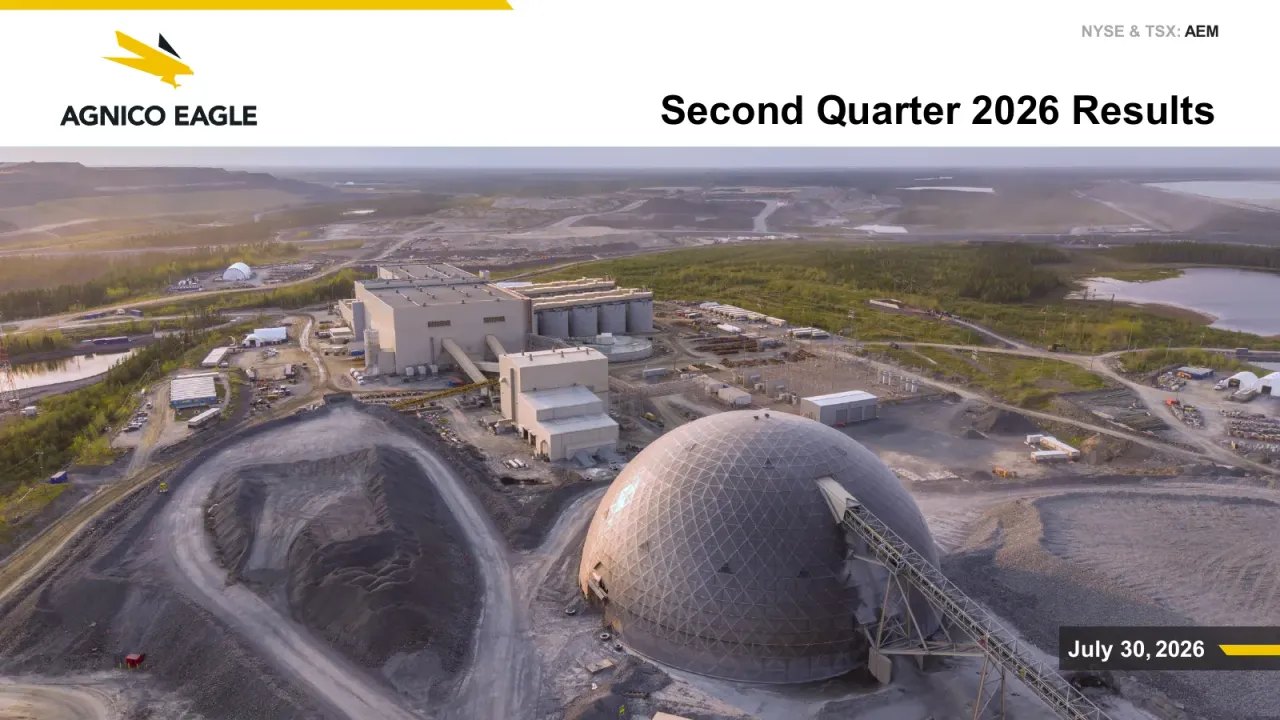
Agnico Eagle Mines (TSX:AEM) Q2 2026 earnings call, held 2026-07-30. Watch the replay and read the transcript on 6ix.
On 6ix: 6ix.com/event/agnico-eagle-mines-limited-aem-q2-2026-earnings-call
Automated transcript · Written by software from the replay's audio. It can mishear names and figures; the replay is the record.
0:00 Good morning, ladies and gentlemen. My name is Vanessa and I will be your conference operator today. At this time, I would like to welcome everyone to the Agnico Eagle Mines Limited Q2 twenty twenty six Conference Call. All lines have been placed on mute to prevent any background noise. After the speakers' remarks, there will be a question and answer session. Thank you, operator. Good morning, everyone, and thank you for joining our Agnico Eagle second quarter twenty twenty six conference call. I'd like to remind everyone that we will be making a number of forward looking statements. So please keep that in mind and refer to the disclaimers at the beginning of this presentation. Next slide, please.
0:56 My colleagues and I are pleased to report another strong quarter with not only record free cash flow generated by our operations, but also record capital returns to our shareholders. Gold production of 856,000 ounces was for the second consecutive quarter above budget with cash costs and all in sustaining costs both within our guidance range. This is not a small accomplishment in a quarter where oil traded above $100 per barrel for much of the time. As you'll hear on this call, the business is strong and we continue to move towards creating substantial additional value for our owners. This quarter, we're reporting solid operations, excellent progress on our growth pipeline, continued exceptional exploration results, all with yet another quarter of record financials.
1:48 My team will go through all of this in more detail, but let me outline and summarize what I believe are the key messages that are important to take away from this call. The first key message is that we continue to work hard every day not only to deliver what we promise, but also to continue to take every opportunity to improve our business step by step, quarter by quarter. For example, this quarter, I'm pleased to highlight that at Macassa, we had record skip tons, record mill throughput, and the first processing of our AK-four at LZ-five. At Detour, record total mine tons and record daily mill throughput.
2:36 At Meliadine, record mill throughput. At Kitila, record mill throughput. Individually, these may seem like small accomplishments, but when we step back and when we look at the big picture collectively, this quarter, we've had record mill throughput at mines representing slightly more than half of our total production. In and of itself, record mill throughput at half our mines represents substantial continuous operational improvement. But the real message we want to convey is that these improvements are an illustration of the culture and the dedication of our teams. A culture of commitment to always do the best they can and then to look to do even better, even when things are going well, even when gold prices are high, and even when we're delivering record financial returns to our owners. I have to tell you sincerely as a CEO that makes me very proud.
3:33 To be sure, mining is a challenging business and Agnico Eagle is not immune to these challenge. For example, on July 1, we had a rock movement in the wall of our Barnat pit. Of course, this was a disappointment. But I am proud of our team and importantly of our systems and our processes, including the systems and processes we had in place to track potential wall movement that allowed us to move quickly to protect both our people and our equipment. The safety of our people remains the most important thing always. I'm proud that within twenty four hours of the event, we had a good understanding of its impact and we were able to communicate to our owners and to the market that we are still able to forecast 2026 production within our original guidance range of 3.3 to 3,500,000 ounces, albeit towards the lower end of that range.
4:29 Agnico Eagle is not immune to the challenges common to our businesses. But we have a long and demonstrated history of managing these challenges well. And we have a long and demonstrated history of recovering from these challenges quickly. The second key message I want to convey this morning is that we continue to aggressively reinvest in our business into projects that deliver exceptional returns at relatively lower risk. We're making steady progress and in many cases, we're well ahead of schedule. We've announced the go ahead of our Hopay mine. This will be a world class low cost mine producing between 450,000 ounces a year that we expect to happen for decades.
5:16 We had the opportunity to tour this project with our board a few days ago. And while we're all impressed with the very real and substantial progress, I think what really stood out was the excitement of the team regarding the potential on these two eighty kilometer Greenstone belts. We really are just starting to scratch the surface of the potential at Hope Bay. Dom and Natasha will spend some time talking about continued progress in moving both Malartic and Detour to 1,000,000 ounces of yearly production and moving forward on Upper Beaver, another high quality, low cost, brand new mine in our backyard. Jani, who runs our Northern European business, will talk about our recent consolidation of what our team believes to be the most prospective exploration belt in the Nordic Region and his team's plans to more than double that business to over 500,000 ounces of yearly production.
6:12 We're making excellent and steady progress on our target of increasing production by up to 20 to 30% over the next decade. And that target was before the Finland land consolidation. We have the strongest pipeline in our history. We have the strongest pipeline in the business and there is more to come. We're only in the third or fourth inning here. We remain long term bullish on gold and we remain focused heavily focused on steadily increasing gold production per share for years and for decades to come. The third key takeaway is again, continued exceptional exploration results. Exploration is the lifeblood of our business and Guy will spend some time going over some exciting holes that are both confirming and expanding our key mines and our organic growth projects.
7:08 As Jamie, our CFO likes to say, we're in a gold price environment where with strong operating performance and with good cost control, we're able to do it all. We're able to reinvest in our business to support the best organic growth in the industry. This quarter we invested over $800,000,000 in advancing key projects and in capitalized exploration. This quarter we're able to opportunistically pursue strategic M and A opportunities that add value per share and that improve the quality of our business. This quarter we consolidated the best land package in Northern Europe including using almost $600,000,000 in cash. We continue to strengthen the balance sheet. In the second quarter, we added over $350,000,000 of cash to reach a record 3,500,000,000 of cash on hand. All of this while delivering another record quarter of returns to our shareholders. In the second quarter, we delivered $625,000,000 to our owners between our dividends and our $400,000,000 of share repurchases.
8:19 Second quarter of twenty twenty six has been volatile, volatile geopolitically, volatile economically and certainly volatile gold prices. But even in this environment, our team was able to deliver the steady, reliable performance that Agnico Eagle is known for, delivering solid results across the business. But before I turn this call over to the rest of our team to talk about this in more detail, I need to spend a moment to talk about the very sad fatality we had since our last call. Danielle Gero, partner of Michelle and father of two teenage girls tragically lost his life while on the job on May 1. Every fatality is devastating not only to the families involved but to all the people they've touched in their lives, including friends and colleagues here at Agnico Eagle.
9:11 In the almost seventy years of operation from 1957 to today, we've had a total of 23 fatalities and three of these have occurred in the last year. I will repeat what I said last quarter, fatalities, every single one is not acceptable. I want to assure all of you and more importantly I want to assure all of our people who come into work every day working hard for the company that we are more focused on safety than ever before. Taking care of all of you remains our number one responsibility. Again and with great emphasis, there is nothing more important than the safety of our people and of our communities.
9:58 I'll now ask Jamie Porter, our CFO to discuss our Q2 financial results. Thank you, Omar. This is another solid quarter for Agnico Eagle, reflecting our high quality asset portfolio, solid operational execution and continued leverage to the gold price. Strong operational performance and disciplined cost management combined with a favorable gold price environment to drive record free cash flow of over $1,300,000,000 for the quarter. We also delivered excellent financial results, generating adjusted net income of approximately 1,500,000,000 or $3.07 per share, and adjusted EBITDA of approximately 2,700,000,000. Gold production was ahead of plan at 856,000 ounces reflecting a very strong finish to the second quarter.
10:48 This outperformance was led by Detour Lake, Quitela and Fosterville, reflecting the benefits of continuous operation improvement at these sites. We are extremely proud of the work of our teams who remain focused on productivity initiatives, operational optimization and disciplined cost control. These efforts translate into another quarter of solid cost performance. Total cash costs were $10.54 dollars per ounce and all in sustaining costs were $14.59 dollars per ounce, below our costs in the first quarter, below the midpoint of our guidance ranges, and hundreds of dollars below the industry average. This cost control is particularly impressive given the inflationary pressures we're seeing across the industry.
11:34 Overall, our business continues to demonstrate the consistency and resilience that have long differentiated Agnico Eagle, allowing us to translate strong gold prices into record cash generation and record shareholder returns this quarter. We turn to Slide five. We remain in the strongest financial position in the company's history. Our strong balance sheet and record cash generation allows us to maintain a balanced and disciplined approach to capital allocation, creating value through shareholder returns, investment in future growth and continued financial strength. As Amar mentioned that I like to say, we are in a gold price environment where we are truly able to do it all. We generated approximately $3,500,000,000 of operating cash flow in the first half of the year. Approximately 30% of that was returned to shareholders through dividends and share buybacks, with a record $625,000,000 of shareholder returns in the second quarter alone.
12:32 Nearly 40% of the operating cash flow year to date was allocated to sustaining and growing our business through investments in our organic pipeline. We invested over $800,000,000 in capital expenditures and capitalized exploration in the second quarter alone. Advancing our five key value driver projects will support long term production growth of 20% to 30% over the next decade. Another 15% of our cash flow was used to support our acquisitions in Finland. Again, these acquisitions strengthen an already high quality regional business and create additional opportunities to generate value from our established operating presence in the region, which Jani, our Vice President of Europe will discuss later in the presentation. The remaining 15% of our operating cash flow was applied to continue strengthening our balance sheet.
13:20 We're paying healthy returns to our owners, while positioning the company for long term first share value creation. Our balance sheet continues to grow stronger. At the end of the second quarter, our net cash position increased approximately $3,300,000,000 reinforcing our position of having one of the strongest balance sheets in the sector. This financial strength was recognized in April when Fitch Ratings upgraded Agnico Eagle's long term issuer default rating from BBB plus to A-. Beginning of the year, we set a target of returning approximately 40% of free cash flow to shareholders. Through the first half of the year, we've exceeded that objective, returning approximately 48% of free cash flow through dividends and share repurchases. Given our strong free cash flow generation in the current gold price environment, we see the potential to exceed our original target for the full year.
14:14 During the quarter, we monetized a portion of our equity investment portfolio creating additional flexibility to accelerate share repurchases. We continue to view buybacks as an attractive use of capital. And again, at current gold prices, we see the capacity to continue to buy back shares, while investing in growth and maintaining a best in class balance sheet. Overall, we are exceptionally well positioned in the current gold price environment with record cash flow, supporting record shareholder returns, continued balance sheet strength and ongoing investment in our industry leading growth pipeline. This balanced approach remains a key differentiator for Agnico Eagle and positions us well for long term value creation. With that, I'll turn the call over to Dom. Thank you, Jamie. Good morning, everyone.
15:02 In my section, I will cover the highlights for Quebec, Nunavut and Finland. Overall, the quarter ended in line with the plans and great to continue to see all initiatives ongoing to control costs. In Quebec, Canadian Malartic are facing more challenges, but thanks to the team led by Dan, Serge and Justine for their management of those challenges and their dedication to it. Overall, Canadian Malartic finished the first half on target unless they have some challenges. Concerning Barnabas pit wall, I will explain what are the next steps. First, all the rock that move from the wall, approximately 1,000,000 tons gonna stay there. So the first step is to build some safety berm to allow us to get back in mining in the Barnett Pit.
15:59 Second is to build access. We already built one along the south wall to get back to that mining area, but we still need to build some access inside that pit and also to finish the berms. The berms height will be between fifteen and twenty five meters high to catch if ever there's other rocks that's gonna come from that located area. So we're planning to do those mitigation in Q3 and we expect to resume mining in Q4. For Nunavut, the first half of the year production is also on plan. Good news, the spring migration is over and it went very well. Today six of the 19 vessels are already received from our sealift and an interesting highlight, Amar mentioned about it but the mill at Medellin achieved a quarterly record over 7,000 ton per day average during the quarter. The target was 6,500.
17:02 For Finland, Kitelot delivered an excellent quarter both on production and cost. Thanks to the entire team for their outstanding accomplishment. It is especially timely as we are expanding our presence in Finland. It is a good timing to give them a bigger playground. Danny will provide more details shortly. On the optimization initiative, I would like to highlight the LZ5 team that keep improving the performances when we do autonomous trucking. During the fully automated shift, which are Friday, Saturday, Sunday night, when our employees better like to be at home, this is when we do automated trucking or mining.
17:49 They managed to increase the productivity by 65% in the first half of the year. So 65 more ton haul by shift by the truck. They did that by improving the network communication, the software, but also a better technology using a scanner that could see or analyze in three d instead of two d. That reflects in the past we had to do actions or to stop the sequence 1,700 times per shift. Right now, it's down to 700 and it keeps improving. Good job, team. Next page, on the project pipeline at Malartic, we continue to advance our field and mill vision to potentially grow the annual production towards 1,000,000 ounces per year.
18:39 Two important milestones. We completed the first phase of the shaft sinking three months ahead of schedule. The last bench was taken on July 9, reaching approximately 1.6 kilometer underground. So now we're moving to the hoist changeover to get back to a production mode. That's going to start this is starting in Q3 and we're still planning to start the commissioning of this production shaft in Q2 twenty twenty seven. Another important milestone, we extracted our two first stopes where the second stope is still ongoing and then the team is going through that typical learnings to that first mining. We will mine another four stope during the end of the year in 'twenty six, and we're planning to mine 30 in 'twenty seven and above 90 in 2028.
19:35 So you could see the ramp up and this is why we need the production shaft to take those tons at the top. At Aubrey, we've reached our target of the detailed engineering, which was the trigger for us to give the green light for construction that we did in May. I have the privilege to work with a great team led by Chris, led by Yishan, led by Marc Andre and also working well with the exploration guide with Conrad and Ashley that they work together to develop a very strong study. And this is where we know we're going to deliver that project well. I'm really confident we're going to deliver that project safely, on time and on cost.
20:29 We have the privilege to also to expose the project and our people to the board of director earlier this week. Still a lot of work to do, but we are in good position. Why I feel we're in good position?
20:45 Because today we are over 70% of the engineering completed. Because the team that are building it, planning it, have already did Medellin, Meadowbank and AEMRO project in the Arctic. And we have more than fifteen years of experience operating into the Arctic. One of the critical path of the project is the logistic. And currently we are ahead of the delivery at Vicancourt receiving the material, which is the port where starting. And the first vessel is going to leave the port to Hope Bay on the next weekend, the coming weekend. So around August 10, it should be at Hope Bay. So we are on target. Target. We're going to have nine of those vessels going to Hope Bay. Also, as you could see in the picture, there's three new wings.
21:33 The camp is ready that we could ramp up the workforce. And also the construction schedule is from what we learned where we're going to close the building before the winter and work internally. And on top of that, right now, we
21:48 see a good quality of contractor from the construction site. We are poking more into the West. So half of the crew of the construction is now coming from the West. We really welcome those new resources and this is helping us to deliver that. So Guy will give you more information what we see into the exploration but Hope Bay is a world class deposit and in the end of a world class team. Hope Bay will create value for decades to come for shareholders, employees and Nunavut community. On this, I will pass the mic to Jani that will talk about our Finland hub.
22:32 Thank you, Dominik, and good morning, everyone. I'm Jani Lassonen, Vice President, Europe, and I've been leading our European business over the last ten years. Today, I'll talk about our Finland platform and our growth plans in the region. As you know, Titila Mine is the largest gold mine in Europe, and even after seventeen years of operation, it still has substantial upside potential. Mine site exploration continues to deliver exciting results. The deposit remains open both along strike and at depth, and I'm confident that Kisladag can continue operating for another twenty years. Investment program, including shafts, mill expansion and surface infrastructure investments, was completed in 2023. After that, we have focused on operational excellence, cost control and productivity.
23:21 Our results are very positive, and comparable cost per tonne, excluding royalty and mining tax, in 2025 was lower than in 2024, and again, first half of twenty twenty six unit costs are lower than first half of twenty twenty five. Maintaining a declining unit cost trend despite inflationary pressures and a deepening underground operation is not easy and is clear evidence that systematic productivity work makes a difference. One recent example of productivity gains in Q2 was all time high mill throughput, which helped us to achieve all time high revenue, operating margin and cash flow in the history of Kitkila. All in all, I think that Kitkila is in the strongest position it has ever been.
24:05 We have an experienced management team that has worked for Agnico for years, gaining experience not just in mining, but also building strong relationships with local authorities, communities, other key stakeholders. Based on that experience, we believe we are in a good position to move forward with growth opportunities also outside of EBITDA. Over the last ten years, Agnico has made several strategic investments in processing exploration and development company in Finnish Lapland, driving Agnico's strategic position in the region. In Q2, the time was right for a more significant consolidation transaction, which will solidify Agnico's position in Finland for decades to come.
24:50 Based on years of work and thorough analysis, our conclusion was that the best potential for value creation can be achieved by acquiring three companies, Robert Resources, Orion Resources and the joint venture. As a result of these transactions, Agnico gained a very strong position in the Lapland Greenstone Belt, which we believe is one of the most prospective areas for gold exploration. In addition to a highly prospective land package covering approximately 2,500 square kilometers, a key component of this transaction is the Ikari project, which is the most significant gold discovery in Finland since the Kitkila
25:29 mine. In June, after closing the transactions, we welcomed 44 new colleagues, and the integration work has started very well. The most important priority is that the field teams begin working seamlessly together, while we also continue integrating business processes and systems. At Iqtariff, consolidation transactions removed prior property boundary constraints, and we are now working on project optimization, including unconstrained open pit scenario. The results of the implementation work will be available by the end of twenty twenty seven. Drilling to support surface infrastructure planning started in June. Exploration drilling will continue near the Iktariff deposit with three diamond drill rigs in August, increasing to five rigs by the end of the year.
26:19 In addition to the project optimization and exploration activities, we are also advancing work on environmental impact assessment and land use planning. Overall, we see great potential in Finland by optimizing Kitila, advancing Iktariv and unlocking the exploration upside across our 2,500 square kilometer land package, we are building a business with the potential to grow towards 500,000 ounce per year platform. Our team is excited for this opportunity and has the ability and experience
26:49 to deliver on the region. With that, I'll pass the call over to Natasha. Thanks, Sosiani, and good morning, everyone. I'll cover the operational highlights for Ontario, Australia, and Mexico. So the regions delivered another strong quarter led by excellent performances at Detour, at Fosterville, at Pinos Altos, all of which exceeded the plan. The results reflected the operational and cost improvement efforts underway at each site, all aimed at extracting the full potential of our assets. All the initiatives that Dom and I speak about, they take time, they take effort, They take persistence by the sites to implement. And now we're seeing the benefits of that work with the records achieved this quarter. So we just wanted to say thank you. Thank you to all our teams across the operation for their commitment in driving these results and for continuing to create long term value for our shareholders.
27:51 So now at Detour, we achieved another consecutive quarterly record in tons mined and this is the result the productivity initiatives started last year, which are now paying off. An example is increasing shovel utilization by increasing the amount of blasted material inventory that's available. And also getting that higher shovel productivity by diligently improving on our loading practices. Detour also had a record in tons per day at mill as a result of incremental improvements achieved now that the plant is operating at a stable state. Couple that with their lowest total medical aid frequency in the first half and it made for a very, very strong first half for the site.
28:40 And also at Detour, we continue to advance initiatives to improve our overall mine to mill performance. We have the newly created integrating operating center, the IOC at Detour aimed at improving the decision making process by connecting the mine operations, the mill operations, the planning, and the maintenance. And basically, the IOC is just an operational hub. The initiative here is to break down silos, to integrate people, to integrate processes and technology to enhance our safety, to enable quicker, better decisions, and to help optimize performance from the mine to the mill. Over at Macassa, the mill delivered another quarter of record throughput, which was expected as the team continues to work on optimization efforts as we ramp up towards 2,000 tons per day by the end of the year.
29:35 Fosterville also performed well. The commissioning of the primary fans underground in the first in the quarter and significant step changes in development in the first half of this year marked important milestones for the operation. So far this year, we've seen a 14% increase in development rate year over year. This improvement reflects a number of productivity initiatives that started last year. It includes improving the ventilation system, training, retraining our operators, and enabling independent blasts when we can. Together, these initiatives are increasing the development productivity, but it's also increasing our operational flexibility by opening up more mining areas and positioning Ponce De Ville to sustain the highest throughput rate in the mill in the coming years.
30:27 And these are just a few examples of our ongoing focus on productivity and and operational improvement. What's particularly encouraging is that many of our initiatives that I talked about today are still in their early stages and we see additional opportunity to further optimize and improve our overall mine performance in the periods ahead. Now moving to the next slide, I'll give you a quick update on the projects in Ontario and Mexico. And I'll start with Detour and the site's progress towards becoming a 1,000,000 ounce producer annually. Of course, the Detour Underground project plays a big part in this plan. So we're still in the early days of the project, but we're making good progress and we're advancing on schedule. We continue to advance the exploration ramp and have achieved just over 1,000 meters of development reaching a depth of 180 meters.
31:22 We also continue to excavate the overburden for the conveyor portal near the mill and also progress on the camp expansion. As well, to complement the bulk sample that's planned, we continue to progress with the high intensity drill program in an area we're also considering to mine early as 2028. Guy will speak to this program shortly. Over at Upper Beaver, progress on both the exploration ramp and shaft continued this quarter. The ramp development coupled with the lateral development has advanced over 600 meters in the quarter, reaching a depth of 165 meters. Shaft sinking, which commenced in the fourth quarter of last year, it reached a depth of four seventy meters.
32:07 And the high intensity drill program that focused in the Upper Beaver between the five hundred and six hundred meter depth, That was also completed during the quarter ahead of schedule and we now have an improved understanding of the mineralized zones in this area. So following these results, we're now evaluating the potential for an expanded exploration program by extending the shaft to support infill drilling and possible mineral resource expansion at depth. And finally, over to San Nicolas. We are very happy to share that we reached an important milestone. The joint venture received the approvals for both the change of land use and the environmental impact assessment permit. And now this allows the joint venture to advance on supplementary permits needed before construction can commence.
32:57 And as part of that, the JV, of course, will take into account the terms within the MIA approval.
33:04 And in parallel, the JV will also continue to advance detail engineering and work on critical infrastructure to reduce the execution risk and better refine our capital cost estimates. The team will also work to accelerate construction and operational readiness activities to position the project for a potential sanction decision. Overall, we continue to make really good progress across our projects this quarter and we remain really excited about the significant exploration upside emerging across our portfolio. With that, I'll turn the call over to Guy. Thank you, Natasha and good morning everyone. We had another very strong quarter in terms of exploration drilling, safely completing almost 400 kilometer of diamond drilling for a year to date total of 760,000 meter, having 126 drill rig and operational mine sites in our key value driver project.
34:01 Well on our way to achieve our ambitious budget of 1,400,000 meter for the year aiming to replace and grow our global mineral reserves and resources per share at the end of the year as we have been doing for the last several year in a row. Diving now into some specific project on Slide 11. In Malartic 21 rigs are in operation completing almost 61 kilometer of drilling in the second quarter and close to 140 kilometer year to date from underground drill platform as well as surface drilling into the extension of the East Gouldie deposit. Some regional targets around Canadian Malartic and the adjacent Marban project. We continue to get strong exploration results in the East Gouldie both at depth with 3.8 grams over 19.2 meter in Hole 354 at nineteen fifty meter below surface in the lower portion of the deposit and the upper eastern portion of the East Gouldie as well and drill Hole 62 with 5.1 gram over 14.3 meter at nine fifteen meter depth from level 75.
35:10 To the north, in the Odyssey internal zone, we continue to get very exciting results in a structure known as the Artemis Zone in Hole 13, drilled from underground at level 57 with multiple intercepts reported with the most significant returning 13.7 grams over 14.6 meter core length at around 1,000 meter below surface supporting our view of additional exploration upside from the internal zoonas odyssey close to the mine infrastructure as we continue to add drilling from underground. On the adjacent project at Maraban, four drill rig completed 100 drill hole year to date, continuing condemnation and some exploration drilling to confirm the potential location of the surface and structure related to the project.
36:00 Now on Slide 12, I'll detour it. Nine drill rigs completed close to 53 kilometer of drilling in the second quarter or year to date total of 92 kilometer of drilling. Drilling was dedicated to advancing the high intensity drilling program in
36:16 Domain 54 and to refer to close to the exploration ramp and continuing the resources extension towards the west at depth. And Domain 54 close to the exploration ramp west of the open pit. Client Institute drilling is aiming to confirm the geological resources model by reducing the drill spacing to 20 meter. Some strong results were reported such as 2.5 gram over 62 meter, including 15.2 over 5.9 in Hole 1134 A at two seventy five meter depth. While in the exploration in the Western extension of the deposit towards the current extreme west of the ore body, Flow Hole 1290 returned 20.8 grams over 4.8 meter at around eight forty meter depth with a deposit that remains open towards the West and at depth.
37:11 And finally, I told you on Slide 13, we've drilled close to 37 kilometer of core in the second quarter with six drill rig for a year to date total of close to 70 kilometer ahead of our budget and well on our way to complete and exceed our 110 kilometer of drilling budgeted at Hope Bay for 2026. We were on-site earlier this week, as mentioned by AMR and Dominic with the board. And it was exciting to see some passionate people and the large number of exploration targets that are being developed on the entire belt supporting our view of major long term potential for this belt. Resources to reserve conversion in field and exploration drilling in a patch of an area continue to be the priority with again some very exciting results such as in Drill Hole 478 A that those of you that were on-site around the project announcement in May got to see on the table of the core shack, we got the results and we got 28.8 grams over 21 meter core length in that draw hole, including when considering capping and estimated through with it's about 15.2 grams over 15.6 meters. But it shows how spectacular locally the grade could be.
38:28 And so it's quite significant to see those multiple double digit grade and double digit meter width in that patch of an area. I'm also pleased to report that we have remobilized two drill rigs at the Boston deposit and have reopened the camp with the aim to complete 7,000 meters this year. All of the drills so far that we have seen visually report strong visceral mineralization with assays expected to be available in the third quarter news release in October. So stay tuned for some more good news coming out of the exploration at Topeak. And before passing it back to Amar, I would like to comment as well on the Finland consolidation. I shared Yani's excitement and the team enthusiasm around the acquisition. We're starting to ramp up activity with some contamination drilling already underway and expected to have up to five drill rate by the end of the year to initiate the investigation of the extension of the known ore body, as well as the numerous exploration target on the large end position.
39:28 And I would also like to take the opportunity to welcome our new colleague from Rupert and Orion Resources who have joined the Agnico Eagle team in our quest to test the full potential of this underexplored vertical belt that we consider to be the most prospective belt in Northern Europe. And on that, I will return the microphone to Amar. Thank you, Guy. Very, very exciting stuff as always. Well done. And thank you to the rest of the team and to all of our people for delivering another strong quarter. As you can see, we continue to work hard for all of our stakeholders and we'll continue to build off the same foundational pillars that have defined our strategy and have served us well for almost seventy years. We'll focus on the best mining jurisdictions based on geologic potential and political stability.
40:17 We'll be disciplined with our owners money, making investment decisions based on technical and regional knowledge, creating value through the drill bit and through smart acquisitions where and when it makes sense. We are uniquely well positioned with a high quality project pipeline leveraging existing assets in the best regions in the world where we believe we have a competitive advantage. And importantly, we will continue to be focused on creating value on a per share basis and on being leaders in our industry and returning capital to shareholders as evidenced by over forty three years consecutive dividend payments and increasing share buybacks. We have a clear and executable strategy to create additional value per share for our owners well into the foreseeable future with manageable risk leveraging off existing infrastructure and regional competitive advantages.
41:15 We have the assets, we have the projects, we have the resources and we have the people. We are making it happen right now. We will stay focused and we will not be distracted. Thank you again for joining us on this call and for many of you, thank you for decades of trust and support. We'll always work hard to maintain that trust and we will never take it for granted. Operator, may I now ask that we open up the call for questions. Thank you. Ladies and gentlemen, we will now begin the question and answer session. Should you have a question, please press the star followed by the one on your touch tone phone. You will hear a prompt that your hand has been raised. Should you wish to decline from the polling process, please press the star followed by the two.
42:02 And if you're using a speakerphone, please lift the handset before pressing any keys. And we have our first question from Josh Wolfson with RBC Capital Markets. Yes. Thank you very much, operator. Just going back to Garnack for a moment. You talked about the 1,000,000 tonnes of material that slid. Is there any way the company can quantify the volume and grade of material that would be inaccessible as a result of that slip? Well, we disclosed that there's 370,000 ounces that would not be accessible anymore, which is sixty, eighty and twenty six, 115, 27, 28. Let's say the remaining ounces in Barnabas is approximately 300,000 ounces that we're going to mine. I don't know the tonnage and the grade, but I don't know grade average grade in Barnat around one, one point one.
43:01 Okay. And then, when think about, maybe beyond remediation, but any potential offsets, is there any way to incorporate more low grade material in the mine plane, to offset some of the impact over the course of the next three years? Even maybe beyond that, are there other assets in the portfolio that are being maybe rethink in some way to look at offsets? Thank you. Maybe I'll jump in there, Josh, and thank you for the question. So clearly, are going to be milling the low grade stockpile. So the mill is going to be busy. We're going to be able to get back into parts of that pit. But I think it's worth to your point of offsetting, that pit has already produced a lot more gold than the original plan had.
43:53 The team has done a really good job of looking at opportunities. And based on everything you've heard, we are not only finding a lot more gold throughout the company, we're also improving our operations on a continuous basis. It is disappointing. We're at the very end of the mine life for that pit. The team did everything right. And as I tried to say on the call, we do have a long track record of recovering from these operational issues when they happen. Great. Thank you very much. Thank you. We have our next question from Bennett Moore with JPMorgan.
44:41 Good morning, Omar and team. Congrats on another strong quarter and thank you for taking my questions. Maybe a question for Guy, but I was wondering if you could unpack the Odyssey drill results a bit further. They looked quite positive, upper eastern extension and Artemis zone. I believe this is near existing underground infra. So, I'm wondering if there's a potential opportunity with more drilling to bring forward some of these higher grade zones in the production profile. Yeah, thanks for the question. So to start with in the Upper Eastern portion of East Gouldie, that's an area that we had identify earlier as a higher grade inferred that we're kind of focusing to convert. And that area to the east, as we've discussed a few times could offer, let's say, maybe another mining area in the upper part of the mine. So that's currently why we are kind of focusing on this specific area being closer shallower into the ore body closer close from the current infrastructure we're having. So this is why we're making a big push to bring it to reserve progressively.
45:43 And we're going to see some addition as well at year end in this area, as well as to the internal zone. The internal zone are a bit more subtle. We know that there was some potential in between the Odyssey North and Odyssey South. It's just that now that we're on the ground with all of the access and we can conduct more drilling and field drilling, we're starting to better understand the geometry of this zone in order to start to put additional thinking on how to approach them and mine them. But as you described, are also fairly close to the north of the shaft. So they will provide optionality and other potential mining area in the near future. And this gets exactly to the question about how do you replace things. Mean, you know, a Malartic if is sort of unique in that there's a lot of gold and as we expand the underground, and this is early and this is just us talking, so don't put it into your models yet. But to the extent you have high grade underground ore close to surface that's accessible in shallow areas of the operation, you can move more of that high grade tonnes into a mill.
46:54 And very, you know, if you're bringing in stuff at five grams and you're displacing the stockpile stuff at 0.5 grams, it does give you an awful lot of flexibility. Again, it's very early. But it does show you the quality of the asset and the quality of the thinking on the team's part. Thanks for that color. And then real quick on San Nicolas. It's nice to see the MEA and land use permits come in. Was wondering if you could walk us through where detailed engineering stands, if there were any contingencies tied to the approval and how we should think about next steps in terms of permits and studies. Thank you. Thanks for the question, Bennett. So yes, so really the joint venture is very much appreciative of working with the Mexican authorities as they conducted a very thorough assessment of the process and ensuring that our partnership is will be committed to the responsible development construction of San Nicolas.
47:52 That being said, it is a fairly large document, the approval process. So we are looking at understanding the terms of the approval so that's going to take us some time before we apply for the supplementary permit. In the meantime though, we're continuing to advance the engineering to derisk the project. It's currently at 45% engineering and at the same time we're continuing to accelerate readiness plan, the activities associated with that, the operational readiness plan for the project to ensure that we have all the processes in place, ensuring that we have the resources in place before we make that decision to sanction.
48:41 Thank you. Best of luck. Thank you. Our next question is from Fahad Tariq with Jefferies. Hi. Thanks for taking my question. One of your peers talked about increased labor costs and contractor costs in Northern Ontario. And I saw in your release there was a mention of just higher labor costs, but that's more year over year. Can you just touch on the labor dynamics are looking like in Ontario specifically? And if you have the latest numbers on retention rates, attrition, etcetera, that would be super helpful. Thanks. Sure. I can start that. So with Ontario, so we in terms of our internal labor, we're running around 4% year over year increase. In terms of our contractors, you know, just in general workforce is a challenge across our operations and so we have a focus on retention on recruiting and we have a recruitment hub, a centralized recruitment hub to ensure that we have provided the team with a detailed plan and we on our detailed growth plan on specific personnel that we're looking for and we're working actively to hire them internally.
49:54 Of course, that being said, we do have focus in on bringing in contractors wherever needed. In terms of our contractors, nothing major in terms of increase to our labor cost on that end. And I would add and Fahad that's a very important question. We've identified here at Agnico and we've been in these places for decades, labor is going to be a challenge over the next ten or fifteen years And we've put a lot of effort into it. As you know, we have the lowest turnover of any of our peers. We probably have half the turnover of our peers and actually the turnover over the last year we've reduced it. But we're going beyond that. I'll give you some examples.
50:46 With regards to getting people up there, sometimes there's no housing. So we are working on projects where we are actually building permanent homes in communities, not just camps where people come and go after Dukes, but permanent homes in communities. That will help attract people. We have mentioned that in places like Hope Bay, the team has done a great job accessing not just the usual pools of people we get, but we've really put a big, big push to recruit from Western Canada and we've had excellent results. So it's a good question. It is going to be a challenge for everyone. But I think Agnico is doing a really, really good job of getting ahead of that.
51:36 Okay, great. Thank you very much. We have our next question from Richard Gottecherina with Barclays. Great, thanks. Good morning, Amar and team, and thanks for taking my question. If I could just circle back to Penny Malartic, you took the cash cost guidance up for the rest of this year, so the second half. Just wondering how we should think about cash costs across portfolio to mitigate that. And then also just going forward to 2027 and 2028, does the higher cost in the second half of this year have any impact going forward? Thank you. Yes. Thanks, Richard. It's Jamie here. I'll address that question. So yes, very strong cost performance in the second quarter. We did take the cost guidance at Malartic up for the second half of the year, but we are seeing much stronger U. S. Dollars than what we budgeted and guided at the start of the year.
52:34 So we're getting the benefit from that. You'll recall that we also guided at a $4,500 gold price. So we're seeing a bit of a benefit on cash costs with respect to royalties. And thirdly, with respect to byproduct credits, we have more conservative assumptions on our copper and silver pricing. So those are all helping. We're starting we're actually in the process of our multi year budgeting and planning process now. So it's premature to be commenting on future year costs. But we obviously will see slightly higher costs at Canadian Malartic given less production through 'twenty seven and 'twenty eight. But on an overall basis, again, we'll do what we can to offset inflation through continuous improvement and other efficiency initiatives.
53:24 Great. Thanks. And then as a follow-up, you maintained the target of 1,000,000 ounces from Malartic. The Barnett incident, does it impact the cadence in terms of how you get there? Are you looking at some changes to the sequencing of anything at the other at the other pits? How are you thinking about that bigger picture? Dominic speaking. No, it is completely different deposit. There's no impact from the wall of Barnat to the future Odyssey underground Barnat or Marban. And that pit was running out as everybody knows. Would have run out in advance of the million ounce that will be in the early 30s.
54:11 Great, thank you. Thank you. We have our next question from Lawson Winder with Bank of America. Thank you, operator, and good morning, Laura and team. It's nice to hear from you all. Thanks for today's update. I guess probably where I would start would be on Detour. So in these results, you've again mentioned the potential to deliver some underground production in 2028 instead of the 2030 date in the last technical report. I guess it'd be helpful to get an idea of how material that could come or could ultimately become. But then you also mentioned an updated buying plan for 2027. What quarter in 2027 would you be anticipating putting that out?
54:57 Hi, Lawson. In terms of the first question was on the ounces. The ounces. Sorry. The ounces was yeah. For Detour Underground, when we look at it, it was we're looking at maybe 20 to 30,000 ounces for 2028 and 2029 each year. And with respect to the update, we're expecting by sometime in mid-twenty twenty seven we'll give an update on DETOR underground. Okay, thank you for that. And Jamie, you mentioned in your remarks to Richard's question about the multi year budgeting planning process unfolding at the current moment. Just curious if you could give us a look at what you're seeing as a reasonable inflation assumption going into 2027?
55:51 Yes. Thanks, Lawson, for the question. Again, it's pretty early. We're just starting to initially, we started the process obviously with our mine plans and then we work through the costing. We're seeing CPI in Canada that that's obviously going to impact our labor and contractor costs, which is 40, 50% of our overall cost structure. So 3%, 4% for labor is probably not unreasonable at this time. But we'll see as we get closer to the end of the year. Across the rest of our input costs, is nothing I guess, one thing that really stands out is diesel. And we do have some of that exposure hedged for the back half of this year. But that's going to be, I'd say, the biggest kind of cost pressure in 2027 relative to 2026.
56:45 Diesel just as a reminder represents about seven percent of our overall costs. Yeah, that's very helpful. Thanks for that reminder and the color. And then can ask on M and A? I mean, particularly given the pullback in valuations and a bit of a derating in the sector and on the back of the closing of the Finish acquisition and considering, I mean, the dozens of current toll hold equity positions that you guys have. How is Agnico now viewing the potential for further acquisitions? And then how do you perceive the current opportunity set? Well, I'll save that, Lawson. Nice to hear from you. You know, we're looking at it the way we always do, which is we have the best pipeline I think we've ever had.
57:33 They're all going really well. We are going to be increasing production per share. The business is going strong. And I can tell you, you know, we're really focused on delivering the best we can for our owners, which means and you know as well as anyone, we focus on per share metrics. We have never had direction from the board to get bigger just for the sake of getting bigger. So it is our job, we get paid to look at opportunities to wisely invest our owners money. That means in projects, that means we look at exploration, that means we do look at M and A opportunities all the time. And our total investments, I'll just say it again, it's not to have a portfolio of assets, it's really items that we might be interested in so that we can learn more about them. When we make decisions, we make them based off of knowledge.
58:31 So our strategy with regards to M and A is the same as it's always been, which is look for opportunities to create value for our owners. But it has to actually make money for our owners on a per share basis. And that's continuing how we look at it today. Okay, thank you all very much. Thank you. Our next question is from Daniel Major with UBS. Hi, can you hear me okay? Yes, we can. Thank you. Great, thanks. Yes, a couple of questions. So just the first one on San Nicolas and I know you answered it before, but I don't know whether I missed it or is can you give any sort of specific milestones around the final permitting?
59:28 And then the second part of the question, I mean, I think I've asked this before, it appeals a bit subscale, 50% of San Nicolas for both you and Anglo Tech. Is there any kind of discussions? Would you take the opportunity to fully consolidate if it came around? Hi, Danielle. I'll answer the first question in terms of San Nicolas. So we're still working through the understanding of, like, the terms in the the EMEA. So we'll based on that, we'll we'll have a better understanding of what additional permits we will need. In terms of the supplementary permits, the ones I can think off the top of my head is, you know, the construction permits, the explosive permits, maybe we're looking at an alternate water solution or power solution. So those are some of the things that we would consider. And based on that decision, we will then have a timeline, a better timeline on those additional permits.
1:00:25 Hopefully that helps. And Daniel, you're right. I mean, you're right. For a company the size of Agnico, San Nicolas is a relatively smaller project, but it is a good project. It's got robust economics. It's in a part of Mexico, which is really the best part of Mexico to be mining. So strategically, it puts us in an area that we think has a lot of potential. With regards to would we or would we not buy it from tech, that falls under the category of it depends on a whole bunch of factors but repeating what I just said before, our job is to look for opportunities to make money for our shareholders and everything we look at including that would be a function of you know, doesn't make economic sense for our owners.
1:01:20 Thank you. And then second question and apologies if I missed anything. Know I was a bit late joining the call, some clashing conference calls this afternoon. On Finland, can you just give us quick summary of the next catalysts we should be thinking about? And then what's your initial assessment after closing the deal on how you think the sort of scale or scope of the initial project will look relative to the Rupert feasibility study? Hi, Danielle, Denis speaking. The first step is to look to the study without boundaries. So where we're gonna, we should put the infrastructure with the known deposit that we have. And we're targeting end of twenty twenty seven to get you more information about that.
1:02:10 That's the next target. Okay, thank you. And then just maybe two quick operational questions, it's thinking about offsetting some of the lost ounces from Canadian Malartic, two specific ones. Detour seven plus million tonnes throughput, is that sustainable through the second half? Or it seems to be trending pretty well relative to guidance? So with Detour, in terms of the throughput, the mill throughput, we're still doing well. We still have a nice healthy stockpile. In terms of the grade though, our profile at the first half of the year was scheduled to be higher and it is higher.
1:02:59 Okay. So you think throughput stays well north of 7,000,000 tonnes per quarter through the second half of the grade comes off? Okay. Yeah. Yeah. We're still tracking to be within our guidance. Okay. Then similar one on Fosterville again in Grey Keys was good performance in the first half relative to the guidance. Is that still expected to come down or is there upside? I guess we're getting more comfortable with the mining in Robinsville and grains to be slightly better than expected. So it may result in something similar to Q2 moving forward. And we're going to be looking at how to capture that if it's a trend that keeps on being there to incorporate that in the future. So it may end up with a slightly better grade than the original plan, but in line with what we're currently experiencing.
1:03:57 Great, thanks a lot. Thank you. Our next question is from Tanya Jakusconek with Scotiabank. Great, good morning, everybody. Thank you so much for taking my questions. The first one is for Dominic. Dominic, you think that there's the potential to at Canadian Malartic to come back to that 370,000 ounces that we've left behind, come back at it after at the end of the mine right to the open pit and access it from underground? Well, we are keeping understanding and redesigning the pit. But Tanya, will not put that in the book anywhere now that we're gonna recover them. We might see opportunity with time, the years to come. I guess next February might have a better view, but I don't expect for now to recover those ounces.
1:04:52 Okay. Thank you for that. And then maybe circling back on just the costing side and I know Jamie provided some insights into the inflation, labor inflation and obviously fuel we have that. But we've talked a lot about this optimization and the productivity improvements that you're seeing both mill and equipment. All else being equal, do you think that we can offset inflation with all of these optimizations? So for example, if inflation is 4% overall, do you think all of this can offset that or partially all else in April? Yes, Tanya, it's Jamie. I'd say, I mean, we'd love to be able to offset all of it. That's our objective is to do as much as we can to offset inflation. If you look back over the last three years, though, I'd say on average, inflation is probably run around 7%.
1:05:45 And if you back out royalties, going up because of higher gold prices, I'd say on average, our costs have been up 3% to 4%. So over the last three years, we've offset almost half of the inflation through continuous improvement and productivity initiatives. So that obviously would be the target going forward. Okay, thank you for that providing at least the number for me. And then my final question for Amar and Carol if Carol is around as well. Just wanted to circle back to safety and just wanted to understand if you have any insights that you can share from these tragic events and any lessons learned that you've implemented within the Agnico operating system.
1:06:32 Yeah, hi Tanya, it's Carol. Certainly, so these, you know, as we talked about earlier in the quarter as well, are these are three very different accidents that happened at three different sites in three completely different regions. So for the people that are maybe a little less familiar with them, the one happened in Fosterville back in December. This was underground with cable bolter. And in this particular situation, it was a risk that unrecognized by ourselves and also unrecognized by the equipment manufacturer. And unfortunately, Alan was in the wrong place at the wrong time and he lost his life in a pinch point that had been unrecognized. Since that time, Sandvik has been working on modification to the equipment to eliminate that risk.
1:07:24 They've got a prototype that will actually be tested at site later this year. And if works well, certainly Sam that will be offering it out to all of the different people that currently own this machine. At Canadian Malartic, this was an accident that happened in the mill with a conveyor. And this was a risk that had been very well recognized right from the beginning of the mine and actually engineering controls have been put in place to prevent anybody from coming in contact with that conveyor. But unfortunately, over the decade plus, since those controls been put in place, there's been an erosion of the controls. They weren't working properly. And this ended up exposing the hazard and the employee was able to come in contact with the conveyor and Francis lost his life in April.
1:08:17 Since that time Canadian Malartic has made modifications in the mill to eliminate the needs to do the cleaning task that operator Francis was doing at the time, as well as re putting those controls back in place and making sure they're in place at all the places they need to be. And then the third incident accident happened in Upper Beaver at the shaft at the beginning of May and again, situation. This situation where the experienced miners have perceived a risk, they changed their work practices in order to mitigate the risk that they perceived but didn't communicate well enough that they were doing this change.
1:09:03 The change to the work practices not been properly risk assessed. And there was an unintended consequence of exposing the employee to a different risk. And again, wrong place, time when that risk came up, and Danielle lost his life. You know, as Amar said, any fatalities unacceptable and we're very committed to doing better. You know, these losses have been profoundly affected our teams not just here at head office but also at the sites and our teams are motivated and engaged to do better. We are accelerating our work to identify and implement critical controls to mitigate major hazards at all of our sites. We're strengthening supervision across the company as well. And we're working to reinforce the organizational behaviours that promote safe production.
1:09:56 So all of this is a very strong action plan with a number of very detailed items that are being carried out across the company. And I think the important thing is that the teams are really engaged to make sure that we can eliminate fatalities and life changing accidents that are at our site. And implementing all of this Carol is it like can it be done quickly? So the critical controls journey we've had, we've been working with one of the experts in the world quite frankly on that for over a year now. And their advice to us is not to try to go too quickly, we can accelerate certain aspects of it. But doing the actual work to understand which of all of the controls we've got in place are actually the critical controls, which are the ones that we really need to reinforce and ensure being well managed at each individual site because every site is different.
1:10:55 The work to do that is actually a big strength of doing the critical control work. So we're pushing it forward, but we're not pushing our teams to accelerate drastically because we want to do it well. And we want to ensure that those controls are well maintained and well verified going forward. Strengthening supervision, that's something that we've been talking about for a while. We've got a training program being rolled out in the next month or so. We've got our supervision formula which has been in place in many of our minds for decades. And we're re emphasizing the training on that as well as making sure that we're not stretching our supervisors too much making sure that we're not actually asking them to be in too many different places and unable to actually do their work well.
1:11:46 So again, this is ongoing. We're going at the pace that the sites and the resources are able to do and we're supplementing those resources to ensure that they can succeed. Okay, thank you and good luck with all the work. Thank you very much. Thank you, Tanya. Our next question is from Anita Soni with CIBC World Markets. Thank you and thank you for taking my question. I just want to circle back to OHDICEY and the progress that you're making there. I think it's in the paste backfill plant is a little bit behind schedule, but it's on the critical path. I just want to understand also the shaft you completed ahead of schedule. I could be as a commentary says that the last bench was taken out on July 9. When I look back at the Q1 commentary, it supposed to be, I guess, completed in at the end of the year. So, I'm just curious, like, is there still more to be done at the infrastructure wise at the bottom of the shaft and that's still on schedule for the end of the year? And then lastly, just can you give me an update on, you know, there was some commentary about progress on the main ramp being a little bit lighter than what you had previously thought because of ground control issues. Can you just give an update on that as well?
1:13:02 Yes. Thanks, Anita. Yeah. For the first shaft, we took the last bench in July, but there's just some remaining work. Let's say we need to dismantle the Galloway. We need to, let's say, do some infrastructure work underground at the Level 1 And 50 and also at the first loading at the Level 101 101 11. Sorry. So we're ahead of schedule on the shaft sinking, but it doesn't mean that we're gonna be faster and be better for q two next year for the commissioning. There's still lots of work to do. We might have a bit of contingency with those events, but it doesn't change the date. We're well positioned.
1:13:53 On the REMS development, we get a bit of delay this quarter and the team is working to catch up on that in the coming quarters. So it is going as we plan almost for the development. And the first stope that we've mined, we're learning from them and improving our practices. We still have six to come this year and so far so good. And then, sorry, you're targeting a 2,000 meters, I think it is per month on the development. Was that the target? And what are you at right now? Well, we are 1,800 around right now and the target for q four is 2,000. Two Two thousand per month. Okay, great. Thank you very much.
1:14:42 Thank you. There are no further questions in queue at this time. I will now turn the call over to Ahmaud Aljundi for closing remarks. Thank you, operator, and thank you once again, everyone, for joining the call. And for those of you who get to enjoy the long weekend, have a fabulous weekend. Thank you. Thank you. Ladies and gentlemen, this concludes today's conference. We thank you for your participation. You may now disconnect.
Follow Agnico Eagle Mines Limited into a list and get an email when it puts out news.
at RBC Capital Markets
at JPMorgan
at Jefferies
at Barclays
at Bank of America
at UBS
at Scotiabank
at CIBC World Markets