Replay available
Aditya Infotech (NSE:CPPLUS) Q2 2027 Earnings Call
Aditya Infotech (NSE:CPPLUS) Q2 2027 earnings call, held 2026-11-06. Watch the replay and read the transcript on 6ix.
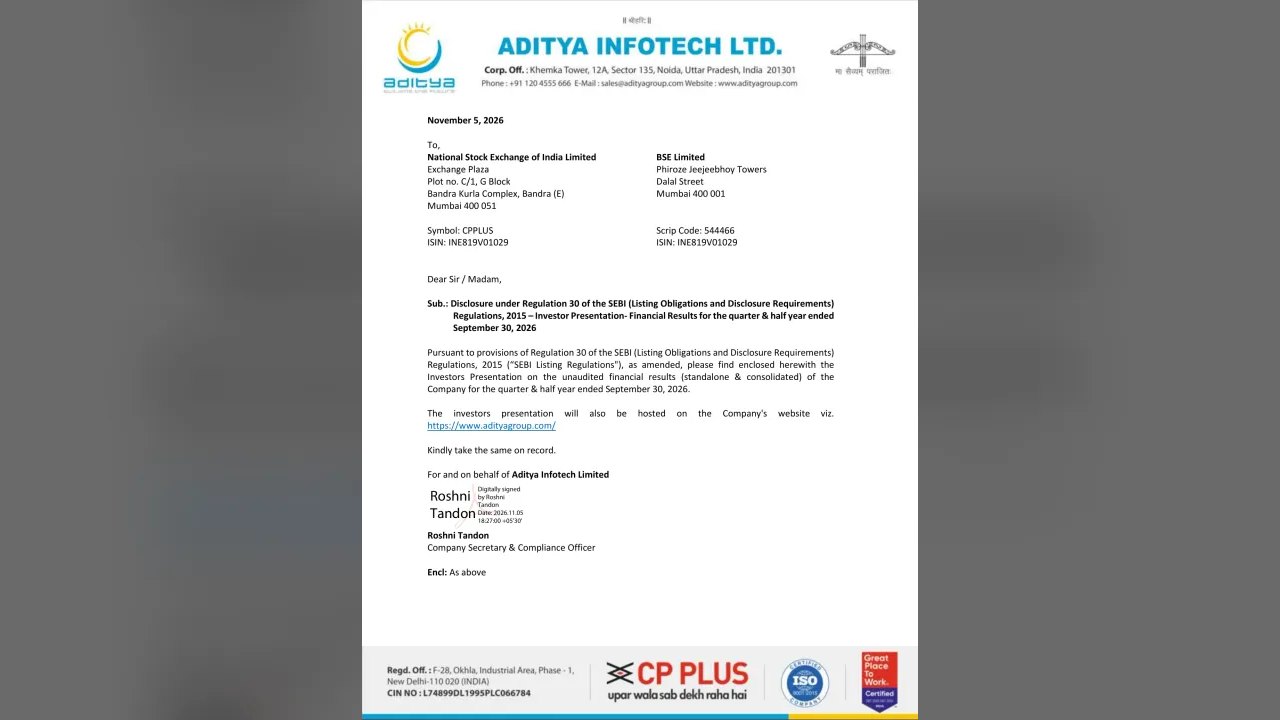
- Company
- Aditya Infotech Limited (NSE:CPPLUS)
- Period
- Q2 2027 earnings call
- Date
- Fri, Nov 6, 2026, 4:21 AM ET
- Replay
- Watch the replay on this page · 40 min
On 6ix: 6ix.com/event/aditya-infotech-limited-cpplus-q2-2027-earnings-call
Replay
Transcript
Automated transcript · Written by software from the replay's audio. It can mishear names and figures; the replay is the record.
0:00 Ladies and gentlemen, good day, and welcome to Aditya Infotech q two FY twenty seven conference call hosted by ICICI Securities Limited. As a reminder, all participant lines will be in the listen only mode, and there will be an opportunity for you to ask questions after the presentation concludes. Please note that this conference is being recorded. I now hand the conference over to mister Aditya from ICICI Securities. Thank you, and over to you. Yeah. Thanks,. On behalf of ICICI Securities, we welcome you all to Q2 FY twenty seven and H1 FY twenty seven results conference call of Aditya Infotech Limited.
0:51 We have with us today senior management represented by mister Aditya Khemka, managing director, mister Anup Nair, director, strategy business development and investor relations, mister Yogesh Sharma, chief financial officer, and miss Deepika Dubay, manager, investor relations. Now I hand over the call to the senior management for taking us through the quarterly performance, and then we will open the floor for question and answer session. Thanks, and over to you, Aditya ji. Yeah. Thank you, Anurag. Good day, everyone. Wish you a very happy Dhanteras, and thank you for joining us today for Aditya Infotech's Q2 and H1 FY twenty twenty seven earnings call. With me are our CFO and our Investor Relations team.
1:38 The results and the investor presentation are on the stock exchange website and also on our company website. Let me start with the headline. This has been the strongest half in our history. In quarter two, revenue was INR1746 crore, up 89.9% year on year. EBITDA was INR $30.07 crore, up 177% with a margin of 17.6%. FAT before the exceptional item was INR $2.20 crore, up 214%. For the first half year, revenue was INR 3,148 crores, up 89.7%. EBITDA was INR $5.15 crores at a 16.3% margin.
2:26 PADD before the exceptional item was INR $3.62 crores, up 252%. Also sequentially, quarter two revenue grew 24.5% over quarter one, and EBITDA margin rose from 14.8% to 17.6%. Reported PAT for quarter two was INR 185.5 crore after a onetime exceptional item of INR 34.4 crore from a fire incident that happened in our Kadapa plant due to short circuit in September. The loss is fully covered by insurance and the claim has already been lodged. Excluding it, the underlying business delivered the INR $2.20 crore PAT, which I just mentioned. CPPLUS remains the growth engine of this growth the core engine of this growth. It contributed about 88% of revenue in quarter two against 86% a year ago.
3:24 Within CPPLUS, IP products are now about 79% of the portfolio, up from 71%. Our leadership in the Indian video surveillance has widened. In the twelve months to September 2026, our share of the total market, including the unorganized segment, was about 42%, which at the time of our IPO was 30%. The industry's move to higher data security standards as well as trusted supply chains played to our strengths. Cybersecurity certified products needed scale in manufacturing, depth in R and D and a secure supply of critical components. They needed the nationwide reach to put products in the market across India and an Indian brand, which the Indian consumers can trust.
4:18 They also needed the most experienced management and field teams in the Indian surveillance ecosystem. We had all these ingredients in place and the gains eventually came from our team's execution. We expect to keep gaining market share through the rest of the year. On our revised guidance, our FY twenty twenty seven share is expected to be in the range of 43% to 45%. On the margin side, our gross margin for the first half was 30.4%, up three seventy four basis points year on year. Three things drove it: a richer brand and product mix, deeper localization initiatives and operating leverage. In quarter two, gross margin was 30%, flat year on year and slightly below quarter one, 30.8% as we began absorbing part of the input cost increase in SoC and Memory.
5:17 I want to highlight clearly about the input cost environment. Critical semiconductor components like SoC, DDR and flash prices have risen sharply across the electronics industry. Ahead of this, we took strategic positions in SoC and memory, which is why inventory is on the higher side on our balance sheet. This was a planned move as this protected both our consistent supply situation as well as our margins in the first half year. We strategically passed on the input cost increases rather gradually to market instead of all at once. As market leaders, we did not want to give the channel a sudden price shock and ensured that the momentum of overall market expansion as well as our market share growth continues.
6:08 As the lower cost inventories get used up and as we moderate price increases to further gain market share, we expect second half margins to be lower than Q2. Thus Q2 should not be read as a run rate. That is why we are keeping our full year EBITDA margin guidance at 14% to 15%, even after a 16.3% in the first half, so as to keep enough cushion to support our market share growth strategy in such a volatile input cost environment. In September, we completed our qualified institutions placement and raised 1,500 crores. Leading globe... Domestic and global institutions took part, and I thank them once again for their confidence in the company and management.
7:00 In October, we repaid all our borrowings, and now the company is debt free. The lower finance cost will show from the second half. The proceeds will go to three users as set out in the placement document. Repaying borrowings of Aditya Infotech Limited and also our wholly owned subsidiary, AI Dixon, manufacturing capacity expansion through our wholly owned subsidiary, inorganic growth through acquisitions and general corporate purposes. On September 30, cash and cash equivalents were INR $14.34 crore against borrowing of INR $3.63 crore. Annualized return on equity for the first half was 26.9%. Also, the finance cost was down 41% year on year for first half year.
7:49 Working capital went up in the half mainly due to increase in inventory because of strategic component buying that I described to maintain supply strength. It was a deliberate choice to secure supply and cost. Collections have improved. Receivable days came down to 87 in Q2 from 93 in Q1 and one zero five a year ago. As the components positions used get used up, working capital should come down in future. Our Board approved and we signed agreements to invest 45.4 for a 30% stake on a fully diluted basis in Blue K Graph AI solutions. Blue has built a video compression layer that works on top of standard S2.64.
8:43 It can cut storage and bandwidth by up to 90%, needs no GPU, and works with cameras already installed in the field. The six highly talented cofounders have built and sold a video analytics company already before. For us, this means lower storage costs in our NVRs and cloud and a recurring software layer on our installed base. We will hold one board seat and one observer seat, and completion is subject to customary conditions. On the manufacturing side, our Karappa plant capacity is at 2,500,000 units a month, and we plan to more than double this through Karappa Phase III and a new facility in Greater Noida funded from the QIP.
9:33 We are also localizing four components categories, lenses, cables, housing enclosures and IoT modules. Our fully integrated lens plant is planned in Greater Noida with a capacity of 2,000,000 lenses per month. The housing and enclosures plant in Katappa begins trials this quarter with commercial production coming in place from the coming quarter. The cable plant will also go live in Q4 of this financial year, which is next quarter. Localization improves quality, secures supply and adds to margins over time as we scale this up. Through our multi brand strategy, we now have a portfolio that addresses every segment of the market from entry level to the most premium enterprise.
10:24 CPPLUS is our flagship and mainstream brand. The new range of CPPLUS Pro series targets the premium enterprise segment, and its rollout is planned in the coming quarter in the quarter four of FY twenty seven. The other two brands Nexiveo and Aira serves to the entry and the mid market, and this counters the lower end of the pyramid as well as the unorganized sector. This festive season, we launched a national campaign with Bollywood superstar, Ambi Singh, as our brand ambassadors. It ran alongside our presence in the Indian cricket space as well as major airports, and it builds awareness of intelligent security in everyday life.
11:15 On the back of a strong first half, we are raising our FY twenty twenty seven guidance. Revenue, we are raising it to INR 6,500 crores to INR 6,800 crores, up from INR 6,000 to INR 6,005 crores, which is a growth of 54% to 61% over the year. EBITDA margins, we are maintaining still at 14% to 15%, while the PAT margin, we are now raising now to 9% to 10%, which earlier was 8.5% to 9.5%. A word on the second half. 90% growth in H1 was partly helped by a soft base last year when STQC certifications backlogs held back supply across the industry.
12:04 The second half of last year was a normal base. So growth will normalize from these levels while still remaining strong, as you can see in our revised guidance. To sum up, we have widened our market leadership, strengthened our balance sheet and are investing in capacity, localization and technology. Our focus remains on disciplined execution and sustainable long term value creation for all our stakeholders. With that, I'll request the moderator to open the line for questions. Thank you so much. Thank you very much. We will now begin the question and answer session.
12:52 Anyone who wishes to ask a question may press star and 1 on their touch tone telephone. If you wish to remove yourself from the question queue, you may press star and 2. Participants are requested to use handset while asking the question. Ladies and gentlemen, we will wait for a moment while the question queue assembles. The first question is from the line of Dhruv Chien from Ambit Capital. I had a couple of clarifications. So if we look at your guidance for margins for the full year, now I do appreciate the fact that the first half and this quarter has been exceptional.
13:38 If we kind of back calculate the second half margins, it turns out to be around 13%. And you mentioned in your opening remarks that the backward integration will eventually flow through in the second half. So just want to just kind of double click there, if you can just provide some clarification on the margin front. Brody, this is Anup here. Thanks for your question. I'm taking the second part of your question first. The backward integration benefits flow through will essentially happen only in the next financial year because the housing plant will go online in Q4, as we mentioned, and same for the cable JV. So all benefits that will start accruing will happen in the next financial year. So that was the second part of your question. The first part of your question, as we mentioned on the call, it's still a very volatile situation while we are going ahead with the strategy of stocking up on SoCs and memories. We want to be prudent.
14:34 And as our history is, we have always over delivered from our guidance, and we would want to maintain the cushion in order to ensure and go for market share as well. So it is from that perspective that we are maintaining the EBITDA at 14% to 15%. And that is that's where it's coming from. I understand your bad calculation, but we are just trying to ensure that we we have a cushion for our strategy execution as well. Fair enough. And, sir, you know, the second question is on the inorganic piece. So in your presentation, you've, you know, obviously, raised capital to do some bit of inorganic stuff. If you could just provide or give some details with respect to the kind of capabilities that we're looking through these, you know, these these new investments.
15:21 One is blue, but the other kind of capabilities that you're looking to acquire. Yeah. So we can't disclose what we are looking at, but it's part of a larger journey that we are internally calling as CPPLUS two dot o, where we are looking at growing from a hardware company to more of a solution services cloud company with a global footprint. So and AI. So the broad three areas which we think, you know, which we need to tick off, one is the capabilities, like you said, which Blue is also bringing to us, which gives us more skill sets and, you know, maybe patents and IP on AI cloud and cloud storage and storage algorithms. The second is whether it gives us product adjacencies, it enables us to grow into categories, which are adjacent to what we are doing. And third is geographic expansion. So it's part of a larger plan that we are going ahead with. And you can see that step by step how we are executing. We have an R and D office in Taiwan. We are building a pro series. Now we are getting the capabilities that we are speaking about. And this will go into a larger expansion and export strategy, which we have laid out in the over eighteen to twenty four months. So it's part of a product plan that we spoke about.
16:30 Got it. And so just one last question. So out of this 90% top line growth that we've seen this quarter, what will be the split between, say, and the rate price hikes of premiumization and volume growth? Thanks a lot. You know, we generally don't call that out, but we try and give that data at a later point in time. Thank you. Thank you. Thanks, Thanks, Thank you. Next question is from Anuj Kashyap from A3 Capital. Please go ahead. Hello. Hi. Good afternoon, team. Thanks for the opportunity. So just I wanted to know that there was an article in the business standard. This was mentioning that the the Chinese... Us... The US 12 Chinese competitors also applied for s... SQTC certifications.
17:20 I said, do you have any knowledge about it or something? So, Anush, hi, Aditya. Yeah. I don't know, you know, to best of my knowledge, any companies. People might be applying, but the government is taking a very, you know, clear stance on trusted supply chains, and and and there's laid down very strict and stringent guidelines to ensure that no semiconductor or no company from the land border situation gets certification. So until today, as we speak, I don't have any, you know, such company certified for any single model, which is still live and there. So there have been some instances, the government where some labs probably took some call and government then already deferred for those situations.
18:12 So no such companies that certified at the moment. Thank you, sir. And sir, one more question. So like to be due to the rising input cost due to materials and memory, do you do we as a company see our market share increasing more like the unorganized player due to the memory increase and the capital issues, so some issues. Do you see that we can gain more market share? So we have broadly guided for the end of this financial year. On basis, our guidance, I think we should be in the range of 43% to 45% market share by the end of the year, and that's what we are sort of guiding and planning for. In this quarter. Thank you.
19:03 Before we take the next question, a reminder to all the participants, if you wish to ask a question, please press star and 1. Next question is from the line of Nikhil from Invesco. Firstly, Aditya's congratulations on a great set of numbers, and wish you a very happy Diwali. Sir, I just wanted to kind of double down on your statement or on your guidance for margins in the second half. You said that you want to kind of moderate price increases to kind of further gain market share. Just want to understand that a bit better. So are we kind of seeing some pushback in terms of the market, in terms of the price increases? Are you seeing some impact on demand because of this kind of steep price increase?
19:49 Or is it again kind of a function of competitive environment? Just some color on this would be a question. Yeah. So, basically, you see, what is happening is we are right now keeping some cushion for competitive environment for not passing the price... Input price rise in immediate basis and probably staggering it further as well as further expanding market share. So like while Anubh mentioned, the guidance is 40% to 45%, we, of course, keep trying to work on a higher share. So the attempt is to keep growing market share, especially in these times, and have a competition crushing strategy. So basis that, we are just keeping that cushion and guiding for 14 to 15 EBITDA.
20:38 And have you seen we keep on hearing about our new entrants kind of trying to enter the market. But on the ground, have you seen any kind of activity on that front? Or is it just still, I mean, in the works you're hearing about how it is kind of coming up? So, Nikhil, I think as per the online portal, there are almost 40 plus brands now which are SQC certified. And we have I'm sure there will be new entrants also trying, but we are not seeing any significant traction on the ground levels at the moment. We are keeping a close watch on the competition in the market. And at the moment, we don't see a consistent supply or any significant entry there. Got it. Got it. And my second question was on the kind of brand that you put it up in the presentation. So kind of given the steep price hikes that you'll be... I mean, it has been necessitated to party.
21:31 I mean, have you seen... What is the kind of feedback... Initial feedback that you've seen for the Hira brand, given that it's at the base of the dynamic of the entry level kind of pricing? Maybe some color on that would be great. So, Nikhil, the Aira brand has not touched the market. I think it will happen by the end of this month or in December. That's when the first products will flow into the market. Nexiveo is the brand which has got introduced in about April, and the initial pickup has been good. And we are seeing significant movement. It's the first placement that are happening, but we believe the strategy is playing itself out. Got it. Got it. Thank you. I'll get back in. Thanks. I see. Thank you. Next question is from Manan from ICIC Securities.
22:20 Please go ahead. Hi, sir. Congratulations on a very good set of numbers. Sir, two questions from my side. So the first, like, we have invested... We have taken a minority stake in Blue. So can this company like Glue become a meaningful recurring revenue contributor over the next three to five years? Like, how should we evaluate the potential contribution from just software and AI analytics? And the second question is regarding the exports. Like, we plan to enter into exports market in roughly eighteen months from now. So which geographies are we targeting, and what will be the initial product category which we are trying to launch? Yeah. Thank you, sir. Hi, Manan. So the Blue acquisition for us is more of a tech led thing and less of a revenue or EBITDA credited from an approach perspective.
23:08 So it's part of a larger strategy where we want to start attaching cloud storage and analytics to our cameras. So the the capabilities that we can... What we need is getting built up from Blue. And so if you will see the impact coming in the longer term in terms of the services revenue, cloud storage, and AI analytics revenue. So it's not a stand alone big revenue driver as such, but it's more of a capability buildup that's happening. The second question you were asking is about the export market. Yes, we have sort of defined a time frame where we are looking at it. We don't want to name the markets right now. But yes, again, we look at markets where it is more of China plus one strategic and those markets is where it is more conducive to go for us initially. And the products that would go are products that are fit for those markets. So it might be pro, it might be entry level, depending from market to market and country to country. But we are, again, building on the R and D, the manufacturing capacities and the product range that is needed to execute this strategy.
24:06 Understood, sir. Thank you so much. Thank you. Thank you. Ladies and gentlemen, to ask a question, please press star and 1. Next question is from Santosh Shishadri from Aventis Park. Please go ahead. Hi there. Congratulations for great success numbers. So I just wanted to double click on your strategy to shift away... You know, to to basically, you know, become more of a solutions company and targeting the export market. So just on the revenue streams, how should we think about is it going to be more of a recurring revenue stream?
24:51 Or do you think this actually gives pricing power to position ourselves in the premium category? So that's my question, first question. And also, who is the target segment? Is it going to be more of an enterprise or government? And is there a real appetite among domestic players for this segment? Santosh. Answering your first question first. We are not shifting away. It's more an add on. The recurring revenue as well as the product export is more of an add on that will come in. And again, it's too early for us to give you in terms of numbers, but it's where the market and overall the evolution is happening towards more intelligent led cameras.
25:41 And if you see a lot of our recent marketing campaign, we are talking about intelligent camera systems. So we see the old market evolving towards it. Now the rate of evolution might differ. It might be faster on enterprise, maybe it will be slower on the consumer depending upon the market and also how quick is the uptake and, you know, other points, of course, the price points as well. So what we are trying to do is ensure, like, you know, CPPLUS always stood about taking CCTV to the masses. So our strategy here itself is whether we can take cloud storage and AI analytics to a mass level. For that, of course, the pricing becomes important. So we are first building the capabilities on the cloud and price points where we can... Where it can lead to mass adoption. The second part of your question was the export market. Yes, again, I would like to say, depending on the country, we would have the complete product range, as you can see. And as we build up the more product range, the CPPLUS Pro and more professional cameras and the manufacturing capacity, we would have the ability to target whichever segment where there is an opportunity in the international market. But it's a bit too early to again talk about which segments and which markets we'll be entering. I think it's at a slightly longer time frame eighteen to twenty four. Maybe we'll discuss that sometime in the future.
26:54 Sure. And just a quick follow-up there. So I understand that it's early to explain about the export market and what we're competing here. But does it really require an establishment of distribution presence like we have in the domestic market? Yes and no. Santosh, again, we have not spelled out our strategy for those markets. You know, it can be a mix of our own brand. Maybe it can be a partnership with somebody. It can be an inorganic. So it depends on what we are doing. Maybe we will be open to doing ODM for somebody else in those market as a market entry. So it depends on how we plan it out. But what we are clear on basis our initial assessment is there is an opportunity, and that we have studied. Now how we go about executing that, I think it will still need some more time for us to lay it out to you.
27:49 Thank you very much, sir. All the very best wishes. Thank you. Thank you. Next question is from Rahul Agarwal from Ikigai Sf. Please go ahead. Hi. Very good afternoon. Thank you so much for the opportunity. So three questions. Firstly, you know, we've all, you know, gone through very hyper growth this year. And, you know, hence, we all struggle to figure out what's the most sustainable growth rate and, margins for this industry and for CPPLUS. If I just take a bit more medium term outlook, not the second half and look at 2020 or 2029 fiscal, you will end market share at 45% is what you said by March 27, roughly thereabouts.
28:34 Next two years, given that most of the pricing hike is done, your revenue growth should reflect volume growth. That's one understanding. And second is because you are backward integrating, there should be some benefit going through on your EBITDA margins. So if I take a three year view, sir, could you please give us some color, like how should this revenue growth rate should be equal to volume growth rate going forward? And then how much benefit would you expect over a two three year time frame if your backward integration plays out on time? That's the first question. So, Rahul, let us answer that first question since it's a long question. So thanks for pointing out where we are also struggling with the hyper growth rate, how to put a number to it. So I think for the first time in our investor PPT, we try to give a management view of the market size and all because we have been seeing varying reports from multiple third party agencies. So you've seen the figure where we are estimating the market at. So from a unit growth perspective, we still see that from a three five year horizon, there should be a CAGR of 18% to 20% on unit terms.
29:38 Now coming to your second question, how does that translate into value? That depends upon the price rise, which I think is $100,000,000 question, but we can answer whether when will the price rise taper on both SoC and memory. So that's a difficult question to answer. But again, taking a view on that, the price rises are still going up. Maybe the rate of price increase will slow down. So maybe in the near term, the next year or onwards, the value growth should be much higher than unit growth still. And our endeavor has always been to beat the market growth rate. And so you can sort of infer what we are speaking about from that perspective. You are right in terms of the backward integration initiatives will flow into the EBITDA margins. But again, we have not modeled for it because of too many variable factors that are happening. So I think we would rather want to first finish off the H2 and then discuss about it. There are too many moving parts at the moment in terms of, you know, like you're saying, what kind of further price rise can happen when the backward integrations come online. So we would rather be conservative on that side.
30:43 Sure. But this this this business should make, like, if you're making 14%, 15% steady state assuming that incremental offline is lower, the number has to be higher than that if we are localizing manufacturing. That's the direction. Is that correct? Yes. Okay, perfect. Thank you. See, second question was on CapEx. You spent about INR100 crores first half. Just wanted to understand if you can break it down into products and plans over the next three years, the expansion kind of for Phase III, Noida and whatever else you're doing, if you just break down the CapEx, what's the total spend for the company over the next two years and where it will be spent? So broadly, we had called out about INR $6.50 crores will go into CapEx, and we are looking at about doubling our capacity by FY late FY 'twenty nine to early FY 'thirty. And this capacity expansion will happen across two of our campuses.
31:40 One is Karappa, which is a Karappa Phase III happening, where we have just acquired 22 acres more land. And then there's a Greater Noida facility where, again, the land acquisition is done and now the civil construction will start in the next quarter. So both of these facilities, the CapEx buildup should start happening gradually and maybe in eighteen to twenty four months time frame, you will start seeing the capacities coming online. But the broader goal is to double the capacities by about late FY 'twenty nine to early FY 'thirty. And this will entail a total of about INR $6.50 crores. And then, of course, there are some other initiatives that are happening in terms of the housing plan, which is coming live. And we are looking at some of the other backwards like Aditya mentioned in his speech about the IoT lenses and all. And but we would like to form up those plans maybe in the next couple of quarters. But this is broadly the plan.
32:31 Got it. And the housing plan, what was the spend for us? I mean, which is coming up in fourth quarter? It's already done. We'll get back to you. I might not have the numbers handy, but we'll some difficult somebody will get back to you. No problem. It's already up and running. It's sorry, go ahead. Yes, yes. Yes, understood that. I understand. Just last question on cash flow. Just on the working capital side, again, medium term, where should this cycle settle down? Because know, one to see some more operating cash flow generation in the business. I understand right now pricing is very elevated and hence investments are very high. But incrementally as business settles down, your market share settles down, pricing settles down, where should we see the cycle settling for CPPLUS over the next two to three years?
33:21 Rahul, we are currently comfortable at where it is in terms of a strategy. Like we said, it's more about taking position on the inventory. And if you see the other receivables and all, there has been an improvement. So we are fairly comfortable where we are at. And I think it's part of a market share led strategy and the SOC memory stocking led strategy. And the cash flow is more a function of growth now. If you see in the H1, when you grow at 90%, most of the operating cash flow is going to grow. So I think otherwise, we are fairly comfortable where it is. Got it, sir. Got it. All right. Thank you so much and wish everyone. Thank you, Rahul. You. Next question is from Anirud Chokshi from ICICI Securities. Please go ahead.
34:10 Yes. So great set of numbers. Two questions. While CPPLUS brand is doing well, how will you rate the performance of the other two brands, Aira and Nexiveo? That is question one. Question two, on April 1, now the new guidelines will also become mandatory. And in a way, there will be further restrictions in terms of STQC for the recorders also. So what kind of incremental time may get opened up for the Indian brands, and what will be Aditya Infotech's strategy to grab share in that market? That is question number two. And last question, what is the total number of outlets in which CCTV cameras can be present and where CPPLUS is present right now. I mean, to say, the penetration led opportunity, just to give you fans, there are roughly around three lakh 50,000 outlets, and the market leader is presenting two lakh 78,000.
35:14 So that way, the penetration can be very high. So so what would be that indicative number is fine for the CCTV cameras. Yeah. That... That's it from my side. Thank you. I think first question about the other two brands. Yeah. I think Aira is still yet to kick in, as Anoop mentioned. Nextiva has been there for a few months. It's picking up fast, and we expect this brand to be among the leading brands after CPPLUS and then forthcoming years. So we're working towards that, and it's helping us attack the lower side of the entry to market space. So that's the strategy. It's kicking in well, and we are further augmenting on this growth. Regarding the second question, there is no new notification as such from the government of India as yet regarding the DVR and VR. There have been instances of communicating with the industry and government is working on a policy. But until that is out, we can't, you know, say when this will kick in and what, you know, impact it will have and how they will define. So it's under work in progress.
36:22 Yeah. But of course, once this is out, of course, it will further give more impetus to the domestic brands and the leading domestic brands to further grow their market share on the back end recorder side also. And last question, I think with respect to reach of, I think, video serverless market, it's hard to put a number, but, I mean, we have 30, 35,000 installers and re... Resellers connected with us on our app where they collect points and get some small incentives and they buy our products. So that's the time, you know, dealer base and then 2,000 installers, system integrators who are parallelly doing installations and projects. My sense is we are pretty much, you know, there across the nation in every part of the country.
37:09 And I think CPPLUS today is one of the de facto standard brands in most most shops or installers when they offer a solution to the customer. So... And which reflects clearly in our overall market share of, you know, 40%, 50% bandwidth that we are working on. So I hope I answered most of the things. Right? Yes, sir. This is very helpful. Thank you. Next question is from Nikhil from Invesco. Please go ahead. Yeah. I just had a follow-up on the working capital side of things. So you you kind of explained the IT side of things, but on the receivable, there has been a pretty significant improvement. So just wanted to understand what is driving that. Is that structural? And also just to kind of correlate the different brand kind of strategy as we launch more brands, how do you... How does the kind of receivable cycle change, especially, say, for example, CPPLUS4, which is maybe enterprise segment and maybe an IRA, which is a value or entry bottom of the benefit kind of product?
38:17 So, yeah, Nikhil, the receivable is... I know there's been a conscious effort to be tight and, you know, just keep monitoring it, basis the supply levels and also, like we had broadly outlined, we are fairly comfortable where it is. And but this is more about efficiencies and the teams driving that. And we are monitoring that basis the supply. And on an average, again, we should be comfortable at the same receivable level across categories, whether it is IRA, next CVU, CPPLUS Pro. So on a blended level, we should be fairly are currently. We're pretty comfortable with that. Got it. So going forward, this is a number that we could probably issue categories? Yes. Yes. Okay. Thank you. Thanks, Nikol. Thank you. Ladies and gentlemen, that is the last question for today. I would now like to hand the conference back to management for closing comments.
39:11 Thank you, everyone, for joining this call, and wish everybody a happy Dantiras and a happy Diwali in advance. And we'll catch you up in the next call. Thank you. Thank you very much. On behalf of ICIC Securities Limited, that concludes this conference. Thank you all for joining us today, and you may now disconnect your lines.
Follow Aditya Infotech Limited into a list and get an email when it puts out news.
Latest news releases
- NSE:CPPLUS — Aditya Infotech Limited has informed the Exchange regarding a press release dated November 05, 2026, titled "CP PLUS owner Aditya Infotech to acquire 30% stake in AI video-compression firm BLUE". · Thu, Nov 5, 2026
- NSE:CPPLUS — Aditya Infotech Limited has informed the Exchange regarding a press release dated October 27, 2026, titled "Ranveer Singh Joins CP PLUS as Brand Ambassador, India s Leading Brand in Smart… · Tue, Oct 27, 2026