Sanjay Pandita
CEO at Adani Total Gas
Replay available
Adani Total Gas (NSE:ATGL) Q1 2027 earnings call, held 2026-07-22. Watch the replay and read the transcript on 6ix.
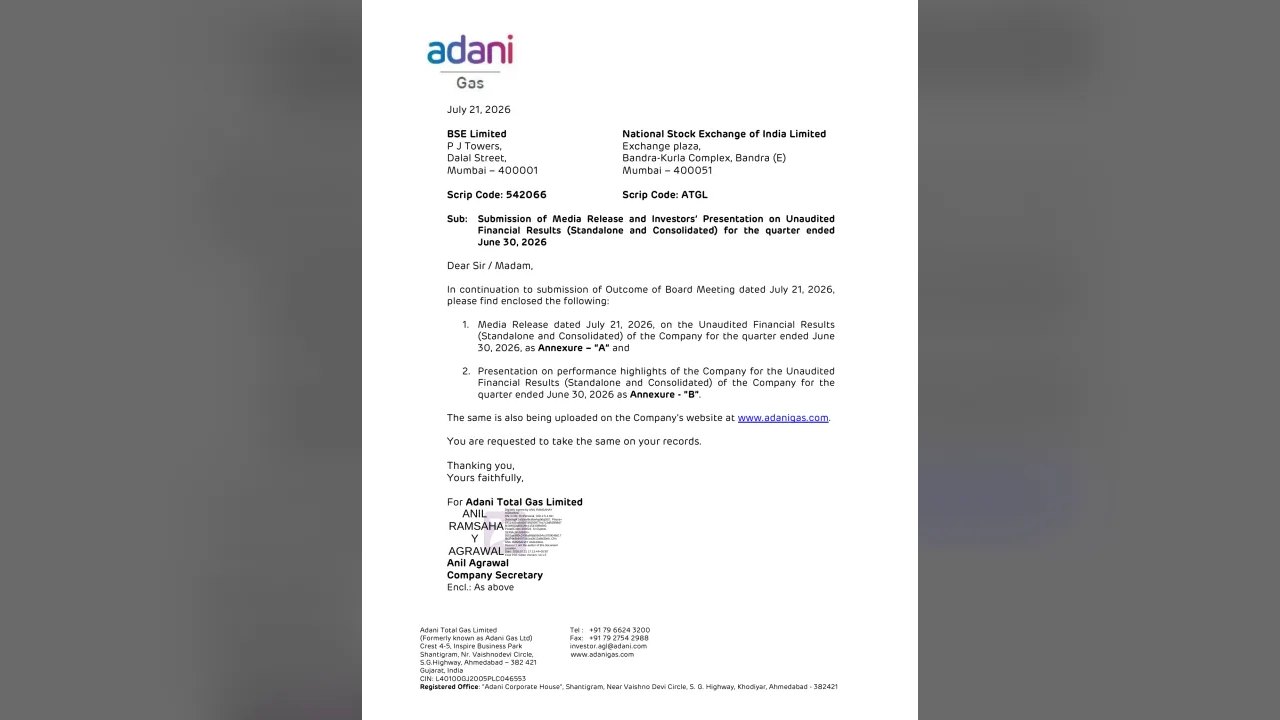
On 6ix: 6ix.com/event/adani-total-gas-limited-atgl-q1-2027-earnings-call
Automated transcript · Written by software from the replay's audio. It can mishear names and figures; the replay is the record.
0:00 Ladies and gentlemen, good day, and welcome to the Adani Total Gas Limited Q1 FY 'twenty seven Earnings Conference Call. As a reminder, all participant lines will remain in the listen only mode, and there will be an opportunity for you to ask questions after the presentation concludes. Please note that this conference is being recorded. From Adani Total Gas, we are joined on the call by Mr. Sanjay Pandita, CEO Mr. Praesh Dauvery, Interim Chief Financial Officer Mr. Ravindra Desai, Head of Gas Sourcing and Business Development. I will now hand the conference over to Mr. Sanjay Pandita, Chief Executive Officer of Adani Total Gas Limited for opening remarks. Thank you and over to you, sir.
0:53 Thank you so much and good morning to all our investors, analysts, fund representatives. A warm welcome to all of you today to join and discuss the results of Adani Total Gas for the quarter ending 06/30/2026. Let me take this opportunity to briefly share the current business operating environment. During the first quarter, geopolitical issues in West Asia continued to influence global energy markets, leading to elevated Brent linked gas contract prices, further affected by U. S. Iron ore currency depreciation. However, government's timely interventions with additional gas allocation and extension on waiver of imbalances and system, disciplinary charges help to maintain uninterrupted gas supplies to our consumers.
1:44 Navigating these fluctuations, ATGL ensured uninterrupted supplies of gas to its consumers. This strategic approach has driven another quarter of resilient operational growth. During the quarter, gas sales volume reached three zero three MMSEM, reflecting a robust growth of 13% year on year, led by 18% year on year growth in CNG segment and 4% year on year growth in P and G segment. At the same time, our steel pipeline expanded to 15,987 inches kilometers, further strengthening our distribution network to support future growth. During the quarter, we added 38,000 new households connection, taking our total customer base to 11.41 lakh households in domestic segment.
2:32 On CNG segment front, we added five new CNG stations with our total network of seven zero seven CNG stations currently. We added three ninety two commercial customers and 56 industrial customers, which is almost 3x and 2x increase respectively over the same period last year. Our customer base now stands at 10,422 in industrial and commercial segment. On e mobility business vertical, our EV charging network expanded to 5,306 charging points with an installation capacity of 58 megawatts. We sold 3,300,000 electrons during the quarter and delivered robust growth of 100% year on year basis.
3:19 This strong momentum reinforced our confidence in achieving our targets of 10,000 EV charging points with continued focus on improving network utilization and operational efficiency. Our joint venture partner, IOGL continues to expand in their 19 geographical areas meaningfully. Together, we operate across 53 geographical areas, which represents 14% Indian population, spanning across 125 districts. Combined customer base stands at 13.74 lakhs PNG households, 12,326 commercial and industrial customers and our CNG network stands at eleven sixty seven stations. These customs are served by robust steel pipe network of 28,600 inches kilometers.
4:11 Our strong operational execution was reflected in our financial performance with revenue growth at a rate of growing at the rate of 27% year on year to $19.10 crores during the quarter and EBITDA stands at INR $2.81 crores. On sustainability side, Care, Edge and Crystal Gas ratings have increased to eighty four and sixty six out of 100 respectively, thus placing ATGL among the best performing ASG companies in the peer group. Dear shareholders, ATGL is accelerating its evolution from a city gas and distribution company into one of the India's most trusted integrated clean energy platforms, serving homes, mobility, industries and communities with affordable, reliable and sustainable energy solutions.
5:05 Thank you so much and we now invite the questions to take it all. Thank you. Ladies and gentlemen, we will now begin the question and answer session. Anyone who wishes to ask a question may press star and one on their touch tone telephone. If you wish to remove yourself from the question queue, you may press star and 2. Participants are requested to use their handsets while asking a question. Ladies and gentlemen, we will wait for a moment while the question queue assembles. Participants who wish to ask a question, please press star and one. We take the first question from the line of Shreedhar from Prasad Capital. Please go ahead.
5:55 So good morning, team. First of all, congratulations for the high revenue. And my question is over the last six to eight quarters, despite the consistent double digit revenue growth, the operating margins have compressed around 25% to 15% now. And operating profit and net profit have remained largely flat. Could management explain the key reasons for the sustained margin compression? Is this primarily due to gas sourcing cost and lithium allocation? Or there are such any factors there? More importantly, when do you expect margins to recover? Shita, sorry to interrupt. Pardon. Actually, voice is not clear.
6:42 Can you just speak from some distance? I think that would be... Is it fine now? Is it fine now? Yes. If you can move a bit apart, then probably that would have better. Still better than the last one, but if you can move a bit far. Okay. Just a minute. So my question is over the last six to eight quarters despite the consistent double digit revenue growth, the operating margins have compressed from around 25% to 15% and operating profit and net profit have remained largely flat. Could management explain the key reasons for this sustained margin compression? Is this primarily due to gas sourcing cost and the ATM allocation?
7:29 Or are there any structural factors? More importantly, when do you expect margins to recover? Yes. Yes. Primarily, one of the major reasons in terms of these compressed margins is on the gas availability on a market driven prices. And second is the APM allocation is going slowly down. They are the major reasons. And in terms of future perspective, while we have a line of contracts coming up for the renewal and we are working on bringing back the margins as well as while focusing and maintaining our growth in terms of the volume product.
8:17 Just to add to that, we see that once this crisis in The Middle East was over, obviously, a lot of supply coming in from U. S. And the Qatar region. So that will help us to get better rates in the coming years and the coming months. So once this happens and the Middle East prices will lower, we'll see the margins improving to the last level, so better than that. Okay. And one more point to add up to that my previous question. So how much of the current margin pressure is since it's purely cyclical, U. V, INR and West Asia versus structural, if the external environment remains unchanged for another probably nine to twelve months, so what actions is management is taking internally to protect margins?
9:12 So see, there are multiple sources to take care of in the current crisis. So in the interim, the current margins have been impacted because of the spot purchases. So we are looking at various options like procuring some margins on the midterm basis. So not on the short term because the prices are elevated for the shorter term. But if you look at middle term, then probably the prices will be more competitive. That will help us to cater to the current exposure to the spot market. In addition to that, we are looking at the longer term purchases also as the market stabilizes. So that will help to protect the margins in time to come. Okay.
9:57 Thank you. Thank you. We take the next question from the line of Adia Patel from MK Global. Congratulations on the rest of the numbers. So could you help us with the gas sourcing mix for the current quarter as to how much is or how much percentage of ATM and WG even the pooled gas?
10:50 And what we understand is going ahead, you know, has gone away with the pooled gas mechanism. So can you throw some light on it as whether they've gone away and how do we, you know, look at our sourcing mix going ahead? Thank you. That is my question. So if you look at the domestic APM and NWG elevation, that is around 40%. And then on the longer term contracts, have 48%. Okay. And if you look at the current during the full mechanism, volumes were available from the allocation and which has been withdrawn after the fees this because I would say the sudden decision by the government. However, in view of the shortfall due to withdrawal of the total mechanism, we are looking at submit the purchases, which would help us to get the shortfall volumes.
11:47 And in the longer term, we are looking at a longer term contract once the market stabilizes so that the security of supply is managed. Got it. Thank you, That is my question. Thank you. We take the next question from the line of Nirmal Goli from Aditya Birla, BMS. Please go ahead. Hi. Thank you, sir, for the opportunity. So just you mentioned that current margins are impacted due to spot purchases. Can you share how much of our current volumes are we taking from spot? Spot volumes are around 15% of the total consumption after the curtailment.
12:41 Okay. And we expect to source the we expect to close this gap or we are planning to keep it like this or sometime unless we have some stability? So if you look at the current crisis, it is very difficult to predict how the Middle East prices will pan out in the times to come. However, the curtailment would not continue indefinitely. So the volumes which are curtailed, that would come up, so that could reduce the spot purchases and that would help us to improve the margins. But if you ask me to predict the how long will it take, it will be very difficult. But yes, we are closely observing the situation and we are taking necessary steps, smaller steps, which will help us to get the shortfall volumes from the domestic market and also the imported volumes.
13:39 Okay, sir. Thank you so much. Thank you. We take the next question from the line of Githan Mehta from Baroda PNB Paribas. Please go ahead. Sir, in terms of the gas sourcing mix, will you be able to sort of break up the long term contracts according to the various linkages? And would you be also able to indicate the what was sort of the average cost for each bucket during Q1? I'm trying to understand where what has driven sort of INR 5 per SEM increase in the gas cost, which were the main contributors?
14:39 So if you look at the breakup, nearly domestic volumes are around 62% of our portfolio. And the imported RLNG would be around 38%, which consists of both handling contracts and the handling contracts. However, not only the imported RLNG costs have gone up, but in addition to that, since the brand moved up during the price to around more than $107 per barrel, the NWG prices also went up, which has impacted overall gas cost. NWG price, does it is it simply the 12% or is there any ceiling applied on that?
15:29 It is 12% of the Indian crude basket. Sure. Significantly more than $5 per MMBtu levels during the last quarter. Understood, sir. The second question was about the sort of the infrastructure push that we have seen from the government where there has been a drive to sort of enroll more domestic as well as the commercial consumers. We see that we added around 38,000 domestic consumers. So it is more or less in line with sort of the what we have seen during the last quarter. So are there any difficulties in enrolling more customers that we are facing? No, no, not really. So we are in part of achieving much more numbers as we progress forward.
16:20 While there are certain areas where permissions remains a challenge and the monsoon issues where there is a prolonged rain, that is where it may affect for some time. But otherwise, we are on track of achieving more numbers. Even if you see the growth in terms of commercial numbers, it's almost 3x and industrial is also 2x compared to last year same quarter. So we don't see any major issues in that sense. And moreover, government is also supporting in terms of navigating some major challenges in most of the states, including state as well as central government. Would this lead... Because of the government support to lay out... Lay down the pipelines, some of the tasks will become easier. So will we be increasing our CapEx budget on the pipeline laying this year to sort of increase work at our end?
17:14 Yes, we have slightly higher budget compared to last year, but we are monitoring the situation in end to end, which is, you know, terms of the gas office scenarios, in terms of the areas where the growth is very evident in terms of the areas where but when it comes to P and G movement, that is almost a connection and all, we are giving a very dedicated task force who is working on bringing us more additional connections on domestic front. Sure. One last question on the CNG side. We have seen sort of a CNG realization going up during the quarter. Are you seeing any impact on this price increase in terms of the future demand? Are there any early signs on that?
18:01 If you see the arbitrage between petrol and CNG, there is a room, but at the same time, we have to be conscious of act of bringing more customers on board so that people. So we will keep on evaluating that from time to time. And as and when we see that and it will vary from state to state the price difference between all credit tools and we keep on evaluating that. We ensure. At the same time, we do have some areas where there is a competition with the existing CDD areas also. So that's the outcome of the marketing strategies from time to time and from GA to GA. We keep on evaluating on almost everyday basis. Sure. And how are we seeing sort of the demand emerging from the sort of the light commercial vehicles, which actually were gas substitutes the diesel?
18:56 Yes, it is picking up. If you see entire CNG segment, whether it is light commercial vehicles or passenger vehicles or taxi aggregators, I mean, growth is in double digits. Entire value chain in terms of the infrastructure, which is being planned all across country, in terms of CNG stations added, it is in double digit. In terms of vehicle manufacturers, the OEMs like Maruti, Hyundai, Tata in terms of CNG and also the Asia, Volvo, they are equally growing at a very high percent. So close to around CNG, which is growing at around 30% in terms of numbers. So we are quite confident that this demand will continue for vehicle side, for infrastructure as well as the volume side. Sure. Thank you, sir, for this color.
19:46 Thank you. Thank you. We take the next question from the line of Nirmal Goli from Aditya Birla of PMS. Please go ahead. Hi. So just on the context of the PNG connections, Are you seeing any so we have read news that there is an impact due to shortage of technical personnel, which is impacting the scale up of PNG connections. So on the ground, are you seeing any impact due to that? Or they are not in not in impact per se. Yes. What is happening is in terms of onboarding them, there are multiple, you know, limited CGDs with limited resources. But the way we are coming up as an industry is we are started training more and more people onboarded from the different fields like electricity, like water, like metering and we are giving them the dedicated trainings to build on.
20:45 Initially we have those hiccups, but probably as an industry we're coming up those challenges and we are adding more and more contractors, more and more plumbers, more and more trainings to them in terms of aligning them with the safety procedures on gas front side. Okay. So this is happening across India, the training? Yes. This is happening across India. And even there's a support from government as a skill development. They're introducing a course on the gas plumbing side specifically. Also, there's a tie up with ITIs. There's a tie up with the diploma engineering colleges, which are helping us to bring more and more manpower in this industry. Okay. And, sir, also, how how many PNG connections do you think you can add going ahead because of this government?
21:39 We would at least maintain the same rate at which we are right now doing it. So that is how our aim is. While we are also exploring multiple options or the business models, which will help us to accelerate these numbers like reticulated system, like LPG system, which is already there as regulator where we can convert the same infrastructure after taking the due diligence on the safety part. So those other new initiatives are happening in parallel. Okay. And so government had also come up with deemed approval sort of mechanism where if you local government is not approving BNG layout for certain number of days, it will be deemed approved.
22:30 So how is the ground execution of this moving exit? That has helped us a lot in terms of seeking the permissions wherever it was feasible. And in few states, we do have in terms of coordination where we need to coordinate maximum in terms of making them understand what the regulations have been given to us, how we are going to forward. So it is more to do with the coordination on day to day basis in terms of understanding those deemed approach. But majority of 90%, 99 of our states or district authorities are supporting and cooperating us to lay the lines. Okay. So how much incremental volume do you think we should add? Currently, are at 0.21 MMFMD from PNG.
23:23 If you see the per capita consumption of domestic is around 0.38 to 0.4 SCMD. Now the number of customers which we are going to add will give me additional volume accordingly. Okay, sir. Thank you so much. Thank you. Thank you. A reminder, participants who wish to ask a question, please press star and 1. We take the next question from the line of Ketan Mehta from Baroda PNB Paribas. Please go ahead.
24:20 Thank you, sir, for another opportunity. In terms of the pooled gas mechanism, as an industry, have you made representation for restarting this? And what's your interpretation of the situation in terms of when would it be considered by government? So yes, representation at the industry level has been going on for and probably there is some development also from the government is looking at bringing it back again because it definitely has an impact on the CGT industry at the whole and directly impacting the consumers also.
25:06 So we see that probably as we understand, there's probably some positive news should come shortly on that part if the Middle East tension is not getting over. So the government would be looking at supporting on the full cash mechanism, bringing back the same again. Sure. And are there any tweaks being considered or it would be more or less in the similar form? No, it should be in the similar form only, probably because generally fertilizer demand should be going down in the times to come because most of the sowing has happened the monsoon sowing has happened. So that should go down. So the volume should be available more for the industry. Right. Thank you.
25:55 Thank you. We take the next question from the line of Shreedhar from Praxit Capital. Please go ahead. Thank you for having the opportunity, sir. And could you please give us the revenue guidance for the coming quarters or whatever the figures, it is a benchmark or we can expect the similar revenue? So I would like to understand from your side, sir. So if you see our volume growth that will continue to grow in the similar manner. And right now, the challenge is only to bridge the gap about the spot volumes.
26:44 That is where we are working towards ensuring that we continually we maintain the momentum. So we don't see any major issue as far as volume growth is concerned because all the infrastructure in terms of CNG, PNG industries, we continue to expand our network. Okay. Thank you. Thank you. As there are no further questions from the participants, I now hand the conference over to Mr. Adish Vakaria from Investor Relations for closing comments.
27:57 Thanks, Ryan. And thank you once again for all investors, funds and analysts for taking time to join the quarter one earnings call. If you have any further questions, please feel free to reach out to us. Our contact details are available on the website as well as on the press release. Thank you so much. Thank you. On behalf of Adani Total Gas Limited, that concludes this conference call. Thank you for joining us, and you may now disconnect your lines.
Follow Adani Total Gas Ltd. into a list and get an email when it puts out news.
CEO at Adani Total Gas
Interim Chief Financial Officer at Adani Total Gas
Head of Gas Sourcing and Business Development at Adani Total Gas
at MK Global
at Aditya Birla, BMS
at Baroda PNB Paribas
at Aditya Birla of PMS
at Baroda PNB Paribas