Jelena Arsic Van Os
CEO at ACCSYS TECHNOLOGIES PLC
Replay available
Interim results for the six months ended 30 September 2025 hosted by Accsys Technologies (LSE:AXS) on Investor Meet Company, held 2025-12-01.
On 6ix: 6ix.com/event/accsys-technologies-plc-axs-interim-results-for-the-six-months-ended-30-september-2025
Automated transcript · Written by software from the replay's audio. It can mishear names and figures; the replay is the record.
0:01 Good afternoon, ladies and gentlemen. Welcome to the AXIS Technologies PLC Investor Presentation. Throughout this recorded presentation, investors will be in listen only mode. Questions are encouraged. They can be submitted at any time via the Q and A tab that's just situated on the right hand corner of your screen. Please just simply type in your questions and press send. The company may not be in a position to answer every question it receives during the meeting itself. However, the company can review all questions submitted today and will publish those responses where it's appropriate to do so on the investor meet company platform. Before we begin, we would just like to submit the following poll. And if you could give that your kind attention, I'm sure the company would be most grateful. And I would now like to hand you over to the executive management team from AXS Technologies PLC. Yelena, good afternoon. Good afternoon, Jake, and thank you very much for this opportunity.
0:48 We are here today to present our h one results of FY twenty six and also to give a little bit broader view on what is company do doing and how is our transformation journey going forward. We are today going to talk a little bit about us, the introduction from me and Sam, h one f y twenty six overview. We will skip to the financial review, business review, and then give finally outlook for the rest of this financial year. My name is. I'm CEO of the company, that joined the company two two and a half years ago. I spent over more than twenty five years operating in the chemical, business sectors, so running large businesses for international companies.
1:36 Most of my career for the ACCSYS TECHNOLOGIES and later on for the company called. And I'm Sam Vora. I'm the CFO of the company. I've been with the company since September 2024, so just over fourteen months, I'm a UK trained chartered accountant, but I spent over twenty years working for UK listed companies, and over half of that time was working for engineering and manufacturing companies. So a little bit about the ACCSYS, Technologies, PLC. Company has a very, strong, purpose of changing wood to change the world. What does this mean? We see ourselves as disruptors in this industry space, in the in the space of building materials.
2:22 We are taking fast growing, sustainably harvested wood and passing it through our proprietary process that is protected with more than 300 patents across 45 countries, we give that wood a superpowers, superpowers in terms of durability, in the terms of dimensional stability, in the terms of resistant to rot. Company today is producing three main products, akoya, akoya color, and trichoya. Akoya is acetylated wood. Akoya color has additional step of coloring in color impregnation of acetylated wood. So coloring impregnation of akoya, that is the first step.
3:13 And then trichoia starts with a koia wood that is being shredded in small pieces and then, mixed, with a little bit of resin, and we are producing the panels they're going to sustain a very, very long time exposed to the environment. All of our products are having warranty of fifty years above the ground and exposed to to the environment in the outside applications, and then twenty five years in the ground or in the water. Today, most of our applications, most of our wood is used in in the windows, making windows and doors, cladding, decking, fencing, outside furniture, all submerged in the in the water protecting the canals in The Netherlands or even siding the canals along the Thames, in the in The UK.
4:12 We have all the sustainability credentials. We are very, very passionate, about sustainability. And, and, if you are looking at, as a carbon capturing product, every single person that is working for AXS is actually here because of that fantastic product that we make. Today, we have three production sites, two acetylation plants, one in Arnhem in The Netherlands that has four reactors and 80,000 cubic meters in the production capacity that is operational since 2007.
4:58 We have a second acetylation plant in Kingsport, Tennessee, which is a joint venture with the Eastman Chemicals company. AXS is holding 60% in this joint venture, and Eastman is holding remaining 40. It is operational since September last last year, and it has a capacity. It has two reactors installed, so the capacity of 43,000 cubic meters today. Bury in Wales is our coloring facility. So wood from Arnhem, acetylated wood from Arnhem or Kingsport will come to Wales to be colored, impregnated by through the core to produce a a coya color.
5:48 The Arnhem plant is actually supplying strategically positioned to supply Europe and the rest of the world, and our Kingsport facility is, supplying local, US market, including Canada and, and Mexico. So why the company has unique value proposition, for for for for our investors? We have generally very unique product, really innovative product in our portfolio with this unwield warranty of fifty years, that we are offering, and there is no industry match that that can compete, with the durability and performance of ACCOIA. So there is a very clear product differentiation.
6:42 Product and the technology is protected by patents. We have 27 patent families, so more than 300 patents across 45 countries that are protect protecting the product and the technology. We have a unique and very known brand among the wood products in the market for all aqua, aqua color, and tricoia. And the last but not the least, certainly not least, the company has established manufacturing footprint. And if you know that building a plant or a plant, you need an investment that is around 150,000,000 million euros, having established two manufacturing sites in a two largest and the most profitable wood markets in in the in the world, the premium wood markets in the world, does create a significant barrier to entry to any newcomers and giving us a very good position, for growth, in this, in this, in the building materials industry.
7:52 Now ACCOIA, ACCOIA Color and TECHNOLOGIES have a significant, market share opportunity in our core markets that are driven by the trends of, population growth in the need of more housing being built everywhere. It doesn't matter in which country in the world you look. There is a general housing shortage everywhere, but there is also the sustainability trend materials that are looking on a carbon footprint in the building industry as being one of the most, impactful for the carbon emissions are very much needed. And, also, our products are having a quite a nice natural look so that biophilic design is is very much wanted at the moment, is very trendy at the moment.
8:41 But looking besides the trends, if you look what are the addressable markets for our products today, We operate in two large ones. Our our oldest home market, I would say, is is Europe, including UK. And and there, we are talking about 1,900,000 cubic meters of addressable market for ACCOIA in the application we are playing, we are playing today. If we look at the available capacity that we have in Europe and even with the plants completely full, it is very obvious that the market share, for ACCOIA is in a low single digits. In The UK, we have a market share of circa 4%, so there is still significant opportunity for us to grow and develop in Europe and UK.
9:34 On the other hand, looking at, at The US, cladding, decking, windows and doors, market, it is by far, our largest premium market for for for ACCOIA. It is, almost, four times, if not more, higher bigger than, the one in Europe. And looking at our available capacity, even if we have a Kingsport completely full, the market share in The US is going to be less than 1%. So there is enough space, for ACROIA to establish itself and to grow and still, not reach even a very single digit of the available, market we have in those two important geographical regions for us.
10:23 Now, when we look at ACCOIA, how does it compete with other products? We certainly focus on a premium market segment. When we are talking about premium, we are also having a pricing premium that is reflecting the value that our products are adding. So here you can see all the other, available products that you can find in cladding, siding, decking, or windows and doors. Depending on the current, cost and the performance. You see that TECHNOLOGIES with this green dot is always on the completely right side with the critical performance performance attributes that are far above any other competitive material, but that also comes with the with the premium, premium values.
11:22 So, we are we are very proud, that our, critical performance attributes are certainly a stability dimensional stability, of our products that reminds, would remain stable, over even in the very, extreme, conditions. That means that, if you that your maintenance cycles are quite, lower. So value in use is getting benefits, over time. In the decking market, for instance, our products have a significant decay resistance. So that means that they're going to outlast any other good option in in in the ten year test. So people who are looking for durability are certainly counting on ACCOIA in that in that segment.
12:19 And for windows and doors, again, a low maintenance for coatings because our material is very stable when you put a coating over it because wood below is not moving. That coating can stay significant time longer. So we on our, windows that we have on a test field, we have a a window that's sitting there, fifteen years, with no maintenance. So we are very proud, that, Aquia is certainly a flagship product, if you like, in this space of wood building materials. Coming now to the h one and how did company performed for the first half of the financial year '26.
13:05 We have delivered excellent first half with significant improvement in profit profitability. ACCOIA sales volume increased 22% across different regions with 61% of growth in the in The US where we, since September last year, have our new production plant. Group revenue delivered was 76.1, million, which is a 23% increase in a group revenue on like for like, basis versus the first half of last year when we are talking about like for like, basis. In the first half, last year and this half last year in the first half last year, we have, transferred 13% of group volume and, 14% of the group, revenue to be produced and supplied from our new production site in The US.
14:13 So if you take that volume out of equation, then you look at underlying ACCOIA and underlying group revenue grow 23% because we were able to replace all of this transferred volume with the new business in our our R and M plant. This is significant positive news and significant success. And why is that? Because underlying building material markets didn't really grow, in this period of time. So because our growth is double digit and a high double digit if look on what is happening in The US, but also in the rest of the Europe.
15:00 That means that ACCOIA is gaining market share compared to all the other building materials. At the same time, we are continuing, our pricing and our cost discipline. So we were able to, contain 2,300,000 of savings from our transformation program, which is, which is helping us, of course, now in improving that profitability line that significantly, changed since last year. Just to remind you that for the full financial year last year, company made company made 10,800,000, EBITDA adjusted EBITDA. And for this first half of the year, we have delivered 10,400,000 adjusted e EBITDA going from 4,000,000 last year.
15:52 So this is a significant improvement, and Sam is going to tell you a little bit more later on when we dive deeper into the financials. Companies above gross margin target of 30% and very quite we are very, very pleased to show progress on deleveraging our balance sheet with the refinancing that was completed just in the first week of of October. Our leverage ratio end of September was 2.1% compared to 2.5% at the end of March, so at the end of the financial year last year. And if we, if we look, on where we are on all the targets that company actually, put forward, in our capital market days, we are tracking quite spot on on each one, of the KPIs, that, we said that we are going to measure ourselves, on.
16:57 So we are very, very happy with where first half of the year is, and I'm going to take you later on on the where we are going to after Sam explain a little bit more details on the financial, how do we see the rest of the year progressing with this, Sam. Okay. Sorry. Are continuing to build a strong and sustainable platform for growth. In January last year, we had a Capital Market Day. In the Capital Market Day, we said that we want to build AXS to become fundamentally strong, operationally efficient, customer centric, and preferred, with the United team safe and sustainable company going forward.
17:46 If we look how do we track on those, pillars, fundamentally strong. We are showing a much stronger financial performance than, than what we have in a in a in a past. Business is considerably derisked with now two fully operational, manufacturing sites, that are operating in a two largest and most most profitable markets in the world, and we are strongly positioned to grow from that position of strength. We also have a refinancing completed, so we have now funds in place to basically fund the growth for the next, until October 2029.
18:32 So that is for the phase one and phase two of our strategy. Operationally efficient, our like for like gross margin increased 1.1%. So this is at the same time when we are growing the top line and the bottom line. As I mentioned on the previous slide, 2,300,000 of benefits, of business transformation are still, kept. And we are also finalizing now the investment in our acetyl storage, in, which is one of the significant CapEx that we did, this year. We spent 2,500,000 for this project, and is going to walk you a little bit later on through more details around it. Everything what we do, we are doing, because of our customers. They are core on every single activity company is performing.
19:22 We are seeing, good, significant market share growth of ACCOIA in every single region. We are adding new distributor partners. In this first half of the year, three new distributor partner distribution partners are added to our customer portfolio. We rebranded ACCOIA, and, we are continuing to be specified for the high profile, projects, around the world. At the same time, following a very strong demand for our ACCOYA COLA, we are seeing doubling, of capacity in Barrie. We invested in operation, yeah, in the second shift. So now we can produce, double than what we did last year. We are strengthening our our talent across the sites. We are investing in a revenue generating headcount and also the headcount that is in the operational, sites, our finance team teams, and key, key management functions, on our locations.
20:31 And as, last but not least, we have launched our sustainability strategy, just a couple of weeks ago and investment in a new, stacker whole, safety improvement and environmental improve improvement in Arnhem. So it was quite a busy and quite a successful first half of the year. So with this, now I'm giving it to Sam to walk us through the financials. Great. Thank you very much, Elena. So over the next couple of slides, I'm gonna go go through a lot more detail on the financial performance and talk about a number of the key financial metrics and show how they progressed during the period in terms of waterfall graphs. So really what we're seeing here is is a summary of the financial performance that we saw for the first half of the year. And as Yelena mentioned, it really was a very strong performance and an excellent first half of the year for us.
21:27 Whilst sales volumes by the group, which excludes the joint venture, were up 1% On a like for like basis, when you do exclude the volumes that were transferred to the joint venture in the previous year, the group sales volumes did increase 15%, which is very, very strong. I mean, it shows the the the strong growth that we've had in all of our key regions that we operate in. Total sales volumes for ACCOIA, which is a much stronger indicator of global demand for ACCOIA, were up 22% to 38,618 cubic meters, a really, really strong performance. So then when we think about revenue, revenue growth, as you know, I mentioned, for like revenue growth was 23%, which is really demonstrating that volume growth plus the focus on strong pricing that we have.
22:18 And aggregated revenue, which includes our share of the joint venture, was up 21% to 89,900,000. When you start thinking about this joint venture in Kingsport in America, only commenced operations in September 2024. It's done €23,000,000 of revenue just in h one itself. So with that 23,000,000 and the 76, your your AXS and the JV's gross revenue is effectively the best part of a 100,000,000 for six months of the year. When you're thinking it was only a few years back in 2021 that the business only used to do a 100,000,000 revenue for the whole financial year, it shows how we've successfully scaled up scaled up the capacity, produced it, sold it, and at the same time, increased our pricing to gain market share, which is a very, very strong performance for the group.
23:16 Our gross profit margin increased over 110 basis points on a like for like basis and remains above our 30% strategic target number, and I'll talk more about that slightly later on. Underlying EBITDA was up 29% or and the margin was up two sixty basis points, which is a very, very strong performance. And that is excluding the joint venture, GBP 10,700,000 in underlying EBITDA for the first half of the year. Really, really strong point for us for this year was the joint venture. So the North American operation only commenced operations, as I mentioned, in September 2024. And we've always said that for the first twelve months of operations, it would be loss making because it's a start up. You know, there's always those initial costs that you incur as a business ramps up.
24:09 We then said at our Capital Markets Day that we expect this business to be profitable at an EBITDA level for its first full financial year. So for the first half of the year, the business was close to breakeven. The share of the loss of the JV was only 300,000,000 loss, which is, you know, a very, very remarkable progress that has been made there. And that was really off the back of particularly strong growth in North America of 61%, but also a really good manufacturing environment that's been created with very tight controls over costs and a really strong operational base there. So overall, our adjusted EBITDA, which is our main profitability performance measure, was up 160% year on year from a 100 and from 4,000,000 to 10,400,000.
25:00 And when you think, in our last full financial year, so the year ending March 2025, the group, including the joint venture, delivered £10,800,000 of adjusted EBITDA profit. Well, we nearly achieved that just in H1 of this year, which is really good. The adjusted margin was 11.6%. At our investor strategy, we said we would like to be at 12% adjusted margin at the end of FY twenty seven. Well, we're nearly there now some eighteen months in advance. And then really from a for an overall, debt position, our net debt stood at 39,800,000, which was a leverage ratio of 2.1 times, and that was an improvement, from the 2.5 times that we saw six months before at March 2025.
25:50 And now I'll go into more detail about revenue, profitability, margin and also cash flow growth over the first half of the year. So from a revenue perspective, you noted mentioned earlier that when you start factoring in the volumes that were transferred to the joint venture in the first half of the previous year, it was just over 3,800 cubic meters. That represented 13% of volume, but it was 14% of revenue. So when we exclude that, then like for like revenue growth was up 23% to 76,100,000. And that's really off the back of very strong growth. And we'll talk about our regional end markets later in the business review. But the other key thing is around the pricing discipline.
26:42 We operate a premium product in a in a niche market, and we don't have to discount to gain market share. So as a result, during the year, we were actually able to increase our average selling price by 1.7, which is a really, really strong performance in a broader market that is flat. License fee and royalties represents the return that we get from our joint venture. We get an ongoing percentage royalty on every dollar or sale they make, and the licensee actually relates to the construction and establishment of the plant. So the licensee was affected in three three phases. One, when the the the JV agreement was signed, one, when the plant was completed, and the final licensee payments, which was made in September of this year, was really when the plant passed its final performance test.
27:38 That showed that the plant was operating exactly to the same specifications and tolerances as the facility, and that gave rise to that final license fee income. Our return now from the joint venture is effectively a a percentage royalty on all all of their sales. So overall, very strong growth in revenue. Total aggregated revenue, including the joint venture, was GBP89.9 million, and that was after a translational FX gain of another 1% or so. So aggregated like for like revenue was also up 23% as well as like for like revenue. So from a gross margin perspective, very strong improvements. On the face of it, it looks like the gross margin, while still being over our strategic target of 30%, looked like it dropped by 20 basis points.
28:37 But when we factor in the volume that was transferred to North America in the previous year, it was 13% of volume, 14% of revenue, but 18% of gross margin and 23% of EBITDA, primarily because sales in North America command a far higher average sales price than the rest of the world, then we saw 110 basis points increase in our gross margin through volume growth, favorable sales mix, we were able to increase our proportion of a COIA color sold in the in the first half of the year. We added a second shift to the Barry facility in June. It wasn't a CapEx investment. We've added four heads to the to the operation. So the efficiency of the operation is now producing over two shifts, and that's with a combination of external drying of the color resulted in a more than doubling of capacity from 6,000 to 14,000 cubic meters per year. That took place in June, so we had a couple of months benefits of higher color production, but we're continuing to see strong color demand over the year.
29:49 The license fees and royalties I mentioned earlier. From a production cost perspective, about 62% of our cost base relates to our raw materials. So wood and net acetyls, which is used in the acetylation process. So wood, we buy from New Zealand from about 15 sawmills that we work with. And really over h one compared to h one of the previous year, we the wood the the wood cost was pretty flat year on year. Even though we saw a slight increase in the cost of appearance grade wood, that was more than offset by a reduction in wood chip grade wood, which we effectively use for the Ecoa for Tri Ecoa product.
30:36 From a net ACTOS perspective, we actually saw a favorable benefit here in in terms of our gross margin, and that was really because of an improvement in the usage of anhydride that we use in the production process. So we can still assassinate the same quantity of wood using a a slightly lower amount of anhydride, which leads to a reduction in the unit cost of production, which, hence, improves your gross margin. We also benefited from a a change in our supplier mix, but also given one of our suppliers for anhydride is a US based company, which invoices us in US dollars, we saw a favorable FX benefit because of the weakness of the dollar against the euro in the in the in the first half of the year. So overall, 3,200,000 gross margin with a with a 30.5% gross margin percentage, which remains above our strategic target level.
31:34 From an overall perspective in terms of looking at profitability, we more than doubled our adjusted profitability from GBP 4,000,000 to GBP 10,400,000. That was 160% increase year on year or six twenty basis points improvement in the margin, a very, very strong performance. That was driven by the gross margin improvement that I mentioned before, but also keeping those operating costs. So SG and A costs below gross profit really under tight control. We only grew our OpEx costs by GBP 200,000 year on year. And as Jelena mentioned, we've retained GBP 2,300,000 of the benefit from the business transformation program undertaken in FY twenty four. That's that's retained even after we've made additional investments in terms of adding sales and marketing staff, but also upgrading the talent we have in the operations in health and safety and finance and other key functional areas.
32:37 Any costs to do with the whole business or Trico UK have all completely gone. That business was put into liquidation in December 2024. So you've got a 1,600,000 swing in profitability h one on h one because this the whole is no longer part of our group. And then you can see the big benefit from the performance of the joint venture, which last year was a £4,300,000 loss, and now we're very close to breakeven. So a big £4,000,000 swing in the profitability of the joint venture over that over that time period. So what does this mean from an overall segmental perspective? So the first bar here shows the operating assets of the AXS group. So it excludes the joint venture and really focuses just on Arnhem and Barry. And that showed a significant improvement in profitability to 12,700,000 and an improvement in the margin to 16.7%, which is really, really strong performance.
33:38 Corporate costs, which really represent the cost of the listing. So it's the corporate functions in head office, the cost of the listing fees, the board of directors, anything to do with our our our our listing on AIM and also Euronext reduced by 400,000 to 2,000,000 in the year. And that was really, again, because of the the tight cost control we have, but also there are a couple of one off costs in the in in the previous year. So the overall the middle bar, which is a light green bar, shows AXS Group, and that's excluding JV. So that shows the underlying profitability of 10,700,000, which is up from 8,300,000 the previous year, but really that big improvement in in the margin, which is up two sixty basis points to 14,100,000 14.1%.
34:28 Sorry. The JV, as I mentioned earlier, was close to breakeven with our share of the loss at 300,000, which took our adjusted EBITDA profitability up to the 10,400,000 or 11.6%. And as I mentioned before, that 11.6% is very close to the 12% target that we set ourselves to be at at March 2027. So nearly there, but some eighteen months in advance. So net debt overall. This chart shows a progression of net debt. And we ended the year at £39,800,000 of net debt with a 2.1 times leverage ratio. Our working capital increased during the first half of the year by £4,200,000 but that's really all to do with wood.
35:18 Our target is to hold three and a half months of raw wood in stock. This is first wood that we buy from our sawboards primarily from New Zealand, and we keep three and a half months in stock because of really that long lead time. We then keep about one and a half months worth of stock as finished goods to meet customer demand and to provide availability of SKUs to to to our end end customers. So given the substantial growth that we've seen in H1 with 23% growth and the forecast growth that we're seeing in H2 compared to the previous year, it's necessary for the business to carry higher levels of working capital or or would to move that demand. There's also a feature of timing here because the cutoff point is eventually September 30, the end of our first half of the year. But, effectively, on the October 1, the Arnhem business undertakes its annual maintenance stop. So the plant closes for three weeks while we maintain and clean the plants and eventually make sure that all the parts are in working order and anything any maintenance CapEx is undertaken.
36:30 So really ahead of that maintenance stocks, you build up inventory levels. And then during the month of October, when the plant isn't producing anything, you're selling out of finished goods. So there is a slight feature there in terms of working capital as well. Net interest went up by 2,300,000, of which about half of that relates to our convertible loan notes. CapEx investment in h one was 2,900,000, and that comes from a couple of projects. So the the the largest project was a project we internally call project Elmtree two, and this was really about increasing our ACCSYS storage capacity in the plant in Arnhem. So we can now store about seven days of acetic acid and and anhydrides in the in in in the plant. Previously, we were reliant on tanker deliveries.
37:22 If there was any scheduling issues with tanker deliveries, it could have a knock on impact on production, and that's been taken away by by the introduction of project Helmetree two. The the the the the CapEx involved was front half loaded with the with the project being effectively connected to the rest of the plant during October, and it will then go live later this month. We also made a good investment in terms of improving the health, safety, and environmental conditions of our Stacker Hall in Arnhem to improve soundproofing, light, and ventilation, which makes it a much better working environment for our operators who operate in in that hall. Tax received was GBP 700,000 in respect to previous tax years.
38:11 And hence, the overall net debt was GBP 39,800,000 with 2.1x leveraged. And really, the final slide for myself is just summarizing that excellent first half of the year where we saw a significant improvement in profitability. We saw total sales order growth of 22% with sales accelerating in North America, which grew 61%, which is particularly strong. The JV was close to breakeven, and we saw a big improvement in adjusted EBITDA with that margin very close to our phase one targets already. We've continued to deleverage the balance sheet, which again, of our strategic aims with a good improvement in our in our leverage ratio. And the refinancing that we've just recently completed in October by introducing a new banking partner to our banking group has really strengthened our our capital structure and given us significantly more financial flexibility on improved financing terms.
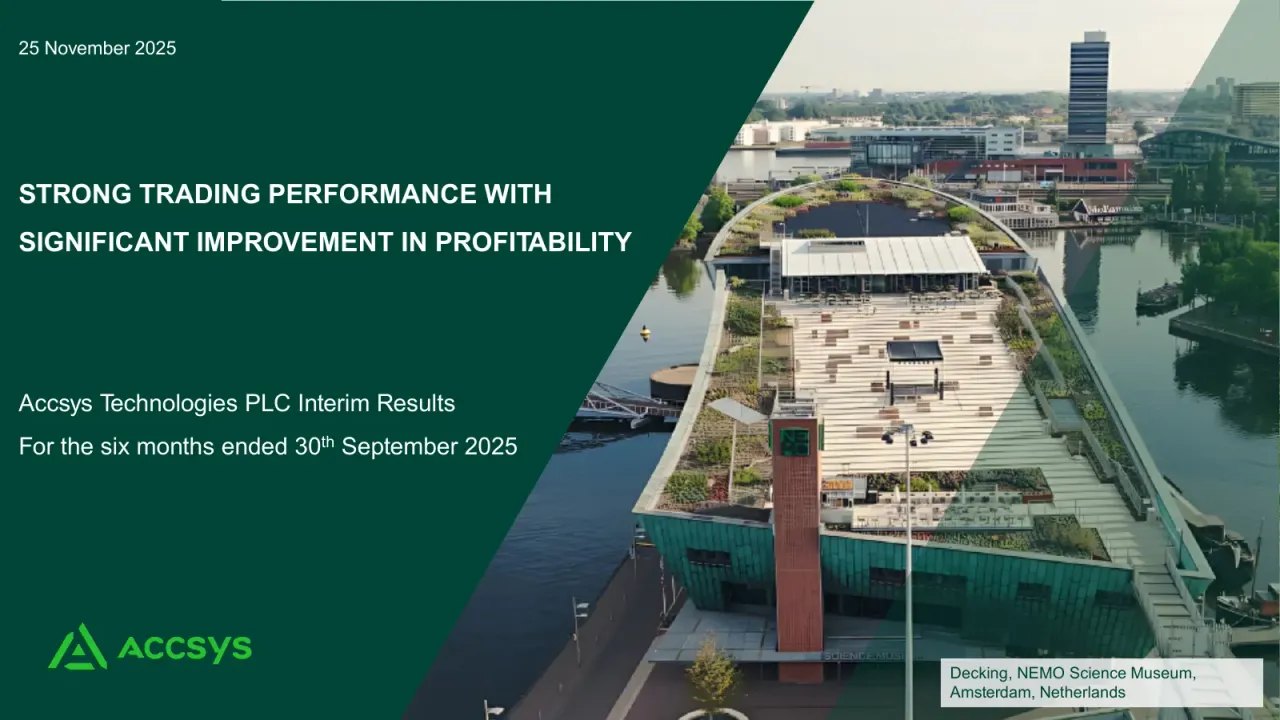
39:09 So with that, I'm now gonna pass over to Yelena, who's gonna talk you through the business review. Thank you, Sam. Thank you very much. So my business review, I will start first just mentioning some of the fantastic projects that we realized in this first half of financial year '26. You saw a couple of them passing through the slides as we went through it from the NEEMO Museum in the in the heart of Amsterdam, where we have a new terrace on the rooftop, that is now being done in ACCOIA and also, benches and tables are going to be done in the future. We had a library in in Barcelona where beautiful cladding was chose because of the durability and resistance to harsh environment of the sea sea air in in that area. Here you see a beautiful hospital cladding in New Zealand that is important market for Korea as well.
40:07 Let me remind you, first about where do we stand on, with our focused strategy and the targets that we gave ourselves in January 2025. As we said, strategy is going to be delivered across, along the three phases. And in the first phase, that is just focusing on resetting operationally, maximizing returns and cash flow from the existing assets and increasing and reinforcing the fundamentals, including the red reducing the debt, and optimizing our capital structure. Our first half year results demonstrate excellent progress against the phase one targets. We are spot on, if you like, on delivering, almost each of the KPIs that we, that we gave ourselves as as a as a target.
41:02 With our sales volume, on a run rate of 77,000 for the, for the full year, we are very good on the target or meeting this target of 100,000 that was at the end of our phase one. Significantly improved profitability, moved from 5.4% of adjusted EBITDA margin from last year to 11.6 this year, which is very, very close to the adjusted EBITDA margin target of 12% for the first phase of our strategy. Importantly, we are deleveraging and derisking the business, placing company in a much stronger position for growth. Our successful October refinancing is giving us more favorable payment terms with the reduction in quarterly payments, capital payments, going forward.
41:58 So if you look at where do we stand on the first phase, I would proudly say that, you know, with the good efforts of the team, we are taking basically each one of those boxes. Now, going, what is happening in our markets, we see quite a strong demand across all the, all the geographies. UK and Ireland demonstrated growth of almost 14%, rest of the Europe, 22%, rest of the world, 28%, and fantastic 61% in North America. At the same time, we are keeping our pricing on the on the pair. So group average sales price was maintained with the 1.7 average increase across of our region.
42:45 So that means that despite the premium or in in in addition to the premium pricing, ACCOIA is gaining market share globally if you know that underlying market are almost stagnant or growing 1% or 2%, in some of the countries. At the same time, we are doubling our core production capacity, and our, decking collection is underway to be launched in the second half of this financial year. The the the confidence of our distributors and our customers in availability of supply of ACCOIA and also fantastic, performance credential are helping us to deliver this growth. We as we also said, we are particularly proud on the excellent performance in JV, 61%, growth, in The U. S.
43:41 For the first half of the year, 8,000 cubic meters of ACCOIA was sold. And and as you know, and Sam went into the details of it. So ACCOIA USA is almost on a breakeven on their, EBITDA. We promised to to the markets that a joint venture is going to be, show breakeven EBITDA in this financial year and then cash positive in the next financial year. So we are actually on that path, delivering very, very good performance for the for the reporting period. There was one of the negative impacts or negative potential news in the reporting period, and that were the import tariffs on the softwood coming from New Zealand or any country importing in The US. We were able to react and increase, our average sales price, as from November 1.
44:44 Tariffs were announced in the first weeks of October. So we are passing, this without too much troubles, to the market. I think, everybody in US is adjusting now and adjusted now to overall inflation in everything. So we are confident that we will be able to manage this impact quite successfully, going forward. If here, we are going a little bit in-depth on what is happening in this, US market. Our sales in The US are outpacing overall market growth, allowing us to gain share from competitors. With forecast, indicating strong and sustained demand for modified wood, overall out, over alternative materials, we are confident that TECHNOLOGIES USA will continue to expand its presence in the growing in this growing, markets.
45:44 Our main drivers, in or main application in The US are cladding and decking. And these those both of these segments are showing very strong growth rates for modified wood. As you can see it from the from the table, they are showing double digit growth forecast for the for the decking. Traditional timbers like hardwoods are seeing sharp declines in demand in a customer who are opting now for the higher performing modified and engineering solutions. And furthermore, the increased regulation on the import of hardworks like Ipe and Kumaru from Brazil had quite a good and positive benefit for ACCOIA in The US as supply was quite limited for those species.
46:37 And you can as you can see from the table, we are expecting them to further contract going forward. Our growth in The US is coming predominantly from our existing distributors, our long lasting partners, Huawei, Poya from its starts, also investing together with us for many years. But we are also adding some new distributors, like hardwood specialty prod products or GMX Group that is focusing more on a decking and more retail side of the of the of the of the business. And we also add a new, new our first, distributor in Mexico who is having also a milling capacity. So they are they are capable of not only distributing raw sonna coya, but also making more finished product, up to it.
47:28 In Arnhem and Berry, we continue driving operational efficiencies to maximize our returns on our asset. As we said, the underlying gross margin showed increase of 1.1%. We will continue to work on those efficiency to drive this margin even higher going forward. And you can also imagine that as we approach the nameplate capacity, as we grow our volume, most of that profitability, given that we do not have really a lot of people in our operations, most of that benefit is going to go, to the to the bottom line. We have invested in Arnhem in a new l three. I think Sam already mentioned, very important capital investment, which is going to give us additional batches, so additional capacity of couple of thousands in the in the year and also allow us to be more flexible with the shipments and receiving of our chemical finished goods or raw materials during the week and not doing it, in the weekend.
48:35 In Barrie, we see fantastic 56% year on year growth for the ACCOIA, collar sales volumes. We invested in a second shift, and we will continue to build the the the market and also, supply of this very nice, product AXS is having today. Last but not least, we have launched our sustainability strategy where the first time in the company history we are actually committing to the decarbonization targets. Sustainability is in a core of everything what ACCSYS does. So we are very happy that we are finally at the stage to make the commitments to the markets and keep tracking on the progress as we go forward.
49:28 This will bring me this is the last slide that we are talking about existing business, and this is now bringing me to the to the outlook. And I would like to summarize today's messaging. We have delivered very strong h one, and we are entering the second half of the year from the position of strength. Our trading is remaining robust going into h two, and, it is supported by this sustained global demand for our premium differentiated products. We expect to see the to see this continuation of sales acceleration in North America. And, also noticing the impact of recently announced tariffs, we expect joint venture to be, EBITDA positive, for the financial year.
50:24 While we also have to be mindful that the underlying market conditions are relatively soft in a building and building material industry, so there are continuing macroeconomic challenges, the board is really confident that company will continue to deliver further growth and profitability improvement for the year ahead, which is consistent with the expectations, and we will continue to make further progress towards our strategic targets. With this, I would like just to remind you, why, AXIS is, is showing an a compelling investment case and sustainable, growth opportunity.
51:10 Company has very unique product that is that is that is really backed up with a significant patent portfolio, and we see ourselves as an industry disruptor and generally innovative product that is operating in a grow in a growing and sizable addressable markets that are underpinned by a very, very strong, brand. We have established manufacturing footprint. Even though this technology is known for more than hundred, more than hundred years, nobody in the, in the industry was, having commercial sites and available, commercialized manufacturing location and be able to actually, provide to the customers acetylated wood. And knowing that building a plant cost 250,000,000, then it also, creates a sustainable and high barrier to entry for any new commerce.
52:19 We have we are improving, and we are showing quite a strong financial performance. And now with the fund funds in place with the refinancing that we did in October, we do have enough funds to deliver on our focused strategy that we that we showed in in the first half of, of, in the first half of this calendar year. So we do believe that company is at a inflection point to deliver significant shareholder value. I don't believe that the markets are recognizing fully with the share price all of this great work that teams are putting in and this significant significant improvement in all the results.
53:10 But, nevertheless, if you look where we were in, in January with the Capital Market Day, where the share price was and where is it today, it is almost 60%, higher, so significantly higher. And we will continue to work very hard and to to as we improve and further strengthen the company, this recognition will come, I'm absolutely sure. So with this, I'm going to, finalize this presentation, and we are going to open the stage for the Q and As. Perfect. Elena, Sam, if I may just jump back in there. Thank you very much indeed for your presentation this afternoon. Ladies and gentlemen, please do continue to submit your questions just by using the Q and A tab that's situated on the right hand corner of your screen.
53:55 But just while the team take a few moments to review those questions that have been submitted already, just like to remind you that a recording of this presentation along with a copy of the slides and the published q and a can all be accessed via your investor dashboards. Guys, as you can see there, we have received a number of questions throughout your presentation this afternoon. And thank you to all of those on the call for taking the time to to submit their questions. But, guys, at this point, if I may just hand back to you to read out those questions and give your responses where it's appropriate to do so. If And I pick up from you at the end, that'd be great. Thank you. Thank you, Jake. So I will start with the first question from Michael H. Can I ask what you are doing for the share price as you have been CEO now for two years, and the share price hasn't given shareholders any returns at all?
54:41 Why is that? Michael, thank you. This is a very good question. And as I just mentioned at the end of my presentation, I do do not believe that share price is giving the justice on all the excellent work and excellent progress that is being done in the last couple of couple of years. Of course, the moment when I joined the company, company was on the with some difficult decisions needed to be made. We had two unfinished big capital projects, one in The US, one in Hull. At the time with the company of our size having two large capital projects unfinished means significant risk on the company results. And I do believe that that's why share price reacted at the time as as as it as it was.
55:38 We have we have done a lot of improvements. Today, we have at that time, we had one site. Today, we have two a acetylation plants and one coloring plant. Much, much stronger financial performance, completely derisked with this exposure to the unfinished projects. We have a strategy in place that is really proving that it is working. And again, as I said, as from the me as from the Capital Market Day that we had in January this year, our share price increased almost 60%. We are going to we are very much committed to continue delivering on this road map, and I'm absolutely sure that that with the team that we have in place, with the talent that we have in place that we are continuing investing, we are going to continue showing progress. And as a company, continue to show the progress, share price will come.
56:35 Great. Next question. Can I ask why you changed brokers from Numis delivering? Yeah. So yeah. Good question. And it was in April this year we did move from Deutsche Numis to Panmure Liberum. But but really, you know, why why do we why do we do that? And it's you know, Deutsche Numis are very, very good, but we felt it was time for a a fresh pair of eyes from both a a broking and a Nomad perspective. And it's always good to refresh your advisers periodically to bring fresh ideas and fresh initiatives as well. And really, know, linked to to Elena's last last points about driving that share price higher, you know, it's about introducing us to new investors, people who excited about the strategy just as we are. And really, we felt that by changing brokers that we could get those introductions to potentially new shareholders who could help drive that share price higher.
57:33 We have a question from Nigel. Given that phase one of the focus strategy targets improved utilization of existing assets, what is your current planned utilization rate and how much further headroom remains before requiring new capital investment? We are today at around 70% of utilization rate. We will not need any new investment, at least with the first two phases of our strategy. So no expansions at least in the next couple of years. Great. Next question. As utilization of your existing capacity increases, do you see opportunities through efficiency gains, product mix improvements or pricing to move gross margins above the 30% targets? What indicators should investors watch to assess this?
58:19 So I think really, you know, we have said we wanna maintain a gross margin of 30, but we want to improve that each each year. And it is through a combination of all of those above things. So it is operational efficiency. How do we get more throughput through coming through the plants, looking at cycle times, looking at our our our costs? I mean, just over 60% of our costs are wood or net of sea tiles. So through procurement activities, looking at overall efficiency about how the how the plant operates, how we engage with our our suppliers and and and and partners, and also pricing, which remains a firm part of what we do. But you can't just rely on pricing to drive your revenue to drive revenue forwards and drive your gross margin forwards. It has to be company with operational efficiency.
59:10 So what indicators should investors look for? Well, I think, you know, every every six months as we're reporting, you're seeing volume growth and revenue growth and you can see that in terms of how that is benefiting gross margin. So the next question, which is probably one for me, what are the terms of the new bank loan? So, yeah, so we undertook a refinancing of our banking activities that that concluded in October of this year, so just just in the in in the second half of the year. And, really, it was important for us to diversify our banking partner base so that I mean, ABN AMRO have been very, very supportive to the business for a number of years and continue to do so.
59:59 But we wanted to introduce a a further bank. So as we get to the end of phase two of our of our strategy, as we start looking at expansionary growth for phase three, you don't wanna just put all your eggs in one basket and be reliant on one banking partner to effectively provide the the debt funding to do that. Having a a a second bank gives you greater optionality and and ability to fund growth through through debt. And we we couldn't be more delighted than getting a partner of of the strength and caliber of HSBC. So, I mean, the key the the the the key terms I mean, I'm not I'm I'm not gonna go into terms of the the the commercial terms, but it is at least one percentage point better on pricing.
1:00:46 And the the pricing is now linked in terms of the margin pricing to our level of leverage. And, also, we get to keep more of our cash in the business. So the the capital repayments on the loan that are are are significantly improved on the compared to the the the the previous facility. So you could think that overall, the business will be approximately after FY 2026, 2,000,000 a year better in cash terms than under the previous facility. We have a question from Michael. Is it worth it having two share price quotes on Euronext and AIM? It's an excellent question, Michael. And it was worth it having two share price quotes because if you know the all of our investors, 60% of our investors are family office from The Netherlands listed on Euronext.
1:01:41 And then 40% of the investors is listed on on on AIM. At the time when company needed the funds for the big capital expenditure, all of those listings were quite logical. It is a little it is complicated for us as a company of our side to be listed on two two markets. But at this moment in time, we are really focusing more to deliver on operationally, and, listing, is not in, our priority in this moment of time. Then we have a next question from Jochem. Jochem, research presented through the live TRIKOIA results indicates promising long term potential for TRIKOIA.
1:02:30 What role do you see TRIKOIA playing in ACCSYS future? Thank you, Jochen. This is an excellent question. Tracoia company still has patents and technology as important assets for us. At this moment in time, we are focusing on getting returns from our existing assets of ACCOIA and focusing on ACCOIA as a product range. But, nevertheless, I could imagine that in one or two years as we if we are if when ACCOIA USA is fully cash positive, when the growth is there, when the factories are full, that we are going to very, very actively look at TECHNOLOGIES again. Next question from David S. What financial measures do you utilize to approve CapEx? What are the hurdle rates?
1:03:21 How do the current CapEx projects compare to those hurdles? So the key thing is, we have a very disciplined governance approach to evaluating CapEx. We look at a number of metrics, NPV, cash payback, IRR. And the key thing is the CapEx for expansionary growth projects has to be in excess of our overall cost of capital from a NPV and IRR perspective. But there are there are 33 categories of CapEx we look at. One is expansionary growth, where we can then effectively apply that hurdle rates evaluation. And and the and the projects like LG two absolutely beats that hurdle significantly. But then we have two other types. One is regulatory, where we just have to do it because there are compliance legislative compliance reasons why we have to do it, and the other is health and safety. So I mentioned before the the improvements we made to the Stacker Hall in Arnhem.
1:04:20 Well, that is to to improve the quality of the working conditions for our our staff in there in terms of lighting, ventilation, soundproofing. You know, you don't apply hurdle rates to CapEx like that. It's really important from a health and safety perspective as to why we do that. And since this is our last question, I would like to just to summarize the presentation for today. So looking ahead, we remain confident in the long term potential of our technology and our strategy. We have a clear road map. We have a market leading products in attractive growth markets and a fully funded manufacturing base that position us to deliver significant shareholder value.
1:05:06 I continue we continue to be very excited by the prospects of our business. We are transforming, we are delivering, and we are growing. Thank you very much for your attention and interest in AXS. Thank you. Perfect, Yelena. Sam, if I may just jump back in there. Thank you very much indeed for updating investors this afternoon. Could I please ask investors not to close this session as you will now be automatically redirected for the opportunity to provide your feedback in order that the management team can read better understand your views and expectations. This will only take a few moments to complete, but I'm sure it'll be greatly valued by the company. On behalf of management team of ACCSYS Technologies PLC, we would like to thank you for attending today's presentation. That now concludes today's session. So good afternoon to you all.
Follow Accsys Technologies PLC into a list and get an email when it puts out news.
CEO at ACCSYS TECHNOLOGIES PLC
CFO at ACCSYS TECHNOLOGIES PLC