James Dawes
Chief Financial Officer at 3I INFRASTRUCTURE PLC
Replay available
Half Year Results hosted by 3i Infrastructure (LSE:3IN) on Investor Meet Company, held 2025-11-20.
On 6ix: 6ix.com/event/3i-infrastructure-plc-3in-half-year-results
Automated transcript · Written by software from the replay's audio. It can mishear names and figures; the replay is the record.
0:01 Good morning, ladies and gentlemen, and welcome to the 3I INFRASTRUCTURE PLC Half Year Results Investor Presentation.. Q and A tab that's just situated on the right hand corner of your screen. Please just simply type in your questions and press send. The company may not be in a position to answer every question it receives during the meeting itself. However, the company can review all questions submitted today, and we'll publish our responses where appropriate to do so on the Investor Meet company platform.
0:31 Before we begin, we would just like to submit the following poll. And if you could give that your kind attention, I'm sure the company would be most grateful. And I would now like to hand you over to CFO, James Dawes. James, good morning, sir. Good morning, and thank you all very much for joining this this webinar. It's good to have you and good to have retail interest in this company. I will take you through our slides, then we'll make sure there's time for for the q and a later. Just go through the disclaimers. Right. So what what are we what are we about? What's 3IM structure for? So we're we're here to provide public market investors. So that's that's you, people who have access to buying shares on the on the stock exchange, with a liquid exposure to buying into a a diverse portfolio of private infrastructure businesses. So you can't build this portfolio yourself. These are private companies, but you can buy into them through owning 3I INFRASTRUCTURE PLC.
1:37 These are controlling stakes. So so we own substantially all of our our portfolio companies. And and we can therefore execute our active management play... Playbook because we control the boards of the companies, and we can work very closely with the management teams to deliver on the strategies. So that's what you're buying into. The investment objectives are to provide you as shareholders with a total return of eight to 10% per annum over the medium term. And within that return target, you get a progressive annual dividend per share. So it's been going up every year since the start of the life of the the the company. So that's what we're here for. Just a little bit about the market. There's a bit of jargon in the infrastructure market.
2:25 So we're we're trying to buy infrastructure businesses. So they're not... It's not just a portfolio of assets. We buy companies. There are 11 companies in the portfolio. We'll run through those. And we're at the... What we view as as the slightly higher risk, slightly higher return end of the infrastructure market. So you can see at the bottom left of the chart on on the screen, at the core end, so that would be regulated monopolies where you get a regulated allowed allowed return, or public private partnerships, for example, or also renewable energy assets are often down at this lower end where it's a it's a more predictable return. It's often exposed to regulatory risk, which we we aren't that keen on, but those would be targeting returns below our investment target.
3:18 What we buy are companies. They're they're companies that own an asset base. They have strong market positions, and we're looking for European companies. They may be multinationals, but but they're headquartered, and the the weight of their business typically is in Europe. They're supported by long term growth megatrends. I'll I'll talk a bit about that in a minute. But they have... They're real companies, real businesses with employees, and they have the potential to outperform, and we drive them hard to try and make sure that they do that. Our performance in the in the first half of the year, so just just the six months to September, was at 7.4% total return. So we've nearly achieved our annual return target in six months, so we're on track to certainly exceed that target for for the financial year.
4:12 The net asset value per share was at $4.00 7.9 p. We've actually gone ex div today, so you you would have seen the the dividends come out of the share price today. The interim dividend is 6.725p. So the ex div now is a little over £4. The total income and non income cash is what's supporting our our dividend was a £121,000,000. That was 18% higher than the same period in the last financial year. So we seek to cover our dividend and the cost of running the company with income off the portfolio, and we're expecting that to be the case this financial year. So we're very happy with those results for six months.
5:00 This is a slightly longer term perspective. This is going back to COVID, really. The the growth in the the NAV per share, can see from around £2.50 in March 2020 up to, as I said, over £4 now. The big contributors to the the growth in the portfolio in this first half are from the larger investments in our portfolio as you'd expect, but with a standout contribution from our business TCR. And, again, I'll go through why that is in a minute, and I'll go through what these companies do in a minute. So here's the overall performance. You can see it on the pie chart, the larger going through to the smaller companies in the portfolio.
5:46 The overall value of the portfolio, £4,100,000,000. It's a substantial portfolio of companies. And behind our 7.4% return for the company, so before all the costs, the portfolio delivered a 7.8% return. So most of that return is obviously flowing through to shareholders. And I'll, as I say, I'll go through each individual company. On this pie chart, we allocate the companies across what we what we call megatrends. So these are the long term sort of tailwinds behind our companies that support our companies. And and these these are tailwinds that that last not just any any one year or any any sort of economic cycle, but across economic cycles. So these are these are multi decade trends.
6:36 You can see that the largest trends in the portfolio really are the energy transition, and we play that theme in a in a number of different ways in the portfolio, not just generating renewable energy, but a number of different ways of doing it. And digitalization, which we primarily in the in the portfolio at the moment invest through connectivity, whether it's through... For for customers, for consumers, which is DNS net companies, which is TampNet or or sort of countries and continents, which is our our business flag. Again, I'll I'll go through what each of these do. We've also got renewing sort of aging and essential infrastructure as a as a key theme and demographic change, so particularly on the aging of populations and what that means in terms of infrastructure requirements.
7:25 And in in this in this portfolio at the moment, it's principally through the health care sector. So what we do in terms of active management of our businesses, there are three aspects. This is not step one, step two, step three. We we look at all of these three pillars from the moment we take the keys for a business. The first part of it is to derisk the businesses and make them more infrastructure like. A part of our... The secret source for 3I is to buy businesses sort of at the mid market end, and and then we we seek to grow them. But our our traditional hunting ground for new investments, particularly because we're trying to buy things typically on a bilateral basis rather than through broad auction processes where where price is the is the key factor to win.
8:17 We're looking in places like carve outs of of divisions in in corporates, maybe that have been slightly unloved or starved of of investment, or businesses within private equity or family office portfolios where, again, they might they might be run for cash roll and invested in and and maybe the infrastructure characteristics are less appreciated. So we can buy those businesses and then make them more infrastructure like. And the sorts of things I'm talking about there are, for example, making contracts longer, putting in place infrastructure style financing, so debt facilities that last a long period of time where that we we can persuade the lenders of the infrastructure characteristics and the and the downside protection inherent in these businesses, where maybe we can pivot the asset base to to something that is even more essential or or more where the market position is is even stronger.
9:17 So things that we can do, and I'll I'll give an example in a minute, to make it a more core infrastructure business. And then the the second pillar is I I talked a bit about investing in companies and and sometimes companies being starved of of investment. Infrastructure investors love CapEx, particularly where the CapEx leads to contracted earnings sort of straight away. So where you're not doing speculative builds, but you're building to contract. So that's the ideal for an infrastructure investor, and we can talk a bit more about that in a minute. But we pursue sort of growth plans that are baked into our original investment cases. But then more importantly, we find more growth for these companies, and and and generally, that would be at at returns that are ahead of our original underwriting cases.
10:11 And that's where we can outperform our our our return target, which we've done very consistently over the over the life of the company. And then finally, we we are investors. This is sort of a a private equity style of of of management. So we do seek to sell our companies periodically and then reinvest the proceeds to continue to grow the business. And when we're when we're looking to an exit, what we want to do is define the future growth pathways, the white space for the companies to grow into, which may be sort of adjacent categories for the business or perhaps internationalization, which is a strong theme across the 3i platform, so that we can...
10:56 We've got something to sell on to the next the next owner. And, typically, we we might then start down the pathway of investing in those areas, you know, pursuing some internationalization, but not everything, or pursuing some of the the the new sort of categories of asset base that that we might might have identified so that that a future buyer can feel confident in putting value on it. So so paying us at the exit, at point of exit for for growth that is yet to come. So that's our playbook, and I'll give some examples in a moment on on how how we've done that through the portfolio. So the first one, this this writing on this slide looks quite small to me. Hopefully, it's slightly larger on your screens. This this this roadshow deck, the slide deck, is available on the 3INFRASTRUCTURE website if you want to look at it in more detail and if it's easier to read that way. So it's available as a PDF on the website.
11:56 So the first of those pillars, giving you an example here of what we've done with the company, is a business called SVACT, which is a shipping business. This was a carve out of a division from Maersk when we bought into it in 2015. 3I INFRASTRUCTURE was a a much smaller business at the time, and we didn't have the firepower to buy all of the business at the time. So we actually bought a sort of... Joint as venture alongside another fund manager, AMP, and their infrastructure fund. So we we bought joint control. And the strategy from when we bought the business was to to pivot the business into a a a different market sector.
12:42 So as a shipping business, this was focused on providing emergency response and rescue vessels for offshore oil and gas platforms in the North Sea. So a market that in in long... In the long term was going to be declining as as we stopped extracting fossil fuels. When I say we, I don't mean SVAC. I mean, SVAC's customers stopping extracting fossil fuels from from the North Sea. And we saw an opportunity to turn this business into a a business where where the vessels were instead servicing offshore wind farms, where we saw that was a growing market relatively early, more than a decade ago. And and we could turn the business so that it was majority gonna be servicing offshore wind farms.
13:31 Now these are different sorts of vessels. So that was a... As the older vessels servicing offshore oil and gas retired and as the the cash flow came in from from that part of the business, it could fund the development of of a fleet of of the different type of vessels to to service offshore wind. So that's what we've done. And and by the... By this year, with all the the vessels in the pipeline as they come through in terms of contracted revenues, we're about three quarters of the business is now servicing the the offshore wind segment. And that was about, I think, 10% when we when we took the business, so took control of the business. So it's been a substantial pivot, and that pivot will continue. So we haven't built any more tonnage for the the oil and gas sector. It's all been going into the offshore wind.
14:24 Now when we look to exit this business, we do think it will be attractive to some more large energy transition funds, so private funds looking to invest in this space because of what we've done with the business. So so we're... We... We've converted the business into a segment which is in structural growth where there's long term contracts, so ten to fifteen year contracts, very likely sort of strong renewal rates at the end of contracts, and inflation linkage built into the revenues under those contracts. So much more solid infrastructure characteristics. And in terms of defining the white space for future growth, we've got one vessel in construction to service a US offshore wind farm. But for reasons that would be obvious to anybody that reads the newspaper, we don't have anything more in the pipeline for The US market at the moment.
15:20 But we have signed a joint venture with a Korean business, so for for South Korea, for developing alongside our existing customer base, actually, vessels to service offshore wind around the the South Of The Korean Peninsula. So that's a future growth prospect. We don't have anything in our valuation for that at the moment. One other thing I should mention, because 3IM structure is a lot larger now, in 2022, we were able to buy out AMP's infrastructure fund. So we now own substantially all of this business, but we we brought in... We syndicated a stake down at the time to third party coinvestors. So where we, 3I, manage that stake so that it's tied together with 3IN stake, we we still have control of the board.
16:09 But that flexibility allows sort of the additional firepower alongside 3IN to to do that sort of thing. The next example on the second pillar is talking about growth CapEx. This business, FLAG, stands for the fibre link around the globe. This is a business that owns subsea fiber cables around the globe. So... But the weight of the network is from Europe through The Middle East to to Asia. And we bought into a business where the majority of the network still had spare capacity, so our thesis was to sell that capacity into the growing demand for bandwidth between countries and between continents.
16:57 Principally, when we invested in it in in 2022, this was based on workloads of cloud infrastructure and and streaming demands. But since then, there's the... The growth in AI workloads is a very strong driver for demand on the network. So this has been performing very well for us. We think the prospects are very good. And over and above our initial investment case, we've been able to grow the network. So in the last period, we bought into two new cable systems around India. So there was India to Europe, India to Asia. They were known as the IAX and IEX cable systems. And in the last six months, we've bought a a capacity on a a new cable, which was which was a Google cable.
17:48 So we bought into the unused capacity by by Google from them. And this is a cable that runs from Singapore over to California, so a Transpacific cable. And not only will we monetize the capacity that that we've just bought, we also have an agreement with Google to monetize other unused capacity because it's not Google's business to sell capacity to to many other players on on cables. They they do other things, but they've partnered with Flag to monetize the spare capacity on the cable. So we think that's very attractive. Anything that develops our network and grows the network actually makes the existing network more attractive. So just by bolting on new routes, you make the existing routes new... More attractive as well.
18:37 And we raised additional debt to to... In in the last six months to continue our growth at Flags. So we've raised the $340,000,000 facility that will help us invest more through this this company. And I think it's worth saying as as as we invest in CapEx, as the earnings grow for businesses, we have very high cash conversion across our companies that will deliver more cash that we can use to invest further. And also on the back of increased earnings, we're able to to raise greater debt facilities, which equally gives us more firepower to invest in CapEx. And as I say, infrastructure investors love CapEx. So that's a great business flag.
19:25 TCR is the one that everybody in the market is talking about at the moment. We have acknowledged in these results presentations that we're undertaking a strategic review, and we'll be seeking offers for this business. That has been known in the in the private market for some time. There've been a number of articles, including on Bloomberg, talking about the potential for this business coming to market. So it's good to get that out in the open now. This is a business we bought into almost a decade ago, so that that investment completed in in July 2016. Again, as I said a decade or or more ago, 3IN was a smaller business. Again, with this one, we went in jointly with Deutsche Bank, so with DWS' infrastructure fund, again, joint control.
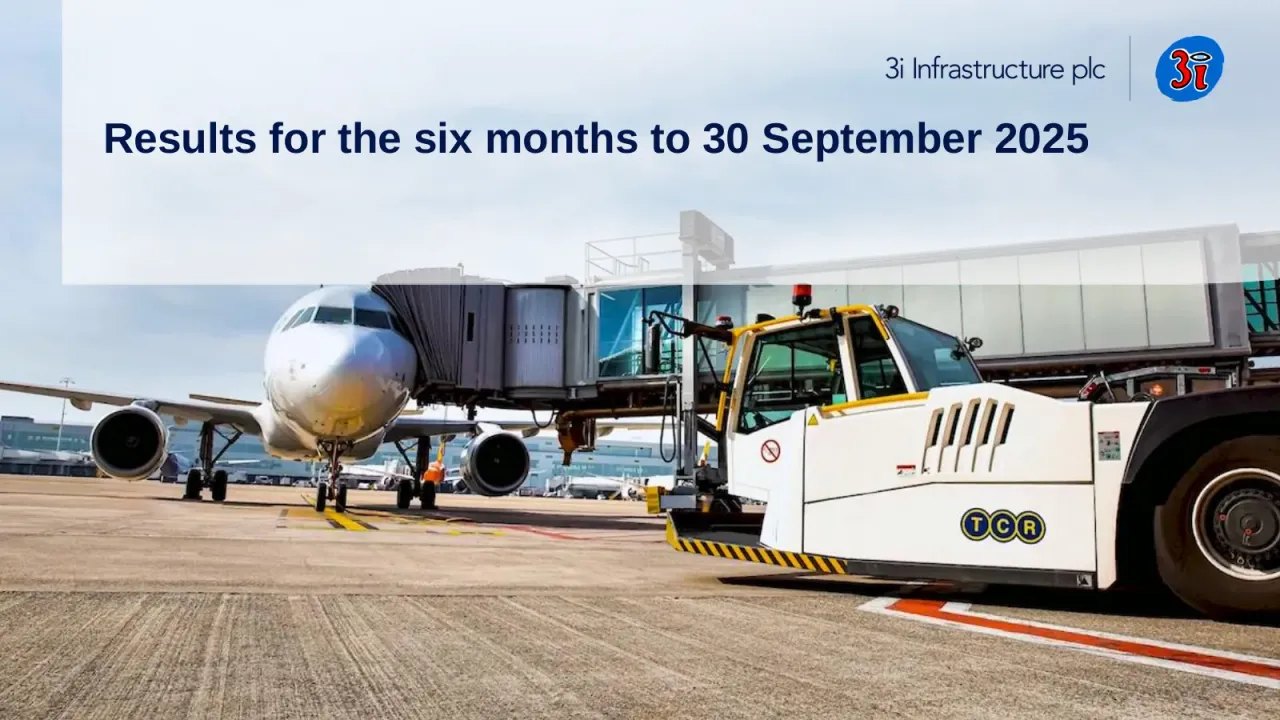
20:13 And, again, similar to the SVAC story, we, in 2022, were able to buy them out. There's a a story behind that, but I won't go into that in detail. And at the same time, we syndicated a stake to third party money managed by 3I that sits alongside 3IN. So even though this is the largest investment in in 3IN, there's there's another stake alongside it, and we will be selling all of that... All of the business to a future buyer if if that... If we're successful. So about 71 percent of this sits within 3INstructure PLC. When we bought into this, it was a business providing leasing ground handling equipment in airports. So this is one of those logos that you can spot as you travel.
21:01 It's on the equipment, everything that moves around the plane or around the airfield that isn't a plane. So the tractors that push the planes back, the tractors that bring the the bags to the plane, the steps, the catering trucks, all that sort of thing. So it's a it's a leasing business. It will lease to ground handlers, airlines, and in some cases, And at acquisition, it was principally a European business operating in about 95 in... Well, in 95 airports. We've then we've then grown that. And and the real growth driver rather than an increase in air travel, it's really been an increase in the penetration of leasing in terms of the the the market for this equipment.
21:49 And a new statistic that's come out as we've gone through our work defining the white space for taking this business to market is globally only about 12% of the equipment, the ground handling equipment, is leased. The rest of it is owned by the users of the equipment. So there's a there's a huge white space to go for for leasing. And, of course, during our our ownership, we went through COVID when airports were shut and and people weren't travelling. And this really proved the infrastructure characteristics for for TCR because TCR's leases are availability based leasing. And and the customers under the contracts have to pay TCR so so long as the equipment is available to be used regardless of whether they're using it or not.
22:39 So TCR, unlike its customers, unlike the airlines and the ground handlers, held on to the the vast majority of its earnings through COVID, which really proved out the infrastructure characteristics. When
22:52 we first bought into this business, it had been in a private equity fund, and it really wasn't viewed by people as a as a as a core infrastructure asset. It is now much more viewed by the market as an infrastructure asset, and that passage through COVID has has been important for that. So post COVID, when DWS were looking to monetize their stake, We thought there was a lot more growth to go for, so we we decided to buy their share off them. So we've shown in in the charts here that by that point, we were operating in a 172 airports. There'd been substantial growth at that point. But we were right. There's been a lot more growth since, so we're very pleased with that that investment buying them out.
23:37 And we're now at a position where the business operates in in 240 airports. It is now a a global platform. It started to penetrate The US market in a very meaningful way, in particular, a recent contract to be the only provider of equipment on a pooled basis where TCR will manage the overall pool of equipment and all of the the users of that equipment in JFK's new terminal one will will contract with TCR to use the equipment. And that's a fully electric fleet, so the energy transition and and electrification, you know, ways away from diesel engines towards electric vehicles on the air on the airfield aprons has been a real driver for for new CapEx and for TCR's growth. That new terminal one at JFK, that's a fully electric pool of equipment.
24:29 So these are... You know, this is the space to grow into. The US is a huge market. We've made a meaningful start in The US, but we feel that now is a good time to take the business to market. It's a large company, but it's not too large. It's a nice fit in... For any of the large private infrastructure funds that have been raised in recent years. This will be a a good fit for them, and and there's more growth for for them to go for. So we think this is a... An appropriate time to go to market. In the private market, it it... These processes take months, so this is this is not something that you'll get immediate news on. But but in due course, likely next year, there will be additional news we hope to to bring to you.
25:18 So that's why that was a a very strong return during during the six months. A big chunk of that return was the strong performance of TCR, and the remainder really was the reflecting the upsides in in terms of some of the upsiding growth prospects for the business.
25:37 So looking forward, having gone through the sort of three three of the key assets, we we are on track to to exceed our target returns this this year. We're continuing to invest through our portfolio, but we do have line of sight, we hope, on on a potential realization in the next year. A lot of work has been going in this year to build a strong pipeline of of potential future investments. We've got an eye on further diversifying the portfolio. So if one comes out, ideally, two to three new things will will go in. It will be very returns driven and what what we expect from future investments. But to the maximum extent, having some optionality over timing on those investments so that we can try and match the timing of potential realizations with new investments. We do have a a credit facility at the three m structure level, which is there to help us bridge between realizations and and new investments.
26:44 Just to take you through... I've done just under half an hour so far. Other aspects of the portfolio, these these are are in size size order. And and particularly where we think about additional drivers of return if we are successful in in selling TCR, what are the other great companies in the portfolio that will will be drivers of return for the next few years? SVAC and and FLAG, I've already talked about. Those are large companies, and and we do expect great things from them. INFRASTRUCTURE PLC is also one of the largest companies in in the portfolio. This is an energy transition play. It is a a substantial power generator in The UK. It generates electricity from landfill gas.
27:30 So rather than flaring off the methane that comes from... Is emitted from from waste rotting in in closed off landfill sites, a much better thing to do with it is to capture that methane and burn it through a gas turbine engine and generate electricity and and plug that into the into the grid. This is base load power. It's it's always on. The gas is always coming out. The engines are always running. It's local to sources of demand. So, typically, landfill sites were built relatively near the outskirts of large urban centers. So you've got a a source of power that's local to large urban centres, so that's a positive thing. And where we've been investing in this business and to some extent the pivot has been as the methane resource, which you can see grey on the bar chart here, as it very gradually declines as the waste rots, eventually there will be no more methane coming off the landfill site, it is a gradual decline.
28:35 We've been able to roll out solar panels onto these sites, which is a good alternative use for the site. You can't build housing on them. You can't... It's not agricultural land a closed off landfill site, but you can roll out solar panel panels. And INFRASTRUCTURE is there. It operates already on the sites. And importantly, it already owns grid connections on the sites, which is, I think, may have read in in the newspapers, it can take a long time to get grid connections. But INFRASTRUCTURE is already there and has the grid connections often with spare capacity. So it's a it's a great head start for INFRASTRUCTURE to to develop. And as you can see in in the charts, the financial year there is to March. So to March 2025, they'd already installed a substantial amount of solar capacity.
29:29 By the end of next March, we're expecting actually the solar to be more generating capacity than the landfill gas in the business. So there's been a lot of investment going through there. The pipeline is 1.4 gigawatts, which is almost half a size well c, And, hopefully, we can we can develop that faster than size well c gets developed. And we've brought in a new CEO who who... This is part of a managed transition. So he's he's gonna be driving the growth of this business. And we've refinanced the business. So we... We've got additional debt, including more than a 100,000,000 of of sort of untapped CapEx facility to continue investing in in rolling out solar capacity here. So that's a great a great business, and we're expecting great things... Further great things from it.
30:21 TampNet is another one of our digitalization businesses. This is... This connects offshore platforms substantially in the North Sea, but also in the Gulf Of Mexico where when we bought into the business, this is one of these enhancing infrastructure characteristics, that network was there, but based on using a a fiber backbone owned by BP, where we had a... TempNet had a lease on that fiber. Early in the life of our investment, we bought that fiber off BP, so so that made it a much more solid position in the in the Gulf Of Mexico. And this is where the the the main customers would be oil and gas majors. They are increasingly automating operations on their platforms to improve performance, but also to take people off the platforms and have them run more onshore.
31:14 That obviously has health and safety benefits. It's it's hard operating a long way from shore. And in order to do that, they need high speed, low latency connectivity from the platforms to the shore where they have vessels, for example, or or floating rigs. They they need roaming connectivity, and TAMNET has roaming network around these platforms using, obviously, the platforms themselves to provide the sort of the towers in order to to get mobile connectivity. Increasingly during our our ownership, we've been bringing to customers private networks, so owning all of the sort of connectivity on the rigs and and some of the sort of sensors and and so on on the rigs themselves.
32:09 And most recently partnering with a business called Armada to deliver edge data centers. So this is as as AI workloads increase, having some of the data center capacity on the edge, so on the platforms themselves, but obviously connected through the the the fiber, the high speed fiber network that that Tampnetto also owns. So here, the the the thesis has been to to sell capacity and and an increasing demand for capacity on the fiber networks. But but we've also got a line of sight on on broadening the sort of customer base of the business, and we're really encouraged that the first contract has been has been signed with a customer to provide connectivity to to... For a carbon sequestration project in the North Sea. So once we finish...
33:05 Not we, again, it's the customers of TampNet finish pulling the gas out of the gas fields, for example, in the North Sea, in due course, it's likely that carbon will be will be pumped back down into the gas fields under the North Sea and and providing connectivity. Clearly, there's a much longer time frame for TampNet's network if we can succeed in in connecting customers to do that. So we're encouraged by that. That's potentially the future of the business. And the other side, of course, is connecting offshore wind farms. Typically, the the the electricity cables connecting the offshore wind farms have fibers... Fiber connectivity in them. But if you view TampNet's network as sort of a spider's web in the North Sea and in the Gulf Of Mexico, you can also connect to TampNet's network, and that gives you sort of redundancy or or additional bandwidth if you're an offshore wind farm operator, again, to automate and and monitor operations.
34:04 So we really... That's an excellent, very good very good performing company. Joules is another energy transition business, but it's not an energy generator or at least not substantially an energy generator. It's a a business that was a carve out of a regulated electricity network in in The Netherlands. Principally, its weight of operations in... Is in the South Of The Netherlands where, as you can see on the map we've put on this slide, there is is particularly strong grid congestion in the in the South Of The Netherlands. This was the non regulated business. It was the first sort of privatization of a division like that in The Netherlands. There are two other large networks, both of which have since sold off their unregulated business.
34:50 This installs and leases electrical equipment in customer premises. So think office parks, hotels,
35:01 increasingly data centers, for example, where they're installing the transformers. And rather than the ownership passing to the the landlord, Jules retains ownership and leases on an annual basis with with a sort of maintenance contract built into the lease. So full service rental. We like leasing businesses where where it... The ownership of the assets remains with with the company we own. As... Over time, we've owned this business for around six and a bit years. Over time, we've been transitioning this business into a broader integrated energy solutions business where it's not just the the the equipment like the transformers and the meters, which is the traditional business for for Joules, but really essentially all of the electrical infrastructure, including some generation infrastructure like solar panels on the roofs, electric vehicle charging in the car parks.
36:00 And because the grid congestion, if you've got, for example, a new data center or a new business park where they can't get an electricity grid connection, partnering with companies to provide on-site generation perhaps through through gas turbine engines where that can be running the bit... The the the office park or or the data center can be run off grid until such time as a data grid connection becomes available. And then when that happens, the the gas turbine engines can be taken away. But but that that grid connection will be complementary to the existing on-site generation from the solar panels and the storage either from batteries or or through the electric vehicle charging in in the car parks. So it's it's an integrated solution, all of the management of the energy and the balancing of the power would be through Joules' equipment managed by Joules.
36:56 So that's the... That's really the future, and and the pivot is is is... We're the sort of first to to be doing that in the in the Dutch market. So we've got a a... An advantage, a sort of first mover advantage in doing that. We're now starting to look at potential international growth opportunities, both actually organic and inorganic, so through potential bolt ons to the business. And this is where, you know, we can make investments over and above our original investment case where we see that they're accretive to our original returns that we were expecting from these businesses. I'm slightly conscious of time, so I want to leave time for for questions. Again, these are the key ones because they're in in size order. Eonisos is a business demographic change was... Is the sort of megatrend behind it.
37:48 This is a business where the end customer is really in in the in the medical equipment and and pharmaceutical market, so health care. This business sterilizes medical and and pharma products. So if you think about things that that you might see in a hospital, whether it's syringes or or catheters, things that are in in packages where where they're sterile packages and and when they're used in the hospital, you open the package and and and everything's sterilized inside it. These are things that can't be sterilized by heating them up, which was obviously a traditional method of sterilization, but instead they're they're blasted with radiation which kills all the bugs that that may may be in the in the packaging and in the product.
38:35 And there are... It it... It's run as a market in Europe really with with only three players. Two are American based, and it's only part of their market is is in sterilization. And... But Eonisos is is the the the third player, and and this is all it does. It's performed extremely well over our ownership. The underlying volume growth, sort of the demand for the products is growing. There's ever more demand for sterilization of things we put on and inside ourselves, and there's ever more demand for health care. So so the underlying dynamic's been very strong, and and the pricing power that it has has been good. We've been getting good price increases year on year, and so the inflation linkage is is strong.
39:24 We've recently strengthened the board with with somebody who used to run STERIS in Europe. So that's one of the other competitors. And so he's obviously bringing great insight into the market and things that Jonasos could be doing better. I'm just gonna keep whizzing through. DNSnet, I've mentioned this is one of our other digitalization businesses. It's a fiber to the home network rollout in the in the German market. It it has had a tougher tougher start. The the German market has been difficult, but but we took quite a lot of action early on, recruited new management team to take the business forward and focused on connecting homes rather than just rolling out fiber down down streets because we'd seen a gap opening up between the the capital essentially that had gone into into the ground to to provide the trunk network, but not not enough revenue coming through from connected customers.
40:24 So we paused the trunk rollout. We focused exclusively for a period on the connecting the customers. The business is now profitable, covering the the cost of the development team, and and and we're very happy with the penetration rate. So we're over a third penetrated, which is well ahead of the German market average. We want to keep growing that, obviously. Eventually, we'll open the the network to wholesale, so you'd be able to buy your Internet connectivity from a number of players, but using DNSnet's network. There are some questions in the q and a already on this, so I'll I'll deal with some of that detail later on when I do do the q and a. But this business does seem to have stabilized and turned a corner, so so it's growing in valuation again. Oyster catcher is is now one remaining terminal for liquid sort of petroleum products in in the main...
41:21 So in the main, it's gasoline storage and blending in Singapore, which is a very strong market in in Asia. It's a sort of strategic location to store oil products. This is a business we sold most of it. It used to be a a portfolio of of five terminals invested from from really the start of the life of 3IN. Again, there's a question in the in the q and a that's been submitted, so I'll I'll address where we are with it at the moment. But it... This is a a really great business. As the CFO, this makes me very happy. It's... It it always does what it's what it's supposed to be doing. It's a very strong contributor to to income yield for for 3IM structure, so it's a very good business.
42:11 So... But I'll I'll address the question in a minute. SRL is a business where we've been... We we... We've had some difficulty. Again, there's a question in the q and a, so I'll address some of that in a moment. But after we after we bought the business, there was a marked slowdown in expenditure on repairing roads from local authorities who had... Who were cash strapped. The long term megatrend, is that the roads are crumbling and do need to be repaired, and the overall state of the roads gets worse every year. You know, the the repairs are not keeping up with the the requirements on the roads. And the the the rollout of some new new pipes and and and strengthening the electricity grids, all all that renewing aging infrastructure, that is all real. You know, the... There's gonna be a lot of investment in the water network in the next five years.
43:07 The the fiber net... Network rollout is not yet complete. Strengthening the electricity grid is clearly something that needs to happen in The UK. So the megatrend is there, but we've had a a slowdown in demand since we first acquired the business. We've also had, as as many businesses in The UK have have experienced, rising minimum wage costs, which have affected the the business. It has a large depot network and and lots of people driving around, replacing batteries and and and putting lights out on the roads. This is a temporary traffic light lessor. I should have said that at the beginning. And indeed, the the employer's national insurance increase obviously hit the business. So we've reflected that. We've reflected some caution in in the in the near term, and we've we've actually taken out some of the cash flows for some of our simpler products in the longer term to reflect what we're seeing in the market. But we do have strong future areas of growth that we're we're expecting to to try and try and do better with in due course. Again, I'll cover some of that in in the q and a.
44:15 Very quickly, our smallest business, Future Biogas, is a... Well, it's grown a lot since we bought it. It's a generator of energy through anaerobic digestion. So it generates methane, so non fossil fuel methane. And it's done better than expected since we since we bought into the business. It... Its plants are performing ahead of our expectations. We we built recently a new plant with an offtake agreement with AstraZeneca. So this is part of customers' sort of long term decarbonization plans is to... Rather than using fossil fuels, sometimes you do need to use methane in industrial processes or or in requirements where then high heat is required.
45:08 So rather than using fossil fuels, they want to use biomethane, and here's a source of it from future biogas. That's a a long term offtake agreement, a fifteen year agreement. No subsidies, and that's that's been fully constructed, the the gas has been produced really since the start of 2025. We would like to do more of that, and and we have more in the pipeline. So so we... There is a strong future for this business. So that's the end of the core part of the presentation. There are more slides, and and as I said, the deck is available on the on the website. But I think I'm now ready to move to q and a. Perfect, James. That's great. And thank you very much indeed for your presentation this morning. Ladies and gentlemen, please do continue to submit your questions just by using the Q and A tab that's situated on the right hand corner of your screen. But just while James takes a few moments just to review those questions that have been submitted already, just like to remind you that a recording of this presentation,
46:09 along with a copy of the slides and the Q and A, can all be accessed via your investor dashboards. James, as you can see there, we have received a number of questions that were both presubmitted ahead of today's event as well as those that have come in throughout your presentation this morning as well. So firstly, thank you to all of those on the call for taking the time to submit their questions. And, James, at this point, sir, if I may hand back to you just to read out those questions and give your responses where it's appropriate to do so. And if I pick up from you at the end, that'd be great. Thank you. Okay. Thank you very much. So there's sort of two themes in the questions in the q and a. Some are on our portfolio and our strategy, which I think I'll cover first. And then there's a bit about the market, in particular market news in in the last week for other listed infrastructure companies. So I'll make sure I I I cover that at the end.
47:02 And, Jake, if I if I forget to do that, can you please prompt me? But I can see them here. So the first one is on t... TCR. Why why are you looking to to to sell TCR? And we do think that that this is a good time to to take the business to market. It has it has achieved all of our original investment thesis, our our investment case. It's achieved all of our second investment case when we bought out our our co shareholder in 2022. We've got... It's now a global platform. It's got to a really good size, but it's equally not too big to sell on to a future buyer. And and this is part of our model is that that as investors, we we will grow our businesses and periodically sell them.
47:49 We are long term holders. Think, overall, it's more than seven years is the average hold period in the portfolio at the moment. TCR, we're likely to have held for about ten years by the time if we're successful in selling it this time around. And it's been a great compounder, but if we can get a really great price for it now, we can drive exceptional value for shareholders and then seek to redeploy and continue to diversify the the portfolio. It's a delicate balance when to take businesses to market. We're extremely thoughtful about it and have thought long and hard about it. We love this business. It's been growing extremely well. But we do think this is a good time to take it to to market, and there's a lot of interest in it.
48:38 DNSnet was the next one, talking a bit about DNSnet and and whether we about the risk of somebody else coming in overbuilding our our investment. So so one of the reasons we've invested in DNSnet was because it was a regionally focused play. It was just in a region around Berlin. We weren't trying to cover the the whole country in in fiber. And it's a a a sort of suburban, semi rural area, so an area where there's relatively low density of housing, so decent space between houses, where there... It only will make sense, we think, economic sense for one network to be built, and then eventually that network to be opened up on a wholesale basis so that other sort of providers of of Internet services can can sell to the end customer, but using that network and paying to use that network.
49:40 That has proven to be the case. So we haven't been overbuilt in the areas that that we were... We're out in. And where there was another player
49:54 building in selected areas, which which meant they got their first and and DNSnet then not going to build in those areas. We've seen that lessening because of the, I think, quite well publicized difficulties in rolling out fiber networks in Germany. We we see actually less competition in our area now. So so fewer people coming to try and... Nobody's coming to try and steal our lunch. So I think we got the overbuild risk right. I think that focus play was the right call. That... It has been difficult, but we think we have the right strategy and the right control over our fiber network. So, ultimately, we do see a a route to making a good return on the... This investment. It it is growing. Again, we... We've we've increased the valuation in the last six months.
50:44 And, ultimately, we're building a utility that that will undeniably be a core infrastructure asset. You know, fiber connectivity is is essential for people that have it. I, you know, I couldn't wait to get it when I was at home. Sort of took took a long time in The UK. It's taken a long time in The... In in Germany as well. So I think we've got that right, but it's been difficult. The investment case for SRL is the next question. It's been challenging as we as we said in our results. The questioner isn't isn't local authority spending always scarce? And how are you planning to make any money in in this market structure? It's a good point. But I think as as we showed on the graph on the slide, it's been particularly scarce since we invested in in SRL, which has been unfortunate.
51:37 And I I think what what what we would like to do ultimately is to be able to contribute to improving health and safety, improving the cost for customers of undertaking roadworks. And that's not just local authorities. It's principally utilities as well who have a lot of need to dig up the roads and improving traffic flow and improving emissions. And you do that with more complicated temporary traffic lights that have that can adapt to the traffic that can see either with radar or now in our latest latest products with cameras and with remote monitoring of lights where the traffic flow can be managed and the timing on the lights can change to reflect the buildup of traffic around junctions.
52:29 And being able to do that in a lower cost way because on many roadworks in The UK, you may not see them, but but the the permit for digging out the road specifies having a man in a van sitting there, monitoring the traffic, and then intervening in the timing of the lights. But, actually, you can have multiple junctions monitored by one person in the SRL control center. So these are SRL employees with the full sort of traffic management qualification. But they can look at more than one junction, and they're there. They're not at the side of the road. It's safer. They definitely turn up. There's an ex army guy sitting at the back of the room making sure that everything's being done properly. So it's it's run as a monitoring center rather than a a load of individuals at the side of the road, and that is cheaper. So it's a cheaper and better solution.
53:21 So I think that's how we want to take the business. That strategy seems clear and sensible. The megatrend is clear. The roads are crumbling, and the local... And the utilities need to do the roadwork. So there's there's something to go for. It's it's been very hard work, and we'll continue to work very hard on that business. The next one is around oyster catcher and that oil storage terminal that I that I covered. Very successful investment over a long hold period, the questioner kindly says. We realized four of the assets a few years ago. What's the plan for the rest of the stake? As I said, I'm I'm particularly happy with that investment. It's a... It's been a a very good performer, and it's a good cash yielder.
54:06 So we're not in a hurry to sell it. I think we've we've been clear with with investors that it's not actually a long term hold that we would be opening to realize it at the right time. We're we're not trying to sell this at the moment. This is one that we don't actually control. We don't have a controlling state. We've got sort of a joint governance arrangement with the operator of the terminal, Advario. So maybe maybe there would be an opportunity to sell alongside them, or in due course, maybe we can sell to another financial investor like us that Advario would be happy to partner with, particularly if it's a financial investor that they partner with in other things. So there could be other ways of monetizing it, but it's it's a great business. So no hurry to do that. We've taken some value off the table by adding a bit of holdco debt ahead of it. So, essentially, borrowing money against the terminal, against the robust cash flows of the terminal and and getting an extra distribution to 3IN. So the equity value is a bit less that we're holding that at.
55:11 That's that one. Another good one on on the the 3I Group has been building a US infrastructure team in recent years. Are there any plans to include US investments in 3IN? Well, it... It's a possibility. I mean, the the the idea was to build the track record with a sort of seed capital, and and there's been some third party money raised as well that that team are managing, and they've been investing in exclusively through US North American businesses. So it it potentially is something that we could look at, but it's not a current focus for us. We do see good good opportunities in Europe, so our focus is remaining on European headquartered businesses. But as I said, we we do have a number of multinationals.
55:56 I talked about TCR growing in The US. We talk to our US colleagues all the time. We we share ideas. They're familiar with TCR. We're familiar with their airport equipment business called Smart Cart that does luggage trolleys. So there are... There's... There there are benefits to having North American team within the the 3i sort of ecosystem, but no current plans to to deploy capital from 3IN through that team. But I say it could be something for the future. A question about why we sold our company in Valerem, one of the best performing assets alongside other very strong performing assets, steady and high returns. Was there room to scale it further?
56:42 Yes. Room to scale it further, defining the white space for for a future buyer and getting them to pay pay now for future growth. That was something that we believe we did successfully. It wasn't a a zero risk business. It was a business that was an energy developer principally in France, but but it's been growing around Europe. It was an onshore wind developer. We sold when it had achieved a very decent scale and sold to essentially a more core infrastructure, lower cost of capital investor that wants to back the next phase of growth. And it may be that the returns available on the next phase of growth that that they may they may scale faster if they take except slightly lower returns.
57:31 The management team were keen for a deep pocketed future backer for their business, and and we'd been in it, I think, for for about eight years by that point. And we thought it was a good time for us to sell it on where it still had a very clear growth pipe... Pipeline ahead of it. And it... We got a very strong return on that business, sold it for materially more than we've been holding it for. That's what we do.
58:01 Before I get on to the market one, just looking through some of the other questions that have been raised as I was delivering the presentation. Who are the minority shareholders in in the companies? As I said, sometimes we syndicate it to third party money. So these would be generally private infrastructure fund investors, so limited partners in the industry jargon. There's there's... It's often pension money, long term pension money, and so institutional money. And as I say, we, 3IN, manage that money alongside 3IN. We also, in many of the businesses, we have the the the management team, some of which may be founders, but the management team invested alongside us. It's good. It aligns...
58:46 It's an aligned incentive to have them invested in the in the equity alongside us. So that's... But, typically, where where it's, say, 25, 30% minority alongside, when you look through the charts, that... That's typically other institutions that we're managing.
59:06 That's that one. I think... So undersea... Final final one on the portfolio. Undersea data cables, talked about, and, obviously, it's in the news very relevant recently. It's been a Russian vessel that's been crisscrossing an area where there are data cable... Data cables. Breakages in data subsea cables are a fact of life. There are there are a number of them on on the flag network each year. Typically, it's it's fishing boats, and so either anchor dragging or or trawling, breaking the the cables, or sometimes it's sort of subsea activity. So so sort of wave action and tidal action changing the the the shape of the the seabed and and sometimes you get a bridge and a cable will snap.
1:00:03 There may be examples. It's not always easy to prove whether a fishing vessel is is not fully a fishing vessel that are security related. There is a whole industry. It's sort of like a self insured model for the whole industry. There are vessels regionally focused that go out and their job is within a few weeks to repair any breakages in the network. So it's an ongoing process. It's something that's always been present in the industry. And one of the benefits of our networks are that they're, as I mentioned, spider's web, so there are many ways the the data can travel to go from a to b. It can go a number of different routes, and that's part of the attractiveness of our our network to customers. So it's a fact of life. The data can go around a breakage, and then the breakages are repaired.
1:00:53 I think I'll call it a day on the asset questions now and cover... I'll I'll read out the first one, which covers it. So with the combination reshaping the listed infrastructure space, how is 3IN positioning itself in terms of energy transition exposure, capital allocation, and sustaining dividend cover... Coverage while pursuing growth? That's a great question. Many parts to it. I mean, firstly, our our view, and it's... You know, our advisers have helped shape our view on this, is that the sector needed to shrink, and it will shrink. And it has already started to shrink. Too much money was raised when interest rates were too low, and and the returns available from many of those vehicles have not been enough in a world of higher interest rates where if your return isn't that far above what you can get from investing in in a in a ten year government bond, for example, then why would you do that?
1:02:00 3IN has always been different. I mean, we we... We've been more than a decade focused on this core plus return. We... We've we've been trying to target eight to 10%, but trying to outperform that. So so a more than 10% return, but with the downside protection from investing in infrastructure assets, but with growth. So we've been quite a different proposition. It's an equity proposition. It's not a bond proxy, and we've always tried to make that very, very clear. So we think we... Our our position is just as relevant now as it as it always was and that it is differentiated from from HICL, from INPP, and from TRIG and and the other renewable funds. One of the big differences with 3IN's investments and some of the renewable funds is we invest in the developer, operator, and owner of assets.
1:02:54 INFRASTRUCTURE operates PLC its generation assets. It owns the assets. It's it's selling the power. It's got a power price hedging program. It it... It's it's, you know, it's got a development capability. There are people working there. Often in renewable funds, what you have is a portfolio of assets. So you don't have the development function. You don't have the operation function. Those things are outsourced to to third parties. So you're buying something quite different when you're buying into 3IN's businesses. And the same is true for our future biogas. It's a it's a real company with real people with operational and development expertise. So we can do more with our renewable assets than a pure play renewable portfolio.
1:03:44 So that's how we differentiate ourselves. That's how we think we can sustain our our model. Our capital allocation is not going to be just to buy assets in in isolation. We have been investing, as I've said, through INFRAS in rolling out solar panels through future biogas in developing new plants. We did actually buy plants from other people where where Future BioGas was already operating. We bought economic ownership from from two parties for for plants. So that is something we do, but it... It's through the development platform. So I think that's a very different thing. I don't think I have anything more to add. I've been asked quite a lot of this on the road, but the the broker notes and the the pieces that have been in the times and and so on have have said very sensible things about it being not an obvious con... Combination.
1:04:42 But but if it's a way of the sector consolidating and then the number of parties shrinking, that's probably at the margin, a good thing for 3IN. 3IN's proposition will clearly be different from from a combination of hickel and trig, for example. So I don't think we need to change our positioning. I hope that answers that question. That's, I think, that covers a lot of things on the on the the call. Oh, there's one final on the weighted average discount rate. I think I'll make this my final question. I slightly run over an hour. About the weighted average discount rate, the the questioner says it's risen slightly. It was only point 2%. It's gone from 11.3 to 11.5%.
1:05:34 You know, what... What's behind that?
1:05:38 And and then there's a question about what's the duration of the portfolio. That's a bond proxy question. So I'll cover the waste average discount rate rising slightly. I think you should view that as a as a portfolio mix effect really rather than a a a sort of wholesale view of of increasing discount rates. Obviously, it is an increase, and and increases in discount rates typically serve to reduce the valuations, whereas our valuations overall have have gone up quite quite strongly. There's there's a clear increase in the weight in the portfolio from from TCR, so I think you can read read read into that. But we don't... Our principle for valuations is to make changes in in the performance of the companies and the prospects of the companies through the cash flows and not muck around with the discount rates.
1:06:27 We keep our long term assumptions on inflation, on long term interest rates, and so on constant. The inflation rate assumption we have is 2%. Other people have higher inflation assumptions. Inflation is is a good a good thing for for this portfolio. And our discount rates are consistent with that. So we we haven't made any wholesale changes in discount rates. On the what's the approximate duration of the portfolio, I just mentioned this is an equity portfolio. These are equity investments in equity returns. We don't see ourselves as a bond proxy, so so we don't have a duration of the portfolio. You're taking equity risk, but with downside protection from the asset base and the essential nature of what these companies do and their strong market positions.
1:07:13 So we don't we don't measure and we don't publish a a duration.
1:07:20 Perfect. It's Jake. Over to you, Jake. Thanks, James, and thank you very much indeed for being so generous of your time then addressing all of those questions that came in from investors this morning. And, of course, if there are any further questions that do come through, I will make those available to you immediately after the presentation has ended. But James, perhaps before really now, just looking to redirect those on the call to provide you with their feedback, which I know is particularly important to yourself and the company. If I could please just ask you for a few closing comments just to wrap up with, that'd be great. Well, the main thing is to thank you all for your attention and joining joining this this call. I think this is something we'd like to continue to do. It's a new thing for us, but retail investors are very important. We do think this is a very relevant return, you know, an eight to 10% return. That's the net net of everything, net of all fees and costs.
1:08:07 Don't don't add any more costs onto that. That's that's what we're trying to deliver, and we've consistently delivered it over the life of the company. Perfect, James. That's great. And thank you once again for updating investors this morning. Could I please ask investors not to close this session as you'll now be automatically redirected for the opportunity to provide your feedback in order that the management team can really better understand your views and expectations. This will only take a few moments to complete, but I'm sure it'd be greatly valued by the company. On behalf of the management team of 3I INFRASTRUCTURE PLC, we would like to thank you for attending today's presentation. That now concludes today's session. So good afternoon to you all.
Follow 3i Infrastructure PLC into a list and get an email when it puts out news.
Chief Financial Officer at 3I INFRASTRUCTURE PLC