Motilal Oswal Mutual Fund - Motilal Oswal Nifty 100 ETF · NSE:MONIFTY100
Motilal Oswal Mutual Fund - Motilal Oswal Nifty 100 ETF — Association of Mutual Funds in India — Investor Presentation (December 2019)
69 slides from Motilal Oswal Mutual Fund - Motilal Oswal Nifty 100 ETF's investor presentation, December 2019
Slide 1: Investor Awareness Program
Investor Awareness Program Copyright ©2019 Association of Mutual Funds in India ver1_122019 1
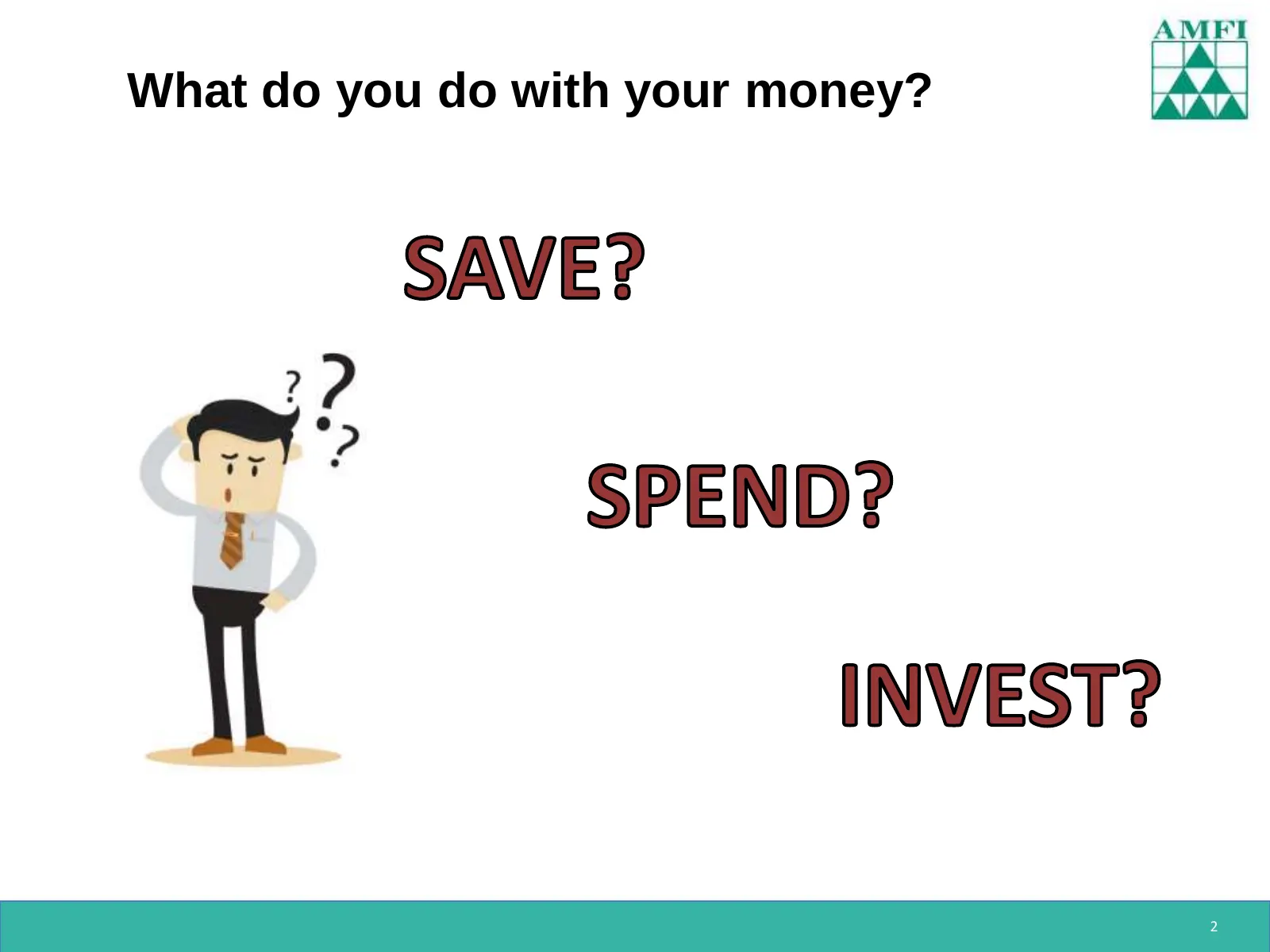
Slide 2: What do you do with your money?
What do you do with your money? 2
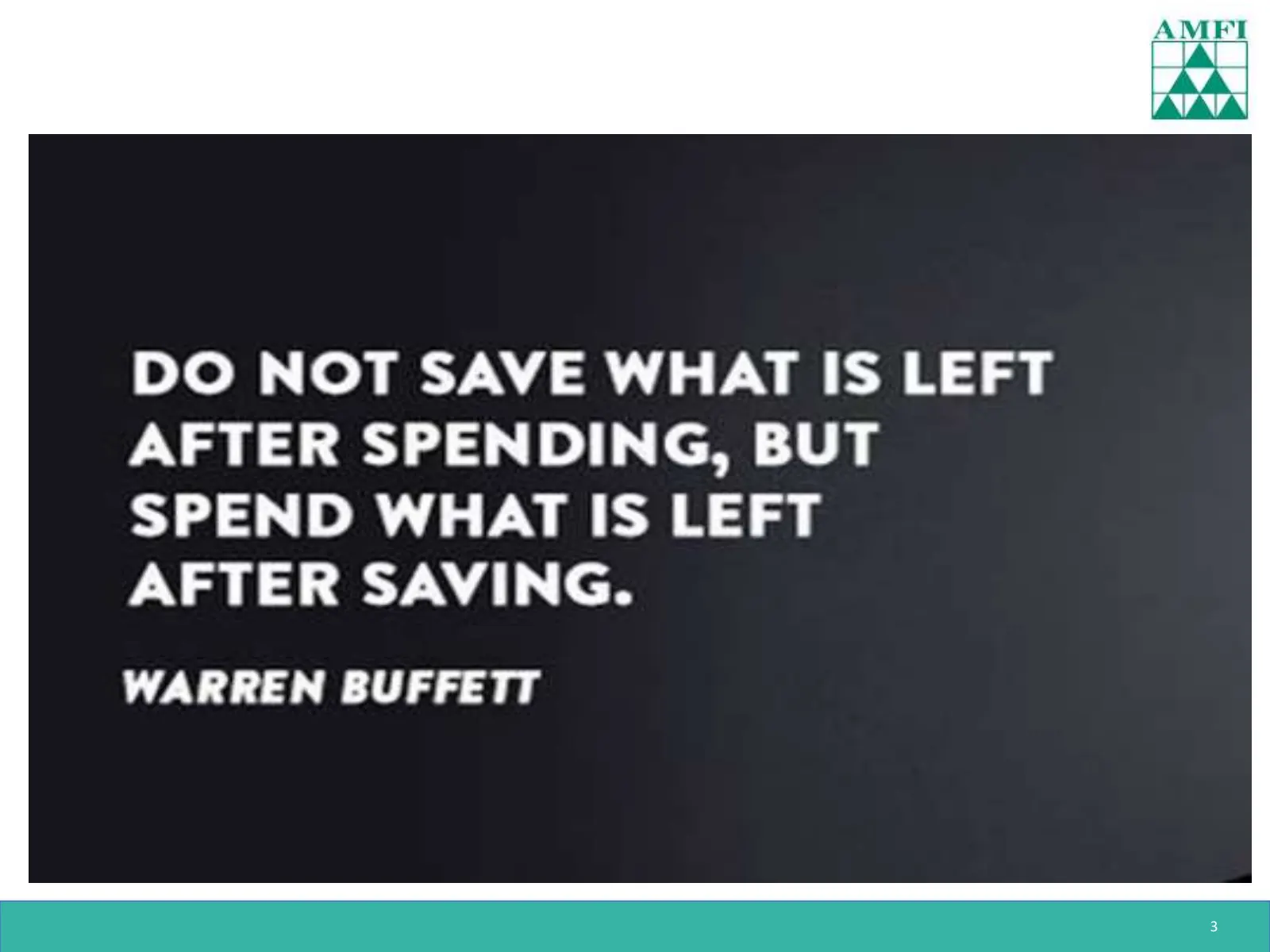
Slide 3: Do not save what is left after spending (Warren Buffett quote)
DO NOT SAVE WHAT IS LEFT AFTER SPENDING, BUT SPEND WHAT IS LEFT AFTER SAVING. WARREN BUFFETT
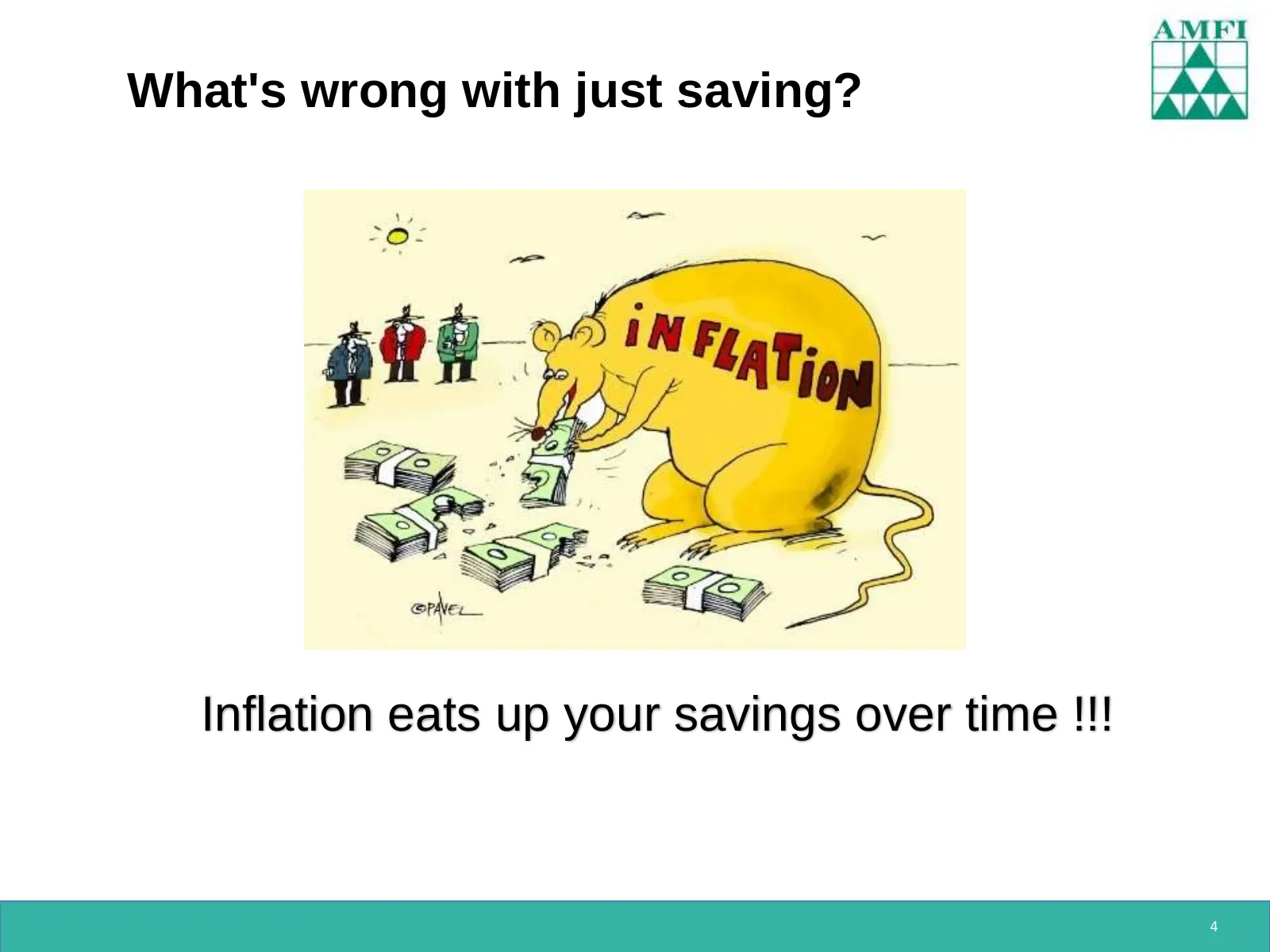
Slide 4: What's wrong with just saving?
What's wrong with just saving? Inflation eats up your savings over time !!! 4
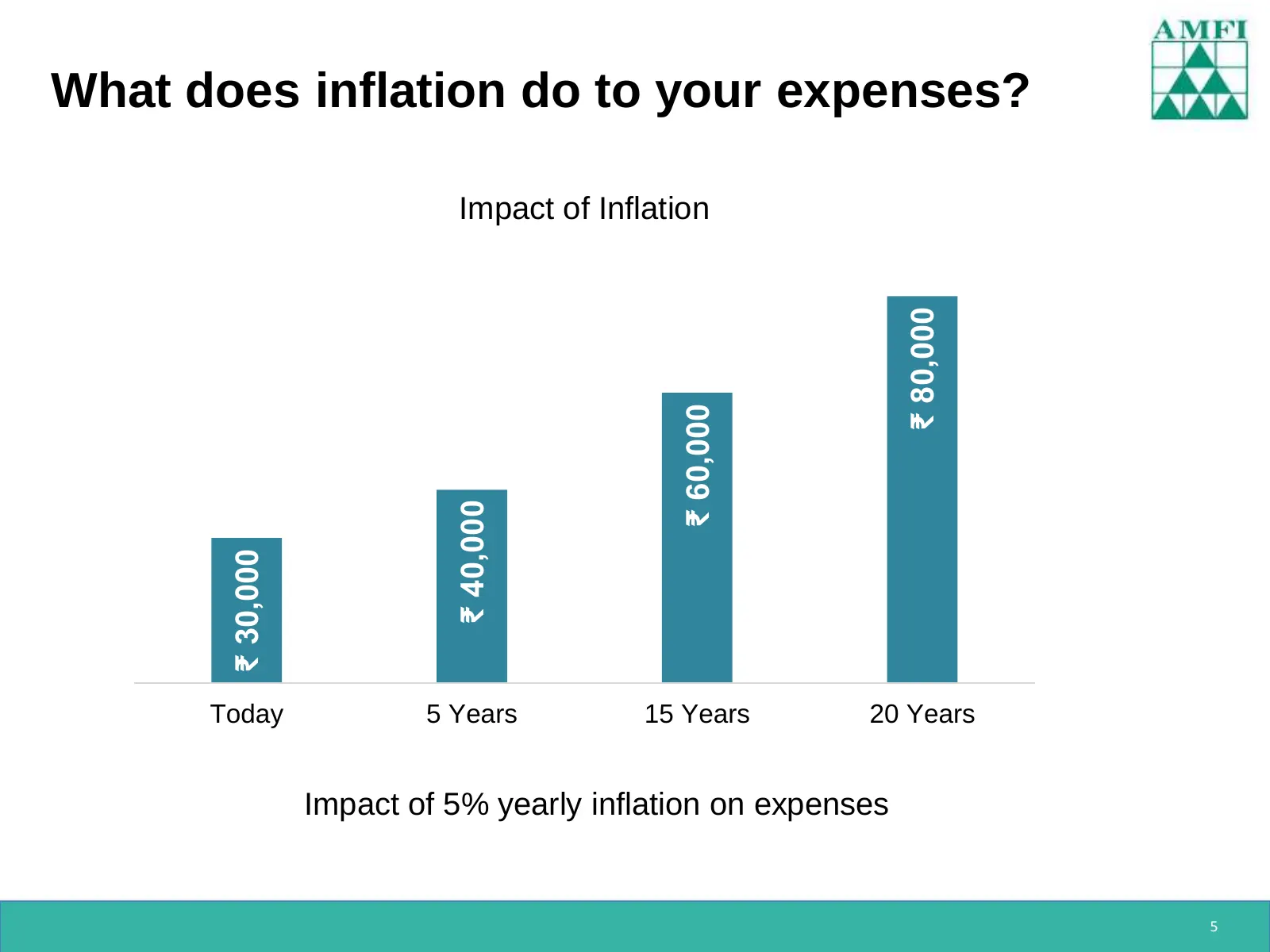
Slide 5: What does inflation do to your expenses?
What does inflation do to your expenses? Impact of Inflation ₹ 80,000 ₹ 60,000 ₹ 40,000 ₹ 30,000 Today 5 Years 15 Years 20 Years Impact of 5% yearly inflation on expenses 5
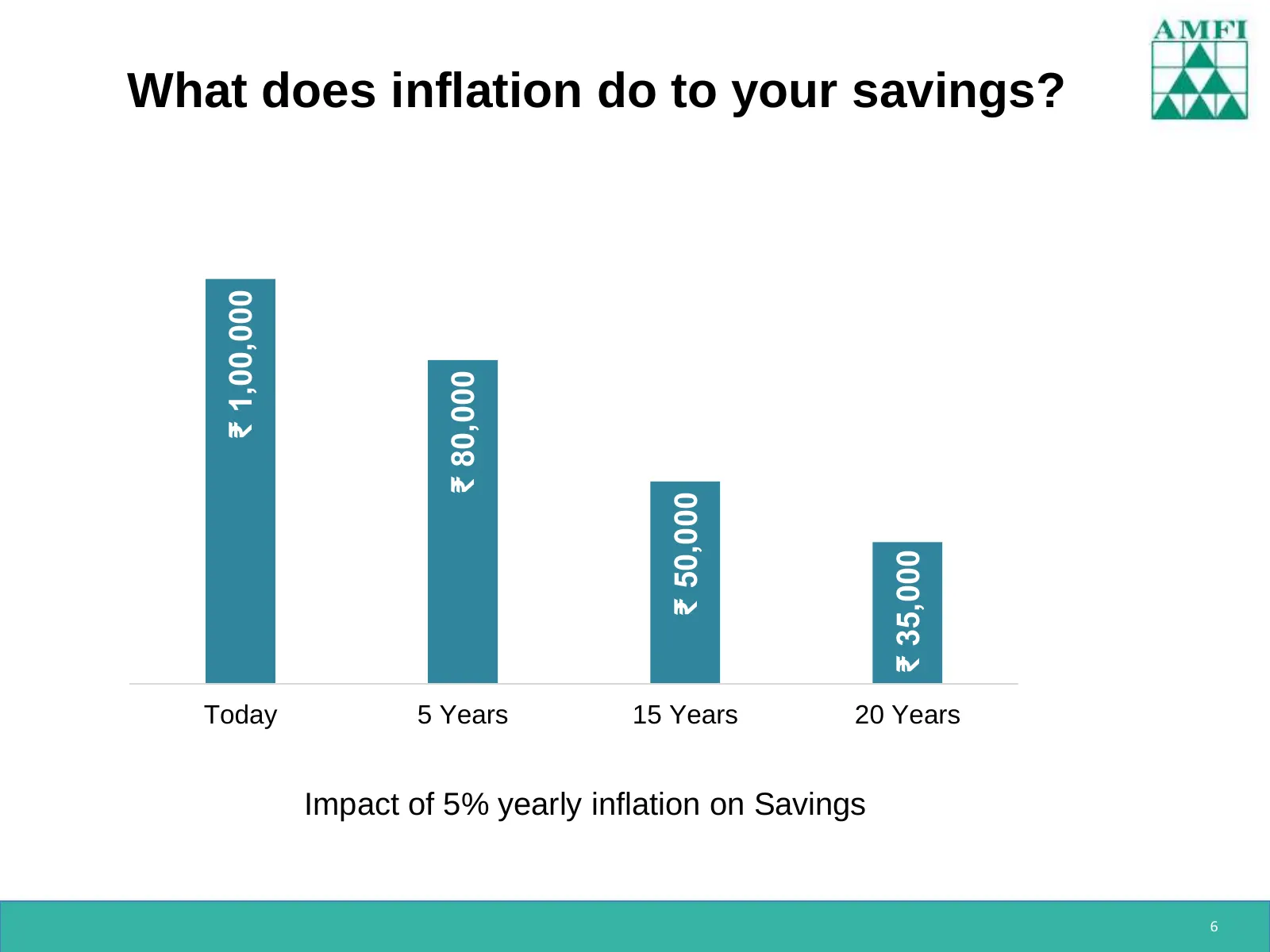
Slide 6: What does inflation do to your savings?
What does inflation do to your savings? ₹ 1,00,000 ₹ 80,000 ₹ 50,000 ₹ 35,000 Today 5 Years 15 Years 20 Years Impact of 5% yearly inflation on Savings 6
Slide 7: Solution? Investing - the safeguard against inflation
Solution? Investing - the safeguard against inflation • Start Saving … earlier you start the better • Progress from a Saving to Investing • Put money to work rather than accumulating or keeping it idle • You work hard to earn money … So, make the money work hard for you • Benefit from the Power of C
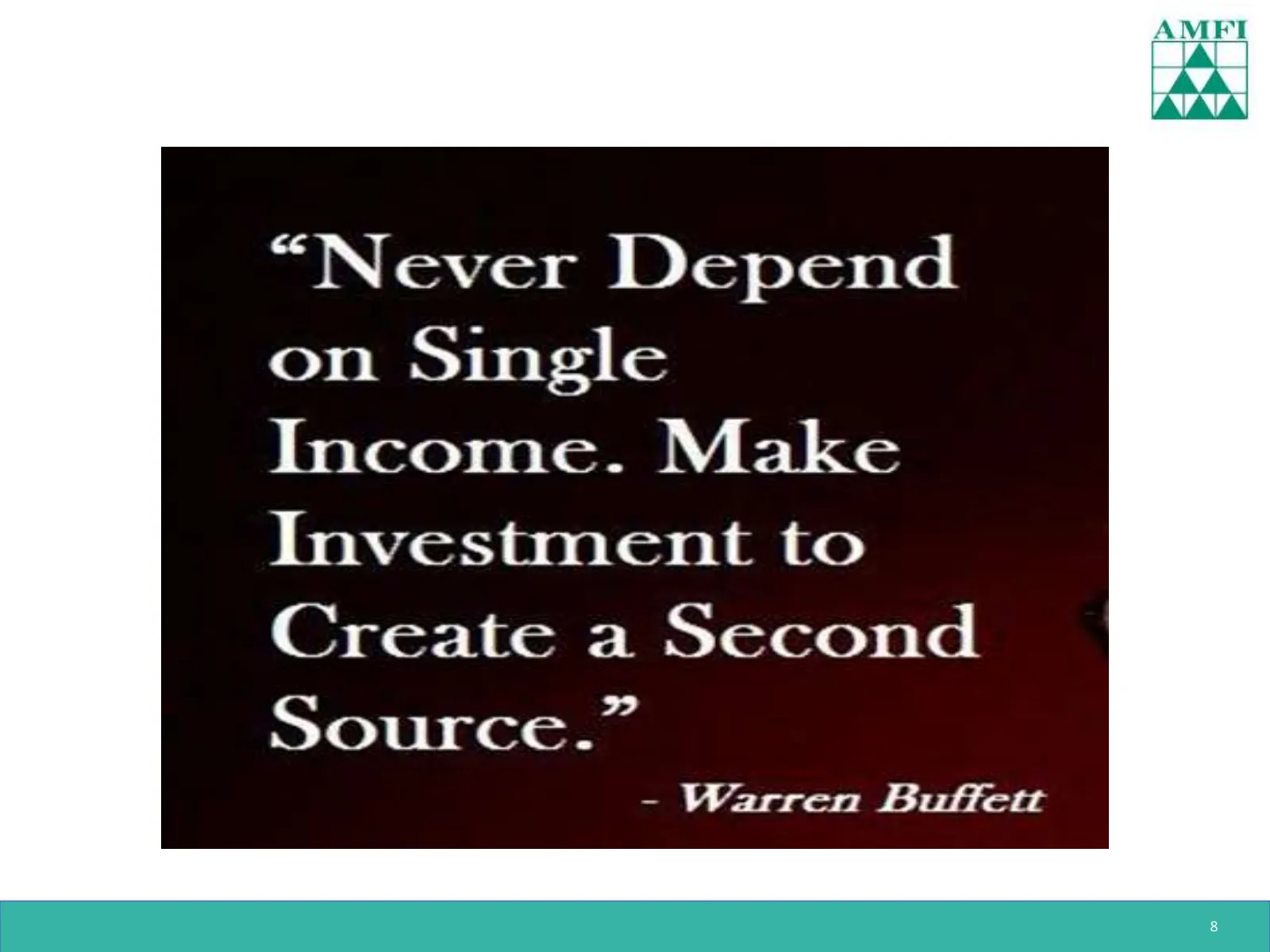
Slide 8: Never depend on single income (Warren Buffett quote)
“Never Depend on Single Income. Make Investment to Create a Second Source.” -~- Warren Buffett
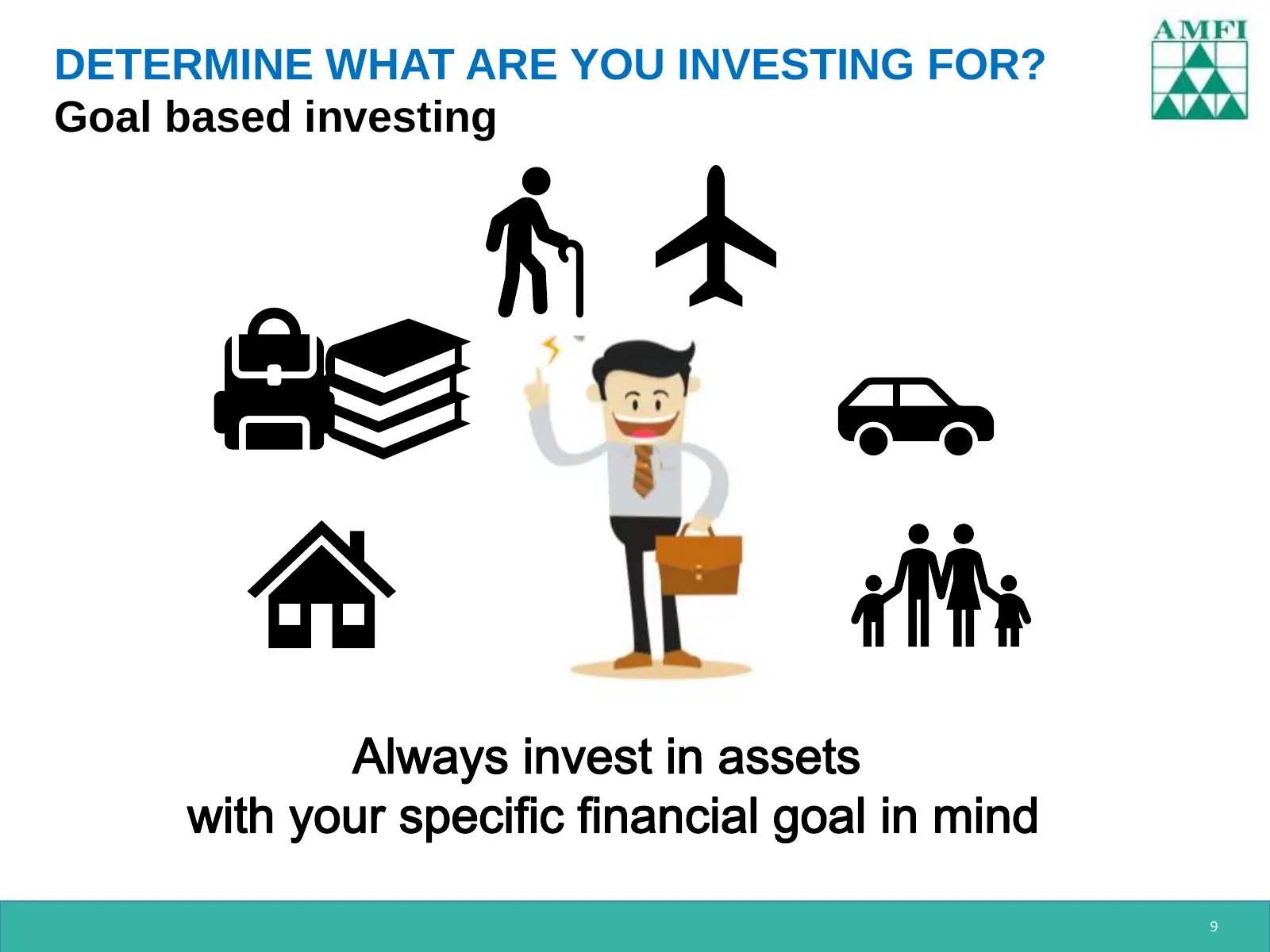
Slide 9: Determine what are you investing for? Goal based investing
DETERMINE WHAT ARE YOU INVESTING FOR? Goal based investing 9
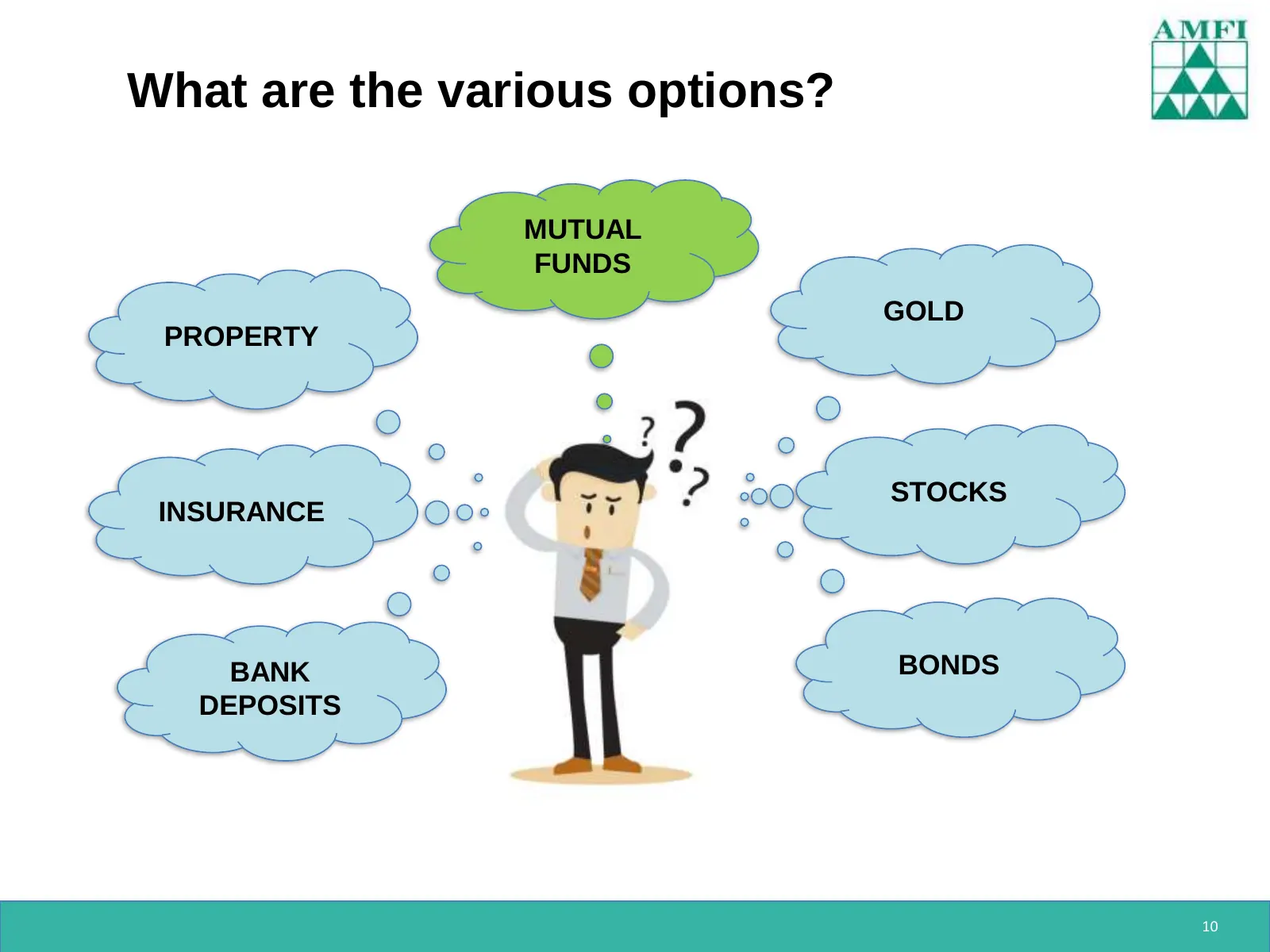
Slide 10: What are the various options?
What are the various options? MUTUAL FUNDS GOLD PROPERTY STOCKS INSURANCE BANK BONDS DEPOSITS 10
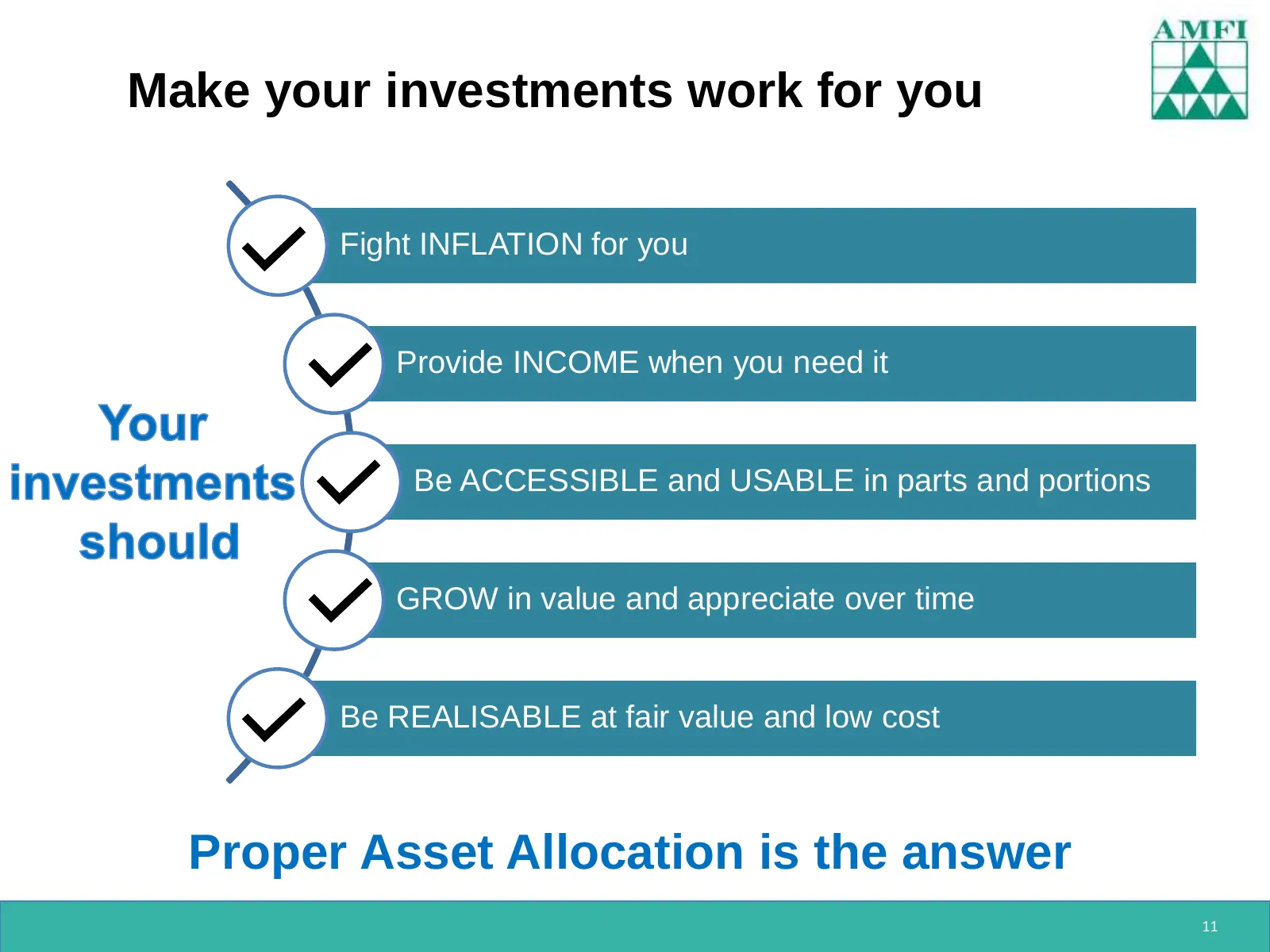
Slide 11: Make your investments work for you
Make your investments work for you Fight INFLATION for you Provide INCOME when you need it Be ACCESSIBLE and USABLE in parts and portions GROW in value and appreciate over time Be REALISABLE at fair value and low cost Proper Asset Allocation is the answer 11
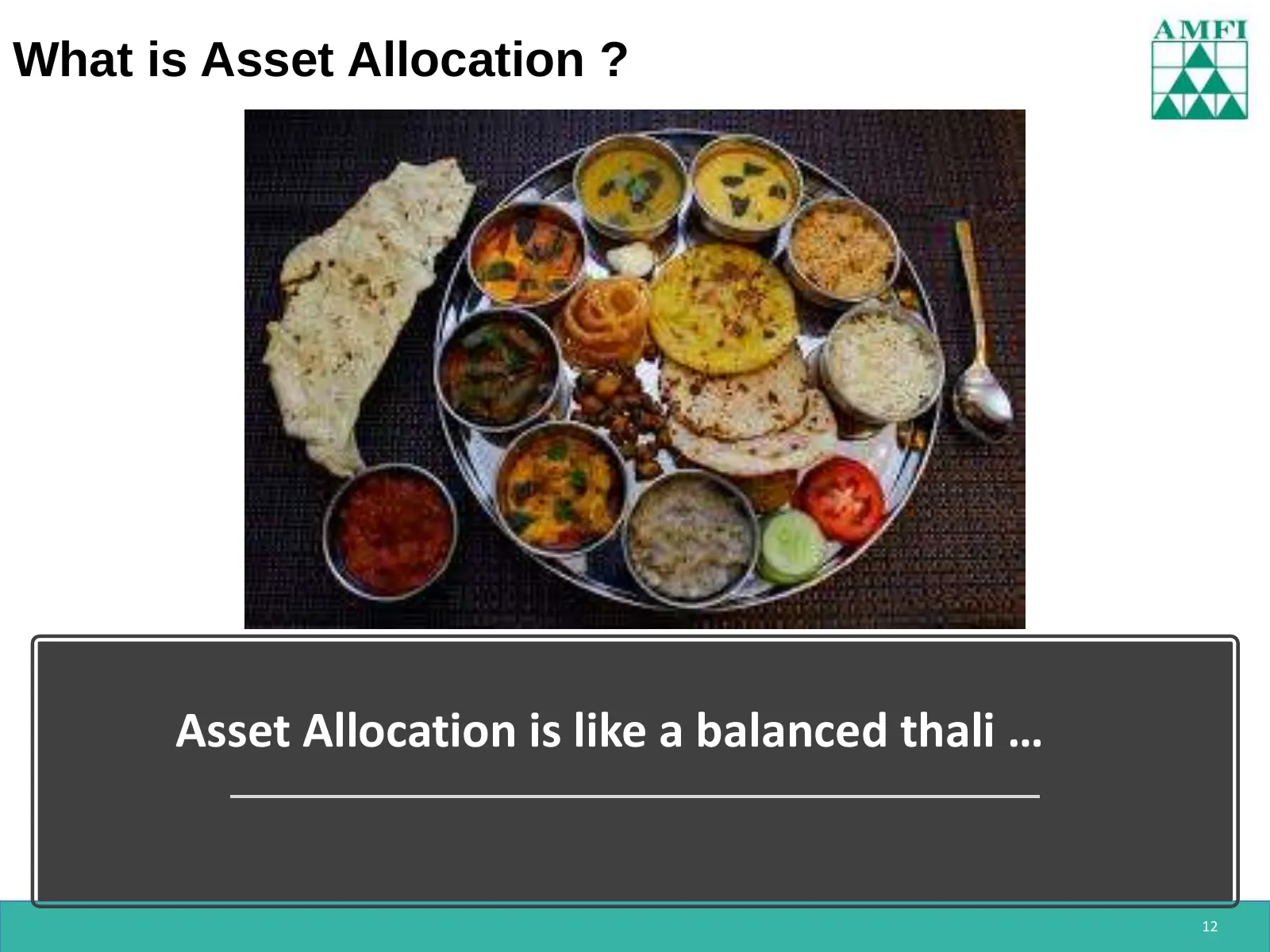
Slide 12: Asset Allocation is like a balanced thali
What is Asset Allocation ? Asset Allocation is like a balanced thali … 12
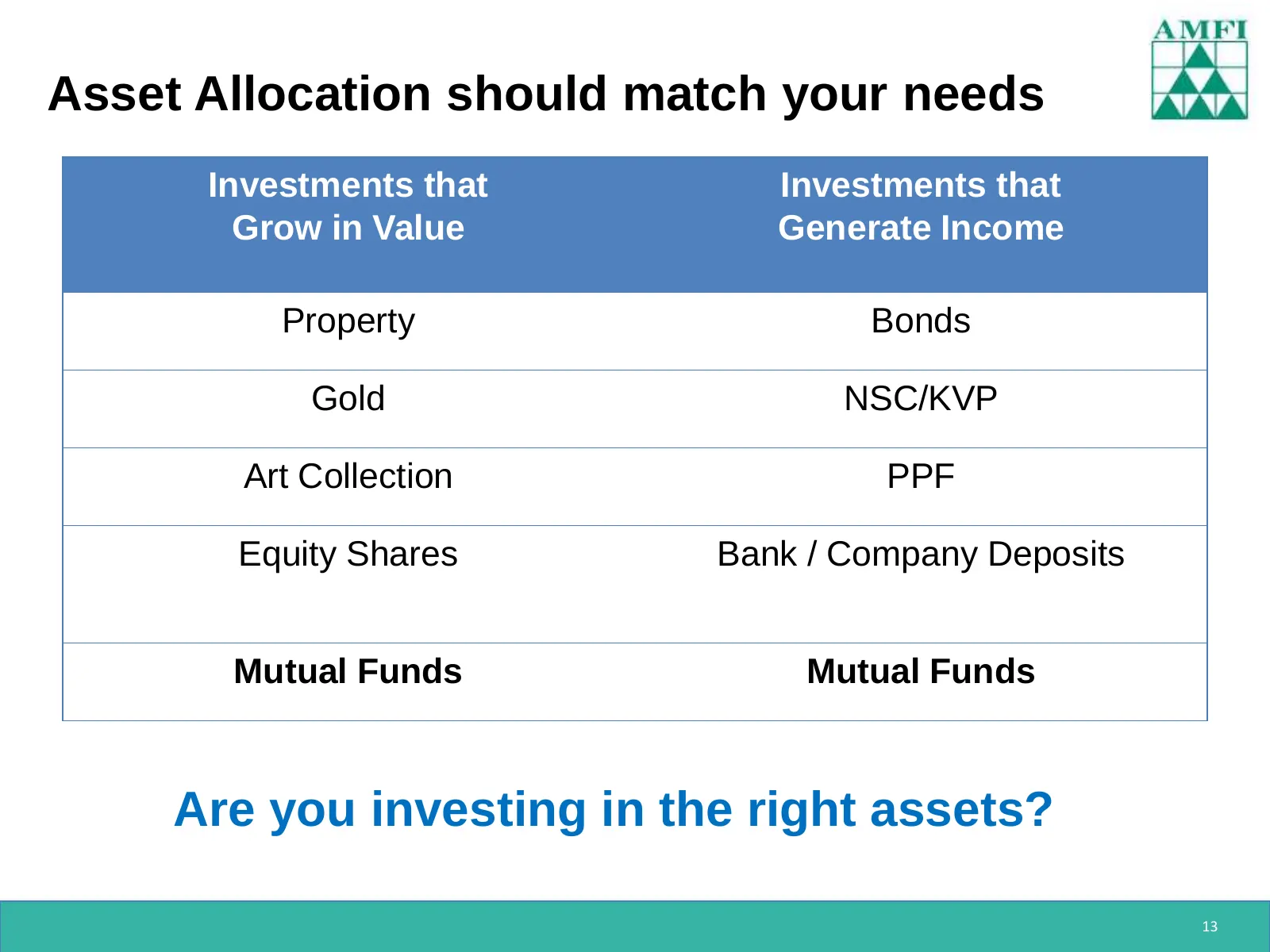
Slide 13: Asset Allocation should match your needs
Asset Allocation should match your needs Investments that Investments that Grow in Value Generate Income Property Bonds Gold NSC/KVP Art Collection PPF Equity Shares Bank / Company Deposits Mutual Funds Mutual Funds Are you investing in the right assets? 13
Slide 14: Mutual Funds
Mutual Funds 14
Slide 15: What is a Mutual Fund?
What is a Mutual Fund? • A mutual fund is the trust that pools the savings of a number of investors who share a common financial goal. • Anybody with an investible surplus of as little as a few hundred rupees can invest in Mutual Funds. • Money collected is invested by a professional fund manager in
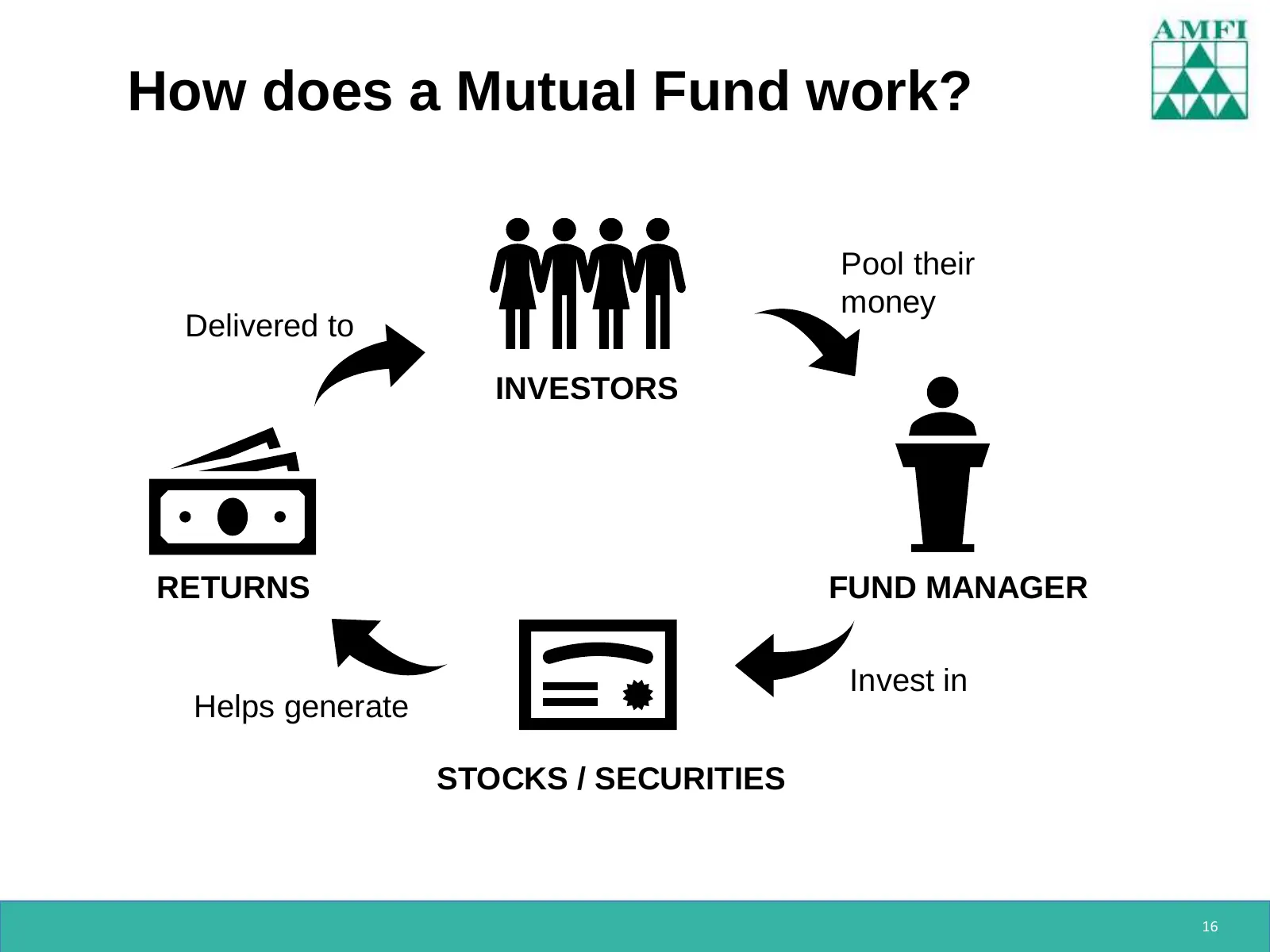
Slide 16: How does a Mutual Fund work?
How does a Mutual Fund work? Pool their money Delivered to INVESTORS RETURNS FUND MANAGER Invest in Helps generate STOCKS / SECURITIES 16
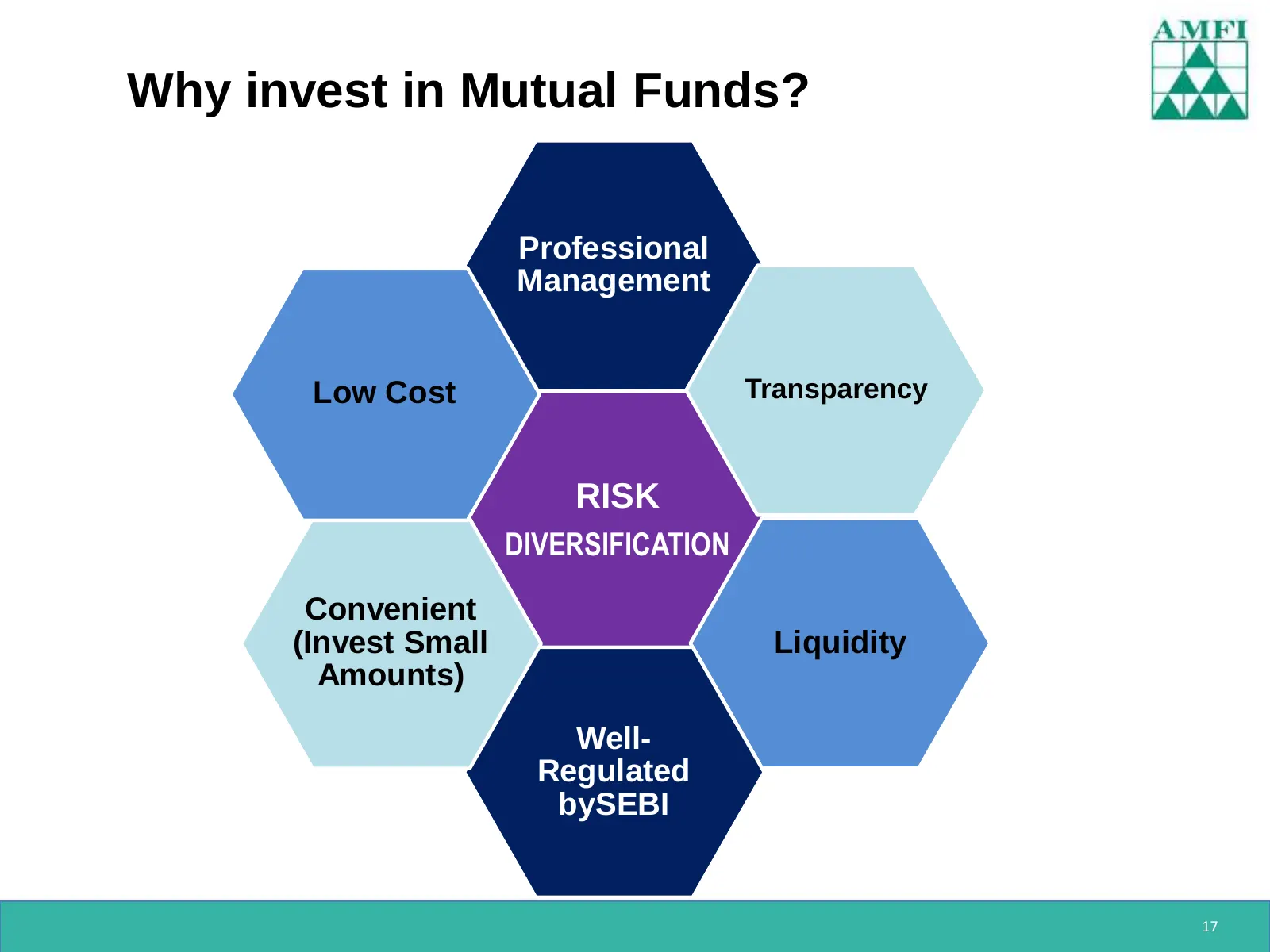
Slide 17: Why invest in Mutual Funds?
Why invest in Mutual Funds? Professional Management Low Cost Transparency RISK DIVERSIFICATION Convenient (Invest Small Liquidity Amounts) Well- Regulated bySEBI 17
Slide 18: Mutual Fund Structure & Scheme Categories
Mutual Fund Structure & Scheme Categories 18
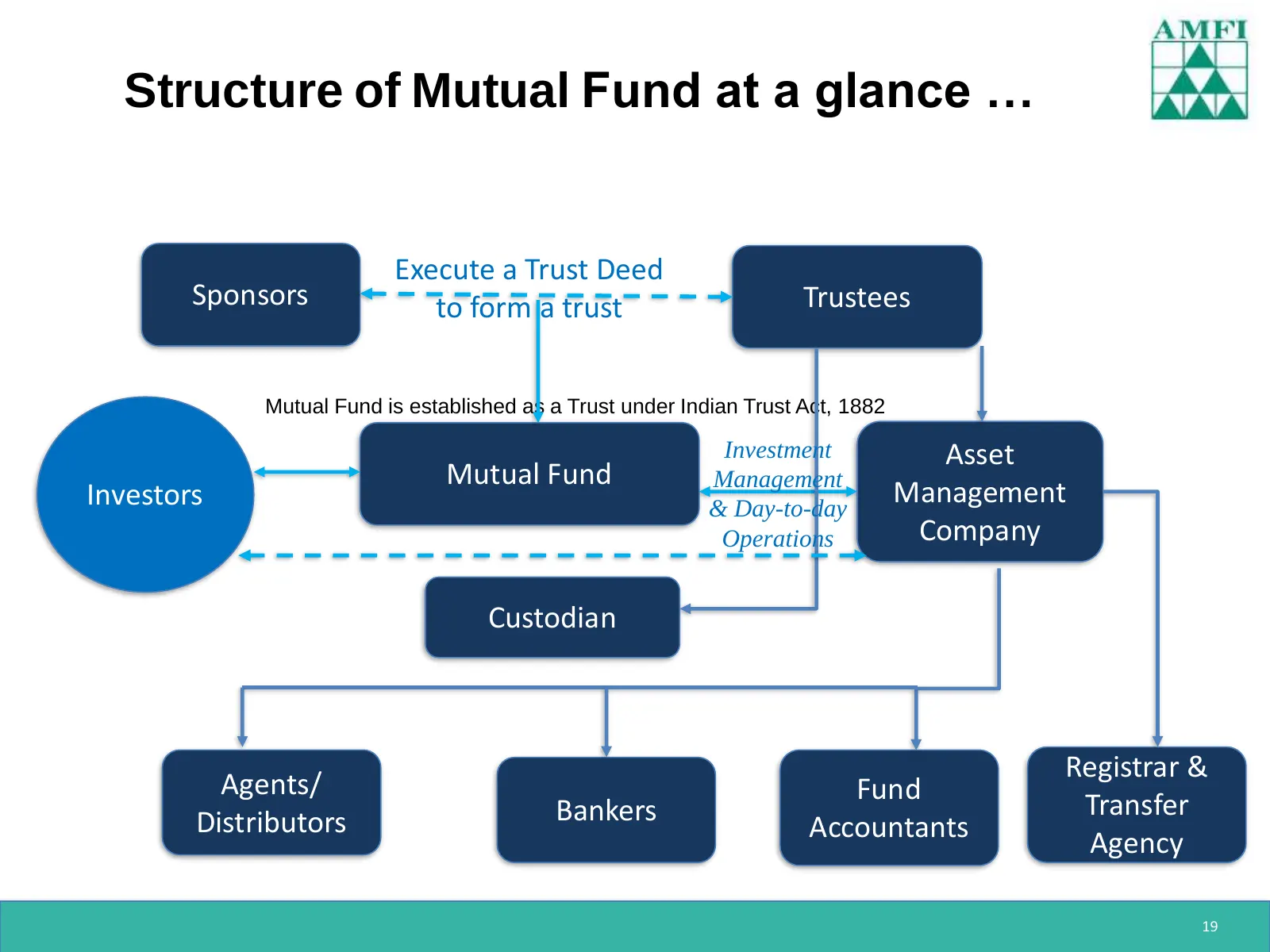
Slide 19: Structure of Mutual Fund at a glance
Structure of Mutual Fund at a glance … Execute a Trust Deed Sponsors to form a trust Trustees Mutual Fund is established as a Trust under Indian Trust Act, 1882 Investment Asset Mutual Fund Management Investors & Day-to-day Management Operations Company Custodian Registrar & Agents/ Fund Bankers Tra
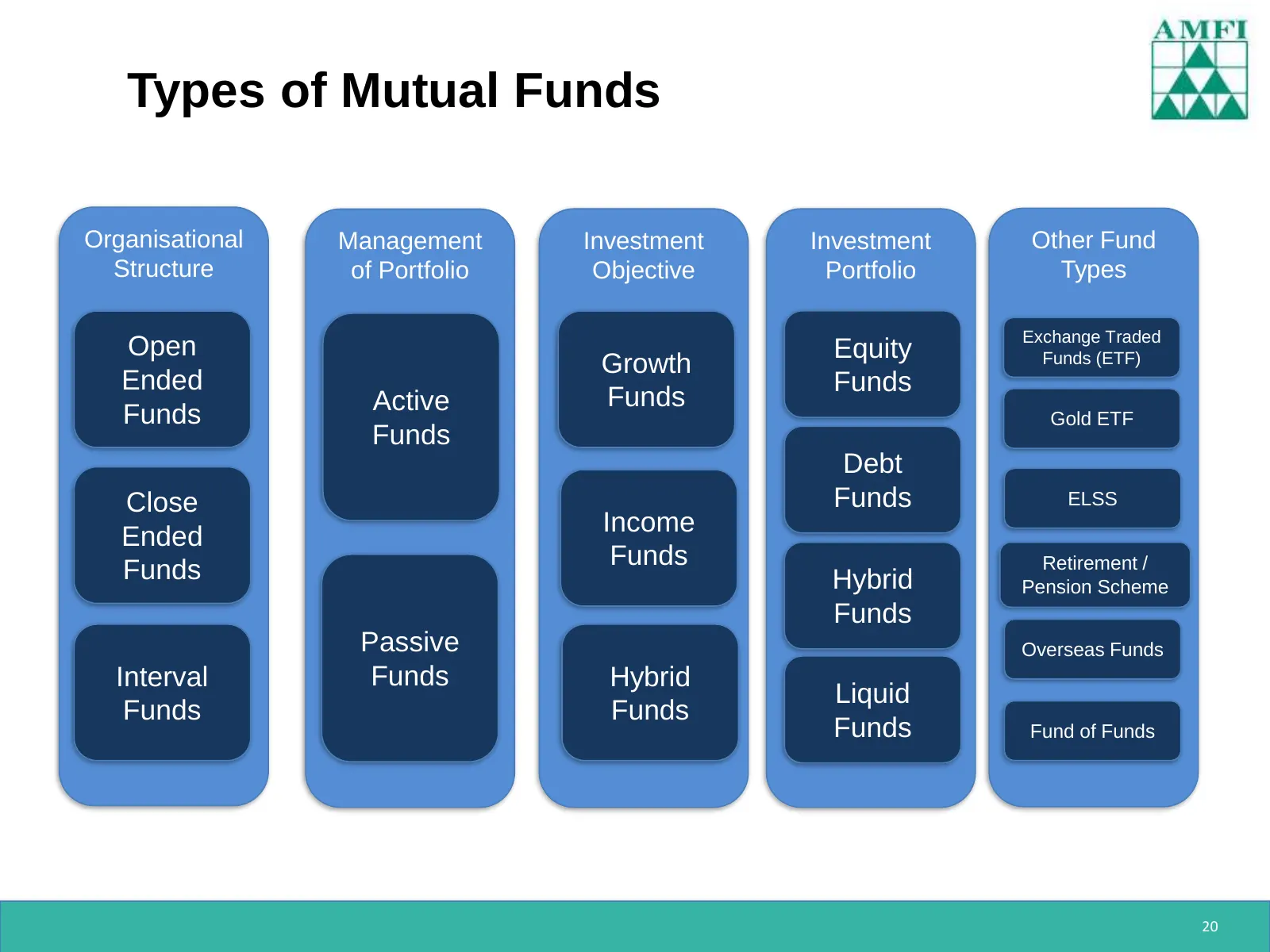
Slide 20: Types of Mutual Funds
Types of Mutual Funds Organisational Management Investment Investment Other Fund Structure of Portfolio Objective Portfolio Types Exchange Traded Open Equity Funds (ETF) Growth Ended Funds Active Funds Funds Gold ETF Funds Debt Close Funds ELSS Income Ended Funds Retirement / Funds Hybrid Pension Sc
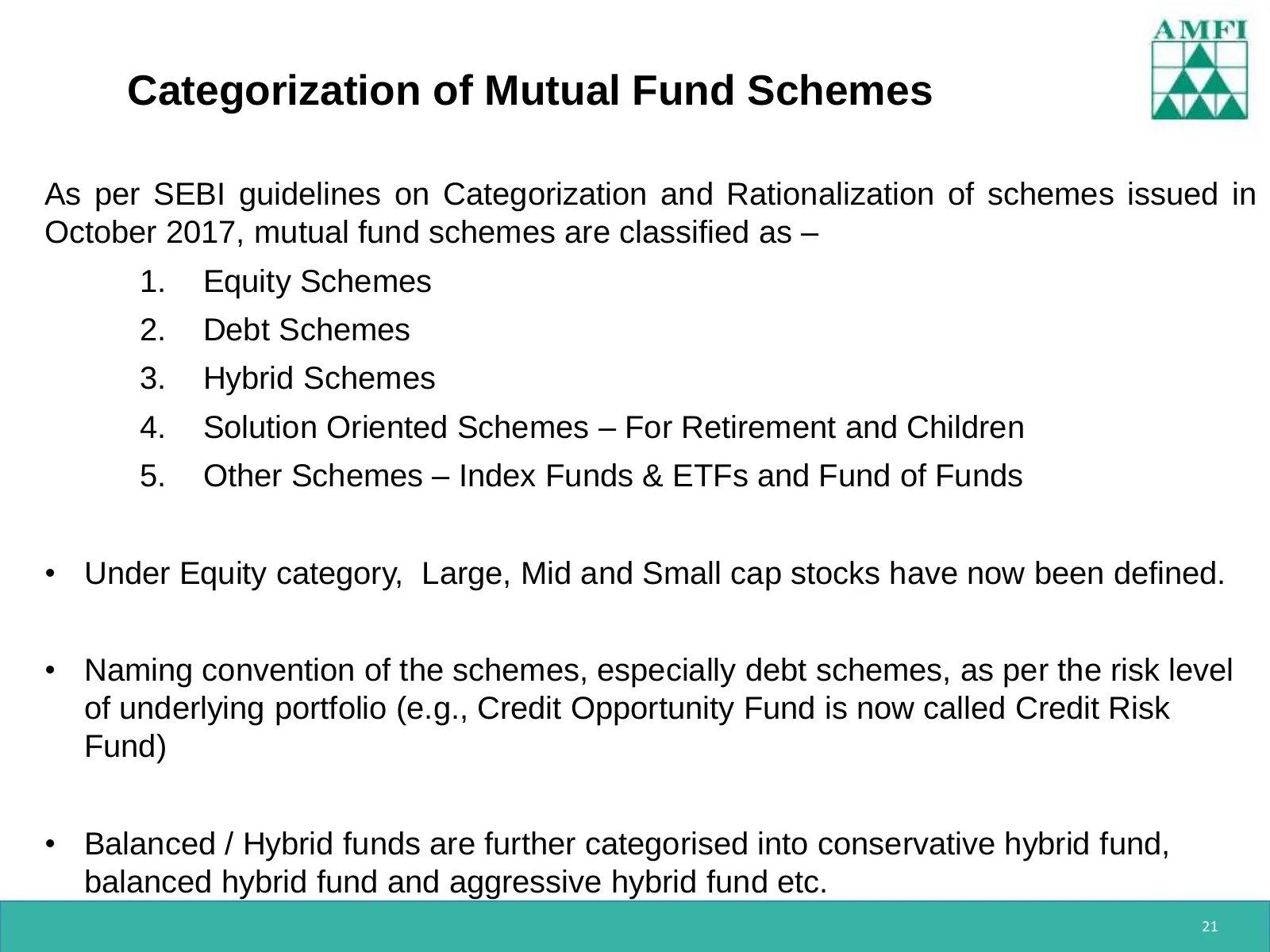
Slide 21: Categorization of Mutual Fund Schemes
Categorization of Mutual Fund Schemes As per SEBI guidelines on Categorization and Rationalization of schemes issued in October 2017, mutual fund schemes are classified as – 1. Equity Schemes 2. Debt Schemes 3. Hybrid Schemes 4. Solution Oriented Schemes – For Retirement and Children 5. Other Scheme
Slide 22: Equity schemes
Equity schemes 22
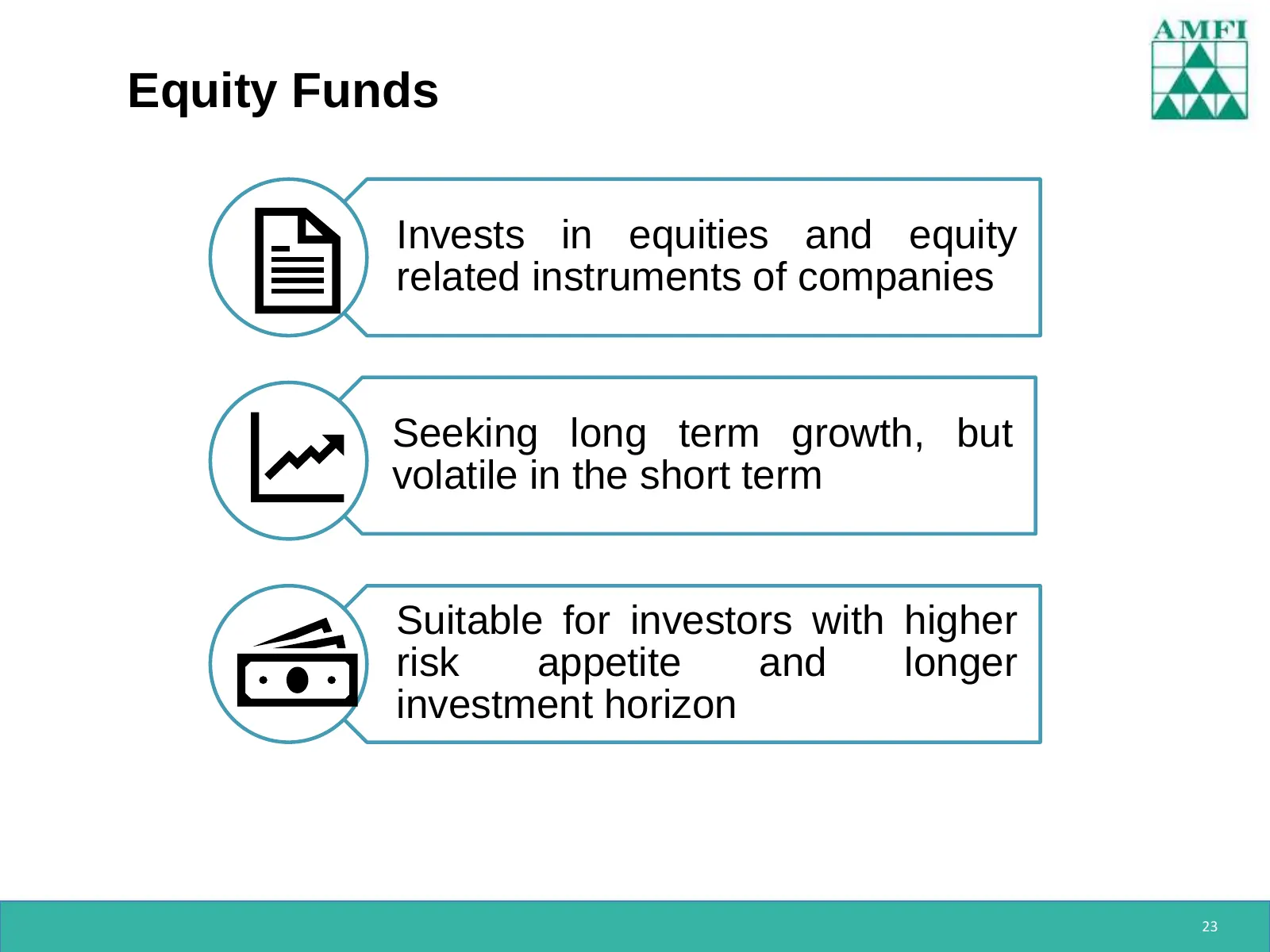
Slide 23: Equity Funds
Equity Funds Invests in equities and equity related instruments of companies Seeking long term growth, but volatile in the short term Suitable for investors with higher risk appetite and longer investment horizon 23
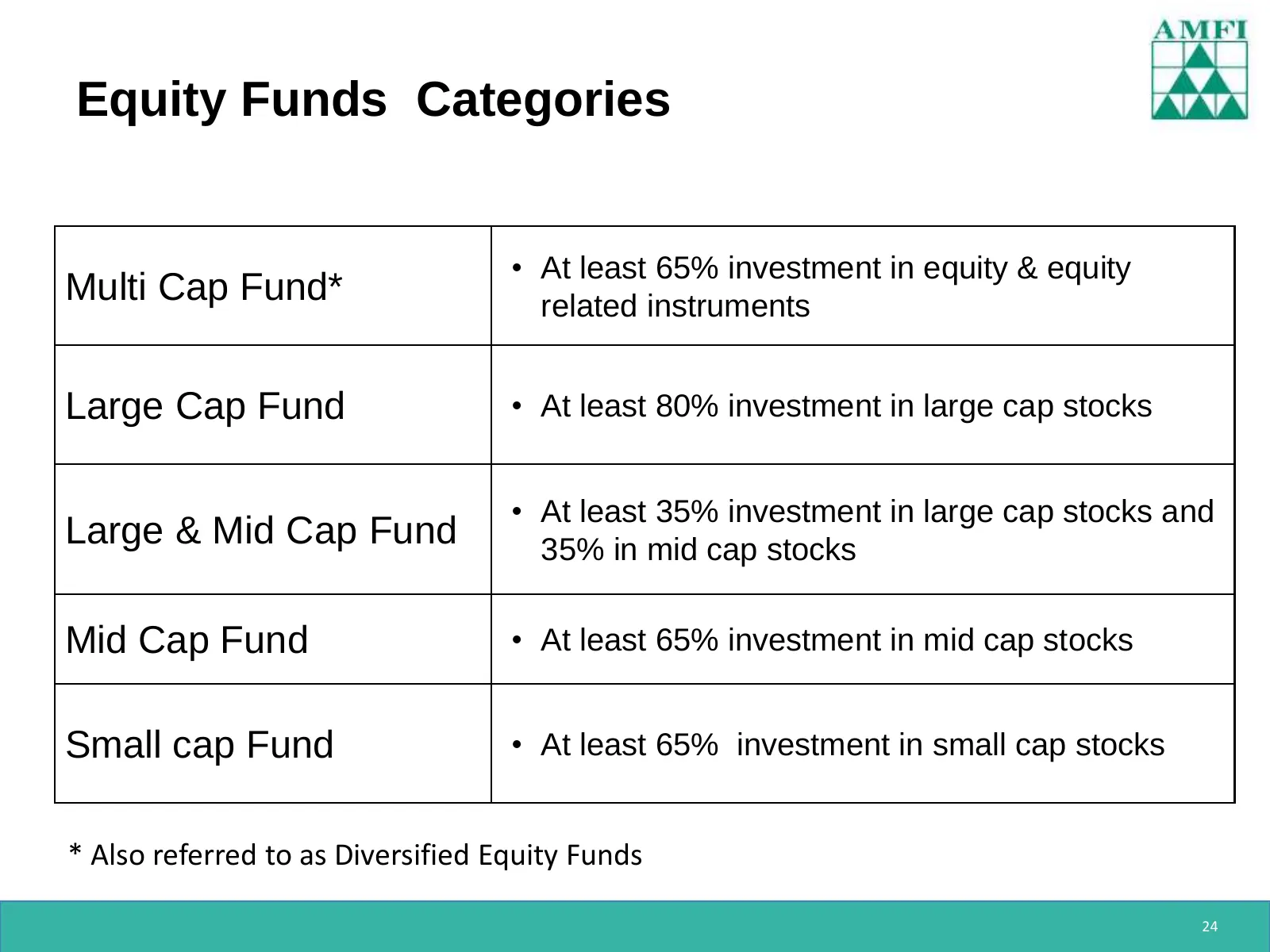
Slide 24: Equity Funds Categories
Equity Funds Categories • At least 65% investment in equity & equity Multi Cap Fund* related instruments Large Cap Fund • At least 80% investment in large cap stocks • At least 35% investment in large cap stocks and Large & Mid Cap Fund 35% in mid cap stocks Mid Cap Fund • At least 65% investment in
Slide 25: Equity Funds
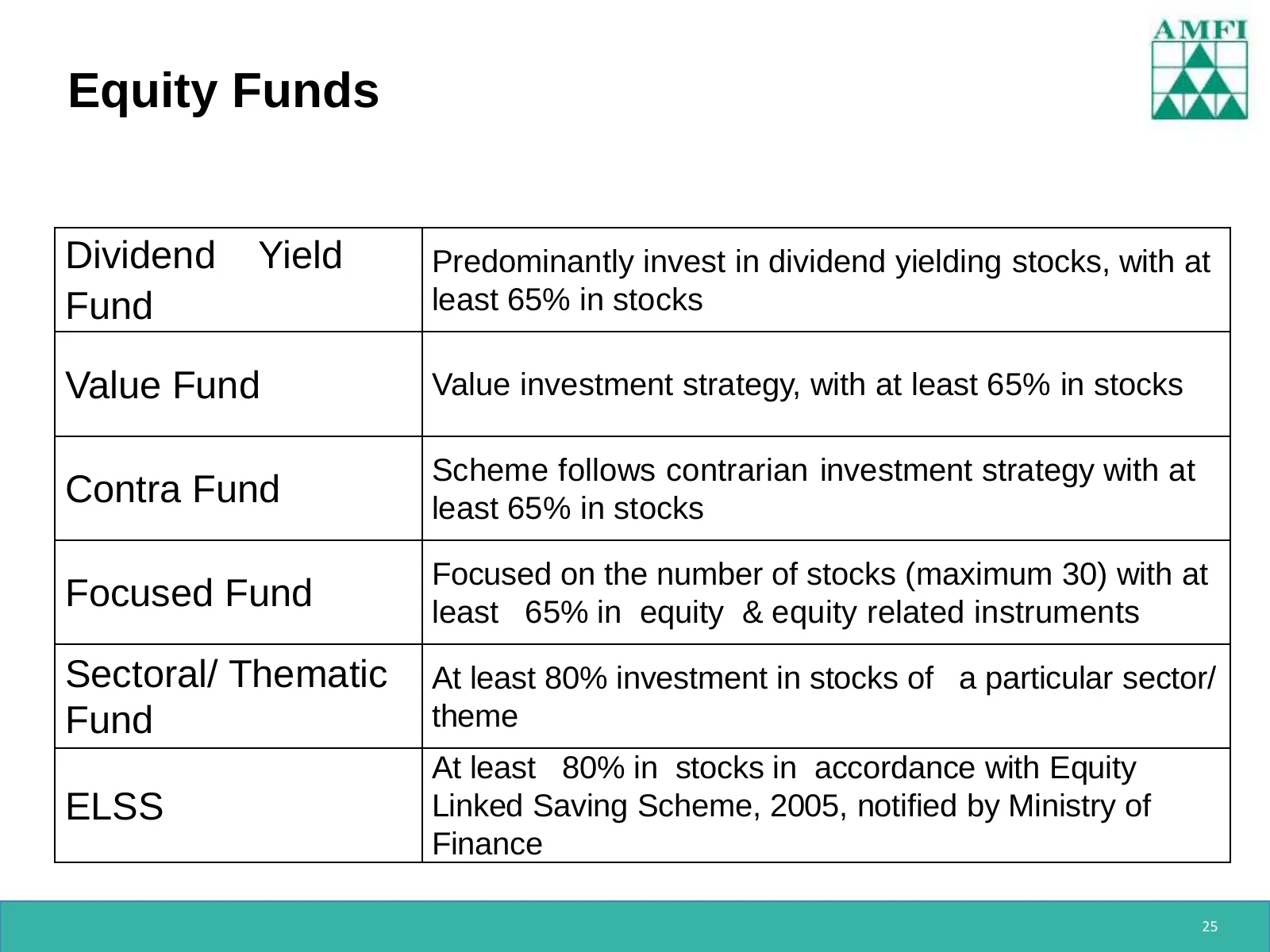
Equity Funds Dividend Yield Predominantly invest in dividend yielding stocks, with at Fund least 65% in stocks Value Fund Value investment strategy, with at least 65% in stocks Scheme follows contrarian investment strategy with at Contra Fund least 65% in stocks Focused on the number of stocks (maxi
Slide 26: Equity Linked Savings Scheme (ELSS)
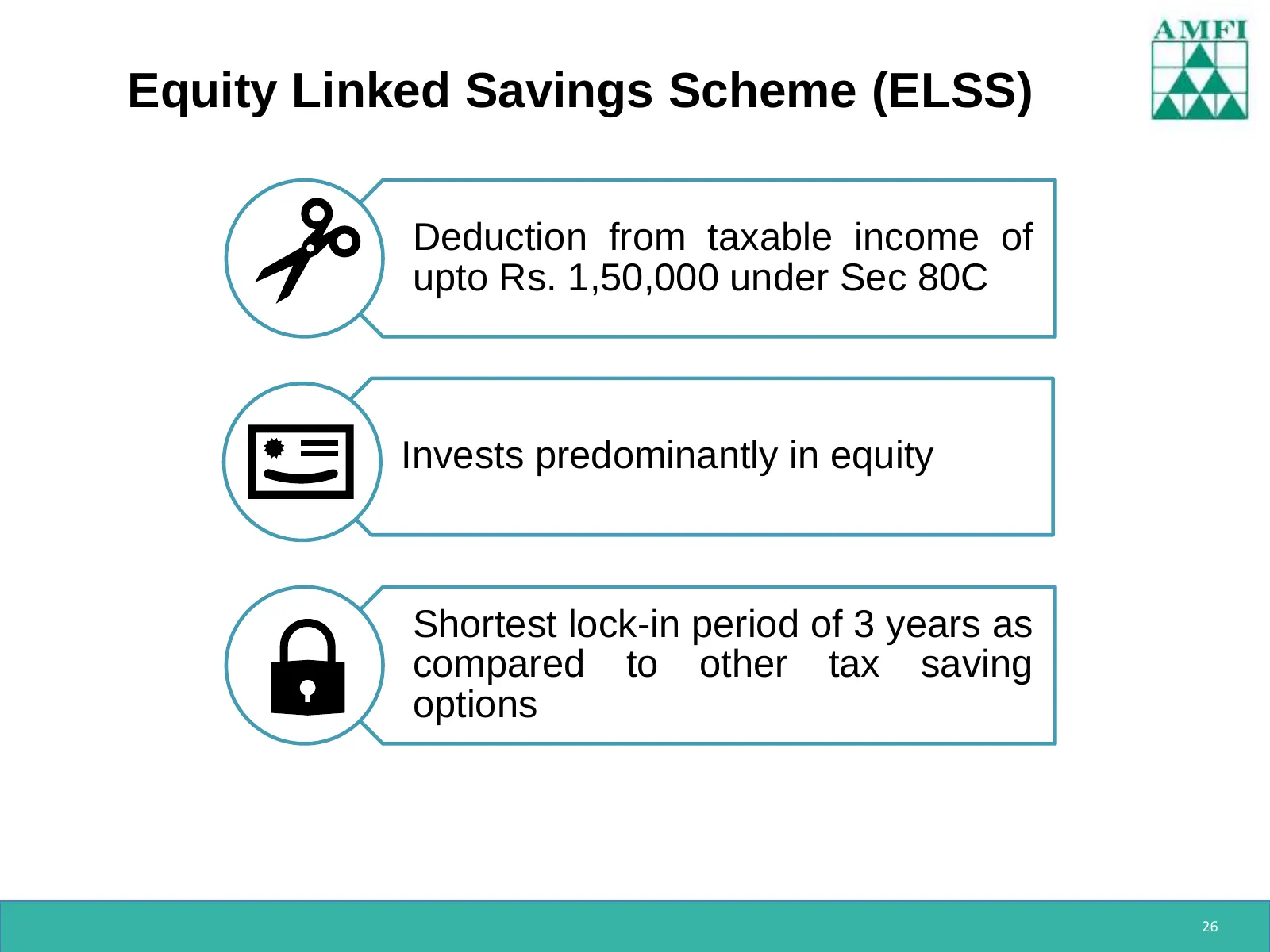
Equity Linked Savings Scheme (ELSS) Deduction from taxable income of upto Rs. 1,50,000 under Sec 80C Invests predominantly in equity Shortest lock-in period of 3 years as compared to other tax saving options 26
Slide 27: Debt schemes
Debt schemes 27
Slide 28: Debt Funds
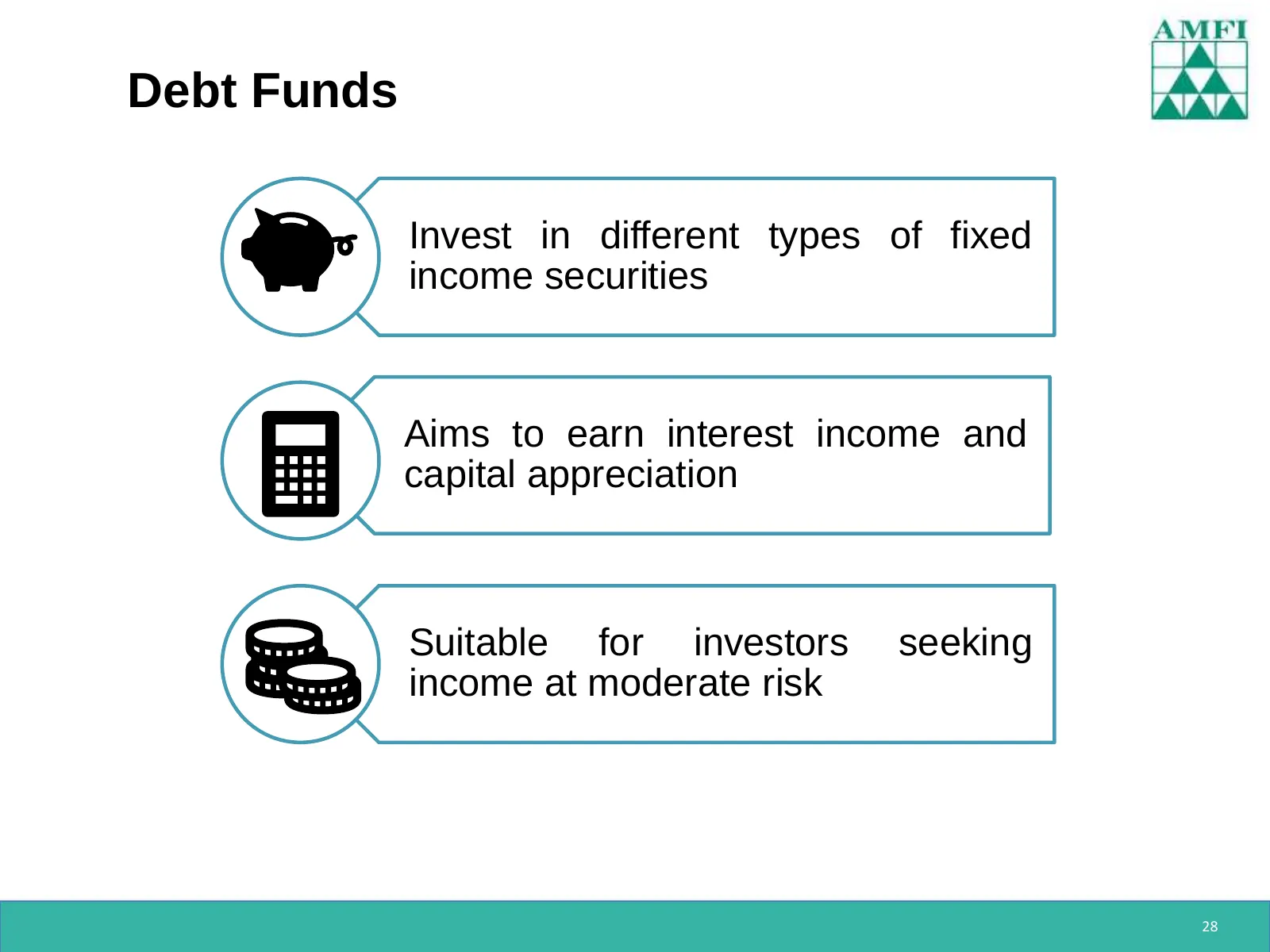
Debt Funds Invest in different types of fixed income securities Aims to earn interest income and capital appreciation Suitable for investors seeking income at moderate risk 28
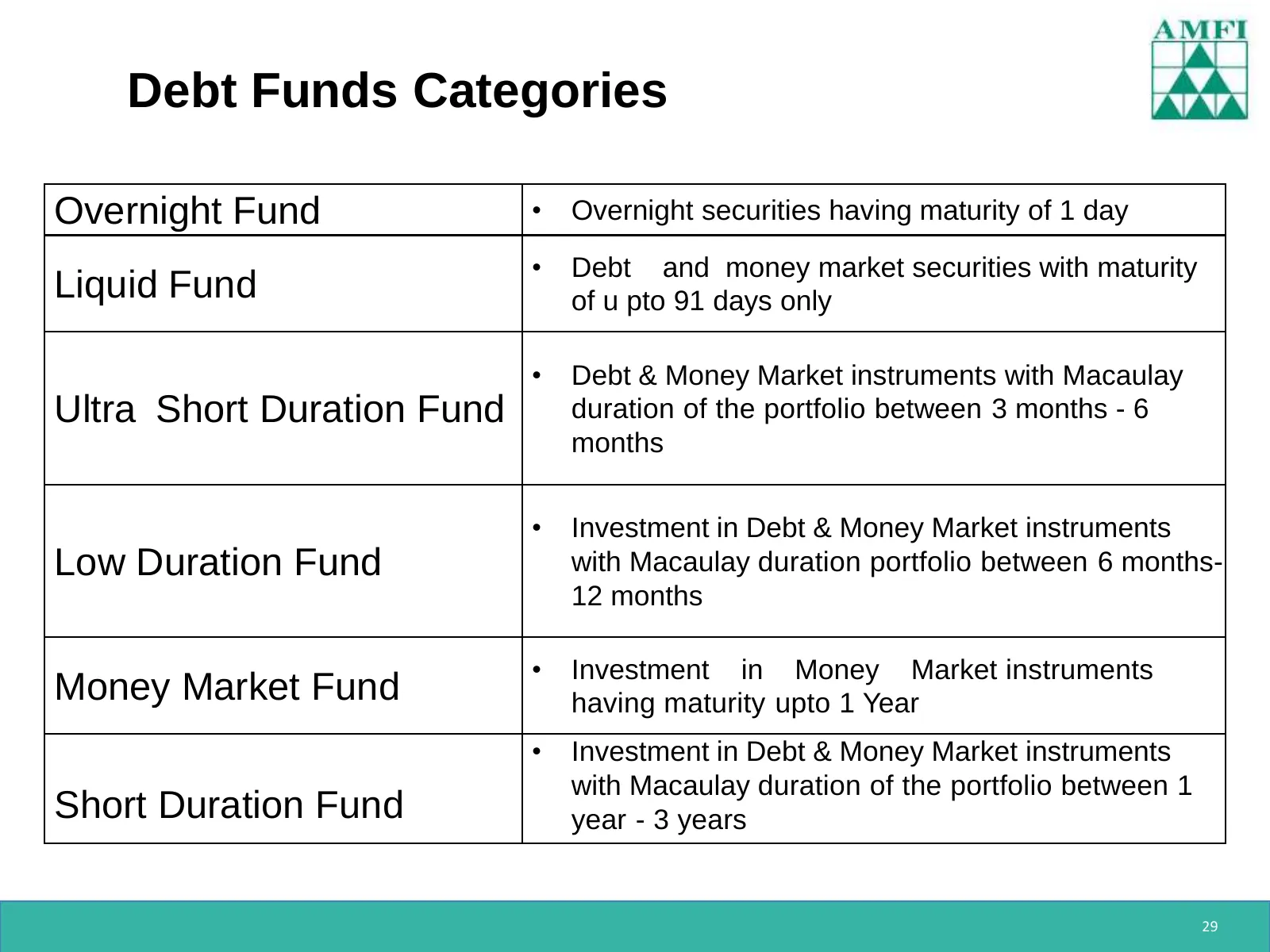
Slide 29: Debt Funds Categories
Debt Funds Categories Overnight Fund • Overnight securities having maturity of 1 day • Debt and money market securities with maturity Liquid Fund of u pto 91 days only • Debt & Money Market instruments with Macaulay Ultra Short Duration Fund duration of the portfolio between 3 months - 6 months • In
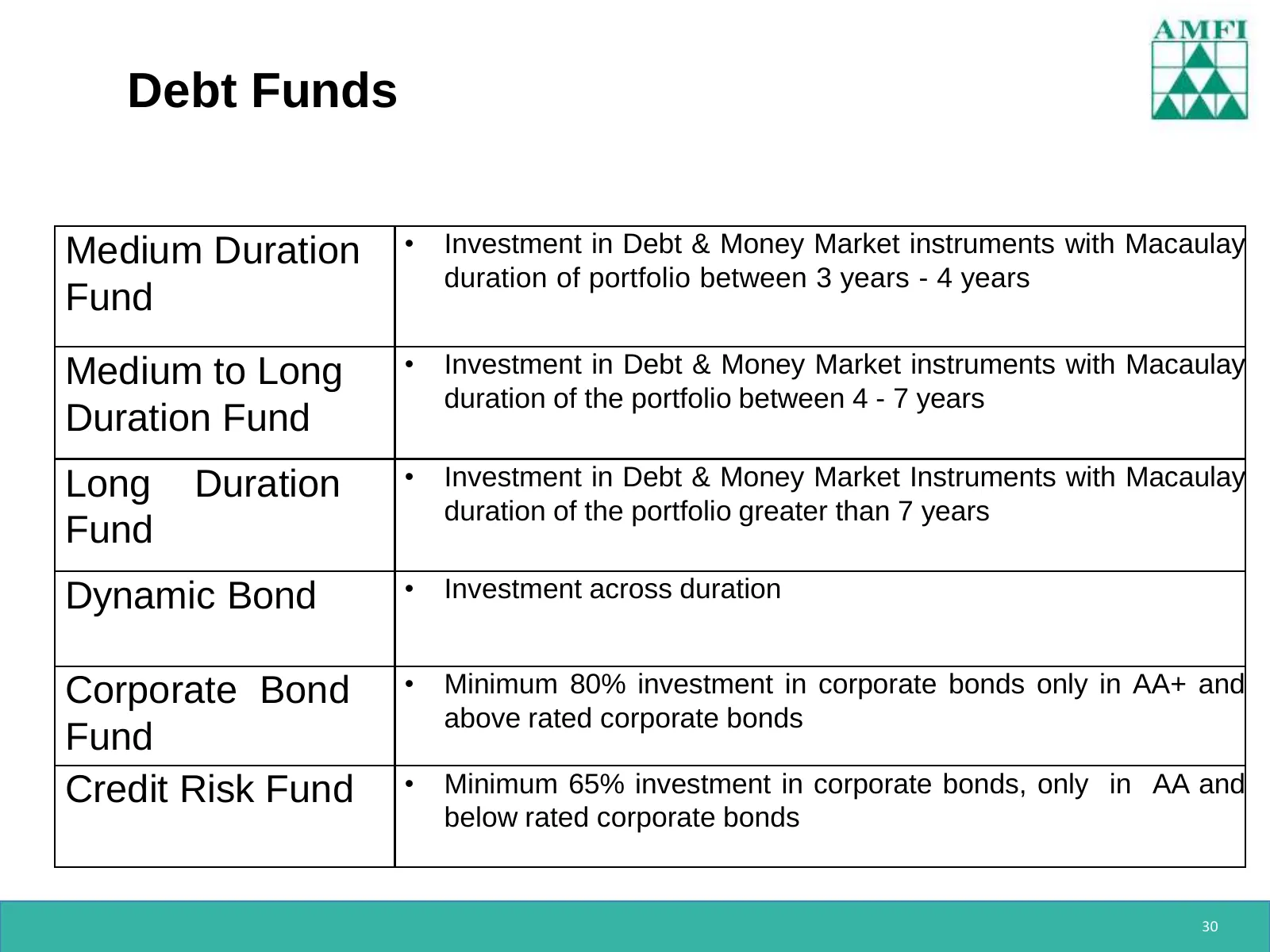
Slide 30: Debt Funds
Debt Funds Medium Duration • Investment in Debt & Money Market instruments with Macaulay duration of portfolio between 3 years - 4 years Fund Medium to Long • Investment in Debt & Money Market instruments with Macaulay duration of the portfolio between 4 - 7 years Duration Fund Long Duration • Inves
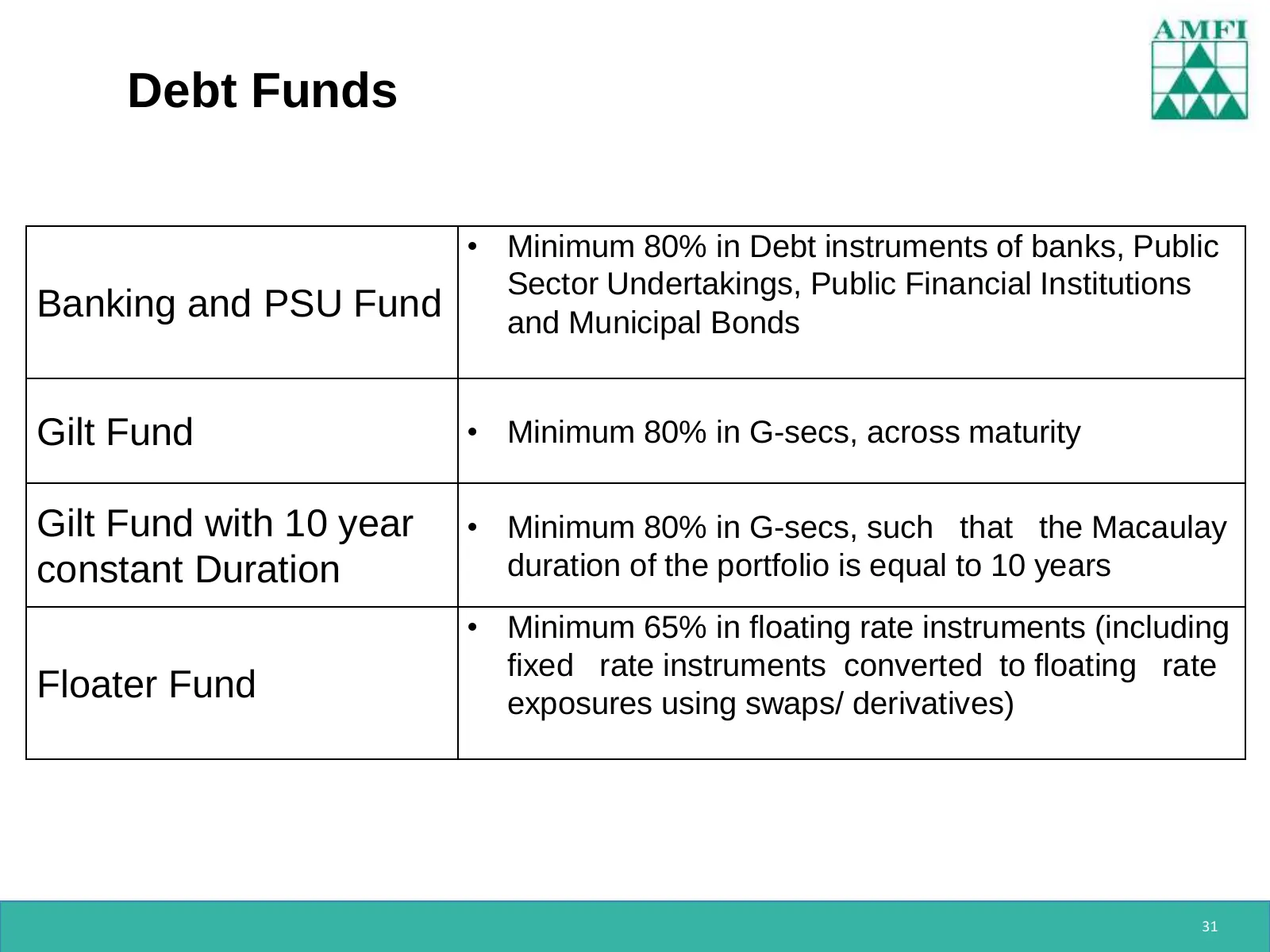
Slide 31: Debt Funds
Debt Funds • Minimum 80% in Debt instruments of banks, Public Sector Undertakings, Public Financial Institutions Banking and PSU Fund and Municipal Bonds Gilt Fund • Minimum 80% in G-secs, across maturity Gilt Fund with 10 year • Minimum 80% in G-secs, such that the Macaulay constant Duration durati
Slide 32: Hybrid schemes
Hybrid schemes 32
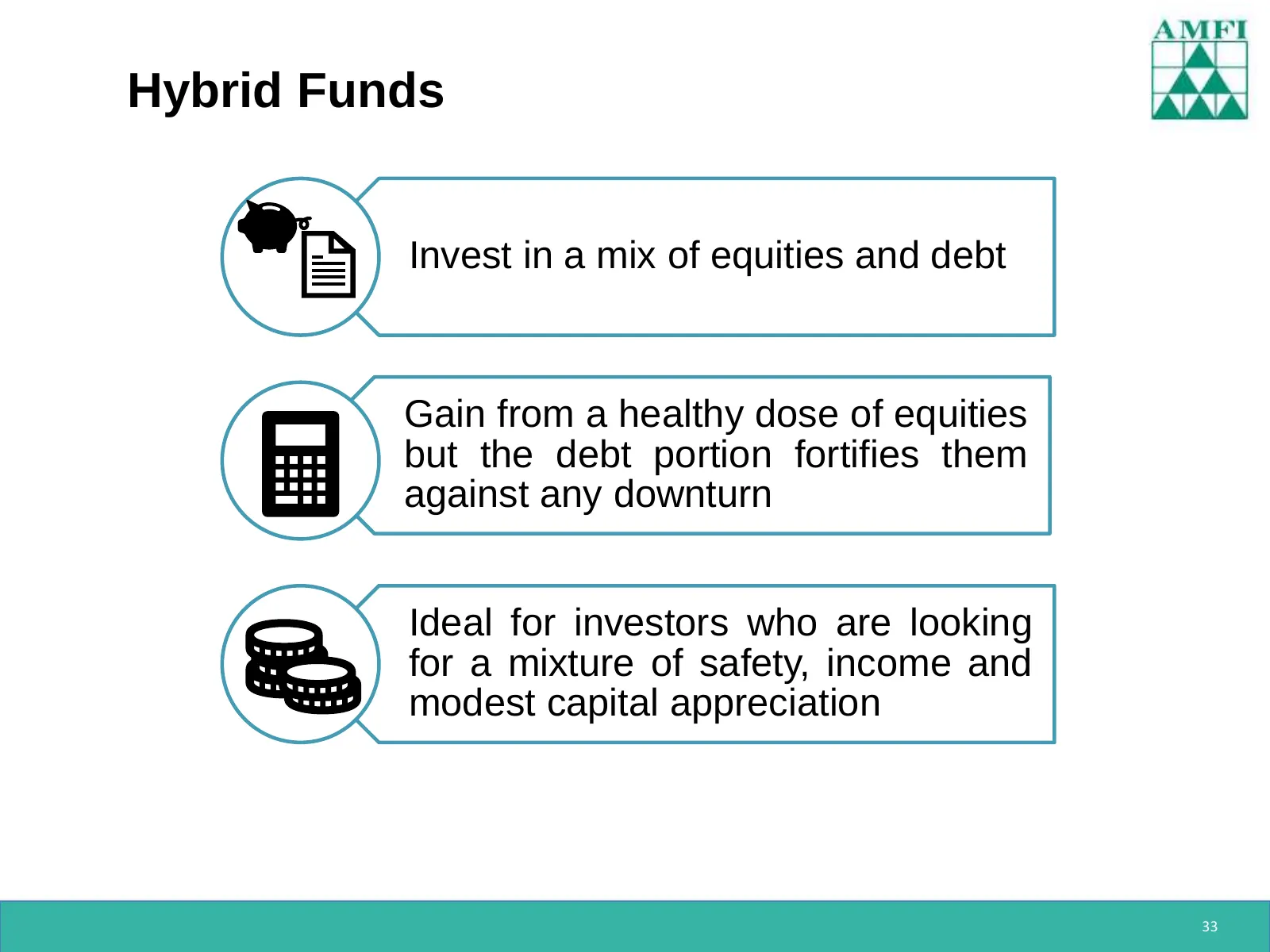
Slide 33: Hybrid Funds
Hybrid Funds Invest in a mix of equities and debt Gain from a healthy dose of equities but the debt portion fortifies them against any downturn Ideal for investors who are looking for a mixture of safety, income and modest capital appreciation 33
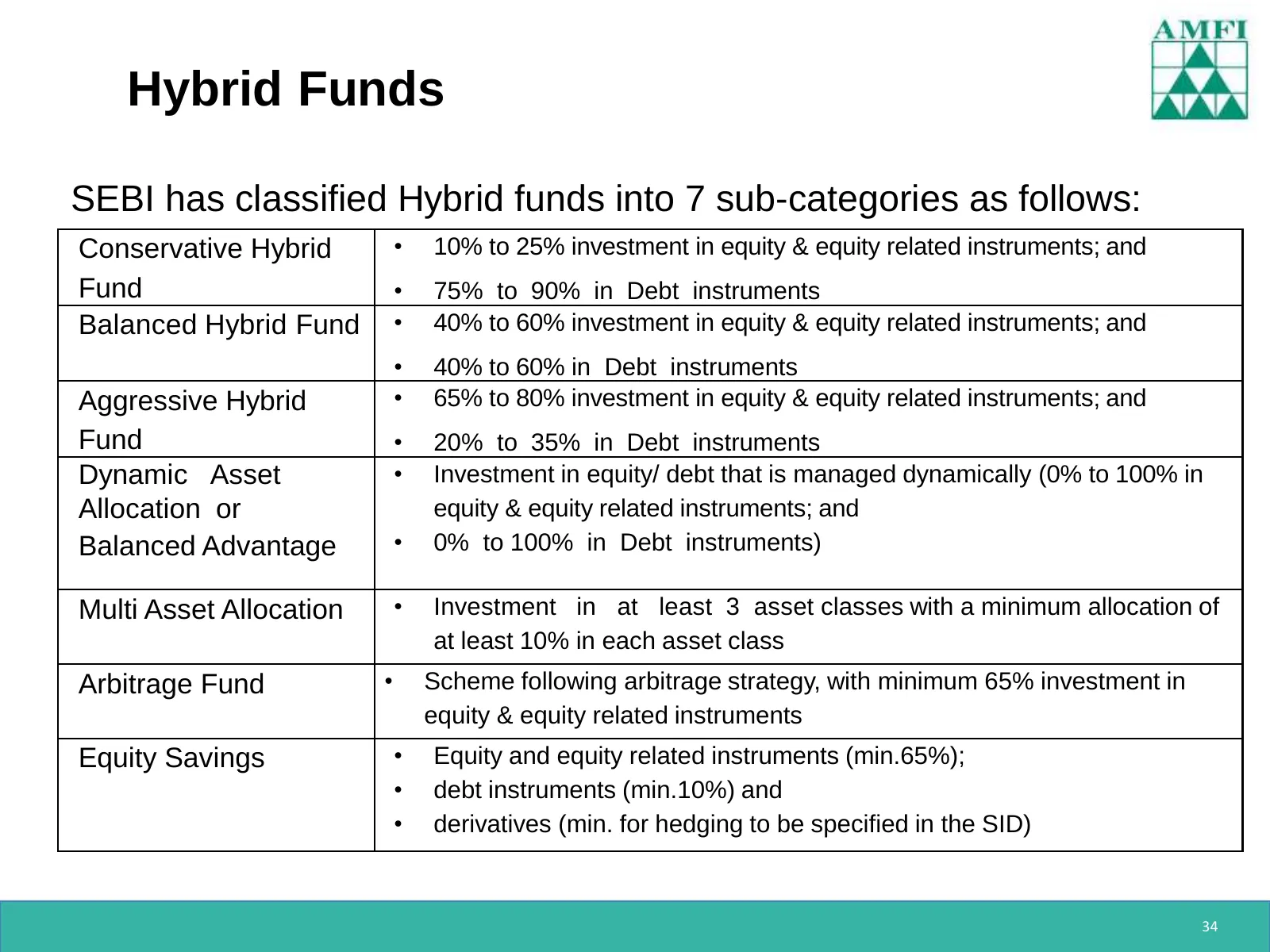
Slide 34: Hybrid Funds
Hybrid Funds SEBI has classified Hybrid funds into 7 sub-categories as follows: Conservative Hybrid • 10% to 25% investment in equity & equity related instruments; and Fund • 75% to 90% in Debt instruments Balanced Hybrid Fund • 40% to 60% investment in equity & equity related instruments; and • 40%
Slide 35: Solution-oriented & Other schemes
Solution-oriented & Other schemes 35
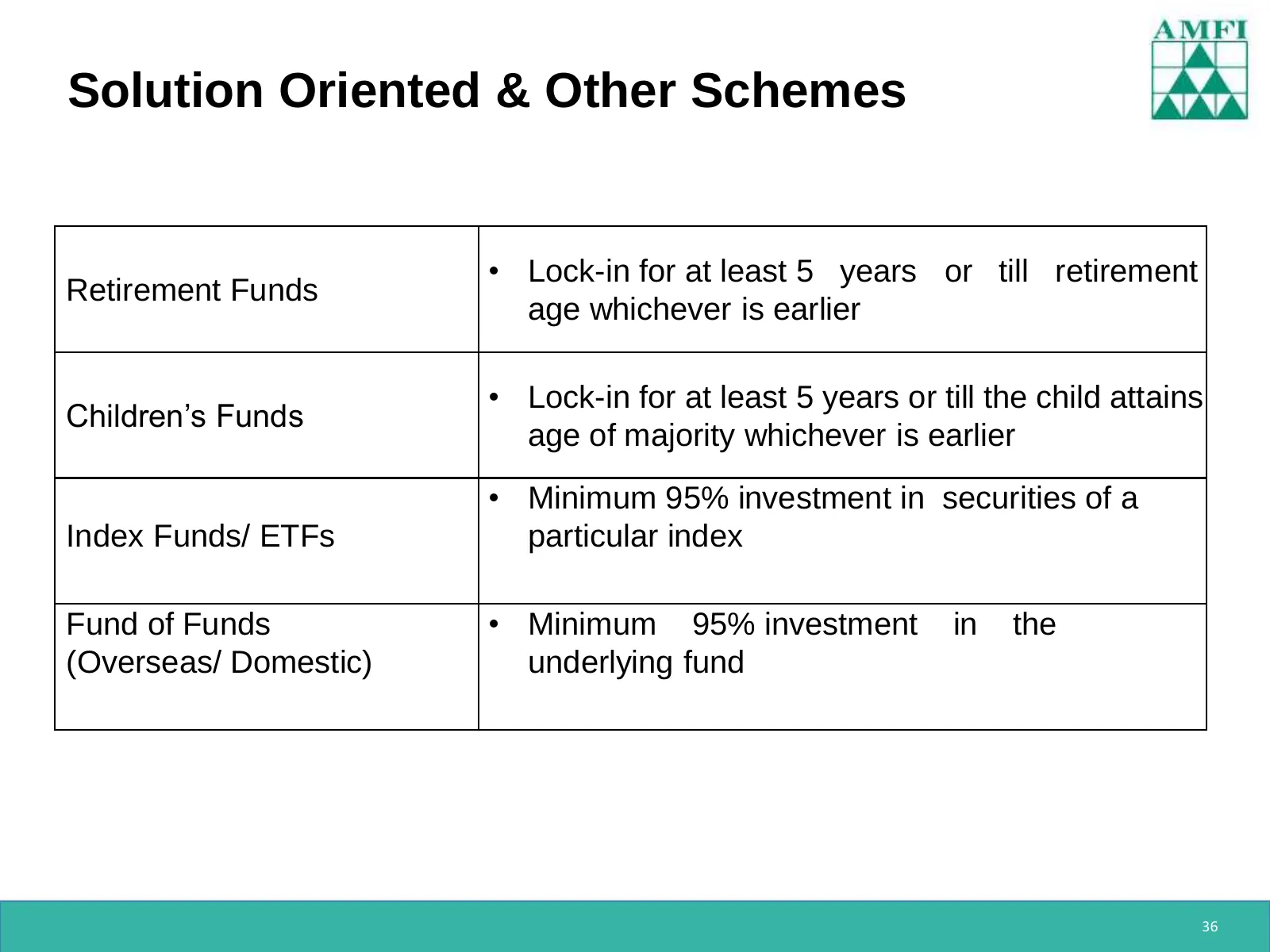
Slide 36: Solution Oriented & Other Schemes
Solution Oriented & Other Schemes • Lock-in for at least 5 years or till retirement Retirement Funds age whichever is earlier • Lock-in for at least 5 years or till the child attains Children’s Funds age of majority whichever is earlier • Minimum 95% investment in securities of a Index Funds/ ETFs p
Slide 37: Index Funds
Index Funds Portfolio replicates the index Aims to provide returns in line with index Suitable for investors seeking returns similar to index 37
Slide 38: Index Funds
Index Funds • Index funds create a portfolio that mirrors a market index • The securities included in the portfolio and their weights are the same as that in the index • The fund manager does not rebalance the portfolio based on their view of the market or sector • The fund offers the same return an
Slide 39: Exchange Traded Funds (ETFs)
Exchange Traded Funds (ETFs) • An ETF is a marketable security that tracks an index, a commodity, bonds, or a basket of assets like an index fund. • Unlike regular mutual funds, an ETF trades like a common stock on a stock exchange. The traded price of an ETF changes throughout the day like any othe
Slide 40: Gold Exchange Traded Funds
Gold Exchange Traded Funds • Gold ETF is a open ended scheme which invest pure physical gold bullion of 99.5 per cent purity. The scheme may also invest gold related instruments approved by SEBI and Gold Deposit Scheme of banks up to 20% of net assets • Gold ETFs issue units against gold held in the
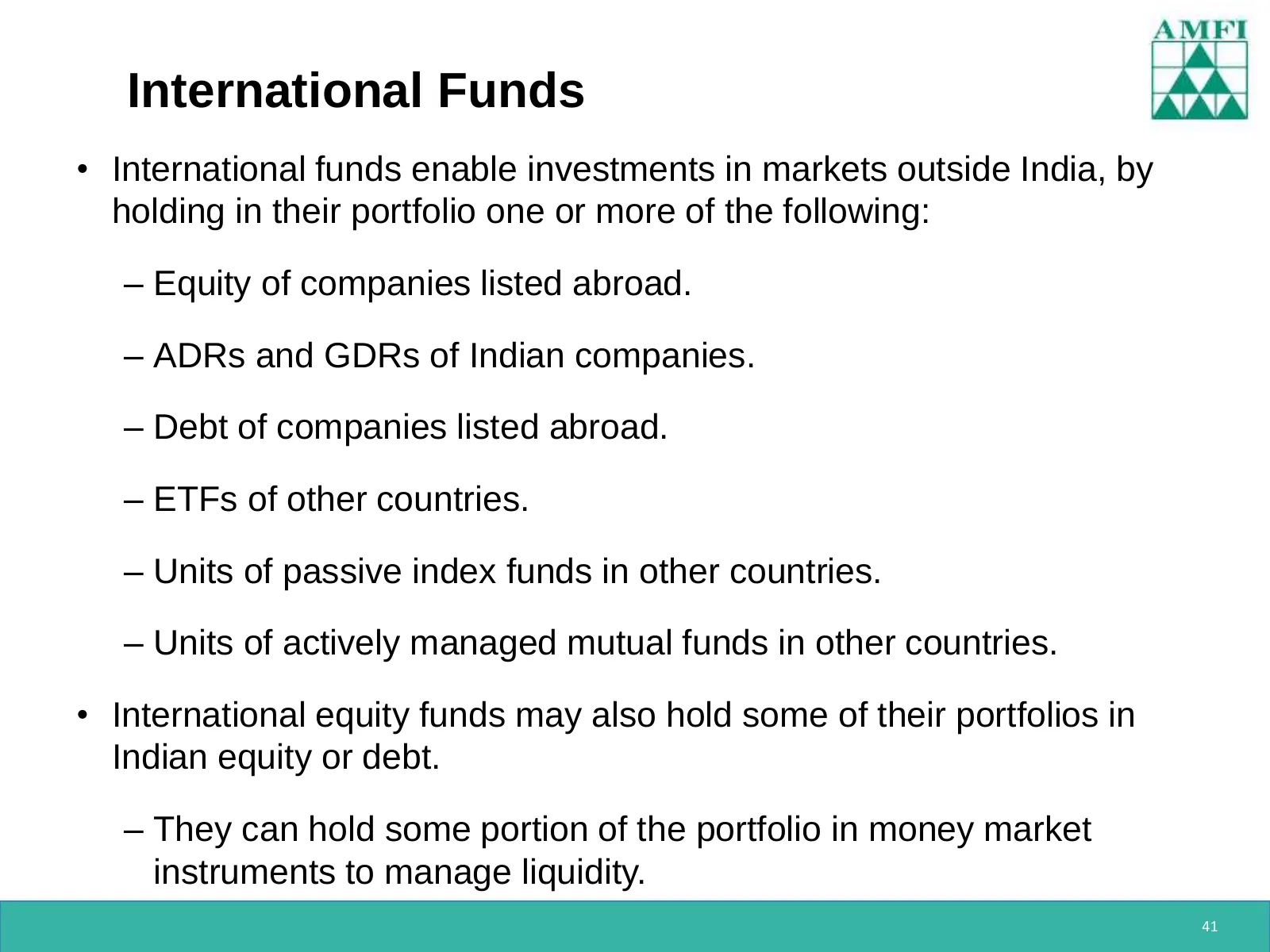
Slide 41: International Funds
International Funds • International funds enable investments in markets outside India, by holding in their portfolio one or more of the following: – Equity of companies listed abroad. – ADRs and GDRs of Indian companies. – Debt of companies listed abroad. – ETFs of other countries. – Units of passiv
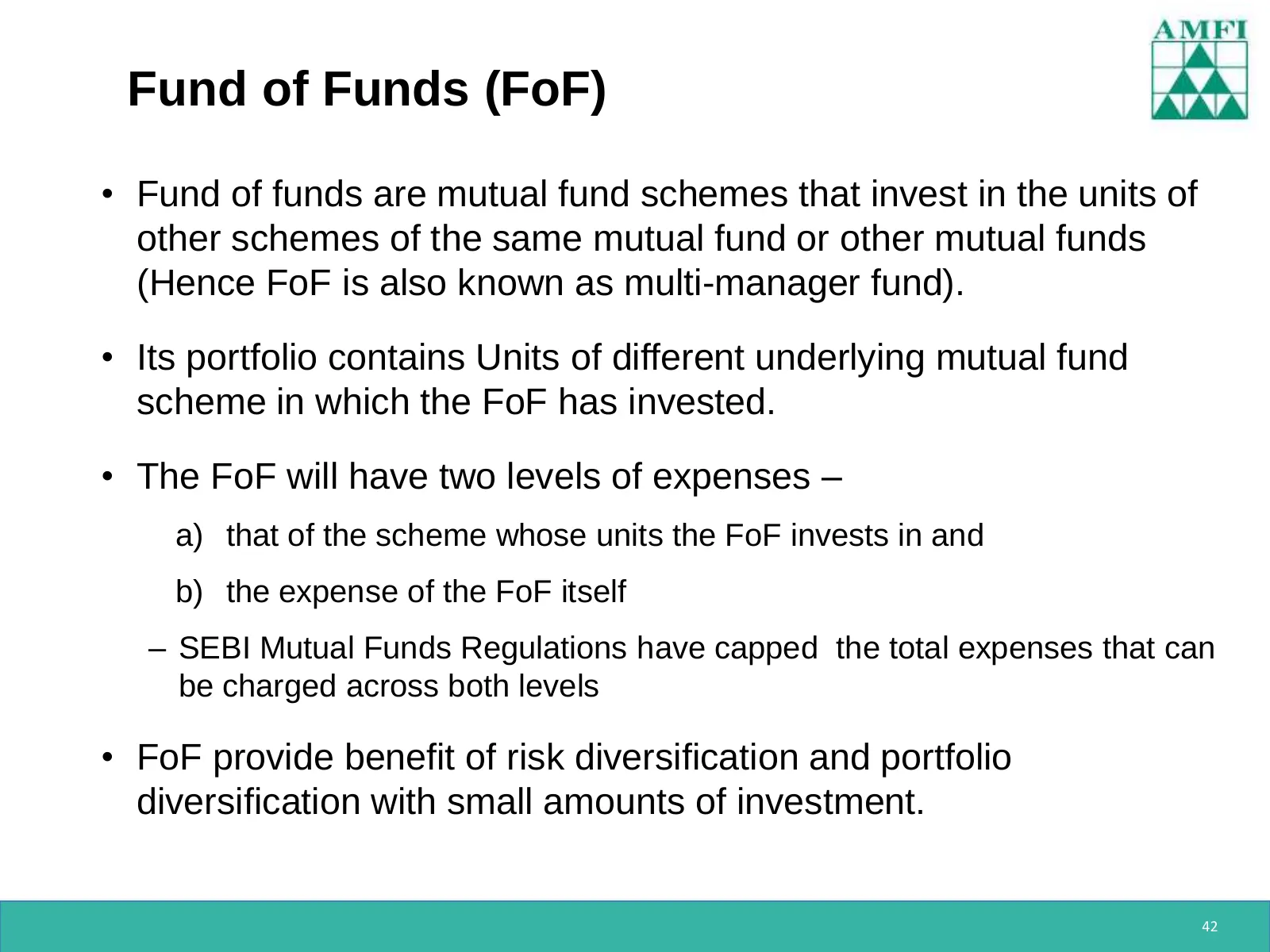
Slide 42: Fund of Funds (FoF)
Fund of Funds (FoF) • Fund of funds are mutual fund schemes that invest in the units of other schemes of the same mutual fund or other mutual funds (Hence FoF is also known as multi-manager fund). • Its portfolio contains Units of different underlying mutual fund scheme in which the FoF has invested
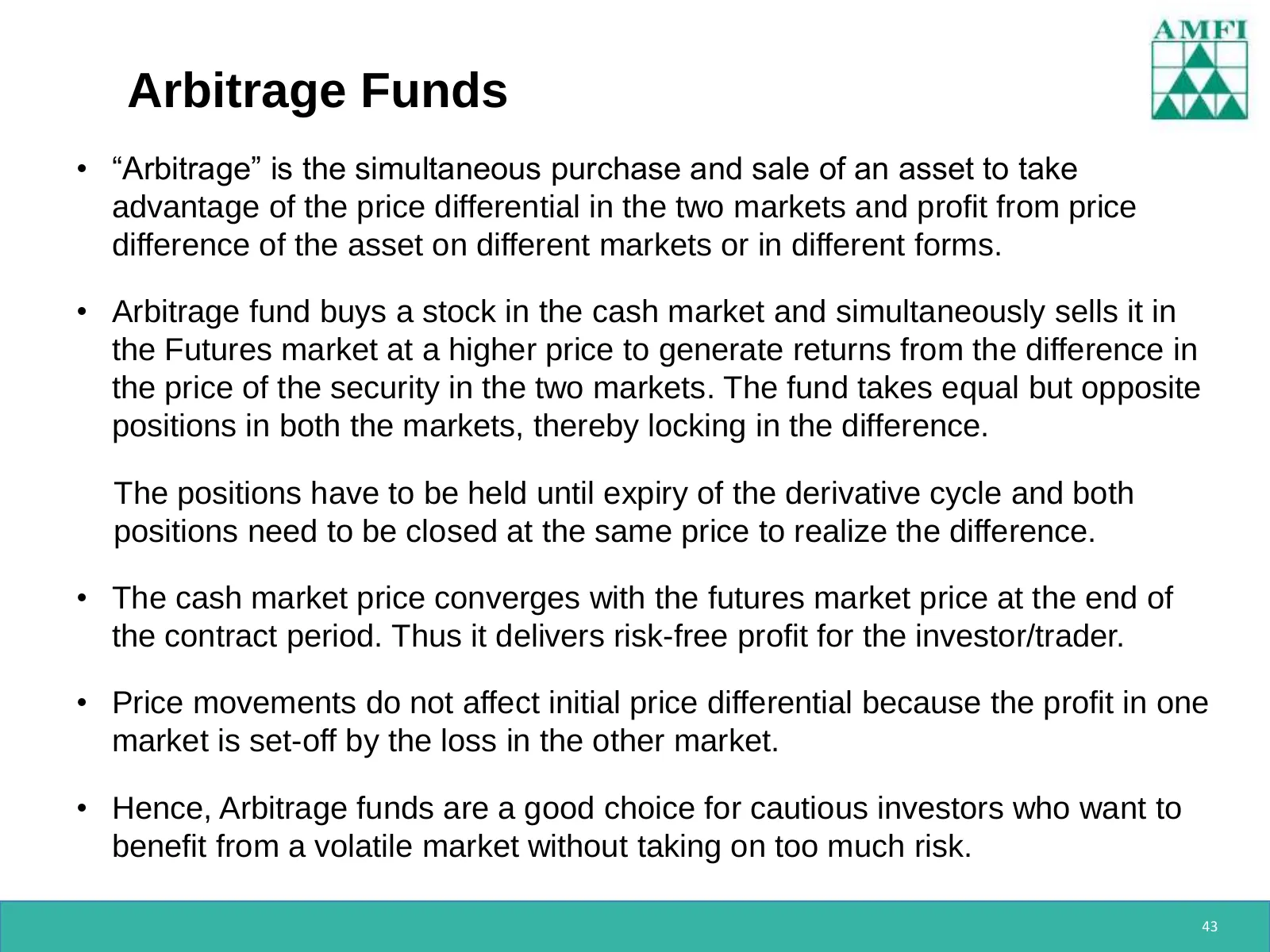
Slide 43: Arbitrage Funds
Arbitrage Funds • “Arbitrage” is the simultaneous purchase and sale of an asset to take advantage of the price differential in the two markets and profit from price difference of the asset on different markets or in different forms. • Arbitrage fund buys a stock in the cash market and simultaneously
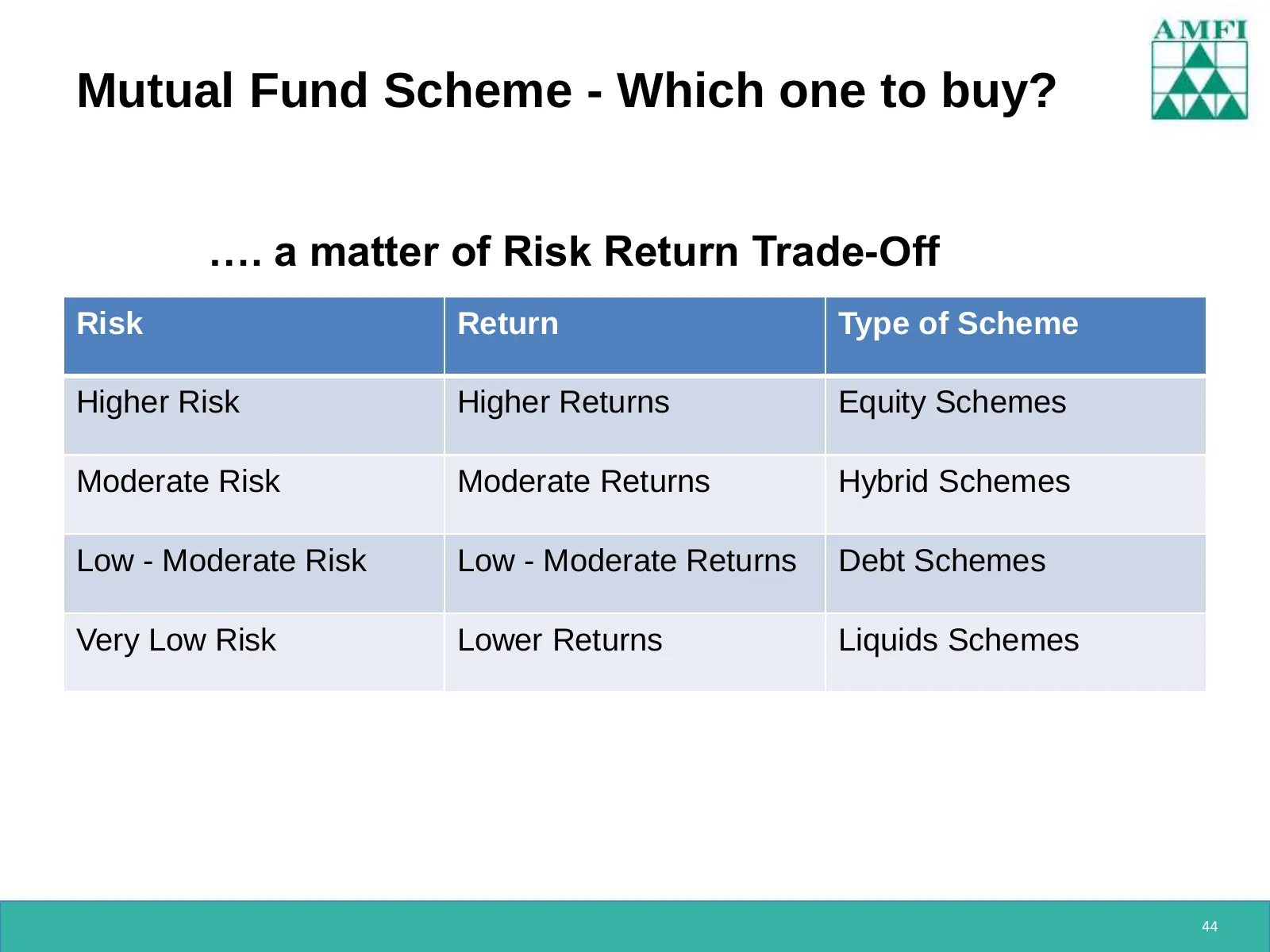
Slide 44: Mutual Fund Scheme - Which one to buy?
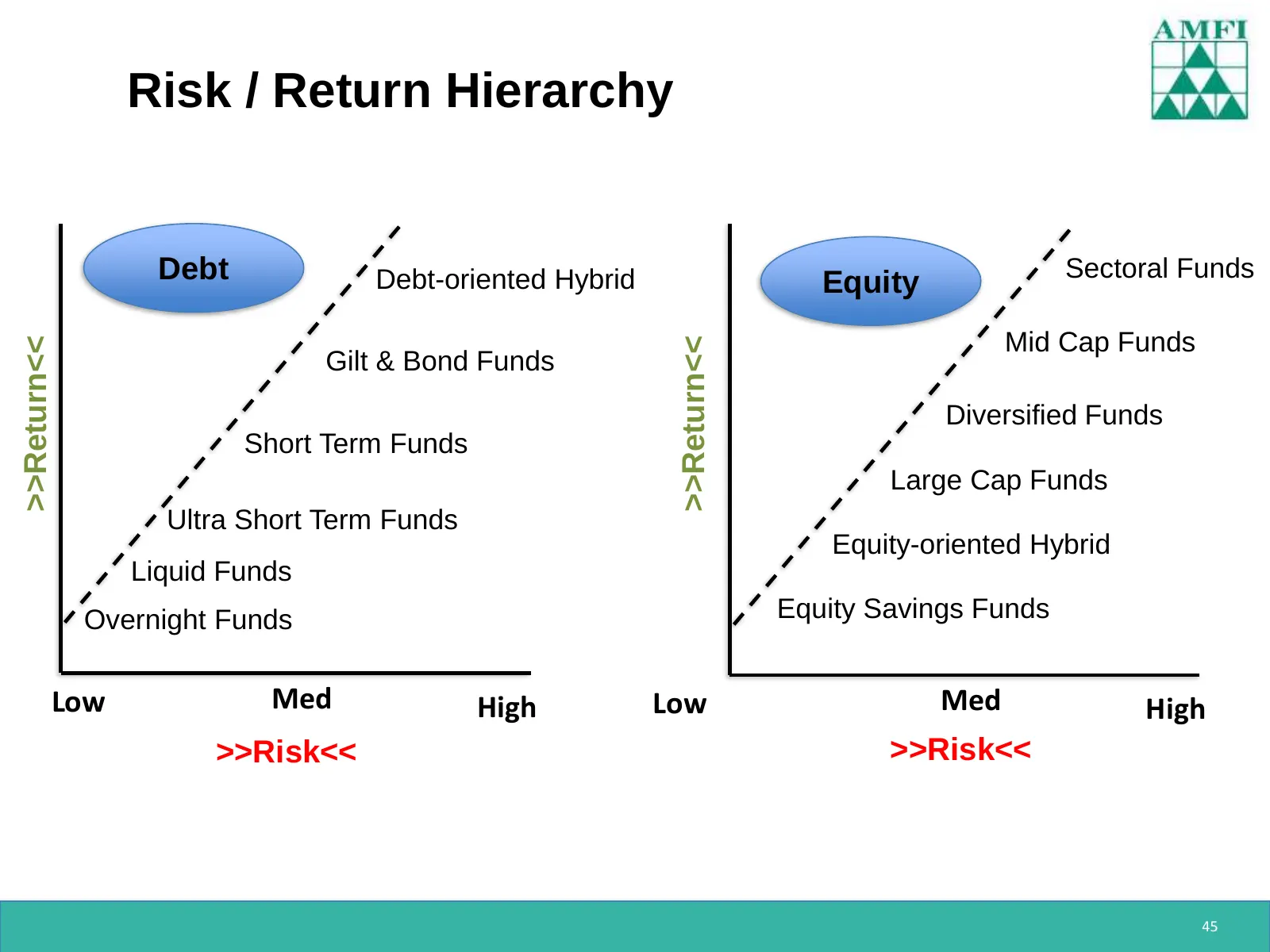
Mutual Fund Scheme - Which one to buy? …. a matter of Risk Return Trade-Off Risk Return Type of Scheme Higher Risk Higher Returns Equity Schemes Moderate Risk Moderate Returns Hybrid Schemes Low - Moderate Risk Low - Moderate Returns Debt Schemes Very Low Risk Lower Returns Liquids Schemes 44
Slide 45: Risk / Return Hierarchy
Risk / Return Hierarchy Debt Debt-oriented Hybrid Equity Sectoral Funds Mid Cap Funds >>Return<< >>Return<< Gilt & Bond Funds Diversified Funds Short Term Funds Large Cap Funds Ultra Short Term Funds Equity-oriented Hybrid Liquid Funds Overnight Funds Equity Savings Funds Low Med High Low Med High >
Slide 46: Scheme Related Documents
Scheme Related Documents 46
Slide 47: Scheme Related Documents
Scheme Related Documents • Scheme information document (SID) – SID contains information that is specific to a each MF scheme. – Concise & detailed information that a prospective investor should know so as to take an informed decision to invest • Statement of Additional Information(SAI) – SAI contain
Slide 48: Factsheet
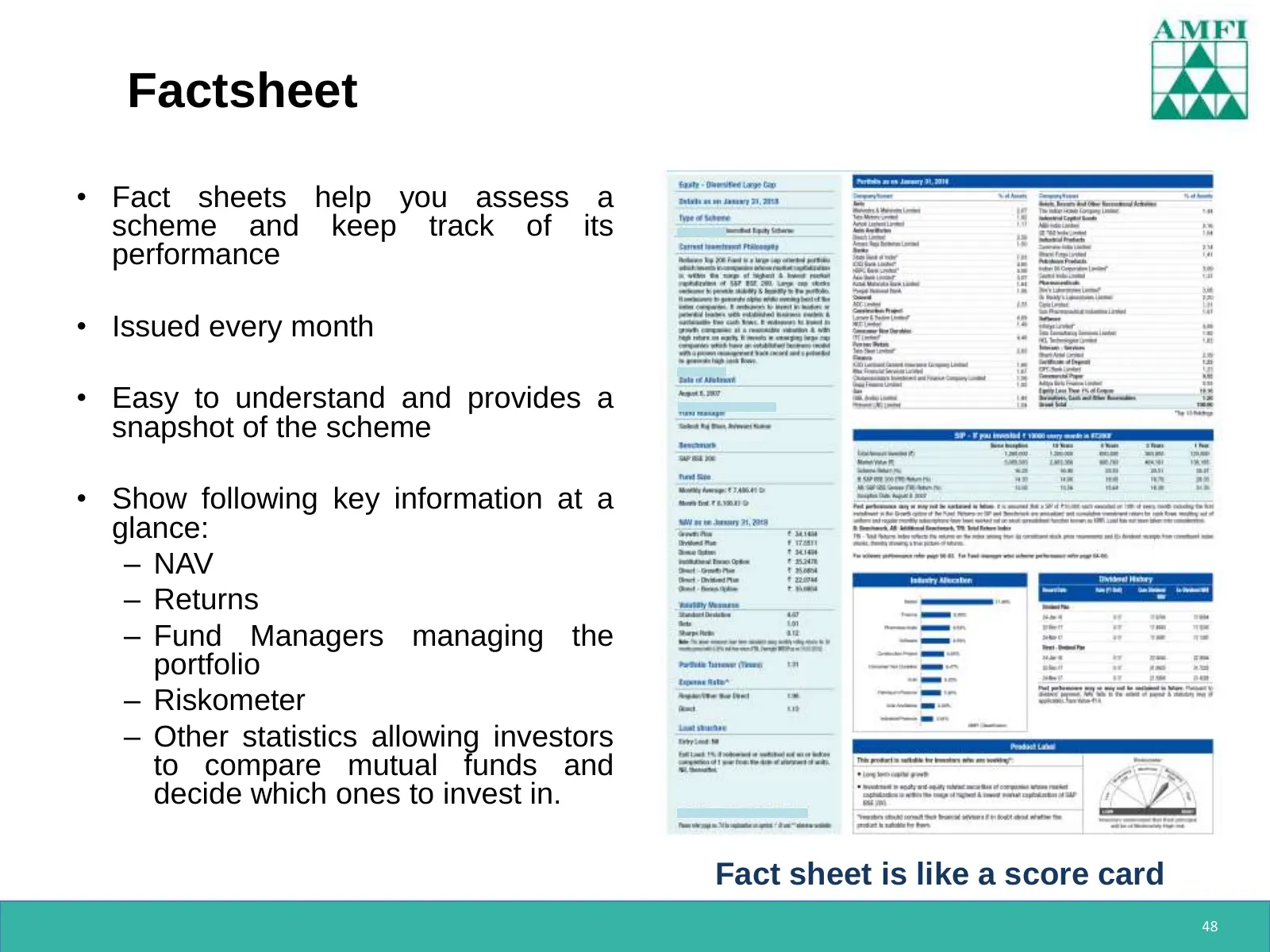
Factsheet • Fact sheets help you assess a scheme and keep track of its performance • Issued every month • Easy to understand and provides a snapshot of the scheme • Show following key information at a glance: – NAV – Returns – Fund Managers managing the portfolio – Riskometer – Other statistics allo

Slide 49: Plans & Options
AMFI Plans & Options
Slide 50: Direct Plans & Regular Plans
Direct Plans & Regular Plans • All MF schemes offer a Direct Plan and Regular Plan for investments • You can invest – – DIRECTLY i.e., without involving or routing the investment through any distributor/agent in a ‘Direct Plan’ OR – Through / with the help of a Mutual Fund agent/distributor in a Reg
Slide 51: Growth Option & Dividend Option
Growth Option & Dividend Option • Growth Option – Capital appreciation in the investment are ploughed back in the scheme and are reflected in increase in the NAV. – Investors do not receive any periodic payments. – Suitable for investors who do not require regular income. – Tax efficient • Dividend
Slide 52: Modes of Investing
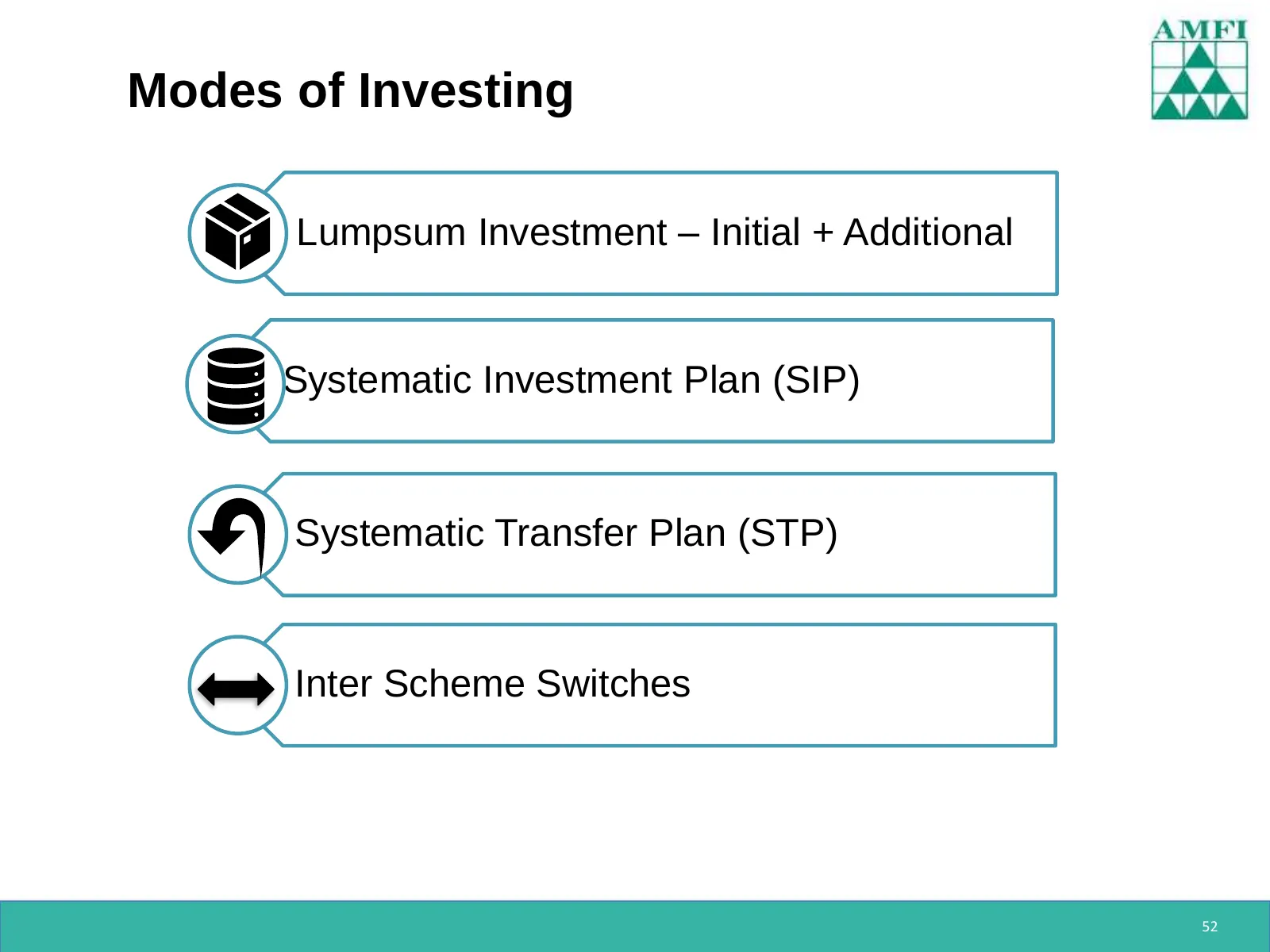
Modes of Investing Lumpsum Investment – Initial + Additional Systematic Investment Plan (SIP) Systematic Transfer Plan (STP) Inter Scheme Switches 52
Slide 53: Systematic Investment Plan (SIP)
Systematic Investment Plan (SIP) • SIP is a method of investing a fixed sum, at a regular interval, in a mutual fund scheme • Similar to monthly saving schemes like a recurring deposit • Advantages • Enables regular investments without any additional paperwork • Convenient way to invest regularly th
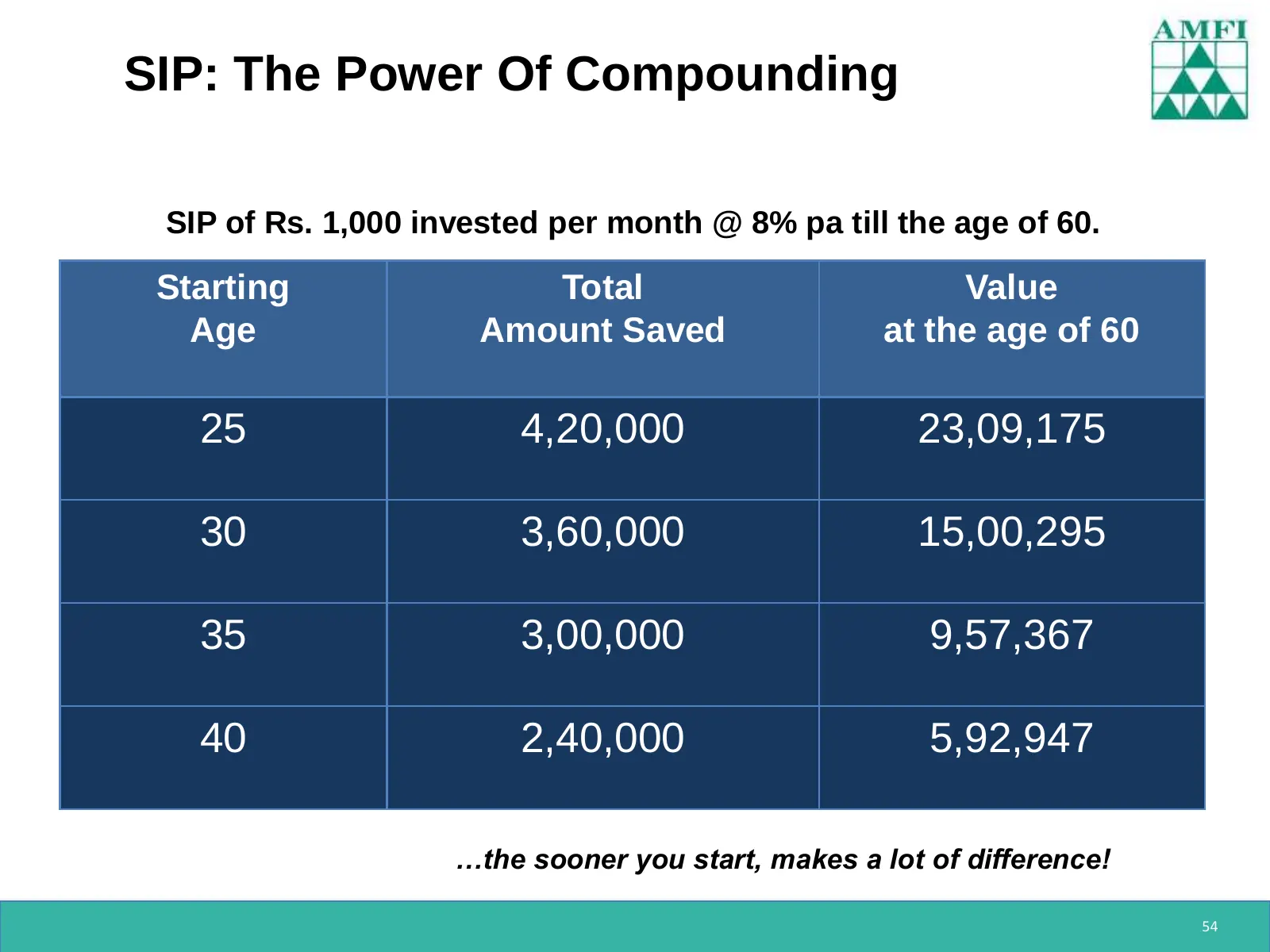
Slide 54: SIP: The Power Of Compounding
SIP: The Power Of Compounding SIP of Rs. 1,000 invested per month @ 8% pa till the age of 60. Starting Total Value Age Amount Saved at the age of 60 25 4,20,000 23,09,175 30 3,60,000 15,00,295 35 3,00,000 9,57,367 40 2,40,000 5,92,947 …the sooner you start, makes a lot of difference! 54
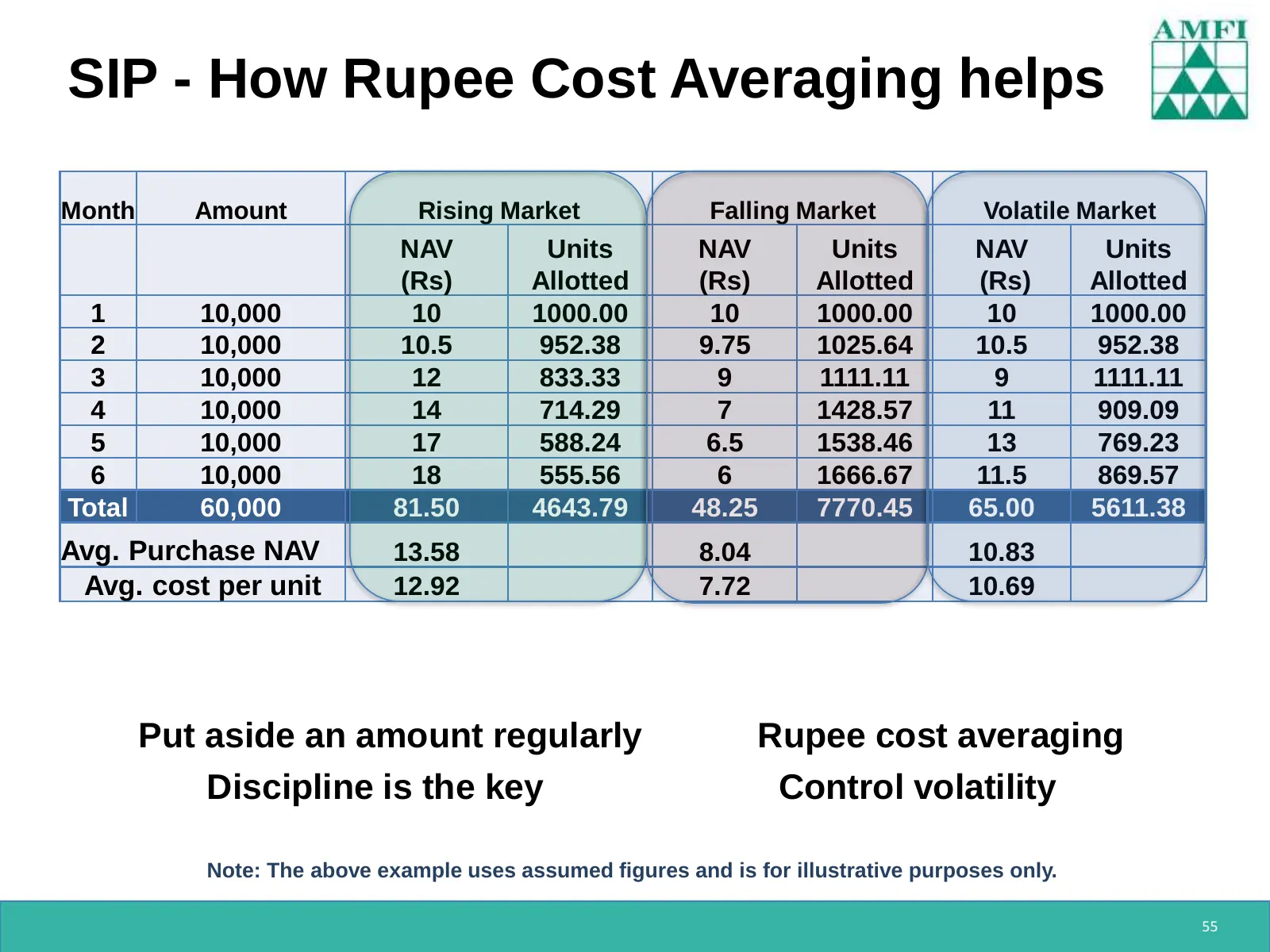
Slide 55: SIP - How Rupee Cost Averaging helps
SIP - How Rupee Cost Averaging helps Month Amount Rising Market Falling Market Volatile Market NAV Units NAV Units NAV Units (Rs) Allotted (Rs) Allotted (Rs) Allotted 1 10,000 10 1000.00 10 1000.00 10 1000.00 2 10,000 10.5 952.38 9.75 1025.64 10.5 952.38 3 10,000 12 833.33 9 1111.11 9 1111.11 4 10,0
Slide 56: Systematic Withdrawal Plan (SWP)
Systematic Withdrawal Plan (SWP) • SWP is a facility which allows an investor to withdraw a fixed amount from the investment in a MF scheme at pre-determined interval, such as monthly or quarterly basis. • Under SWP, units equivalent to the amount desired by the investor are redeemed and the proceed
Slide 57: How to Invest in Mutual Funds
HOW TO INVEST IN MUTUAL FUNDS 57
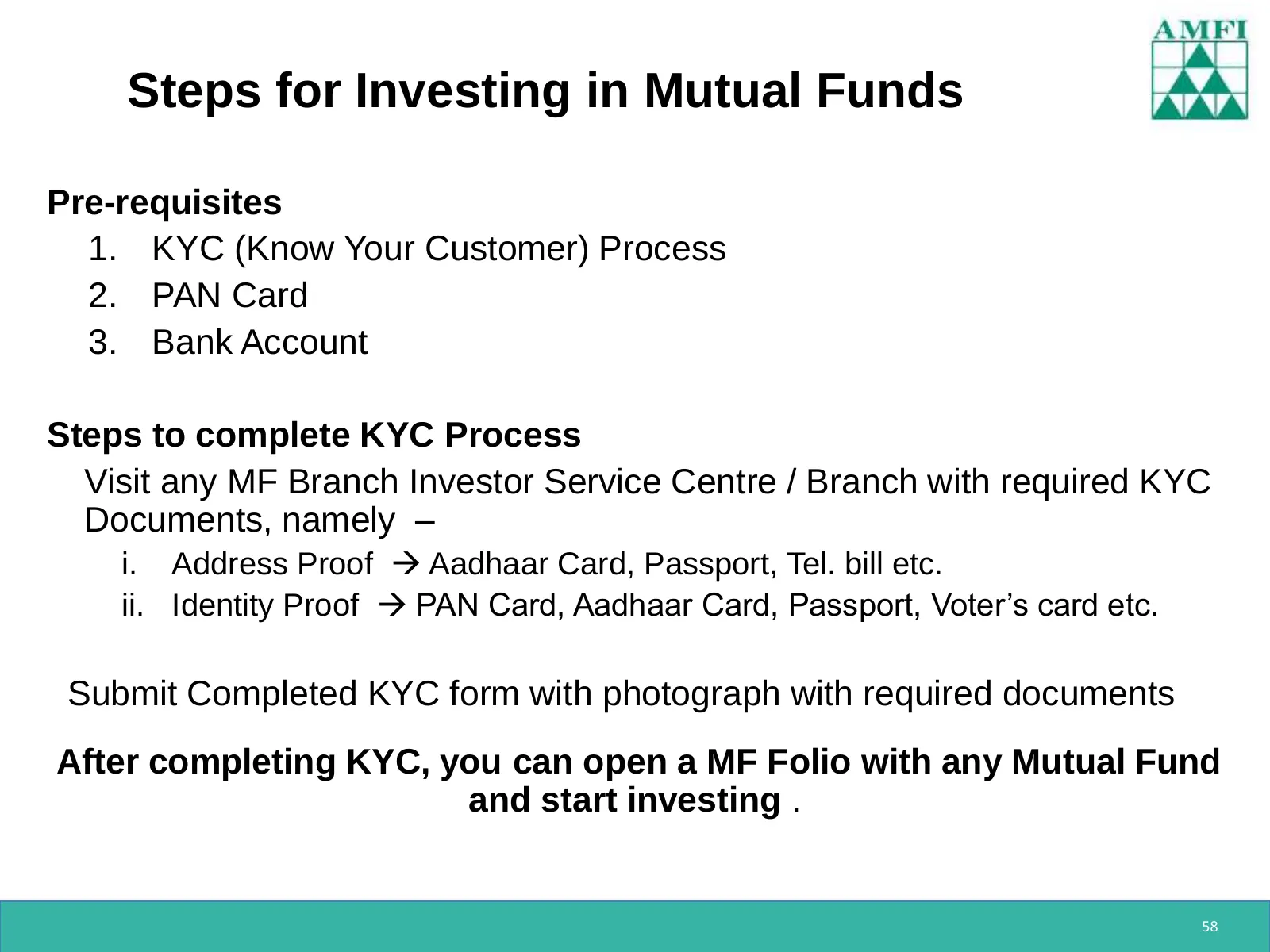
Slide 58: Steps for Investing in Mutual Funds
Steps for Investing in Mutual Funds Pre-requisites 1. KYC (Know Your Customer) Process 2. PAN Card 3. Bank Account Steps to complete KYC Process Visit any MF Branch Investor Service Centre / Branch with required KYC Documents, namely – i. Address Proof → Aadhaar Card, Passport, Tel. bill etc. ii. Id
Slide 59: Modes of Investing: Physical and On-line
Modes of Investing 📝Physical Mode✍🏻 (Traditional / Paper based ) and On-line Mode 59
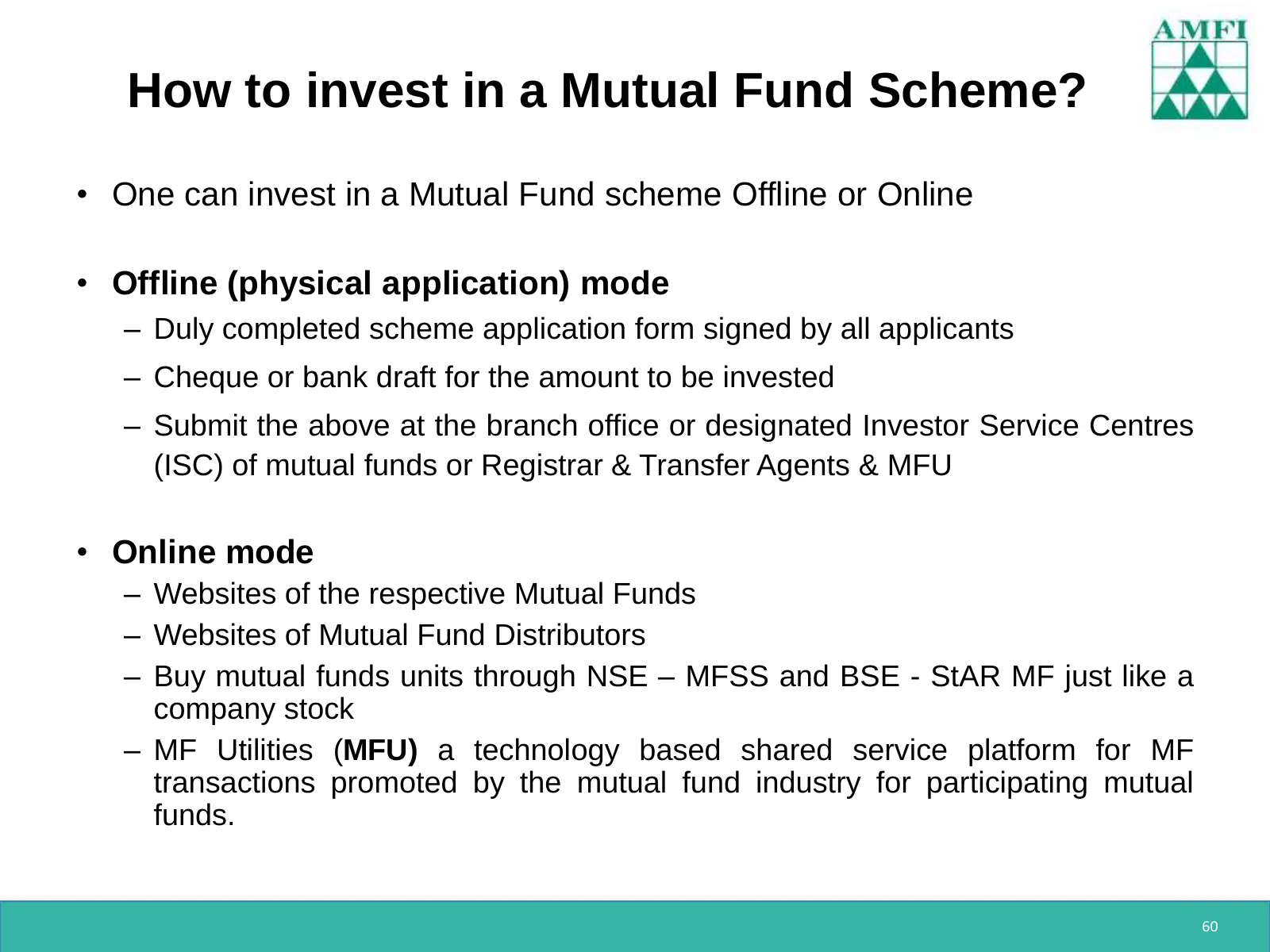
Slide 60: How to invest in a Mutual Fund Scheme?
How to invest in a Mutual Fund Scheme? • One can invest in a Mutual Fund scheme Offline or Online • Offline (physical application) mode – Duly completed scheme application form signed by all applicants – Cheque or bank draft for the amount to be invested – Submit the above at the branch office or de
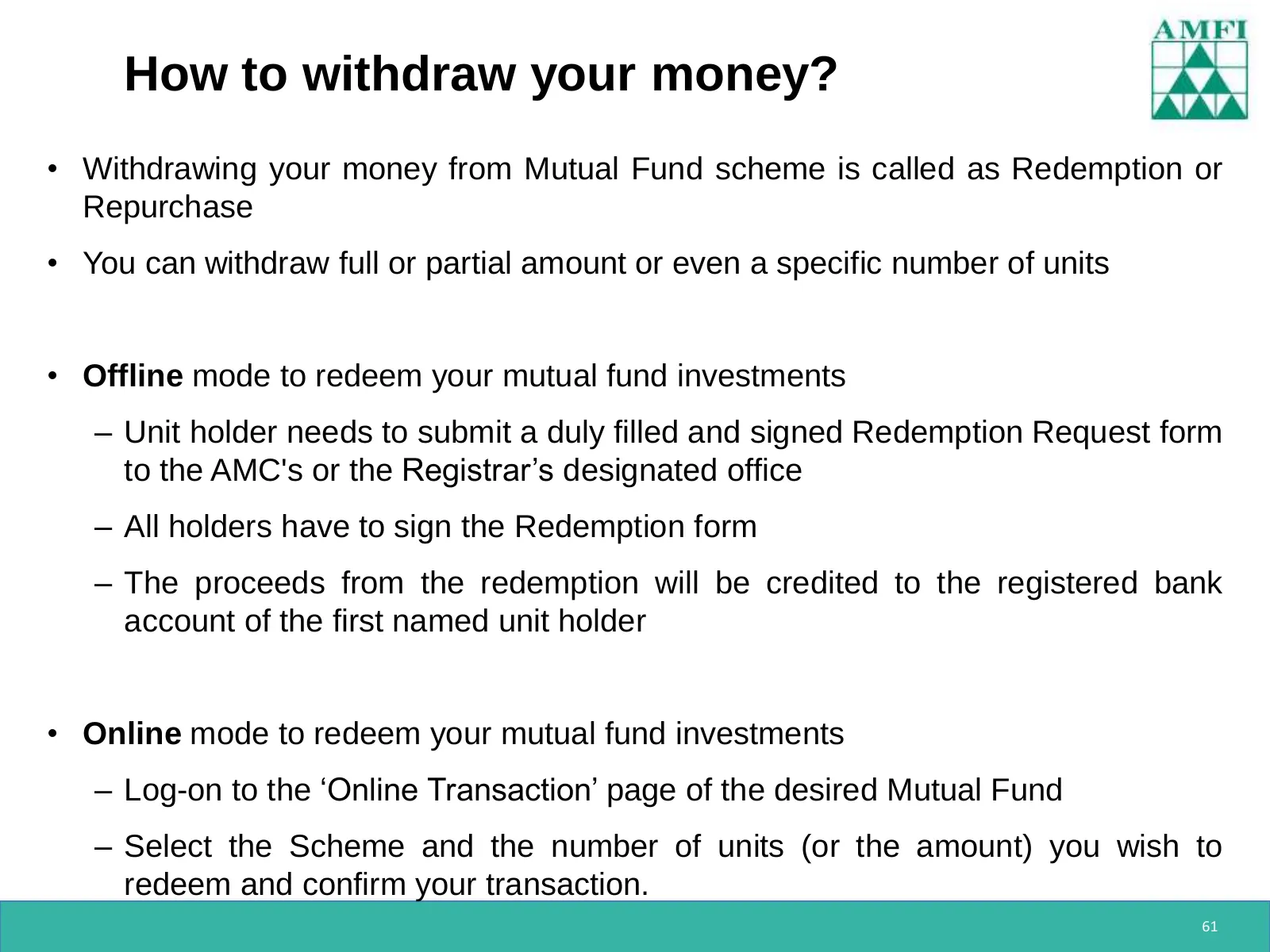
Slide 61: How to withdraw your money?
How to withdraw your money? • Withdrawing your money from Mutual Fund scheme is called as Redemption or Repurchase • You can withdraw full or partial amount or even a specific number of units • Offline mode to redeem your mutual fund investments – Unit holder needs to submit a duly filled and signed
Slide 62: Performance Evaluation Principles
Performance Evaluation Principles • A mutual fund provides relative return, with respect to its benchmark. – Returns have to always be seen in comparison with a fund’s benchmark – Appropriate benchmarks should be used to evaluate a fund’s performance • The return of a fund should be measured over a
Slide 63: What is NAV?
What is NAV? • The NAV (net asset value) is the market value of all the funds investments less liabilities and expenses, divided by outstanding number of units for the firm. • NAV is important as it is the basis for valuing an investor’s holding of units in a mutual fund, and the relative appreciati
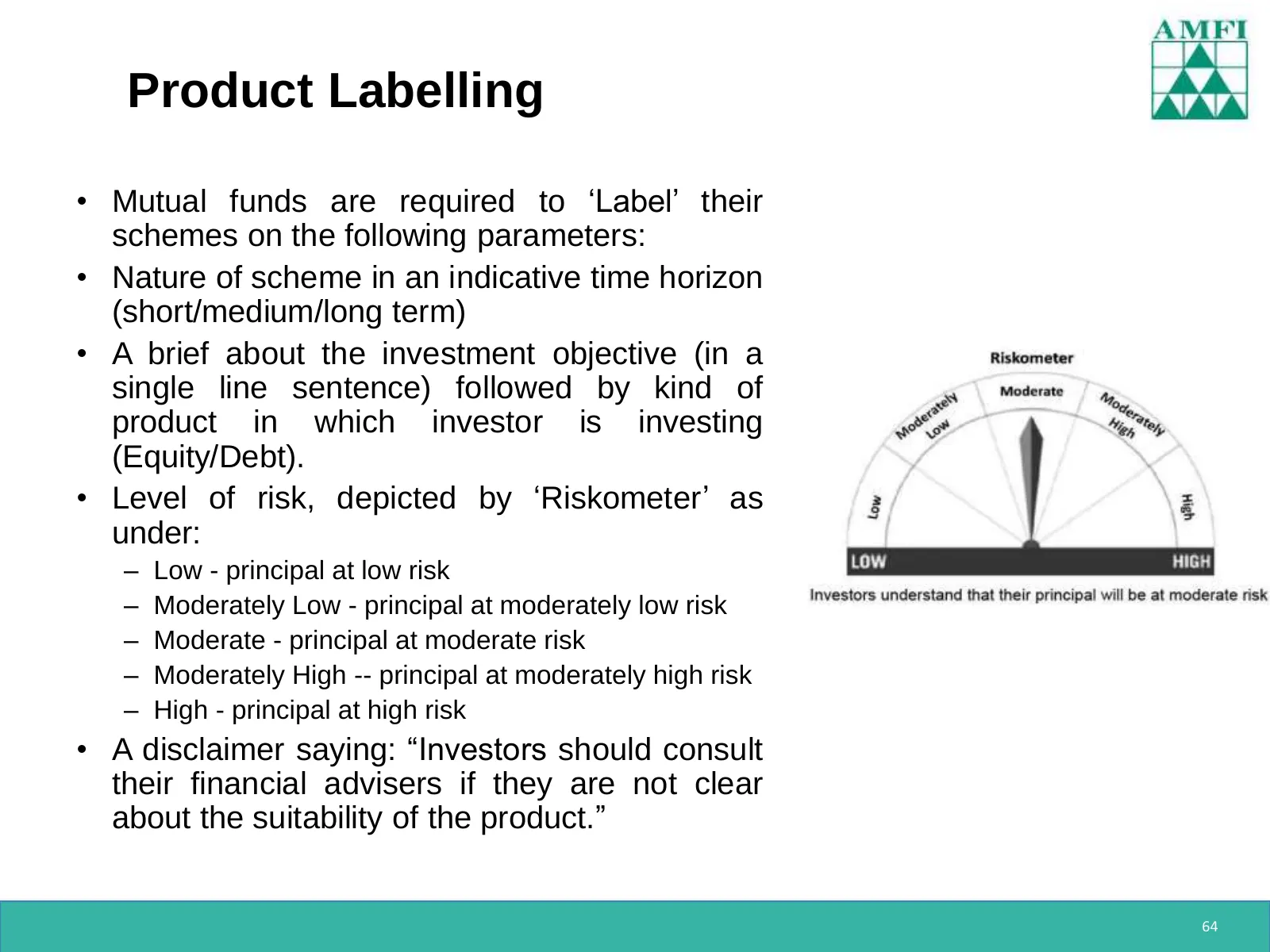
Slide 64: Product Labelling
Product Labelling • Mutual funds are required to ‘Label’ their schemes on the following parameters: • Nature of scheme in an indicative time horizon (short/medium/long term) • A brief about the investment objective (in a single line sentence) followed by kind of product in which investor is investin
Slide 65: Nomination
Nomination • Facility that enables an individual unitholder (including sole proprietor of sole proprietary concern) to nominate a person, who can claim the Units held by the unitholder or the redemption proceeds thereof in the event of death the unitholder. • If the Units are held jointly by more th
Slide 66: Why is Nomination important?
Why is Nomination important? • In case nomination is not made by a Unitholder, the Units would be transmitted to the account of legal heir(s), depending whether the deceased person has left behind a Will and as per applicable succession law, which involves lengthy (and sometimes expensive & cumberso
Slide 67: Complaints Redressal Mechanism
Complaints Redressal Mechanism Complaint to Mutual Fund – Contact the Investor Relations Officer of the Mutual Fund – Name and contact details of the Investor Relations Officer are available in the Scheme Information Document and also on the website of the concerned mutual fund. 67
Slide 68: SEBI Complaints Redress System
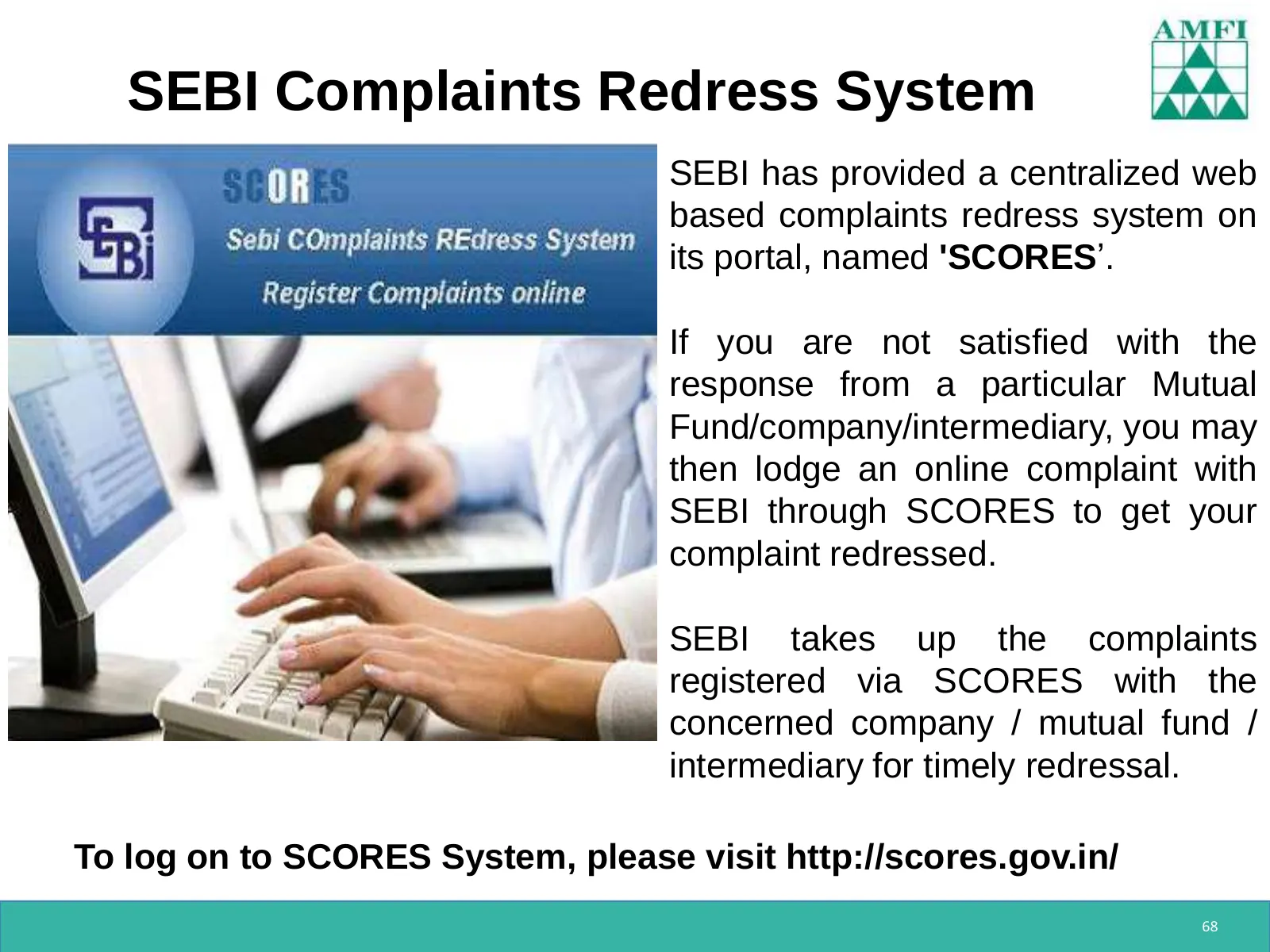
SEBI Complaints Redress System SEBI has provided a centralized web based complaints redress system on its portal, named 'SCORES’. If you are not satisfied with the response from a particular Mutual Fund/company/intermediary, you may then lodge an online complaint with SEBI through SCORES to get your

Slide 69: Thank You
Thank You
Source: Internet Archive copy of motilaloswalmf.com
More decks from Motilal Oswal Mutual Fund - Motilal Oswal Nifty 100 ETF
 Investor Presentation (September 2026)27 slides · September 2026
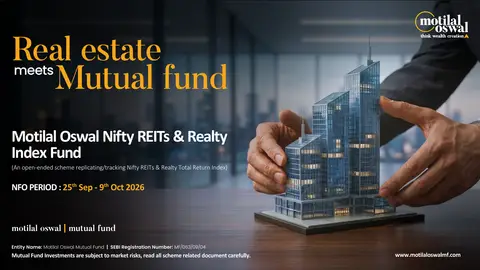 Investor Presentation (September 2026)35 slides · September 2026
 Investor Presentation (August 2026)26 slides · August 2026
 Investor Presentation (August 2026)33 slides · August 2026
 Investor Presentation (June 2026)22 slides · June 2026
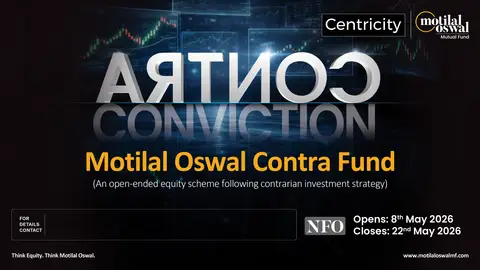 Investor Presentation (May 2026)40 slides · May 4, 2026
All 13 Motilal Oswal Mutual Fund - Motilal Oswal Nifty 100 ETF decks