

- Investigational RGX-202 continues to demonstrate evidence of positively changing disease trajectory for Duchenne
- Pivotal dose participants exceeded external controls across functional measures at 1 year, including participants aged 8+
- Cardiac MRI data for pivotal dose patients demonstrated stability at 1 year
- Favorable safety profile continued with no serious adverse events or adverse events of special interest observed in Phase I/II study
- New data from multiple measures supported liver safety in pivotal patients
- Pivotal topline data expected Q2 2026
ROCKVILLE, Md., March 11, 2026 /PRNewswire/ -- REGENXBIO Inc. (Nasdaq: RGNX) today announced new positive interim data from the Phase I/II AFFINITY DUCHENNE trial of RGX-202, a potential best-in-class gene therapy for Duchenne muscular dystrophy. Trial investigator Carolina Tesi-Rocha, M.D., Clinical Professor, Neurology, Stanford School of Medicine, Stanford Children's Health, is presenting this data, including new functional, safety, biomarker, and cardiac MRI measures, at the Muscular Dystrophy Association (MDA) Clinical and Scientific Conference.
"Today's new Phase I/II interim data demonstrates continued positive impact on function, stable cardiac health, and a favorable safety profile, highlighting the potential of RGX-202 to be a differentiated gene therapy option for Duchenne," said Steve Pakola, M.D., Chief Medical Officer of REGENXBIO. "Our proactive, comprehensive approach to safety combined with our novel microdystrophin construct are supported by the sustained safety and durable functional outcomes through two years post-treatment. As we approach our topline pivotal data readout in early Q2, we are very encouraged by this thorough new dataset and the opportunity to advance RGX-202 as a potential meaningful treatment option for patients."
"Duchenne is a devastating, degenerative disease that robs children of muscle strength and independence over time, and I'm pleased to see the continued positive safety and encouraging efficacy profile of RGX-202," said Dr. Tesi-Rocha. "These positive Phase I/II data, including biomarker results, functional improvement, cardiac stability, and liver safety provide a clearer picture of RGX-202's potential impact across key measures of health in Duchenne."
AFFINITY DUCHENNE Phase I/II Interim Data Updates (data cut: January 5, 2026)
Functional DataIn the interim functional results from seven participants treated at the pivotal dose level (2x10¹⁴ GC/kg), aged approximately 6 to 12 years at dosing, RGX-202 continues to demonstrate evidence of positively impacting disease trajectory on North Star Ambulatory Assessment (NSAA) and all timed function tests (Time to Stand, 10 Meter Walk-run, Time to Climb) at one year.
Functional outcomes were analyzed using multiple validated methods to estimate expected disease progression without treatment, including the cTAP disease progression model and external control comparisons using coarsened exact matching and propensity score weighting. Propensity score weighting is the primary analysis method specified in the SAP for the pivotal trial.
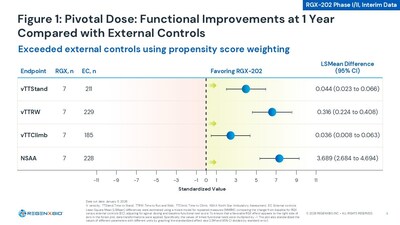
The pivotal dose participants demonstrated improved performance across all timed function tests and NSAA when compared to external control using propensity score weighting. The 95% confidence interval demonstrates favorability to RGX-202. [Figure 1]
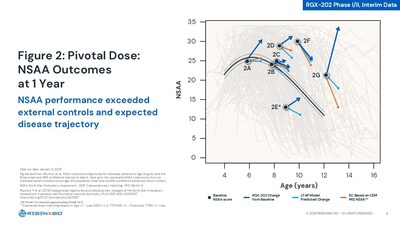
On NSAA, pivotal dose participants exceeded expected disease trajectory and external controls. Notably, five of the seven participants were aged 8+ at dosing, when functional decline is expected. At one year, participants (n=7) improved an average of +4.9 points compared to cTAP. The older participants (n=5) improved an average of +5.2 points compared to cTAP. [Figure 2]
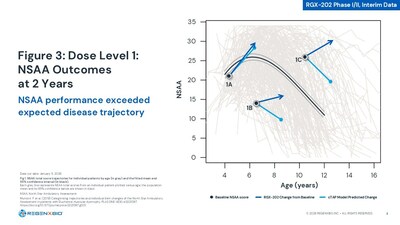
Additionally, dose level 1 (1x10¹⁴ GC/kg) participants (n=3) exceeded expected disease trajectory and improved an average of +5.6 points compared to cTAP at two years. [Figure 3]
Cardiac FunctionPivotal dose participants demonstrated cardiac stability at one year post-treatment as measured by MRI endpoints, including mean left ventricular ejection fraction, global circumferential strain, and fibrosis assessed by late gadolinium enhancement.
Baseline | 12 Months | |
Subjects (N) | 7 | 7 |
Age Mean (range) | 8.7* (5.8-12.1)** | 9.7 (6.8-13.1) |
Left Ventricular Ejection Fraction Mean (range) Median | 61.7% (54-72)** 60% | 61.6% (57-74) 60% |
Global Circumferential Strain Mean (range) Median | -20.4% (-22% to -19%) -20.4% | -20.9% (-23% to -17%) -21.5% |
Late Gadolinium Enhancement (LGE) | 1 participant with fibrosis | No change from baseline |
Biomarker DataBiomarker data from the Phase I/II study continues to support consistent, high expression and transduction of RGX-202 microdystrophin (n=13). New data from an additional patient, aged 3.6 at dosing, had a microdystrophin expression level of 51.2% at Week 12. The primary endpoint in the pivotal phase of AFFINITY DUCHENNE is the proportion of participants whose RGX-202 microdystrophin expression is >10% at Week 12.
RGX-202 was appropriately localized to the sarcolemma, demonstrating that the differentiated construct with the inclusion of the C-Terminal (CT) domain is appropriately targeting the muscle.
Safety and Tolerability DataNew interim safety data from all Phase I/II pivotal dose participants aged 1 to