Mogelijk gemaakt door  Translate
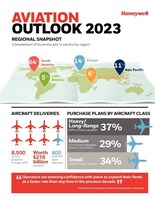
TranslateLAS VEGAS, Oct. 15, 2023 /PRNewswire/ -- Honeywell's (NASDAQ: HON) 32nd annual Global Business Aviation Outlook forecasts up to 8,500 new business jet deliveries worth $278 billion from 2024 to 2033, in line with the same 10-year forecast a year ago. This year, surveyed business aviation operators reported higher five-year new jet purchase plans, which is up two percentage points from a year ago. However, fleet expansion rates nearly tripled in 2023's survey compared to the decade average preceding 2020. The intentions gathered from respondents are consistent with what the OEMs reported to investors in Q2 — an increase in delivery pace during the first half of 2023, which further aligns with the industry's efforts to scale up production in response to record-high backlogs.
"Our industry is on the upswing. Operators are showing confidence with plans to expand their fleets at a faster rate than any time in the previous decade. Notably, we are excited by the recent announcements from fractional operators indicating their intent to acquire several hundred new jets, including midsize and super-midsize jets powered by Honeywell HTF engines," said Heath Patrick, president, Americas Aftermarket, Honeywell Aerospace. "There's also a positive shift toward sustainability, as operators are keen to reduce carbon emissions. Additionally, new users in business aviation have increased demand by 500 aircraft and 6% more flights over the next 10 years. This, along with expected double-digit increases in turbofan deliveries in 2023 and 2024, shows our industry's commitment to meeting growing demand."
Key findings in the 2023 Honeywell Global Business Aviation Outlook include:
Sustainability in business aviationHoneywell is committed to reaching carbon neutrality by 2035 in its operations and facilities and to driving aviation sustainability with a wide range of ready-now solutions that will support a more sustainable future for the sector. This year's survey, for the third consecutive year, features a dedicated section on operators' current and future plans to reduce their carbon footprint during operations.
Regional breakdown and preowned aircraft
North America: North American fleets account for 64% of the five-year new jet deliveries. This year's share is on par with last year's and is likely driven by 90% of North American respondents believing that the economy will at least remain the same if not improve. This makes North America the most optimistic region in 2023.
Europe: European operators will make up 14% of the five-year new jet deliveries. This is one percentage point below last year's share, driven by economic uncertainty and a strong focus on sustainability in this continent.
Latin America: Operators in the Latin American region will make up 5% of global deliveries in the next five years, two percentage points below 2022's share. Nearly 70% of Latin American operators report that local economic conditions will remain the same or decline in the near future, making this region the most pessimistic.
Asia Pacific: This region will make up 11% of new jet demand over the next five years, one percentage point up from the previous year. Operators here have seen the second-highest business aviation utilization growth in 2023 behind only the Middle East.
Middle East/Africa: Fleets here will account for 6% of the five-year new jet deliveries. This is two percentage points above last year's share. This region accounted for the most growth in Bizav flights in 2023.
Preowned Aircraft: Five-year purchase plans for used jets total 27% of the current fleet, just one percentage point below last year's results. After record-high demand for used jets the past two years, 2023 will see a slight increase in the inventory of jets available for sale.
Update on new users of business and private aviationThe business aviation industry experienced a surge in first-time private aviation users and buyers after the onset of the COVID-19 pandemic. At certain points in 2022, this trend drove flight activity to levels not seen since 2007. However, in 2023, global flight activity declined and is expected to decrease this year by approximately 4% compared with 2022. This decline can be attributed to factors such as inflation and the resumption of commercial air service on key routes.
Furthermore, the pace of new orders for jets has slowed down while OEMs focus on meeting current demand by significantly increasing production rates over the next several years. It is anticipated that flight activity will stabilize in 2024 and return to growth in 2025, driven by an accelerated pace in IPOs, corporate profits and easing inflation rates. Consequently, we will be able to assess in 2024 how many of these new users and buyers have remained in the business aviation sector and determine their long-term impact. However, a large impact is already being felt:
Making an Impact on Business DecisionsThe Global Business Aviation Outlook reflects current operator concerns and identifies longer-cycle trends that Honeywell uses in its own product decision process. The survey has helped identify opportunities for investments in sustainability solutions, has expanded propulsion offerings, innovative safety products, services and upgrades, and has enhanced aircraft connectivity offerings. The survey informs Honeywell's business pursuit strategy and helps consistently position the company on high-value platforms in growth sectors.
MethodologyHoneywell's forecast methodology is based on multiple sources, including macroeconomic analyses, original equipment manufacturers' production and development plans shared with the company, and expert deliberations from aerospace industry leaders. Honeywell also uses information gathered from interviews conducted during the forecasting cycle with 100 nonfractional business jet operators representing a fleet of 206 business aircraft worldwide. The survey sample is representative of the entire industry in terms of geography, operation and fleet composition. This comprehensive approach provides Honeywell with unique insights into operator sentiments, preferences and concerns and provides considerable insight into product development needs and opportunities.
About Honeywell
Honeywell Aerospace products and services are found on virtually every commercial, defense and space aircraft. The Aerospace business unit builds aircraft engines, cockpit and cabin electronics, wireless connectivity systems, mechanical components and more. Its hardware and software solutions create more fuel-efficient aircraft, more direct and on-time flights and safer skies and airports. For more information, visit www.honeywell.com or follow us at @Honeywell_Aero.
Honeywell (www.honeywell.com) is a Fortune 100 technology company that delivers industry specific solutions that include aerospace products and services; control technologies for buildings and industry; and performance materials globally. Our technologies help aircraft, buildings, manufacturing plants, supply chains and workers become more connected to make our world smarter, safer and more sustainable. For more news and information on Honeywell, please visit www.honeywell.com/newsroom.
This release contains certain statements that may be deemed "forward-looking statements" within the meaning of Section 21E of the Securities Exchange Act of 1934. All statements, other than statements of historical fact, that address activities, events or developments that we or our management intends, expects, projects, believes or anticipates will or may occur in the future are forward-looking statements. Such statements are based upon certain assumptions and assessments made by our management in light of their experience and their perception of historical trends, current economic and industry conditions, expected future developments and other factors they believe to be appropriate. The forward-looking statements included in this release are also subject to a number of material risks and uncertainties, including but not limited to economic, competitive, governmental and technological factors affecting our operations, markets, products, services and prices. Such forward-looking statements are not guarantees of future performance, and actual results, developments and business decisions may differ from those envisaged by such forward-looking statements. We identify the principal risks and uncertainties that affect our performance in our Form 10-K and other filings with the Securities and Exchange Commission.
Contacts:
MediaAdam Kress(602) 760-6252adam.kress@honeywell.com


 View original content to download multimedia:https://www.prnewswire.com/news-releases/honeywell-forecast-shows-strong-demand-for-new-business-jets-increased-focus-on-reducing-emissions-301956886.html
SOURCE Honeywell