

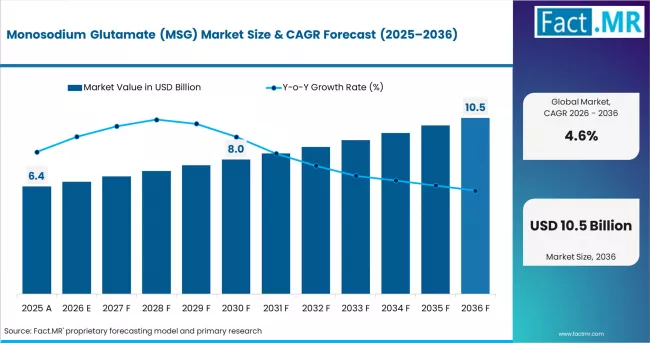
The Monosodium Glutamate (MSG) Market is segmented by Form (Powder and Granules), Application, and Region. Forecast for 2026 to 2036.
ROCKVILLE, MD, UNITED STATES, April 17, 2026 /EINPresswire.com/ -- The global monosodium glutamate (MSG) market is projected to grow from USD 6.12 billion in 2025 to USD 9.6 billion by 2035, expanding at a CAGR of 4.6%. Growth is driven by increasing demand for convenience foods, instant noodles, and cost-effective flavor enhancement solutions.𝗚𝗲𝘁 𝗗𝗲𝘁𝗮𝗶𝗹𝗲𝗱 𝗠𝗮𝗿𝗸𝗲𝘁 𝗙𝗼𝗿𝗲𝗰𝗮𝘀𝘁𝘀, 𝗖𝗼𝗺𝗽𝗲𝘁𝗶𝘁𝗶𝘃𝗲 𝗕𝗲𝗻𝗰𝗵𝗺𝗮𝗿𝗸𝗶𝗻𝗴, 𝗮𝗻𝗱 𝗣𝗿𝗶𝗰𝗶𝗻𝗴 𝗧𝗿𝗲𝗻𝗱𝘀: https://www.factmr.com/connectus/sample?flag=S&rep_id=12232
📊 Quick Stats at a Glance
Market Size (2025): USD 6.12 Billion
Forecast Value (2035): USD 9.6 Billion
CAGR (2025–2035): 4.6%
Top Form: Powder (~60.8% share)
Top Application: Noodles, soups & broths (~38.1% share)
Fastest Growing Country: India (5.9% CAGR)
🧂 Market Overview
The monosodium glutamate (MSG) market is a core segment of the global food ingredients industry, widely used as a flavor enhancer that delivers the “umami” taste across processed foods, restaurant meals, and packaged products.
MSG is extensively applied in:
Instant noodles and soups
Processed meat products
Seasonings and snack foods
Restaurant and foodservice formulations
Its ability to enhance taste while reducing overall salt usage and cost makes it a critical ingredient for food manufacturers and culinary professionals worldwide.
🚀 Key Growth Drivers
Rapid Growth of Convenience Foods
Rising consumption of ready-to-eat and instant meals
Global instant noodle demand growing 5–7% annually
MSG is essential for flavor consistency in mass-produced foods
Expansion of Food Processing Industry
Increasing industrial food production across:
Asia Pacific
Latin America
Integration of MSG in processed and packaged food supply chains
Cost-Effective Flavor Enhancement
Enables manufacturers to:
Improve taste profiles
Reduce ingredient costs
Widely used at low inclusion rates (0.2–0.8%) for maximum efficiency
Growth of Restaurant & QSR Chains
Increasing adoption in standardized recipes and menu formulations
Supports taste uniformity across global outlets
📈 Key Market Trends
Dominance of Powdered MSG
Holds ~60.8% market share
Preferred for:
Easy mixing
High solubility
Industrial food processing efficiency
Expansion in Instant Food Applications
Noodles, soups & broths dominate with ~38.1% share
High-volume consumption in instant food manufacturing
Technological Advancements in Fermentation
Improved production efficiency
Lower manufacturing costs
Enhanced purity levels
Shift Toward Customized MSG Formulations
Development of:
Granulated variants
Customized particle sizes
Application-specific blends
⚙️ Segment Insights
By Form
Powder: ~60.8% share
Ideal for large-scale food manufacturing
Granules: ~39.2% share
Preferred in foodservice and household applications
By Application
Noodles, Soups & Broths: 38.1% share
Seasonings & Dressings: 26.4%
Meat Products: 23.7%
Other applications include snacks and ready meals
🌍 Regional Insights
Asia Pacific – Dominant Market
Largest consumption and production hub
Driven by:
High instant noodle demand
Expanding processed food industry
China: Global leader in production and consumption
India: Fastest growth at 5.9% CAGR
North America – Moderate Growth
Stable demand in processed foods and restaurant sectors
Growth influenced by clean-label trends and consumer awareness
Europe – Regulated & Mature
Slower growth due to:
Strict food additive regulations
Clean-label preferences
Selective MSG usage in processed foods
🏢 Competitive Landscape
The MSG market is moderately concentrated, with leading players controlling 40–50% of global production capacity.
Key Players
Ajinomoto Co., Inc.
Fufeng Group
Meihua Holdings Group
COFCO Corporation
Ningxia Eppen Biotech
Shandong Qilu Biotechnology
Competitive Strategies
Investment in fermentation efficiency and cost optimization
Expansion into high-purity and specialty MSG variants
Strategic partnerships with food manufacturers and QSR chains
💡 Expert Insight
Industry analysts highlight that MSG remains a foundational ingredient in modern food systems, particularly as global demand for affordable, flavorful, and scalable food solutions continues to rise.
Despite evolving consumer perceptions, its cost-efficiency, performance, and versatility ensure sustained relevance across both industrial and culinary applications.
⚠️ Challenges & Restraints
Consumer perception concerns regarding food additives
Fluctuating raw material prices (corn-based fermentation inputs)
Regulatory scrutiny in developed markets
Growing demand for clean-label and natural alternatives
📊 Opportunity Outlook
Expansion in emerging markets (India, Southeast Asia, Latin America)
Growth in processed and ready-to-eat food segments
Development of clean-label and naturally fermented MSG variants
Integration into new food categories and flavor systems
❓ FAQs (SEO-Optimized)
What is monosodium glutamate (MSG) used for?
MSG is used as a flavor enhancer in foods such as noodles, soups, snacks, and processed meat products.
What is driving MSG market growth?
Growth is driven by rising convenience food demand, expansion of food processing industries, and increasing global consumption of instant meals.
Which segment dominates the MSG market?
Noodles, soups, and broths dominate with the highest market share.
Which region leads the market?
Asia Pacific leads due to high consumption and production levels.
What are the major challenges in the market?
Key challenges include consumer perception issues, regulatory constraints, and raw material price volatility.
📣 Conclusion
The global monosodium glutamate (MSG) market is set for steady, demand-driven growth, supported by the rapid expansion of convenience foods and global food processing industries. While perception challenges persist, MSG’s cost efficiency, functional benefits, and scalability position it as a critical ingredient in the evolving global food ecosystem.
𝗨𝗻𝗹𝗼𝗰𝗸 𝟯𝟲𝟬° 𝗜𝗻𝘀𝗶𝗴𝗵𝘁𝘀 𝗳𝗼𝗿 𝗦𝘁𝗿𝗮𝘁𝗲𝗴𝗶𝗰 𝗗𝗲𝗰𝗶𝘀𝗶𝗼𝗻 𝗠𝗮𝗸𝗶𝗻𝗴 𝗮𝗻𝗱 𝗜𝗻𝘃𝗲𝘀𝘁𝗺𝗲𝗻𝘁 𝗣𝗹𝗮𝗻𝗻𝗶𝗻𝗴 : https://www.factmr.com/checkout/12232
Related Reports:
Sodium Diacetate as Mold Inhibitor in Packaged Bread Market: https://www.factmr.com/report/sodium-diacetate-as-mold-inhibitor-in-packaged-bread-market
Pigeon Pea Market: https://www.factmr.com/report/pigeon-pea-market
Sugar Reduction Mouthfeel Recovery Additives Market: https://www.factmr.com/report/sugar-reduction-mouthfeel-recovery-additives-market
Pea Starch for Clean-Label Confectionery Applications Market: https://www.factmr.com/report/pea-starch-for-clean-label-confectionery-applications-market
About Fact.MR
We are a trusted research partner of 80% of fortune 1000 companies across the globe. We are consistently growing in the field of market research with more than 1000 reports published every year. The dedicated team of 400-plus analysts and consultants is committed to achieving the utmost level of our client's satisfaction.
S. N. Jha
Fact.MR
+1 628-251-1583