

Threonine Acids Market grows with rising demand in animal feed, nutrition supplements, and pharmaceutical applications globally.
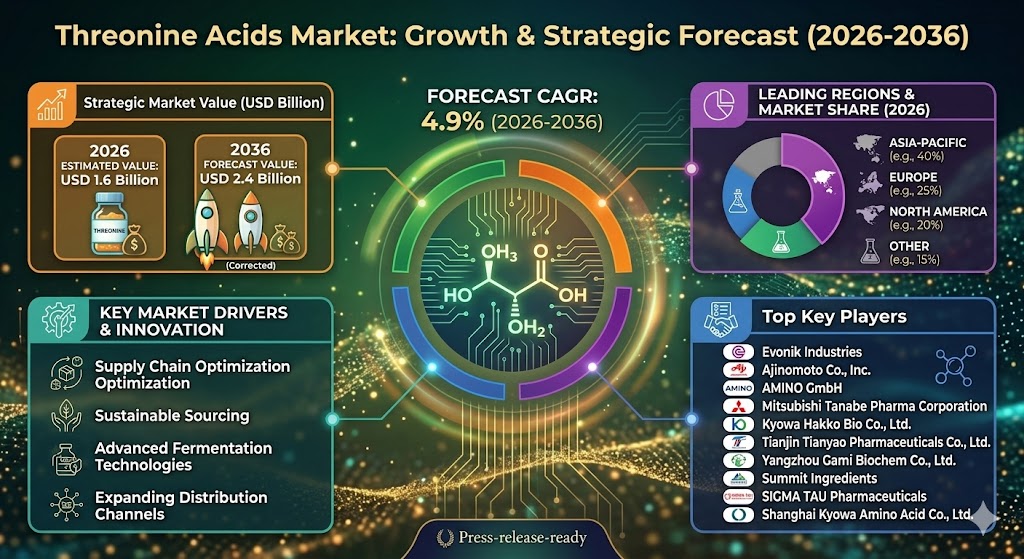
ROCKVILLE, MD, UNITED STATES, April 9, 2026 /EINPresswire.com/ -- According to Fact MR, latest analysis, the global threonine acids market is valued at USD 1.5 billion in 2025 and is projected to reach USD 1.6 billion in 2026, expanding to USD 2.4 billion by 2036, reflecting a CAGR of 4.9%. The market is expected to generate an incremental opportunity of USD 0.8 billion over the forecast period.This market is undergoing structural transformation from a commodity feed additive industry to a dual-tier model, where low-margin animal feed applications coexist with high-value pharmaceutical and nutraceutical segments. Regulatory tightening, clean-label demand, and precision nutrition are redefining value creation.
Get detailed market forecasts, competitive benchmarking, and pricing trends: https://www.factmr.com/connectus/sample?flag=S&rep_id=14675
Quick Stats
Market Size (2025): USD 1.5 Billion
Market Size (2026): USD 1.6 Billion
Forecast Value (2036): USD 2.4 Billion
CAGR (2026–2036): 4.9%
Incremental Opportunity: USD 0.8 Billion
Leading Segment: L-Threonine (80% share)
Leading End Use: Animal Feed (60% share)
Leading Region: Asia-Pacific (India & China)
Key Players: Ajinomoto, Evonik Industries, Kyowa Hakko Bio, AMINO GmbH, Tianjin Tianyao
Executive Insight for Decision Makers
The market is shifting toward certified, high-purity amino acids, with GMP-compliant production becoming a key differentiator.
Strategic Imperatives:
Invest in pharmaceutical-grade fermentation capacity
Develop plant-based and clean-label threonine solutions
Expand presence in India and regulated markets
Risk of Inaction:
Exposure to price erosion in commodity feed segments
Loss of access to premium regulated markets
Weak positioning in long-term supply contracts
Market Dynamics
Key Growth Drivers
Rising demand for animal protein, boosting feed amino acid usage
Expansion of pharmaceutical and clinical nutrition sectors
Growth in nutraceuticals and functional foods
Increasing regulatory focus on feed efficiency and emissions reduction
Key Restraints
Overcapacity in Chinese fermentation production
Volatility in corn and molasses feedstock prices
Margin pressure in commodity-grade threonine
Emerging Trends
Shift toward GMP-certified amino acids
Growth in plant-based fermentation technologies
Adoption of precision nutrition in livestock
Expansion of functional food and supplement applications
Segment Analysis
Leading Segment: L-Threonine holds ~80% share, driven by scalability and regulatory acceptance
Fastest-Growing Segment: Pharmaceutical-grade threonine (premium segment)
Breakdown
Product Type: L-Threonine, D-Threonine
End Use: Animal Feed (60%), Pharmaceuticals, Food Supplements
Strategic Importance
Feed segment ensures volume stability
Pharma and nutraceutical segments drive margin expansion and innovation
Supply Chain Analysis
Value Chain Structure
Raw Materials: Corn, molasses, glucose (agri-based inputs)
Producers: Fermentation-based amino acid manufacturers
Distributors: Feed additive suppliers, pharma ingredient distributors
End Users:
Feed manufacturers (poultry, swine)
Pharmaceutical companies
Nutraceutical brands
Who Supplies Whom
Agricultural processors → supply feedstock to fermentation companies
Producers (e.g., amino acid manufacturers) → supply bulk threonine to feed companies and pharma firms
Distributors → bridge supply to regional feed mills and supplement brands
Insight:
Pharmaceutical buyers prefer long-term contracts, while feed manufacturers rely on multi-supplier sourcing for price optimization.
Pricing Trends
Commodity vs Premium:
Feed-grade threonine = price-sensitive, low margin
Pharmaceutical-grade = 50–100% premium pricing
Key Pricing Factors
Raw material cost fluctuations
Regulatory certifications (GMP, FSSAI, EU approvals)
Supply-demand imbalance
Production scale (China vs non-China producers)
Margin Insights
Commodity segment margins remain compressed
Premium segments offer higher profitability and stability
Regional Analysis
Top 5 Countries by CAGR (2026–2036)
India: 6.1%
China: 5.8%
Japan: 5.5%
Germany: 5.0%
United States: 4.8%
Regional Insights
India: Growth driven by pharmaceuticals and nutraceutical expansion
China: Dominates feed production and fermentation scale
Japan: High-value demand from functional foods (FOSHU)
Germany: Regulatory-driven demand for certified products
USA: Mature market focused on quality and compliance
Developed vs Emerging Markets
Developed markets = premium, regulated demand
Emerging markets = volume-driven feed demand
Competitive Landscape
Market Structure: Moderately consolidated (premium), fragmented (commodity)
Key Players
Ajinomoto Co., Inc.
Evonik Industries
Kyowa Hakko Bio Co., Ltd.
AMINO GmbH
Mitsubishi Tanabe Pharma
Tianjin Tianyao Pharmaceuticals
Yangzhou Gami Biochem
Summit Ingredients
Shanghai Kyowa Amino Acid
Competitive Strategies
Expansion of GMP-certified production
Investment in fermentation technology
Strategic long-term supply agreements
Portfolio diversification into nutraceuticals
Strategic Takeaways
For Manufacturers
Shift toward high-purity, certified production
Reduce reliance on commodity feed markets
For Investors
Focus on premium amino acid segments
Target companies with regulatory compliance advantage
For Marketers / Distributors
Build regional compliance expertise
Expand into pharma and supplement channels
Future Outlook
The market will continue evolving toward a two-tier ecosystem:
High-volume, low-margin feed applications
High-value, regulated pharmaceutical and food applications
Key Trends Ahead:
Biotechnology-driven fermentation innovation
Sustainability and plant-based production
Increasing integration with precision nutrition systems
Conclusion
The global threonine acids market is transitioning from volume-led growth to value-driven expansion. Companies that align with regulatory standards, invest in premium production, and localize supply chains will capture long-term opportunities.
Why This Market Matters
Threonine acids are critical to global food security, animal nutrition efficiency, and clinical nutrition advancement. As industries prioritize sustainability, efficiency, and health outcomes, this market will remain a strategic pillar across agriculture, pharmaceuticals, and food systems worldwide.
Unlock 360° insights for strategic decision making and investment planning: https://www.factmr.com/checkout/14675
To View Related Report:
Odour Control Textiles Market https://www.factmr.com/report/849/odour-control-textiles-market
Wind Turbine Gear Oil Market https://www.factmr.com/report/877/wind-turbine-gear-oil-market
Fiberglass Fabric Market https://www.factmr.com/report/878/fiberglass-fabric-market
Thermal Interface Materials Market https://www.factmr.com/report/879/thermal-interface-materials-market
About Fact.MR
Fact.MR is a global market research and consulting firm, trusted by Fortune 500 companies and emerging businesses for reliable insights and strategic intelligence. With a presence across the U.S., UK, India, and Dubai, we deliver data-driven research and tailored consulting solutions across 30+ industries and 1,000+ markets. Backed by deep expertise and advanced analytics, Fact.MR helps organizations uncover opportunities, reduce risks, and make informed decisions for sustainable growth.
S. N. Jha
Fact.MR
+ +1 628-251-1583
sales@factmr.com