

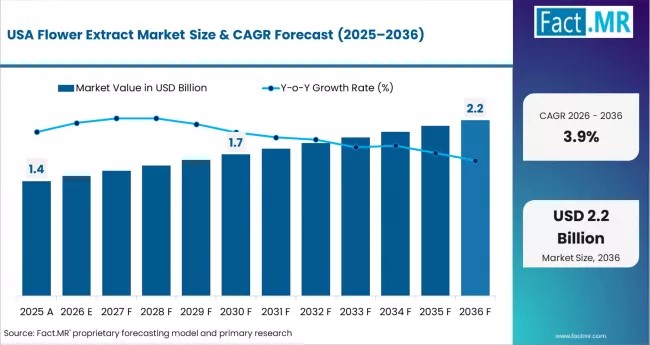
Flower Extract Market blooms with rising demand in cosmetics, food, and wellness, driven by natural ingredients and clean-label trends.
ROCKVILLE, MD, UNITED STATES, April 7, 2026 /EINPresswire.com/ -- The global Flower Extract Market is witnessing a period of rapid industrialization and premiumization, driven by a fundamental shift in consumer preference toward plant-based, bioactive ingredients. According to a comprehensive market study by Fact.MR, the industry is projected to grow from a valuation of USD 3.4 billion in 2026 to USD 5.6 billion by the end of 2036, representing a steady CAGR of 5.2%.As the personal care, food and beverage, and pharmaceutical sectors move away from synthetic additives, flower extracts—notably Jasmine, Rose, and Chamomile—have emerged as essential raw materials for high-margin product formulations.
For Details Deep insights, Please Request A sample report for Free: https://www.factmr.com/connectus/sample?flag=S&rep_id=14655
Market Dynamics: Growth Catalysts
The "Clean Label" Evolution: Growing consumer scrutiny of ingredient lists in North America and Europe is forcing manufacturers to replace artificial fragrances and flavors with standardized botanical extracts.
Bioactive Efficacy: Beyond scent, extracts like Marigold (Lutein) and Hibiscus are being integrated into "cosmeceuticals" and "nutraceuticals" for their proven antioxidant and anti-inflammatory properties.
Technological Advancement: The adoption of Supercritical CO2 Extraction and Ultrasound-Assisted Extraction (UAE) is allowing for higher yield and purity, justifying premium pricing tiers.
Supply Chain Analysis: From Field to Formulation
The supply chain is characterized by a high degree of vertical integration among top-tier players to ensure raw material traceability:
Cultivation (Upstream): Dominated by regional hubs such as Bulgaria (Rose), India (Jasmine), and France (Lavender).
Processing & Extraction (Midstream): Key specialty chemical and ingredient houses like Givaudan, Symrise, and International Flavors & Fragrances (IFF) source crude biomass and process it into essential oils, powders, and liquid extracts.
End-Use Manufacturers (Downstream): Global conglomerates including L’Oréal, Estée Lauder, and Nestlé are the primary buyers, often engaging in long-term supply contracts to hedge against crop volatility.
Key Market Segments
Product Type: Jasmine and Rose extracts currently dominate the market share due to high demand in the luxury perfumery and premium skincare sectors.
Form: Liquid extracts account for over 55% of the market, favored for their ease of integration into liquid personal care formulations. However, powdered extracts are witnessing the fastest growth in the dietary supplement category.
Application: While Cosmetics & Personal Care remains the largest segment, the Food & Beverage sector is seeing a surge in demand for floral-infused functional beverages and herbal teas.
Regional Outlook
North America: Holds a significant share of the market, driven by a mature organic personal care sector and high per-capita spending on premium wellness products.
Europe: Continues to lead in high-end fragrance production and stringent regulatory standards that favor natural ingredients over synthetics.
East Asia (South Korea & China): Expected to grow at a CAGR of 8.5% through 2036. The "K-Beauty" influence and the traditional use of floral medicine in China are creating a massive regional demand for innovative extracts.
Competitive Landscape
The market is moderately fragmented, with a mix of global chemical giants and specialized botanical houses. Leading companies are focusing on "Fair Trade" certifications and sustainable sourcing to appeal to ESG-conscious investors.
Givaudan SA
Symrise AG
International Flavors & Fragrances Inc. (IFF)
Sensient Technologies Corporation
Synthite Industries Ltd.
Pricing Trends & Risks
Pricing: Prices for premium extracts (e.g., Rose Otto) remain highly sensitive to climate conditions. Increased adoption of climate-controlled indoor farming and greenhouse cultivation is helping to stabilize the supply of high-value floral crops.
Risks: The primary threats to market stability include adulteration of extracts and regulatory shifts regarding allergen labeling in botanical fragrances.
Investment Outlook: Actionable Insights
For decision-makers, the most lucrative investment opportunities lie in standardized medicinal extracts for the nutraceutical market. Furthermore, companies that can provide full transparency in their supply chain (Blockchain-enabled traceability) are likely to capture a higher market share in the premium European and North American segments.
For instant access to this report, click “Buy Now” or connect with our analyst for customization: https://www.factmr.com/checkout/14655
To View Related Report:
Reactive Diluents Market https://www.factmr.com/report/599/reactive-diluents-market
Polyacrylates Market https://www.factmr.com/report/602/polyacrylates-market
High Purity Oxygen Market https://www.factmr.com/report/619/high-purity-oxygen-market
High Purity Silica Market https://www.factmr.com/report/622/high-purity-silica-market
About Fact.MR
Fact.MR is a global market research and consulting firm, trusted by Fortune 500 companies and emerging businesses for reliable insights and strategic intelligence. With a presence across the U.S., UK, India, and Dubai, we deliver data-driven research and tailored consulting solutions across 30+ industries and 1,000+ markets. Backed by deep expertise and advanced analytics, Fact.MR helps organizations uncover opportunities, reduce risks, and make informed decisions for sustainable growth.
S. N. Jha
Fact.MR
+ +1 628-251-1583
sales@factmr.com