
26 March 2026
Pollen Street Group Limited: Full Year 2025 Trading Update
Continued growth in 2025 with sustained and growing fundraising momentum
Pollen Street Group Limited ("Pollen Street", together with its subsidiaries, the "Group") today issues its financial results for the year ended 31 December 2025. The Group is delivering sustained and growing fundraising momentum across both Private Credit and Private Equity strategies, underpinning strong financial performance and delivering against its key strategic priorities.
|
AUM (£bn) |
2025 |
2024 |
YoY Growth (%) |
|
Total AuM |
7.1 |
5.4 |
30% |
|
Fee Paying AuM |
5.2 |
4.0 |
32% |
|
INCOME STATEMENT (£m) |
2025 |
2024 |
YoY Growth (%) |
|
Fund Management Income |
81.1 |
66.8 |
21% |
|
Fund Management Administration Costs |
(49.4) |
(39.6) |
25% |
|
Fund Management EBITDA |
31.7 |
27.2 |
17% |
|
Income on Net Investment Assets |
32.9 |
31.8 |
4% |
|
EBITDA |
64.6 |
59.0 |
10% |
|
Profit After Tax |
56.6 |
49.6 |
14% |
|
EPS |
93.7p |
78.8p |
19% |
|
DPS |
58.0p |
53.6p |
8% |
FY25 Highlights
· Total Assets Under Management ("AUM") increased by 30 per cent to £7.1 billion (FY 2024: £5.4 billion)
· Fee-paying AUM grew 32 per cent to £5.2 billion (FY 2024: £4.0 billion)
· Flagship fundraises in both Private Equity and Private Credit significantly outperforming target
· Group Profit After Tax up 14 per cent to £56.6 million (FY 2024: £49.6 million)
· Asset Management share of net revenues increased to 71 per cent (FY2024: 68 per cent)
· Investment company income stable and consistent over long term at £32.9 million
· £1.6 billion deployed across both strategies
· Second (and final) interim dividend of 31 pence per share brings total dividend declared for the year to 58.0 pence per share, 3 pence per share ahead of guidance and 8 per cent up on FY24
· Growing visibility on reaching Total AUM of £10 billion, in line with our medium term target
Commenting on the performance, Lindsey McMurray, Chief Executive Officer, said:
"2025 was a strong year for Pollen Street, marked by a step-change in fundraising and growth across both our Private Equity and Private Credit platforms. Our total AUM increased by 30 per cent to £7.1 billion, driven by the successful close of Private Equity Fund V and clear momentum in Private Credit Fund IV.
This fundraising strength, underpinned by the trust of our global investor base, enabled us to generate strong management fee income and deliver Group Operating Profit of £64.4 million, ahead of expectations.
Our investment strategies have continued to demonstrate resilience and outperformance amidst difficult market conditions. Across both Private Equity and Private Credit, the Group is focused on disciplined underwriting, downside protection and supporting portfolio companies and borrowers through active engagement.
We enter 2026 with exciting momentum and a robust pipeline for both deployment and fundraising. Our strategic priorities remain clear: to continue deploying capital across our flagship funds, prepare for the next generation of investment strategies, and deliver sustainable value for our investors and shareholders."
Financial Performance
· Management fees up 26 per cent to £69.9 million
· Fund Management EBITDA increased to £31.7 million, up 17 per cent
· Income on Net Investment Assets of £32.9 million (2024: £31.8 million) giving a return of 9.9 per cent
· Underlying return on Net Investment Assets of 10.6 per cent before dilution from equalisation related to the strong fundraising
· Earnings per share increased to 93.7 pence per share, up 19 per cent from 78.8 pence per share in 2024, ahead of the growth in Profit After Tax given the benefit of share buybacks
Fundraising
· Significant fundraising outperformance achieved across both strategies
· Final close of Private Equity Fund V at €1.5 billion in July 2025
· Private Credit Fund IV now at £1.8 billion with further capital commitments expected ahead of an imminent final close
· £0.8 billion dry powder in Private Credit as at end December 2025, which will convert to fee-paying AUM once deployed
· Fundraising momentum and expanded investor base underpin £10 billion medium term AUM target
Deployment and exits
· £1.6 billion invested across both platforms
· Mid-market target market resilient offering a rich and deep opportunity set
· Existing funds seasoning well and current vintage deploying at planned pace
· Robust pipeline of transaction opportunities developed across both strategies for execution in 2026
· Three disposals completed during 2025 including the IPO of Shawbrook on the London Stock Exchange
Outlook
· We are confident that our strategic focus and significant momentum will enable the Group to capitalise on opportunities for continued sustainable growth in 2026 and beyond.
· In order to recognise individual contributions to the substantial outperformance of the Private Credit Fund IV fundraise, the Board has determined to allocate a further 8 per cent of Carried Interest in Private Credit Fund IV to certain individuals with the effect of reducing the groups share to 17 per cent and to give more flexibility in how the Group's share of Carried Interest is set for future funds. Given the significant outperformance in fund size, there is no change in the Group's financial guidance as a result of these changes.
· Despite our strong performance and favourable fundamentals, the share price has not fully reflected the progress made and we believe significantly undervalues the strength and resilience of the platform. This conviction underpins the Groups continued commitment to returning capital to shareholders through its share buyback programme.
Dividend
· The Board has declared a final dividend of 31.0 pence per share, bringing the total dividend for the year to 58.0 pence per share or £34.7 million, pence per share ahead of guidance and an 8 per cent increase on 2024
· The Group is committed to maintaining our progressive dividend policy
AGM Notice
The Company will hold its Annual General Meeting on 30 April 2026 at 4pm at the offices of Slaughter & May, One Bunhill Row, London EC1Y 8YY. Further details are provided in the Notice of Annual General Meeting to be circulated to shareholders in due course and shortly available on www.pollenstreetgroup.com.
About Pollen Street
Pollen Street is an alternative asset manager dedicated to investing within the financial and business services sectors across both Private Equity and Private Credit strategies. Founded in 2013, the Group has consistently delivered top-tier returns alongside growing AuM.
Pollen Street operates through two complementary segments: the Asset Manager, which manages third-party AuM, and the Investment Company, which invests on balance sheet to generate attractive returns and accelerate AuM growth through alignment with investors.
POLN is listed on the London Stock Exchange (ticker symbol: POLN) and is a member of the FTSE 250 index. Further details are available at www.pollenstreetgroup.com.
For investors:
A presentation and Q&A will be held for analysts at 1 PM on 26 March 2026.
The full presentation is available for on the website www.pollenstreetgroup.com.
Results webinar:
For further information about this announcement please contact:
Pollen Street - Corporate Development Director
Shweta Chugh
+44 (0)20 3965 5081
Barclays Bank plc - Joint Broker
Neal West / Stuart Muress
+44 (0)20 7623 2323
Investec Bank plc - Joint Broker
Ben Griffiths / Kamalini Hull
+44 (0)20 7597 4000
FGS Global
Chris Sibbald / Anna Tabor
PollenStreetCapital-LON@fgsglobal.com
MUFG Corporate Governance Limited - Company Secretary
POLNcosec@cm.mpms.mufg.com
LEI: 894500LP94M98N8CY487
Annual Report and Accounts
The Annual Report and Accounts are available to view and download from the Company's website https://ir.pollenstreetgroup.com/investors/financial-information/. Neither the contents of the Company's website nor the contents of any website accessible from hyperlinks on the Company's website (or any other website) is incorporated into or forms part of this announcement. The information set out below does not constitute the Company's statutory accounts for the year ended 31 December 2025 but is derived from those accounts. Statutory accounts for the year ended 31 December 2025 will be delivered to the Registrar of Companies in due course. The group's auditors have reported on those accounts: their report was (i) unqualified, (ii) did not include a reference to any matters to which the auditors drew attention by way of emphasis without qualifying their report, and (iii) did not contain a statement under 'Section 263 (2) or (3) of The Companies (Guernsey) Law, 2008. The following text are selected extracts from the Annual Report and Accounts.
In accordance with UK Listing Rule 6.4.1, the following documents will be submitted to the Financial Conduct Authority and will shortly be available for inspection via the National Storage Mechanism which can be accessed at https://data.fca.org.uk/#/nsm/nationalstoragemechanism:
· Annual Report and Accounts for the year ended 31 December 2025;
· notice of 2026 annual general meeting; and
· proxy form for the 2026 annual general meeting.
In accordance with DTR 6.3.5(1A), the Annual Report and Accounts for the year ended 31 December 2025 will be submitted in full unedited text to the Financial Conduct Authority's National Storage Mechanism and will be available for inspection as noted above.
Chair's Statement
Lynn Fordham
Chair
In my first report as Chair of Pollen Street Group Limited, I am pleased to highlight another year of impressive progress for the business. Pollen Street is successfully delivering against its strategy, growing assets under management, deepening and maintaining investor relationships, and solidifying its position as a leader in its selected strategies.
Momentum: Accelerating Our Growth
In 2025 Pollen Street has achieved the goals set at the start of the year, executing well on our growth ambitions whilst also delivering strong cash returns to shareholders. Our consistent investment performance and strong relationships with our Limited Partner investors ("LPs") have driven successful fundraises across both Private Equity and Private Credit.
In 2025, we grew AuM across both Private Equity and Private Credit to £7.1 billion - a 30 per cent increase on prior year. In Private Equity, we delivered a successful final close of Private Equity Fund V, well ahead of its initial target. In Private Credit, we have developed strong fundraising momentum for Private Credit Fund IV which has already exceeded its target with significant further commitments expected ahead of the final close. This fundraising activity translated into sustained robust management fee growth in the period with momentum for going forward.
The Investment Company continued to demonstrate strong and consistent performance, with robust income generation and cash conversion supporting £39.4 million of cash returns to shareholders during the year through dividends and share buybacks.
In last year's report we set out our expectation of a favourable outlook as the Group builds upon its strong foundations in differentiated strategies. Our realised fundraising success reflects a robust and consistent investment track record, strategic clarity and resilience, alongside the quality relationships with existing and new LPs.
Looking ahead, we expect continued institutional allocation to private markets in 2026, driven by the diversification and long-term return benefits these strategies can offer especially with sustained demand for exposure to mid-market opportunities where our sector-specialist focus remains a clear differentiator. While macroeconomic, geopolitical and technology-related uncertainties persist, Pollen Street's disciplined approach to investment selection and active portfolio management position us well to navigate this environment and capitalise on the structural opportunities it presents.
Group's Share of Carried Interest
Following the successful fundraises for Private Equity Fund V and Private Credit Fund IV, the Board has reviewed how Carried Interest is allocated between the Group and individual team members. At the time of the Combination between Honeycomb Investment Trust and Pollen Street Capital Holding Limited in 2022, it was agreed that 25 per cent of the Carried Interest entitlement in all future funds would be allocated to the Group.
While we believe that it is important for the Group to benefit from the performance of the funds it manages, in the case of Private Credit Fund IV, and specifically to recognise contributions made to the success of this fundraise and its resultant increased scale, the Board has determined to reduce the Group's share of Carried Interest in this fund to 17 per cent and to give more flexibility in how the Group's share of Carried Interest is set for future funds. Going forward, the Group's allocation for each fund will be set by the Board at or before the final close of the fund. The Group's allocation will be set at no less than 15 per cent and up to 25 per cent of the total entitlement for the next generation of flagship Private Equity and Private Credit Funds.
The Board believe this change is strategically important for the Group to support the long-term growth and development of our asset management platform.
There is no change in the Group's financial guidance as a result of these changes.
Capital Allocation Framework & Buyback Programme
The Group continues to follow the enhanced capital allocation framework that was put in place in November 2025 which gives confidence in maintaining cash returns to shareholders whilst prioritising strategic growth opportunities, including making capital commitments to our funds.
The Board has declared a final dividend of 31.0 pence per share, bringing the total dividend for the year to 58.0 pence per share or £34.7 million.
Corporate Governance and Reporting on Responsible Investing
Pollen Street places excellent governance at the heart of everything that we do. We adopt rigorous oversight, transparency and accountability as essential foundations for delivering long-term value for our investors and shareholders. We aim to model best-in-class governance through the strength and independence of our Board. In this context, I am delighted to welcome Robert Ohrenstein, who joins as an independent Non-Executive Director and will be appointed as Chair of the Audit Committee following the AGM. Robert brings deep private markets expertise and an unwavering commitment to robust audit and risk oversight, further enhancing our governance framework.
Responsible Investing is a key part of Pollen Street's strategy and culture helping us to build robust, resilient businesses with foundations to grow for the future. We use proprietary metrics to drive clear, measurable progress enabling fast, sustainable and safe growth - both for Pollen Street and for our portfolio companies and borrowers.
The Group also remains focused on strengthening its reporting and climate risk management, ensuring transparency and accountability as the regulatory landscape further evolves.
Our Outlook: Sustained Progress and Long-Term Growth
Pollen Street enters 2026 with strong momentum and confidence in delivering against our targets for the year ahead. While we are cognisant of the uncertain macroeconomic environment, complex geopolitical backdrop and ever-changing market dynamics, we believe that the outlook for the Group is positive. Our platform has demonstrated performance across cycles, supported by disciplined risk management and strong governance.
Pollen Street's shares delivered strong performance during 2025, significantly outperforming the FTSE 250 index and reflecting investor confidence in our successful fundraising, robust financial results, and quality earnings growth. 2026 has presented a more challenging backdrop for equity markets broadly and listed alternative asset managers in particular. Initially this resulted from a sharp sell-off in growth stocks amid heightened uncertainty over the impact of AI, which was exacerbated by investor caution around private credit. More recently this has been compounded with heightened risk aversion across global markets following the escalation of the Iran conflict.
Notwithstanding this backdrop, the fundamental performance of our business remains strong, with continued momentum in fundraising, deployment, and portfolio performance.
I would like to thank the entire Pollen Street team for their outstanding work in delivering such a successful year, as well as our LPs and shareholders for their continued support. We look forward to building on this momentum in the year ahead.
Lynn Fordham
Chair
25 March 2026
CEO Report
Lindsey McMurray
Chief Executive Officer
Strong Performance and Fundraising Momentum
2025 marked another strong year of progress for Pollen Street. We have continued to execute well against our strategic objectives, delivering notable fundraising successes and extending our consistently strong investment track record.
We delivered substantial growth in AuM across both Private Equity and Private Credit, reflecting the strength of our strategies and the depth of our investor support. In July we completed the successful final close of Private Equity Fund V, securing commitments of €1.5 billion. Including associated co-investment vehicles, the Group has raised more than €2.0 billion for our flagship strategy. Private Credit Fund IV has surpassed its target with £1.8 billion of commitments at the date of signing the financial statements and significant further capital commitments expected ahead of a final close. Importantly, the increase in commitments is from a broad range of global investors and their consultant advisers, significantly adding to the resilience of the platform and supporting cross sell across our strategies over time. We are very grateful for the endurance of relationships that we have with established partners and are thrilled to develop new partnerships as we continue to expand our investor base.
This outperformance in fundraising enabled us to deliver strong financial performance in the period, especially in relation to high-quality management fee income and profits ahead of expectations.
Group Operating Profit grew to £64.4 million for 2025, up from £58.2 million in 2024. The primary growth driver was our Asset Manager, with Operating Profit increasing to £31.7 million (49 per cent of Group), from £27.2 million (47 per cent of Group) in 2024. This included an £8.4 million benefit from catch up fees in Fund V ahead of it's final close during the year.
Resilience in a Changeable Macro Environment
As the macroeconomic and geopolitical backdrop remains uncertain, we are intensely vigilant while our strategies remain resilient. Across both Private Equity and Private Credit, we are focused on disciplined underwriting and downside protection while actively engaging to support portfolio companies and borrowers continue to build value.
We continually consider emerging threats from changing market conditions including idiosyncratic events in adjacent markets and AI. In Private Credit, high quality borrowers seek our expertise and long-term partnership and we work together to create bespoke structures to withstand events and shocks. In Private Equity, change also brings opportunities, both on an individual investee company level and from a portfolio construction perspective and we actively work with our companies to ensure that they have the expertise and resources to take advantage of improved operational models to enhance their customer proposition and their own operational efficiencies. Overall, we believe our portfolio companies benefit from highly resilient business models operating in regulated areas and benefiting from substantial proprietary data and resilient end user markets.
ASSET MANAGER
Fundraising and Deployment
Total AuM grew to £7.1 billion as of 31 December 2025, up 30 per cent from £5.4 billion at the end of 2024 with Fee-Paying AuM increasing 32 per cent (£1.3 billion) to £5.2 billion.
Private Equity AuM increased to £4.2 billion and Private Credit AuM increased to £2.9 billion.
2025 was a strong year for deployment across the platform. We invested £0.5 billion in Private Equity and £1.1 billion in Private Credit during the year. We enter 2026 with a robust pipeline of opportunities across both strategies and look forward to another active year of disciplined capital deployment.
Deepening our Diverse Client Base
Our fundraising momentum is driven by our strategies being positioned in the most resilient and growing parts of private markets and by the strength of positioning of our funds in their relevant markets, reflected in our consistently strong investment track record. This has enabled us to increasingly build out the strength and diversity of our investor base. We are supported by a highly engaged and sophisticated group of Limited Partners, built through long-standing relationships and reinforced by consistent performance. We continue to attract new institutional capital, reflecting increasing interest in specialist strategies, particularly within Financial Services and asset-backed opportunities. The increasing breadth and depth of relationships supported by the top global consultants, builds out the resilience of our investor base and provides a greater opportunity for cross sell across strategies over time.
INVESTMENT COMPANY
2025 marked another strong year of returns for the Investment Company, extending its robust long-term track record.
Balance sheet investments performed in line with expectations generating income of £32.9 million in addition to contributing to share buybacks of £6.6 million and dividends paid of £32.8 million. Underlying returns of 10.6 per cent were in line with guidance, with reported returns of 9.9 per cent after £2.4 million of equalisation charges related to the strong fundraising.
Our balance sheet is a strategic resource enabling the acceleration of Third-Party AuM growth through demonstrating strong alignment with LPs alongside delivering consistent returns. Making meaningful GP commitments, c.2 - 5 per cent in Private Equity Funds and 7 - 10 per cent in Private Credit Funds, remains an important differentiator that supports us in attracting new investors and strengthening existing ones.
At the end of 2025 GP commitments to Pollen Street managed funds were £188 million, with 72 per cent drawn (2024: 66 per cent). As at 31 December 2025, the balance sheet allocation was £120 million Private Credit and £68 million Private Equity.
OUTLOOK FOR 2026
Looking ahead with confidence to 2026, our strategic focus and significant momentum will enable us to capitalise on opportunities for continued sustainable growth, notwithstanding geopolitical and macroeconomic uncertainties. We remain dedicated to delivering exceptional returns to our investors and shareholders with our key priorities for 2026:
· Continue to deploy Private Equity Fund V
· Continue to deploy and build Private Credit AuM
· Prepare for marketing of Private Equity VI
· Maintain our progressive dividend policy while strategically deploying capital for shareholder value
· Return surplus capital to shareholders through share buybacks, subject to relative attractiveness compared to other value-creation opportunities
And we are confident in our medium-term goal of reaching a Total AuM of £10 billion.
Our achievements in the past year were only possible with hard work, commitment and teamwork shown across Pollen Street. I am incredibly proud of the people that work in and with Pollen Street, and I am grateful to everyone across the Group for the energy, care and professionalism they bring every day. I would also like to thank our Board, Limited Partners, shareholders, investors and wider partners for their continued trust and support. It means a great deal to us.
Finally, I am delighted to welcome Lynn Fordham as Chair and Robert Ohrenstein as an independent Non-Executive Director of our Board. They bring deep experience, strong judgement and a shared commitment to high standards, and I very much look forward to working with them as we continue to build Pollen Street together. I would like to thank Jim Coyle who will be retiring from the Board this year after 10 years of service. He has been a strong support in implementing and maintaining our high governance standards and we wish him well for the future.
Lindsey McMurray
Chief Executive Officer
25 March 2026
Private Equity Strategy
Michael England
Partner
Pollen Street Capital is a leading private markets investor focused on mid-market European financial and business services. Our Private Equity strategy targets majority stakes in founder-led businesses, where we support outstanding teams to accelerate growth. Applying our deep sector knowledge and a proven operational framework enables us to build businesses with the potential to deliver transformational growth. The Group earns management fees and carried interest from managing and advising funds investing in this strategy.
We invest aligned with structural growth trends which form the basis of our investment themes, from the wide-ranging impact of middle and back-office automation, the consolidation of distribution that is driving change across sectors and the embedding of financial services into other technologies such as payments. We identify these key drivers of change and align our investment strategy with businesses positioned to capitalise on these opportunities to become market leaders.
Pollen Street's Private Equity strategy, developed and refined over 20 years, has been proven through multiple market cycles. During this time, we have consistently delivered top-tier returns through a disciplined, specialist approach grounded in deep sector expertise and best practice.
How it Works: A Consistent Approach With Defined Areas Of Focus
Our long-standing investment strategy remains dedicated to buying and building great businesses serving the financial ecosystem across six key sub-sectors:
· Payments;
· Wealth;
· Insurance;
· Financial software;
· Professional services; and
· Lending.
We combine this deep sector knowledge with deal origination that is built around long-term themes, whilst continuing to assess the impact of market changes. The approach we use to grow our portfolio companies is based around three key pillars:
· Buy, build and consolidation;
· Global expansion; and
· Product development.
2025 - Continued Strength in Fundraising, Deployment, and Exits
During the year, we have delivered consistently strong performance across our Private Equity funds, with disciplined deployment activity, strong revenue and EBITDA growth as well as delivery on exits.
Pollen Street welcomed three new platform deals:
· Keylane: a software platform for European general insurers and life and pension providers
· OrderYOYO: market-leading payments enabled ecommerce solutions to restaurants
· Leonard Curtis: leading provider of corporate restructuring and professional services to UK SMEs and Corporates
We also completed 24 bolt-on transactions enhancing the value of our portfolio companies. Combined we acquired over €0.5 billion of Enterprise Value.
Alongside this, the pace of exits continues to build, with the disposal of:
· Punkta, a motor insurance broker in central Europe, was sold to a local private equity sponsor
· Shawbrook, admitted to trading on the London Stock Exchange, in one of the largest IPOs in a number of years
· Kingswood: sale of the UK and Ireland business to a strategic acquirer
In July we announced the successful final close of Private Equity Fund V at €1.5 billion exceeding our initial €1 billion target. Including associated co-investment vehicles, the Group has raised more than €2 billion in total equity capital for this flagship strategy. The fundraise welcomed new Limited Partners from North America and Europe, together with returning investors, reflecting confidence in our track record of top-tier returns and controlled risk together with our ability to secure exits and to continue to deploy capital into attractive deals.
Market Environment
Throughout the course of the year, markets have moved rapidly.
Most notable is the market reaction to the potential impact of GenAI on wider society and especially the impact on the longevity of business models in certain sectors. Our assessment across the portfolio sees more opportunity than threat. Many of our portfolio companies stand to deliver impactful automation initiatives to drive margin improvements and some are seeing product enhancements driving increased sales. On the risk side, our approach to subsector diversification means we have limited overall exposure to software, and we are protected from correlation risks. Within our software investments, we have been focused on product categories which are "systems of record" which enables them to be closer to proprietary datasets such as customer records, delivering mission-critical services and operating in categories where accuracy and precision are critical success factors.
Overall, we continue to see attractive and well-priced businesses despite the more recent market sell-off and continue to be optimistic that we can continue to build our franchise throughout 2026.
Michael England
Partner
25 March 2026
Private Credit Strategy
Matthew Potter
Partner
Pollen Street's Private Credit strategy is focused on asset-based lending ("ABL") to mid-market companies across Europe. The Group earns management fees, performance fees and carried interest from managing and advising funds investing in this strategy.
ABL is a private credit strategy where investments are backed by diversified tangible asset portfolios and is the funding behind the everyday activities which power our economy and society. We provide funding to support everything from building homes to funding SMEs, to vehicle financing. Our deals are predominantly senior secured loans to companies that are serving these end markets secured on diverse portfolios of financial or hard assets, such as loans, leases and vehicles, alongside corporate guarantees.
As banks reduced their lending activity after the global financial crisis, a significant and enduring funding gap emerged. Pollen Street recognised early the opportunity to support this large and expanding market. Our ABL strategy is designed to deliver resilient returns through the cycle, with low correlation to other private credit strategies. Seniority, strong collateral, comprehensive covenants and bespoke structuring provide robust downside protection and close alignment with borrowers. Our specialist team offers access to a market that is difficult to reach, enabling us to generate consistently attractive returns compared with broader private and public credit strategies.
Our ABL credit team, one of the largest in Europe, has deep expertise and a network of long-term established relationships that allows us to identify opportunities in the fragmented and underpenetrated mid-market. This is where we believe the greatest opportunity and largest financing gap exists meaning we can create the most favourable risk-reward profile. As a result, Pollen Street has increasingly become a "go-to" funding partner for many borrowers.
How it Works: Structuring for Protection
Our strategy brings together the strengths of asset-backed and corporate lending through a disciplined, repeatable approach that has produced strong returns with low volatility. Significant credit protection is created through both asset security and transaction structure: loans are secured against large, diversified pools of assets that generate borrower cash flow, complemented by full corporate guarantees and comprehensive covenants.
We follow a structured investment approach that focuses on:
· Diverse asset-backing: predominantly senior loans secured on highly diverse tangible assets to maintain credit protection;
· Bespoke structuring: highly structured investments that seek to create strong downside protection and align incentives with our borrowers; and
· Conservative leverage on assets with tangible value: substantial credit protection from borrower cash equity, asset pool profits and corporate guarantees.
2025 - Accelerating Growth Alongside Strong Performance
2025 has been a successful period for both fundraising and deployment which is helping to cement Pollen Street's reputation as a leader in the European Asset Backed market. Private Credit Fund IV has attracted strong investor interest with total commitments now surpassing the original target raise at £1.8 billion up to the date of signing the financial statements with further commitments expected ahead of a final close. This result has been delivered through 100 per cent retention rate of existing investors by final close alongside securing a range of new global blue chip investors. These long term relationships provide a strong platform for future fundraises and give confidence in the long term growth of the platform.
Deployment across funds has also been strong with £1.1 billion of new deals completed increasing Fee-Paying AuM to £2.1 billion (up from £1.4 billion in 2024), with strong visibility of future growth in 2026 from borrowers drawing down existing commitments alongside deployment of the new raised Private Credit Fund IV.
Fund returns have continued to outperform with inception to date IRRs ahead of target alongside delivering high cash income distributions on a quarterly basis. The strategy continues to deliver strong levels of liquidity with Private Credit Fund III continuing to deliver realisations and high cash income yields. Private Credit Fund IV is already a well-seeded portfolio with £1.3 billion of facilities closed across 27 different names with diversification across UK and European asset classes.
Market Environment
The Private Credit market continued its growth in 2025 albeit at a slower pace than prior years as the industry matures in size and scale, with AUM growing to ~$2.3 trillion and fundraisings increasing to $224 billion up 3 per cent on the prior year. This maturing cycle has coincided with an increase in competitive pressure from the volume of capital entering the sector alongside banks and syndicated markets becoming increasingly active. This has resulted in investors become increasingly nervous about the credit quality of loans being written, borrower friendly structures and looser documentation. This nervousness has been heightened by a few high-profile defaults and isolated incidents of potentially fraudulent activity. US publicly traded Business Development Companies ("BDCs") have also traded down throughout 2025 with the majority trading at large discounts to NAV as investors have sought redemptions in the face of this uncertainty.
This environment has accelerated investors desire to diversify their private credit programmes with historic allocations typically heavily weighted towards corporate credit. Asset based lending has benefited from this diversification activity as it is viewed as being lowly correlated with other areas of private debt and benefits from a less competitive investing environment (especially in Europe) alongside strong downside protection from financial and hard assets as opposed to relying solely on borrower cash-flow strength. Our positioning in the mid market provides further protection, as transactions are predominately bilateral, giving us control over due diligence and the counterparty relationship, with no reliance on syndication agents.
This strategy is best delivered by a dedicated and experienced managers with strategies specifically designed to provide capital into the sector with bespoke underwriting and data and asset monitoring capabilities alongside differentiated access to the market through a large investment team. We believe Pollen Street is well positioned to take advantage of these dynamics.
Matthew Potter
Partner
25 March 2026
CFO Report
Crispin Goldsmith
Chief Financial Officer
Delivering Strong Performance with High-Quality Earnings
During the year ended 31 December 2025, the Group has delivered strong financial performance against our strategic objectives, underpinned by continued fundraising momentum, a growing contribution of high-quality, recurring management fee income and resilient investment returns. Fee-Paying AuM has increased by £1.3 billion, or 32 per cent, on the prior year which has in turn generated higher management fees allowing the Group to deliver robust growth and profits ahead of expectations.
The Investment Company delivered performance in line with expectations, with Income on Net Investment Assets of £32.9 million (2024: £31.8 million) notwithstanding the £2.4 million effect of equalisation on its investments in Pollen Street managed funds, linked to the strong fundraising performance, and alongside returning £39.4 million of cash to shareholders through dividends and share buybacks, which had the effect of reducing invested assets. The Investment Company delivered an underlying return on Net Investment Assets of 10.6 per cent, with a reported 9.9 per cent return after the effect of equalisation is taken into account.
Fundraising accelerated across both strategies during the year, bringing total AuM to £7.1 billion as at 31 December 2025 (31 December 2024: £5.4 billion), an increase of 30 per cent, supported by a diverse and growing investor base. Private Equity Fund V achieved its final close at €1.5 billion (together with a further €0.5 billion of associated co-investment capital) in July 2025 significantly exceeding the target fund size of €1 billion.
We are also pleased with the sustained strong fundraising momentum for Private Credit Fund IV which underpinned £1.0 billion (50 per cent) growth in total Credit AuM to £2.9 billion during the year. Private Credit Fund IV has exceeded its initial £1 billion target with total commitments of £1.8 billion up to the date of signing the financial statements and with the expectation of significant further commitments ahead of the fund's final close from a strong pipeline of investors in an advanced stage of due diligence. As these commitments are deployed, they will convert into Fee-Paying AuM, supporting future management fee growth.
The Operating Profit for the Group increased by 11 per cent to £64.4 million (2024: £58.2 million). The main driver of this increase was the 17 per cent increase in the Operating Profit of the Asset Manager segment to £31.7 million (2024: £27.2 million) as successful fundraising grew high quality, recurring management fee income. This included the benefit of £8.4 million of Private Equity catch-up fees during the year.
Growing Asset Manager Share of Earnings
Assets under management are tracked on a total and fee-paying basis. Total AuM represents the total commitments that investors have made into funds managed by the Asset Manager, whereas Fee-Paying AuM represents only that portion of AuM on which the Group earns management fees. For Private Equity, the Fee-Paying AuM is the committed capital in the flagship and Accelerator funds.
As funds mature, Fee-Paying AuM reduces, tracking the invested capital of the fund. The difference between Total AuM and Fee-Paying AuM largely relates to capital in co-investment vehicles which are typically non-fee paying. Fee-Paying AuM for Private Credit is the net invested amount from each fund. So non-Fee-Paying AuM for Private Credit represents capital available to be deployed, which will become fee-paying as it is deployed.
Total AuM was £7.1 billion as at 31 December 2025 (2024: £5.4 billion). As a result of Private Equity fundraising and Private Credit fundraising and deployment, Fee-Paying AuM increased by 32 per cent during the year to £5.2 billion (31 December 2024: £4.0 billion).
|
Total AuM |
2025 (£ billion) |
2024 (£ billion) |
|
Private Equity |
4.2 |
3.5 |
|
Credit |
2.9 |
1.9 |
|
Total |
7.1 |
5.4 |
|
Fee-Paying AuM |
2025 (£ billion) |
2024 (£ billion) |
|
Private Equity |
3.1 |
2.6 |
|
Credit |
2.1 |
1.4 |
|
Total |
5.2 |
4.0 |
Of this, £3.1 billion related to Private Equity, up 21 per cent from £2.6 billion at December 2024, and £2.1 billion related to Private Credit, up 52 per cent from £1.4 billion at December 2024.
We expect the Private Credit strategy to be the main driver of Fee-Paying AuM growth in 2026 as the strong fundraising pipeline converts into additional committed capital and the £0.8 billion of dry powder at December 2025 is deployed and becomes fee-paying.
Fund Management Income comprises management fees, performance fees and income from carried interest. Total Income increased by 21 per cent to £81.1 million (2024: £66.8 million), driven by increases in the Group's Fee-Paying AuM flowing through into increased Management Fees, which are contracted over the life of the fund and therefore recur over multiple years. We have also benefitted from Private Equity catch-up fees, as outlined below.
Fund Management Administration Costs increased by 25 per cent to £49.4 million (2024: £39.6 million) as we made ongoing investments in our Business Development and Investment teams to support the long-term growth of the business. It is important to note that fundraising costs associated with Private Credit funds, in relation to placement agents and Business Development team incentivisation arrangements, are typically linked to fundraising rather than deployment and are therefore incurred in advance of fee generation. As a result, there is a natural timing difference between cost recognition and revenue generation, with the benefits expected to flow through in future periods.
The Group tracks the performance of this segment using Fund Management EBITDA, which is the Operating Profit. Fund Management EBITDA has grown by 17 per cent to £31.7 million (2024: £27.2 million), while Fund Management EBITDA Margin has remained stable with a slight decrease from 41 per cent to 39 per cent over the year for the reasons outlined above.
|
Asset Manager Profitability |
2025 (£ million) |
2024 (£ million) |
|
Total Income |
81.1 |
66.8 |
|
Administration Costs |
(49.4) |
(39.6) |
|
Fund Management EBITDA |
31.7 |
27.2 |
|
Fund Management EBITDA Margin |
39% |
41% |
Fund Management EBITDA now stands at 49 per cent of the Group EBITDA, up from 46 per cent in 2024.
|
Asset Manager Financial Ratios |
2025 |
2024 |
|
Management Fee Rate (% of Average Fee-Paying AuM) |
1.52% |
1.50% |
|
Performance Fee Rate (% of Fund Management Income) |
14% |
17% |
|
Fund Management EBITDA Margin (% of Fund Management Income) |
39% |
41% |
Private Equity funds typically charge management fees on committed capital, with investors admitted after the first close paying catch-up fees so that all investors pay fees from the first closing date. Private Credit funds generally charge fees on net invested capital, with capital recycled until the end of the investment period. Management fee rates are fixed for the life of each fund. We have guided to a long-term blended management fee rate across Private Equity and Private Credit of 1.25-1.5 per cent. In 2025, we are at the upper end of this guidance at 1.52 per cent (2024: 1.5 per cent), reflecting catch-up fees on capital raised for Private Equity Fund V in the year. Excluding £8.4 million of catch-up fees, the 2025 management fee rate would have been 1.34 per cent.
In addition to management fees, the Group earns performance fees and carried interest. These allow the Group to share in the profits of the funds under management and are variable amounts dependent on the level of fund returns. Carried Interest is earned once cumulative returns exceed an agreed threshold (the "hurdle") over the lifetime of each fund. The Group was allocated 25 per cent of carried interest in all Private Equity funds since Private Equity Fund IV and Private Credit funds since Private Credit Fund III.
Carried interest is typically 20 per cent of Private Equity returns above an 8 per cent per annum hurdle, and 10 per cent of Private Credit returns above a 5 to 6 per cent per annum hurdle, in each case with full catch-up.
Performance fees and carried interest recognised in 2025 reflect the continued growth in the value of the underlying fund portfolios and represents 14 per cent of Fund Management Income for the year (2024: 17 per cent) and 8 per cent of total income for the year (2024: 10 per cent). This is slightly below the lower end of the long-term guidance of 15 per cent to 25 per cent of Fund Management Income, reflecting outperformance in management fees together with the relatively early stage of Private Equity Fund V and Accelerator II which are expected to be the key generators of Carried Interest value over the long-term. Excluding catch-up management fees, the performance fee rate was 15 per cent of Fund Management Income (2024: 19 per cent).
Following the Combination completed on 30 September 2022, the Group acquired 25 per cent of the carried interest rights in two Private Equity funds. These were recognised on acquisition under IFRS 3 and are subsequently accounted for under IFRS 9, and represent all of the recognised Private Equity Carried Interest to date. The remaining Private Equity Carried Interest is accounted for under IFRS 15 and will be recognised only where it is highly probable that no significant reversal will occur. Discounts are therefore applied to reflect fund maturity, asset diversification, market conditions and remaining holding periods. Under IFRS 15, if no discount rate was applied to the carried interest outstanding the carried interest receivable would increase by £18.4 million (2024: £13.1 million).
Following the outperformance in fundraising for Private Credit Fund IV, the management team and Board have reviewed the allocation of Carried Interest between the Group and the team. In order to recognise the contribution of certain team members to the fundraising outperformance, and in order to continue expanding both the Business Development and Investment teams to sustain and enhance the growth momentum of the Group going forward, the Board has elected to increase the team's share of the Carried Interest in Private Credit Fund IV by reducing the Group's share to 17 per cent. Given the outperformance in fundraising, the value of the Group's allocation is still expected to be higher than it would have been at the initial £1 billion target size for the fund. As such, there will be no impact on the Operating Profit of the Asset Manager on implementing this change, nor will there be any change in the Group's forward-looking guidance as a result of it.
The Board has further decided to adopt a similar approach for future funds to be raised by the Group. The Group's share of Carried Interest will be up to 25 per cent for all future funds and shall be set at no less than 15 per cent for the next generation of flagship Private Equity and Private Credit Funds. The precise Group allocation for each fund will be determined by the Board, prior to the final close of each fund.
Consistent Investment Company Returns
The Investment Company delivered returns in line with guidance with Return on Net Investment Assets increasing to 9.9 per cent and Income on Net Investment Assets of £32.9 million (2024: £31.8 million). This is in line with expectations, notwithstanding £2.4 million of dilution from equalisation effects in the year, related to the strong fundraising activity, and £6.6 million of share buybacks, which had the effect of reducing invested assets. Strong growth in third party AuM across both Private Equity and Private Credit had the effect of temporarily diluting the Investment Company's returns on its investments in these funds through equalisation with new investors. The equalisation process aims to treat all investors as having come into the fund at the first close. To do so, gains initially allocated to earlier investors in the fund are re-allocated to later investors pro rata to the increased fund size. In return, newer investors pay interest to the older investors to compensate them for their cost of capital on funds which have previously been drawn. The underlying return on Net Investment Assets, before equalisation effects, was 10.6 per cent.
We have maintained our disciplined investment approach resulting in robust performance which is well diversified across deals and borrowers and the performance of Pollen Street managed funds. The largest investment accounted for 12 per cent of the portfolio, with the portfolio being 80 per cent invested in Credit Assets and 20 per cent invested in Private Equity Assets (either in direct deals or through Pollen Street managed funds). The portfolio has seen high levels of cash generation in the year of £172 million (2024: £239 million) driven by realisations, interest payments and amortisations on continuing positions. This cash generation demonstrates the quality and liquidity of the portfolio and facilitates the strategic rotation from direct investments to investments in Pollen Street managed funds.
|
Investment Company Segment |
2025 |
2024 |
|
Investment Assets (£'m) |
536 |
504 |
|
Average Net Investment Assets (£'m) |
332 |
330 |
|
Income on Net Investment Assets (£'m) |
32.9 |
31.8 |
|
Reported Net Investment Return (%) |
9.9% |
9.6% |
|
Add back: Equalisation Impact (£'m) |
2.4 |
- |
|
Underlying Income on Net Investment Assets (£'m) |
35.3 |
31.8 |
|
Underlying Net Investment Return (%) |
10.6% |
9.6% |
As at 31 December 2025, the investment portfolio was £536 million (2024: £504 million).
The total drawn leverage for the Group was £199.7 million (2024: £188.3 million). In addition, the Group had £11.9 million (2024: £11.2 million) of cash resulting in a strong liquidity position and a net debt-to-gross investment assets ratio of 35 per cent (2024: 35 per cent).
Profit before Tax and Tax
Profit before Tax for the Group increased by 10 per cent to £61.6 million for 2025 (2024: £55.8 million). The main driver of this was the £4.5 million increase in the Operating Profit from the Asset Manager.
The charge for depreciation and amortisation is £2.8 million (2024: £2.4 million). This relates to a charge of £0.6 million (2024: £0.3 million) associated with the depreciation of the Group's fixed assets, a charge of £1.5 million (2024: £1.5 million) associated with the depreciation of the Group's leased assets and a charge of £0.6 million (2024: £0.6 million) associated with the amortisation of intangible assets representing the value of customer relationships acquired with the combination.
During the year a full review of the Group's tax position has been conducted which has resulted in the release of certain previously accrued tax liabilities and the identification of losses which had not previously been applied. As a result, there was a minimal current tax charge for the period of £37k (2024: £3.1 million). As at December 2025, the Group had a deferred tax liability of £10.6 million (2024: £8.9 million) relating to fair value gains in the Investment Company and carried interest in the Asset Manager, which is expected to crystallise as these gains are realised in the medium term. The deferred tax charge for the year was £5.0 million (2024: £3.1 million), resulting in an effective tax rate of 8.2 per cent (2024: 11.1 per cent).
As detailed in Note 6 to the financial statements, the Group had a lower effective tax rate than the UK statutory rate for the period. This was largely driven by one-off adjustments made in the year, as referenced above, as well as the tax treatment of certain other forms of income. We expect the effective tax rate to increase towards previously guided levels going forward.
|
2025 (£ million) |
2024 (£ million) |
|
|
Operating Profit of Asset Manager |
31.7 |
27.2 |
|
Operating Profit of Investment Company |
32.9 |
31.8 |
|
Operating Loss of Central segment |
(0.2) |
(0.8) |
|
Operating Profit of Group |
64.4 |
58.2 |
|
Depreciation and amortisation |
(2.8) |
(2.4) |
|
Profit before Tax |
61.6 |
55.8 |
|
Corporation tax |
(5.0) |
(6.2) |
|
Profit after Tax |
56.6 |
49.6 |
Earnings per Share & Dividends
Earnings per share (basic and diluted) increased by 19 per cent to 93.7 pence per share (2024: 78.8 pence per share), ahead of the 14 per cent growth in Profit After Tax given the benefit of share buybacks.
The Board is pleased to confirm a second (and final) interim dividend for the period ended 31 December 2025 of 31.0 pence per share, amounting to a total payment of £18.5 million. This dividend, combined with the first interim dividend of 27.0 pence per share, brings the total dividends declared in respect of 2025 to 58.0 pence per share, which is ahead of the guidance given and represents a 4.4 pence per share (8 per cent) increase on 2024.
The second interim dividend will be paid on 1 May 2026 to shareholders on the share register at the record date, being 7 April 2026. The ex-dividend date will be 2 April 2026. Pollen Street operates a Dividend Re-Investment Programme ("DRIP"), details of which are available from the Company's Registrars, Computershare. The final date for DRIP elections will be 10 April 2026.
In November 2025, we announced a further share buyback programme of up to £30 million following the successful completion of the initial share buyback programme launched in 2024. During 2025, £0.8 million was used to repurchase 8,338 shares.
Outlook
The Group enters 2026 with confidence, supported by a strong balance sheet, a diversified and supportive investor base, and a growing base of Fee-Paying AuM. While we are cognisant of the uncertain macroeconomic environment and complex geopolitical backdrop, the Group benefits from strong fundraising momentum across both strategies.
Fund Management income in 2026 is expected to be stable as further capital raises and their subsequent deployment in Private Credit offset the non-recurrence of Private Equity catch-up fees. As with prior periods, the timing of deployment and consequent conversion of commitments into Fee-Paying AuM will influence the pace at which this translates into revenue.
The balance sheet remains robust, with strong liquidity and disciplined leverage, supporting ongoing investment activities and consistent returns.
The Group applies a disciplined approach to cost management, balancing investments in the platform to support long-term growth with the achievements and short-term profitability targets and maintaining operational resilience. Execution discipline remains a priority as the business continues to scale.
The Group continues to trade in line with expectations and remains focused on delivering sustainable long-term value for shareholders. In line with the Capital Allocation Framework, the Board intends to maintain a progressive dividend policy and will continue to assess opportunities to return surplus capital to shareholders, including through share buybacks, while retaining sufficient flexibility to support future growth and investment opportunities.
Crispin Goldsmith
Chief Financial Officer
25 March 2026
Risk Management
Effective risk management underpins the successful delivery of our strategy and longer-term sustainability of the Group. It provides an integrated approach to the evaluation, control and monitoring of the risks that the Group faces. A robust governance structure ensures well defined, transparent, and consistent lines of responsibility, supported by effective processes to identify, manage, monitor, and report risks the Group is, or may become, exposed to.
The Group's Risk landscape can be divided into six main categories:
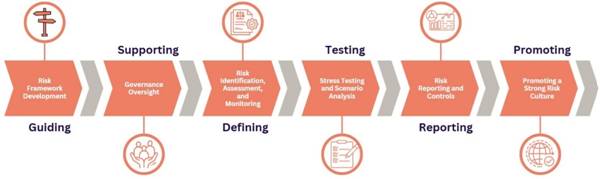
The Group fosters a strong culture of risk awareness and proactive risk management, demonstrated by the conduct of its personnel, established governance arrangements that it has embedded, and the commitment of staff to maintain appropriate management and control standards. A strong control culture exists, with clear accountability, a tailored set of systems and controls, and ongoing compliance monitoring. The monitoring and control of risk form a fundamental part of the Group's management processes.
The Group's governance structure is by way of committees, designed to ensure that the Board maintains appropriate oversight of the Group's activities. The effectiveness of the governance framework is reviewed by senior management on an ongoing basis. Should a material deficiency in the control environment or risk management framework be identified, it shall be addressed without undue delay.
The Board has established a Risk Committee responsible for overseeing the Group's risk management systems and processes, including the management of the key risks across the organisation. In addition, the Risk and Operations Committee operates at management level, providing stewardship of the risk framework, promoting a culture of risk awareness across all employees, and reviewing the key risks together with the management approach to each risk.
Risk Management Framework
A comprehensive and independent risk management framework ensures that the Group identifies, monitors, mitigates and manages risk with oversight from the Risk Committees and the Board. Appropriate systems to identify, assess, monitor and, where proportionate, reduce all material risks and harms have been implemented and all areas of the business are engaged in risk management supporting long-term performance and growth.
All staff are expected to actively manage risks, incorporate mitigants into their processes, and escalate risk issues promptly and transparently actively contributing to the Group's risk culture.
The risk management framework includes key components such as risk identification, risk appetite, accountability, risk limits, controls and reporting. Together, these elements enable effective oversight of risk across the Group. Under this framework, a wide range of risk mitigants are targeted at the risks to which the business is exposed.
Challenge and oversight are provided through the first, second and third lines of defence; the Group has established committees that oversee specific areas of the business, each of which will report to the relevant governing bodies.
Risk Environment 2025
The global economic and financial environment through 2025 continued to evolve against a backdrop of persistent uncertainty and structural change. While inflation continued to moderate and central banks began to ease monetary policy, the pace of rate reductions was slower than markets had initially anticipated, leaving the cost of capital elevated relative to previous years and continuing to shape investor sentiment and asset valuations against a backdrop of subdued economic growth.
Geopolitical tensions remained elevated, with continuing conflicts in Ukraine and persistent instability across parts of the Middle East exerting pressure on energy markets, trade, and global supply chains. These conditions left markets sensitive to further geopolitical shocks, particularly in energy‑producing regions. Longer-term transformative forces such as decarbonisation, digitisation, deglobalisation, and demographic shifts collectively reshaped the global investment landscape for many. The acceleration of artificial intelligence and other technological innovations continued to influence productivity expectations, business models, and operating risks across many sectors.
Disciplined capital allocation and proactive portfolio management remained central within our business. The fundraising environment continued to be selective, reflecting a greater focus on manager differentiation, operational value creation, and sustainable returns.
The regulatory environment continues to evolve, with heightened expectations around transparency, Responsible Investment integration, and operational resilience. The Group continues to embrace these developments closely and adapt its governance, compliance and risk management frameworks accordingly.
Despite the complex environment, the Group's overall risk profile remains stable. The strength of our governance arrangements and our disciplined approach to investment provides resilience against market volatility. As we move into 2026, the Group remains focused on prudent risk management, capital preservation, and identifying opportunities that align with our long-term investment philosophy.
Principal Risks & Uncertainties
The Group's assessment of risk has identified a broad range of internal and external factors which it believes could adversely impact the Group. The following summary of key risks has been identified as having the potential to be material; it is not exhaustive of those faced by the Group. It includes emerging risks and has been reviewed by the Risk and Operations Committee and the Risk Committee on a regular basis and recorded on the Group's risk register.
Responsible Investing and Climate-Related Risks are also considered, further information on these are included in the Climate-Related Risk Management - Task Force on Climate-Related Financial Disclosures section.
Key
|
|
|
|


|
Economic & Market Conditions |
||
|
|
|
|
|
Economic and market factors may affect the Group's investments, track record or ability to raise new capital, and may also adversely impact the timing and terms of exits from existing investments. In stressed or otherwise unfavourable conditions, market liquidity may also be reduced, which could limit the Group's ability to transact or reallocate capital as intended. |
Pollen Street operates closed ended funds without redemption rights for investors, therefore is not subject to redemption risk, allowing a greater degree of freedom to pursue investment objectives throughout macroeconomic cycles, taking advantage of favourable market conditions, and weathering downturns. Regular investment reviews are undertaken. The Investment Committee focuses on investment strategy, exit processes, refinancing strategies, and assesses the impact of geopolitical developments, supply chain and skills constraints, and technology driven shifts in market sentiment, including those related to AI, throughout the life of an investment. An efficient capital call process exists enabling funds to be called from Investors when needed in the unlikely event of potential liquidity shortfalls. |
The portfolios remained resilient throughout 2025. Financial performance, together with progress towards the Group's medium-term targets was in line with expectations. |
|
Fundraising |
||
|
|
|
|
|
The inability to secure new capital, or the delay in raising capital, in a competitive market affecting the Group's revenue and cash flows. The potential for downward pressure on fee levels and other terms that the Group receives to manage new funds, which could adversely affect the Group's ability to generate revenue. Fundraising activities involve a degree of fraud risk for the Group, for example through external parties making fraudulent approaches to investors or misleading communications about fund offerings. |
Pollen Street has extensive experience investing in both private equity and private credit strategies across a wide geographic landscape. The Group continues to invest in its Investor Relations function to support capital raising across the business and has a supportive and growing investor base. The Group maintains a focus on its brand and reputation through various media, including thought leadership alongside consistent delivery of its investment strategy and has established controls and oversight over fundraising activities. |
The Investor Relations team continued to benefit from additional resource and, together with management, remained focused on fundraising activities across the business throughout 2025. During the year, the Group's reach was broadened with the opening of a new office to support engagement across a wider geographic scope. Pollen Street's management fee revenue is long term and contractual in nature and its core strategies continue to provide a clear route to increasing AuM despite the continued challenging macro environment. |
|
Investment Underperformance and Financial Risks |
||
|
|
|
|
|
The Group's Investment Assets are exposed to credit and market risks. They may be impacted by adverse economic and market conditions, including higher impairment charges or reduced valuations, leading to returns within the funds falling below target levels. In addition, credit risk, market risk (such as interest rate risk, currency risk & price risk), capital management risk, and liquidity risk exists. Idiosyncratic risks in the underlying loan portfolios may affect the value and performance of the Group's investments. |
The Group has a proven track record of making robust investment decisions and has in place a strong team of investment professionals delivering investment returns that are resilient to market conditions and idiosyncratic risks, and in line with published guidance. Investments are monitored closely as part of the Group's ongoing investment monitoring programmes, adhering to the funds' investment strategy. Pollen Street dedicates ample resources to product development, expansion, bolt-on acquisitions and business development via the network of its portfolio companies. |
The Group has a diversified, granular portfolio of assets. Loans are subject to stringent underwriting and stress testing. Investment performance remains robust. Further information over financial risk management is set out in more detail in Note 18. |
|
Conduct and Regulatory |
||
|
|
|
|
|
Conduct and regulatory risk arises from the potential for the Group to fail to meet applicable laws, regulations, rules or recognised standards of market conduct in the jurisdictions in which it operates. This includes the risk of market abuse or other illegal, improper or unethical practices that could disadvantage investors, distort or manipulate financial markets, or otherwise undermine the fair treatment of clients and counterparties. Such failures could result in regulatory investigations, supervisory interventions, fines and sanctions, civil or criminal proceedings, reputational damage, and requirements to remediate identified weaknesses. They may also give rise to financial losses, restrictions on business activities, increased operating costs and material reputational damage, which could adversely affect investor confidence, fundraising, capital flows and the Group's ability to execute its strategy. |
A comprehensive compliance framework is in place, supported by policies that describe expected standards of behaviour, outline prohibited practices (including market abuse) and set out procedures for identifying, escalating, reporting and preventing such issues. Regular training is provided to staff on conduct expectations, regulatory obligations and reporting procedures, with additional targeted training for higher‑risk roles. Personal account dealing controls oversee employees' personal trading activities, and the Group undertakes ongoing monitoring of relevant activities and communications to identify and address potential conduct or regulatory concerns at an early stage. |
Conduct and regulatory risk remained a key area of focus for the Group in 2025, reflecting the evolving regulatory landscape and continued emphasis on market integrity and the fair treatment of Investors and the markets. |


|
Talent and Retention |
||
|
|
|
|
|
Talent and retention remain a key people related risk for the Group given the importance of attracting, developing and retaining skilled individuals to deliver its strategy and performance objectives. In addition, risk arises from the potential inability to secure and retain the right skills at the right time, provide competitive and appropriate remuneration and development opportunities, maintain an engaging culture and sense of purpose, and ensure effective succession planning for key roles. |
Pollen Street seeks to create an environment that enables employees to deliver maximum potential and invests in both leadership development and ongoing development opportunities for all employees. The Group's remuneration and incentive arrangements are structured to promote sound risk management and good conduct and are designed so that the variable pay elements do not encourage excessive or irresponsible risk-taking, in line with regulatory expectations. These incentive schemes align individual, team, and organisational goals, driving value for the Group. |
The business continued to strengthen its team throughout 2025, investing in the development of its people and making a number of senior key hires and progressing internal promotions to support the continued growth and development of the business. Employee engagement is actively considered, and the firm seeks to enhance employee satisfaction through various programmes. The firm also invests in training and development to further enhance employee skills and knowledge, supporting high standards of performance and professionalism. |
|
Information Security & Resilience |
||
|
|
|
|
|
Information Security and Resilience risk arises from the Group's dependence on reliable and secure technology, systems and data to support its operations. This includes risks associated with information security and data protection, such as insufficient investment in, or ineffective implementation of, appropriate technology; failures of IT systems leading to financial loss, data loss, business disruption or reputational damage; and weaknesses in data protection and information security controls. This risk also encompasses loss of personal data or unauthorised access to sensitive data that could compromise the integrity, confidentiality or availability of information and result in data breaches or other cyber security incidents. In addition, shortcomings in business continuity, disaster recovery and broader operational resilience arrangements could amplify the impact of such events on the Group and its investors. |
The Group maintains strong technical and operational controls against cyber and information security threats which comply with industry standards and regulatory requirements. Staff awareness, being key to any modern defence plans, is enhanced through new joiner and ongoing training, and regular communications to staff about relevant threats observed across the industry. Resilient systems are deployed to protect the Group's assets and are validated through regular testing and simulations. The Group holds a defined incident response plan as a set of guideline procedures to be followed in the event of an information security attack or breach. The primary aim of any response is to protect the Group's assets, remediate any issues and minimise the impact of the breach as quickly as possible. The plan sets out communication, oversight and other considerations to be undertaken. |
The Group invests annually in detailed external security reviews and penetration tests. All technology and security policies have been reviewed and updated during the year and the protections in place continue to operate well. The technology team is appropriately sized to manage the various security demands and utilises industry standard tooling to ensure monitoring and response management is efficient and thorough. The Group tested its Disaster Recovery Plan and Business Continuity Plans in 2025 with no material findings. |
Emerging Risk Identification
The Risk Management Function continually scans the horizon to identify and communicate emerging risks that could materially affect the Group, which are expected to have a significant impact within 1 to 10 years. Emerging risks may be entirely new or developments of existing risks and are typically characterised by a high degree of uncertainty in both likelihood and impact, with the potential to influence the Group's strategy, business model and operations.
The Group monitors these risks, supporting organisational readiness for external volatility, drawing on both top down insight from the Board and Risk Committee and bottom-up input from the business via the Risk and Operations Committee. Key emerging risks for 2026 include:
· The growing integration of AI and machine learning into financial markets and operating models, which presents both opportunities and new forms of business, operational and conduct risks.
· The evolution of Cybersecurity risks, including increasingly sophisticated AI-enabled attacks and ransomware, which may impact the confidentiality, integrity and availability of systems and data.
· Heightened geopolitical tensions including the potential escalation of existing conflicts, which may drive market volatility and amplify operational, counterparty, cyber, and fraud risks.
· The increasing sophistication of fraud risk, including AI-enabled financial fraud, identity fraud and misrepresentation in investment and fundraising processes, which presents both direct financial risk and reputational exposure, and requires continued vigilance across the Group's underwriting, operational and compliance functions.
· A more volatile and uncertain environment for private markets, including higher‑for‑longer interest rates, persistent inflation and periods of reduced market liquidity. These conditions may affect valuations, exit opportunities and financing availability for portfolio companies, and could in turn influence fundraising conditions and deployment pace for the Group.
The Risk Committee will continue to oversee and assess these and other emerging risks, with a focus on strengthening operational resilience and adapting governance, technology and risk management capabilities in response to the evolving risk landscape.
Viability Statement
The Company has chosen to voluntarily comply with the requirements of Listing Rules 6.6.6R(3) and present a Viability Statement. Therefore, the Directors have carried out a comprehensive and vigorous assessment of the prospects of the Group over the three-year period to Pollen Street Group Limited's AGM in 2029. The Board believes this period to be appropriate for assessing viability, considering the Group's current trading position, the potential impact of principal risks, and aligning with the recommendations of the Financial Reporting Council's 2021 thematic review.
The Group's long-term prospects are primarily assessed through the strategic and financial planning process, culminating in the Board-approved Group Budget. As of the year-end, the Group was in a strong financial position, with cash balances of £11.9 million and £371 million of tangible net assets, coupled with good visibility of future management fees and a largely predictable cost base, supports its ongoing viability.
To prepare the viability statement, the Board has considered the prospects of the Group in light of its current position and has considered each of the Group's principal risks, uncertainties and mitigating factors to develop a comprehensive scenario analysis for viability.
These projections consider the Group's income, net asset value and the cash flows over the three-year period under a range of scenarios. The scenarios are not a business plan in itself, but rather a prudent view of how the Group may evolve, based principally upon its growth to date, in order to demonstrate its viability. Analysis to assess viability focused on the risks of delivery of the growth of the business and a series of projections have been considered, including changing new business volumes and the performance of the Investment Assets.
Key assumptions within the scenario analysis include:
· the raising of new funds, which impacts the amount of management fees;
· the timing and level of returns from funds, which impacts co-investment and carried interest cash flows and profit recognition; and
· changes in the cost base, primarily in relation to people costs and inflation.
Progress against the current year's budget, which underpins the Group's strategic plan, is monitored through the year.
The stressed scenarios applied were deliberately challenging, with the combined scenario representing an extreme case. While the testing identified potential pressures on liquidity in the most severe cases, the Board concluded that the Group has sufficient mitigating actions available.
The ongoing geopolitical and macroeconomic disruption has also been considered in these scenarios.
All the analysis indicates that due to the stability and cash-generating nature of the Investment Asset portfolio, the long-term fund management contracts of the Asset Manager, as well as the long-term debt facilities in place, the Group would be able to withstand the impact of the risks identified. Based on the robust assessment of the principal risks, prospects and viability of the Group, the Board confirms that they have reasonable expectation that the Group will be able to continue operating and meet its liabilities as they fall due over the three-year period to Pollen Street Group Limited's AGM in 2029. The Board also continuously monitors the financial performance of the Group against key financial metrics and ratios, ensuring a strict discipline in the financial management of the business.
Going Concern
The Group has chosen to voluntarily comply with the requirements of Listing Rules 6.6.6R(3) and present a going concern statement. This statement includes the Directors' assessment of the appropriateness of adopting the going concern basis of accounting and their evaluation of the Group's prospects, in line with Provisions 30 and 31 of the UK Corporate Governance Code.
The Directors have reviewed the financial projections of the Group, which show that the Group will be able to generate sufficient cash flows in order to meet its liabilities as they fall due for a period of at least twelve months from when the financial statements are authorised for issue. The Group benefits from income from long-term fund management contracts, with a significant majority of forecast management fees in the assessment period from funds that have already been raised. The firm benefits from a largely predictable cost base, of which over three quarters is personnel related. Based on the above there is good visibility of income, expenditure and future profitability during and beyond the period covered by this assessment. These financial projections have been performed for the Group under various new business volumes and stressed scenarios, and in all cases the Group is able to meet its liabilities as they fall due. The stressed scenarios included no new fundraising and material impairments for a number of structured facilities. The Directors consider these scenarios to be the most relevant risks to the Group's operations. Finally, the Directors reviewed financial and non-financial covenants in place for its debt facility with no breaches anticipated, even in the stressed scenario.
The Directors are satisfied that the going concern basis remains appropriate for the preparation of the financial statements. The Group also has detailed policies and processes for managing the risk.
Financial Statements
Consolidated Statement of Profit or Loss and Other Comprehensive Income
|
For the year ended 31 December 2025 |
For the year ended 31 December 2024 |
||
|
Notes |
£'000 |
£'000 |
|
|
Management fee income |
4 |
64,321 |
50,282 |
|
Carried interest and performance fee income |
4, 13 |
7,551 |
7,786 |
|
Interest income on Credit Assets held at amortised cost |
4 |
33,063 |
41,380 |
|
Gains on Investment Assets held at fair value |
4, 9 |
29,584 |
18,998 |
|
Total income |
134,519 |
118,446 |
|
|
Expected credit loss charge |
4, 8 |
(472) |
(593) |
|
Third-party servicing costs |
4 |
(1,104) |
(1,177) |
|
Net operating income |
132,943 |
116,676 |
|
|
Administration costs |
4 |
(52,074) |
(41,931) |
|
Finance costs |
4, 16 |
(16,468) |
(16,587) |
|
Operating profit |
64,401 |
58,158 |
|
|
Depreciation |
4 |
(2,160) |
(1,730) |
|
Amortisation |
4, 12 |
(640) |
(640) |
|
Profit before tax |
61,601 |
55,788 |
|
|
Tax charge |
6 |
(5,035) |
(6,190) |
|
Profit after tax |
56,566 |
49,598 |
|
|
Other comprehensive income Foreign currency translation reserve |
507 |
62 |
|
|
Total comprehensive income |
57,073 |
49,660 |
|
|
Earnings per share (basic and diluted) |
7 |
93.7 pence |
78.8 pence |
The notes to the accounts form an integral part of the financial statements.
Company Statement of Profit or Loss and Other Comprehensive Income
|
For the year ended 31 December 2025 |
For the year ended 31 December 2024 |
||
|
Notes |
£'000 |
£'000 |
|
|
Revenue |
4 |
34,550 |
40,508 |
|
Administration costs |
4 |
(1,771) |
(1,486) |
|
Profit before tax |
32,779 |
39,022 |
|
|
Tax charge |
6 |
- |
- |
|
Profit after tax |
32,779 |
39,022 |
The notes to the accounts form an integral part of the financial statements.
There is no other comprehensive income in the current or preceding financial years.
Consolidated Statement of Financial Position
|
As at 31 December 2025 |
As at 31 December 2024 |
||
|
Notes |
£'000 |
£'000 |
|
|
Non-current assets |
|||
|
Credit Assets at amortised cost |
8 |
300,098 |
309,423 |
|
Investment Assets held at fair value through profit or loss |
9 |
236,054 |
194,176 |
|
Fixed assets |
10 |
916 |
1,149 |
|
Lease assets |
11 |
3,763 |
4,860 |
|
Goodwill and intangible assets |
12 |
226,460 |
227,100 |
|
Carried interest |
13 |
31,916 |
25,073 |
|
Deferred tax asset |
6 |
- |
3,256 |
|
Total non-current assets |
799,207 |
765,037 |
|
|
Current assets |
|||
|
Trade and other receivables |
14 |
32,475 |
35,542 |
|
Current tax receivable |
7,275 |
561 |
|
|
Derivative financial assets |
15 |
688 |
- |
|
Cash and cash equivalents |
11,899 |
11,195 |
|
|
Total current assets |
52,337 |
47,298 |
|
|
Total assets |
851,544 |
812,335 |
|
|
Current liabilities |
|||
|
Interest-bearing borrowings |
16 |
121 |
498 |
|
Trade and other payables |
17 |
40,399 |
29,249 |
|
Lease liabilities |
11 |
1,512 |
1,376 |
|
Derivative financial liabilities |
15 |
- |
1,467 |
|
Total current liabilities |
42,032 |
32,590 |
|
|
Total assets less current liabilities |
809,512 |
779,745 |
|
|
Non-current liabilities |
|||
|
Interest-bearing borrowings |
16 |
199,538 |
187,767 |
|
Lease liabilities |
11 |
2,352 |
3,756 |
|
Deferred tax liability |
6 |
10,608 |
8,866 |
|
Total non-current liabilities |
212,498 |
200,389 |
|
|
Net assets |
597,014 |
579,356 |
|
|
Shareholders' funds |
|||
|
Ordinary share capital |
20 |
601 |
610 |
|
Share premium |
20 |
543,129 |
549,757 |
|
Retained earnings |
52,984 |
29,196 |
|
|
Other reserves |
20 |
300 |
(207) |
|
Total shareholders' funds |
597,014 |
579,356 |
The notes to the accounts form an integral part of the financial statements.
The financial statements of Pollen Street Group Limited (company number 70165), which includes the notes, were approved and authorised by the Board of Directors on 25 March 2026 and were signed on its behalf by:
Lynn Fordham
Chair
25 March 2026
Company Statement of Financial Position
|
As at 31 December 2025 |
As at 31 December 2024 |
||
|
Notes |
£'000 |
£'000 |
|
|
Non-current assets |
|||
|
Investments in subsidiaries |
27 |
571,269 |
571,269 |
|
Total non-current assets |
571,269 |
571,269 |
|
|
Current assets |
|||
|
Trade and other receivables |
14 |
24,271 |
23,986 |
|
Total current assets |
24,271 |
23,986 |
|
|
Total assets |
595,540 |
595,255 |
|
|
Current liabilities |
|||
|
Trade and other payables |
17 |
36,088 |
29,167 |
|
Total current liabilities |
36,088 |
29,167 |
|
|
Net assets |
559,452 |
566,088 |
|
|
Shareholders' funds |
|||
|
Ordinary share capital |
601 |
610 |
|
|
Share premium |
536,344 |
542,972 |
|
|
Retained earnings |
22,507 |
22,506 |
|
|
Total shareholders' funds |
559,452 |
566,088 |
The notes to the accounts form an integral part of the financial statements.
The financial statements of Pollen Street Group Limited (company number 70165), which includes the notes, were approved and authorised by the Board of Directors on 25 March 2026 and were signed on its behalf by:
Lynn Fordham
Chair
25 March 2026
Consolidated Statement of Changes in Shareholders' Funds
For the year ended 31 December 2025
|
Ordinary Share Capital |
Share Premium |
Retained Earnings |
Foreign Currency Translation Reserve |
Total Equity |
|
|
£'000 |
£'000 |
£'000 |
£'000 |
£'000 |
|
|
Shareholders' funds as at 1 January 2025 |
610 |
549,757 |
29,196 |
(207) |
579,356 |
|
Profit after taxation |
- |
- |
56,566 |
- |
56,566 |
|
Dividends paid |
- |
- |
(32,778) |
- |
(32,778) |
|
Buybacks |
(9) |
(6,628) |
- |
- |
(6,637) |
|
Foreign currency translation reserve |
- |
- |
- |
507 |
507 |
|
Shareholders' funds as at 31 December 2025 |
601 |
543,129 |
52,984 |
300 |
597,014 |
For the year ended 31 December 2024
|
Ordinary Share Capital |
Share Premium |
Retained Earnings |
Special Distributable Reserve |
Merger Reserves |
Foreign Currency Translation Reserve |
Total Equity |
|
|
£'000 |
£'000 |
£'000 |
£'000 |
£'000 |
£'000 |
£'000 |
|
|
Shareholders' funds as at 1 January 2024 |
642 |
- |
4,978 |
351,625 |
225,270 |
(269) |
582,246 |
|
Reallocation of reserves |
- |
576,895 |
- |
(351,625) |
(225,270) |
- |
- |
|
Profit after taxation |
- |
- |
49,598 |
- |
- |
- |
49,598 |
|
Reclassification of transaction costs |
- |
517 |
(517) |
- |
- |
- |
- |
|
Transaction costs in relation to the Reorganisation |
- |
(4,833) |
- |
- |
- |
- |
(4,833) |
|
Dividends paid |
- |
- |
(24,863) |
- |
- |
- |
(24,863) |
|
Buybacks |
(32) |
(22,822) |
- |
- |
- |
- |
(22,854) |
|
Foreign currency translation reserve |
- |
- |
- |
- |
- |
62 |
62 |
|
Shareholders' funds as at 31 December 2024 |
610 |
549,757 |
29,196 |
- |
- |
(207) |
579,356 |
The notes to the accounts form an integral part of the financial statements.
Company Statement of Changes in Shareholders' Funds
For the year ended 31 December 2025
|
Ordinary Share Capital |
Share Premium |
Retained Earnings |
Total Equity |
|
|
£'000 |
£'000 |
£'000 |
£'000 |
|
|
Shareholders' funds as at 1 January 2025 |
610 |
542,972 |
22,506 |
566,088 |
|
Profit after taxation |
- |
- |
32,779 |
32,779 |
|
Dividends paid |
- |
- |
(32,778) |
(32,778) |
|
Buybacks |
(9) |
(6,628) |
- |
(6,637) |
|
Shareholders' funds as at 31 December 2025 |
601 |
536,344 |
22,507 |
559,452 |
For the year ended 31 December 2024
|
Ordinary Share Capital |
Share Premium |
Retained Earnings |
Total Equity |
|
|
£'000 |
£'000 |
£'000 |
£'000 |
|
|
Shareholders' funds as at 1 January 2024 |
- |
- |
- |
- |
|
Issue of share capital |
642 |
570,627 |
- |
571,269 |
|
Transaction costs in relation to the Reorganisation |
- |
(4,833) |
- |
(4,833) |
|
Profit after taxation |
- |
- |
39,022 |
39,022 |
|
Dividends paid |
- |
- |
(16,516) |
(16,516) |
|
Buybacks |
(32) |
(22,822) |
- |
(22,854) |
|
Shareholders' funds as at 31 December 2024 |
610 |
542,972 |
22,506 |
566,088 |
The notes to the accounts form an integral part of the financial statements.
Consolidated Statement of Cash Flows
|
For the year ended 31 December 2025 |
For the year ended 31 December 2024 |
||
|
Notes |
£'000 |
£'000 |
|
|
Cash flows from operating activities: |
|||
|
Cash generated from operations |
22 |
56,754 |
35,077 |
|
Investments in Credit Assets at amortised cost |
(93,590) |
(35,064) |
|
|
Distributions received on Credit Assets at amortised cost |
104,870 |
176,726 |
|
|
Purchase of investments at fair value |
9 |
(37,229) |
(94,984) |
|
Proceeds from disposal of investments at fair value |
9 |
23,000 |
6,483 |
|
Tax paid |
(6,580) |
(3,669) |
|
|
Net cash inflow from operating activities |
47,225 |
84,569 |
|
|
Cash flows from investing activities: |
|||
|
Purchase of fixed assets |
10 |
(565) |
(156) |
|
Net cash inflow from investing activities |
(565) |
(156) |
|
|
Cash flows from financing activities: |
|||
|
Payment of lease liabilities |
11 |
(1,654) |
(1,564) |
|
Reorganisation transaction costs |
- |
(4,833) |
|
|
Drawdown of interest-bearing borrowings |
16 |
111,670 |
240,500 |
|
Repayments of interest-bearing borrowings |
16 |
(100,900) |
(260,519) |
|
Transaction costs for financing activities |
16 |
- |
(2,880) |
|
Interest paid on financing activities |
16 |
(15,657) |
(15,951) |
|
Share buybacks |
(6,637) |
(22,854) |
|
|
Dividends paid in the year |
21 |
(32,778) |
(24,863) |
|
Net cash outflow from financing activities |
(45,956) |
(92,964) |
|
|
Net change in cash and cash equivalents |
704 |
(8,551) |
|
|
Cash and cash equivalents at the beginning of the year |
11,195 |
19,746 |
|
|
Cash and cash equivalents at the end of the year |
11,899 |
11,195 |
Interest received for the Group for the year ended 31 December 2025 was £37.8 million (2024: £33.5 million).
The notes to the accounts form an integral part of the financial statements.
Company Statement of Cash Flows
|
For the year ended 31 December 2025 |
For the year ended 31 December 2024 |
||
|
Notes |
£'000 |
£'000 |
|
|
Cash flows from operating activities: |
|||
|
Cash generated from operations |
23 |
39,415 |
44,203 |
|
Net cash inflow from operating activities |
39,415 |
44,203 |
|
|
Cash flows from financing activities: |
|||
|
Reorganisation transaction costs |
- |
(4,833) |
|
|
Share buybacks |
(6,637) |
(22,854) |
|
|
Dividends paid in the year |
(32,778) |
(16,516) |
|
|
Net cash outflow from financing activities |
(39,415) |
(44,203) |
|
|
Net change in cash and cash equivalents |
- |
- |
|
|
Cash and cash equivalents at the beginning of the year |
- |
- |
|
|
Cash and cash equivalents at the end of the year |
- |
- |
The notes to the accounts form an integral part of the financial statements.
Notes to the Financial Statements
General information
Pollen Street Group Limited is a public company limited by shares, incorporated and registered under the laws of Guernsey with registration number 70165. Pollen Street Group Limited is referred to as the "Company" or "Pollen Street", and together with its subsidiaries, the "Group". The registered office of the Company is: Mont Crevelt House, Bulwer Avenue, St. Sampson, Guernsey, GY2 4LH. The principal place of business of the Company is 11-12 Hanover Square, London, W1S 1JJ.
The principal activity of the Group is to act as an alternative asset manager investing within the financial and business services sectors across both Private Equity and Private Credit strategies, as well as holding on-balance sheet investments consisting of both direct investments and investments in funds managed by Pollen Street. The principal activity of the Company is to be the holding company for two 100 per cent owned subsidiaries engaged in these asset management and investment activities.
Material accounting policies
Basis of preparation
These financial statements have been prepared in accordance with UK-adopted International Accounting Standards and with the requirements of The Companies (Guernsey) Law 2008, and the Disclosure Guidance and Transparency Rules sourcebook of the UK's Financial Conduct Authority ("FCA"). The accounting policies comprise standards and interpretations approved by the International Accounting Standards Board ("IASB") and International Financial Reporting Committee as adopted in the UK, including interpretations issued by the IFRS Interpretations Committee and interpretations issued by the International Accounting Standard Committee ("IASC") that remain in effect.
The financial statements have been prepared on a historical cost basis, except for financial assets and financial liabilities that are required to be measured at fair value, including investments classified as at fair value through profit or loss and derivative financial instruments. These instruments are measured at fair value at each reporting date, with changes in fair value recognised in profit or loss in accordance with the relevant accounting standards.
Going concern
The Directors have reviewed the financial projections of the Group, which show that the Group will be able to generate sufficient cash flows in order to meet its liabilities as they fall due for a period of at least twelve months from when the financial statements are authorised for issue. These financial projections have been performed for the Group under stressed scenarios, and in all cases the Group is able to meet its liabilities as they fall due. For the Investment Company, the stressed scenarios included material impairments to a significant number of structured facilities and individual exposures experiencing ongoing performance at the worst monthly impact experienced throughout 2024 and 2025. For the Asset Manager, the stressed scenarios included no new funds being raised and no realisations in relation to accrued carried interest.
The Directors consider these scenarios to be the most relevant risks to the Group's operations. Finally, the Directors reviewed financial and non-financial covenants in place for all debt facilities within the subsidiaries of the Group with no breaches anticipated, even in the stressed scenario. The Directors are satisfied that the going concern basis remains appropriate for the preparation of the financial statements.
The material accounting policies adopted by the Company are set out below and have been consistently applied across periods presented and all values are in pounds, rounded to the nearest thousand.
Adoption of new and amended standards and interpretations
Standards, interpretations and amendments to published standards effective for the year ended 31 December 2025
The following new and amended standards do not have a material impact on the Group's financial statements:
|
International accounting standards and interpretations |
Effective date |
|
Lack of Exchangeability - Amendments to IAS 21 'The Effects of Changes in Foreign Exchange Rates' |
1 January 2025 |
Standards, interpretations and amendments to published standards which are not yet effective
New and amended standards that have been issued, but are not yet effective, up to the date of the Group's financial statements are disclosed below. These standards do not have a material impact on the Group's financial statements, with the exception of IFRS 18: 'Presentation and Disclosure in Financial Statements' which will impact the presentation and disclosure of financial statements. The Group plans to adopt these, if applicable, when they become effective.
|
International accounting standards and interpretations |
Effective date |
|
Amendments to the Classification and Measurement of Financial Instruments - Amendments to IFRS 9 and IFRS 7 |
1 January 2026 |
|
Annual Improvements to IFRS Accounting Standards - Volume 11 |
1 January 2026 |
|
IFRS 18 'Presentation and Disclosure in Financial Statements' |
1 January 2027 |
Accounting policies
Consolidation
Subsidiaries are investees controlled by the Company. The Company controls an investee if it is exposed to, or has the rights to, variable returns from its involvement with the investee and has the ability to affect those returns through its power over the investee. The Company reassesses whether it has control if there are changes to one or more elements of control. The Company does not consider itself to be an investment entity for the purposes of IFRS 10, as it does not hold substantially all of its investments at fair value. Consequently, it consolidates its subsidiaries rather than holding at fair value through profit or loss.
The Group also assessed the consolidation requirements for the carried interest partnerships and certain underlying entities of Pollen Street managed funds ("funds") which the Group holds as investments as explained in the investments in associates section. Refer to Note 26 for further details.
In the consolidated financial statements, intra-group balances and transactions, and any unrealised income and expenses arising from intra-group transactions, are eliminated. All entities within the Group have coterminous reporting dates.
Capital reorganisation
Capital reorganisations are accounted for using the book-value method. This methodology is used as these transactions do not represent a substantive change in ownership. Instead, they are viewed as a reorganisation of entities within the same group. The Directors consider this method to be the most accurate reflection of the historical financial performance and position of the combining entities following the Reorganisation.
This method applies retrospectively, meaning that the financial statements are restated as if the Reorganisation had occurred at the beginning of the earliest period presented. The assets and liabilities of the combining entities are recognised at their carrying amounts in the financial statements. No adjustments are made to reflect fair values or recognise any new assets or liabilities, except where necessary to align accounting policies.
Any consideration transferred is recognised at its carrying amount. The difference between the consideration transferred and the carrying amount of the net assets acquired is recognised in equity.
Investments in subsidiaries
Investments in subsidiaries in the Statement of Financial Position of the Company are recorded at cost less provision for impairments. All transactions between the Company and its subsidiary undertakings are classified as related party transactions for the Company accounts and are eliminated on consolidation.
Investments in associates
Associates are entities over which the Group has significant influence, but does not control, generally accompanied by a shareholding of between 20 per cent and 50 per cent of the voting rights.
Before the acquisition of Pollen Street Limited by the Company, Pollen Street Limited acquired carried interest rights in two Private Equity funds as part of the Combination on 30 September 2022. The rights are in the form of partnership participations in carried interest partnerships. The Group has 25 per cent of the total interests in these partnerships. The Group has in excess of 20 per cent participation and therefore is considered to have significant influence over the partnerships and the partnerships are considered to be an associate.
The Directors also consider any influence that the Group has in the set up of any new carried interest partnerships in order to assess the power to control them. The Group has up to 25 per cent of the total interests in these partnerships. It was determined that the carried interest partnerships were set up on behalf of the fund investors, and that on balance, the Group does not control the carried interest partnerships. Where the Group has in excess of 20 per cent of LP interest in the carried interest partnership, the Group is considered to have significant influence. It was therefore determined that these carried interest partnerships are also accounted for as associates.
These carried interest partnerships (including associates and contract assets) are presented in the 'Carried interest' line on the Consolidated Statement of Financial Position; and income from the carried interest partnerships is presented in the 'Carried interest and performance fee income' line on the Consolidated Statement of Profit or Loss and Other Comprehensive Income.
The key judgemental areas for the accounting of carried interest partnerships are set out in Note 3, Significant accounting estimates and judgements.
For the underlying entities or funds, the Directors consider the nature of the relationships between the Group, the underlying entities or funds and the investors. The Directors also consider any influence that the Group has in the set up of the underlying entities or funds in order to assess the power to control the underlying entities or funds. It was determined that the underlying entities or funds were set up for the investors, and that on balance, the Group does not control the underlying entities or funds.
The Group also holds more than 20 per cent of interest in certain underlying entities or funds. The Group elects to hold these investments in associates at Fair Value Through Profit or Loss ("FVTPL"). This treatment is permitted by IAS 28 Investments in Associates and Joint Ventures, which permits investments held by entities that are venture capital organisations, mutual funds or similar entities to be excluded from its measurement methodology requirements where those investments are designated, upon initial recognition, as at FVTPL and accounted for in accordance with IFRS 9. These underlying entities or funds are presented in the 'Investment Assets held at fair value through profit or loss' line on the Consolidated Statement of Financial Position. Changes in fair value of these entities or funds are presented in the 'Gains on Investment Assets held at fair value' on the Consolidated Statement of Profit or Loss and Other Comprehensive Income.
Business model assessment
The Group determines the business model for managing financial assets at a portfolio level, as this best reflects how those assets are grouped and managed in practice to achieve the Group's cash flow objectives. That is, whether the Group's objective is solely to collect the contractual cash flows from the assets or is to collect both the contractual cash flows and cash flows arising from the sale of assets. If neither of these are applicable, then the financial assets are classified and measured at FVTPL.
The assessment includes:
· the stated policies and objectives for the portfolio and the operation of those policies in practice, including whether the strategy focuses on earning contractual interest revenue, maintaining a particular interest rate profile, matching duration of the financial assets to the duration of the liabilities that are funding those assets or realising cash flows through the sale of assets;
· past experience on how the cash flows for these assets were collected;
· how the performance of the portfolio is evaluated and reported;
· the risks that affect the performance of the business model (and the financial assets held within that business model) and how those risks are managed; and
· the frequency, volume and timing of deployment in prior years, the reasons for such deployment and expectations about future deployment activity. However, information about deployment activity is not considered in isolation, but as part of an overall assessment of how the stated objective for managing the financial assets is achieved and how cashflows are realised.
Assessment of whether contractual cash flows are solely payments of principal and interest
For the purposes of this assessment, "principal" is defined as the fair value of the financial asset on initial recognition. "Interest" is defined as consideration for the time value of money, for the credit risk associated with the principal amount outstanding during a particular period of time and for other basic lending risks and costs (e.g. liquidity risk and administrative costs), as well as a reasonable profit margin.
In assessing whether the contractual cash flows are solely payments of principal and interest, the contractual terms of the instrument are considered. This includes assessing whether the financial asset contains a contractual term that could change the timing or amount of contractual cash flows such that it would not meet this condition. In making the assessment the following features are considered:
· contingent events that would change the amount and timing of cash flows;
· leverage features;
· prepayment and extension terms;
· terms that limit the Group's claim to cash flows from specified assets, e.g. non-recourse asset arrangements; and
· features that modify consideration for the time value of money, e.g. periodic reset of interest rates.
Classification and measurement
Financial assets and financial liabilities are recognised in the Consolidated Statement of Financial Position when the Group becomes a party to the contractual provisions of the instrument. The Group shall offset financial assets and financial liabilities if it has a legally enforceable right to set off the recognised amounts and interests and intends to settle on a net basis. Financial assets and liabilities are derecognised when the Group settles its obligations relating to the instrument.
Classification and measurement - Financial assets
IFRS 9 contains a classification and measurement approach for debt instruments that reflects the business model in which assets are managed and their cash flow characteristics. This is a principle-based approach and applies one classification approach for all types of debt instruments. For debt instruments, two criteria are used to determine how financial assets are classified and measured:
· the entity's business model (i.e. how an entity manages its debt Instruments in order to generate cash flows by collecting contractual cash flows, selling financial assets or both); and
· the contractual cash flow characteristics of the financial asset (i.e. whether the contractual cash flows are solely payments of principal and interest).
A debt instrument is measured at amortised cost if it meets both of the following conditions and is not designated as at FVTPL:
a) it is held within a business model whose objective is to hold assets to collect contractual cash flows; and
b) its contractual terms give rise on specified dates to cash flows that are solely payments of principal and interest on the principal amount outstanding.
IFRS 9 details the classification and measurement approach for assets measured at fair value through other comprehensive income ("FVOCI") if it meets both of the following conditions and is not designated as at FVTPL:
a) it is held within a business model whose objective is achieved by both collecting contractual cash flows and selling financial assets; and
b) its contractual terms give rise on specified dates to cash flows that are solely payments of principal and interest on the principal amount outstanding.
Equity instruments and derivatives are measured at FVTPL, unless they are not held for trading purposes, in which case an irrevocable election can be made on initial recognition to measure them at FVOCI with no subsequent reclassification to profit or loss. This election is made on an investment by investment basis.
All financial assets not classified as measured at amortised cost or FVOCI as described above are measured at FVTPL.
All equity positions are measured at FVTPL. Financial assets measured at FVTPL are recognised in the balance sheet at their fair value. Fair value gains and losses together with interest coupons and dividend income are recognised in the Consolidated Statement of Profit or Loss and Other Comprehensive Income within Gains on Investment Assets held at fair value in the period in which they occur. The fair values of assets and liabilities traded in active markets are based on current bid and offer prices respectively. If the market is not active the Group establishes a fair value by using valuation techniques. In addition, on initial recognition the Group may irrevocably designate a financial asset that otherwise meets the requirements to be measured at amortised cost or at FVOCI as FVTPL if doing so eliminates or significantly reduces an accounting mismatch that would otherwise arise.
The Group does not hold any FVOCI assets.
Classification and measurement - Financial liabilities
Financial liabilities are classified and subsequently measured at amortised cost, except for:
· Financial liabilities at fair value through profit or loss: this classification is applied to derivatives, financial liabilities held for trading and other financial liabilities designated as such at initial recognition. Gains or losses on financial liabilities designated at fair value through profit or loss are presented partially in other comprehensive income (the amount of change in the fair value of the financial liability that is attributable to changes in the credit risk of that liability, which is determined as the amount that is not attributable to change in market conditions that give rise to market risk) and partially in profit or loss (the remaining amount of change in the fair value of the liability). This is unless such a presentation would create, or enlarge, an accounting mismatch, in which case the gains and losses attributable to changes in the credit risk of the liability are also presented in the Consolidated Statement of Profit or Loss and Other Comprehensive Income.
· Financial liabilities arising from the transfer of financial assets which did not qualify for derecognition, whereby a financial liability is recognised for the consideration received for the transfer. In subsequent years, the Group recognises any expense incurred on the financial liability.
· Financial guarantee contracts and loan commitments.
Credit Assets at amortised cost
Loans are initially recognised at a carrying value equivalent to the funds advanced to the borrower plus the cost of acquisition fees and transaction costs. After initial recognition loans are subsequently measured at amortised cost using the effective interest rate method ("EIRM") less expected credit losses (see Note 3).
Expected credit loss allowance for financial assets measured at amortised cost
The credit impairment charge or release in the Consolidated Statement of Profit or Loss and Other Comprehensive Income represents the change in expected credit losses which are recognised for loans and advances to borrowers, other financial assets held at amortised cost.
IFRS 9 applies a single impairment model to all financial instruments subject to impairment testing. Impairment losses are recognised on initial recognition, and at each subsequent reporting period, even if the loss has not yet been incurred. In addition to past events and current conditions, reasonable and supportable forecasts affecting collectability are also considered when determining the amount of impairment in accordance with IFRS 9.
At initial recognition, allowance is made for expected credit losses resulting from default events that are possible within the next 12 months (12-month expected credit losses). In the event of a significant increase in credit risk, allowance (or provision) is made for expected credit losses resulting from all possible default events over the expected life of the financial instrument (lifetime expected credit losses). Financial assets where 12-month expected credit losses are recognised are considered to be Stage 1; financial assets which are considered to have experienced a significant increase in credit risk are in Stage 2; and financial assets which have defaulted or are otherwise considered to be credit-impaired are allocated to Stage 3. Stage 2 and Stage 3 are based on lifetime expected credit losses.
The measurement of expected credit loss ("ECL"), is primarily based on the product of the instrument's probability of default ("PD"), loss given default ("LGD") and exposure at default ("EAD"), taking into account the value of any collateral held or other mitigants of loss and including the impact of discounting using the EIR.
· The PD represents the likelihood of a borrower defaulting on its financial obligation, either over the next 12 months ("12M PD"), or over the remaining lifetime ("Lifetime PD") of the obligation.
· EAD is based on the amounts the Group expects to be owed at the time of default, over the next 12 months or over the remaining lifetime. For example, for a revolving commitment, the Group includes the current drawn balance plus any further amount that is expected to be drawn up to the current contractual limit by the time of default, should it occur. The EAD is discounted back to the reporting date using the EIR determined at initial recognition.
· LGD represents the Group's expectation of the extent of loss on a defaulted exposure. LGD varies by type of counterparty, type and seniority of claim and availability of collateral or other credit support. LGD is expressed as a percentage loss per unit of EAD. LGD is calculated on a 12-month or lifetime basis, where 12-month LGD is the percentage of loss expected to be made if the default occurs in the next 12 months and Lifetime LGD is the percentage of loss expected to be made if the default occurs over the remaining expected lifetime of the loan ("Lifetime LGD").
The ECL is determined by estimating the PD, LGD and EAD for each individual exposure or collective segment. These three components are multiplied together and adjusted for the likelihood of survival (i.e. the exposure has not prepaid or defaulted in an earlier month). This effectively calculates an ECL, which is then discounted back to the reporting date and summed. The discount rate used in the ECL calculation is the original EIR or an approximation thereof. The Lifetime PD is developed by applying a maturity profile to the current 12-month PD. The maturity profile looks at how defaults develop on a portfolio from the point of initial recognition throughout the lifetime of the loans. The maturity profile is based on historical observed data and is assumed to be the same across all assets within a portfolio and credit grade band where supported by historical analysis. The 12-month and lifetime EADs are determined based on the expected payment profile, which varies by product type:
· For amortising products and bullet repayment loans, this is based on the contractual repayments owed by the borrower over a 12-month or lifetime basis. This is also adjusted for any expected overpayments made by a borrower. Early repayment/refinance assumptions are also incorporated into the calculation.
· For revolving products, the EAD is predicted by taking current drawn balance and adding a "credit conversion factor" which allows for the expected drawdown of the remaining limit by the time of default. These assumptions vary by product type and current limit utilisation band, based on analysis of the Group's recent default data.
The 12-month and lifetime LGDs are determined based on the factors which impact the recoveries made post default. These vary by product type.
· For secured products, this is primarily based on collateral type and projected collateral values, historical discounts to market/book values due to forced sales, time to repossession and recovery costs observed.
· For unsecured products, LGDs are typically set at product level due to the limited differentiation in recoveries achieved across different borrowers. These LGDs are influenced by collection strategies, including contracted debt sales and price.
The main difference between Stage 1 and Stage 2 is the respective PD horizon. Stage 1 estimates use a maximum of a 12-month PD, while Stage 2 estimates use a lifetime PD. The main difference between Stage 2 and Stage 3 is that Stage 3 is effectively the point at which there has been a default event. For financial assets in Stage 3, lifetime ECL continues to be recognised but now recognises interest income on a net basis. This means that interest income is calculated based on the gross carrying amount of the financial asset less ECL. Stage 3 estimates continue to leverage existing processes for estimating losses on impaired loans, however, these processes are updated to reflect the requirements of IFRS 9, including the requirement to consider multiple forward-looking scenarios using independent third-party economic information.
Movements between Stage 1 and Stage 2 are based on whether an instrument's credit risk as at the reporting date has increased significantly relative to the date it was initially recognised. Where the credit risk subsequently improves such that it no longer represents a significant increase in credit risk since origination, the asset is transferred back to Stage 1.
In assessing whether a borrower has had a significant increase in credit risk, the following indicators are considered:
· Significant change in collateral value (secured facilities only) which is expected to increase the risk of default;
· Actual or expected significant adverse change in operating results of the borrower or performance of collateral;
· Significant adverse changes in business, financial and/or economic conditions in the market in which the borrower operates;
· Actual or expected forbearance or restructuring;
· Significant increase in credit spread, where this information is available; and
· Early signs of cashflow/liquidity problems such as delay in servicing of payables.
However, as a backstop, unless identified at an earlier stage, the credit risk of financial assets is deemed to have increased significantly when repayments are more than 30 days past due. Movements between Stage 2 and Stage 3 are based on whether financial assets are credit impaired as at the reporting date. IFRS 9 contains a rebuttable presumption that default occurs no later than when a payment is 90 days past due. The Group uses this 90-day backstop for all its assets except for UK second charge mortgages, where the Group has assumed a backstop of 180 days past due as mortgage exposures more than 90 days past due, but less than 180 days, typically show high cure rates and this aligns to the Group's risk management practices. Assets can move in both directions through the stages of the impairment model.
In assessing whether a borrower is credit-impaired, the following qualitative indicators are considered:
· Whether the borrower is in breach of financial covenants, for example where concessions have been made by the lender relating to the borrower's financial difficulty or there are significant adverse changes in business, financial or economic conditions on which the borrower operates;
· Where the credit risk has increased, the remaining lifetime PD at the reporting date is assessed in comparison to the residual lifetime PD expected at the reporting date when the exposure was first recognised; and
· Any cases of forbearance.
The criteria above have been applied to all Credit Assets at amortised cost held by the Group and are consistent with the definition of default used for internal credit risk management purposes. The default definition has been applied consistently to model the PD, EAD and LGD throughout the Group's expected credit loss calculations.
Inputs into the assessment of whether a financial instrument is in default and their significance may vary over time to reflect changes in circumstances.
Under IFRS 9, when determining whether the credit risk (i.e. the risk of default) on a financial instrument has increased significantly since initial recognition, the Group considers all reasonable and supportable information that is relevant and available without undue cost or effort. This includes both quantitative and qualitative information, together with analysis based on historical experience, credit assessments and forward-looking information.
The measurement of expected credit losses for each stage and the assessment of significant increases in credit risk considers information about past events and current conditions as well as reasonable and supportable forward-looking information. A "Base case" view of the future direction of relevant economic variables and a representative range of other possible forecasts scenarios have been developed. The process has involved developing two additional economic scenarios and considering the relative probabilities of each outcome.
The base case represents a most likely outcome and is aligned with information used for other purposes, such as strategic planning and budgeting. The number of scenarios and their attributes are reassessed at each reporting date. All of the portfolios of the Group use one positive, one optimistic and one downside scenario. These scenario weightings are determined by a combination of statistical analysis and expert judgement, taking account of the range of possible outcomes each chosen scenario is representative of.
The estimation and application of forward-looking information requires significant judgement. PD, LGD and EAD inputs used to estimate Stage 1 and Stage 2 credit loss allowances, are modelled and adjusted based on the macroeconomic variables (or changes in macroeconomic variables) that are most closely correlated with credit losses in the relevant portfolio. The Group has utilised macroeconomic scenarios prepared and provided by Oxford Economics ("Oxford"). Oxford combines two decades of forecast data with the quantitative assessment of the current risks facing the global and domestic economy to produce robust forward-looking distributions for the economy. Oxford construct three alternative scenarios at specific percentile points in the distribution. In any distribution, the probability of a given discrete scenario is close to zero. Oxford produces a probability distribution of potential macroeconomic outcomes. For IFRS 9 purposes, the Group selects a finite set of discrete scenarios (e.g. Base, Upside and Downside) positioned at specified percentile points within that distribution. As an individual percentile point has negligible probability in a continuous distribution, each selected scenario is treated as representative of a range of outcomes of similar severity around that percentile. The probability weight applied to each scenario therefore reflects the probability mass of that range (i.e. the "bucket" of outcomes the scenario represents). Scenario weights are calibrated so that the probability weights across all selected scenarios sum to 100 per cent. Where a greater number of scenarios is used, the distribution is split into more (and narrower) buckets, and each individual scenario will therefore carry a smaller probability weight. This allows the probabilities to be calculated according to whichever subset of scenarios have been chosen for use in the ECL calculation. Oxford updates these scenarios on a quarterly basis to reflect changes to the macroeconomic environment. The Group updates the scenarios during the year if economic conditions change materially. Oxford selects the scenarios to represent a broadly fixed probability within the distribution of potential outcomes. As such the Group has maintained the probability of each scenario at a broadly constant level despite the changing macroeconomic environment. The Base case is given a 40 per cent weighting and the downside and upside a 30 per cent weighting each, which is unchanged from the prior year.
As with any economic forecasts, the projections and likelihoods of occurrence are subject to a high degree of inherent uncertainty and therefore the actual outcomes may be significantly different to those projected. The Group considers these forecasts to represent its best estimate of the possible outcomes and has analysed the non-linearities and asymmetries within the Group's different portfolios to establish that the chosen scenarios are appropriately representative of the range of possible scenarios.
Other forward-looking considerations not otherwise incorporated within the above scenarios, such as the impact of any regulatory, legislative or political changes, have also been considered, but no adjustment has been made to the ECL for such factors. This is reviewed and monitored for appropriateness at each reporting date.
Expected credit loss allowance for receivables
Receivables consist of trade and other debtor balances and prepayments and accrued income. Trade receivables balances are represented by fees receivable for investment fund management and advisory services provided during the year to the Group's customers. The Group's customers are funds that the Group manages or advises. As such, the Group has detailed and up-to-date information on the financial position and outlook of its counterparties. Receivable balances are generally collected on a monthly or quarterly basis and are therefore short-term in nature. The Group applies a simplified approach in calculating ECLs and recognises a loss allowance based on lifetime ECLs at each reporting date. Given the historic rate of recoverability is 100 per cent and the absence of reasons to believe the recoverability pattern will change, management's assessment is that ECL calculated under IFRS 9 would be immaterial at the end of the current and previous reporting period. Management will continue to assess the recoverability at each reporting date for changes in the circumstances surrounding the recoverability of the trade and other receivables, and recognise an expected credit loss allowance when appropriate.
Write-off policy for financial assets measured at amortised cost
A loan or advance is normally written off, either partially or in full, against the related allowance when the proceeds from realising any available security have been received or there is no realistic prospect of recovery and the amount of the loss has been determined. Subsequent recoveries of amounts previously written off decrease the amount of impairment losses recorded in the Consolidated Statement of Profit or Loss and Other Comprehensive Income .
Modification of loans
The Group sometimes renegotiates or otherwise modifies the contractual cash flows of loans to customers. When this happens, the Group assesses whether or not the new terms are substantially different to the original terms. The Group does this by considering, among others, the following factors:
· if the borrower is in financial difficulty, whether the modification merely reduces the contractual cash flows to amounts the borrower is expected to be able to pay;
· whether any substantial new terms are introduced, such as a profit share/equity-based return that substantially affects the risk profile of the loan;
· significant extension of the loan term when the borrower is not in financial difficulty;
· significant change in the interest rate;
· change in the currency the loan is denominated in; and
· insertion of collateral, other security or credit enhancements that significantly affect the credit risk associated with the loan.
If the terms are substantially different, the Group derecognises the original financial asset and recognises a new asset at fair value and recalculates a new EIR for the asset. The date of renegotiation is consequently considered to be the date of initial recognition for impairment calculation purposes, including for the purpose of determining whether a significant increase in credit risk has occurred. However, the Group also assesses whether the new financial asset recognised is deemed to be credit-impaired at initial recognition, especially in circumstances where the renegotiation was driven by the debtor being unable to make the originally agreed payments. Differences in the carrying amounts are also recognised in the Consolidated Statement of Profit or Loss and Other Comprehensive Income as a gain or loss on derecognition. If the terms are not substantially different, the renegotiation or modification does not result in derecognition, and the Group recalculates the gross carrying amount based on the revised cash flows of the financial asset and recognises a modification gain or loss in the Consolidated Statement of Profit or Loss and Other Comprehensive Income. The new gross carrying amount is recalculated by discounting the modified cash flows at the original EIR (or credit-adjusted EIR for purchased or originated credit-impaired financial assets).
Modification of financial assets
The Group sometimes modifies the terms of loans provided to customers due to commercial renegotiations, or for distressed loans, with a view to maximising recovery.
Such restructuring activities include extended payment term arrangements, payment holidays and payment forgiveness. Restructuring policies and practice are based on indicators or criteria which, in the judgement of management, indicate that payment will most likely continue. These policies are kept under continuous review. Restructuring is most commonly applied to term loans.
The risk of default of such assets after modification is assessed at the reporting date and compared with the risk under the original terms at initial recognition, when the modification is not substantial and so does not result in derecognition of the original assets. The Group monitors the subsequent performance of modified assets. The Group may determine that the credit risk has significantly improved after restructuring, so that the assets are moved from Stage 2 or Stage 3.
Collateral and other credit enhancements
The Group employs a range of policies to mitigate credit risk. The most common of these is accepting collateral for funds advanced. The Group has internal policies of the acceptability of specific classes of collateral or credit risk mitigation.
The Group prepares a valuation of the collateral obtained as part of the loan origination process. This assessment is reviewed periodically. The principal collateral types for loans and advances are:
· mortgages over residential properties;
· security over our borrowers receivables;
· margin agreement for derivatives, for which the Group has also entered into master netting agreements;
· charges over business assets such as premises, inventory and accounts receivable; and
· charges over financial instruments such as debt securities and equities.
Longer-term finance and lending to corporate entities are generally secured; revolving individual credit facilities are generally unsecured.
Collateral held as security for financial assets other than loans and advances depends on the nature of the instrument. Derivatives are also generally collateralised, such as collateralised debt obligations, in order to provide collateral as a form of security for the obligations arising from the derivative.
The Group closely monitors collateral held for financial assets considered to be credit-impaired, as it becomes more likely that the Group will take possession of collateral to mitigate potential credit losses.
Derecognition other than a modification
Financial assets, or a portion thereof, are derecognised when the contractual rights to receive the cash flows from the assets have expired, or when they have been transferred and either (i) the Group transfers substantially all the risks and rewards of ownership, or (ii) the Group neither transfers nor retains substantially all the risks and rewards of ownership and the Group has not retained control.
The Group enters into transactions where it retains the contractual rights to receive cash flows from assets but assumes a contractual obligation to pay those cash flows to other entities and transfers substantially all of the risks and rewards. These transactions are accounted for as "pass-through" transfers that result in derecognition if the Group:
· has no obligation to make payments unless it collects equivalent amounts from the assets;
· is prohibited from selling or pledging the assets; and
· has an obligation to remit any cash it collects from the assets without material delay.
Derecognition
Financial liabilities are derecognised when they are extinguished (i.e. when the obligation specified in the contract is discharged, cancelled or expires). Different terms, as well as substantial modifications of the terms of existing financial liabilities, are accounted for as an extinguishment of the original financial liability and the recognition of a new financial liability. The terms are substantially different if the discounted present value of the cash flows under the new terms, including any fees paid net of any fees received and discounted using the original EIR, is at least 10 per cent different from the discounted present value of the remaining cash flows of the original financial liability. In addition, other qualitative factors, such as the currency that the instrument is denominated in, changes in the type of interest rate, new conversion features attached to the instrument and change in covenants are also taken into consideration. If an exchange of debt instruments or modification of terms is accounted for as an extinguishment, any costs or fees incurred are recognised as part of the gain or loss on the extinguishment. If the exchange or modification is not accounted for as an extinguishment, any costs or fees incurred adjust the carrying amount of the liability and are amortised over the remaining term of the modified liability.
Investments held at fair value through profit or loss
The investments held at FVTPL include Equity Assets and Credit Assets.
Equity Assets held at FVTPL are valued in accordance with the International Private Equity and Venture Capital Valuation Guidelines ("IPEVCV") effective 1 January 2019 with the latest update in December 2025 as recommended by the British Private Equity and Venture Capital Association.
Equity Assets are instruments that have equity-like returns; that is, instruments that do not contain a contractual obligation to pay and that evidence a residual interest in the issuer's net assets. Examples of equity instruments include ordinary shares or investments in Private Equity funds managed or advised by the Group. Investments into funds managed by the Group are valued on the net asset value of each fund. The valuations reflect the fair value of the Group's proportionate share of each investment as at the reporting date.
Credit Assets at FVTPL consists of loans made to counterparties where the contractual cash flows do not meet the requirements of the solely payments of principal and interest test or are otherwise classified at fair value, together with investments in Private Credit funds managed or advised by the Group. See the section on Classification and measurement - Financial assets earlier in this Note. Examples of credit instruments include credit instruments where incremental cash flows are due contingent on certain events occurring.
These Credit Assets at FVTPL are priced at their amortised cost value as a proxy for the fair value, given that they are floating rate assets and performing in line with expectations with limited credit risk.
Credit Assets at FVTPL also consists of investments in Private Credit Funds managed by the Group and are valued based off the net asset value of each fund. The valuations typically reflect the fair value of the Group's proportionate share of each investment as at the reporting date.
Purchases and sales of unquoted investments are recognised when the contract for acquisition or sale becomes unconditional.
IFRS 13 requires the Group to classify its financial instruments held at fair value using a hierarchy that reflects the significance of the inputs used in the valuation methodologies. These are as follows:
· Level 1 - quoted prices in active markets for identical investments.
· Level 2 - other significant observable inputs (including quoted prices for similar investments, interest rates, prepayments, credit risk, etc.).
· Level 3 - significant unobservable inputs (including the Group's own assumptions in determining the fair value of investments).
An investment is always categorised as Level 1, 2 or 3 in its entirety. In certain cases, the fair value measurement for an investment may use a number of different inputs that fall into different levels of the fair value hierarchy. The assessment of the significance of a particular input to the fair value measurement requires judgement and is specific to the investment.
The gain on fair value is shown in the 'Gains on Investment Assets held at fair value' line on the Consolidated Statement of Profit or Loss and Other Comprehensive Income.
Fixed assets
Fixed assets are shown at cost less accumulated depreciation. Depreciation is calculated by the Group on a straight-line basis by reference to the original cost, estimated useful life and residual value. Cost includes the original purchase price and the costs attributable to bringing the asset to its working condition for its intended use. The period of estimated useful life for this purpose is up to 10 years. Residual values are assumed to be nil.
Plant and equipment is stated at historical cost less accumulated depreciation and impairment. Historical cost includes expenditure that is directly attributable to the acquisition of the items.
Depreciation is charged so as to allocate the cost of assets less their residual value over their estimated useful lives, using the straight-line method.
Depreciation is provided on the following basis:
Fixtures and fittings 3 years
Office equipment 3 years
Electric vehicles 5 years
Leasehold improvements 10 years
The assets' residual values, useful lives and depreciation methods are reviewed, and adjusted prospectively if appropriate, or if there is an indication of a significant change since the last reporting date.
Gains and losses on disposals are determined by comparing the proceeds with the carrying amount and are recognised in the Consolidated Statement of Profit or Loss and Other Comprehensive Income.
Goodwill
Goodwill is initially measured at cost, which constitutes the excess of the aggregate of the consideration transferred over the net identifiable assets acquired and liabilities assumed. If the fair value of the net assets acquired is in excess of the aggregate consideration transferred, the Group reassesses whether it has correctly identified all of the assets acquired and all of the liabilities assumed, and reviews the procedures used to measure the amounts to be recognised at the acquisition date. If the reassessment still results in an excess of the fair value of net assets acquired over the aggregate consideration transferred, then the gain is recognised in the Consolidated Statement of Profit or Loss and Other Comprehensive Income.
After initial recognition, goodwill is measured at cost less any accumulated impairment losses.
Goodwill is tested for impairment on an annual basis and whenever there is an indication that the recoverable amount of a cash-generating unit ("CGU") is less than its carrying amount. Any impairment loss recognised on the goodwill is not reversed subsequently. For the purpose of impairment testing, goodwill acquired in a business combination is, from the acquisition date, allocated to each of the Group's CGUs or group of CGUs that are expected to benefit from the combination, irrespective of whether other assets or liabilities of the acquiree are assigned to those units. A CGU represents the lowest level at which goodwill is monitored for internal management purposes.
Where goodwill has been allocated to a CGU and part of the operation within that unit is disposed of, the goodwill associated with the disposed operation is included in the carrying amount of the operation when determining the gain or loss on disposal. Goodwill disposed in these circumstances is measured based on the relative values of the disposed operation and the portion of the CGU retained.
Intangibles
Intangible assets, which constitute acquired customer relationship assets acquired from a business combination, are stated at cost less accumulated amortisation and accumulated impairment losses. Intangible assets are assessed at each reporting date when there are indicators of impairment.
Amortisation is calculated using the straight-line method to allocate the amortised amount of the assets to their residual values over their estimated useful lives.
Leases
The Group assesses at contract inception whether a contract is, or contains, a lease. That is, if the contract conveys the right to control the use of an identified asset for a period of time in exchange for consideration.
Group as a lessee
The Group applies a single recognition and measurement approach for all leases, except for short-term leases and leases of low-value assets. The Group recognises lease liabilities to make lease payments and lease assets representing the right to use the underlying assets.
Lease assets
The Group recognises lease assets at the commencement date of the lease (i.e., the date the underlying asset is available for use). Lease assets are measured at cost, less any accumulated depreciation and impairment losses, and adjusted for any remeasurement of lease liabilities. The cost of lease assets includes the amount of lease liabilities recognised, initial direct costs incurred, an estimate of costs to be incurred in restoring the underlying asset to the condition required by the terms and conditions of the lease and lease payments made at or before the commencement date less any lease incentives received. Lease assets are depreciated on a straight-line basis over the shorter of the lease term and the estimated useful lives of the assets.
If ownership of the leased asset transfers to the Group at the end of the lease term or the cost reflects the exercise of a purchase option, depreciation is calculated using the estimated useful life of the asset.
Lease liabilities
At the commencement date of the lease, the Group recognises lease liabilities measured at the present value of lease payments to be made over the lease term. The lease payments include fixed payments less any lease incentives receivable and amounts expected to be paid under residual value guarantees. The lease payments also include payments of penalties for terminating the lease, if the lease term reflects the Group exercising the option to terminate.
In calculating the present value of lease payments, the Group uses its incremental borrowing rate at the lease commencement date because the interest rate implicit in the lease is not readily determinable. After the commencement date, the amount of lease liabilities is increased to reflect the accretion of interest and reduced for the lease payments made. In addition, the carrying amount of lease liabilities is remeasured if there is a modification, a change in the lease term, a change in the lease payments (e.g., changes to future payments resulting from a change in an index or rate used to determine such lease payments) or a change in the assessment of an option to purchase the underlying asset.
Carried interest receivable
Carried interest represents unrealised and realised shares of fund profits from holdings in carried interest partnerships where the Group receives variable returns as an incentive for management of the underlying funds. The realised amount is the amount actually received. For the unrealised performance, the amount recognised is determined against an assessment of the underlying investor returns exceeding an agreed threshold or hurdle, and is either accounted for under IFRS 9 (for carried interest partnerships acquired as part of the Combination) or under IFRS 15 (for non-acquired carried interest partnerships).
Movements in fair value, and amounts accrued as revenue under IFRS 15, are shown in the 'Carried interest and performance fee income' line on the Consolidated Statement of Profit or Loss and Other Comprehensive Income, with the outstanding balance shown in the 'Carried interest' line on the Consolidated Statement of Financial Position and are typically presented as non-current assets unless they are expected to be received within the next 12 months.
Cash and cash equivalents
Cash and cash equivalents, which are presented as a single class of asset on the Consolidated Statement of Financial Position, comprise cash at bank, including cash that is restricted and held in reserve.
Financial liabilities
Financial liabilities are classified according to the substance of the contractual arrangements entered into.
Derivatives
The Group uses foreign exchange spot, forward and swap transactions to hedge foreign exchange movements in non-GBP assets or liabilities in order to minimise foreign exchange exposure.
Derivative financial instruments are initially measured at fair value on the date on which the derivative contract is entered into and are subsequently measured at fair value at each reporting date. The Group does not designate derivatives as cash flow hedges and so fair value movements are recognised in the 'Administration costs' line on the Consolidated Statement of Profit or Loss and Other Comprehensive Income. The fair value of unsettled forward currency contracts is calculated by reference to the market for forward contracts with similar maturities.
Interest-bearing borrowings
Interest-bearing borrowings are initially recognised at a carrying value equivalent to the proceeds received net of issue costs associated with the borrowings. After initial recognition, interest-bearing borrowings are subsequently measured at amortised cost using the effective interest rate ("EIR") method.
Finance costs
Finance costs are accrued on the EIR basis and are presented as a separate line on the Consolidated Statement of Profit or Loss and Other Comprehensive Income.
Dividends
Dividends to shareholders are recognised in the period in which they are paid.
Income
The Group has four primary sources of income: management fee income, carried interest and performance fee income, interest income on Credit Assets held at amortised cost, and gains on Investment Assets held at fair value.
Management fee income includes fees charged by the Group to the funds that it manages for the provision of investment fund management and advisory services, which are treated as a single performance obligation. The parties to agreements for fund management services comprise the Group and the investors of each fund. Accordingly, the group of investors of each fund are identified as a customer for accounting purposes.
Management fees are earned over a period and are recognised on an accrual basis in the same period in which the service is performed. Management fees are based on an agreed percentage of either committed or invested capital, depending on the fund and its life stage, in accordance with individual management agreements or limited partnership agreements.
Income is measured based on the consideration specified in the contracts and exclude amounts collected on behalf of third parties, discounts and value added taxes.
For Private Equity managed funds, management fee income is charged from the inception of the fund. Where an LP enters the fund as part of subsequent closes "catch-up" management fee income is calculated and charged as if the LP had entered the fund on first close. These management fees are earned over a prior period where the provision of investment fund management and advisory services has already been provided and the corresponding performance obligation is satisfied. Therefore, these catch-up management fees are recognised immediately in full. This is not applicable on Private Credit funds given that management fee income is charged on invested capital, rather than commitments.
Carried interest and performance fee income includes income recognised under IFRS 15 from holdings in carried interest partnerships where the Group receives variable returns as an incentive for the funds that it manages. Carried interest represents a share of fund profits through the Group's holdings in carried interest partnerships. The amount is determined by the level of accumulated profits exceeding an agreed threshold or hurdle. The carried interest income is recognised when the performance obligations are expected to be met. Income is only recognised to the extent that it is highly probable that there would not be a significant reversal of any accumulated revenue recognised on the completion of a fund. The uncertainty of future fund performance is reduced through the application of discounts in the calculation of carried interest income. Performance fees are generally calculated as a percentage of the appreciation in the net asset value of a fund above a defined hurdle, and are recognised on an accrual basis when the fee amount can be estimated reliably, and it is highly probable that it will not be subject to significant reversal.
Management fees and performance fees are charged to the Investment Company by the Asset Manager. These fees are shown in Note 4, operating segments. However, they are eliminated on consolidation.
Interest income on Credit Assets held at amortised cost is generated from loans originated by the Group. Interest from loans are recognised in the Consolidated Statement of Profit or Loss and Other Comprehensive Income for all instruments measured at amortised cost using the EIRM. The EIRM is a method of calculating the amortised cost of a financial asset or financial liability and of allocating the interest income or interest expense over the relevant period. The EIR is the rate that exactly discounts estimated future cash flows through the expected life of the financial instrument or, when appropriate, a shorter period to the net carrying amount of the financial asset or financial liability. When calculating the EIR, the Group takes into account all contractual terms of the financial instrument, for example prepayment options, but does not consider future credit losses. The calculation includes all fees paid or received between parties to the contract that are an integral part of the EIR, transaction costs and all other premiums or discounts. Fees and commissions which are not considered integral to the EIR model and deposit interest income are recognised on an accruals basis when the service has been provided or received.
Gains on Investment Assets held at Fair Value include realised and unrealised income on assets accounted for at fair value, including equity assets and credit assets. Refer to the Investments held at fair value through profit or loss section for further details.
Pensions
The Group makes contributions into employee personal pension schemes. Once the contributions have been paid, the Group has no further payment obligations.
The contributions are recognised as an expense in the Consolidated Statement of Profit or Loss and Other Comprehensive Income when they fall due. Amounts not paid are shown in accruals as a liability in the Consolidated Statement of Financial Position.
Share-based payments
The Group grants annual bonuses to its Executive Directors and other senior employees some of which are deferred in accordance with the Group's Remuneration Policy. Deferred awards may be used to acquire shares in Pollen Street Group Limited (a Share-Based Award), or fund commitments into Pollen Street managed funds (Co-Investment Opportunity) and are subject to malus and clawback provisions.
The Share-Based Awards generally vest after three years, subject to the opportunity for co-investment. The Co-Investment Opportunity permits the employee to collect the deferred award early, either in shares or up front in cash, provided they elect to apply the after-tax proceeds of the deferred award into a fund managed by the Group that has a contractual duration of longer than three years.
The Group accounts for Share-Based Awards as share-based payments. The awards are considered to be compound financial instruments, because the employee has the right to demand settlement in cash. The Group first measures the fair value of the cash component, which is considered to be a cash-settled share-based payment, and then measures the fair value of the equity component taking into account that the counterparty must forfeit the right to receive cash in order to receive the equity instrument, which is considered to be an equity-settled share-based payment.
Segmental reporting
The Group has two segments: the Asset Manager segment and the Investment Company segment. The primary revenue streams for the Asset Manager segment consist of management fees and performance fees or carried interest arising from managing Private Equity and Private Credit funds. The Investment Company segment primarily consists of the Group Investment Assets and borrowings. The primary revenue stream for the Investment Company segment is interest income and fair value gains on Investments held at fair value.
The Asset Manager segment charges management and performance fees to the Investment Company segment for managing the segment's assets. These fees are shown in the segmental results. However, they are eliminated in the consolidated financial statements. Refer to Note 4 for further details.
Taxation
Although the Company is incorporated and registered under the laws of Guernsey, the Company elected to be UK resident for taxation purposes, and as a result is non-tax resident in Guernsey.
Current income tax
Current income tax assets and liabilities are measured at the amount expected to be recovered from or paid to the taxation authorities. The tax rates and tax laws used to compute the amount are those that are enacted or substantively enacted at the reporting date in the countries where the Group operates and generates taxable income.
Current income tax relating to items recognised directly in equity is recognised in equity and not in the Consolidated Statement of Profit or Loss and Other Comprehensive Income. Management periodically evaluates positions taken in the tax returns with respect to situations in which applicable tax regulations are subject to interpretation and establishes provisions where appropriate.
Deferred tax
Deferred tax is provided using the liability method on temporary differences between the tax bases of assets and liabilities and their carrying amounts for financial reporting purposes at the reporting date.
Deferred tax liabilities are recognised for all taxable temporary differences, except:
· when the deferred tax liability arises from the initial recognition of goodwill or an asset or liability in a transaction that is not a business combination and, at the time of the transaction, affects neither the accounting profit nor taxable profit or loss; and
· in respect of taxable temporary differences associated with investments in subsidiaries, associates and interests in joint arrangements, when the timing of the reversal of the temporary differences can be controlled and it is probable that the temporary differences will not reverse in the foreseeable future.
Deferred tax assets are recognised for all deductible temporary differences, the carry forward of unused tax credits and any unused tax losses. Deferred tax assets are recognised to the extent that it is probable that taxable profit will be available against which the deductible temporary differences, and the carry forward of unused tax credits and unused tax losses can be utilised, except:
· when the deferred tax asset relating to the deductible temporary difference arises from the initial recognition of an asset or liability in a transaction that is not a business combination and, at the time of the transaction, affects neither the accounting profit nor taxable profit or loss; and
· in respect of deductible temporary differences associated with investments in subsidiaries, associates and interests in joint arrangements, deferred tax assets are recognised only to the extent that it is probable that the temporary differences will reverse in the foreseeable future and taxable profit will be available against which the temporary differences can be utilised.
The carrying amount of deferred tax assets is reviewed at each reporting date and reduced to the extent that it is no longer probable that sufficient taxable profit will be available to allow all or part of the deferred tax asset to be utilised. Unrecognised deferred tax assets are reassessed at each reporting date and are recognised to the extent that it has become probable that future taxable profits will allow the deferred tax asset to be recovered.
Deferred tax assets and liabilities are measured at the tax rates that are expected to apply in the period when the asset is realised or the liability is settled, based on tax rates (and tax laws) that have been enacted or substantively enacted at the reporting date.
Deferred tax relating to items recognised outside profit or loss is recognised in Other Comprehensive Income ("OCI") or directly in equity.
Tax benefits acquired as part of a business combination, but not satisfying the criteria for separate recognition at that date, are recognised subsequently if new information about facts and circumstances change. The adjustment is either treated as a reduction in goodwill (as long as it does not exceed goodwill) if it was incurred during the measurement period or recognised in the Consolidated Statement of Profit or Loss and Other Comprehensive Income.
The Group offsets deferred tax assets and deferred tax liabilities if and only if it has a legally enforceable right to set off current tax assets and current tax liabilities and the deferred tax assets and deferred tax liabilities relate to income taxes levied by the same taxation authority on either the same taxable entity or different taxable entities which intend either to settle current tax liabilities and assets on a net basis, or to realise the assets and settle the liabilities simultaneously, in each future period in which significant amounts of deferred tax liabilities or assets are expected to be settled or recovered.
Sales tax
Expenses and assets are recognised net of the amount of sales tax, except:
· when the sales tax incurred on a purchase of assets or services is not recoverable from the taxation authority, in which case, the sales tax is recognised as part of the cost of acquisition of the asset or as part of the expense item, as applicable; and
· when receivables and payables are stated with the amount of sales tax included.
The net amount of sales tax recoverable from, or payable to, the taxation authority is included as part of receivables or payables in the Consolidated Statement of Financial Position.
Expenses
All expenses are accounted for on an accruals basis.
Foreign currency
The financial statements have been prepared in Pounds Sterling because that is the currency of the majority of the transactions during the year, so has been selected as the presentational currency.
The liquidity of the Group is managed on a day-to-day basis in Pounds Sterling as the Group's performance is evaluated in that currency. Therefore, the Directors consider Pounds Sterling as the currency that most faithfully represents the economic effects of the underlying transactions, events and conditions and is therefore the functional currency.
Transactions involving foreign currencies are converted at the exchange rate ruling at the date of the transaction. Foreign currency monetary assets and liabilities are translated into Pounds Sterling at the exchange rate ruling on the year-end date. Foreign exchange differences arising on translation would be recognised in the Consolidated Statement of Profit or Loss and Other Comprehensive Income.
Receivables
Receivables do not carry any interest and are short term in nature. They are initially stated at their nominal value and reduced by appropriate allowances for expected credit losses (if any).
Payables
Payables represent amounts for goods and services provided to the consolidated entity prior to the end of the financial year and which are unpaid. The amounts are unsecured and are usually paid within 30 days of recognition. Payables are non-interest-bearing and are initially stated at their nominal value.
Shares
Ordinary and treasury shares are classified as equity. The costs of issuing or acquiring equity are recognised in equity (net of any related income tax benefit), as a reduction of equity on the condition that these are incremental costs directly attributable to the equity transaction that otherwise would have been avoided.
The costs of an equity transaction that is abandoned are recognised as an expense. Those costs might include registration and other regulatory fees, legal fees, accounting and other professional advisers, printing costs and stamp duties.
Treasury shares have no entitlements to vote and are held directly by the Company.
Significant accounting estimates and judgements
The UK-adopted International Accounting Standards requires the Group to make judgements, estimates and assumptions that affect the application of accounting policies and the reported amounts of assets and liabilities at the date of the financial statements and the reported amounts of income and expenses during the reporting period. IFRS requires the Directors, in preparing the Group's financial statements, to select suitable accounting policies, apply them consistently and make judgements and estimates that are reasonable. The Group's estimates and assumptions are based on historical experience and expectations of future events and are reviewed on an ongoing basis. Although these estimates are based on the Directors' best estimate of the amount, actual results may differ materially from those estimates.
Estimates
The estimates of most significance to the financial statements are detailed below. Estimates and underlying assumptions are reviewed on an ongoing basis. Revisions to accounting estimates are recognised in the period in which the estimates are revised and in any future periods affected.
Expected Credit loss allowance for financial assets measured at amortised cost
The calculation of the Group's ECL allowances and provisions against loan commitments and guarantees under IFRS 9 is complex and involves the use of significant judgement and estimation. Loan Impairment Provisions represent an estimate of the losses incurred in the loan portfolios at the balance sheet date. Individual impairment losses are determined as the difference between the carrying value and the present value of estimated future cash flows, discounted at the loans' original EIR. The calculation involves the formulation and incorporation of multiple forward-looking economic conditions into ECL to meet the measurement objective of IFRS 9, depending on a range of factors such as changes in the economic environment in the UK. The most significant factors are set out below.
Definition of default - The PD of an exposure, both over a 12-month period and over its lifetime, is a key input to the measurement of the ECL allowance. Default has occurred when there is evidence that the customer is experiencing significant financial difficulty which is likely to affect the ability to repay amounts due.
A number of the Group's loans are secured against underlying collateral. The Directors do not consider the value of this collateral when assessing the probability of default. However, the structure of certain lending arrangements may improve the Group's ability to recover borrowings, even in cases of heightened default risk.
The definition of default adopted by the Group is described in expected credit loss allowance for financial assets measured at amortised cost above. The Group has rebutted the presumption in IFRS 9 that default occurs no later than when a payment is 90 days past due on some of its portfolio.
The lifetime of an exposure - To derive the PDs necessary to calculate the ECL allowance it is necessary to estimate the expected life of each financial instrument. A range of approaches has been adopted across different product groupings including the full contractual life and taking into account behavioural factors such as early repayments and refinancing. The Group has defined the lifetime for each product by analysing the time taken for all losses to be observed and for a material proportion of the assets to fully resolve through either closure or write-off.
Significant increase in credit risk ("SICR") - Performing assets are classified as either Stage 1 or Stage 2. An ECL allowance equivalent to 12 months' expected credit losses is established against assets in Stage 1; assets classified as Stage 2 carry an ECL allowance equivalent to lifetime expected credit losses. Assets are transferred from Stage 1 to Stage 2 when there has been a SICR since initial recognition.
A number of the Group's loans are secured against underlying collateral. The Directors do not consider the value of this collateral when assessing whether there has been a significant increase in credit risk. However, the structure of certain lending arrangements may improve the Group's ability to recover borrowings, even in cases of heightened default risk, therefore influencing whether there has been a SICR.
The Group uses a quantitative test together with qualitative indicators and a backstop of 30 days past due for determining whether there has been a SICR. The setting of precise trigger points combined with risk indicators requires judgement. The use of different trigger points may have a material impact upon the size of the ECL allowance.
Forward-looking information - IFRS 9 requires the incorporation of forward-looking macroeconomic information that is reasonable and supportable, but it provides limited guidance on how this should be performed. The measurement of expected credit losses is required to reflect an unbiased probability-weighted range of possible future outcomes.
In order to do this the Group uses a model to project a number of key variables to generate future economic scenarios. These are ranked according to severity of loss and three economic scenarios have been selected to represent an unbiased and full loss distribution. They represent a "most likely outcome" (the Base case scenario) and two, less likely, "outer" scenarios, referred to as the "Upside" and "Downside" scenarios. These scenarios are used to produce a weighted average PD for each product grouping which is used to calculate the related ECL allowance. This weighting scheme is deemed appropriate for the computation of unbiased ECL. Key scenario assumptions are set using external economist forecasts, helping to ensure the IFRS 9 scenarios are unbiased and maximise the use of independent information. Using externally available forecast distributions helps ensure independence in scenario construction. While key economic variables are set with reference to external distributional forecasts, the overall narrative of the scenarios is aligned to the macroeconomic risks faced by the Group at 31 December 2025.
The choice of alternative scenarios and probability weighting is a combination of quantitative analysis and judgemental assessments, designed to ensure that the full range of possible outcomes and material non-linearity are captured. Paths for the two outer scenarios are benchmarked to the Base scenario and reflect the economic risk assessment. Scenario probabilities reflect management judgement and are informed by data analysis of past recessions, transitions in and out of recession, and the current economic outlook. The key assumptions made, and the accompanying paths, represent management's "best estimate" of a scenario at a specified probability. Suitable narratives are developed for the central scenario and the paths of the two outer scenarios. It may be insufficient to use three scenarios in certain economic environments. Additional analysis may be requested at management's discretion, including the production of extra scenarios. We anticipate there will only be limited instances when the standard approach will not apply. The Base case, Upside and Downside scenarios are usually generated annually and those described herein reflect the conditions in place at the balance sheet date and are only updated during the period if economic conditions change significantly.
The Group incorporates forward-looking information in its IFRS 9 ECL model using macroeconomic scenarios prepared and provided by Oxford. In Oxford's Base case scenario, the UK economy records growth of 1.0 per cent in 2026 and 1.4 per cent in 2027. The labour market recovers gradually, and the unemployment rate falls to its recent decade-low of 4.0 per cent by 2032. Supported by stronger sentiment, incomes and employment, residential house prices pick-up faster in 2026. A sharp increase in consumption lifts financial market sentiment from its current levels resulting in renewed gains in asset prices.
The base case forecasts the unemployment rate to rise to around 5.0 per cent in 2026, before gradually recovering towards 4.0 per cent by end-2032, with the Bank of England base rate reducing to 2.5 per cent by 2029. In the mild upside scenario, stronger global demand supports UK growth and a tighter labour market, with unemployment falling to around 3.6 per cent by mid-2028; inflationary pressures also re-emerge and the base rate rises to a new peak of 4.75 per cent in Q2 2026. In the downside scenario, unemployment increases further, peaking at 6.9 per cent in mid-2028 and remaining elevated thereafter (still around 5.5 per cent by end-2034); to counter the downturn, the base rate falls more quickly to 1.8 per cent by December 2027.
The one-year forecast changes in key economic drivers are shown in the table below.
See Note 8 for a breakdown of IFRS 9 provisioning.
|
As at 31 December 2025 |
Base |
Upside |
Downside |
|
UK unemployment rate yearly change |
0.60% |
0.58% |
0.59% |
|
UK HPI yearly change |
1.17% |
1.32% |
1.20% |
|
UK Base Rate yearly change |
(0.50)% |
(0.63)% |
(0.63)% |
|
As at 31 December 2024 |
Base |
Upside |
Downside |
|
UK unemployment rate yearly change |
(0.03)% |
(0.67)% |
1.07% |
|
UK HPI yearly change |
1.19% |
3.20% |
(7.13)% |
|
UK Base Rate yearly change |
(1.00)% |
0.52% |
(1.85)% |
Loss given default - referred to as LGD, represents the expectation of the extent of loss on a defaulted exposure. LGD varies by type of counterparty, type and seniority of claim and availability of collateral or other credit support. LGD is expressed as a percentage loss per unit of exposure at the time of default. LGD is calculated on a 12-month or lifetime basis, where 12-month LGD is the percentage of loss expected to be made if the default occurs in the next 12 months and Lifetime LGD is the percentage of loss expected to be made if the default occurs over the remaining expected lifetime of the loan.
The 12-month and lifetime LGDs are determined based on the factors which impact the recoveries made post default. These vary by product type:
· For secured products, this is primarily based on collateral type and projected collateral values, historical discounts to market/book values due to forced sales, time to repossession and recovery costs observed.
· For unsecured products, LGDs are typically set at product level due to the limited differentiation in recoveries achieved across different borrowers. These LGDs are influenced by collection strategies, including contracted debt sales and price.
Exposure at default - referred to as EAD, is based on the amounts expected to be owed at the time of default, over the next 12 months or over the remaining lifetime. IFRS 9 requires an assumed draw down profile for committed amounts.
Equity Asset valuation
The valuation of unquoted investments and investments for which there is an inactive market is a key area of estimation and may cause material adjustment to the carrying value of those assets and liabilities. The unquoted Equity Assets are valued on a periodic basis using techniques including a market multiple approach, costs approach and/or income approach. The valuation process is collaborative, involving the finance and investment functions of the Group with the final valuations being reviewed by the Valuation Committee, which is a management-level Committee responsible for the oversight of the valuation of investments. The techniques used include earnings multiples, discounted cash flow analysis, the value of recent transactions and the net asset value of the investment. The valuations often reflect a synthesis of a number of different approaches in determining the final fair value estimate. The individual approach for each investment will vary depending on relevant factors that a market participant would take into account in pricing the asset. These might include the specific industry dynamics, the Investee's stage of development, profitability, growth prospects or risk as well as the rights associated with the particular security.
Increases or decreases in any of the inputs in isolation may result in higher or lower fair value measurements. Changes in fair value of all investments held at fair value, which includes Equity Assets are recognised in the Consolidated Statement of Profit or Loss and Other Comprehensive Income. On disposal, realised gains and losses are also recognised in the Consolidated Statement of Profit or Loss and Other Comprehensive Income. Transaction costs are included within gains or losses on investments held at fair value, although any related interest income, dividend income and finance costs are disclosed separately in the financial statements.
Sensitivity analysis has been performed on equity asset valuations in Note 9.
Impairment assessment for Goodwill
Goodwill is assessed for indicators of impairment at each reporting date and whenever there is an indication that the recoverable amount of a cash-generating unit ("CGU") is less than its carrying amount, and tested for impairment annually. For the impairment test, goodwill is allocated to the CGU or groups of CGUs which benefit from the synergies of the acquisition and which represent the lowest level at which goodwill is monitored for internal management purposes.
The recoverable amount of CGUs is determined based on the higher of value-in-use and fair value less costs to sell. Key assumptions in the discounted cash flow projections are prepared based on current economic conditions and comprise an estimated long-term growth rate, the period over which future cashflows have been forecast, the weighted average cost of capital and estimated operating margins. Wherever possible, the inputs into the discounted cash flow projections used for the impairment test of goodwill are based on third party observable data.
Sensitivity analysis has been performed on the goodwill impairment assessment in Note 12.
Carried interest
Carried interest represents unrealised and realised shares of fund profits from holdings in carried interest partnerships where the Group receives variable returns as an incentive for management of the underlying funds. The realised amount is the amount actually received. For the unrealised performance, the amount recognised is determined against an assessment of the underlying investor returns exceeding an agreed threshold or hurdle, and is either accounted for under IFRS 9 (for carried interest partnerships acquired as part of the Combination) or under IFRS 15 (for non-acquired).
Movements in fair value, and amounts accrued as revenue under IFRS 15, are shown in the 'Carried interest and performance fee income' line on the Consolidated Statement of Profit or Loss and Other Comprehensive Income, with the outstanding balance shown in the 'Carried interest' line on the Consolidated Statement of Financial Position.
Carried interest at fair value is only recognised under IFRS 15 provided it has been determined as being highly probable that there will not be a significant reversal. The value of carried interest, under this method, has been modelled by assessing the value of the assets in the fund as well as the terms of the carried interest arrangements that the Group is a beneficiary of. The value of the unrealised investments have been discounted to ensure that it is highly probable that there will not be a significant reversal.
The discount applied for each fund depends on its stage and maturity profile, and therefore recognises the de-risking of the income over time, taking into account diversity of assets, whether there has been a recent market correction and the expected average remaining holding period.
If the discount rates were unwound to give the notional carried interest due to the Group based on unrealised fair value of investment in the relevant funds this would result in additional carried interest income of £18.4 million (2024: £13.1 million) being recognised.
For carried interest accounted for under IFRS 9 and measured at fair value through profit or loss, carried interest at fair value is modelled from the value of the funds' investments and the amount that would be due to the Group under the terms of the carried interest arrangements if the assets were realised at these values. Carried interest includes an embedded option where carried interest holders participate in gains but not losses of the fund subject to certain hurdles. The value of this option has been modelled using a variety of techniques, including the Black Scholes option valuation model and scenario analysis.
Sensitivity analysis has been performed on carried interest valuations in Note 13.
Judgements
The critical judgements relate to the consolidation of Group companies, the consolidation of fund investments and the accounting for carried interest partnerships.
Consolidation of Group companies
Determining whether the Group has control of an entity is generally straightforward when based on ownership of the majority of the voting capital. However, in certain instances, this determination will involve significant judgement, particularly in the case of structured entities where voting rights are often not the determining factor in decisions over the relevant activities. This judgement may involve assessing the purpose and design of the entity. It will also often be necessary to consider whether the Group, or another involved party with power over the relevant activities, is acting as a principal in its own right or as an agent on behalf of others.
Consolidation of fund investments
It was assessed throughout the period whether the Group should consolidate investments in funds managed or advised by the Group into the results of the Group. Control is determined by the extent of which the Group has power over the investee, exposure or rights to variable returns from its involvement with the investee and the ability to use its power over the investee to affect the amount of the investor's returns.
The Group has assessed the legal nature of the relationships between the Group, the relevant fund, the General Partners and the Limited Partnerships. This assessment included carrying out a control assessment of each Limited Partnership in accordance with IFRS 10 to consider whether the Limited Partnerships should be consolidated into the financial statements of the Group. The Group has determined that control over the LPs ultimately resides with the underlying fund majority investors and that the Group, through the Asset Manager, acts as an agent to the underlying fund majority investors and not as principal. The Group also determined that as the manager, the Group has the power to influence the returns generated by the fund, but the Group's interests typically represent only a small proportion of the total capital within each fund. The Group has therefore concluded that the Group acts as an agent, which is primarily engaged to act on behalf, and for the benefit, of the Limited Partnerships rather than to act for its own benefit.
Accounting for carried interest partnerships
Carried interest represents unrealised and realised shares of fund profits from holdings in carried interest partnerships where the Group receives variable returns as an incentive for management of the underlying funds. The amount is determined by the level of accumulated profits exceeding an agreed threshold or hurdle. The rights are in the form of partnership interests in carried interest partnerships. The Group has between 1 and 25 per cent of the total interests in these partnerships.
The Group has undertaken a control assessment of each carried interest partnership in accordance with IFRS 10 to consider whether they should be consolidated into the Group's results. The Group has considered the nature of the relationships between the Group, the fund, the fund investors, the carried interest partnership and participants in the carried interest partnership. The Group has determined that the power to control the carried interest partnerships ultimately resides with the fund investors and that the Group is therefore an agent and not a principal. This is because the purpose and design of the carried interest partnerships and the carry rights in the fund are determined at the outset by each fund's Limited Partnership Agreement ("LPA"), which requires investor agreement and reflects investor expectations to incentivise individuals to enhance performance of the underlying fund. While the Group has some power over the carried interest partnerships, these powers are limited and represent the best interests of all carried interest holders collectively.
The Group has assessed the payments and the returns the carried interest holders make and receive from their investment in carried interest and have considered whether those carried interest holders, who are also employees of the Group, were providing a service for the benefit of the Group or the investors in the fund. The Group concluded that the carried interest represents a separate relationship between the fund investors and the individual employees and that the carried interest represents an investment requiring the individuals to put their own capital at risk and that, after an initial vesting period, continued rights to returns from the investment is not dictated by continuation of employment. As a result of this, distributions from these carried interest partnerships are not consolidated in the Group's Consolidated Statement of Profit or Loss.
In addition, the Group has also considered the variability of returns for all carried interest partnerships and in doing so have determined that the Group is exposed to variable returns up to 25 per cent as at 31 December 2025, with the main beneficiaries of the carried interest partnership variable returns being the other participants. The Group concluded that the carried interest partnership are not controlled by the Group and therefore should not be consolidated.
The Group has also assessed whether the Group has significant influence over the carried interest partnerships under IAS 28, Investments in Associates and Joint Ventures. Where the Group has a share of 20 per cent or more of the rights to the carried interest, the Group is considered to have significant influence and therefore these carried interest partnerships are treated as an associate.
Operating segments
The Group has two operating segments: the Asset Manager segment and the Investment Company segment.
The Asset Manager segment incorporates the activities of the Group that provide investment management and investment advisory services to a range of funds under management within Private Equity and Private Credit strategies. The primary revenue streams for the Asset Manager segment consist of management fees, performance fees and carried interest. Fund management services are also provided to the Investment Company segment, however fees from these services are eliminated from the Group consolidated financial statements. Fund Management EBITDA in the Strategic Report is the Operating Profit of the Asset Manager segment.
The Investment Company segment holds the Investment Assets of the Group. The primary revenue stream for this segment is interest income and fair value gains on the Investment Asset portfolio. The Operating Profit of the Investment Company segment is referred to as the Income on Net Investment Assets in the Strategic Report.
The following tables show the consolidated operating segments profit and loss movements for their respective years:
|
For the year ended 31 December 2025 |
||||
|
Group |
Asset Manager £'000 |
Investment Company £'000 |
Central £'000 |
Total £'000 |
|
Management fee income |
61,551 |
- |
(5,605) |
55,946 |
|
Catch-up management fee income |
8,375 |
- |
- |
8,375 |
|
Carried interest and performance fee income |
11,153 |
- |
(3,602) |
7,551 |
|
Interest income on Credit Assets held at amortised cost |
- |
33,063 |
- |
33,063 |
|
Gains on Investment Assets held at fair value |
- |
29,584 |
- |
29,584 |
|
Total income |
81,079 |
62,647 |
(9,207) |
134,519 |
|
Expected credit loss charge |
- |
(472) |
- |
(472) |
|
Third-party servicing costs |
- |
(1,104) |
- |
(1,104) |
|
Net operating income |
81,079 |
61,071 |
(9,207) |
132,943 |
|
Administration costs |
(49,171) |
(11,873) |
8,970 |
(52,074) |
|
Finance costs |
(187) |
(16,281) |
- |
(16,468) |
|
Operating profit |
31,721 |
32,917 |
(237) |
64,401 |
|
Depreciation |
(2,160) |
- |
- |
(2,160) |
|
Amortisation |
- |
- |
(640) |
(640) |
|
Profit before tax |
29,561 |
32,917 |
(877) |
61,601 |
|
For the year ended 31 December 2024 |
||||
|
Group |
Asset Manager £'000 |
Investment Company £'000 |
Central £'000 |
Total £'000 |
|
Management fee income |
49,600 |
- |
(5,193) |
44,407 |
|
Catch-up management fee income |
5,875 |
- |
- |
5,875 |
|
Carried interest and performance fee income |
11,320 |
- |
(3,534) |
7,786 |
|
Interest income on Credit Assets held at amortised cost |
- |
41,380 |
- |
41,380 |
|
Gains on Investment Assets held at fair value |
- |
18,998 |
- |
18,998 |
|
Total income |
66,795 |
60,378 |
(8,727) |
118,446 |
|
Expected credit loss charge |
- |
(593) |
- |
(593) |
|
Third-party servicing costs |
- |
(1,177) |
- |
(1,177) |
|
Net operating income |
66,795 |
58,608 |
(8,727) |
116,676 |
|
Administration costs |
(39,386) |
(10,467) |
7,922 |
(41,931) |
|
Finance costs |
(235) |
(16,352) |
- |
(16,587) |
|
Operating profit |
27,174 |
31,789 |
(805) |
58,158 |
|
Depreciation |
(1,730) |
- |
- |
(1,730) |
|
Amortisation |
- |
- |
(640) |
(640) |
|
Profit before tax |
25,444 |
31,789 |
(1,445) |
55,788 |
|
Asset Manager EBITDA |
For the year ended 31 December 2025 £'000 |
For the year ended 31 December 2024 £'000 |
|
Operating profit of the Asset Manager |
31,721 |
27,174 |
|
Fund Management EBITDA |
31,721 |
27,174 |
|
Fund Management EBITDA Margin |
39% |
41% |
|
Group |
For the year ended 31 December 2025 |
For the year ended 31 December 2024 |
|
Investment Assets (£'m) |
536 |
504 |
|
Average Net Investment Assets (£'m) |
332 |
330 |
|
Income on Net Investment Assets (£'m) |
32.9 |
31.8 |
|
Reported Net Investment Return (%) |
9.9% |
9.6% |
|
Add back: Equalisation Impact (£'m) |
2.4 |
- |
|
Underlying Income on Net Investment Assets (£'m) |
35.3 |
31.8 |
|
Underlying Net Investment Return (%) |
10.6% |
9.6% |
All of the Credit Assets at amortised cost were held within the Investment Company segment and held by Pollen Street Limited and Pollen Street Investments Limited at year end. The Investment Assets held at fair value through profit or loss as at 31 December 2025 were £236.1 million (2024: £194.2 million), of which £236.1 million (2024: £194.2 million) were held within the Investment Company segment and held by Pollen Street Limited and its subsidiary. The Gains on Investment Assets at fair value includes both realised and unrealised income.
Income
Management fee income represents all income in the form of management fees arising in the Asset Manager. Carried interest and performance fee income includes income earned by the Asset Manager that is in the form of a performance fee or the carried interest share from the funds under management. Interest income relates to income earned by the Investment Company on loans provided to third parties. Gains/(losses) on Investment Assets held at fair value include revenue earned by the Group on its Investment Asset portfolio.
There was realised carried interest of £0.3 million (2024: nil). The remaining carried interest income was unrealised.
For the Company, income is made up of dividend income of £32.8 million (2024: £39.0 million) received from subsidiaries and from costs of £1.8 million (2024: £1.5 million) that are charged to the Investment Company and the Asset Manager.
Expenses
Estimated credit losses relate to any charges/(releases) on the assets held at amortised cost within the Investment Company. Administrative costs include employee expenses such as salaries, bonuses and any employee benefits costs incurred by the Asset Manager.
The following table shows the fees payable to the Group's auditors PricewaterhouseCoopers LLP ("PwC"):
|
Group |
For the year ended 31 December 2025 £'000 |
For the year ended 31 December 2024 £'000 |
|
Fees for the audit of the Company and Group financial statements |
630 |
640 |
|
Fees for the statutory audits of the subsidiaries |
189 |
275 |
|
Audit related assurance services |
132 |
38 |
|
Total |
951 |
953 |
The audit related assurance services for the current year relate to the review of the interim financial information and client assets audit of a subsidiary.
Central
The Central column consists primarily of the elimination of inter-segment fees, which are fees charged by the Asset Manager to the Investment Company, exceptional costs and the amortisation of intangibles acquired as part of the business combination.
Employees
The following tables show the average monthly number of employees and the Directors during the year.
|
Group - Average number of staff and directors |
For the year ended 31 December 2025 |
For the year ended 31 December 2024 |
|
Directors |
7 |
7 |
|
Professional staff |
95 |
86 |
|
Total |
102 |
93 |
|
Company - Average number of directors |
For the year ended 31 December 2025 |
For the year ended 31 December 2024 |
|
Directors |
7 |
7 |
|
Total |
7 |
7 |
There were no employees in the Company throughout the year (2024: nil) and the Company had 7 Directors as at 31 December 2025 (2024: 6). The Group had a total of 99 employees as at 31 December 2025 (2024: 88).
The following table shows the total staff costs incurred during the year. This includes the Group's 7 Non-Executive Directors of Pollen Street Group Limited (2024: 5). The total number of employees and Directors as at 31 December 2025 was 106 (2024: 94).
|
Group - Staff costs |
For the year ended 31 December 2025 £'000 |
For the year ended 31 December 2024 £'000 |
|
Wages and salaries |
33,330 |
27,135 |
|
Social security costs |
5,088 |
3,736 |
|
Defined contribution pension cost |
191 |
173 |
|
Other staff costs |
1,301 |
696 |
|
Total |
39,910 |
31,740 |
Wages and salaries include the expense recognised in relation to bonuses accrued for the year to 31 December 2025.
Employee Share Incentive Plan ("SIP")
During 2025 the Group introduced a UK Share Incentive Plan ("SIP") under which eligible UK-resident employees may purchase ordinary shares in the Company ("Partnership Shares") through monthly deductions from their pre-tax salary. For every Partnership Share purchased, the Company awards additional ordinary shares free of charge ("Matching Shares"). The plan is administered through a UK-resident trust with shares held by the trustee on behalf of participants; participants are the beneficial owners and may instruct the trustee how to vote at shareholder meetings.
Matching Shares are equity-settled share-based payment awards within the scope of IFRS 2. The Matching Shares are required to be held in the SIP trust for a minimum holding period of 3 to 5 years. In addition, the SIP rules provide that shares cease to be subject to the SIP when a participant ceases relevant employment. The fair value of Matching Shares is measured at grant date based on the quoted market price of the ordinary shares on that date, adjusted for any non-vesting conditions and restrictions as applicable. The total expense recognised for Matching Shares during the year was £33,550 (2024: £nil), recognised within Wages and salaries, with a corresponding credit to equity.
No directors or key management personnel participated in the SIP during the year.
Corporation tax
a) Tax expense
The tax charge for the Group for the year was £5.0 million (2024: £6.2 million).
|
Group |
For the year ended 31 December 2025 £'000 |
For the year ended 31 December 2024 £'000 |
|
Current tax expenses |
||
|
UK corporation tax charge for the year |
1,455 |
3,078 |
|
Prior year adjustment |
(1,418) |
38 |
|
Total current tax |
37 |
3,116 |
|
Deferred tax expense |
||
|
Origination and reversal of timing differences |
5,680 |
2,676 |
|
Prior year adjustment |
(682) |
398 |
|
Total deferred tax |
4,998 |
3,074 |
|
Total tax charge |
5,035 |
6,190 |
The Company incurred no tax expense during the year (2024: nil).
b) Factors affecting taxation charge for the year
The taxation charge for the year is based on the standard rate of UK corporation tax of 25.0 per cent (2024: 25.0 per cent). A reconciliation of the taxation charge for the year based on the standard rate of UK corporation tax to the actual taxation charge is shown below.
The effective tax rate for the year ended 31 December 2025 is 8.2 per cent (2024: 11.1 per cent). The tax on profit before tax is different to the standard rate of corporation tax in the UK of 25.0 per cent (2024: 25.0 per cent) primarily due to timing differences on taxation of management fee income and the tax treatment of certain other forms of income.
|
Group |
For the year ended 31 December 2025 £'000 |
For the year ended 31 December 2024 £'000 |
|
Profit before taxation |
61,601 |
55,788 |
|
Profit before taxation multiplied by the standard rate of UK Corporation tax (25.0%) (2024: 25.0%) |
15,400 |
13,947 |
|
Effects of: |
||
|
Non-taxable and non-deductible items |
(7,340) |
(3,427) |
|
Origination and reversal of timing differences |
(771) |
1,871 |
|
Recognition of previously unrecognised losses |
- |
(6,568) |
|
Other permanent differences |
(187) |
(89) |
|
Fixed asset differences |
33 |
21 |
|
Prior year adjustment |
(2,100) |
435 |
|
Total tax charge |
5,035 |
6,190 |
c) Deferred tax asset and liability
The following table shows the deferred tax asset and liability for the year:
|
For the year ended 31 December 2025 |
For the year ended 31 December 2024 |
|||||
|
Group |
Deferred tax asset £'000 |
Deferred tax liability £'000 |
Total £'000 |
Deferred tax asset £'000 |
Deferred tax liability £'000 |
Total £'000 |
|
Opening balance |
3,256 |
(8,866) |
(5,610) |
- |
(3,093) |
(3,093) |
|
Prior year adjustment |
- |
(682) |
(682) |
- |
(242) |
(242) |
|
(Charge) / credit to profit or loss |
(3,256) |
(1,060) |
(4,316) |
3,256 |
(5,531) |
(2,275) |
|
Closing balance |
- |
(10,608) |
(10,608) |
3,256 |
(8,866) |
(5,610) |
The deferred tax liability in respect of the recognition of fair value gains within the Investment Company and carried interest in the Asset Manager will crystallise as the realised gain from these begins to flow to the Group in the medium term.
Earnings per Share
The following table shows the Group's earnings per share for the year ended 31 December 2025:
|
Group |
For the year ended 31 December 2025 |
For the year ended 31 December 2024 |
|
Profit after tax (£'000) |
56,566 |
49,598 |
|
Average number of shares ('000) |
60,344 |
62,977 |
|
Earnings per ordinary share |
93.7 pence |
78.8 pence |
Credit Assets at amortised cost
a) Credit Assets at amortised cost
The allowance for ECL movement during the year was a charge of £0.5 million (2024: charge £0.6 million).
The following table presents the gross carrying value of financial instruments and the associated allowance for ECL provision under IFRS. See Notes 2 and 3 for more detail on the allowance for ECL.
|
As at 31 December 2025 |
As at 31 December 2024 |
|||||
|
Group |
Gross Carrying Amount £'000 |
Allowance for ECL £'000 |
Net Carrying Amount £'000 |
Gross Carrying Amount £'000 |
Allowance for ECL £'000 |
Net Carrying Amount £'000 |
|
Credit Assets at amortised cost |
||||||
|
Stage 1 |
262,056 |
(388) |
261,668 |
283,226 |
(596) |
282,630 |
|
Stage 2 |
7,182 |
(117) |
7,065 |
15,785 |
(368) |
15,417 |
|
Stage 3 |
37,523 |
(6,158) |
31,365 |
19,316 |
(7,940) |
11,376 |
|
Closing balance |
306,761 |
(6,663) |
300,098 |
318,327 |
(8,904) |
309,423 |
The Company has no Credit Assets at amortised cost (2024: nil).
The reduction in Credit Assets at amortised cost is driven by the rotation of the portfolio to focus on investing in Pollen Street managed funds from direct investments.
The increase in the Stage 3 gross carrying amount during the year is attributable to the classification of real estate-backed loans where the underlying collateral provides strong loan-to-value support and recovery expectations are consequently high; accordingly, the ECL provisions recognised against these assets are minimal. The decrease in the Stage 3 allowance for ECL relative to the prior year reflects the settlement of a position that in 2024 carried a provision that was large relative to its gross carrying value, such that the composition of the Stage 3 portfolio has shifted materially towards collateralised assets with limited credit loss exposure.
The following tables analyse the ECL by staging for the Group:
|
For the year ended 31 December 2025 |
||||
|
Group |
Stage 1 £'000 |
Stage 2 £'000 |
Stage 3 £'000 |
Total £'000 |
|
As at 1 January 2025 |
596 |
368 |
7,940 |
8,904 |
|
Movement from stage 1 to stage 2 |
- |
35 |
- |
35 |
|
Movement from stage 1 to stage 3 |
- |
- |
99 |
99 |
|
Movement from stage 2 to stage 1 |
1 |
(67) |
- |
(66) |
|
Movement from stage 2 to stage 3 |
- |
(134) |
224 |
90 |
|
Movement from stage 3 to stage 1 |
- |
- |
(77) |
(77) |
|
Movement from stage 3 to stage 2 |
- |
15 |
(57) |
(42) |
|
Movements within stage |
156 |
(32) |
1,723 |
1,847 |
|
Decreases due to repayments |
(263) |
(43) |
(624) |
(930) |
|
Remeasurements due to modelling |
(102) |
(25) |
(357) |
(484) |
|
Provision written off |
- |
- |
(2,713) |
(2,713) |
|
Allowance for ECL as at 31 December 2025 |
388 |
117 |
6,158 |
6,663 |
|
For the year ended 31 December 2024 |
||||
|
Group |
Stage 1 £'000 |
Stage 2 £'000 |
Stage 3 £'000 |
Total £'000 |
|
As at 1 January 2024 |
693 |
576 |
7,042 |
8,311 |
|
Movement from stage 1 to stage 2 |
(2) |
90 |
- |
88 |
|
Movement from stage 1 to stage 3 |
(1) |
- |
280 |
279 |
|
Movement from stage 2 to stage 1 |
- |
(75) |
- |
(75) |
|
Movement from stage 2 to stage 3 |
- |
(101) |
173 |
72 |
|
Movement from stage 3 to stage 1 |
- |
- |
(104) |
(104) |
|
Movement from stage 3 to stage 2 |
- |
15 |
(66) |
(51) |
|
Movements within stage |
(12) |
(3) |
752 |
737 |
|
Decreases due to repayments |
(241) |
(38) |
(234) |
(513) |
|
Remeasurements due to modelling |
159 |
(96) |
97 |
160 |
|
Allowance for ECL as at 31 December 2024 |
596 |
368 |
7,940 |
8,904 |
b) Expected Credit Loss allowance for IFRS 9
Under the IFRS 9 expected credit loss model, impairment provisions are driven by changes in credit risk of instruments, with a provision for lifetime expected credit losses recognised where the risk of default of an instrument has increased significantly since initial recognition.
The following table analyses ECL by staging for the Group:
|
Group |
For the year ended 31 December 2025 £'000 |
For the year ended 31 December 2024 £'000 |
|
As at 1 January |
8,904 |
8,311 |
|
Release for period - Stage 1 |
(208) |
(97) |
|
Release for period - Stage 2 |
(251) |
(208) |
|
Charge for period - Stage 3 |
931 |
898 |
|
Charge for period |
472 |
593 |
|
Provision written off |
(2,713) |
- |
|
Allowance for ECL |
6,663 |
8,904 |
The ECL balance for the portfolio of Credit Assets at amortised cost has decreased from £8.9 million as at 31 December 2024 to £6.7 million as at 31 December 2025 on gross Investment Assets of £307 million (2024: £318 million). This reduction includes a write off of £2.7 million of provisions against accrued interest previously taken on one of the credit platforms. The borrower has repaid all principal and the deal has a positive return.
Measurement uncertainty and sensitivity analysis of ECL
The recognition and measurement of ECL is highly complex and involves the use of significant judgement and estimation. This includes the formulation and incorporation of multiple forward-looking economic conditions into ECL to meet the measurement objective of IFRS 9.
The Group has adopted the use of three economic scenarios, representative of Oxford Economics view of forecast economic conditions, sufficient to calculate an unbiased ECL. They represent a "most likely outcome", the Base scenario, and two, less likely, outer scenarios, referred to as the "Upside" and "Downside" scenarios.
The ECL recognised in these financial statements reflects the effect on expected credit losses of a range of possible outcomes, calculated on a probability-weighted basis, based on the economic scenarios described in Note 3, including management overlays where required. The probability-weighted amount is typically a higher number than would result from using only the Base (most likely) economic scenario. ECLs typically have a non-linear relationship to the many factors which influence credit losses, such that more favourable macroeconomic factors do not reduce defaults as much as less favourable macroeconomic factors increase defaults. The ECL calculated for each of the scenarios represents a range of possible outcomes that have been evaluated to estimate ECL. As a result, the ECL calculated for the Upside and Downside scenarios should not be taken to represent the upper and lower limits of possible actual ECL outcomes. There is a high degree of estimation uncertainty in numbers representing tail risk scenarios when assigned a 100 per cent weight. A wider range of possible ECL outcomes reflects uncertainty about the distribution of economic conditions and does not necessarily mean that credit risk on the associated loans is higher than for loans where the distribution of possible future economic conditions is narrower.
For Stage 3 impaired loans, LGD estimates consider independent recovery valuations provided by external valuers where available, or internal forecasts corresponding to anticipated economic conditions.
Analysis shows that the ECL would have been £0.4 million higher, as at 31 December 2025 (2024: £0.5 million higher), if the weighting of the scenarios were changed to allocate a 100 per cent weight to the downside scenario. The sensitivity of the ECL has been further analysed by assessing the impact of £10.0 million (2024: £10.0 million) of portfolio Credit Assets at amortised cost moving from Stage 1 to Stage 2 based on the ECL coverage of the loan book at the reporting date. The analysis shows that the ECL would have been £0.1 million higher (2024: £0.2 million higher) under this sensitivity as the provision coverage increases from Stage 1 to Stage 2.
c) Disposals of Credit Assets at amortised cost
The Group did not dispose of any assets for the year ended 31 December 2025 (2024: nil) and so no profit or loss on disposal was recorded during the year (2024: nil).
d) Geographical analysis
The following table shows the Group geographical exposures of Credit Assets at amortised cost in GBP equivalent:
|
Group |
As at 31 December 2025 £'000 |
As at 31 December 2024 £'000 |
|
United Kingdom |
252,854 |
281,702 |
|
Europe |
47,244 |
27,721 |
|
Total |
300,098 |
309,423 |
The majority of revenue was obtained in the UK. For the year ended 31 December 2025, the Group earned revenues from European and US Credit Assets of GBP equivalent 3.3 million (2024: GBP equivalent 3.7 million).
Investment Assets at fair value through profit or loss
a) Investment Assets at fair value through profit or loss
The following table shows the total Investment Assets at fair value through profit or loss of the Group, which includes both Equity Assets and Credit Assets for the year ended 31 December 2025.
|
For the year ended 31 December 2025 |
|||
|
Group |
Equity Assets £'000 |
Credit Assets £'000 |
Total £'000 |
|
Opening balance |
83,384 |
110,792 |
194,176 |
|
Additions at cost |
14,635 |
22,594 |
37,229 |
|
Realisations |
(4,136) |
(18,864) |
(23,000) |
|
Unrealised gains through profit or loss |
12,839 |
4,477 |
17,316 |
|
Realised gains through profit or loss |
4,136 |
8,105 |
12,241 |
|
Foreign exchange revaluation |
(9) |
(1,899) |
(1,908) |
|
Closing balance |
110,849 |
125,205 |
236,054 |
|
Comprising: |
|||
|
Valued using net asset value |
86,378 |
96,812 |
183,190 |
|
Valued using earnings multiple |
9,086 |
- |
9,086 |
|
Valued using tangible book value multiple |
15,385 |
- |
15,385 |
|
Valued using discounted cash flow |
- |
28,393 |
28,393 |
|
Closing balance |
110,849 |
125,205 |
236,054 |
For the Group as at 31 December 2024:
|
For the year ended 31 December 2024 |
|||
|
Group |
Equity Assets £'000 |
Credit Assets £'000 |
Total £'000 |
|
Opening balance |
26,839 |
61,381 |
88,220 |
|
Additions at cost |
45,172 |
49,812 |
94,984 |
|
Realisations |
(168) |
(8,021) |
(8,189) |
|
Unrealised gains through profit or loss |
11,541 |
1,330 |
12,871 |
|
Realised gains through profit or loss |
- |
5,813 |
5,813 |
|
Foreign exchange revaluation |
- |
477 |
477 |
|
Closing balance |
83,384 |
110,792 |
194,176 |
|
Comprising: |
|||
|
Valued using net asset value |
43,916 |
85,115 |
129,031 |
|
Valued using earnings multiple |
15,385 |
- |
15,385 |
|
Valued using discounted cash flow |
1,360 |
25,677 |
27,037 |
|
Valued using liquidity discount |
22,723 |
- |
22,723 |
|
Closing balance |
83,384 |
110,792 |
194,176 |
The Company has no Investment Assets at fair value through profit or loss (2024: nil).
b) Fair value classification of total Investment Assets
The Group Investment Assets at fair value through profit or loss are classified as level 3 assets with a value as at 31 December 2025 of £236.1 million (2024: £194.2 million). There were no movements for the Group (2024: no movements) between the fair value hierarchies during the year.
c) Sensitivity analysis of assets at fair value through profit or loss
The investments are in Equity Assets, Private Equity Funds and Private Credit Funds, which are valued using different techniques, including net asset value ("NAV"), earnings multiple, tangible book value multiple, discounted cash flows ("DCF"), recent transactions and a market approach. Sensitivity to the quantitative information regarding the unobservable inputs for the Group's Level 3 positions as at 31 December 2025 and 31 December 2024 is given below:
|
Valuation technique |
Sensitivity applied |
As at 31 December 2025 £'000 Impact of sensitivity |
As at 31 December 2024 £'000 Impact of sensitivity |
|
Net asset value |
NAV changed by 10% |
18,319 |
12,903 |
|
Earnings multiple |
Earnings multiple changed by 1.0x |
4,821 |
1,296 |
|
Tangible book value multiple |
TBV multiple changed by 0.1x |
874 |
- |
|
Discounted cash flow |
Cash flows changed by 10% |
2,839 |
2,704 |
|
Liquidity discount |
Discount changed by 10% |
- |
2,840 |
d) Financial assets and liabilities not carried at fair value but for which fair value is disclosed
For the Group as at 31 December 2025:
|
Carrying Value |
Fair Value |
||||
|
Group |
£'000 |
Level 1 £'000 |
Level 2 £'000 |
Level 3 £'000 |
Total £'000 |
|
Assets |
|||||
|
Credit Assets at amortised cost |
300,098 |
- |
- |
308,286 |
308,286 |
|
Carried interest receivable |
6,095 |
- |
- |
6,095 |
6,095 |
|
Trade and other receivables |
32,475 |
- |
32,475 |
- |
32,475 |
|
Cash and cash equivalents |
11,899 |
11,899 |
- |
- |
11,899 |
|
Total assets |
350,567 |
11,899 |
32,475 |
314,381 |
358,755 |
|
Liabilities |
|||||
|
Trade and other payables |
(40,399) |
- |
(40,399) |
- |
(40,399) |
|
Interest-bearing liabilities |
(199,659) |
- |
(199,659) |
- |
(199,659) |
|
Total liabilities |
(240,058) |
- |
(240,058) |
- |
(240,058) |
For the Group as at 31 December 2024:
|
Carrying Value |
Fair Value |
||||
|
Group |
£'000 |
Level 1 £'000 |
Level 2 £'000 |
Level 3 £'000 |
Total £'000 |
|
Assets |
|||||
|
Credit Assets at amortised cost |
309,423 |
- |
- |
317,629 |
317,629 |
|
Carried interest receivable |
3,983 |
- |
- |
3,983 |
3,983 |
|
Trade and other receivables |
35,542 |
- |
35,542 |
- |
35,542 |
|
Cash and cash equivalents |
11,195 |
11,195 |
- |
- |
11,195 |
|
Total assets |
360,143 |
11,195 |
35,542 |
321,612 |
368,349 |
|
Liabilities |
|||||
|
Trade and other payables |
(29,249) |
- |
(29,249) |
- |
(29,249) |
|
Interest-bearing liabilities |
(188,265) |
- |
(188,265) |
- |
(188,265) |
|
Total liabilities |
(217,514) |
- |
(217,514) |
- |
(217,514) |
Note 8 provides further details of the loans at amortised cost held by the Group.
The fair value of the receivable and payable balances approximates their carrying amounts due to the short-term nature of the balances. The Group considers that the carrying values of these receivables and payables approximate their fair value.
e) Geographical analysis
The following table shows the Group geographical exposures of Investment Assets held at fair value through profit or loss in GBP equivalent:
|
Group |
As at 31 December 2025 £'000 |
As at 31 December 2024 £'000 |
|
UK |
45,449 |
52,992 |
|
Europe |
176,559 |
127,582 |
|
USA |
14,046 |
13,602 |
|
Total |
236,054 |
194,176 |
For the year ended 31 December 2025, the Group earned revenues from US and European Investment Assets of GBP equivalent 21.9 million (2024: GBP equivalent 14.6 million).
Fixed assets
The following table shows the movement in fixed assets for the Group during the year.
|
Group |
For the year ended 31 December 2025 £'000 |
For the year ended 31 December 2024 £'000 |
|
Cost |
||
|
Opening balance |
1,763 |
1,607 |
|
Additions |
565 |
156 |
|
Disposals |
(552) |
- |
|
Closing balance |
1,776 |
1,763 |
|
Accumulated depreciation |
||
|
Opening balance |
(614) |
(330) |
|
Depreciation expense |
(626) |
(284) |
|
Disposals |
380 |
- |
|
Closing balance |
(860) |
(614) |
|
Net book value |
916 |
1,149 |
The Group's fixed assets comprise of fixtures and fittings, office equipment and electric vehicles.
The Company has no fixed assets (2024: nil).
Leases
The Group leases include office premises where the Group is a tenant which include fixed periodic rental payments over the fixed lease terms of no more than five years remaining from the reporting date. The total cash outflow during the year in relation to leases was £1.7 million (2024: £1.6 million).
The following table shows the carrying amounts of lease assets recognised and the movements during the year:
|
Group - Lease assets |
For the year ended 31 December 2025 £'000 |
For the year ended 31 December 2024 £'000 |
|
Cost |
||
|
Opening balance |
7,367 |
4,873 |
|
Additions |
437 |
- |
|
Remeasurement due to lease modification |
- |
2,494 |
|
Closing balance |
7,804 |
7,367 |
|
Accumulated depreciation |
||
|
Opening balance |
(2,507) |
(1,056) |
|
Depreciation expense |
(1,534) |
(1,451) |
|
Closing balance |
(4,041) |
(2,507) |
|
Net book value |
3,763 |
4,860 |
The following table shows the provision for restoration costs on lease contracts which has been recognised as part of the lease assets acquired:
|
Group - Lease provision |
For the year ended 31 December 2025 £'000 |
For the year ended 31 December 2024 £'000 |
|
Opening balance |
87 |
82 |
|
Unwinding of discount |
4 |
5 |
|
Closing balance |
91 |
87 |
The following table shows the carrying amounts of lease liabilities and the movements during the year.
|
Group - Lease liabilities |
For the year ended 31 December 2025 £'000 |
For the year ended 31 December 2024 £'000 |
|
Opening balance |
5,132 |
4,152 |
|
Additions |
199 |
- |
|
Remeasurement due to lease modification |
- |
2,309 |
|
Accretion of interest |
187 |
235 |
|
Payments |
(1,654) |
(1,564) |
|
Closing balance |
3,864 |
5,132 |
Remeasurement due to lease modification
During the year ended 31 December 2024, the Group's office lease underwent a rent review, resulting in an increase in quarterly lease payments from £325,000 to £390,953. This change necessitated a remeasurement of the lease liability and right-of-use asset in accordance with IFRS 16. The remeasurement resulted in an increase of £2.5 million to the lease asset and £2.3 million to the lease liability. This adjustment reflects the present value of the revised lease payments for the remaining lease term, discounted using the original discount rate determined at the lease commencement date.
The following table shows the lease liabilities by maturity:
|
Group - Lease liabilities |
As at 31 December 2025 £'000 |
As at 31 December 2024 £'000 |
|
Current |
1,512 |
1,376 |
|
Non-current |
2,352 |
3,756 |
|
Closing balance |
3,864 |
5,132 |
The following table shows the amounts recognised in the Consolidated Statement of Profit or Loss and Other Comprehensive Income:
|
Group - Amounts recognised in profit or loss |
For the year ended 31 December 2025 £'000 |
For the year ended 31 December 2024 £'000 |
|
Depreciation expense |
1,534 |
1,451 |
|
Finance costs - Lease liability interest |
187 |
235 |
|
Finance costs - Unwinding of discount |
4 |
5 |
|
Closing balance |
1,725 |
1,691 |
The incremental borrowing rate ("IBR") has been estimated based on what the lessee would have to pay to borrow over a similar term as the leases at origination of the lease. The rate of the IBR is in line with the interest margin payable on the Group's debt facilities. If the IBR had been 1 per cent higher or lower, the impact on the lease liabilities would be as follows:
|
Group |
As at 31 December 2025 £'000 |
As at 31 December 2024 £'000 |
|
Lease assets |
||
|
Increase IBR by 1% |
(82) |
(113) |
|
Decrease IBR by 1% |
86 |
183 |
|
Lease liabilities |
||
|
Increase IBR by 1% |
(50) |
(90) |
|
Decrease IBR by 1% |
51 |
214 |
The Company has no lease assets or lease liabilities (2024: nil).
Goodwill and intangible assets
The following table shows the goodwill and intangible assets held by the Group for their respective periods:
|
For the year ended 31 December 2025 |
For the year ended 31 December 2024 |
|||||
|
Group |
Goodwill £'000 |
Intangibles £'000 |
Total £'000 |
Goodwill £'000 |
Intangibles £'000 |
Total £'000 |
|
Cost |
||||||
|
Opening balance |
224,540 |
4,000 |
228,540 |
224,540 |
4,000 |
228,540 |
|
Closing balance |
224,540 |
4,000 |
228,540 |
224,540 |
4,000 |
228,540 |
|
Amortisation |
||||||
|
Opening balance |
- |
(1,440) |
(1,440) |
- |
(800) |
(800) |
|
Amortisation |
- |
(640) |
(640) |
- |
(640) |
(640) |
|
Closing balance |
- |
(2,080) |
(2,080) |
- |
(1,440) |
(1,440) |
|
Net book value |
224,540 |
1,920 |
226,460 |
224,540 |
2,560 |
227,100 |
Goodwill
a) Impairment testing
Goodwill is calculated as the consideration for an acquisition less the value of the assets acquired. The goodwill relates to the acquisition of 100 per cent of the share capital of Pollen Street Capital Holdings Limited ("PSCHL") by Pollen Street Limited ("PSL") on 30 September 2022. The goodwill recognised was made up of one cash-generating unit, which includes future management and performance fees.
As per the requirements of IAS 36 "Impairment of assets", goodwill is tested for impairment annually. The goodwill recognised as part of the acquisition above is compared to a financial model used to estimate the value in use ("VIU") of PSCHL. The value in use involves identifying the cashflows associated with the revenue streams of PSCHL and carrying out a forecast of future cashflows that are discounted back to their net present value based on discount rates obtained from relevant industry comparable information.
Goodwill was tested for impairment on 31 December 2025 and no impairment was identified (2024: no impairment identified). The cashflows have been forecast three years into the future (2024: four years), where the final year is assigned a terminal value. The value in use of goodwill was £552 million (2024: £328 million) which is £328 million (2024: £103 million) above the goodwill value of £225 million (2024: £225 million) reported by the Group. The value in use model has a number of assumptions; the most significant assumptions are the future income projections that are based on PSCHL's forecast profit after tax, the discount rate used of 11.5 per cent (2024: 12.7 per cent), and the assumed long-term growth rate of 3.9 per cent (2024: 3.9 per cent).
The future cashflow projections are based on management's best estimate using historical performance and third-party data and applying assumptions for future potential funds.
b) Sensitivities of key assumptions in calculating VIU
As at 31 December 2025, significant headroom is noted, and therefore no impairment is identified (2024: nil). The future income projections would need to fall short of its projected profit margins by over 56.4 per cent (2024: 31.5 per cent) over the period 2026 to 2028 (2024: 2025 to 2028) for the goodwill to be impaired. Alternatively, the discount rate would have to increase by 10.6 per cent (2024: 3.6 per cent) or the long-term growth rate would have to decrease by 13.8 per cent (2024: 5.0 per cent) for the goodwill to be impaired.
Intangible assets
The intangible assets arose as part of the acquisition and represents existing customer relationships of PSCHL. The intangible assets have a finite life, which is estimated to be up to the end of 2029, and so the intangibles are amortised on a straight-line basis up to the end of 2029 and are included in Administration costs on the statement of profit or loss and other comprehensive income. See Notes 2 and 4 for further information on intangible assets.
Carried interest assets
The following table shows the total value of the carried interest held by the Group, which includes carried interest accounted for under IFRS 9 (for carried interest partnerships acquired as part of the Combination) and under IFRS 15 (for non-acquired carried interest partnerships).
|
Group |
As at 31 December 2025 £'000 |
As at 31 December 2024 £'000 |
|
Carried interest at fair value |
25,821 |
21,090 |
|
Carried interest receivable |
6,095 |
3,983 |
|
Closing balance |
31,916 |
25,073 |
The Company has no carried interest entitlement (2024: nil).
Carried interest assets at fair value through profit or loss
a) Movements during the year
|
Group |
For the year ended 31 December 2025 £'000 |
For the year ended 31 December 2024 £'000 |
|
Opening balance |
21,090 |
15,967 |
|
Net changes in fair value movement |
5,048 |
5,123 |
|
Realised proceeds |
(317) |
- |
|
Closing balance |
25,821 |
21,090 |
b) Fair value classification of carried interest at fair value through profit or loss
Carried Interest at fair value through profit or loss is classified as a level 3 asset with a value as at 31 December 2025 of £25.8 million (2024: £21.1 million). There were no movements between the fair value hierarchies during the year (2024: no movements).
c) Sensitivity analysis of carried interest at fair value through profit or loss
The following table shows the sensitivity impact on the inputs applied to the carried interest assets at FVTPL. The sensitivity parameters are considered reasonable assumptions in the movement in inputs:
|
As at 31 December 2025 |
As at 31 December 2024 |
||||
|
Valuation Parameter |
Sensitivity applied |
Increase £'000 |
Decrease £'000 |
Increase £'000 |
Decrease £'000 |
|
Fund NAV |
+/- 10% |
5,462 |
(5,353) |
5,874 |
(4,886) |
|
Option volatility |
+/- 10% |
699 |
(218) |
1,696 |
(504) |
|
Option time to maturity |
+/- 1 Year |
1,724 |
(1,726) |
2,086 |
(1,819) |
|
Option risk free rate |
+/- 1% |
496 |
(501) |
829 |
(384) |
Carried interest receivable
Movements during the year
|
Group |
As at 31 December 2025 £'000 |
As at 31 December 2024 £'000 |
|
Opening balance |
3,983 |
1,365 |
|
Carried interest income recognised in the profit or loss |
2,112 |
2,618 |
|
Closing balance |
6,095 |
3,983 |
Trade and other receivables
The following table shows a breakdown of the Group receivables:
|
Group |
As at 31 December 2025 £'000 |
As at 31 December 2024 £'000 |
|
Management and performance fees |
5,773 |
17,762 |
|
Amounts due from debtors |
- |
50 |
|
Prepayments and other receivables |
26,702 |
17,730 |
|
Closing balance |
32,475 |
35,542 |
The receivables do not carry any interest and are short term in nature. The Group considers that the carrying values of these receivables approximate their fair value. There were no expected credit losses on receivables recorded during the year (2024: nil).
The following table shows a breakdown of the Company receivables:
|
Company |
As at 31 December 2025 £'000 |
As at 31 December 2024 £'000 |
|
Amounts due from debtors |
1,771 |
1,486 |
|
Promissory note |
22,500 |
22,500 |
|
Closing balance |
24,271 |
23,986 |
The receivables in the Company include an amount due from Pollen Street Limited of £0.8 million (2024: £1.4 million) and from Pollen Street Capital Holdings Limited of £45k (2024: £74k). There were no expected credit losses on receivables recorded during the year (2024: nil).
Derivative financial assets & liabilities
The following table shows the movement in the undiscounted notional values of the foreign exchange forward contracts for the Group:
|
Group |
For the year ended 31 December 2025 |
For the year ended 31 December 2024 |
||
|
EUR £'000 |
USD £'000 |
EUR £'000 |
USD £'000 |
|
|
Opening notional balance |
28,772 |
43,522 |
42,987 |
19,360 |
|
Net movement in notional value |
40,212 |
(1,701) |
(14,215) |
24,162 |
|
Closing notional balance |
68,984 |
41,821 |
28,772 |
43,522 |
The Company has no derivative financial assets (2024: nil).
The following table shows the mark-to-market of the foreign exchange forward contracts as at the end of the year for the Group:
|
Group |
For the year ended 31 December 2025 |
For the year ended 31 December 2024 |
|||||
|
EUR £'000 |
USD £'000 |
Total £'000 |
EUR £'000 |
USD £'000 |
Total £'000 |
||
|
Opening balance |
28 |
(1,495) |
(1,467) |
(191) |
12 |
(179) |
|
|
Fair value movement |
507 |
1,648 |
2,155 |
219 |
(1,507) |
(1,288) |
|
|
Closing balance |
535 |
153 |
688 |
28 |
(1,495) |
(1,467) |
|
The fair value for the forward contracts is based on the forward rate curves for the respective currencies. The maturity date for derivatives that were held as at 31 December 2025 was less than one year (2024: less than one year). The mark-to-market value is presented in the Derivative Financial Liabilities line on the statement of financial position.
Fair value classification of derivatives
The Group derivatives are classified as level 2 in the fair value hierarchy with a GBP equivalent value on 31 December 2025 of £0.7 million (2024: £(1.5) million). There were no movements between the fair value hierarchies during the year. The derivatives are valued using market forward rates and are contracts with a third party so are not traded on an exchange.
Interest-bearing borrowings
The following table shows a breakdown of the Group's interest-bearing borrowings.
|
Group |
As at 31 December 2025 £'000 |
As at 31 December 2024 £'000 |
|
Current liabilities |
||
|
Interest and commitment fees |
121 |
218 |
|
Prepaid arrangement and legal fees |
- |
280 |
|
Total current liabilities |
121 |
498 |
|
Non-current liabilities |
||
|
Credit facility |
201,270 |
190,500 |
|
Prepaid arrangement and legal fees |
(1,732) |
(2,733) |
|
Total non-current liabilities |
199,538 |
187,767 |
|
Total interest-bearing borrowings |
199,659 |
188,265 |
As at 31 December 2025, the debt facility was drawn £201.3 million, being £120.0 million on the term loan and £81.3 million on the revolving credit facility. This debt facility is charged interest at SONIA plus a margin and matures in June 2028.
The Company has no interest-bearing borrowings (2024: nil).
The following table shows the related debt costs incurred by the Group during the year:
|
Group |
For the year ended 31 December 2025 £'000 |
For the year ended 31 December 2024 £'000 |
|
Interest and commitment fees |
15,524 |
15,762 |
|
Other finance charges |
944 |
825 |
|
Total finance costs |
16,468 |
16,587 |
The following table shows the movements in interest-bearing borrowings of the Group. Drawdowns and repayments of interest-bearing borrowings on revolving facilities are shown gross.
|
Group |
For the year ended 31 December 2025 £'000 |
For the year ended 31 December 2024 £'000 |
|
Opening balance |
188,265 |
210,764 |
|
Drawdowns of interest-bearing borrowings |
111,670 |
240,500 |
|
Repayments of interest-bearing borrowing |
(100,900) |
(260,519) |
|
Origination and legal fees |
757 |
(2,880) |
|
Finance costs |
15,524 |
16,351 |
|
Interest paid on financing activities |
(15,657) |
(15,951) |
|
Closing balance |
199,659 |
188,265 |
The following tables analyse the Group's financial liabilities into relevant maturity groupings.
|
As at 31 December 2025 |
||||
|
Group |
<1 year £'000 |
1 - 5 years £'000 |
More than 5 years £'000 |
Total £'000 |
|
Credit facility |
- |
199,538 |
- |
199,538 |
|
Interest and commitment fees |
121 |
- |
- |
121 |
|
Total exposure |
121 |
199,538 |
- |
199,659 |
|
As at 31 December 2024 |
||||
|
Group |
<1 year £'000 |
1 - 5 years £'000 |
More than 5 years £'000 |
Total £'000 |
|
Credit facility |
- |
187,767 |
- |
187,767 |
|
Interest and commitment fees |
498 |
- |
- |
498 |
|
Total exposure |
498 |
187,767 |
- |
188,265 |
Trade and other payables
The following table shows a breakdown of the Group payables:
|
Group |
As at 31 December 2025 £'000 |
As at 31 December 2024 £'000 |
|
Staff salaries and bonuses |
21,116 |
16,282 |
|
Audit fee accruals |
951 |
953 |
|
Deferred income and other payables |
18,332 |
12,014 |
|
Closing balance |
40,399 |
29,249 |
The following table shows a breakdown of the Company payables:
|
Company |
As at 31 December 2025 £'000 |
As at 31 December 2024 £'000 |
|
Amounts due to creditors |
34,639 |
28,153 |
|
Deferred income and other payables |
1,449 |
1,014 |
|
Closing balance |
36,088 |
29,167 |
The payables in the Company include an amount due to Pollen Street Limited of £34.6 million (2024: £28.1 million) and to Pollen Street Capital Holdings Limited of £14k (2024: £43k).
Financial risk management
This Note details the management of financial risk and includes quantitative data on specific financial risks.
The Group has a comprehensive risk management framework that includes risk appetite statements, risk policies, procedures, a committee oversight structure, a risk register, risk reporting, monitoring and risk controls. The Board maintains oversight of this framework through the Board Risk Committee.
The most significant financial risks that the Group is exposed to are credit risk, market risk, capital management and liquidity risk. Market risk includes interest rate risk, foreign currency risk and price risk. Capital management includes the risk of there being insufficient capital, including insufficient capital of a particular type.
Credit risk
Credit risk is the risk of loss arising from failure of a counterparty to pay the amounts that they are contractually due to pay. The Group is exposed to credit risk principally through the Investment Company.
The Investment Committee approves all investment decisions, and all investments are subject to extensive due diligence prior to approval. The performance of each investment is monitored by the Investment Committee by way of regular reviews of the investment and any collateral. Sector and asset class concentrations across the investment portfolio are closely monitored and controlled, with mitigating actions taken where appropriate.
Credit risk is mitigated through first loss protection, where the Group is senior to equity in the partner and where the Group benefits from underlying collateral, as well as diversification across the wide range of platforms that makes up its portfolio.
Credit risk is analysed further in Note 19.
Market risk
In addition to the underlying trading performance of the Group's investment portfolio, the fair value or future cash flows of a financial instrument held by the Group may fluctuate because of changes in market prices. Market risk can be summarised as comprising three types of risk:
· Interest rate risk - the risk of loss arising from changes in market interest rates;
· Currency risk - the risk of loss arising from changes in foreign exchange rates; and
· Price risk - the risk of loss arising from changes in other market rates.
The Group's exposure, sensitivity to and management of each of these risks is described in further detail below. Management of market risk is fundamental to the Group's investment objective. The investment portfolio is continually monitored to ensure an appropriate balance of risk and reward.
a) Interest rate risk
Interest rate risk arises from the possibility that changes in interest rates will affect future cash flows or the fair value of financial instruments.
The Group invests in Credit Assets which may be subject to a fixed rate of interest, or a floating rate of interest (which may be linked to base rates or other benchmarks). The Group's borrowings are subject to a floating rate of interest.
The Group intends to manage the mismatch it has in respect of the income generated by its Credit Assets, on the one hand, with the liabilities in respect of its borrowings, on the other hand, by matching any floating rate borrowings with investments in Credit Assets that are also subject to a floating rate of interest. To the extent that the Group is unable to match its funding in this way, it may use derivative instruments, including interest rate swaps, to reduce its exposure to fluctuations in interest rates, however some unmatched risk may remain. The Group has not used any interest rate derivative instruments in the current or prior year.
Exposure of the Group's financial assets and liabilities to floating interest rates (giving cash flow interest rate risk when rates are changed) and fixed interest rates (giving fair value risk) is shown below:
|
As at 31 December 2025 |
|||
|
Group |
Floating rate £'000 |
Fixed rate £'000 |
Total £'000 |
|
Credit Assets at amortised cost |
255,106 |
44,992 |
300,098 |
|
Cash and cash equivalents |
11,899 |
- |
11,899 |
|
Interest-bearing borrowings |
(199,659) |
- |
(199,659) |
|
Total fixed and floating rate exposure |
67,346 |
44,992 |
112,338 |
|
As at 31 December 2024 |
|||
|
Group |
Floating rate £'000 |
Fixed rate £'000 |
Total £'000 |
|
Credit Assets at amortised cost |
224,315 |
85,108 |
309,423 |
|
Cash and cash equivalents |
11,195 |
- |
11,195 |
|
Interest-bearing borrowings |
(188,265) |
- |
(188,265) |
|
Total fixed and floating rate exposure |
47,245 |
85,108 |
132,353 |
The Company has no fixed or floating rate exposure (2024: nil).
A 1 per cent change in interest rates impacts Group income on the assets with a floating rate by £3.0 million for year to 31 December 2025 (2024: £2.2 million). For the year ended 31 December 2025, a 1 per cent change in interest rates impacts the debt expense on the floating rate liabilities by £2.0 million (2024: £1.9 million).
b) Currency risk
Currency risk arises from foreign currency assets and liabilities. The Group uses economic hedges to hedge currency exposure between the Pound Sterling and other currencies using foreign exchange contracts.
The Group monitors the fluctuations in foreign currency exchange rates and uses forward foreign exchange contracts to hedge the currency exposure of the Group's non-GBP denominated investments. The Group re-examines the currency exposure on a regular basis in each currency and manages the Group's currency exposure in accordance with market expectations. The Group did not designate any derivatives as hedges for accounting purposes as described under IAS 39 or IFRS 9 during the current or prior year and records its derivative activities on a fair value basis.
The following table shows the Group's foreign exchange exposures:
|
As at 31 December 2025 |
As at 31 December 2024 |
|||
|
Group |
EUR £'000 |
USD £'000 |
EUR £'000 |
USD £'000 |
|
Credit Assets at amortised cost |
47,244 |
13,501 |
27,721 |
14,453 |
|
Investment Assets at fair value |
15,892 |
51,220 |
928 |
13,602 |
|
Trade and other receivables |
868 |
182 |
10,973 |
213 |
|
Cash and cash equivalents |
1,441 |
1,069 |
1,530 |
1,440 |
|
Total assets |
65,445 |
65,972 |
41,152 |
29,708 |
|
Trade and other payables |
(821) |
(295) |
- |
- |
|
Total liabilities |
(821) |
(295) |
- |
- |
|
Net assets |
64,624 |
65,677 |
41,152 |
29,708 |
|
Derivatives notional |
(78,341) |
(56,117) |
(28,879) |
(42,026) |
|
Net exposure |
(13,717) |
9,560 |
12,273 |
(12,318) |
If the GBP exchange rate increased by 10 per cent against the above currencies, the impact on Group profit for the year ended 31 December 2025 would be £0.4 million (2024: £0.7 million).
The Company has no currency risk exposure (2024: nil).
c) Price risk
Price risk is the risk that the fair value of future cash flows of a financial instrument will fluctuate because of changes in market prices (other than those arising from interest rate risk or currency risk), whether those changes are caused by factors specific to the individual financial instrument or its issuer, or factors affecting similar financial instruments traded in the market. Local, regional or global events such as war, acts of terrorism, the spread of infectious illness or other public health issue, recessions, or other events could have a significant impact on the Group and market prices of its investments. This risk applies to financial instruments held by the Group, including Equity Assets, Credit Assets, carried interest held at fair value and derivatives. Sensitivity analysis on these financial instruments is included in their respective notes to these financial statements.
Capital management
The Group manages its capital to ensure that the Group and its subsidiaries have sufficient capital and the optimum combination of debt and equity. The Group also manages its capital position to ensure compliance with capital requirements imposed by the Financial Conduct Authority ("FCA") on certain subsidiaries within the Group.
The Group monitors capital using a ratio of debt-to-gross investment assets. Debt is calculated as total interest-bearing borrowings (as shown in the Consolidated Statement of Financial Position). The Group's net debt-to-gross investment assets ratio was 35 per cent as at 31 December 2025 (2024: 35 per cent). It is less than the borrowing limit of 100 per cent set by the Board.
The Group's debt facility is subject to financial covenants. The Group's debt facility agreements are subject to a ratio of total net debt to collateral asset value of Credit Assets on a rolling annual period. During the year the Group was fully compliant with regulatory capital requirements relating to its regulated subsidiaries and the covenants on its debt facilities.
Liquidity risk
Liquidity risk is the risk that the Group will be unable to meet its obligations in respect of financial liabilities as they fall due.
The Group manages its liquid resources to ensure sufficient cash is available to meet its expected contractual commitments both under normal and stressed conditions, without incurring unacceptable losses or risking damage to its reputation. It monitors the level of short-term funding and balances the need for access to short-term funding, with the long-term funding needs of the Group.
As at 31 December 2025 the Group had a committed debt facility totalling £240 million (2024: £240 million) with a maturity date of June 2028. This facility includes a term and revolving facility secured on a range of assets. The Group has no other debt facilities following the repayment and extinguishing of the prior year facilities. Further details of the Group's debt facilities are in Note 16.
The Group utilises its treasury system data such as live cash balance, debt balances and upcoming payment obligations in order to monitor liquidity on an ongoing basis.
The following tables show the cash flows of the Group's and Company's financial liabilities on an undiscounted basis by contractual maturity:
|
As at 31 December 2025 |
|||||
|
Group |
<3 months £'000 |
3-12 months £'000 |
1-5 years £'000 |
5+ years £'000 |
Total £'000 |
|
Liabilities |
|||||
|
Trade and other payables |
(26,102) |
(5,073) |
(9,224) |
- |
(40,399) |
|
Lease liabilities |
(391) |
(1,173) |
(2,402) |
- |
(3,966) |
|
Interest-bearing borrowings |
(121) |
- |
(199,538) |
- |
(199,659) |
|
Total liabilities |
(26,614) |
(6,246) |
(211,164) |
- |
(244,024) |
|
As at 31 December 2024 |
|||||
|
Group |
<3 months £'000 |
3-12 months £'000 |
1-5 years £'000 |
5+ years £'000 |
Total £'000 |
|
Liabilities |
|||||
|
Trade and other payables |
(19,561) |
(7,697) |
(1,991) |
- |
(29,249) |
|
Lease liabilities |
(391) |
(1,173) |
(3,966) |
- |
(5,530) |
|
Interest-bearing borrowings |
(498) |
- |
(187,767) |
- |
(188,265) |
|
Total liabilities |
(20,450) |
(8,870) |
(193,724) |
- |
(223,044) |
|
As at 31 December 2025 |
|||||
|
Company |
<3 months £'000 |
3-12 months £'000 |
1-5 years £'000 |
5+ years £'000 |
Total £'000 |
|
Liabilities |
|||||
|
Trade and other payables |
(36,088) |
- |
- |
- |
(36,088) |
|
Total liabilities |
(36,088) |
- |
- |
- |
(36,088) |
|
As at 31 December 2024 |
|||||
|
Company |
<3 months £'000 |
3-12 months £'000 |
1-5 years £'000 |
5+ years £'000 |
Total £'000 |
|
Liabilities |
|||||
|
Trade and other payables |
(29,167) |
- |
- |
- |
(29,167) |
|
Total liabilities |
(29,167) |
- |
- |
- |
(29,167) |
Credit risk
Credit risk is the risk that one party to a financial instrument will cause a financial loss for the other party by failing to discharge an obligation.
The Group's credit risks arise principally through exposures to loans originated or acquired by the Group and cash deposited with banks, both of which are subject to risk of borrower default.
The Group establishes and adheres to stringent underwriting criteria. The Group invests in a granular portfolio of assets, diversified at the underlying borrower level, with each loan being subject to a maximum single loan exposure limit. This helps mitigate credit concentrations in relation to an individual customer, a borrower group or a collection of related borrowers.
The credit quality of loans is assessed through evaluation of various factors, including credit scores, payment data, collateral available from the borrower and other information.
The Group further mitigates its exposure to credit risk by structuring facilities so that they are secured and the borrower provides the first-loss position, with the Group financing the senior risk and benefiting from collateral to reduce potential credit losses.
The following table shows an analysis of the gross closing balances of the Group's Credit Assets at amortised cost split between unsecured and secured as at 31 December 2025:
|
Group |
As at 31 December 2025 |
||
|
Unsecured £'000 |
Secured £'000 |
Total £'000 |
|
|
Credit Assets at amortised cost |
55 |
306,706 |
306,761 |
|
Total secured and unsecured exposure |
55 |
306,706 |
306,761 |
For the Group as at 31 December 2024:
|
Group |
As at 31 December 2024 |
||
|
Unsecured £'000 |
Secured £'000 |
Total £'000 |
|
|
Credit Assets at amortised cost |
13,632 |
304,695 |
318,327 |
|
Total secured and unsecured exposure |
13,632 |
304,695 |
318,327 |
Equity
a) Share capital and premium
The following table shows the movement in shares of the Company during the year:
|
For the year ended 31 December 2025 |
For the year ended 31 December 2024 |
|||
|
No. Issued, allocated and fully paid ordinary shares of £0.01 each |
Ordinary shares |
Treasury shares |
Ordinary shares |
Treasury shares |
|
Opening number of shares |
60,987,340 |
3,222,257 |
64,209,597 |
- |
|
Number of shares bought back |
(833,844) |
833,844 |
(3,222,257) |
3,222,257 |
|
Closing number of shares |
60,153,496 |
4,056,101 |
60,987,340 |
3,222,257 |
Share capital represents the number of ordinary shares issued in the capital of the Company multiplied by their nominal value of £0.01 each. Share premium substantially represents the aggregate of all amounts that have ever been paid above nominal value to the Company when it has issued ordinary shares. The nominal value of ordinary shares as at 31 December 2025 was £0.6 million (2024: £0.6 million). Treasury shares have no entitlements to vote and are held directly by the Company. Treasury shares are excluded from the Consolidated Statement of Financial Position.
b) Other reserves
The Foreign Currency Translation Reserve reflects the foreign exchange differences arising on translation that are recognised in the Consolidated Statement of Profit or Loss and Other Comprehensive Income.
Dividends
The following table shows the dividends paid during the year ended 31 December 2025 and 31 December 2024.
|
Payment Date |
Amount per Share (pence) |
Total £'000 |
|
|
Interim dividend for the period to 31 December 2023 |
March 2024 |
13.0p |
8,347 |
|
Interim dividend for the period to 30 June 2024 |
October 2024 |
26.5p |
16,516 |
|
Second interim dividend for the period to 31 December 2024 |
May 2025 |
27.1p |
16,528 |
|
Interim dividend for the period to 30 June 2025 |
October 2025 |
27.0p |
16,251 |
|
Second interim dividend for the period to 31 December 2025 |
May 2026 |
31.0p |
18,484 |
The second interim dividend for the period to 31 December 2025 of 31.0 pence per share was approved on 25 March 2026 and will be paid on 1 May 2026.
The following table shows the total dividends declared and the total dividends paid:
|
For the year ended 31 December 2025 £'000 |
For the year ended 31 December 2024 £'000 |
|
|
Total dividends paid in the year |
32,778 |
24,863 |
|
Total dividends in relation to the year |
34,735 |
33,043 |
Cash generated from operations
|
Group |
For the year ended 31 December 2025 |
For the year ended 31 December 2024 |
|
|
Notes |
£'000 |
£'000 |
|
|
Profit before taxation |
61,601 |
55,788 |
|
|
Adjustments for: |
|||
|
Charge in expected credit loss |
8 |
472 |
593 |
|
Gains on Investment Assets held at fair value |
9 |
(29,557) |
(18,684) |
|
Net interest from Credit Assets at amortised cost |
(521) |
(7,855) |
|
|
Finance costs |
16 |
16,468 |
16,587 |
|
Foreign exchange revaluation |
589 |
226 |
|
|
Gains in carried interest |
13 |
(7,160) |
(7,741) |
|
Depreciation of fixed assets |
10 |
626 |
284 |
|
Depreciation of lease assets |
11 |
1,534 |
1,451 |
|
Amortisation of intangible assets |
12 |
640 |
640 |
|
Decrease / (increase) in receivables |
14 |
3,067 |
(17,600) |
|
Increase in payables |
17 |
11,150 |
10,100 |
|
(Decrease) / increase in derivatives |
15 |
(2,155) |
1,288 |
|
Cash generated from operations |
56,754 |
35,077 |
|
Company |
For the year ended 31 December 2025 |
For the year ended 31 December 2024 |
|
|
Notes |
£'000 |
£'000 |
|
|
Profit before taxation |
32,779 |
39,022 |
|
|
Adjustments for: |
|||
|
Increase in receivables |
14 |
(285) |
(23,878) |
|
Increase in payables |
17 |
6,921 |
29,059 |
|
Cash generated from operations |
39,415 |
44,203 |
Related party transactions
IAS 24 'Related Party Disclosures' requires the disclosure of the details of material transactions between the Group and any related parties. Accordingly, the disclosures required are set out below. The Group considers all transactions with companies that are controlled by funds managed by the Group, and the Group's investments in and commitments to funds and vehicles managed or advised by the Group, as related party transactions.
The Group holds 4 per cent (2024: 4.0 per cent) equity in Tandem Money Limited a portfolio company of Private Equity funds managed by the Group. This is included in Investment Assets at fair value through profit or loss in Note 9.
During the year the Group's unsecured loan with Kingswood Group, a wealth and investment manager that was controlled by Private Equity funds managed by the Group, was fully repaid. This was replaced by a new loan facility with HSQ Investments Limited, the holding company of Kingswood Group. As at 31 December 2025, the facility had an outstanding balance of £16.9 million (2024: £13.6 million).
The Group has a participation in debt instruments issued by Soteria Insurance Limited ("Soteria"), a subsidiary of a portfolio company managed by the Group, with a balance of £0.5 million (2024: £5.5 million). Soteria is also an LP in PSC Credit III (B) SCSp and as a result the Group charges Soteria management fee and carried interest. These credit instruments are included in Credit Assets at amortised cost in Note 8.
The Group has made GP commitments to PSC Credit III (A) SCSp of £15.7 million, PSC Credit III (B) SCSp of £34.3 million, and PSC Credit IV (B) SCSp of £70.0 million which are Private Credit funds managed by the Group. The Group has made GP commitments to PSC Accelerator II (A) LP of £25.0 million, PSC V (A) LP of £42.0 million, and PSC Plane (Guernsey) LP Incorporated of £0.6 million which are Private Equity funds managed by the Group. On 1 August 2025, the Group increased its GP commitment to PSC Accelerator II (A) LP by £4.2 million to £25.0 million as part of an upsizing of the fund. On 29 November 2024, the Group purchased a £11.3 million commitment in PSC Marlin LP ("Marlin"). Please see Note 25 for analysis of Group GP commitments to Pollen Street managed funds and any undrawn amount at year end.
During the year ended 31 December 2025, the Group offered employees the opportunity to co-invest in PSC V and PSC Credit IV through the Group's investment vehicle, PSC Employee Co-Investment LP, which in turn makes commitments into the underlying fund(s) via PSC V Carry LP and PSC Credit IV Carry SCSp. As at 31 December 2025, the Group had commitments under these arrangements totalling £32.3 million (2024: £nil). Amounts drawn as at 31 December 2025 totalled £7.7 million (2024: £nil). The Group's balance with PSC Employee Co-Investment LP was £8.0 million (2024: £nil) and is included within Investment Assets at fair value through profit or loss in Note 9.
During the year, the Group carried out foreign exchange transactions with Lumon Risk Management Limited ("Lumon") in relation to EUR and USD derivative transactions. Lumon is one of the Group's panel providers of foreign exchange and all foreign exchange transactions are carried out on a best execution basis. Lumon is a portfolio company owned by a Private Equity fund that is managed by the Group. The derivatives exposure with Lumon is disclosed in Note 15.
During the year, the Company bought back 833,844 ordinary shares (2024: 3,222,257).
The Board of Directors are considered to be the key management personnel of the Group.
Contingent liabilities and capital commitments
As at 31 December 2025, there were no contingent liabilities for the Group (2024: nil).
The Group had £60.3 million (2024: £38.0 million) of undrawn committed credit facilities and £63.5 million (2024: £66.3 million) of undrawn commitments in relation to direct Pollen Street managed fund investments.
Ultimate controlling party
It is the opinion of the Directors that there is no ultimate controlling party of the Group.
Investments in subsidiaries
On 24 January 2024, Pollen Street Group Limited was introduced as the new parent of Pollen Street Limited by way of a scheme of arrangement. Pollen Street Limited subsequently distributed the entire issued share capital in Pollen Street Capital Holdings Limited to Pollen Street Group Limited on 14 February 2024. The Company now has two wholly owned subsidiaries with a clear and operationally useful distinction between the businesses carried on by the Investment Company and the Asset Manager.
|
Company |
For the year ended 31 December 2025 £'000 |
For the year ended 31 December 2024 £'000 |
|
Opening balance |
571,269 |
- |
|
Increase in investments in subsidiaries |
- |
571,269 |
|
Closing balance |
571,269 |
571,269 |
a) Impairment testing
As per the requirements of IAS 36 "Impairment of assets", investments in subsidiaries are tested at least annually for indicators of impairment. As the carrying value for both subsidiaries exceeded the net assets of those subsidiaries as at 31 December 2025, an impairment assessment was performed.
The carrying value of investments in subsidiaries is compared to a financial model used to estimate the value in use of Pollen Street Limited ("PSL") and Pollen Street Capital Holdings Limited ("PSCHL"). The value in use involves identifying the independent cashflows associated with the revenue streams of PSL and PCSHL and carrying out a forecast of future cashflows that are discounted back to their net present value based on discount rates obtained from relevant industry comparable information.
Investments in subsidiaries were tested for impairment on 31 December 2025 and no impairment was identified.
The cashflows have been forecast three years into the future, where the final year is assigned a terminal value. The value in use of the investments in subsidiaries was £361 million for PSL and £611 million for PSCHL, which is £29 million and £372 million respectively above the investments in subsidiaries value presented by the Company. The value in use model has a number of assumptions; the most significant assumptions are the future income projections that are based on forecast profit after tax, the discount rate used of 11.5 per cent for both PSL and PSCHL, and the long-term growth rate of 3.9 per cent for both PSL and PSCHL.
The future cashflow projections are based on management's best estimate using historical performance and third-party data and applying assumptions to future potential funds.
b) Sensitivities of key assumptions in calculating VIU
The following table shows the sensitivity impact on the inputs applied to the investments in subsidiaries. The sensitivity parameters are considered reasonable assumptions in the movement in inputs:
|
As at 31 December 2025 |
As at 31 December 2024 |
||||
|
Valuation Parameter - PSL |
Sensitivity applied |
Increase £'000 |
Decrease £'000 |
Increase £'000 |
Decrease £'000 |
|
Future income projections |
+/- 10% |
36,121 |
(36,121) |
37,631 |
(37,631) |
|
Discount rate |
+/- 100 bps |
(40,276) |
52,467 |
(39,965) |
50,516 |
|
Growth rate |
+/- 100 bps |
47,150 |
(36,185) |
39,911 |
(31,596) |
|
As at 31 December 2025 |
As at 31 December 2024 |
||||
|
Valuation Parameter - PSCHL |
Sensitivity applied |
Increase £'000 |
Decrease £'000 |
Increase £'000 |
Decrease £'000 |
|
Future income projections |
+/- 10% |
61,092 |
(61,092) |
36,568 |
(36,568) |
|
Discount rate |
+/- 100 bps |
(71,314) |
92,959 |
(39,611) |
49,820 |
|
Growth rate |
+/- 100 bps |
83,731 |
(64,258) |
39,290 |
(31,288) |
The movement in the key assumptions that would reduce headroom to nil would be, for PSL, a reduction in future cash flows of 8 per cent, an increase in the discount rate of 69 basis points or a decrease in the long-term growth rate of 78 basis points; and, for PSCHL, a reduction in future cash flows of 61 per cent, an increase in the discount rate of 1,176 basis points or a decrease in the long-term growth rate of 1,564 basis points.
Investments in consolidated entities
The consolidated financial statements of the Group include the following subsidiaries:
|
Name |
Country on incorporation |
Class of shares |
Holding |
Activity |
|
Avant Credit of UK, LLC |
USA |
Ordinary |
100% |
Lending company |
|
Bud Funding Limited |
UK |
Ordinary |
100% |
Dormant |
|
Financial Services Infrastructure Limited |
UK |
Ordinary |
100% |
Dormant |
|
Hanover Square GP S.a.r.l |
Luxembourg |
Ordinary |
100% |
General partner |
|
Hive Investments GP, LLC |
USA |
Ordinary |
100% |
General partner |
|
Honeycomb Finance Limited |
UK |
Ordinary |
100% |
Lending company |
|
Juniper Lending Fund GP S.a.r.l |
Luxembourg |
Ordinary |
100% |
General partner |
|
Pollen Street Capital (US) Holdings LLC |
USA |
Ordinary |
100% |
Holding company |
|
Pollen Street Capital (US) LLC |
USA |
Ordinary |
100% |
Asset management services |
|
Pollen Street Capital Holdings Limited |
Guernsey |
Ordinary |
100% |
Holding company |
|
Pollen Street Capital Limited |
UK |
Ordinary |
100% |
Asset management services |
|
Pollen Street Capital Partners Limited |
UK |
Ordinary |
100% |
Holding company |
|
Pollen Street Investments Limited |
Guernsey |
Ordinary |
100% |
Investment company services |
|
Pollen Street Limited |
UK |
Ordinary |
100% |
Investment company services |
|
PollenUp Limited |
UK |
Ordinary |
100% |
Dormant |
|
PSC 3 Funding Limited |
UK |
Ordinary |
100% |
Dormant |
|
PSC Accelerator GP Limited |
Guernsey |
Ordinary |
100% |
General partner |
|
PSC Accelerator II (C) GP Limited |
Guernsey |
Ordinary |
100% |
General partner |
|
PSC Accelerator II GP Limited |
Guernsey |
Ordinary |
100% |
General partner |
|
PSC Accelerator II GP S.a.r.l |
Luxembourg |
Ordinary |
100% |
General partner |
|
PSC Accelerator Nominee Limited |
Guernsey |
Ordinary |
100% |
Nominee |
|
PSC Accelerator Nominee II Limited |
Guernsey |
Ordinary |
100% |
Nominee |
|
PSC Credit (P) GP S.a.r.l |
Luxembourg |
Ordinary |
100% |
General partner |
|
PSC Credit (T) GP S.a.r.l |
Luxembourg |
Ordinary |
100% |
General partner |
|
PSC Credit Holdings LLP |
UK |
Capital contribution |
100% |
Asset management services |
|
PSC Credit III GP S.a.r.l |
Luxembourg |
Ordinary |
100% |
General partner |
|
PSC Credit IV GP S.a.r.l |
Luxembourg |
Ordinary |
100% |
General partner |
|
PSC Credit Limited |
Cayman |
Ordinary |
100% |
Holding company |
|
PSC Digital Limited |
UK |
Ordinary |
100% |
Holding company |
|
PSC Group Carry GP Limited |
Guernsey |
Ordinary |
100% |
General partner |
|
PSC III Carry GP Limited |
UK |
Ordinary |
100% |
General partner |
|
PSC III G GP Limited |
Guernsey |
Ordinary |
100% |
General partner |
|
PSC III GP Limited |
UK |
Ordinary |
100% |
General partner |
|
PSC Investments (Q) GP Limited |
UK |
Ordinary |
100% |
General partner |
|
PSC IV GP Limited |
Guernsey |
Ordinary |
100% |
General partner |
|
PSC IV GP S.a.r.l |
Luxembourg |
Ordinary |
100% |
General partner |
|
PSC Marlin GP Limited |
Guernsey |
Ordinary |
100% |
General partner |
|
PSC Nominee 1 Limited |
UK |
Ordinary |
100% |
Dormant |
|
PSC Nominee 3 Limited |
UK |
Ordinary |
100% |
Dormant |
|
PSC Nominee 4 Limited |
Guernsey |
Ordinary |
100% |
Nominee |
|
PSC Nominee 5 Limited |
Guernsey |
Ordinary |
100% |
Nominee |
|
PSC Plane GP (Guernsey) Limited |
Guernsey |
Ordinary |
100% |
General partner |
|
PSC Service Company Limited |
UK |
Ordinary |
100% |
Service company |
|
PSC US Credit GP MM LLC |
USA |
Ordinary |
100% |
General partner |
|
PSC V GP Limited |
Guernsey |
Ordinary |
100% |
General partner |
|
PSC V GP S.a.r.l |
Luxembourg |
Ordinary |
100% |
General partner |
|
Saturn GP Limited |
UK |
Ordinary |
100% |
General partner |
|
SOF Annex Nominees Limited |
UK |
Ordinary |
100% |
Dormant |
|
SOF General Partner (Cayman) Limited |
Cayman |
Ordinary |
100% |
General partner |
|
SOF General Partner (Scotland) II Limited |
UK |
Ordinary |
100% |
General partner |
|
SOF General Partner (UK) Limited |
UK |
Ordinary |
100% |
General partner |
|
Sting Funding Limited |
UK |
Ordinary |
100% |
SPV |
All shares held in the Group's subsidiaries represent ordinary shares except otherwise stated.
On 3 December 2025, Avant Credit of UK, LLC was dissolved. Furthermore, on 3 December 2025 PSC Digital Limited, Pollen Street Capital Partners Limited and PSC Credit Holdings LLP entered liquidation proceedings and on 22 December 2025 Sting Funding Limited entered liquidation proceedings.
Investments in unconsolidated structured entities
The Group has interests in a number of entities who act as general partner to a number of funds structured as limited partnerships. The limited partnerships are not treated as subsidiary undertakings of the Group because the rights of the general partners are exercised on behalf of other investors in the limited partnerships and, being fiduciary in nature, are not considered to result in power over the relevant activities of the limited partnerships. As such, the Group is considered an agent.
The list of such limited partnerships in which the Group has an interest at 31 December 2025 are:
|
Name |
Jurisdiction |
|
Hanover Square SCSp |
Luxembourg |
|
Hanover Square Feeder SCSp |
Luxembourg |
|
Hive Investments, LP |
USA |
|
Hive Investments AIV, LP |
USA |
|
Hive Investments Cayman, LLC |
Cayman Islands |
|
Juniper Lending Fund SCSp |
Luxembourg |
|
PSC Accelerator Carry LP |
Guernsey |
|
PSC Accelerator II (A) LP |
Guernsey |
|
PSC Accelerator II (B) SCSp |
Luxembourg |
|
PSC Accelerator II (C) LP |
Guernsey |
|
PSC Accelerator II Carry LP |
Guernsey |
|
PSC Accelerator LP |
Guernsey |
|
PSC Employee Co-Investment LP |
Guernsey |
|
PSC Credit (P) SCSp |
Luxembourg |
|
PSC Credit (T) Carry SCSp |
Luxembourg |
|
PSC Credit (T) SCSp |
Luxembourg |
|
PSC Credit III (A) SCSp |
Luxembourg |
|
PSC Credit III (B) SCSp |
Luxembourg |
|
PSC Credit III Carry SCSp |
Luxembourg |
|
PSC Credit IV (A) SCSp |
Luxembourg |
|
PSC Credit IV (A) Feeder SCSp |
Luxembourg |
|
PSC Credit IV (B) SCSp |
Luxembourg |
|
PSC Credit IV (C) SCSp |
Luxembourg |
|
PSC Credit IV Carry SCSp |
Luxembourg |
|
PSC Glebe LP |
Guernsey |
|
PSC III Carry LP |
UK |
|
PSC III G, LP |
Guernsey |
|
PSC III Pooling LP |
Canada |
|
PSC Investments (C), LP |
Guernsey |
|
PSC IV (B) LP |
Guernsey |
|
PSC IV (C), SCSp |
Luxembourg |
|
PSC IV Carry, LP |
Guernsey |
|
PSC Partners LP |
Guernsey |
|
PSC IV, LP |
Guernsey |
|
PSC Leto LP |
Guernsey |
|
PSC Marlin LP |
Guernsey |
|
PSC Neptune LP |
Guernsey |
|
PSC Plane (Guernsey) LP Incorporated |
Guernsey |
|
PSC Plane Carry LP |
Guernsey |
|
PSC Science SCSp |
Luxembourg |
|
PSC Tiger LP |
Guernsey |
|
PSC US Wolverine LLC |
Delaware |
|
PSC V (A) LP |
Guernsey |
|
PSC V (B) SCSp |
Luxembourg |
|
PSC V Carry LP |
Guernsey |
|
PSC Venus LP |
Guernsey |
|
PSCM Carry LP |
Guernsey |
|
PSCM Pooling LP |
Guernsey |
|
Special Opportunities Fund Carry LP |
Guernsey |
|
Special Opportunities Fund (Guernsey) LP |
Guernsey |
|
Special Opportunities Fund A LP |
UK |
|
Special Opportunities Fund B LP |
UK |
|
Special Opportunities Fund C LP |
UK |
|
Special Opportunities Fund D LP |
UK |
|
Special Opportunities Fund Employee LP |
Cayman |
|
Special Opportunities Fund F LP |
UK |
|
Special Opportunities Fund G LP |
UK |
|
Special Opportunities Fund J LP |
UK |
|
Special Opportunities Fund S1 LP |
UK |
|
Special Opportunities Fund S2 LP |
UK |
The maximum exposure to loss for investments in unconsolidated limited partnerships is the carrying amount of any investments in limited partnerships and loss of future fees. As at 31 December 2025, the carrying amount was £183.0 million (2024: £150.0 million).
Qualifying Limited Partnership
The Group holds an interest in Qualifying Limited Partnerships ("QLP"), the balances and transactions of which have been incorporated into these financial statements on a proportional consolidation basis. However, under proportional consolidation and due to the de minimis interest in the QLPs, there is no impact on the Consolidated Statement of Profit or Loss or the Consolidated Statement of Financial Position.
The list of such qualifying limited partnerships in which the Group has an interest at 31 December 2025 are:
|
Name |
Jurisdiction |
|
PSC III LP |
UK |
|
PSC Investments (Q) LP |
UK |
|
PSC Investments B LP |
UK |
|
PSC Investments LP |
UK |
Associates
The Group accounts for investments in funds or carried interest partnerships that give the Group significant influence, but not control, through participation in the financial and operating policy decisions, as associates at fair value through profit or loss. Information about the Group's investments in associates measured at fair value is shown below.
The following tables show the carried interest partnerships that are accounted for as associates. The carried interest partnerships are classified as part of Carried interest in the Group's Consolidated Statement of Financial Position.
The list of associates in which the Group has significant influence, but not control, at 31 December 2025 are:
|
Name |
Country of Incorporation |
Group's interest in the associate |
|
PSC IV Carry LP |
Guernsey |
25% |
|
PSC V Carry LP |
Guernsey |
25% |
|
PSC Accelerator Carry LP |
Guernsey |
25% |
|
PSC Accelerator II Carry LP |
Guernsey |
25% |
|
PSC Credit III Carry SCSp |
Luxembourg |
25% |
|
PSC Credit IV Carry SCSP |
Luxembourg |
25% |
|
Juniper Lending Fund Carry SCSp |
Luxembourg |
25% |
The list of associates in which the Group has significant influence, but not control, at 31 December 2024 are:
|
Name |
Country of Incorporation |
Group's interest in the associate |
|
PSC IV Carry LP |
Guernsey |
25% |
|
PSC V Carry LP |
Guernsey |
25% |
|
PSC Accelerator Carry LP |
Guernsey |
25% |
|
PSC Accelerator II Carry LP |
Guernsey |
25% |
|
PSC Credit III Carry SCSp |
Luxembourg |
25% |
|
PSC Credit (T) Carry SCSp |
Luxembourg |
25% |
Subsequent events
On 25 March 2026 a dividend of 31.0 pence per share was approved for payment on 1 May 2026.
Subsequent to the year end and up to the date of signing of these financial statements, the Group repurchased 526,806 ordinary shares under the share buyback programme.
Shareholders' Information
Directors, Advisers and Service Providers
|
Directors |
Financial advisers and brokers |
|
Lynn Fordham |
Barclays Bank plc |
|
Lindsey McMurray |
1 Churchill Place |
|
Jim Coyle |
Canary Wharf |
|
Gustavo Cardenas |
London E14 5H |
|
Joanne Lake |
England |
|
Richard Rowney |
|
|
James Gillies |
Investec Bank plc |
|
Robert Ohrenstein |
30 Gresham Street |
|
all at the registered office below |
London EC2V 7QP |
|
England |
|
|
Registered office |
|
|
Mont Crevelt House |
Registrar |
|
Bulwer Avenue |
Computershare Investor Services plc |
|
St Sampson |
13 Castle Street, St Helier, |
|
Guernsey GY2 4LH |
Jersey, JE1 1ES |
|
Company secretary |
Website |
|
MUFG Corporate Governance Limited |
|
|
19th Floor |
|
|
51 Lime Street |
Share identifiers |
|
London |
ISIN: GG00BMHG0H12 |
|
EC3M 7DQ |
Sedol: BMHG0H1 |
|
Ticker: POLN |
|
|
Independent auditors |
|
|
PricewaterhouseCoopers LLP |
|
|
7 More London Riverside |
|
|
London SE1 2RT |
Website
The Company's website can be found at www.pollenstreetgroup.com. The site provides visitors with Company information and literature downloads.
The Company's profile is also available on third-party sites such as www.trustnet.com and www.morningstar.co.uk.
Share prices and Net Asset Value information
The Company's ordinary shares of 1p each are quoted on the London Stock Exchange:
· SEDOL number: BMHG0H1
· ISIN number: GG00BMHG0H12
· EPIC code: POLN
The codes above may be required to access trading information relating to the Company on the internet.
Annual and half-yearly reports
The Group's audited Consolidated Annual Report and Accounts, half-yearly reports and other formal communications are available on the Company's website. To reduce costs the Company's half-yearly financial statements are not posted to shareholders but are instead made available on the Company's website.
Whistleblowing
The Company has established a whistleblowing policy. The Audit Committee reviews the whistleblowing procedures of the Group to ensure that the concerns of their staff may be raised in a confidential manner.
Warning to shareholders - share fraud scams
Fraudsters use persuasive and high-pressure tactics to lure investors into scams. They may offer to sell shares that turn out to be worthless or non-existent, or to buy shares at an inflated price in return for an upfront payment. While high profits are promised, if you buy or sell shares in this way, you will probably lose your money.
How to avoid share fraud
· Keep in mind that firms authorised by the FCA are unlikely to contact you out of the blue with an offer to buy or sell shares
· Do not get into a conversation, note the name of the person and firm contacting you and then end the call
· Check the Financial Services Register from www.fca.org.uk to see if the person and firm contacting you is authorised by the FCA
· Beware of fraudsters claiming to be from an authorised firm, copying its website or giving you false contact details
· Use the firm's contact details listed on the Register if you want to call it back
· Call the FCA on 0800 111 6768 if the firm does not have contact details on the Register or you are told they are out of date
· Search the list of unauthorised firms to avoid at www.fca.org.uk/scams
· Consider that if you buy or sell shares from an unauthorised firm you will not have access to the Financial Ombudsman Service or Financial Services Compensation Scheme.
· Think about getting independent financial and professional advice before you hand over any money
· Remember: if it sounds too good to be true, it probably is!
5,000 people contact the Financial Conduct Authority about share fraud each year, with victims losing an average of £20,000.
Report a scam
If you are approached by fraudsters, please tell the FCA using the share fraud reporting form at fca.org.uk/scams, where you can find out more about investment scams.
You can also call the FCA Consumer Helpline on 0800 111 6768.
If you have already paid money to share fraudsters, you should contact Action Fraud on 0300 123 2040.
Definitions and Reconciliation to Alternative Performance Measures
Definitions
|
Asset-Based Lending |
Collateralised financing where loans are secured by a company's assets with credit limits determined by the assets' liquidation value. |
|
Asset Manager |
The business segment of the Group that is responsible for managing third-party AuM and the Investment Company's assets. All activities of this segment reside in Pollen Street Capital Holdings Limited and its subsidiaries. |
|
AuM |
The assets under management of the Group, defined as: · investor commitments for active Private Equity funds; · invested cost for other Private Equity funds; · the total assets for the Investment Company; and investor commitments for Private Credit funds. |
|
Average Fee-Paying AuM |
The fee-paying asset under management of the Group, defined as: · investor commitments for active fee-paying Private Equity funds; · invested cost for other fee-paying Private Equity funds; · the total assets for the Investment Company; and · net invested amount for fee-paying Private Credit funds. The average is calculated using the opening and closing balances for the period. |
|
Average Number of Shares |
Average number of closing daily ordinary shares, excluding treasury shares. |
|
Co-investment |
A direct investment made alongside or in a Fund taking a pro-rata share of all instruments. |
|
Combination |
The acquisition of 100 per cent of the share capital of Pollen Street Capital Holdings Limited by Pollen Street Limited (formerly Honeycomb Investment Trust plc) with newly issued shares in Pollen Street Limited as the consideration that completed on 30 September 2022. |
|
Credit Assets |
Loans made by the Group to counterparties, together with investments in Private Credit funds managed or advised by the Group. |
|
Equity Assets |
Instruments that have equity-like returns; that is, instruments that do not contain a contractual obligation to pay and that evidence a residual interest in the issuer's net assets. Examples include ordinary shares or investments in Private Equity funds managed or advised by the Group. Carried interest receivable by the Group is not classified as an Equity Asset. |
|
Fair Value |
The amount that would be received to sell an asset or paid to transfer a liability in an orderly transaction between market participants. |
|
Fee-Paying AuM |
The fee-paying asset under management of the Group, defined as: · investor commitments for active fee-paying Private Equity funds; · invested cost for other fee-paying Private Equity funds; · the total assets for the Investment Company; and · net invested amount for fee-paying Private Credit funds. |
|
Fund Management EBITDA |
Fund Management Income less Fund Management Administration Costs. |
|
Fund Management Income |
The income of the Group's Asset Manager according to IFRS reporting standards. |
|
Fund Management EBITDA Margin |
The ratio of the Fund Management Adjusted EBITDA and the Fund Management Income, expressed as a percentage. |
|
Group |
Pollen Street Group Limited and its subsidiaries. |
|
IFRS |
International Financial Reporting Standards as adopted by the United Kingdom. |
|
Internal Rate of Return |
The discount rate that makes the net present value of all cash flows from a particular investment equal to zero, effectively indicating the annualised rate of return that the investment is expected to generate. |
|
Investment Asset |
The Group's portfolio of Equity Assets and Credit Assets. |
|
Investment Company |
The business segment of the Group that holds the Investment Asset portfolio and the debt facilities. The activities of this segment predominately reside within Pollen Street Limited, Pollen Street Investments Limited, Sting Funding Limited and Bud Funding Limited. |
|
Management Fee Rate |
The ratio of the Fund Management Income attributable to management fees and the Average Fee-Paying AuM, annualised and expressed as a percentage. |
|
Multiple on Invested Capital |
The return on an investment by comparing the total value realised to the initial capital invested, indicating how many times the original investment has been multiplied. |
|
Net Investment Assets |
The Investment Assets plus surplus cash, net of debt. |
|
Net Investment Asset Return |
The ratio of the income from Investment Company to the Net Investment Assets, expressed as an annualised ratio. |
|
Performance Fees |
Share of profits that the Asset Manager is due once it has returned the cost of investment and agreed preferred return to investors. |
|
Performance Fee Rate |
The ratio of the Fund Management Income attributable to carried interest and performance fees and the total Fund Management Income, expressed as a percentage. |
|
Private Credit |
The Group's strategy for managing Credit Assets within its private funds. |
|
Private Equity |
The Group's strategy for managing Equity Assets within its private funds. |
|
Registrar |
An entity that manages the Company's shareholder register. The Company's registrar is Computershare Investor Services plc. |
|
Reported Net Investment Return |
The ratio of the income from Investment Company to the Net Investment Assets, expressed as an annualised ratio. |
|
Reorganisation |
The reorganisation that was affected on 14 February 2024, to distribute the entire issued share capital of Pollen Street Capital Holdings Limited from Pollen Street Limited to the Company referred to as the Distribution. The Scheme and the Distribution are together referred to as the "Reorganisation". |
|
The Scheme |
The scheme of arrangement that was affected on 24 January 2024, to change the listing category of Pollen Street Limited's shares to that of a commercial company from an investment company and to introduce the Company as a Guernsey incorporated holding company as the new parent of the Group. |
|
SMA |
Separately Managed Accounts |
|
Sterling Overnight Interbank Average Rate ("SONIA") |
The effective overnight interest rate paid by banks for unsecured transactions in the British sterling market. |
|
Structured Loan |
Credit Asset whereby the Group typically has senior secured loans to speciality finance companies, with security on the assets originated by the speciality finance company and first loss protection deriving from the speciality finance company's equity. Corporate guarantees are also typically taken. |
|
Underlying Net Investment Return |
The annualised ratio of gross income on Investment Assets, adjusted to exclude equalisation effects and other non-recurring items, to Net Investment Assets. |
Reconciliation to Alternative Performance Measures
The alternative performance measures are used to improve the comparability of information between reporting periods, either by adjusting for uncontrollable or one-off factors that impact upon IFRS measures or, by aggregating measures, to aid the user to understand the activity taking place. Alternative performance measures are not considered to be a substitute for IFRS measures but provide additional insight on the performance of the business.
Management fee rate
|
Group |
For the year ended 31 December 2025 £'000 |
For the year ended 31 December 2024 £'000 |
|
Management fee income for the Asset Manager |
69,926 |
55,475 |
|
Average Fee-Paying AuM |
4,591,781 |
3,692,237 |
|
Management fee rate |
1.52% |
1.50% |
The Management Fee Rate is calculated by dividing the management fee income for the Asset Manager by the Average Fee-Paying AuM. The Management Fee Rate is annualised.
Performance fee rate
|
Group |
For the year ended 31 December 2025 £'000 |
For the year ended 31 December 2024 £'000 |
|
Carried interest & performance fee income for the Asset Manager |
11,153 |
11,320 |
|
Fund Management Income for the Asset Manager |
81,079 |
66,795 |
|
Performance fee rate |
14% |
17% |
The Performance Fee Rate is calculated by dividing the Carried interest and performance fee income for the Asset Manager by the Fund Management Income for the Asset Manager.
Fund Management EBITDA & Fund Management EBITDA Margin
|
Group |
For the year ended 31 December 2025 £'000 |
For the year ended 31 December 2024 £'000 |
|
Operating profit of the Asset Manager |
31,721 |
27,174 |
|
Fund Management EBITDA |
31,721 |
27,174 |
|
Fund Management Income for the Asset Manager |
81,079 |
66,795 |
|
Fund Management EBITDA Margin |
39% |
41% |
The Fund Management EBITDA is equal to the statutory Operating Profit of the Asset Manager. The Fund Management EBITDA Margin is calculated by dividing the Fund Management EBITDA by the Fund Management Income.
EBITDA
|
Group |
For the year ended 31 December 2025 £'000 |
For the year ended 31 December 2024 £'000 |
|
Operating profit of the Asset Manager |
31,721 |
27,174 |
|
Operating Profit of the Investment Company |
32,917 |
31,789 |
|
EBITDA |
64,638 |
58,963 |
EBITDA of the Group is calculated as the sum of the Fund Management EBITDA and the Operating Profit of the Investment Company.
Dividends per Share
|
Group |
For the year ended 31 December 2025 £ pence |
For the year ended 31 December 2024 £ pence |
|
H1 interim dividend |
27.0 |
26.5 |
|
H2 interim dividend |
31.0 |
27.1 |
|
Dividend per share (pence) |
58.0 |
53.6 |
Reported and Underlying Net Investment Return
|
Group |
For the year ended 31 December 2025 |
For the year ended 31 December 2024 |
|
Investment Assets (£'m) |
536 |
504 |
|
Average Net Investment Assets (£'m) |
332 |
330 |
|
Income on Net Investment Assets (£'m) |
32.9 |
31.8 |
|
Reported Net Investment Return (%) |
9.9% |
9.6% |
|
Add back: Equalisation Impact (£'m) |
2.4 |
- |
|
Underlying Income on Net Investment Assets (£'m) |
35.3 |
31.8 |
|
Underlying Net Investment Return (%) |
10.6% |
9.6% |
Gross Investment Assets, Debt-to-Gross Investment Asset Ratio & Net Debt-to-Gross Investment Asset Ratio
|
Group |
As at 31 December 2025 £'000 |
As at 31 December 2024 £'000 |
|
Gross investment assets |
536,152 |
503,599 |
|
Interest-bearing borrowings |
199,659 |
188,265 |
|
Debt-to-Gross investment asset ratio |
37.2% |
37.4% |
|
Cash and cash equivalents |
11,899 |
11,195 |
|
Net debt-to-gross investment asset ratio |
35.0% |
35.2% |
The debt-to-gross investment asset ratio is calculated as the Group's interest-bearing debt divided by the gross investment asset value, expressed as a percentage. The net debt-to-gross investment asset ratio is calculated as the Group's interest-bearing debt less cash and cash equivalents, divided by the gross investment asset value expressed, as a percentage.