Agilent Technologies, Inc. · NYSE:A
Agilent Technologies — Technical Presentation (December 2019)
62 slides from Agilent Technologies's technical presentation, Dec 12, 2019
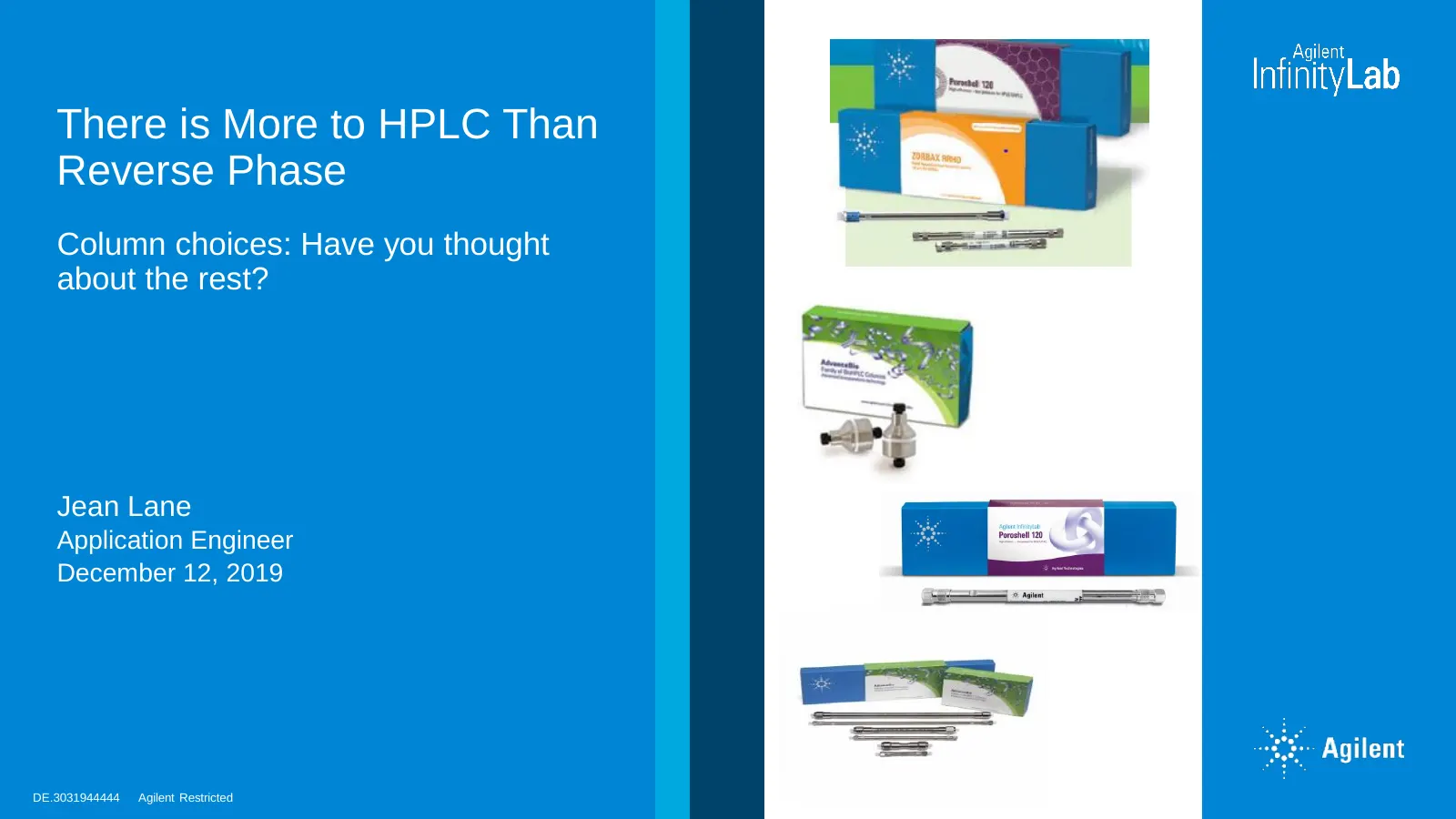
Slide 1: There is More to HPLC Than Reverse Phase
There is More to HPLC Than Reverse Phase Column choices: Have you thought about the rest? Jean Lane Application Engineer December 12, 2019 DE.3031944444 Agilent Restricted
Slide 2: Why Not to Use Reverse Phase
Why Not to Use Reverse Phase Some reasons for trying an alternative C18 columns are a very common ‘go to’ column for HPLC methods and may be a suitable column choice for simple methods. But the C18 chemistry may not be the optimal choice. For analysis of polar analytes, it is typically suggested tha
Slide 3: Why is Changing the Bonded Phase Effective?
Why is Changing the Bonded Phase Effective? • Differences in interactions between polar and nonpolar compounds • Other types of interactions with a bonded phase can be exploited (for example, pi-pi interactions) • These all change with the bonded phase • Changing the bonded phase can improve selecti
Slide 4: What is Supercritical Fluid Chromatography
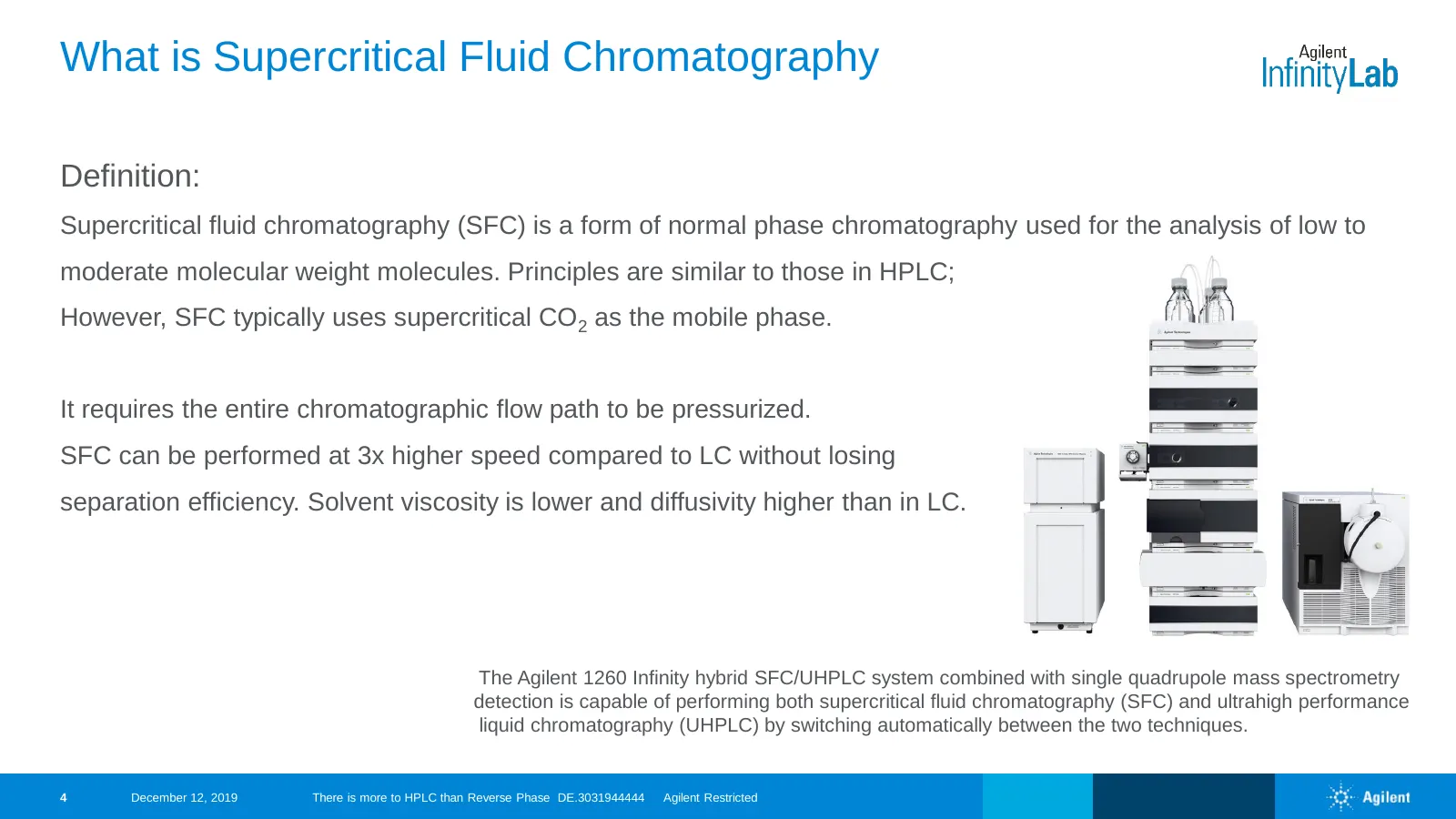
What is Supercritical Fluid Chromatography Definition: Supercritical fluid chromatography (SFC) is a form of normal phase chromatography used for the analysis of low to moderate molecular weight molecules. Principles are similar to those in HPLC; However, SFC typically uses supercritical CO2 as the
Slide 5: Supercritical Fluid Chromatography
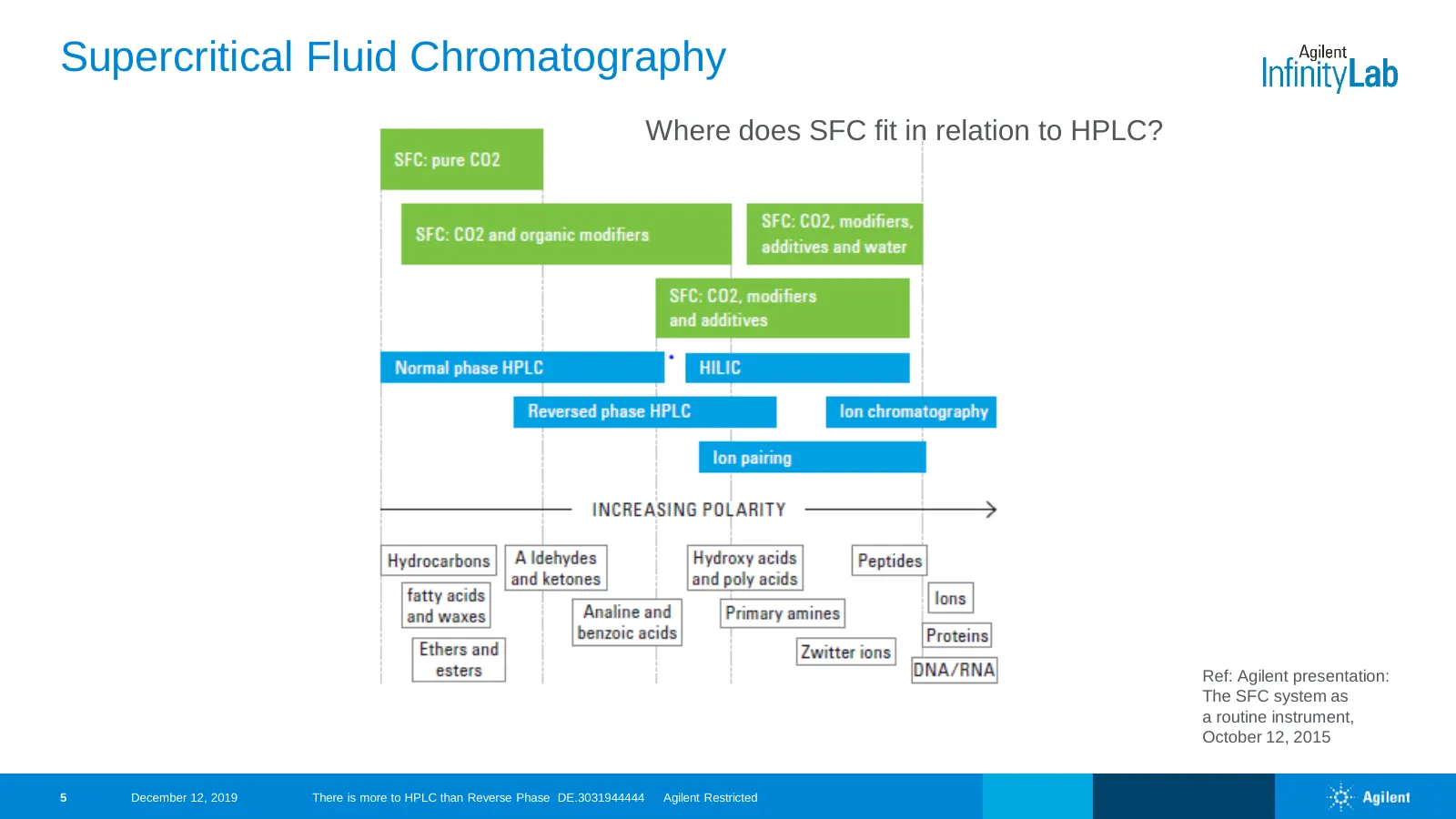
Supercritical Fluid Chromatography Where does SFC fit in relation to HPLC? Ref: Agilent presentation: The SFC system as a routine instrument, October 12, 2015 5 December 12, 2019 There is more to HPLC than Reverse Phase DE.3031944444 Agilent Restricted
Slide 6: Supercritical Fluid Chromatography: What people use SFC
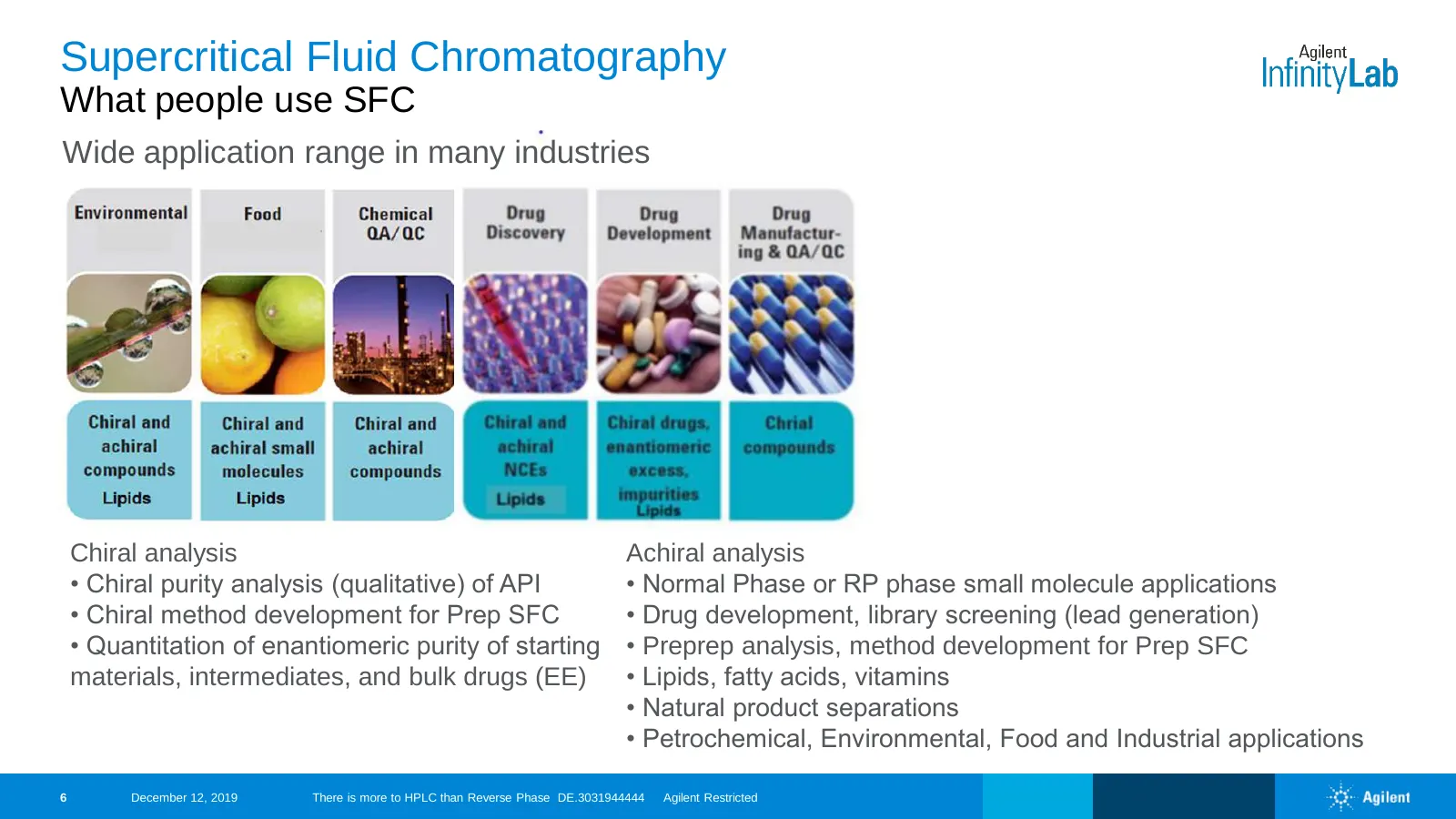
Supercritical Fluid Chromatography What people use SFC Wide application range in many industries Chiral analysis Achiral analysis • Chiral purity analysis (qualitative) of API • Normal Phase or RP phase small molecule applications • Chiral method development for Prep SFC • Drug development, library
Slide 7: Supercritical Fluid Chromatography: Why use CO2?
Supercritical Fluid Chromatography Why use CO2? Methanol is by far the most widely used modifier and among the most polar Today, almost all applications in SFC use CO2, modified with an organic solvent, and sometimes a highly polar modifiers completely miscible with CO2. additive. CO2 is the preferr
Slide 8: SFC Supercritical Fluid Chromatography: Agilent column options
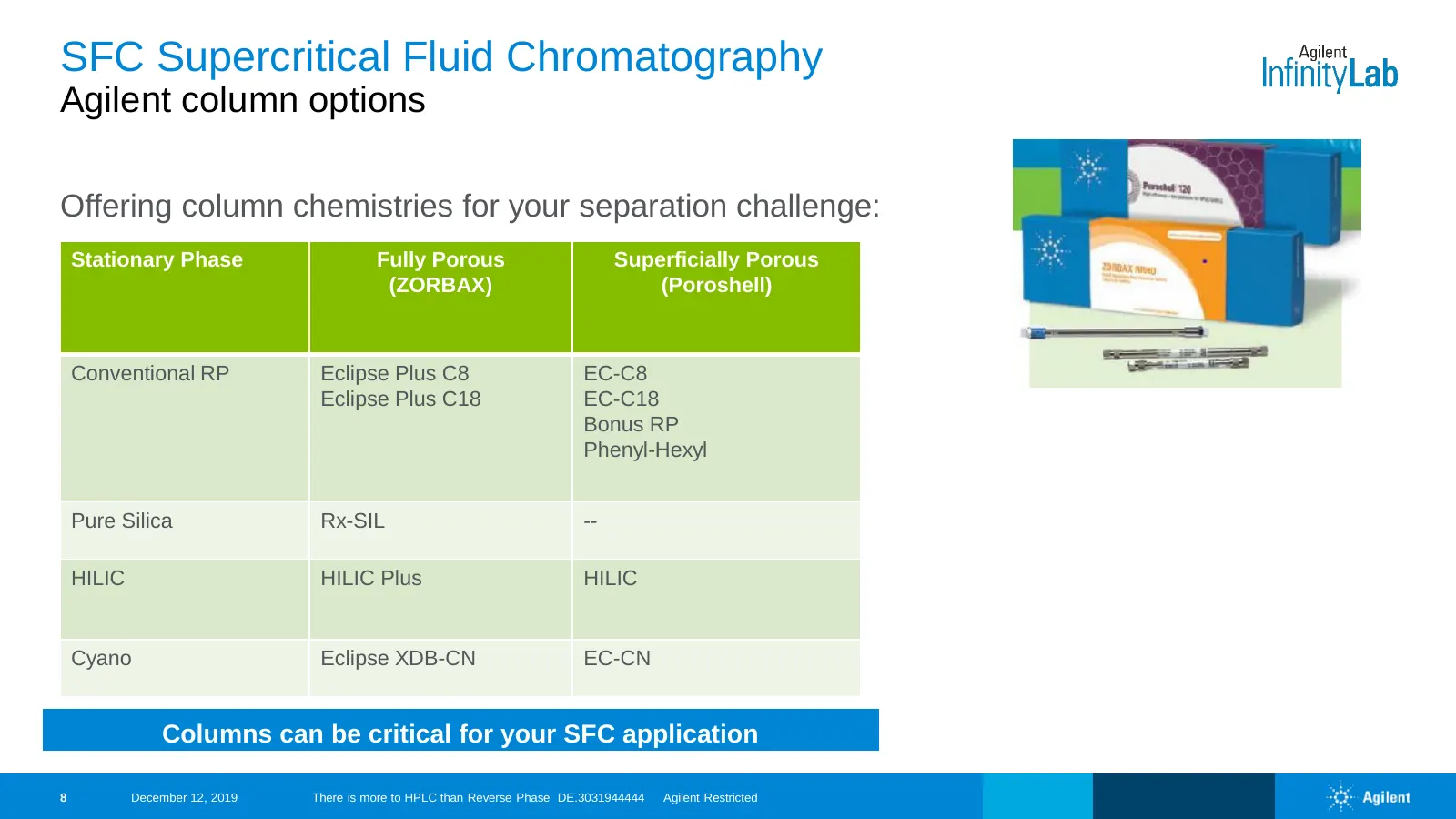
SFC Supercritical Fluid Chromatography Agilent column options Offering column chemistries for your separation challenge: Stationary Phase Fully Porous Superficially Porous (ZORBAX) (Poroshell) Conventional RP Eclipse Plus C8 EC-C8 Eclipse Plus C18 EC-C18 Bonus RP Phenyl-Hexyl Pure Silica Rx-SIL -- H
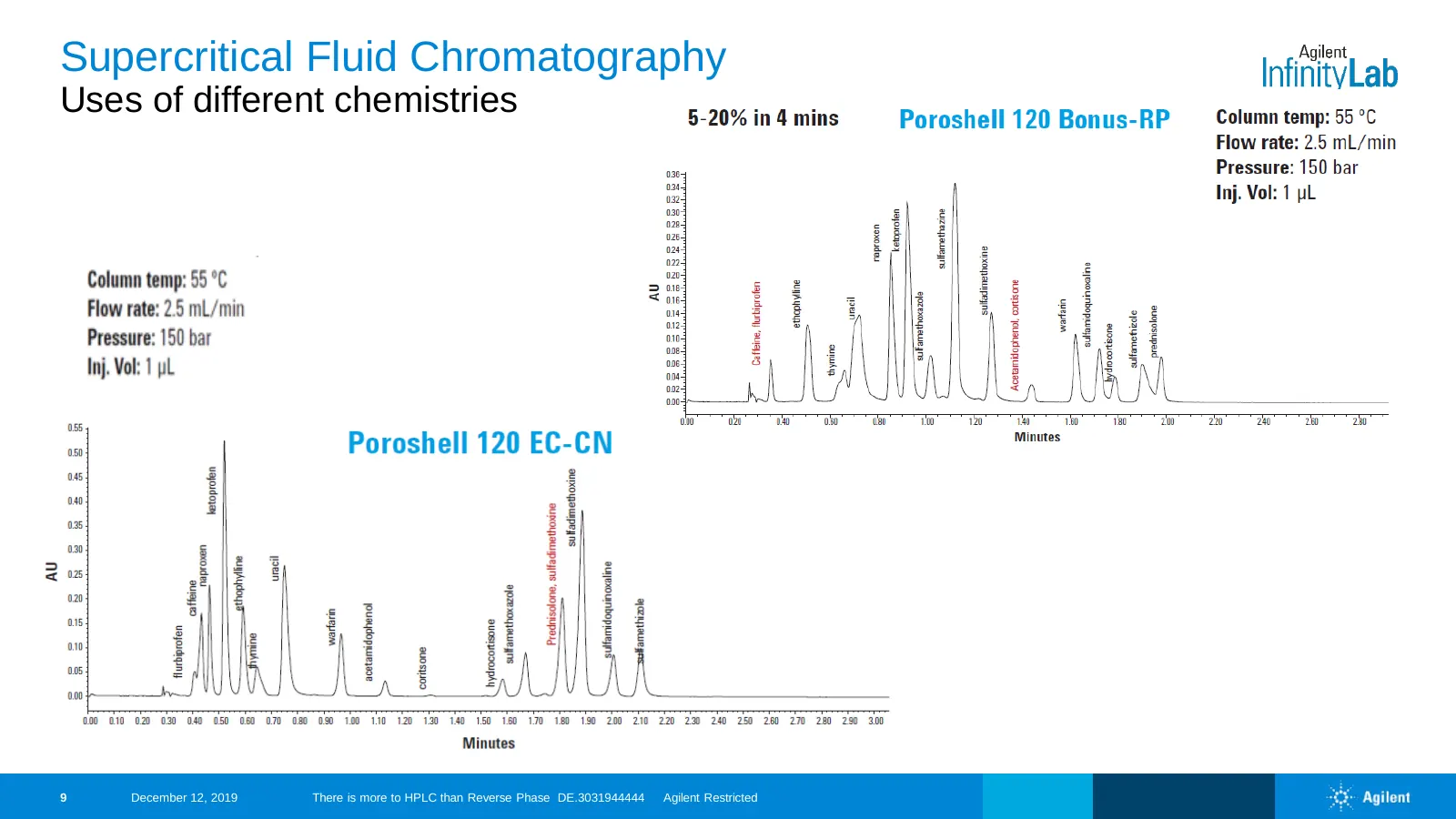
Slide 9: Supercritical Fluid Chromatography: Uses of different chemistries
Supercritical Fluid Chromatography Uses of different chemistries 9 December 12, 2019 There is more to HPLC than Reverse Phase DE.3031944444 Agilent Restricted
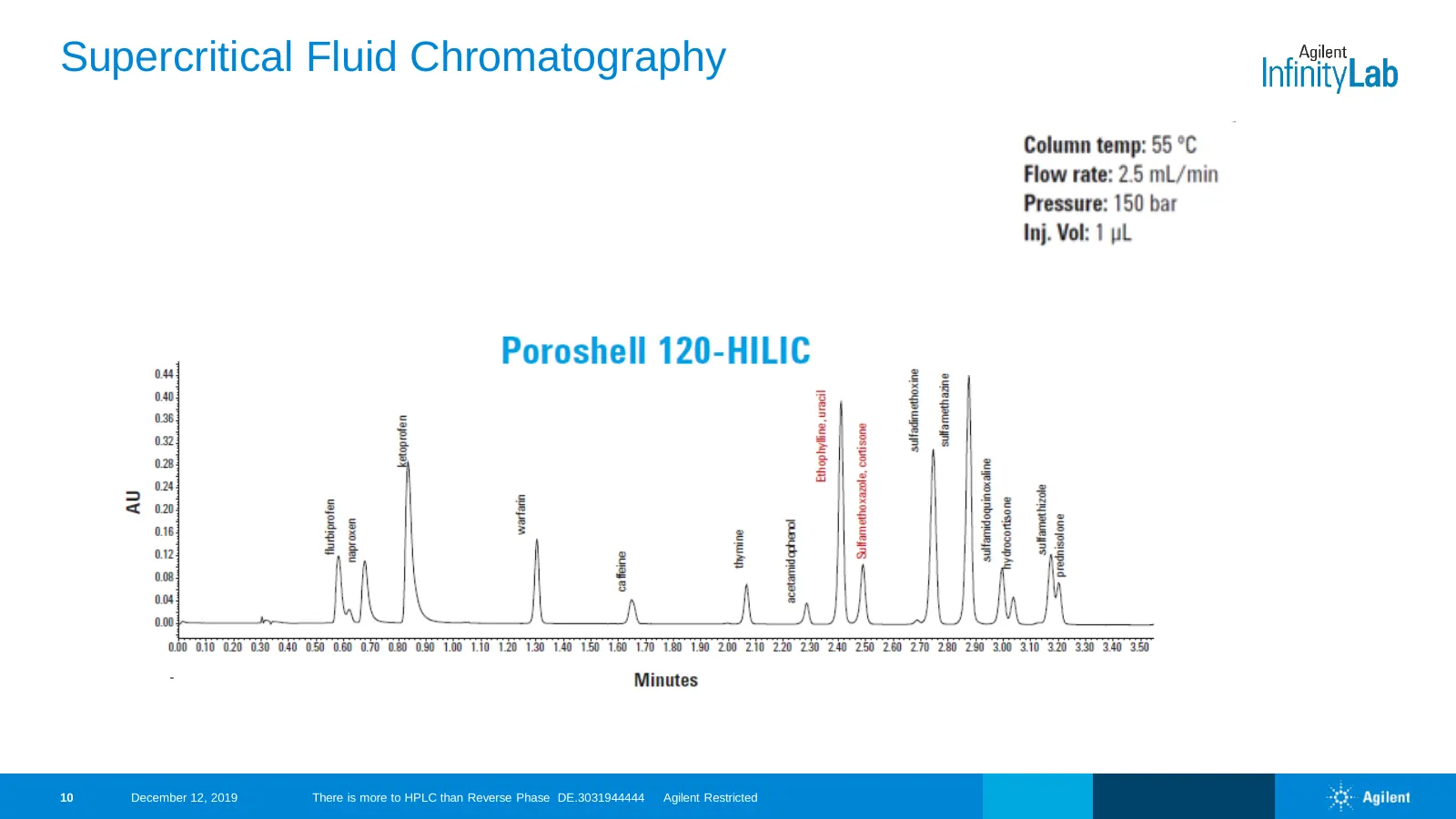
Slide 10: Supercritical Fluid Chromatography
Supercritical Fluid Chromatography 10 December 12, 2019 There is more to HPLC than Reverse Phase DE.3031944444 Agilent Restricted
Slide 11: Chiral Chromatography
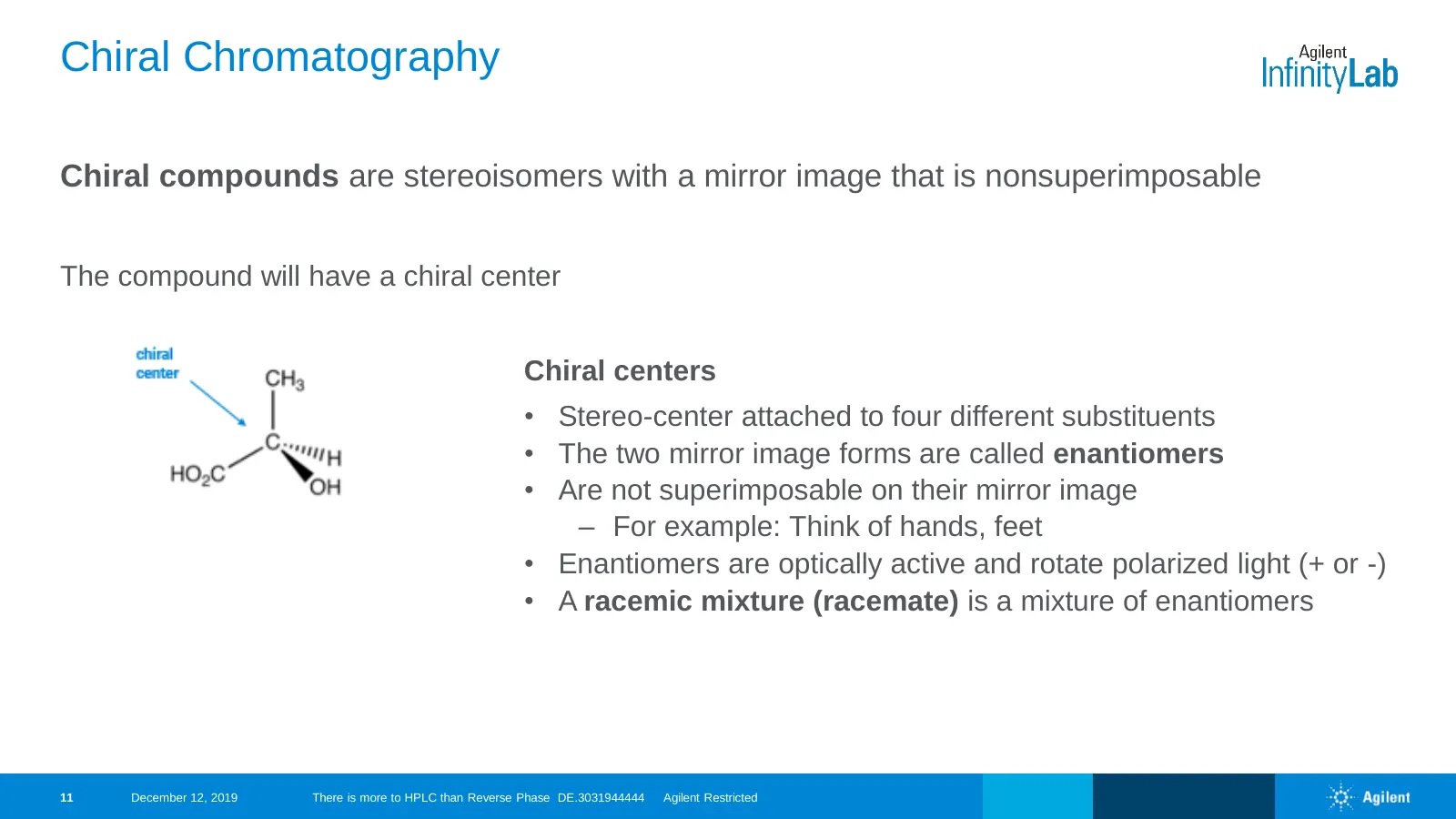
Chiral Chromatography Chiral compounds are stereoisomers with a mirror image that is nonsuperimposable The compound will have a chiral center Chiral centers • Stereo-center attached to four different substituents • The two mirror image forms are called enantiomers • Are not superimposable on their m
Slide 12: Chiral Separations
Chiral Separations • Chiral stationary phases are bonded with ‘chiral selectors’ – compounds that can selectively target +/- enantiomers. • Chiral stationary phases have varying affinities and interactions specific to each enantiomer. • Three simultaneous, different modes of interactions are necessa
Slide 13: Why Do Chiral Separations
Why Do Chiral Separations • Most small molecule drugs on the market today are either racemates or enantiomerically pure. • Enantiomers: Same chemical and physical properties, but can have very different behavorial properties. • It is important to characterize each enantiomer. 13 December 12, 2019 Th
Slide 14: Agilent InfinityLab Chromatography Columns
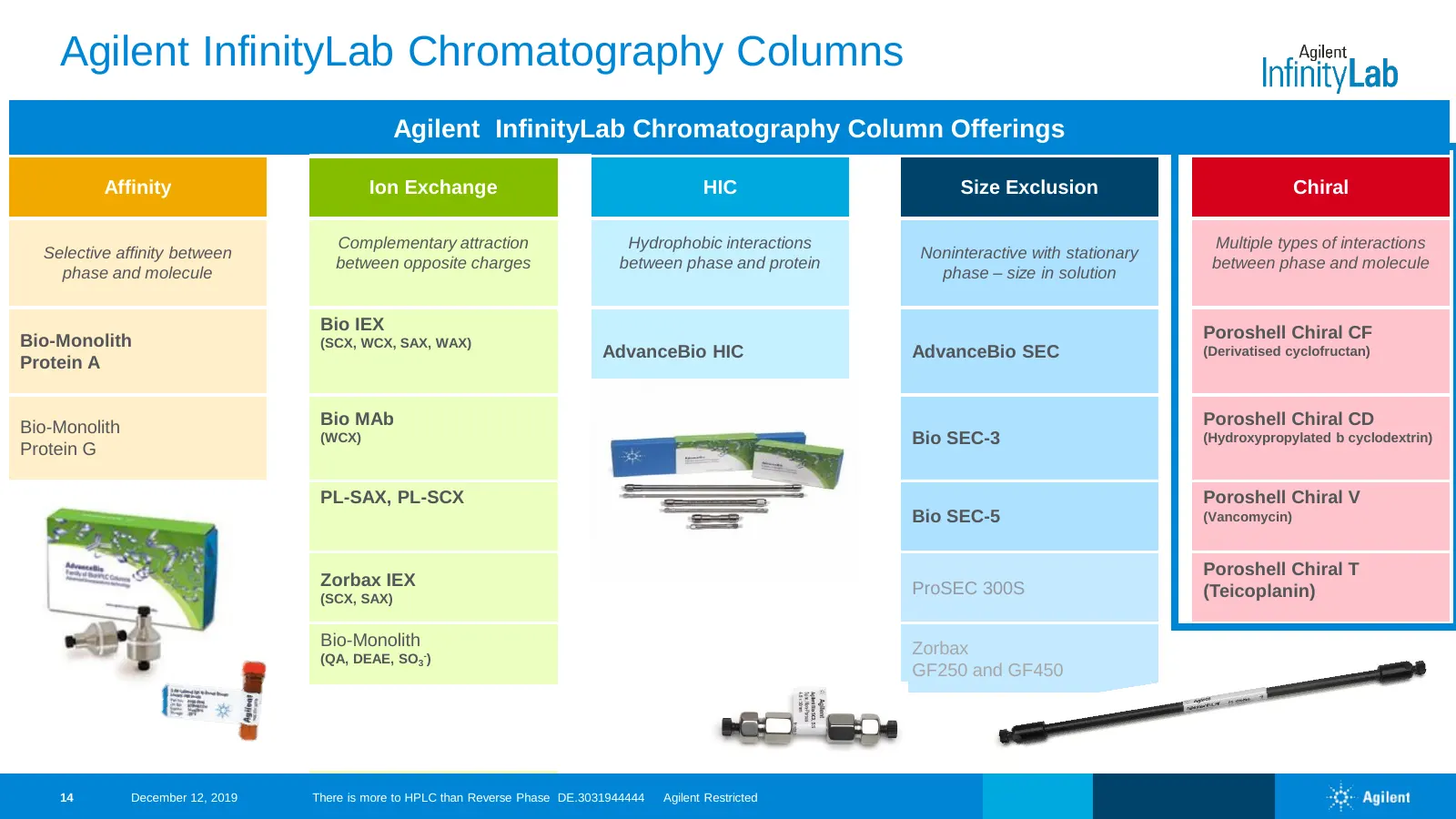
Agilent InfinityLab Chromatography Columns Agilent InfinityLab Chromatography Column Offerings Affinity Ion Exchange HIC Size Exclusion Chiral Complementary attraction Hydrophobic interactions Multiple types of interactions Selective affinity between Noninteractive with stationary between opposite c
Slide 15: InfinityLab Poroshell 120 Chiral Chemistries
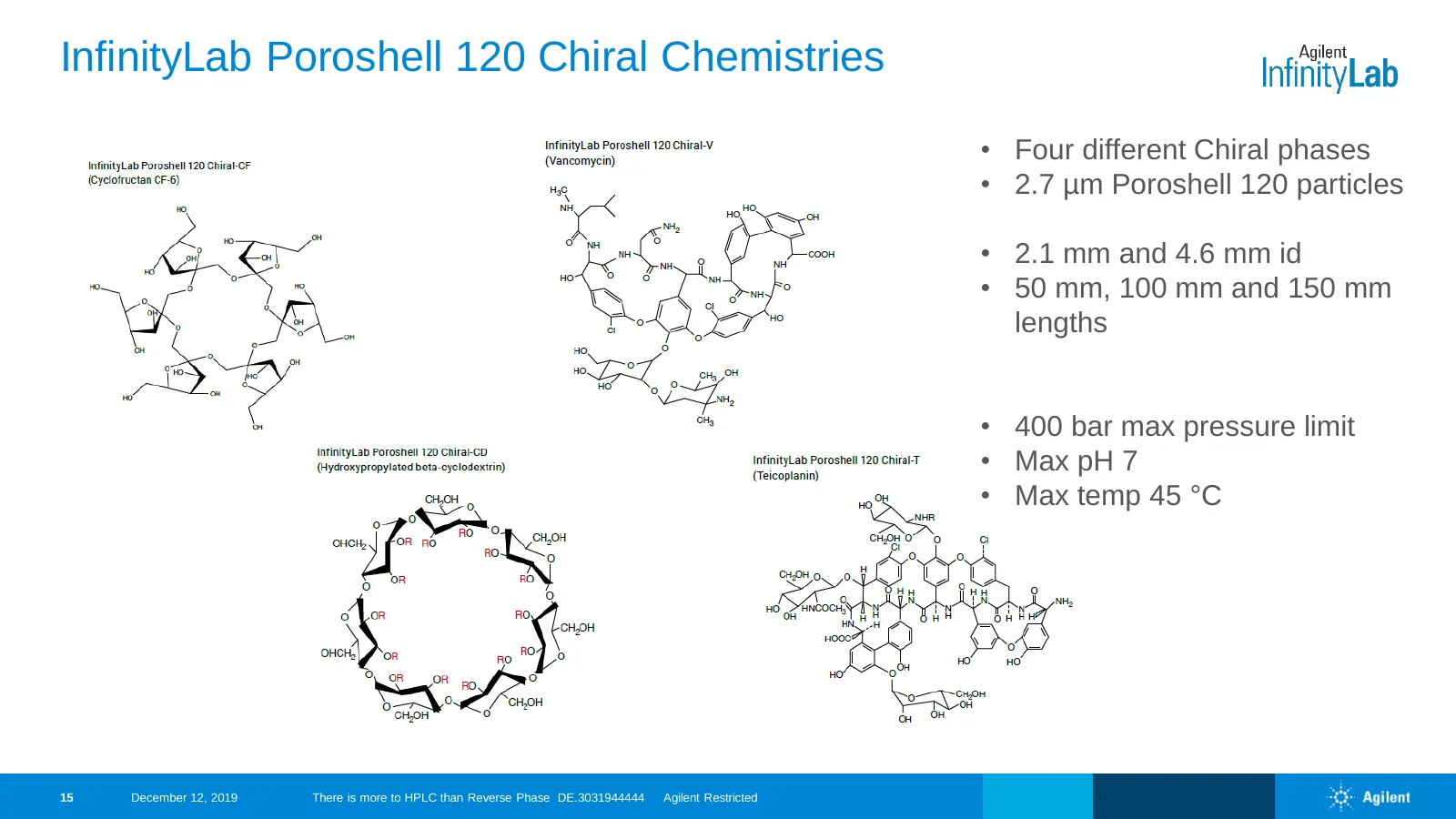
InfinityLab Poroshell 120 Chiral Chemistries • Four different Chiral phases • 2.7 µm Poroshell 120 particles • 2.1 mm and 4.6 mm id • 50 mm, 100 mm and 150 mm lengths • 400 bar max pressure limit • Max pH 7 • Max temp 45 °C 15 December 12, 2019 There is more to HPLC than Reverse Phase DE.3031944444
Slide 16: InfinityLab Poroshell 120 Chiral Chemistries
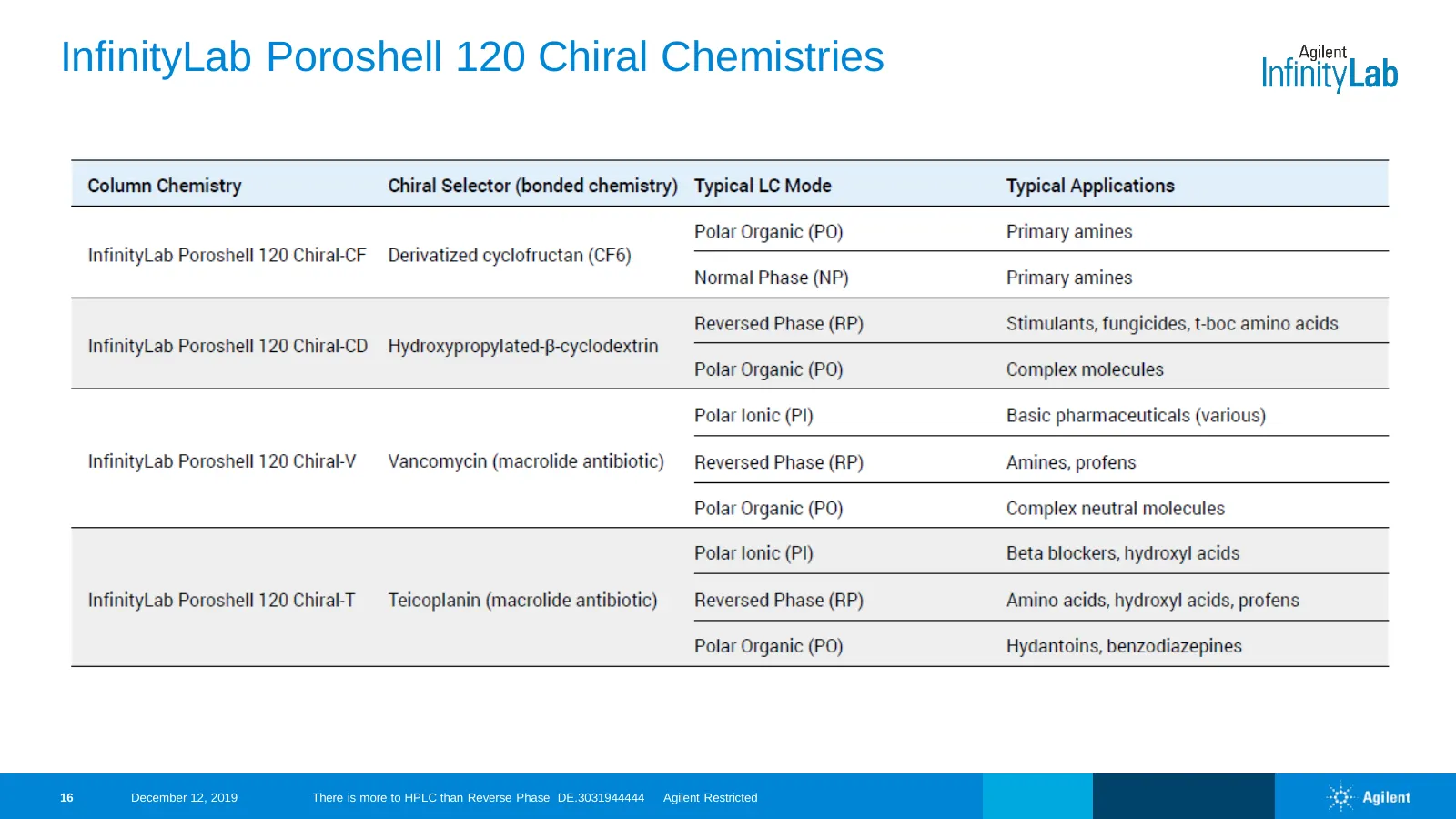
InfinityLab Poroshell 120 Chiral Chemistries 16 December 12, 2019 There is more to HPLC than Reverse Phase DE.3031944444 Agilent Restricted
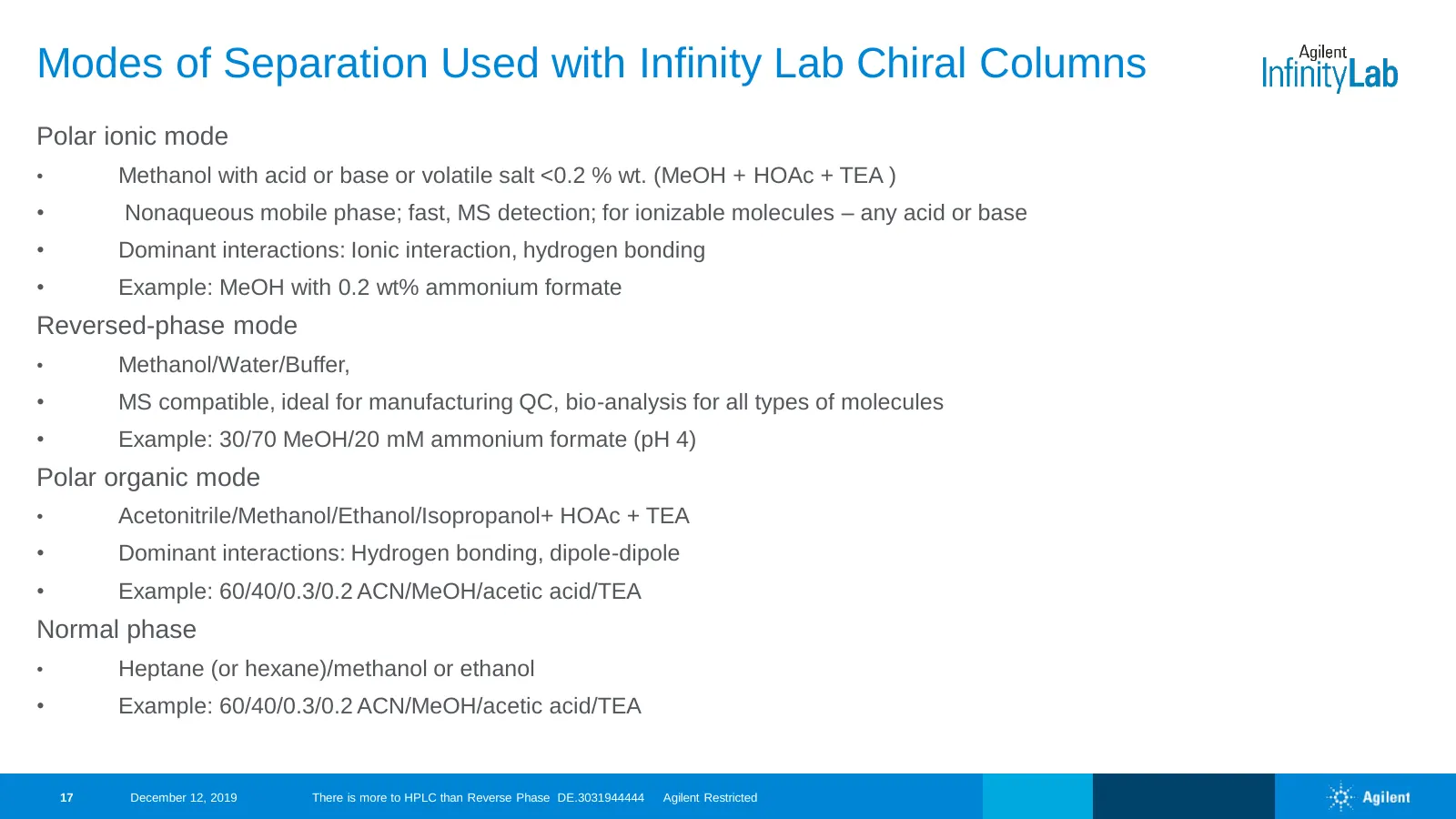
Slide 17: Modes of Separation Used with Infinity Lab Chiral Columns
Modes of Separation Used with Infinity Lab Chiral Columns Polar ionic mode • Methanol with acid or base or volatile salt <0.2 % wt. (MeOH + HOAc + TEA ) • Nonaqueous mobile phase; fast, MS detection; for ionizable molecules – any acid or base • Dominant interactions: Ionic interaction, hydrogen bond
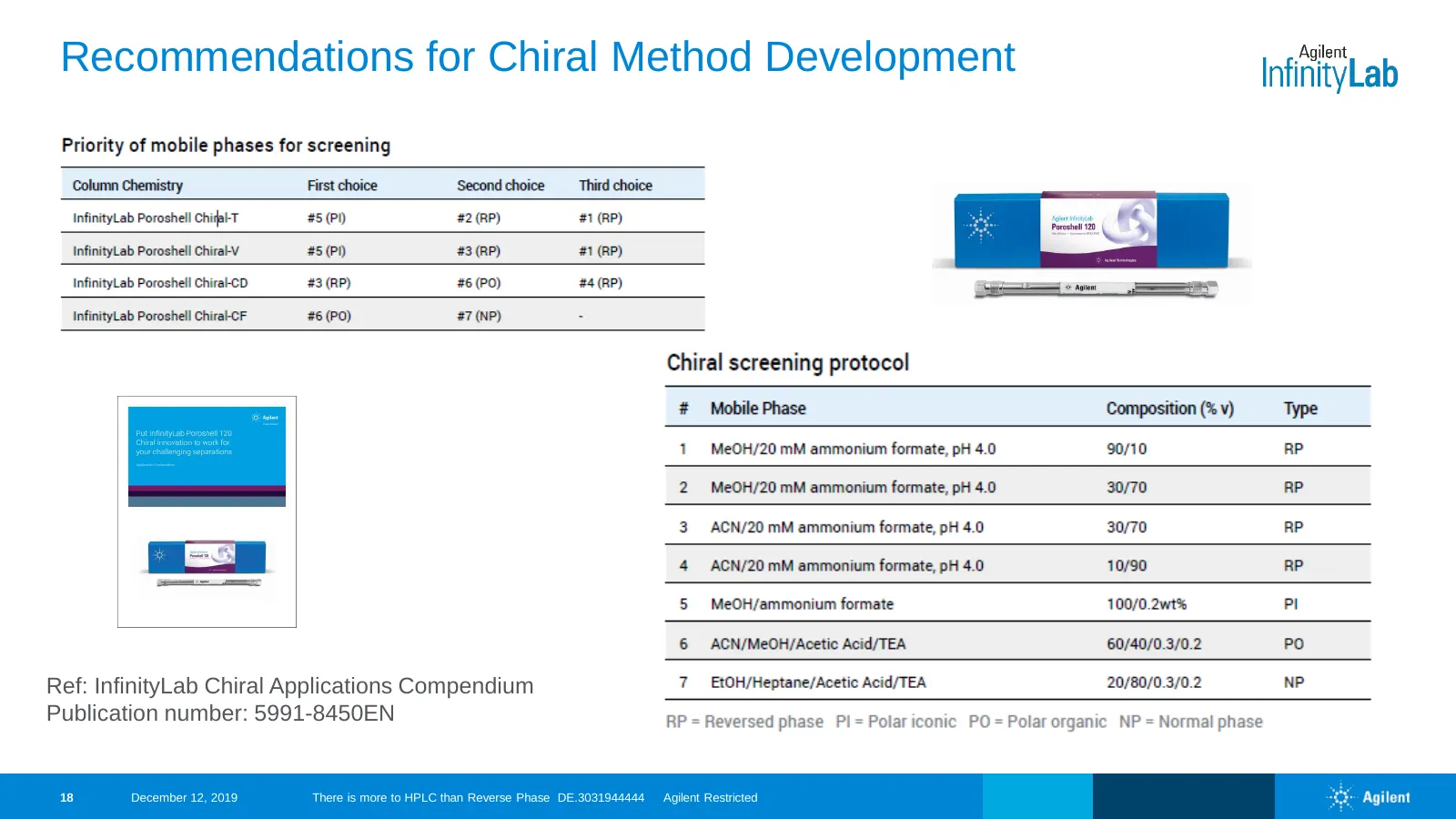
Slide 18: Recommendations for Chiral Method Development
Recommendations for Chiral Method Development Ref: InfinityLab Chiral Applications Compendium Publication number: 5991-8450EN 18 December 12, 2019 There is more to HPLC than Reverse Phase DE.3031944444 Agilent Restricted
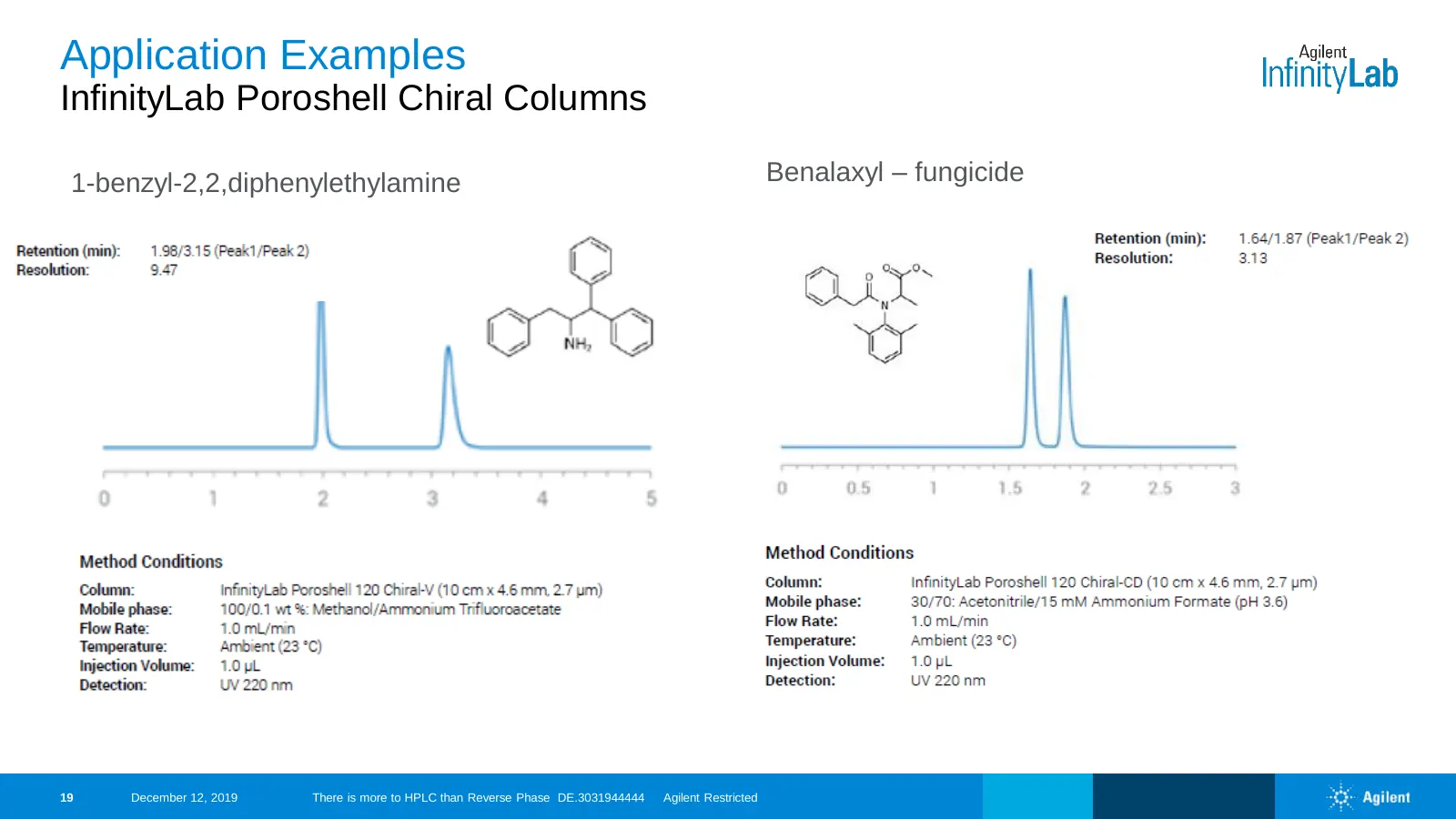
Slide 19: Application Examples
Application Examples InfinityLab Poroshell Chiral Columns 1-benzyl-2,2,diphenylethylamine Benalaxyl – fungicide 19 December 12, 2019 There is more to HPLC than Reverse Phase DE.3031944444 Agilent Restricted
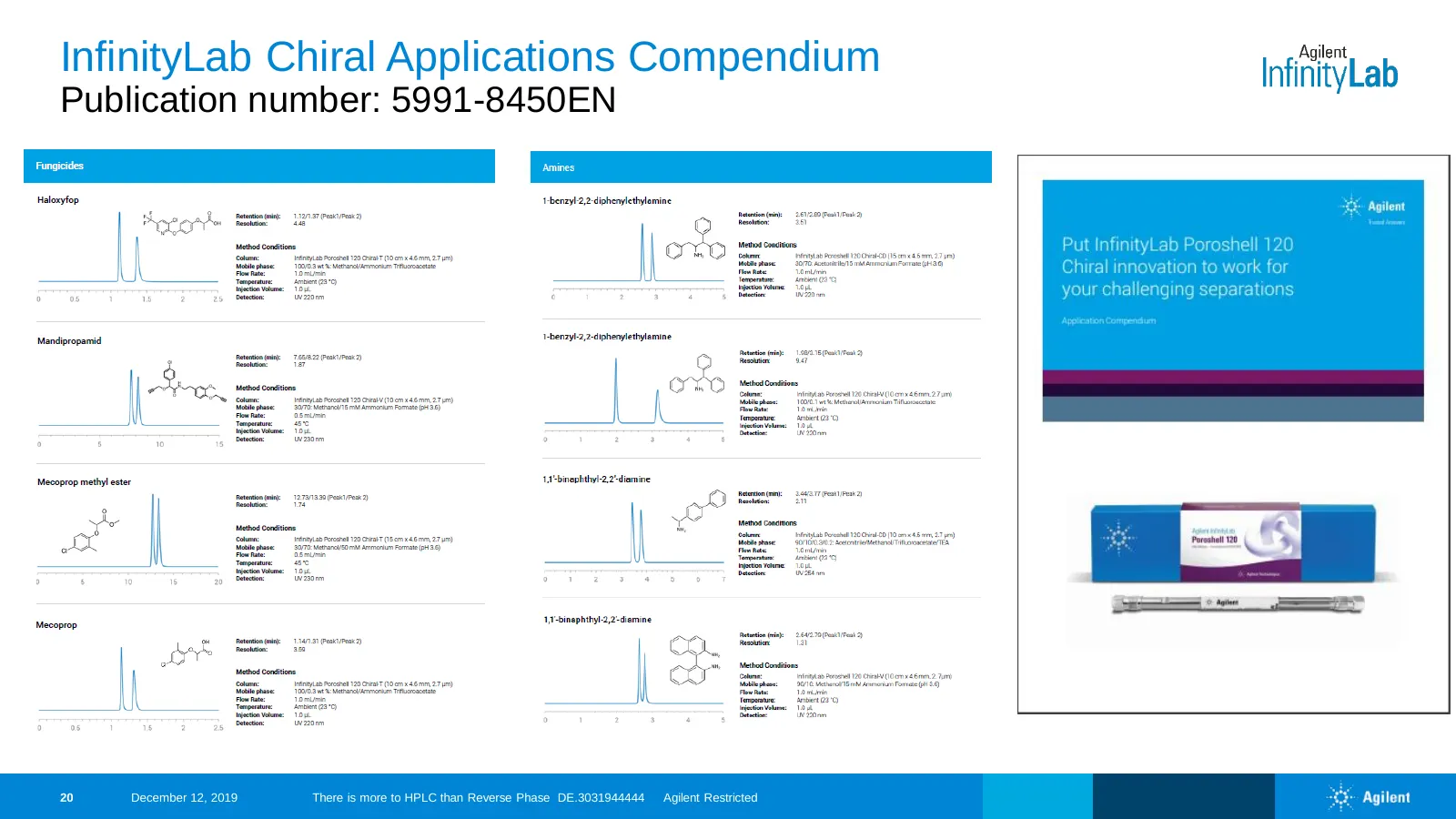
Slide 20: InfinityLab Chiral Applications Compendium
InfinityLab Chiral Applications Compendium Publication number: 5991-8450EN 20 December 12, 2019 There is more to HPLC than Reverse Phase DE.3031944444 Agilent Restricted
Slide 21: Hydrophobic Interaction Chromatography
Hydrophobic Interaction Chromatography HIC Hydrophobic interaction chromatography separates protein molecules based on differences in their hydrophobicity. There is an interaction between the protein sample and the hydrophobic surface of the HIC packing HIC is most commonly used for separating prote
Slide 22: How Does HIC Work?
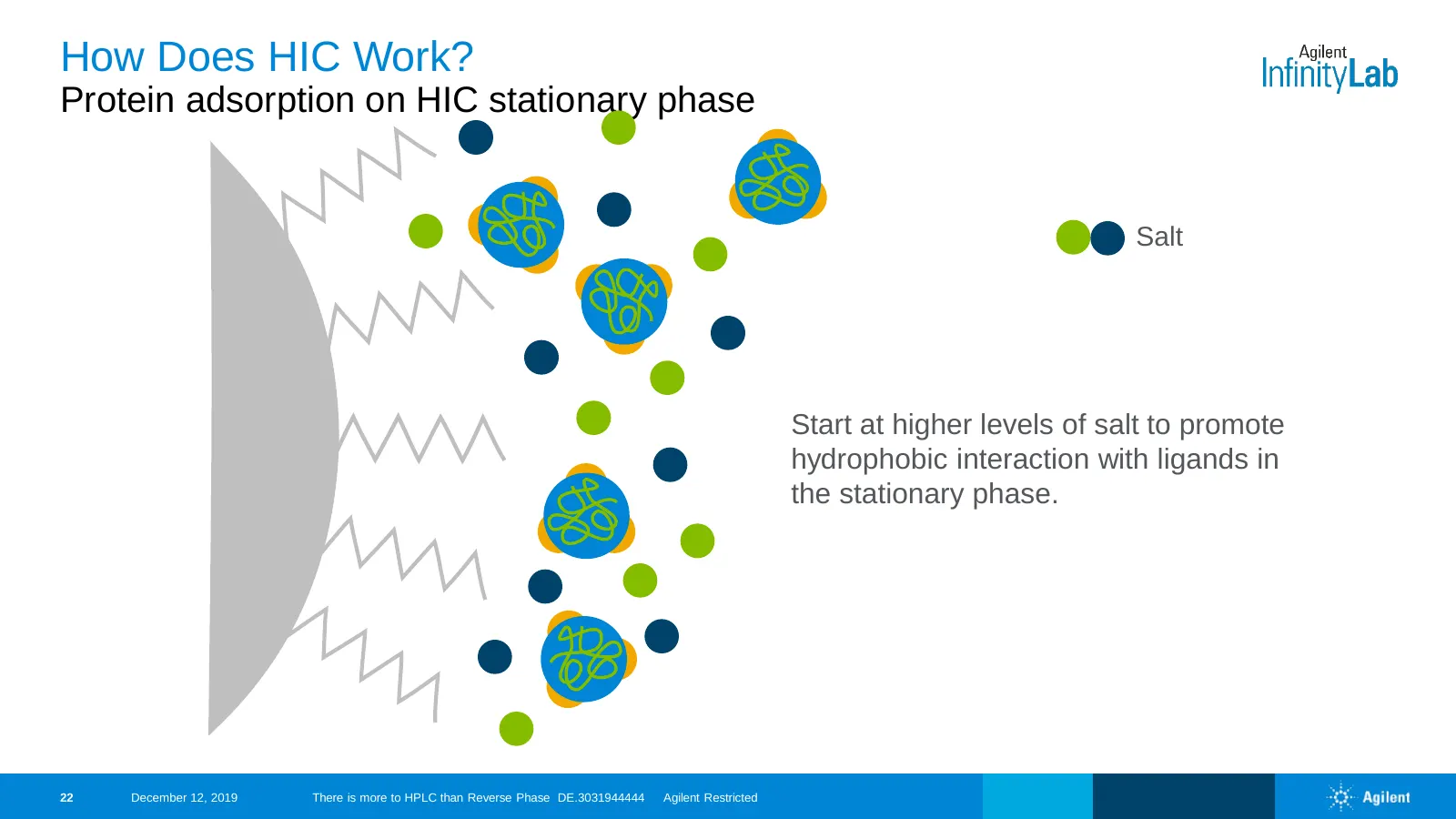
How Does HIC Work? Protein adsorption on HIC stationary phase Salt Start at higher levels of salt to promote hydrophobic interaction with ligands in the stationary phase. 22 December 12, 2019 There is more to HPLC than Reverse Phase DE.3031944444 Agilent Restricted
Slide 23: Protein Adsorption on HIC Stationary Phase
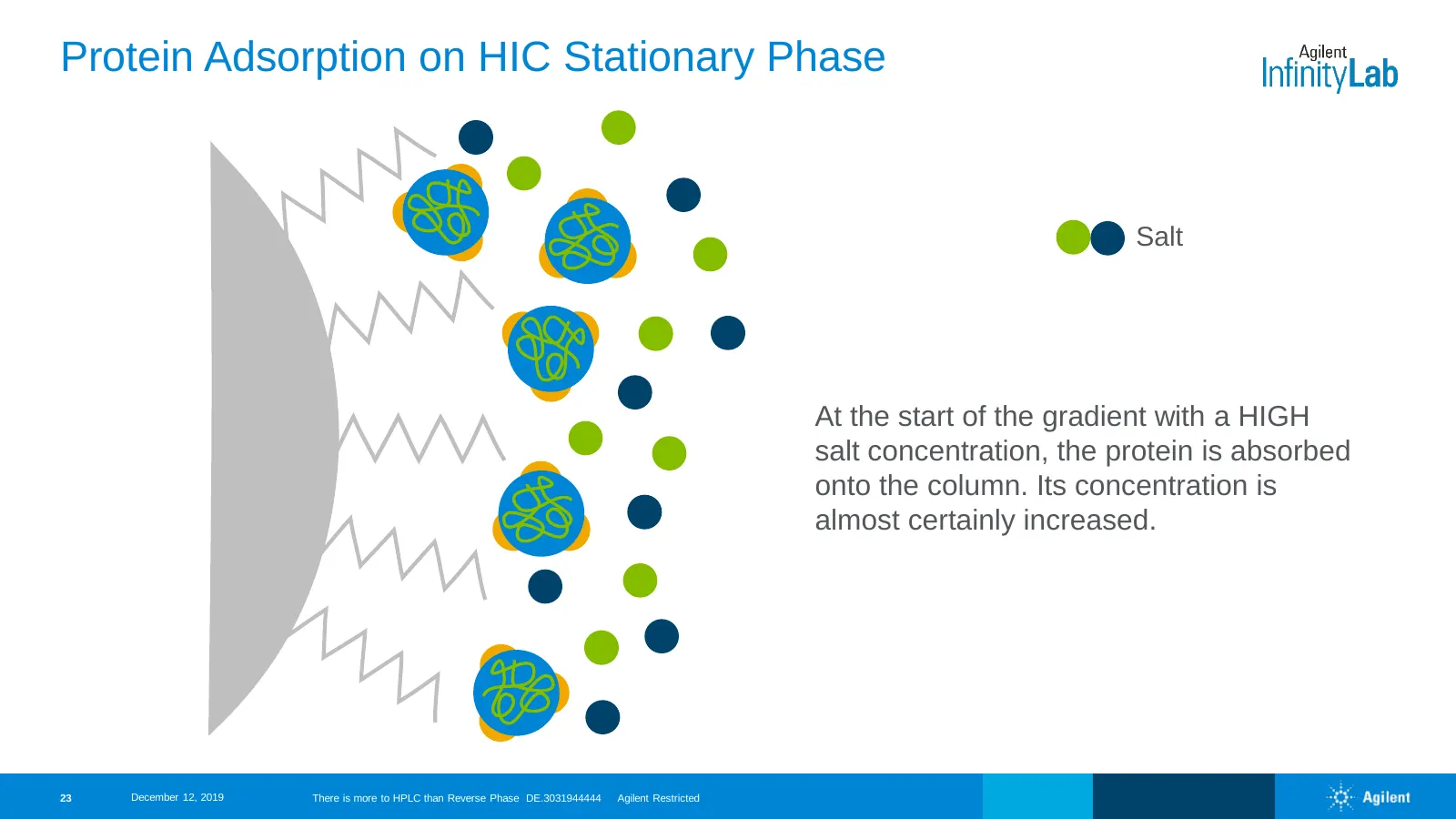
Protein Adsorption on HIC Stationary Phase Salt At the start of the gradient with a HIGH salt concentration, the protein is absorbed onto the column. Its concentration is almost certainly increased. 23 December 12, 2019 There is more to HPLC than Reverse Phase DE.3031944444 Agilent Restricted
Slide 24: Protein Elution on HIC Stationary Phase
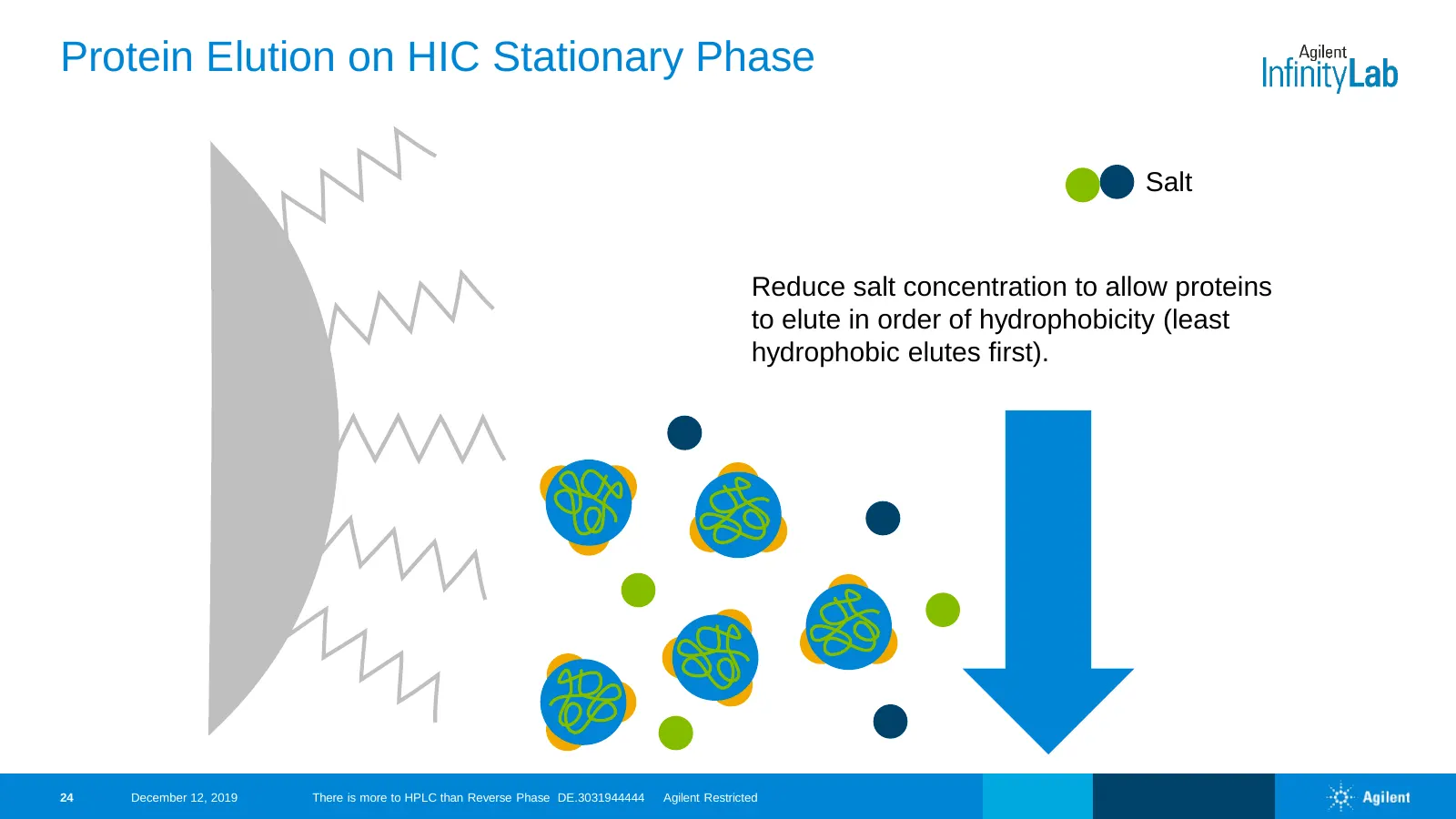
Protein Elution on HIC Stationary Phase Salt Reduce salt concentration to allow proteins to elute in order of hydrophobicity (least hydrophobic elutes first). 24 December 12, 2019 There is more to HPLC than Reverse Phase DE.3031944444 Agilent Restricted
Slide 25: Agilent InfinityLab Chromatography Columns
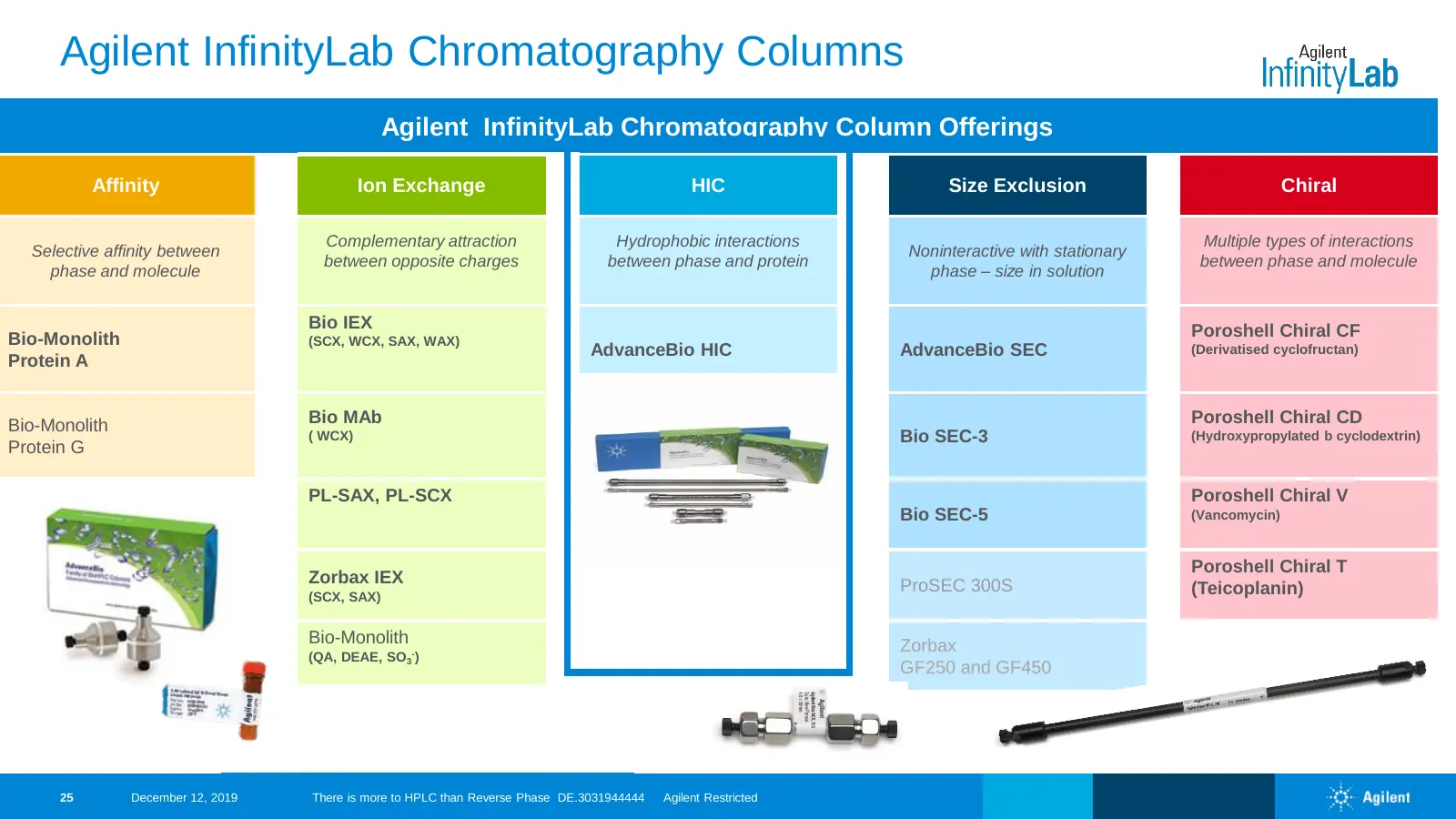
Agilent InfinityLab Chromatography Columns Agilent InfinityLab Chromatography Column Offerings Affinity Ion Exchange HIC Size Exclusion Chiral Complementary attraction Hydrophobic interactions Multiple types of interactions Selective affinity between Noninteractive with stationary between opposite c
Slide 26: AdvanceBio HIC
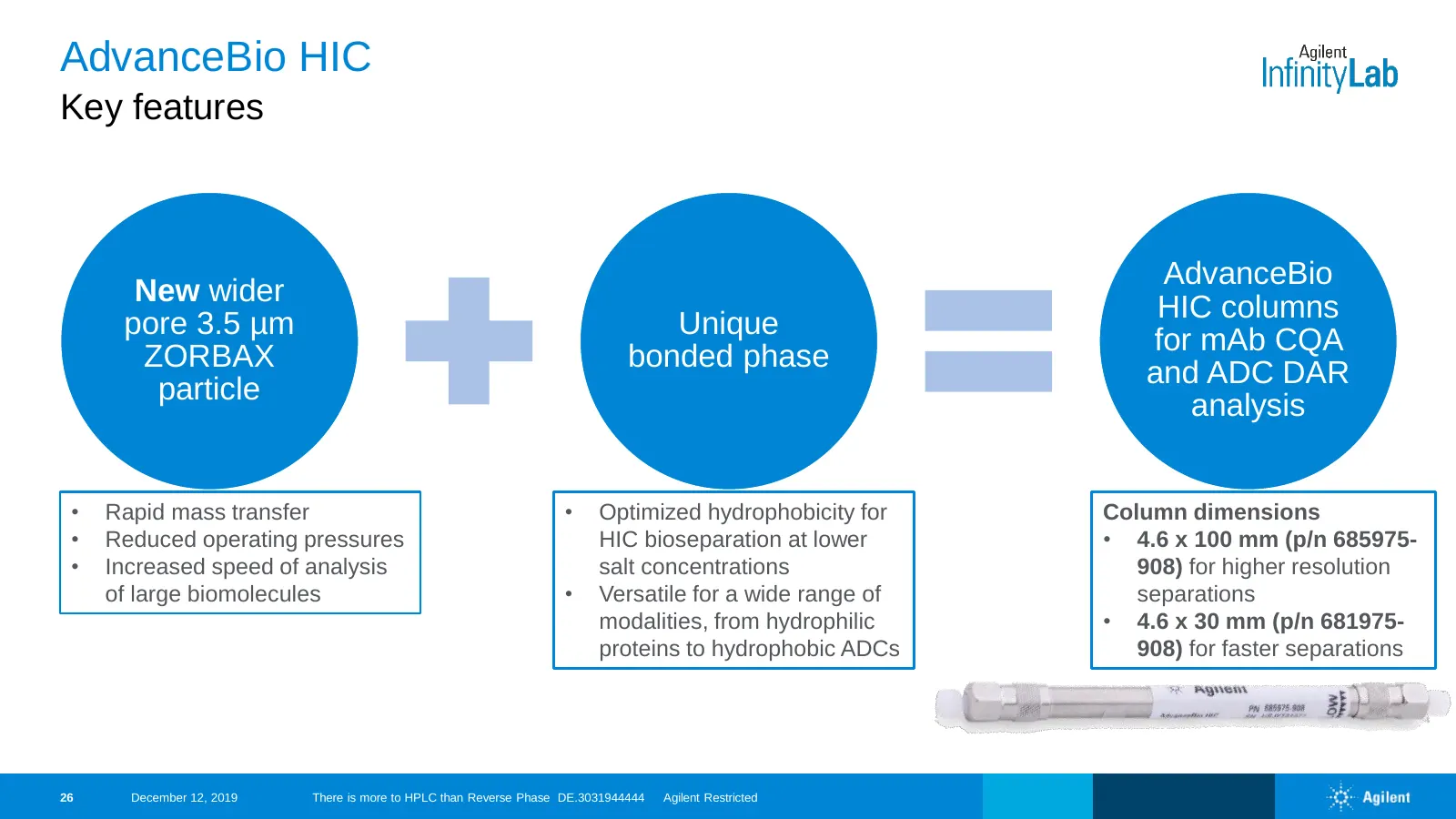
AdvanceBio HIC Key features AdvanceBio New wider HIC columns pore 3.5 µm Unique for mAb CQA ZORBAX bonded phase and ADC DAR particle analysis • Rapid mass transfer • Optimized hydrophobicity for Column dimensions • Reduced operating pressures HIC bioseparation at lower • 4.6 x 100 mm (p/n 685975- •
Slide 27: HIC Separation of Standard Proteins
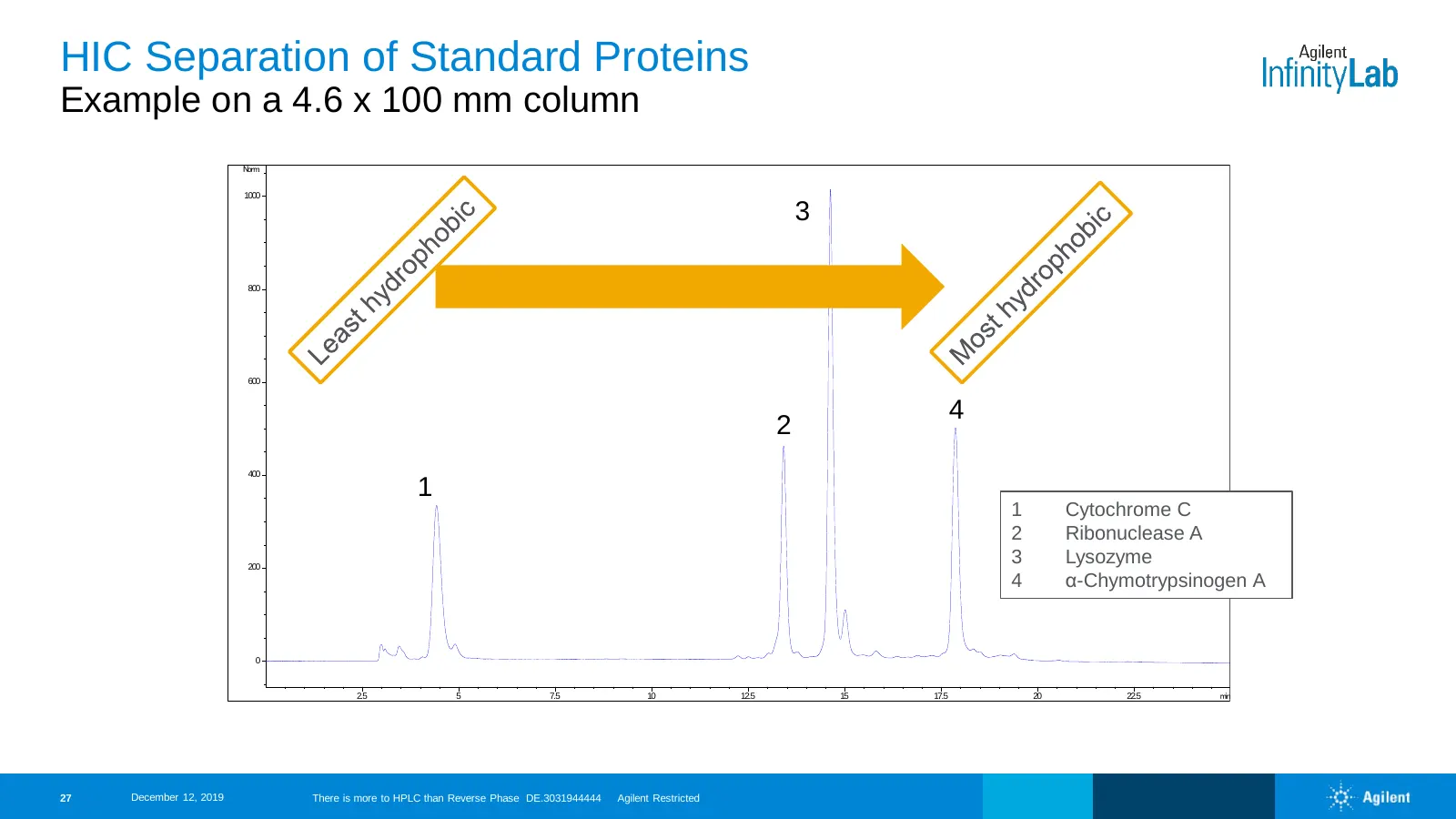
HIC Separation of Standard Proteins Example on a 4.6 x 100 mm column Norm. 1000 3 800 600 4 2 400 1 1 Cytochrome C 2 Ribonuclease A 200 3 Lysozyme 4 α-Chymotrypsinogen A 0 2.5 5 7.5 10 12.5 15 17.5 20 22.5 min 27 December 12, 2019 There is more to HPLC than Reverse Phase DE.3031944444 Agilent Restri
Slide 28: HIC Separation of Standard Proteins
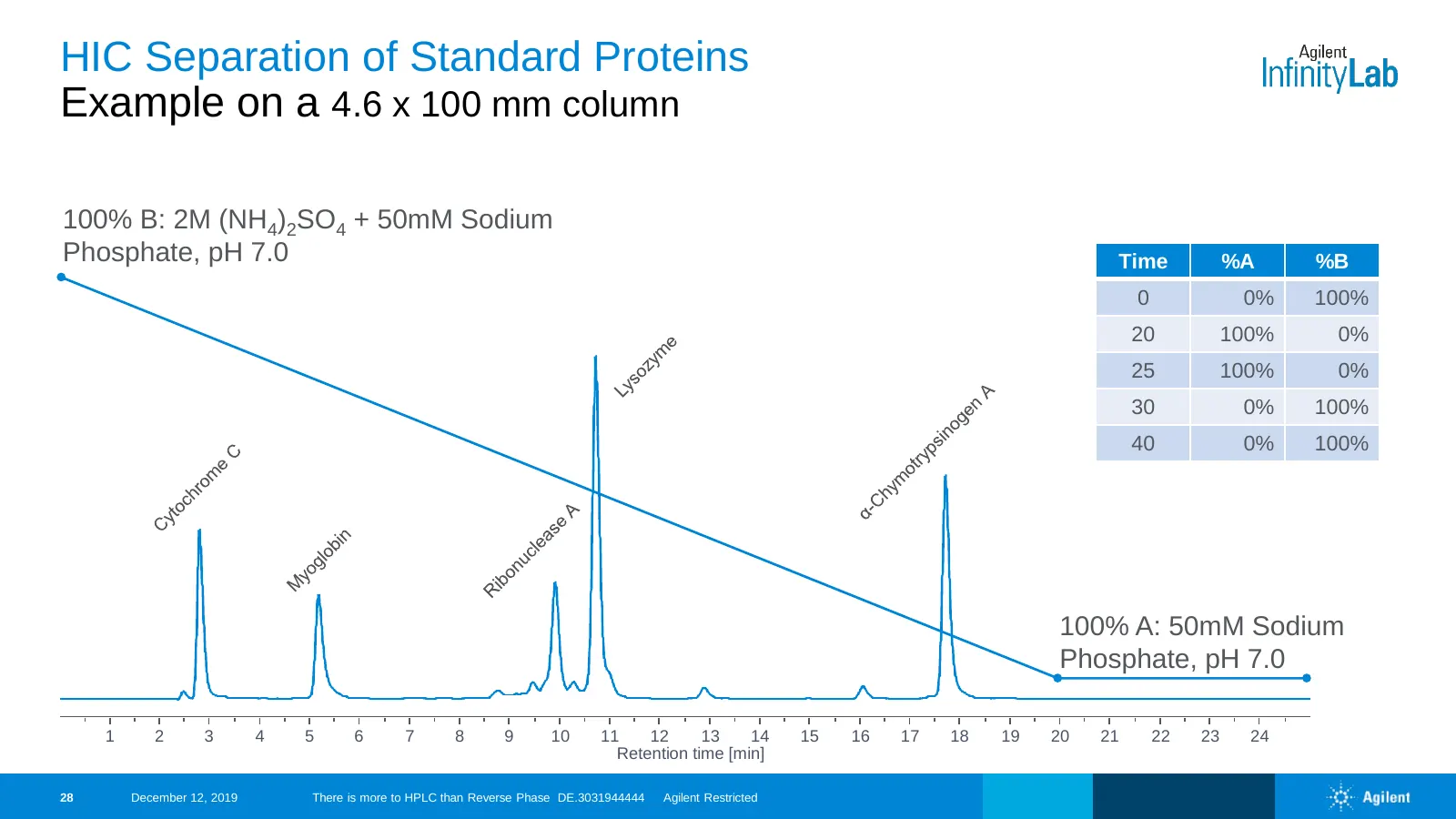
HIC Separation of Standard Proteins Example on a 4.6 x 100 mm column 100% B: 2M (NH4)2SO4 + 50mM Sodium Phosphate, pH 7.0 Time %A %B 0 0% 100% 20 100% 0% 25 100% 0% 30 0% 100% 40 0% 100% 100% A: 50mM Sodium Phosphate, pH 7.0 1 2 3 4 5 6 7 8 9 10 11 12 13 14 15 16 17 18 19 20 21 22 23 24 Retention ti
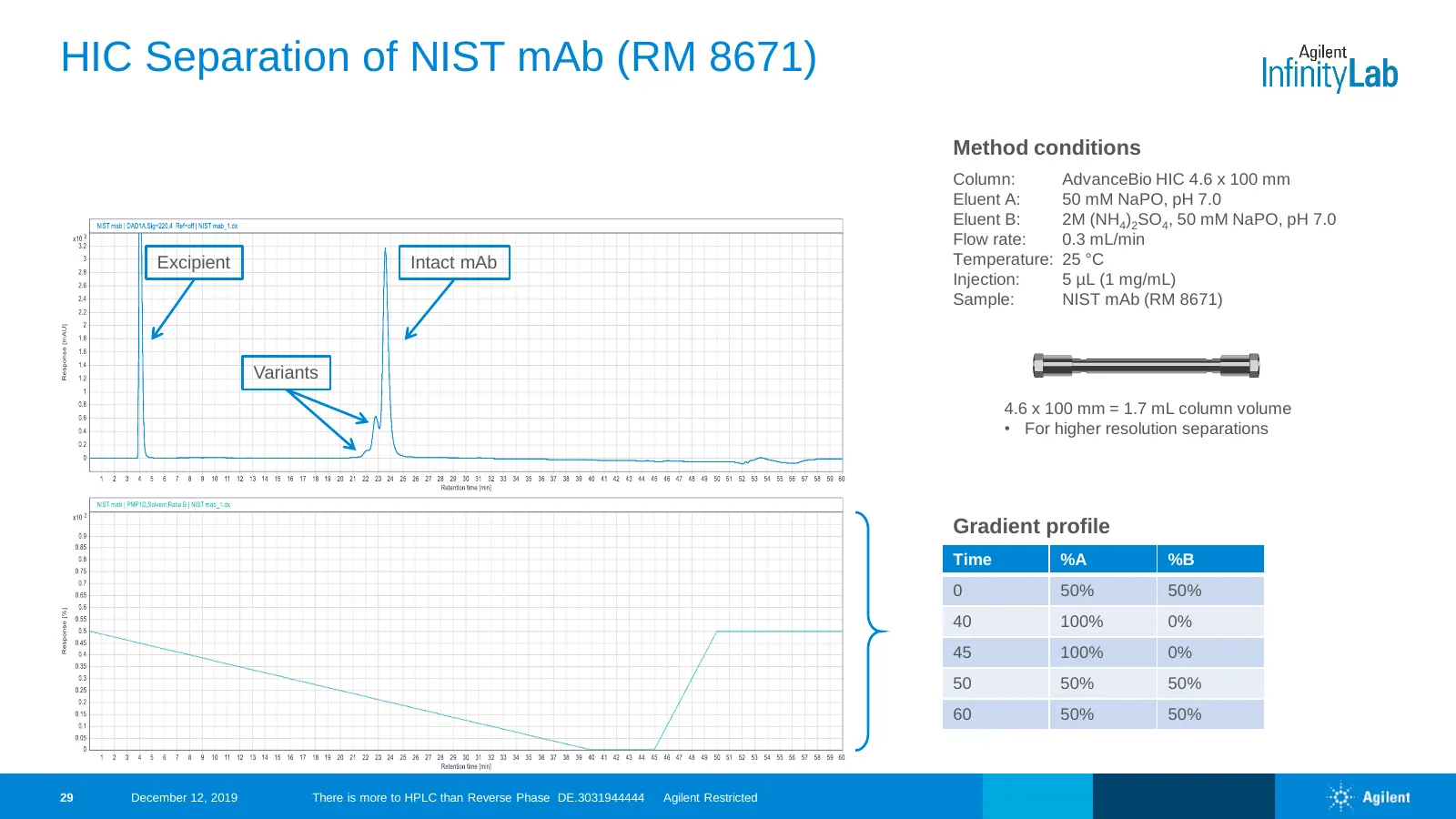
Slide 29: HIC Separation of NIST mAb (RM 8671)
HIC Separation of NIST mAb (RM 8671) Method conditions Column: AdvanceBio HIC 4.6 x 100 mm Eluent A: 50 mM NaPO, pH 7.0 Eluent B: 2M (NH4)2SO4, 50 mM NaPO, pH 7.0 Flow rate: 0.3 mL/min Excipient Intact mAb Temperature: 25 °C Injection: 5 µL (1 mg/mL) Sample: NIST mAb (RM 8671) Variants 4.6 x 100 mm
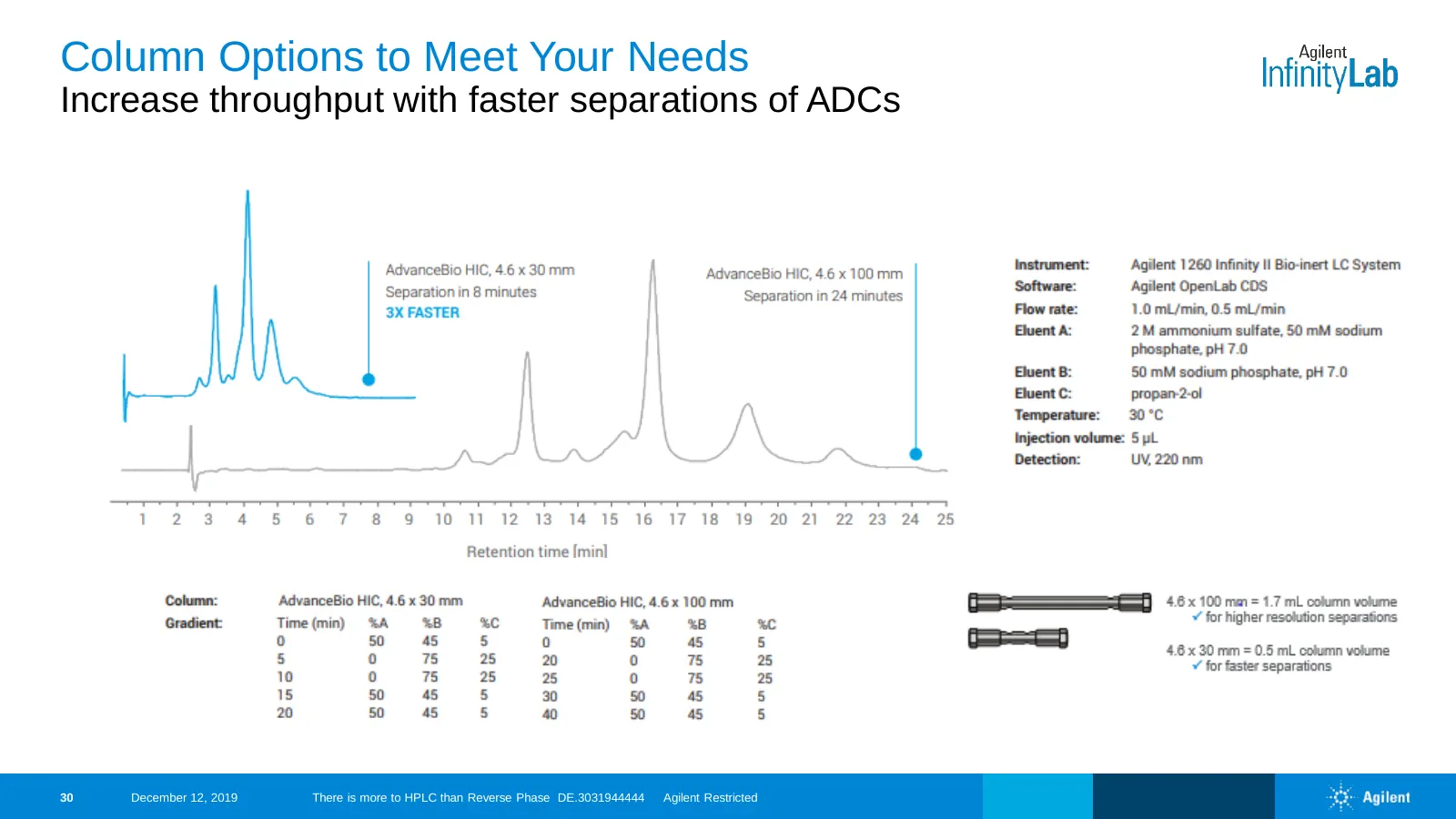
Slide 30: Column Options to Meet Your Needs
Column Options to Meet Your Needs Increase throughput with faster separations of ADCs 30 December 12, 2019 There is more to HPLC than Reverse Phase DE.3031944444 Agilent Restricted
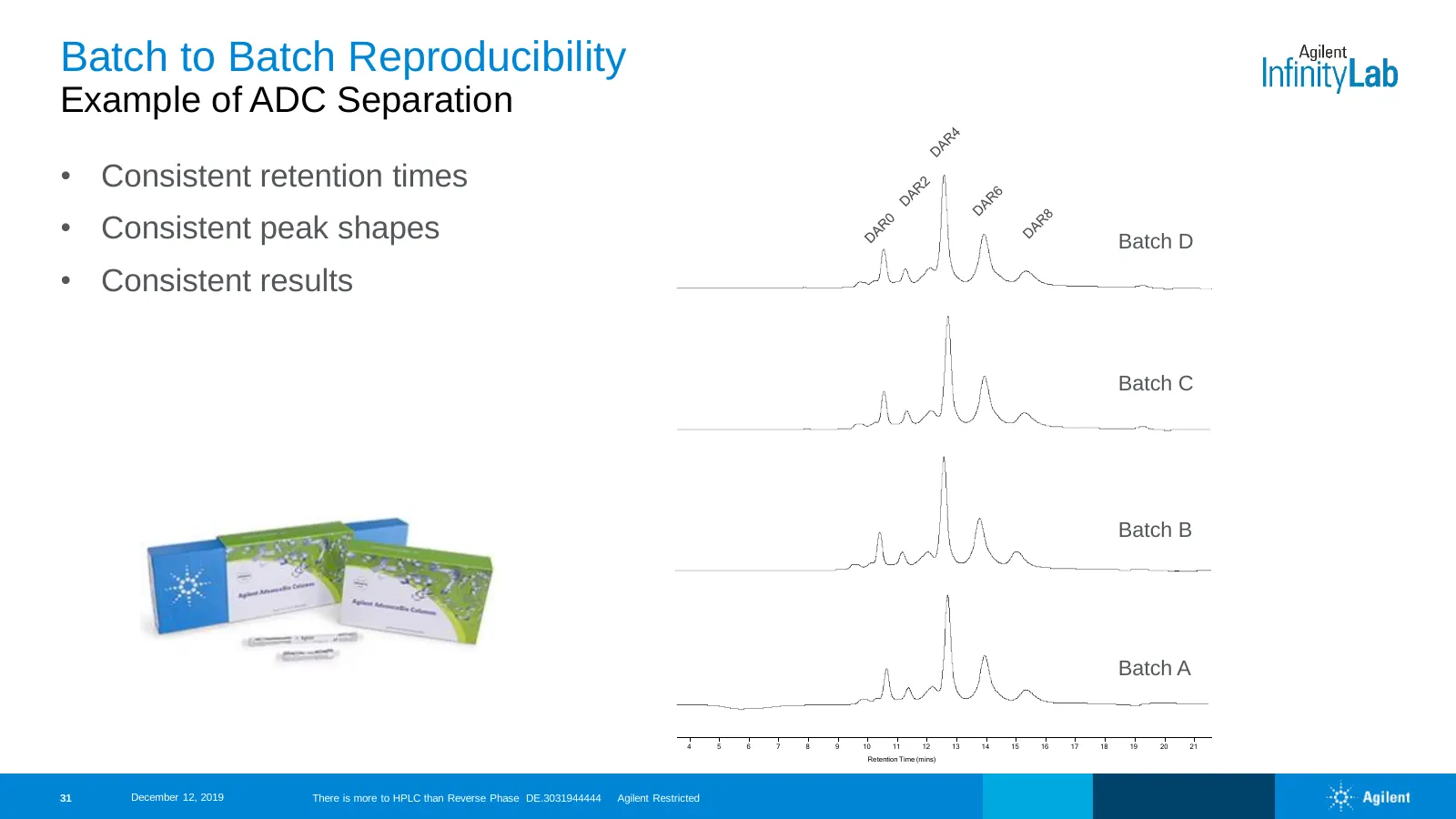
Slide 31: Batch to Batch Reproducibility
Batch to Batch Reproducibility Example of ADC Separation • Consistent retention times • Consistent peak shapes Batch D • Consistent results Batch C Batch B Batch A 4 5 6 7 8 9 10 11 12 13 14 15 16 17 18 19 20 21 Retention Time (mins) 31 December 12, 2019 There is more to HPLC than Reverse Phase DE.3
Slide 32: What is Needed for HIC?
What is Needed for HIC ? A mobile phase containing a salt that encourages the protein to absorb onto the stationary phase, but does not cause the protein to denature. • Ammonium sulfate, typically 1 – 2 M concentration A mobile phase that contains a buffer salt to ensure consistent pH and to keep th
Slide 33: Ion Exchange Chromatography
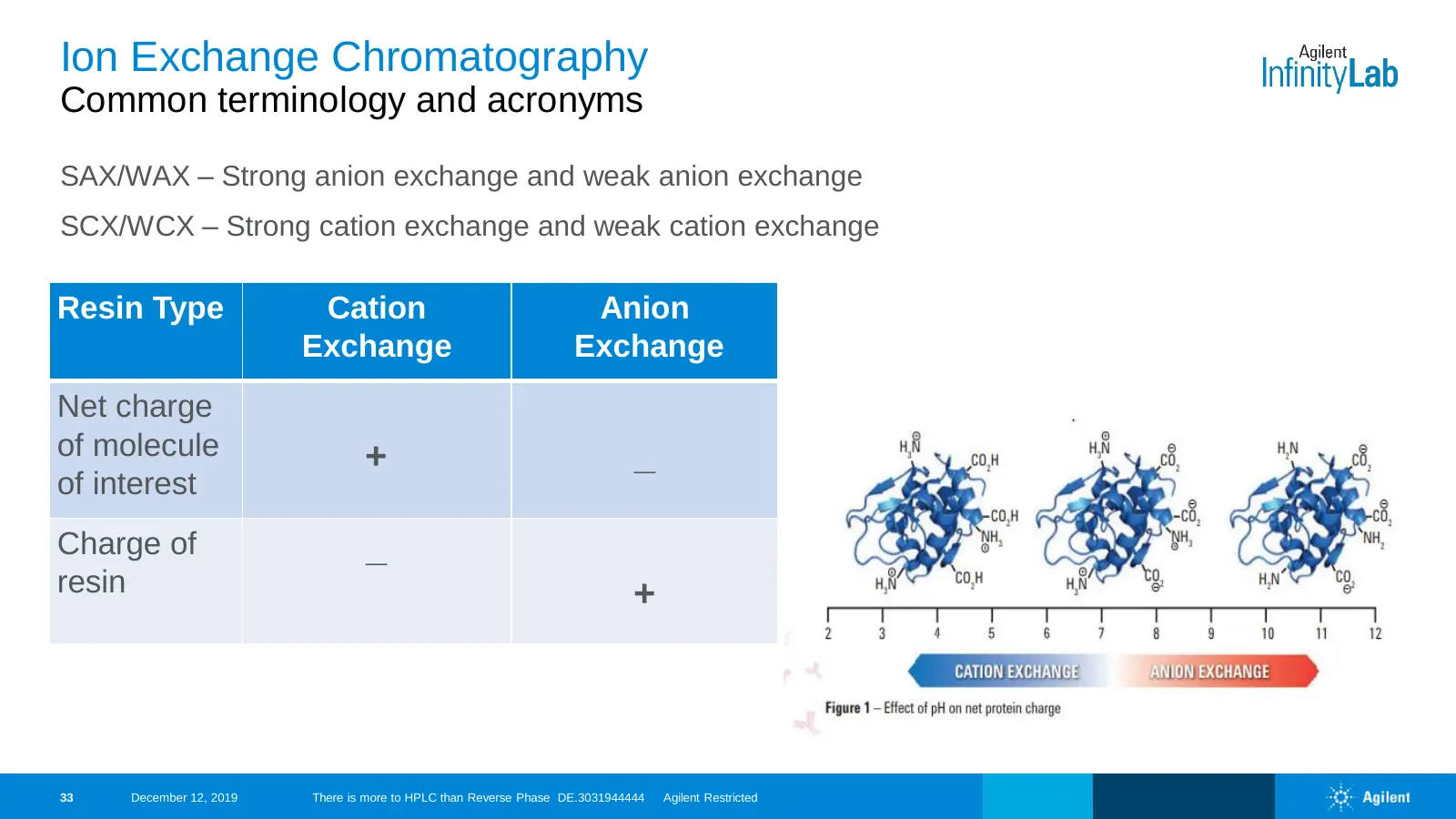
Ion Exchange Chromatography Common terminology and acronyms SAX/WAX – Strong anion exchange and weak anion exchange SCX/WCX – Strong cation exchange and weak cation exchange Resin Type Cation Anion Exchange Exchange Net charge of molecule + _ of interest Charge of _ resin + 33 December 12, 2019 Ther
Slide 34: Ion Exchange (IEX) Technique
Ion Exchange (IEX) Technique Proteins/samples interact with the stationary phase due to the charge present. The technique requires gradients for elution. Separation is based on differences in degree of charge. • The sample is injected in a mobile phase buffer with a low salt concentration – this bin
Slide 35: IEX Mechanism Example
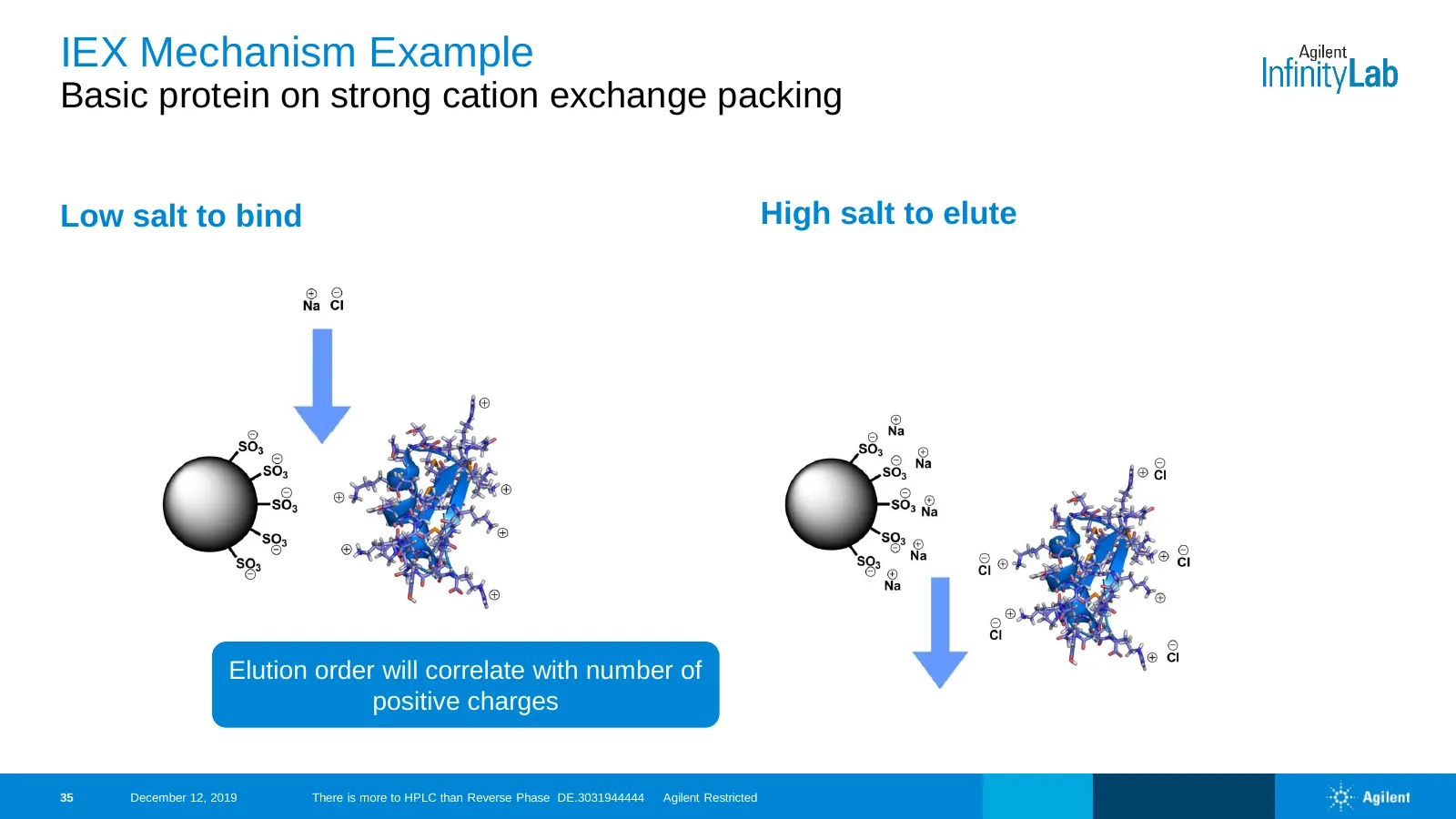
IEX Mechanism Example Basic protein on strong cation exchange packing Low salt to bind High salt to elute Elution order will correlate with number of positive charges 35 December 12, 2019 There is more to HPLC than Reverse Phase DE.3031944444 Agilent Restricted
Slide 36: Ion Exchange Separation Sequence
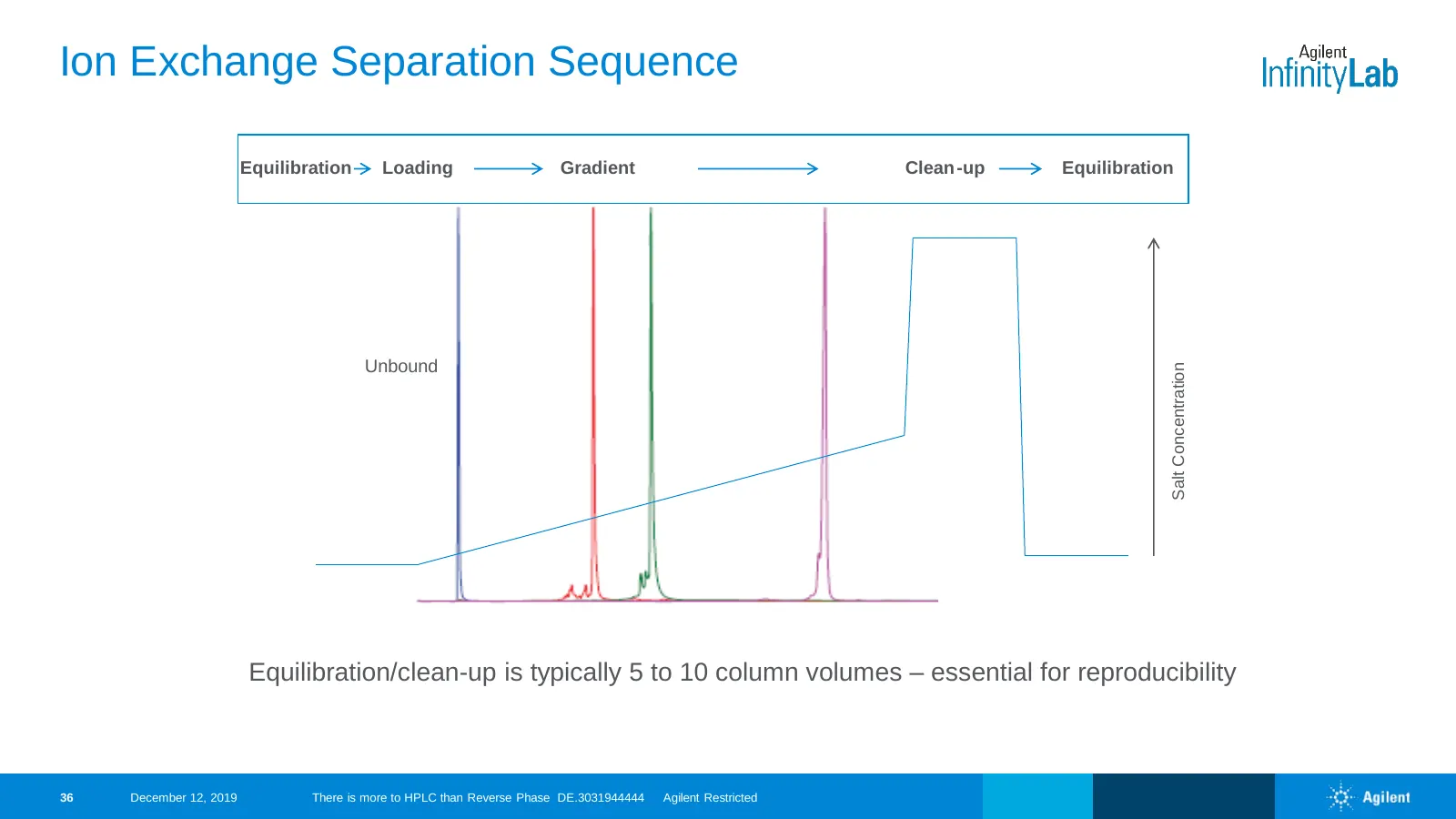
Ion Exchange Separation Sequence Equilibration Loading Gradient Clean -up Equilibration Unbound Salt Concentration Equilibration/clean-up is typically 5 to 10 column volumes – essential for reproducibility 36 December 12, 2019 There is more to HPLC than Reverse Phase DE.3031944444 Agilent Restricted
Slide 37: Agilent InfinityLab Chromatography Columns
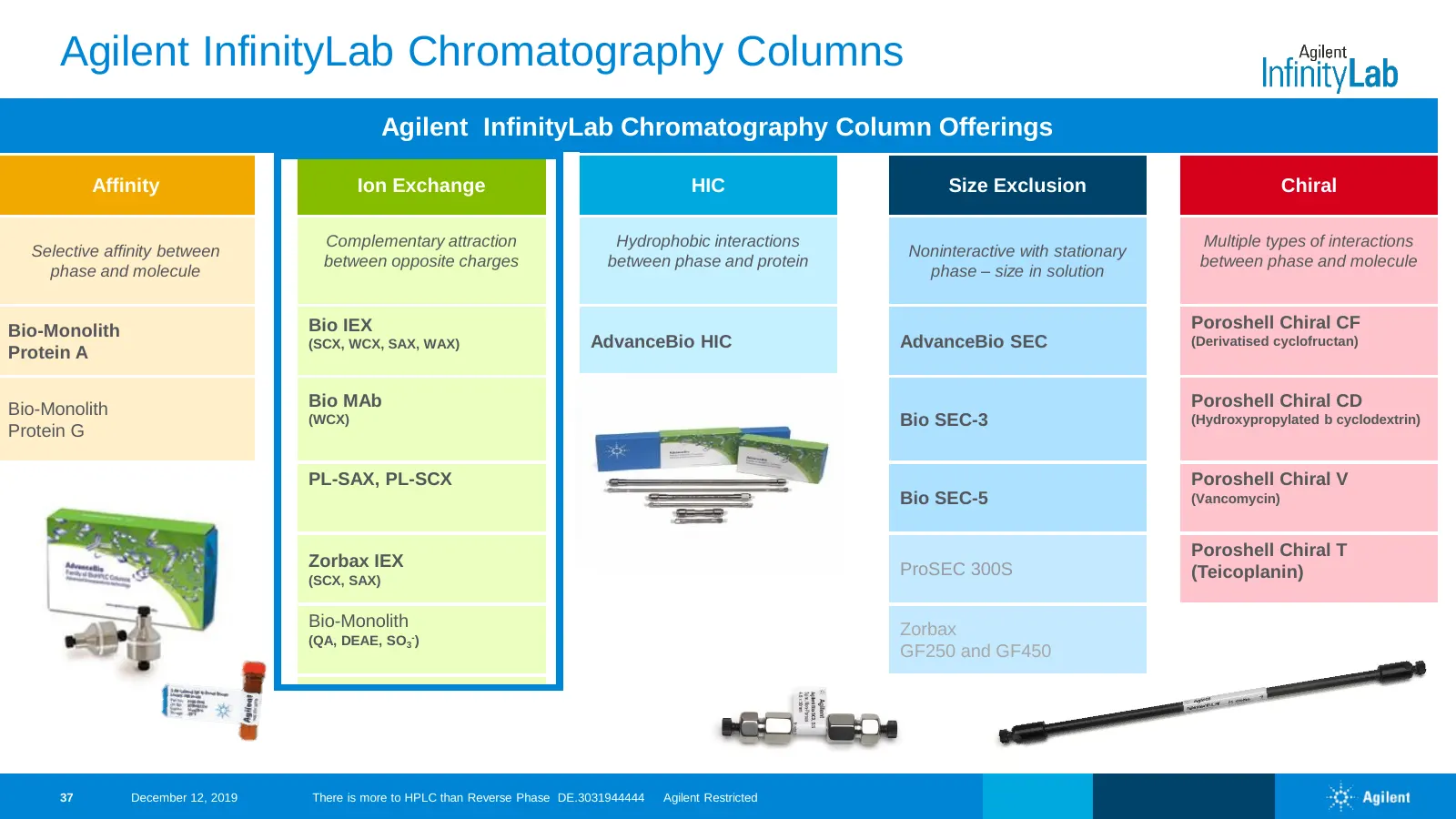
Agilent InfinityLab Chromatography Columns Agilent InfinityLab Chromatography Column Offerings Affinity Ion Exchange HIC Size Exclusion Chiral Complementary attraction Hydrophobic interactions Multiple types of interactions Selective affinity between Noninteractive with stationary between opposite c
Slide 38: Agilent Columns for Ion Exchange
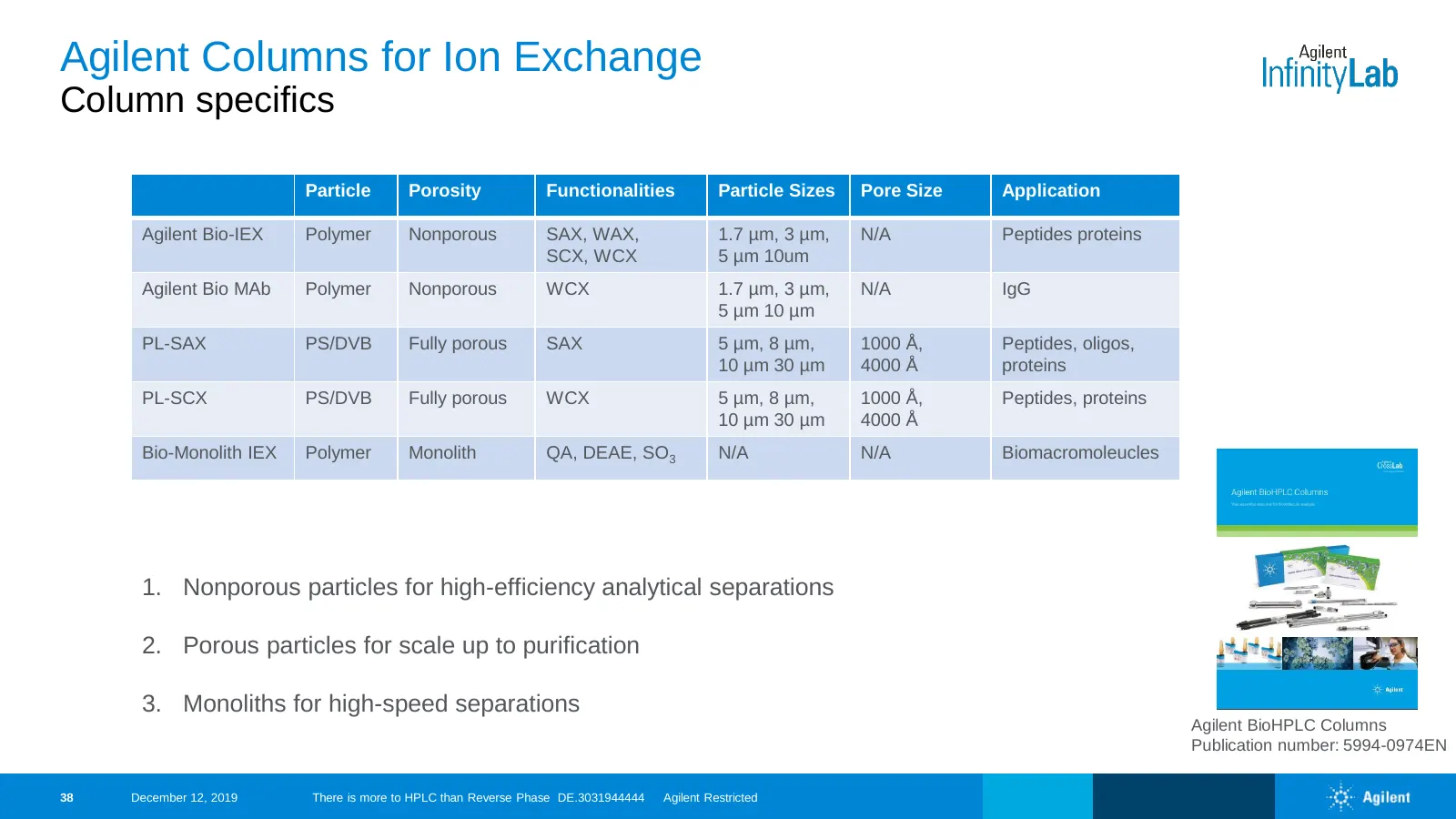
Agilent Columns for Ion Exchange Column specifics Particle Porosity Functionalities Particle Sizes Pore Size Application Agilent Bio-IEX Polymer Nonporous SAX, WAX, 1.7 µm, 3 µm, N/A Peptides proteins SCX, WCX 5 µm 10um Agilent Bio MAb Polymer Nonporous WCX 1.7 µm, 3 µm, N/A IgG 5 µm 10 µm PL-SAX PS
Slide 39: BioIEX – Nonporous Particle Technology
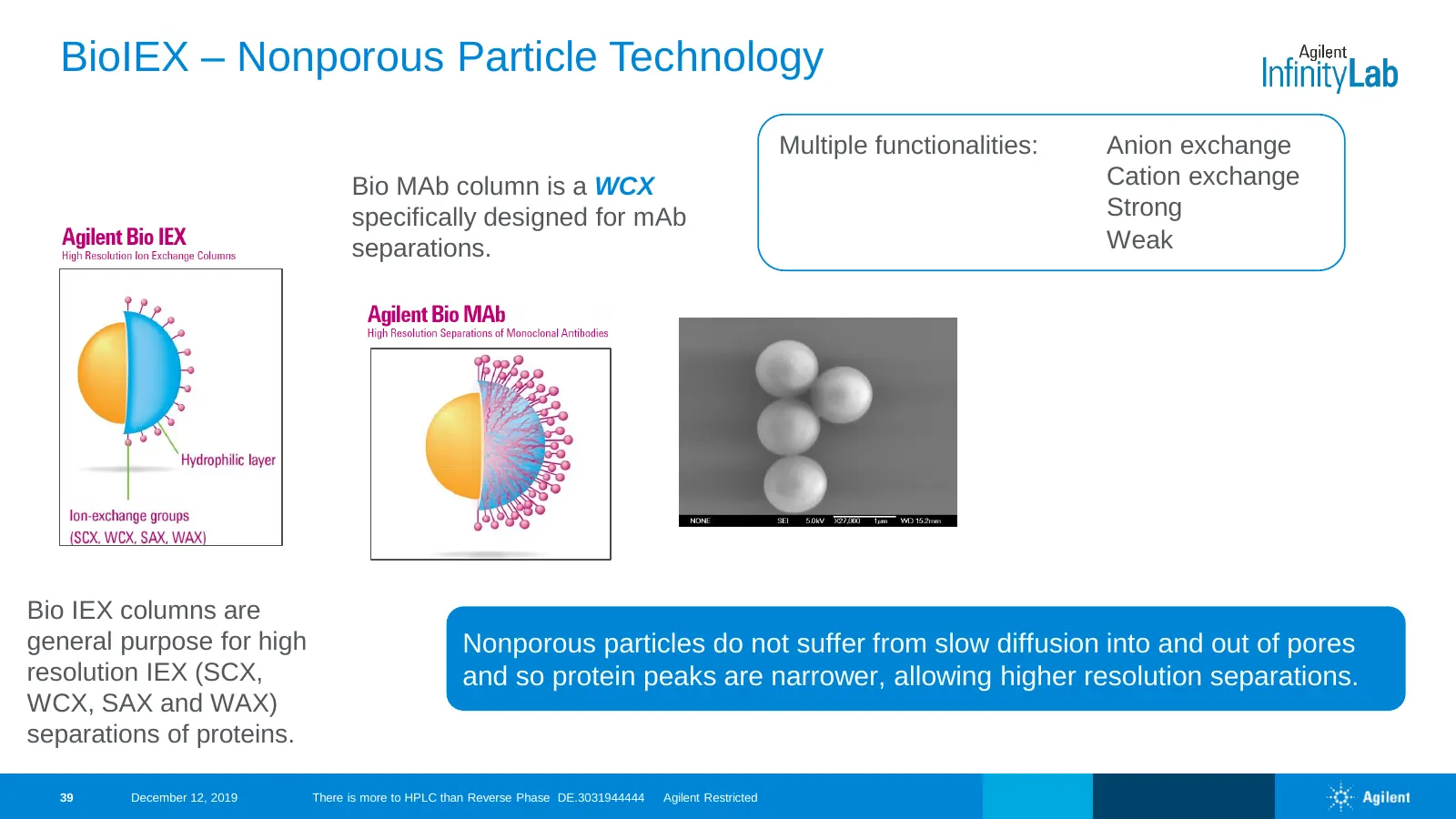
BioIEX – Nonporous Particle Technology Multiple functionalities: Anion exchange Bio MAb column is a WCX Cation exchange specifically designed for mAb Strong separations. Weak Bio IEX columns are general purpose for high Nonporous particles do not suffer from slow diffusion into and out of pores reso
Slide 40: Example IEX Applications
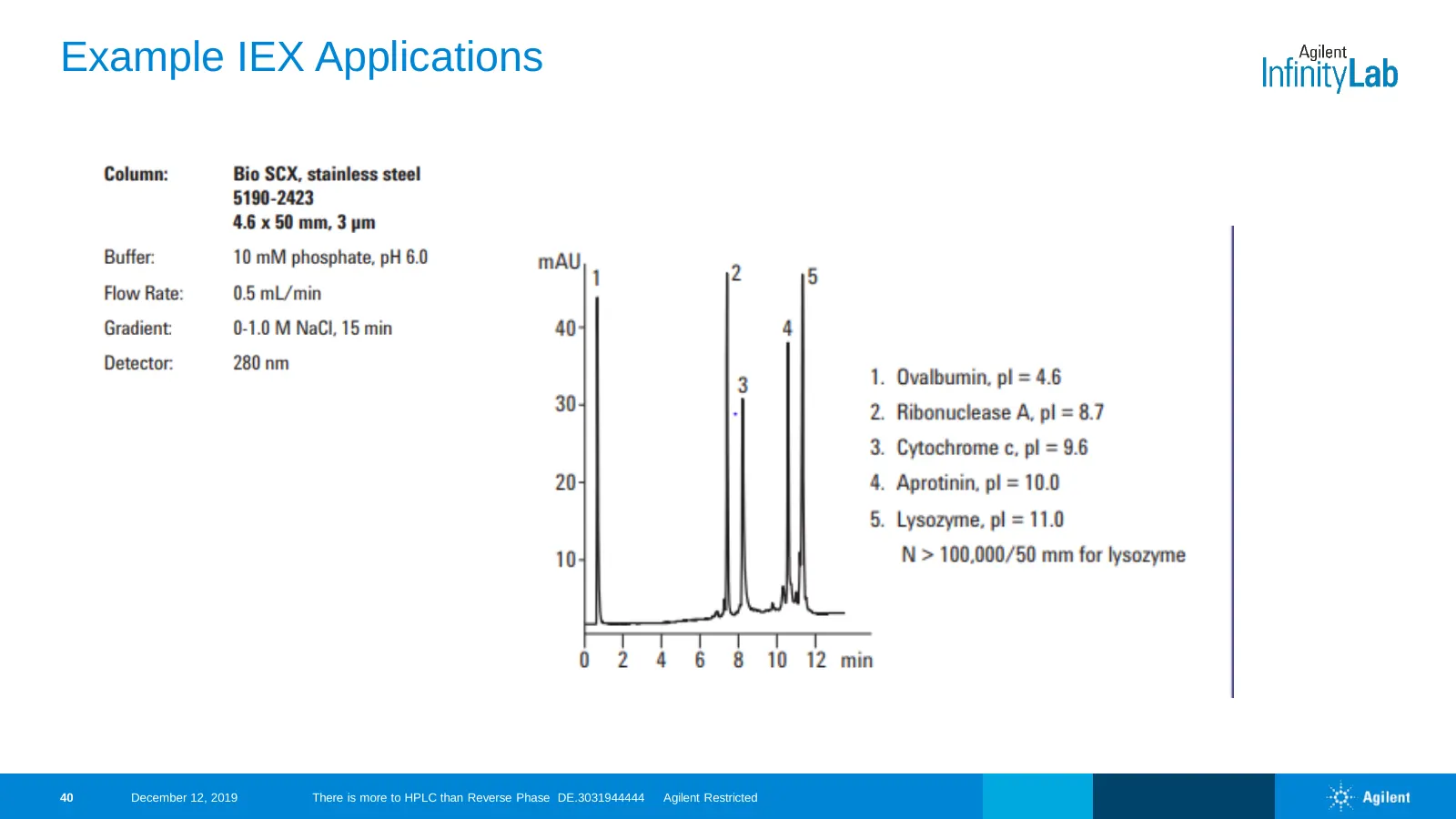
Example IEX Applications 40 December 12, 2019 There is more to HPLC than Reverse Phase DE.3031944444 Agilent Restricted
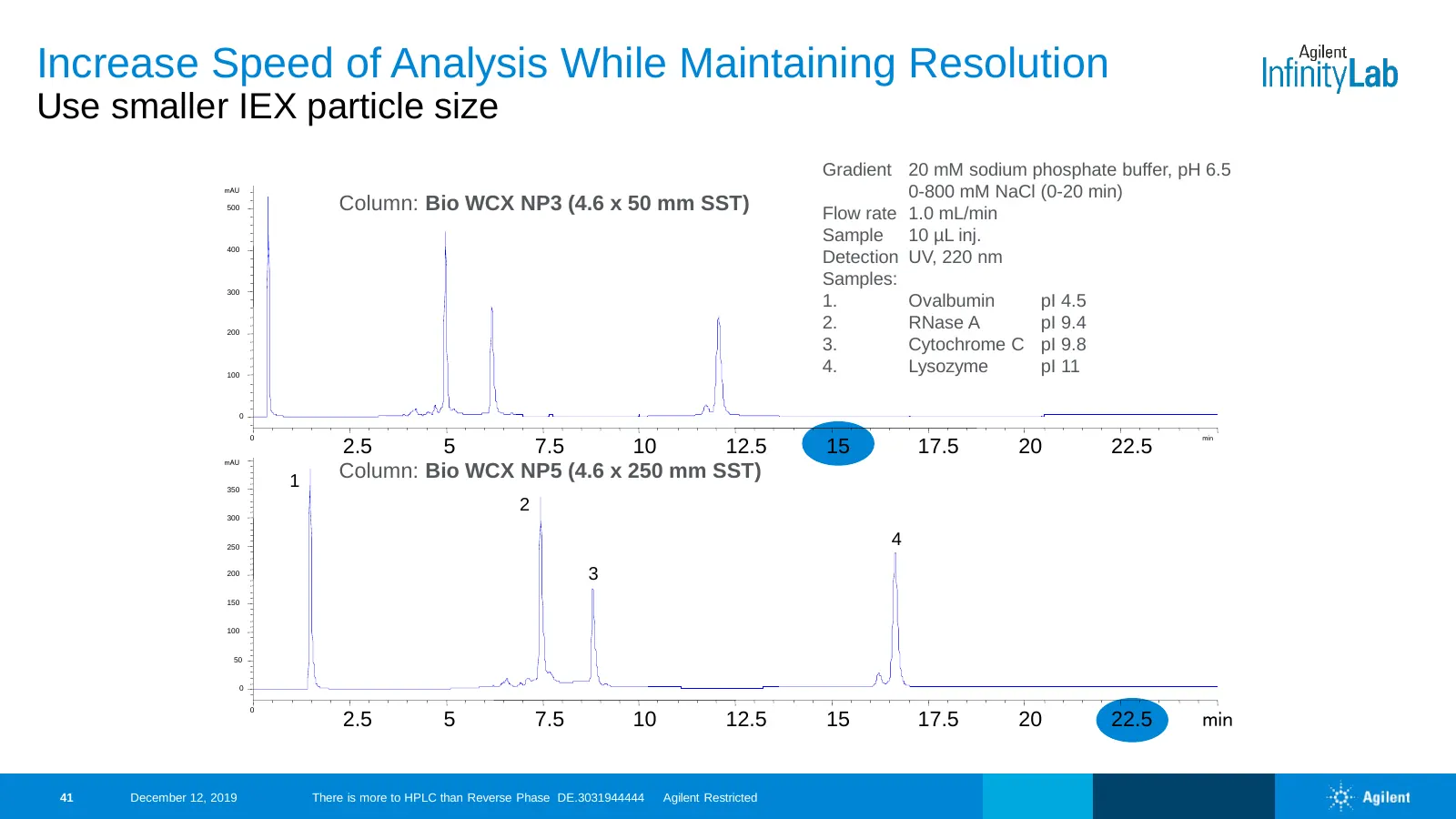
Slide 41: Increase Speed of Analysis While Maintaining Resolution
Increase Speed of Analysis While Maintaining Resolution Use smaller IEX particle size Gradient 20 mM sodium phosphate buffer, pH 6.5 mAU 0-800 mM NaCl (0-20 min) 500 Column: Bio WCX NP3 (4.6 x 50 mm SST) Flow rate 1.0 mL/min Sample 10 µL inj. 400 Detection UV, 220 nm Samples: 300 1. Ovalbumin pI 4.5
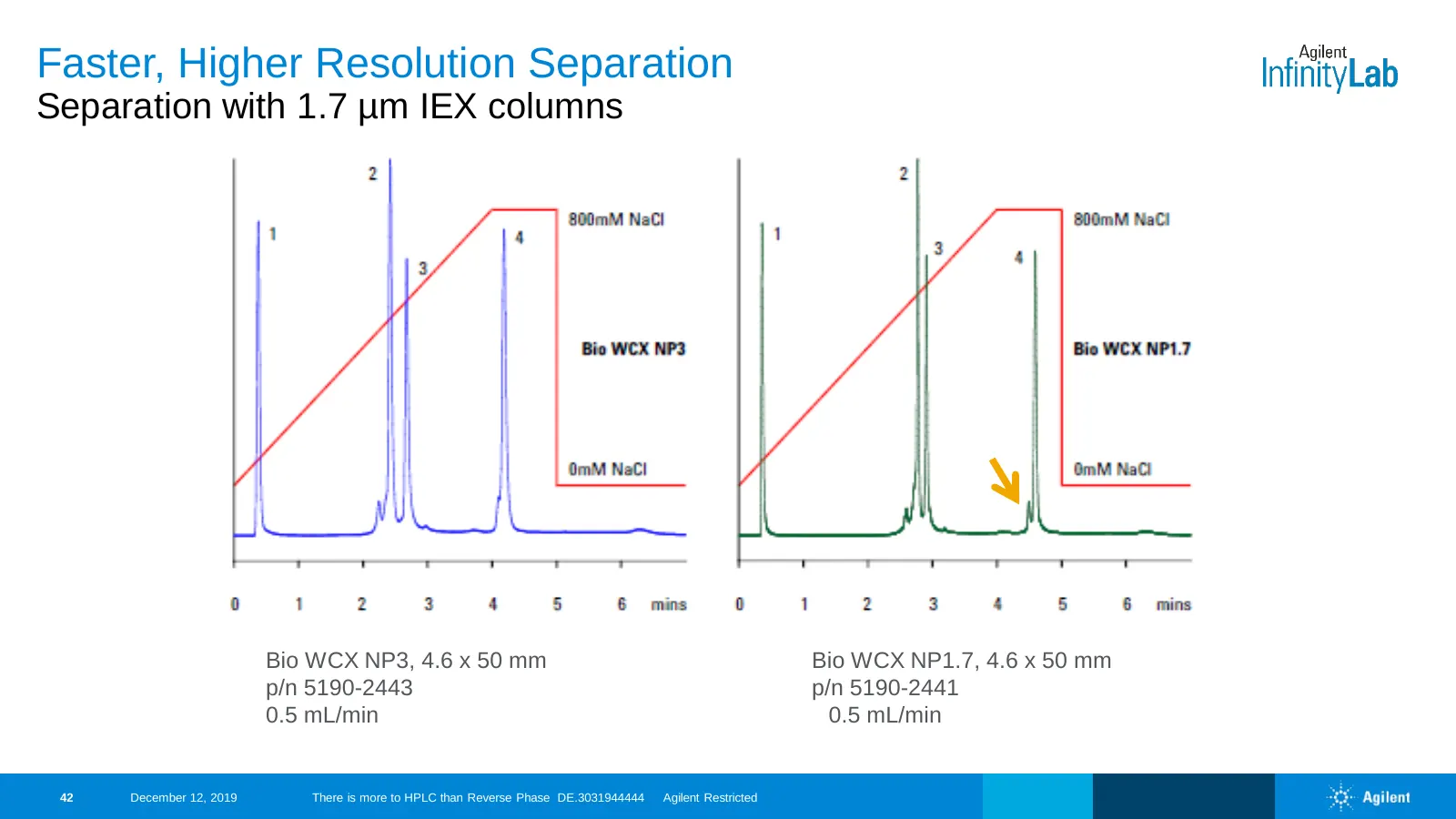
Slide 42: Faster, Higher Resolution Separation
Faster, Higher Resolution Separation Separation with 1.7 µm IEX columns Bio WCX NP3, 4.6 x 50 mm Bio WCX NP1.7, 4.6 x 50 mm p/n 5190-2443 p/n 5190-2441 0.5 mL/min 0.5 mL/min 42 December 12, 2019 There is more to HPLC than Reverse Phase DE.3031944444 Agilent Restricted
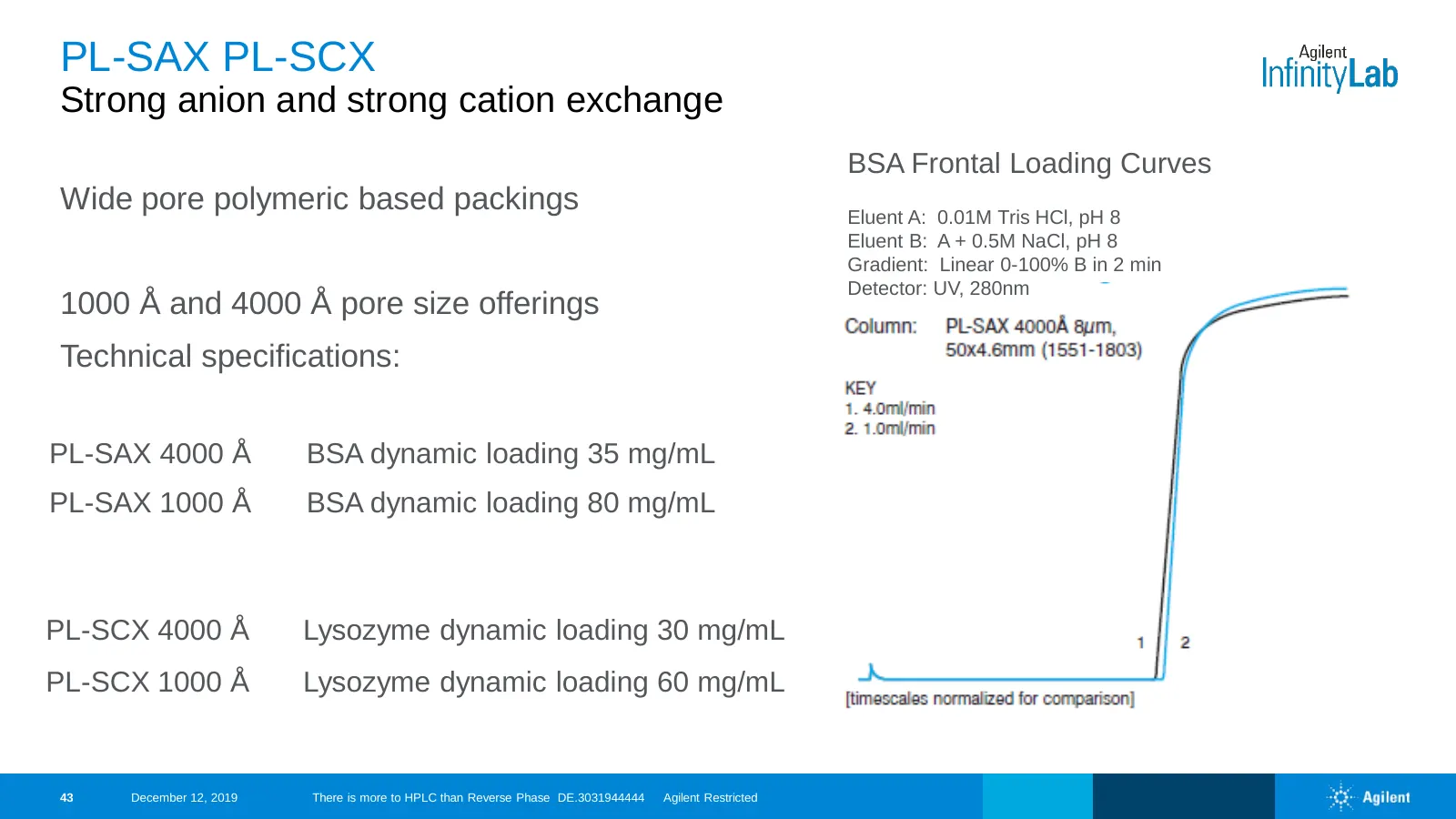
Slide 43: PL-SAX PL-SCX
PL-SAX PL-SCX Strong anion and strong cation exchange BSA Frontal Loading Curves Wide pore polymeric based packings Eluent A: 0.01M Tris HCl, pH 8 Eluent B: A + 0.5M NaCl, pH 8 Gradient: Linear 0-100% B in 2 min Detector: UV, 280nm 1000 Å and 4000 Å pore size offerings Technical specifications: PL-S
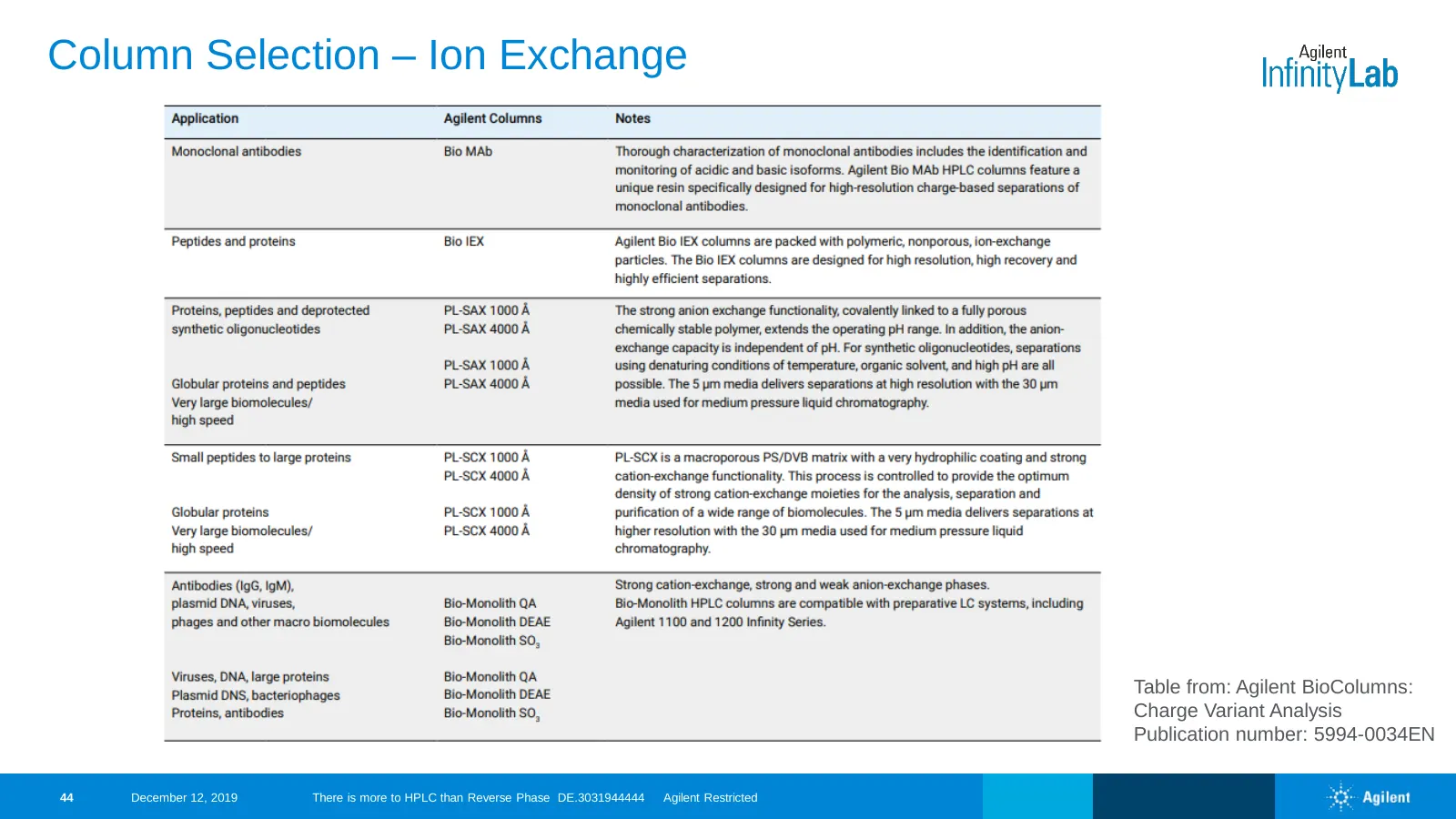
Slide 44: Column Selection – Ion Exchange
Column Selection – Ion Exchange Table from: Agilent BioColumns: Charge Variant Analysis Publication number: 5994-0034EN 44 December 12, 2019 There is more to HPLC than Reverse Phase DE.3031944444 Agilent Restricted
Slide 45: Affinity
Affinity Affinity chromatography is a method of separating biochemical mixture based on a highly specific interaction between antigen and antibody, enzyme and substrate, receptor and ligand, or protein and nucleic acid. Affinity chromatography is a powerful technique which takes advantage of highly
Slide 46: Agilent InfinityLab Chromatography Columns
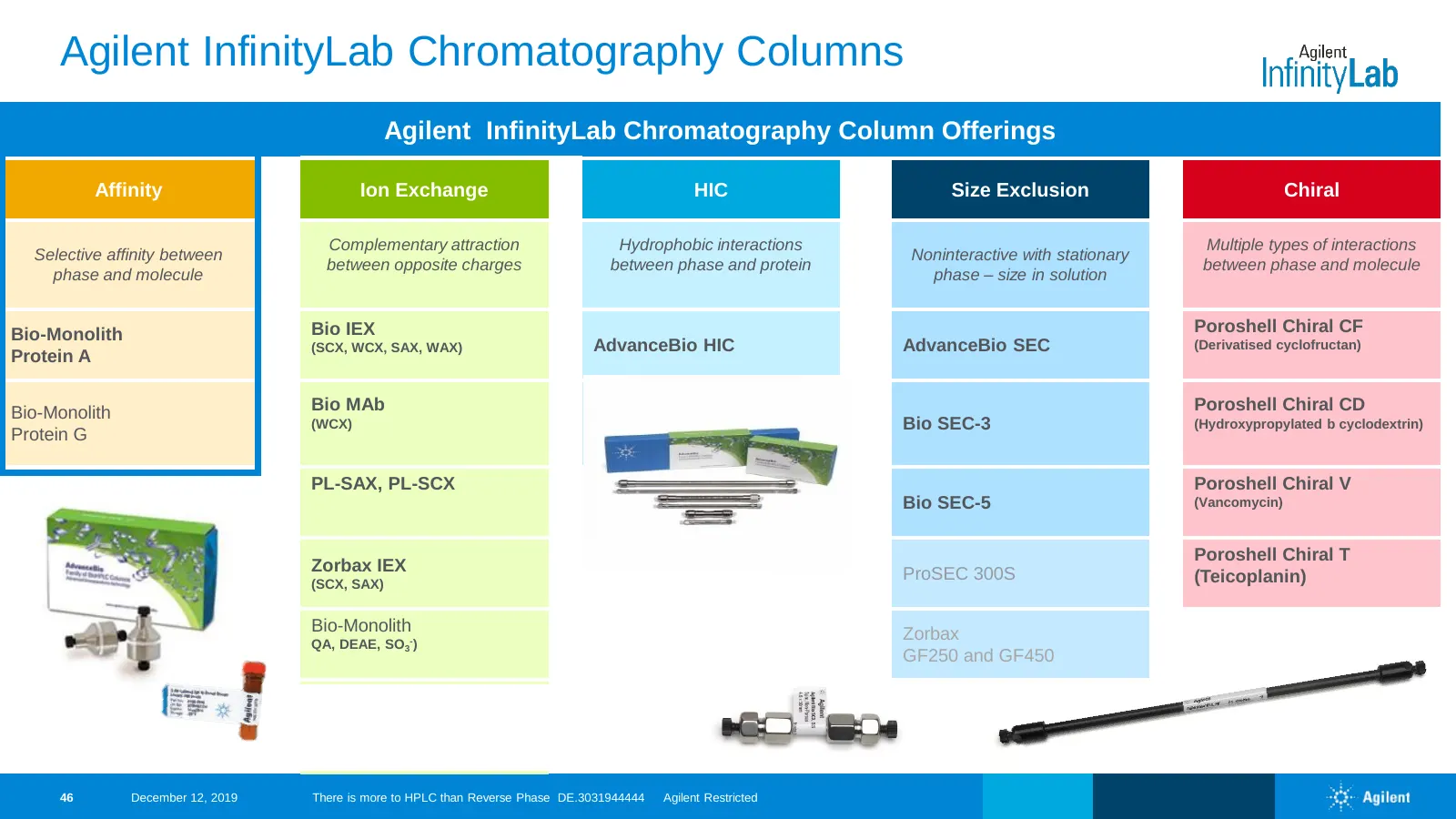
Agilent InfinityLab Chromatography Columns Agilent InfinityLab Chromatography Column Offerings Affinity Ion Exchange HIC Size Exclusion Chiral Complementary attraction Hydrophobic interactions Multiple types of interactions Selective affinity between Noninteractive with stationary between opposite c
Slide 47: Analytical Bio-Monolith Protein A and G Columns
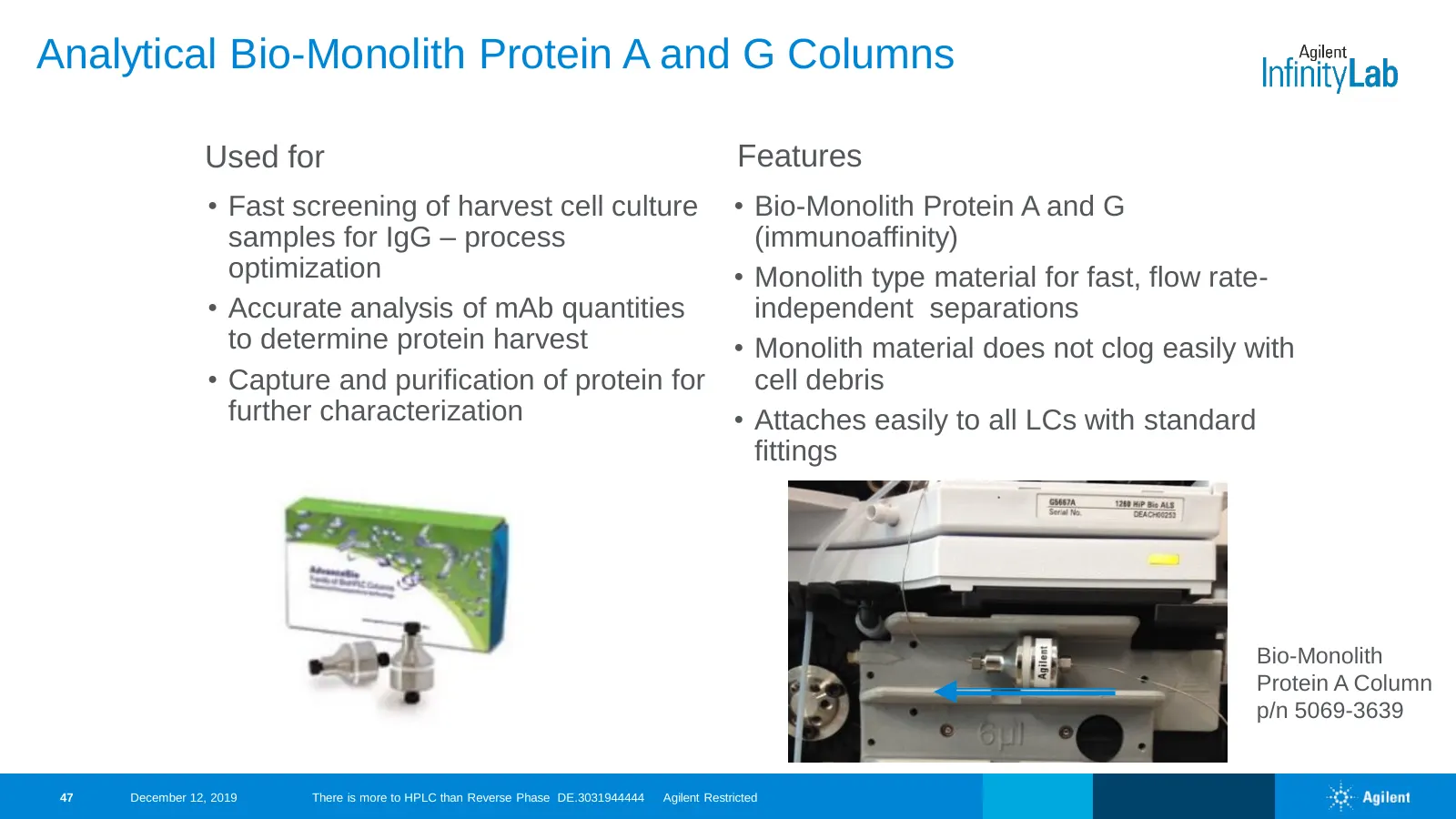
Analytical Bio-Monolith Protein A and G Columns Used for Features • Fast screening of harvest cell culture • Bio-Monolith Protein A and G samples for IgG – process (immunoaffinity) optimization • Monolith type material for fast, flow rate- • Accurate analysis of mAb quantities independent separation
Slide 48: What is a Monolith – Agilent BioMonolith Specifics
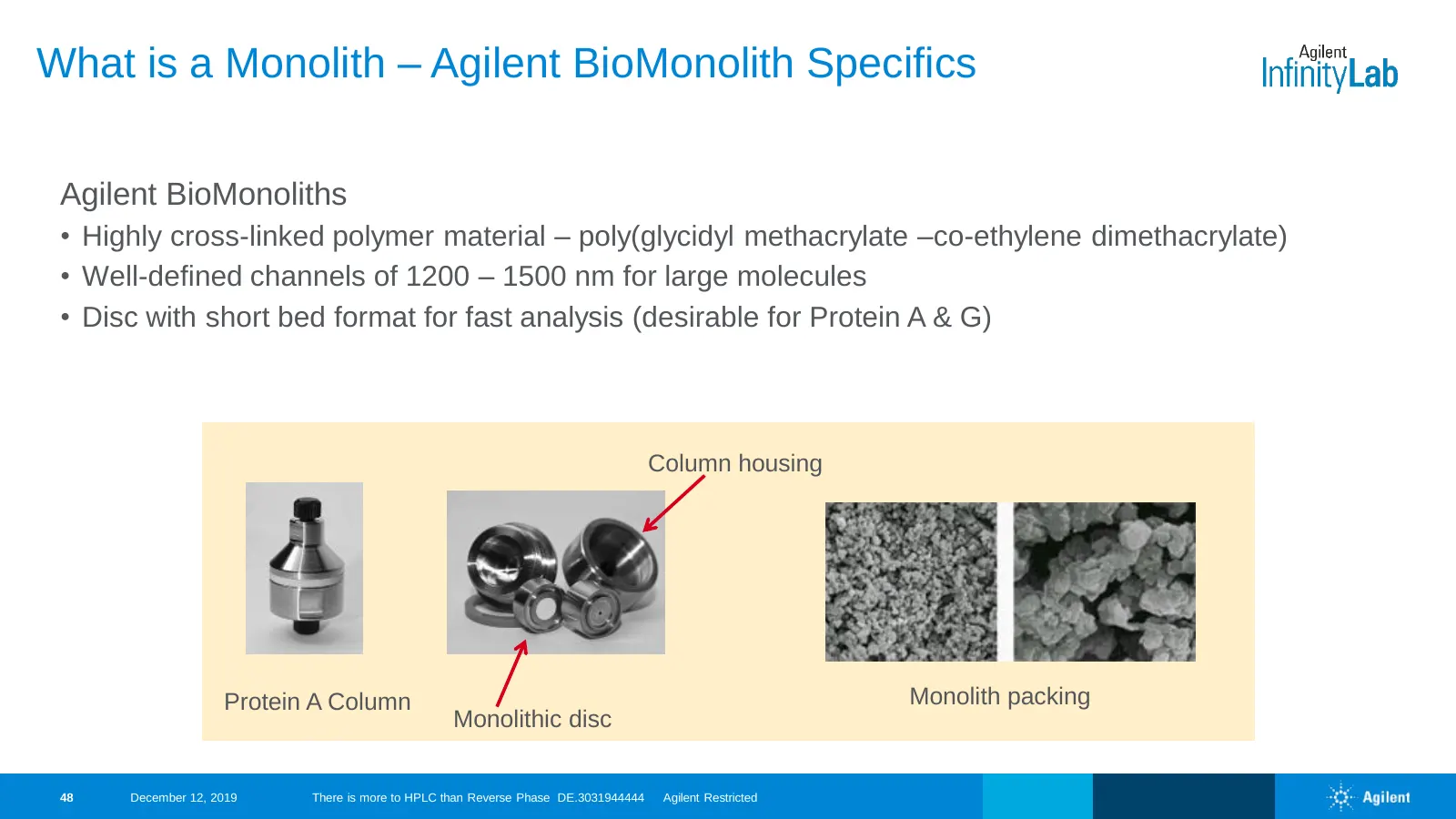
What is a Monolith – Agilent BioMonolith Specifics Agilent BioMonoliths • Highly cross-linked polymer material – poly(glycidyl methacrylate –co-ethylene dimethacrylate) • Well-defined channels of 1200 – 1500 nm for large molecules • Disc with short bed format for fast analysis (desirable for Protein
Slide 49: SEC: Terminology and why do SEC?
SEC Terminology and why do SEC? SEC refers to the chromatographic technique that separates compounds by their size. Same technique, but different acronyms: • SEC – Size exclusion chromatography • Primarily water and buffer • GFC – Gel filtration chromatography • Water and buffer, common term for ind
Slide 50: GPC/SEC Separation Mechanism
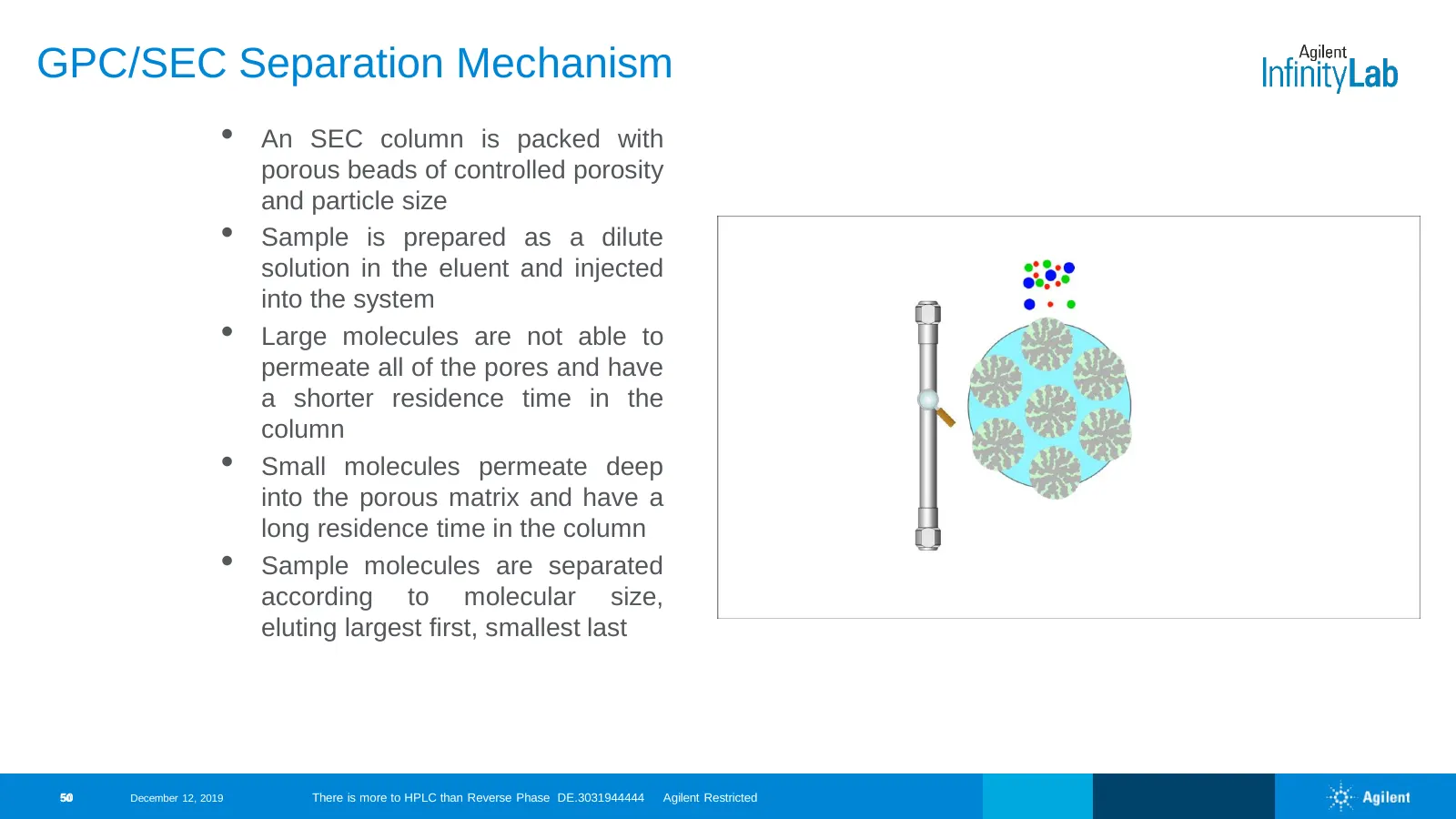
GPC/SEC Separation Mechanism • An SEC column is packed with porous beads of controlled porosity and particle size • Sample is prepared as a dilute solution in the eluent and injected into the system • Large molecules are not able to permeate all of the pores and have a shorter residence time in the
Slide 51: Agilent InfinityLab Chromatography Columns
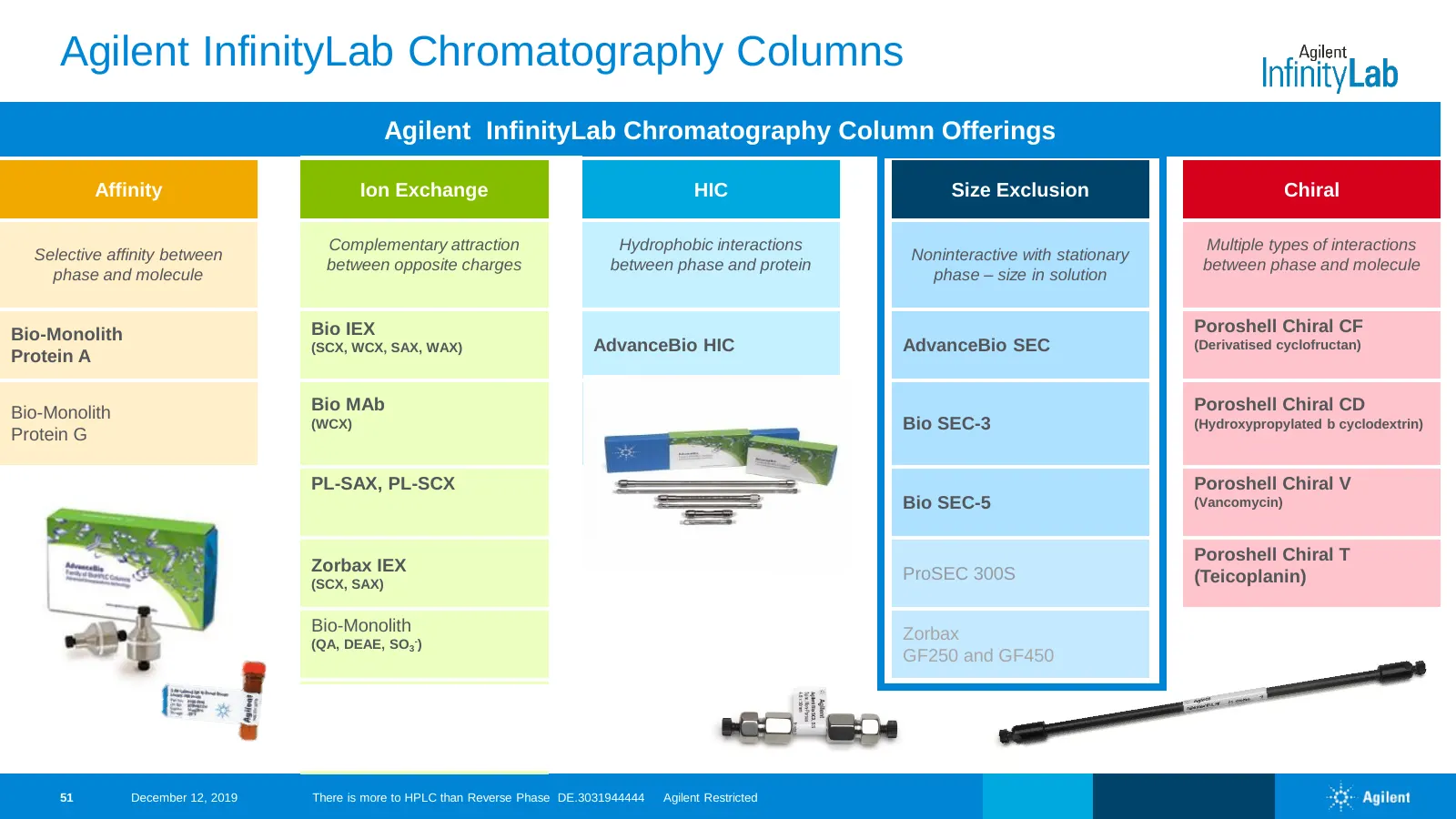
Agilent InfinityLab Chromatography Columns Agilent InfinityLab Chromatography Column Offerings Affinity Ion Exchange HIC Size Exclusion Chiral Complementary attraction Hydrophobic interactions Multiple types of interactions Selective affinity between Noninteractive with stationary between opposite c
Slide 52: Agilent Size Exclusion Columns
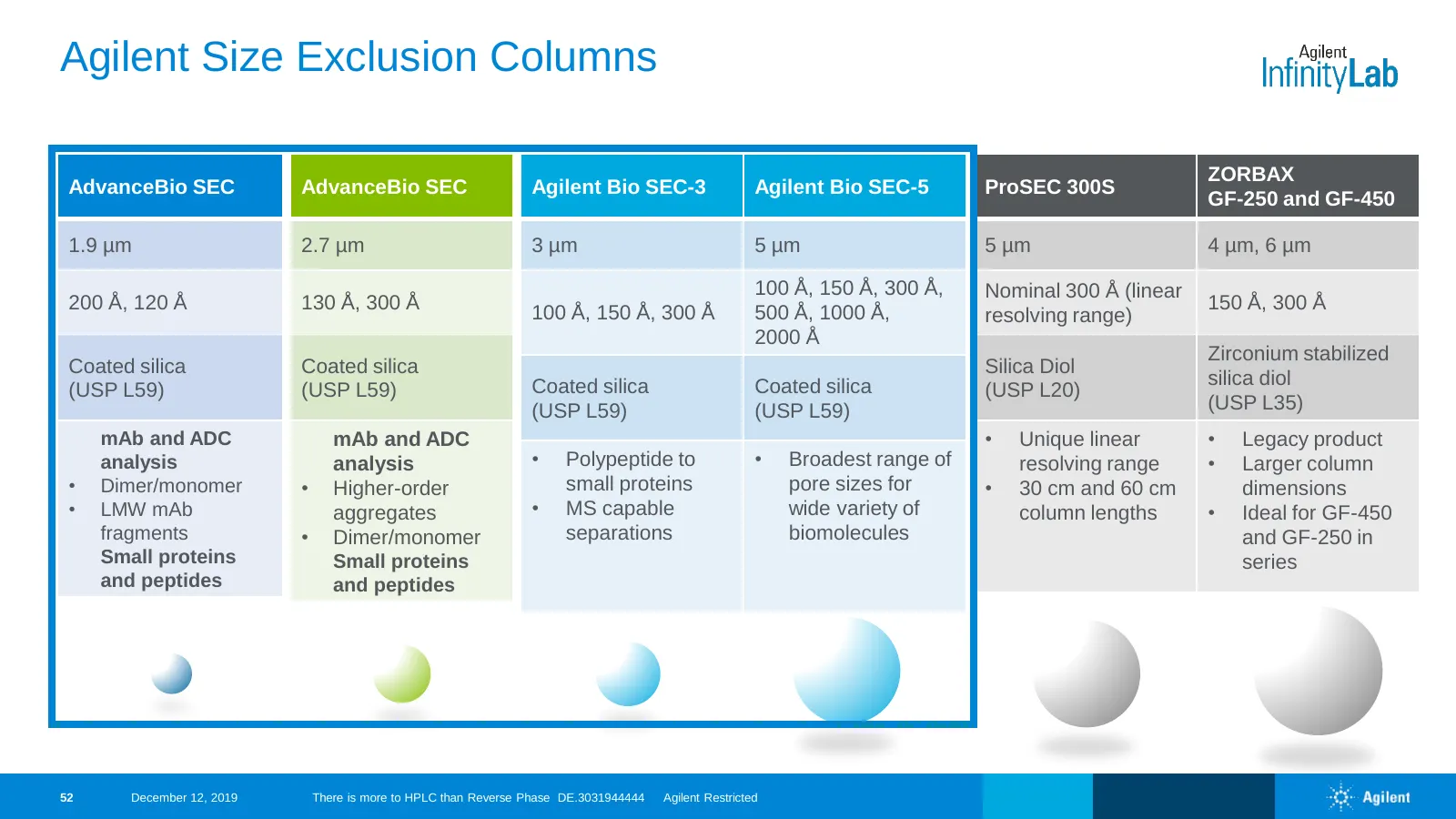
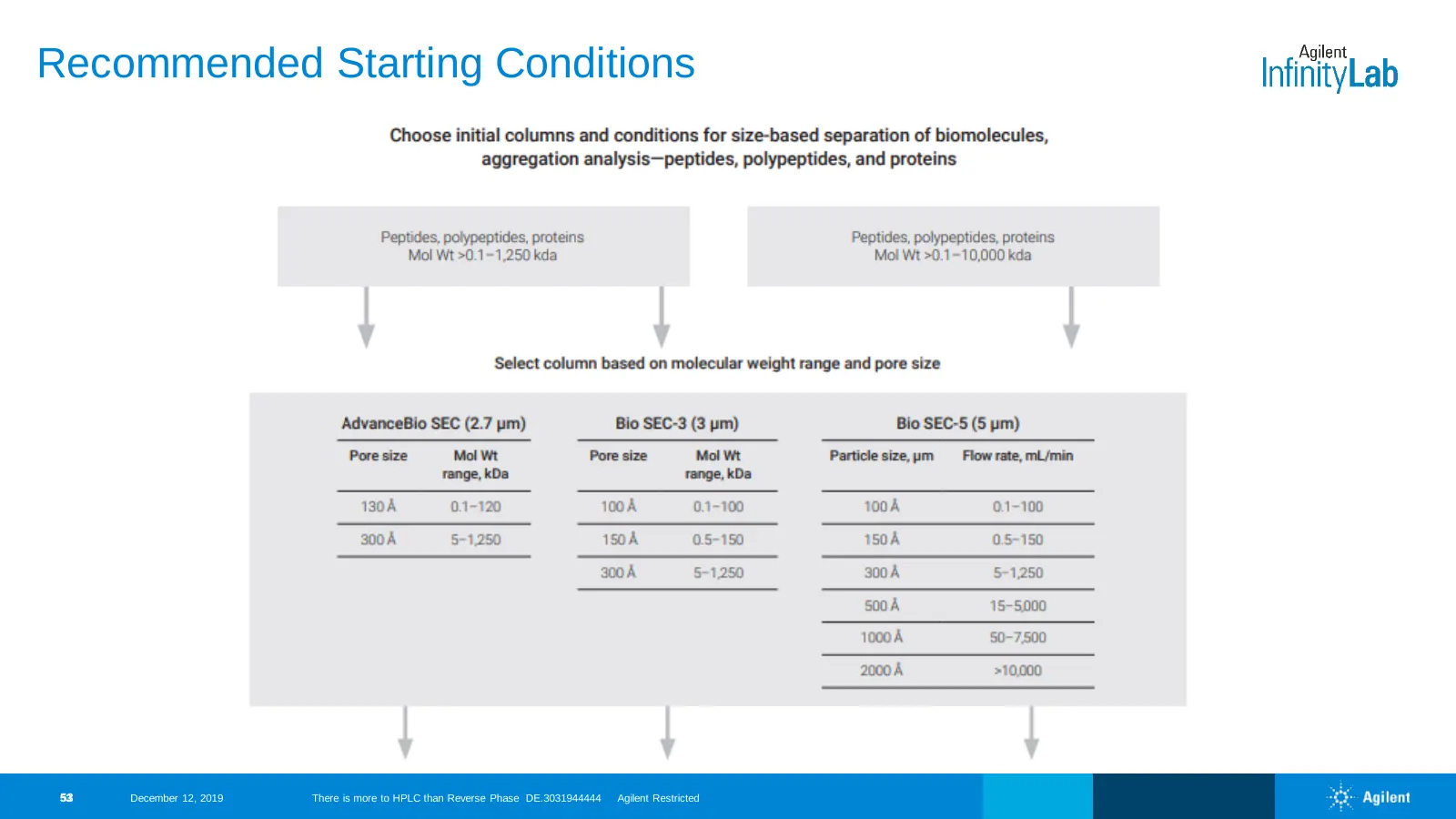
Agilent Size Exclusion Columns ZORBAX AdvanceBio SEC AdvanceBio SEC Agilent Bio SEC-3 Agilent Bio SEC-5 ProSEC 300S GF-250 and GF-450 1.9 µm 2.7 µm 3 µm 5 µm 5 µm 4 µm, 6 µm 100 Å, 150 Å, 300 Å, Nominal 300 Å (linear 200 Å, 120 Å 130 Å, 300 Å 100 Å, 150 Å, 300 Å 500 Å, 1000 Å, 150 Å, 300 Å resolving
Slide 53: Recommended Starting Conditions
Recommended Starting Conditions 53 53 December 12, 2019 There is more to HPLC than Reverse Phase DE.3031944444 Agilent Restricted
Slide 54: Recommended Starting Conditions
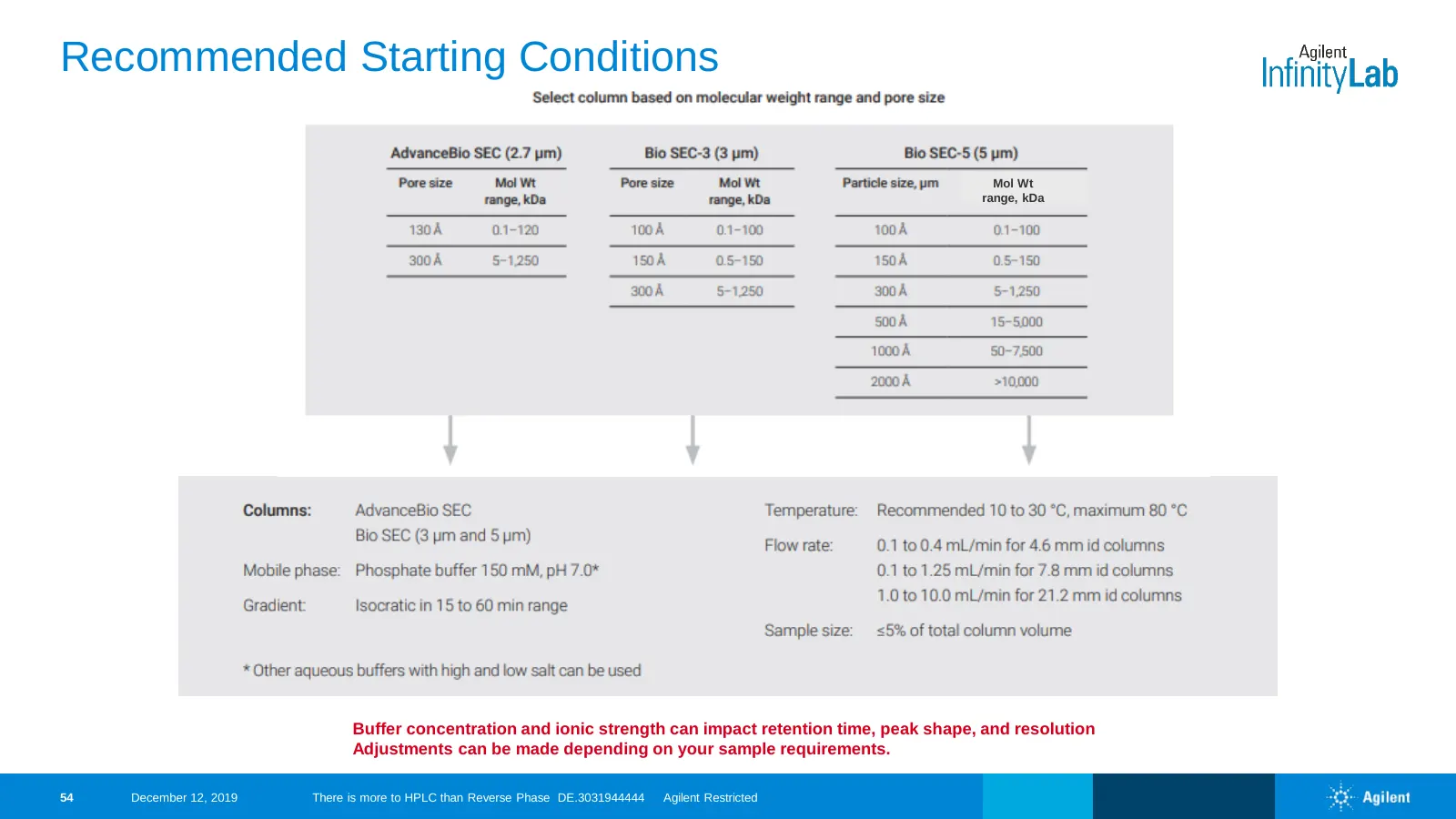
Recommended Starting Conditions Mol Wt range, kDa Buffer concentration and ionic strength can impact retention time, peak shape, and resolution Adjustments can be made depending on your sample requirements. 54 December 12, 2019 There is more to HPLC than Reverse Phase DE.3031944444 Agilent Restricte
Slide 55: Buffers and SEC: Criteria for Optimal Mobile Phase
Buffers and SEC: Criteria for Optimal Mobile Phase The optimal eluent for the separation should be determined by the characteristics of the column stationary phase and the proteins/polymers to be analyzed, so that nonspecific interactions are minimized. • Mobile phase should contain enough buffer sa
Slide 56: Resolution in SEC
Resolution in SEC Running two columns in series, same pore size • Increase pore volume, increases resolution Running two columns in series, different pore size • Extends the resolving range and enables analysis of multiple attributes in one run Use a packing with a smaller particle size • Decrease p
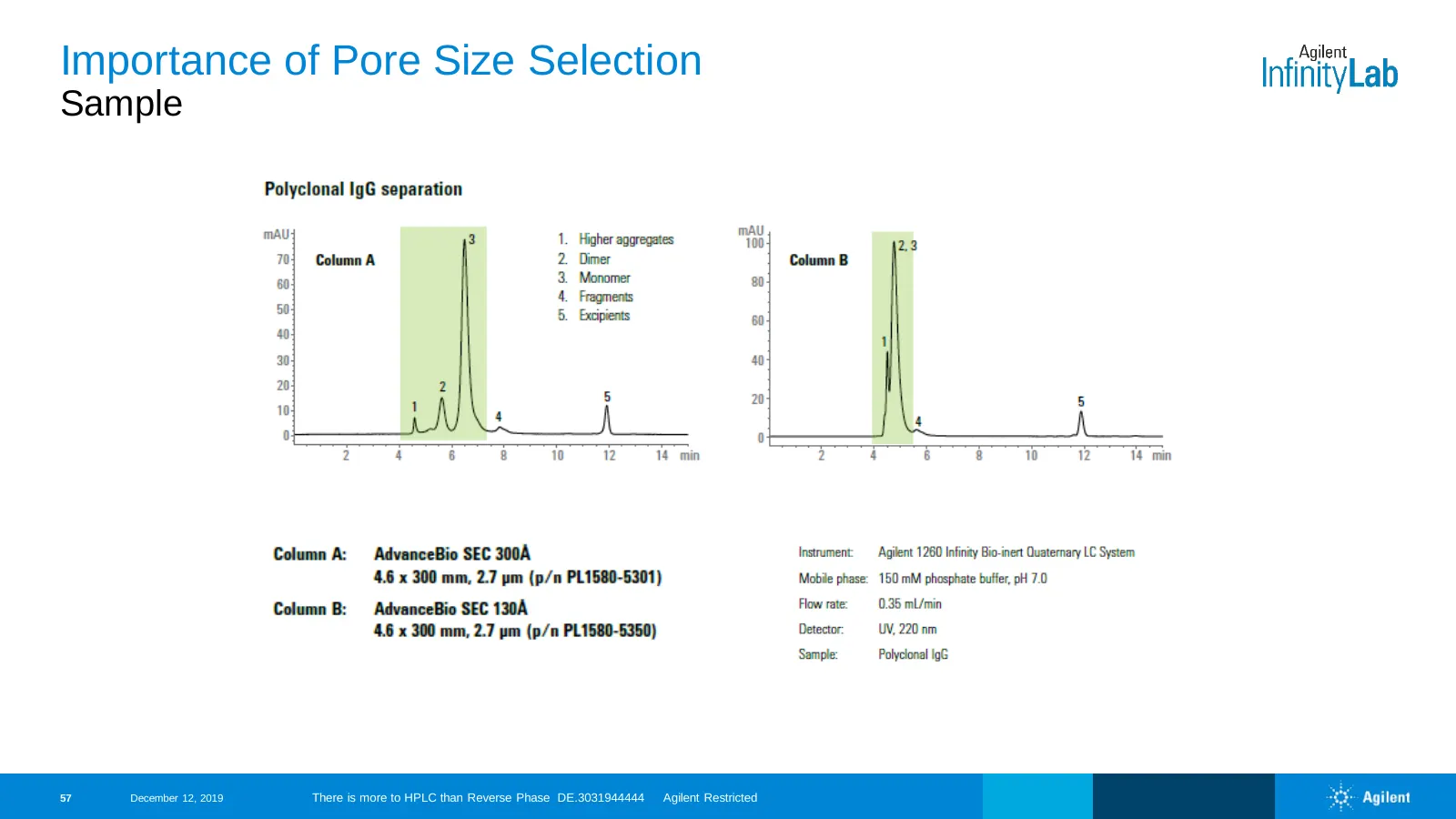
Slide 57: Importance of Pore Size Selection
Importance of Pore Size Selection Sample 57 December 12, 2019 There is more to HPLC than Reverse Phase DE.3031944444 Agilent Restricted
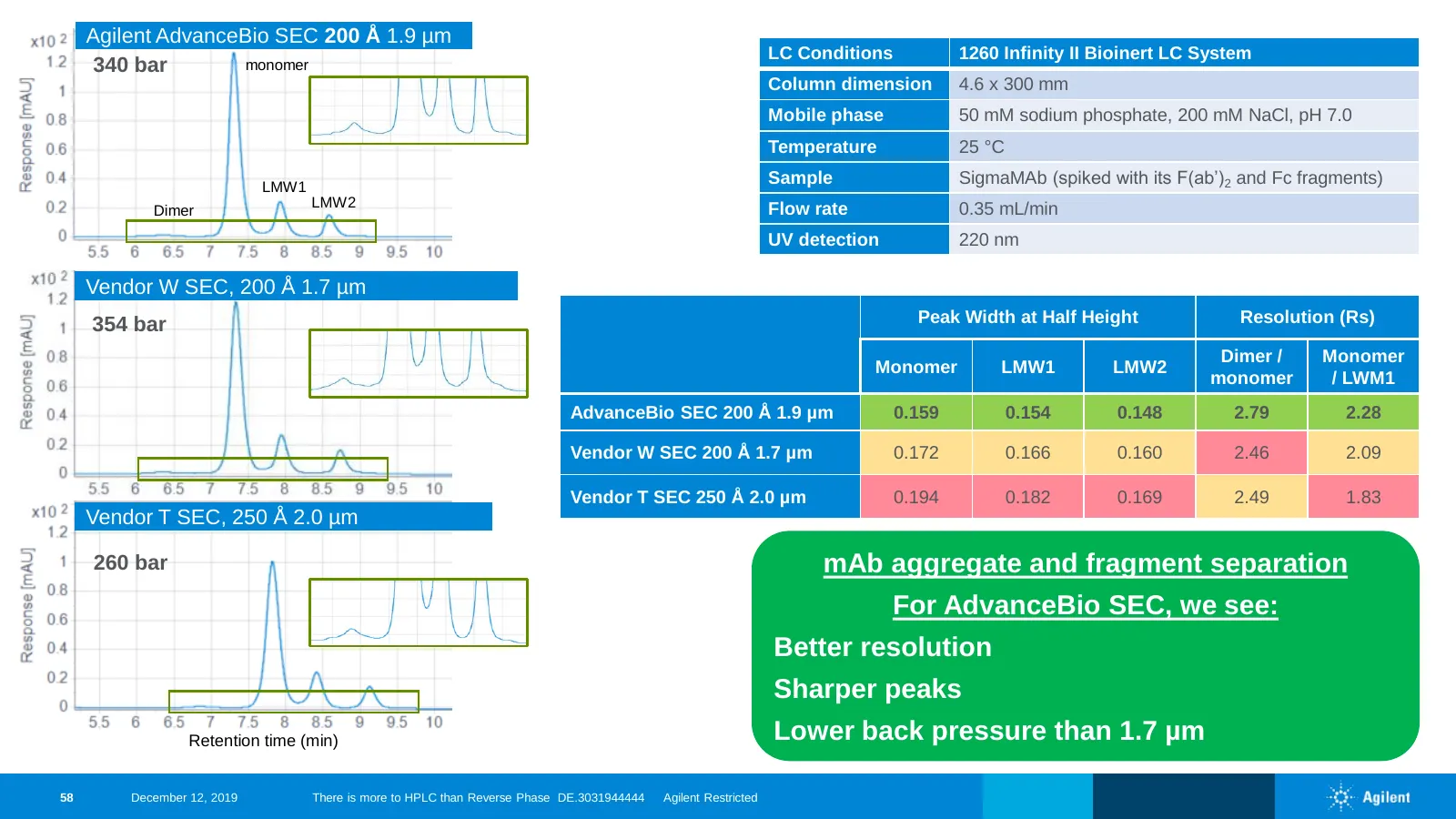
Slide 58: mAb aggregate and fragment separation
Agilent AdvanceBio SEC 200 Å 1.9 µm LC Conditions 1260 Infinity II Bioinert LC System 340 bar monomer Column dimension 4.6 x 300 mm Mobile phase 50 mM sodium phosphate, 200 mM NaCl, pH 7.0 Temperature 25 °C LMW1 Sample SigmaMAb (spiked with its F(ab’)2 and Fc fragments) LMW2 Flow rate 0.35 mL/min Di
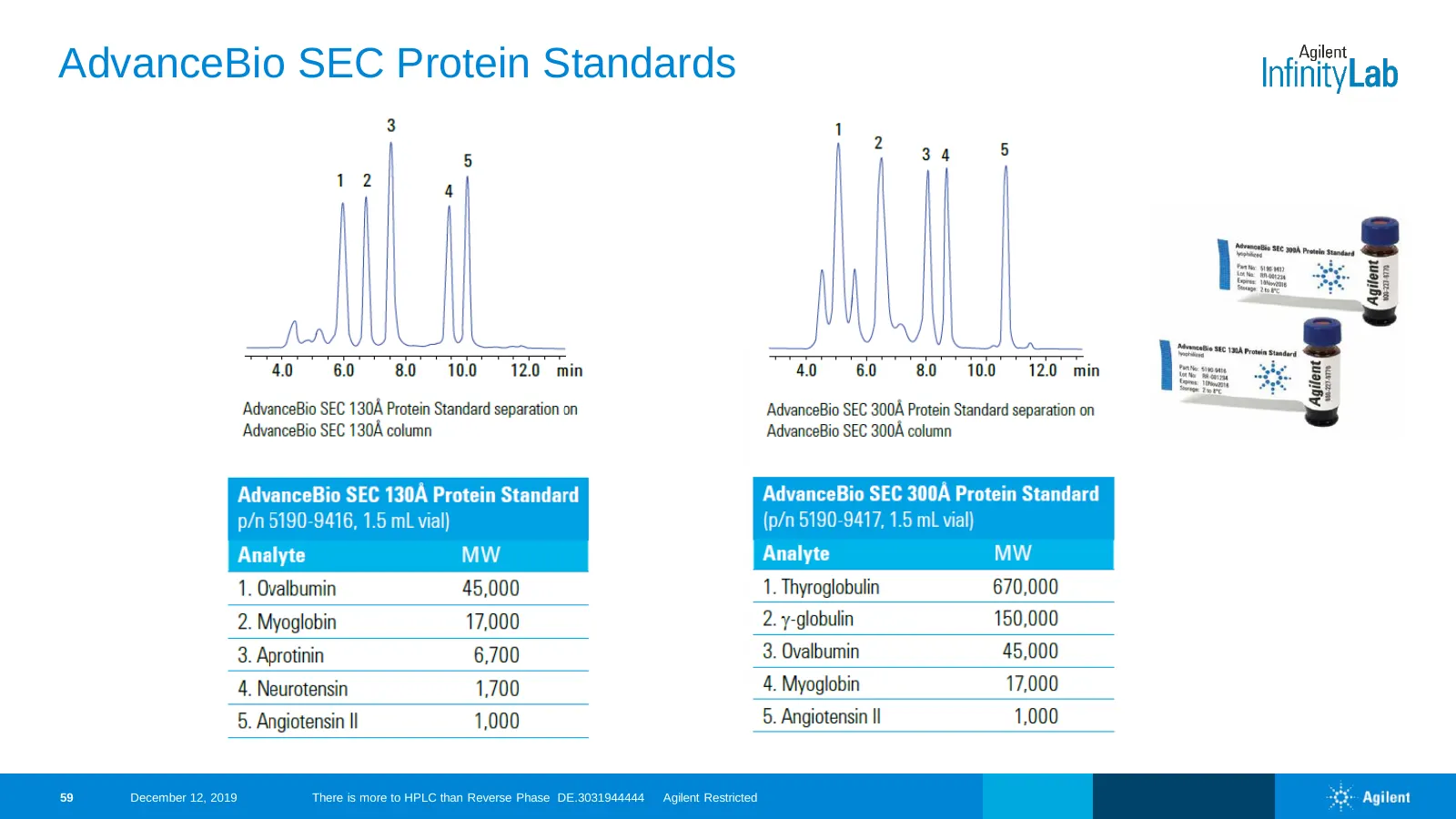
Slide 59: AdvanceBio SEC Protein Standards
AdvanceBio SEC Protein Standards 59 December 12, 2019 There is more to HPLC than Reverse Phase DE.3031944444 Agilent Restricted
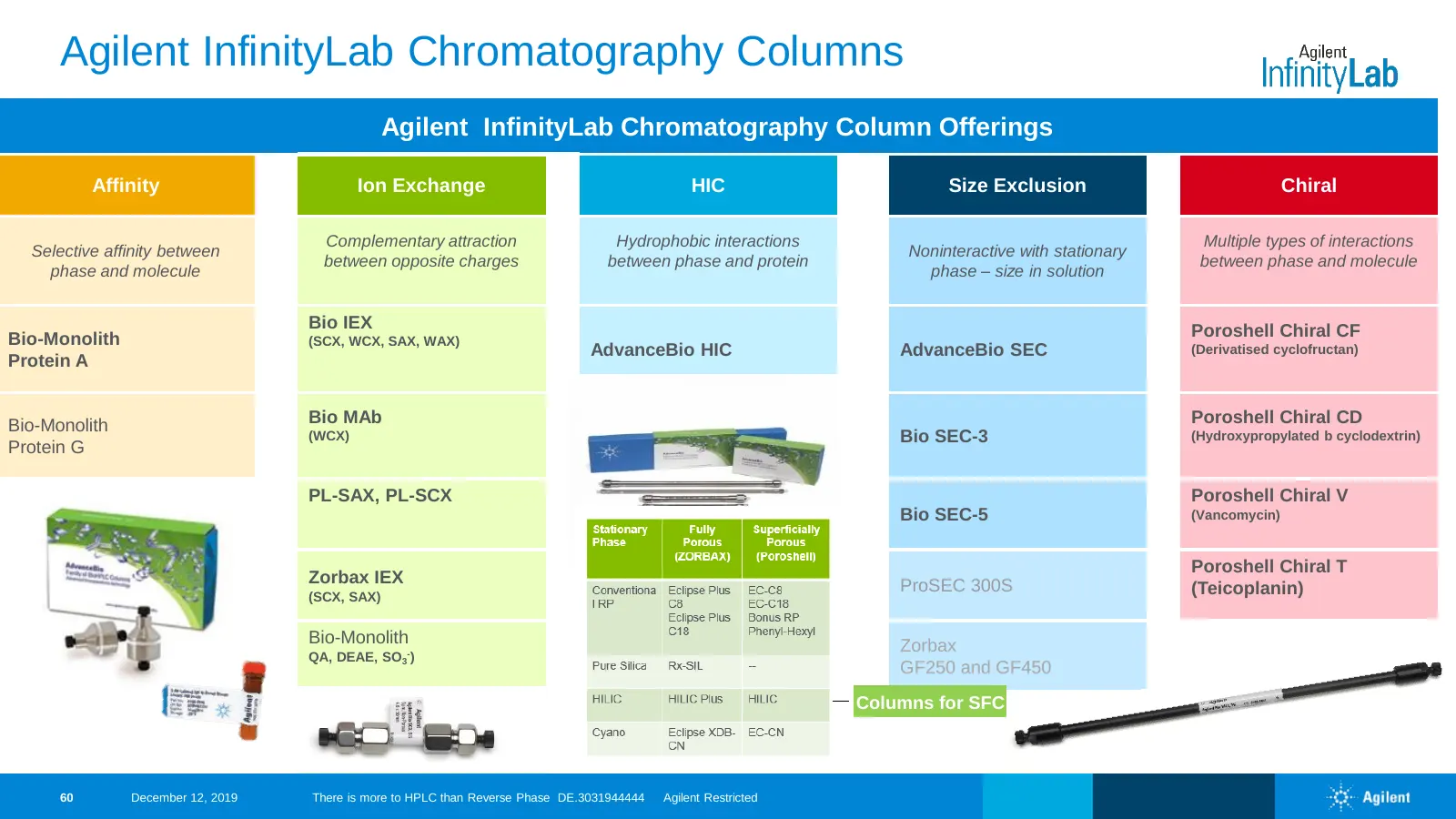
Slide 60: Agilent InfinityLab Chromatography Columns
Agilent InfinityLab Chromatography Columns Agilent InfinityLab Chromatography Column Offerings Affinity Ion Exchange HIC Size Exclusion Chiral Complementary attraction Hydrophobic interactions Multiple types of interactions Selective affinity between Noninteractive with stationary between opposite c
Slide 61: Thank you for attending
Thank you for attending Any questions? 61 December 12, 2019 There is more to HPLC than Reverse Phase DE.3031944444 Agilent Restricted
Slide 62: Contact Agilent Chemistries and Supplies Technical Support
Contact Agilent Chemistries and Supplies Technical Support • 1-800-227-9770 option 3, option 3: • Option 1 for GC and GC/MS columns and supplies • Option 2 for LC and LC/MS columns and supplies • Option 3 for sample preparation, filtration, and QuEChERS • Option 4 for spectroscopy supplies • Option
Source: Internet Archive copy of agilent.com
More decks from Agilent Technologies, Inc.
 Investor Presentation (October 2026)10 slides · Oct 8, 2026
 Technical Presentation (October 2026)11 slides · Oct 7, 2026
 Q3 2026 Earnings Presentation10 slides · Aug 26, 2026
 Q2 2026 Earnings Presentation11 slides · May 27, 2026
 Q1 2026 Earnings Presentation10 slides · Feb 25, 2026
 Q4 2025 Earnings Presentation10 slides · Nov 24, 2025