Dogwood Therapeutics, Inc. · NASDAQ:DWTX
Dogwood Therapeutics — Investor Presentation (November 2026)
26 slides from Dogwood Therapeutics's investor presentation, Nov 23, 2026
Slide 1: Halneuron for the Treatment of Chemotherapeutic-Induced Neuropathic Pain (CINP)
NASDAQ: DWTX Halneuron® for the Treatment of Chemotherapeutic-Induced Neuropathic Pain (CINP) November 2026 Exhibit 99.3
Slide 2: Forward-Looking Statements
2 Forward-Looking Statements Statements in this presentation contain “forward-looking statements,” within the meaning of the U.S. Private Securities Litigation Reform Act of 1995, that are subject to substantial risks and uncertainties. All statements, other than statements of historical fact, conta
Slide 3: Team Introductions
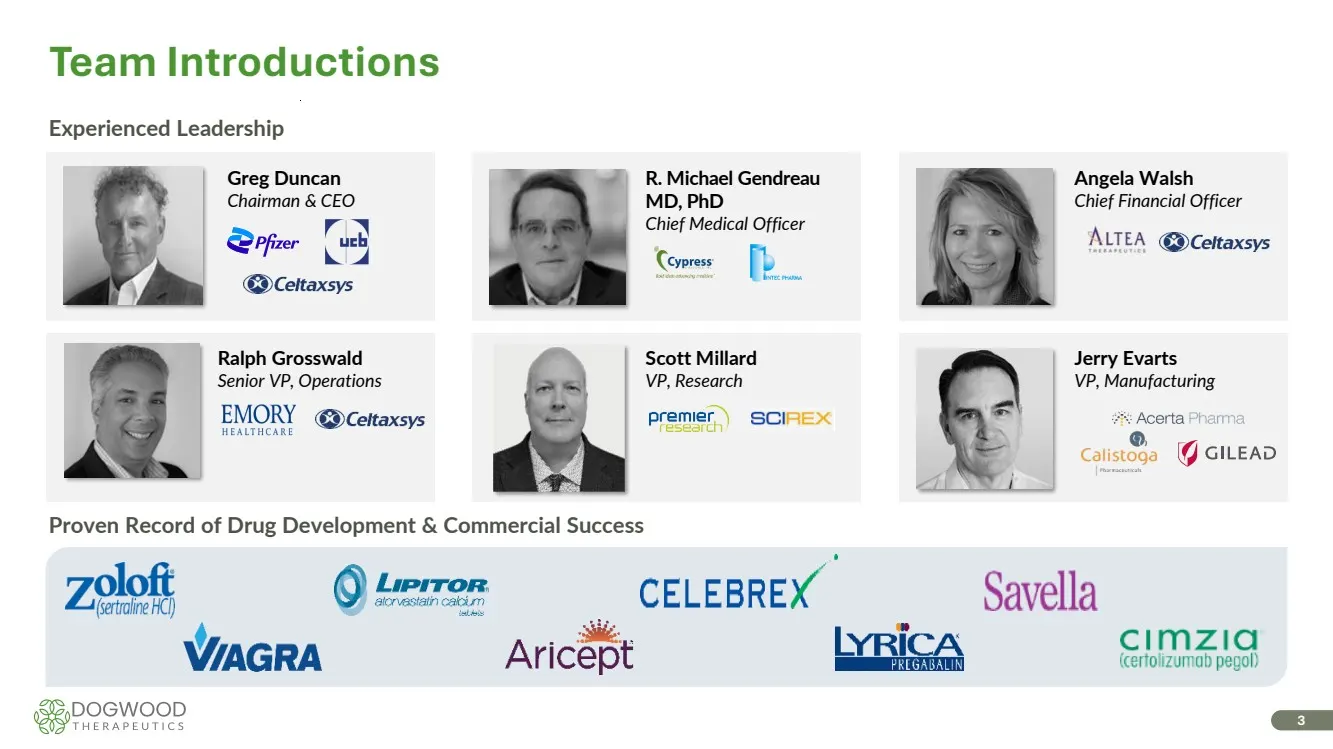
3 Team Introductions Greg Duncan Chairman & CEO R. Michael Gendreau MD, PhD Chief Medical Officer Ralph Grosswald Senior VP, Operations Angela Walsh Chief Financial Officer Proven Record of Drug Development & Commercial Success Jerry Evarts VP, Manufacturing Scott Millard VP, Research Experienced Le
Slide 4: High-Quality, Consistent Halneuron Phase 2b Data
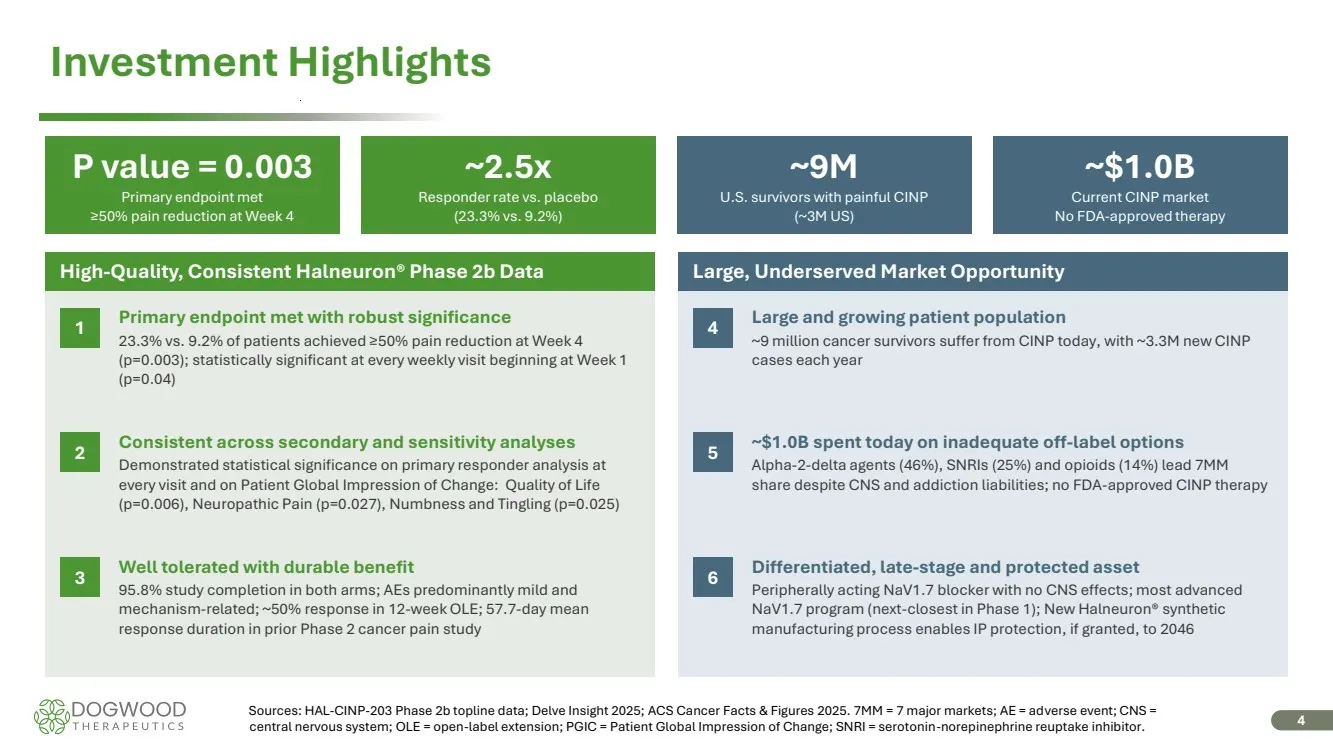
4 P value = 0.003 Primary endpoint met ≥50% pain reduction at Week 4 ~2.5x Responder rate vs. placebo (23.3% vs. 9.2%) ~9M U.S. survivors with painful CINP (~3M US) ~$1.0B Current CINP market No FDA-approved therapy High-Quality, Consistent Halneuron® Phase 2b Data 1 Primary endpoint met with robust
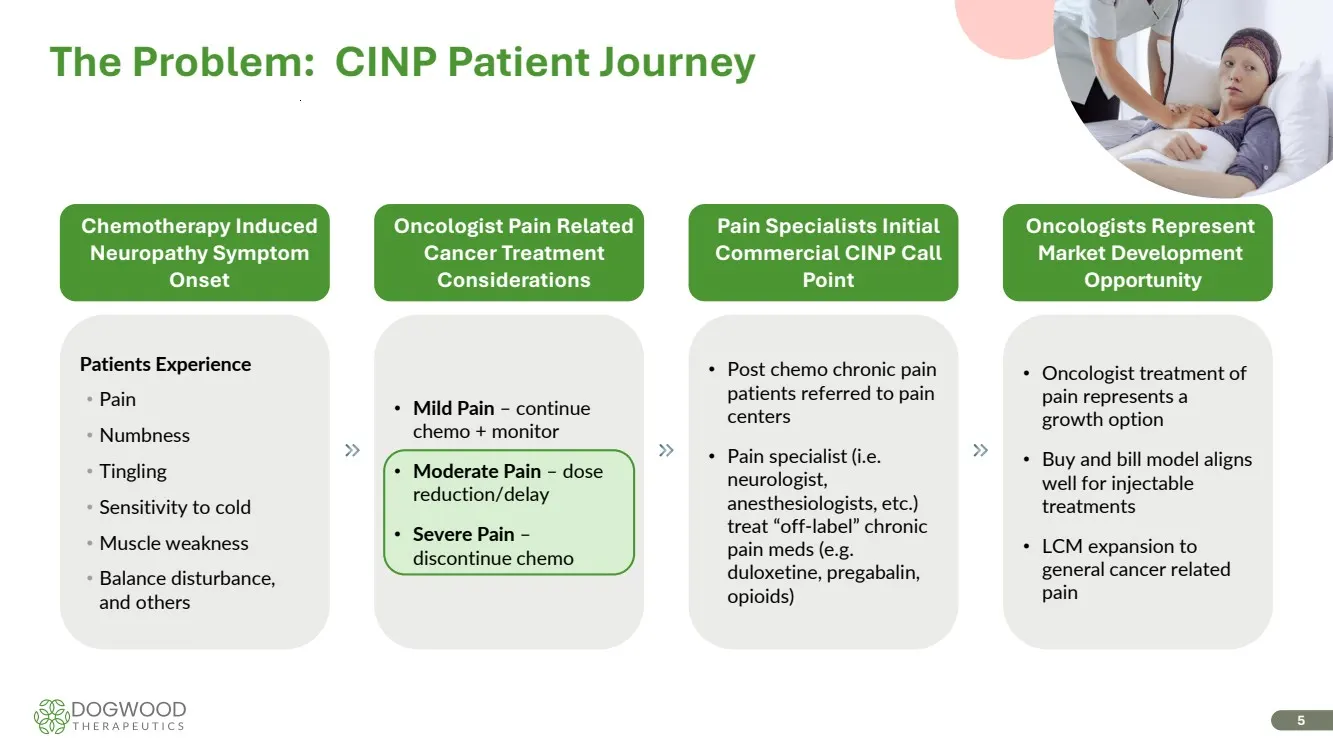
Slide 5: The Problem: CINP Patient Journey
5 The Problem: CINP Patient Journey • Mild Pain – continue chemo + monitor • Moderate Pain – dose reduction/delay • Severe Pain – discontinue chemo Patients Experience • Pain • Numbness • Tingling • Sensitivity to cold • Muscle weakness • Balance disturbance, and others Chemotherapy Induced Neuropat
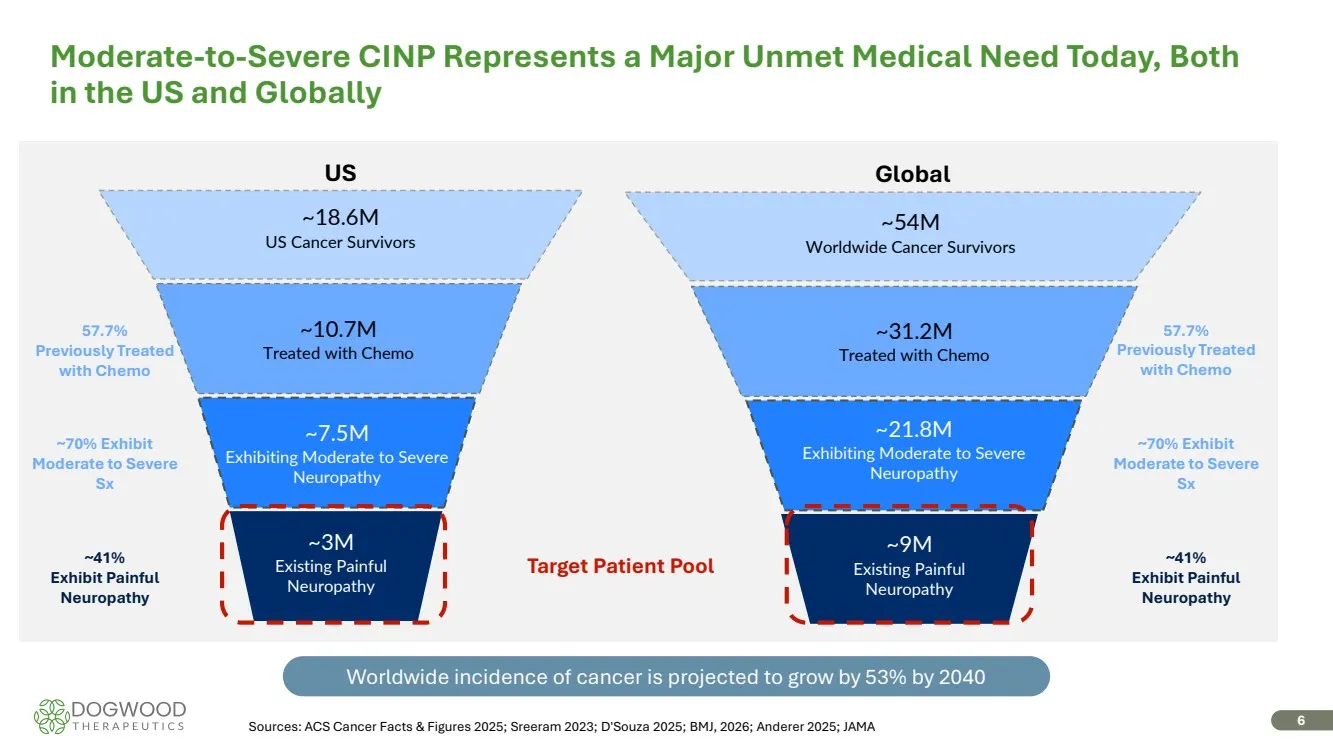
Slide 6: Moderate-to-Severe CINP Represents a Major Unmet Medical Need
6 Moderate-to-Severe CINP Represents a Major Unmet Medical Need Today, Both in the US and Globally Sources: ACS Cancer Facts & Figures 2025; Sreeram 2023; D'Souza 2025; BMJ, 2026; Anderer 2025; JAMA Worldwide incidence of cancer is projected to grow by 53% by 2040 ~18.6M US Cancer Survivors ~10.7M T
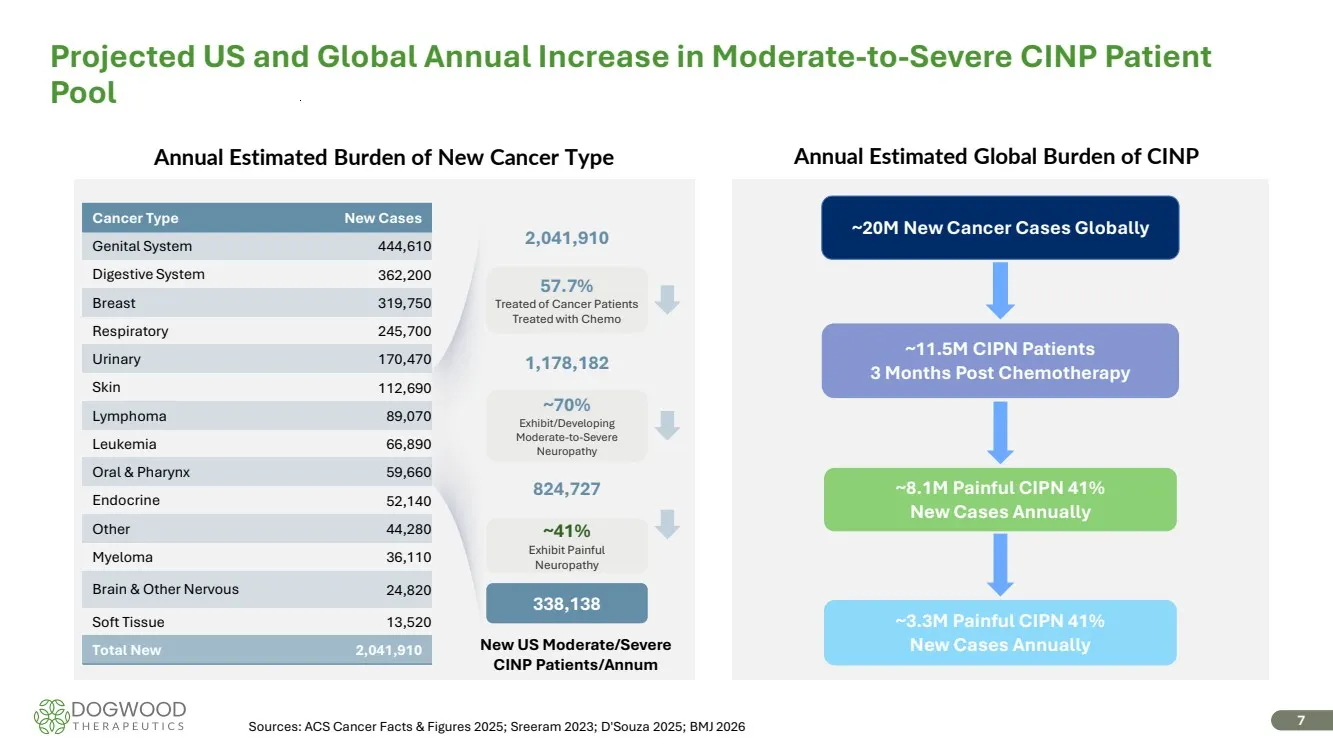
Slide 7: Projected US and Global Annual Increase in Moderate-to-Severe CINP Patient Pool
7 Projected US and Global Annual Increase in Moderate-to-Severe CINP Patient Pool Sources: ACS Cancer Facts & Figures 2025; Sreeram 2023; D'Souza 2025; BMJ 2026 Annual Estimated Burden of New Cancer Type 57.7% Treated of Cancer Patients Treated with Chemo ~70% Exhibit/Developing Moderate-to-Severe N
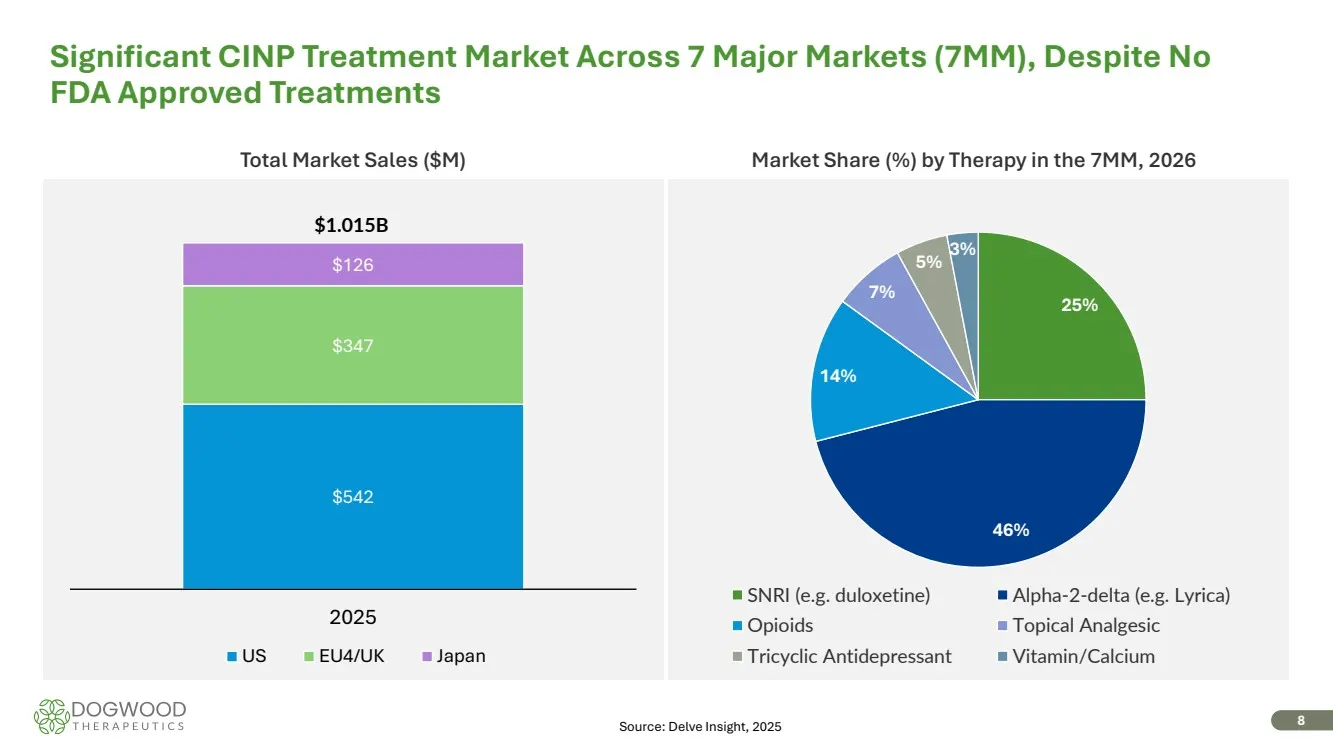
Slide 8: Significant CINP Treatment Market Across Major Markets Despite No FDA Approved Treatments
8 Significant CINP Treatment Market Across 7 Major Markets (7MM), Despite No FDA Approved Treatments Source: Delve Insight, 2025 $542 $347 $126 2025 US EU4/UK Japan 25% 46% 14% 7% 5% 3% SNRI (e.g. duloxetine) Alpha-2-delta (e.g. Lyrica) Opioids Topical Analgesic Tricyclic Antidepressant Vitamin/Calc
Slide 9: Our Solution - Halneuron
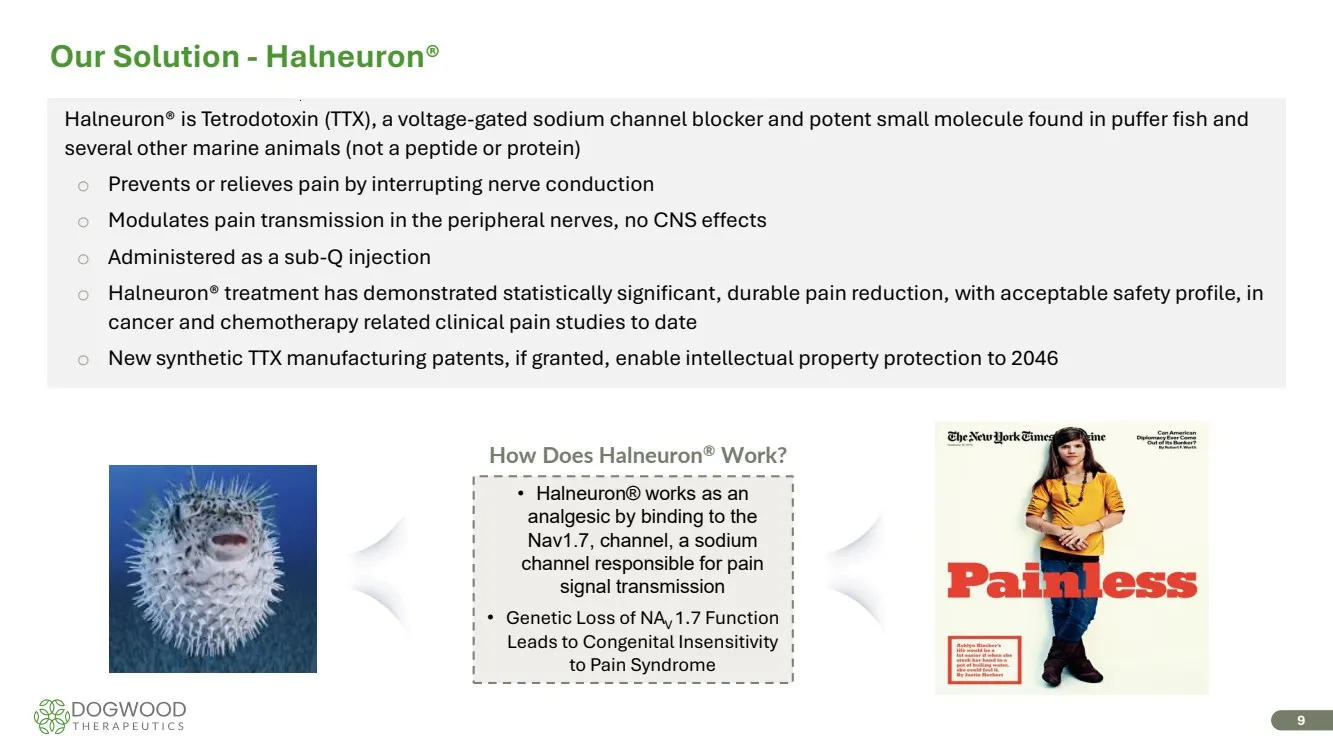
9 Our Solution - Halneuron® Halneuron® is Tetrodotoxin (TTX), a voltage-gated sodium channel blocker and potent small molecule found in puffer fish and several other marine animals (not a peptide or protein) o Prevents or relieves pain by interrupting nerve conduction o Modulates pain transmission i
Slide 10: Phase 2b CINP Study Design
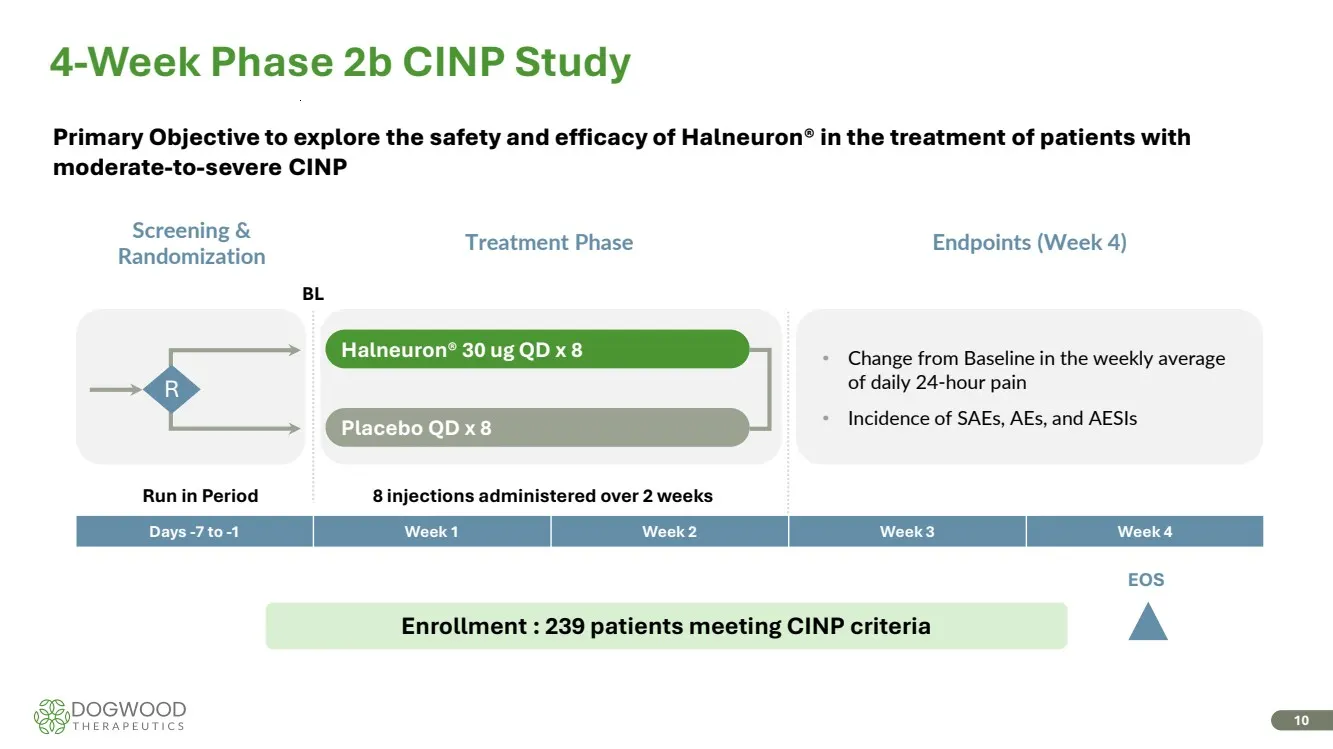
10 Primary Objective to explore the safety and efficacy of Halneuron® in the treatment of patients with moderate-to-severe CINP Screening & Randomization 8 injections administered over 2 weeks • Change from Baseline in the weekly average of daily 24-hour pain • Incidence of SAEs, AEs, and AESIs Haln
Slide 11: HAL-CINP-203: Disposition
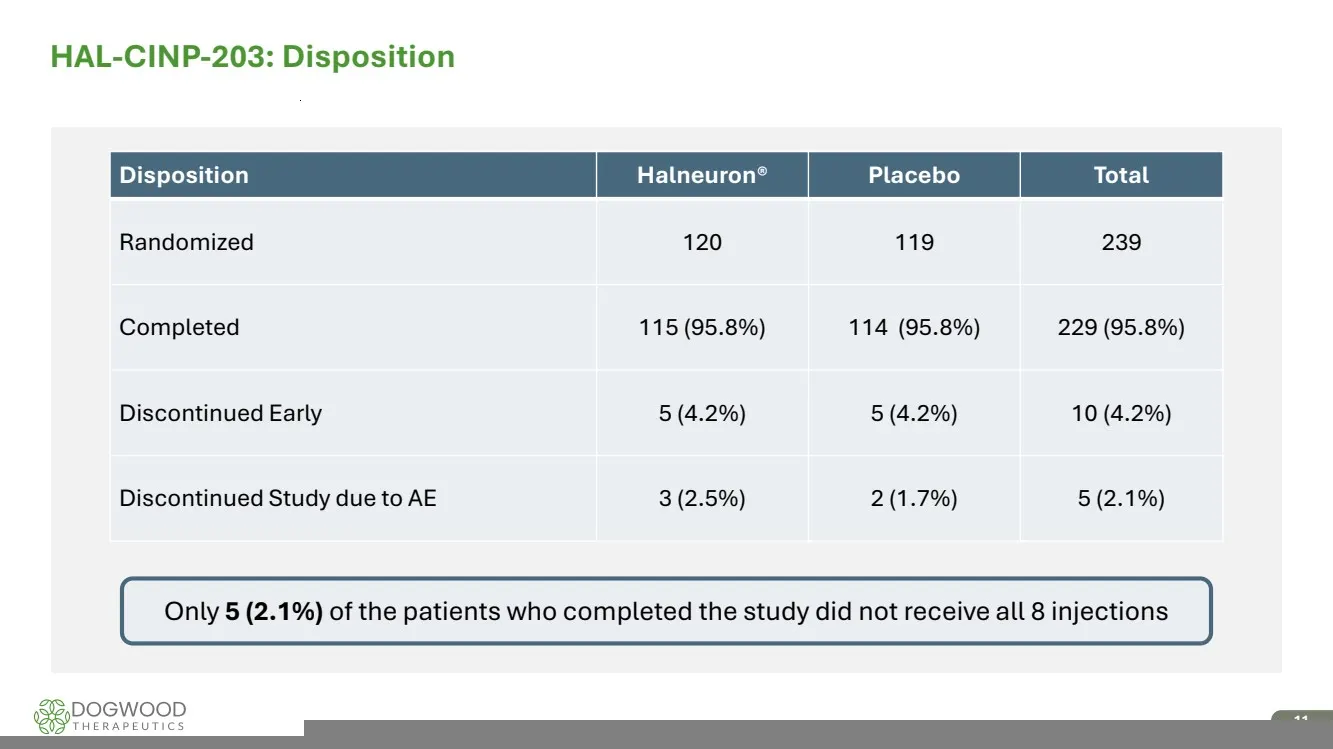
11 HAL-CINP-203: Disposition Disposition Halneuron® Placebo Total Randomized 120 119 239 Completed 115 (95.8%) 114 (95.8%) 229 (95.8%) Discontinued Early 5 (4.2%) 5 (4.2%) 10 (4.2%) Discontinued Study due to AE 3 (2.5%) 2 (1.7%) 5 (2.1%) Only 5 (2.1%) of the patients who completed the study did not
Slide 12: HAL-CINP-203: Baseline Characteristics
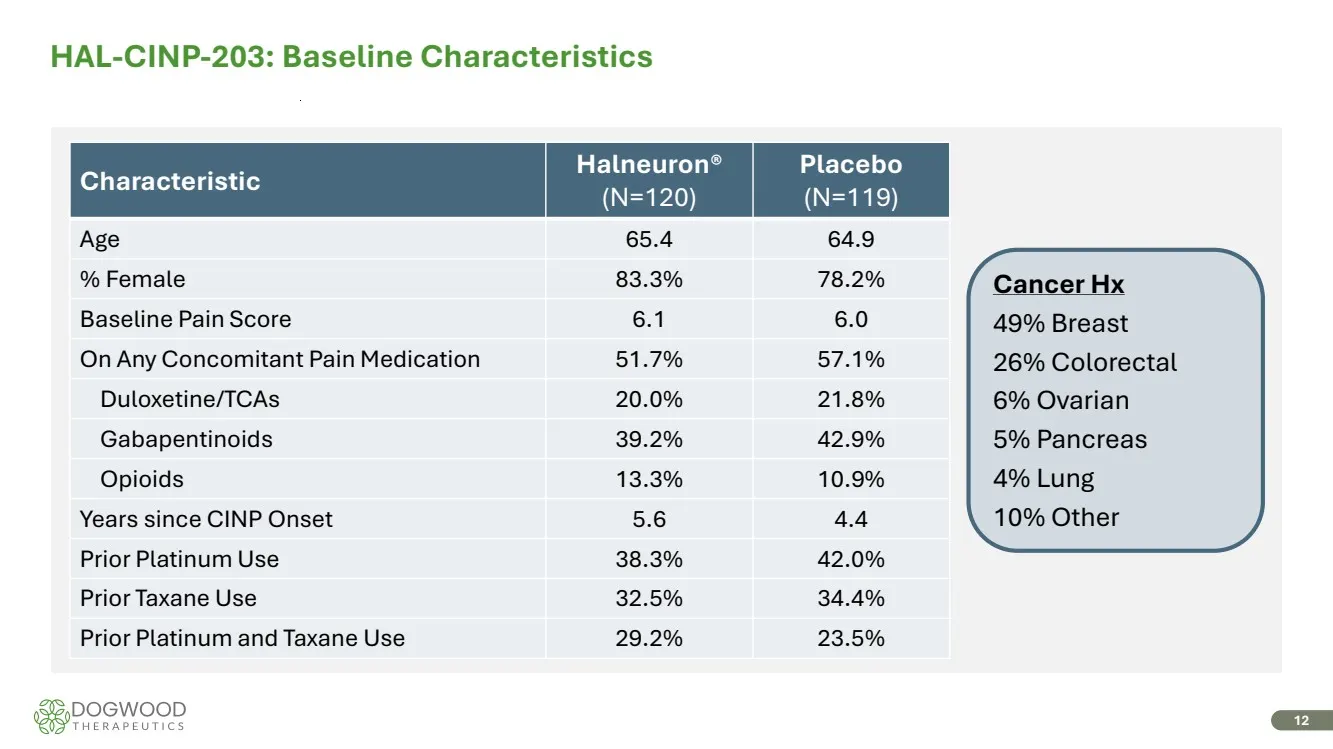
12 HAL-CINP-203: Baseline Characteristics Characteristic Halneuron® (N=120) Placebo (N=119) Age 65.4 64.9 % Female 83.3% 78.2% Baseline Pain Score 6.1 6.0 On Any Concomitant Pain Medication 51.7% 57.1% Duloxetine/TCAs 20.0% 21.8% Gabapentinoids 39.2% 42.9% Opioids 13.3% 10.9% Years since CINP Onset
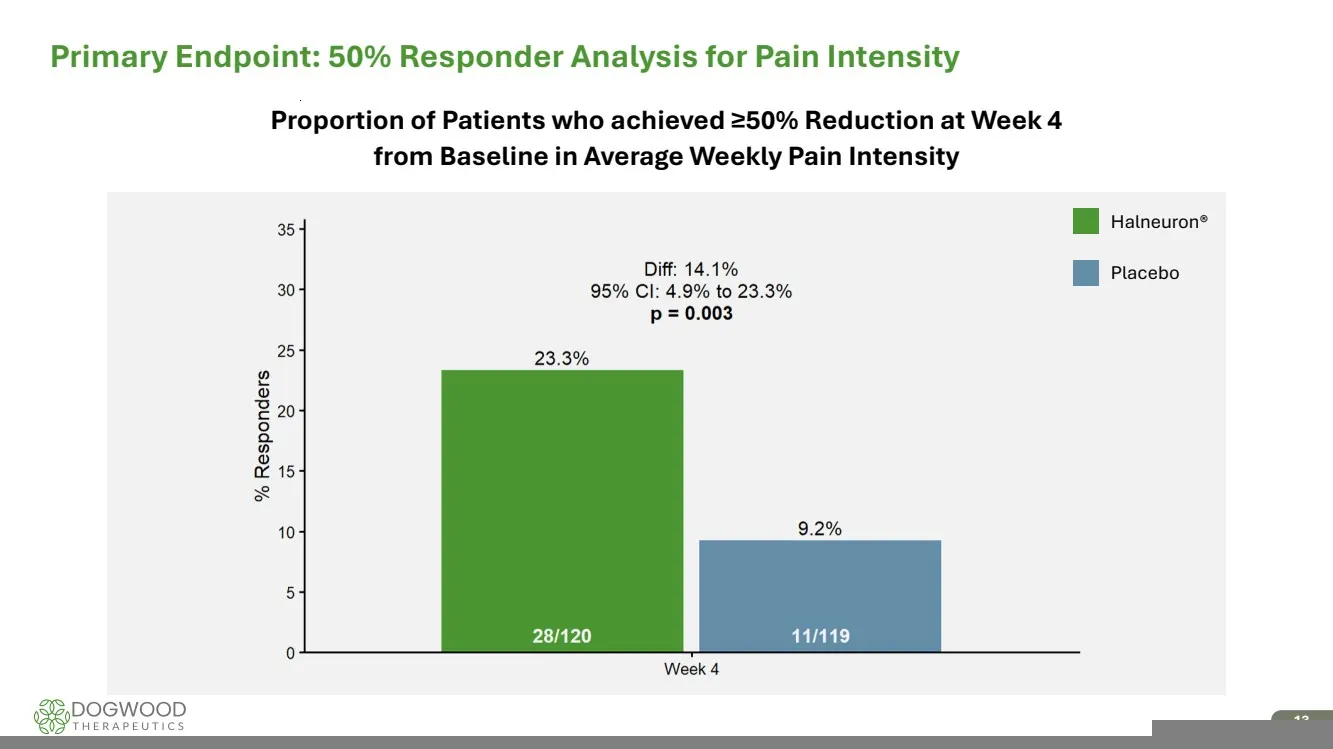
Slide 13: Primary Endpoint: 50% Responder Analysis for Pain Intensity
13 Primary Endpoint: 50% Responder Analysis for Pain Intensity Proportion of Patients who achieved ≥50% Reduction at Week 4 from Baseline in Average Weekly Pain Intensity Halneuron® Placebo
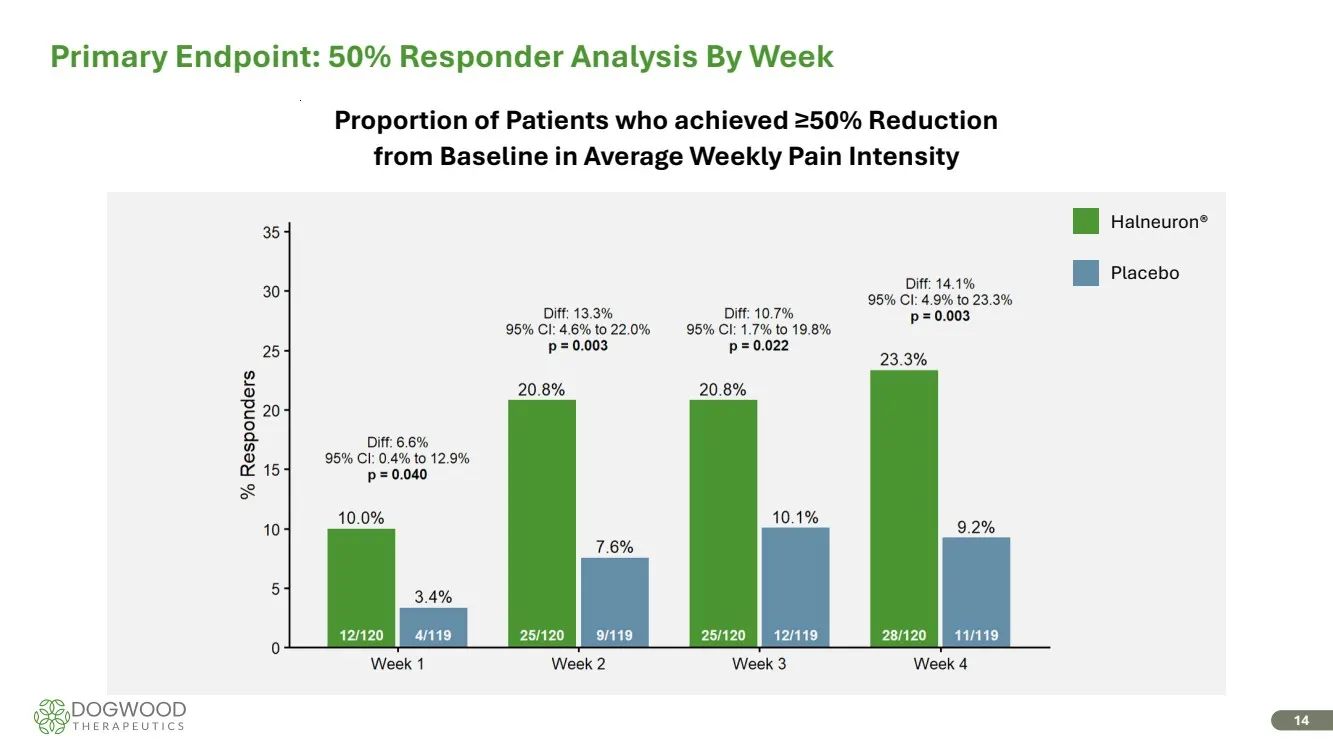
Slide 14: Primary Endpoint: 50% Responder Analysis By Week
14 Primary Endpoint: 50% Responder Analysis By Week Proportion of Patients who achieved ≥50% Reduction from Baseline in Average Weekly Pain Intensity Halneuron® Placebo
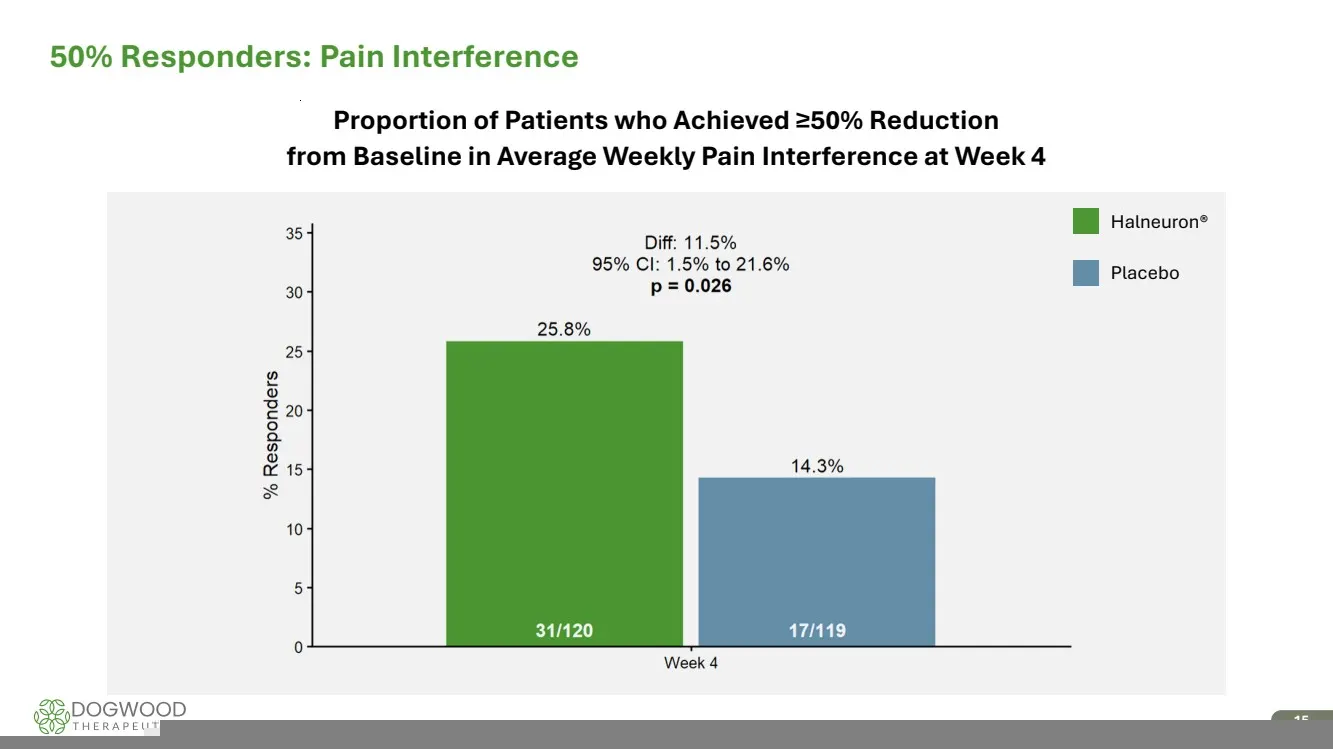
Slide 15: 50% Responders: Pain Interference
15 Halneuron® Placebo 50% Responders: Pain Interference Proportion of Patients who Achieved ≥50% Reduction from Baseline in Average Weekly Pain Interference at Week 4
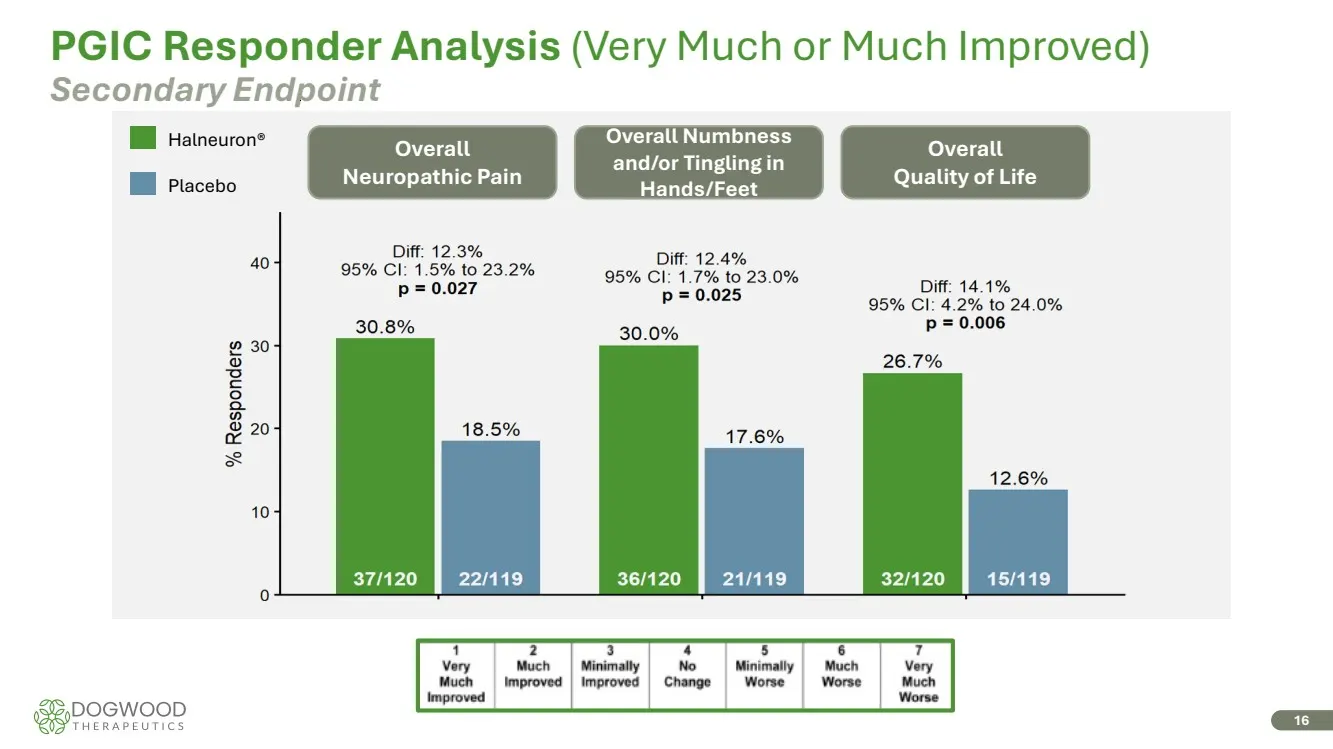
Slide 16: PGIC Responder Analysis (Very Much or Much Improved)
16 PGIC Responder Analysis (Very Much or Much Improved) Secondary Endpoint Halneuron® Placebo Overall Neuropathic Pain Overall Numbness and/or Tingling in Hands/Feet Overall Quality of Life
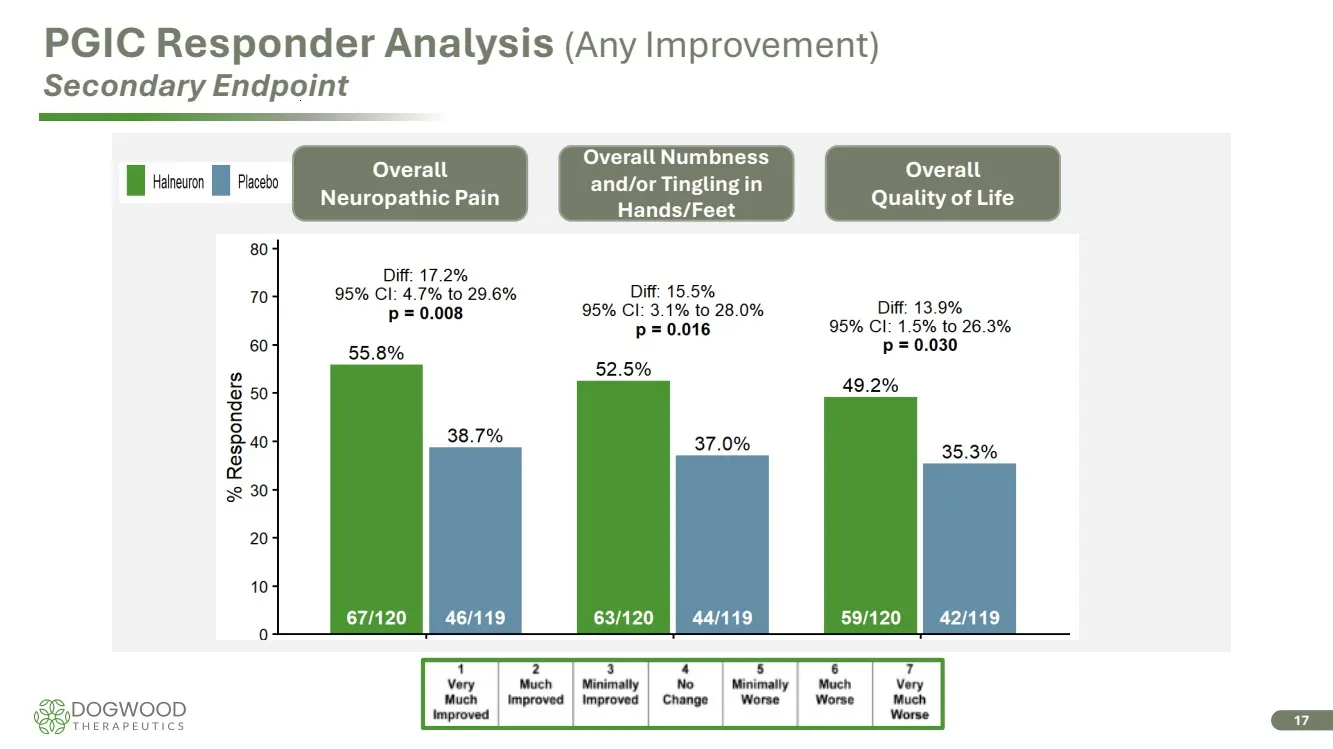
Slide 17: PGIC Responder Analysis (Any Improvement)
17 PGIC Responder Analysis (Any Improvement) Secondary Endpoint Overall Neuropathic Pain Overall Numbness and/or Tingling in Hands/Feet Overall Quality of Life
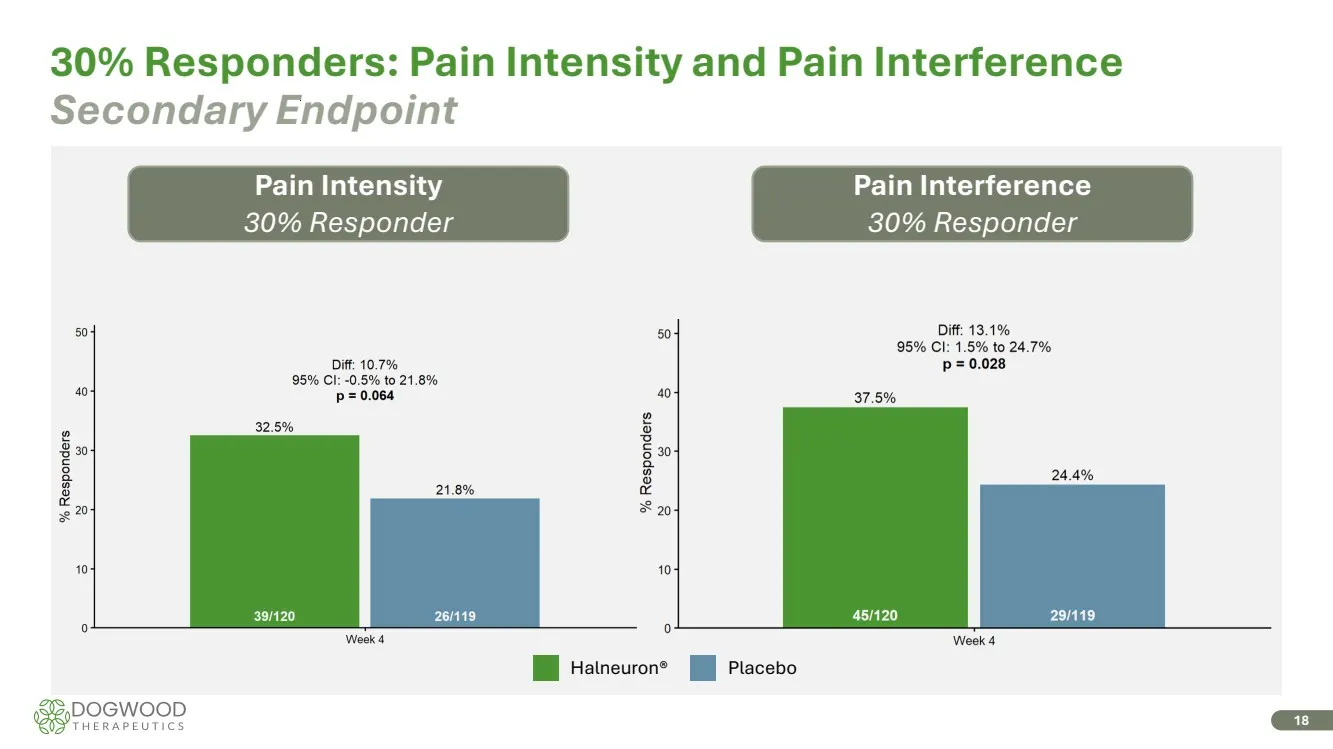
Slide 18: 30% Responders: Pain Intensity and Pain Interference
18 30% Responders: Pain Intensity and Pain Interference Secondary Endpoint Pain Intensity 30% Responder Pain Interference 30% Responder Halneuron® Placebo
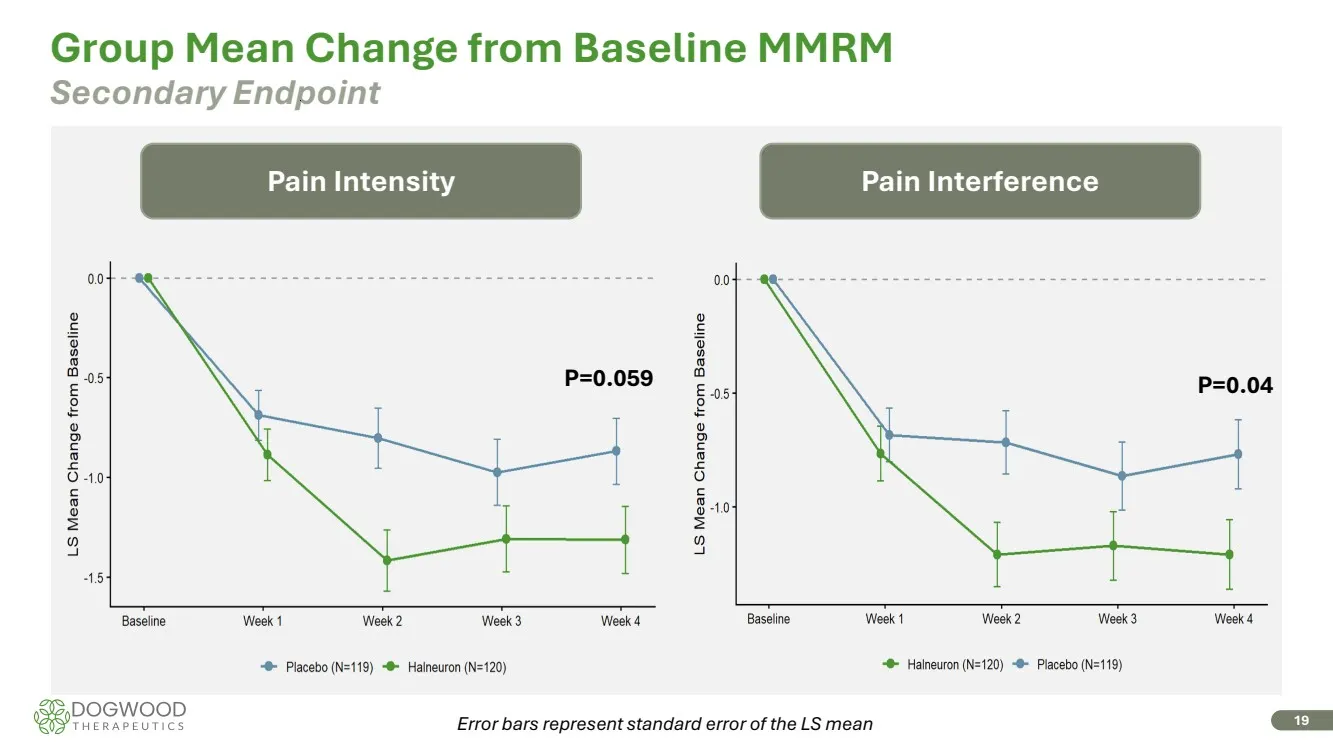
Slide 19: Group Mean Change from Baseline MMRM
19 P=0.059 Pain Intensity Pain Interference P=0.04 Group Mean Change from Baseline MMRM Secondary Endpoint Error bars represent standard error of the LS mean
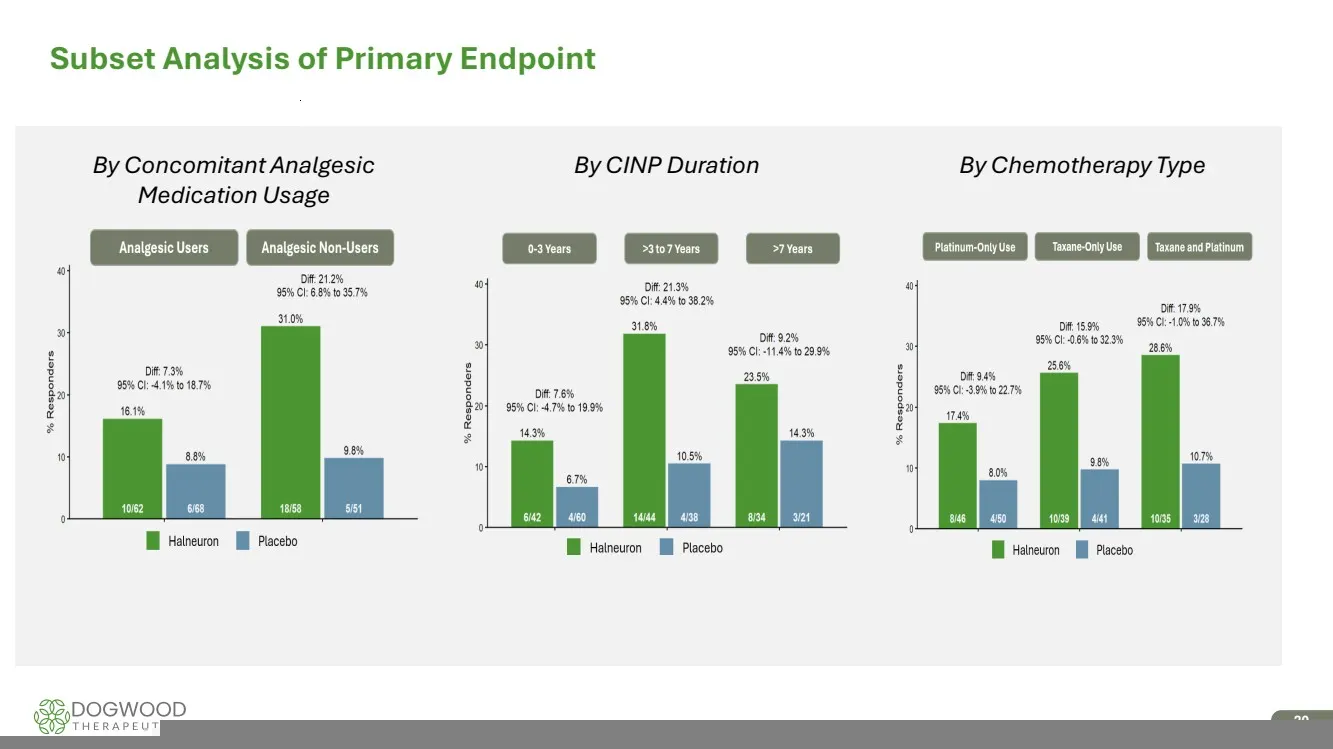
Slide 20: Subset Analysis of Primary Endpoint
20 Subset Analysis of Primary Endpoint By Concomitant Analgesic By CINP Duration Medication Usage By Chemotherapy Type
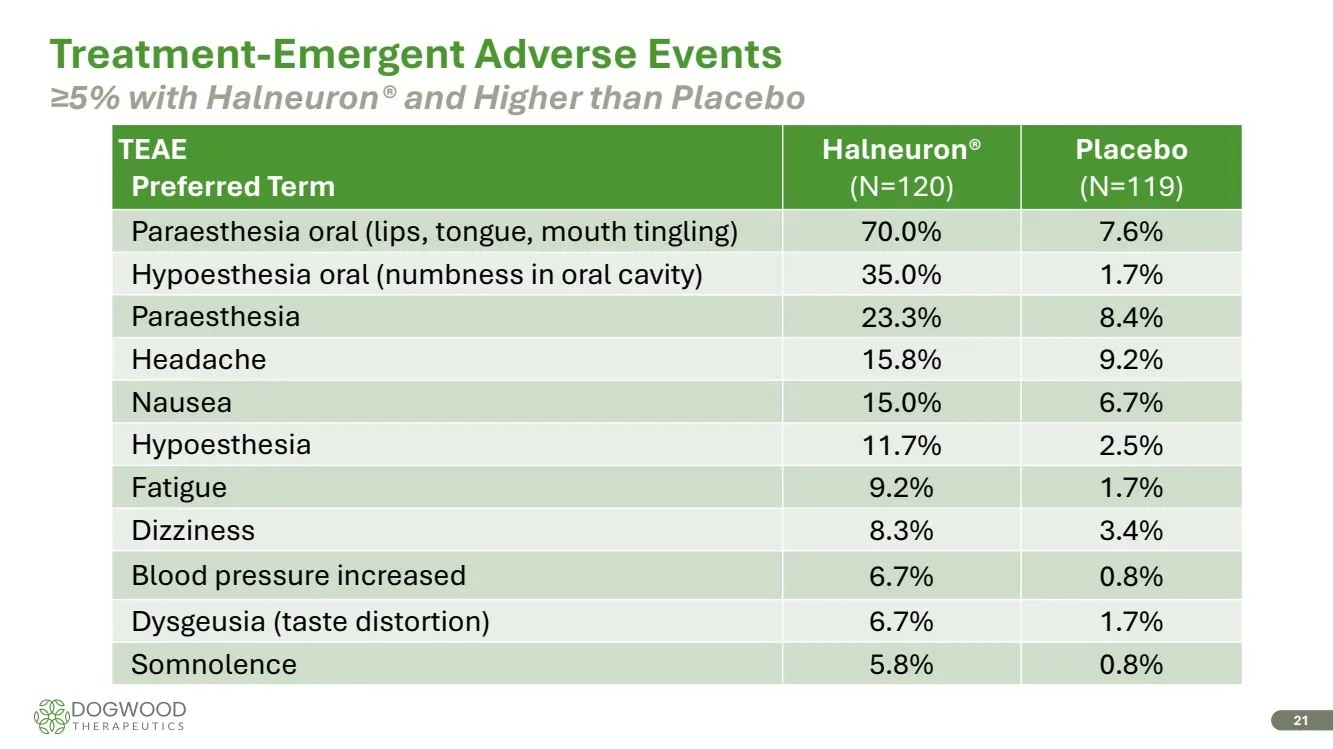
Slide 21: Treatment-Emergent Adverse Events
21 Treatment-Emergent Adverse Events ≥5% with Halneuron® and Higher than Placebo TEAE Preferred Term Halneuron® (N=120) Placebo (N=119) Paraesthesia oral (lips, tongue, mouth tingling) 70.0% 7.6% Hypoesthesia oral (numbness in oral cavity) 35.0% 1.7% Paraesthesia 23.3% 8.4% Headache 15.8% 9.2% Nause
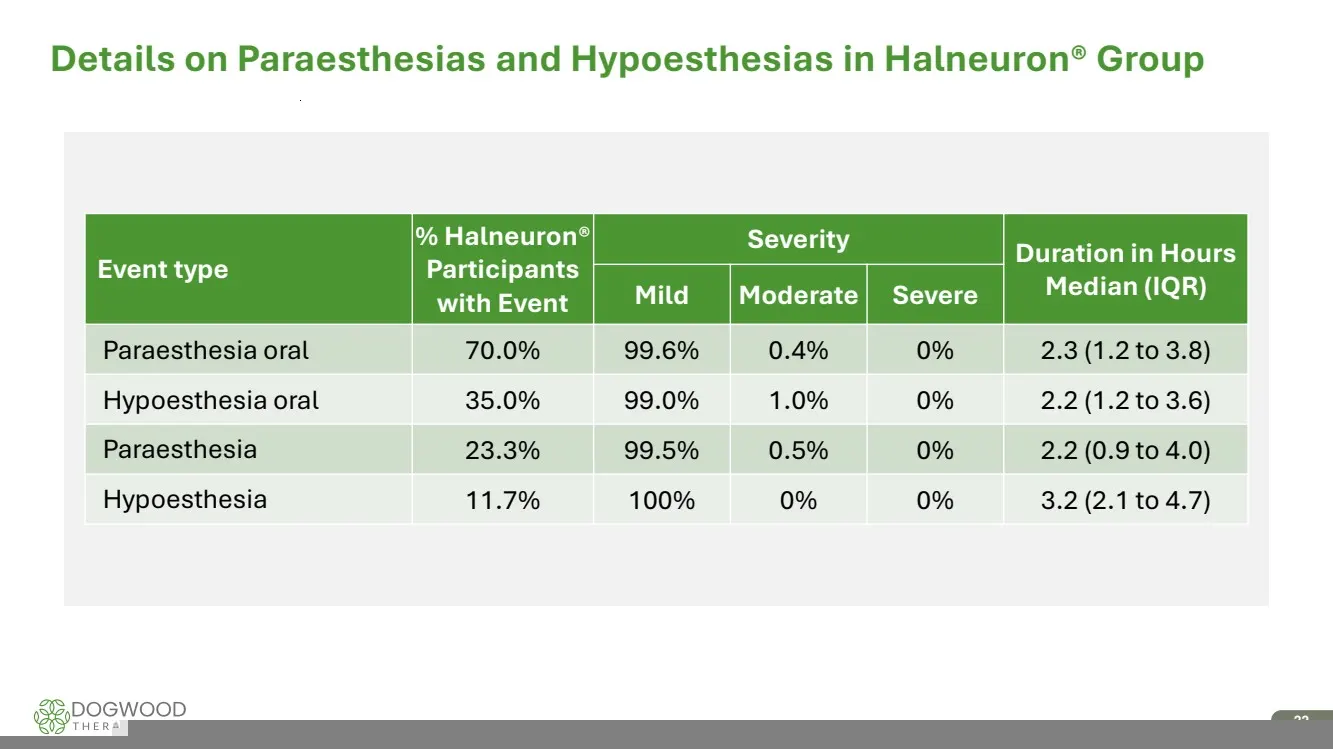
Slide 22: Details on Paraesthesias and Hypoesthesias in Halneuron Group
22 Details on Paraesthesias and Hypoesthesias in Halneuron® Group Event type % Halneuron® Participants with Event Severity Duration in Hours Mild Moderate Median (IQR) Severe Paraesthesia oral 70.0% 99.6% 0.4% 0% 2.3 (1.2 to 3.8) Hypoesthesia oral 35.0% 99.0% 1.0% 0% 2.2 (1.2 to 3.6) Paraesthesia 23
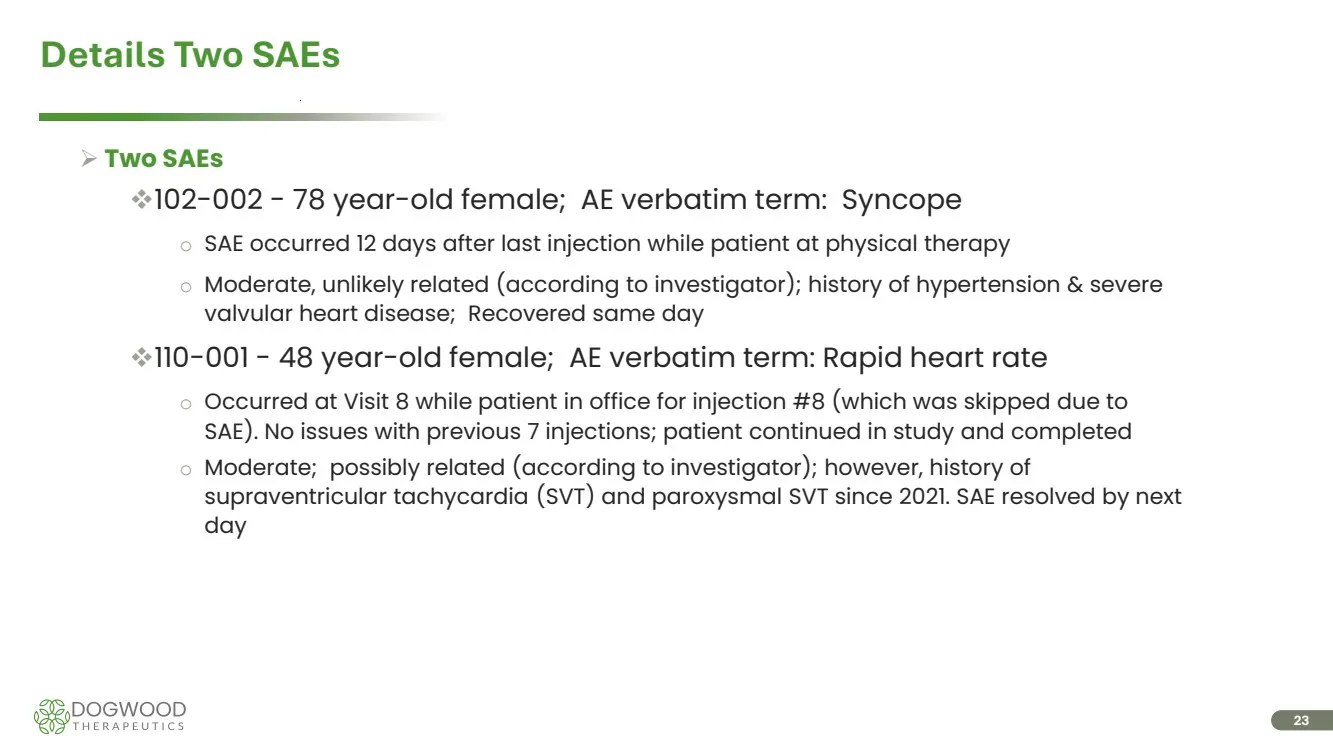
Slide 23: Details: Two SAEs
23 Details Two SAEs ➢ Two SAEs ❖102-002 - 78 year-old female; AE verbatim term: Syncope o SAE occurred 12 days after last injection while patient at physical therapy o Moderate, unlikely related (according to investigator); history of hypertension & severe valvular heart disease; Recovered same day
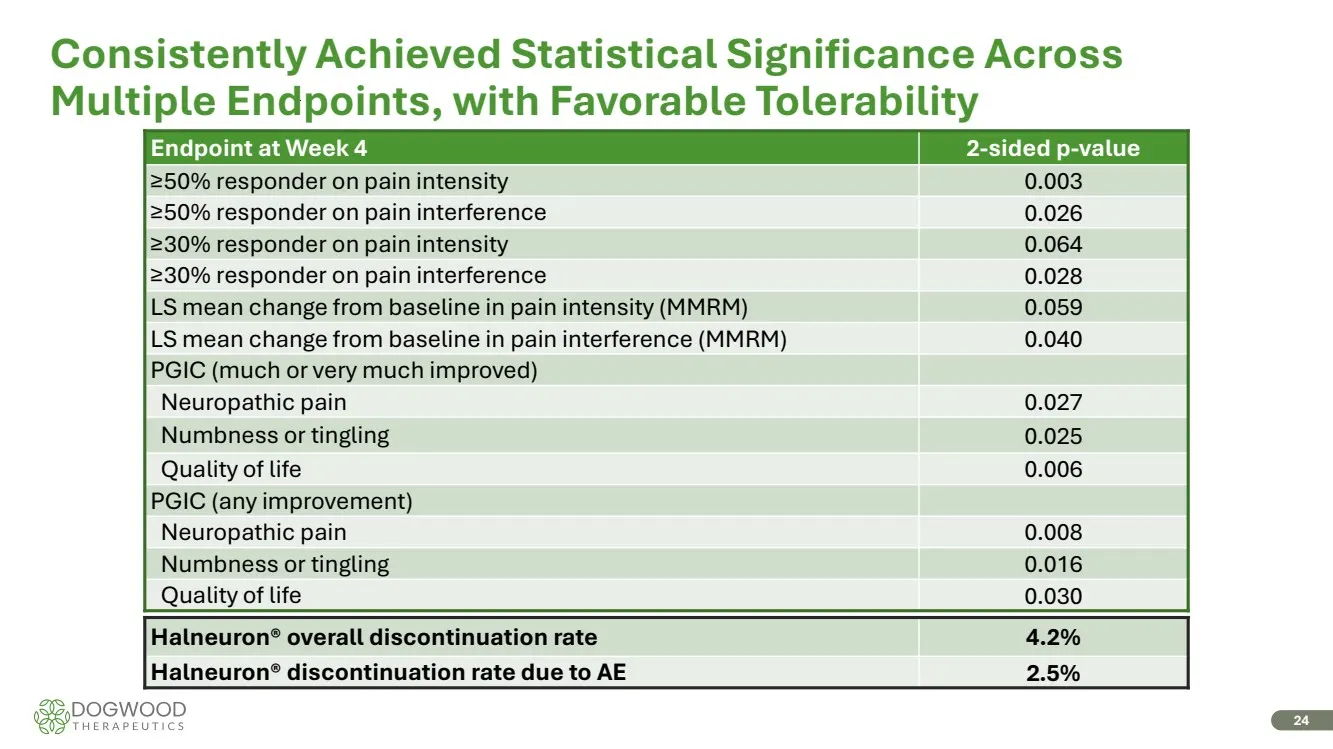
Slide 24: Consistently Achieved Statistical Significance Across Multiple Endpoints, with Favorable Tolerability
24 Consistently Achieved Statistical Significance Across Multiple Endpoints, with Favorable Tolerability Endpoint at Week 4 2-sided p-value ≥50% responder on pain intensity 0.003 ≥50% responder on pain interference 0.026 ≥30% responder on pain intensity 0.064 ≥30% responder on pain interference 0.02
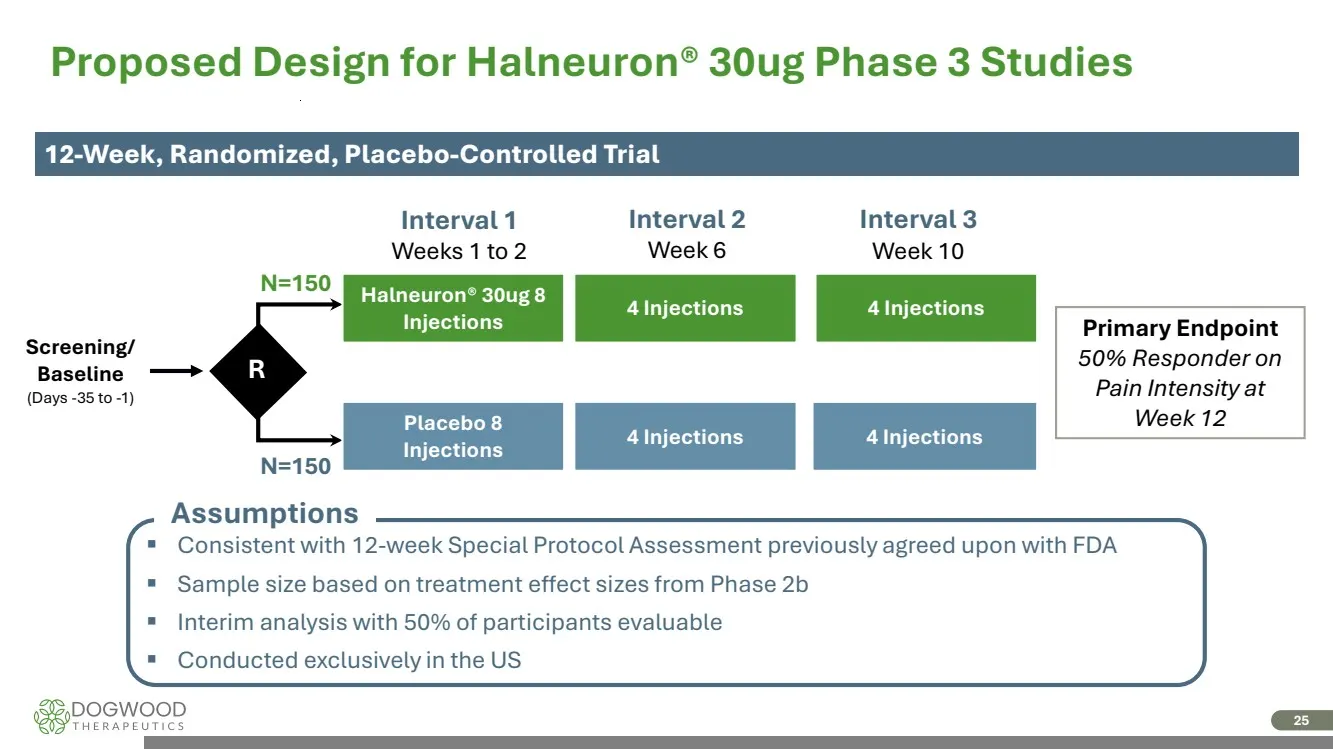
Slide 25: Proposed Design for Halneuron 30ug Phase 3 Studies
25 12-Week, Randomized, Placebo-Controlled Trial Screening/ Baseline (Days -35 to -1) 4 Injections 4 Injections 4 Injections 4 Injections Placebo 8 Injections Halneuron® 30ug 8 Injections Interval 1 Weeks 1 to 2 Interval 2 Week 6 Interval 3 Week 10 Primary Endpoint 50% Responder on Pain Intensity at
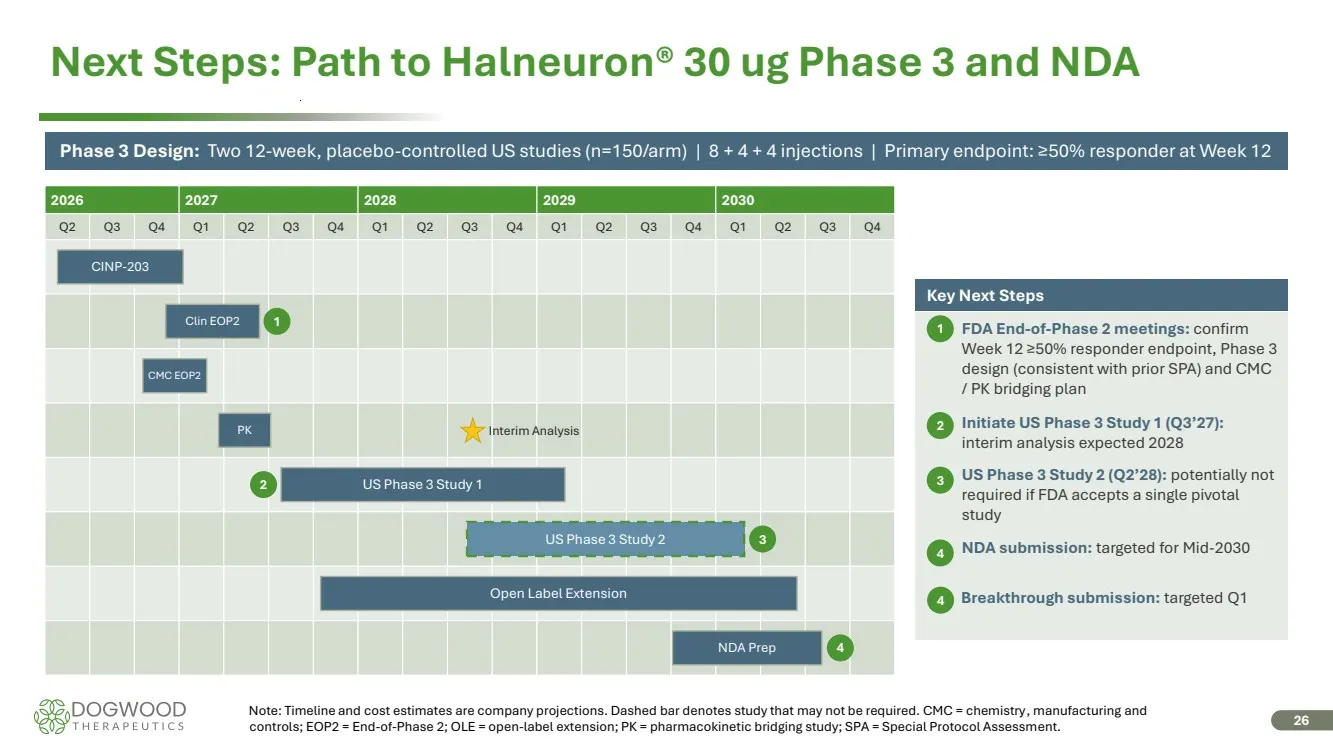
Slide 26: Next Steps: Path to Halneuron 30 ug Phase 3 and NDA
26 Phase 3 Design: Two 12-week, placebo-controlled US studies (n=150/arm) | 8 + 4 + 4 injections | Primary endpoint: ≥50% responder at Week 12 Key Next Steps 1 FDA End-of-Phase 2 meetings: confirm Week 12 ≥50% responder endpoint, Phase 3 design (consistent with prior SPA) and CMC / PK bridging plan
Source: SEC EDGAR · 8-K filed Nov 23, 2026
More decks from Dogwood Therapeutics, Inc.
 Investor Presentation (November 2026)46 slides · November 2026
 Corporate Update (September 2026)34 slides · September 2026
 Corporate Update (October 2025)32 slides · Oct 9, 2025
 Corporate Update (September 2025)16 slides · Sep 29, 2025
 Investor Presentation (February 2025)24 slides · February 2025
 Investor Presentation (January 2025)18 slides · January 2025