UMB Financial Corporation · NASDAQ:UMBF
UMB Financial — AHIP Webinar: Breathing New Life into Financial Wellness (June 2016)
48 slides from UMB Financial's conference presentation, Jun 9, 2016
Slide 1: Breathing New Life into Financial Wellness
June 9, 2016 Breathing New Life into Financial Wellness ©2016 UMB Bank, n.a.
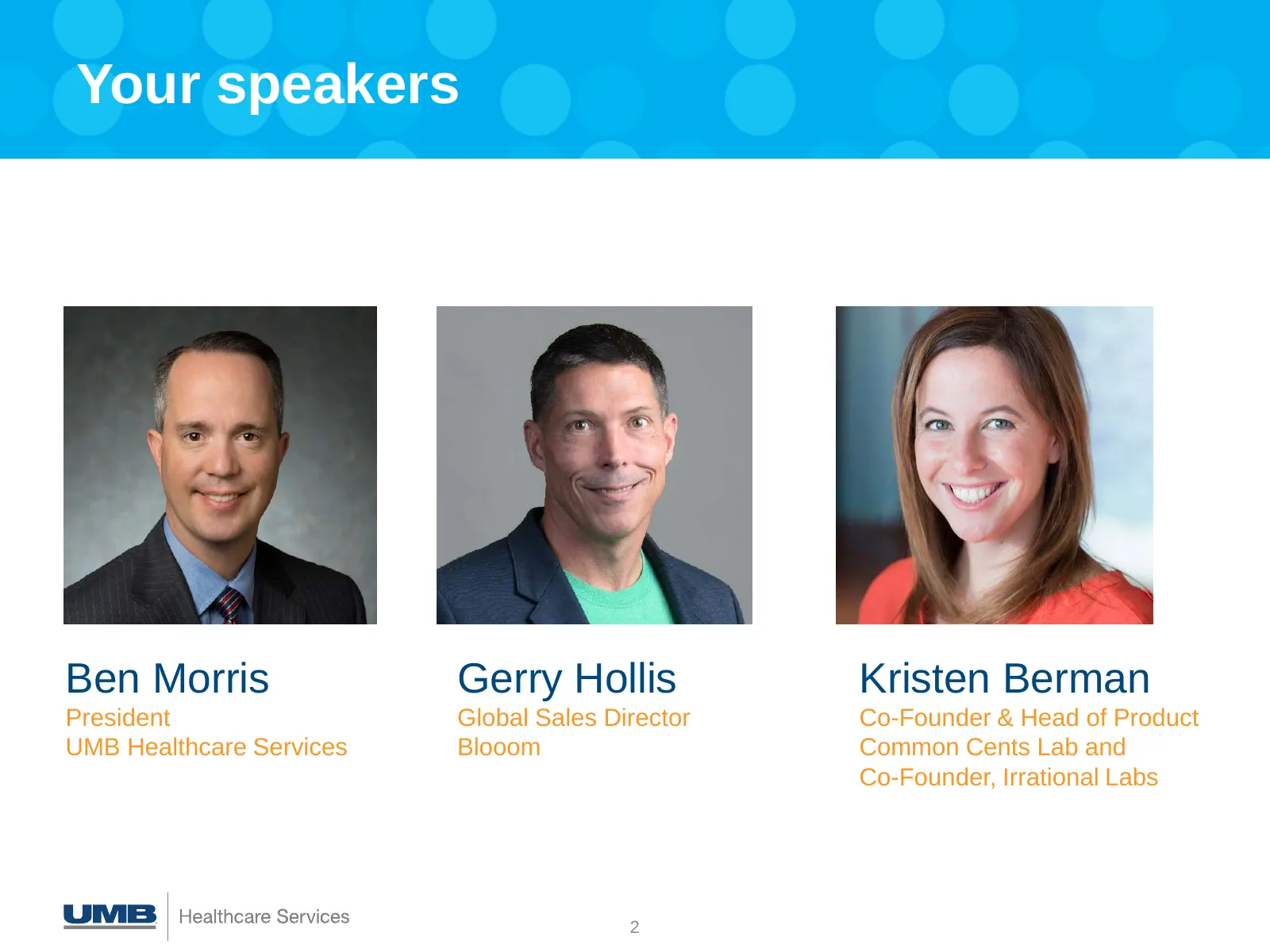
Slide 2: Your speakers
Your speakers Ben Morris Gerry Hollis Kristen Berman President Global Sales Director Co-Founder & Head of Product UMB Healthcare Services Blooom Common Cents Lab and Co-Founder, Irrational Labs 2
Slide 3: Poll question #1
Poll question # 1 How would you describe your role? A. Health plan B. Broker, agent, consultant C. TPA D. Other:_______________ 3
Slide 4: Why Financial Wellness Matters
Why Financial Wellness Matters
Slide 5: The Struggle is Real
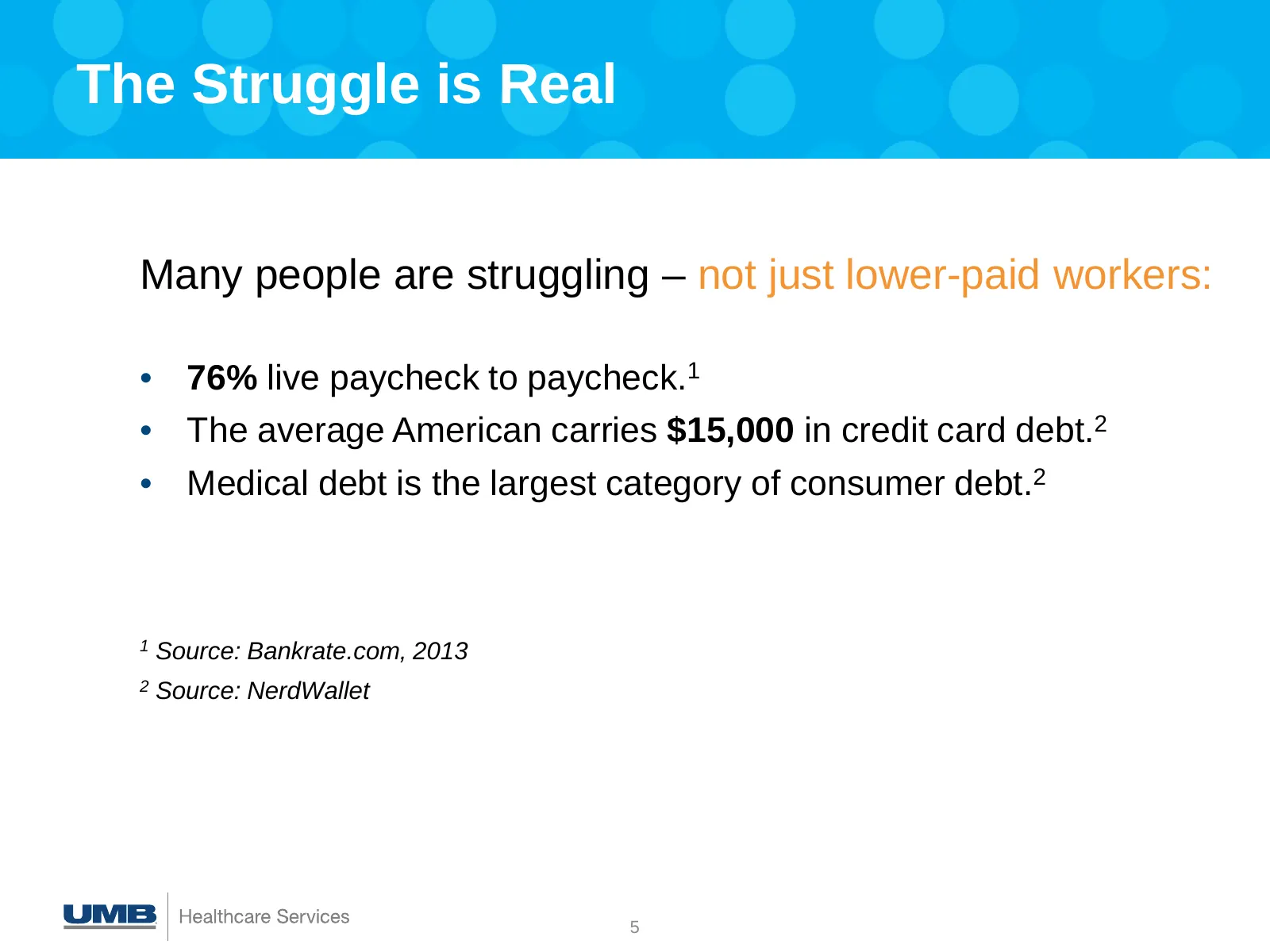
The Struggle is Real Many people are struggling – not just lower-paid workers: • 76% live paycheck to paycheck.1 • The average American carries $15,000 in credit card debt.2 • Medical debt is the largest category of consumer debt.2 1 Source: Bankrate.com, 2013 2 Source: NerdWallet 5
Slide 6: Instincts Get in the Way
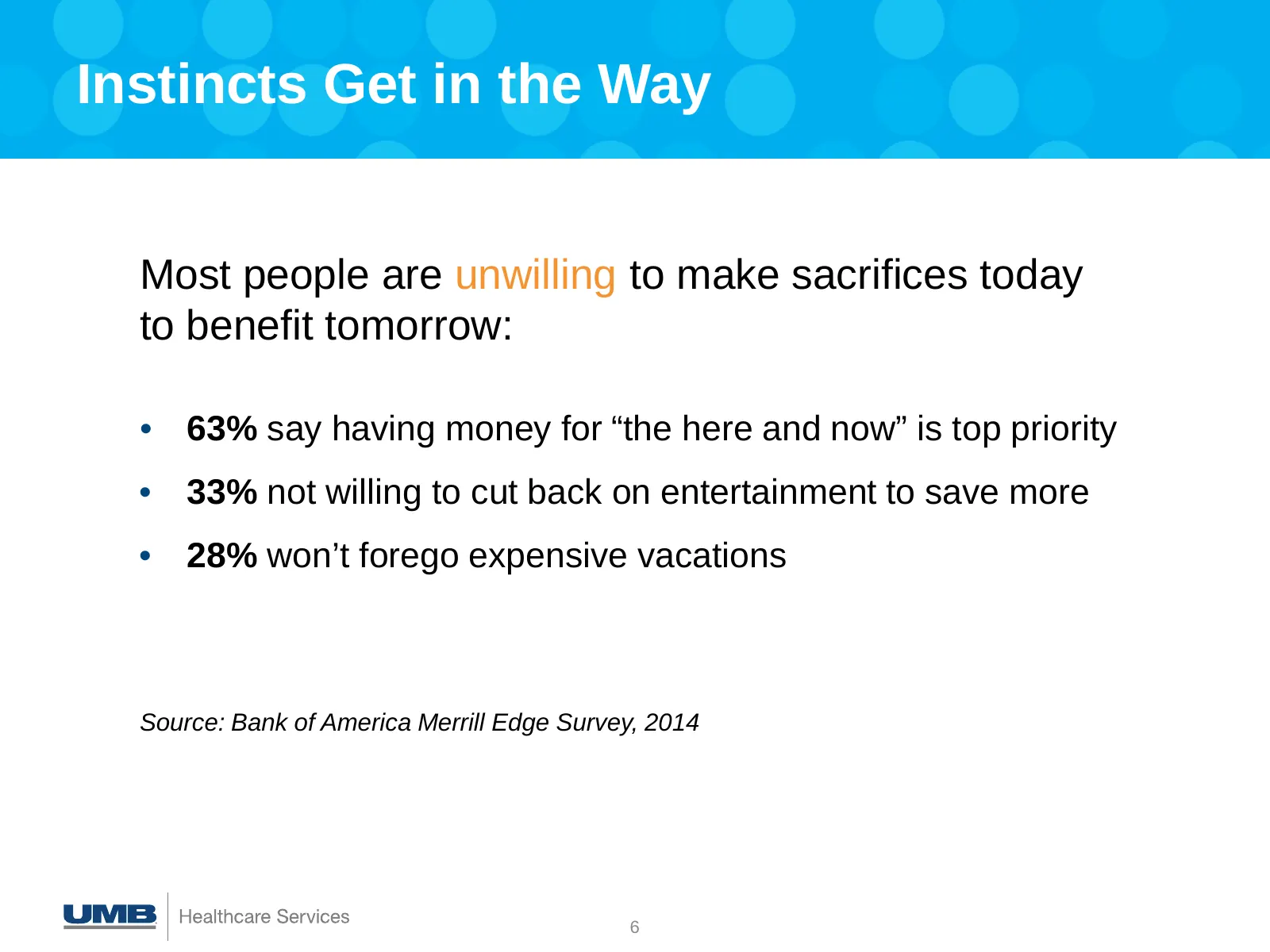
Instincts Get in the Way Most people are unwilling to make sacrifices today to benefit tomorrow: • 63% say having money for “the here and now” is top priority • 33% not willing to cut back on entertainment to save more • 28% won’t forego expensive vacations Source: Bank of America Merrill Edge Surve
Slide 7: The Result
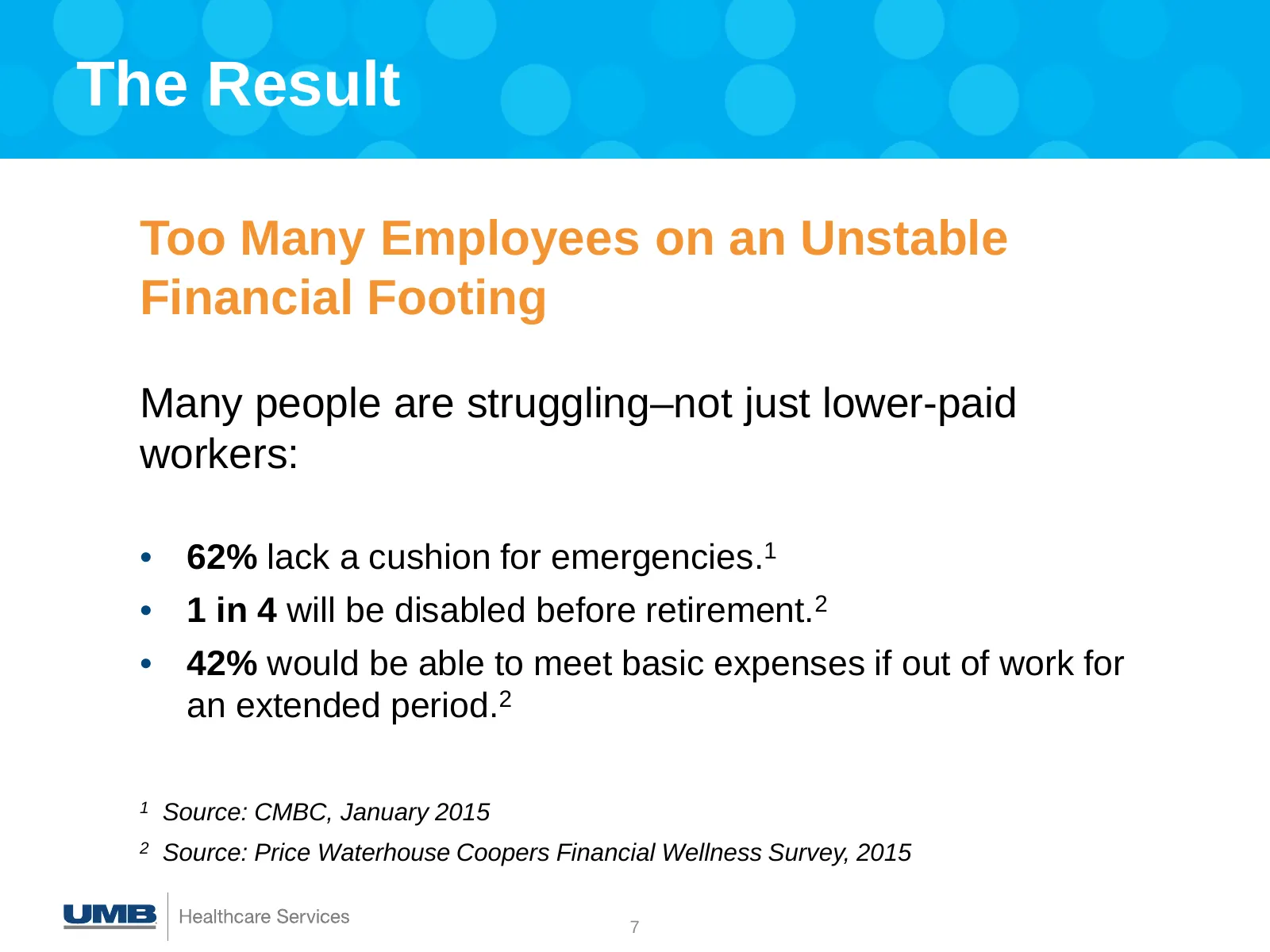
The Result Too Many Employees on an Unstable Financial Footing Many people are struggling–not just lower-paid workers: • 62% lack a cushion for emergencies.1 • 1 in 4 will be disabled before retirement.2 • 42% would be able to meet basic expenses if out of work for an extended period.2 1 Source: CMB
Slide 8: Employers Feeling the Effect
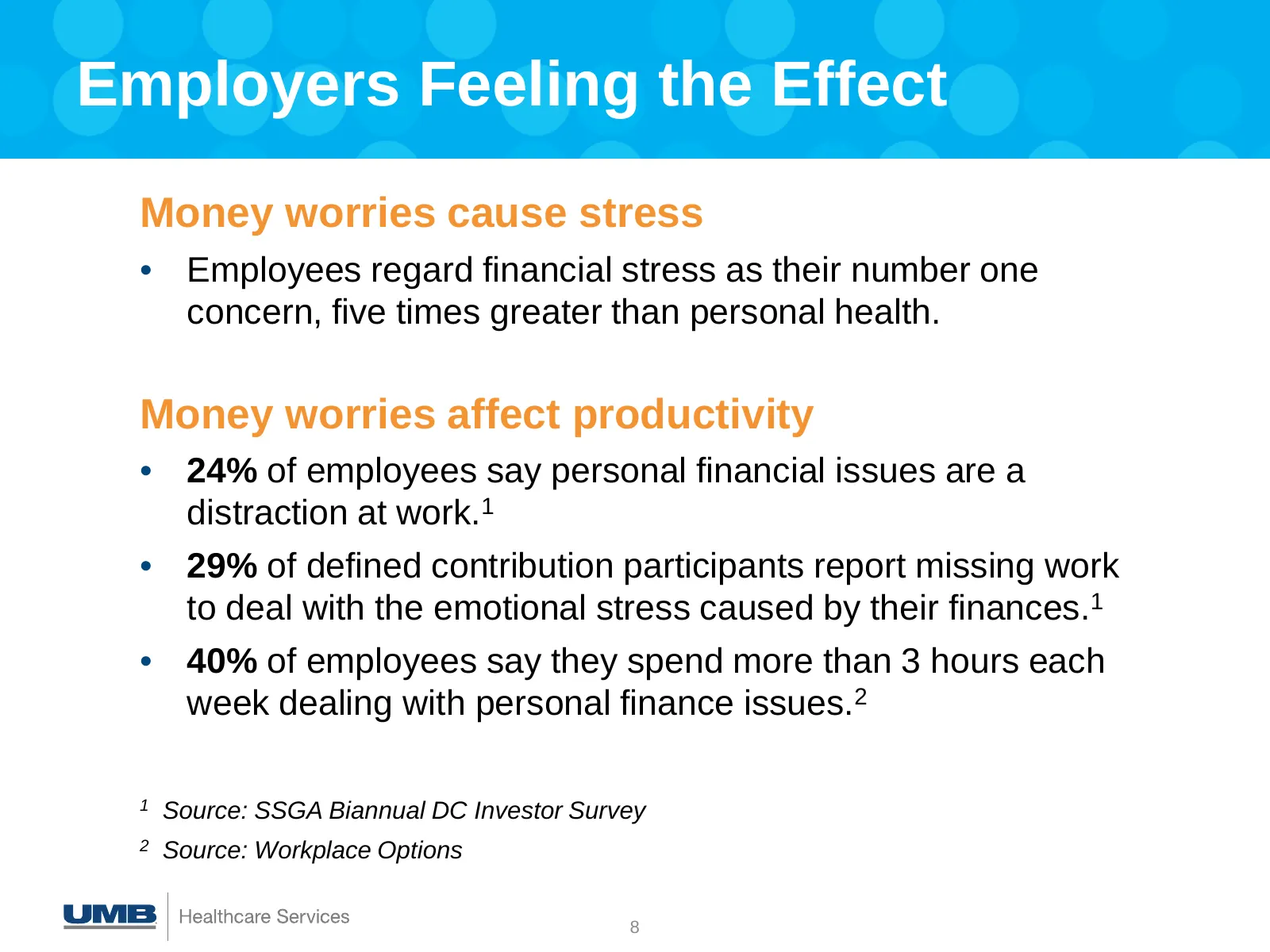
Employers Feeling the Effect Money worries cause stress • Employees regard financial stress as their number one concern, five times greater than personal health. Money worries affect productivity • 24% of employees say personal financial issues are a distraction at work.1 • 29% of defined contributi
Slide 9: HR Professionals Speak Out
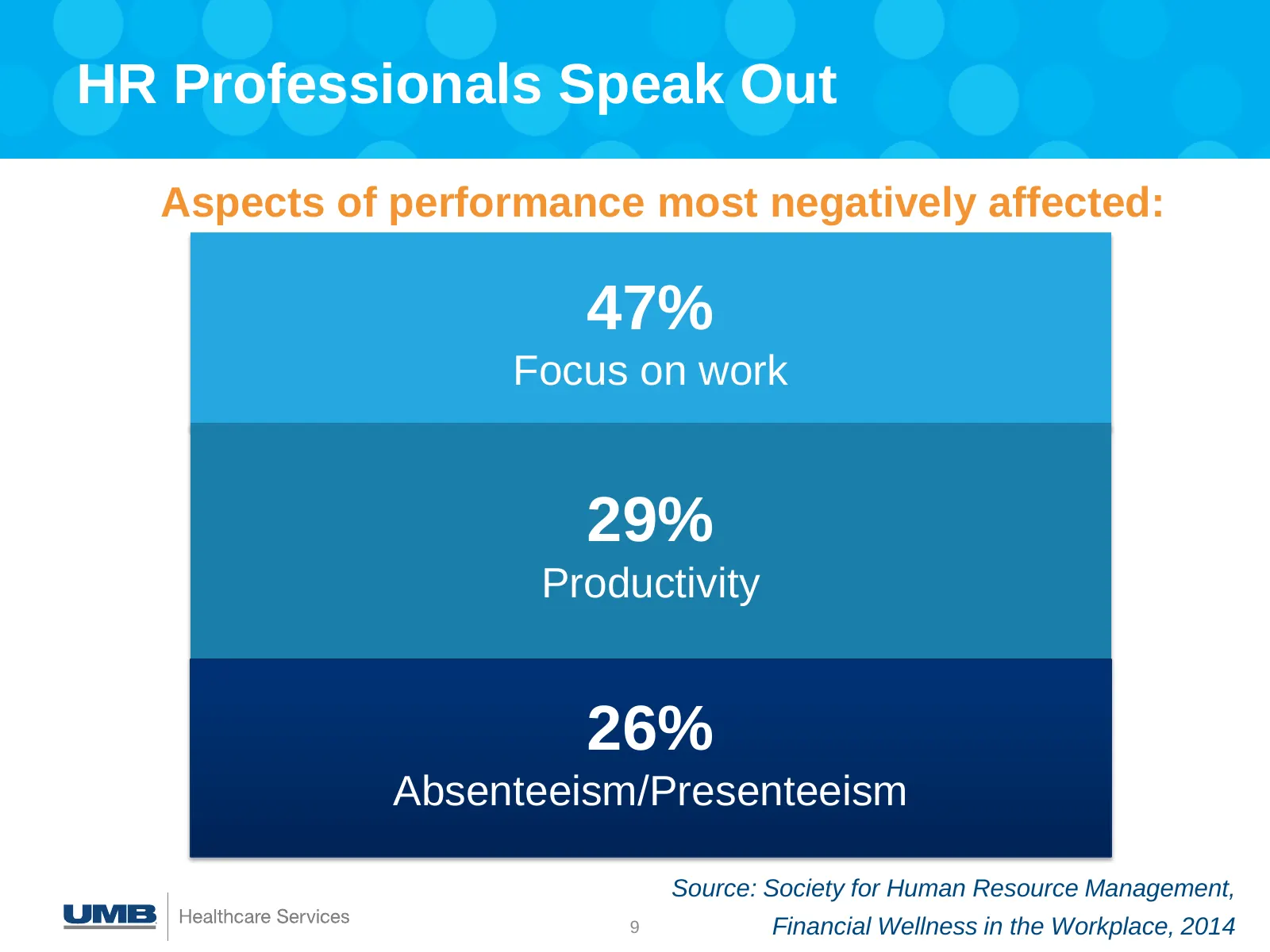
HR Professionals Speak Out Aspects of performance most negatively affected: 47% Focus on work 29% Productivity 26% Absenteeism/Presenteeism Source: Society for Human Resource Management, 9 Financial Wellness in the Workplace, 2014
Slide 10: Everybody Wins
Everybody Wins • Employers well-positioned to help alleviate employees’ financial pressures. • Efficient and affordable solutions. • Affecting change on a large scale. 10
Slide 11: Employees Look to Employers for Help
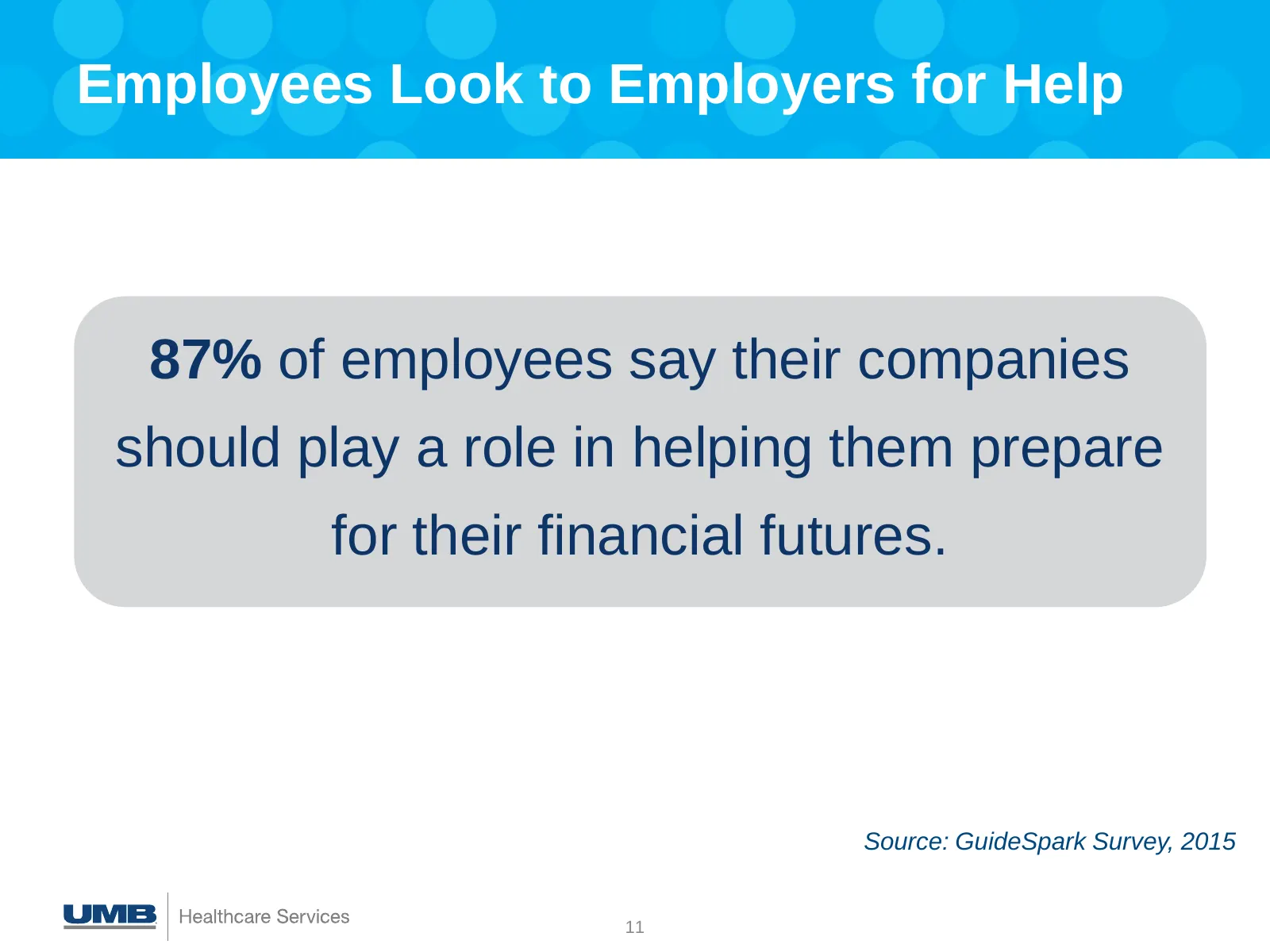
Employees Look to Employers for Help 87% of employees say their companies should play a role in helping them prepare for their financial futures. Source: GuideSpark Survey, 2015 11
Slide 12: What's the Value?
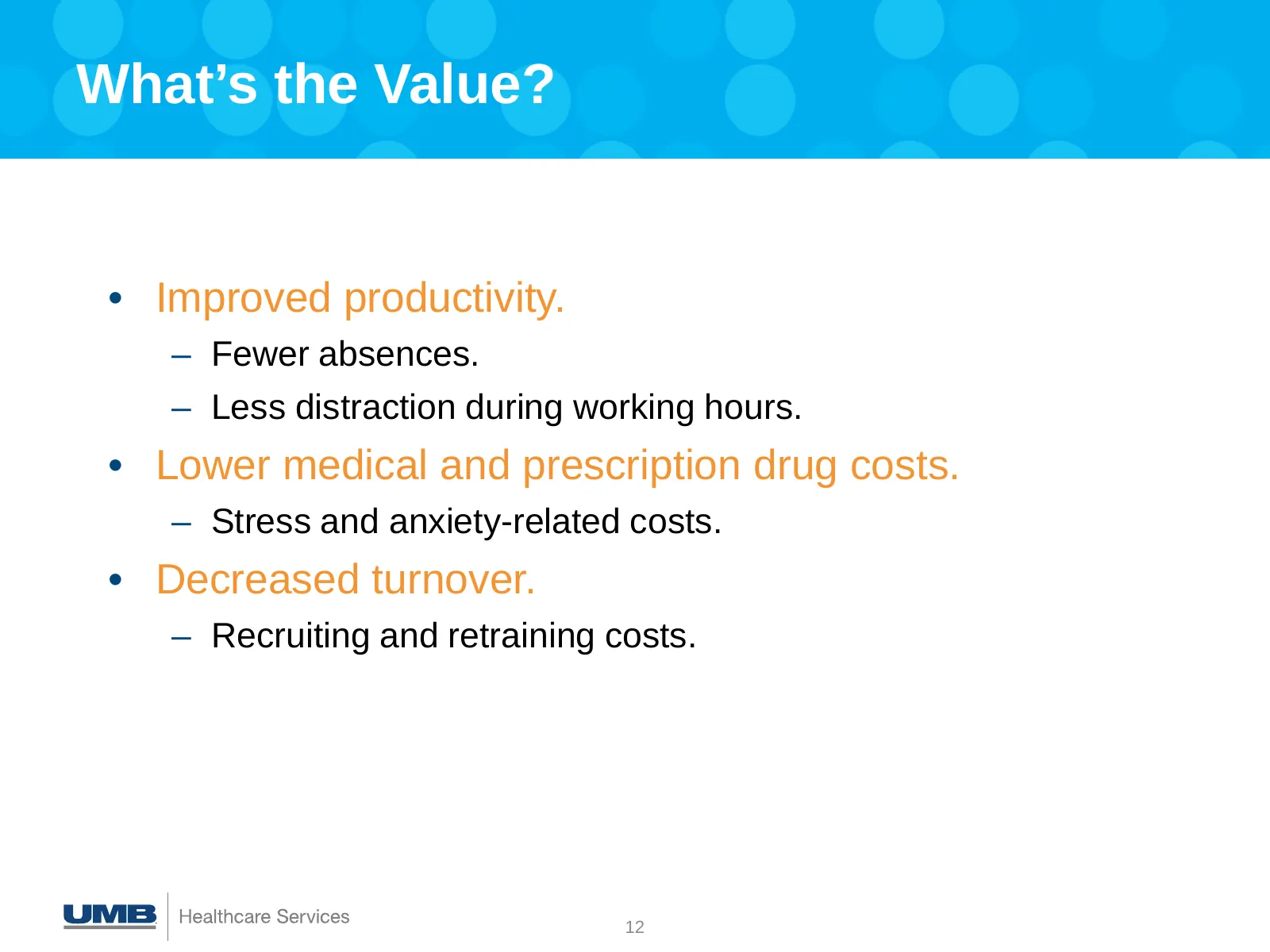
What’s the Value? • Improved productivity. – Fewer absences. – Less distraction during working hours. • Lower medical and prescription drug costs. – Stress and anxiety-related costs. • Decreased turnover. – Recruiting and retraining costs. 12
Slide 13: Poll question #2
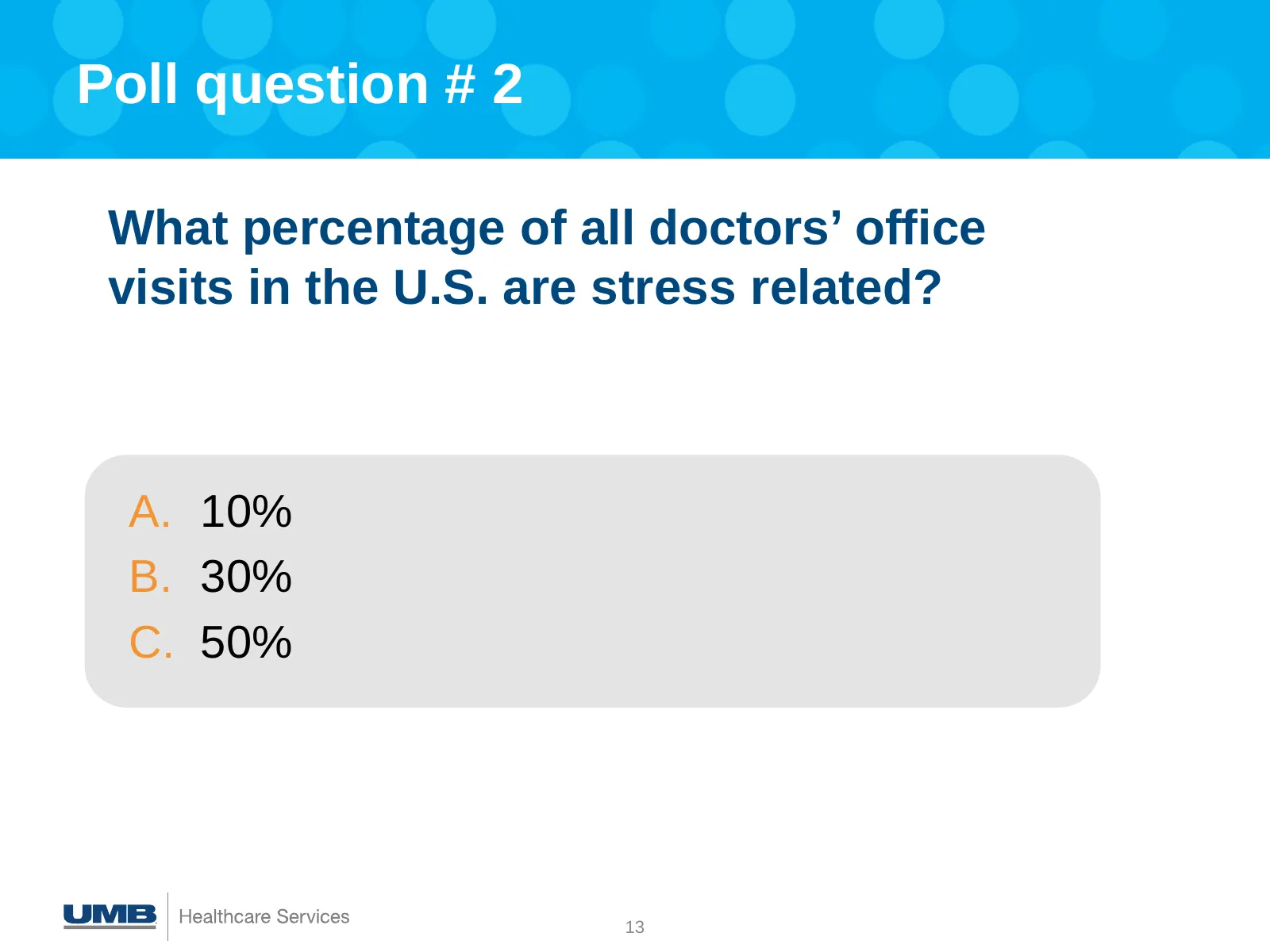
Poll question # 2 What percentage of all doctors’ office visits in the U.S. are stress related? A. 10% B. 30% C. 50% 13
Slide 14: A Prescription for Getting Employees on Track
A Prescription for Getting Employees on Track
Slide 15: Americans are NOT financially secure
Americans are NOT financially secure 15
Slide 16: Americans are NOT Financially Secure.
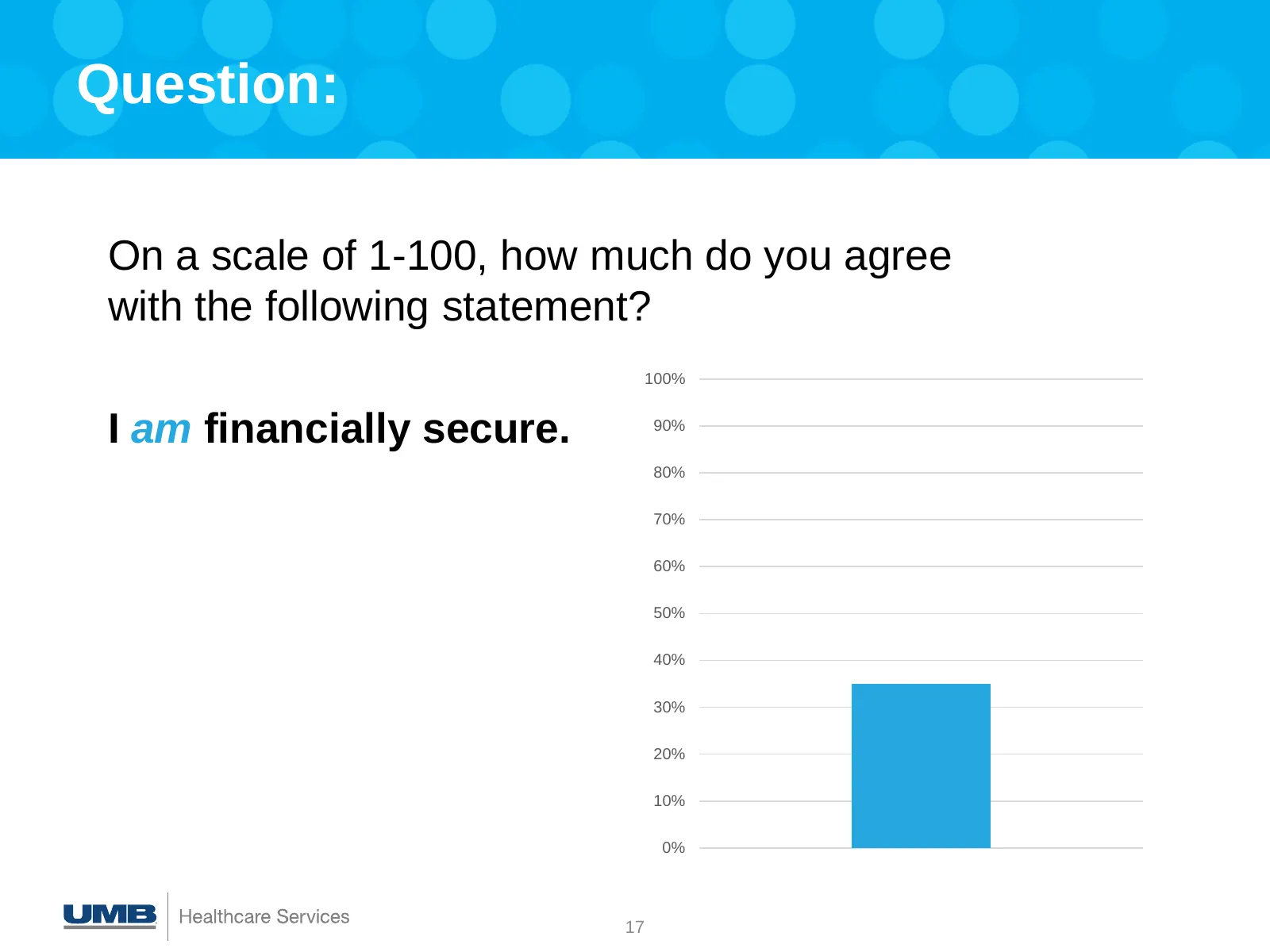
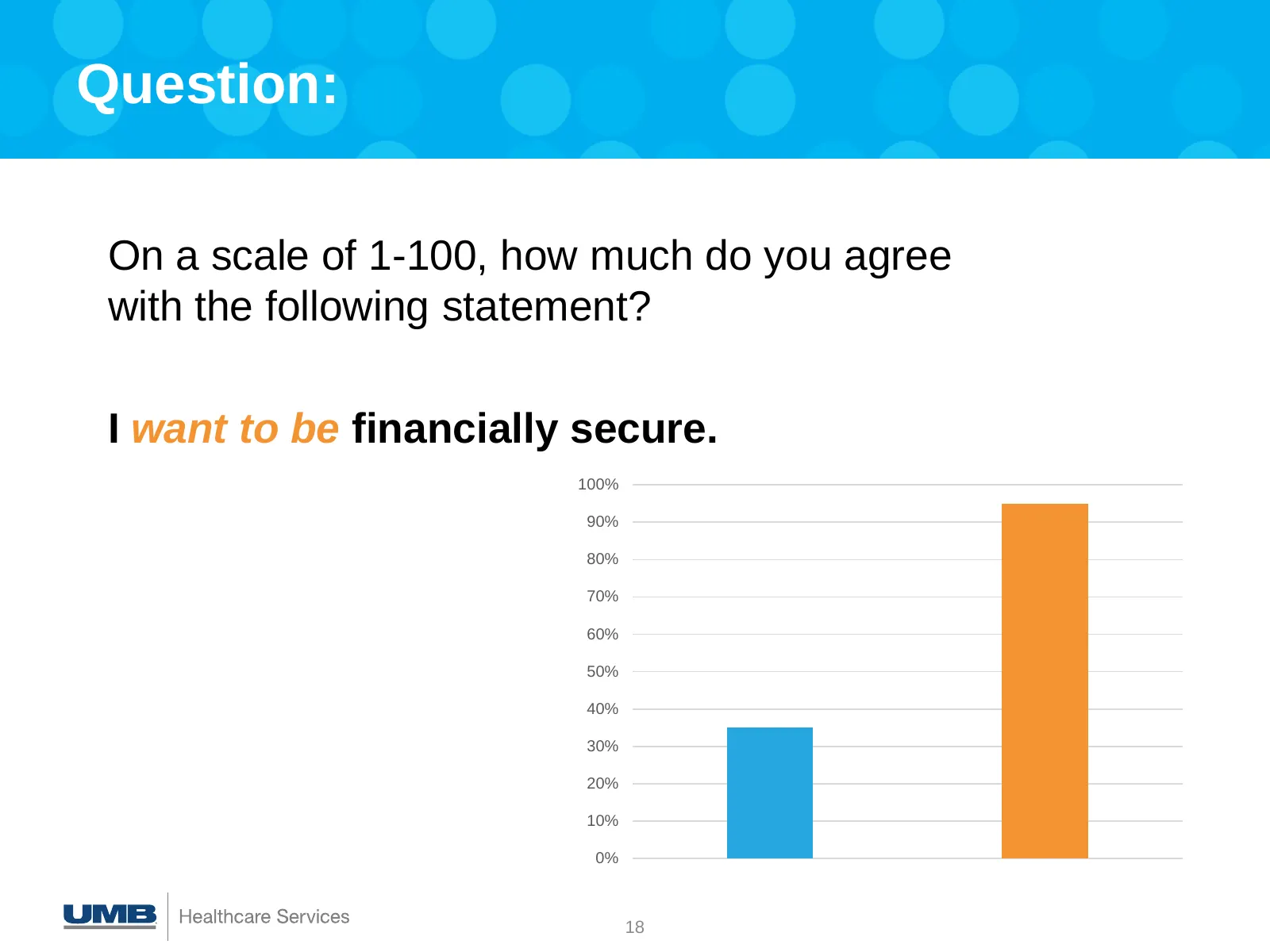
Americans are NOT Financially Secure. In a study of over 800 people in the US, we found that the median savings balance was $2,000 (including retirement accounts), and 36% had $500 or less in savings. 16
Slide 17: Question: I am financially secure
Question: On a scale of 1-100, how much do you agree with the following statement? 100% I am financially secure. 90% 80% 70% 60% 50% 40% 30% 20% 10% 0% 17
Slide 18: Question: I want to be financially secure
Question: On a scale of 1-100, how much do you agree with the following statement? I want to be financially secure. 100% 90% 80% 70% 60% 50% 40% 30% 20% 10% 0% 18
Slide 19: Americans are NOT Financially Secure.
Americans are NOT Financially Secure. Take a moment to think about what specific actions you can take to become more financially secure… Think about actions you can easily start within the next month. 19
Slide 20: 92% listed 3 or more actions
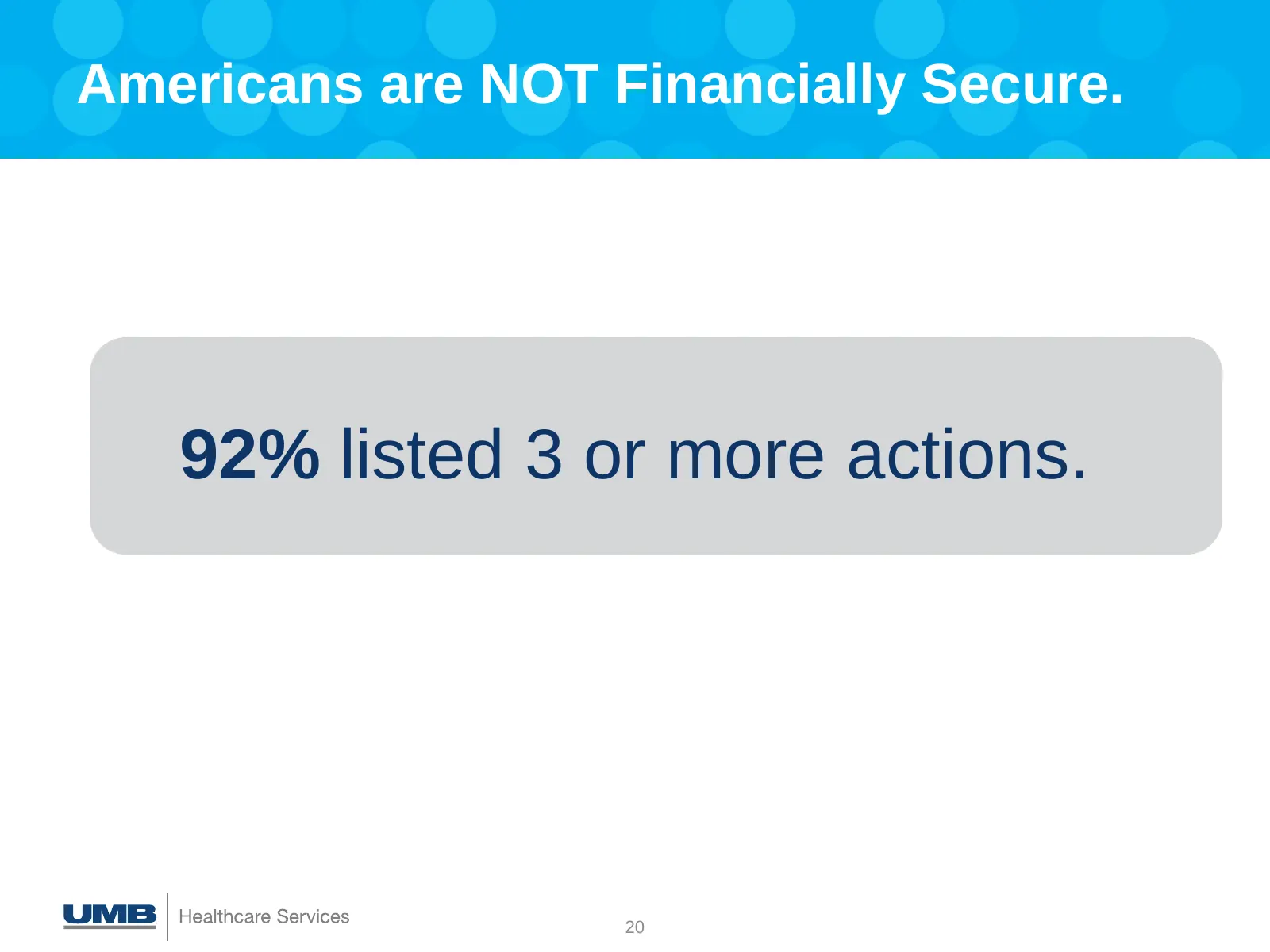
Americans are NOT Financially Secure. 92% listed 3 or more actions. 20
Slide 21: Americans are NOT Financially Secure.
Americans are NOT Financially Secure. People want to be financially secure. They know what to do to become financially secure. Yet, they are not financially secure. 21
Slide 22: Just knowing information does NOT lead to behavior change
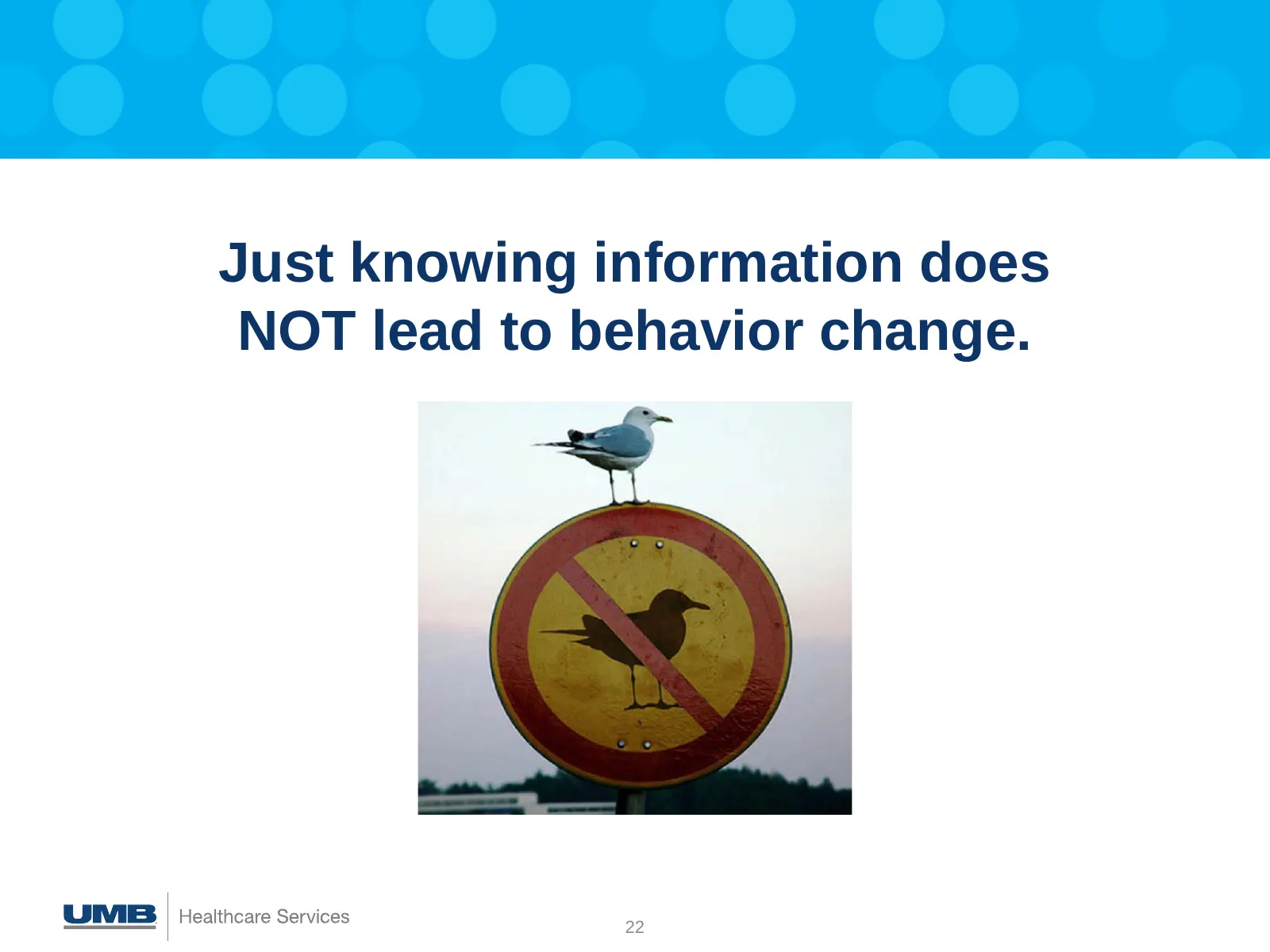
Just knowing information does NOT lead to behavior change. 22
Slide 23: U.S. Government and non-profit agencies spent…
U.S. Government and non-profit agencies spent… 23
Slide 24: $670 million on financial education in 2013
U.S. Government and non-profit agencies spent: $670 million on financial education in 2013. 24
Slide 25: How much variance does financial education explain?
Question: How much variance does financial education explain among good/bad financial behaviors? 25
Slide 26: Change in behavior from financial education
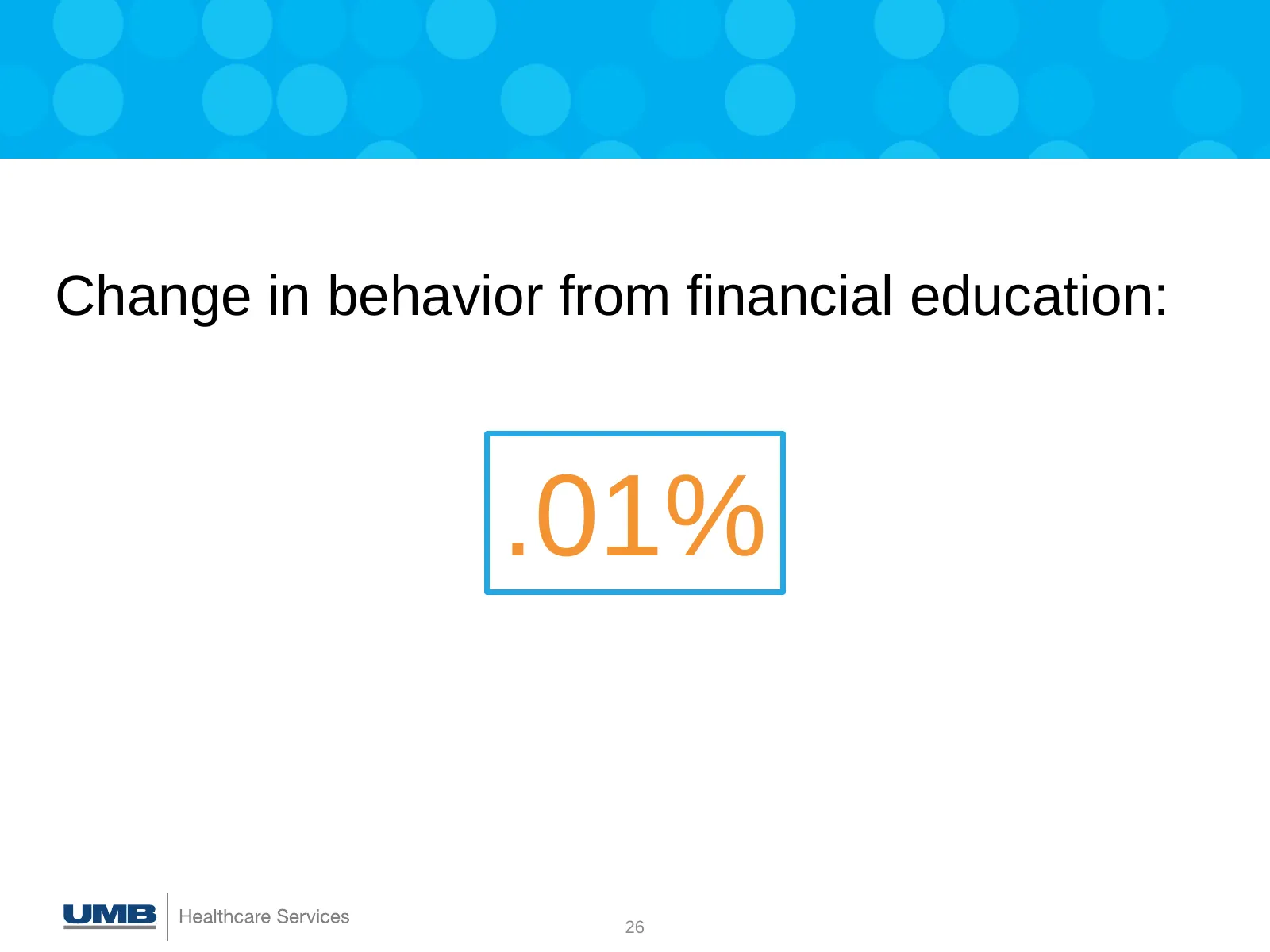
Change in behavior from financial education: .01% 26
Slide 27: But really, my program is different
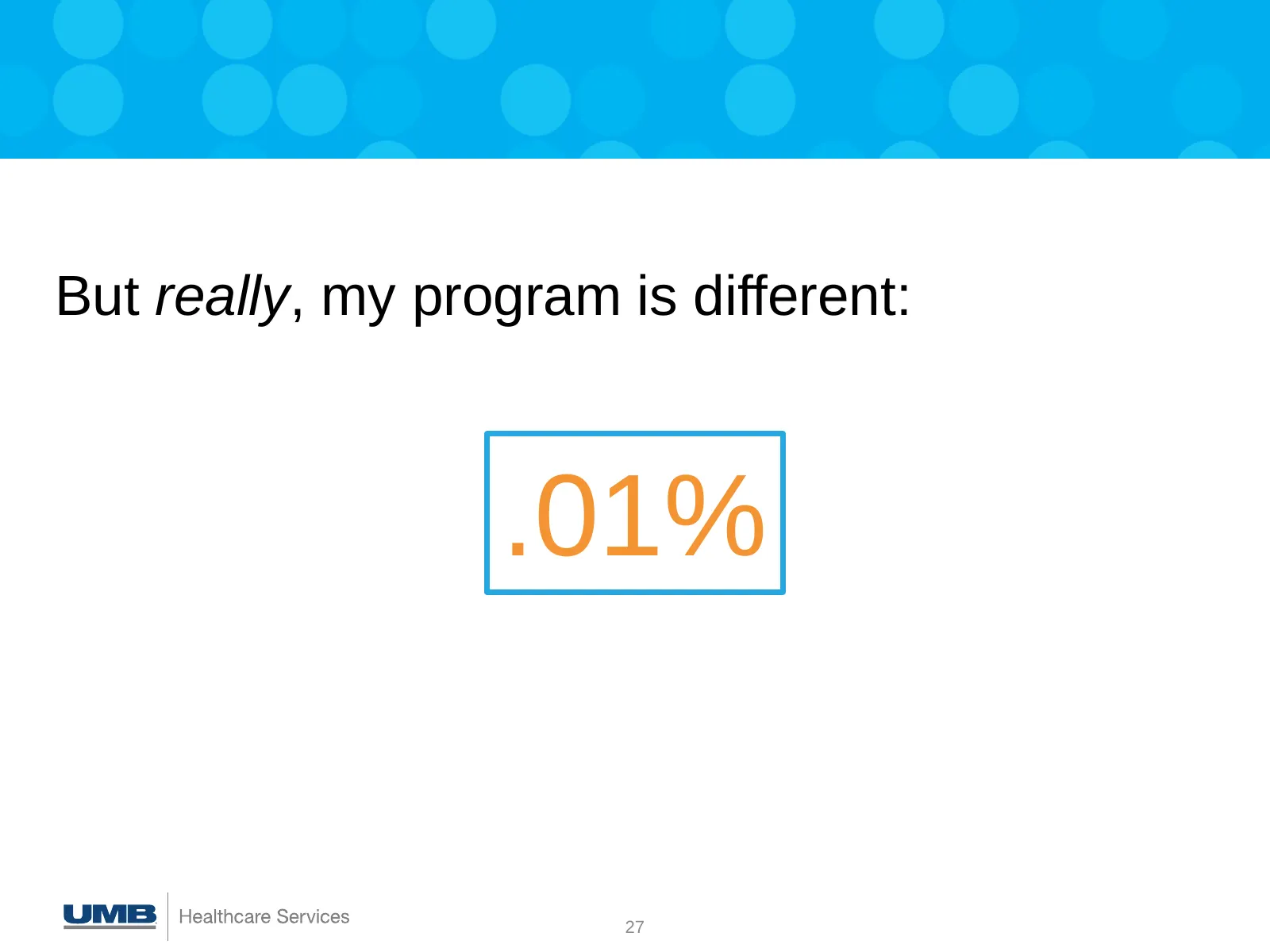
But really, my program is different: .01% 27
Slide 28: Get a Famous Person to do a video
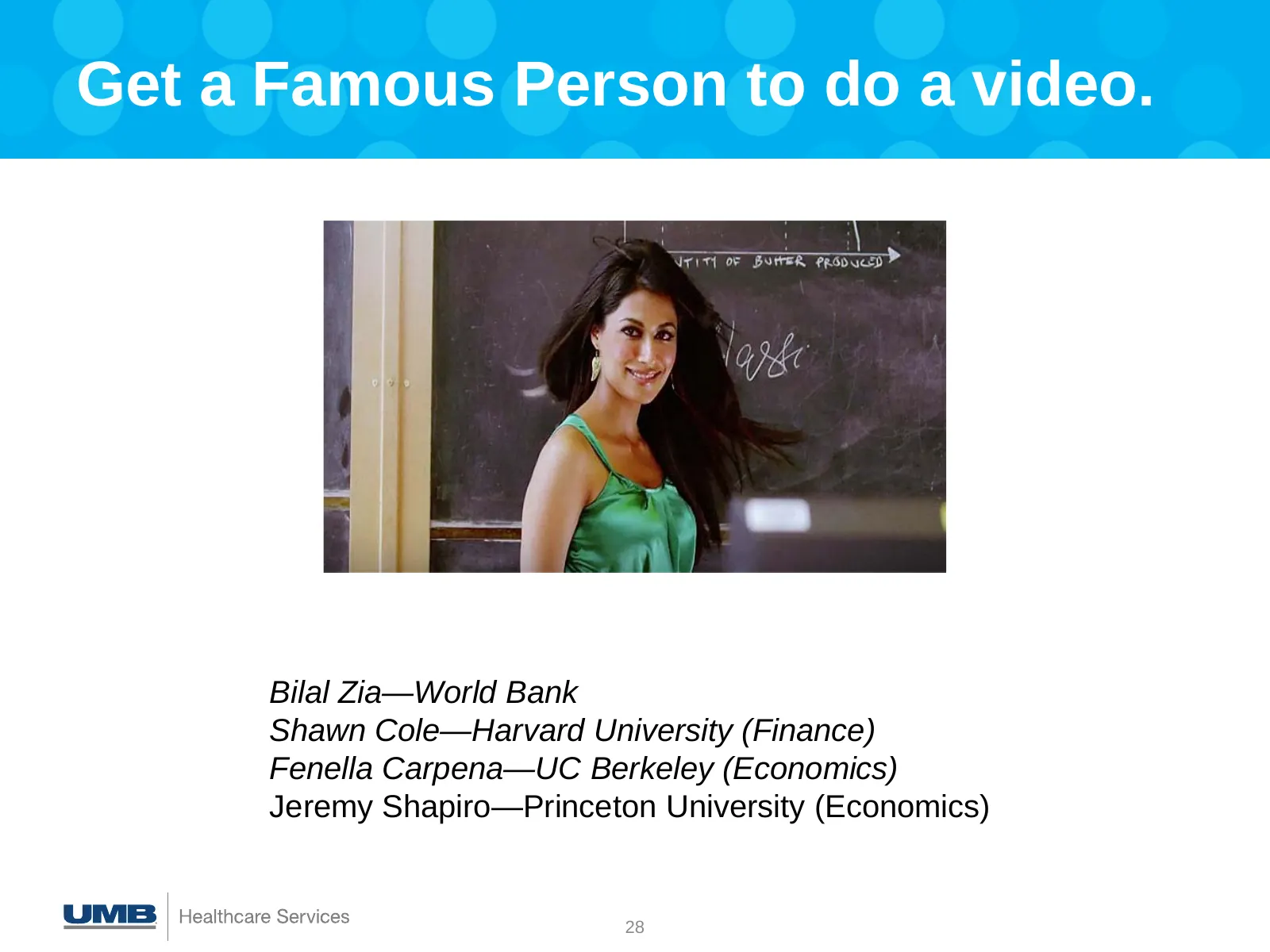
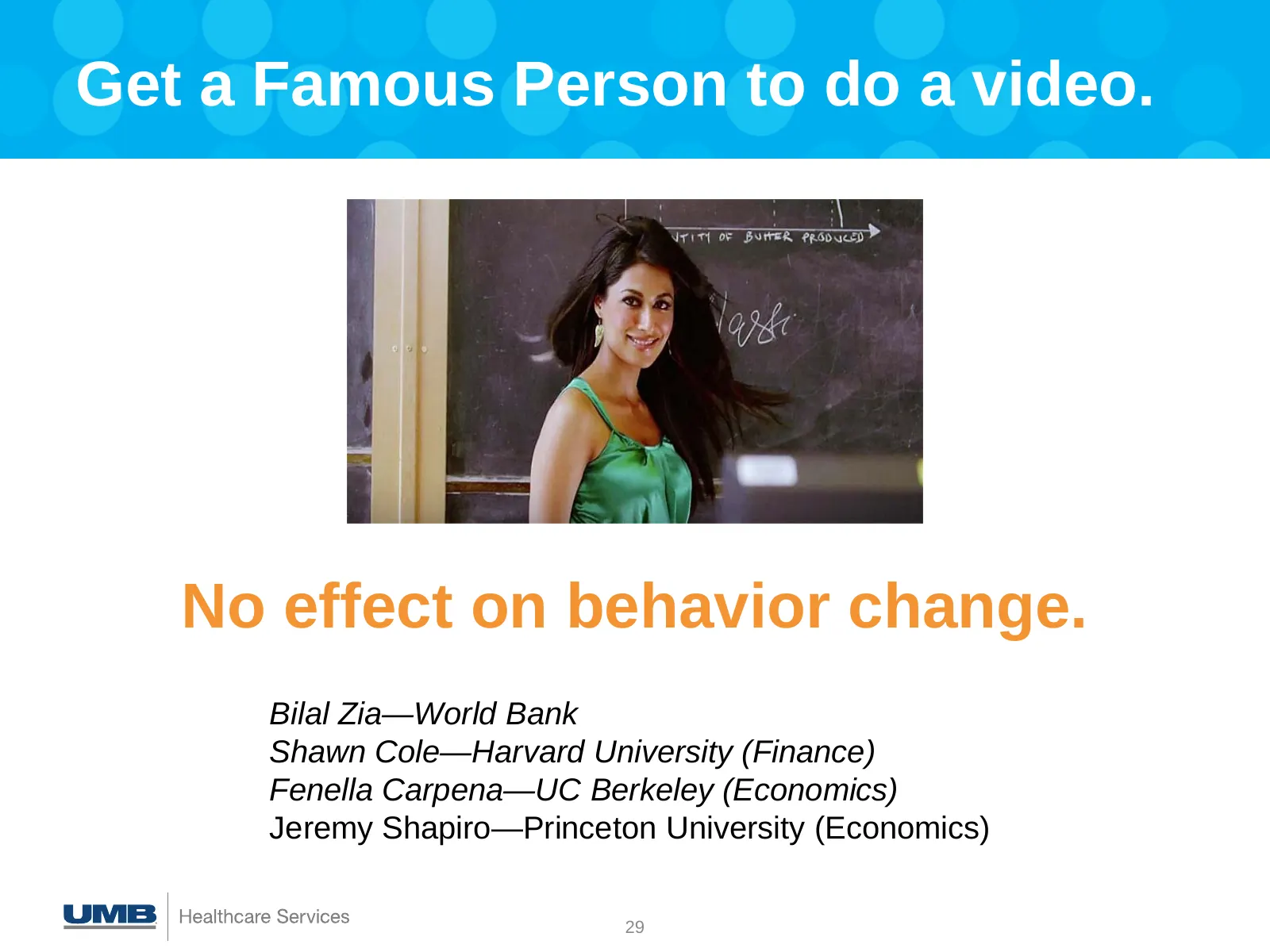
Get a Famous Person to do a video. Bilal Zia—World Bank Shawn Cole—Harvard University (Finance) Fenella Carpena—UC Berkeley (Economics) Jeremy Shapiro—Princeton University (Economics) 28
Slide 29: Get a Famous Person to do a video. No effect
Get a Famous Person to do a video. No effect on behavior change. Bilal Zia—World Bank Shawn Cole—Harvard University (Finance) Fenella Carpena—UC Berkeley (Economics) Jeremy Shapiro—Princeton University (Economics) 29
Slide 30: What Does Work?
What Does Work? UMNIB | Healthcare Services
Slide 31: When is the best time to ask people to take action?
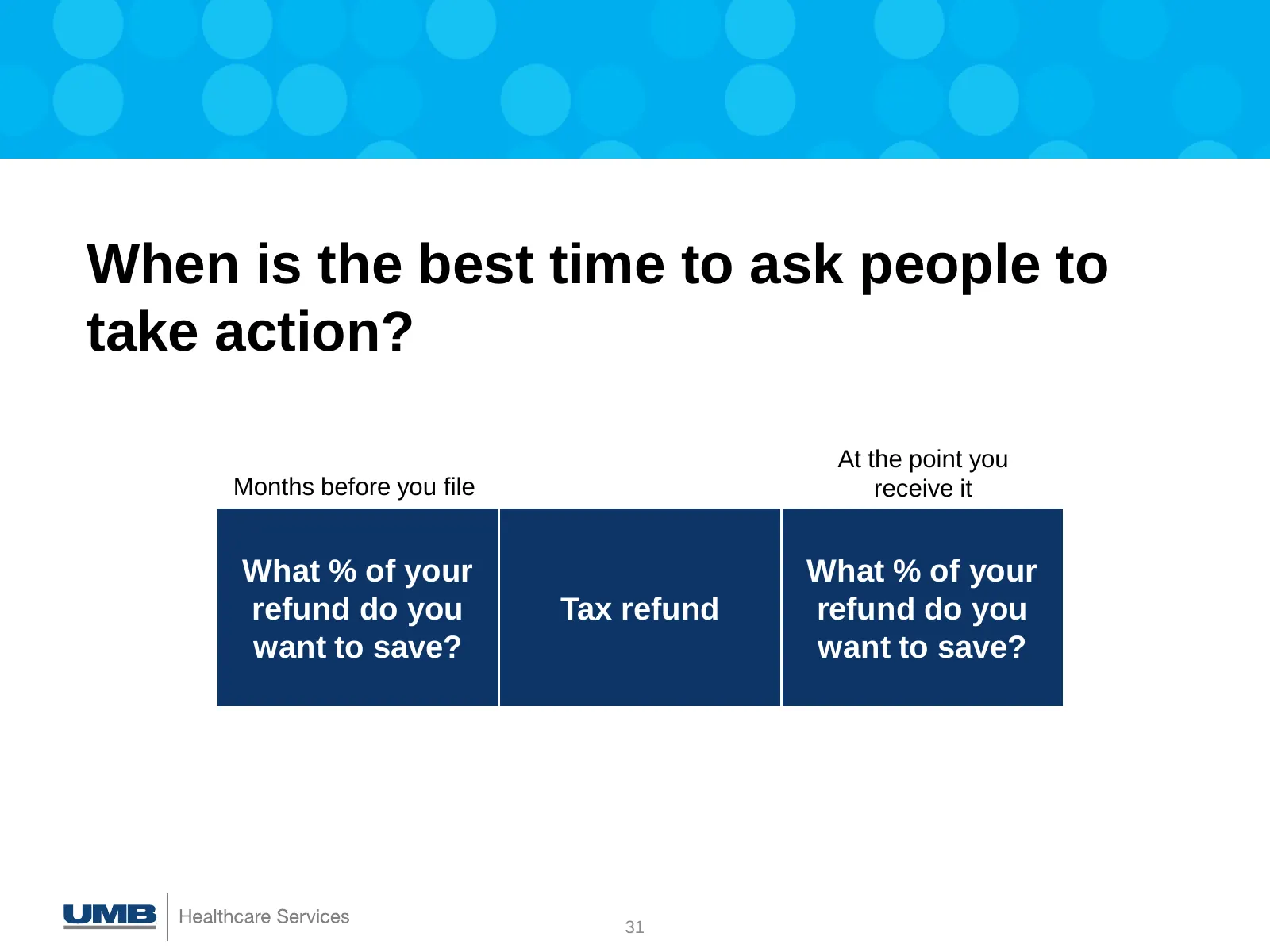
When is the best time to ask people to take action? At the point you Months before you file receive it What % of your What % of your refund do you Tax refund refund do you want to save? want to save? 31
Slide 32: When is the best time to ask people to take action?
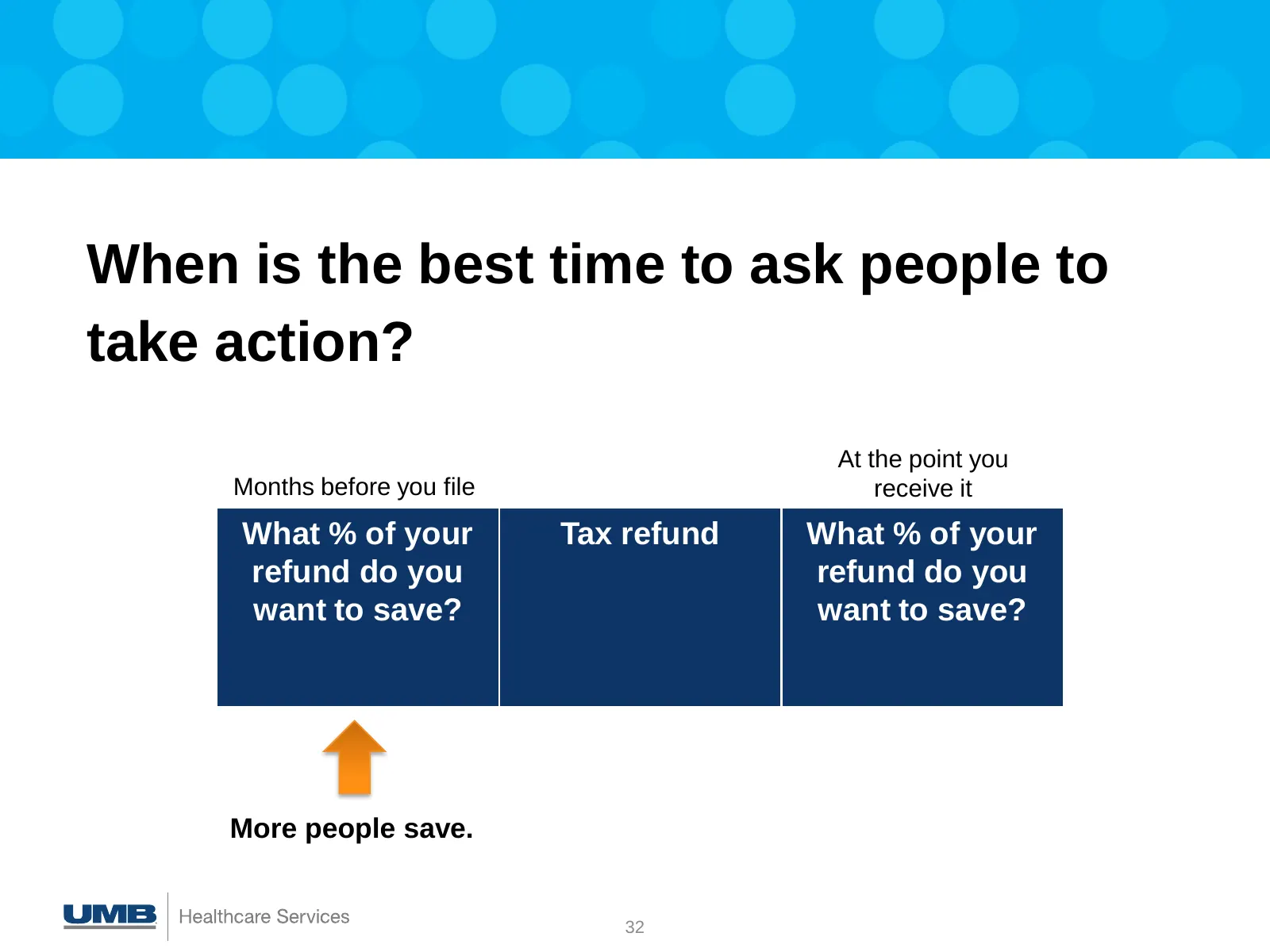
When is the best time to ask people to take action? At the point you Months before you file receive it What % of your Tax refund What % of your refund do you refund do you want to save? want to save? More people save. 32
Slide 33: Pre-commitment
(1) Pre-commitment UMNIB | Healthcare Services
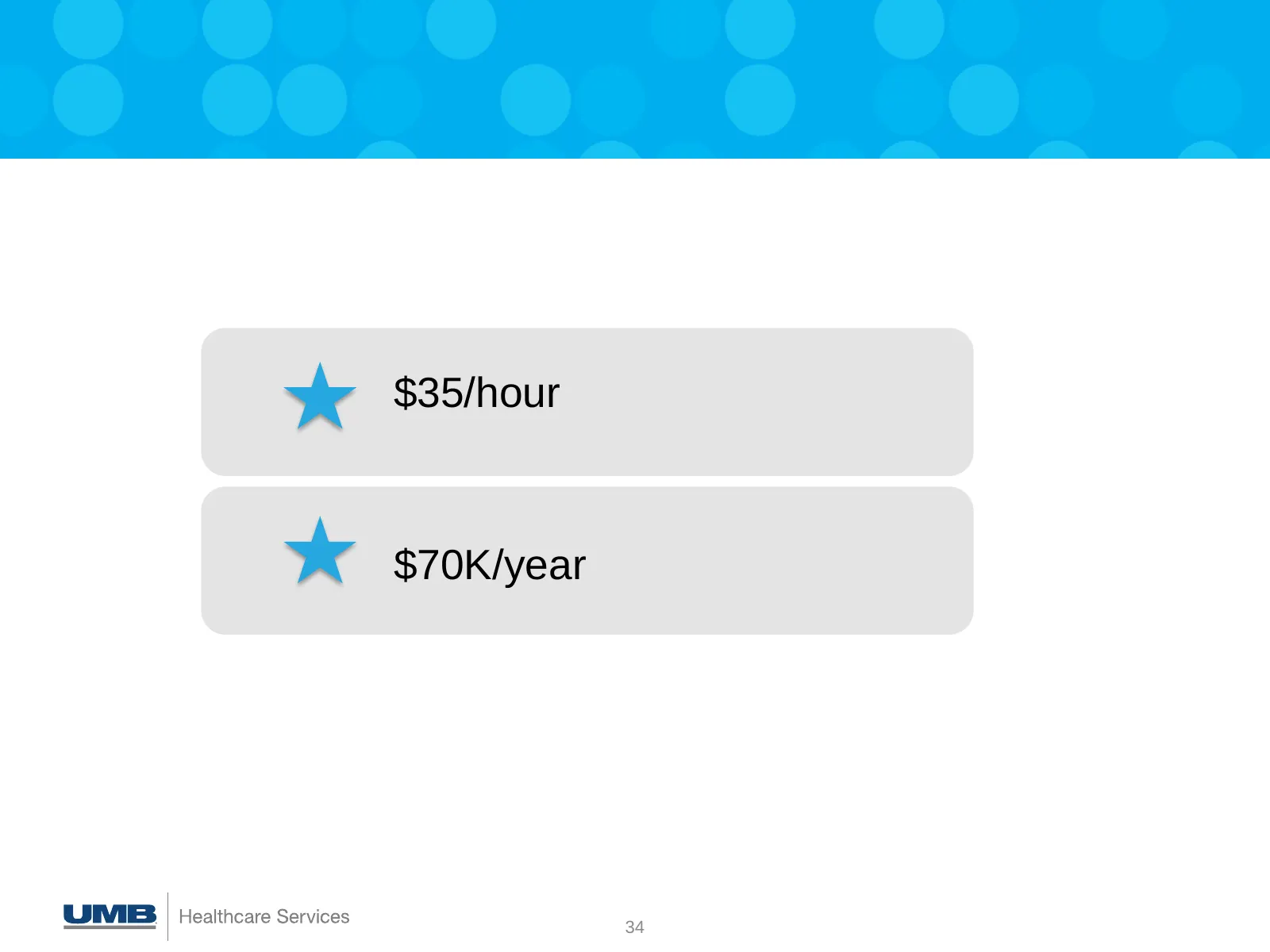
Slide 34: $35/hour $70K/year
UMNIB | Healthcare Services 34
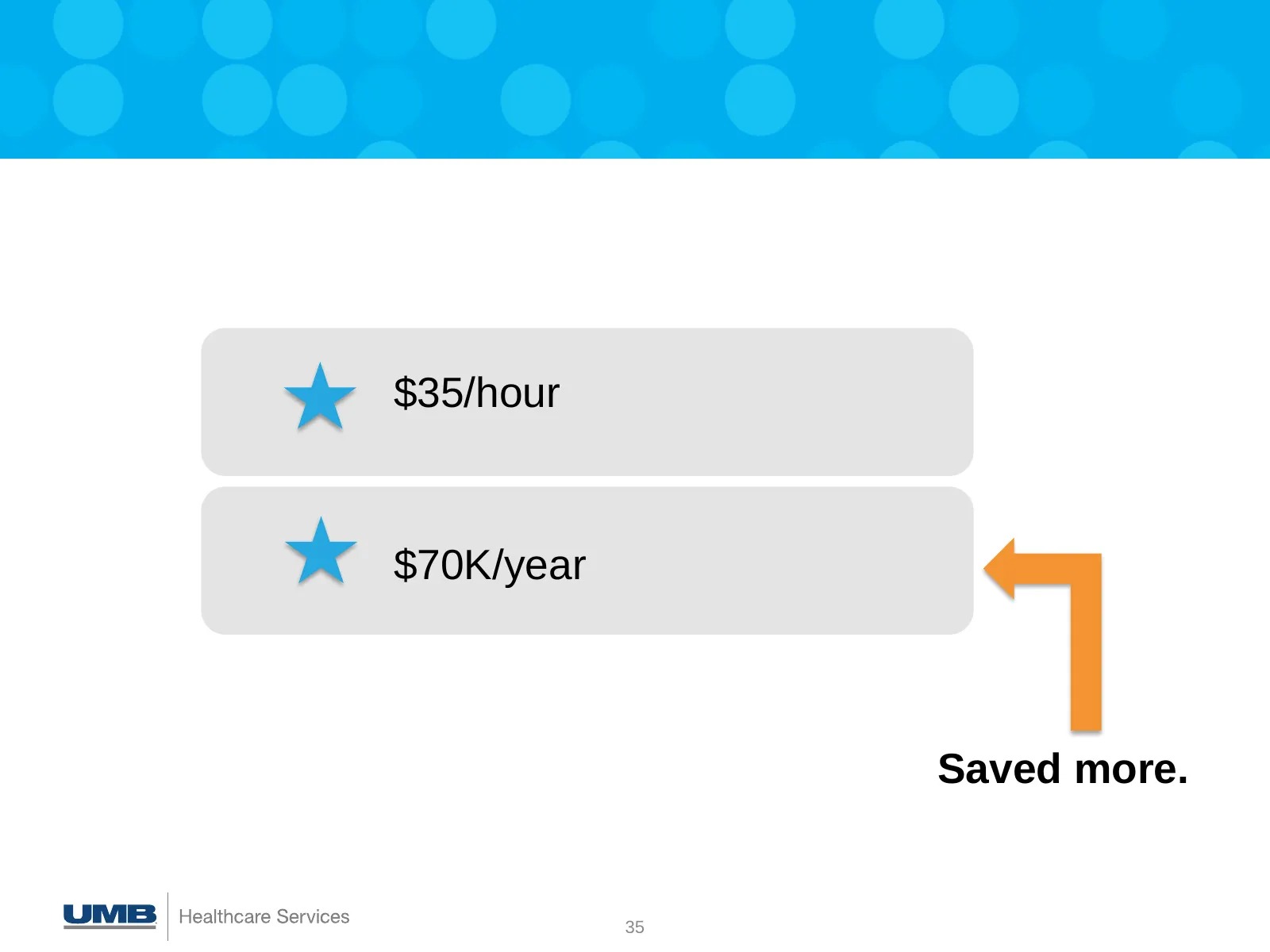
Slide 35: $35/hour $70K/year Saved more.
$35/hour $70K/year Saved more. 35
Slide 36: Long-term mindset
2 Long-term mindset 36
Slide 37: Mortgage Education
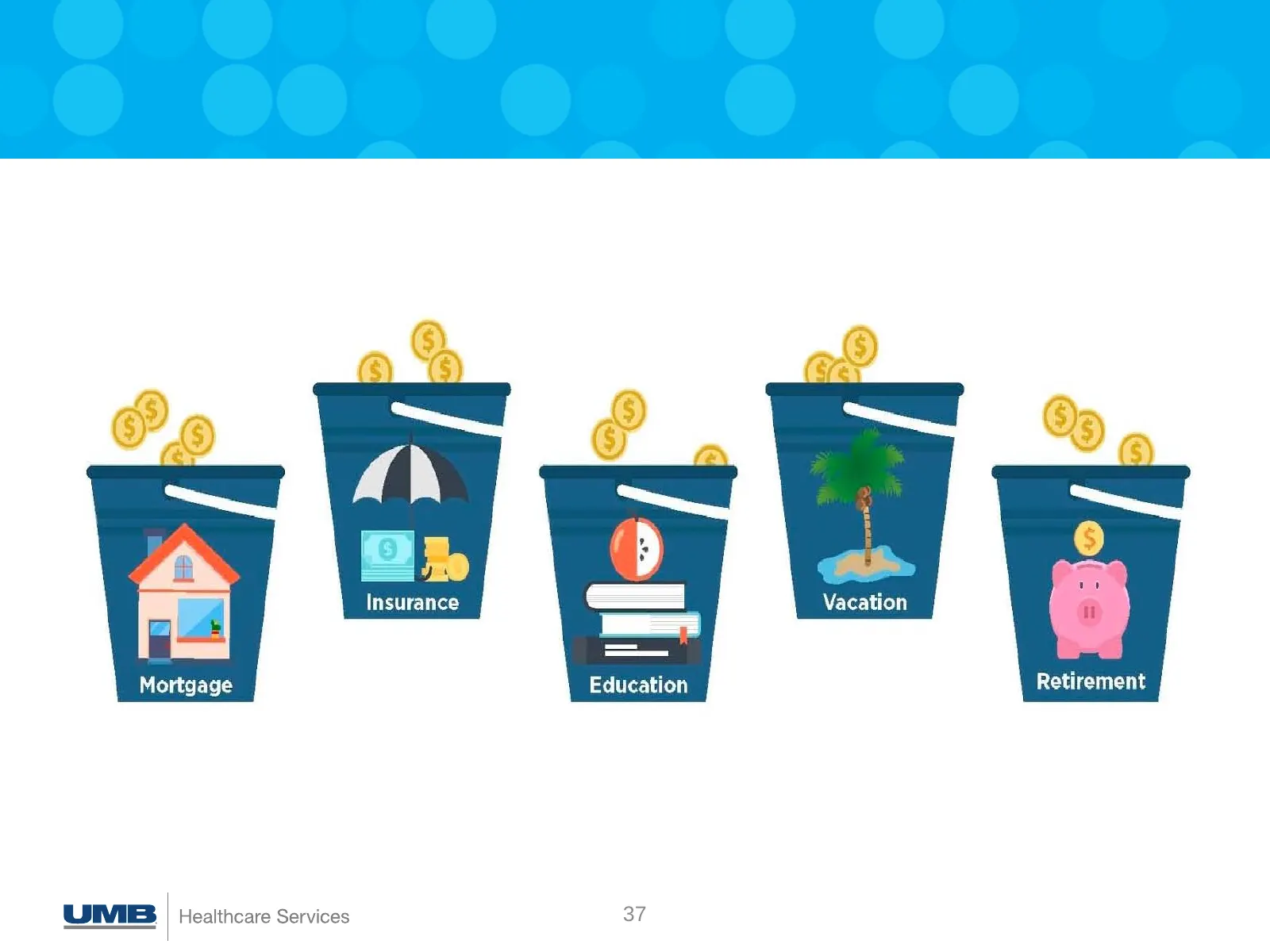
Mortgage Education UMNIB | Healthcare Services 37
Slide 38: Design for Mental Accounting
3 Design for Mental Accounting 38
Slide 39: Poll question #3
Poll question # 3 What percentage of your employer groups offers a financial wellness program? A. Less than 25% B. 26-50% C. 51-75% D. More than 75% 39
Slide 40: Health Savings Accounts: The Unsung Heroes of Financial Wellness
Health Savings Accounts: The Unsung Heroes of Financial Wellness
Slide 41: Financing the Future
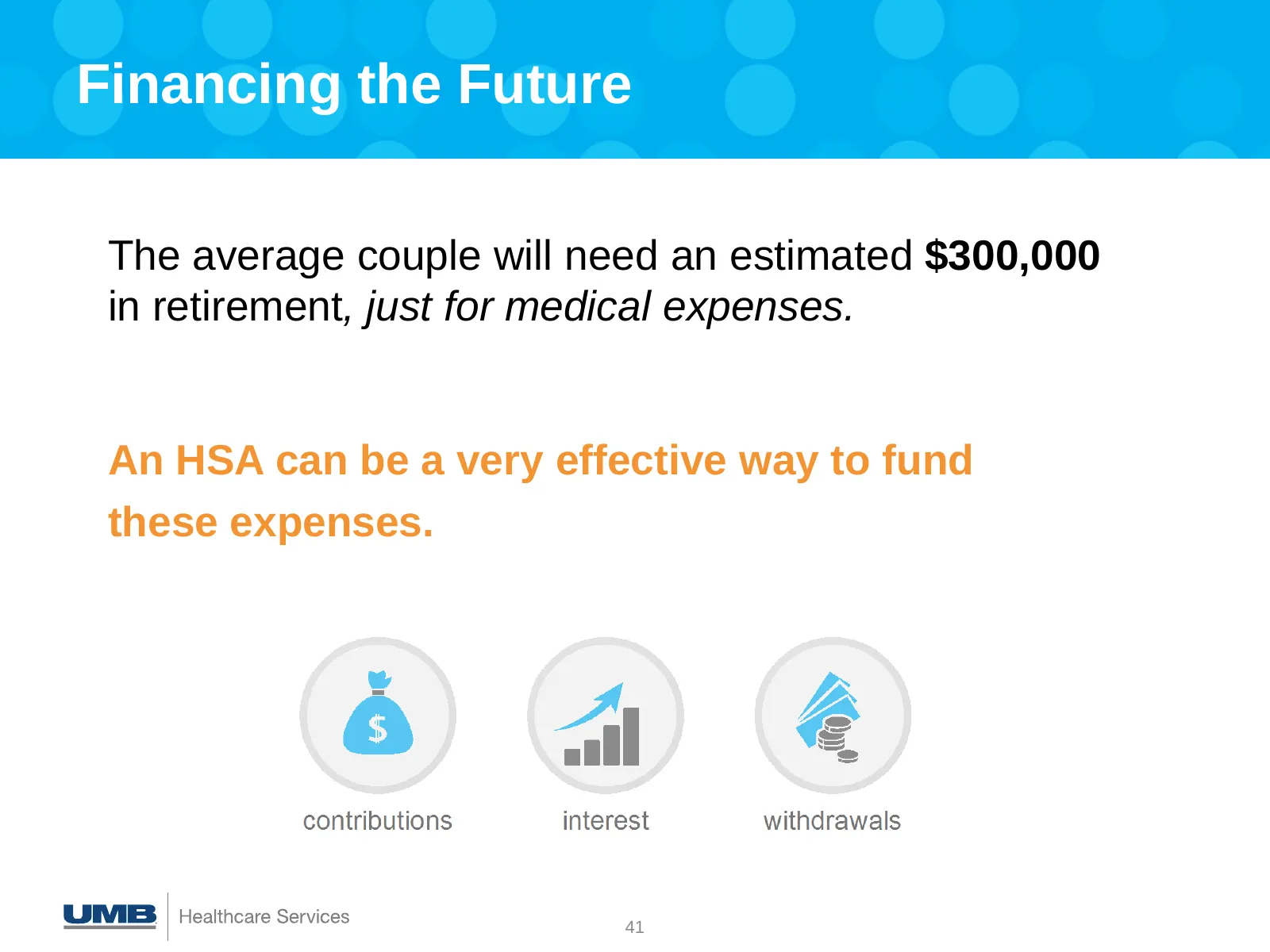
Financing the Future The average couple will need an estimated $300,000 in retirement, just for medical expenses. An HSA can be a very effective way to fund these expenses. 41
Slide 42: High-deductible health plans + HSAs = meaningful savings
High-deductible health plans + Health Savings Accounts = meaningful savings • 20% of American consumers carry medical debt. • HSA can create a cash cushion for today and meaningful savings for the future. 42
Slide 43: Spend for Today, Save for Tomorrow
Spend for Today, Save for Tomorrow Only 16% of employees contributing to an HSA plan to use the funds for future healthcare costs. 43
Slide 44: Maximize Potential
Maximize Potential Shift the emphasis to maximizing the HSA: – Tax-free savings and withdrawals – Investment options – Long-term growth potential *All mention of taxes is made in reference to federal tax law. States can choose to follow the federal tax-treatment guidelines for HSAs or establish thei
Slide 45: Capable Custodians
Capable Custodians HSA custodians should clearly operate in the client’s best interests. 1. Free transparency 2. Financial security 3. Support employer goals 4. Hassle-free administration 5. Actionable analytics 6. Straightforward pricing 7. Consumer-friendly features 45
Slide 46: Additional Resources: UMB
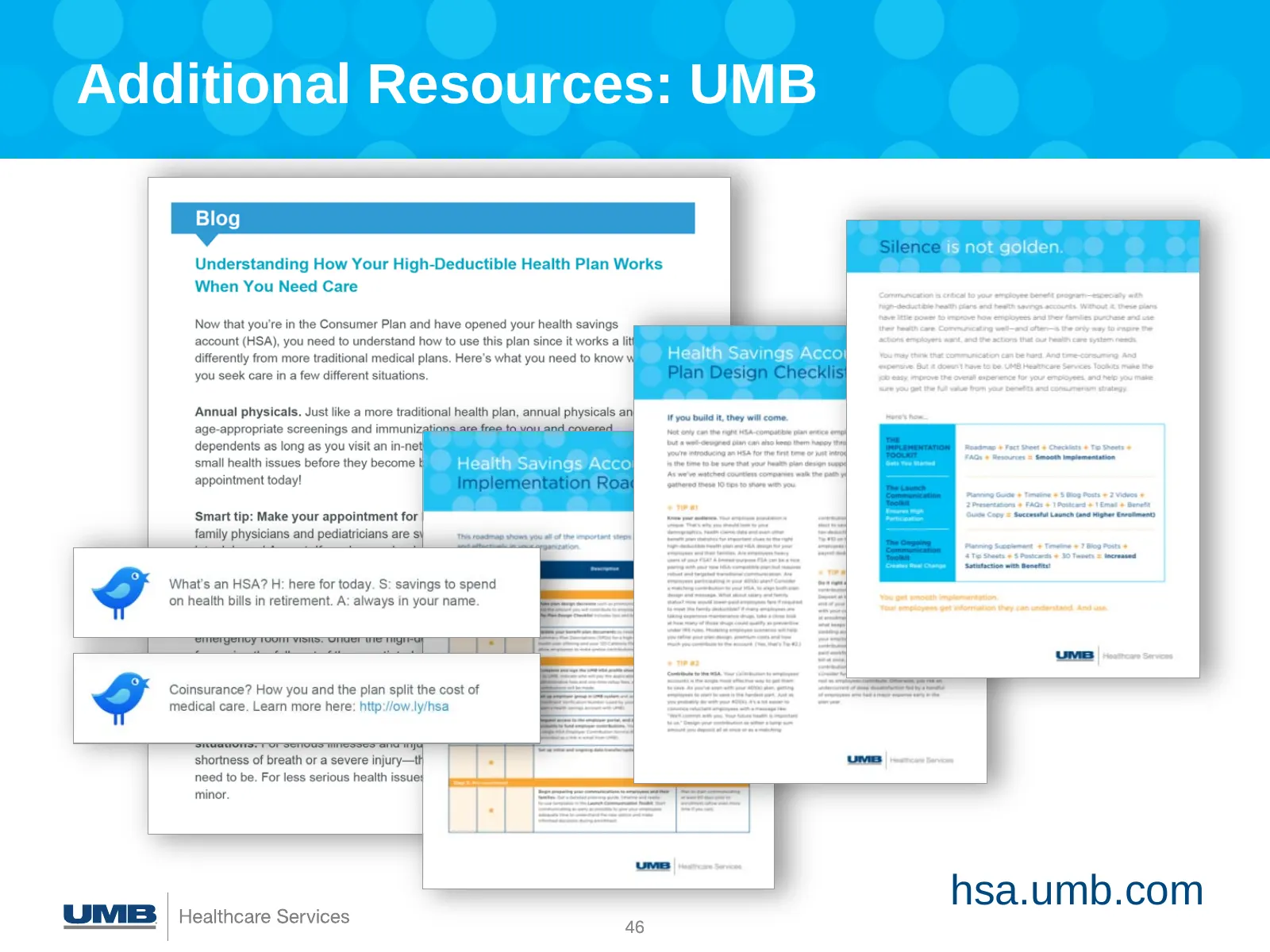
Additional Resources: UMB hsa.umb.com 46
Slide 47: Q & A
Q&A Type in your question at any time for the presenters 47
Slide 48: Thank you for participating!
Thank you for participating! hsa.umb.com Ben Morris Thank you for participating! President, UMB Healthcare Services ben.morris@umb.com Gerry Hollis Kristen Berman Global Sales Director, Co-Founder & Head of Product, Blooom Common Cents Lab Co-Founder, Irrational Labs gerry@blooom.com kristen@commonc
Source: Internet Archive copy of hsa.umb.com
More decks from UMB Financial Corporation
 Q3 2026 Earnings Presentation53 slides · Oct 28, 2026
 Merger or Acquisition (October 2026)8 slides · Oct 27, 2026
 Q2 2026 Earnings Presentation54 slides · Jul 28, 2026
 Q1 2026 Earnings Presentation56 slides · Apr 29, 2026
 Shareholder Meeting (April 2026)13 slides · Apr 28, 2026
 Q4 2025 Earnings Presentation56 slides · Jan 28, 2026