VolitionRx Limited · AMEX:VNRX
VolitionRx — Webinar Feb 2022
61 slides from VolitionRx's conference presentation, February 2022

Slide 1: The Future of Cancer Diagnosis
The Future of Cancer Diagnosis Heather Wilson Robles, DVM DACVIM (Oncology) Sue Ettinger, DVM DACVIM (Oncology) Volition Veterinary Diagnostics Development© 2022 2021
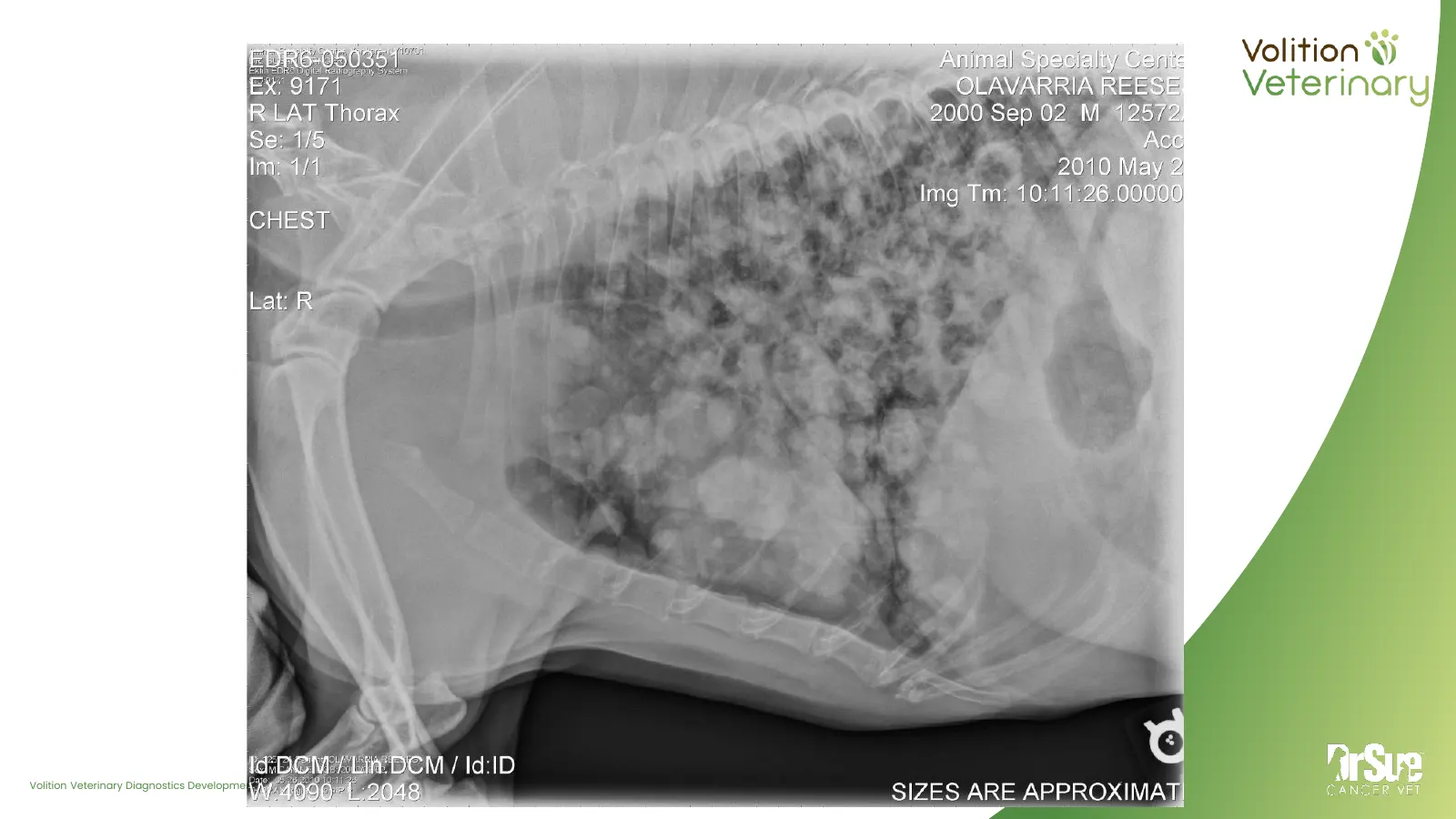
Slide 2: Volition Veterinary Diagnostics Development © 2021
Volition Veterinary Diagnostics Development© 2021
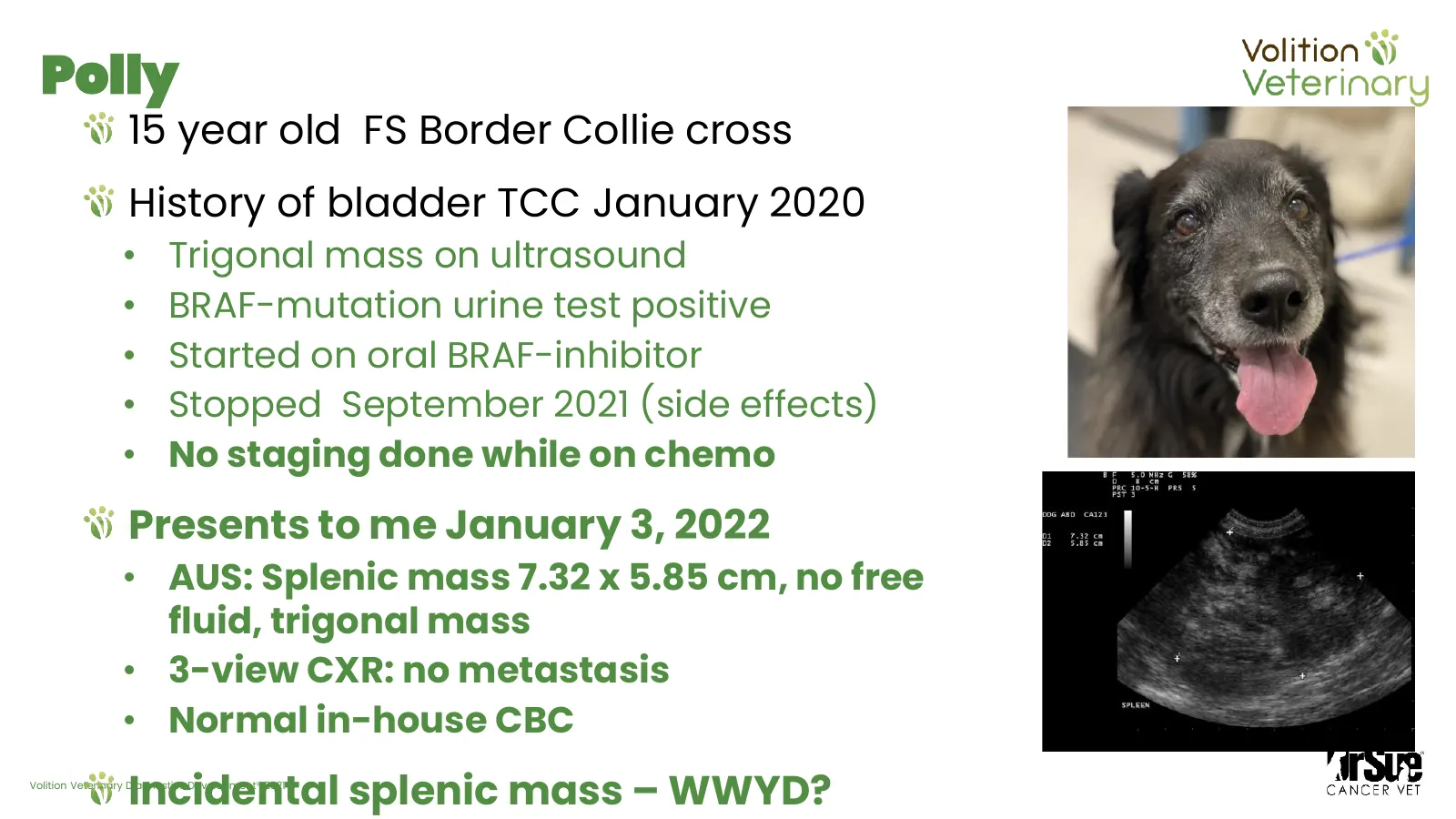
Slide 3: Polly
Polly 15 year old FS Border Collie cross History of bladder TCC January 2020 • Trigonal mass on ultrasound • BRAF-mutation urine test positive • Started on oral BRAF-inhibitor • Stopped September 2021 (side effects) • No staging done while on chemo Presents to me January 3, 2022 • AUS: Splenic mass
Slide 4: How Do We Screen & Find Cancer
How Do We Screen & Find Cancer “Is there a blood test for cancer?” Similar to the human diagnostic market, there are no simple, easy to use, blood tests to help diagnose or monitor cancer Cancer in dogs is often diagnosed late and through costly and/or potentially painful procedures • Radiographs, u
Slide 5: Nu.Q Vet Cancer Screening Test: The Basic Concept
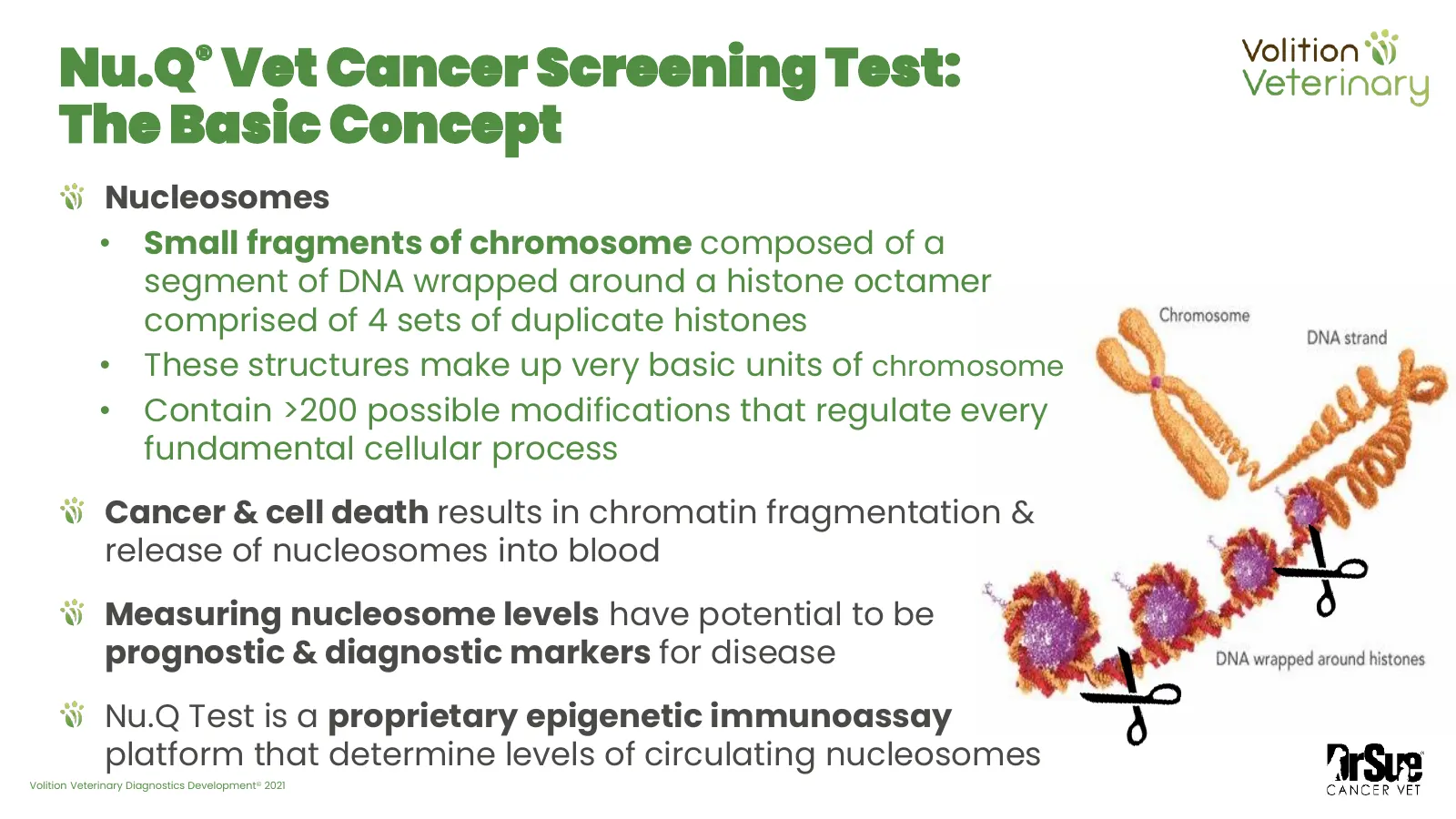
Nu.Q® Vet Cancer Screening Test: The Basic Concept Nucleosomes • Small fragments of chromosome composed of a segment of DNA wrapped around a histone octamer comprised of 4 sets of duplicate histones • These structures make up very basic units of chromosome • Contain >200 possible modifications that
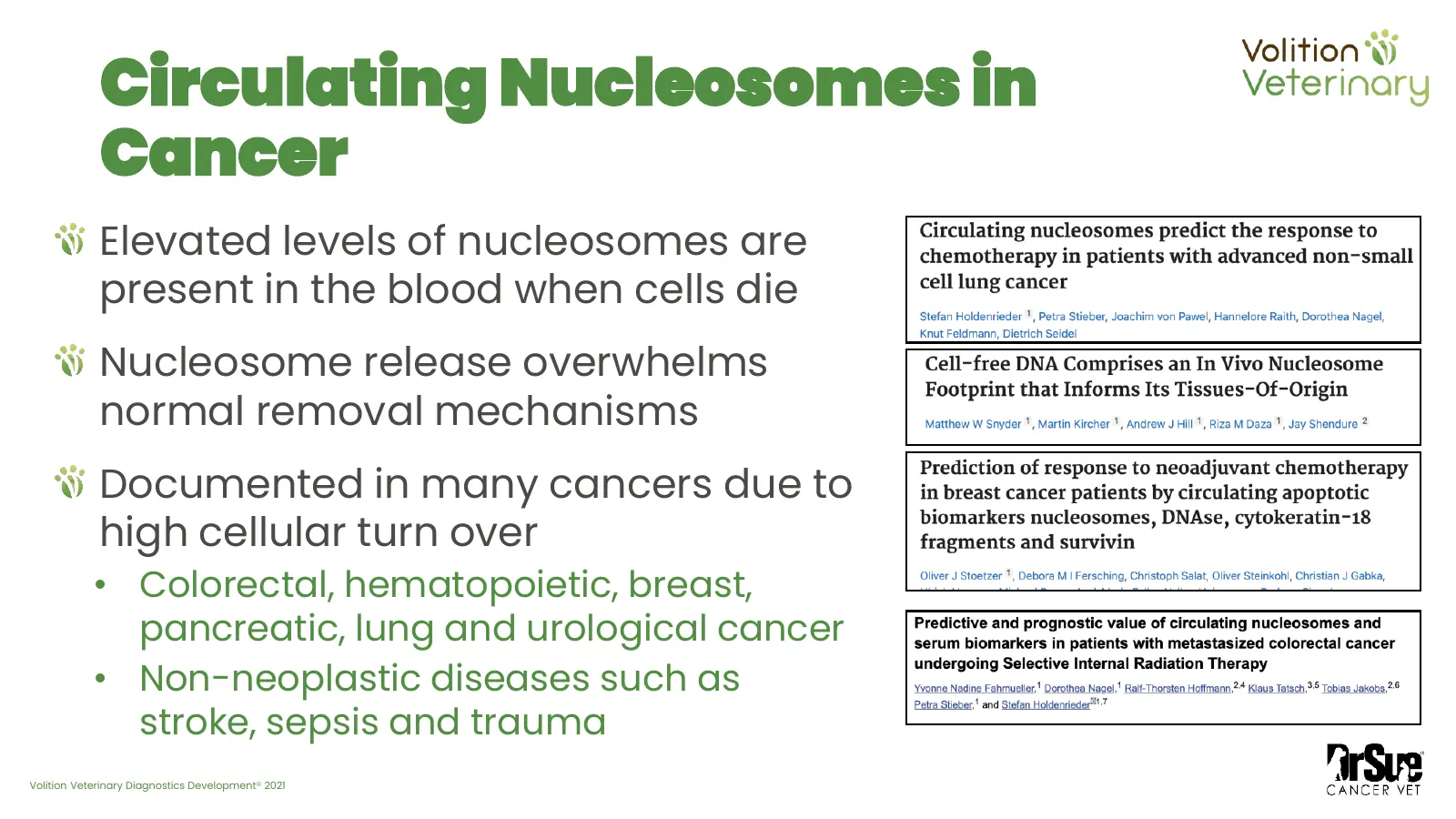
Slide 6: Circulating Nucleosomes in Cancer
Circulating Nucleosomes in Cancer Elevated levels of nucleosomes are present in the blood when cells die Nucleosome release overwhelms normal removal mechanisms Documented in many cancers due to high cellular turn over • Colorectal, hematopoietic, breast, pancreatic, lung and urological cancer • Non
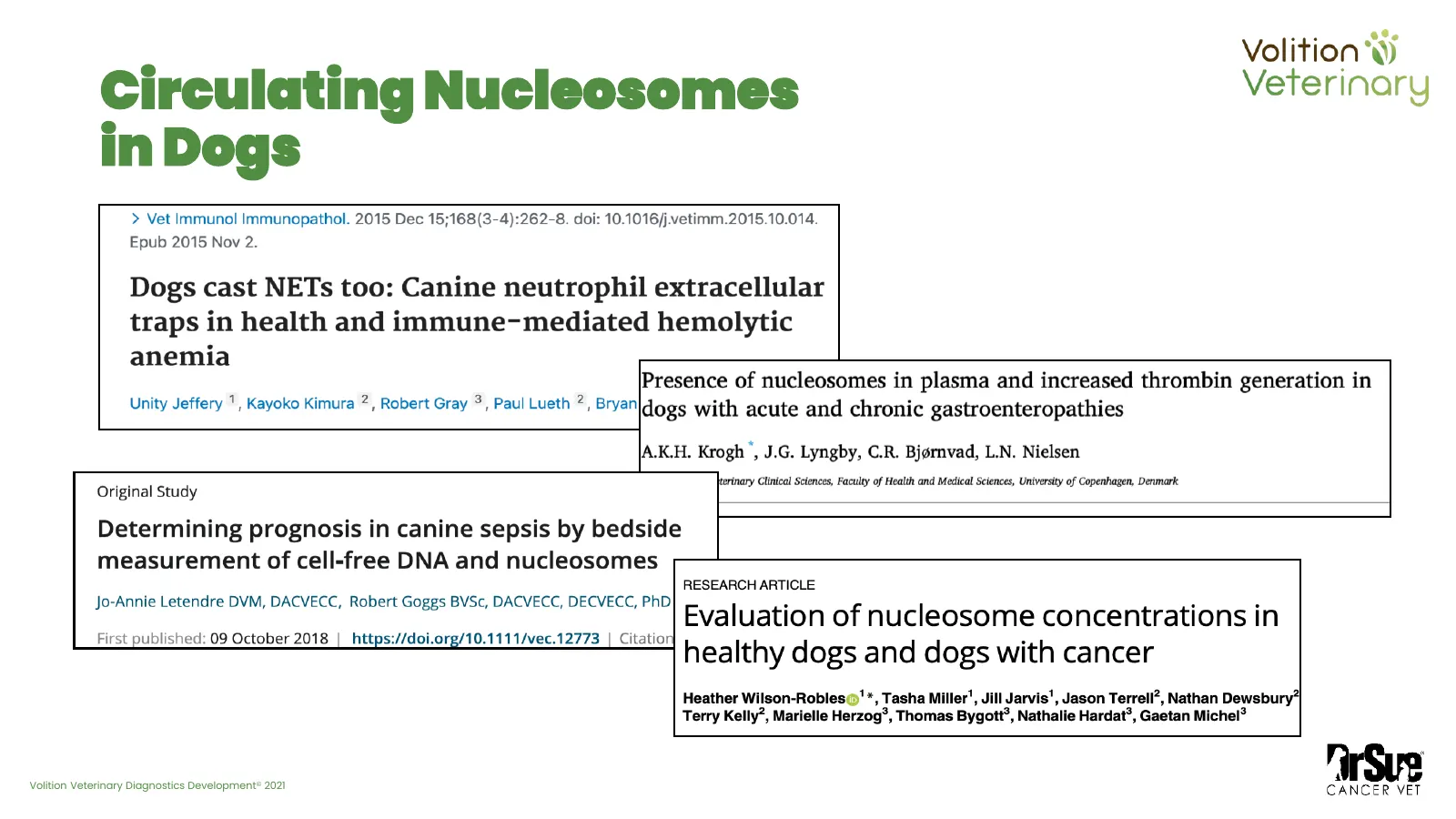
Slide 7: Circulating Nucleosomes in Dogs
Circulating Nucleosomes in Dogs Volition Veterinary Diagnostics Development© 2021
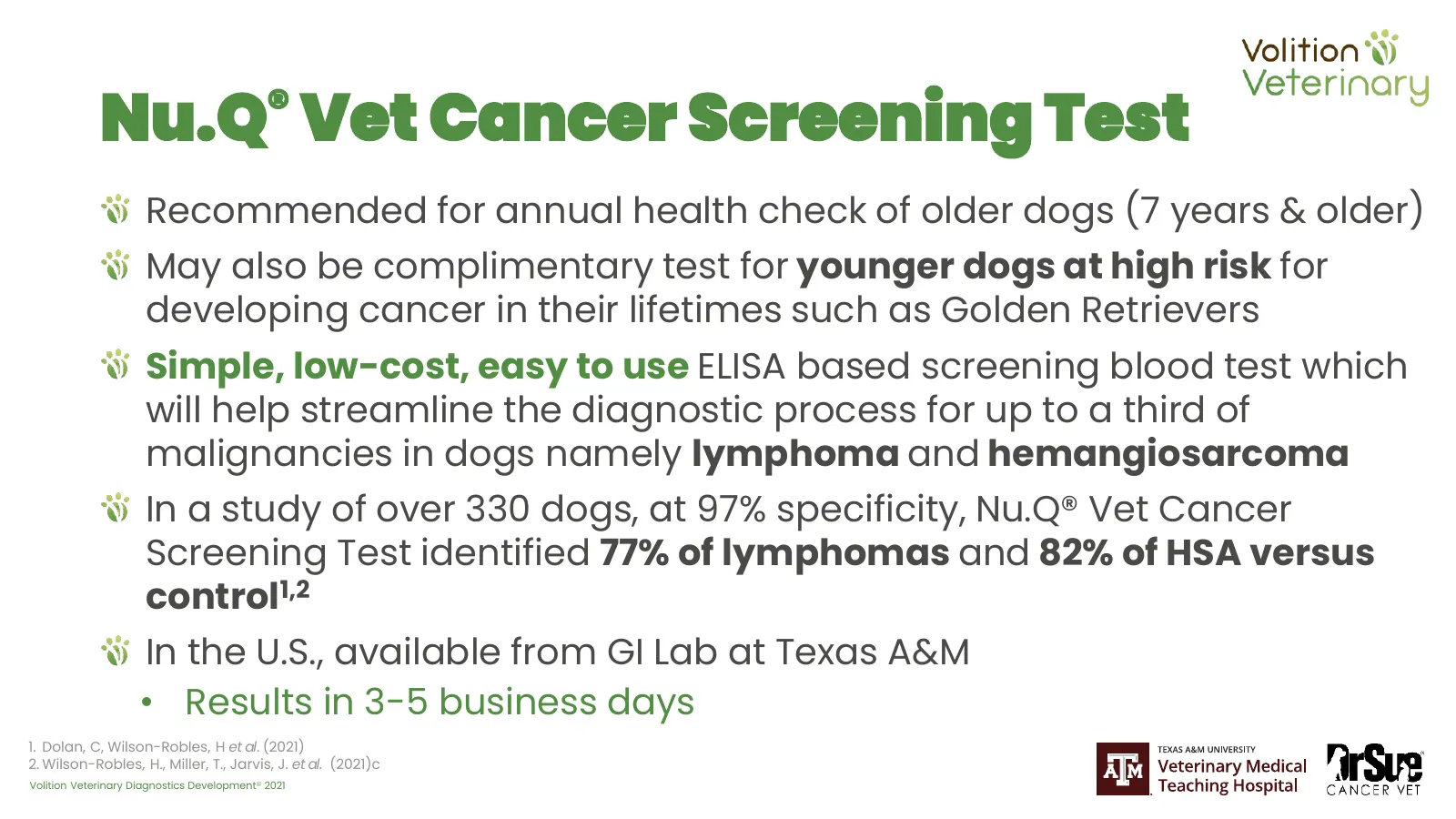
Slide 8: Nu.Q Vet Cancer Screening Test
Nu.Q® Vet Cancer Screening Test Recommended for annual health check of older dogs (7 years & older) May also be complimentary test for younger dogs at high risk for developing cancer in their lifetimes such as Golden Retrievers Simple, low-cost, easy to use ELISA based screening blood test which wil
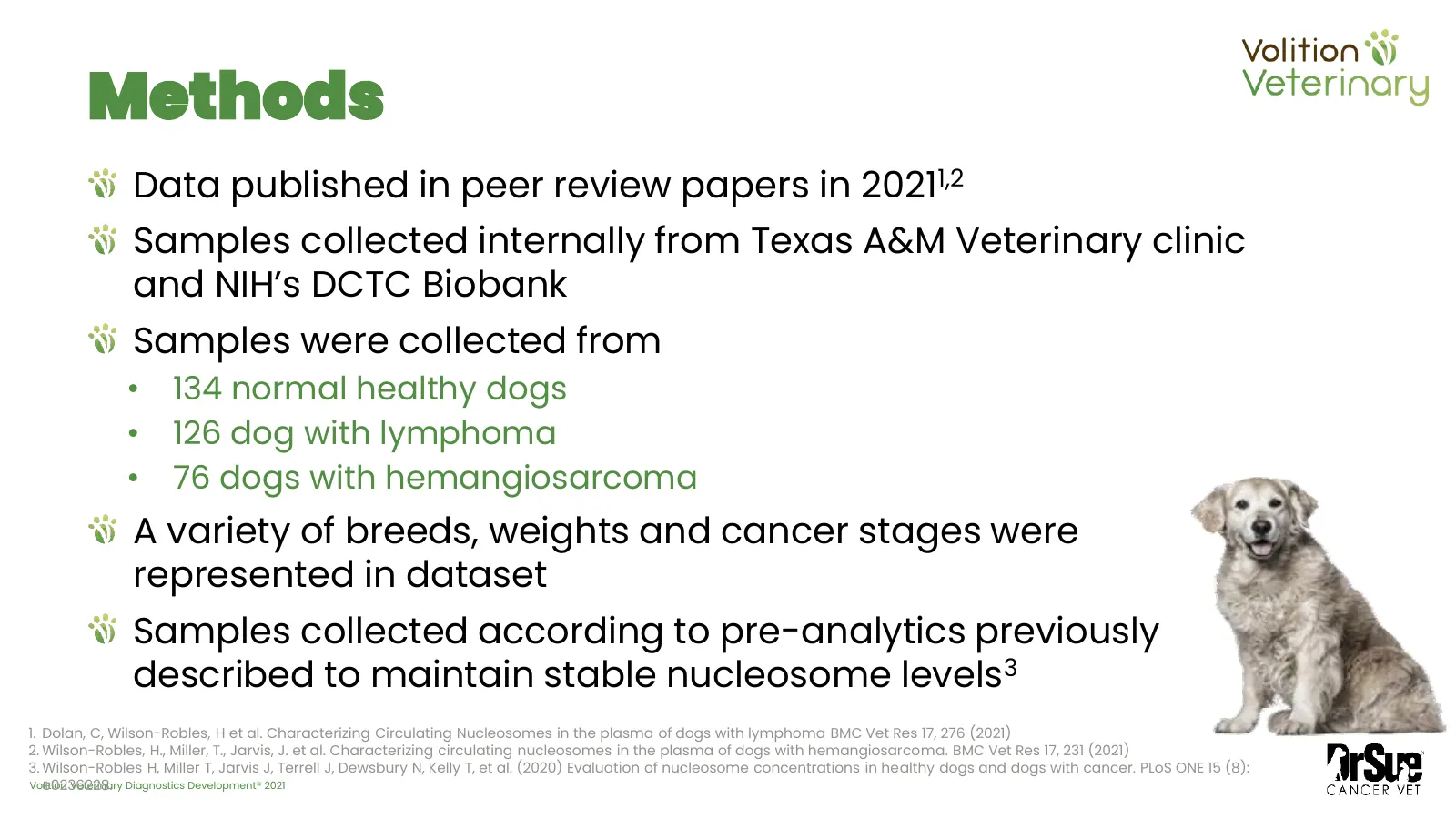
Slide 9: Methods
Methods Data published in peer review papers in 20211,2 Samples collected internally from Texas A&M Veterinary clinic and NIH’s DCTC Biobank Samples were collected from • 134 normal healthy dogs • 126 dog with lymphoma • 76 dogs with hemangiosarcoma A variety of breeds, weights and cancer stages wer
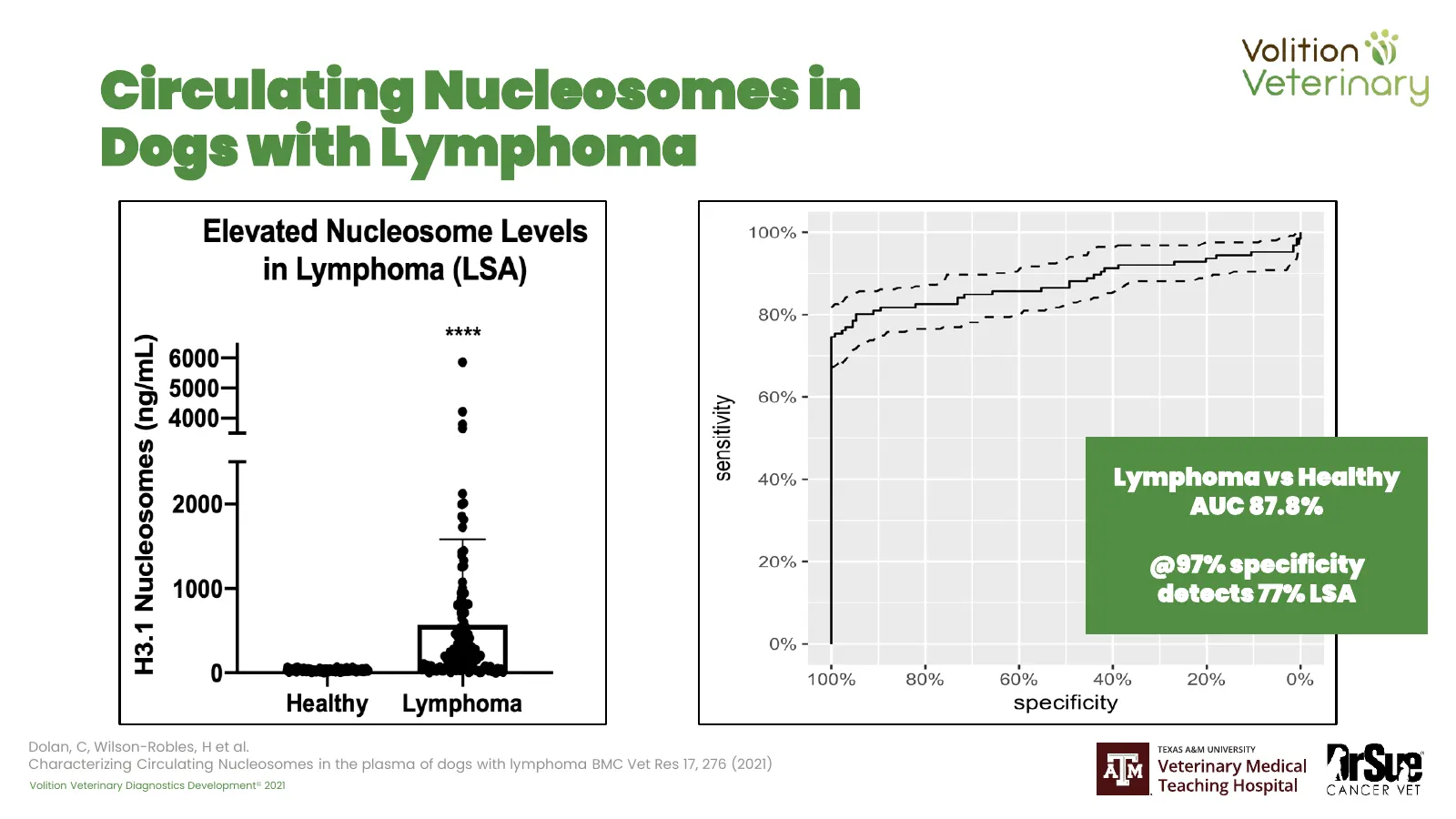
Slide 10: Circulating Nucleosomes in Dogs with Lymphoma
Circulating Nucleosomes in Dogs with Lymphoma Lymphoma vs Healthy AUC 87.8% @97% specificity detects 77% LSA Dolan, C, Wilson-Robles, H et al. Characterizing Circulating Nucleosomes in the plasma of dogs with lymphoma BMC Vet Res 17, 276 (2021) Volition Veterinary Diagnostics Development© 2021
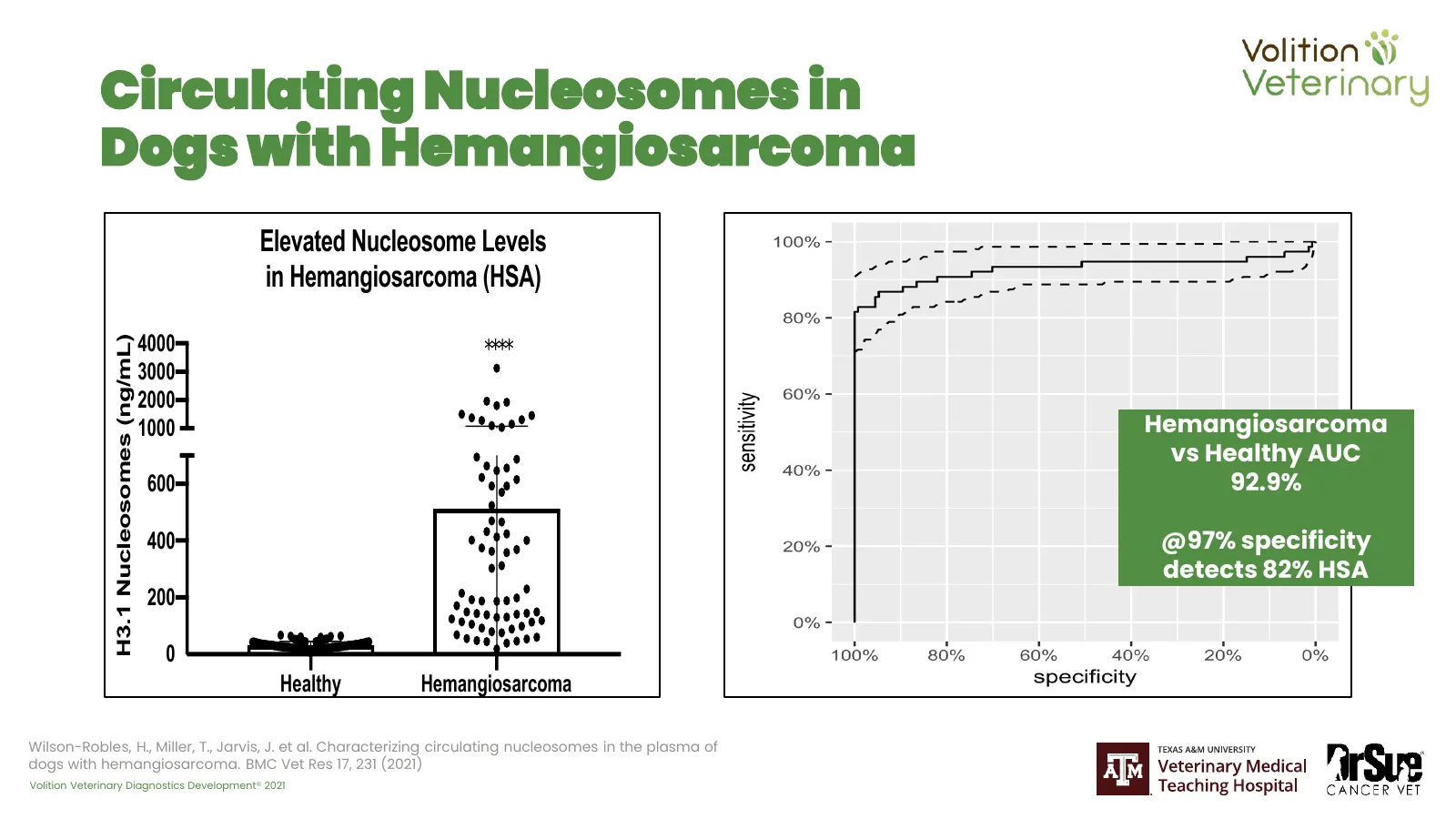
Slide 11: Circulating Nucleosomes in Dogs with Hemangiosarcoma
Circulating Nucleosomes in Dogs with Hemangiosarcoma Elevated Nucleosome Levels in Hemangiosarcoma (HSA) 4000 H3.1 Nucleosomes (ng/mL) **** 3000 2000 1000 Hemangiosarcoma vs Healthy AUC 600 92.9% 400 @97% specificity detects 82% HSA 200 0 Healthy Hemangiosarcoma Wilson-Robles, H., Miller, T., Jarvis
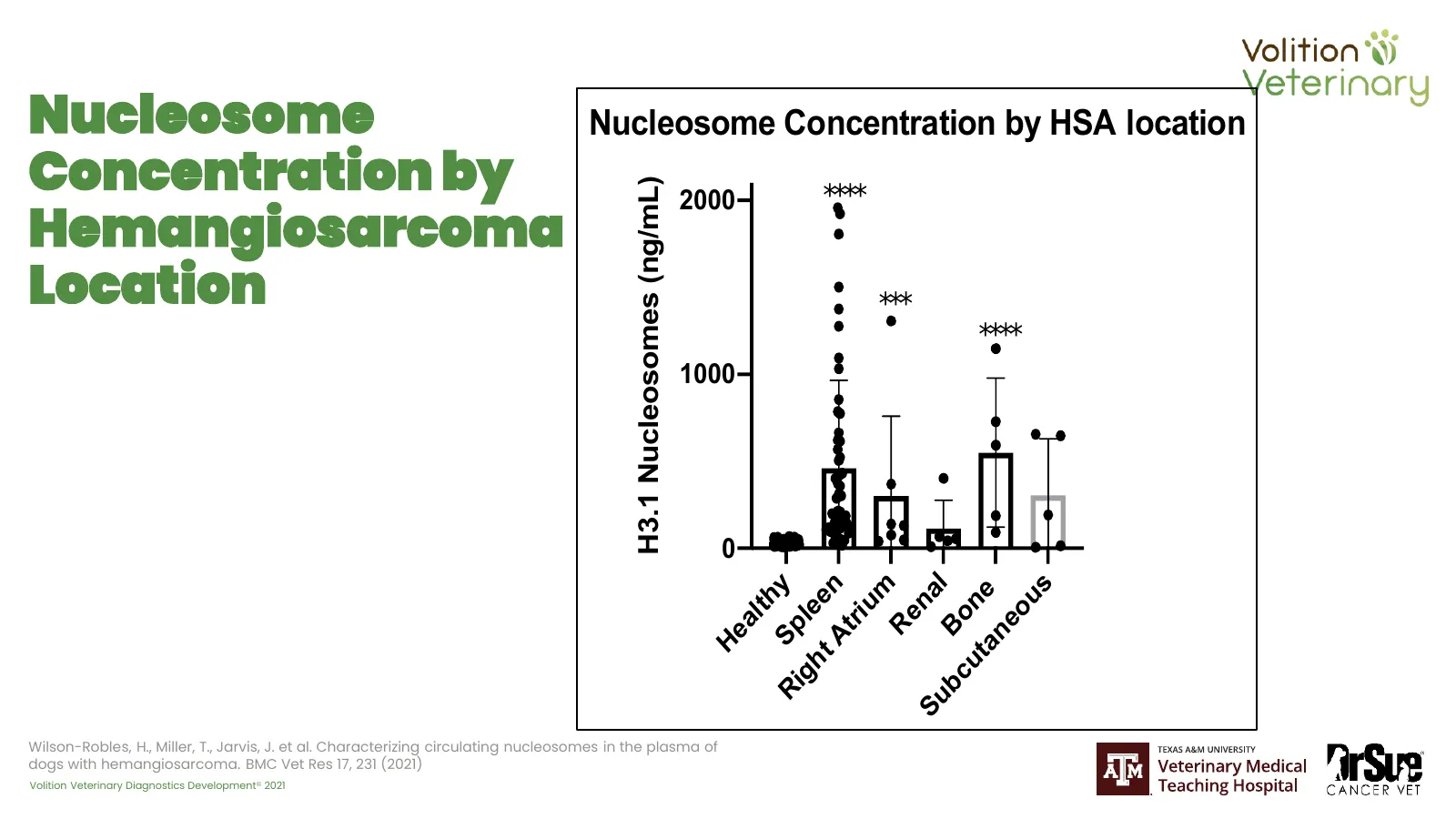
Slide 12: Nucleosome Concentration by HSA Location
Nucleosome Nucleosome Concentration by HSA location Concentration by H3.1 Nucleosomes (ng/mL) 2000 **** Hemangiosarcoma Location *** **** 1000 0 bc B o l Ri Sp y us t A en um na an e th n gh l e eo Re al tri He ut Su Wilson-Robles, H., Miller, T., Jarvis, J. et al. Characterizing circulating nucleos
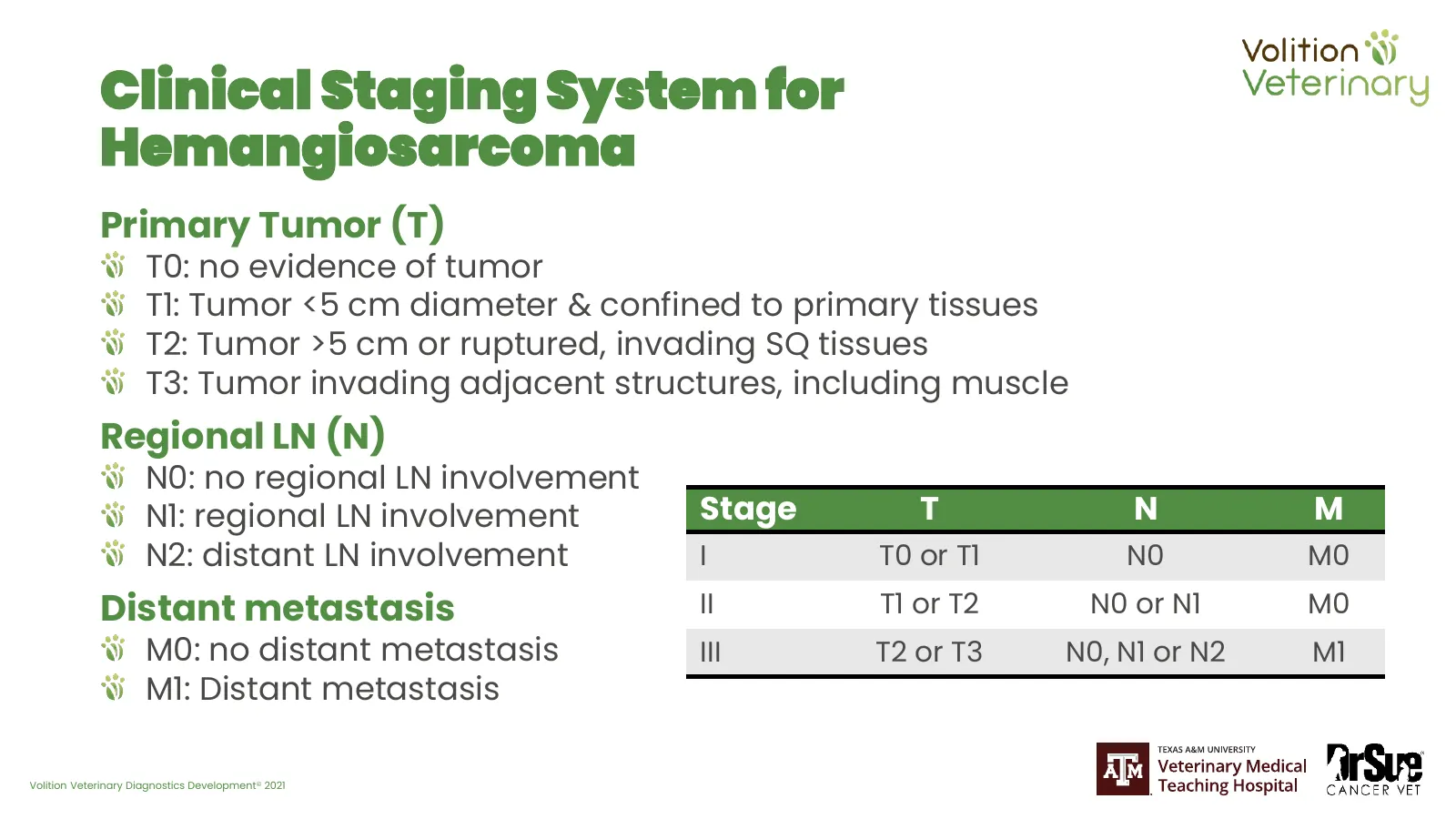
Slide 13: Clinical Staging System for Hemangiosarcoma
Clinical Staging System for Hemangiosarcoma Primary Tumor (T) T0: no evidence of tumor T1: Tumor <5 cm diameter & confined to primary tissues T2: Tumor >5 cm or ruptured, invading SQ tissues T3: Tumor invading adjacent structures, including muscle Regional LN (N) N0: no regional LN involvement N1: r
Slide 14: Nu.Q Test Can Detect All Stages of Hemangiosarcoma
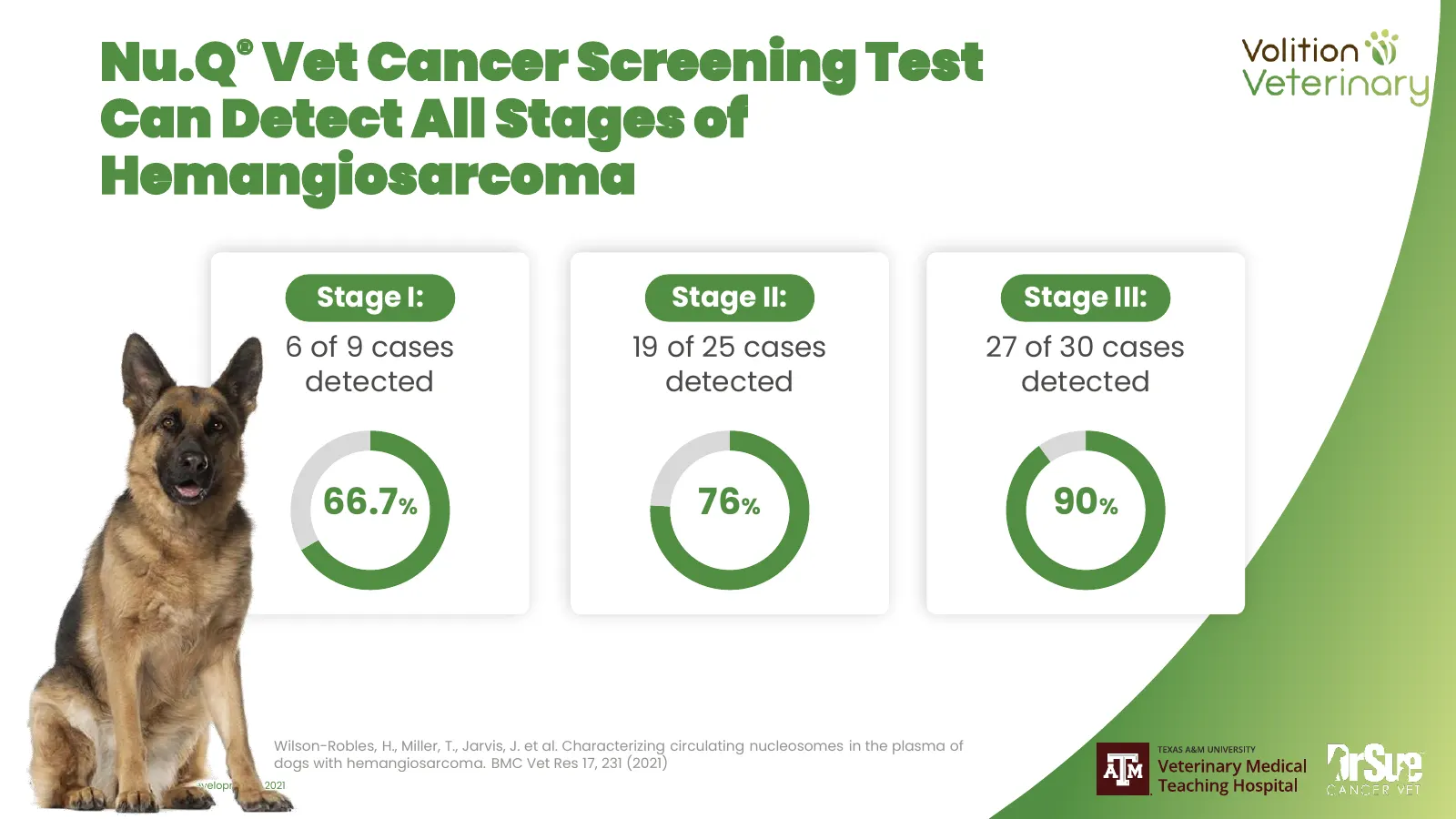
Nu.Q® Vet Cancer Screening Test Can Detect All Stages of Hemangiosarcoma Stage I: Stage II: Stage III: 6 of 9 cases 19 of 25 cases 27 of 30 cases detected detected detected 66.7% 76% 90% Wilson-Robles, H., Miller, T., Jarvis, J. et al. Characterizing circulating nucleosomes in the plasma of dogs wit
Slide 15: Conclusions
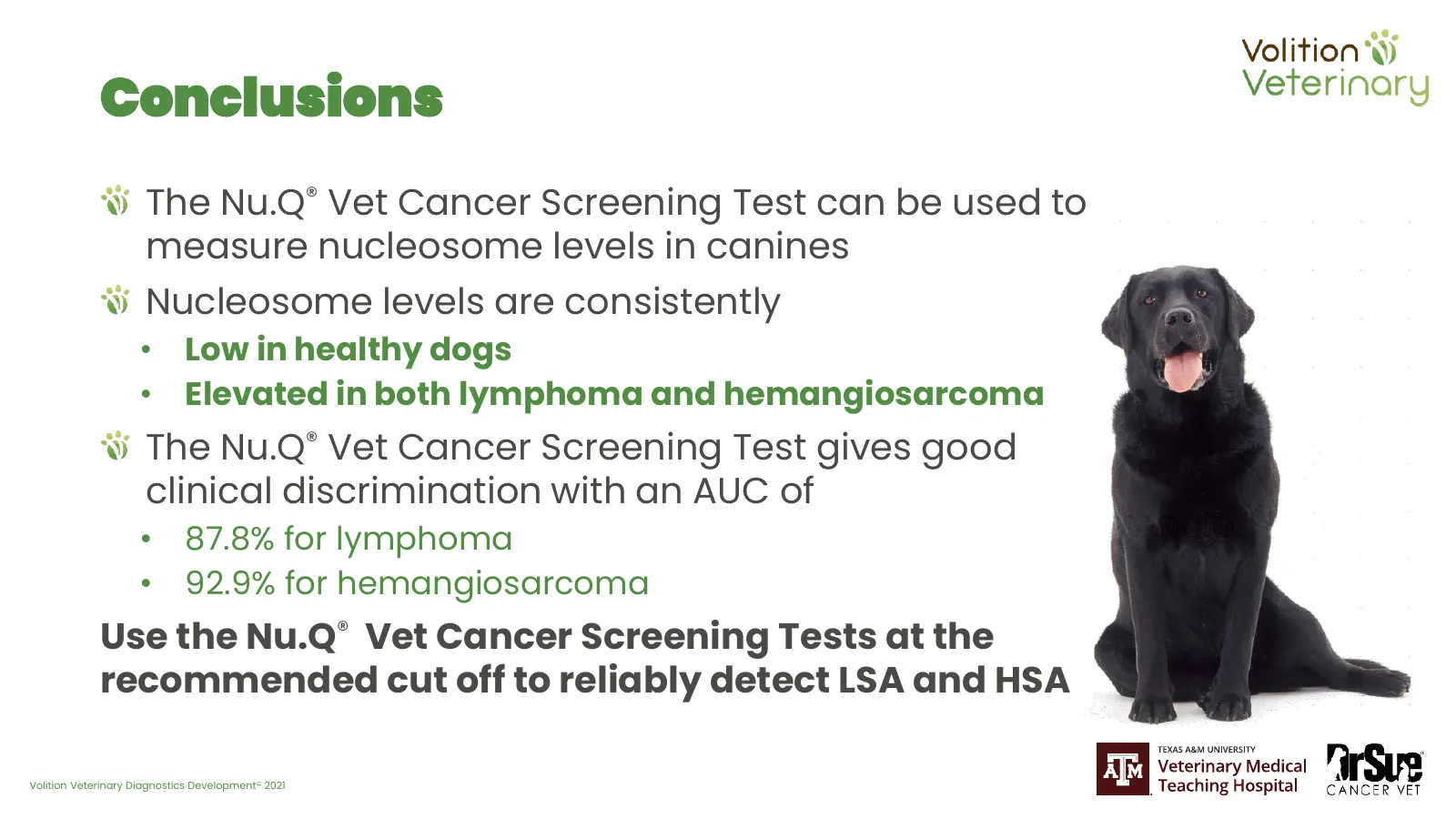
Conclusions The Nu.Q® Vet Cancer Screening Test can be used to measure nucleosome levels in canines Nucleosome levels are consistently • Low in healthy dogs • Elevated in both lymphoma and hemangiosarcoma The Nu.Q® Vet Cancer Screening Test gives good clinical discrimination with an AUC of • 87.8% f

Slide 16: Logistics: How to Submit a Sample & Interpret a Test
Logistics: How to Submit a Sample & Interpret a Test Volition Veterinary Diagnostics Development© 2022 2021
Slide 17: Nu.Q Vet Cancer Screening Test Tips: How to Submit a Sample
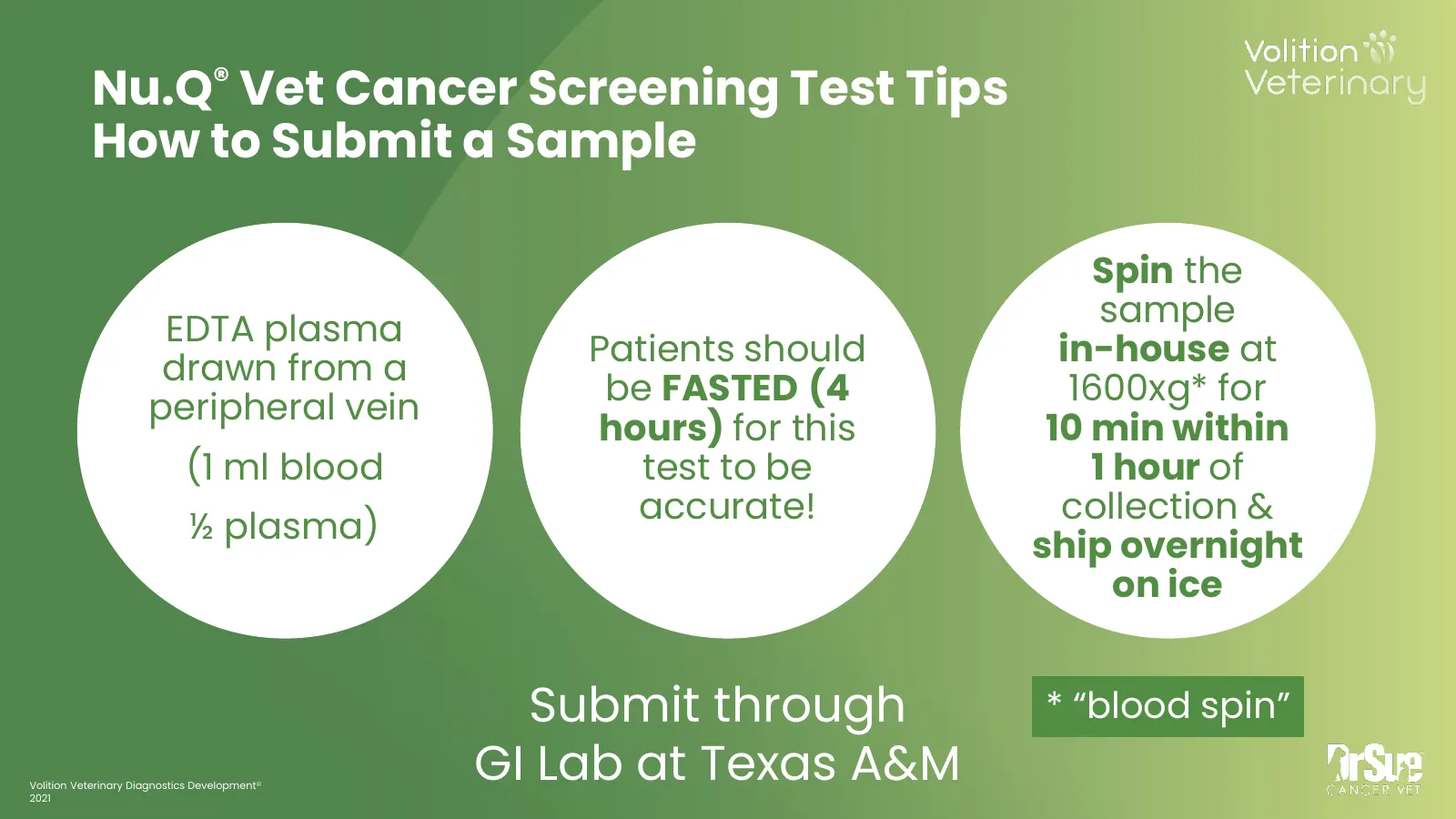
Nu.Q® Vet Cancer Screening Test Tips How to Submit a Sample Spin the sample EDTA plasma Patients should in-house at drawn from a be FASTED (4 1600xg* for peripheral vein hours) for this 10 min within (1 ml blood test to be 1 hour of accurate! collection & ½ plasma) ship overnight on ice Submit throu
Slide 18: How to Interpret Nu.Q Vet Cancer Screening Test
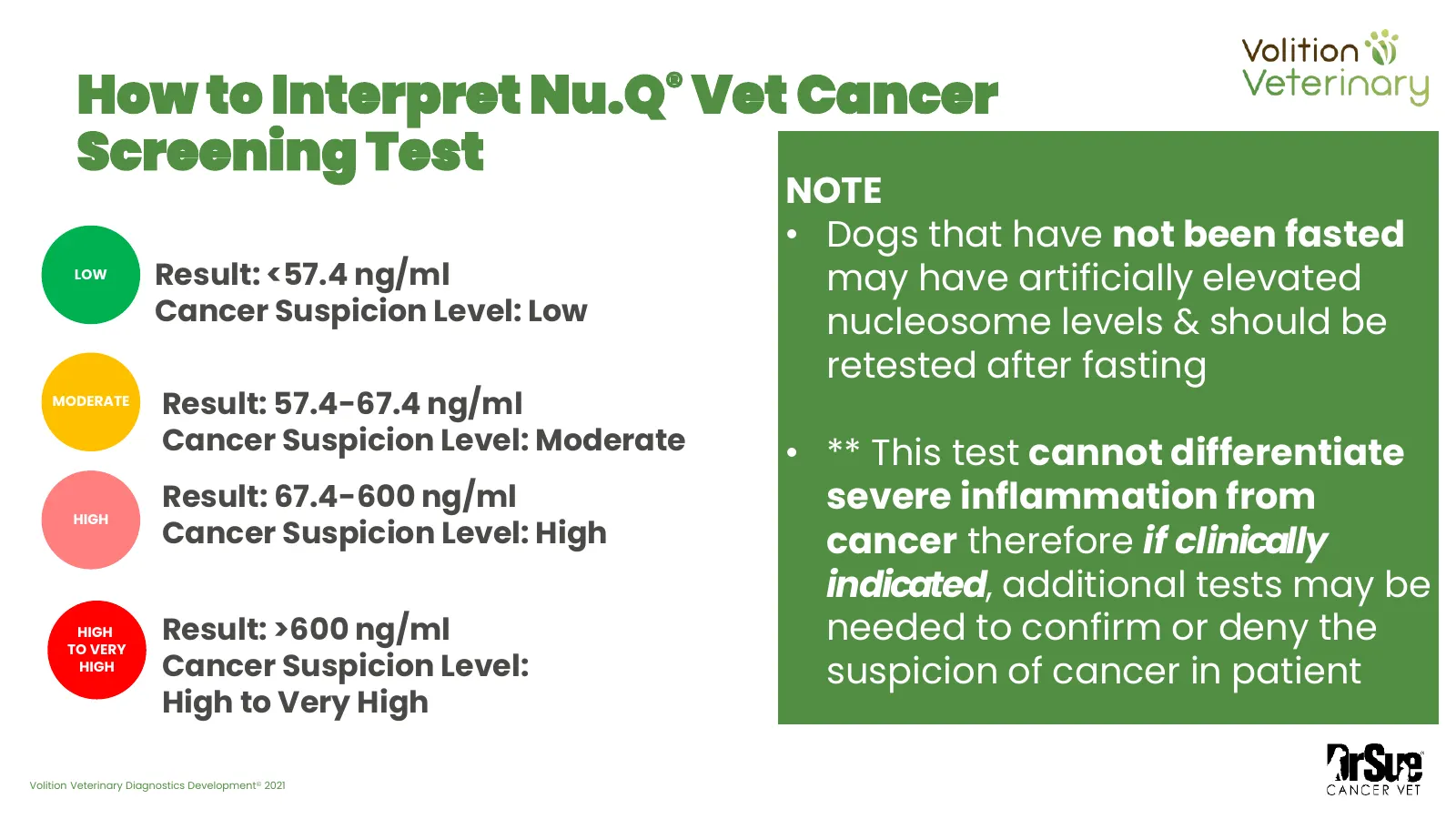
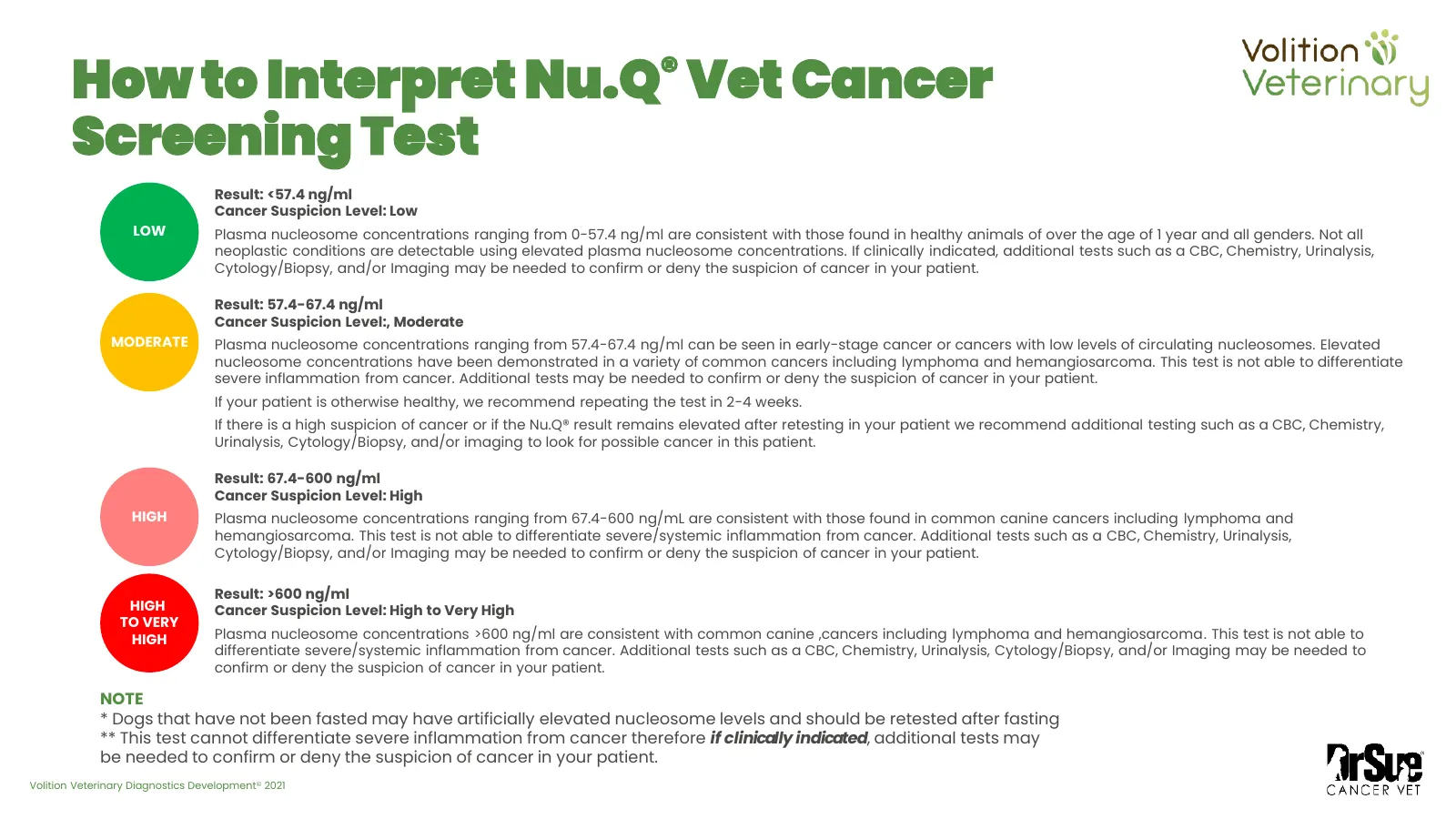
How to Interpret Nu.Q® Vet Cancer Screening Test NOTE • Dogs that have not been fasted LOW Result: <57.4 ng/ml may have artificially elevated Cancer Suspicion Level: Low nucleosome levels & should be retested after fasting MODERATE Result: 57.4-67.4 ng/ml Cancer Suspicion Level: Moderate • ** This t
Slide 19: How to Interpret Nu.Q Vet Cancer Screening Test
How to Interpret Nu.Q® Vet Cancer Screening Test Result: <57.4 ng/ml Cancer Suspicion Level: Low LOW Plasma nucleosome concentrations ranging from 0-57.4 ng/ml are consistent with those found in healthy animals of over the age of 1 year and all genders. Not all neoplastic conditions are detectable u

Slide 20: Case Studies
Case Studies Volition Veterinary Diagnostics Development© 2022 2021
Slide 21: Case 1: Otis
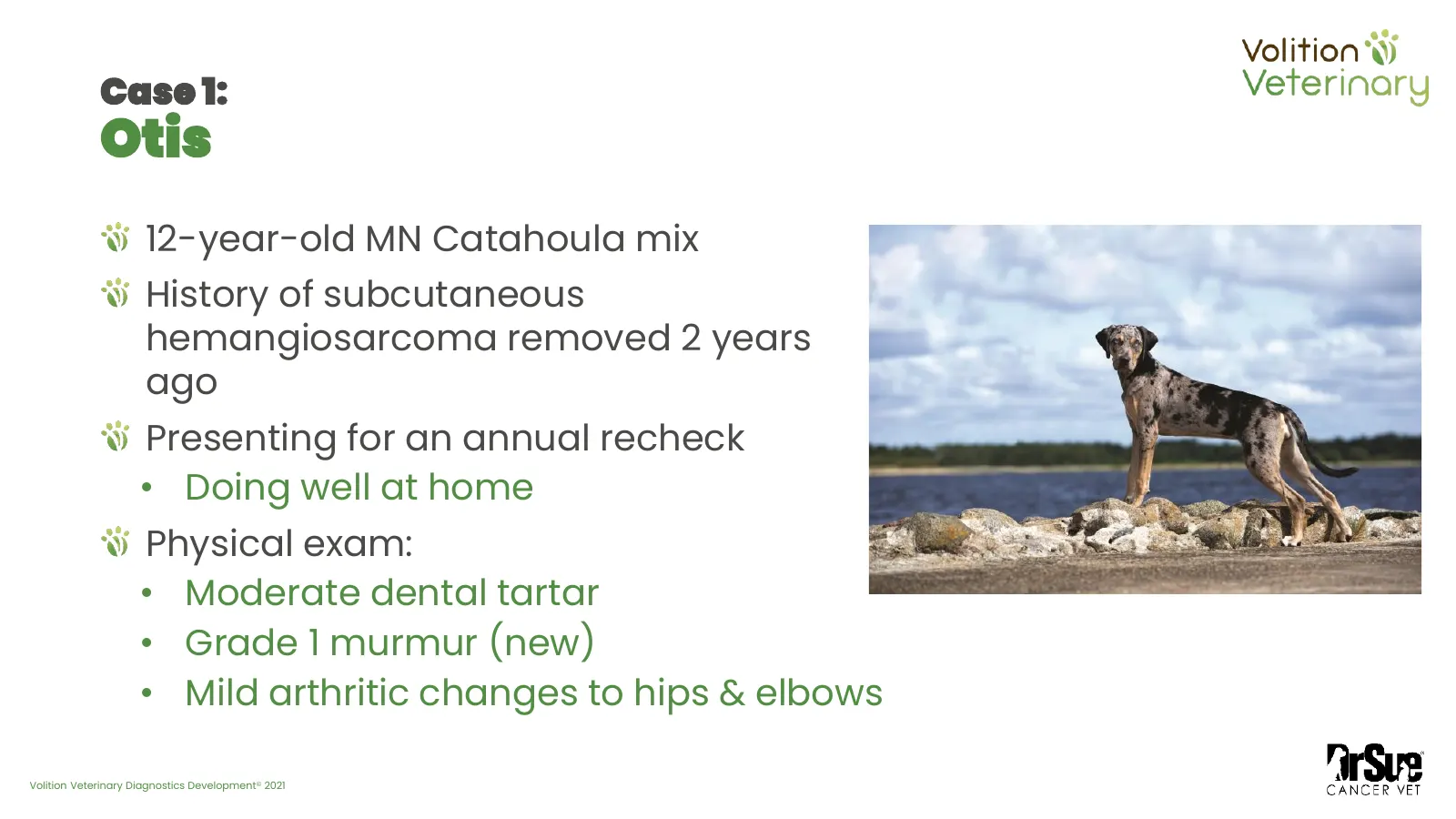
Case 1: Otis 12-year-old MN Catahoula mix History of subcutaneous hemangiosarcoma removed 2 years ago Presenting for an annual recheck • Doing well at home Physical exam: • Moderate dental tartar • Grade 1 murmur (new) • Mild arthritic changes to hips & elbows Volition Veterinary Diagnostics Develop
Slide 22: Case 1: Otis Wellness Exam
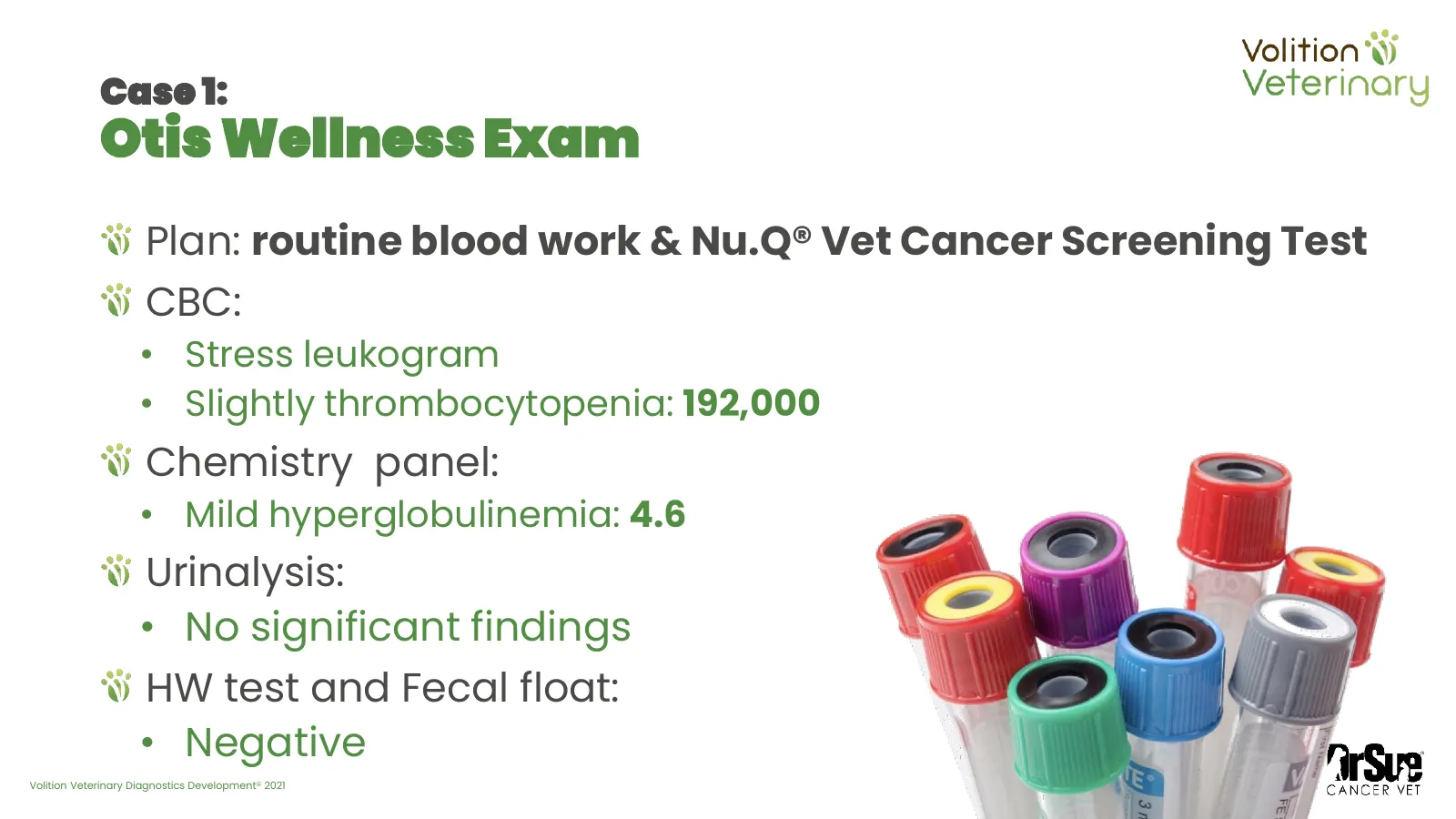
Case 1: Otis Wellness Exam Plan: routine blood work & Nu.Q® Vet Cancer Screening Test CBC: • Stress leukogram • Slightly thrombocytopenia: 192,000 Chemistry panel: • Mild hyperglobulinemia: 4.6 Urinalysis: • No significant findings HW test and Fecal float: • Negative Volition Veterinary Diagnostics
Slide 23: Case 1: Otis
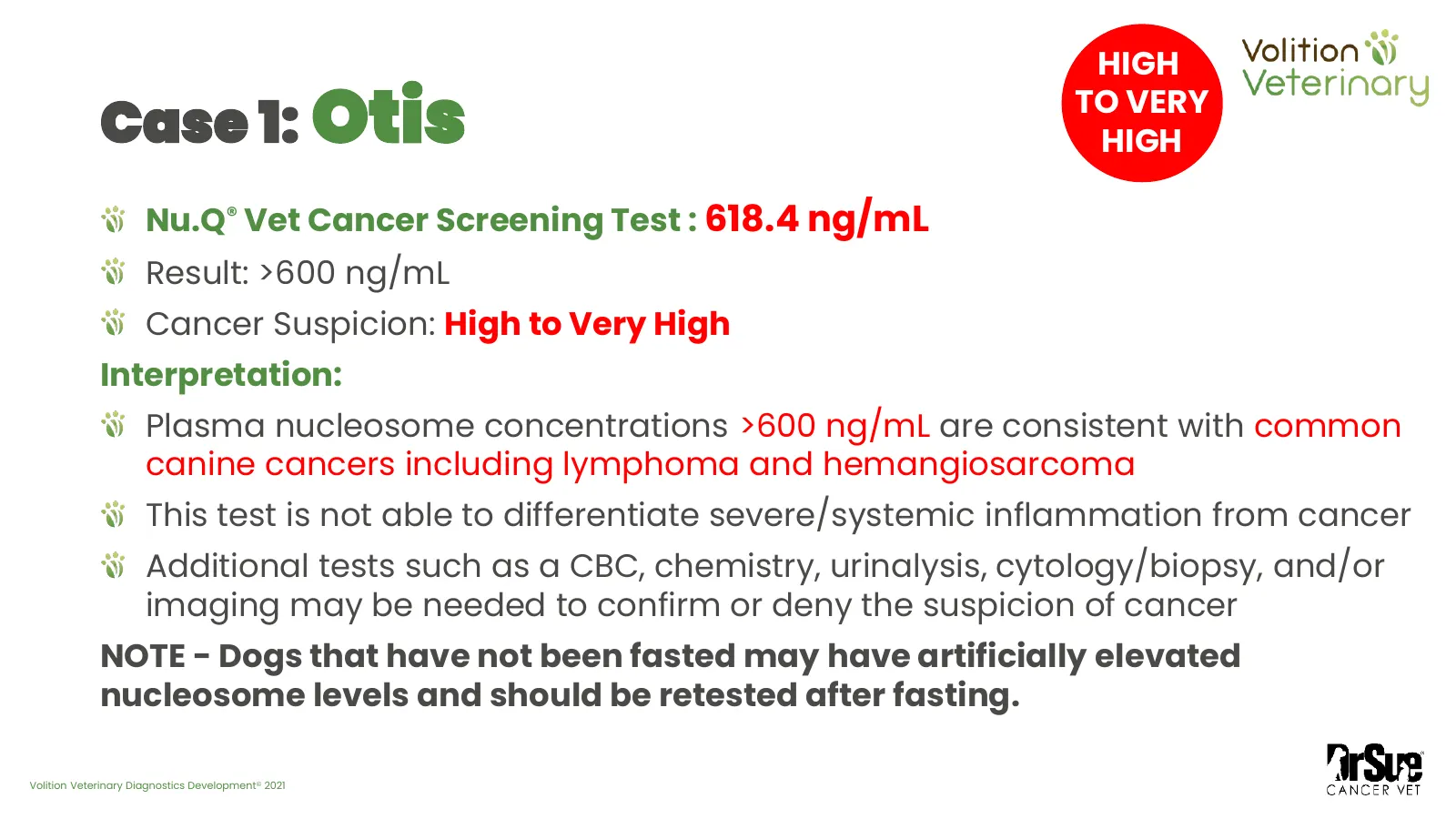
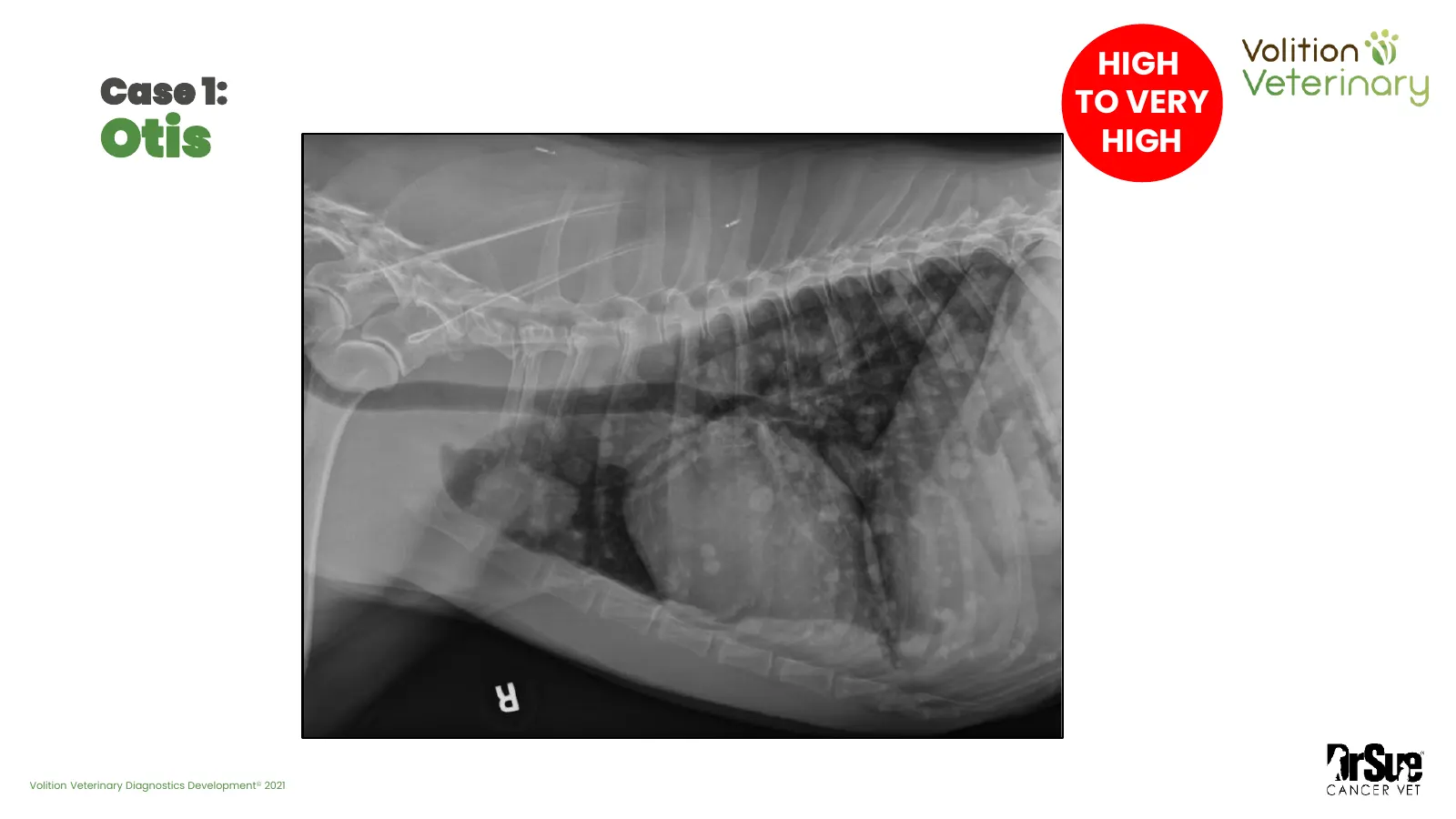
HIGH Case 1: Otis TO VERY HIGH Nu.Q® Vet Cancer Screening Test : 618.4 ng/mL Result: >600 ng/mL Cancer Suspicion: High to Very High Interpretation: Plasma nucleosome concentrations >600 ng/mL are consistent with common canine cancers including lymphoma and hemangiosarcoma This test is not able to di
Slide 24: What Do You Do?
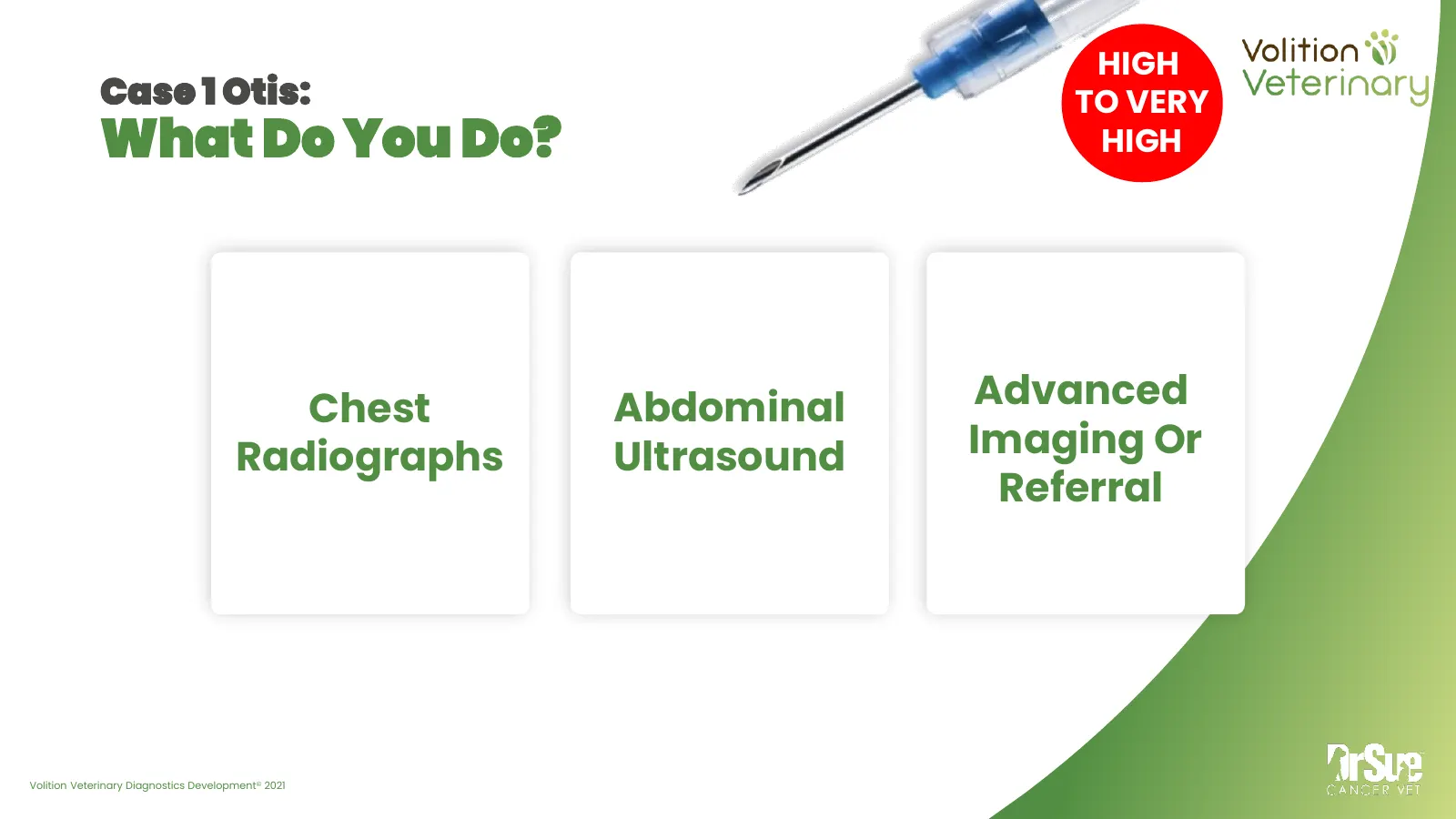
HIGH Case 1 Otis: TO VERY What Do You Do? HIGH Chest Abdominal Advanced Radiographs Ultrasound Imaging Or Referral Volition Veterinary Diagnostics Development© 2021
Slide 25: Case 1: Otis
HIGH Case 1: TO VERY Otis HIGH Volition Veterinary Diagnostics Development© 2021
Slide 26: Case 2: Belle
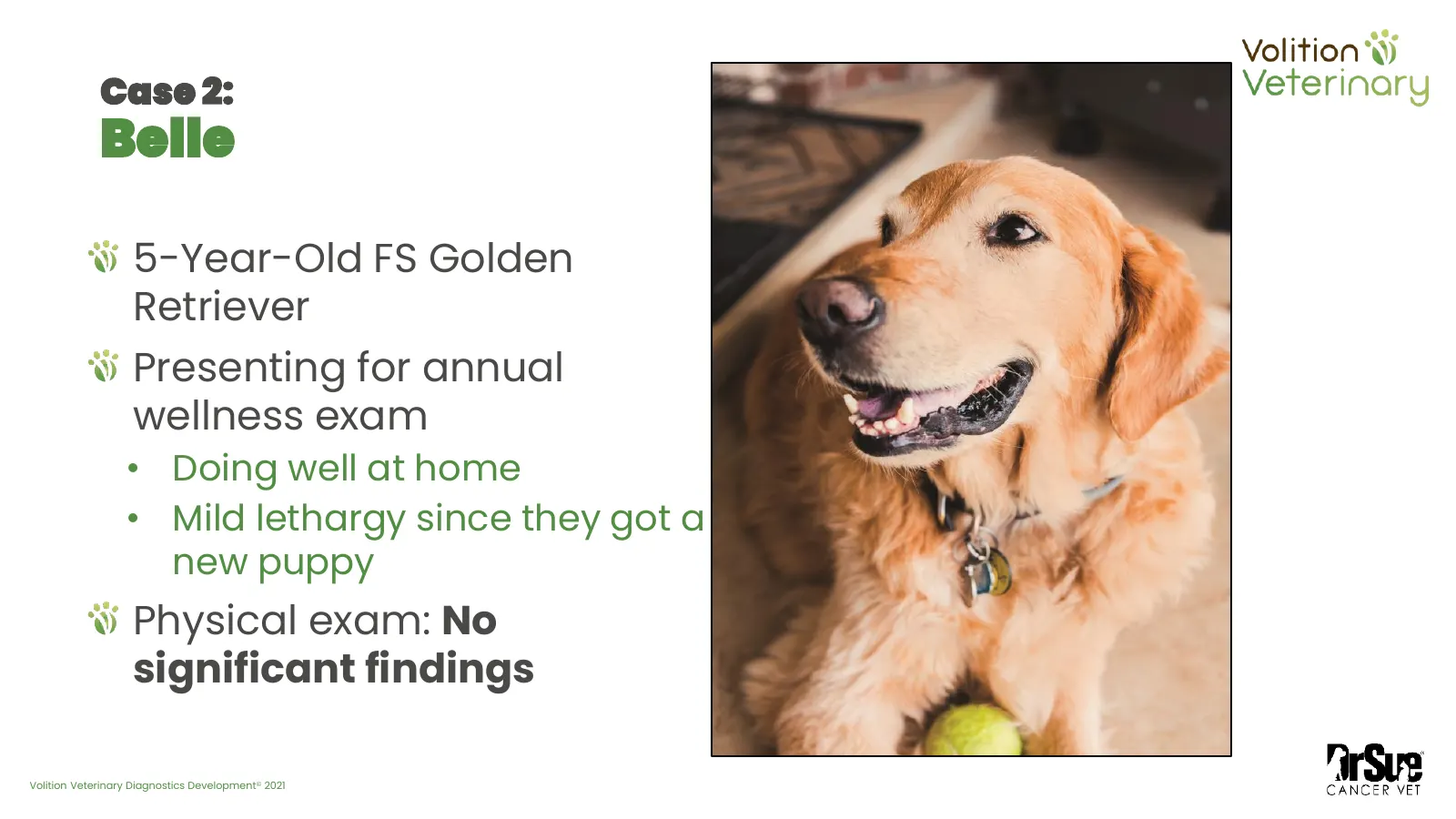
Case 2: Belle 5-Year-Old FS Golden Retriever Presenting for annual wellness exam • Doing well at home • Mild lethargy since they got a new puppy Physical exam: No significant findings Volition Veterinary Diagnostics Development© 2021
Slide 27: Case 2: Belle Wellness Exam
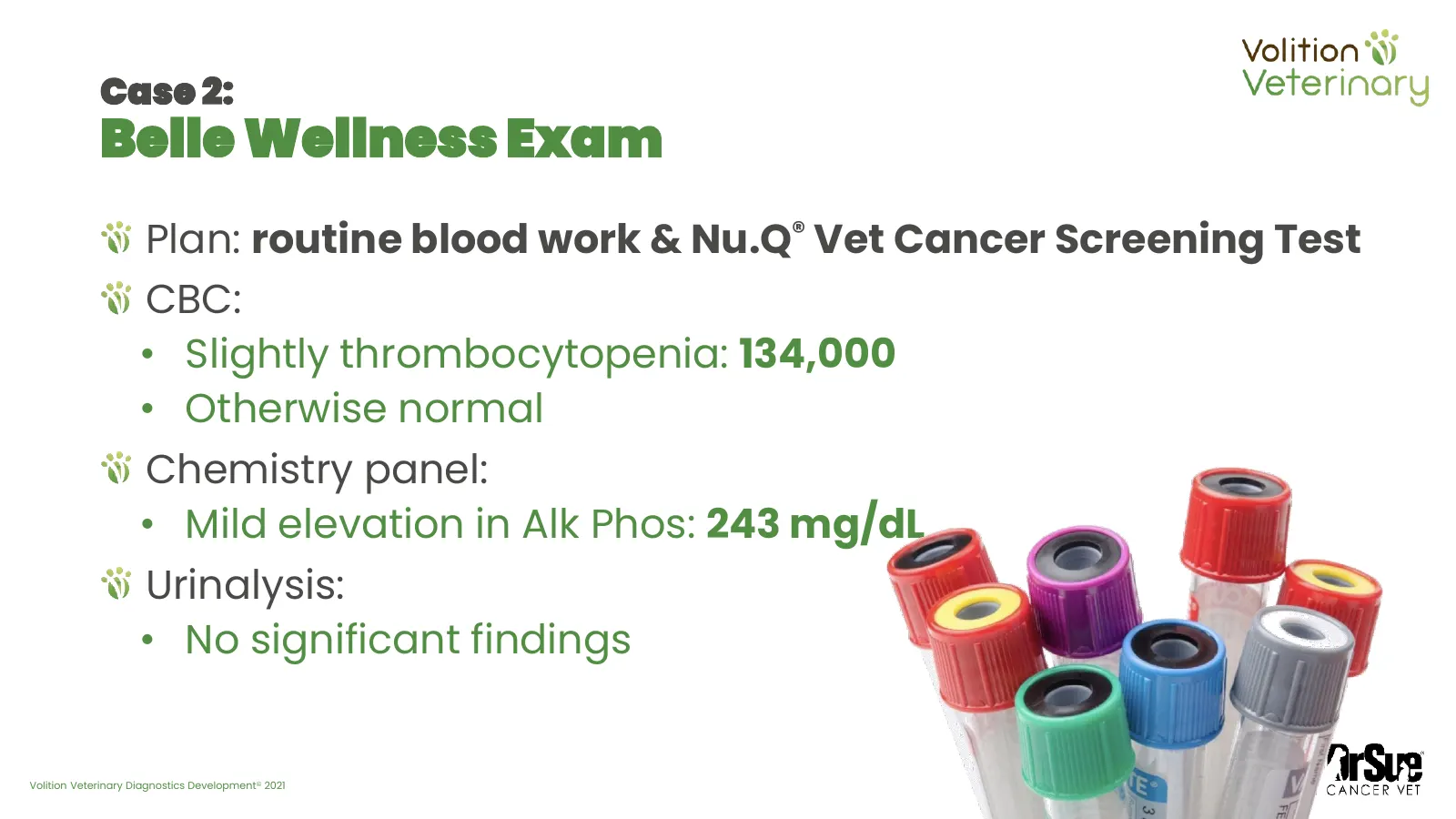
Case 2: Belle Wellness Exam Plan: routine blood work & Nu.Q® Vet Cancer Screening Test CBC: • Slightly thrombocytopenia: 134,000 • Otherwise normal Chemistry panel: • Mild elevation in Alk Phos: 243 mg/dL Urinalysis: • No significant findings Volition Veterinary Diagnostics Development© 2021
Slide 28: Case 2: Belle
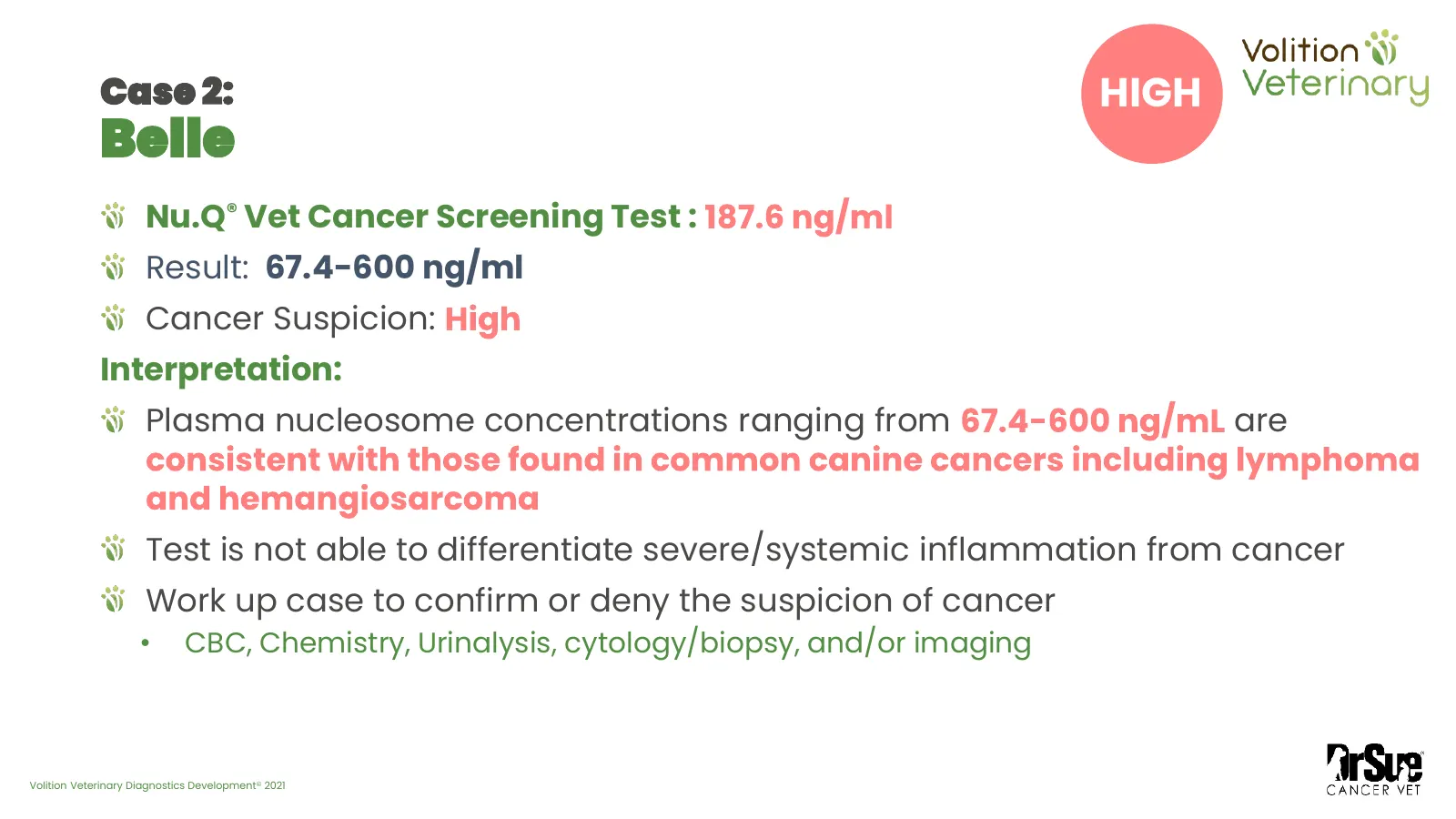
Case 2: HIGH Belle Nu.Q® Vet Cancer Screening Test : Result: 67.4-600 ng/ml Cancer Suspicion: Interpretation: Plasma nucleosome concentrations ranging from are Test is not able to differentiate severe/systemic inflammation from cancer Work up case to confirm or deny the suspicion of cancer • CBC, Ch
Slide 29: What Do You Do?
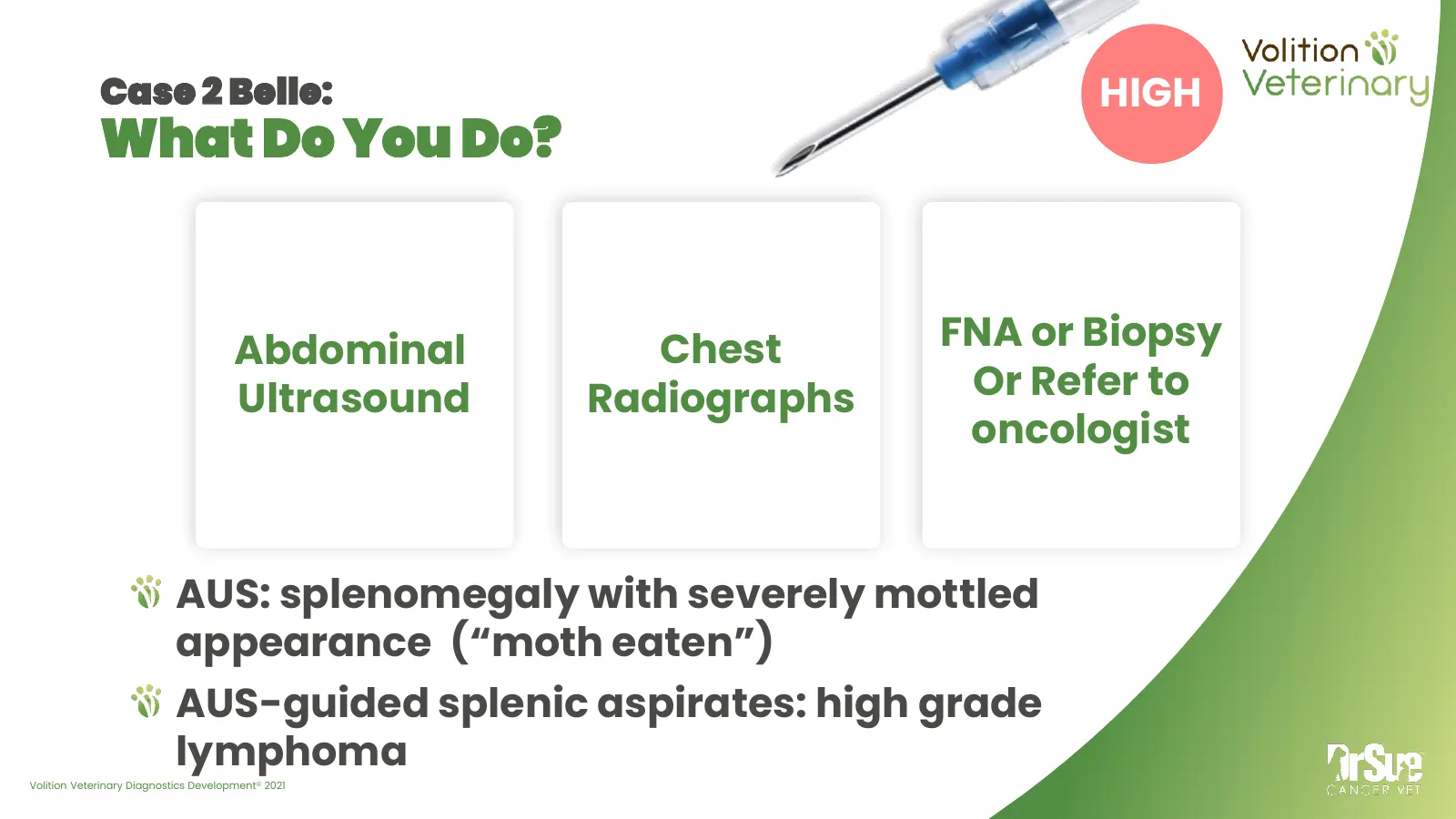
Case 2 Belle: HIGH What Do You Do? Abdominal Chest FNA or Biopsy Ultrasound Radiographs Or Refer to oncologist AUS: splenomegaly with severely mottled appearance (“moth eaten”) AUS-guided splenic aspirates: high grade lymphoma Volition Veterinary Diagnostics Development© 2021
Slide 30: Case 3: Hank
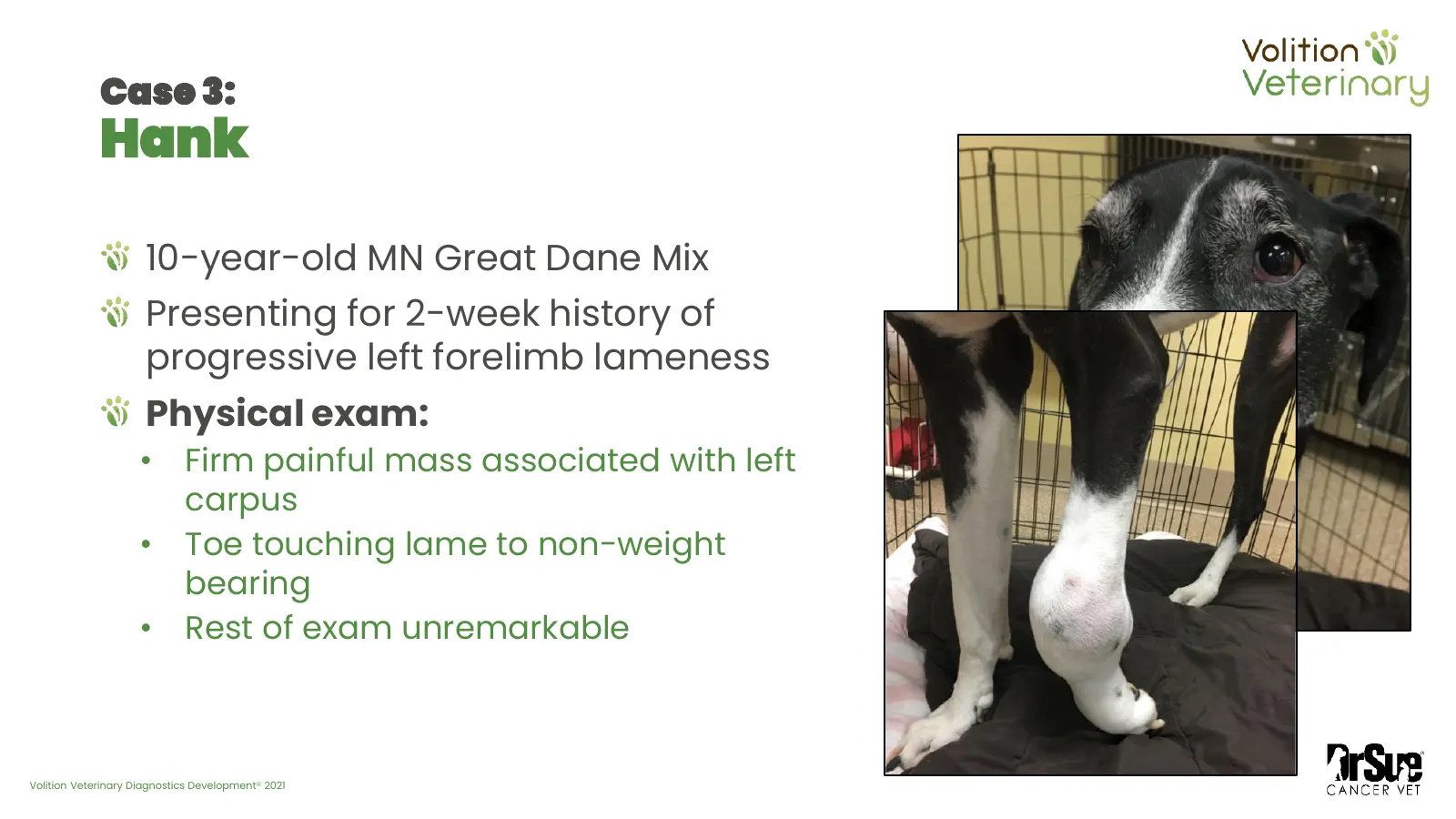
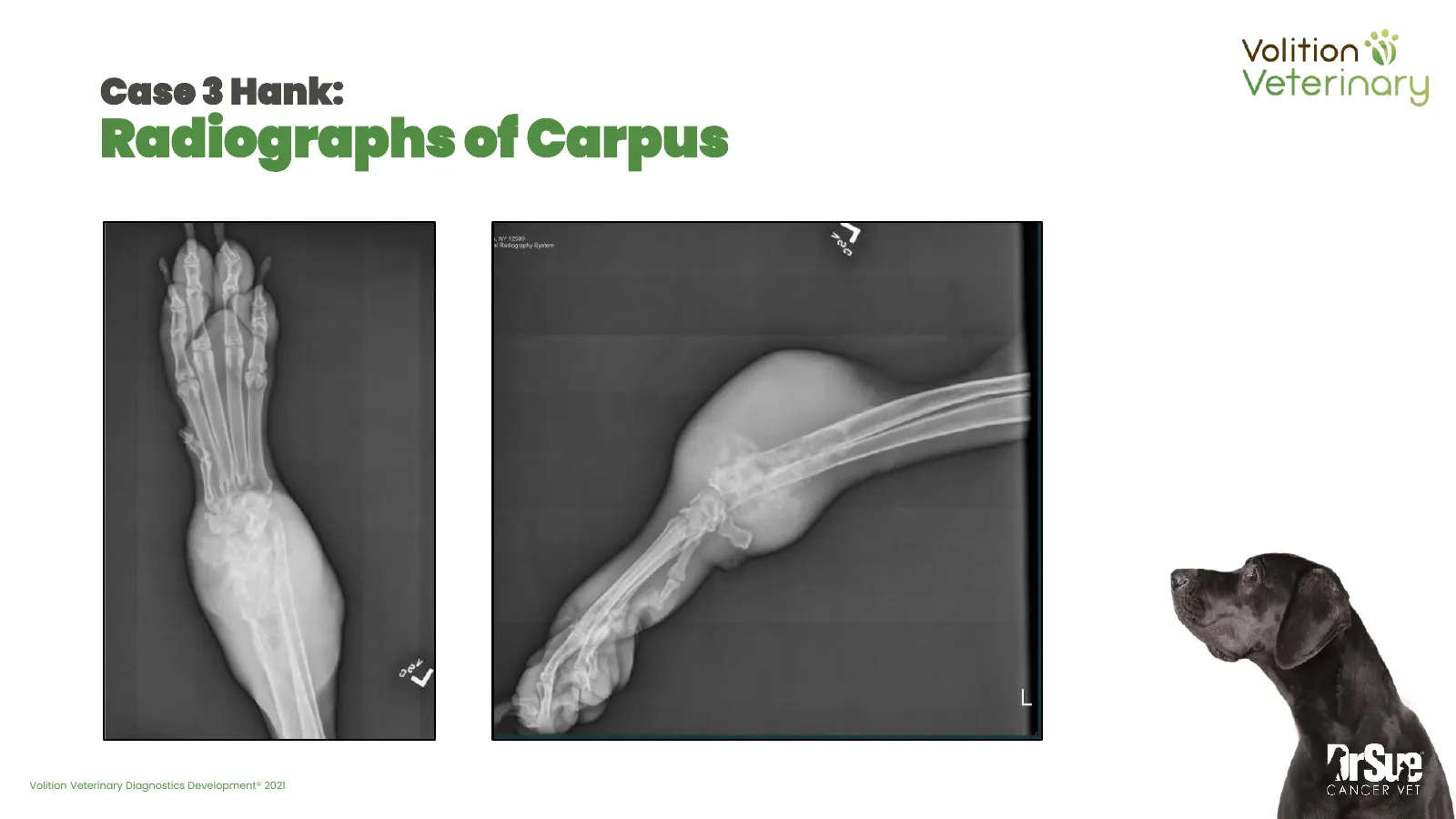
Case 3: Hank 10-year-old MN Great Dane Mix Presenting for 2-week history of progressive left forelimb lameness Physical exam: • Firm painful mass associated with left carpus • Toe touching lame to non-weight bearing • Rest of exam unremarkable Volition Veterinary Diagnostics Development© 2021
Slide 31: Case 3: Hank
Case 3: Hank Owner agrees to minimum database, Nu.Q® Vet Cancer Screening Test, & sedation for carpal radiographs CBC • Stress leukogram • Mild thrombocytosis: 479,000 Chemistry panel: • Mild elevation in Alk Phos: 283 mg/dL Urinalysis • USG 1.040 • 2+ proteinuria Volition Veterinary Diagnostics Dev
Slide 32: Case Hank: Radiographs of Carpus
Case 3 Hank: Radiographs of Carpus Volition Veterinary Diagnostics Development© 2021
Slide 33: Case 3: Hank
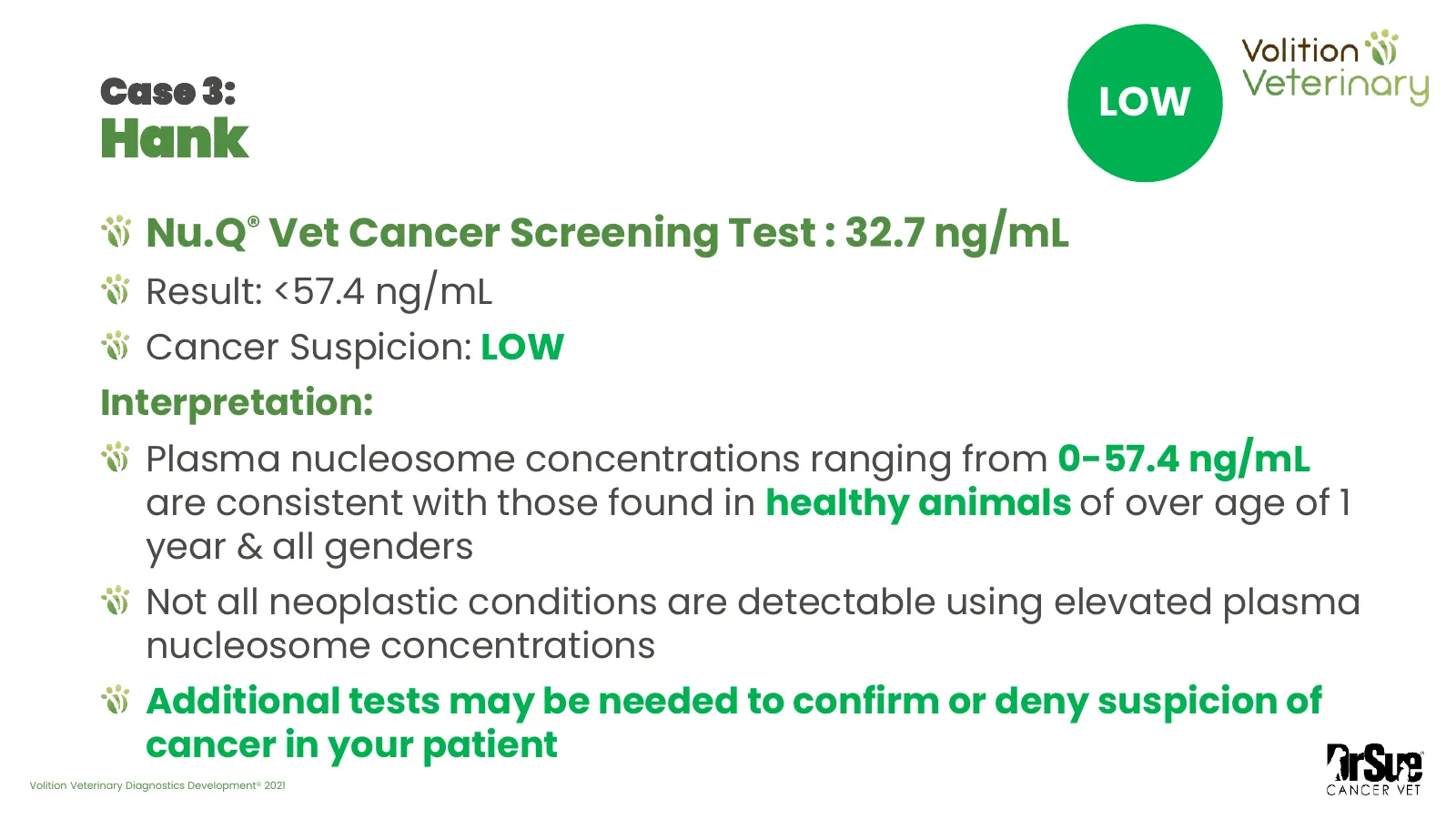
Case 3: LOW Hank Nu.Q® Vet Cancer Screening Test : 32.7 ng/mL Result: <57.4 ng/mL Cancer Suspicion: LOW Interpretation: Plasma nucleosome concentrations ranging from 0-57.4 ng/mL are consistent with those found in healthy animals of over age of 1 year & all genders Not all neoplastic conditions are
Slide 34: What Do You Do?
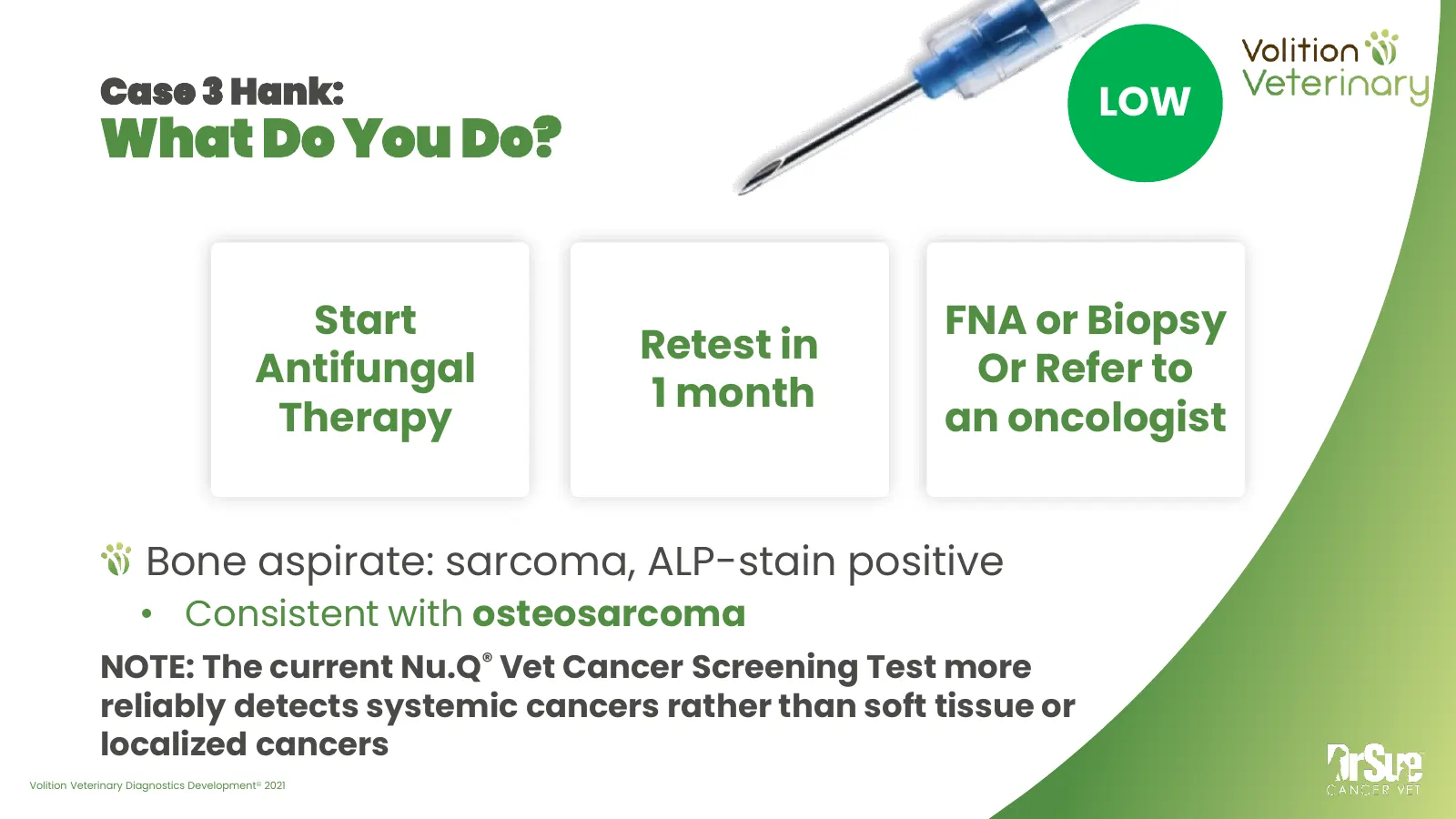
Case 3 Hank: LOW What Do You Do? Start FNA or Biopsy Retest in Antifungal Or Refer to 1 month Therapy an oncologist Bone aspirate: sarcoma, ALP-stain positive • Consistent with osteosarcoma NOTE: The current Nu.Q® Vet Cancer Screening Test more reliably detects systemic cancers rather than soft tiss
Slide 35: Case 4: Percy
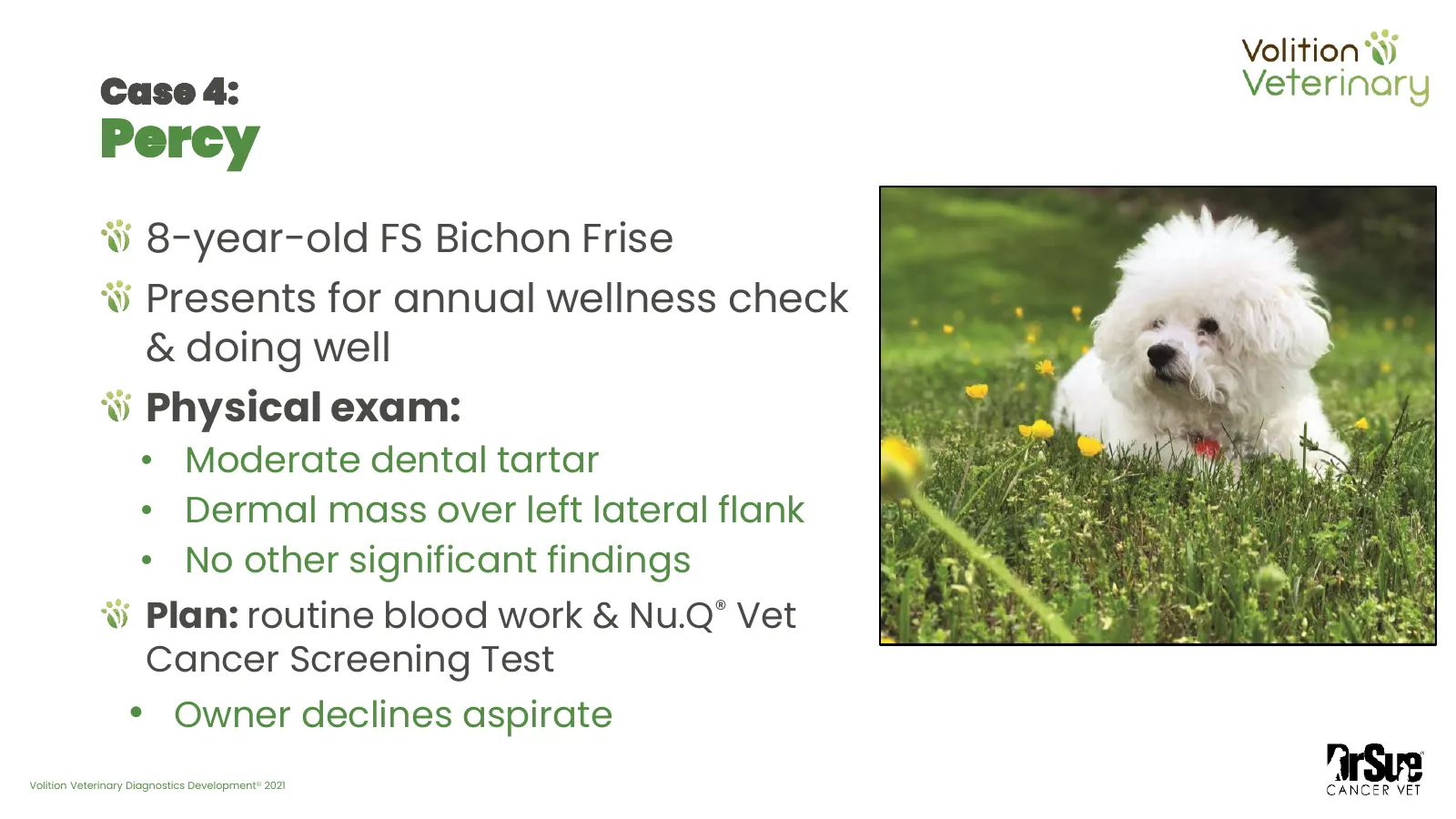
Case 4: Percy 8-year-old FS Bichon Frise Presents for annual wellness check & doing well Physical exam: • Moderate dental tartar • Dermal mass over left lateral flank • No other significant findings Plan: routine blood work & Nu.Q® Vet Cancer Screening Test • Owner declines aspirate Volition Veterin
Slide 36: Case 4: Percy
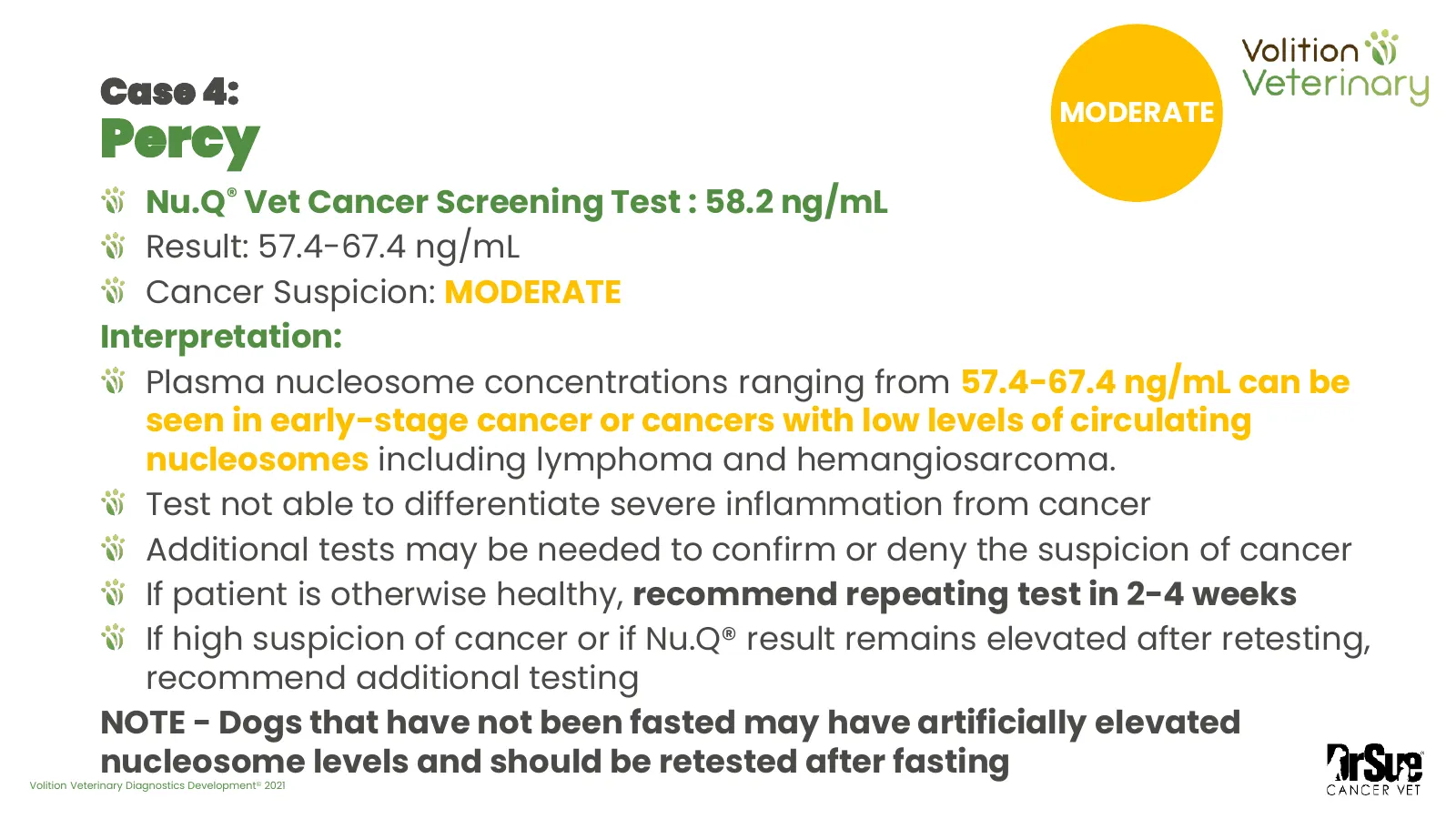
Case 4: MODERATE Percy Nu.Q® Vet Cancer Screening Test : 58.2 ng/mL Result: 57.4-67.4 ng/mL Cancer Suspicion: MODERATE Interpretation: Plasma nucleosome concentrations ranging from 57.4-67.4 ng/mL can be seen in early-stage cancer or cancers with low levels of circulating nucleosomes including lymph
Slide 37: What Do You Do?
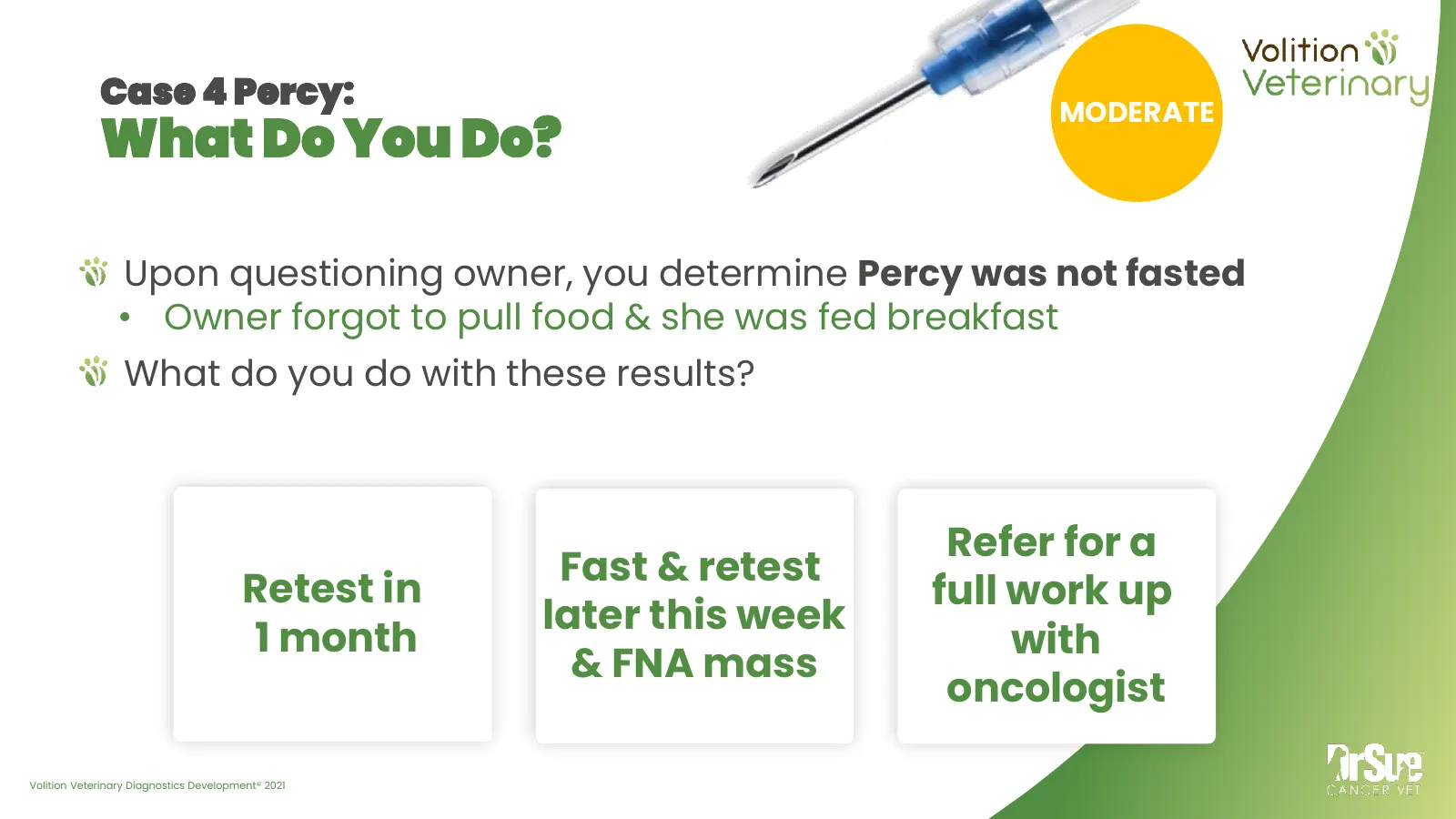
Case 4 Percy: MODERATE What Do You Do? Upon questioning owner, you determine Percy was not fasted • Owner forgot to pull food & she was fed breakfast What do you do with these results? Refer for a Fast & retest Retest in full work up later this week 1 month with & FNA mass oncologist Volition Veteri
Slide 38: Case 4: Percy
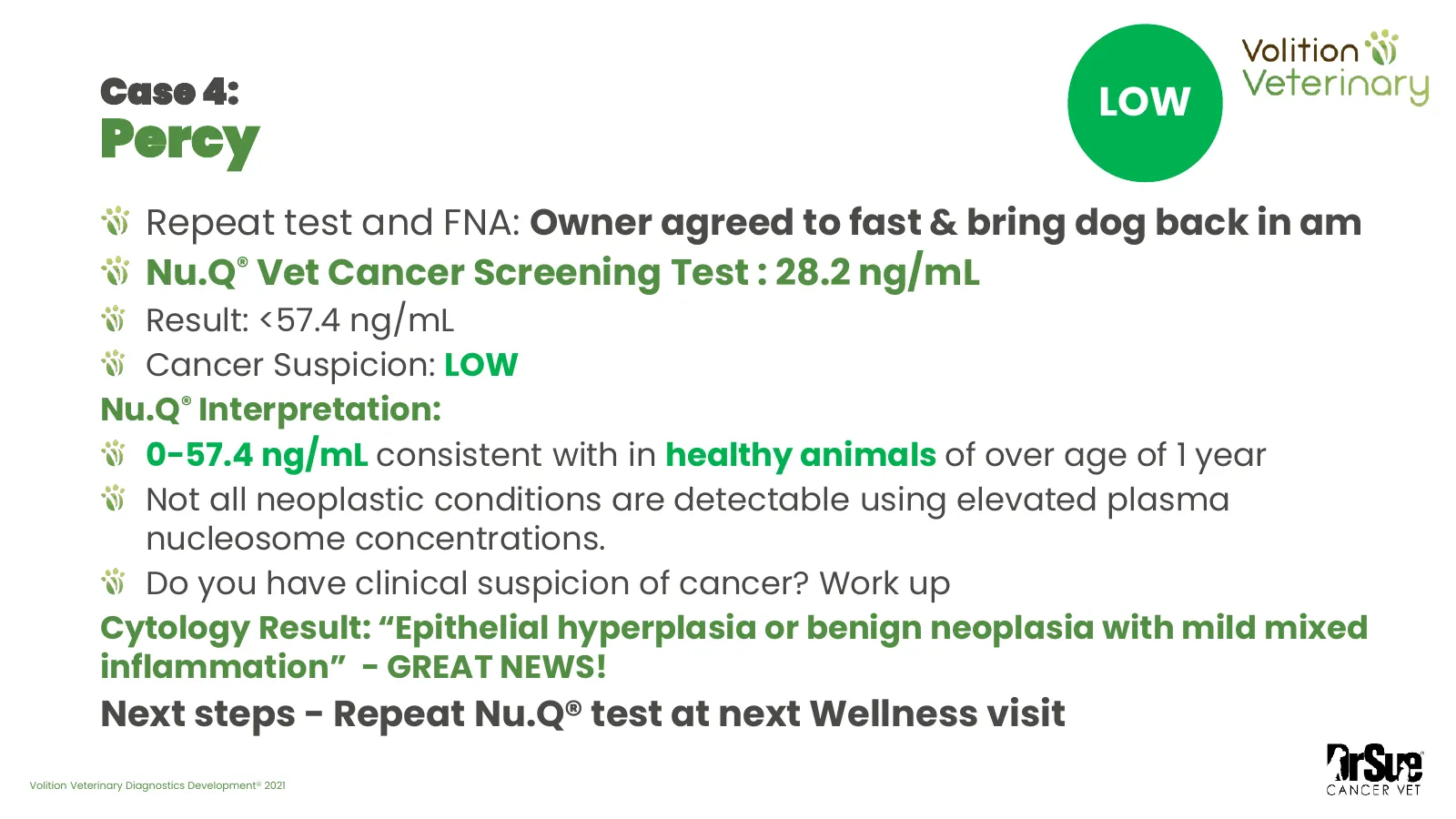
Case 4: LOW Percy Repeat test and FNA: Owner agreed to fast & bring dog back in am Nu.Q® Vet Cancer Screening Test : 28.2 ng/mL Result: <57.4 ng/mL Cancer Suspicion: LOW Nu.Q® Interpretation: 0-57.4 ng/mL consistent with in healthy animals of over age of 1 year Not all neoplastic conditions are dete
Slide 39: Splenic Cases Roxy Danny
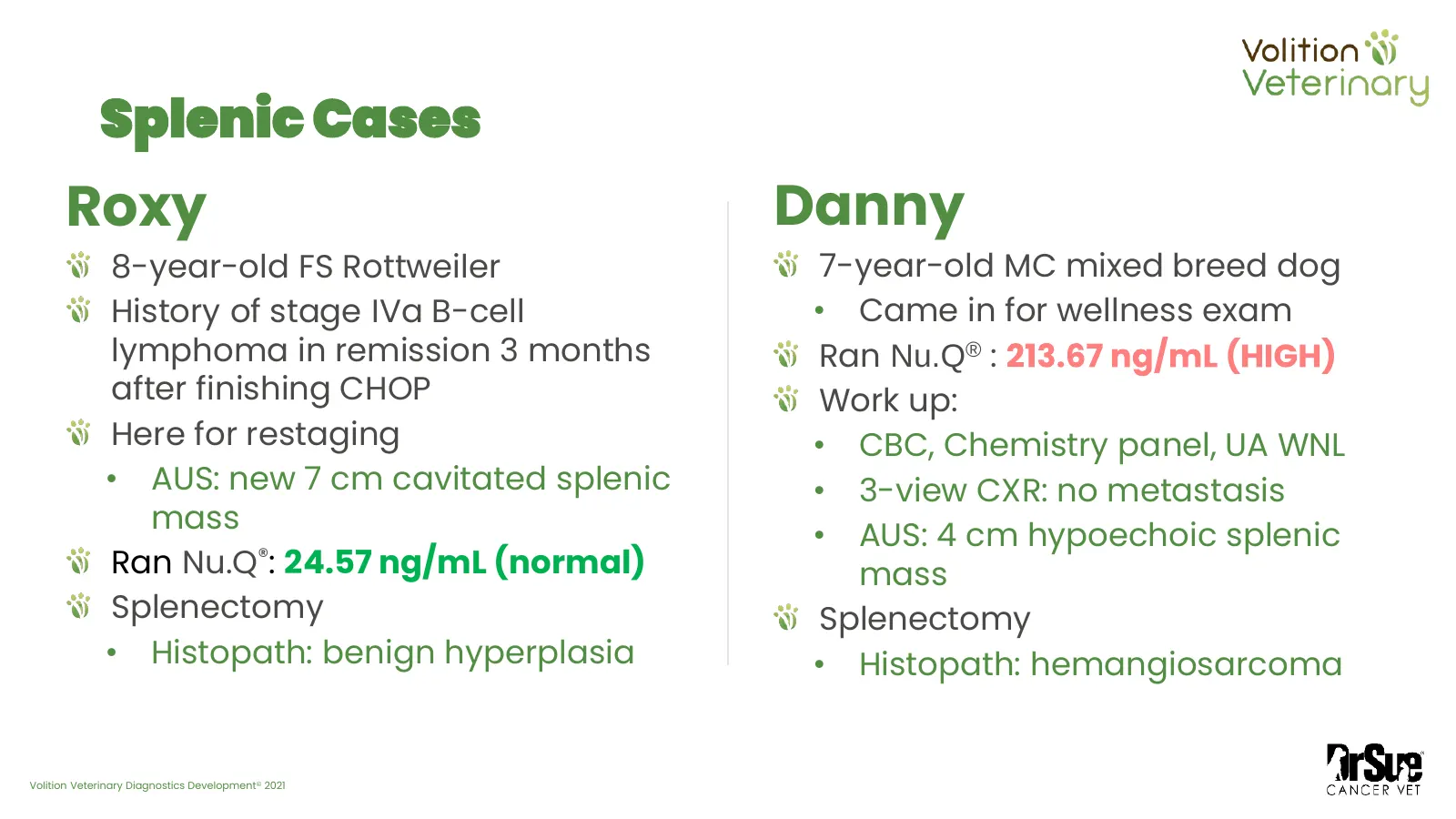
Splenic Cases Roxy Danny 8-year-old FS Rottweiler 7-year-old MC mixed breed dog History of stage IVa B-cell • Came in for wellness exam lymphoma in remission 3 months Ran Nu.Q® : after finishing CHOP Work up: Here for restaging • CBC, Chemistry panel, UA WNL • AUS: new 7 cm cavitated splenic • 3-vie
Slide 40: Splenic Cases: Polly
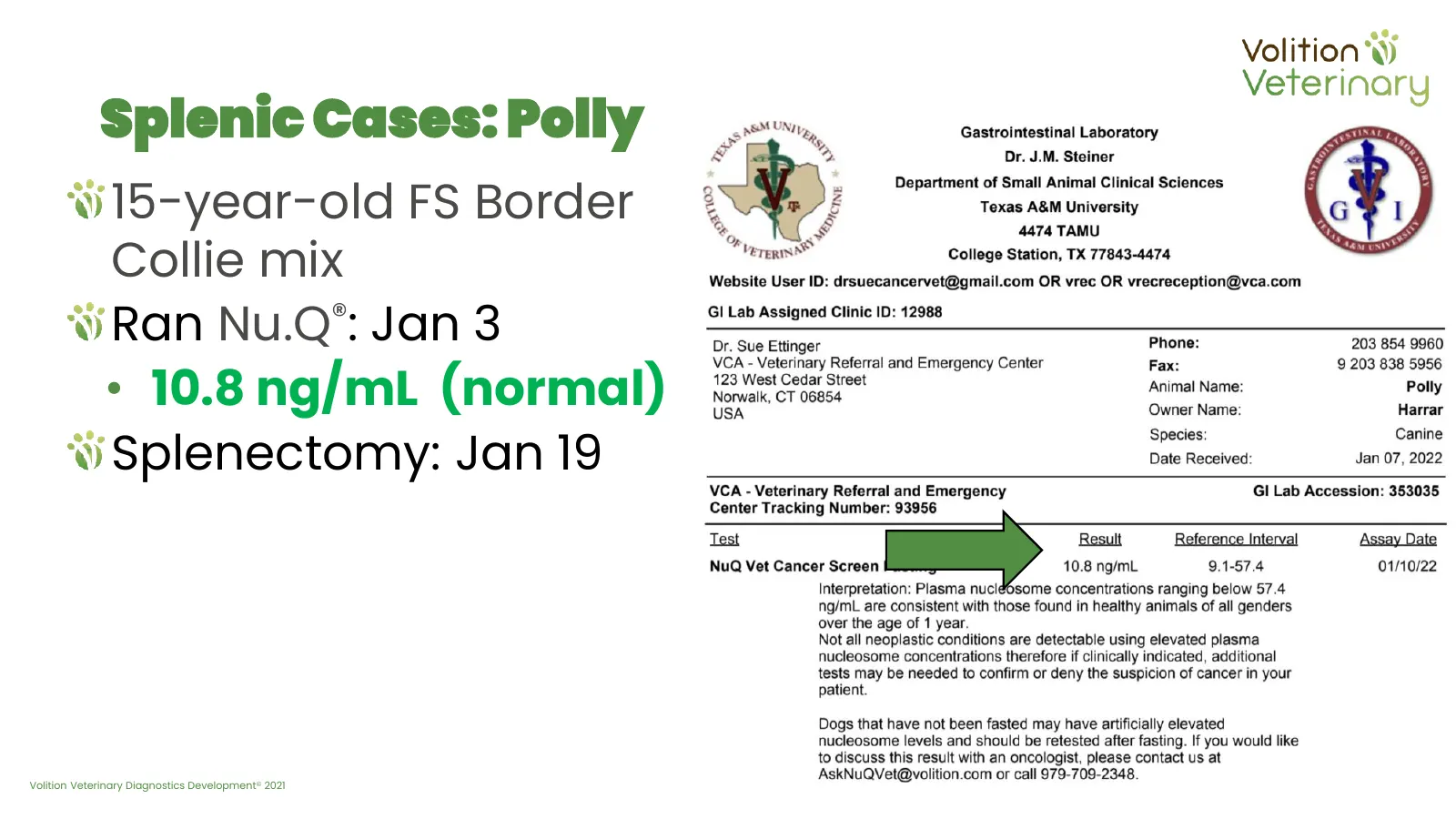
Splenic Cases: Polly 15-year-old FS Border Collie mix Ran Nu.Q®: Jan 3 • 10.8 ng/mL (normal) Splenectomy: Jan 19 Volition Veterinary Diagnostics Development© 2021
Slide 41: Polly's Histopathology
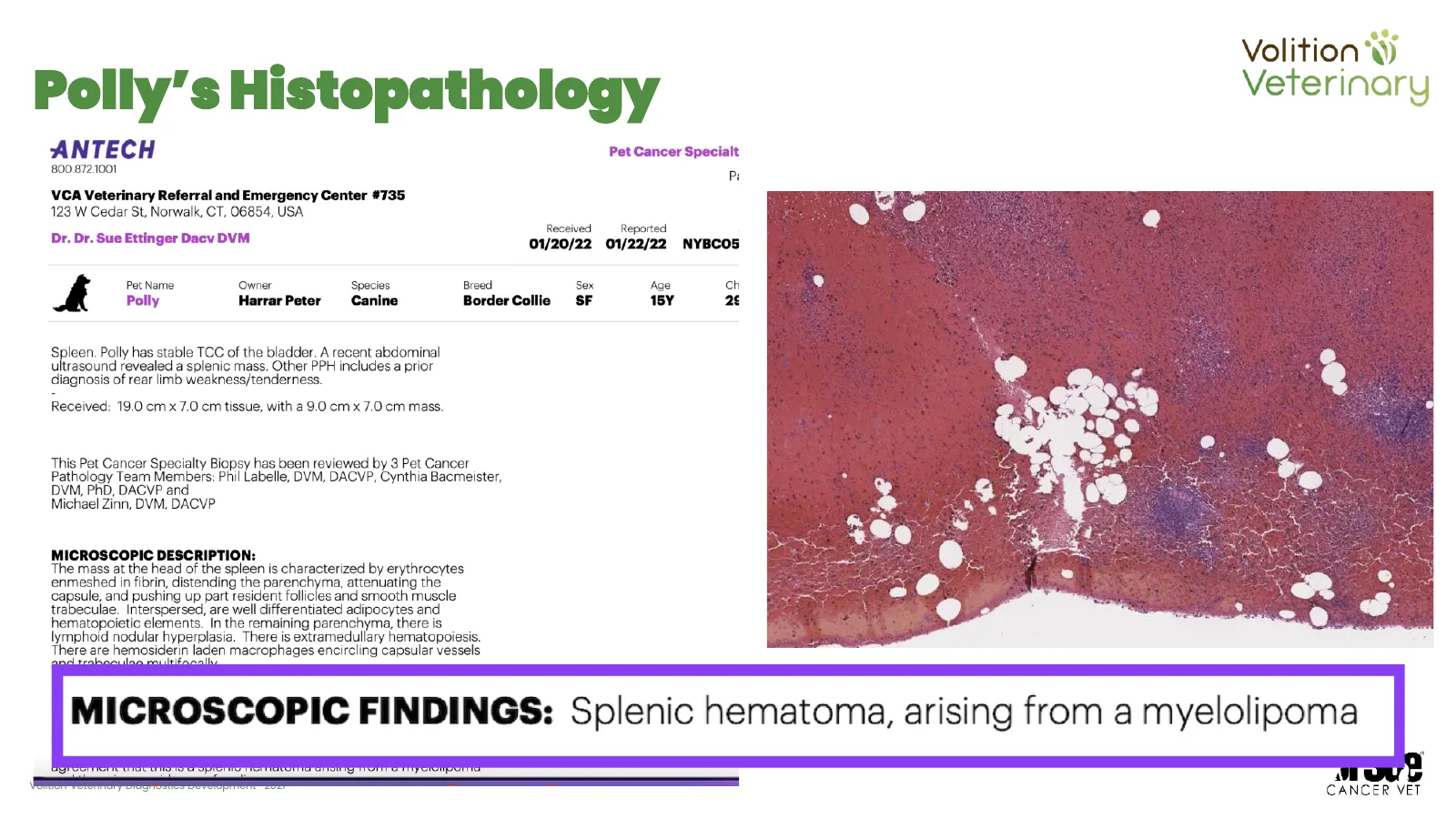
Polly’s Histopathology Volition Veterinary Diagnostics Development© 2021
Slide 42: Cases: Brutus
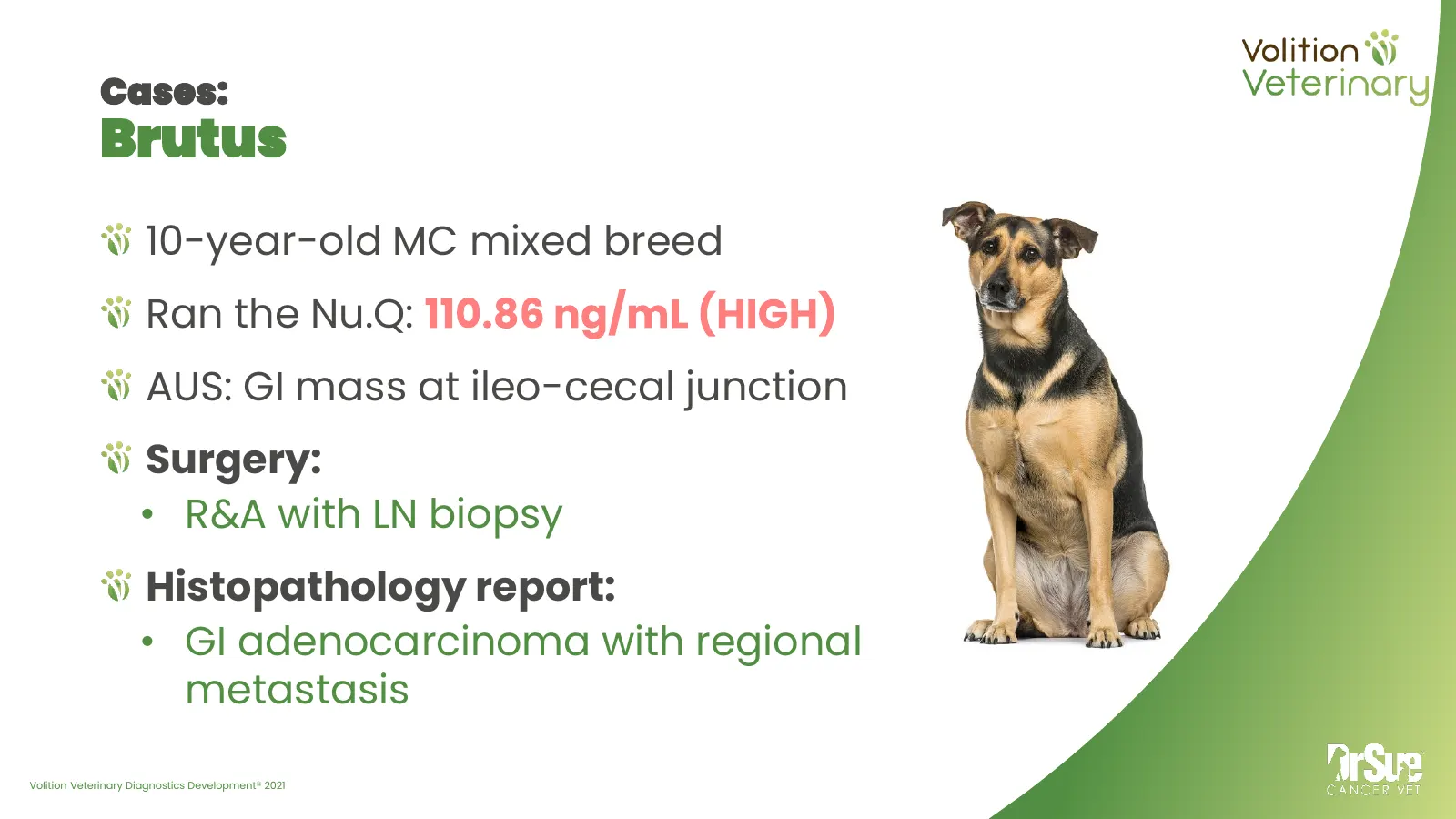
Cases: Brutus 10-year-old MC mixed breed Ran the Nu.Q: AUS: GI mass at ileo-cecal junction Surgery: • R&A with LN biopsy Histopathology report: • GI adenocarcinoma with regional metastasis Volition Veterinary Diagnostics Development© 2021
Slide 43: My Nu.Q Cases
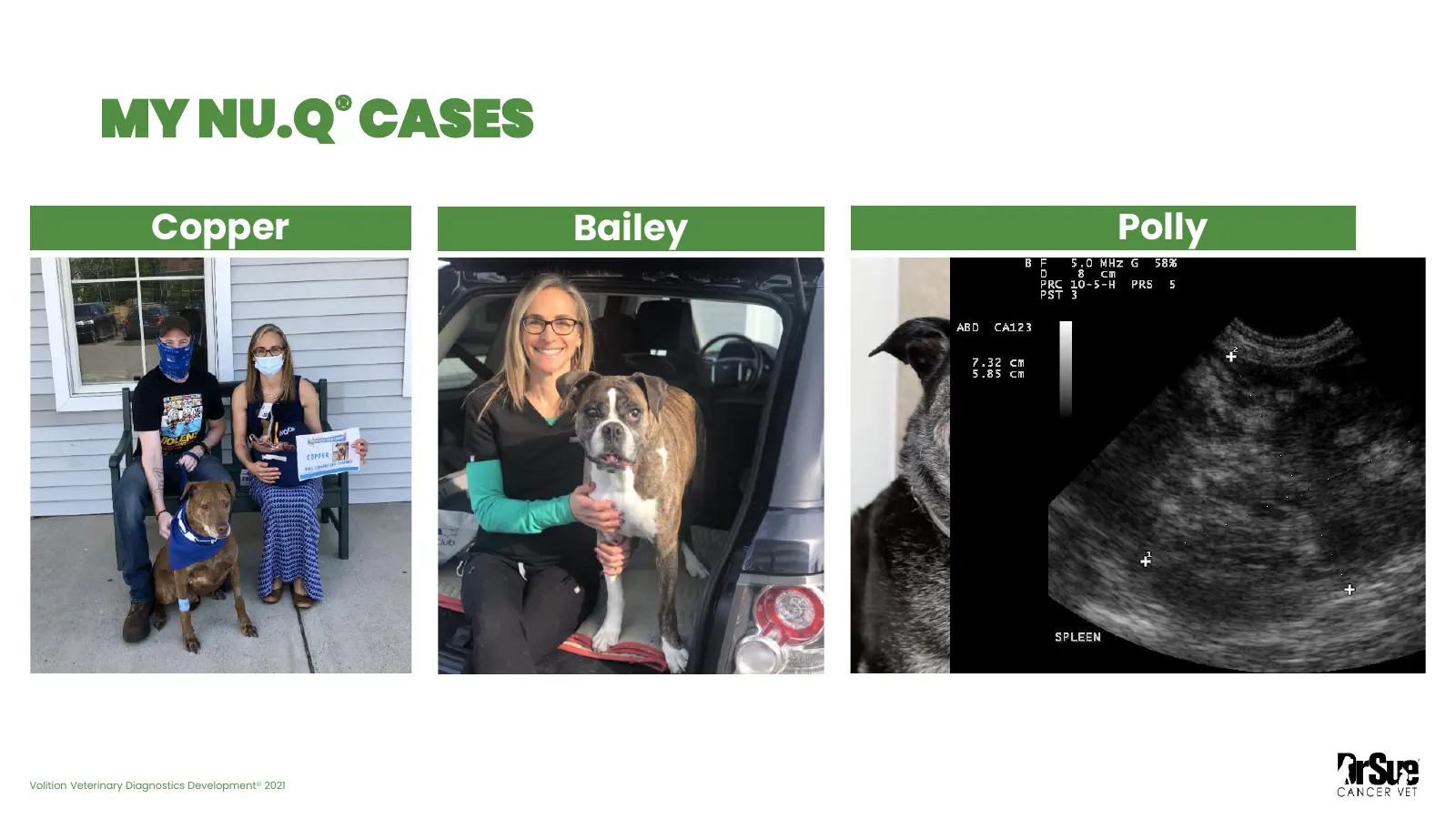
MY NU.Q® CASES Copper Bailey Leo Polly Volition Veterinary Diagnostics Development© 2021
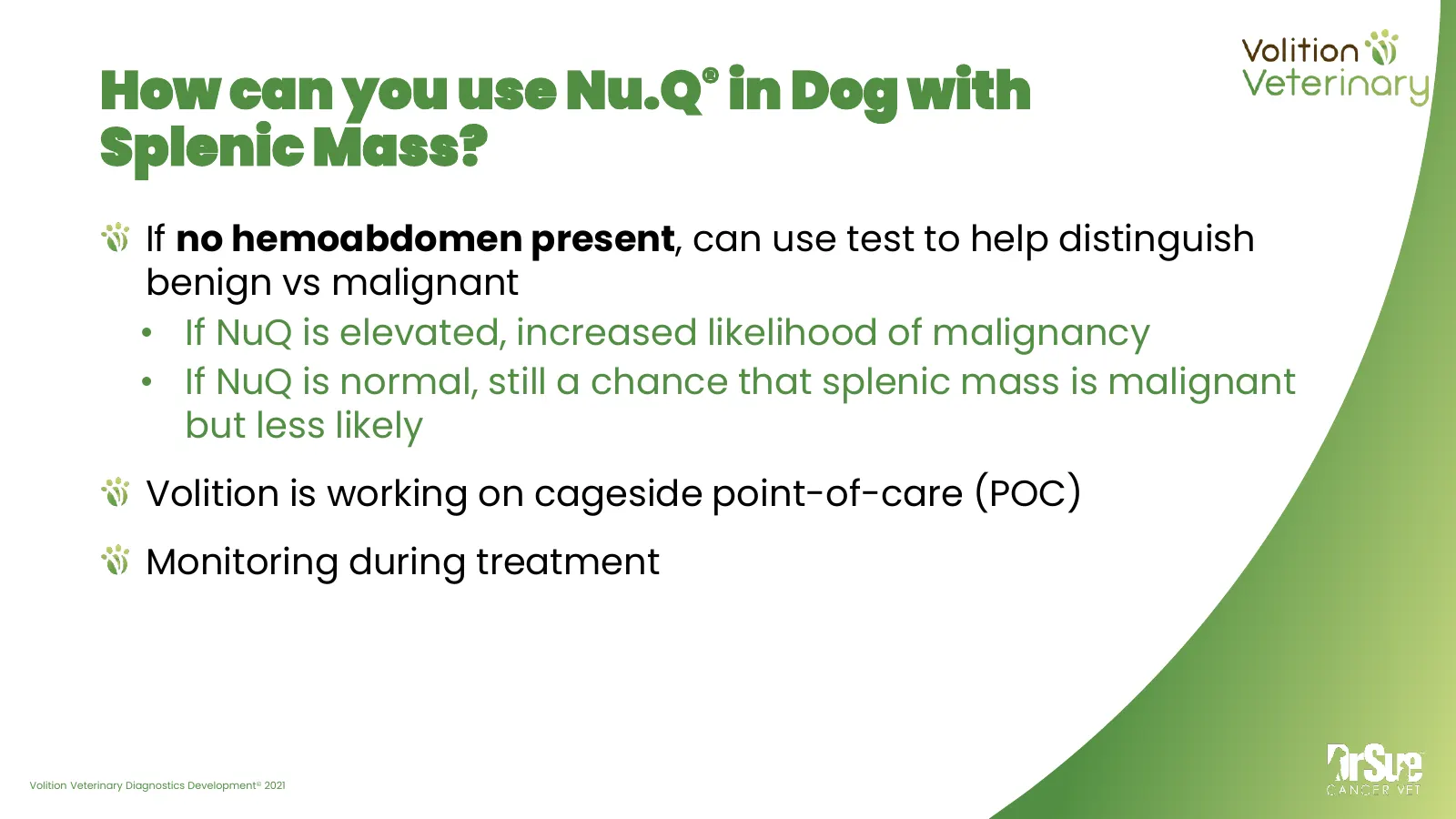
Slide 44: How can you use Nu.Q in Dog with Splenic Mass?
How can you use Nu.Q® in Dog with Splenic Mass? If no hemoabdomen present, can use test to help distinguish benign vs malignant • If NuQ is elevated, increased likelihood of malignancy • If NuQ is normal, still a chance that splenic mass is malignant but less likely Volition is working on cageside p

Slide 45: FAQs
FAQs Volition Veterinary Diagnostics Development© 2022 2021
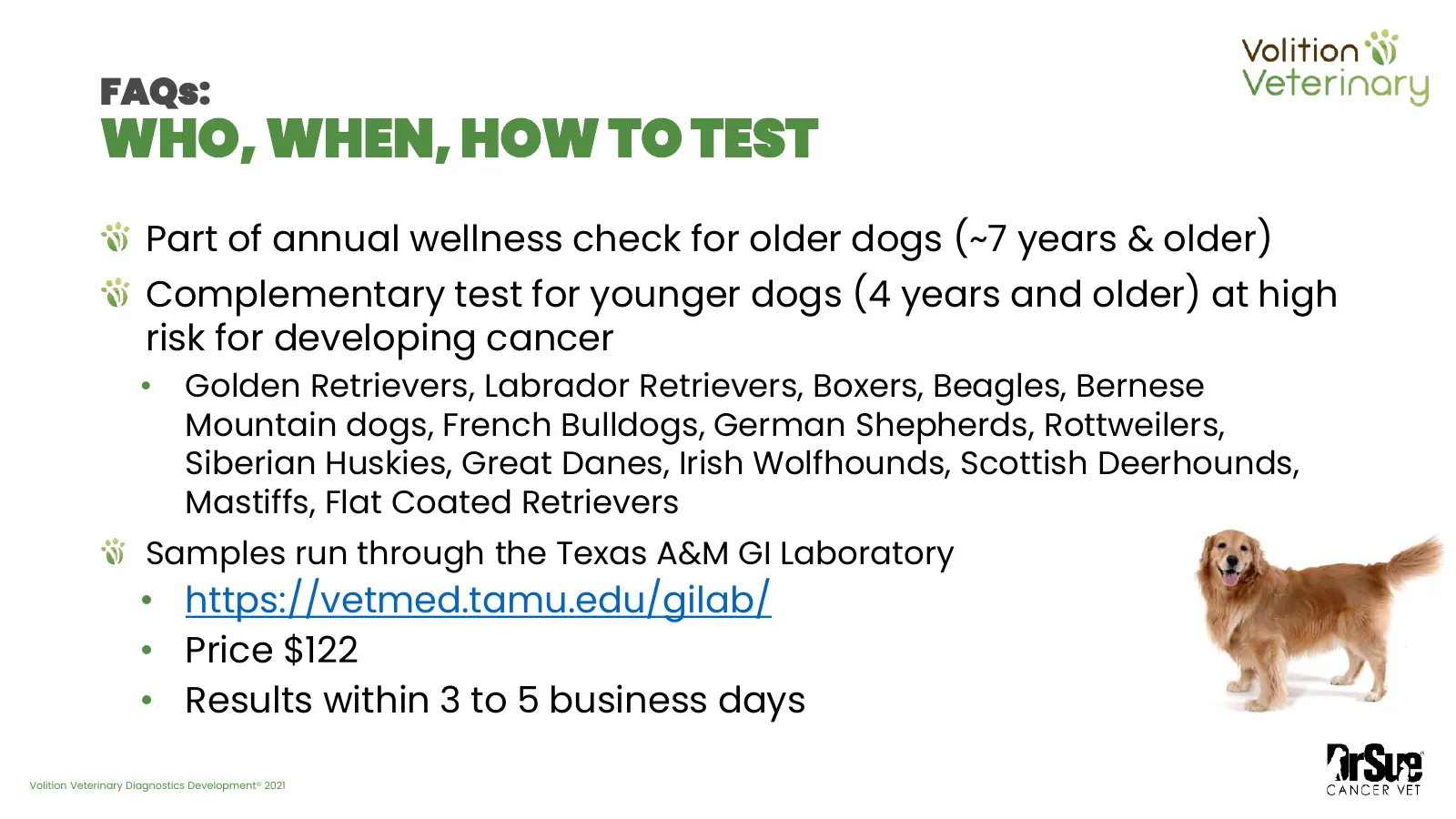
Slide 46: FAQs: Who, When, How to Test
FAQs: WHO, WHEN, HOW TO TEST Part of annual wellness check for older dogs (~7 years & older) Complementary test for younger dogs (4 years and older) at high risk for developing cancer • Golden Retrievers, Labrador Retrievers, Boxers, Beagles, Bernese Mountain dogs, French Bulldogs, German Shepherds,
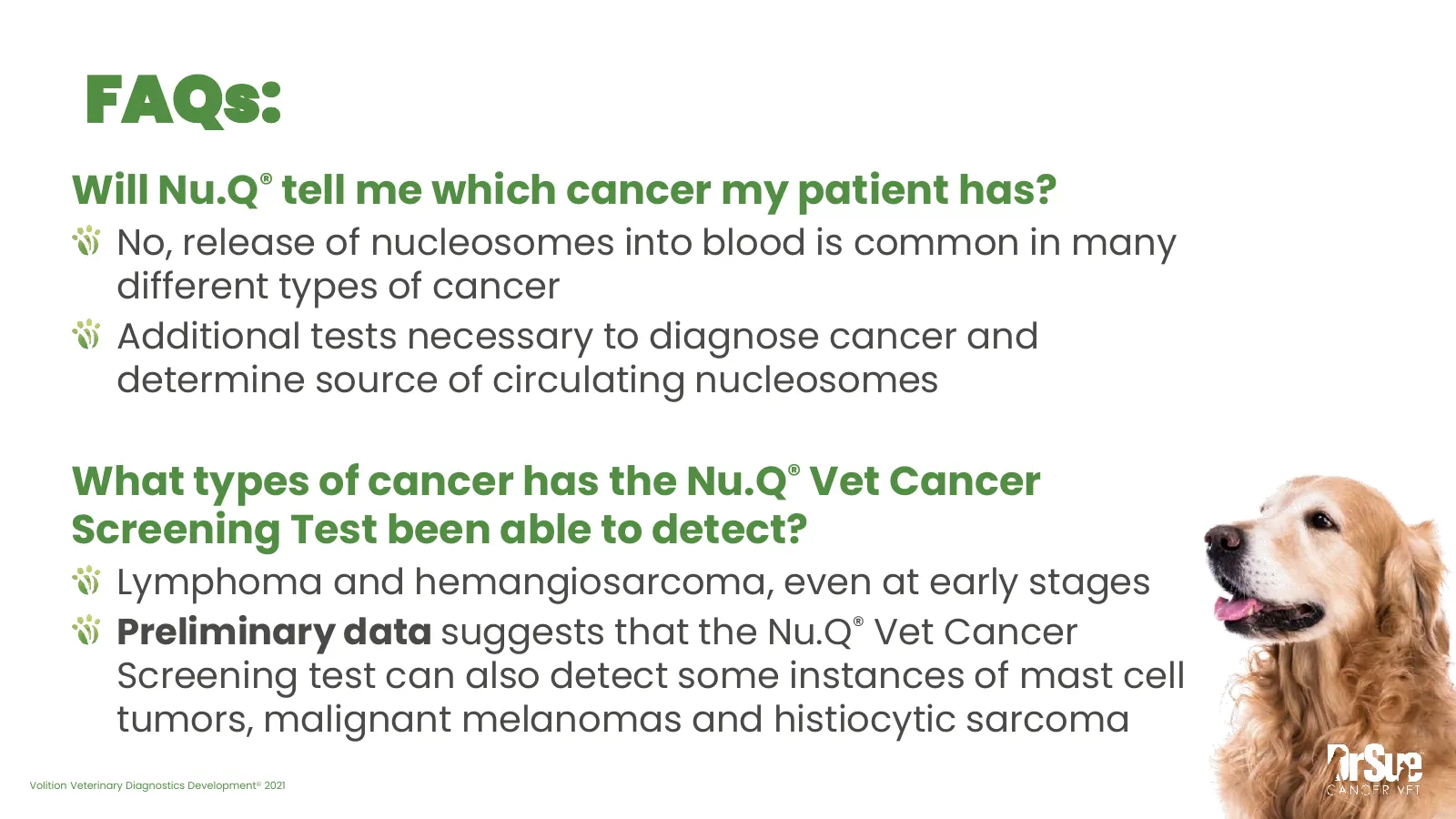
Slide 47: FAQs
FAQs: Will Nu.Q® tell me which cancer my patient has? No, release of nucleosomes into blood is common in many different types of cancer Additional tests necessary to diagnose cancer and determine source of circulating nucleosomes What types of cancer has the Nu.Q® Vet Cancer Screening Test been able
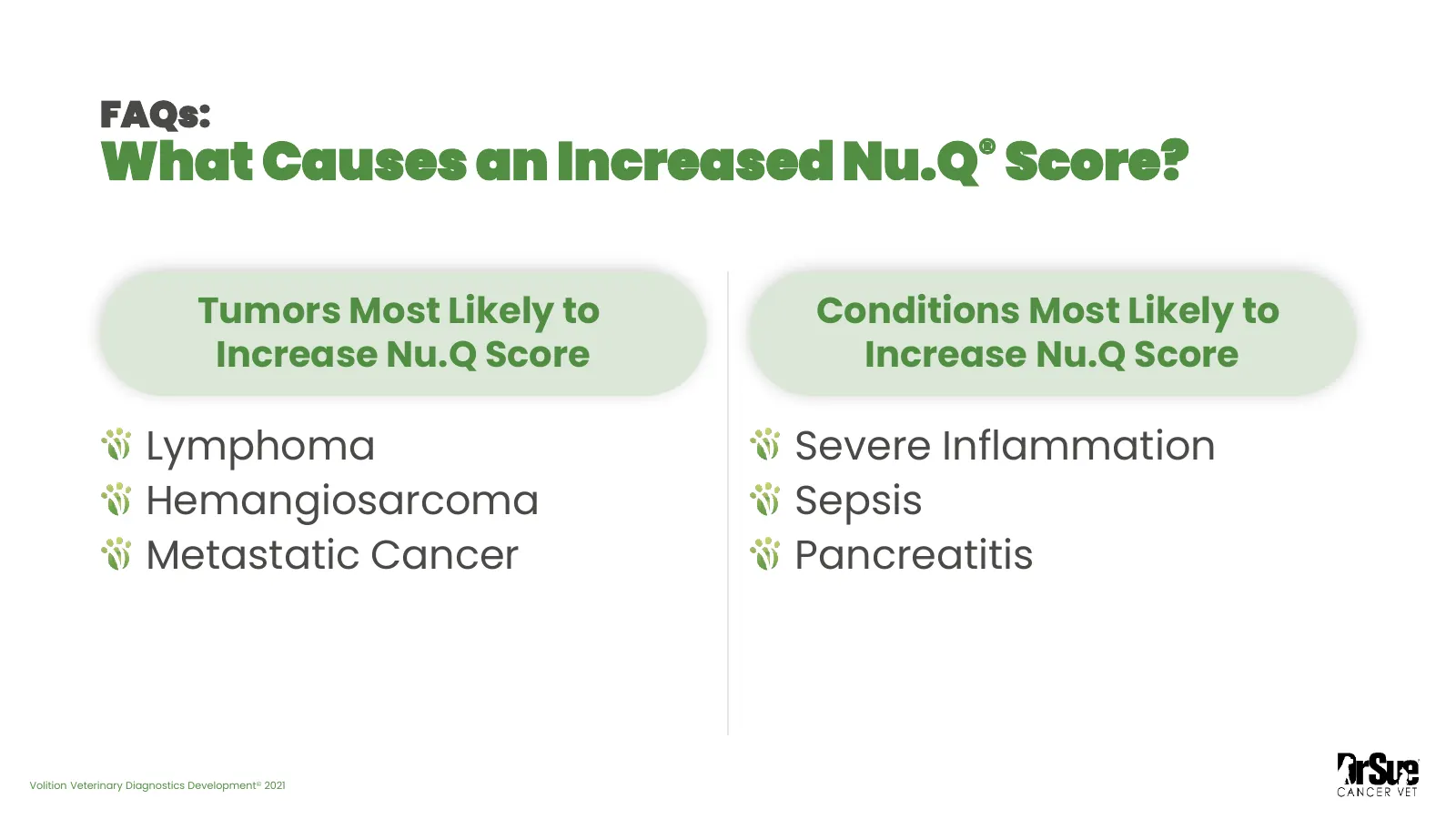
Slide 48: What Causes an Increased Nu.Q Score?
FAQs: What Causes an Increased Nu.Q® Score? Tumors Most Likely to Conditions Most Likely to Increase Nu.Q Score Increase Nu.Q Score Lymphoma Severe Inflammation Hemangiosarcoma Sepsis Metastatic Cancer Pancreatitis Volition Veterinary Diagnostics Development© 2021
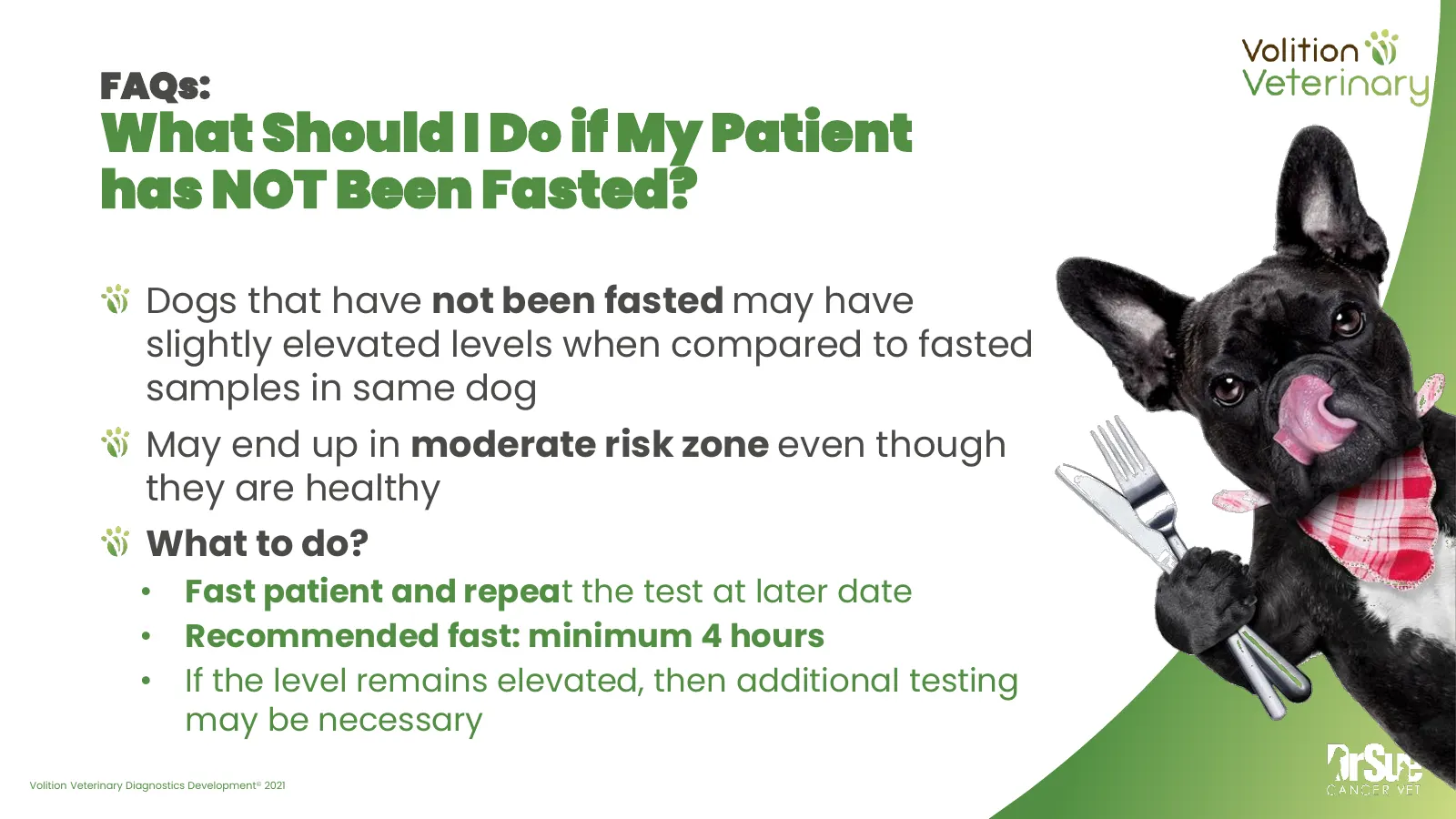
Slide 49: What Should I Do if My Patient has NOT Been Fasted?
FAQs: What Should I Do if My Patient has NOT Been Fasted? Dogs that have not been fasted may have slightly elevated levels when compared to fasted samples in same dog May end up in moderate risk zone even though they are healthy What to do? • Fast patient and repeat the test at later date • Recommen

Slide 50: Longitudinal Data
Longitudinal Data Volition Veterinary Diagnostics Development© 2022 2021
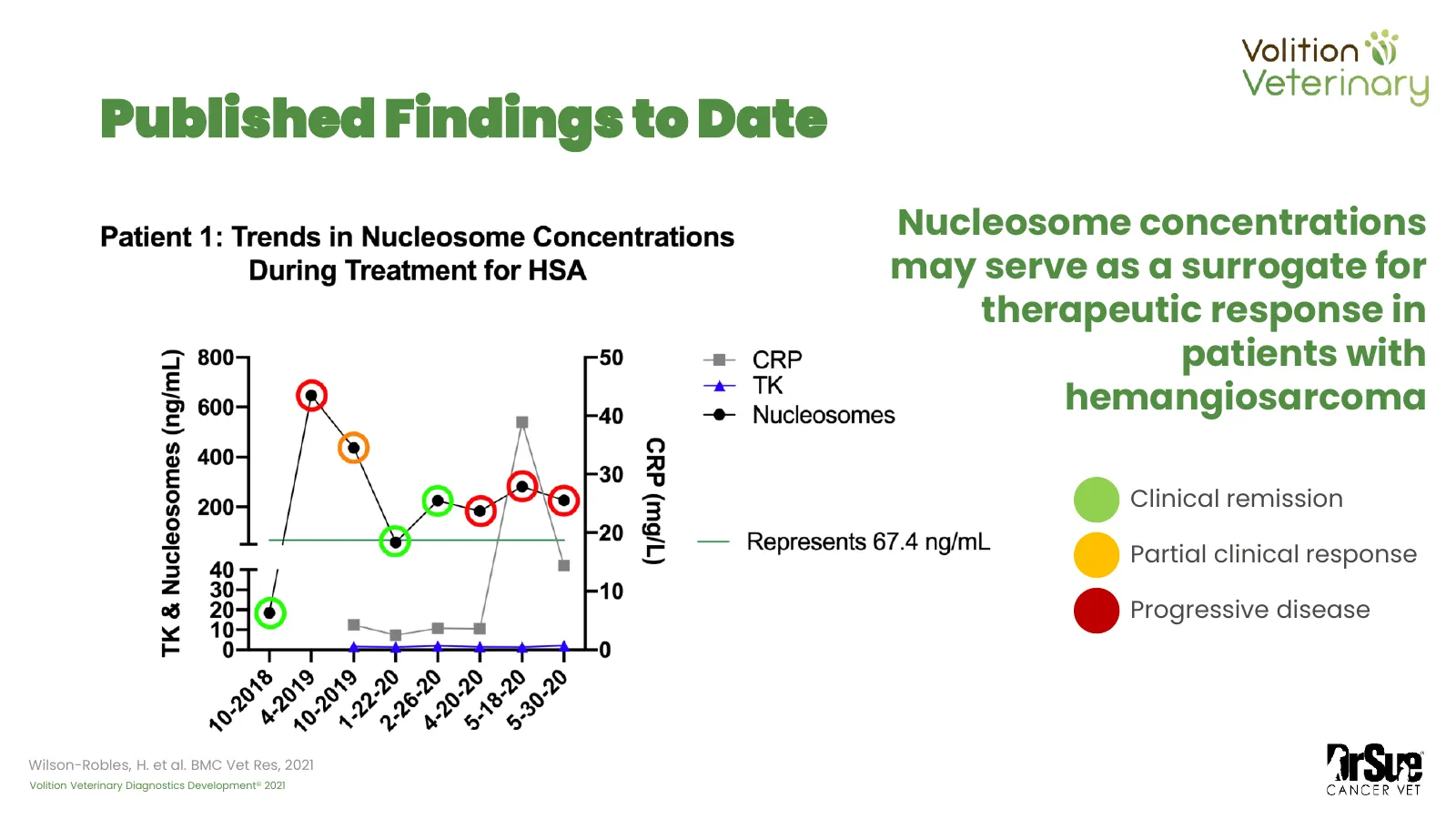
Slide 51: Published Findings to Date
Published Findings to Date Nucleosome concentrations may serve as a surrogate for therapeutic response in patients with hemangiosarcoma Clinical remission Partial clinical response Progressive disease Wilson-Robles, H. et al. BMC Vet Res, 2021 Volition Veterinary Diagnostics Development© 2021
Slide 52: Lymphoma Findings Presented at ACVIM Forum 2021
Lymphoma Findings Presented at ACVIM Forum 2021 Circulating nucleosome concentrations concentrations are elevated in many lymphoma cases (9/10) Circulating nucleosome concentrations change from week to week and appear to mirror disease response There is no correlation between C-reactive protein (CRP
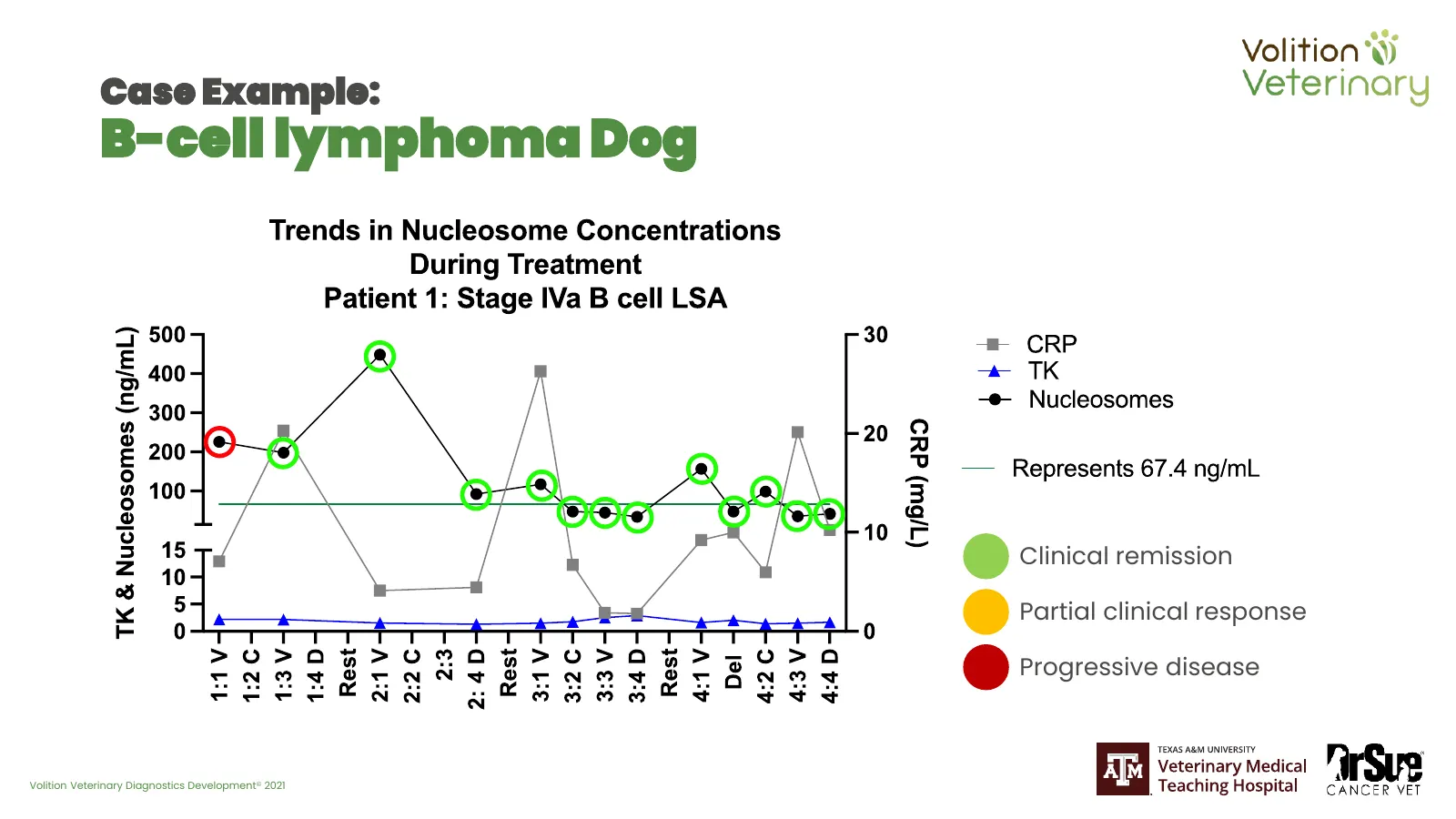
Slide 53: Case Example: B-cell lymphoma Dog
Case Example: B-cell lymphoma Dog Clinical remission Partial clinical response Progressive disease Volition Veterinary Diagnostics Development© 2021
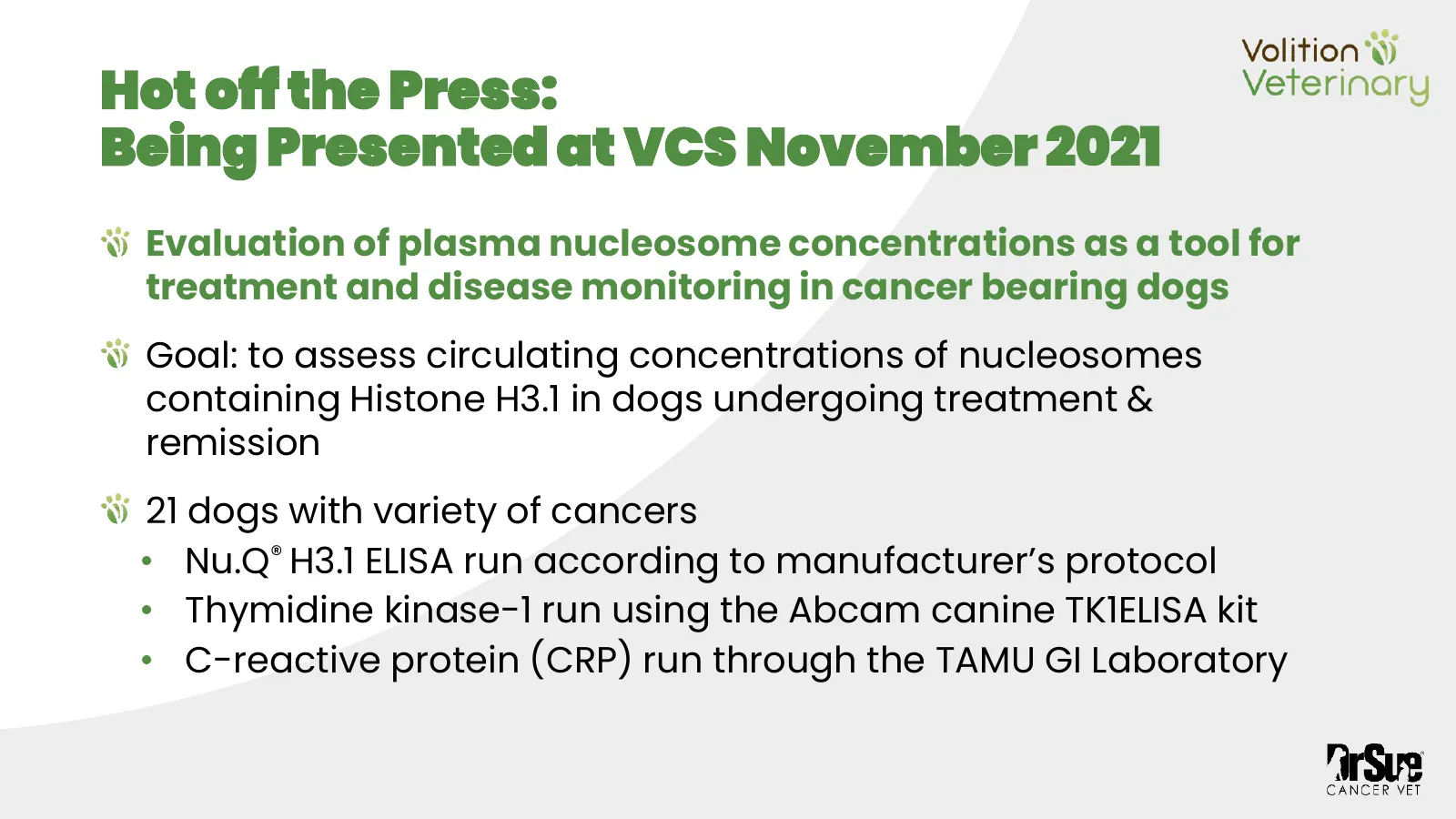
Slide 54: Hot off the Press: Being Presented at VCS November 2021
Hot off the Press: Being Presented at VCS November 2021 Evaluation of plasma nucleosome concentrations as a tool for treatment and disease monitoring in cancer bearing dogs Goal: to assess circulating concentrations of nucleosomes containing Histone H3.1 in dogs undergoing treatment & remission 21 d
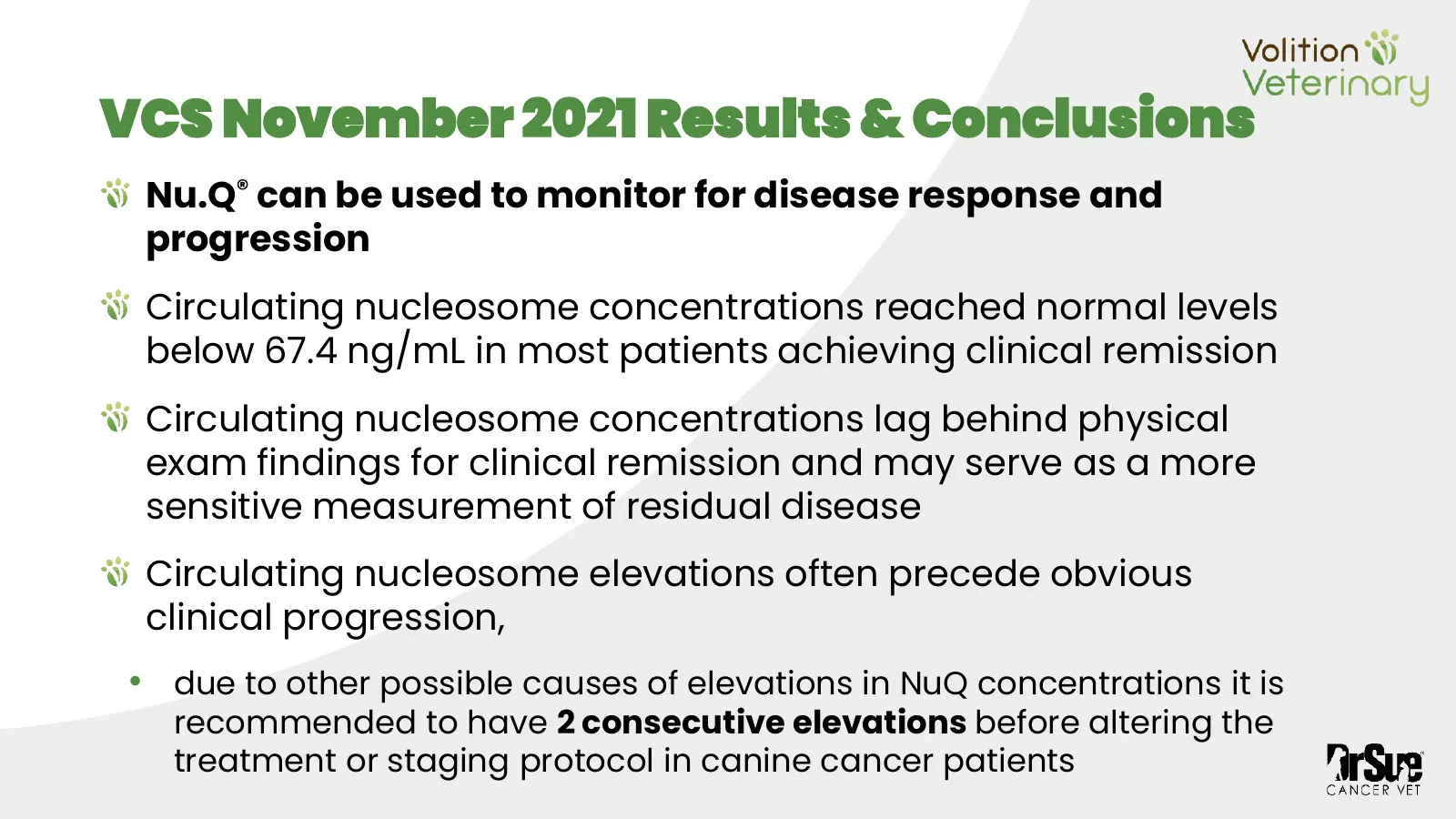
Slide 55: VCS November 2021 Results & Conclusions
VCS November 2021 Results & Conclusions Nu.Q® can be used to monitor for disease response and progression Circulating nucleosome concentrations reached normal levels below 67.4 ng/mL in most patients achieving clinical remission Circulating nucleosome concentrations lag behind physical exam findings
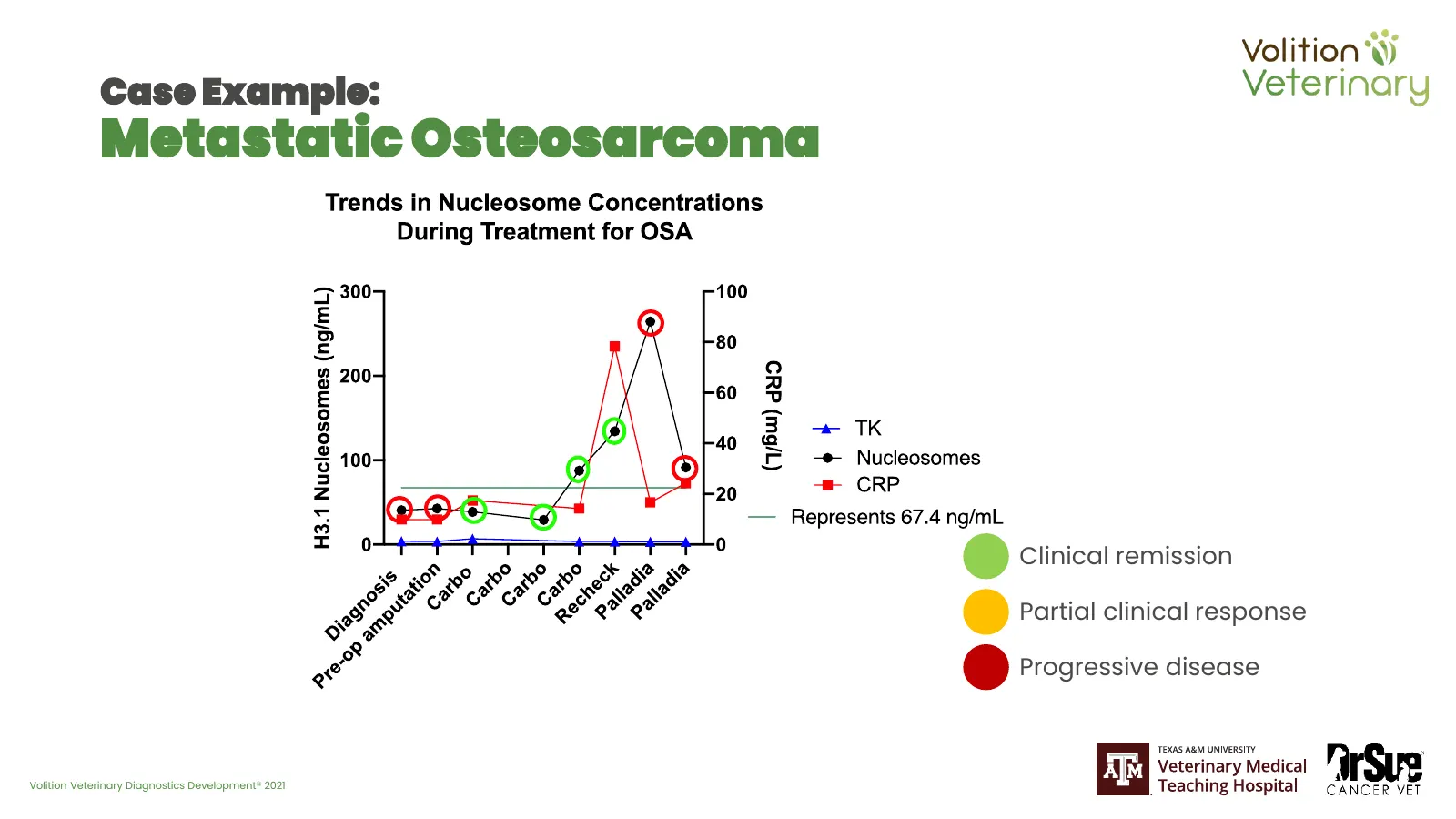
Slide 56: Case Example: Metastatic Osteosarcoma
Case Example: Metastatic Osteosarcoma Clinical remission Partial clinical response Progressive disease Volition Veterinary Diagnostics Development© 2021
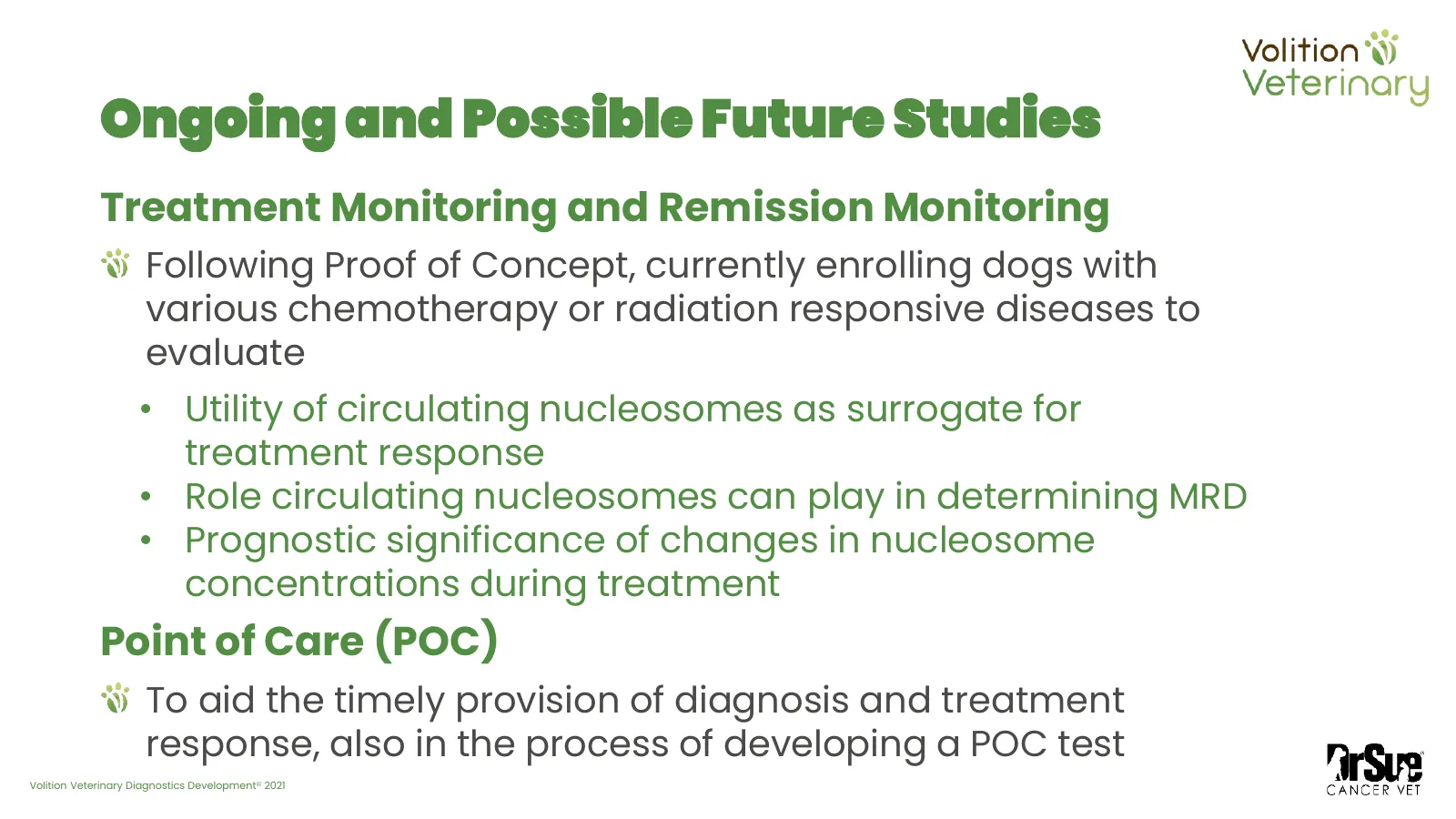
Slide 57: Ongoing and Possible Future Studies
Ongoing and Possible Future Studies Treatment Monitoring and Remission Monitoring Following Proof of Concept, currently enrolling dogs with various chemotherapy or radiation responsive diseases to evaluate • Utility of circulating nucleosomes as surrogate for treatment response • Role circulating nu
Slide 58: Ongoing and Possible Future Studies
Ongoing and Possible Future Studies Broadening the Range of Cancers Detected Peer reviewed publication due soon Although the Nu.Q® VCST has been marketed as a screening test for lymphoma and hemangiosarcoma, this test can be useful in detecting other forms of cancer as well1 Test performs best for t
Slide 59: Ongoing and Possible Future Studies
Ongoing and Possible Future Studies Differential Diagnosis Volition currently working on developing additional tests to add to the Nu.Q® test to better differentiate inflammatory and other conditions from cancer Studies are underway at 5 university hospitals to collect data comparing a variety of co
Slide 60: Materials Available
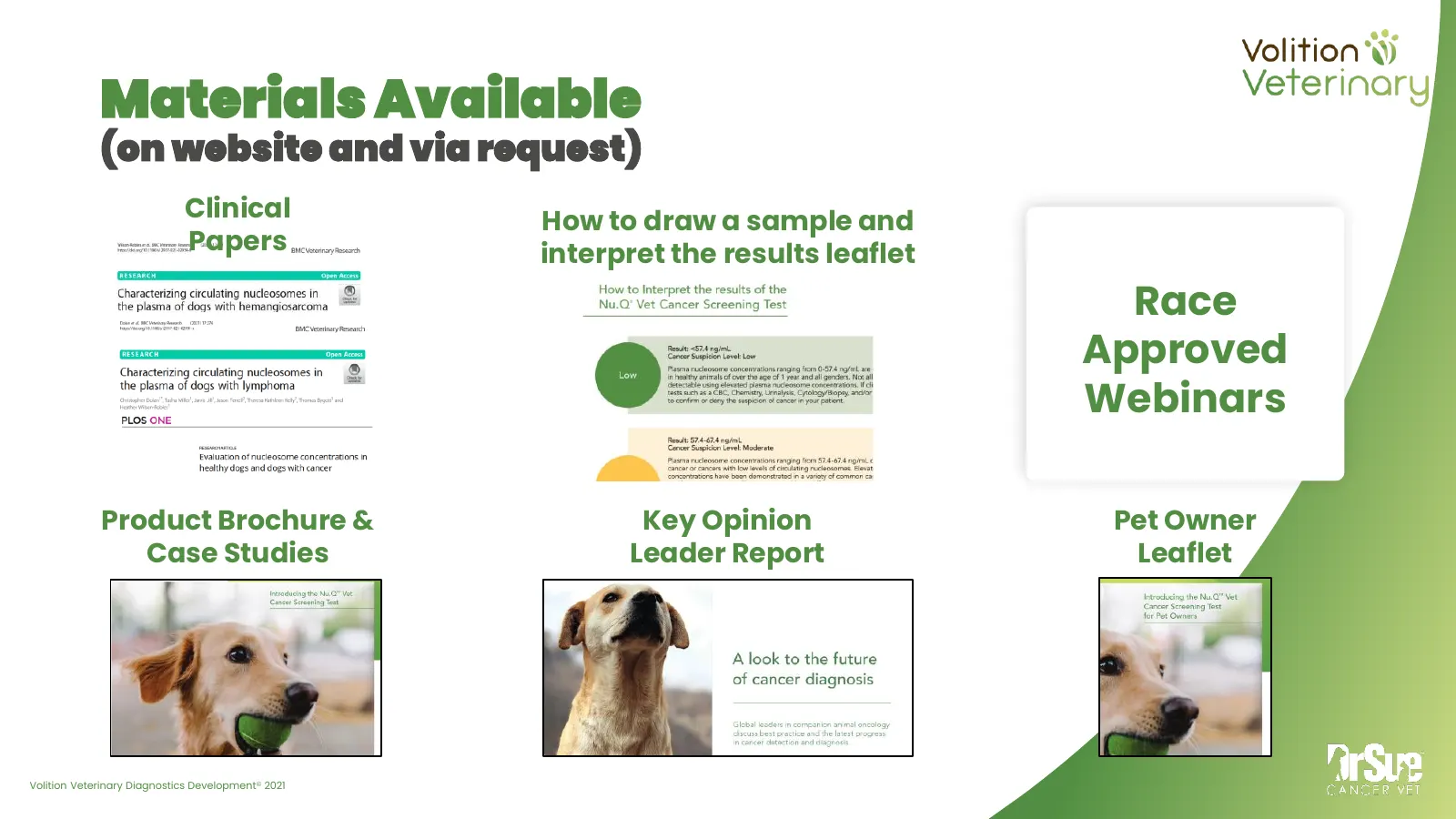
Materials Available (on website and via request) Clinical How to draw a sample and Papers interpret the results leaflet Race Approved Webinars Product Brochure & Key Opinion Pet Owner Case Studies Leader Report Leaflet Volition Veterinary Diagnostics Development© 2021

Slide 61: Any Other Questions?
Any Other Questions? Please visit our website https://volition.com/veterinary Or Contact us at AskNu.Qvet@volition.com Hotline 979-709-2348 Volition Veterinary Diagnostics Development© 2021 2021
Source: Internet Archive copy of veterinary.volition.com
More decks from VolitionRx Limited
 Investor Presentation (September 2026)15 slides · September 2026
 Investor Presentation (September 2026)29 slides · September 2026
 Q2 2026 Earnings Presentation29 slides · Aug 14, 2026
 Investor Presentation (May 2026)13 slides · May 2026
 Investor Presentation (May 2026)27 slides · May 2026
 Investor Presentation (April 2026)12 slides · April 2026