Huron Consulting Group Inc. · NASDAQ:HURN
Huron Consulting — Conference Presentation (2013)
40 slides from Huron Consulting's conference presentation, 2013
Slide 1: Designing a Chart of Accounts that Meets Your Institution's Changing Needs
Designing a Chart of Accounts that Meets Your Institution’s Changing Needs David Klipa Marnie Fulton J. Michael Gower

Slide 2: Introductions
Introductions
Slide 3: Agenda
Agenda Chart of Accounts – Defined Why Redesign Your CoA? CoA Structures and Options Getting Started – Establishing Guiding Principles CoA Design – Approach and Key Considerations The CoA in the Institution’s Fiscal Management Environment Q&A © 2013 Huron Consulting Group. All Rights R
Slide 4: Chart of Accounts – Defined
Chart of Accounts – Defined
Slide 5: Polling Question
Polling Question What financial system is your institution currently using, transitioning to, or considering? A. Oracle/PeopleSoft B. Oracle EBS C. Lawson D. Banner E. Kuali F. Workday G. Other © 2013 Huron Consulting Group. All Rights Reserved. Proprietary & Confidential. 5
Slide 6: CoA: What it is – What it isn't
CoA What it is – What it isn’t The basic structure used to record the financial effects of transactions. The CoA is used to organize the finances of the institution and to segregate expenditures, revenue, assets and liabilities in order to provide an understanding of the financial status of the
Slide 7: Why Redesign Your Chart of Accounts?
Why Redesign Your Chart of Accounts?
Slide 8: Why Redesign Your CoA?
Why Redesign Your CoA? New financial system implementation • Pre-system selection • Early implementation Update to existing financial applications • Functional limitations of existing chart of accounts – Transitioned old CoA structure to new system • Reporting/fiscal management limitations • Upg
Slide 9: Polling Question
Polling Question Why are you interested in changing the Chart of Accounts? A. Implementing a new financial system B. Updating an older financial system C. Adding modules to existing system D. Looking to improve reporting E. None of the above © 2013 Huron Consulting Group. All Rights Reserved. Prop
Slide 10: Chart of Accounts – Structures and Options
Chart of Accounts – Structures and Options
Slide 11: Chart of Accounts - Types
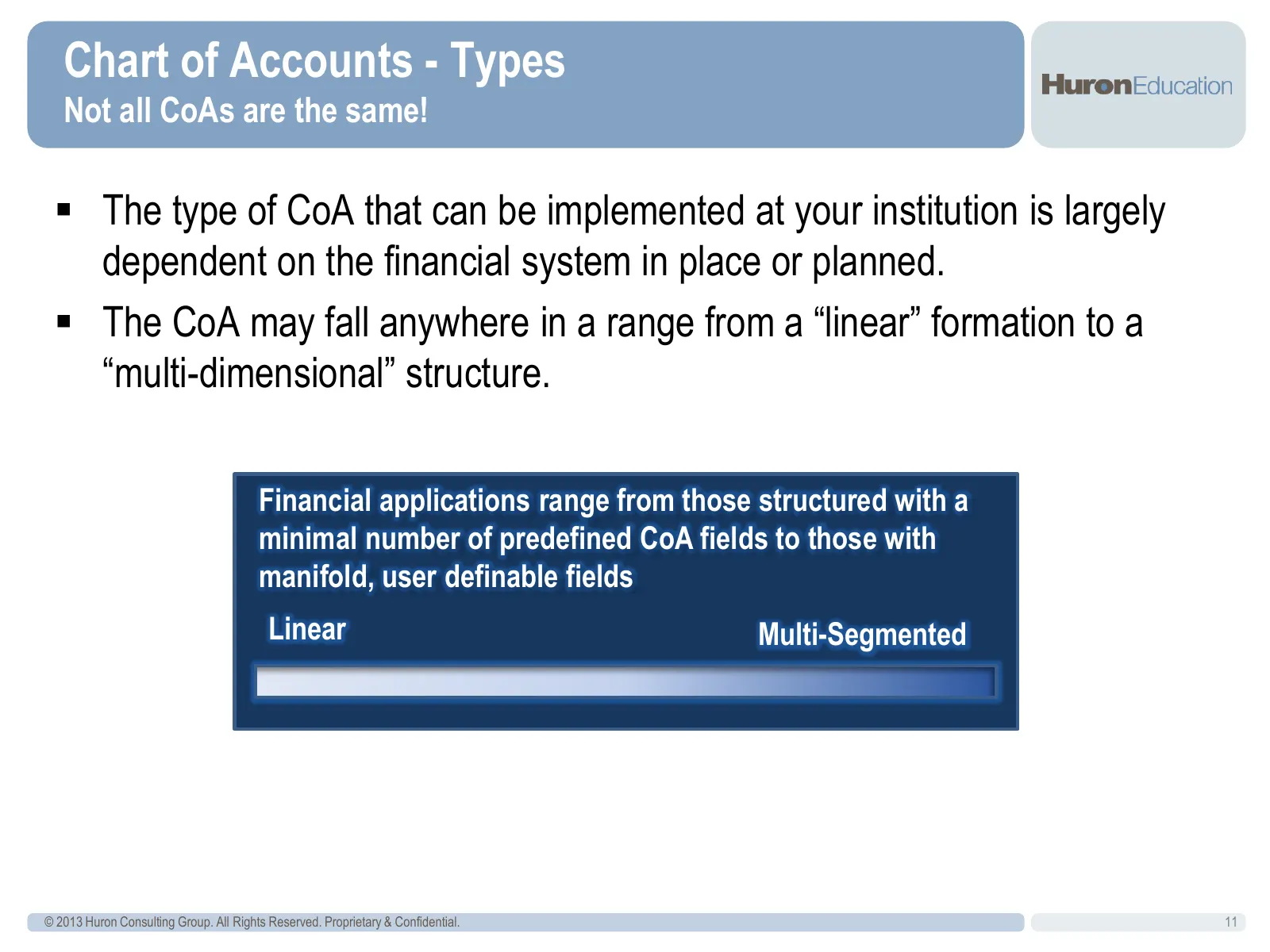
Chart of Accounts - Types Not all CoAs are the same! The type of CoA that can be implemented at your institution is largely dependent on the financial system in place or planned. The CoA may fall anywhere in a range from a “linear” formation to a “multi-dimensional” structure. Financial applicat
Slide 12: CoA Options: Linear Structure
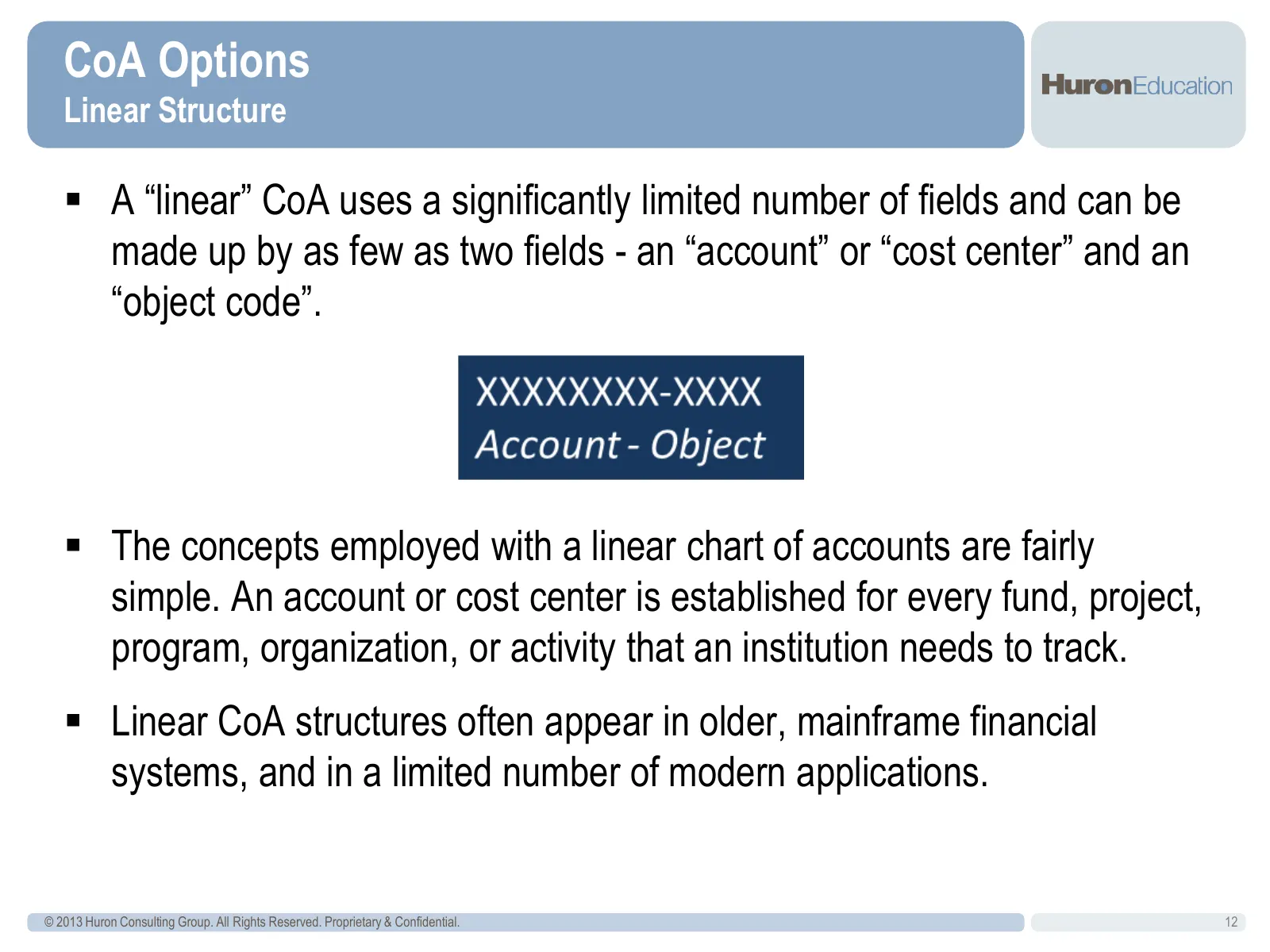
CoA Options Linear Structure A “linear” CoA uses a significantly limited number of fields and can be made up by as few as two fields - an “account” or “cost center” and an “object code”. The concepts employed with a linear chart of accounts are fairly simple. An account or cost center is establi
Slide 13: CoA Options: Multi-Dimensional Structure
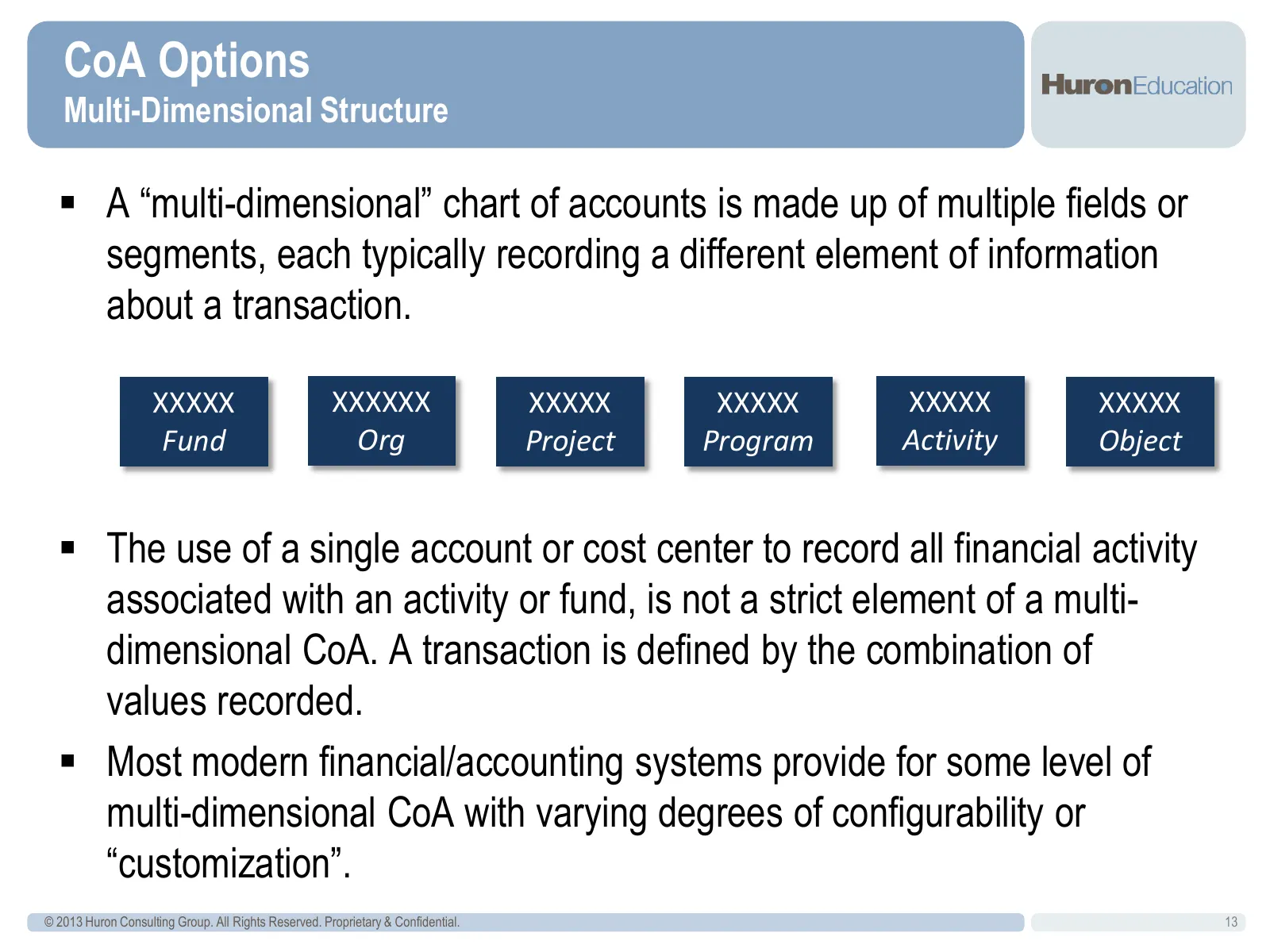
CoA Options Multi-Dimensional Structure A “multi-dimensional” chart of accounts is made up of multiple fields or segments, each typically recording a different element of information about a transaction. XXXXX XXXXXX XXXXX XXXXX XXXXX XXXXX Fund Org Project Program Activity Object The use of a s
Slide 14: CoA Options: Characteristics and Considerations
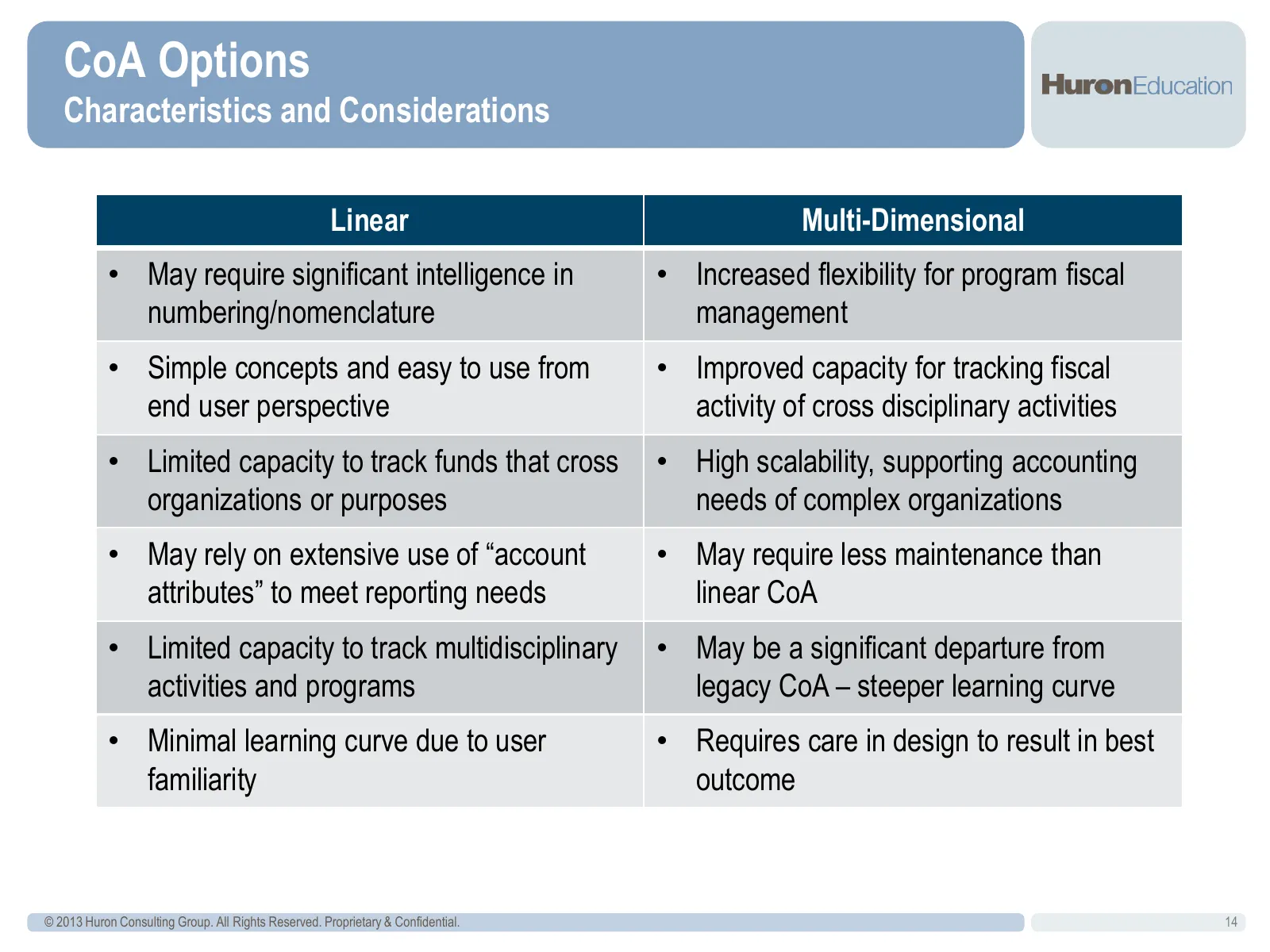
CoA Options Characteristics and Considerations Linear Multi-Dimensional • May require significant intelligence in • Increased flexibility for program fiscal numbering/nomenclature management • Simple concepts and easy to use from • Improved capacity for tracking fiscal end user perspective activity
Slide 15: CoA Options: Linear to Multi-Dimensional Scale
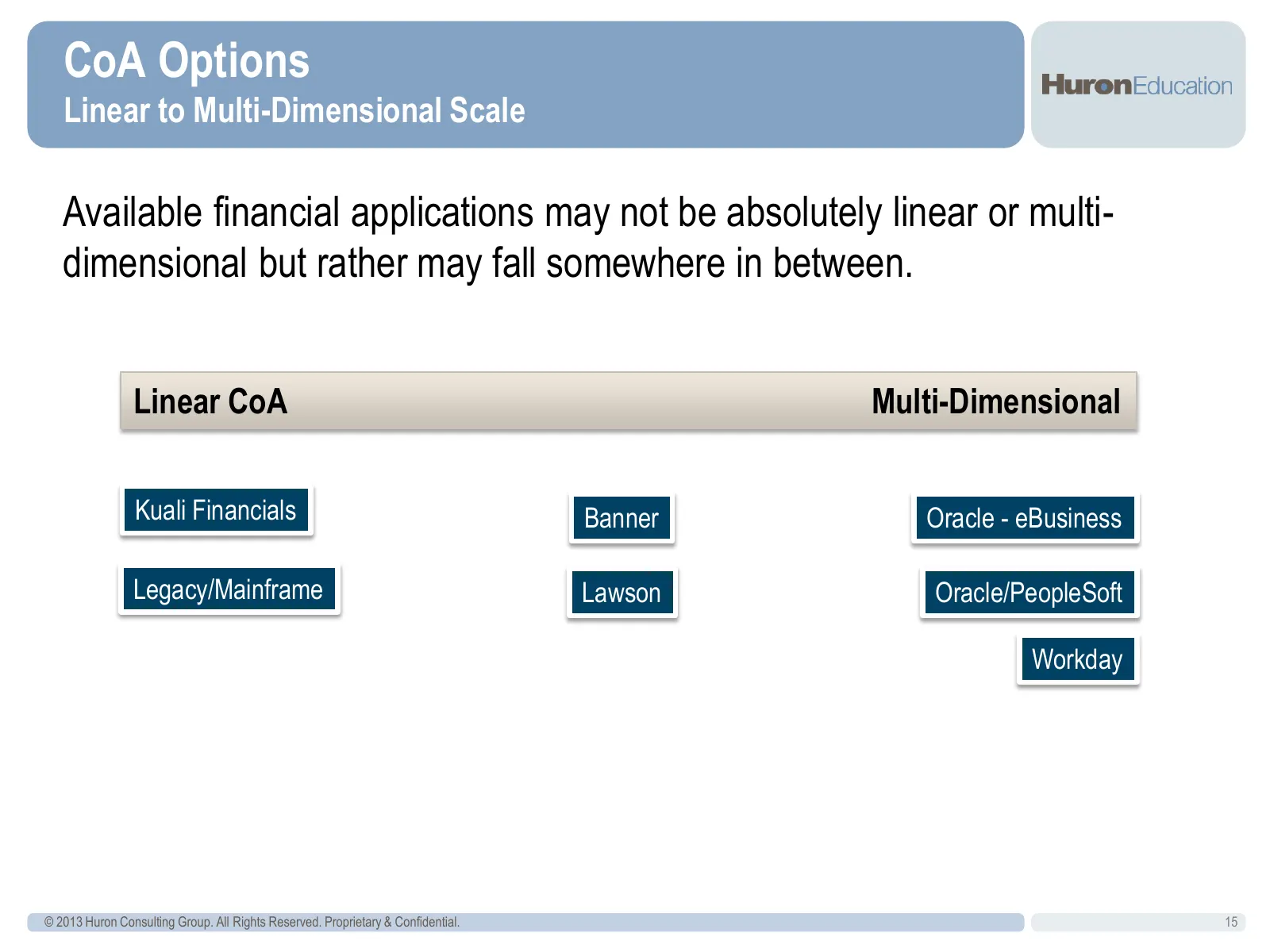
CoA Options Linear to Multi-Dimensional Scale Available financial applications may not be absolutely linear or multi- dimensional but rather may fall somewhere in between. Linear CoA Multi-Dimensional Kuali Financials Banner Oracle - eBusiness Legacy/Mainframe Lawson Oracle/PeopleSoft Workday © 2013
Slide 16: Getting Started – Establish a Team & Set Guiding Principles
Getting Started – Establish a Team & Set Guiding Principles
Slide 17: CoA Design: Establishing a Team
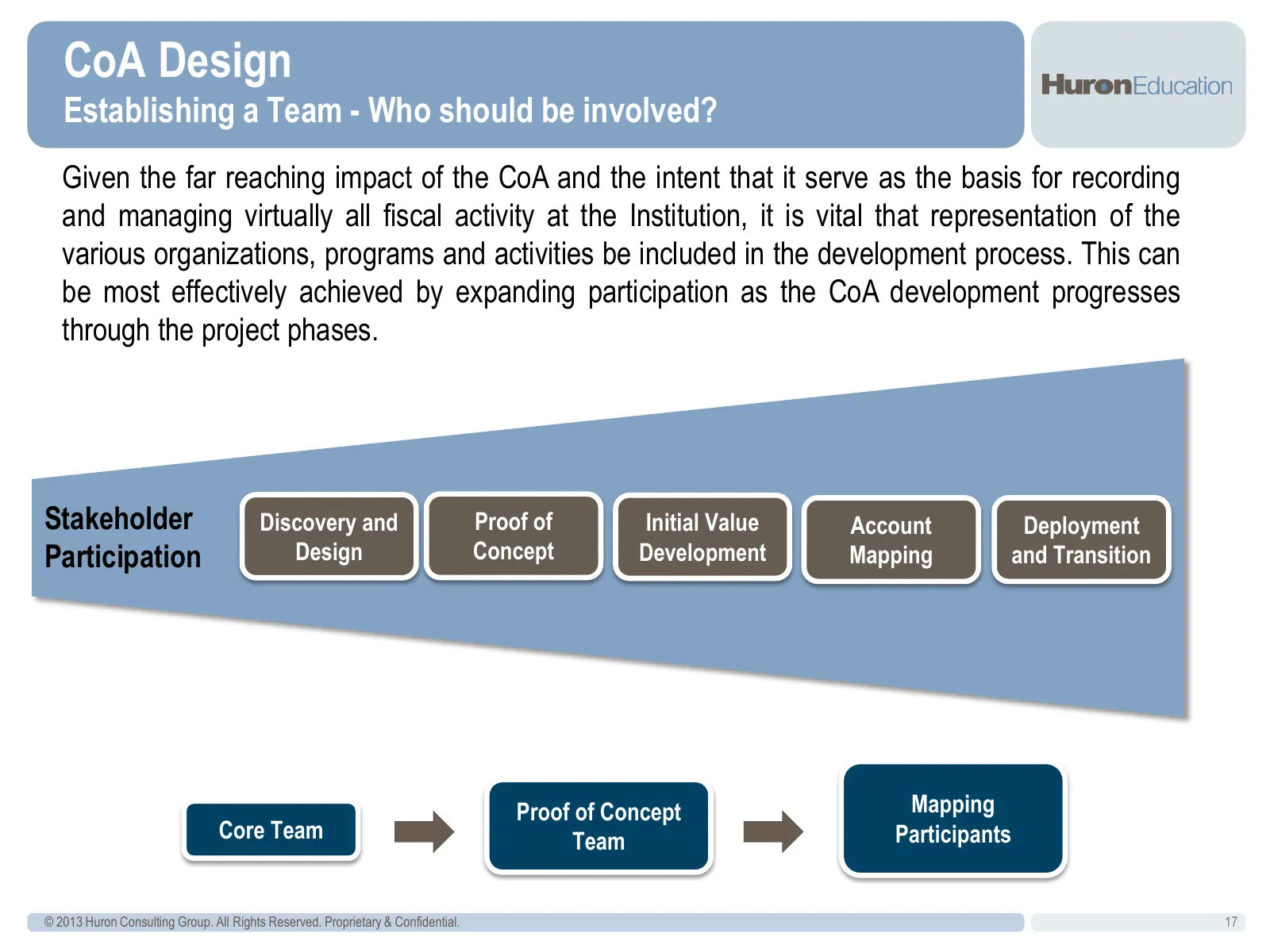
CoA Design Establishing a Team - Who should be involved? Given the far reaching impact of the CoA and the intent that it serve as the basis for recording and managing virtually all fiscal activity at the Institution, it is vital that representation of the various organizations, programs and activiti
Slide 18: CoA Design: Project Participants
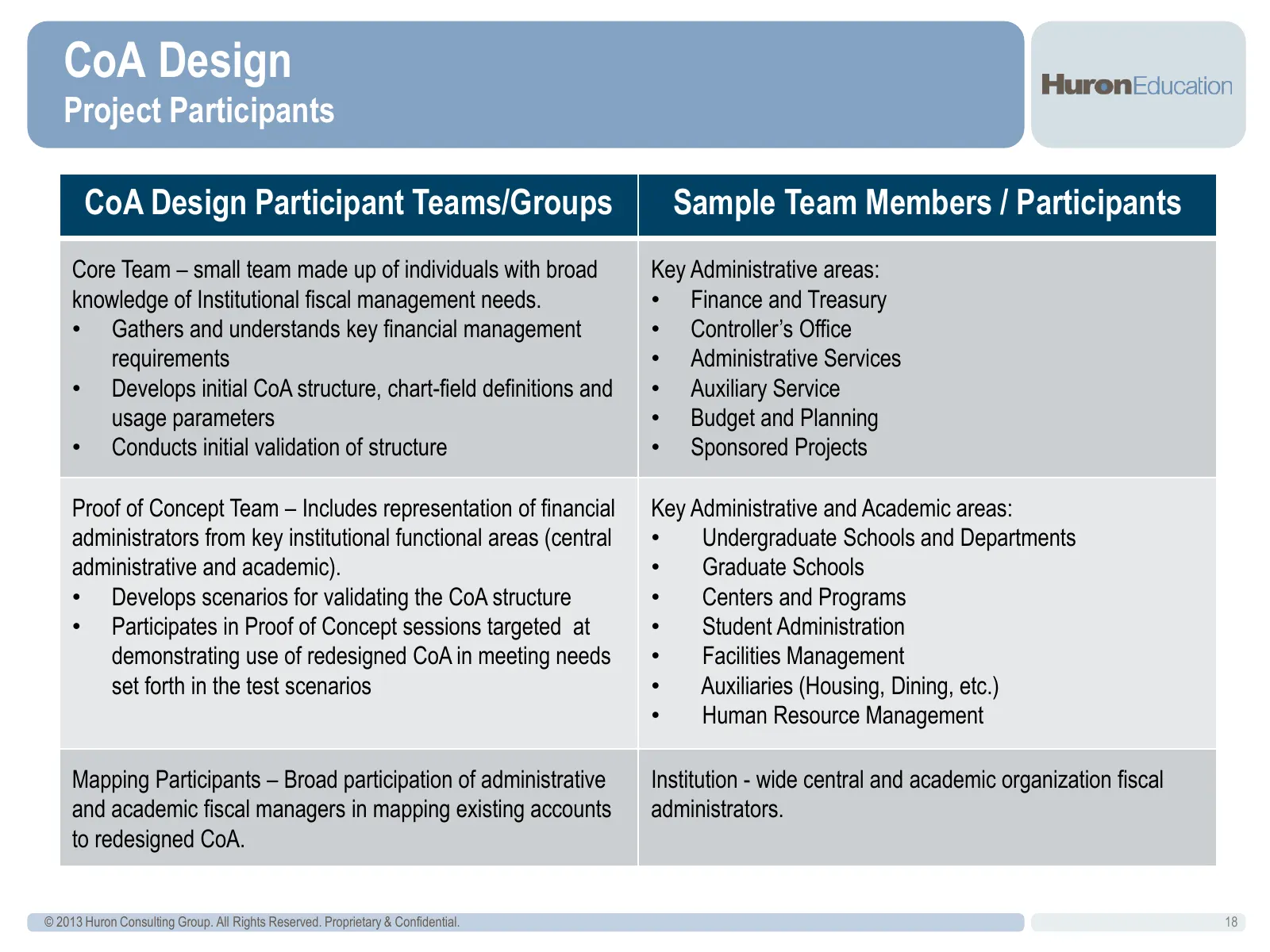
CoA Design Project Participants CoA Design Participant Teams/Groups Sample Team Members / Participants Core Team – small team made up of individuals with broad Key Administrative areas: knowledge of Institutional fiscal management needs. • Finance and Treasury • Gathers and understands key financial
Slide 19: Guiding Principles: Setting Objectives
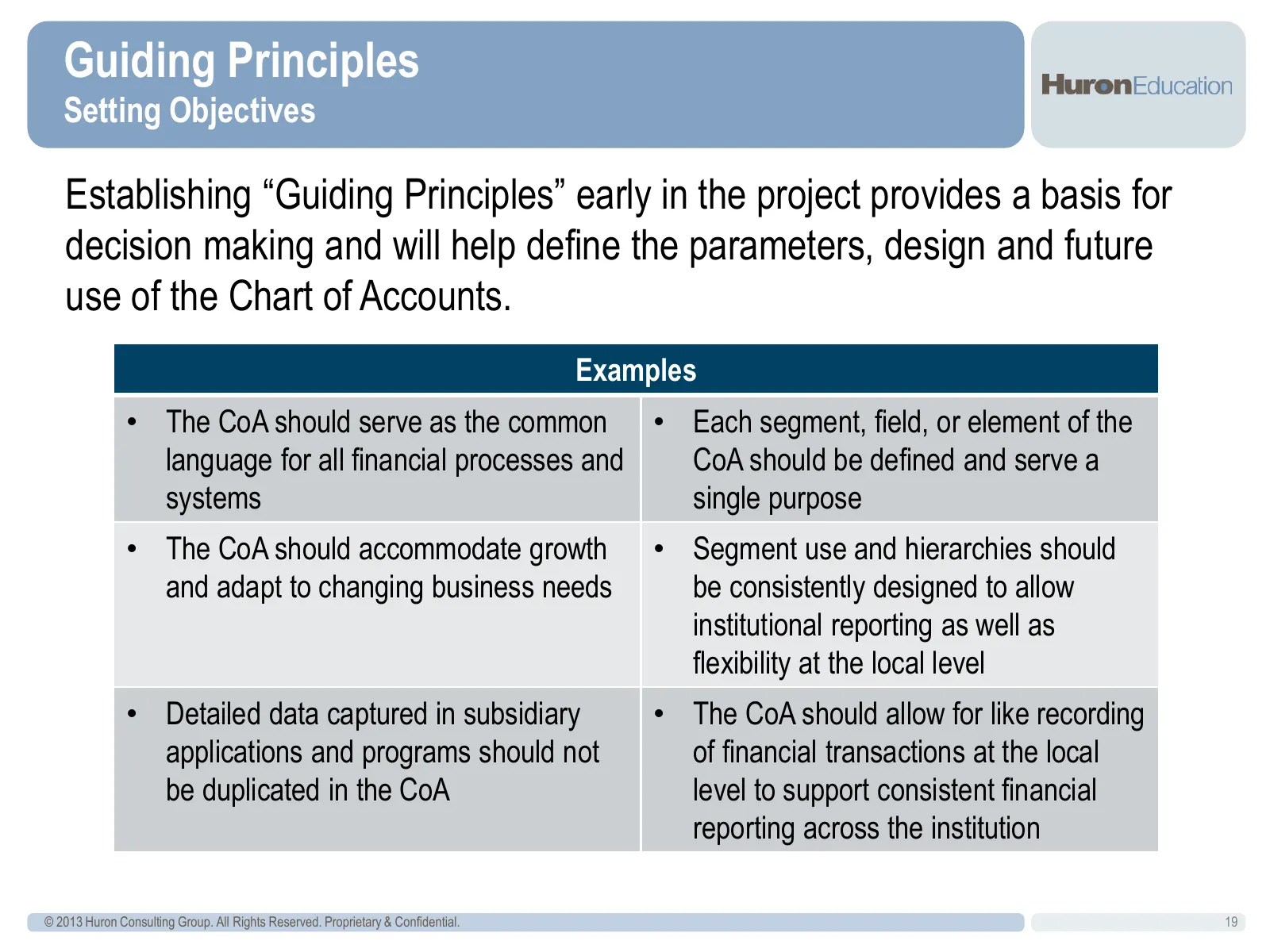
Guiding Principles Setting Objectives Establishing “Guiding Principles” early in the project provides a basis for decision making and will help define the parameters, design and future use of the Chart of Accounts. Examples • The CoA should serve as the common • Each segment, field, or element of th
Slide 20: CoA Design – Approach and Key Considerations
CoA Design – Approach and Key Considerations
Slide 21: Transition to a New CoA
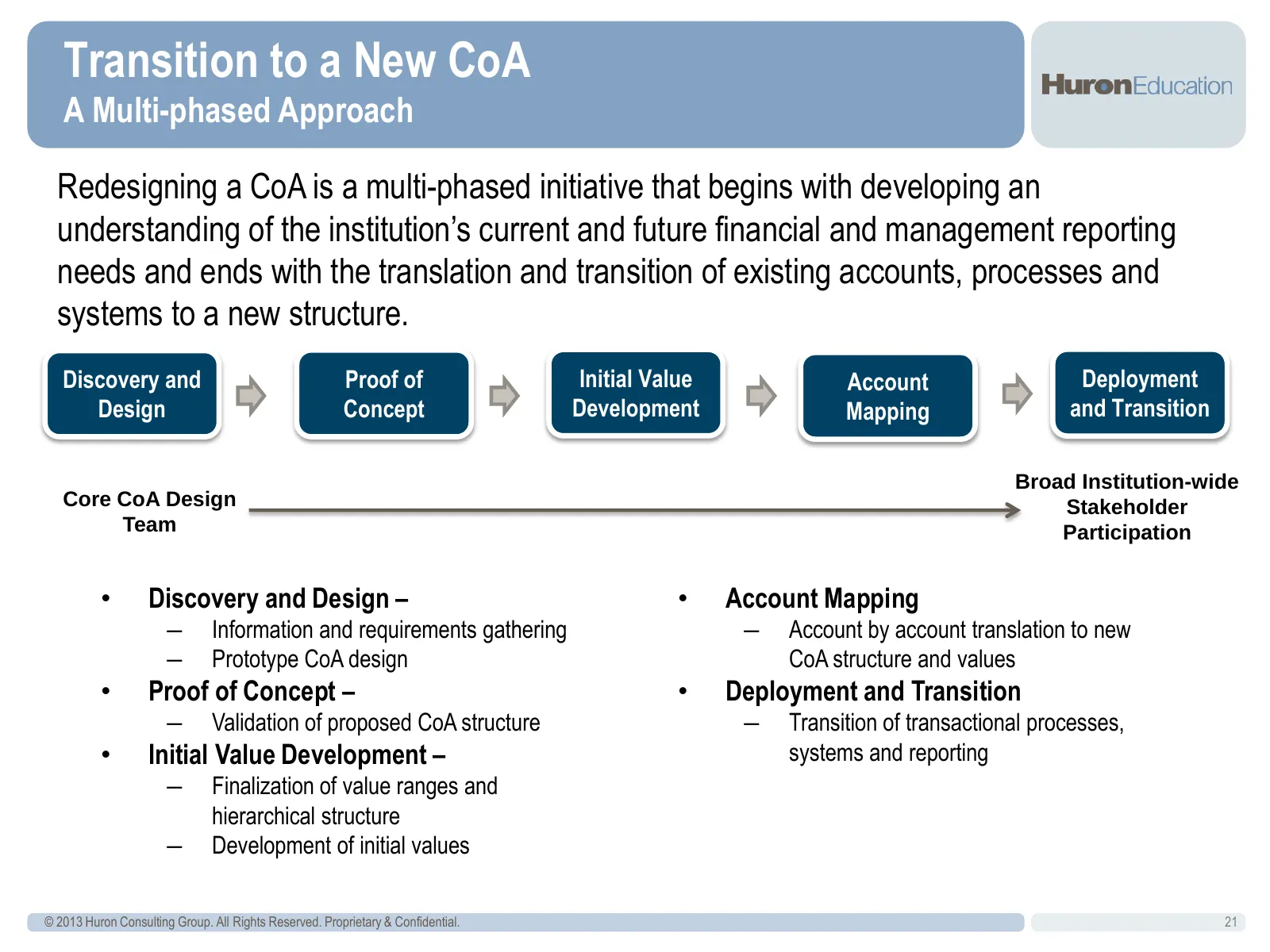
Transition to a New CoA A Multi-phased Approach Redesigning a CoA is a multi-phased initiative that begins with developing an understanding of the institution’s current and future financial and management reporting needs and ends with the translation and transition of existing accounts, processes an
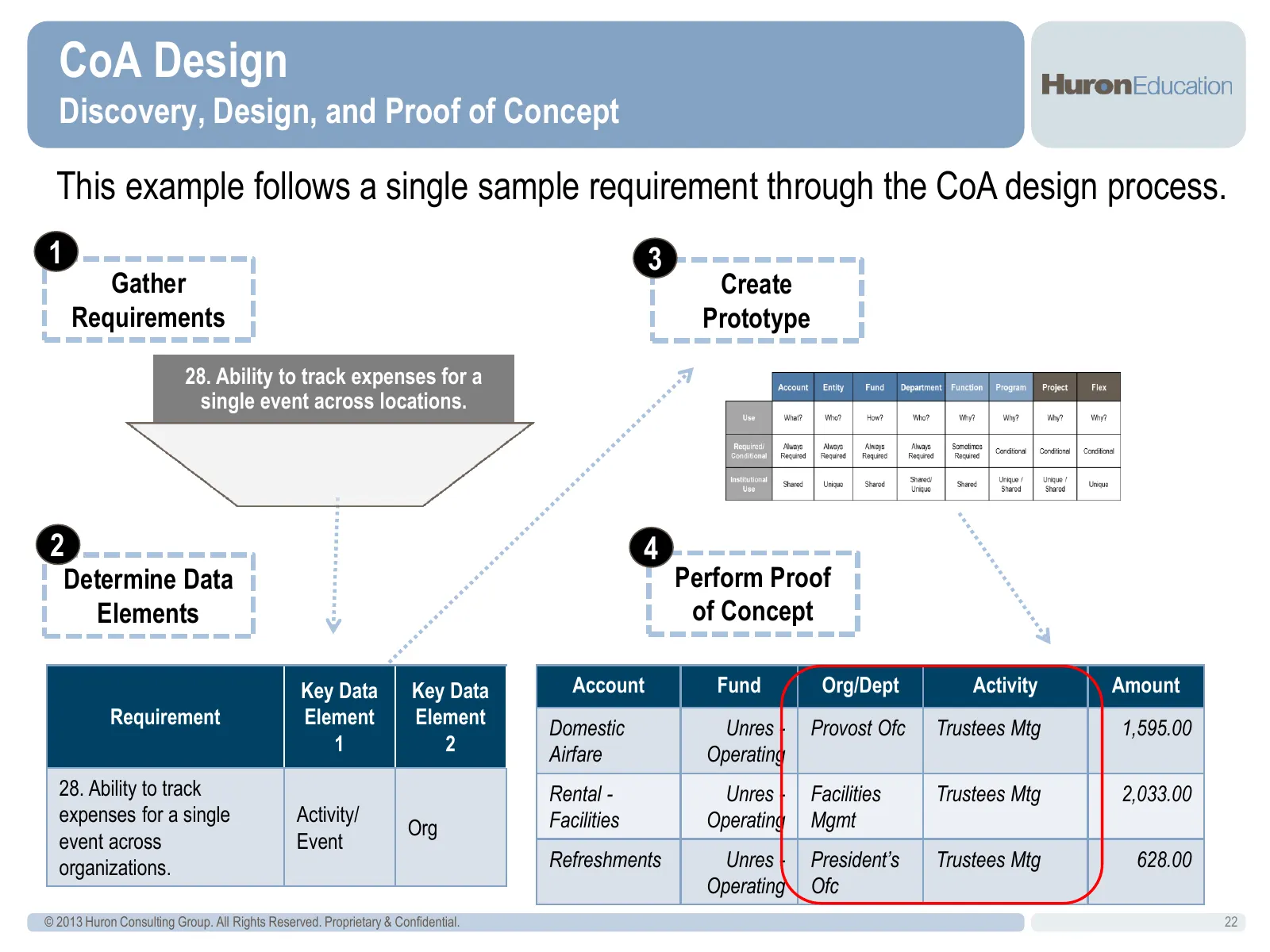
Slide 22: CoA Design: Discovery, Design, and Proof of Concept
CoA Design Discovery, Design, and Proof of Concept This example follows a single sample requirement through the CoA design process. 1 3 Gather Create Requirements Prototype 28. Ability to track expenses for a single event across locations. 2 4 Determine Data Perform Proof Elements of Concept Key Dat
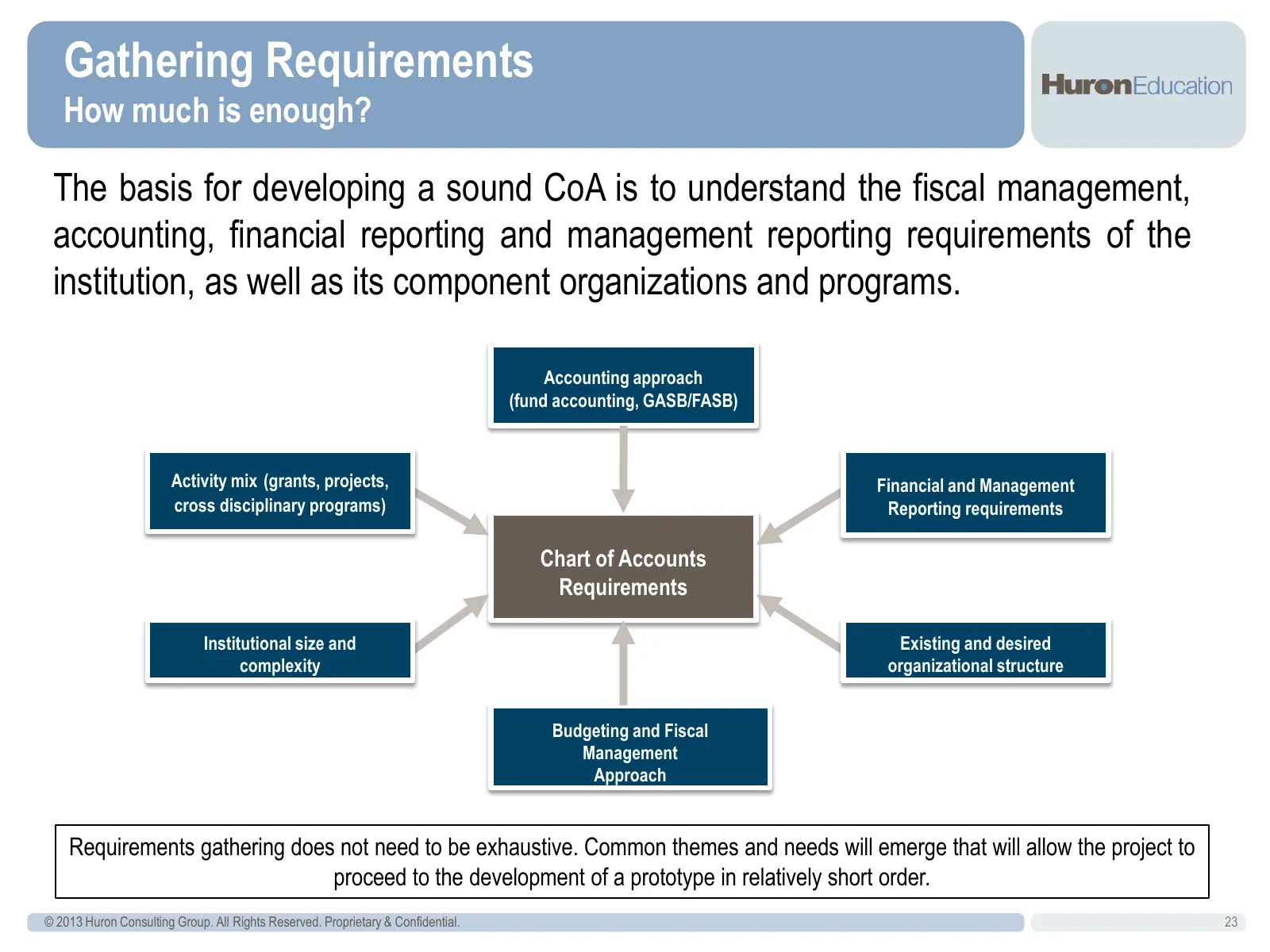
Slide 23: Gathering Requirements
Gathering Requirements How much is enough? The basis for developing a sound CoA is to understand the fiscal management, accounting, financial reporting and management reporting requirements of the institution, as well as its component organizations and programs. Accounting approach (fund accounting,
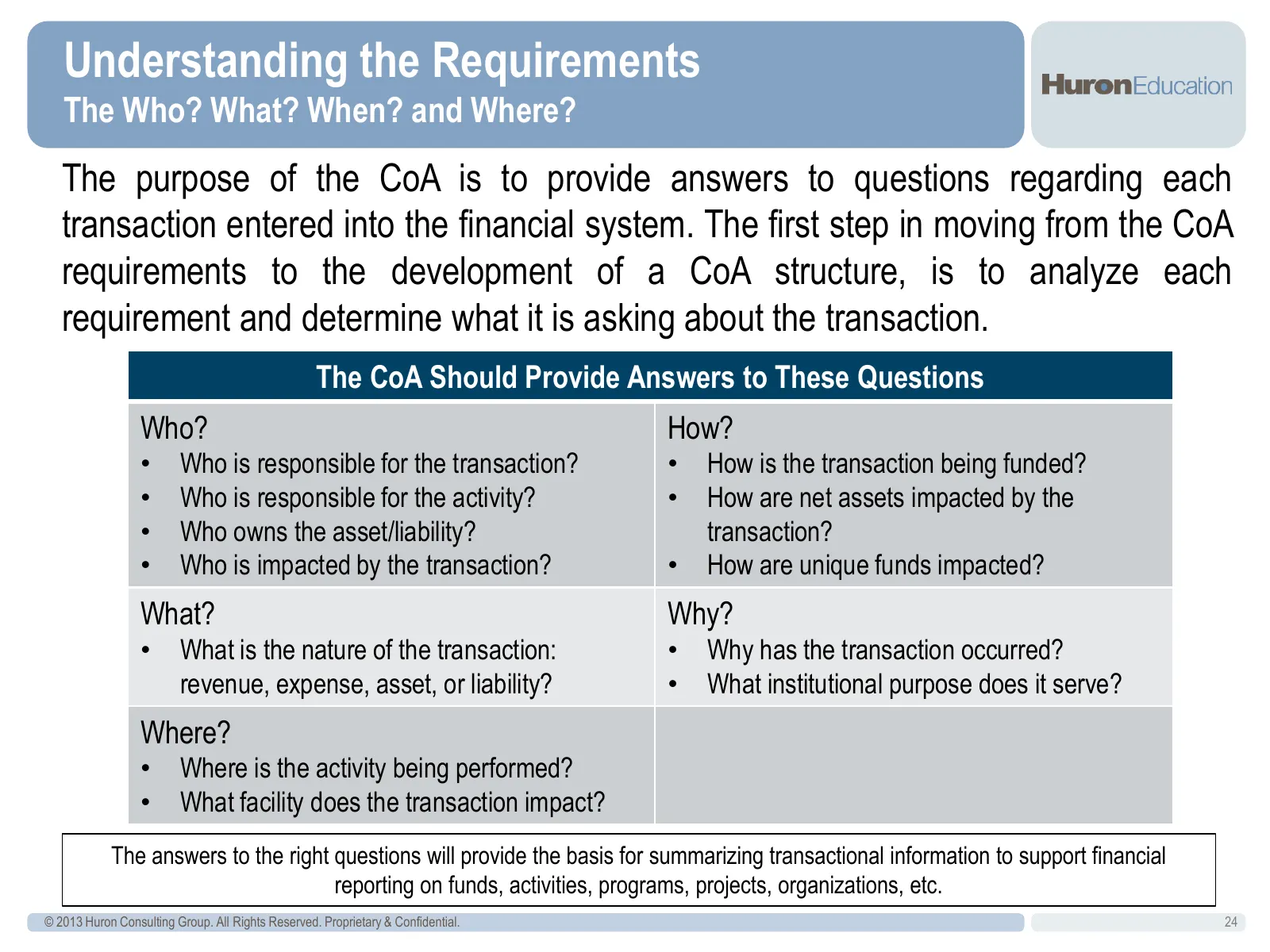
Slide 24: Understanding the Requirements
Understanding the Requirements The Who? What? When? and Where? The purpose of the CoA is to provide answers to questions regarding each transaction entered into the financial system. The first step in moving from the CoA requirements to the development of a CoA structure, is to analyze each requirem
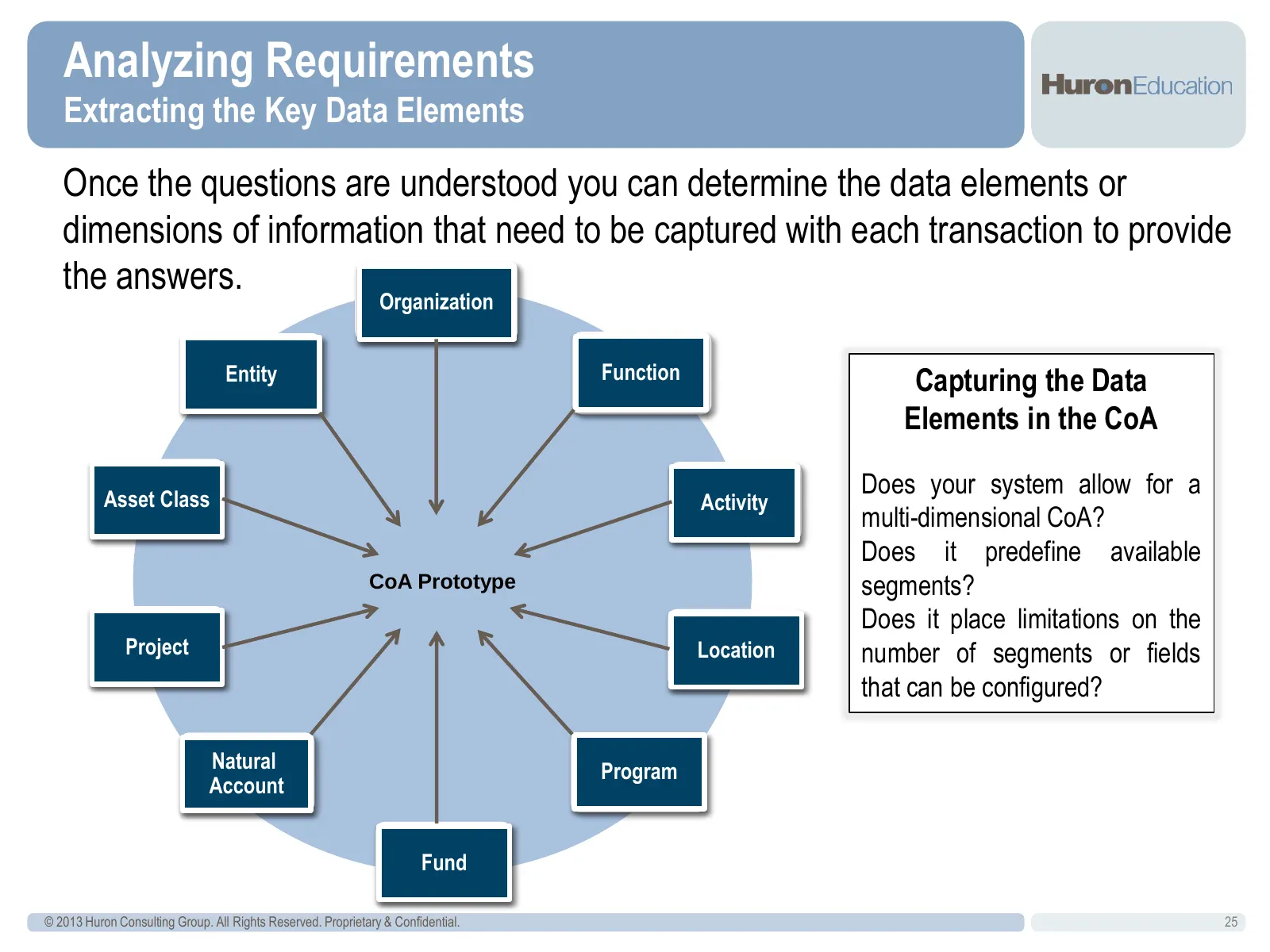
Slide 25: Analyzing Requirements
Analyzing Requirements Extracting the Key Data Elements Once the questions are understood you can determine the data elements or dimensions of information that need to be captured with each transaction to provide the answers. Organization Entity Function Capturing the Data Elements in the CoA Does y
Slide 26: Designing the Prototype: Linear CoA
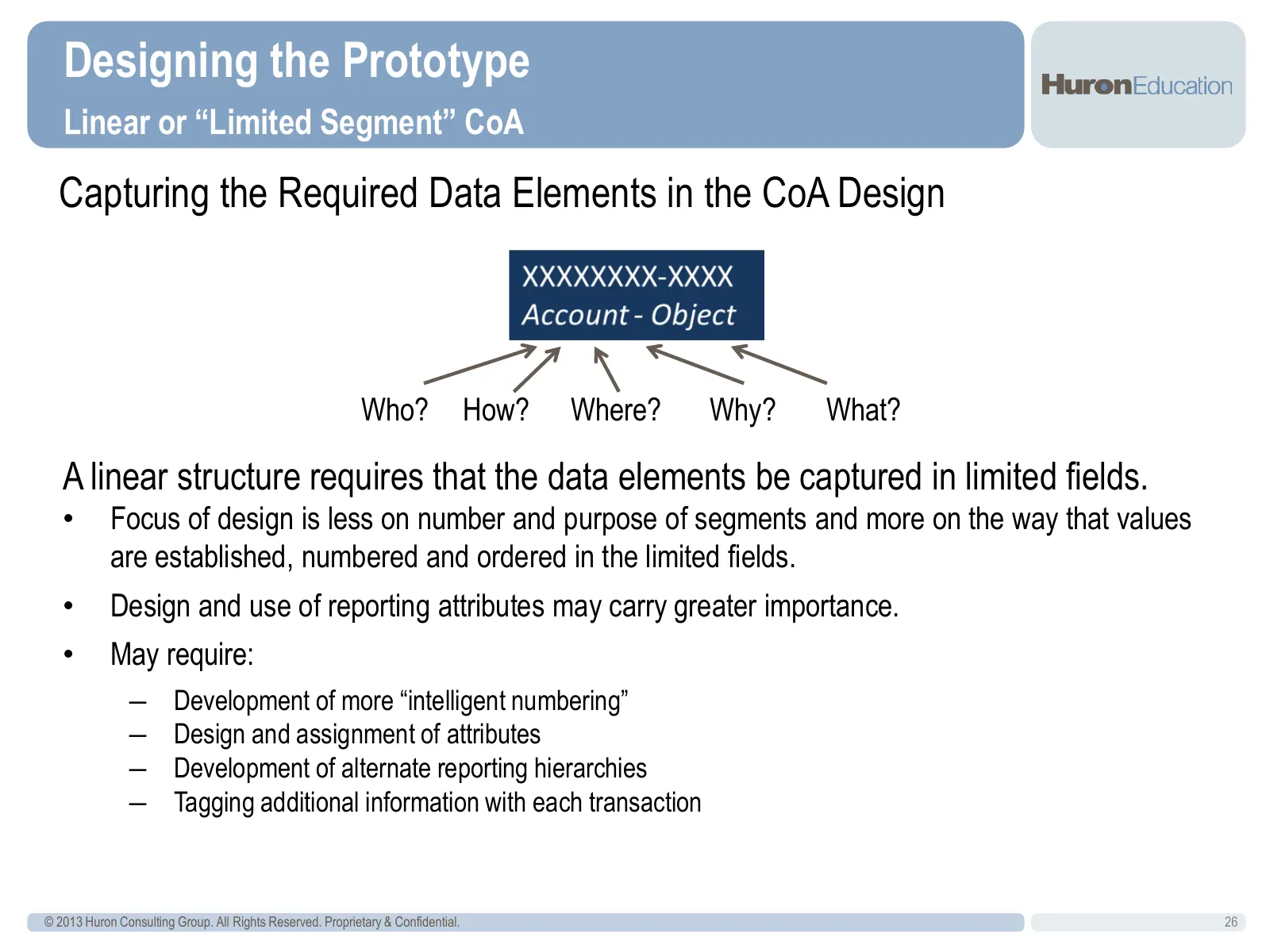
Designing the Prototype Linear or “Limited Segment” CoA Capturing the Required Data Elements in the CoA Design Who? How? Where? Why? What? A linear structure requires that the data elements be captured in limited fields. • Focus of design is less on number and purpose of segments and more on the way
Slide 27: Designing the Prototype: Multi-Dimensional CoA
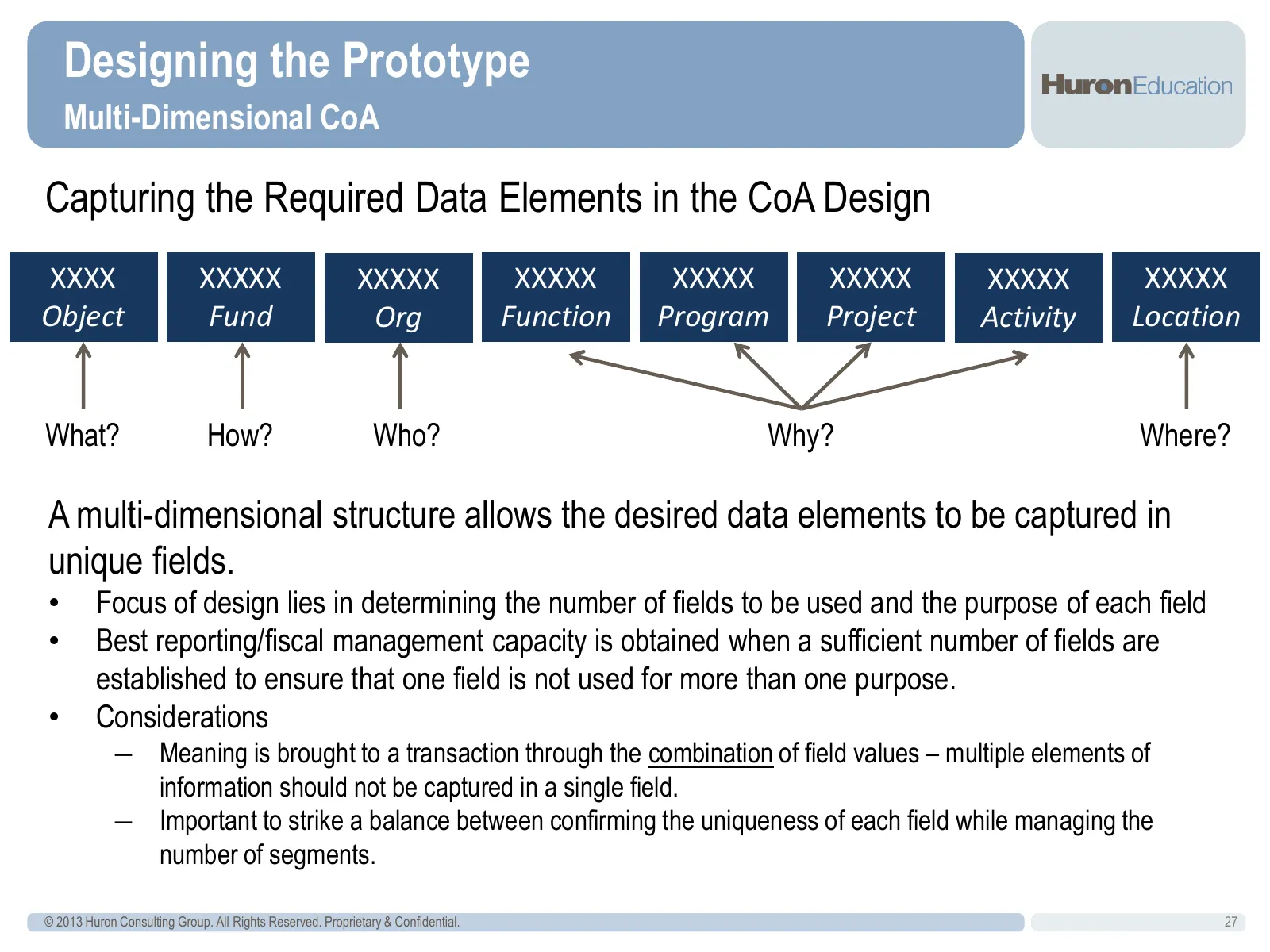
Designing the Prototype Multi-Dimensional CoA Capturing the Required Data Elements in the CoA Design XXXX XXXXX XXXXX XXXXX XXXXX XXXXX XXXXX XXXXX Object Fund Org Function Program Project Activity Location What? How? Who? Why? Where? A multi-dimensional structure allows the desired data elements to
Slide 28: Proof of Concept: Will This Work For Us?
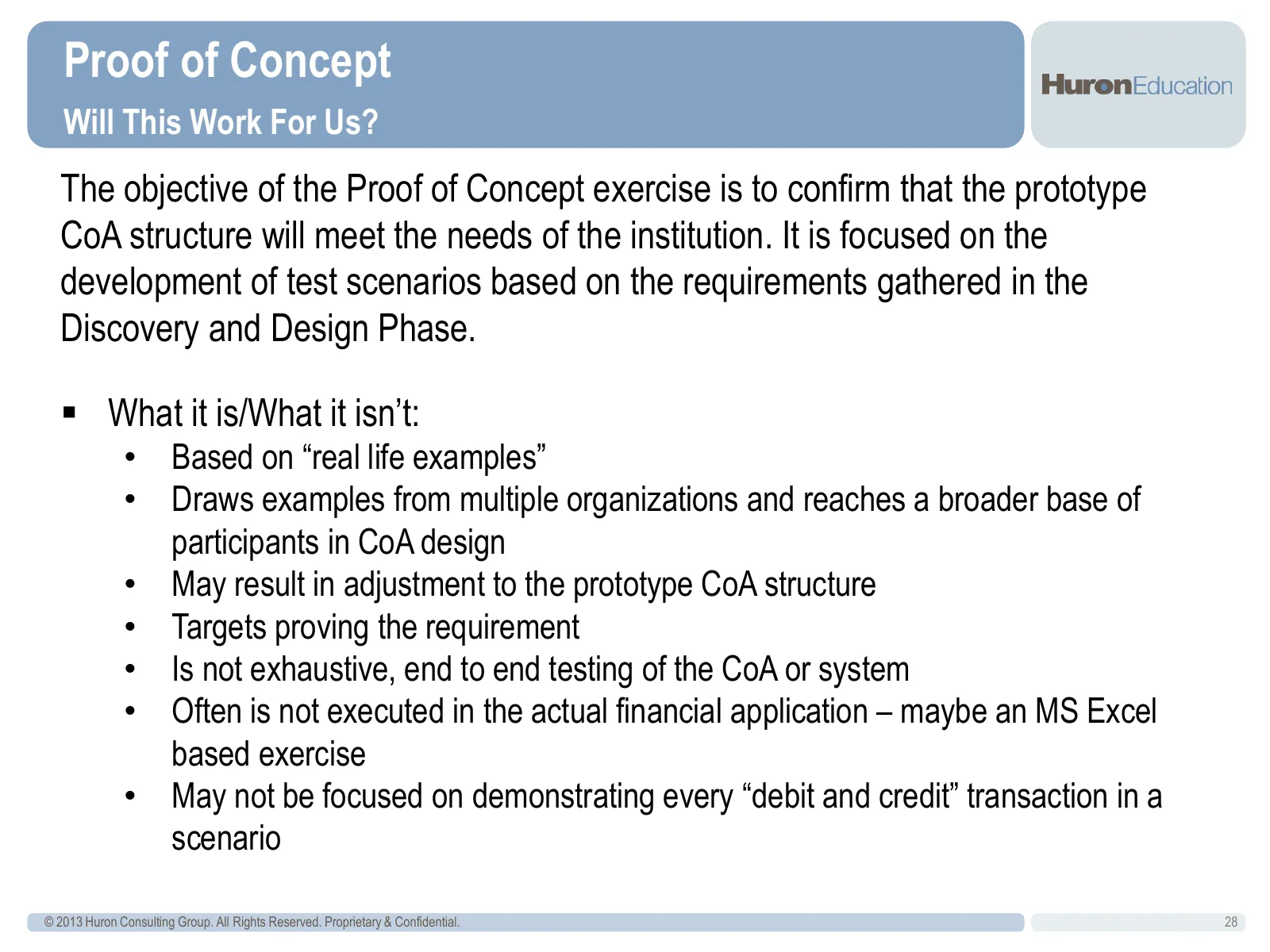
Proof of Concept Will This Work For Us? The objective of the Proof of Concept exercise is to confirm that the prototype CoA structure will meet the needs of the institution. It is focused on the development of test scenarios based on the requirements gathered in the Discovery and Design Phase. Wha
Slide 29: Proof of Concept: An Example
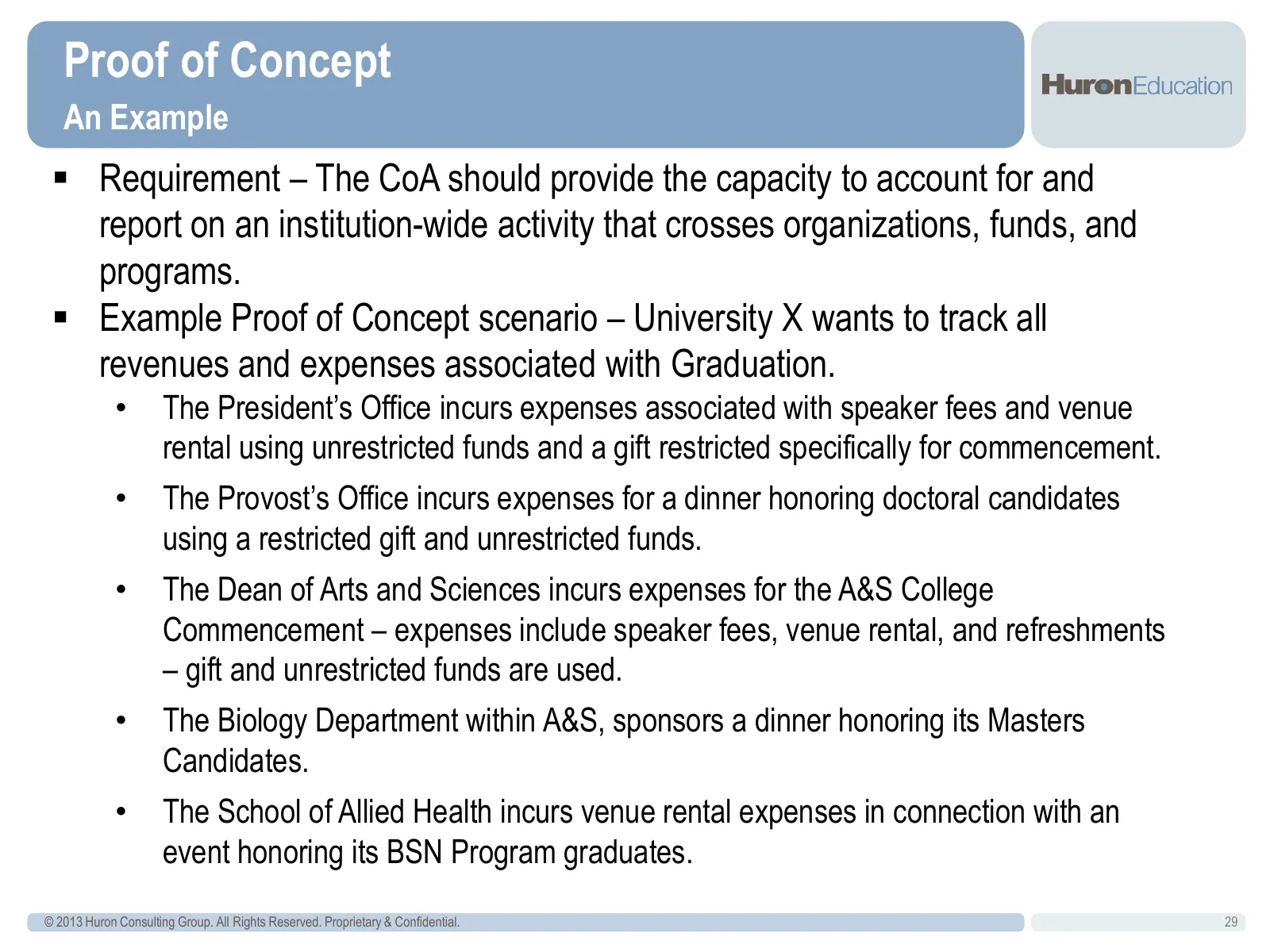
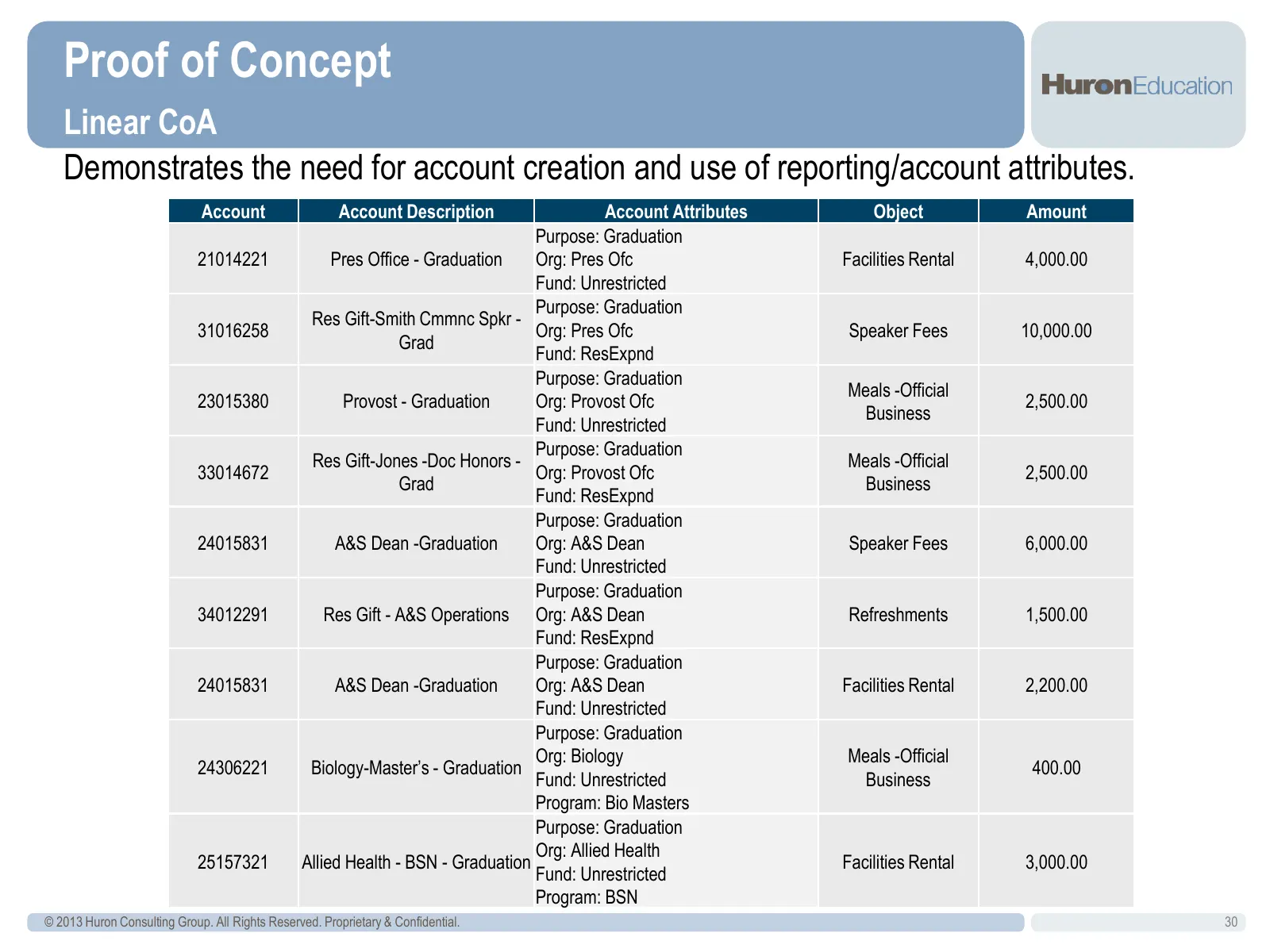
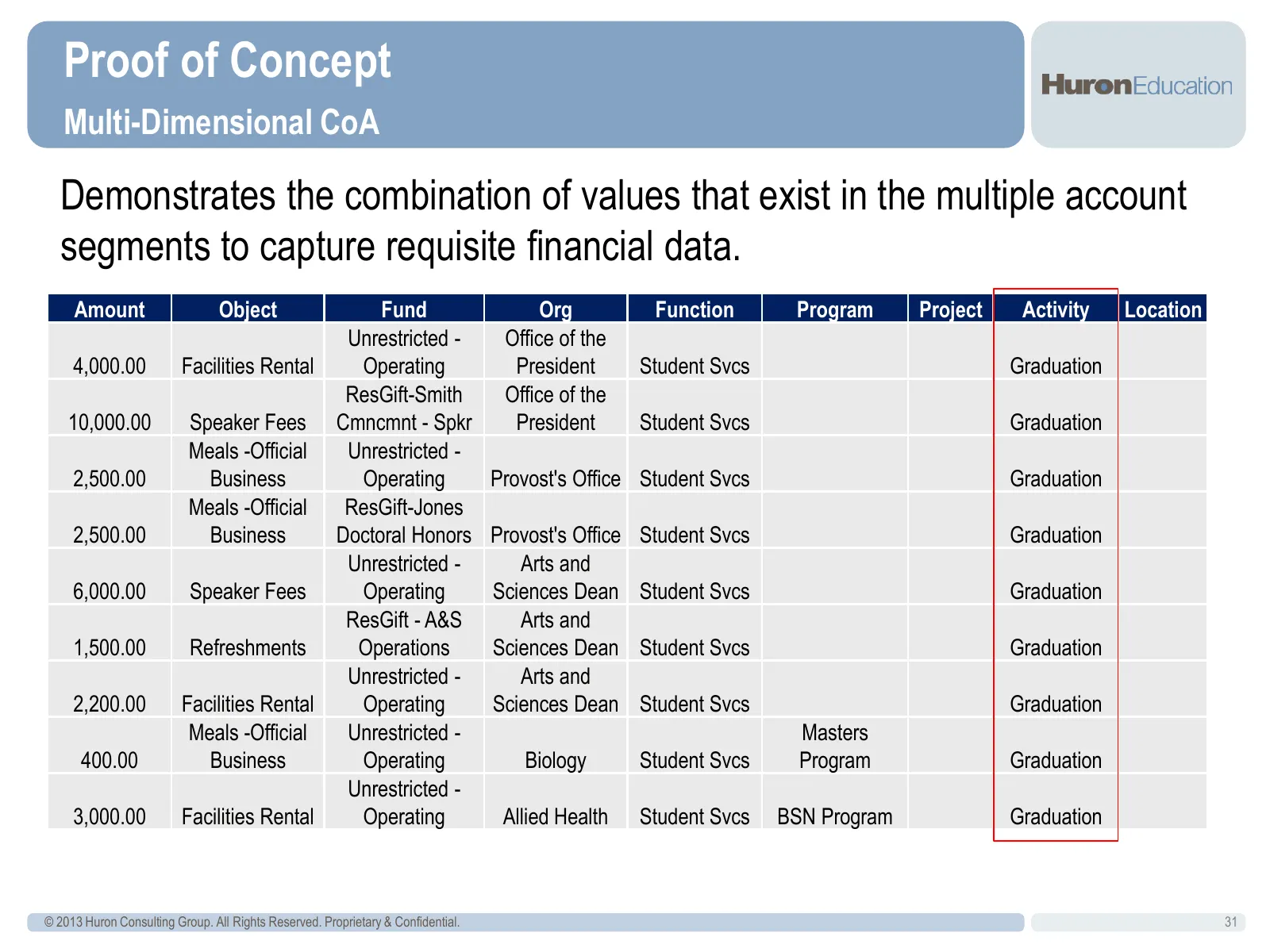
Proof of Concept An Example Requirement – The CoA should provide the capacity to account for and report on an institution-wide activity that crosses organizations, funds, and programs. Example Proof of Concept scenario – University X wants to track all revenues and expenses associated with Gradu
Slide 30: Proof of Concept: Linear CoA
Proof of Concept Linear CoA Demonstrates the need for account creation and use of reporting/account attributes. Account Account Description Account Attributes Object Amount Purpose: Graduation 21014221 Pres Office - Graduation Org: Pres Ofc Facilities Rental 4,000.00 Fund: Unrestricted Purpose: Grad
Slide 31: Proof of Concept: Multi-Dimensional CoA
Proof of Concept Multi-Dimensional CoA Demonstrates the combination of values that exist in the multiple account segments to capture requisite financial data. Amount Object Fund Org Function Program Project Activity Location Unrestricted - Office of the 4,000.00 Facilities Rental Operating President
Slide 32: Value Development: Key Considerations
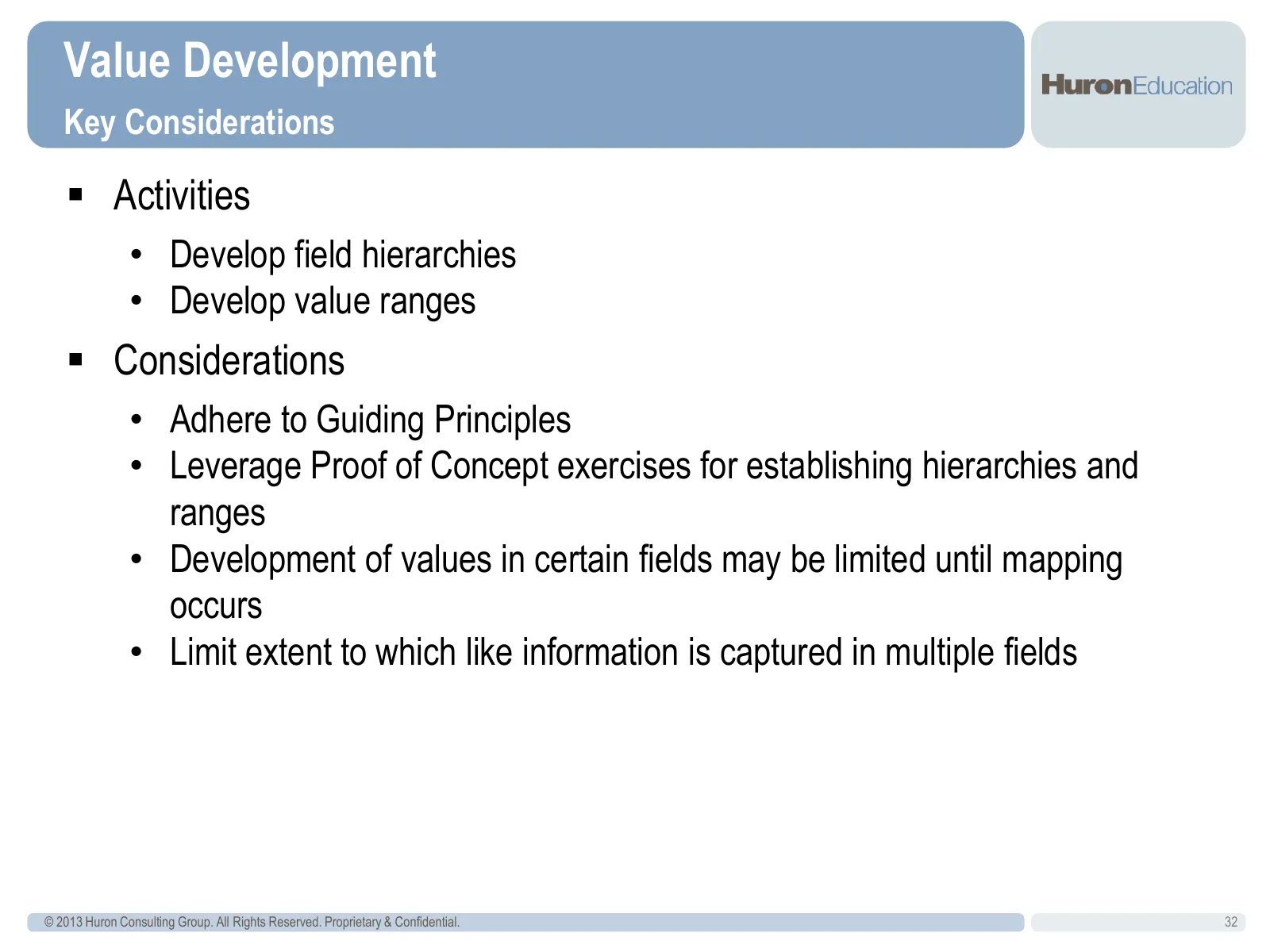
Value Development Key Considerations Activities • Develop field hierarchies • Develop value ranges Considerations • Adhere to Guiding Principles • Leverage Proof of Concept exercises for establishing hierarchies and ranges • Development of values in certain fields may be limited until mapping oc
Slide 33: Mapping: An Institution Wide Initiative
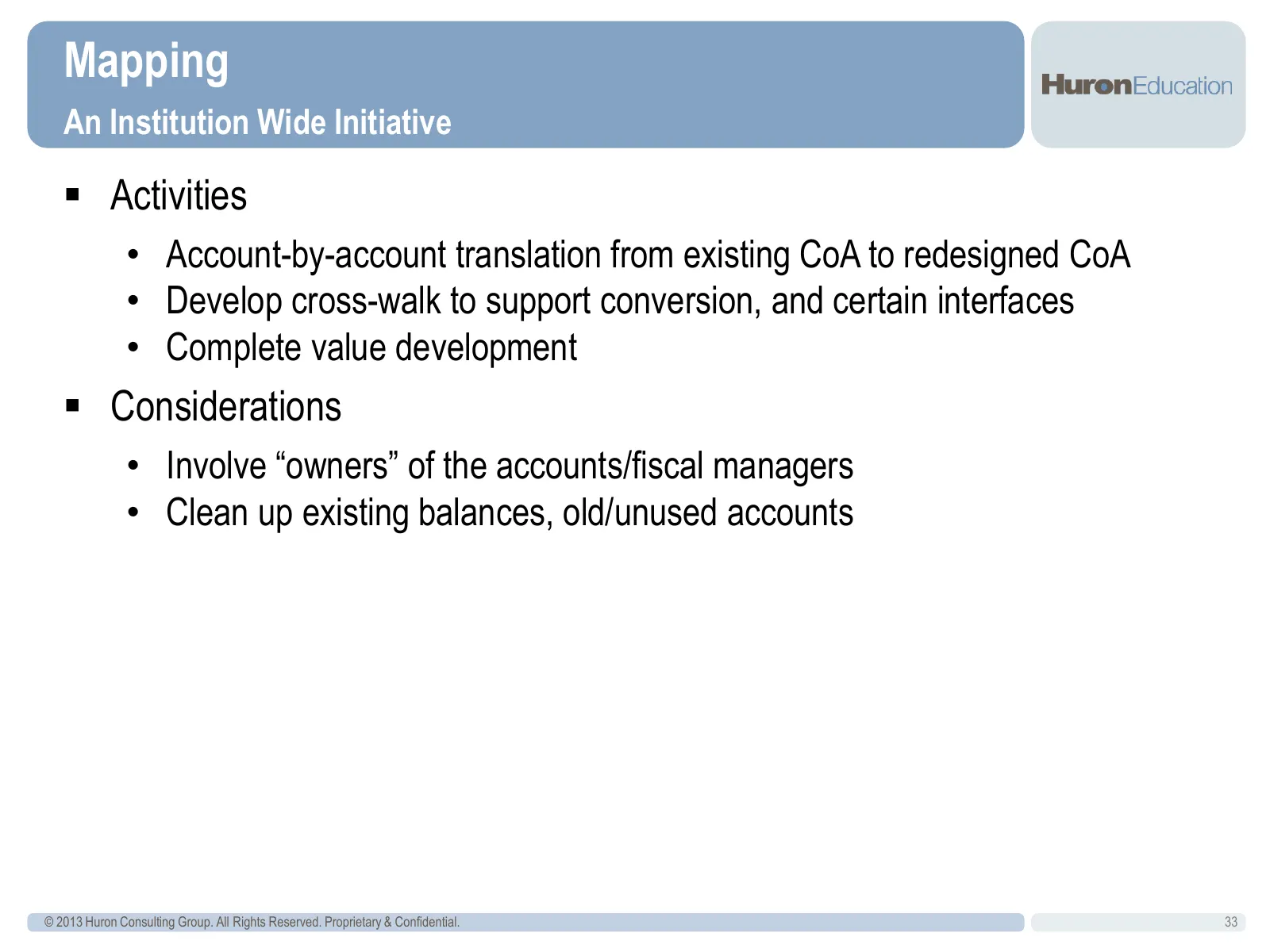
Mapping An Institution Wide Initiative Activities • Account-by-account translation from existing CoA to redesigned CoA • Develop cross-walk to support conversion, and certain interfaces • Complete value development Considerations • Involve “owners” of the accounts/fiscal managers • Clean up exis
Slide 34: Deployment: Making the Transition
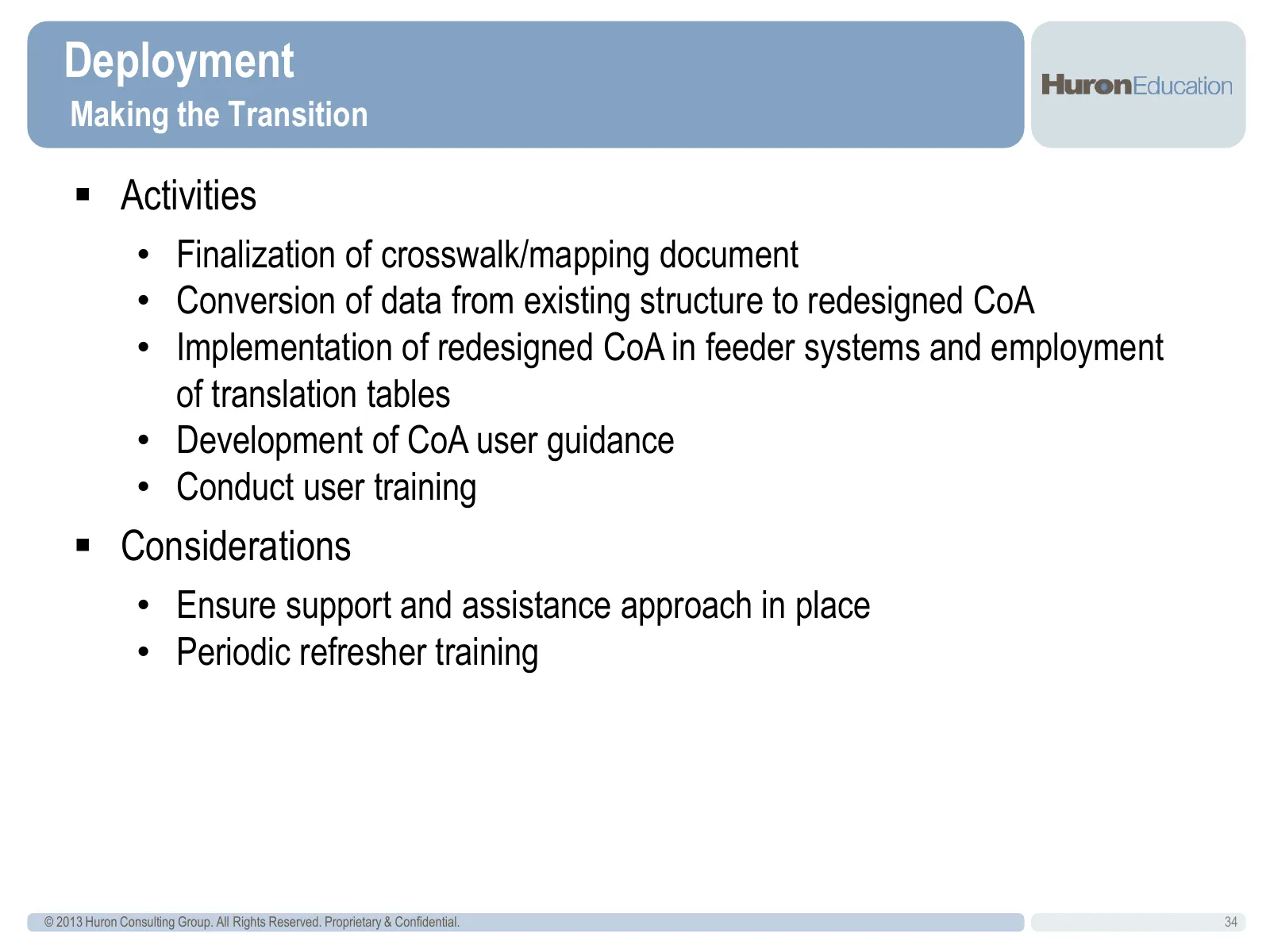
Deployment Making the Transition Activities • Finalization of crosswalk/mapping document • Conversion of data from existing structure to redesigned CoA • Implementation of redesigned CoA in feeder systems and employment of translation tables • Development of CoA user guidance • Conduct user traini
Slide 35: Other Considerations: The New CoA in the Institution's Environment
Other Considerations: The New CoA in the Institution’s Environment
Slide 36: Revised CoA and Existing Technology
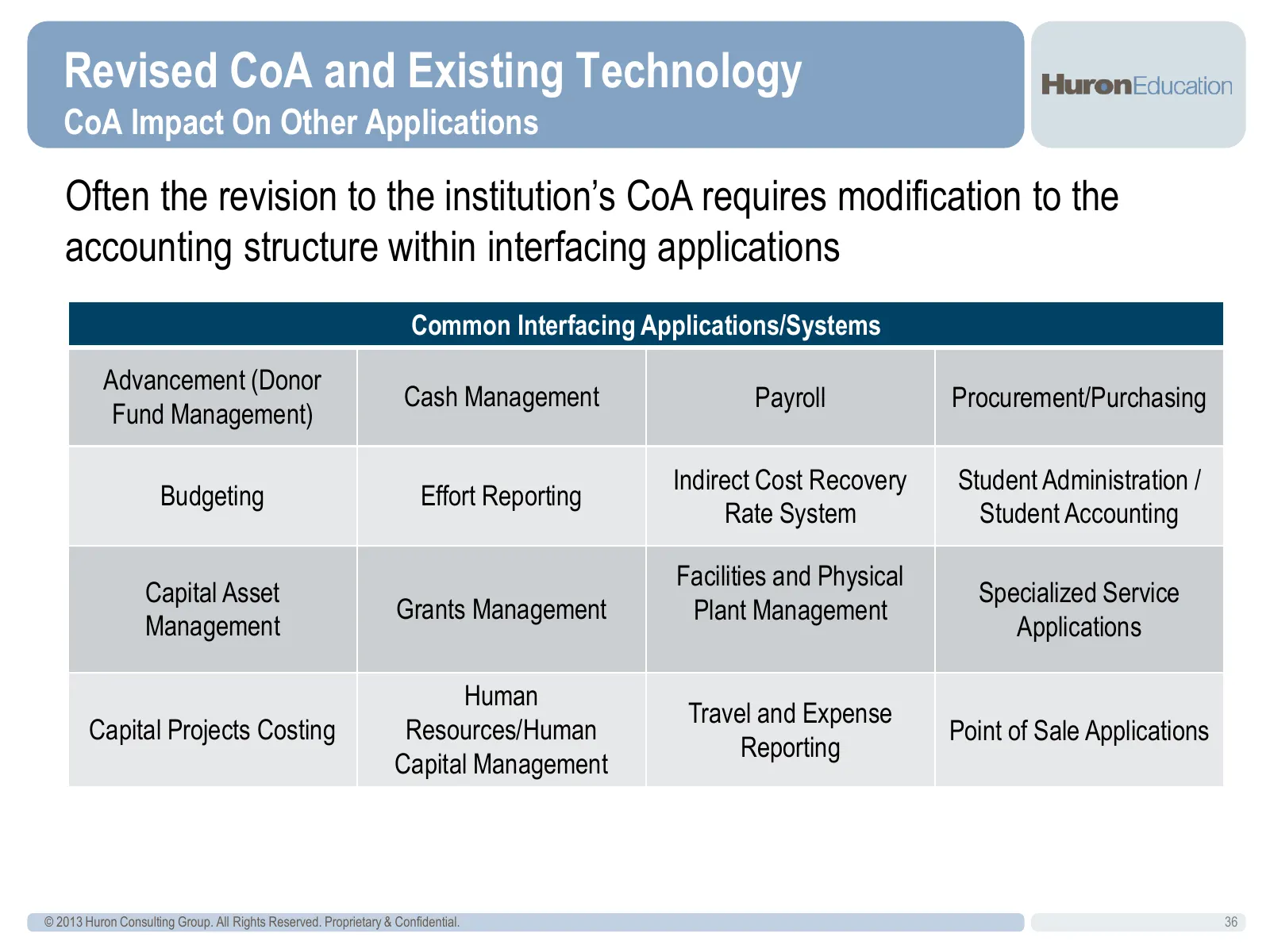
Revised CoA and Existing Technology CoA Impact On Other Applications Often the revision to the institution’s CoA requires modification to the accounting structure within interfacing applications Common Interfacing Applications/Systems Advancement (Donor Cash Management Payroll Procurement/Purchasing
Slide 37: A Word About Managing Change in Higher Education
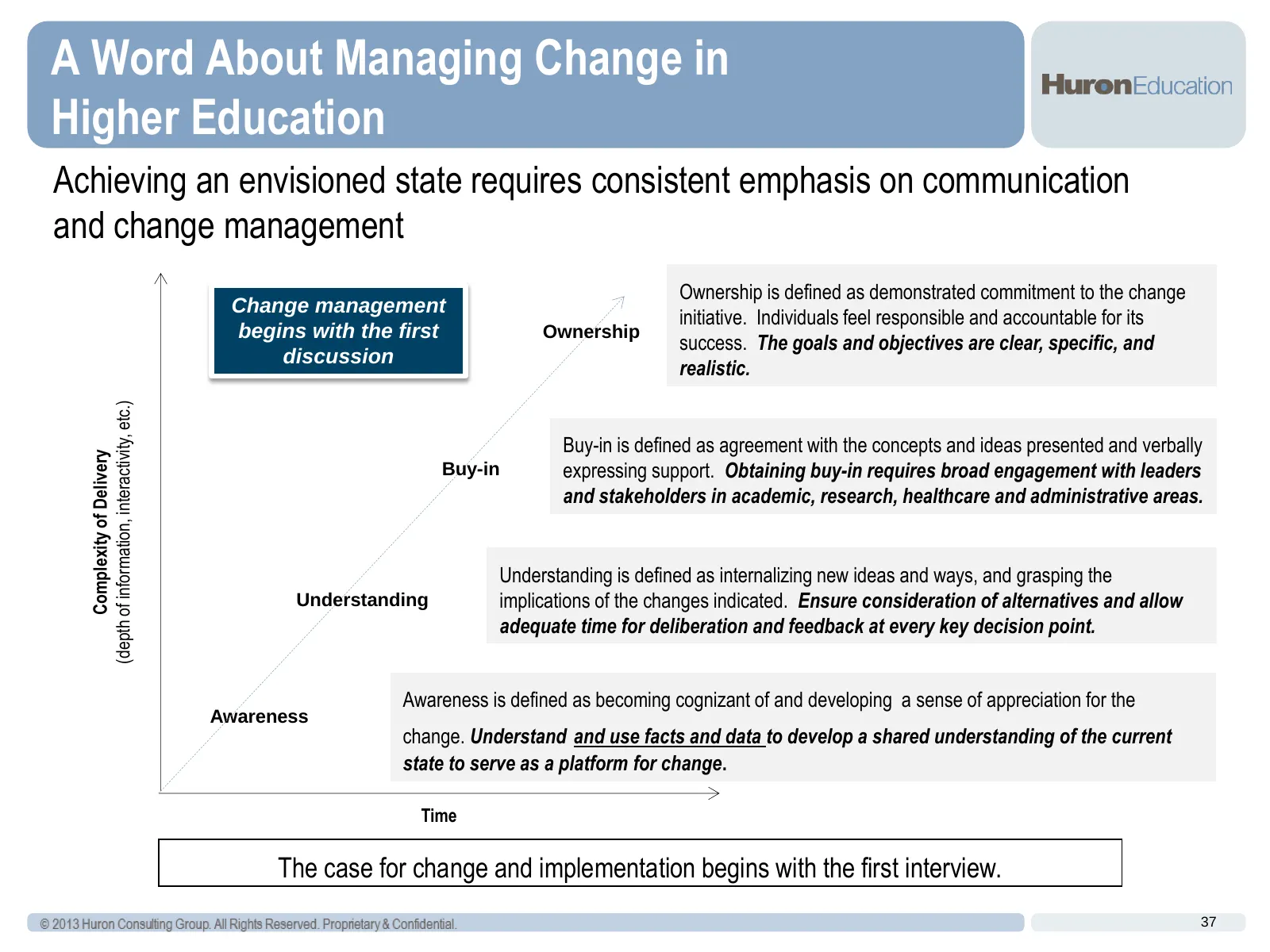
A Word About Managing Change in Higher Education Achieving an envisioned state requires consistent emphasis on communication and change management Ownership is defined as demonstrated commitment to the change Change management initiative. Individuals feel responsible and accountable for its begins w
Slide 38: Lessons Learned
Lessons Learned Key Considerations: • Don’t rely too heavily on the current CoA and reports to determine requirements for the new CoA – consider the institution’s reporting and fiscal management objectives. • The Chart of Accounts serves as the primary financial reporting tool across all institution

Slide 39: Questions and Answers
Questions and Answers
Slide 40: Contact
Contact David Klipa Marnie Fulton Managing Director Manager Huron Consulting Group Huron Consulting Group dklipa@huronconsultinggroup.com mfulton@huronconsultinggroup.com J. Michael Gower Vice President for Business Affairs & CFO Yeshiva University gower@yu.edu © 2013 Huron Consulting Group. All Rig
Source: Internet Archive copy of huronconsultinggroup.com
More decks from Huron Consulting Group Inc.
 Investor Presentation (July 2026)49 slides · July 2026
 Investor Presentation (March 2026)49 slides · March 2026
 Q4 2025 Earnings Presentation12 slides · Feb 24, 2026
 Investor Presentation (July 2025)44 slides · July 2025
 Shareholder Meeting (March 2025)13 slides · Mar 28, 2025
 Investor Day (March 2025)77 slides · Mar 25, 2025