Sangoma Technologies Corporation · TSX:STC
Sangoma Technologies — Technical Presentation (April 2013)
46 slides from Sangoma Technologies's technical presentation, April 2013
Slide 1: The Basics of TDM to VoIP Interconnection
The Basics of TDM to VoIP Interconnection Jeff Dworkin Director of Marketing jdworkin@sangoma.com
Slide 2: Attendee Dashboard
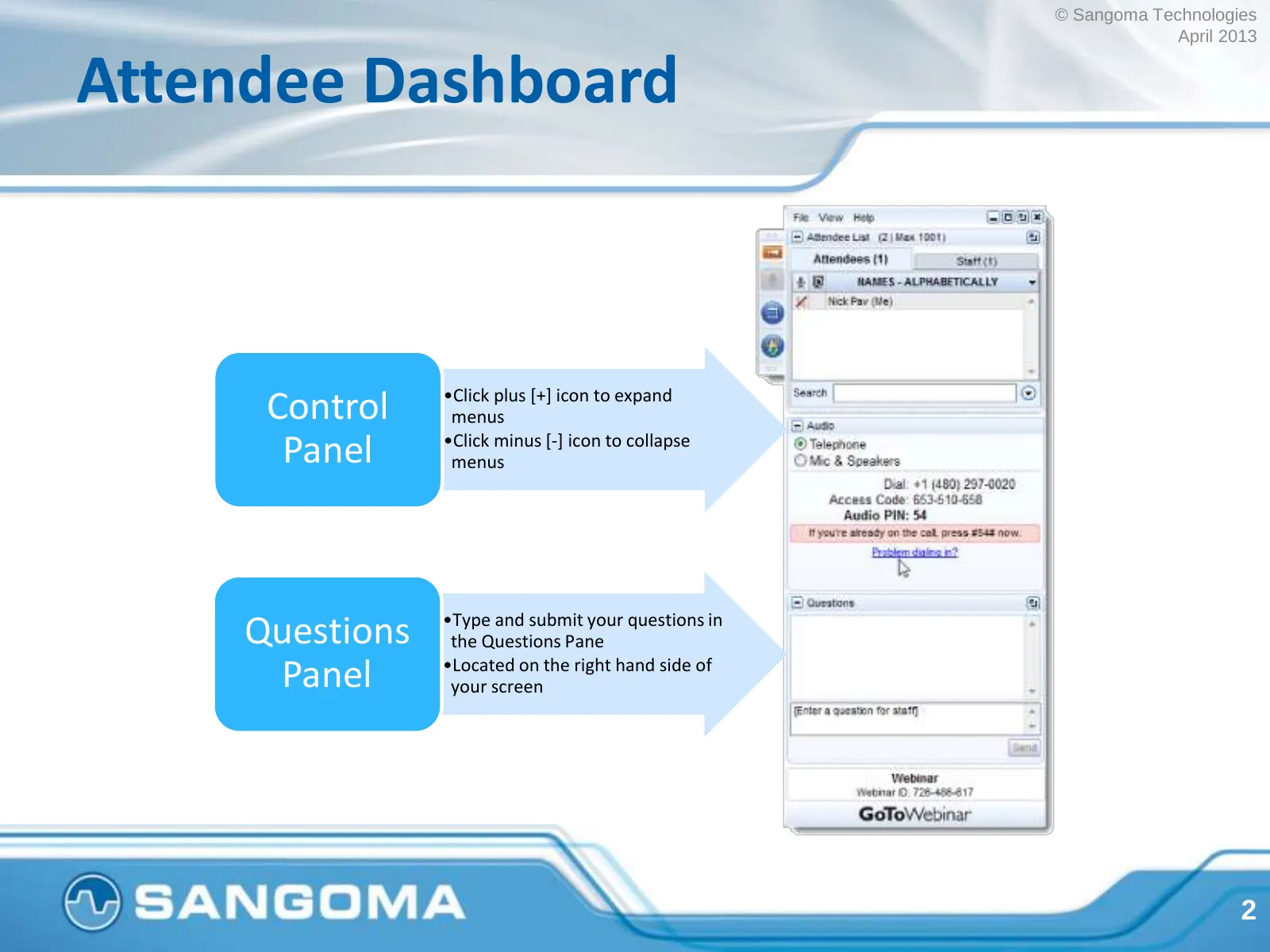
© Sangoma Technologies April 2013 Attendee Dashboard •Click plus [+] icon to expand Control menus Panel •Click minus [-] icon to collapse menus •Type and submit your questions in Questions the Questions Pane Panel •Located on the right hand side of your screen 2
Slide 3: About Sangoma
© Sangoma Technologies April 2013 About Sangoma • Industry pioneer with over 25 years of experience is communications hardware and software • Publicly traded company since 2000 – TSXV: STC • One of the most financially healthy companies in our industry – Growing, Profitable, Cash on the Balance Shee
Slide 4: Broad Line of Great Products
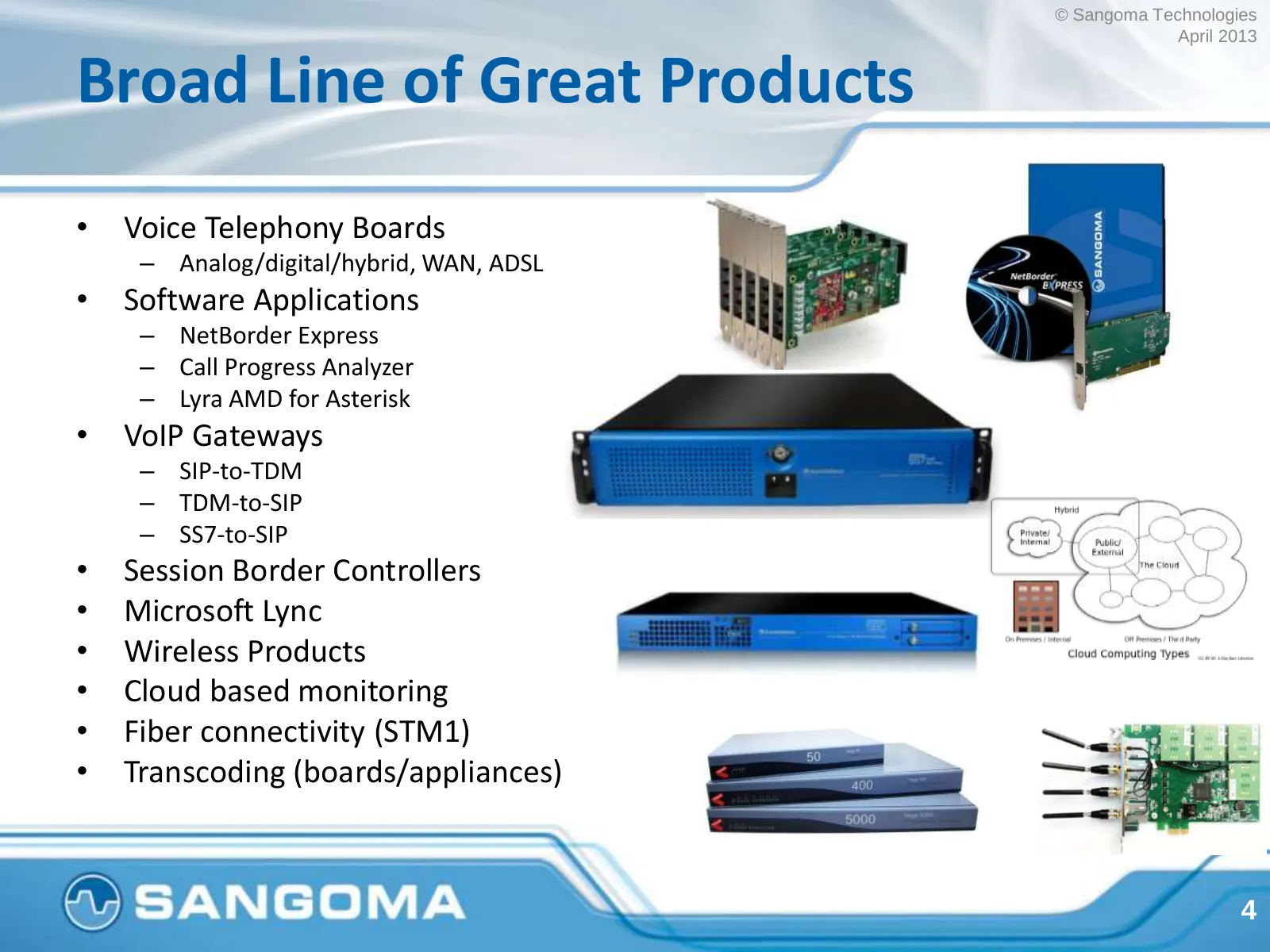
© Sangoma Technologies April 2013 Broad Line of Great Products • Voice Telephony Boards – Analog/digital/hybrid, WAN, ADSL • Software Applications – NetBorder Express – Call Progress Analyzer – Lyra AMD for Asterisk • VoIP Gateways – SIP-to-TDM – TDM-to-SIP – SS7-to-SIP • Session Border Controllers
Slide 5: Vibrant Ecosystem of Clients & Partners
© Sangoma Technologies April 2013 Vibrant Ecosystem of Clients & Partners Open Source Telephony Proprietary PBX and IVR Ready to use drivers for Sangoma boards Plug-in to major soft-PBX and IVRs Contact Center Carriers, Cloud, Data Ntwks OEM Integration with major software suites Proven Infrastructu
Slide 6: Innovation and Interoperability
© Sangoma Technologies April 2013 Innovation and Interoperability Indian Army 6
Slide 7: Key Points of this Presentation
© Sangoma Technologies April 2013 Key Points of this Presentation • Common issues in IP-to-TDM and IP-to-IP interconnections, and mitigation strategies to address them • Key technology solutions to bridge disparate networking technologies and applications common today and coming in the future • A pr
Slide 8: Challenges in a TDM-to-VoIP Migration
© Sangoma Technologies April 2013 Challenges in a TDM-to-VoIP Migration • Service Provider View Point – Capital Expenditure – Learning Curve – Potential Service Disruption – Security • Customer View Point – Capital Expenditure – Learning Curve – Potential Service Disruption – Security 8
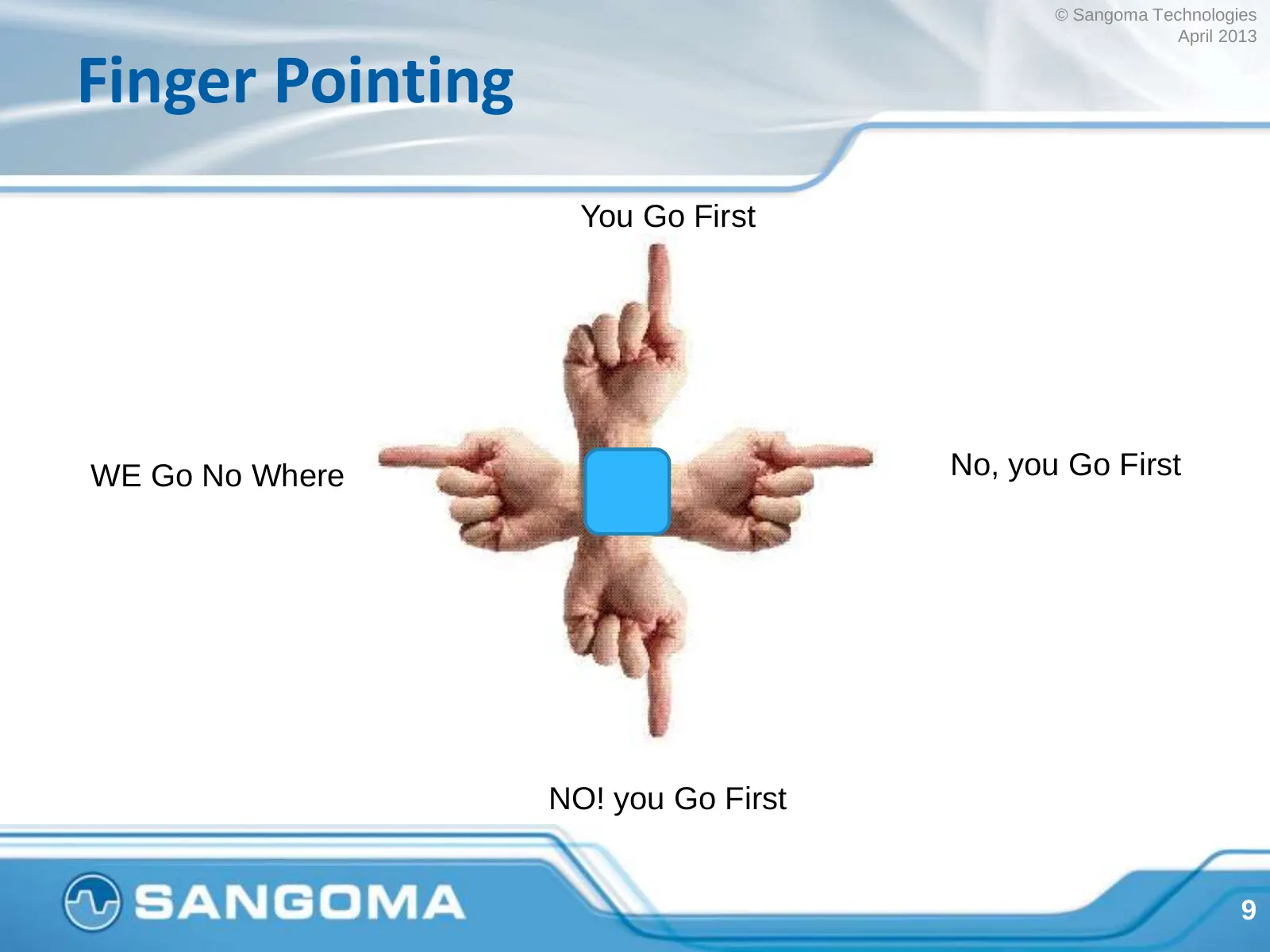
Slide 9: Finger Pointing
© Sangoma Technologies April 2013 Finger Pointing You Go First WE Go No Where No, you Go First NO! you Go First 9
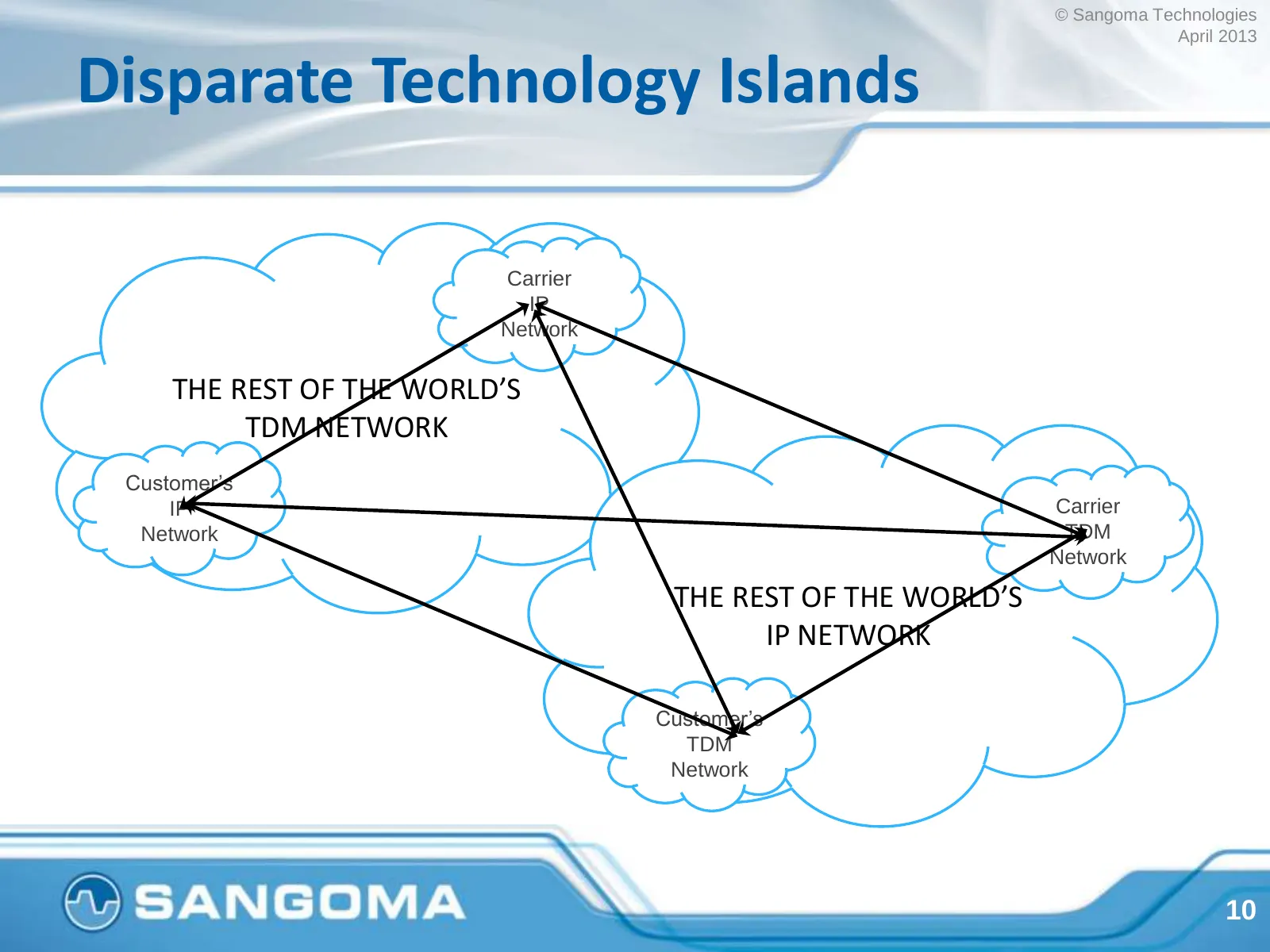
Slide 10: Disparate Technology Islands
© Sangoma Technologies April 2013 Disparate Technology Islands Carrier IP Network THE REST OF THE WORLD’S TDM NETWORK Customer’s IP Carrier Network TDM Network THE REST OF THE WORLD’S IP NETWORK Customer’s TDM Network 10
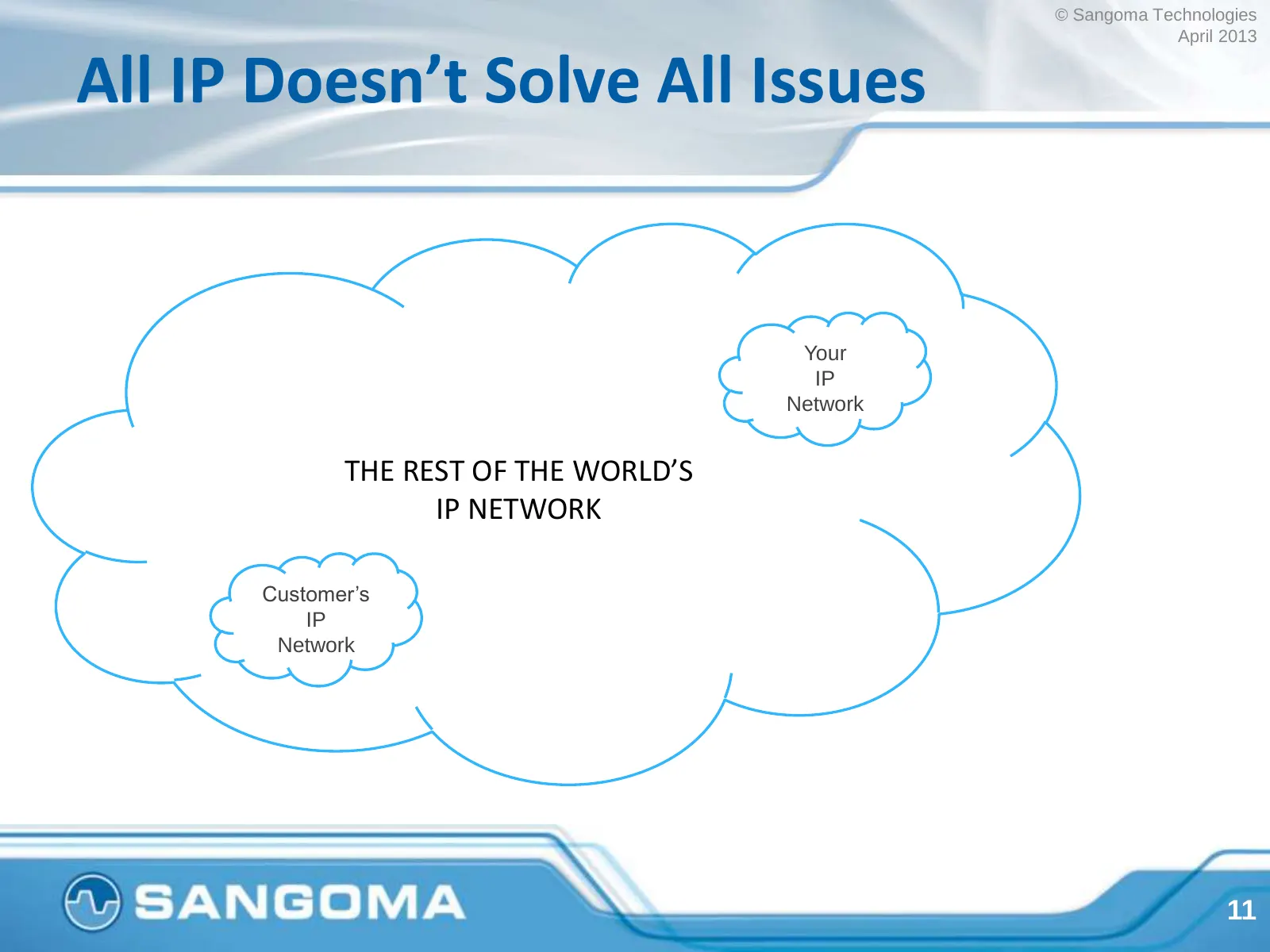
Slide 11: All IP Doesn't Solve All Issues
© Sangoma Technologies April 2013 All IP Doesn’t Solve All Issues Your IP Network THE REST OF THE WORLD’S IP NETWORK Customer’s IP Network 11
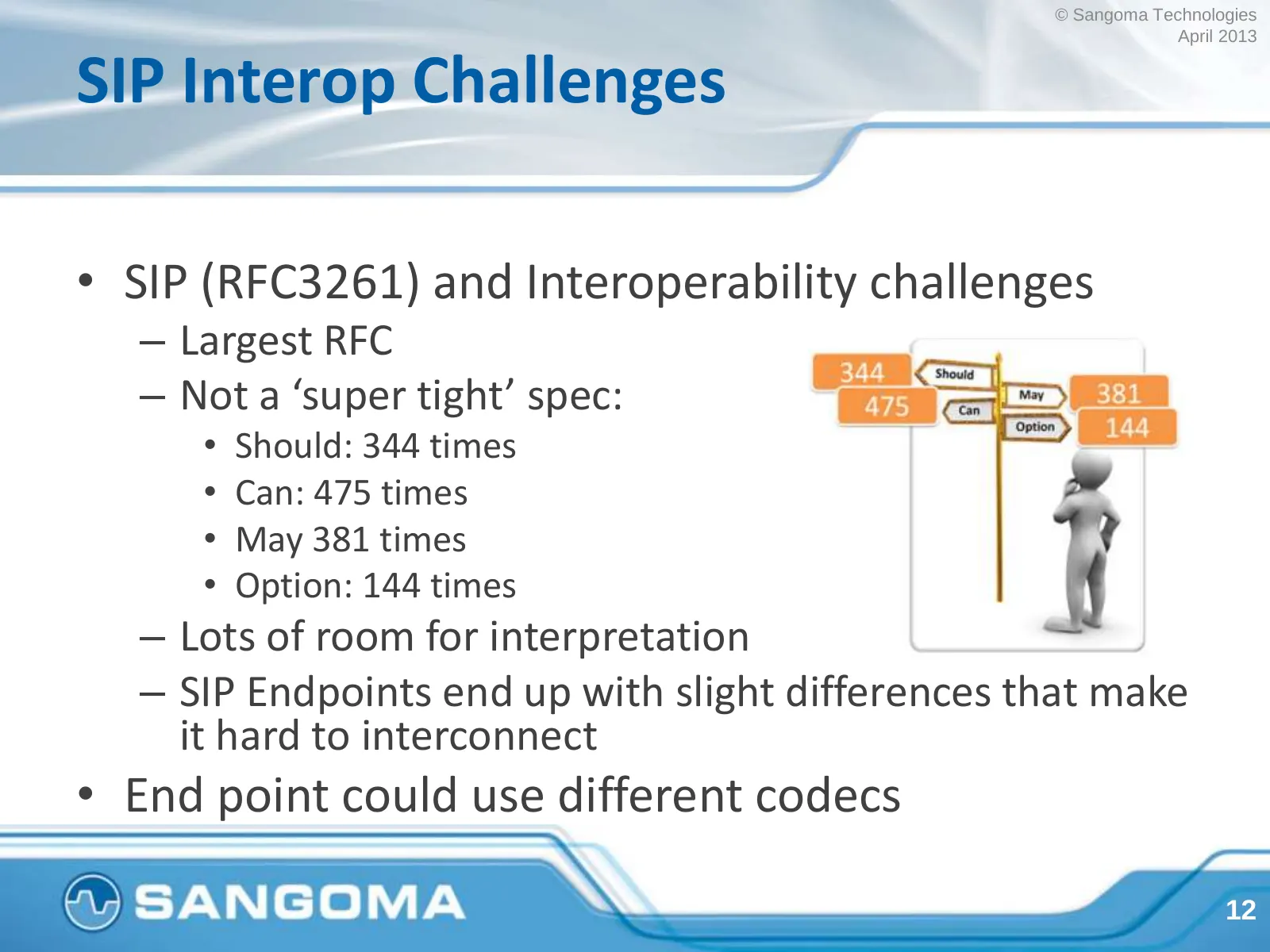
Slide 12: SIP Interop Challenges
© Sangoma Technologies April 2013 SIP Interop Challenges • SIP (RFC3261) and Interoperability challenges – Largest RFC – Not a ‘super tight’ spec: • Should: 344 times • Can: 475 times • May 381 times • Option: 144 times – Lots of room for interpretation – SIP Endpoints end up with slight differences
Slide 13: Looking at the Customer Premise
LOOKING AT THE CUSTOMER PREMISE
Slide 14: Applications Enabled
© Sangoma Technologies April 2013 Applications Enabled • SIP Trunking (SIP-SIP) • VoIP Enablement of Existing TDM Equipment (TDM-SIP) • Legacy Connectivity for the IP-PBX (SIP-TDM) • Connecting Legacy Equipment to an IP-PBX 14
Slide 15: Over The Top Services
© Sangoma Technologies April 2013 Over The Top Services • SIP and Other VoIP Services Can Be Delivered Two Ways – Dedicated Facility • Broadband and SIP Delivered By Single Entity – Over The Top • Broadband and SIP Delivered By Different Providers 15
Slide 16: SIP Trunking
———— SIP TRUNKING 4) SANGOMA CONNECT WITH SANGOMA
Slide 17: Defining SIP Trunking
© Sangoma Technologies April 2013 Defining SIP Trunking • “The use of SIP service bundled in a familiar business construct to connect a PBX or gateway to the PSTN over the Internet” • An alternative to T1s, PRIs, and POTS lines • Pure SIP will allow you to make and receive calls worldwide and should
Slide 18: SIP Trunking Diagram
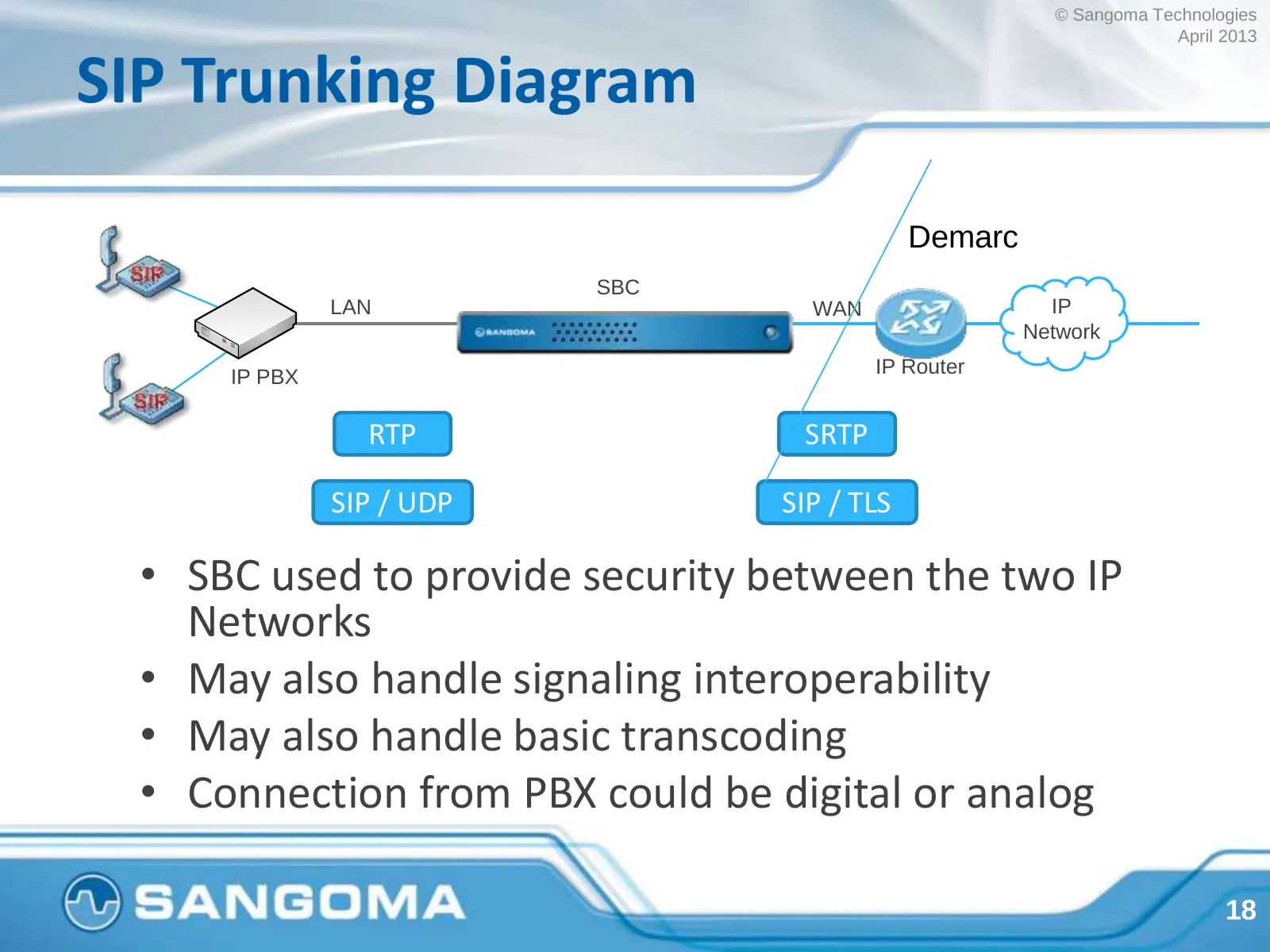
© Sangoma Technologies April 2013 SIP Trunking Diagram Demarc SBC LAN WAN IP Network IP Router IP PBX RTP SRTP SIP / UDP SIP / TLS • SBC used to provide security between the two IP Networks • May also handle signaling interoperability • May also handle basic transcoding • Connection from PBX could b
Slide 19: SIP Trunking Benefits
© Sangoma Technologies April 2013 SIP Trunking Benefits • SIP Trunking allows companies to replace physical PSTN trunks with virtual, broadband trunks, deployed over data connections • Can be – Dedicated lines or shared connections – Internet connections – Burstable • Introduces more flexibility, mo
Slide 20: VoIP Enablement of Existing TDM Equipment
VOIP ENABLEMENT OF EXISTING TDM EQUIPMENT
Slide 21: VoIP Enablement Diagram
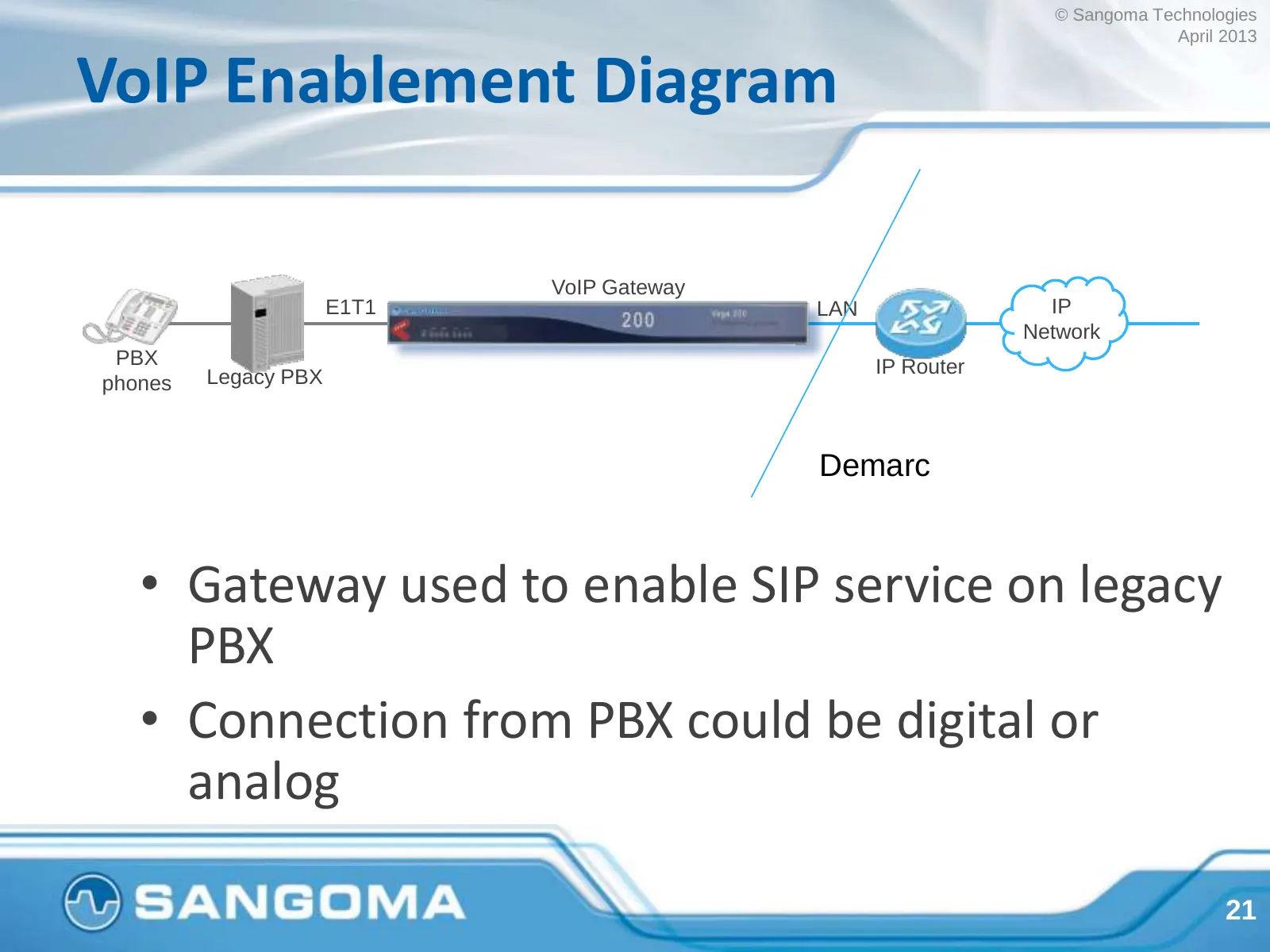
© Sangoma Technologies April 2013 VoIP Enablement Diagram VoIP Gateway E1T1 LAN IP Network PBX IP Router phones Legacy PBX Demarc • Gateway used to enable SIP service on legacy PBX • Connection from PBX could be digital or analog 21
Slide 22: VoIP Enablement Benefits
© Sangoma Technologies April 2013 VoIP Enablement Benefits • Enables Service Provider to retain customers who have moved not yet moved to an IP Infrastructure • Mitigates the threat of encroachment of the Over-The- Top SIP Provider in the Future • All Integration takes place at the customer premise.
Slide 23: Legacy Connectivity for IP-PBX
LEGACY CONNECTIVITY FOR IP-PBX
Slide 24: VoIP Legacy Connectivity
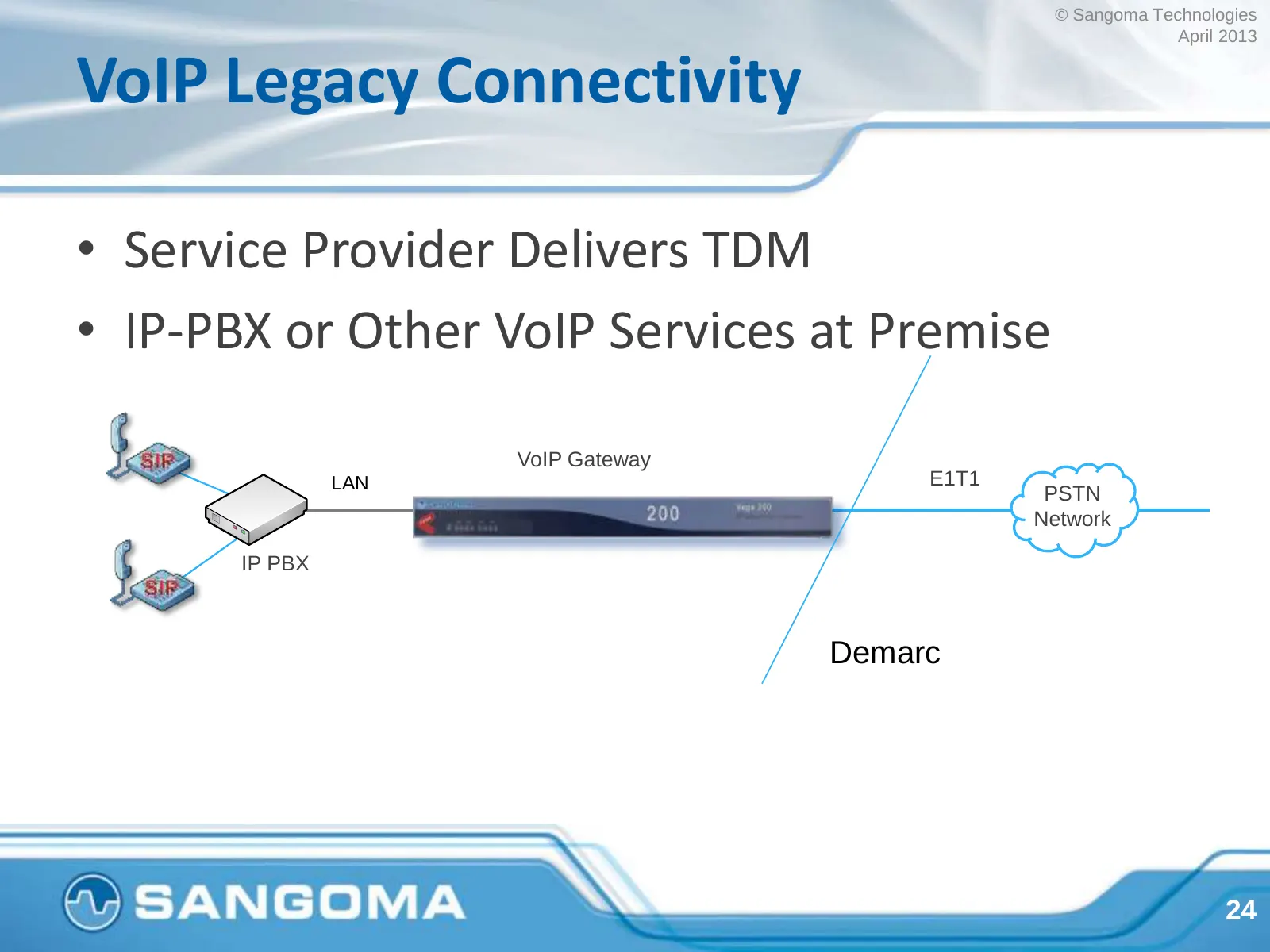
© Sangoma Technologies April 2013 VoIP Legacy Connectivity • Service Provider Delivers TDM • IP-PBX or Other VoIP Services at Premise VoIP Gateway LAN E1T1 PSTN Network IP PBX Demarc 24
Slide 25: Legacy Connectivity Benefits
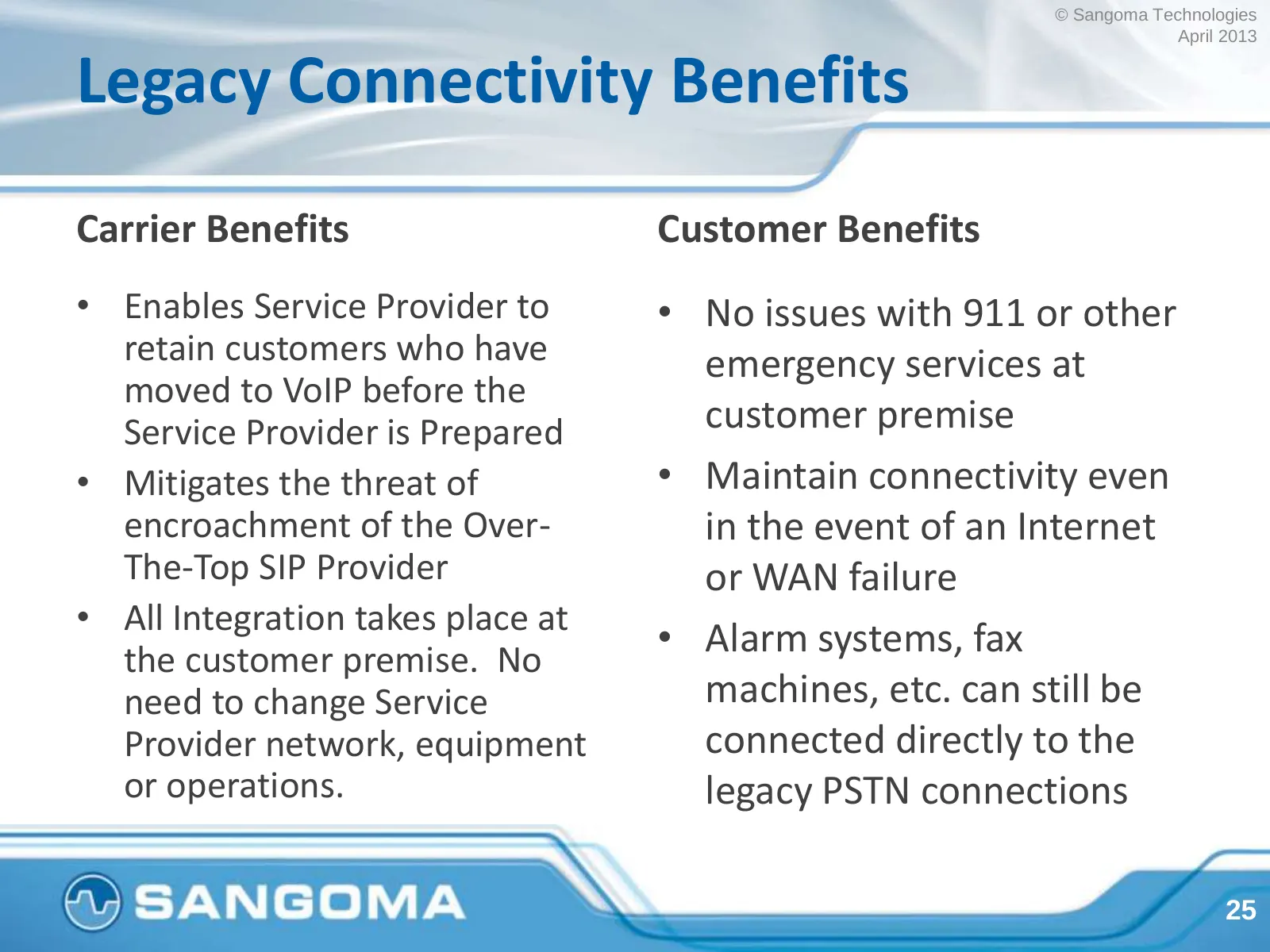
© Sangoma Technologies April 2013 Legacy Connectivity Benefits Carrier Benefits Customer Benefits • Enables Service Provider to • No issues with 911 or other retain customers who have emergency services at moved to VoIP before the Service Provider is Prepared customer premise • Mitigates the threat
Slide 26: Connecting Legacy Equipment to an IP Network
CONNECTING LEGACY EQUIPMENT TO AN IP NETWORK
Slide 27: Legacy Gear Connectivity
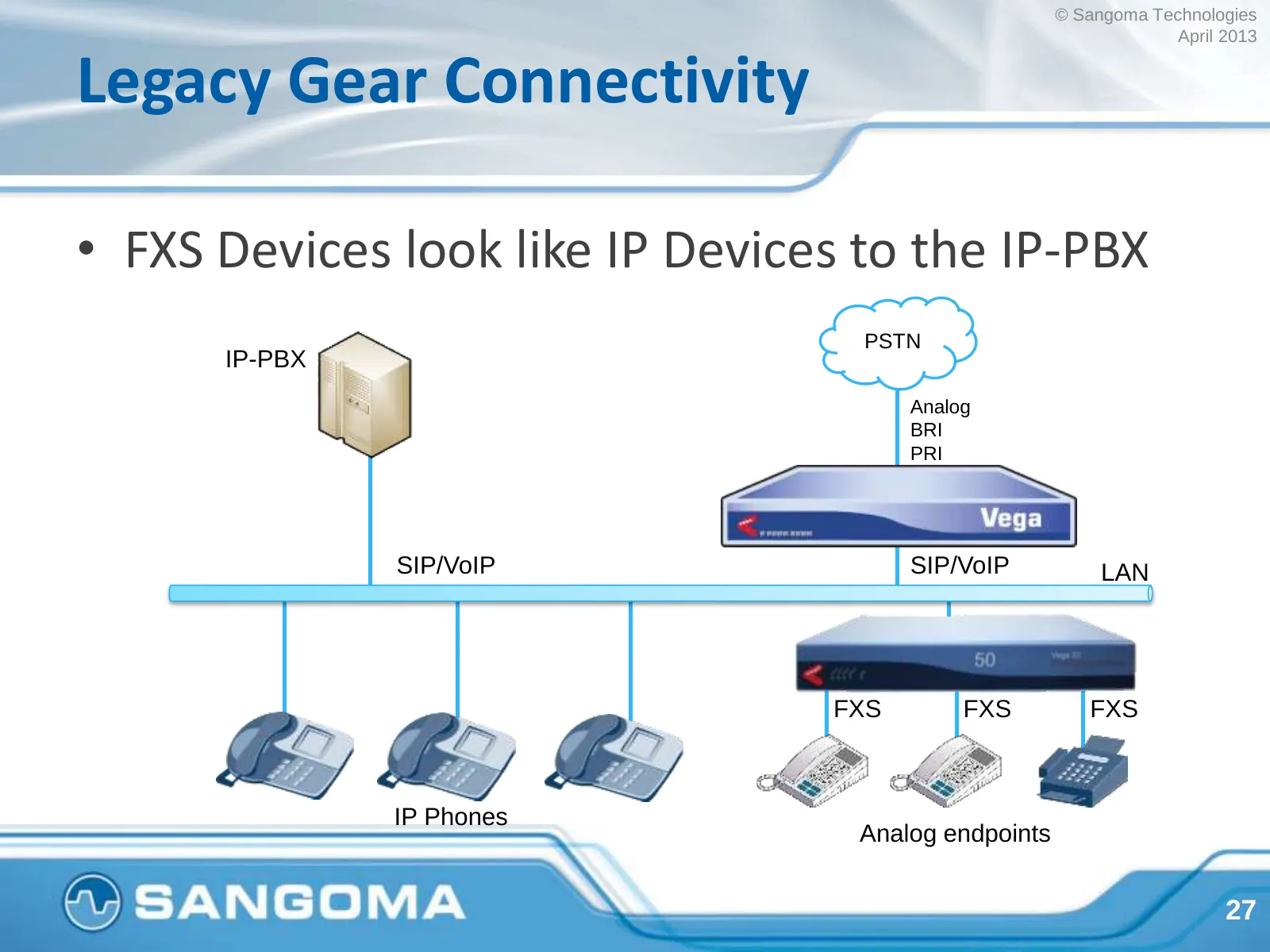
© Sangoma Technologies April 2013 Legacy Gear Connectivity • FXS Devices look like IP Devices to the IP-PBX PSTN IP-PBX Analog BRI PRI SIP/VoIP SIP/VoIP LAN FXS FXS FXS IP Phones Analog endpoints 27
Slide 28: Legacy Gear Connectivity Benefits
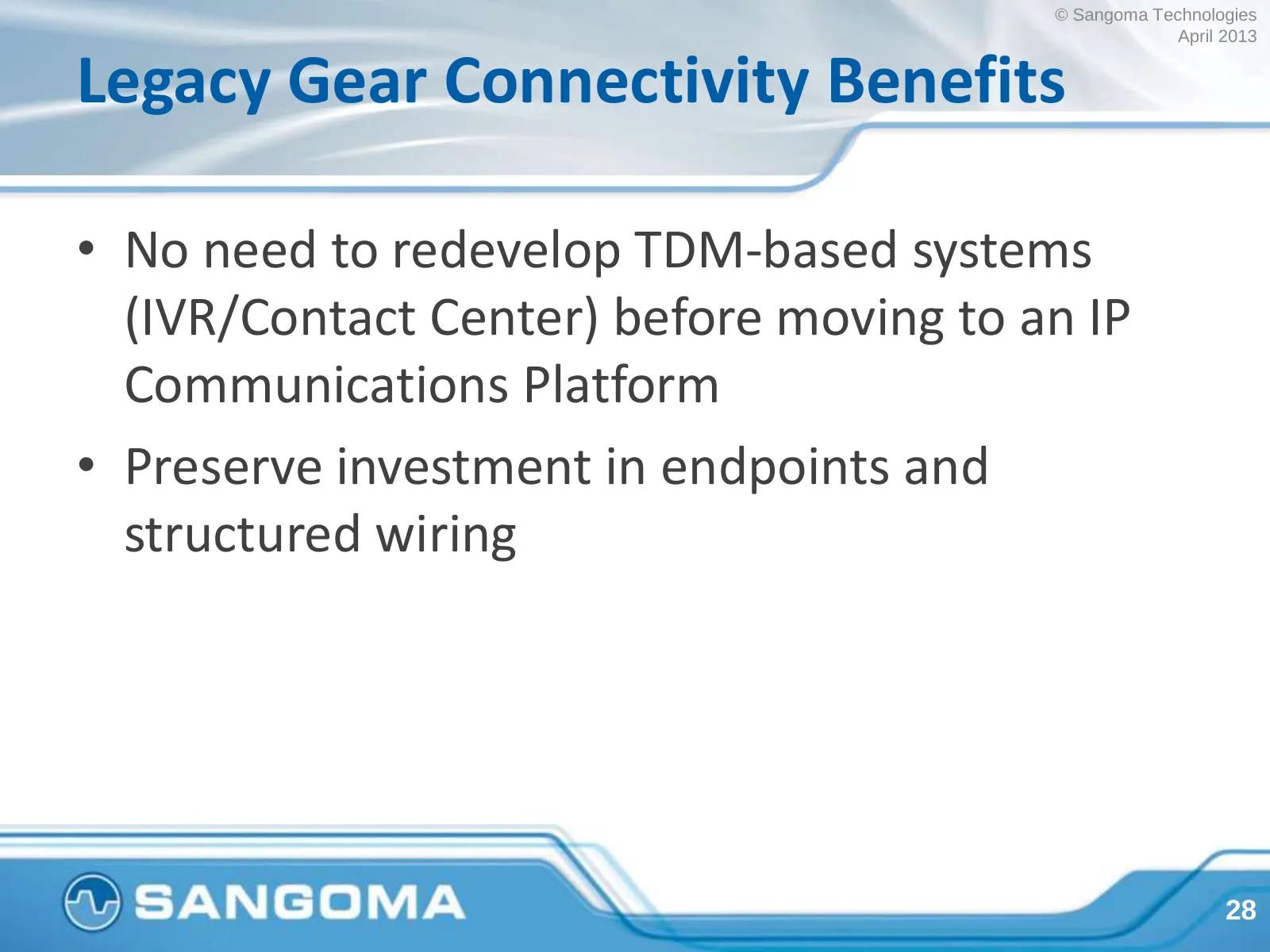
© Sangoma Technologies April 2013 Legacy Gear Connectivity Benefits • No need to redevelop TDM-based systems (IVR/Contact Center) before moving to an IP Communications Platform • Preserve investment in endpoints and structured wiring 28
Slide 29: Looking at Carrier-to-Carrier Connectivity
LOOKING AT CARRIER-TO-CARRIER CONNECTIVITY
Slide 30: Technology Touch Points
© Sangoma Technologies April 2013 Technology Touch Points • Extending investments in TDM equipment • Accessing SS7 from the VoIP Network • Managing Codec Requirements when integrating with other Providers • Network Security in an all IP Environment 30
Slide 31: SS7 Gateway
———— SS7 GATEWAY 4) SANGOMA CONNECT WITH SANGOMA
Slide 32: SS7 Explained
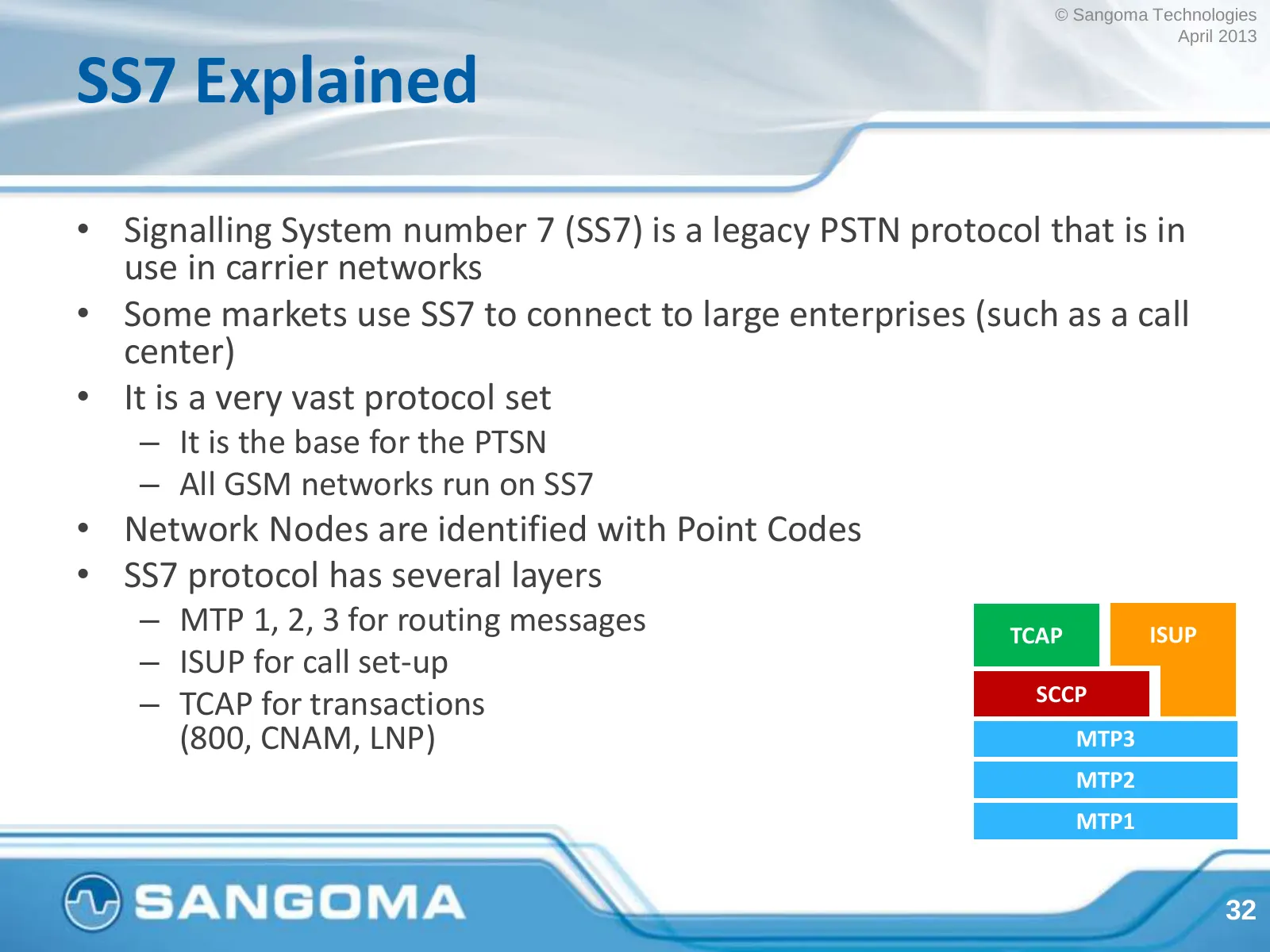
© Sangoma Technologies April 2013 SS7 Explained • Signalling System number 7 (SS7) is a legacy PSTN protocol that is in use in carrier networks • Some markets use SS7 to connect to large enterprises (such as a call center) • It is a very vast protocol set – It is the base for the PTSN – All GSM netw
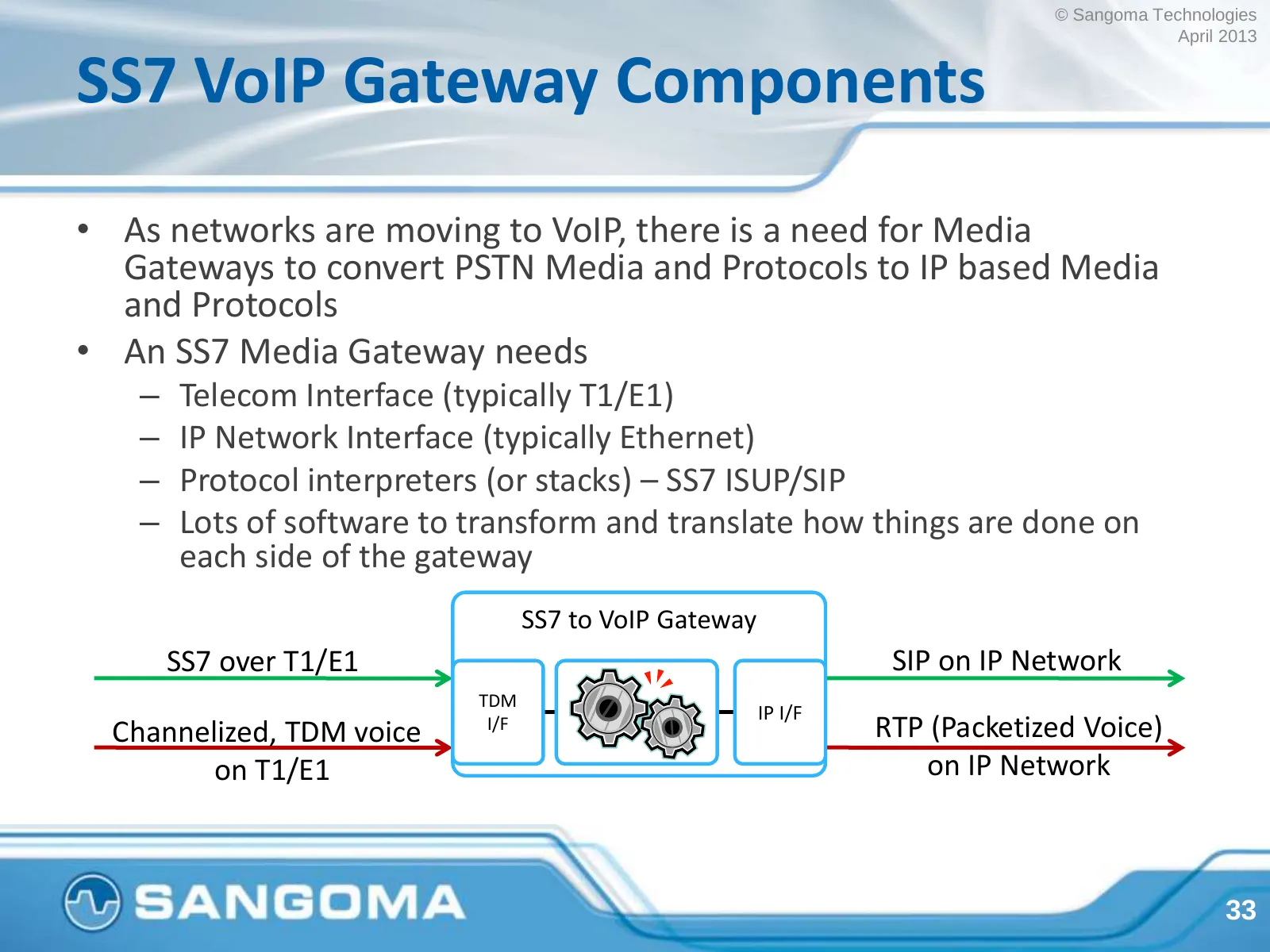
Slide 33: SS7 VoIP Gateway Components
© Sangoma Technologies April 2013 SS7 VoIP Gateway Components • As networks are moving to VoIP, there is a need for Media Gateways to convert PSTN Media and Protocols to IP based Media and Protocols • An SS7 Media Gateway needs – Telecom Interface (typically T1/E1) – IP Network Interface (typically
Slide 34: Transcoding
———— TRANSCODING 4) SANGOMA CONNECT WITH SANGOMA
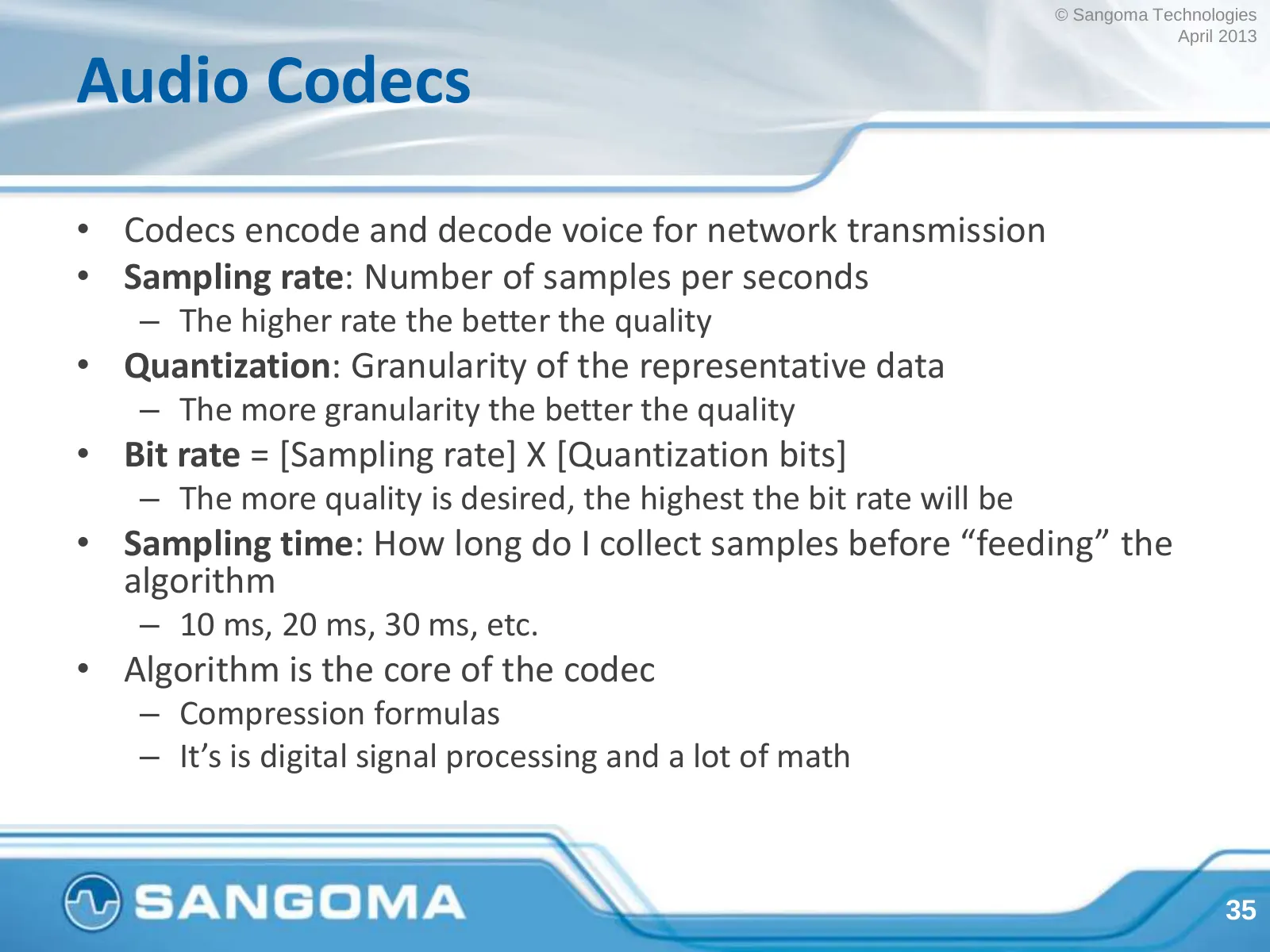
Slide 35: Audio Codecs
© Sangoma Technologies April 2013 Audio Codecs • Codecs encode and decode voice for network transmission • Sampling rate: Number of samples per seconds – The higher rate the better the quality • Quantization: Granularity of the representative data – The more granularity the better the quality • Bit
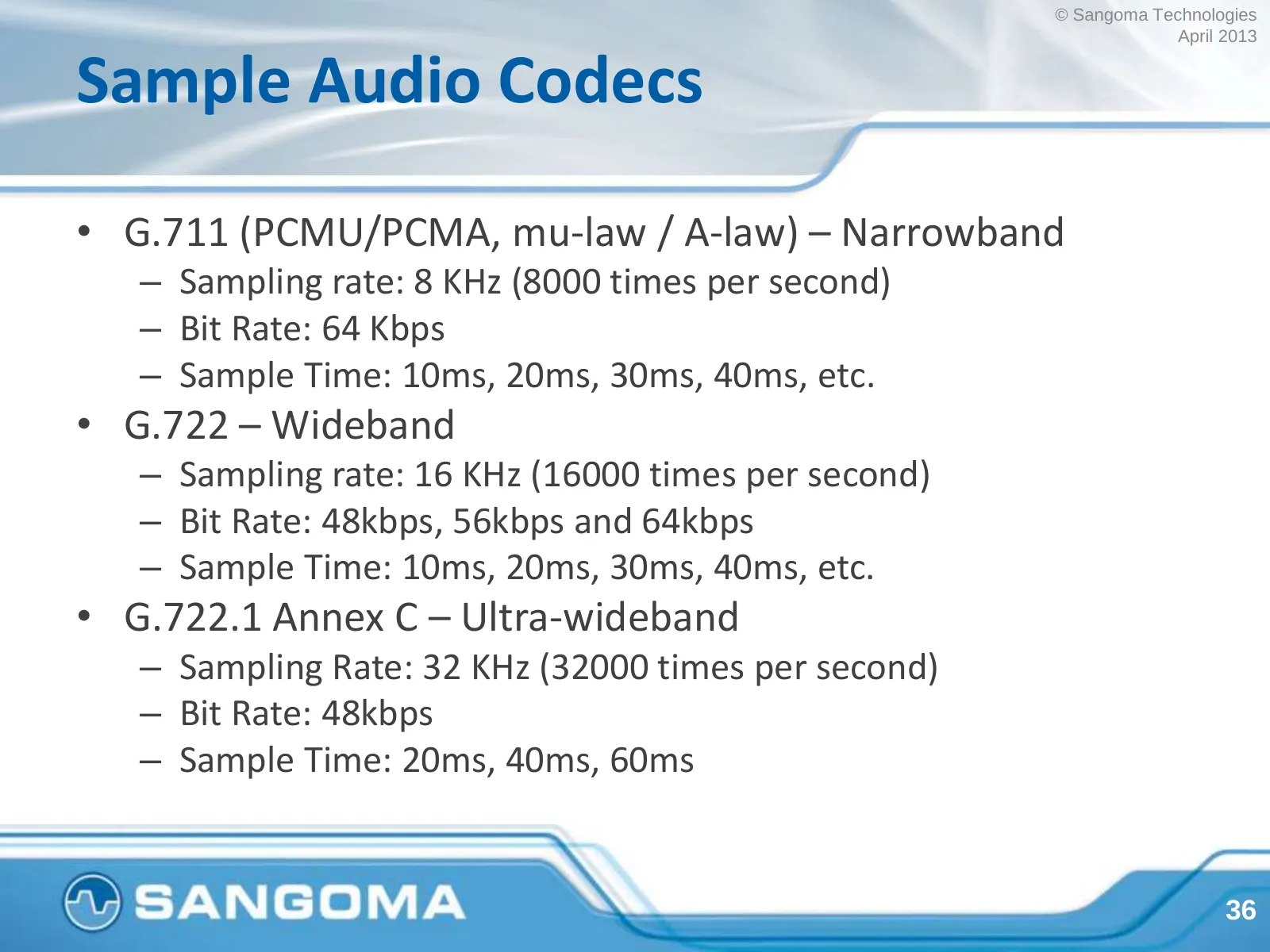
Slide 36: Sample Audio Codecs
© Sangoma Technologies April 2013 Sample Audio Codecs • G.711 (PCMU/PCMA, mu-law / A-law) – Narrowband – Sampling rate: 8 KHz (8000 times per second) – Bit Rate: 64 Kbps – Sample Time: 10ms, 20ms, 30ms, 40ms, etc. • G.722 – Wideband – Sampling rate: 16 KHz (16000 times per second) – Bit Rate: 48kbps
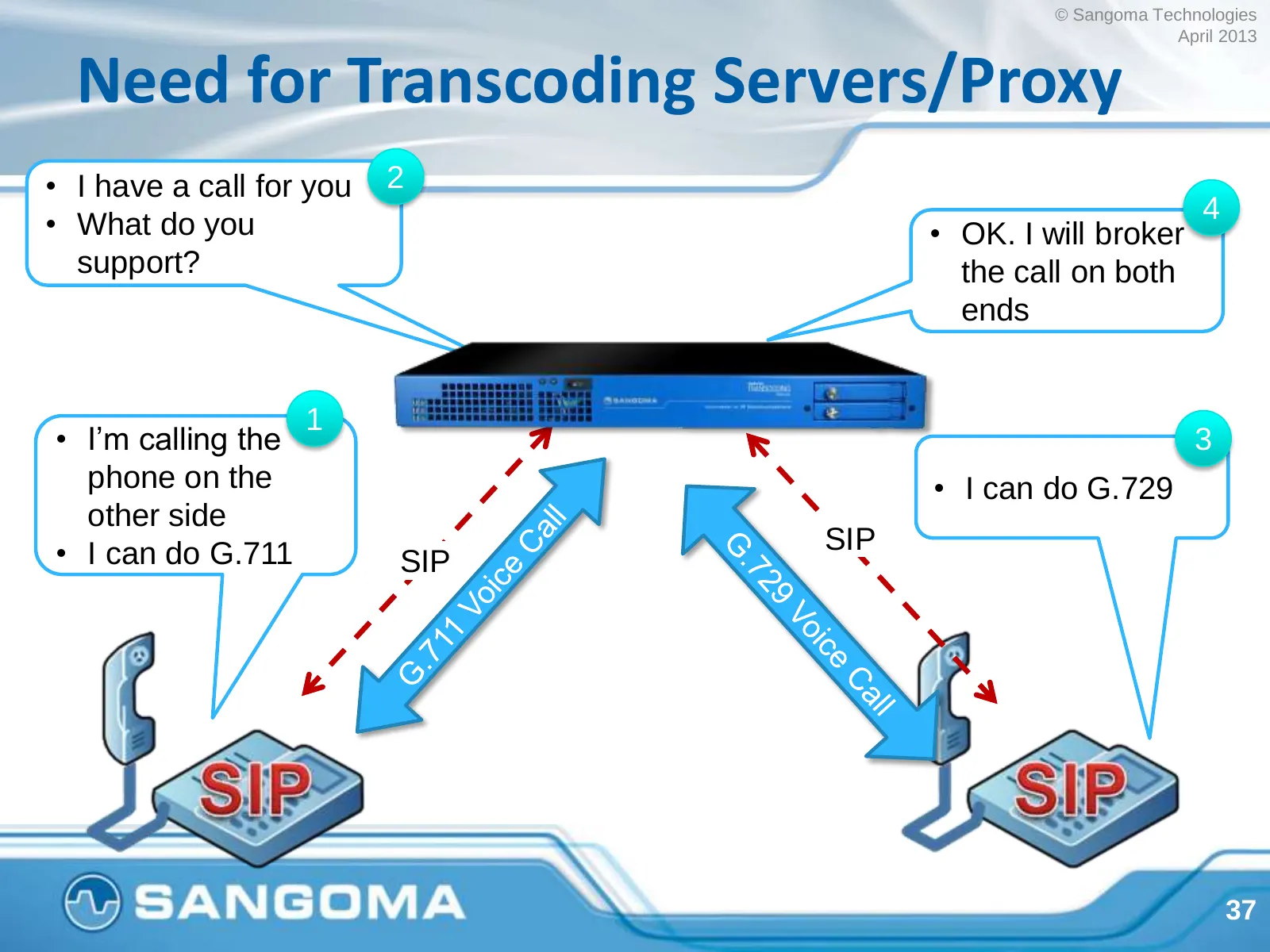
Slide 37: Need for Transcoding Servers/Proxy
© Sangoma Technologies April 2013 Need for Transcoding Servers/Proxy • I have a call for you 2 • What do you 4 • OK. I will broker support? the call on both ends 1 • I’m calling the 3 phone on the • I can do G.729 other side • I can do G.711 SIP SIP 37
Slide 38: Poll Questions
———— POLL QUESTIONS 4) SANGOMA CONNECT WITH SANGOMA
Slide 39: Session Border Controller
— SESSION BORDER CONTROLLER 4) SANGOMA CONNECT WITH SANGOMA
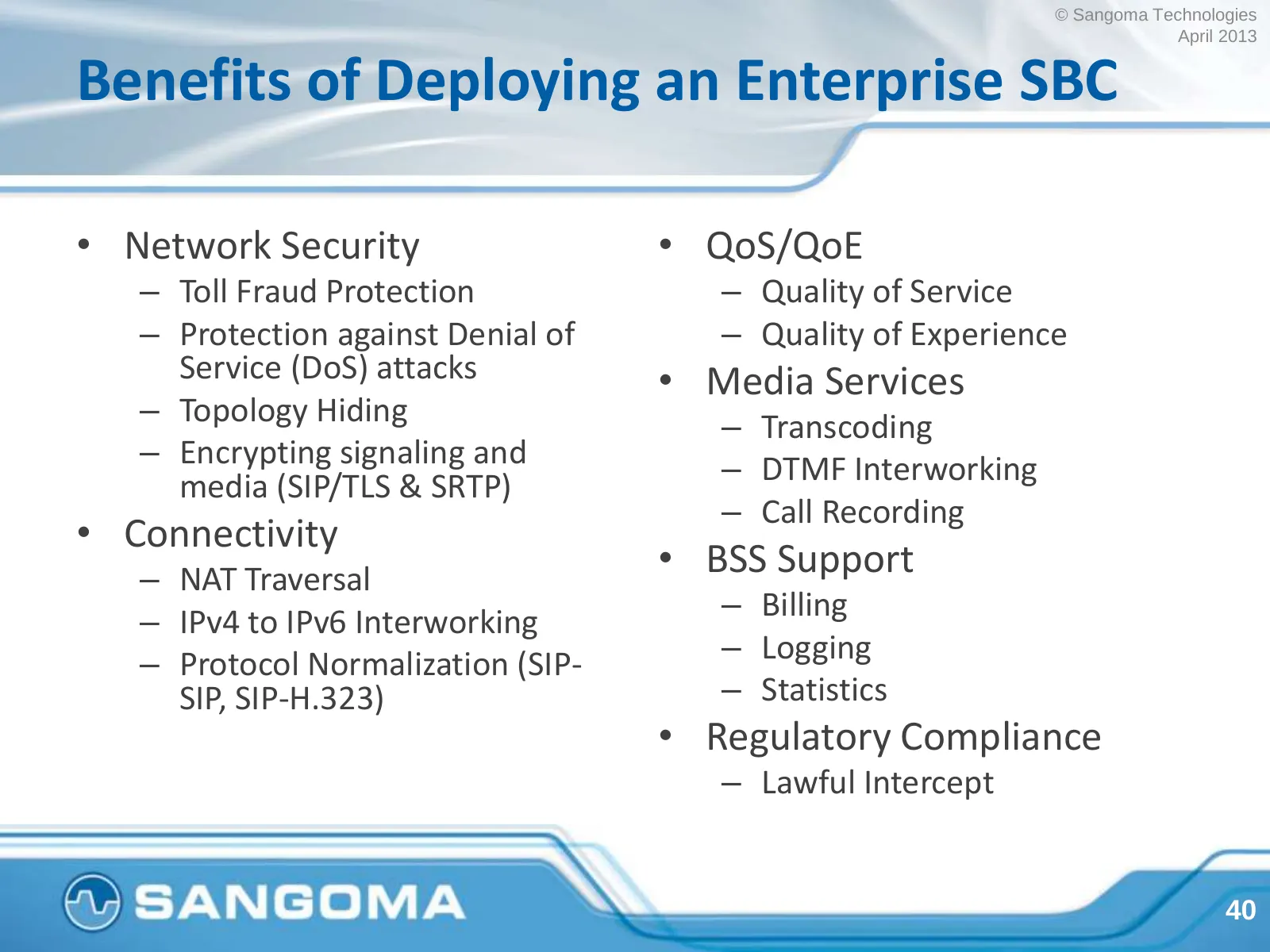
Slide 40: Benefits of Deploying an Enterprise SBC
© Sangoma Technologies April 2013 Benefits of Deploying an Enterprise SBC • Network Security • QoS/QoE – Toll Fraud Protection – Quality of Service – Protection against Denial of – Quality of Experience Service (DoS) attacks • Media Services – Topology Hiding – Transcoding – Encrypting signaling and
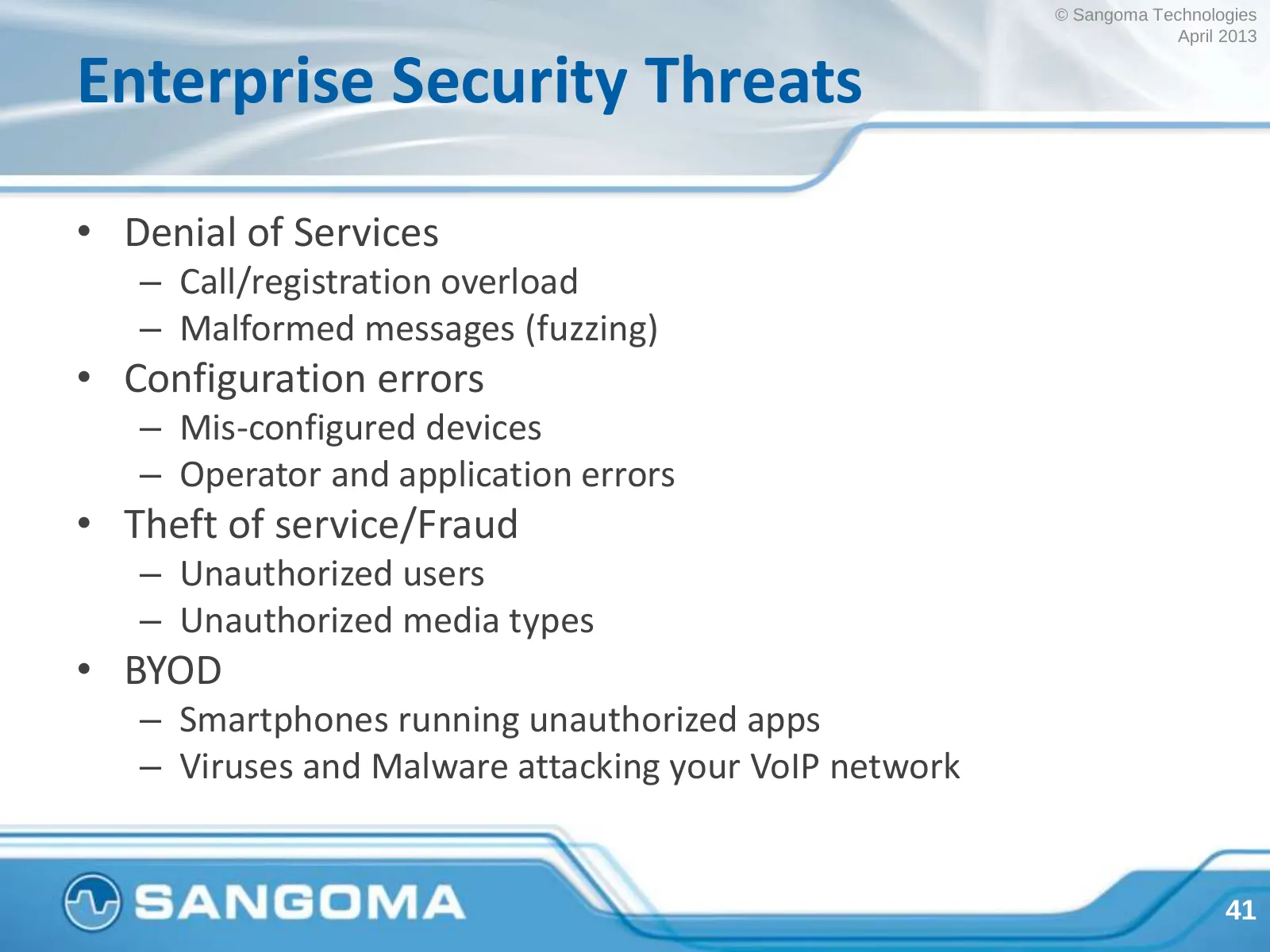
Slide 41: Enterprise Security Threats
© Sangoma Technologies April 2013 Enterprise Security Threats • Denial of Services – Call/registration overload – Malformed messages (fuzzing) • Configuration errors – Mis-configured devices – Operator and application errors • Theft of service/Fraud – Unauthorized users – Unauthorized media types •
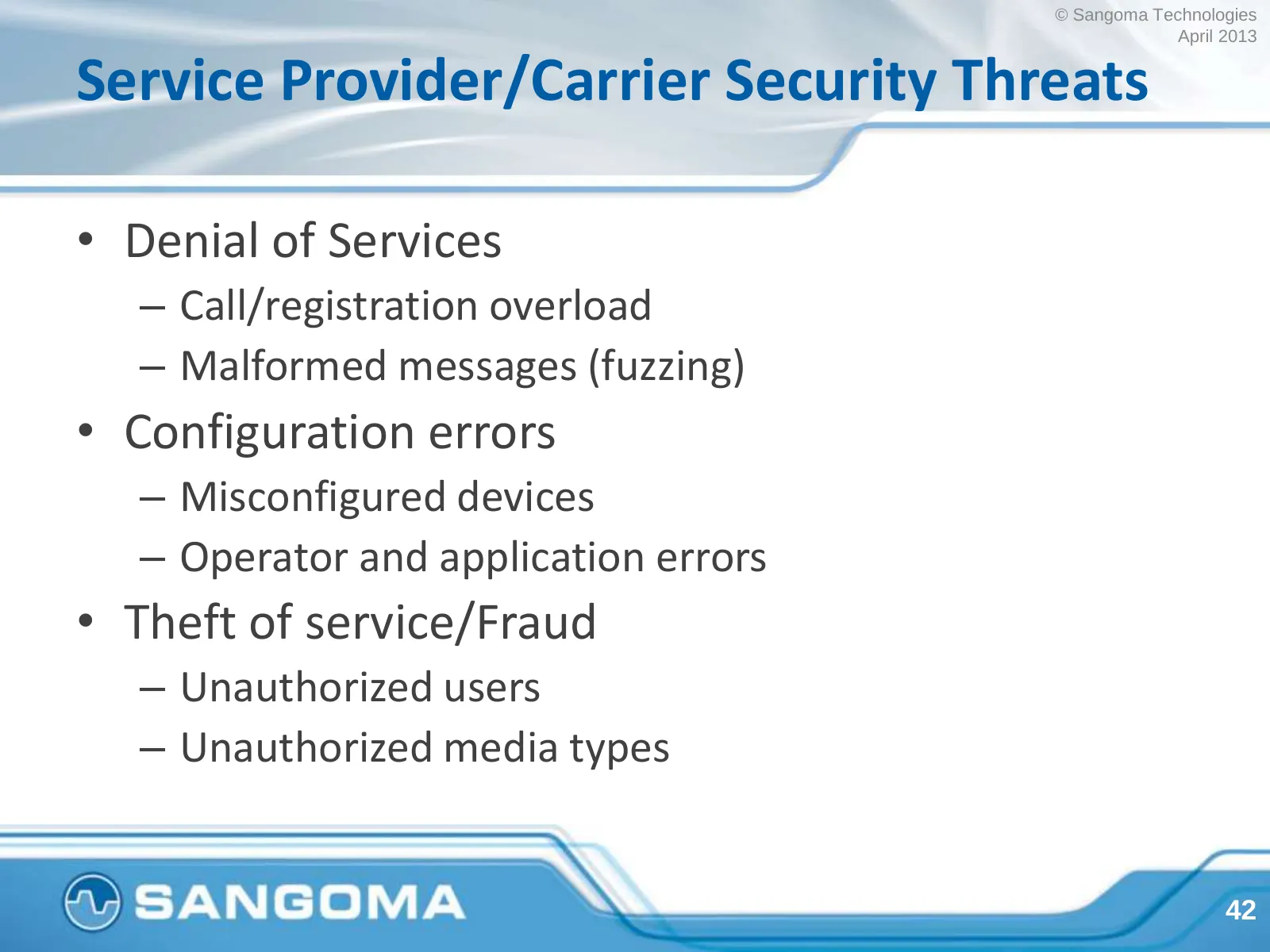
Slide 42: Service Provider/Carrier Security Threats
© Sangoma Technologies April 2013 Service Provider/Carrier Security Threats • Denial of Services – Call/registration overload – Malformed messages (fuzzing) • Configuration errors – Misconfigured devices – Operator and application errors • Theft of service/Fraud – Unauthorized users – Unauthorized m
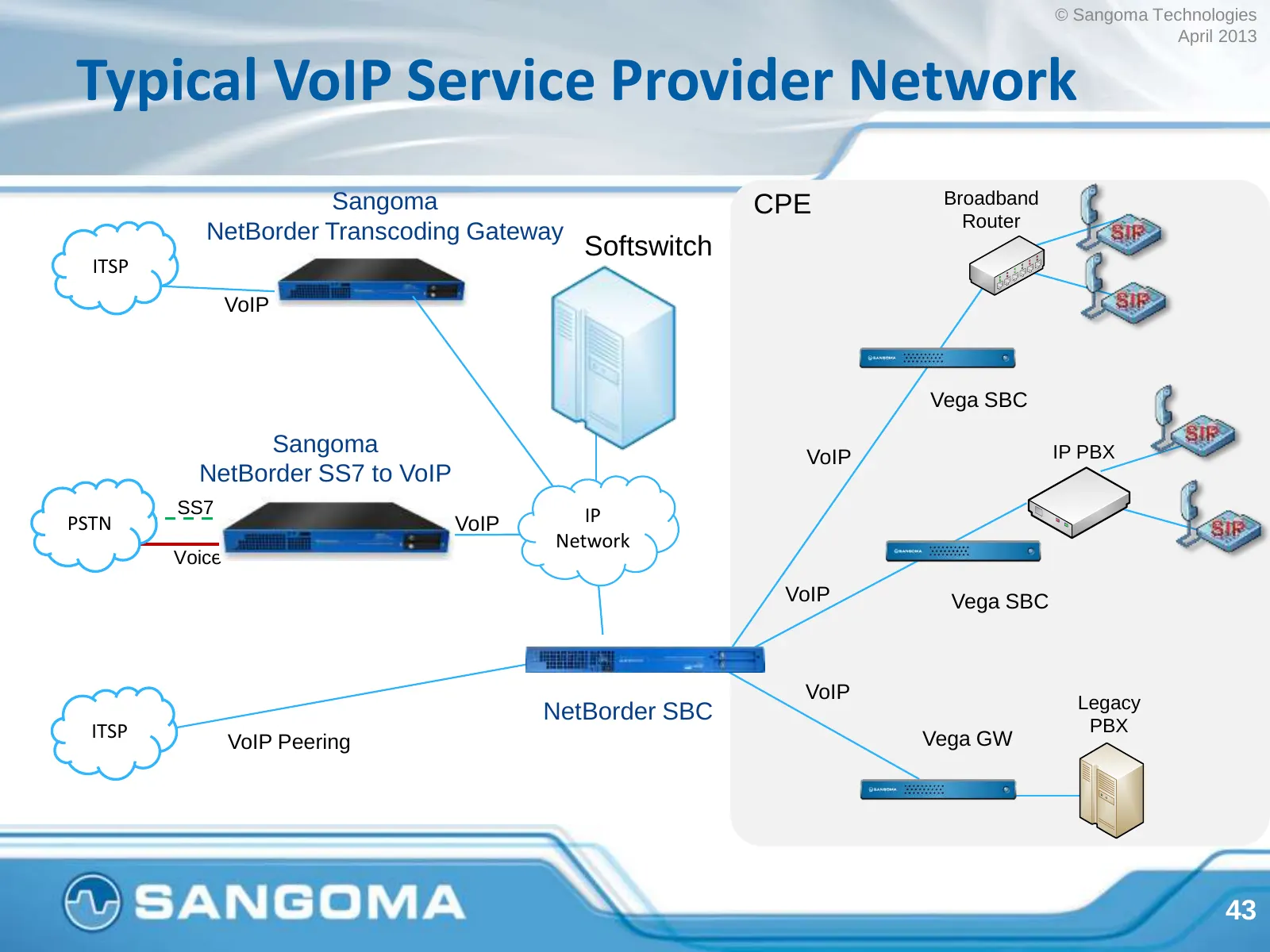
Slide 43: Typical VoIP Service Provider Network
© Sangoma Technologies April 2013 Typical VoIP Service Provider Network Sangoma CPE Broadband Router NetBorder Transcoding Gateway Softswitch ITSP VoIP Vega SBC Sangoma VoIP IP PBX NetBorder SS7 to VoIP SS7 IP PSTN VoIP Network Voice VoIP Vega SBC VoIP Legacy NetBorder SBC ITSP PBX VoIP Peering Vega
Slide 44: Conclusions
© Sangoma Technologies April 2013 Conclusions • Both the carrier and the enterprise share common goals in migrating from TDM-to-IP • “Integration at the Edge” can enable TDM-To-IP migration incrementally, preserving capital and resources while delivering advanced functionality to your user base. • S
Slide 45: Upcoming Webinars
© Sangoma Technologies April 2013 Upcoming Webinars Sangoma Education Series: • Cost Effective Tapping and Call Recording using the Sangoma T116 – April 22, 2013 @ 11:00am EST • The SBC – The Critical Component – May 16, 2013 @ 2:00pm EST • Adding Telephony to Microsoft Lync with Office 365 and Othe
Slide 46: Thank You
THANK YOU facebook.com/Sangoma twitter.com/Sangoma (9 yout ube.com/Sangomatechnologies iy blog.sangoma.com @ 4) SANGOMA CONNECT WITH SANGOMA
Source: Internet Archive copy of sangoma.com
More decks from Sangoma Technologies Corporation
 Investor Presentation (February 2026)24 slides · February 2026
 Investor Presentation (February 2026)26 slides · February 2026
 Q1 2026 Earnings Presentation24 slides · Nov 10, 2025
 Investor Presentation (November 2025)23 slides · November 2025
 Investor Presentation (September 2025)24 slides · September 2025
 Investor Presentation (May 2025)28 slides · May 2025