Simulations Plus, Inc. · NASDAQ:SLP
Simulations Plus — Technical Presentation (February 2021)
45 slides from Simulations Plus's technical presentation, Feb 11, 2021
Slide 1: Strategic Implementation of Model-informed Drug Development for Regulatory Success
Strategic Implementation of Model-informed Drug Development for Regulatory Success Jill Fiedler-Kelly, MS, FISoP February 11, 2021 1 © Cognigen Corporation, 2021.
Slide 2: Overview
Overview • Share some experiences and thoughts on the effective implementation of model-informed drug development approaches • Outline some considerations for optimizing the likelihood of regulatory success with model-informed approaches • Happy International Day of Women and Girls in Science! 2 © C
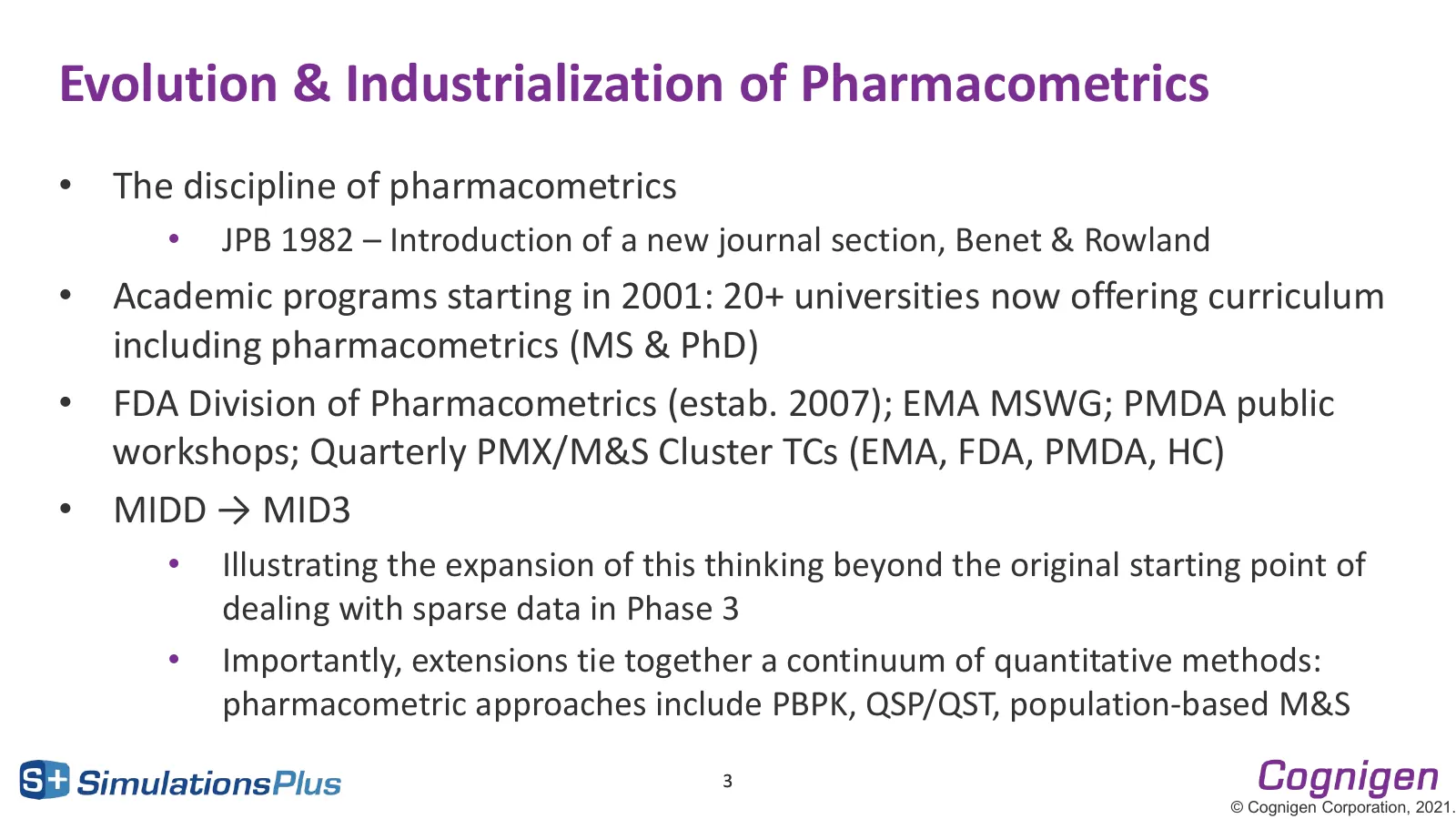
Slide 3: Evolution & Industrialization of Pharmacometrics
Evolution & Industrialization of Pharmacometrics • The discipline of pharmacometrics • JPB 1982 – Introduction of a new journal section, Benet & Rowland • Academic programs starting in 2001: 20+ universities now offering curriculum including pharmacometrics (MS & PhD) • FDA Division of Pharmacometri
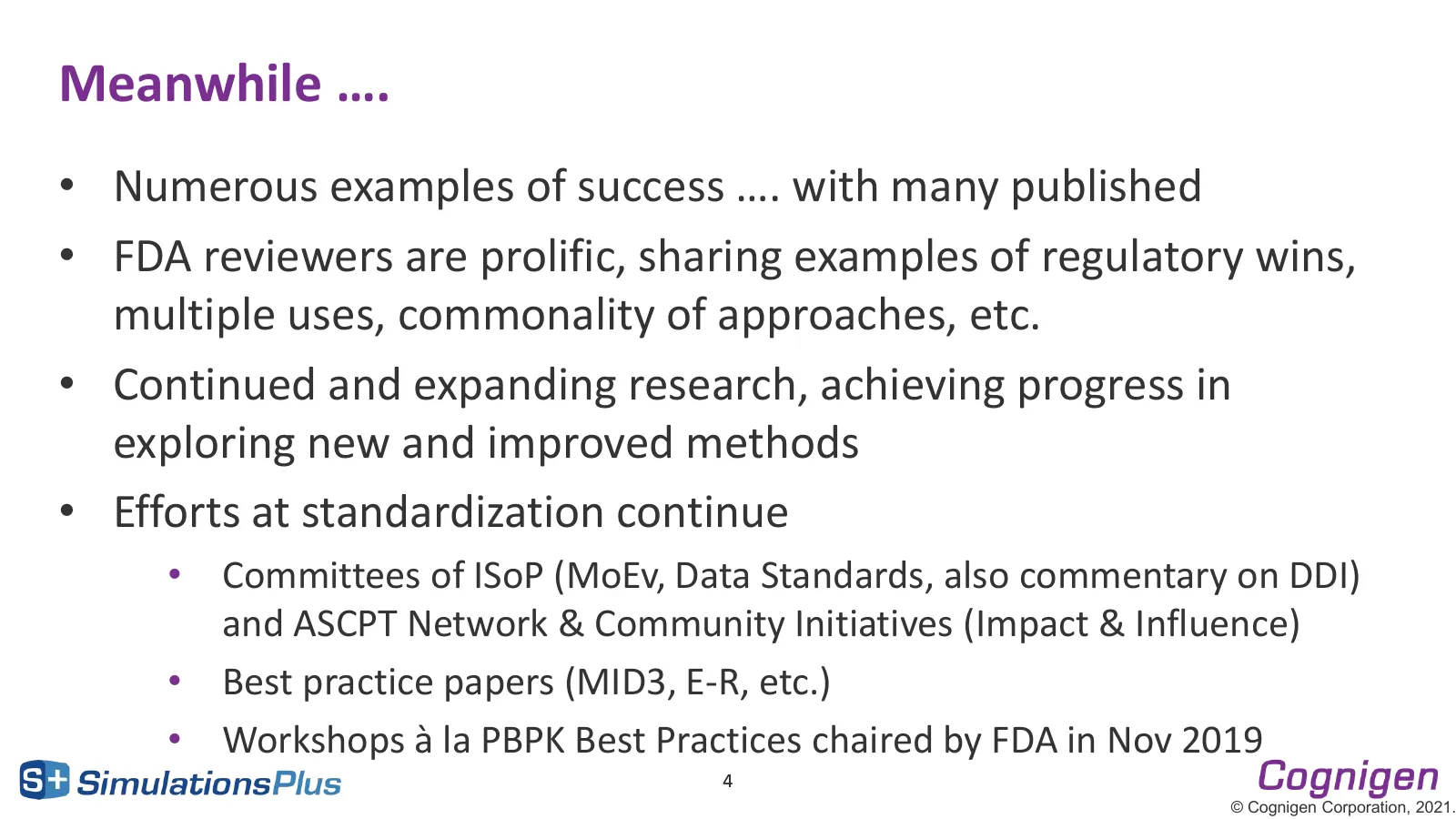
Slide 4: Meanwhile ....
Meanwhile …. • Numerous examples of success …. with many published • FDA reviewers are prolific, sharing examples of regulatory wins, multiple uses, commonality of approaches, etc. • Continued and expanding research, achieving progress in exploring new and improved methods • Efforts at standardizati
Slide 5: Optimal Pharmacotherapy for the Patient
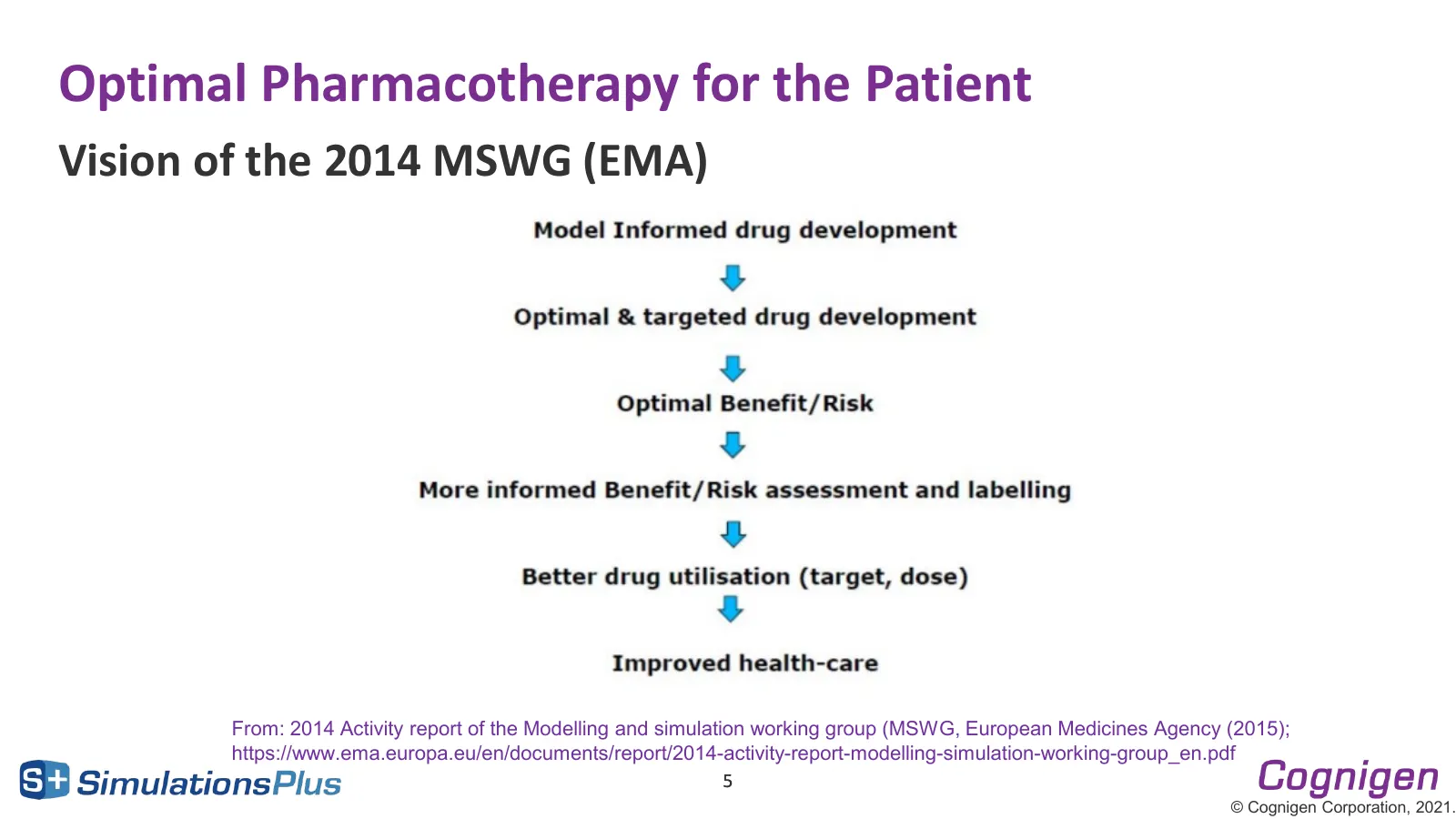
Optimal Pharmacotherapy for the Patient Vision of the 2014 MSWG (EMA) From: 2014 Activity report of the Modelling and simulation working group (MSWG, European Medicines Agency (2015); https://www.ema.europa.eu/en/documents/report/2014-activity-report-modelling-simulation-working-group_en.pdf 5 © Cog
Slide 6: Value of Pharmacometric Approaches
Value of Pharmacometric Approaches Population-based modeling and Exposure-response analyses What questions do we answer: - PK-related: dose proportionality, time invariance, effects of intrinsic/extrinsic factors on PK, drug-drug interactions - PK/PD-related: E-R relationship, quantification of plac
Slide 7: Wide Therapeutic Index
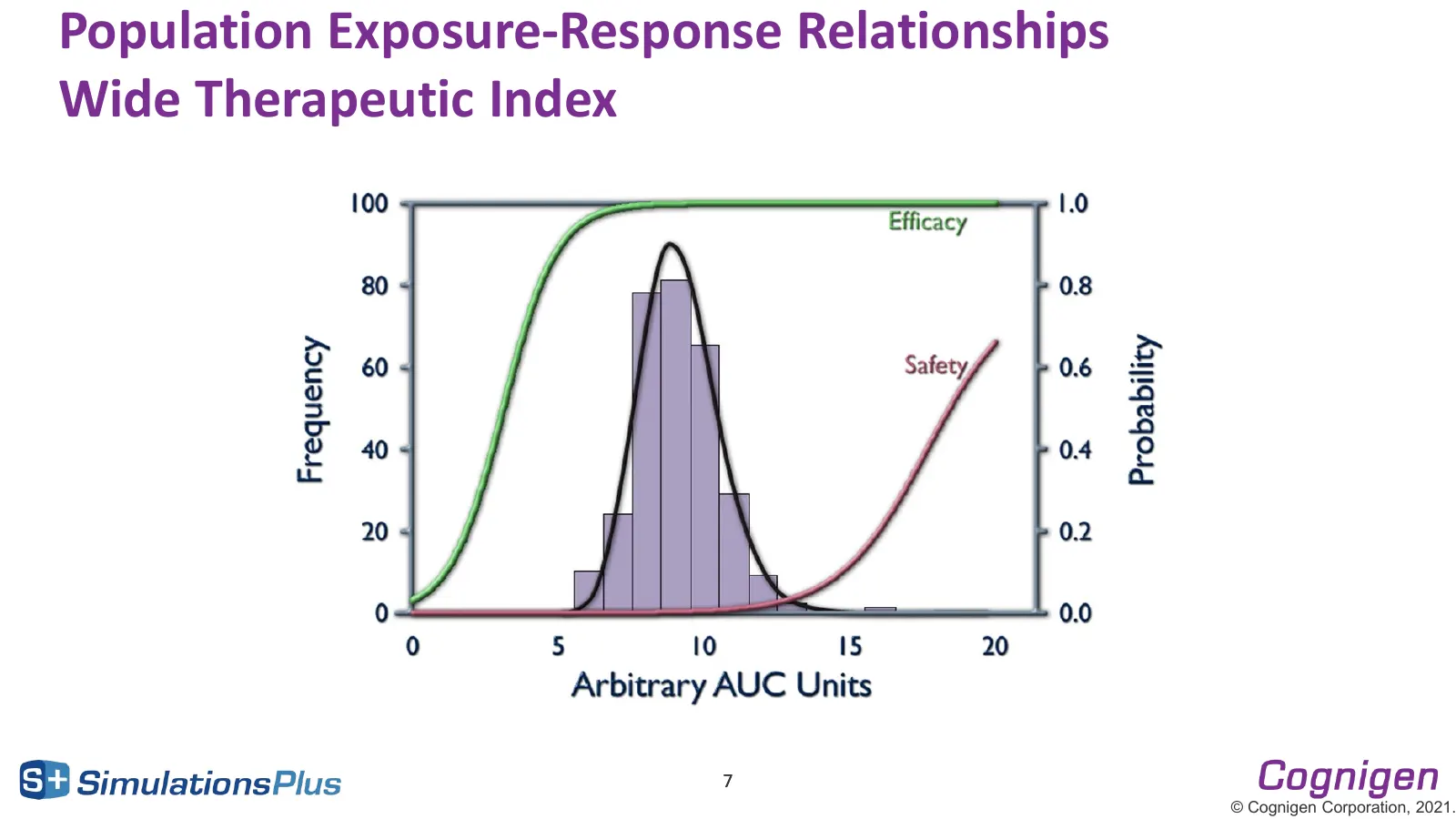
Population Exposure-Response Relationships Wide Therapeutic Index 7 © Cognigen Corporation, 2021.
Slide 8: Impact of PK Variability on Therapeutic Index
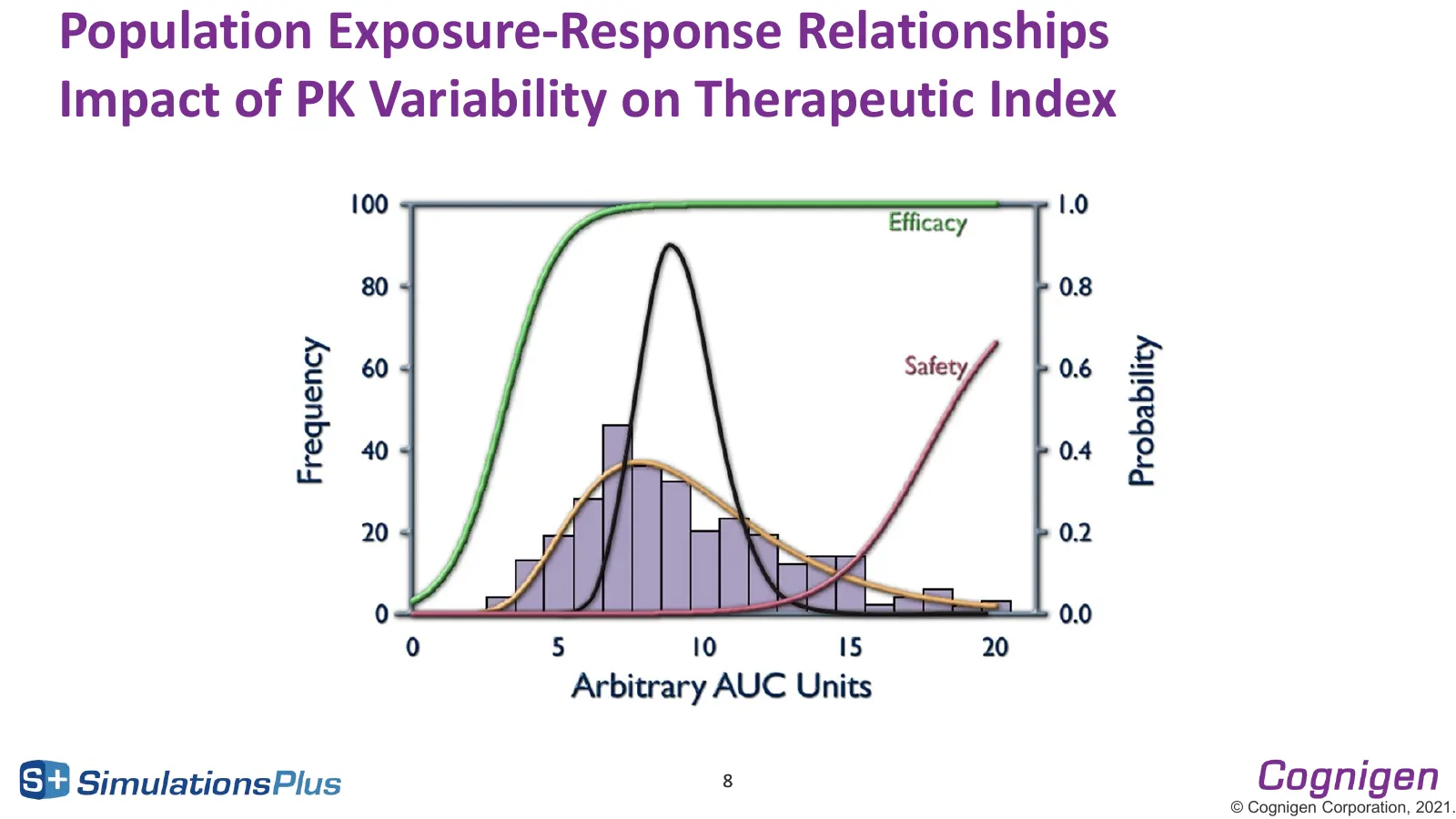
Population Exposure-Response Relationships Impact of PK Variability on Therapeutic Index 8 © Cognigen Corporation, 2021.
Slide 9: Value of Exposure-Response Analysis
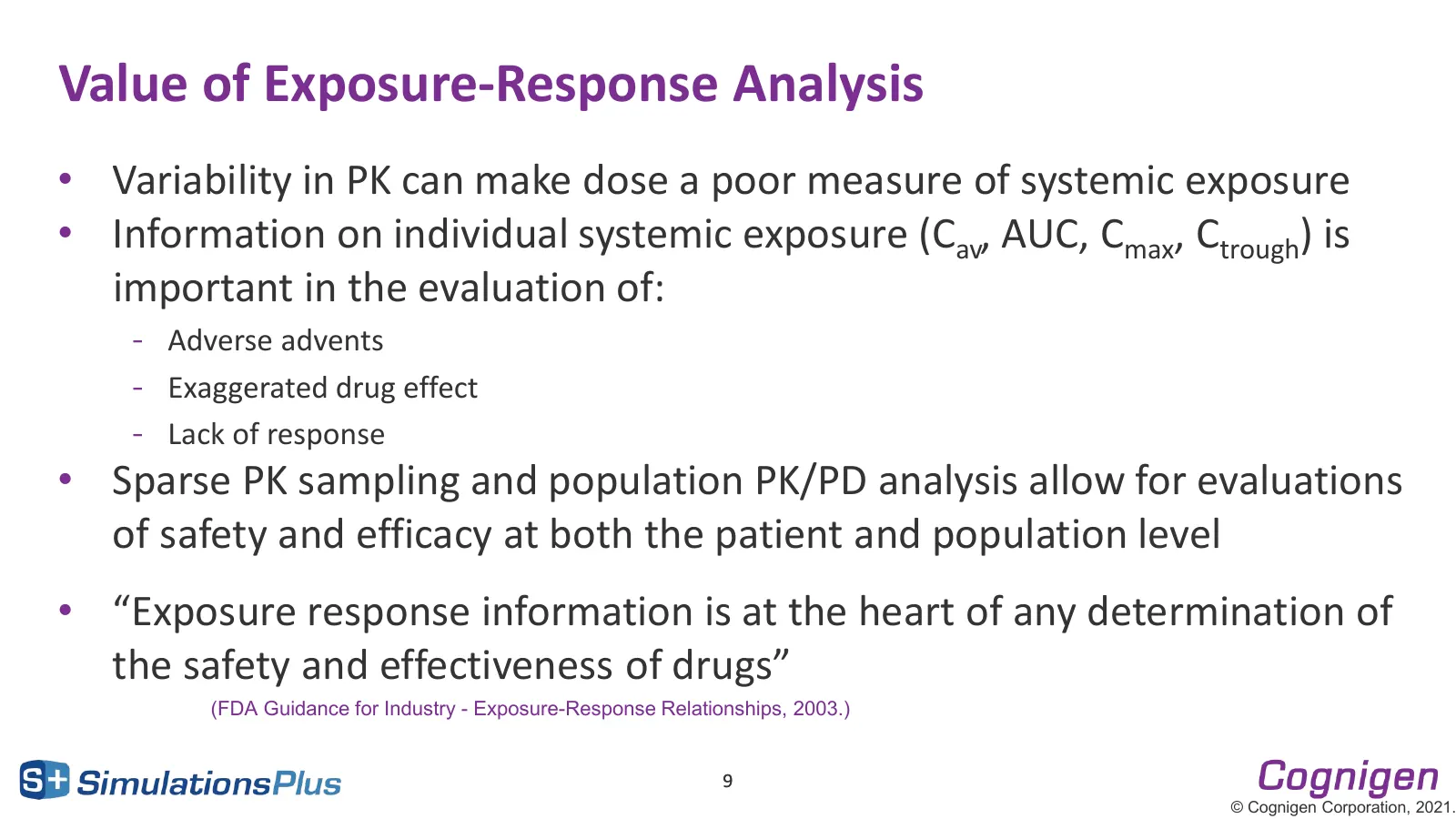
Value of Exposure-Response Analysis • Variability in PK can make dose a poor measure of systemic exposure • Information on individual systemic exposure (Cav, AUC, Cmax, Ctrough) is important in the evaluation of: - Adverse advents - Exaggerated drug effect - Lack of response • Sparse PK sampling and
Slide 10: Applications of Exposure-Response Analyses
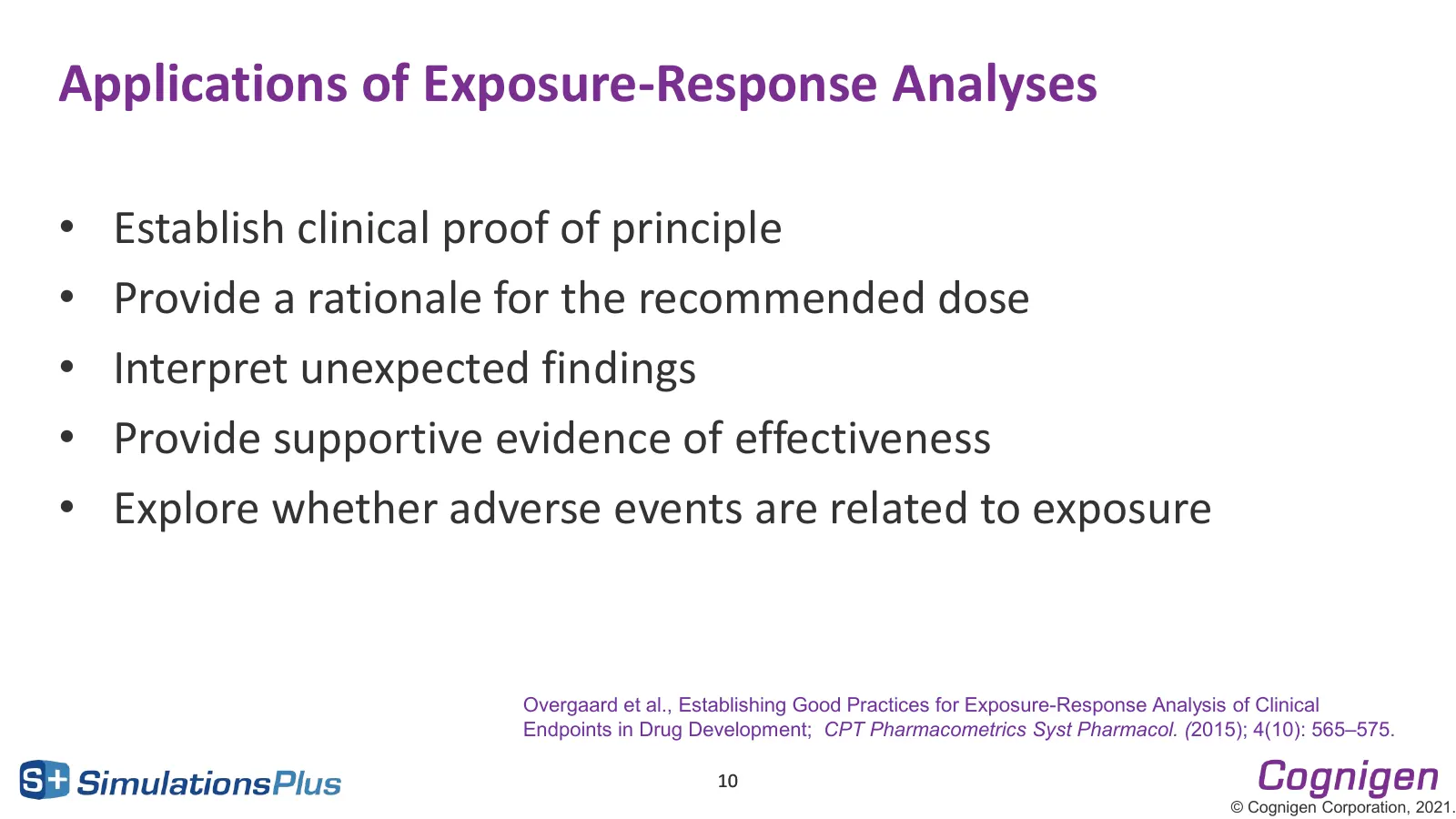
Applications of Exposure-Response Analyses • Establish clinical proof of principle • Provide a rationale for the recommended dose • Interpret unexpected findings • Provide supportive evidence of effectiveness • Explore whether adverse events are related to exposure Overgaard et al., Establishing Goo
Slide 11: Importance of Pharmacometric Analyses in Regulatory Decision Making
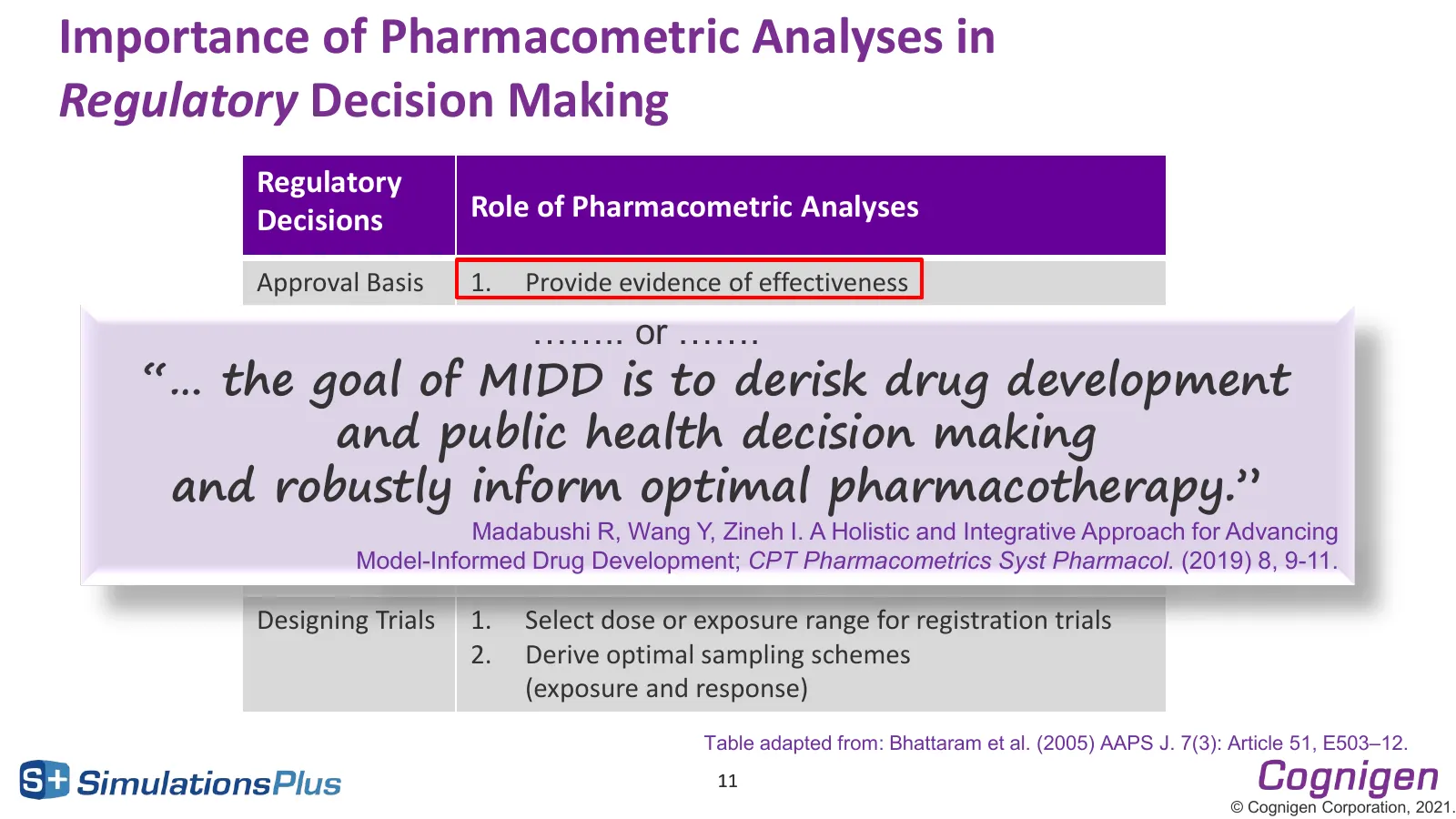
Importance of Pharmacometric Analyses in Regulatory Decision Making Regulatory Decisions Role of Pharmacometric Analyses Approval Basis 1. Provide evidence of effectiveness 2. Assess benefit-risk …….. or ……. “… the goal of 1.MIDD Labelling is to derisk drug development Formulate dosing instructions
Slide 12: Alternative Pharmacometric Approaches: Overlap & Differences in Applications
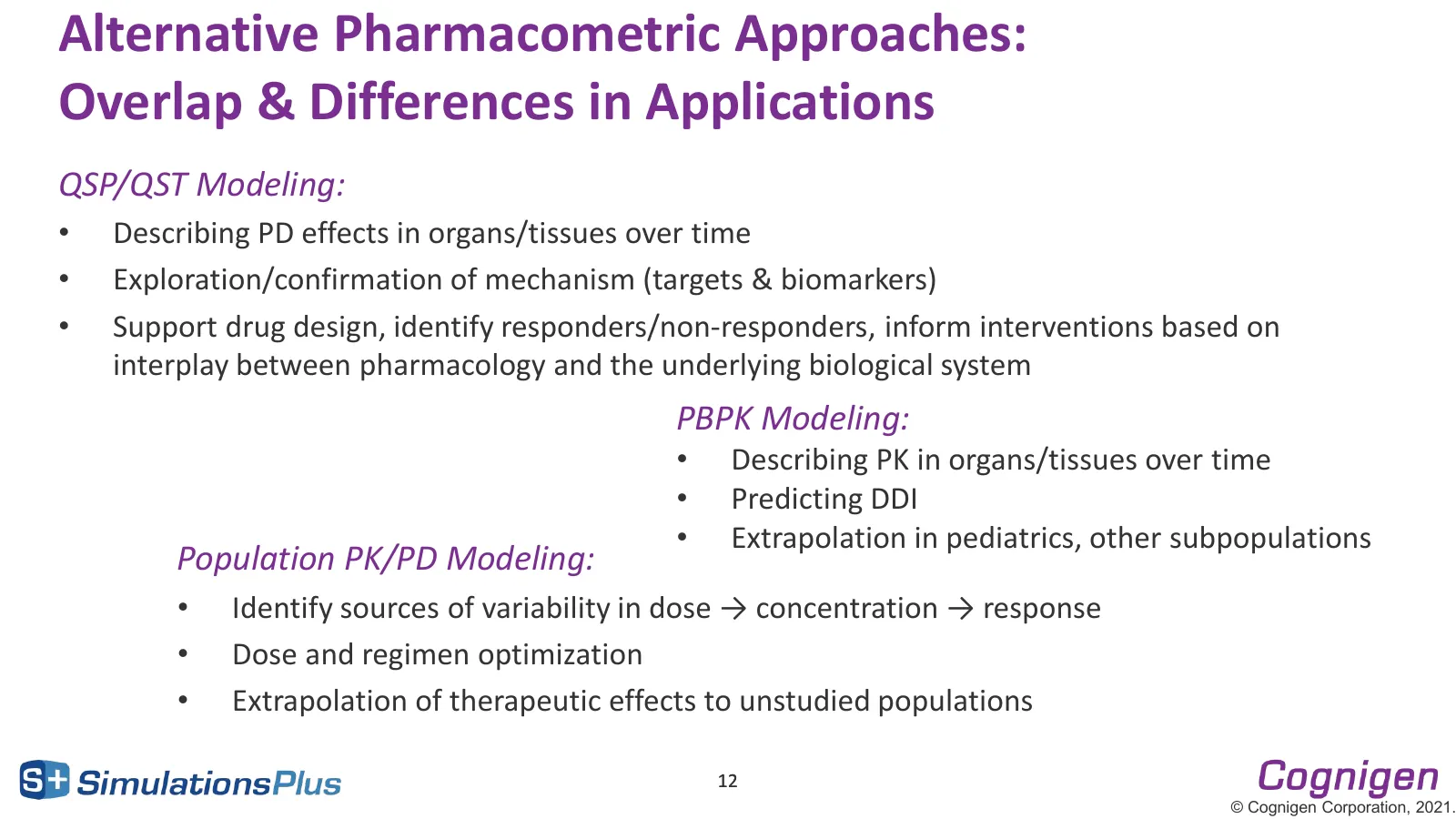
Alternative Pharmacometric Approaches: Overlap & Differences in Applications QSP/QST Modeling: • Describing PD effects in organs/tissues over time • Exploration/confirmation of mechanism (targets & biomarkers) • Support drug design, identify responders/non-responders, inform interventions based on i
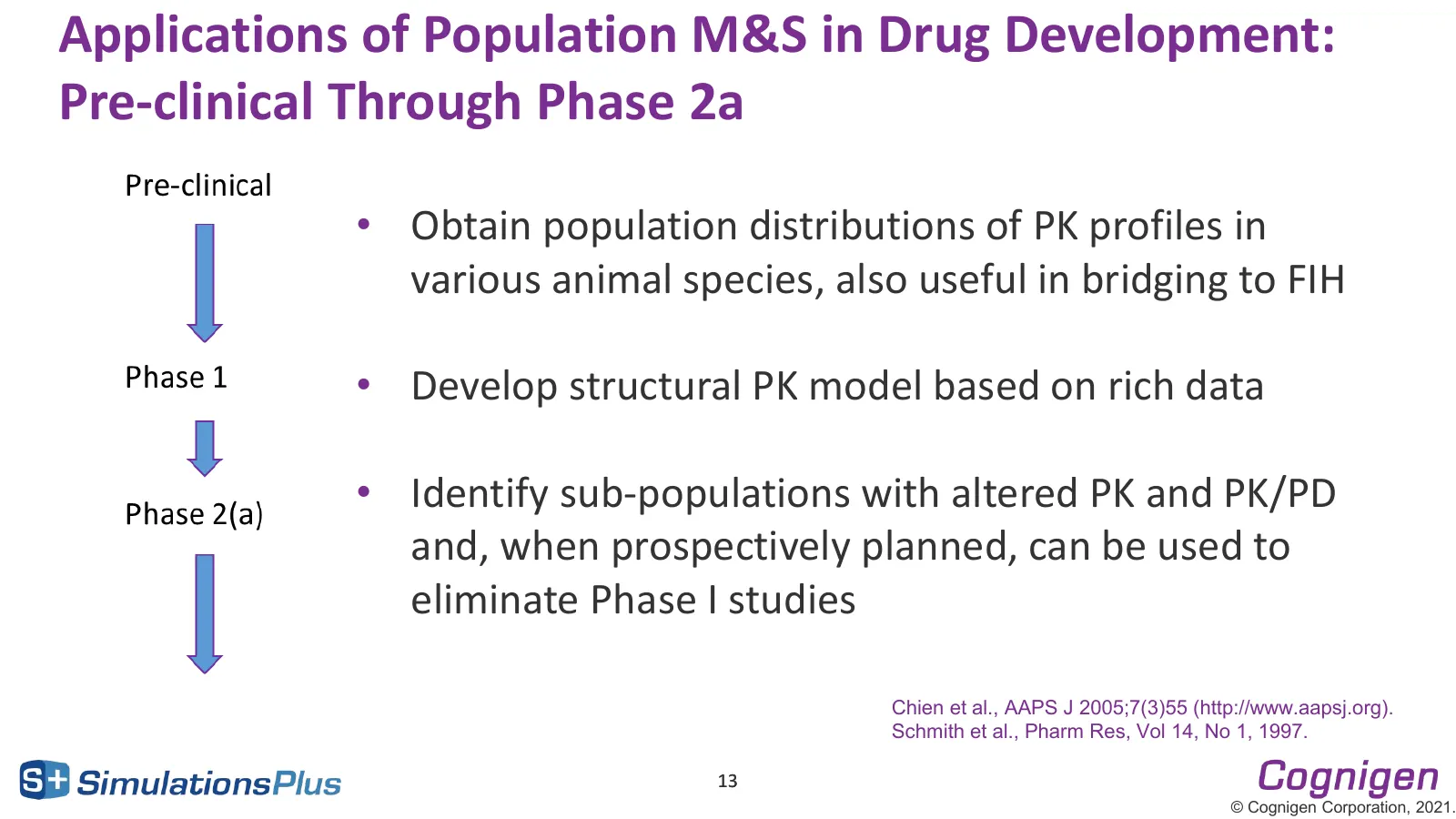
Slide 13: Applications of Population M&S: Pre-clinical Through Phase 2a
Applications of Population M&S in Drug Development: Pre-clinical Through Phase 2a • Obtain population distributions of PK profiles in various animal species, also useful in bridging to FIH • Develop structural PK model based on rich data • Identify sub-populations with altered PK and PK/PD and, when
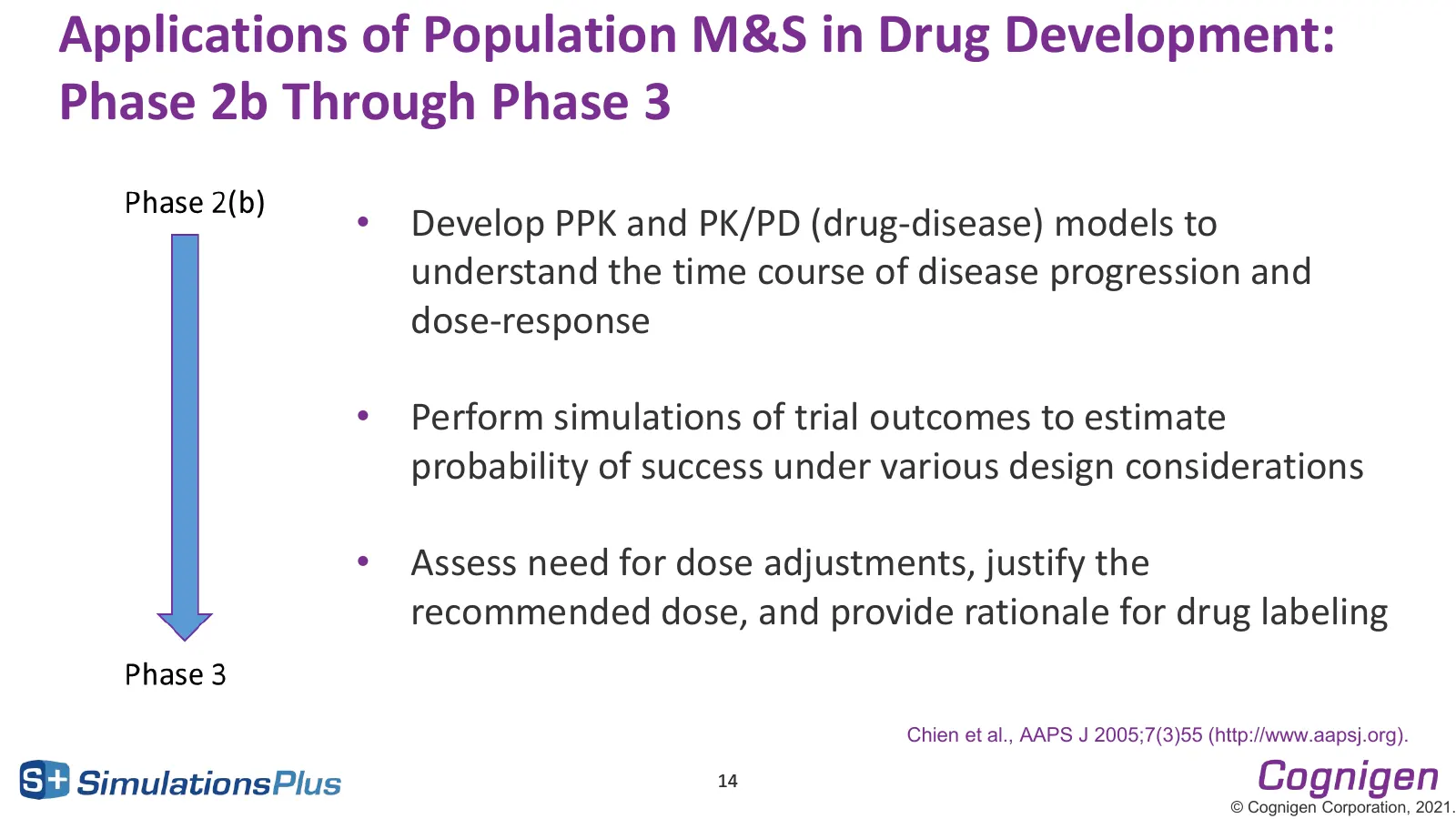
Slide 14: Applications of Population M&S: Phase 2b Through Phase 3
Applications of Population M&S in Drug Development: Phase 2b Through Phase 3 • Develop PPK and PK/PD (drug-disease) models to understand the time course of disease progression and dose-response • Perform simulations of trial outcomes to estimate probability of success under various design considerat
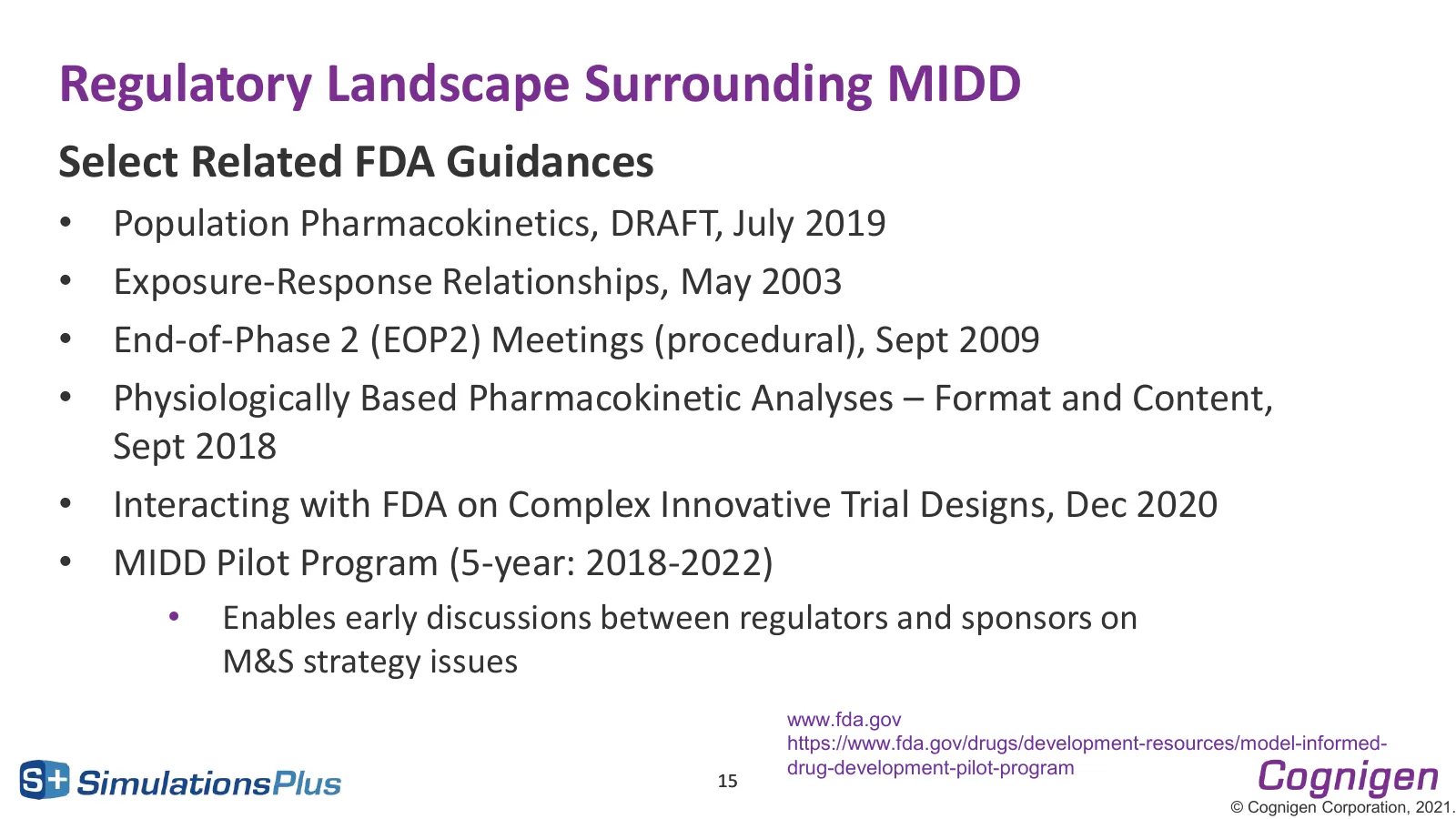
Slide 15: Regulatory Landscape Surrounding MIDD
Regulatory Landscape Surrounding MIDD Select Related FDA Guidances • Population Pharmacokinetics, DRAFT, July 2019 • Exposure-Response Relationships, May 2003 • End-of-Phase 2 (EOP2) Meetings (procedural), Sept 2009 • Physiologically Based Pharmacokinetic Analyses – Format and Content, Sept 2018 • I
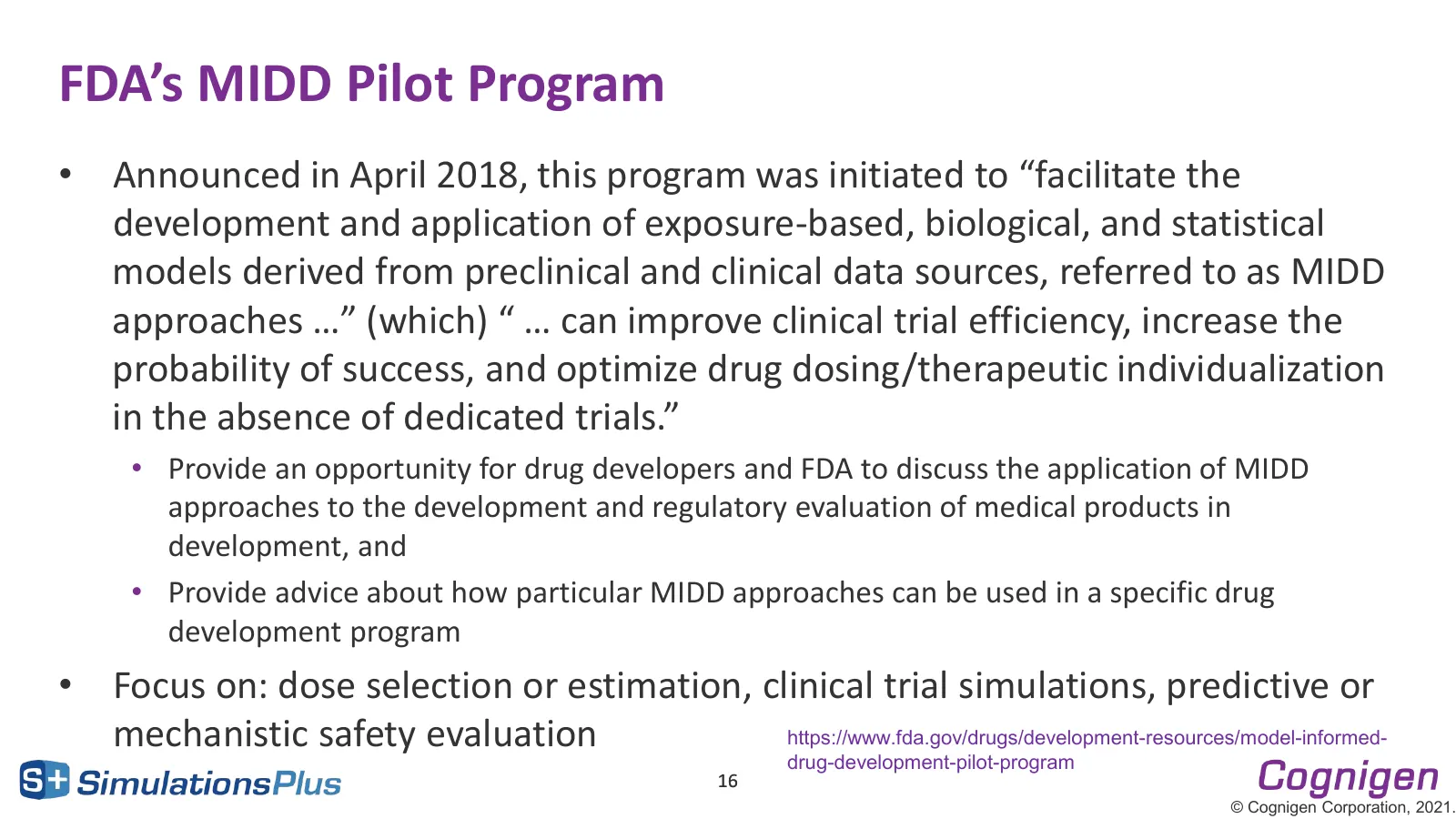
Slide 16: FDA's MIDD Pilot Program
FDA’s MIDD Pilot Program • Announced in April 2018, this program was initiated to “facilitate the development and application of exposure-based, biological, and statistical models derived from preclinical and clinical data sources, referred to as MIDD approaches …” (which) “ … can improve clinical t
Slide 17: FDA Question-based Review (QbR)
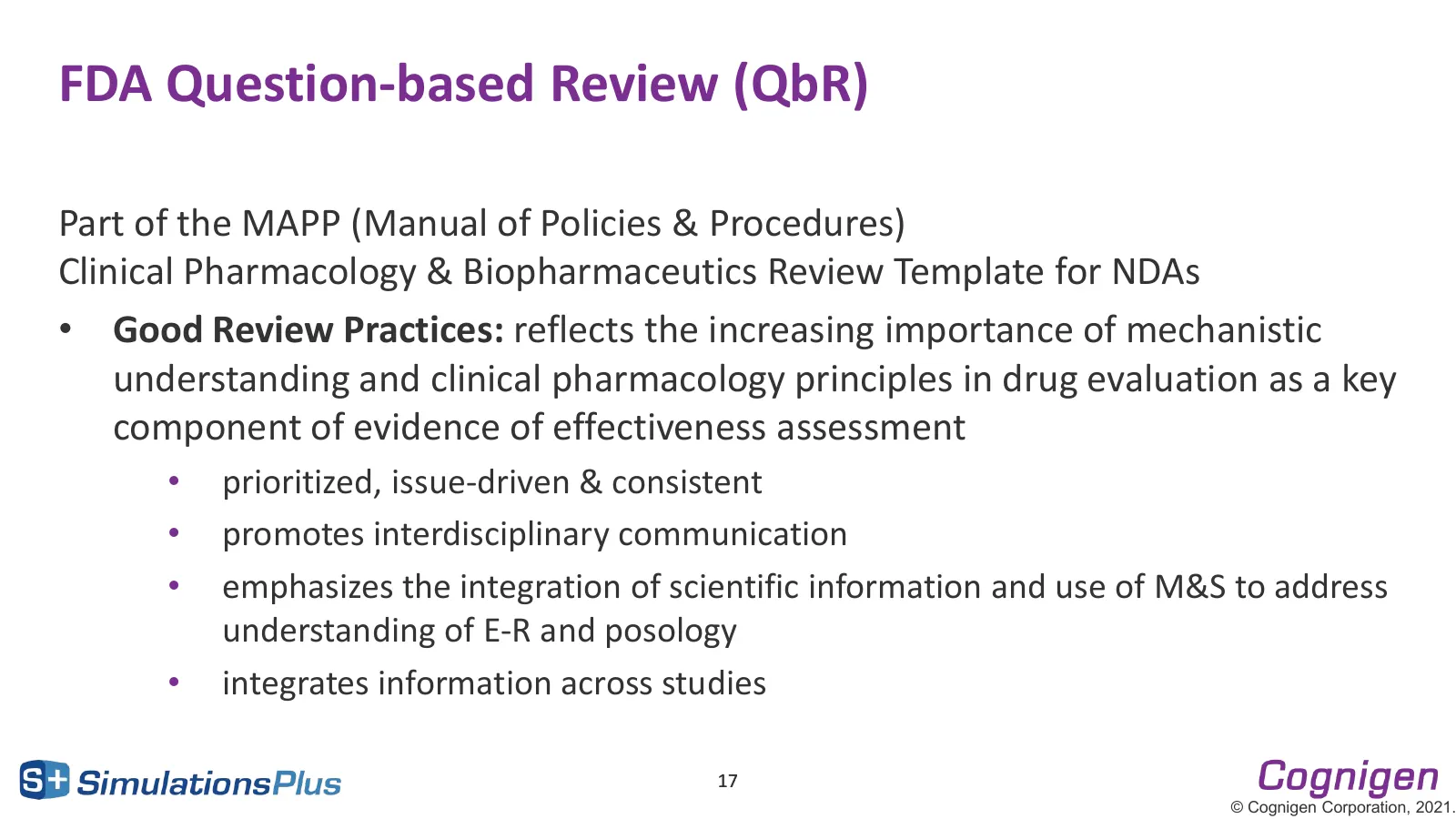
FDA Question-based Review (QbR) Part of the MAPP (Manual of Policies & Procedures) Clinical Pharmacology & Biopharmaceutics Review Template for NDAs • Good Review Practices: reflects the increasing importance of mechanistic understanding and clinical pharmacology principles in drug evaluation as a k
Slide 18: High-Level Clinical Pharmacology Review Questions
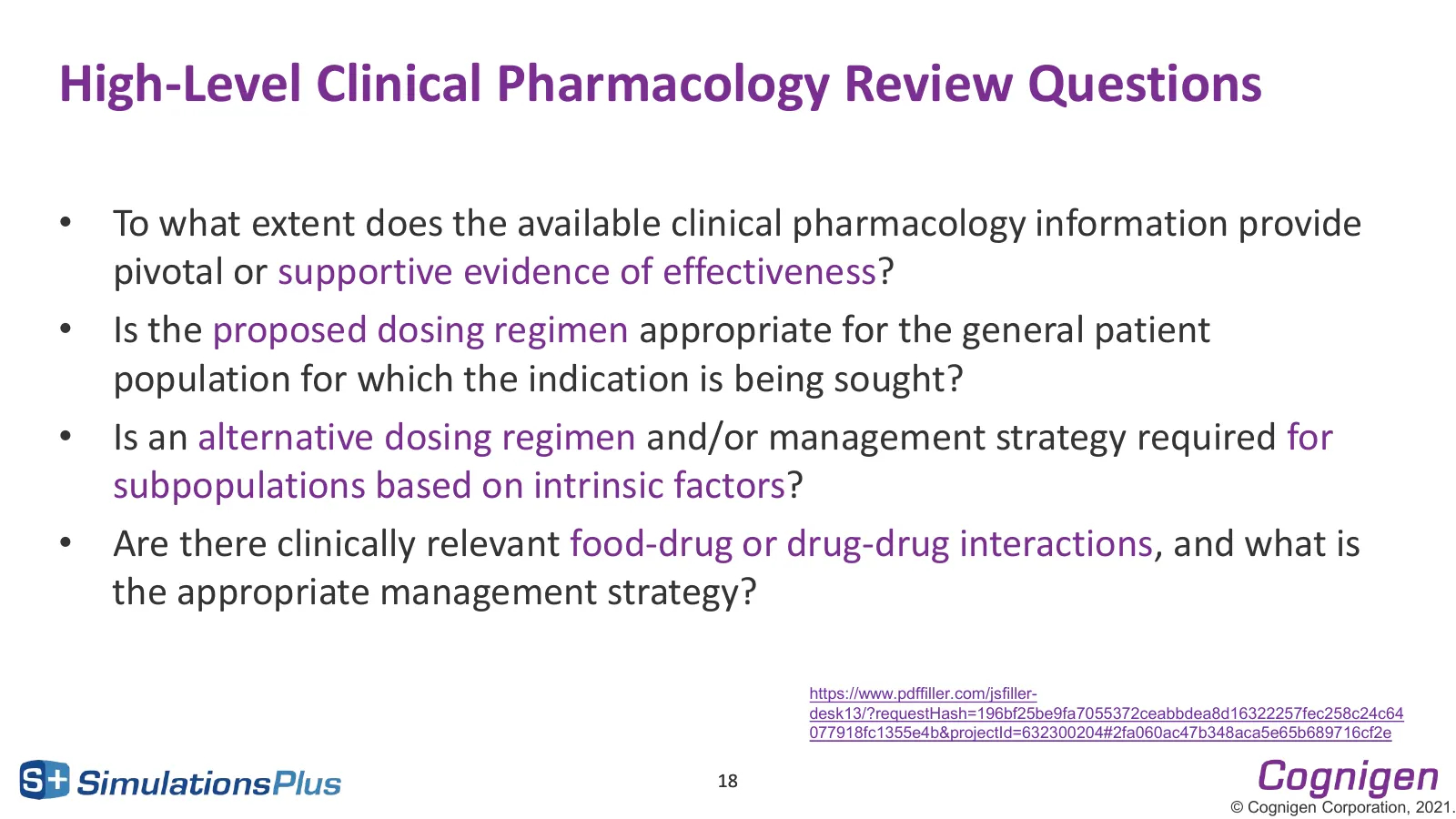
High-Level Clinical Pharmacology Review Questions • To what extent does the available clinical pharmacology information provide pivotal or supportive evidence of effectiveness? • Is the proposed dosing regimen appropriate for the general patient population for which the indication is being sought? •
Slide 19: FDA Question-based Review Contents
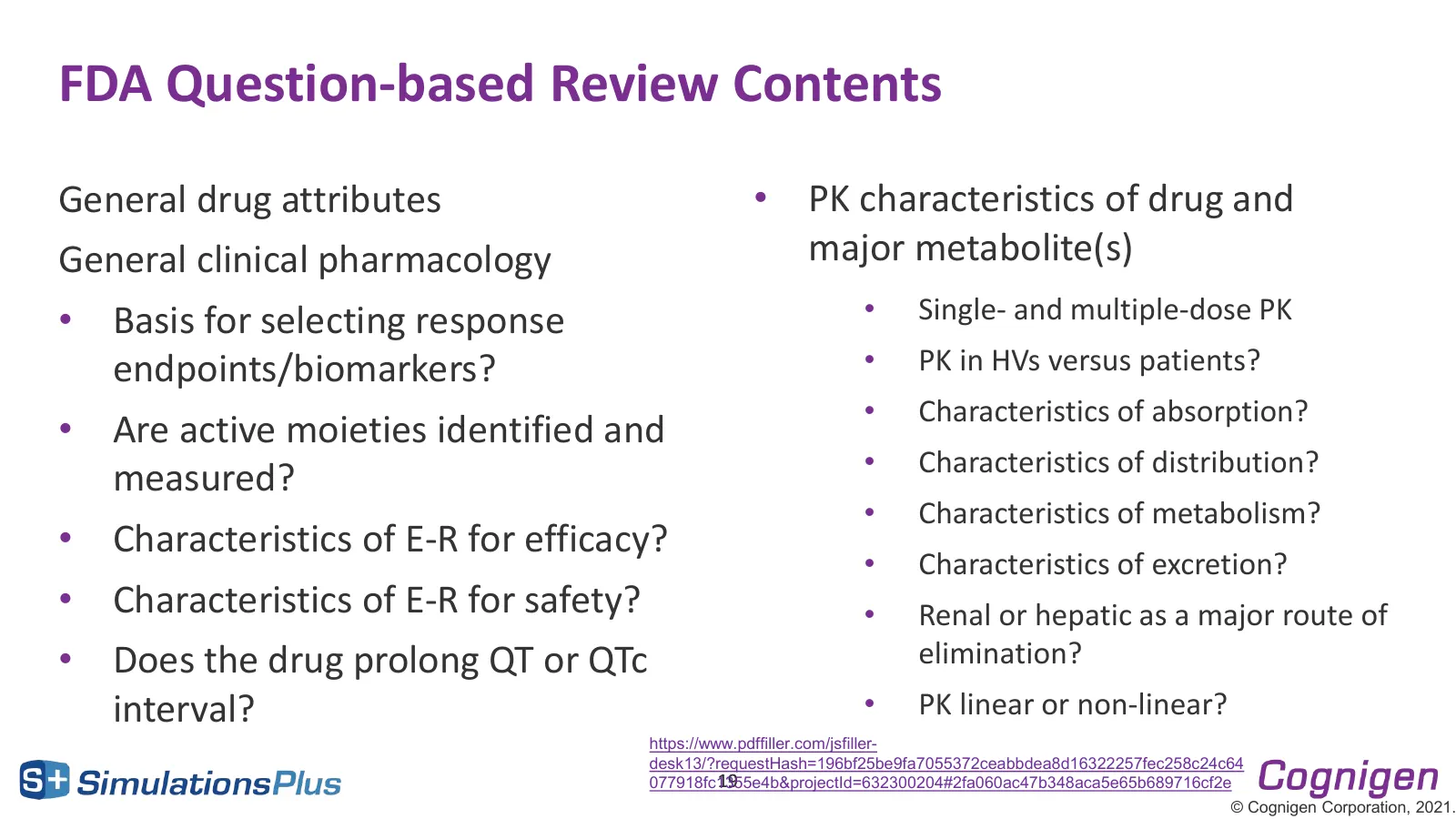
FDA Question-based Review Contents General drug attributes • PK characteristics of drug and General clinical pharmacology major metabolite(s) • Basis for selecting response • Single- and multiple-dose PK endpoints/biomarkers? • PK in HVs versus patients? • Characteristics of absorption? • Are active
Slide 20: FDA Question-based Review Contents (continued)
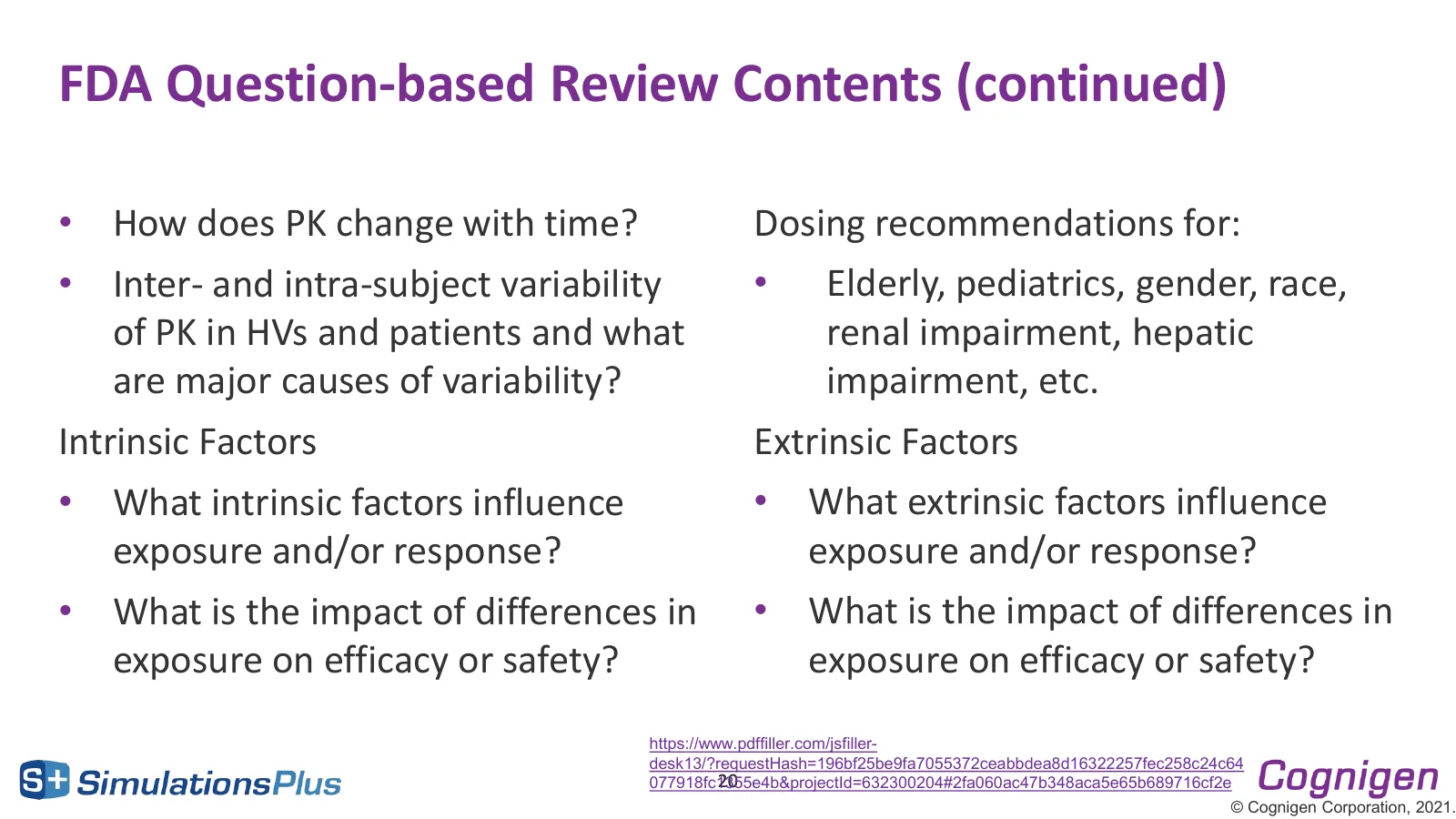
FDA Question-based Review Contents (continued) • How does PK change with time? Dosing recommendations for: • Inter- and intra-subject variability • Elderly, pediatrics, gender, race, of PK in HVs and patients and what renal impairment, hepatic are major causes of variability? impairment, etc. Intrin
Slide 21: FDA Question-based Review Contents (continued)
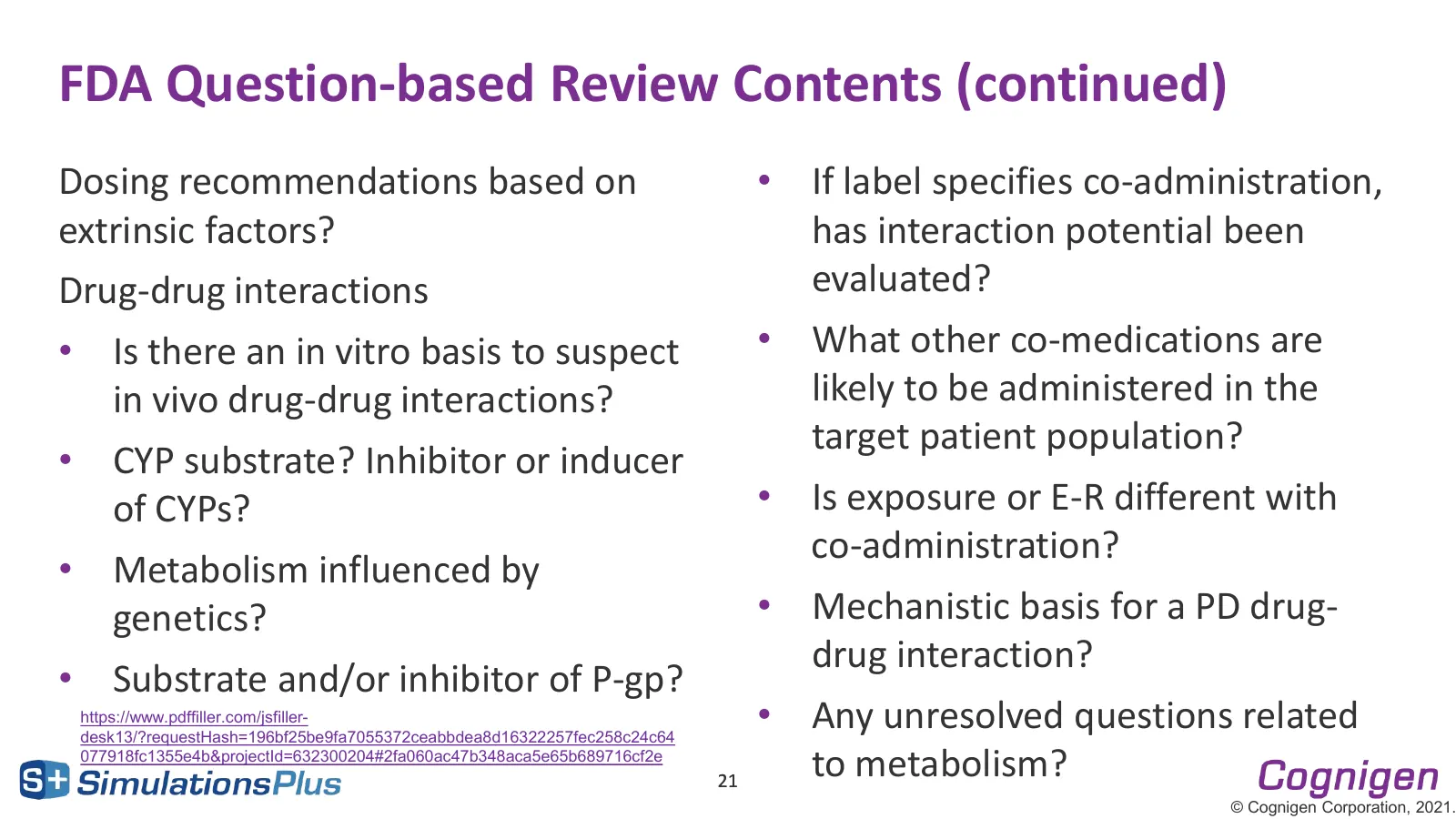
FDA Question-based Review Contents (continued) Dosing recommendations based on • If label specifies co-administration, extrinsic factors? has interaction potential been Drug-drug interactions evaluated? • Is there an in vitro basis to suspect • What other co-medications are in vivo drug-drug interac
Slide 22: Regulatory Landscape Surrounding MIDD: EMA
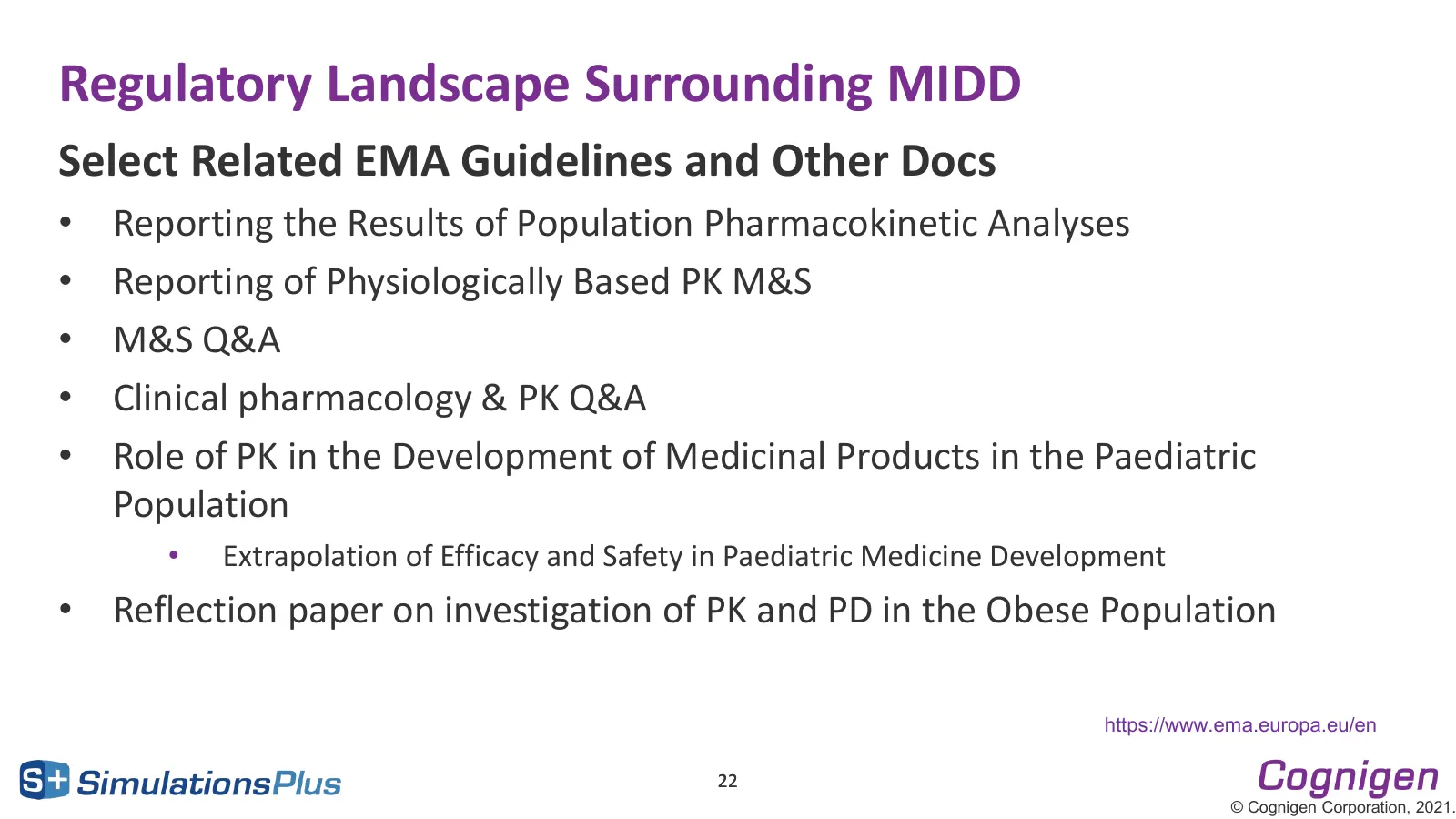
Regulatory Landscape Surrounding MIDD Select Related EMA Guidelines and Other Docs • Reporting the Results of Population Pharmacokinetic Analyses • Reporting of Physiologically Based PK M&S • M&S Q&A • Clinical pharmacology & PK Q&A • Role of PK in the Development of Medicinal Products in the Paedia
Slide 23: Global Harmonisation Efforts ... EMA/FDA
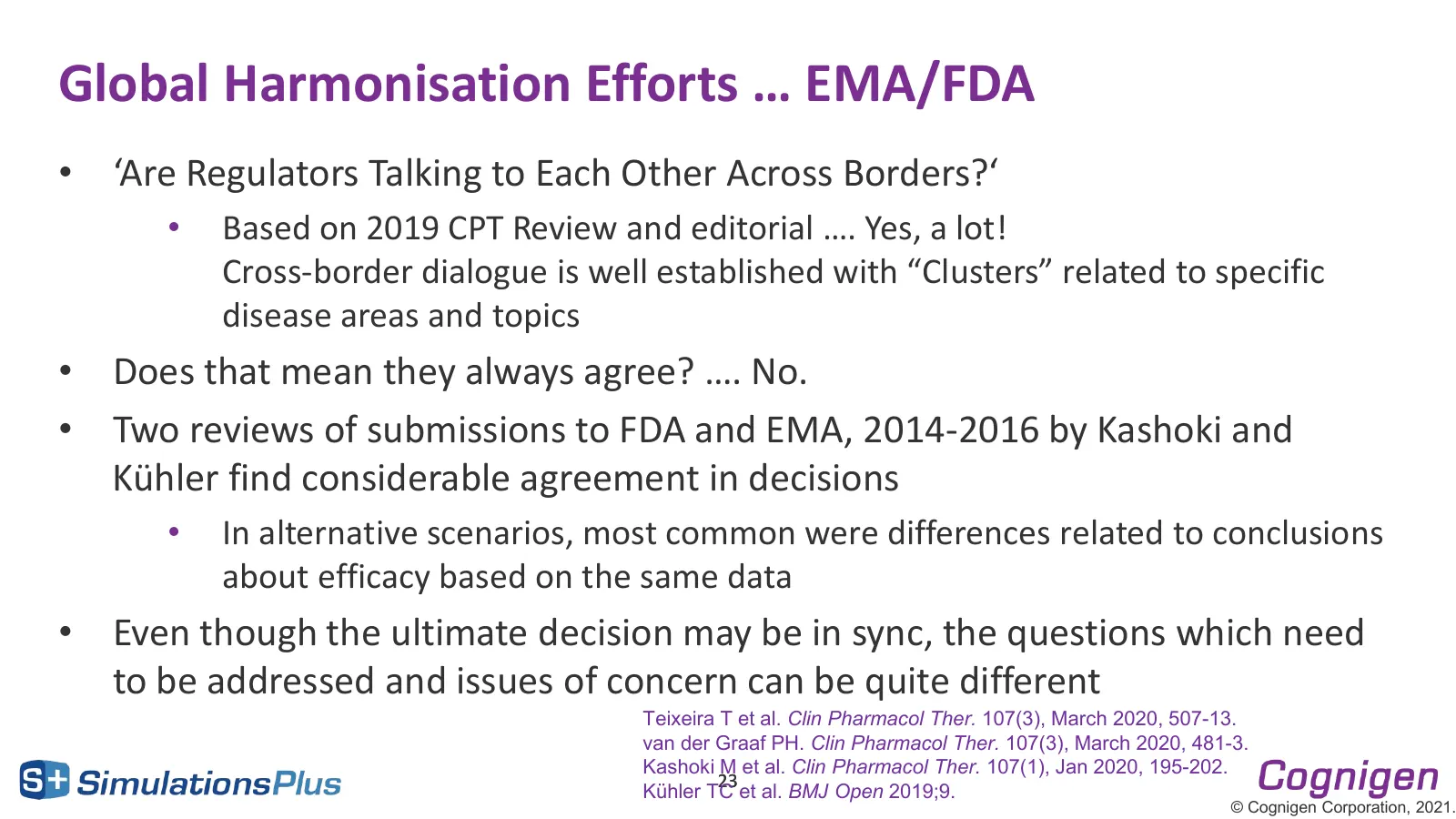
Global Harmonisation Efforts … EMA/FDA • ‘Are Regulators Talking to Each Other Across Borders?‘ • Based on 2019 CPT Review and editorial …. Yes, a lot! Cross-border dialogue is well established with “Clusters” related to specific disease areas and topics • Does that mean they always agree? …. No. •
Slide 24: Predict → Learn → Confirm
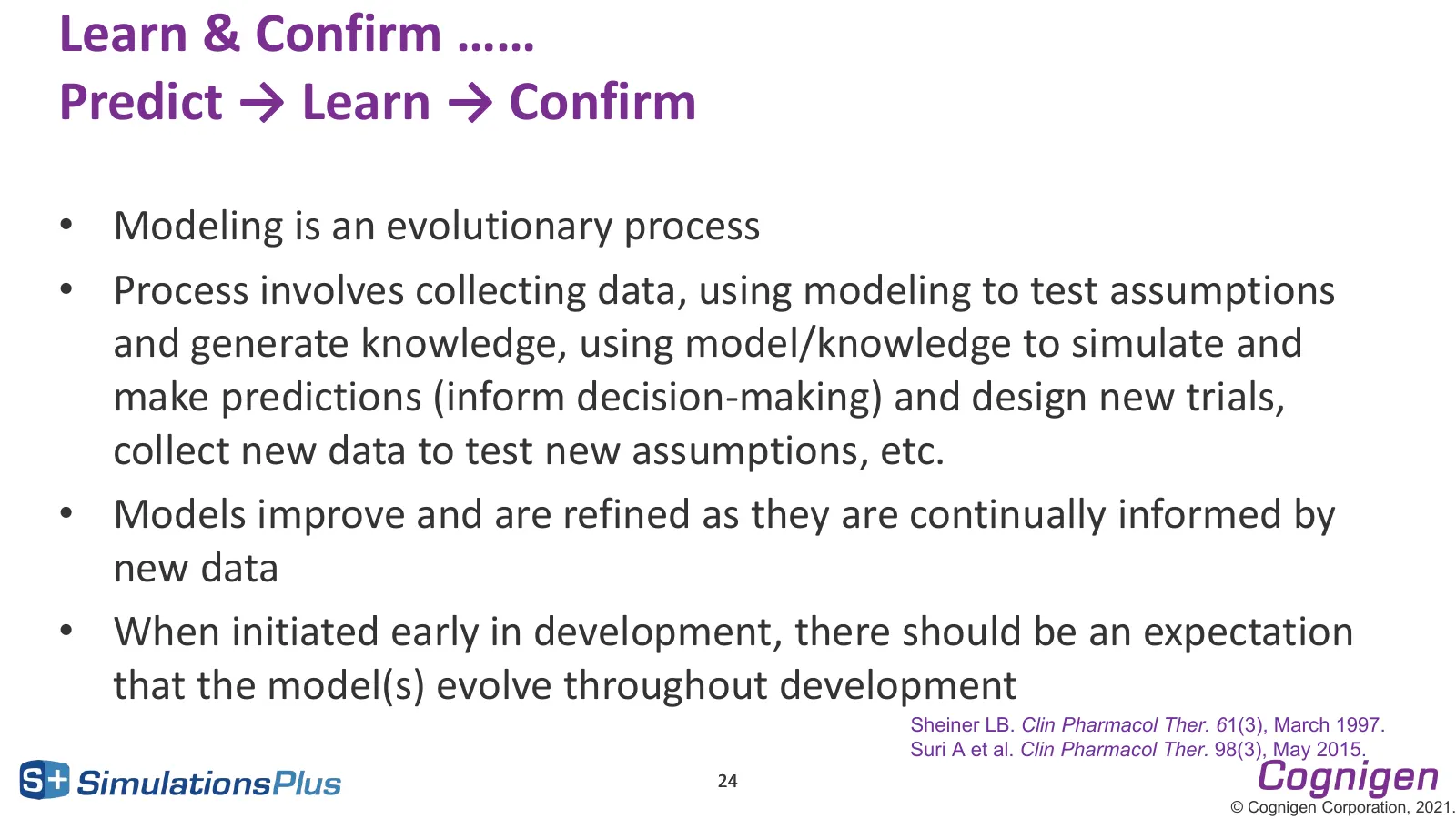
Learn & Confirm …… Predict → Learn → Confirm • Modeling is an evolutionary process • Process involves collecting data, using modeling to test assumptions and generate knowledge, using model/knowledge to simulate and make predictions (inform decision-making) and design new trials, collect new data to
Slide 25: Example PPK/PD Model-Informed Development Program
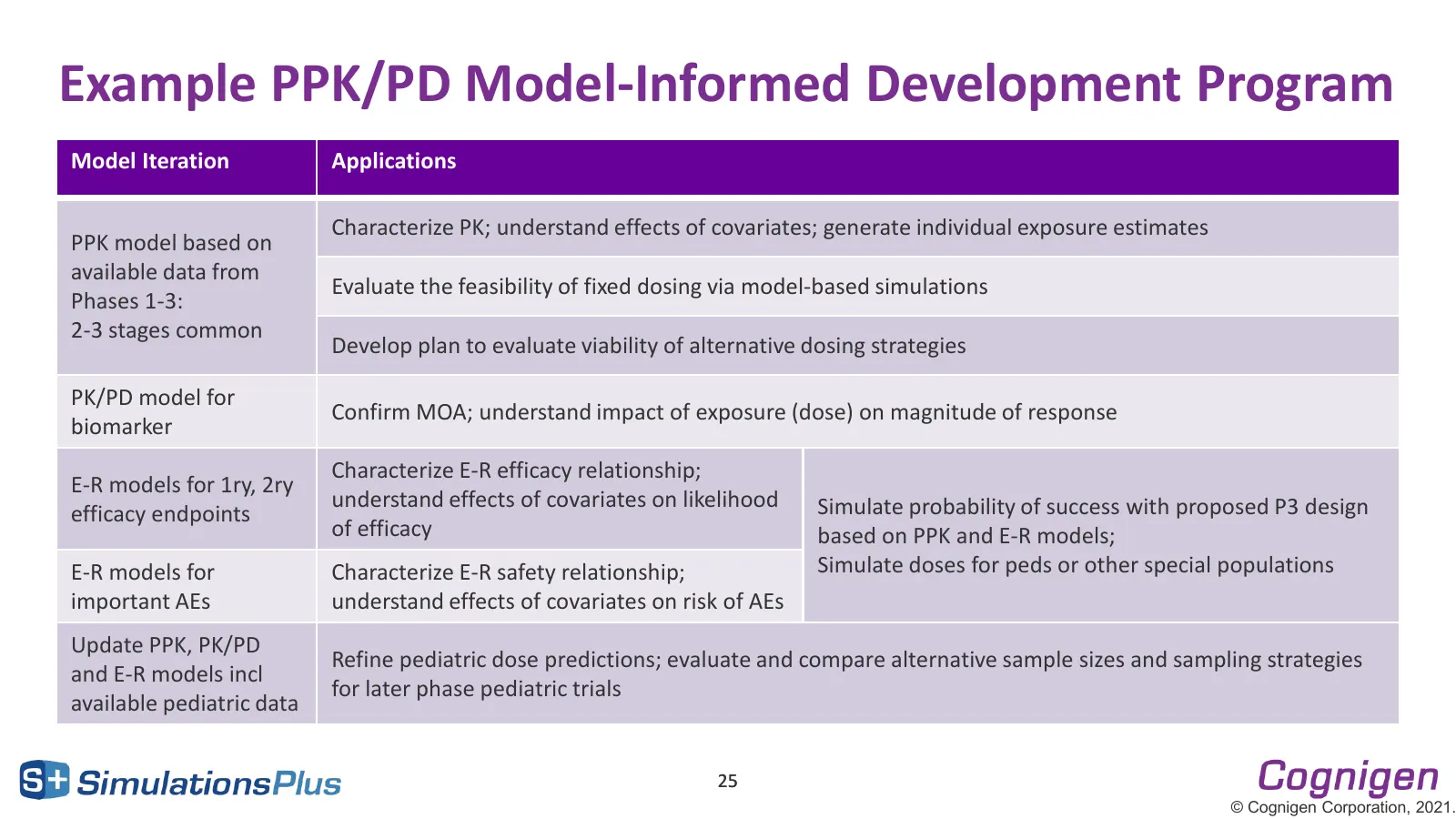
Example PPK/PD Model-Informed Development Program Model Iteration Applications Characterize PK; understand effects of covariates; generate individual exposure estimates PPK model based on available data from Evaluate the feasibility of fixed dosing via model-based simulations Phases 1-3: 2-3 stages
Slide 26: Exposure-Response Good Practices
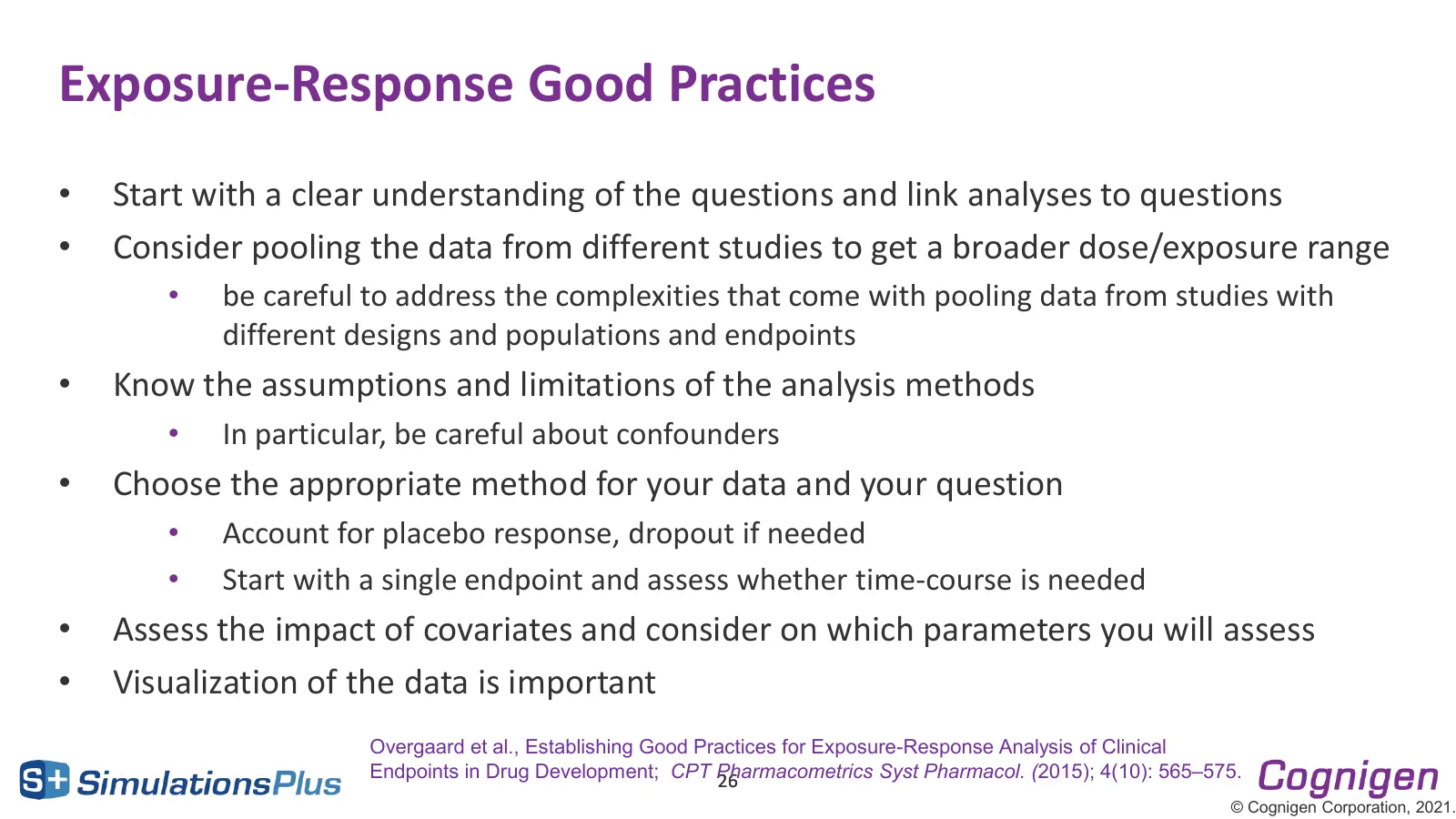
Exposure-Response Good Practices • Start with a clear understanding of the questions and link analyses to questions • Consider pooling the data from different studies to get a broader dose/exposure range • be careful to address the complexities that come with pooling data from studies with different
Slide 27: MID3 Good Practices
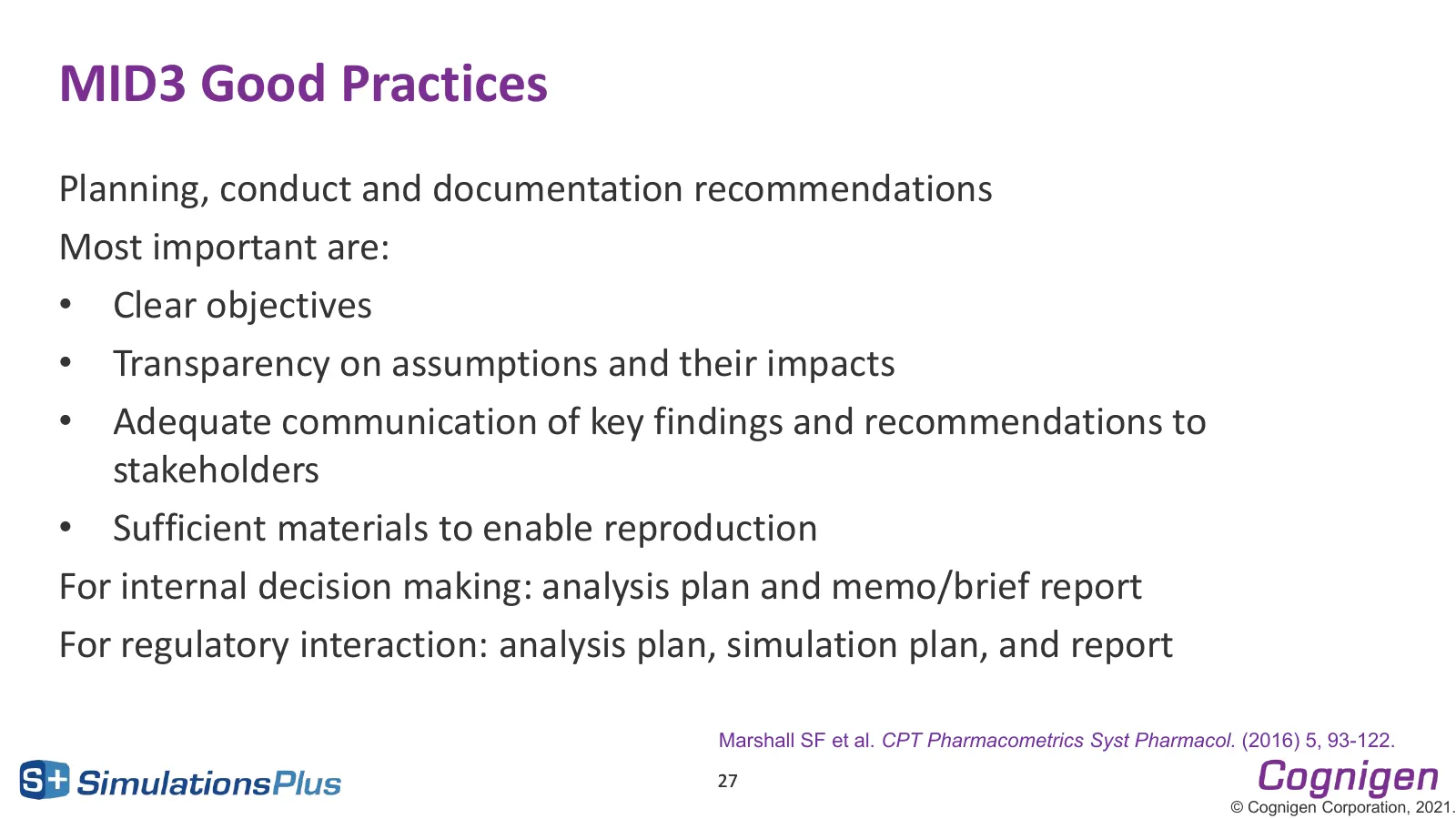
MID3 Good Practices Planning, conduct and documentation recommendations Most important are: • Clear objectives • Transparency on assumptions and their impacts • Adequate communication of key findings and recommendations to stakeholders • Sufficient materials to enable reproduction For internal decis
Slide 28: Survey Says ....
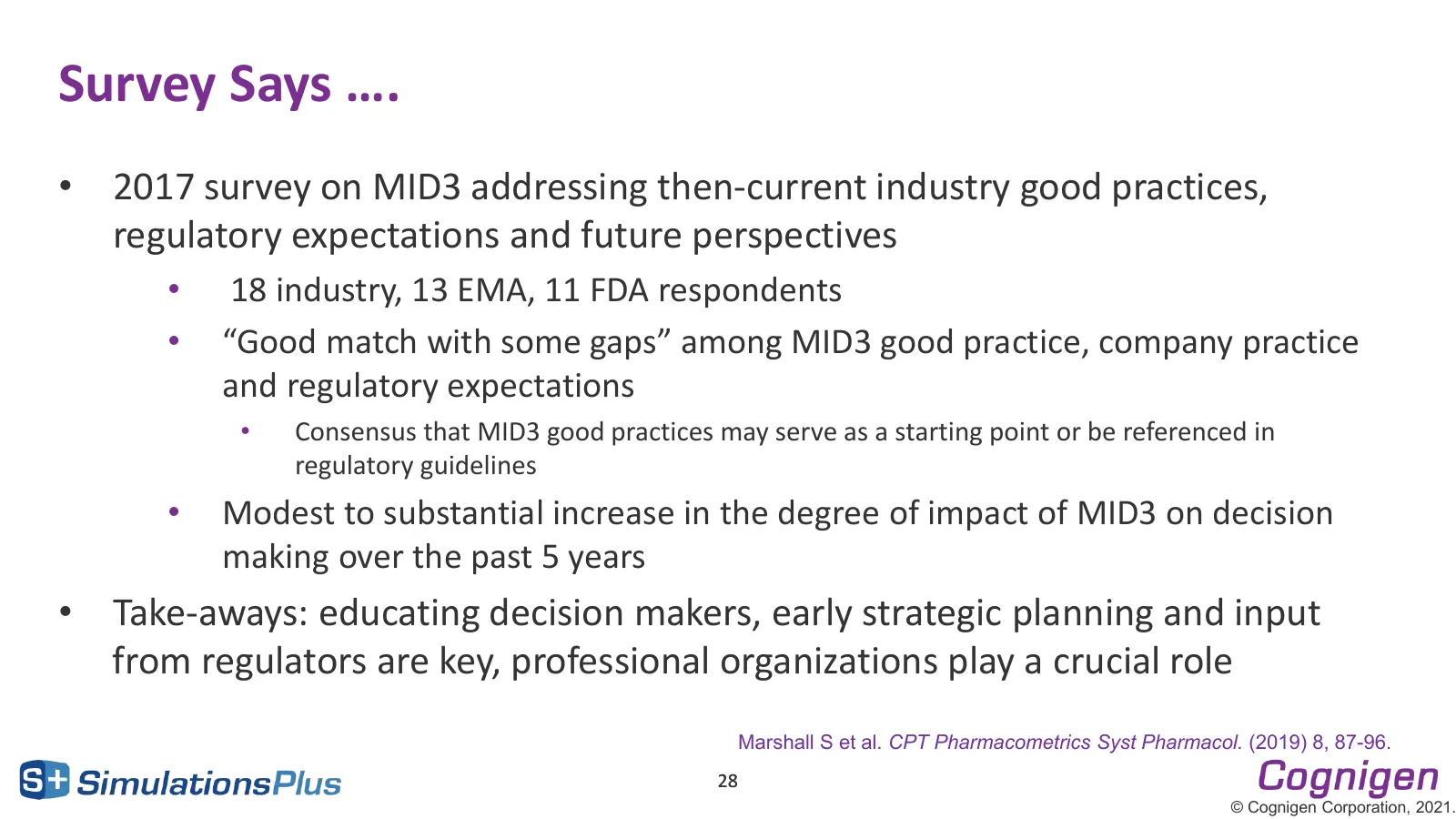
Survey Says …. • 2017 survey on MID3 addressing then-current industry good practices, regulatory expectations and future perspectives • 18 industry, 13 EMA, 11 FDA respondents • “Good match with some gaps” among MID3 good practice, company practice and regulatory expectations • Consensus that MID3 g
Slide 29: Essential Components to Successfully Navigating Regulatory Hurdles with MIDD
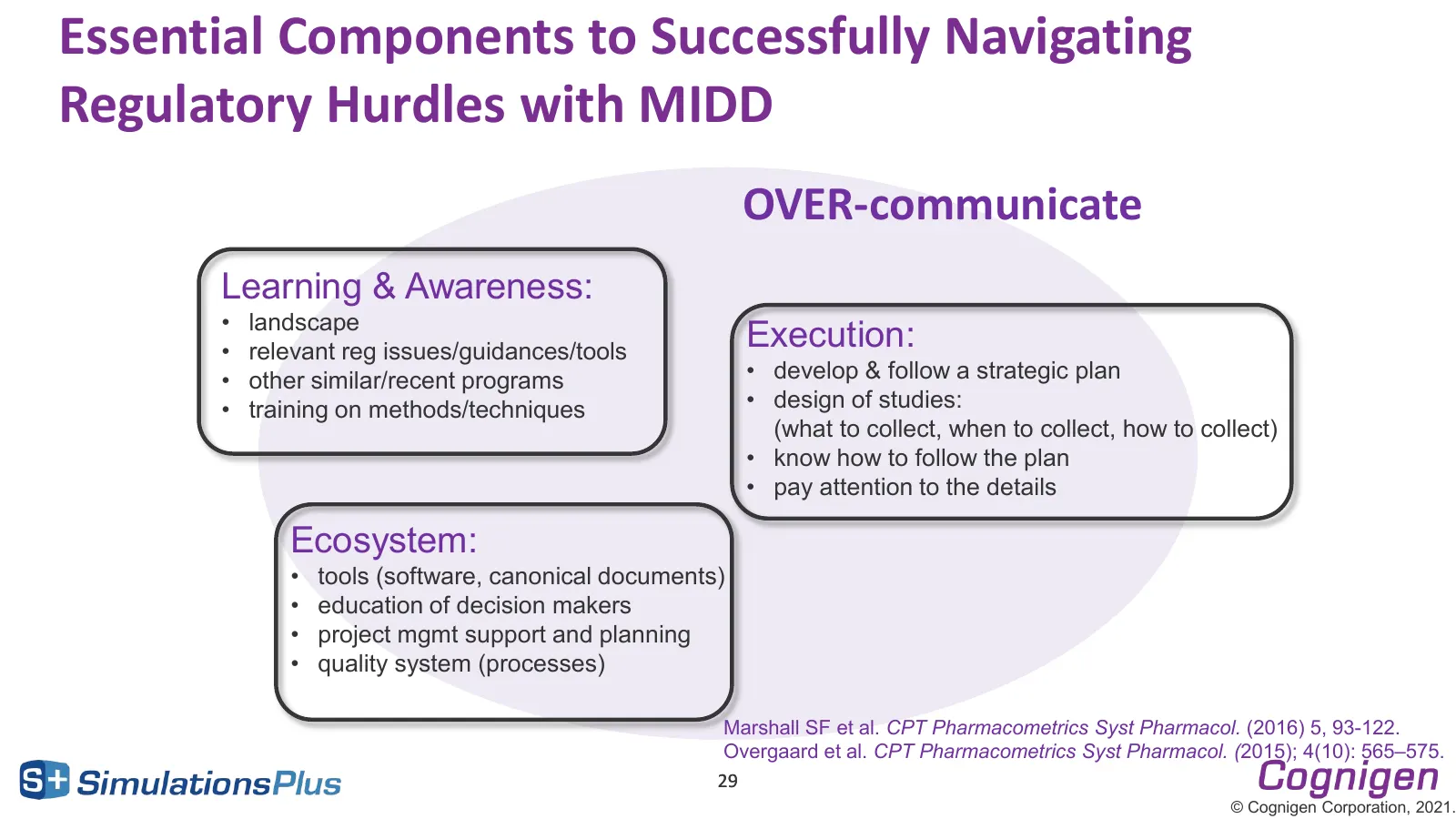
Essential Components to Successfully Navigating Regulatory Hurdles with MIDD OVER-communicate Learning & Awareness: • landscape • relevant reg issues/guidances/tools Execution: • other similar/recent programs • develop & follow a strategic plan • training on methods/techniques • design of studies: (
Slide 30: Recommended Analysis (Simulation) Plan Content
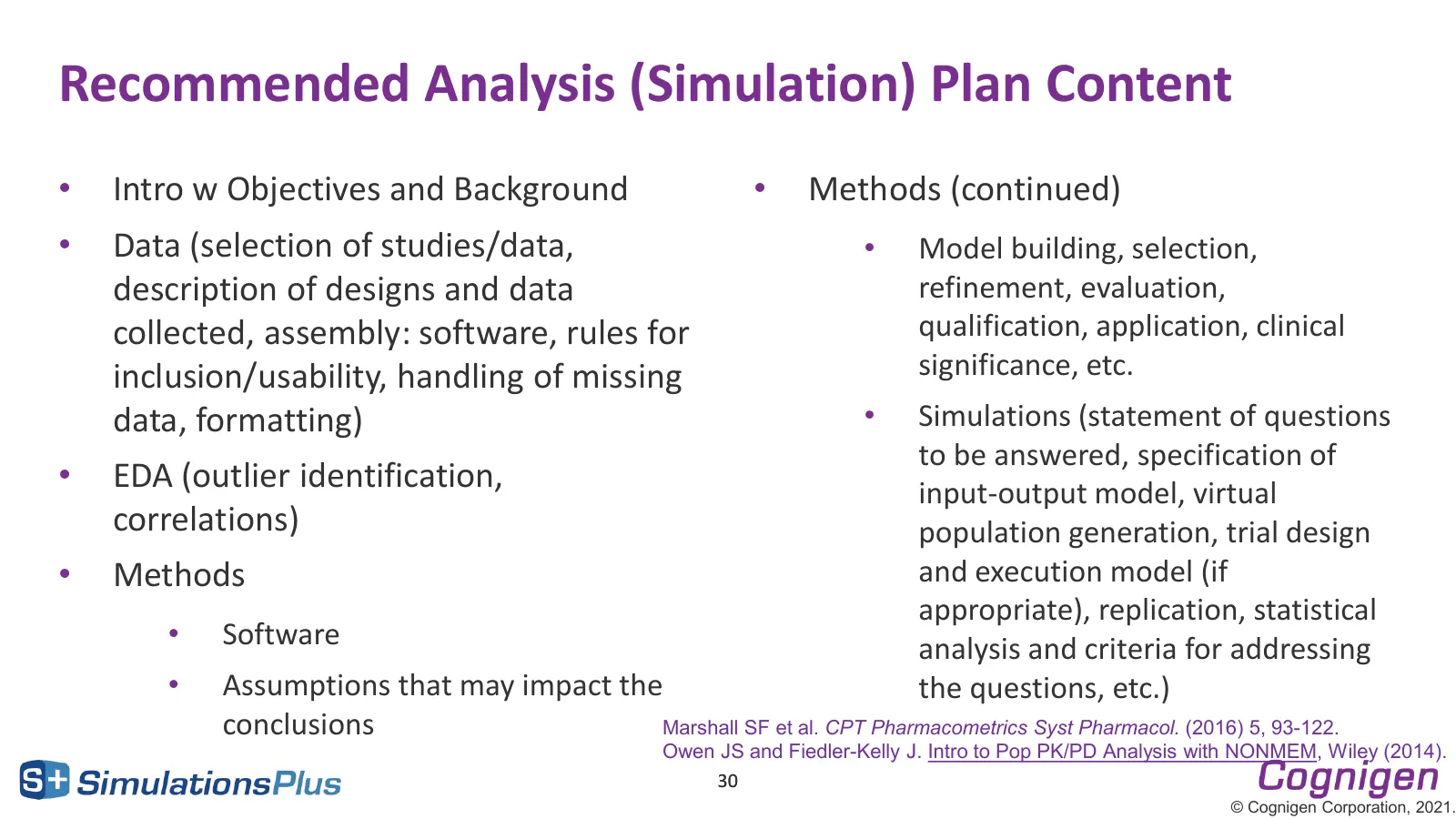
Recommended Analysis (Simulation) Plan Content • Intro w Objectives and Background • Methods (continued) • Data (selection of studies/data, • Model building, selection, description of designs and data refinement, evaluation, collected, assembly: software, rules for qualification, application, clinic
Slide 31: Reporting: Tell the Story
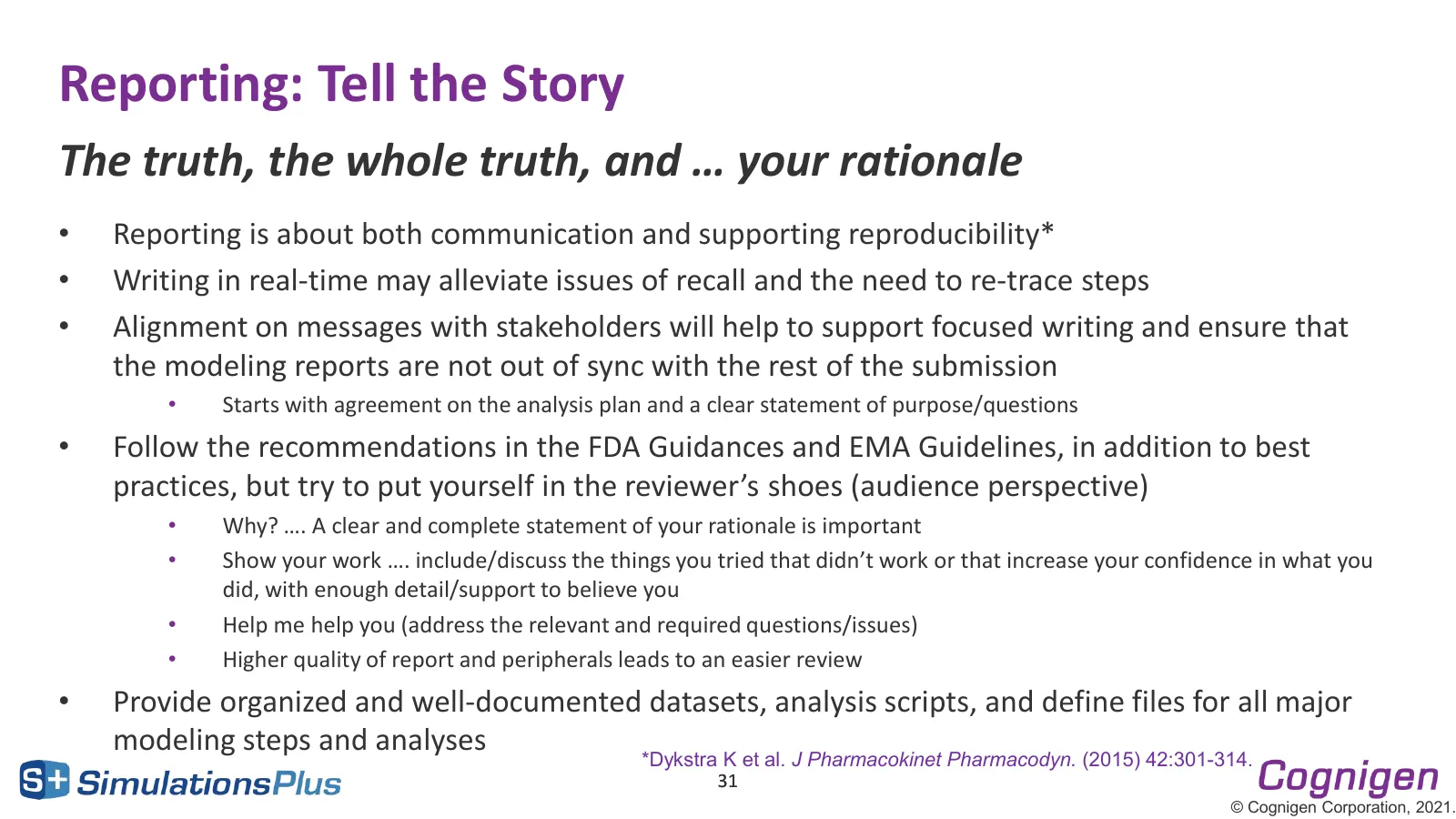
Reporting: Tell the Story The truth, the whole truth, and … your rationale • Reporting is about both communication and supporting reproducibility* • Writing in real-time may alleviate issues of recall and the need to re-trace steps • Alignment on messages with stakeholders will help to support focus
Slide 32: Reporting: Tell the Story - Suggestions from FDA
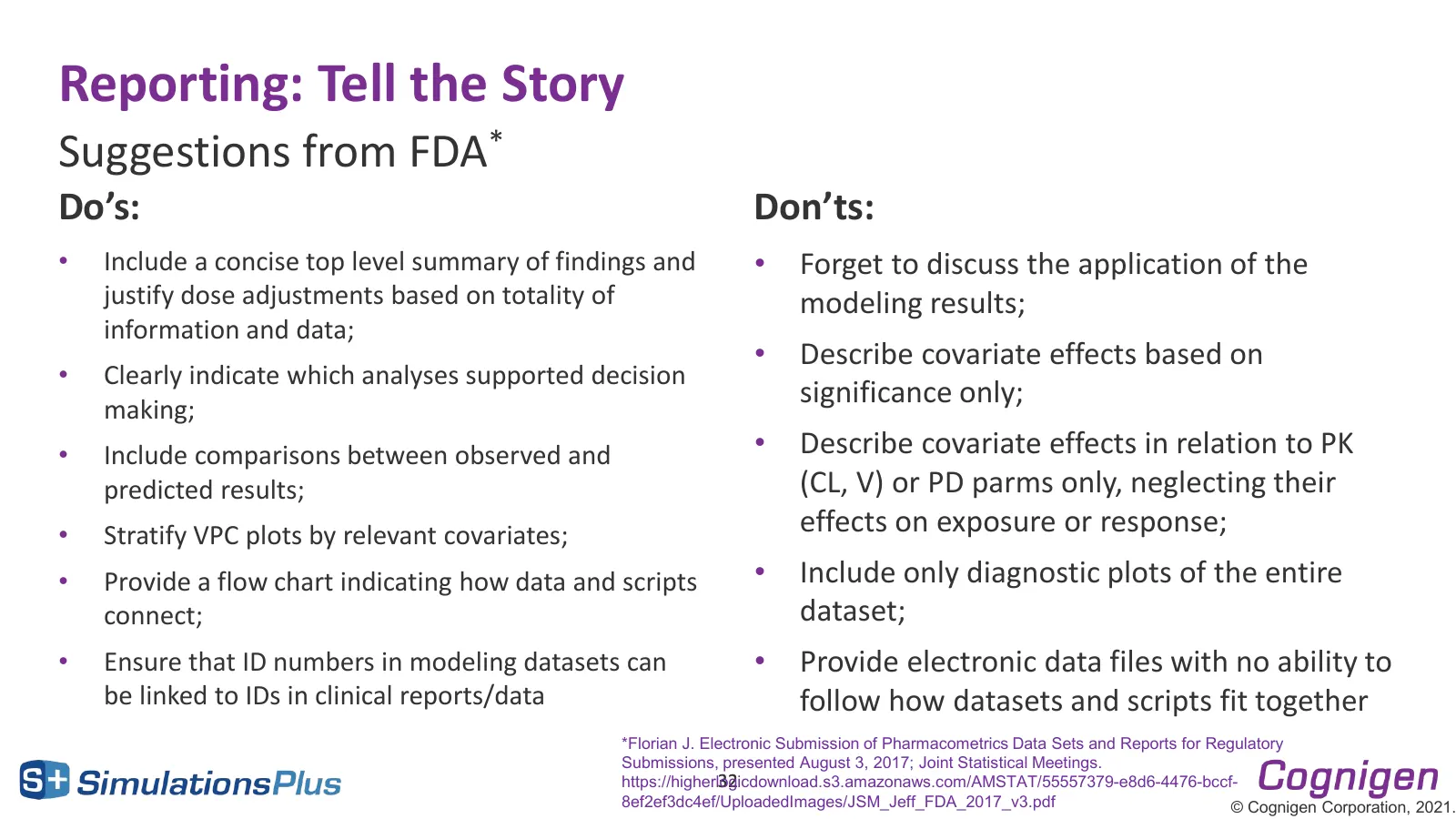
Reporting: Tell the Story Suggestions from FDA* Do’s: Don’ts: • Include a concise top level summary of findings and • Forget to discuss the application of the justify dose adjustments based on totality of modeling results; information and data; • Describe covariate effects based on • Clearly indicat
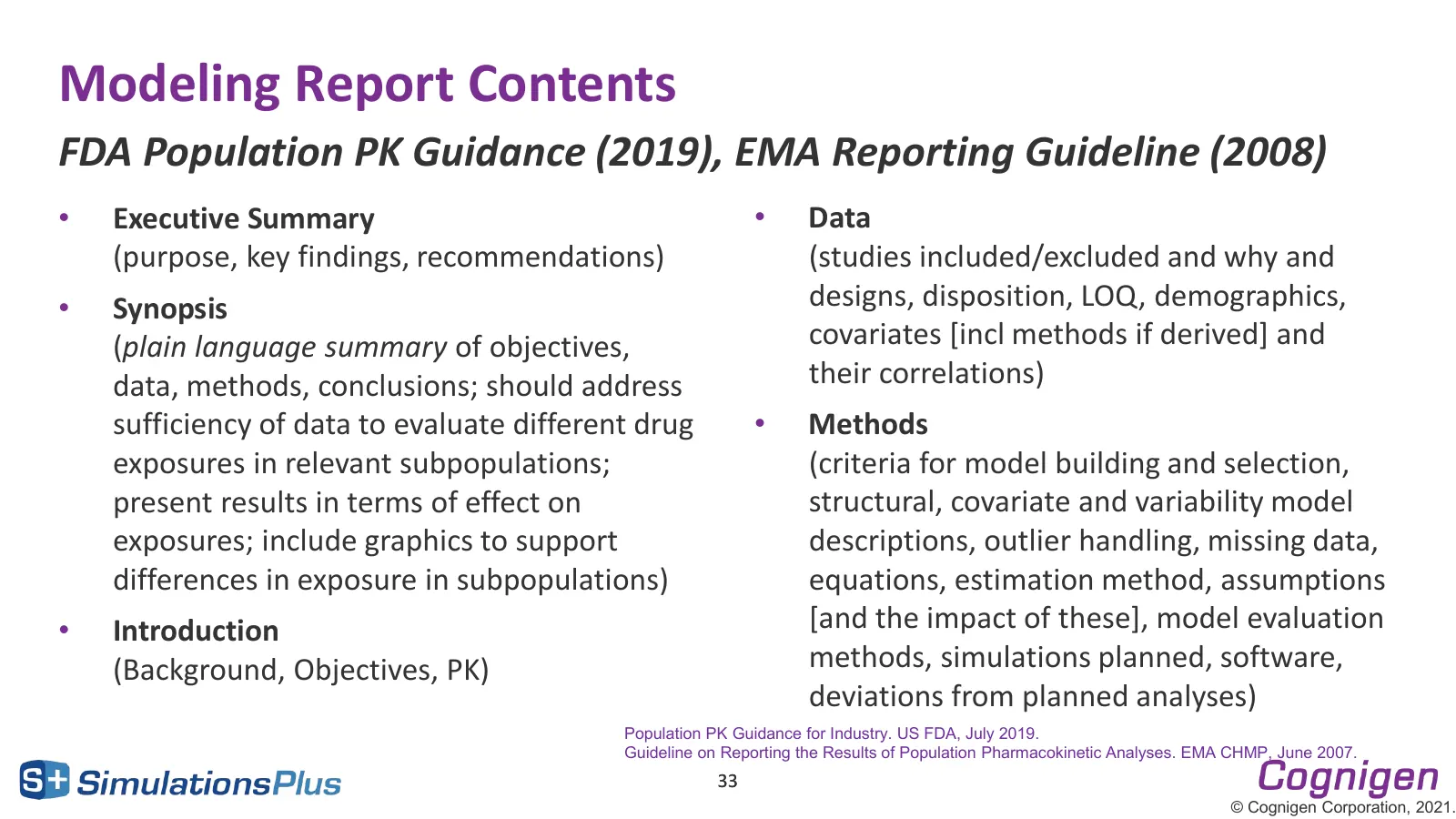
Slide 33: Modeling Report Contents
Modeling Report Contents FDA Population PK Guidance (2019), EMA Reporting Guideline (2008) • Executive Summary • Data (purpose, key findings, recommendations) (studies included/excluded and why and • Synopsis designs, disposition, LOQ, demographics, (plain language summary of objectives, covariates
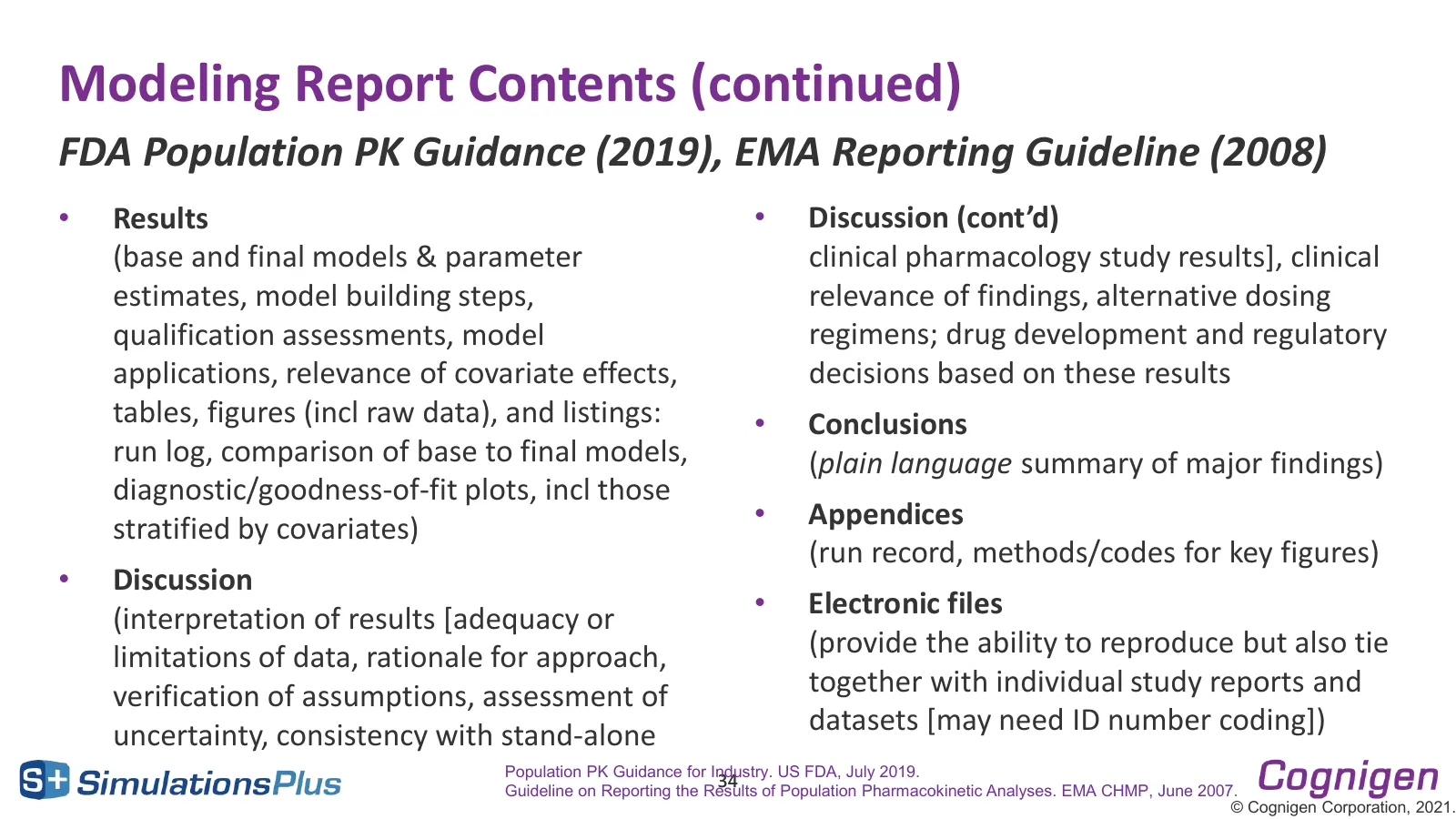
Slide 34: Modeling Report Contents (continued)
Modeling Report Contents (continued) FDA Population PK Guidance (2019), EMA Reporting Guideline (2008) • Results • Discussion (cont’d) (base and final models & parameter clinical pharmacology study results], clinical estimates, model building steps, relevance of findings, alternative dosing qualific
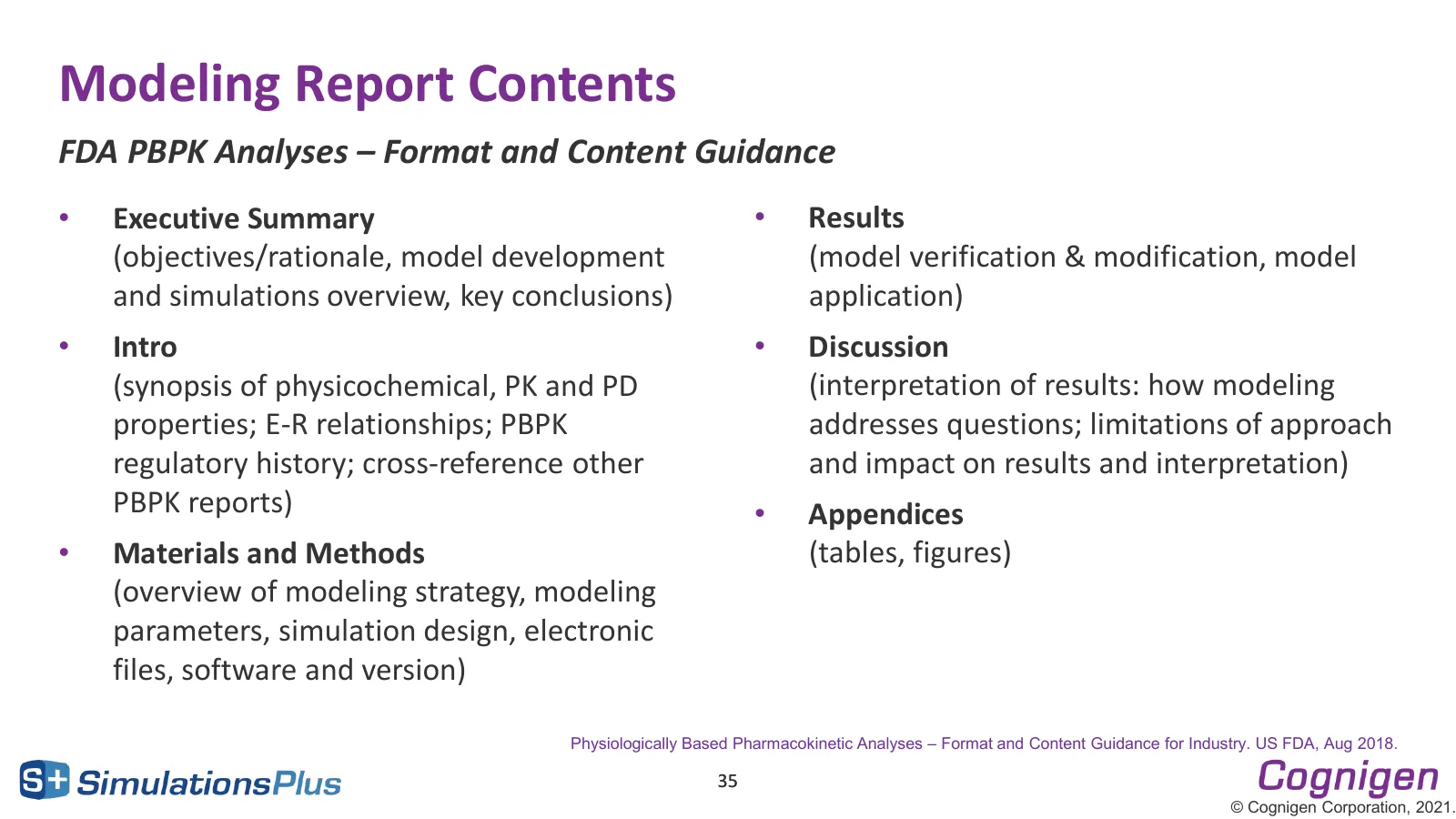
Slide 35: Modeling Report Contents: FDA PBPK Guidance
Modeling Report Contents FDA PBPK Analyses – Format and Content Guidance • Executive Summary • Results (objectives/rationale, model development (model verification & modification, model and simulations overview, key conclusions) application) • Intro • Discussion (synopsis of physicochemical, PK and
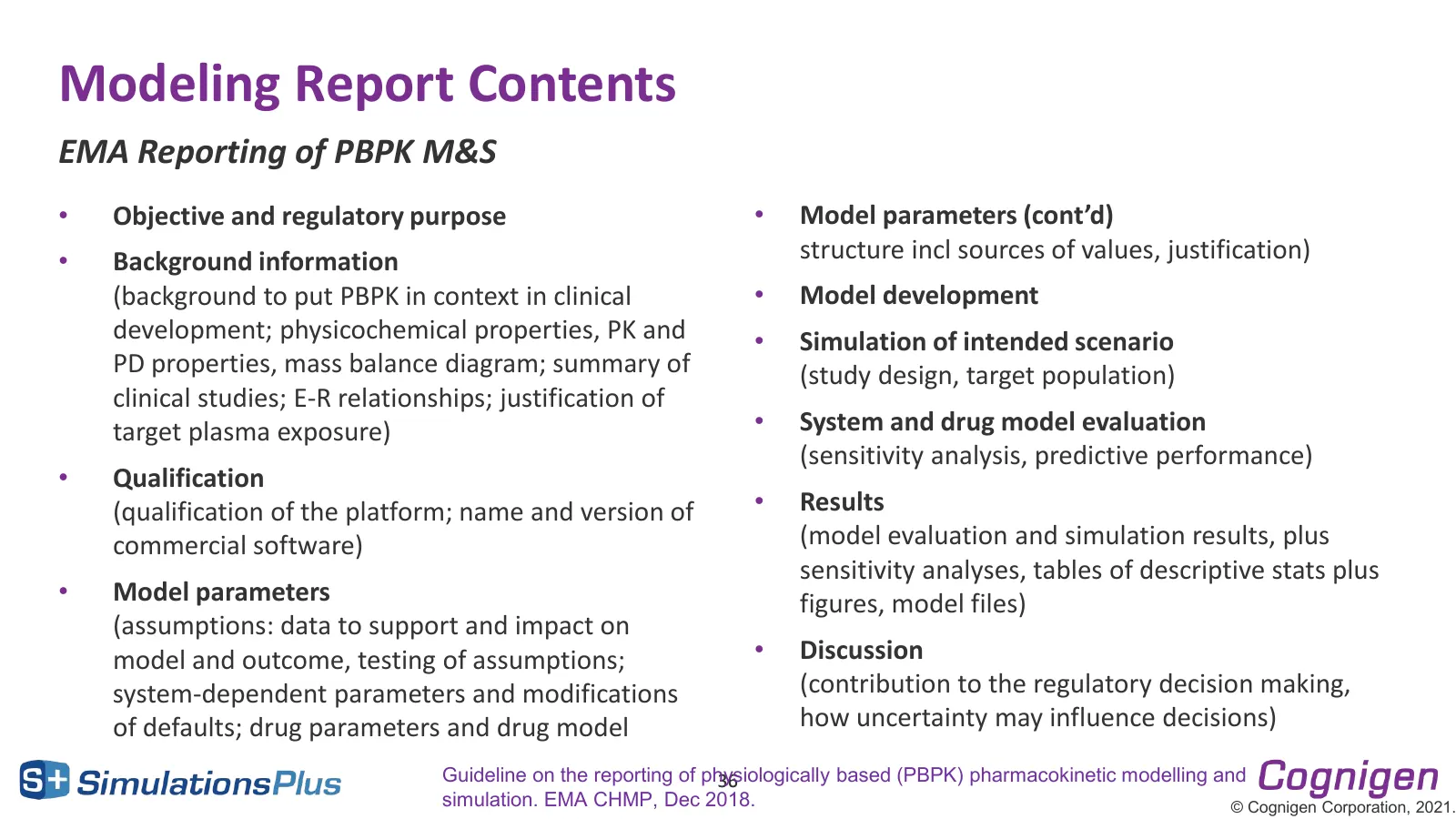
Slide 36: Modeling Report Contents: EMA PBPK
Modeling Report Contents EMA Reporting of PBPK M&S • Objective and regulatory purpose • Model parameters (cont’d) • Background information structure incl sources of values, justification) (background to put PBPK in context in clinical • Model development development; physicochemical properties, PK a
Slide 37: Quality Considerations
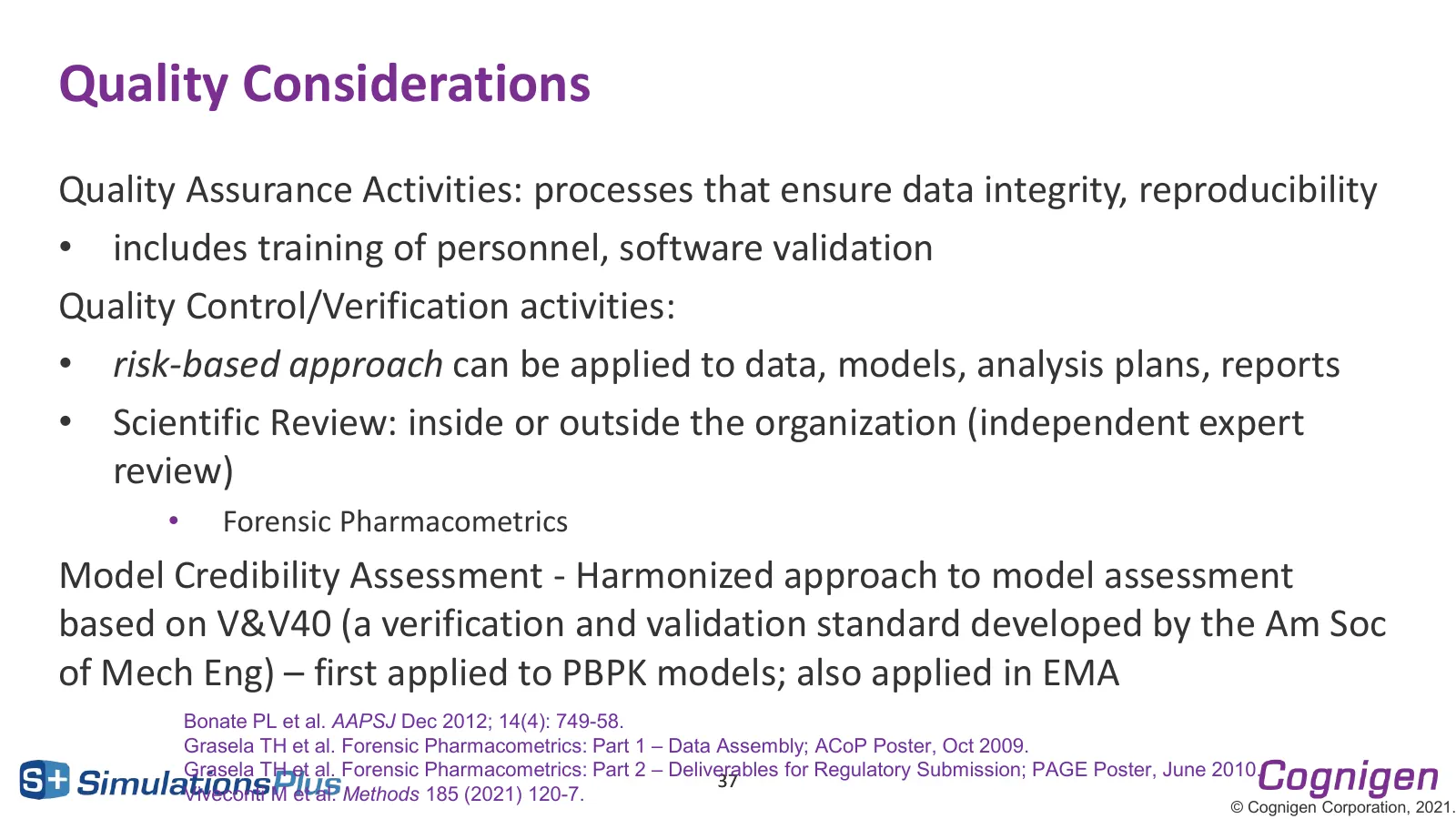
Quality Considerations Quality Assurance Activities: processes that ensure data integrity, reproducibility • includes training of personnel, software validation Quality Control/Verification activities: • risk-based approach can be applied to data, models, analysis plans, reports • Scientific Review:
Slide 38: Role of Canonical Documents
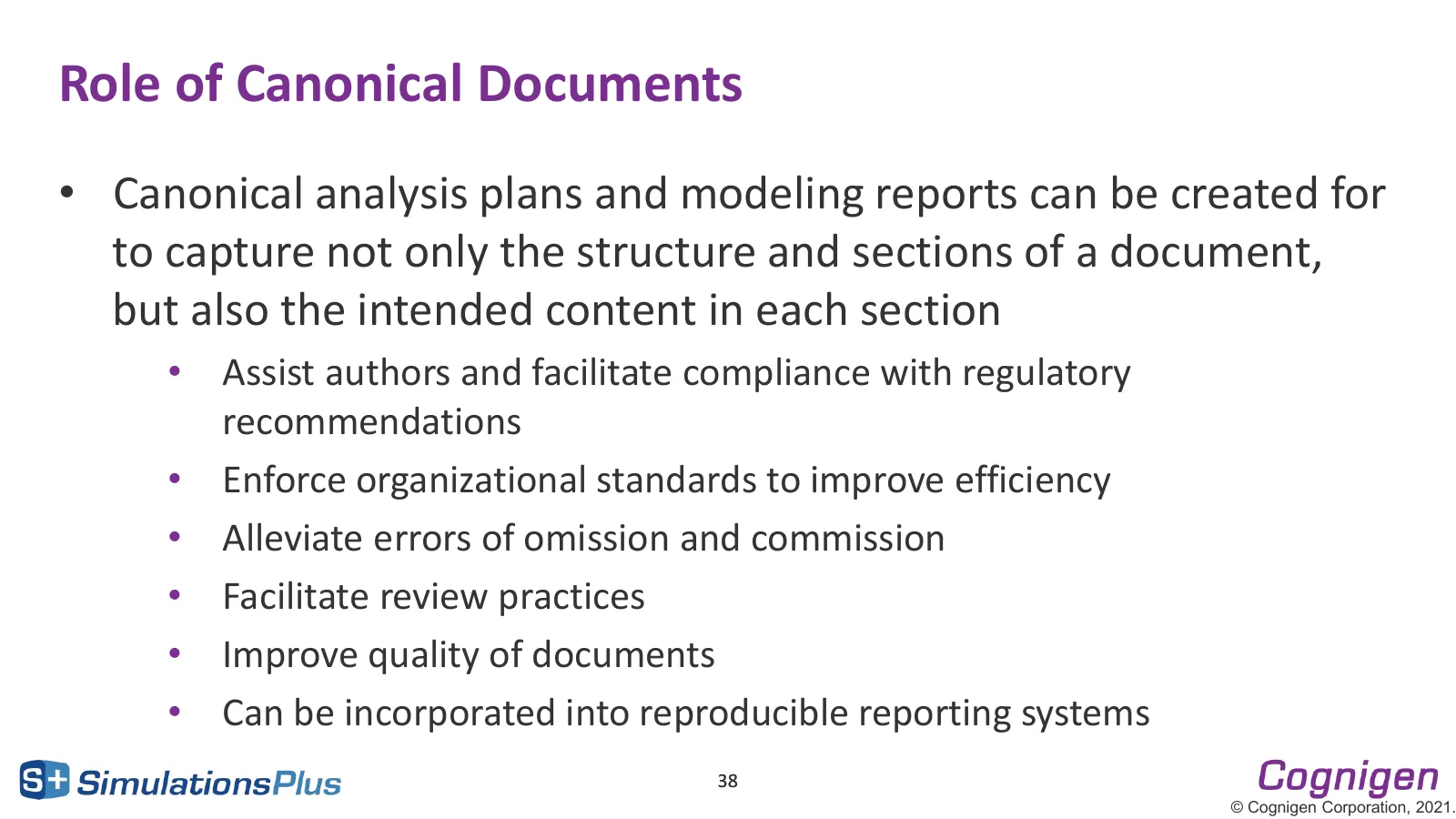
Role of Canonical Documents • Canonical analysis plans and modeling reports can be created for to capture not only the structure and sections of a document, but also the intended content in each section • Assist authors and facilitate compliance with regulatory recommendations • Enforce organization
Slide 39: Pharmacometrics and Systems Pharmacology 2030
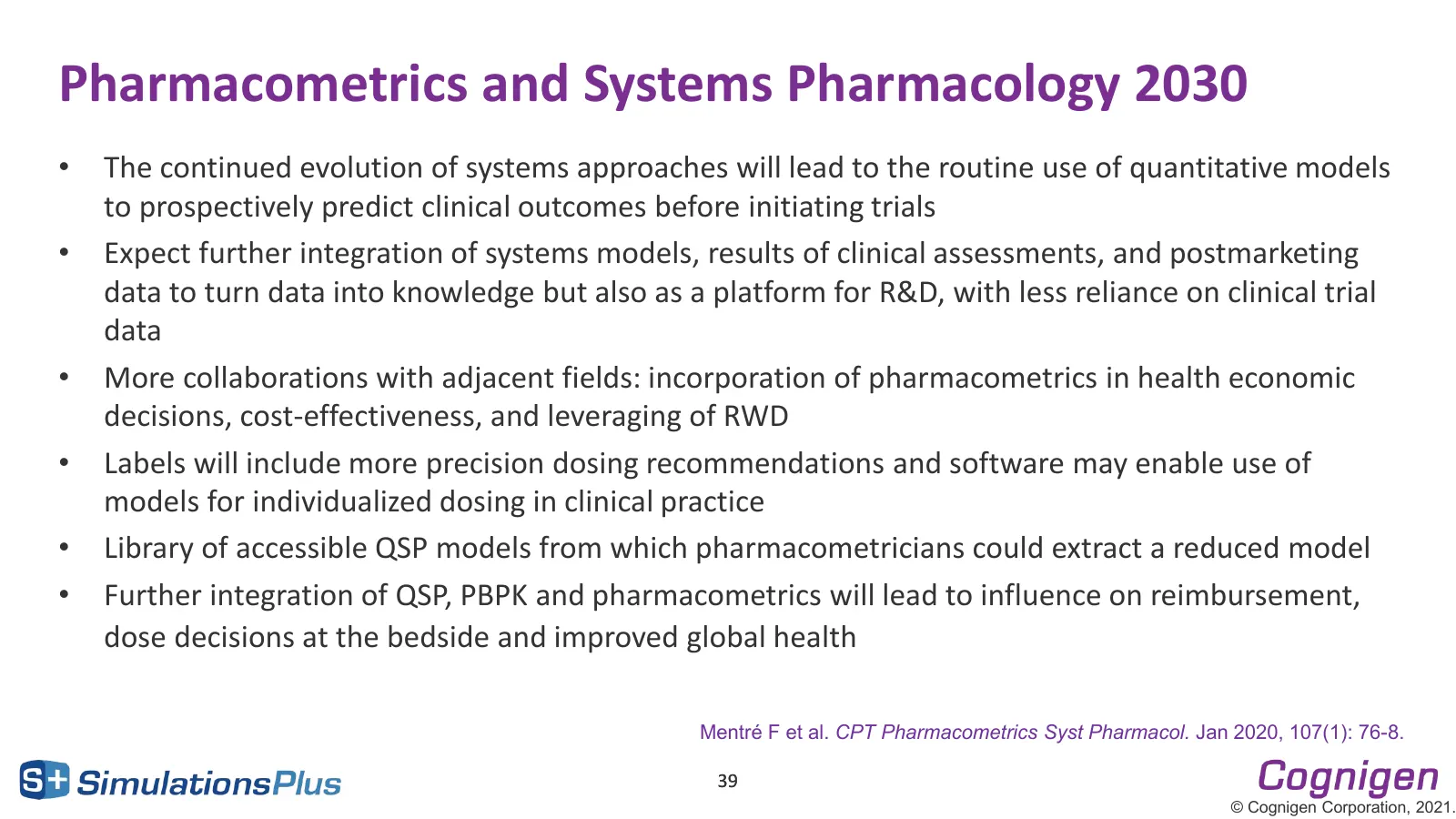
Pharmacometrics and Systems Pharmacology 2030 • The continued evolution of systems approaches will lead to the routine use of quantitative models to prospectively predict clinical outcomes before initiating trials • Expect further integration of systems models, results of clinical assessments, and p
Slide 40: Major Take-aways
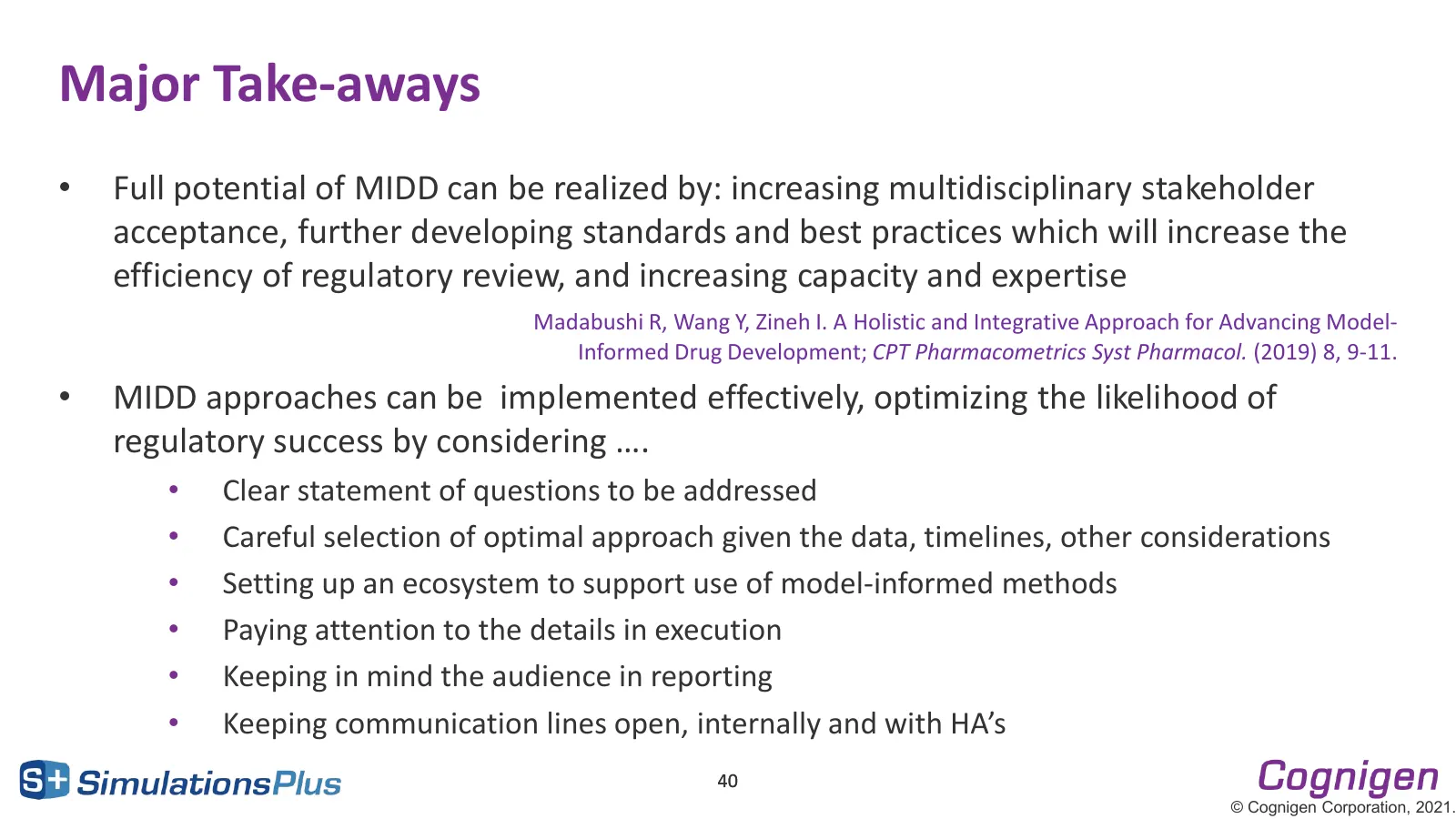
Major Take-aways • Full potential of MIDD can be realized by: increasing multidisciplinary stakeholder acceptance, further developing standards and best practices which will increase the efficiency of regulatory review, and increasing capacity and expertise Madabushi R, Wang Y, Zineh I. A Holistic a

Slide 41: © Cognigen Corporation, 2021.
41 © Cognigen Corporation, 2021.
Slide 42: History & Demographics
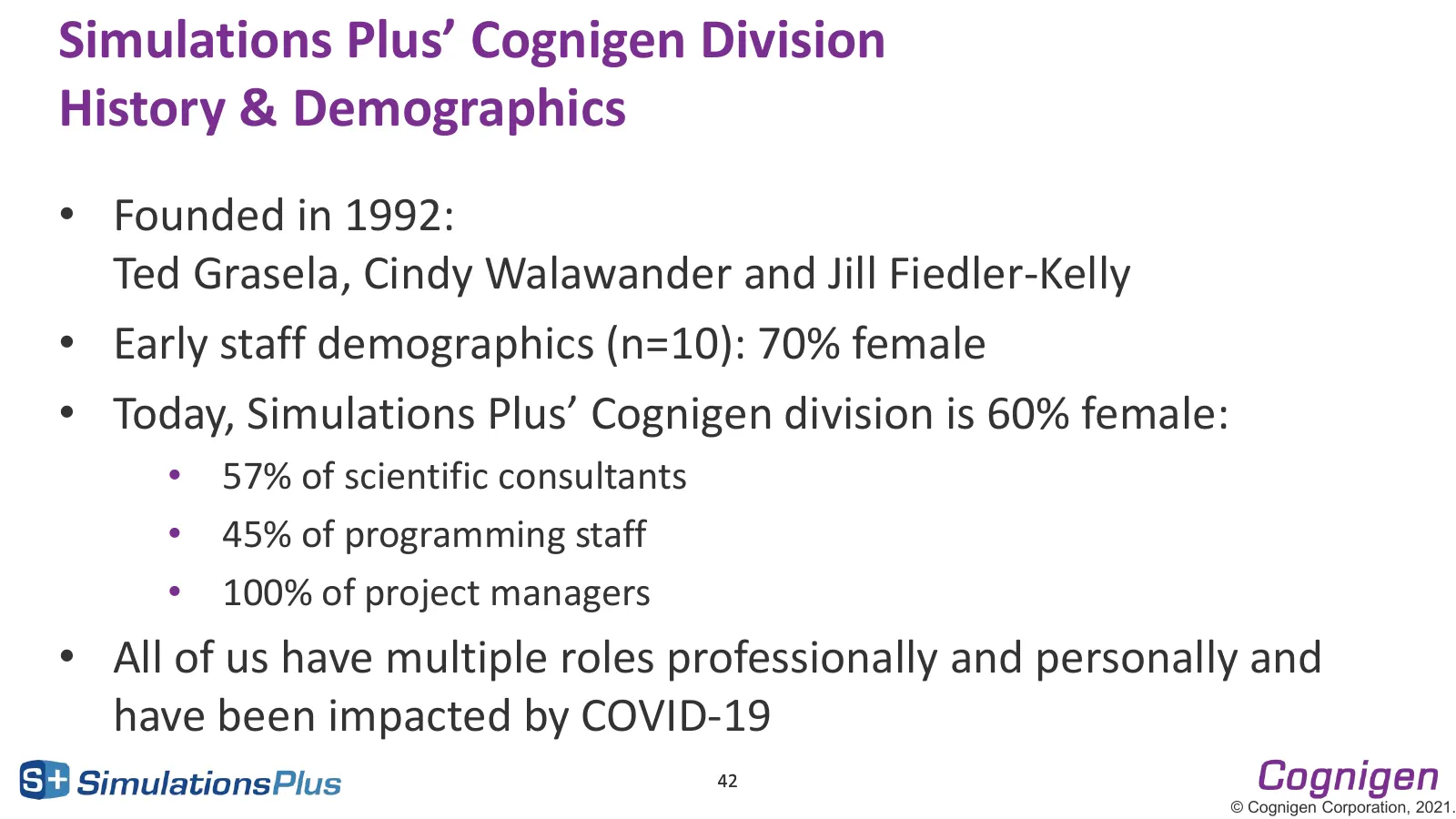
Simulations Plus’ Cognigen Division History & Demographics • Founded in 1992: Ted Grasela, Cindy Walawander and Jill Fiedler-Kelly • Early staff demographics (n=10): 70% female • Today, Simulations Plus’ Cognigen division is 60% female: • 57% of scientific consultants • 45% of programming staff • 10

Slide 43: Happy International Day for Women and Girls in Science!
Happy International Day for Women and Girls in Science! Female role models? • Marie Curie, Gertrude Elion, Jennifer Doudna and Emmanuelle Charpentier • Growing list of female execs in pharma and biotech • Female healthcare/essential workers, teachers, counselors • Numerous women who have been instru

Slide 44: Happy International Day for Women and Girls in Science!
Happy International Day for Women and Girls in Science! Female role models? • Women of SLP: scientists, programmers, developers of Simulations Plus, Cognigen, DILIsym Services, & Lixoft Farah AlQaraghuli Kelly Maxwell Revathi Chapa Haiying Zhou Heather Barcomb Denise Morris Grace Fraczkiewicz Phyo P
Slide 45: Thank you
Thank you 45 © Cognigen Corporation, 2021.
Source: Internet Archive copy of simulations-plus.com
More decks from Simulations Plus, Inc.
 Q3 FY2026 Earnings Presentation21 slides · Jul 9, 2026
 Q2 FY2026 Earnings Presentation21 slides · Apr 9, 2026
 Q2 2026 Earnings Presentation21 slides · Apr 9, 2026
 Technical Presentation (January 2026)37 slides · Jan 22, 2026
 Q1 2026 Earnings Presentation19 slides · Jan 8, 2026
 Investor Day (2026)76 slides · 2026