Infinity Pharmaceuticals, Inc. · OTC:INFIQ
Infinity Pharmaceuticals — Investor Presentation (November 2007)
41 slides from Infinity Pharmaceuticals's investor presentation, Nov 13, 2007
Slide 1: Infinity Pharmaceuticals (NASDAQ: INFI)
Exhibit 99.1 Infinity Pharmaceuticals (NASDAQ: INFI) November 2007
Slide 2: Forward-Looking Statements
Forward-Looking Statements • This presentation contains forward-looking statements within the meaning of The Private Securities Litigation Reform Act of 1995. These statements involve risks and uncertainties that could cause actual results to be materially different from historical results or from a
Slide 3: Profile of Infinity Pharmaceuticals (NASDAQ: INFI)
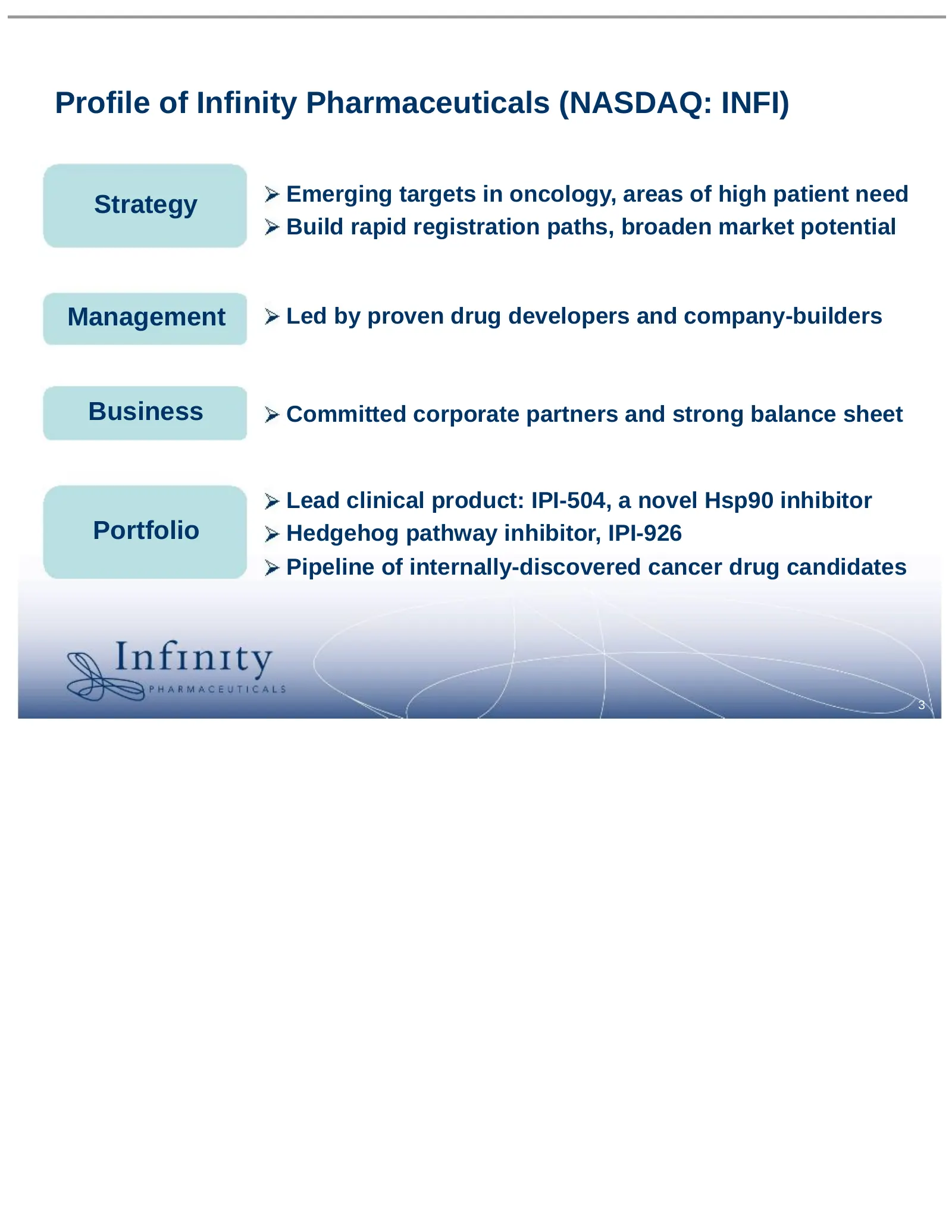
* Profile of Infinity Pharmaceuticals (NASDAQ: INFI) Strategy Emerging targets in oncology, areas of high patient need Build rapid registration paths, broaden market potential Management Led by proven drug developers and company-builders Business Committed corporate partners and strong balance sheet
Slide 4: Infinity Leadership
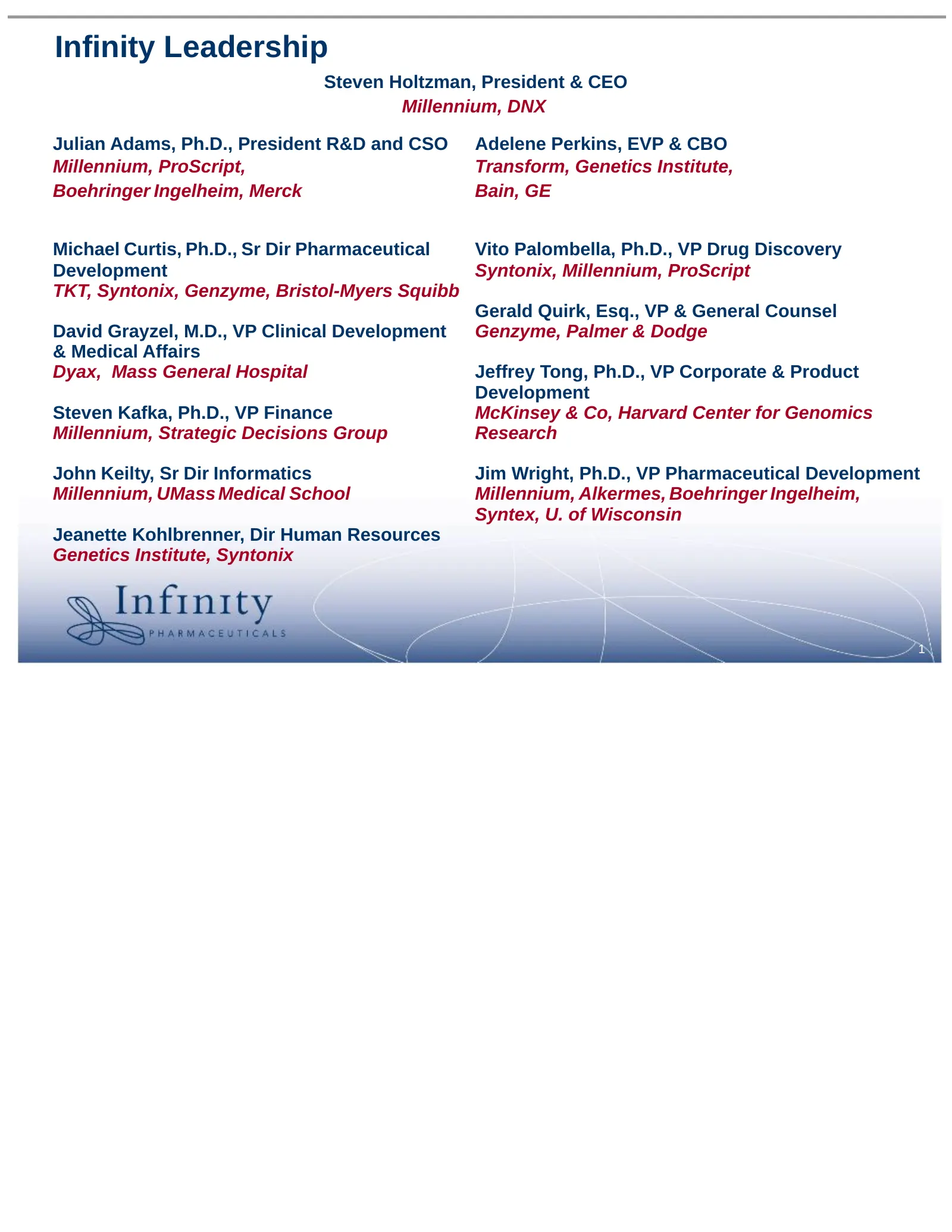
Infinity Leadership Steven Holtzman, President & CEO Millennium, DNX Julian Adams, Ph.D., President R&D and CSO Adelene Perkins, EVP & CBO Millennium, ProScript, Transform, Genetics Institute, Boehringer Ingelheim, Merck Bain, GE Michael Curtis, Ph.D., Sr Dir Pharmaceutical Vito Palombella, Ph.D., V
Slide 5: Lead clinical program IPI-504 – a novel Hsp90 inhibitor
* * * * * Lead clinical program IPI-504 – a novel Hsp90 inhibitor 5
Slide 6: Heat shock protein 90 (Hsp90) is an emerging cancer target
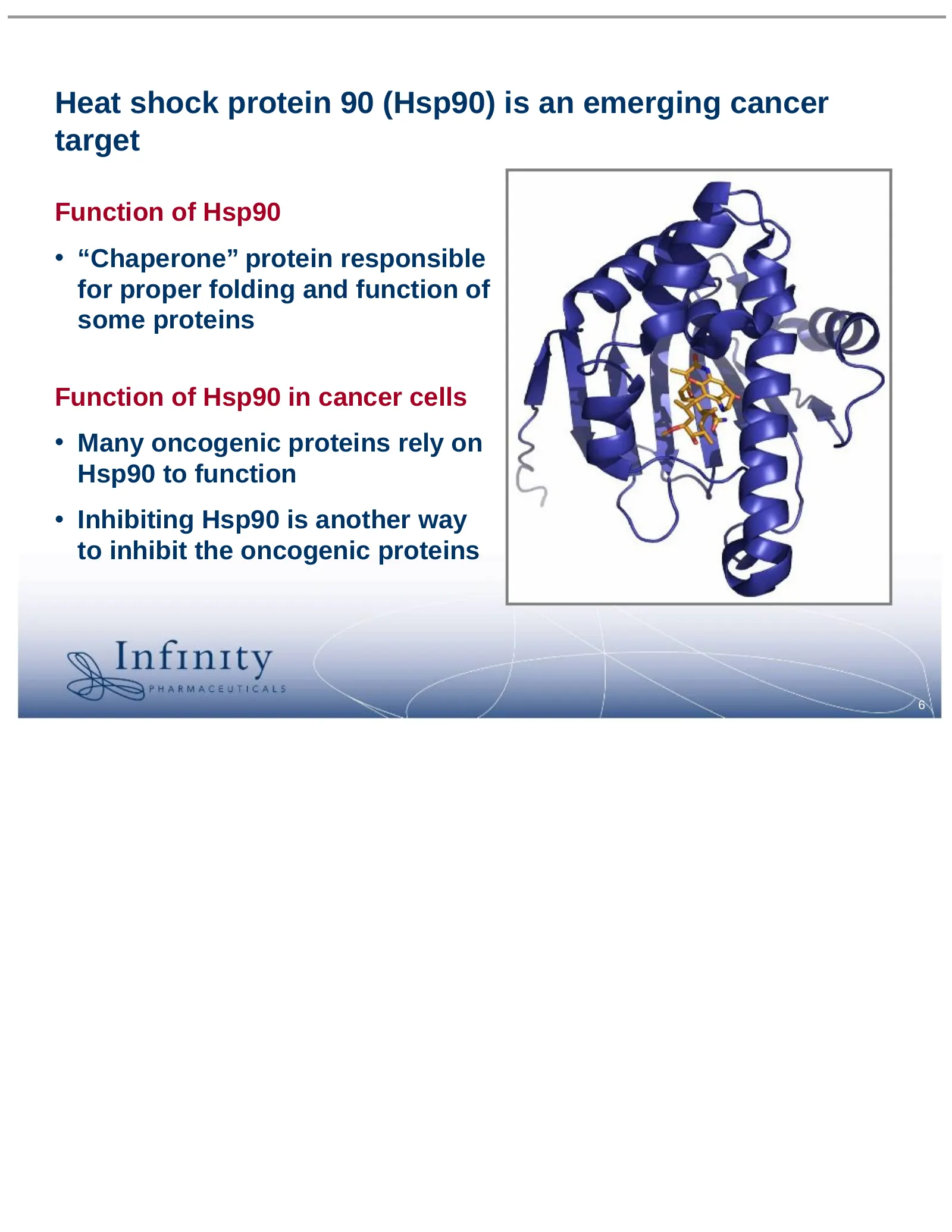
* Heat shock protein 90 (Hsp90) is an emerging cancer target Function of Hsp90 • “Chaperone” protein responsible for proper folding and function of some proteins Function of Hsp90 in cancer cells • Many oncogenic proteins rely on Hsp90 to function • Inhibiting Hsp90 is another way to inhibit the onc
Slide 7: Many critical oncogenic proteins depend on Hsp90…
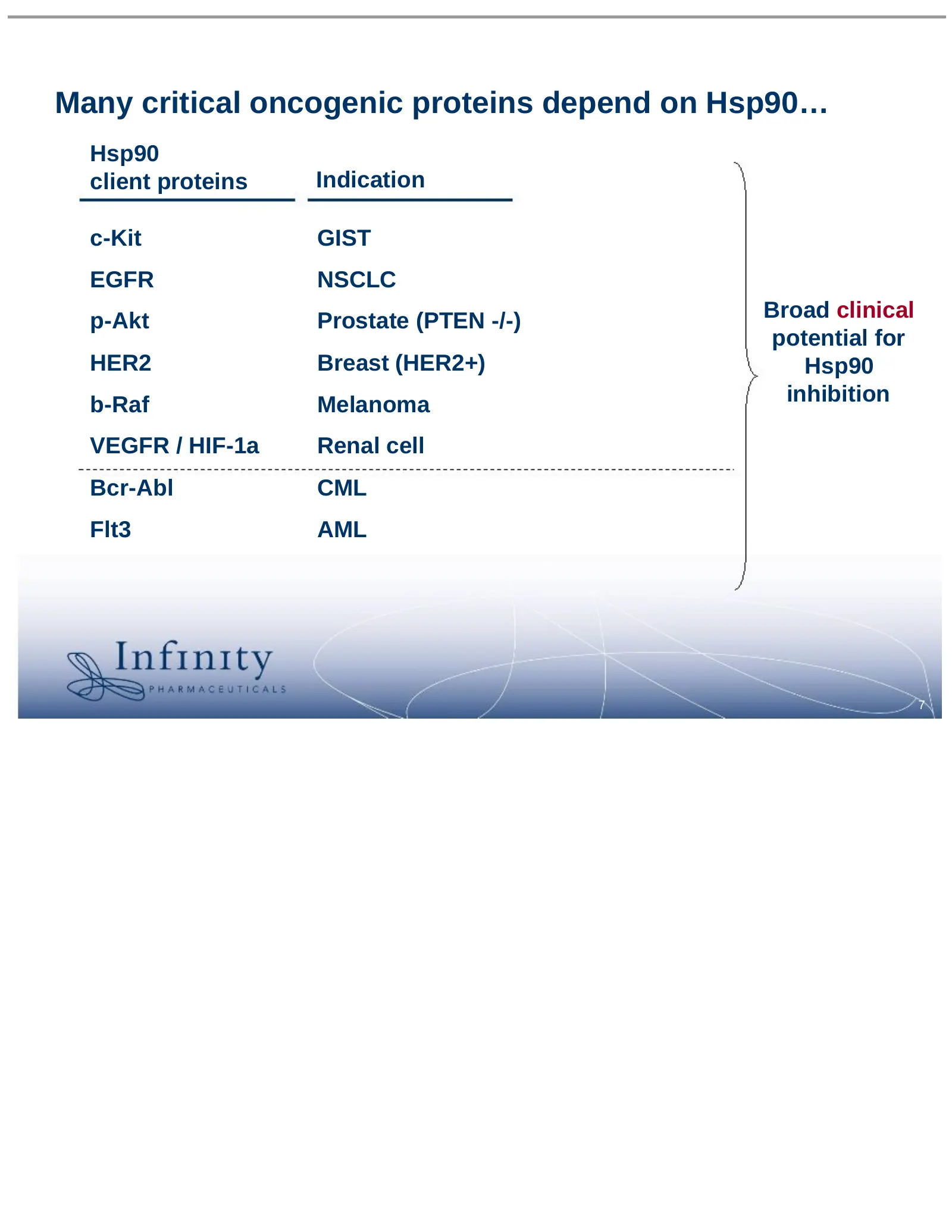
* Many critical oncogenic proteins depend on Hsp90… Hsp90 client proteins Indication c-Kit GIST EGFR NSCLC p-Akt Prostate (PTEN -/-) Broad clinical potential for HER2 Breast (HER2+) Hsp90 b-Raf Melanoma inhibition VEGFR / HIF-1a Renal cell Bcr-Abl CML Flt3 AML 7
Slide 8: …with well-validated commercial potential
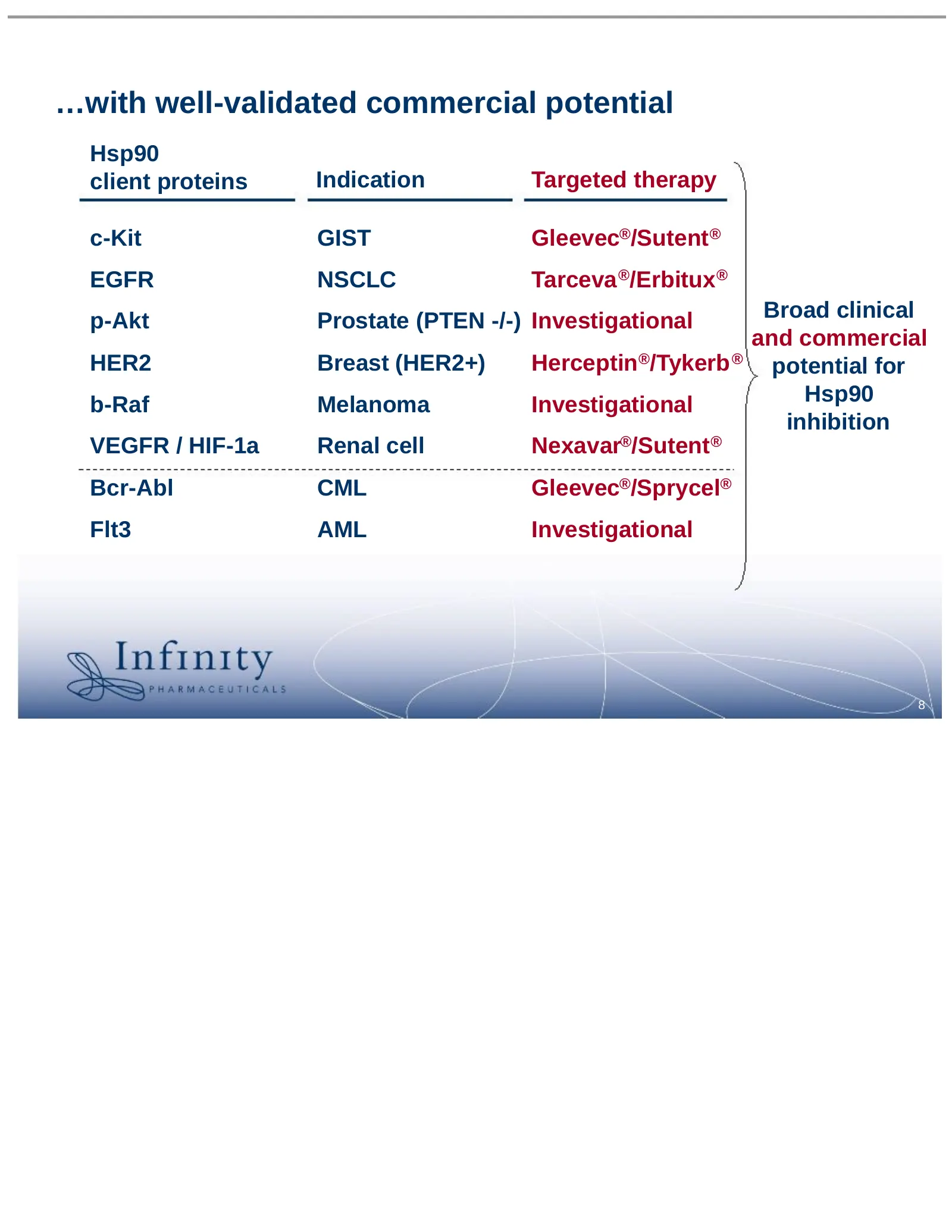
* …with well-validated commercial potential Hsp90 client proteins Indication Targeted therapy c-Kit GIST Gleevec®/Sutent® EGFR NSCLC Tarceva ®/Erbitux® p-Akt Prostate (PTEN -/-) Investigational Broad clinical and commercial HER2 Breast (HER2+) Herceptin /Tykerb ® ® potential for b-Raf Melanoma Inves
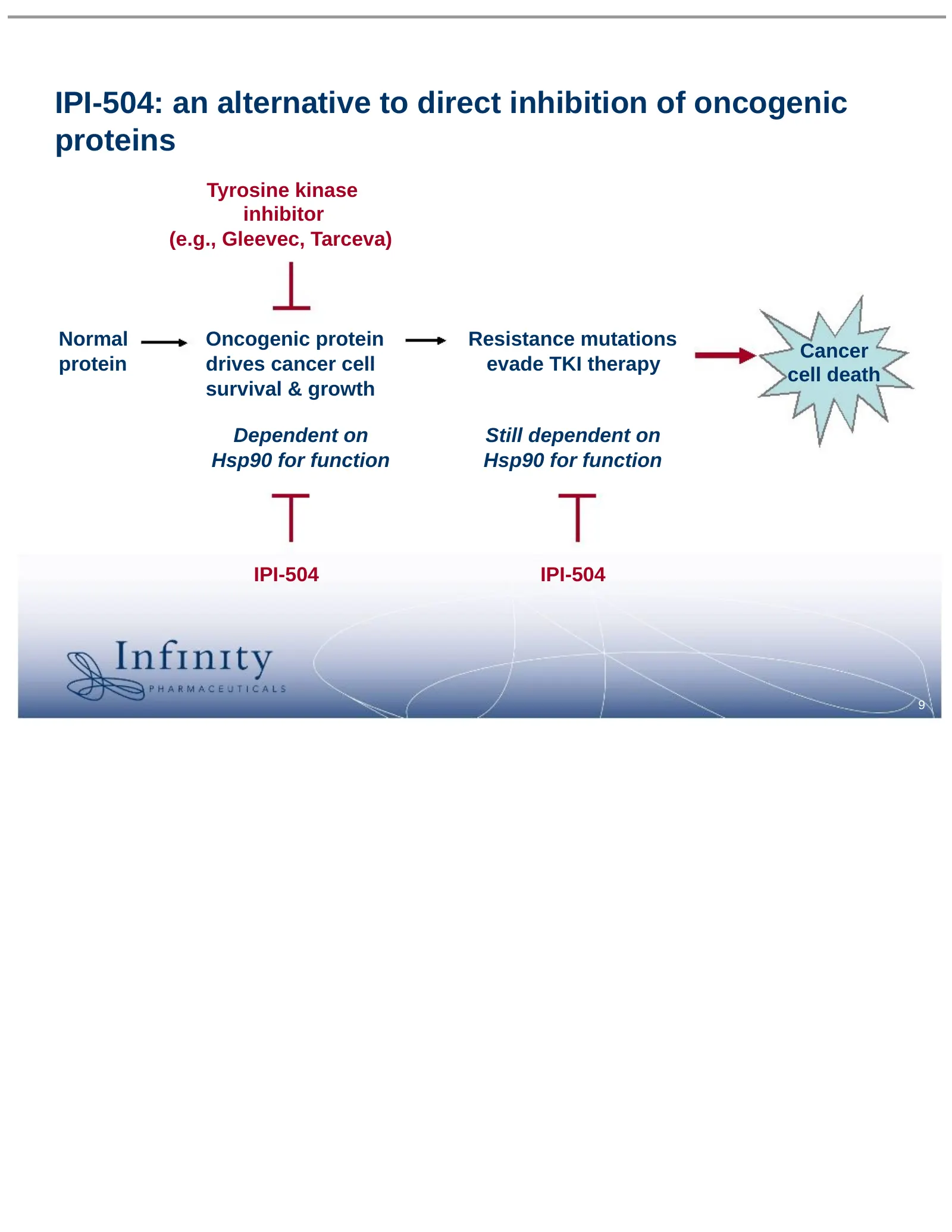
Slide 9: IPI-504: an alternative to direct inhibition of oncogenic proteins
* IPI-504: an alternative to direct inhibition of oncogenic proteins Tyrosine kinase inhibitor (e.g., Gleevec, Tarceva) Normal Oncogenic protein Resistance mutations Cancer protein drives cancer cell evade TKI therapy cell death survival & growth Dependent on Still dependent on Hsp90 for function Hs
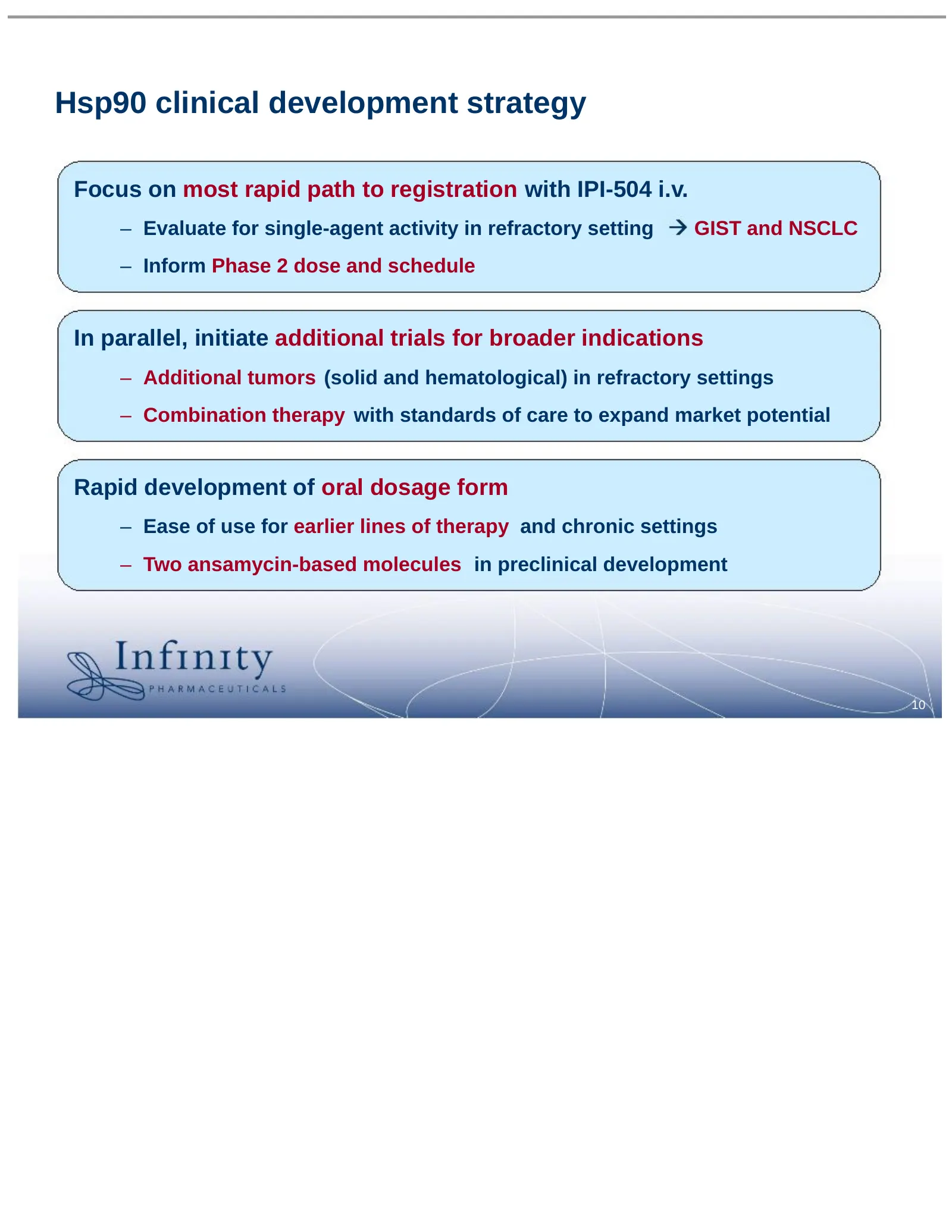
Slide 10: Hsp90 clinical development strategy
* Hsp90 clinical development strategy Focus on most rapid path to registration with IPI-504 i.v. – Evaluate for single-agent activity in refractory setting GIST and NSCLC – Inform Phase 2 dose and schedule In parallel, initiate additional trials for broader indications – Additional tumors (solid and
Slide 11: Hsp90 clinical development strategy
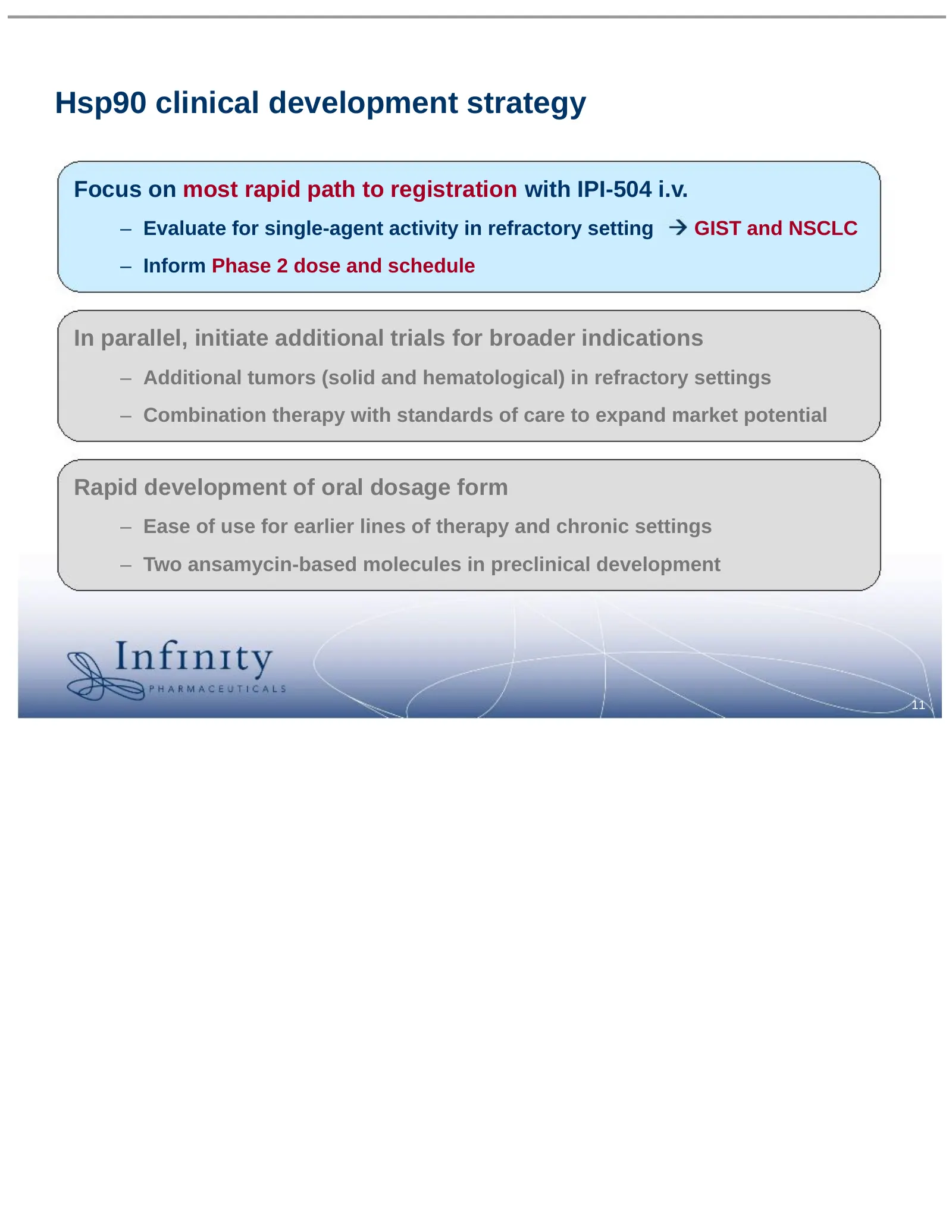
* Hsp90 clinical development strategy Focus on most rapid path to registration with IPI-504 i.v. – Evaluate for single-agent activity in refractory setting GIST and NSCLC – Inform Phase 2 dose and schedule In parallel, initiate additional trials for broader indications – Additional tumors (solid and
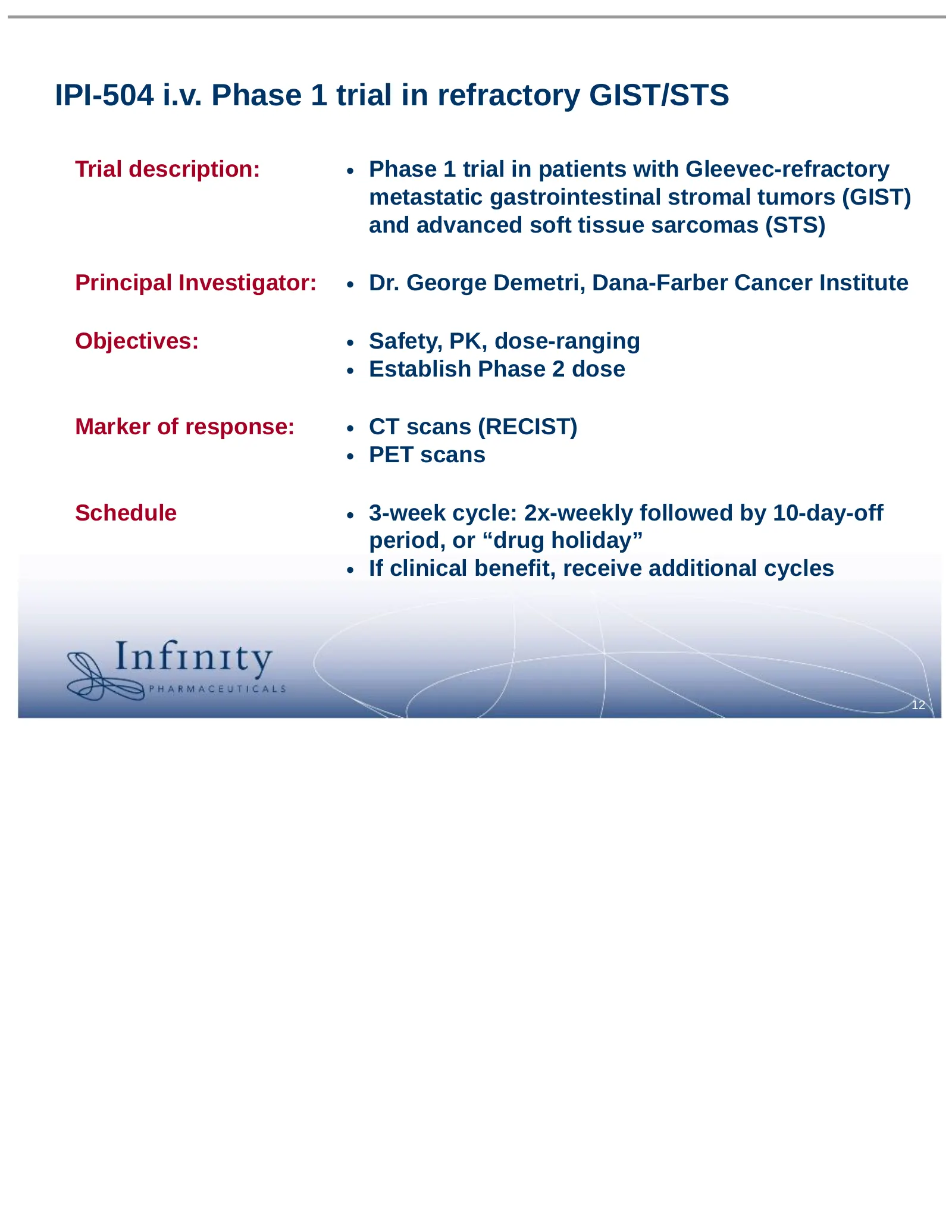
Slide 12: IPI-504 i.v. Phase 1 trial in refractory GIST/STS
* IPI-504 i.v. Phase 1 trial in refractory GIST/STS Trial description: • Phase 1 trial in patients with Gleevec-refractory metastatic gastrointestinal stromal tumors (GIST) and advanced soft tissue sarcomas (STS) Principal Investigator: • Dr. George Demetri, Dana-Farber Cancer Institute Objectives:
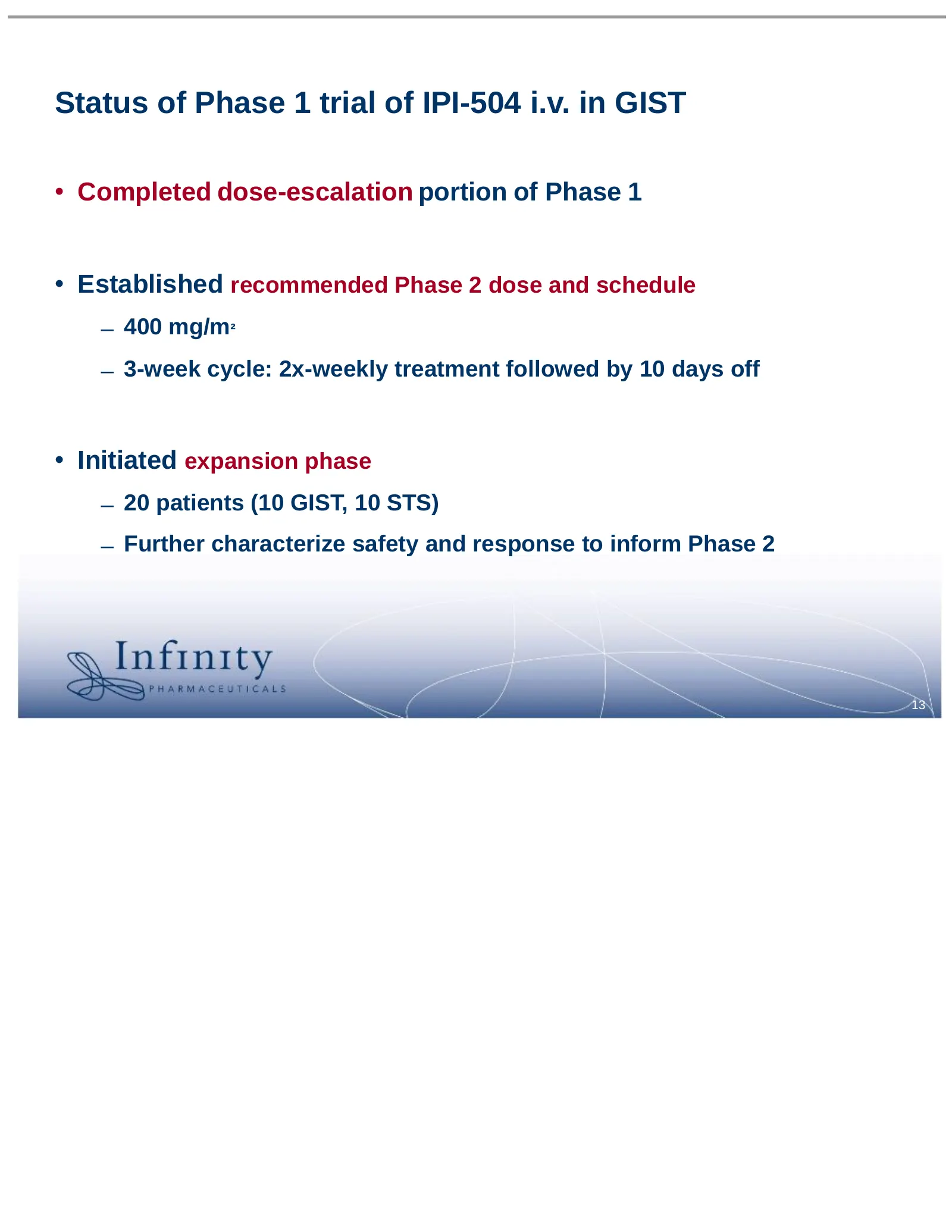
Slide 13: Status of Phase 1 trial of IPI-504 i.v. in GIST
* Status of Phase 1 trial of IPI-504 i.v. in GIST • Completed dose-escalation portion of Phase 1 • Established recommended Phase 2 dose and schedule – 400 mg/m² – 3-week cycle: 2x-weekly treatment followed by 10 days off • Initiated expansion phase – 20 patients (10 GIST, 10 STS) – Further character
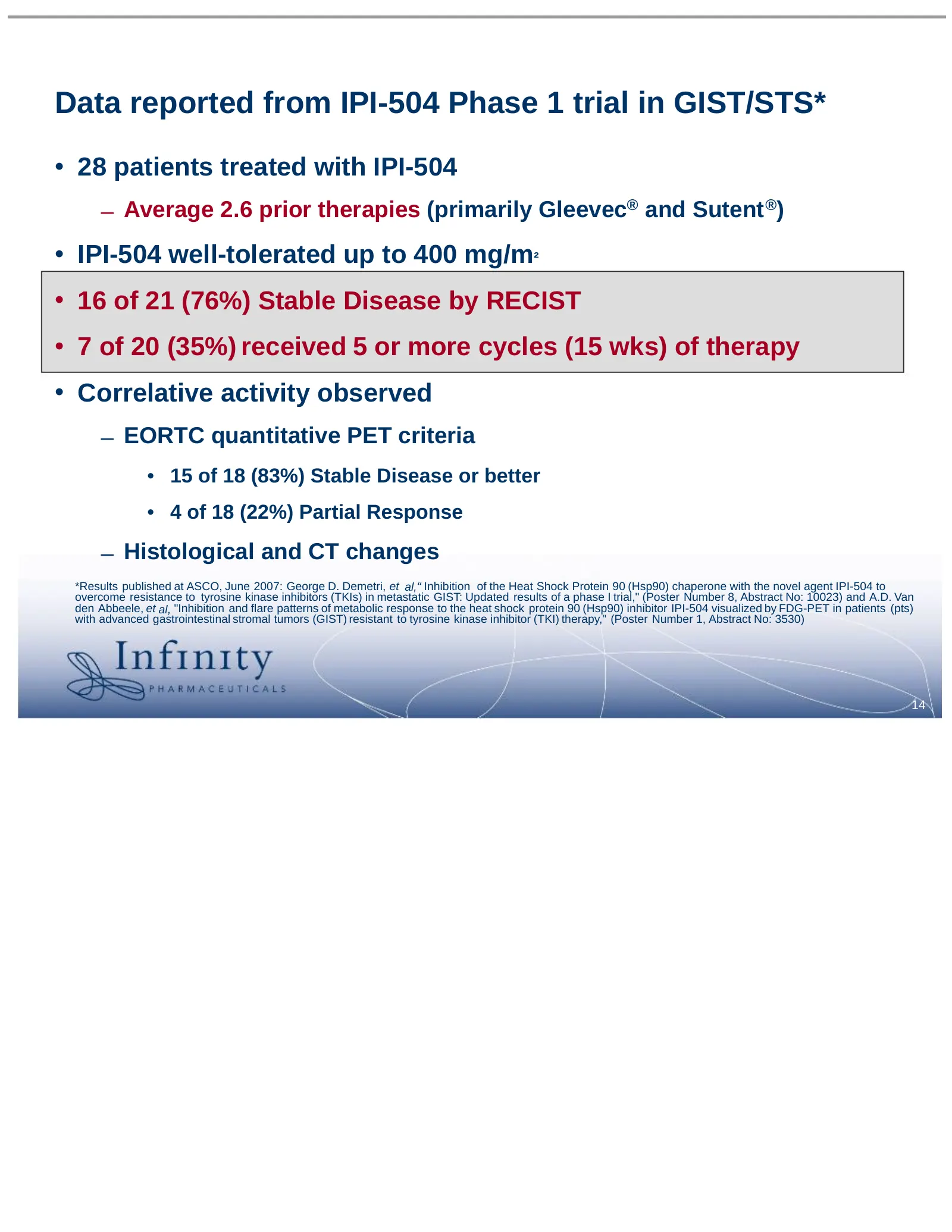
Slide 14: Data reported from IPI-504 Phase 1 trial in GIST/STS
* Data reported from IPI-504 Phase 1 trial in GIST/STS* • 28 patients treated with IPI-504 – Average 2.6 prior therapies (primarily Gleevec® and Sutent ®) • IPI-504 well-tolerated up to 400 mg/m² • 16 of 21 (76%) Stable Disease by RECIST • 7 of 20 (35%) received 5 or more cycles (15 wks) of therapy
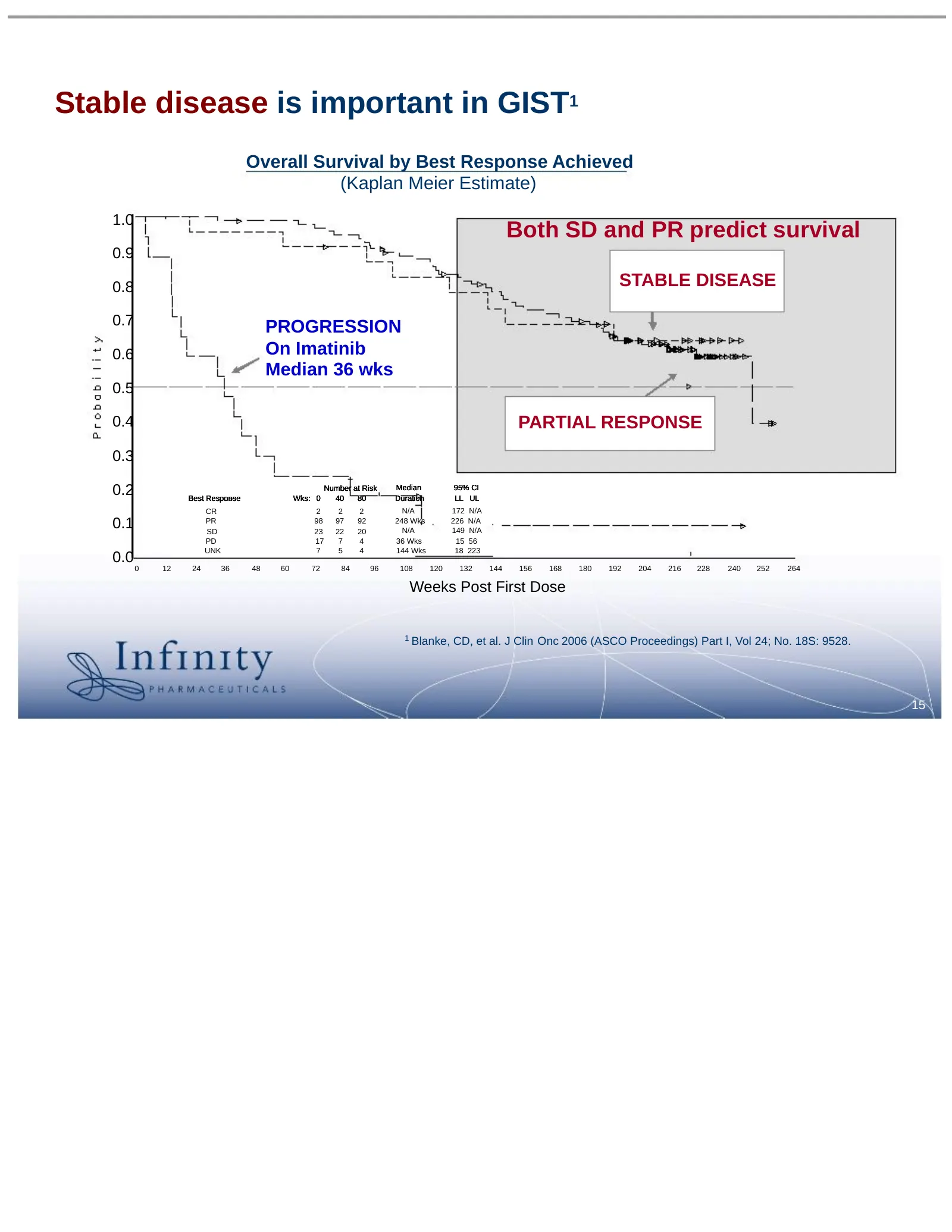
Slide 15: Stable disease is important in GIST
* Stable disease is important in GIST1 Overall Survival by Best Response Achieved (Kaplan Meier Estimate) 1.0 Both SD and PR predict survival 0.9 0.8 STABLE DISEASE 0.7 PROGRESSION 0.6 On Imatinib Median 36 wks 0.5 0.4 PARTIAL RESPONSE 0.3 0.2 Best Resonse Response Wks: 0 Number at Risk 40 80 Median
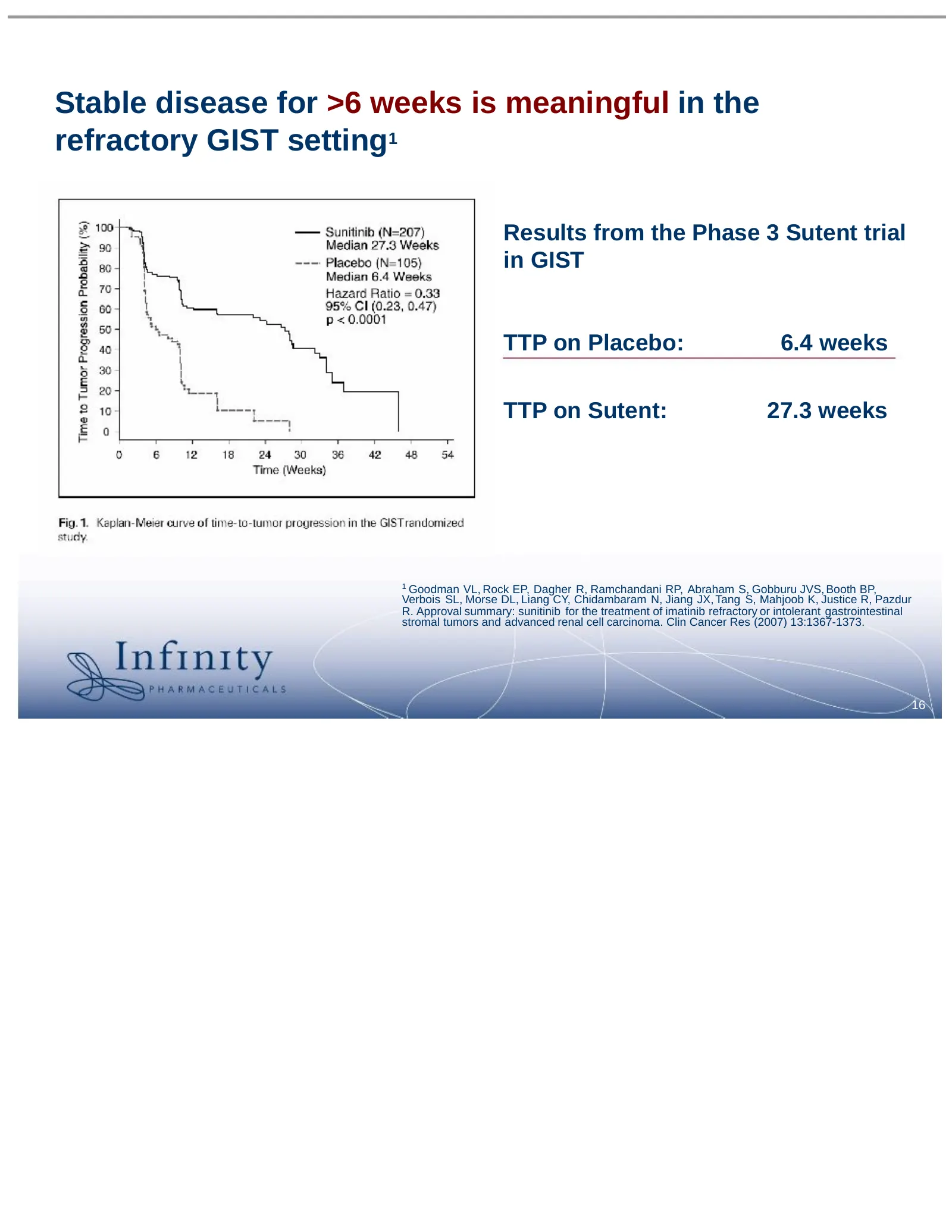
Slide 16: Stable disease for >6 weeks is meaningful in refractory GIST
* Stable disease for >6 weeks is meaningful in the refractory GIST setting1 Results from the Phase 3 Sutent trial in GIST TTP on Placebo: 6.4 weeks TTP on Sutent: 27.3 weeks 1 Goodman VL, Rock EP, Dagher R, Ramchandani RP, Abraham S, Gobburu JVS, Booth BP, Verbois SL, Morse DL, Liang CY, Chidambaram
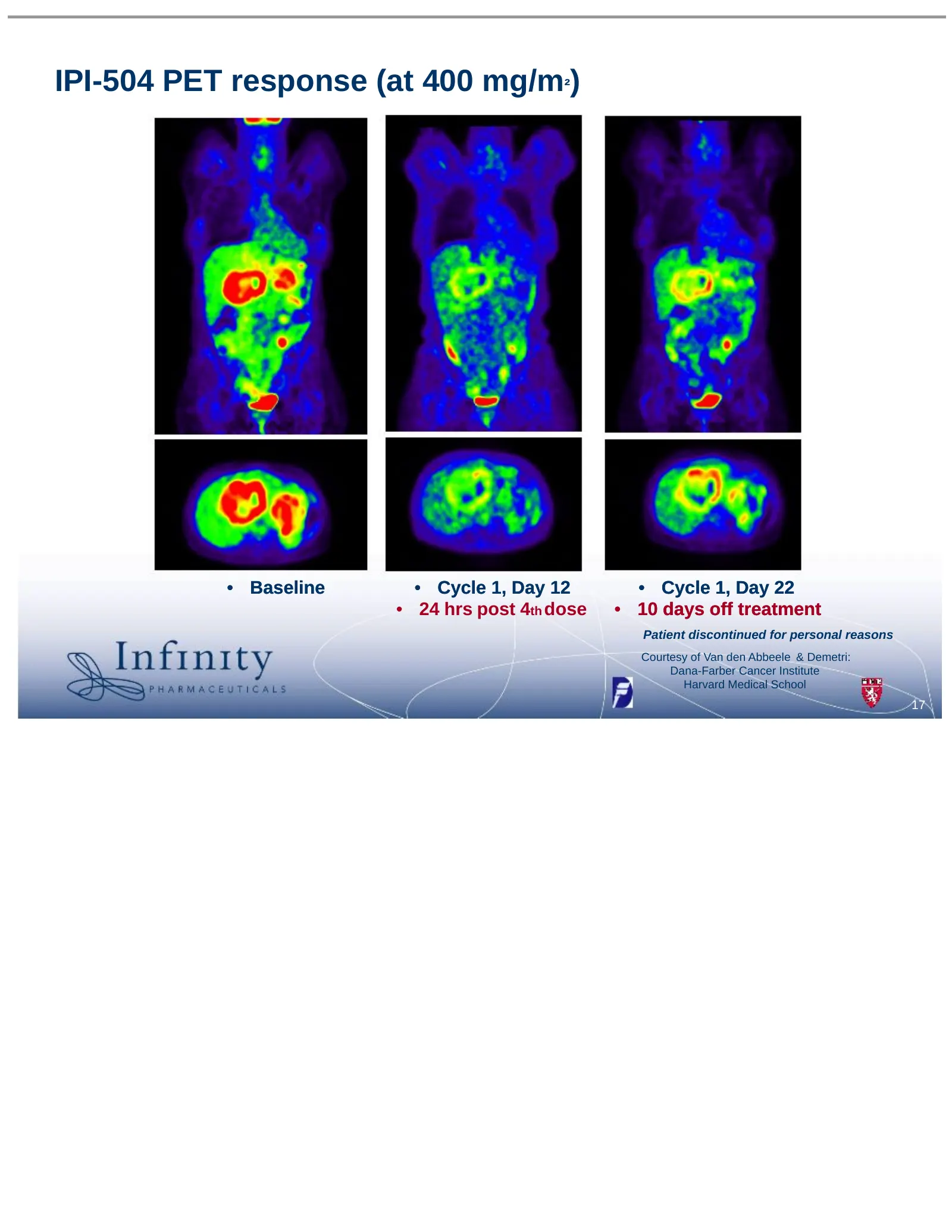
Slide 17: IPI-504 PET response (at 400 mg/m²)
* IPI-504 PET response (at 400 mg/m²) • Baseline • Cycle 1, Day 12 • Cycle 1, Day 22 • 24 hrs post 4th dose • 10 days off treatment Patient discontinued for personal reasons Courtesy of Van den Abbeele & Demetri: Dana-Farber Cancer Institute Harvard Medical School 17
Slide 18: Path forward for IPI-504 i.v. in refractory GIST
* Path forward for IPI-504 i.v. in refractory GIST • Expansion phase at recommended Phase 2 dose in progress – 20 patients (10 GIST, 10 STS) – Further characterize safety and response to inform Phase 2 trial • Phase 2 has potential for rapid approval path – Active consultation with FDA and advisors
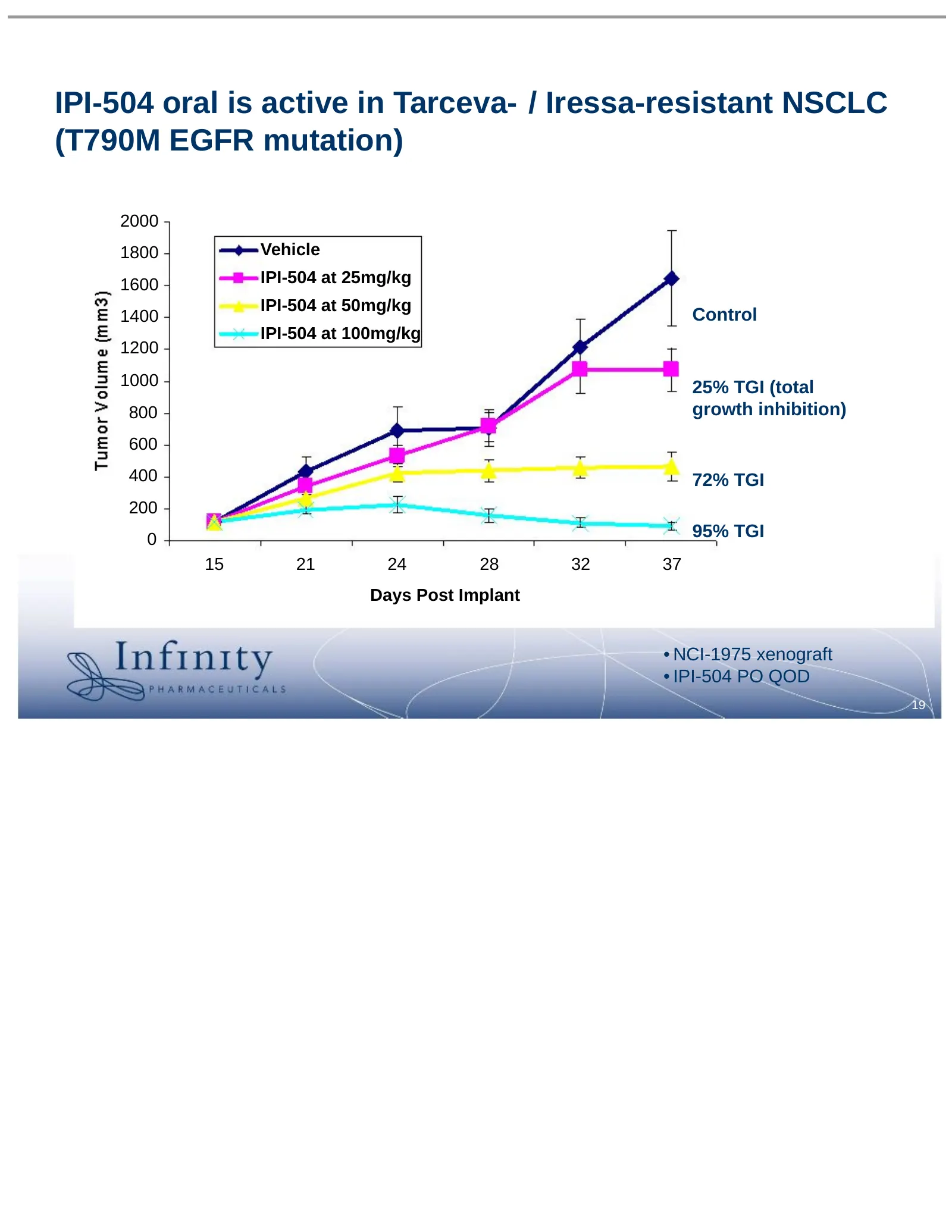
Slide 19: IPI-504 oral is active in Tarceva-/Iressa-resistant NSCLC
* IPI-504 oral is active in Tarceva- / Iressa-resistant NSCLC (T790M EGFR mutation) 2000 1800 Vehicle 1600 IPI-504 at 25mg/kg IPI-504 at 50mg/kg 1400 Control IPI-504 at 100mg/kg 1200 1000 25% TGI (total 800 growth inhibition) 600 400 72% TGI 200 0 95% TGI 15 21 24 28 32 37 Days Post Implant • NCI-19
Slide 20: Phase 1/2 trial in advanced NSCLC
* Phase 1/2 trial in advanced NSCLC Trial description: • Phase 1/2 trial in Stage IIIb/IV NSCLC patients with previous TKI therapy Principal Investigator: • Dr. Thomas Lynch, Massachusetts General Hospital Patient population: • Prior therapy (>12 weeks) on a TKI Objectives: • Phase 1: Safety, PK, do
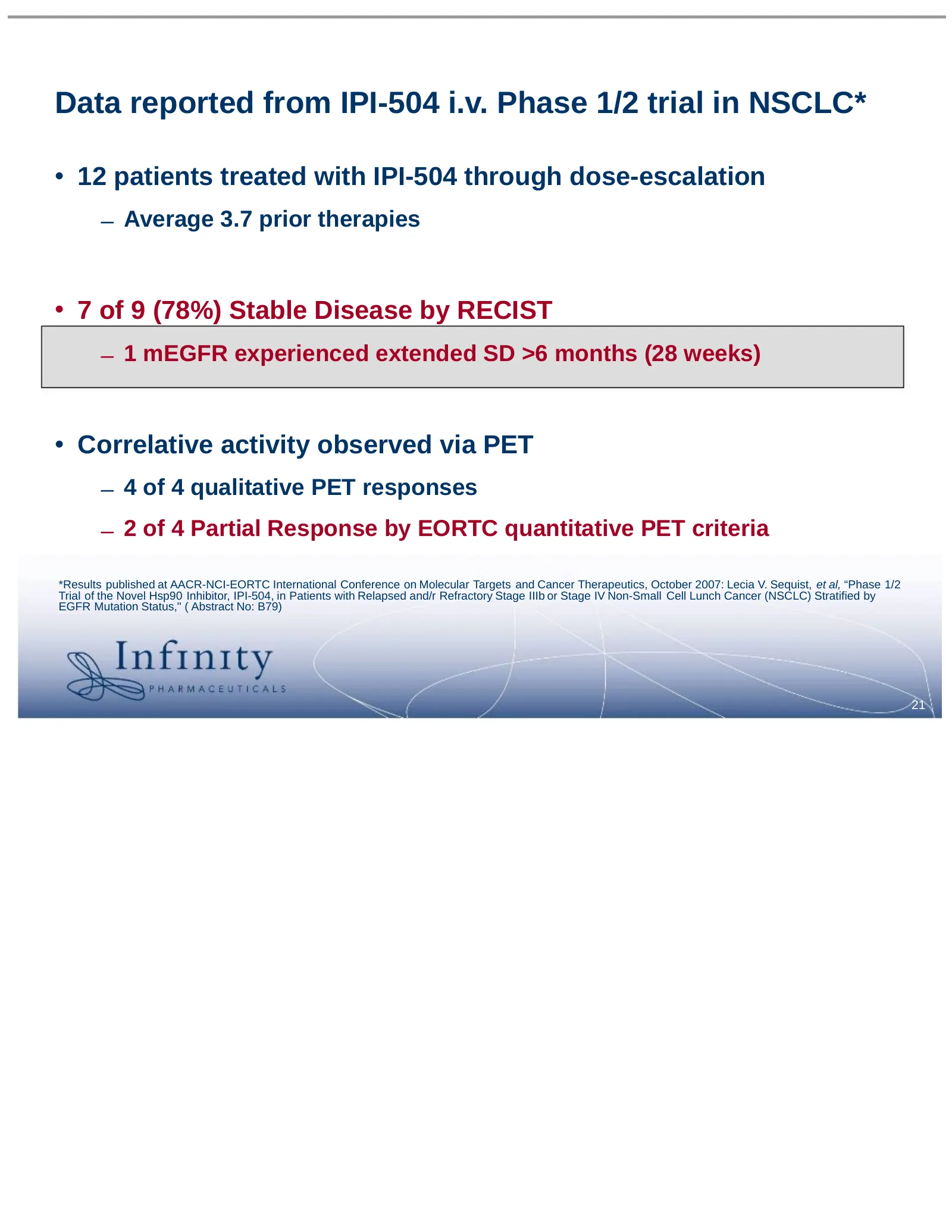
Slide 21: Data reported from IPI-504 i.v. Phase 1/2 trial in NSCLC
* Data reported from IPI-504 i.v. Phase 1/2 trial in NSCLC* • 12 patients treated with IPI-504 through dose-escalation – Average 3.7 prior therapies • 7 of 9 (78%) Stable Disease by RECIST – 1 mEGFR experienced extended SD >6 months (28 weeks) • Correlative activity observed via PET – 4 of 4 qualita
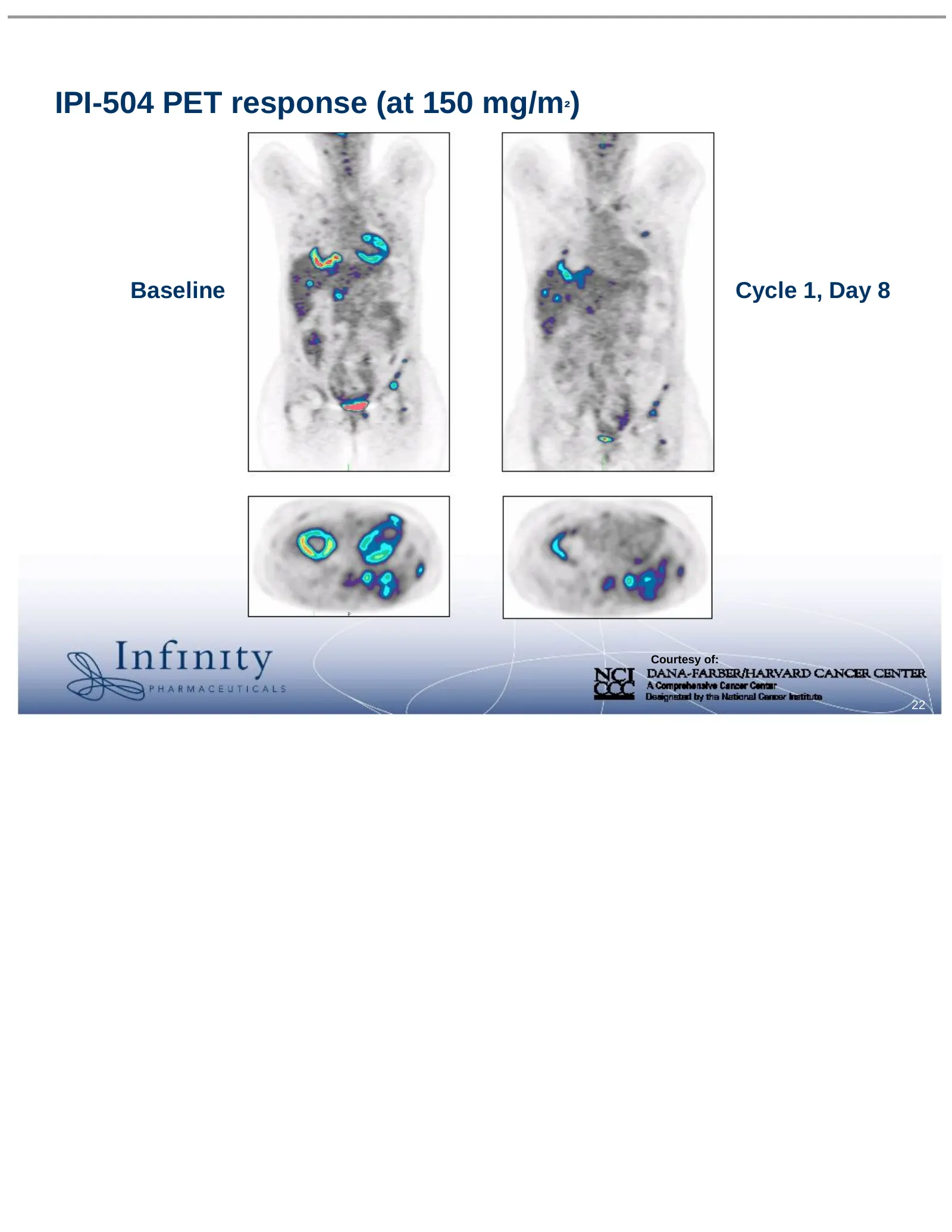
Slide 22: IPI-504 PET response (at 150 mg/m²)
* IPI-504 PET response (at 150 mg/m²) Baseline Cycle 1, Day 8 Courtesy of: 22
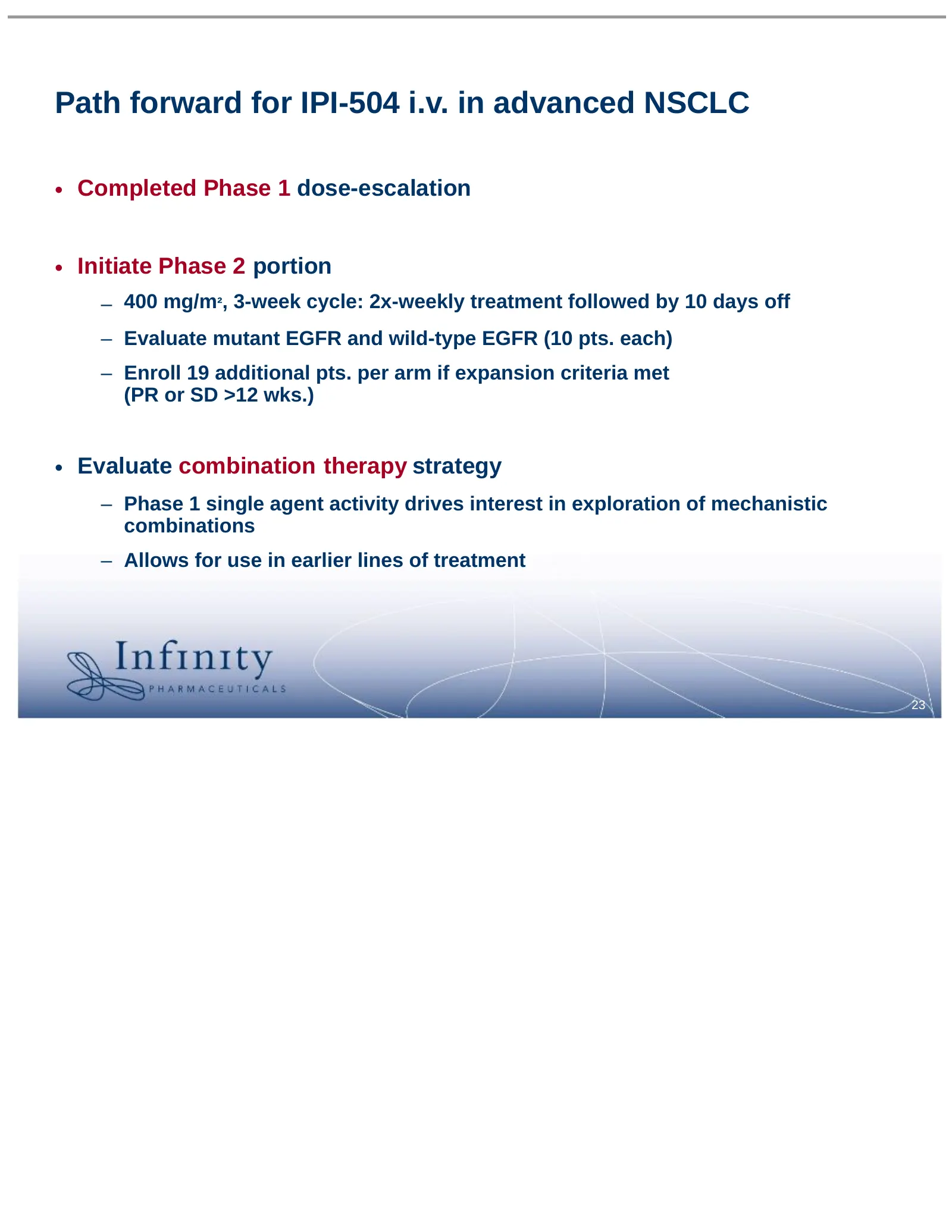
Slide 23: Path forward for IPI-504 i.v. in advanced NSCLC
* * Path forward for IPI-504 i.v. in advanced NSCLC • Completed Phase 1 dose-escalation • Initiate Phase 2 portion – 400 mg/m², 3-week cycle: 2x-weekly treatment followed by 10 days off – Evaluate mutant EGFR and wild-type EGFR (10 pts. each) – Enroll 19 additional pts. per arm if expansion criteria
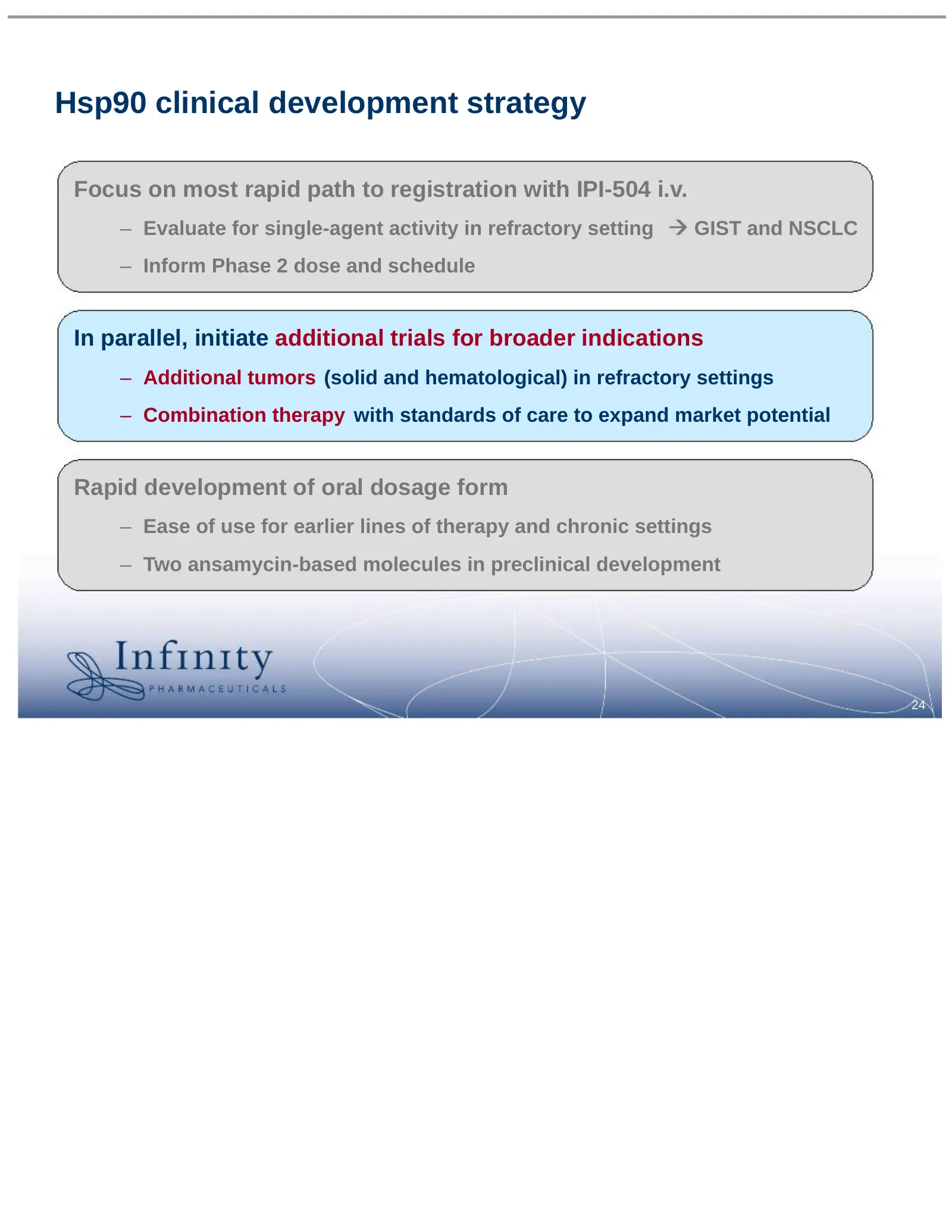
Slide 24: Hsp90 clinical development strategy
* Hsp90 clinical development strategy Focus on most rapid path to registration with IPI-504 i.v. – Evaluate for single-agent activity in refractory setting GIST and NSCLC – Inform Phase 2 dose and schedule In parallel, initiate additional trials for broader indications – Additional tumors (solid and
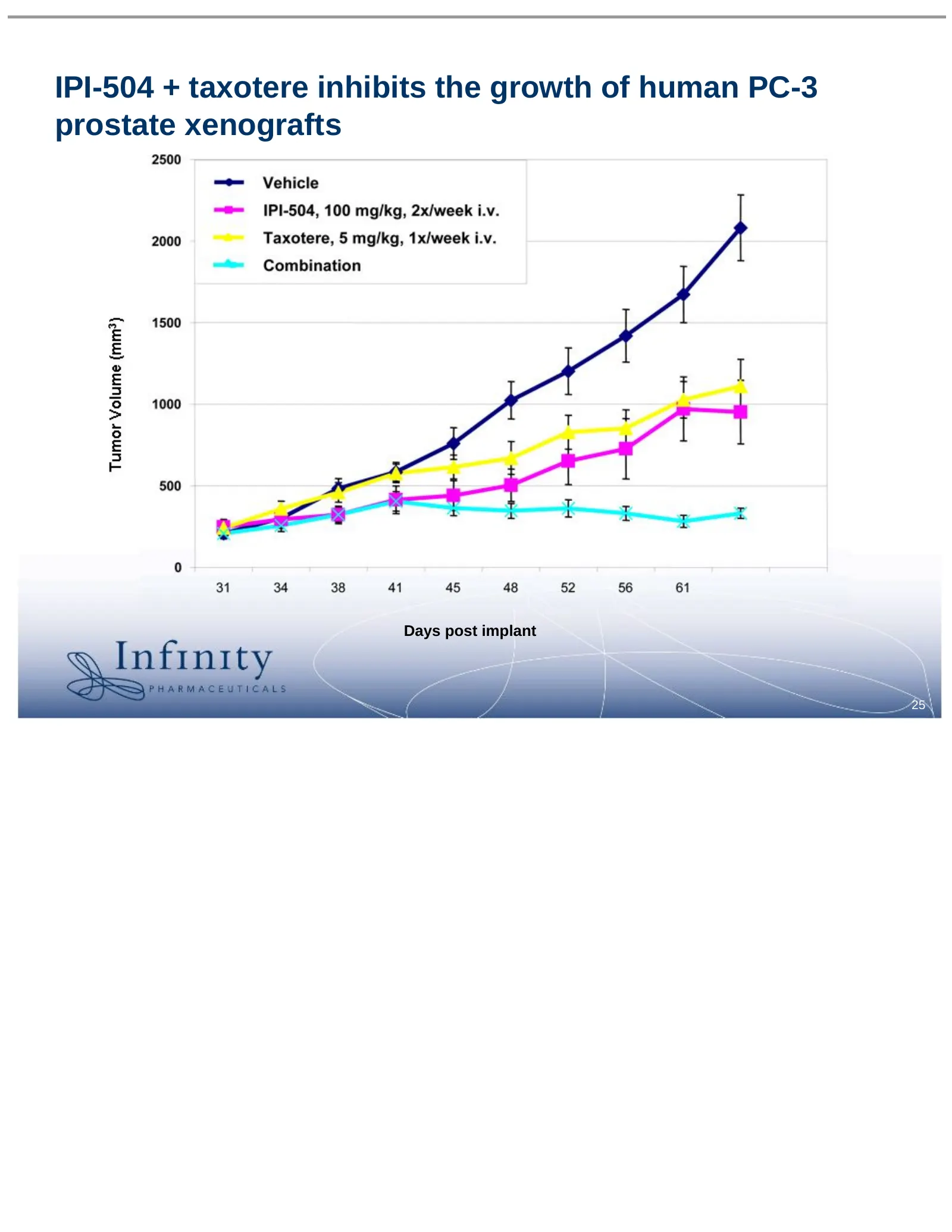
Slide 25: IPI-504 + taxotere inhibits the growth of human PC-3 prostate xenografts
* * IPI-504 + taxotere inhibits the growth of human PC-3 prostate xenografts Days post implant 25
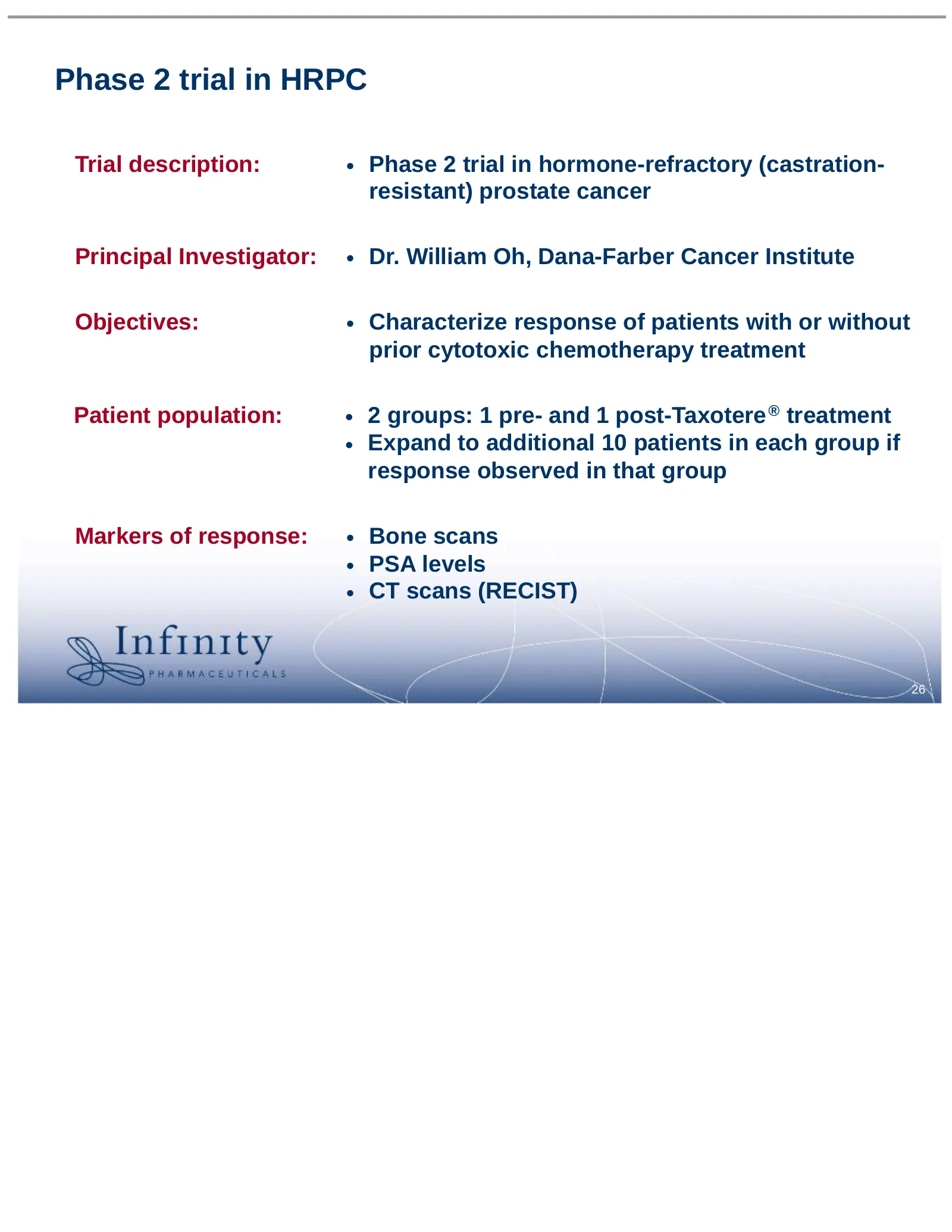
Slide 26: Phase 2 trial in HRPC
* Phase 2 trial in HRPC Trial description: • Phase 2 trial in hormone-refractory (castration- resistant) prostate cancer Principal Investigator: • Dr. William Oh, Dana-Farber Cancer Institute Objectives: • Characterize response of patients with or without prior cytotoxic chemotherapy treatment Patie
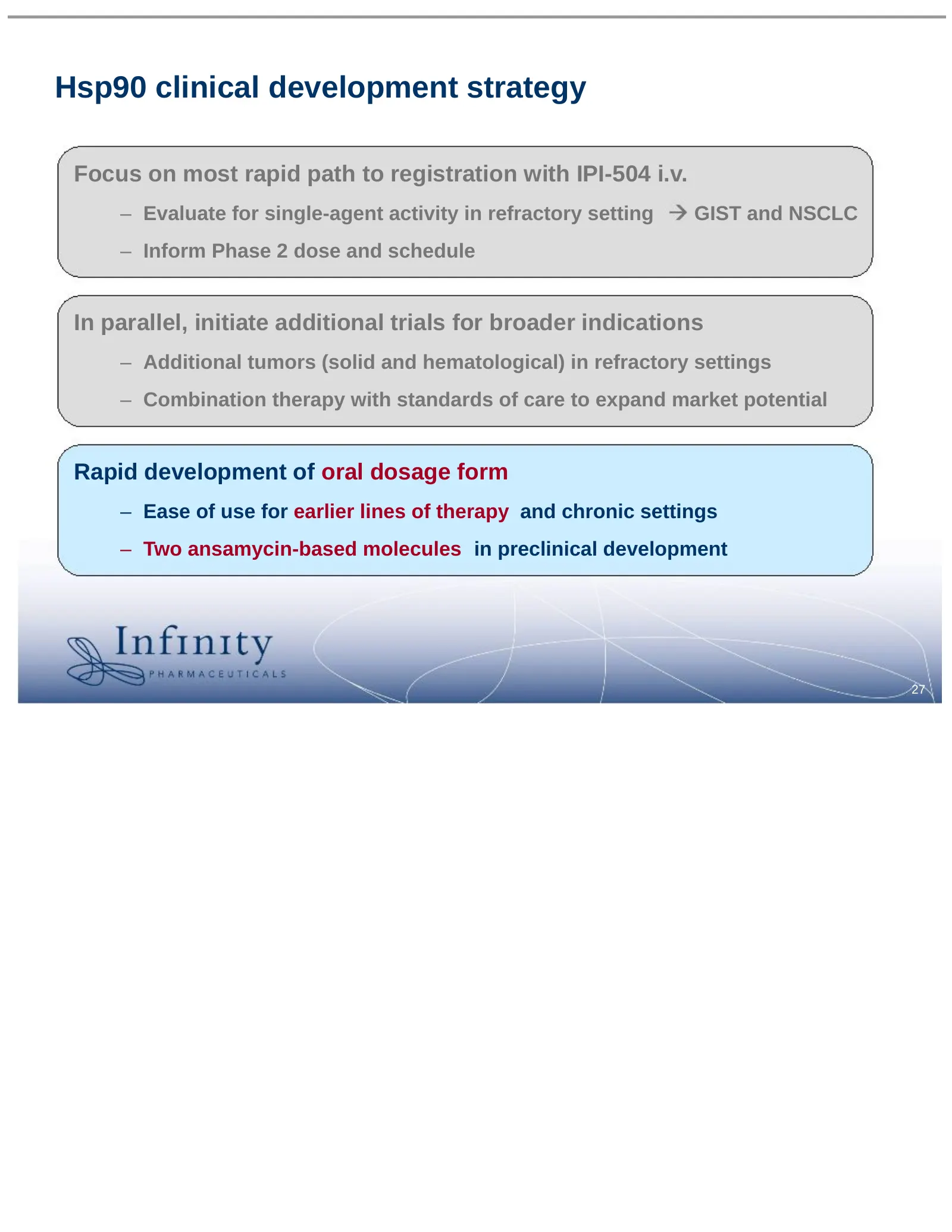
Slide 27: Hsp90 clinical development strategy
* Hsp90 clinical development strategy Focus on most rapid path to registration with IPI-504 i.v. – Evaluate for single-agent activity in refractory setting GIST and NSCLC – Inform Phase 2 dose and schedule In parallel, initiate additional trials for broader indications – Additional tumors (solid and
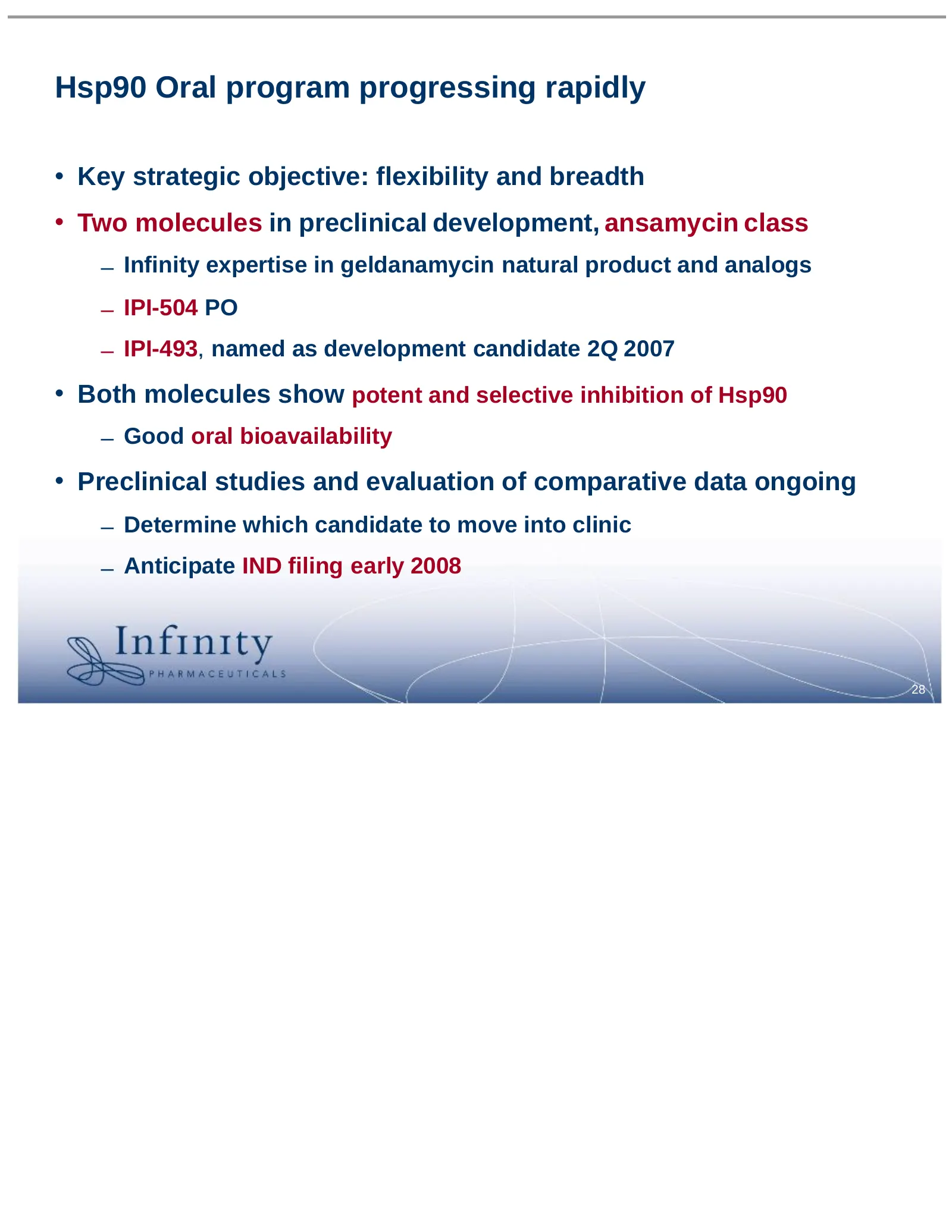
Slide 28: Hsp90 Oral program progressing rapidly
* Hsp90 Oral program progressing rapidly • Key strategic objective: flexibility and breadth • Two molecules in preclinical development, ansamycin class – Infinity expertise in geldanamycin natural product and analogs – IPI-504 PO – IPI-493, named as development candidate 2Q 2007 • Both molecules sho
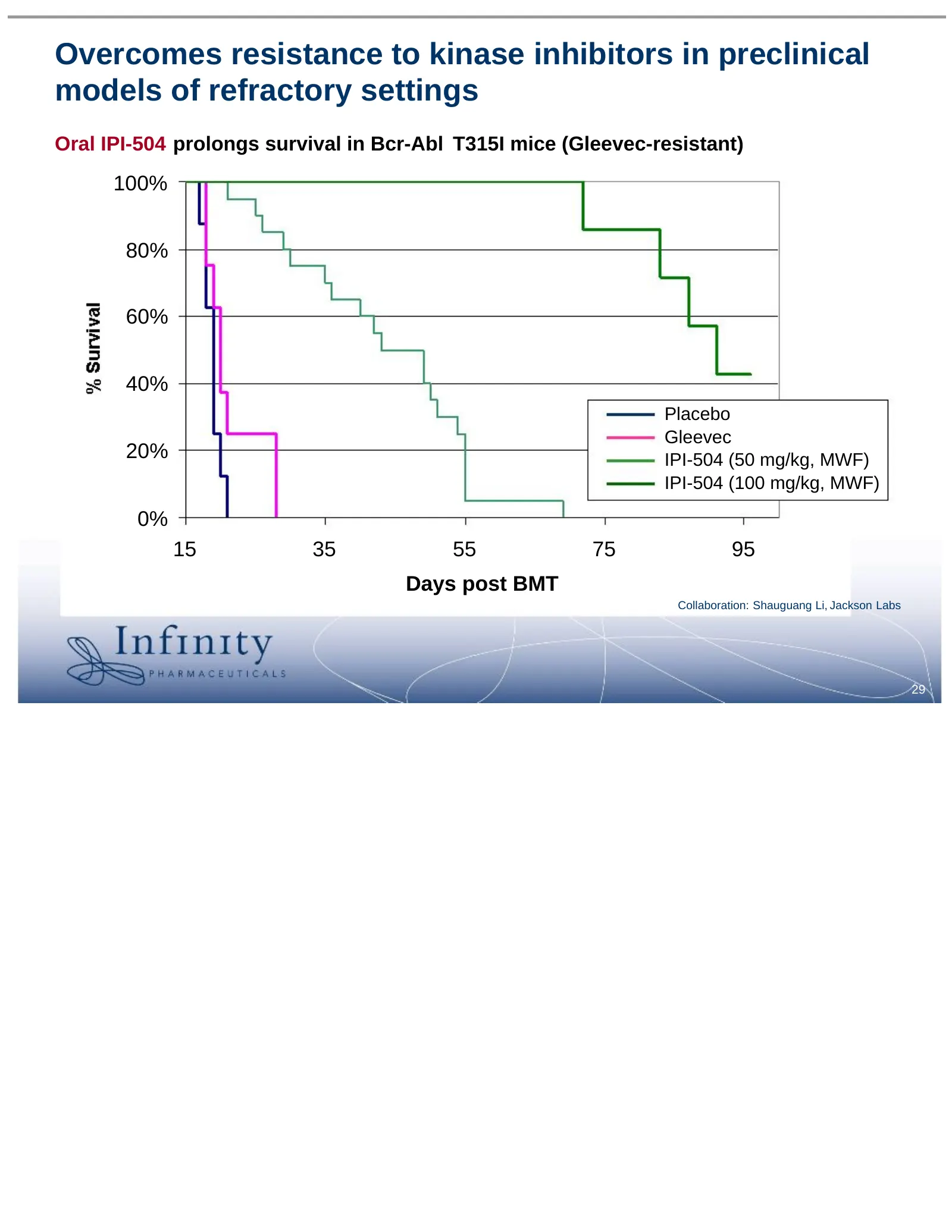
Slide 29: Overcomes resistance to kinase inhibitors in preclinical models of refractory settings
* Overcomes resistance to kinase inhibitors in preclinical models of refractory settings Oral IPI-504 prolongs survival in Bcr-Abl T315I mice (Gleevec-resistant) 100% 80% 60% 40% Placebo Gleevec 20% IPI-504 (50 mg/kg, MWF) IPI-504 (100 mg/kg, MWF) 0% 15 35 55 75 95 Days post BMT Collaboration: Shaug
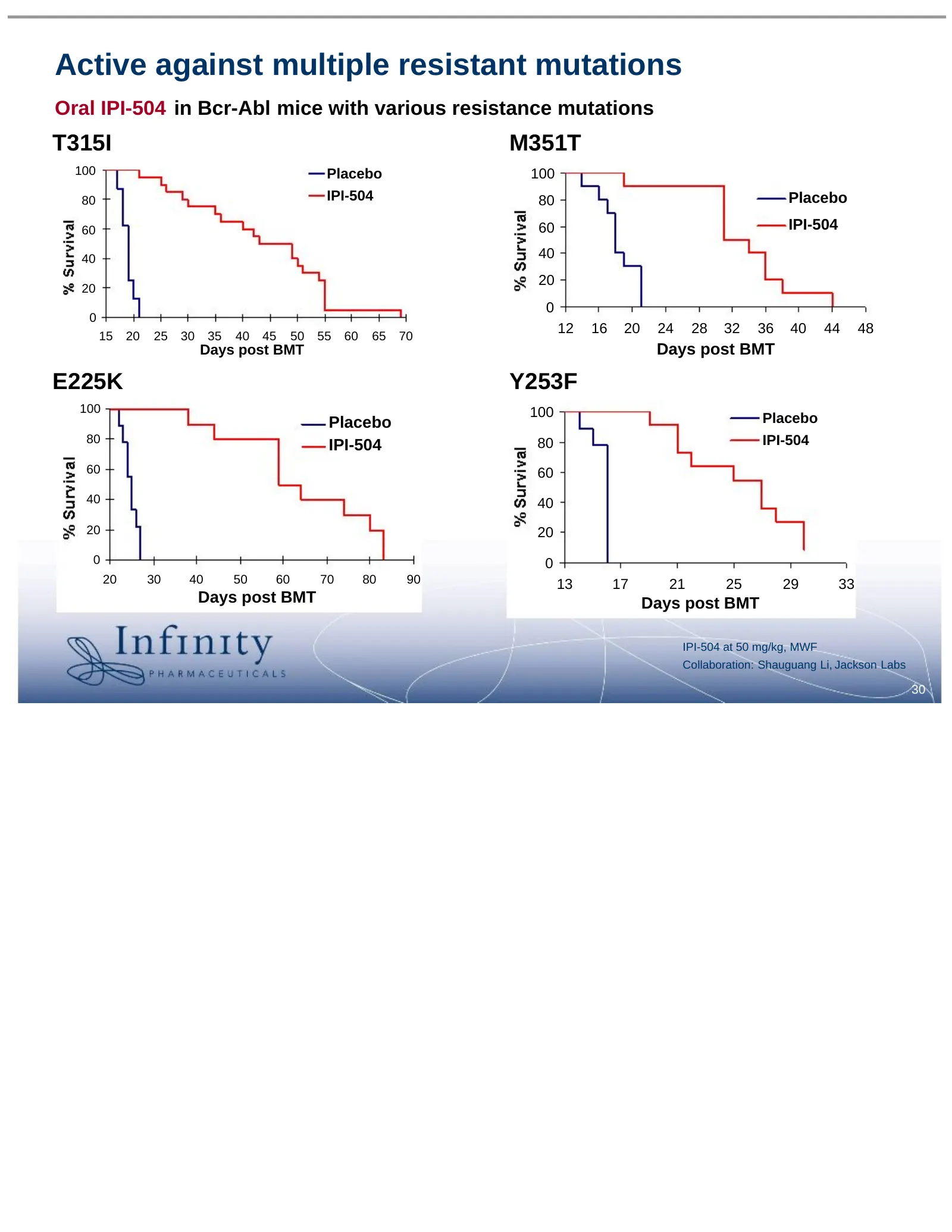
Slide 30: Active against multiple resistant mutations
* Active against multiple resistant mutations Oral IPI-504 in Bcr-Abl mice with various resistance mutations T315I M351T 100 Placebo 100 80 IPI-504 80 Placebo 60 60 IPI-504 40 40 20 20 0 0 15 20 25 30 35 40 45 50 55 60 65 70 12 16 20 24 28 32 36 40 44 48 Days post BMT Days post BMT E225K Y253F 100 1
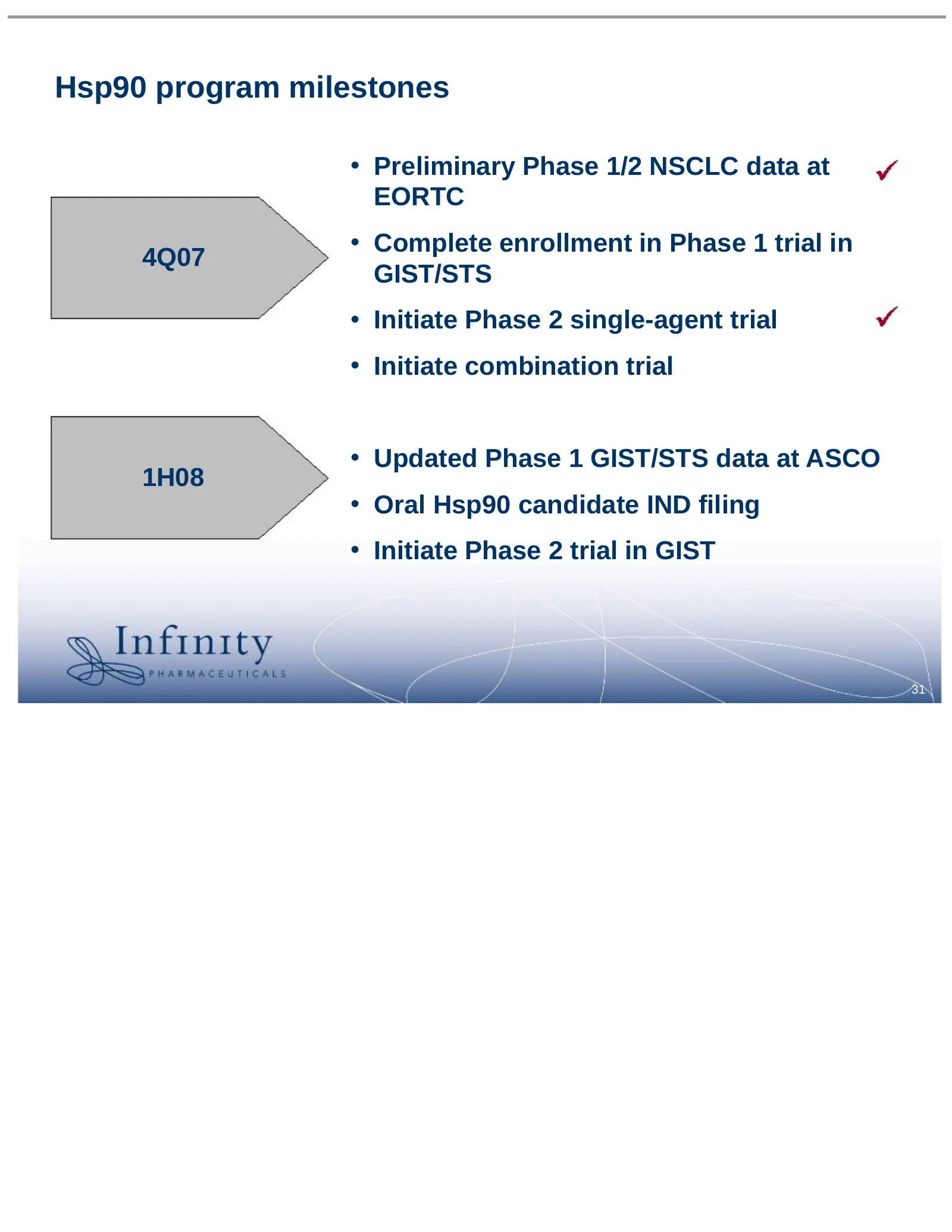
Slide 31: Hsp90 program milestones
* Hsp90 program milestones • Preliminary Phase 1/2 NSCLC data at EORTC • Complete enrollment in Phase 1 trial in 4Q07 GIST/STS • Initiate Phase 2 single-agent trial • Initiate combination trial • Updated Phase 1 GIST/STS data at ASCO 1H08 • Oral Hsp90 candidate IND filing • Initiate Phase 2 trial in
Slide 32: Preclinical programs Hedgehog, Bcl-2
* * * * * * Preclinical programs Hedgehog, Bcl-2 32
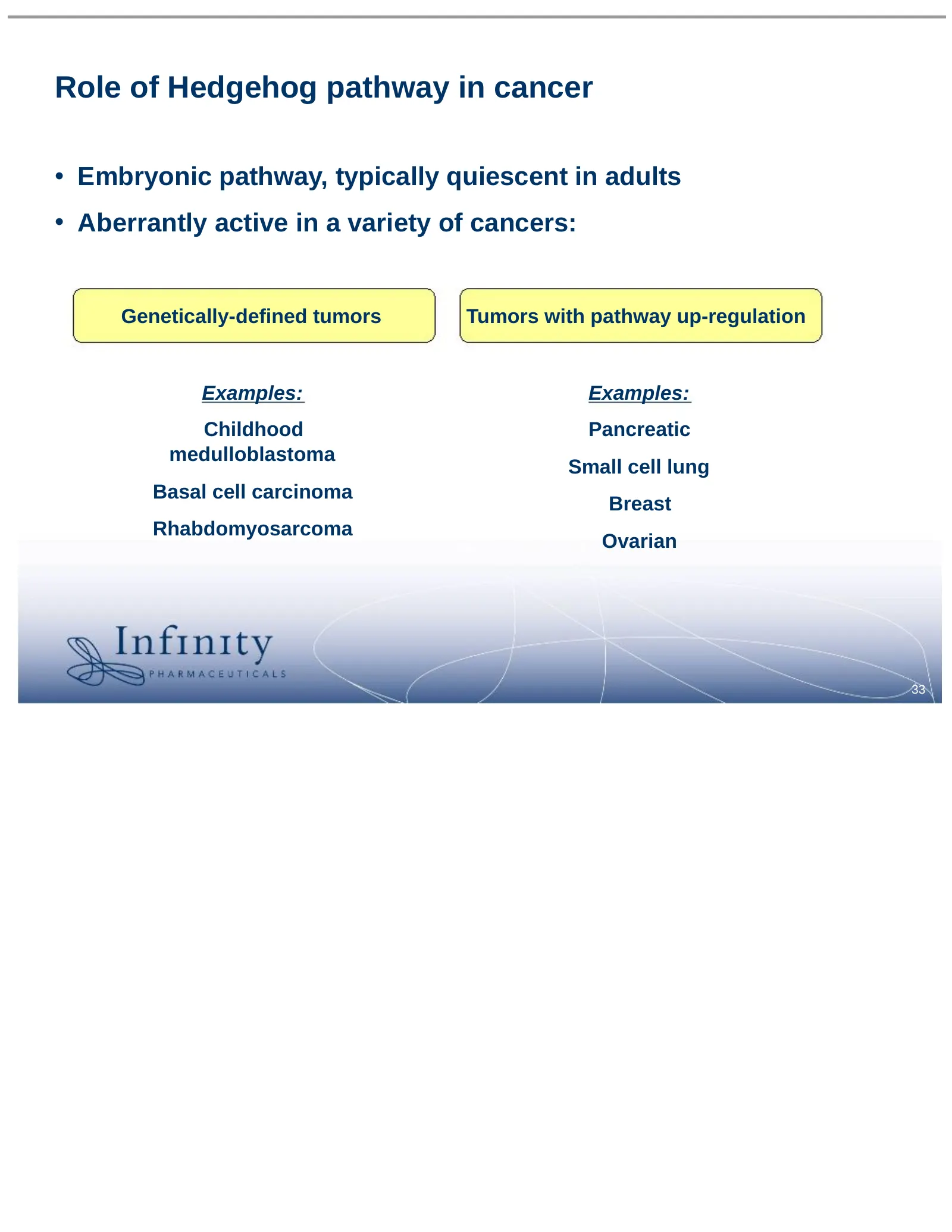
Slide 33: Role of Hedgehog pathway in cancer
* Role of Hedgehog pathway in cancer • Embryonic pathway, typically quiescent in adults • Aberrantly active in a variety of cancers: Genetically-defined tumors Tumors with pathway up-regulation Examples: Examples: Childhood Pancreatic medulloblastoma Small cell lung Basal cell carcinoma Breast Rhabd
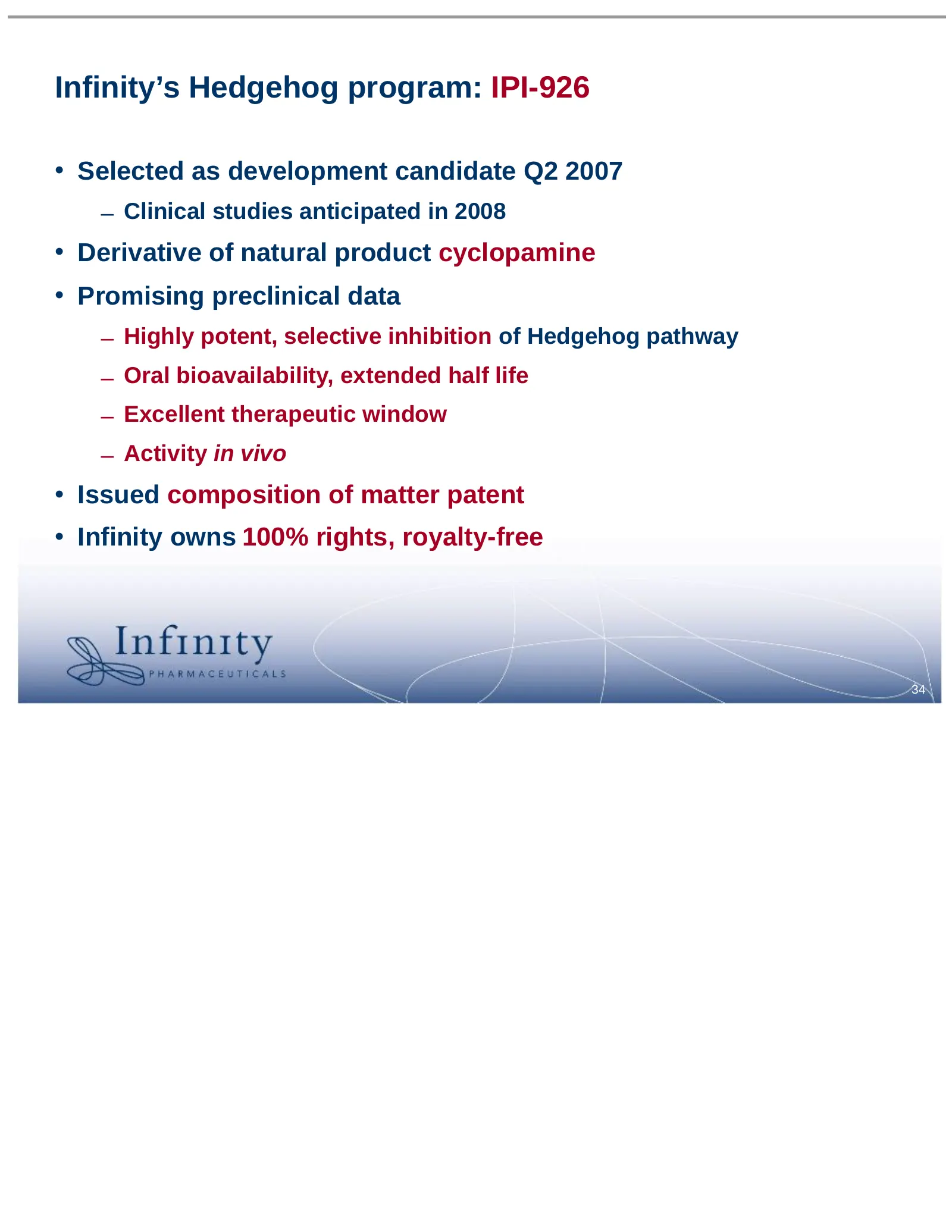
Slide 34: Infinity’s Hedgehog program: IPI-926
* Infinity’s Hedgehog program: IPI-926 • Selected as development candidate Q2 2007 – Clinical studies anticipated in 2008 • Derivative of natural product cyclopamine • Promising preclinical data – Highly potent, selective inhibition of Hedgehog pathway – Oral bioavailability, extended half life – Ex
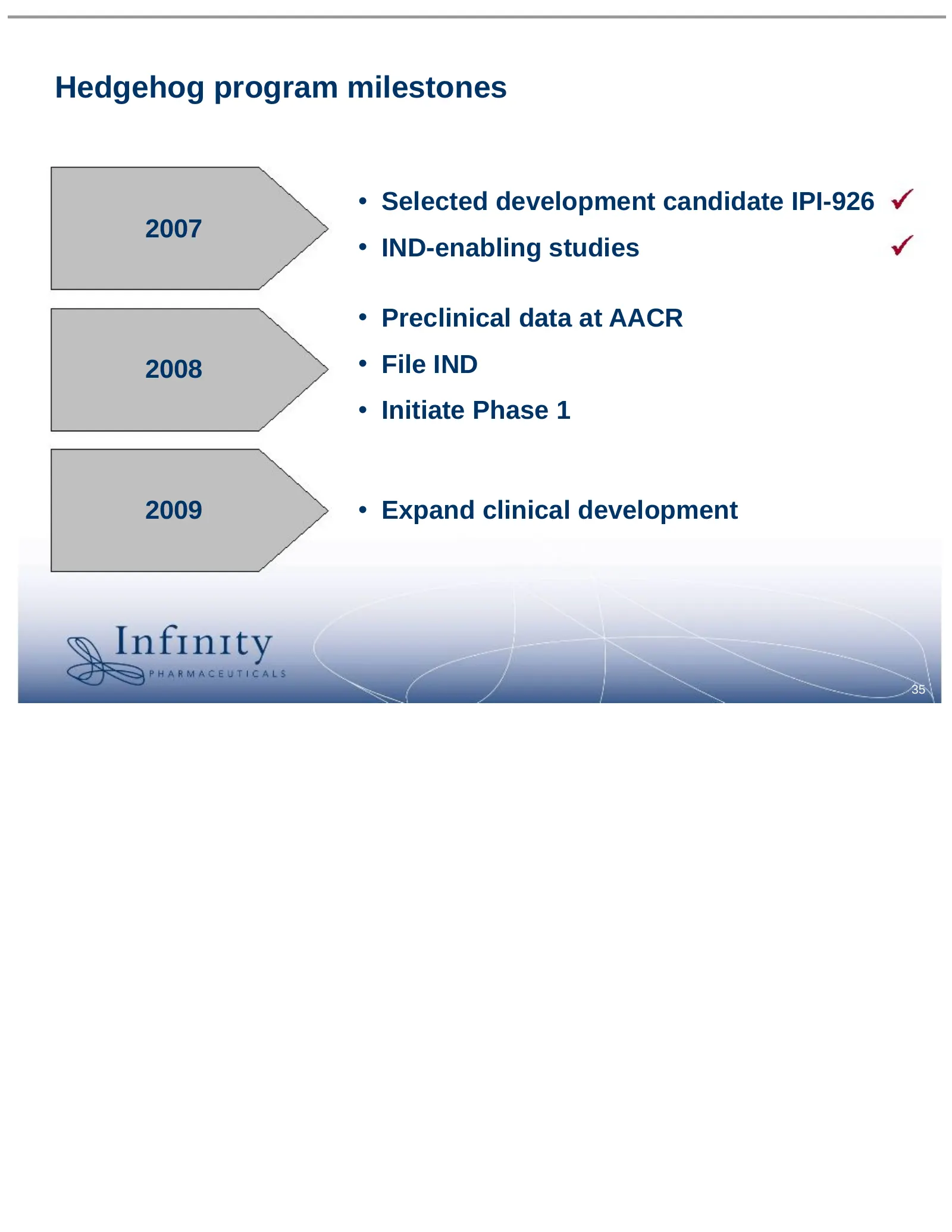
Slide 35: Hedgehog program milestones
* Hedgehog program milestones • Selected development candidate IPI-926 2007 • IND-enabling studies • Preclinical data at AACR 2008 • File IND • Initiate Phase 1 2009 • Expand clinical development 35
Slide 36: Corporate Summary: Strong validation, significant value retention
* * * * * * Corporate Summary Strong validation, significant value retention 36
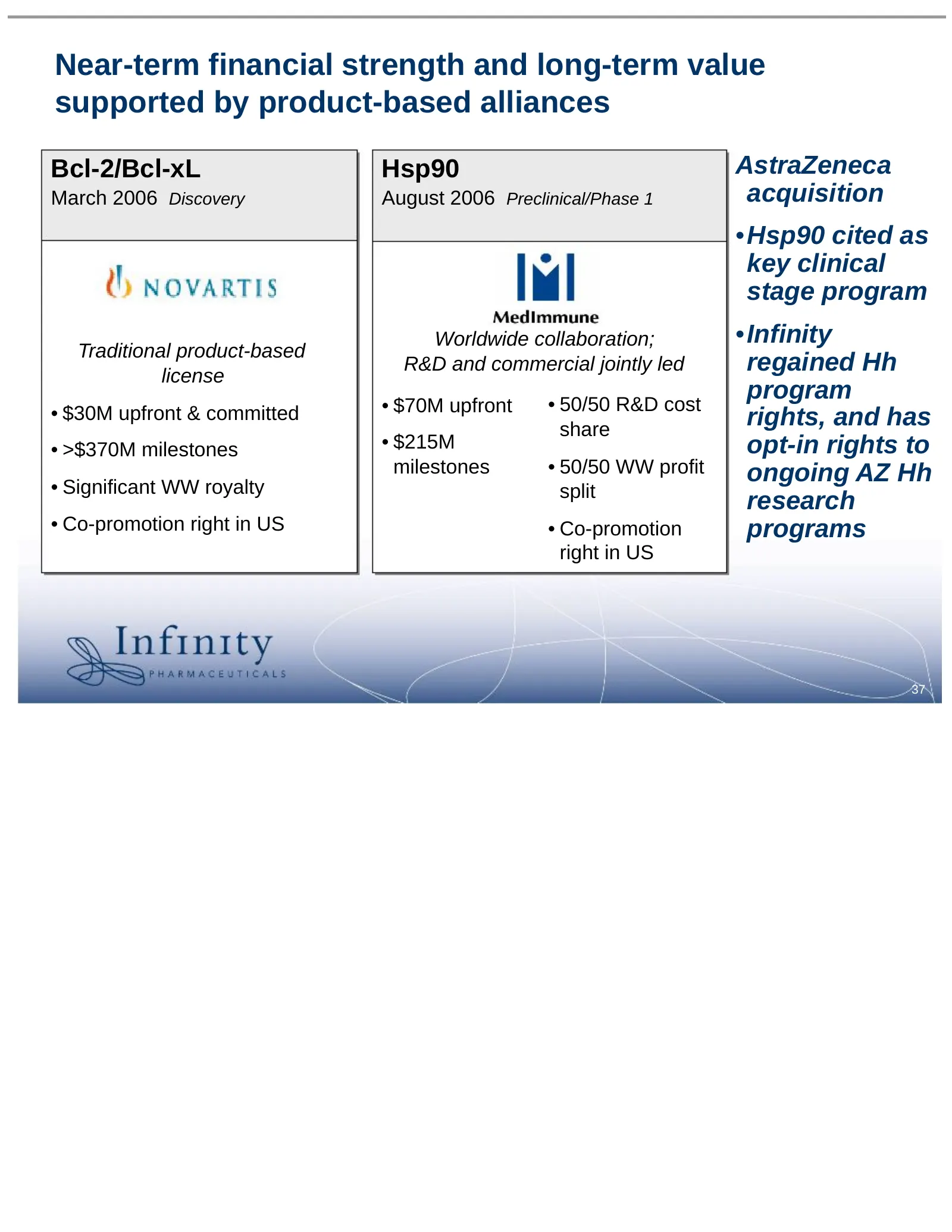
Slide 37: Near-term financial strength and long-term value supported by product-based alliances
* Near-term financial strength and long-term value supported by product-based alliances Bcl-2/Bcl-xL Hsp90 AstraZeneca March 2006 Discovery August 2006 Preclinical/Phase 1 acquisition •Hsp90 cited as key clinical stage program Worldwide collaboration; •Infinity Traditional product-based license R&D
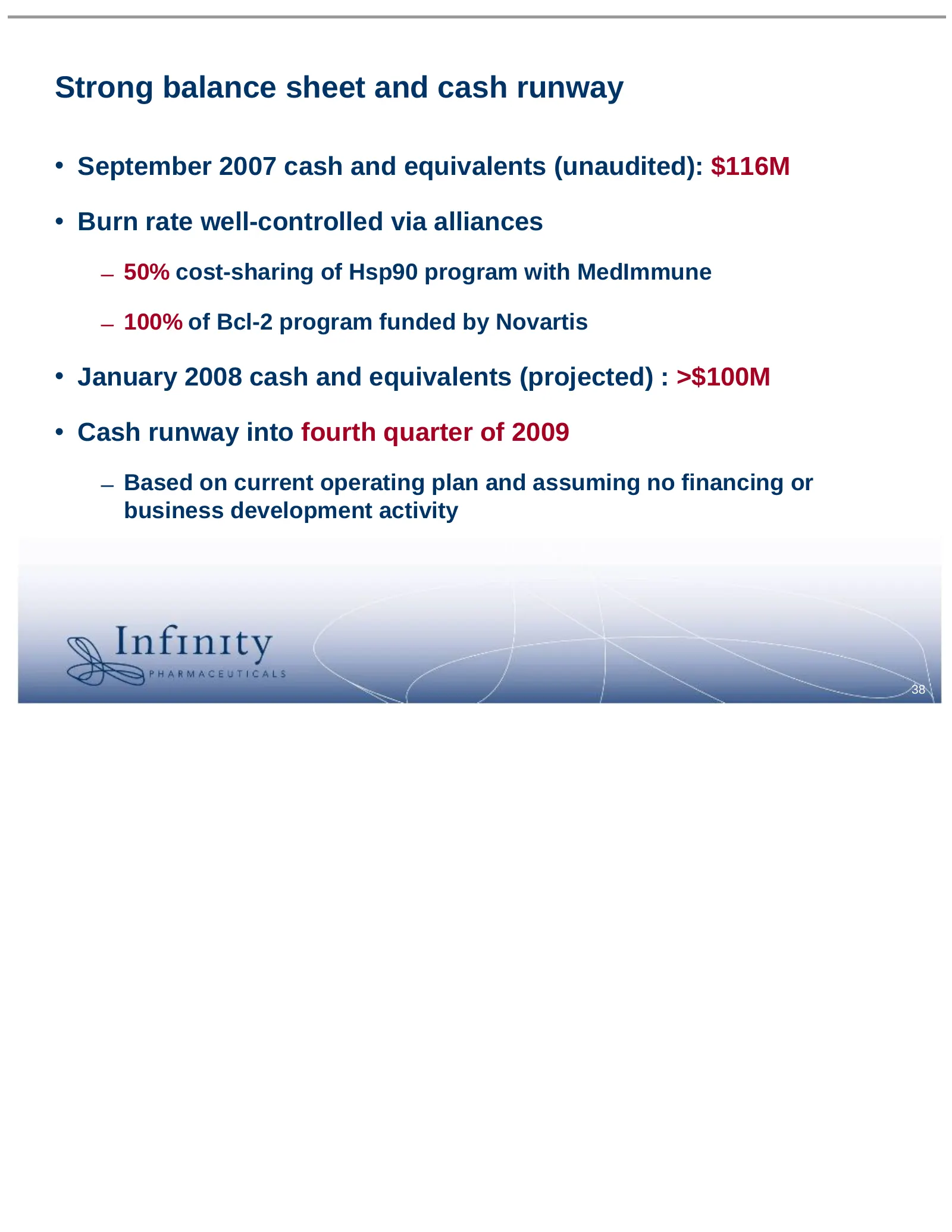
Slide 38: Strong balance sheet and cash runway
* Strong balance sheet and cash runway • September 2007 cash and equivalents (unaudited): $116M • Burn rate well-controlled via alliances – 50% cost-sharing of Hsp90 program with MedImmune – 100% of Bcl-2 program funded by Novartis • January 2008 cash and equivalents (projected) : >$100M • Cash runw
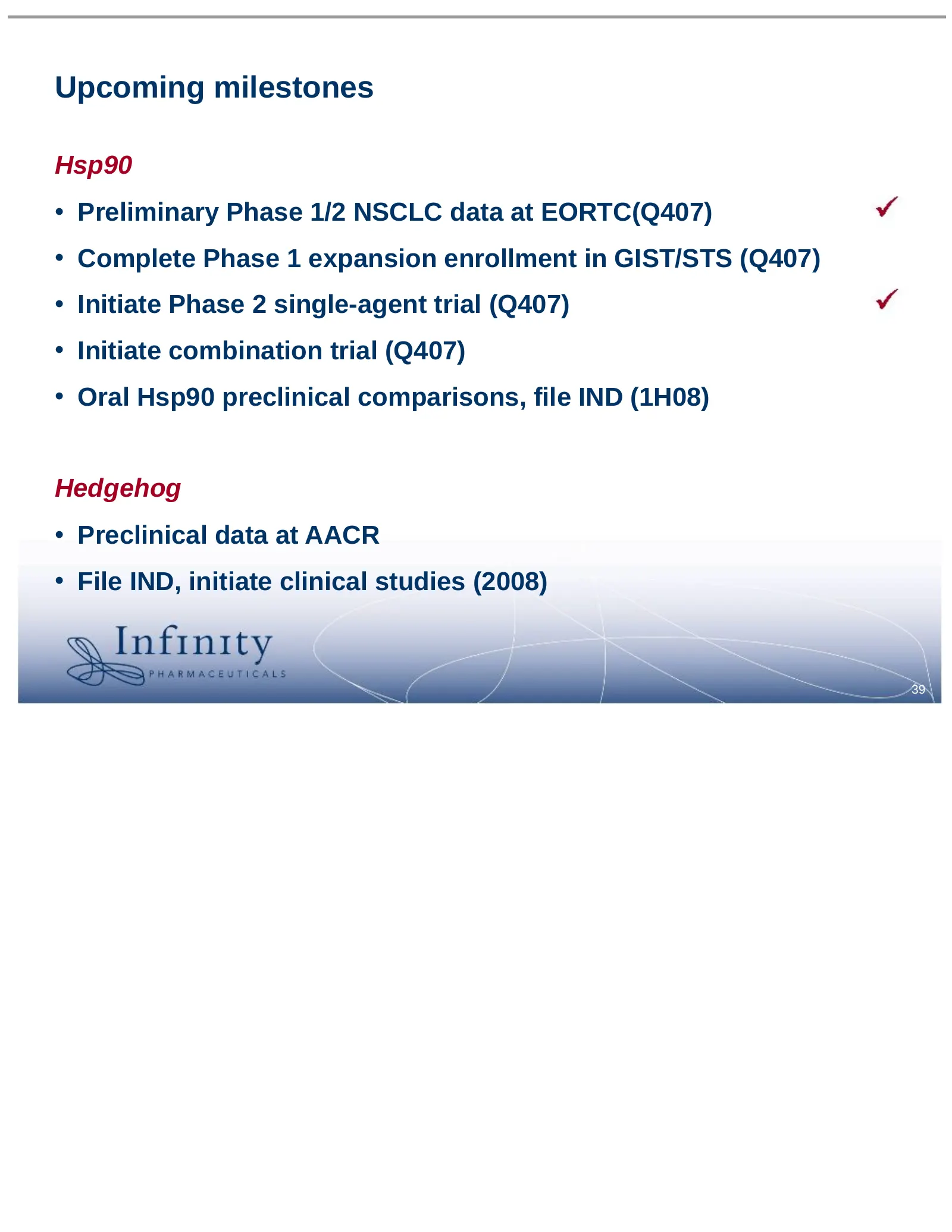
Slide 39: Upcoming milestones
* Upcoming milestones Hsp90 • Preliminary Phase 1/2 NSCLC data at EORTC(Q407) • Complete Phase 1 expansion enrollment in GIST/STS (Q407) • Initiate Phase 2 single-agent trial (Q407) • Initiate combination trial (Q407) • Oral Hsp90 preclinical comparisons, file IND (1H08) Hedgehog • Preclinical data
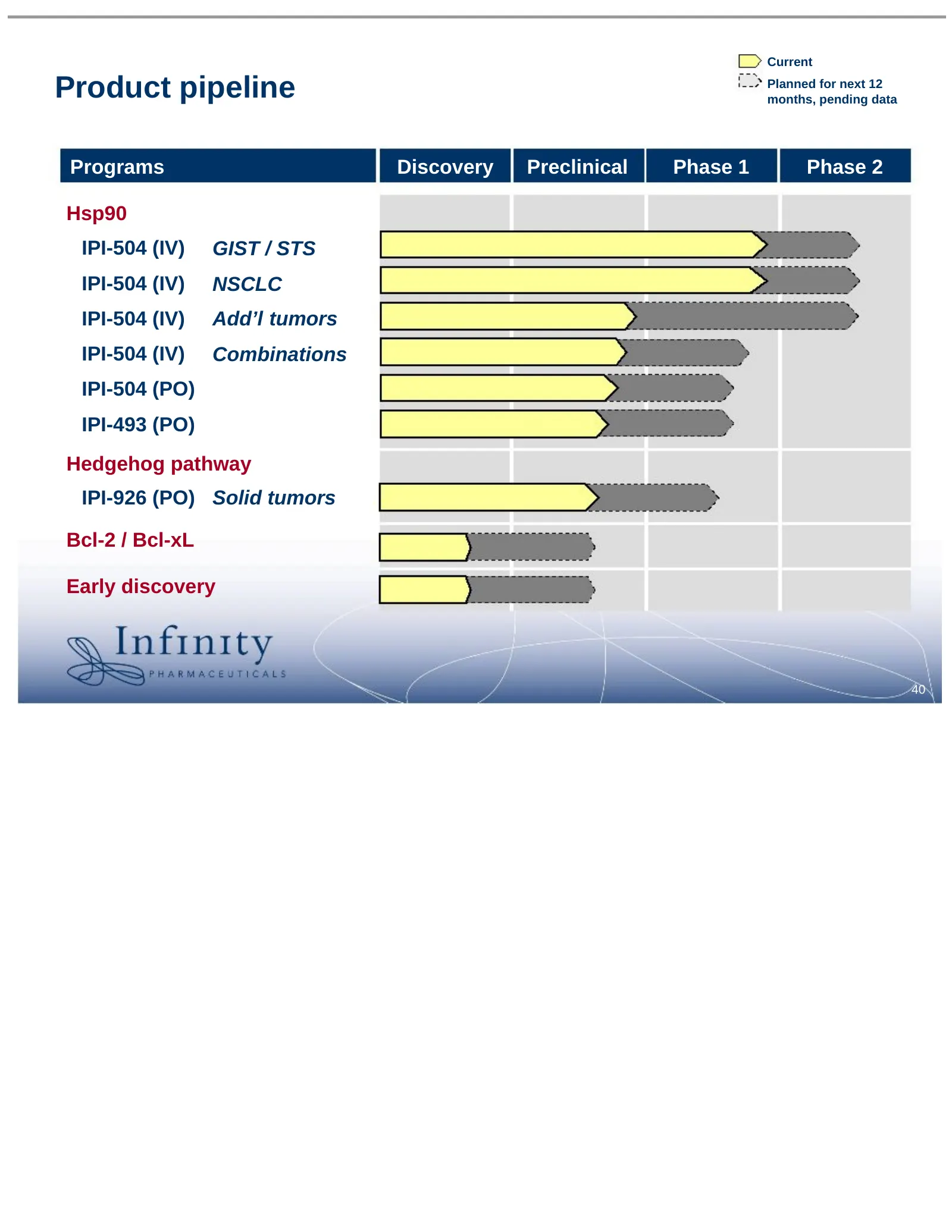
Slide 40: Product pipeline
* Current Product pipeline Planned for next 12 months, pending data Programs Discovery Preclinical Phase 1 Phase 2 Hsp90 IPI-504 (IV) GIST / STS IPI-504 (IV) NSCLC IPI-504 (IV) Add’l tumors IPI-504 (IV) Combinations IPI-504 (PO) IPI-493 (PO) Hedgehog pathway IPI-926 (PO) Solid tumors Bcl-2 / Bcl-xL
Slide 41: Infinity Pharmaceuticals (NASDAQ: INFI)
* Infinity Pharmaceuticals (NASDAQ: INFI) November 2007
Source: SEC EDGAR · 8-K filed Nov 13, 2007
More decks from Infinity Pharmaceuticals, Inc.
 Merger or Acquisition (June 2023)89 slides · Jun 20, 2023
 Merger or Acquisition (February 2023)39 slides · Feb 23, 2023
 Technical Presentation (July 2021)54 slides · Jul 27, 2021
 Technical Presentation (February 2021)53 slides · Feb 11, 2021
 SABCS 2020 Investor Event32 slides · Dec 9, 2020
 Corporate Update (January 2016)47 slides · Jan 11, 2016