Stewart Information Services Corporation · NYSE:STC
Stewart Information Services — Investor Presentation (February 2019)
52 slides from Stewart Information Services's investor presentation, Feb 21, 2019
Slide 1: Welcome to today's webinar! Basic Bankruptcy
Welcome to today’s webinar! Basic Bankruptcy Victor A. Davis February 21, 2019
Slide 2: CE Certificate or CLE Credit requirements
▪ In order to obtain a CE Certificate or CLE Credit, you must ▪ listen to the webinar for a minimum of 55 minutes ▪ obtain the password (provided at the end of the presentation) ▪ follow the instructions as given 2
Slide 3: Attorney Information
ATTORNEY INFORMATION Because of opinions expressed by the Texas Department of Insurance (TDI) concerning rebates, legal credit is available only to: • Attorneys who own title agencies that are Stewart Title Guaranty Agents • Attorneys employed by a title insurance agent licensed with Stewart Title G
Slide 4: Basic Bankruptcy - Victor A. Davis
Basic Bankruptcy Victor A. Davis Underwriter Stewart Title Guaranty Company Houston, Texas
Slide 5: Basic Bankruptcy
Basic Bankruptcy • What is Bankruptcy? • What are the types? • What happens? • What is in the Estate? • Who can sell during? • What is a Discharge? • Who can sell after? 5
Slide 6: Bankruptcy—What is it?
Bankruptcy—What is it? Title 11 of the U. S. Code Article 1, Section 8 of the U.S. Constitution authorizes Congress to enact uniform laws on the subject of bankruptcy throughout the United States. Title 11 of the U.S. Code is the “Bankruptcy Code”. We Americans believe in second chances. People or e
Slide 7: The Debtor and the Creditors
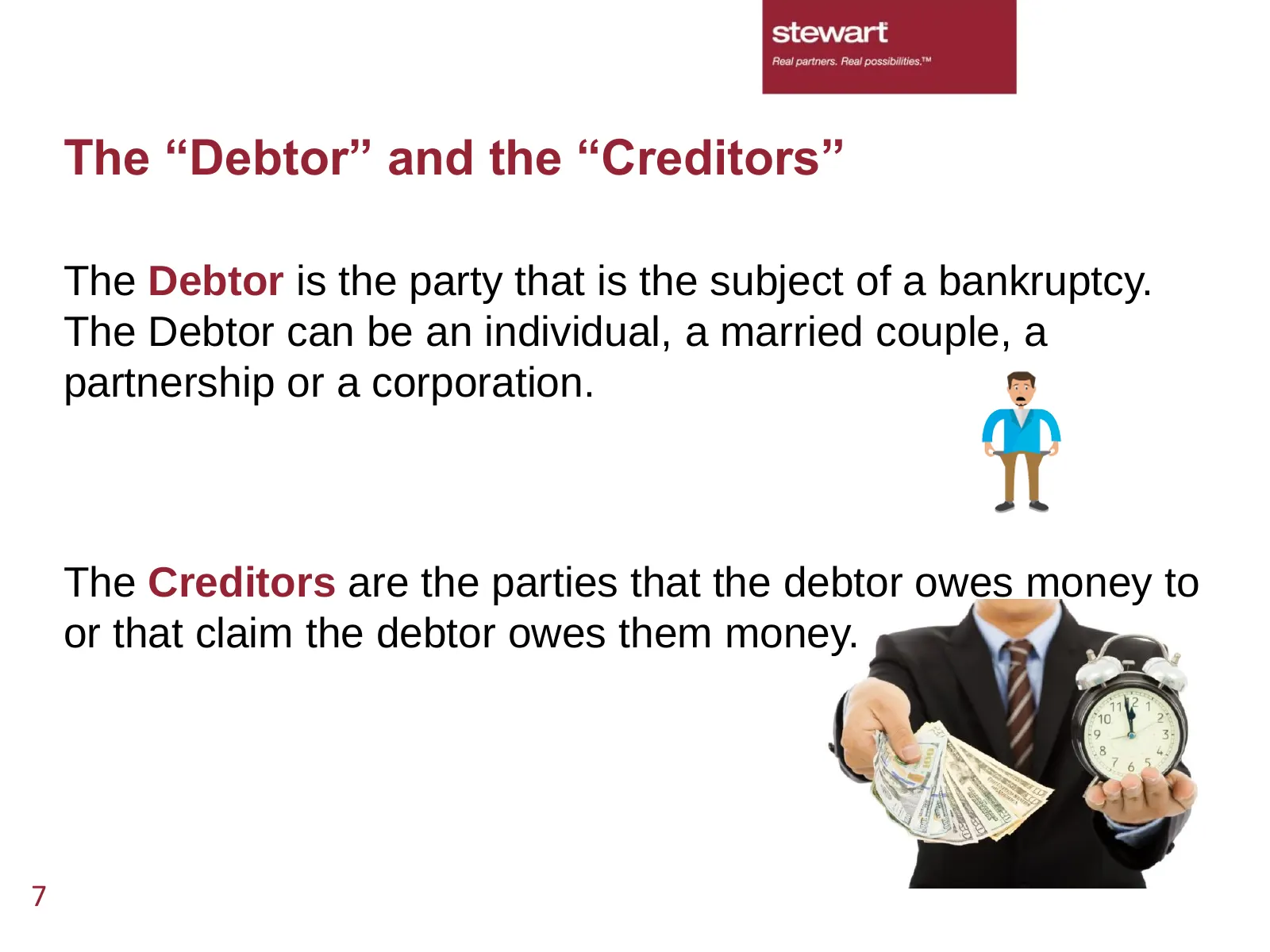
The “Debtor” and the “Creditors” The Debtor is the party that is the subject of a bankruptcy. The Debtor can be an individual, a married couple, a partnership or a corporation. The Creditors are the parties that the debtor owes money to or that claim the debtor owes them money. 7
Slide 8: The Secured and the Unsecured
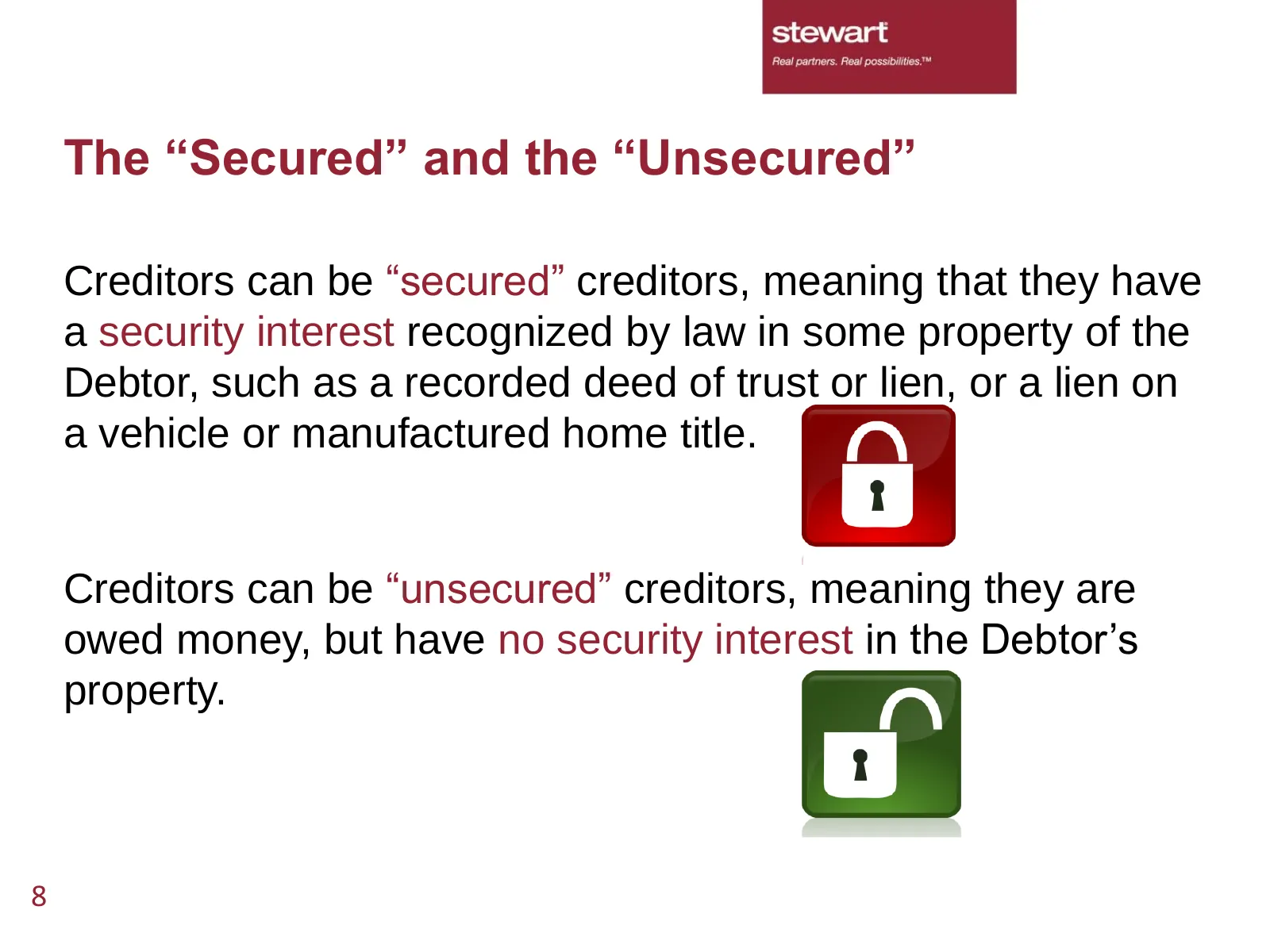
The “Secured” and the “Unsecured” Creditors can be “secured” creditors, meaning that they have a security interest recognized by law in some property of the Debtor, such as a recorded deed of trust or lien, or a lien on a vehicle or manufactured home title. Creditors can be “unsecured” creditors, me
Slide 9: The Chapters of the Code
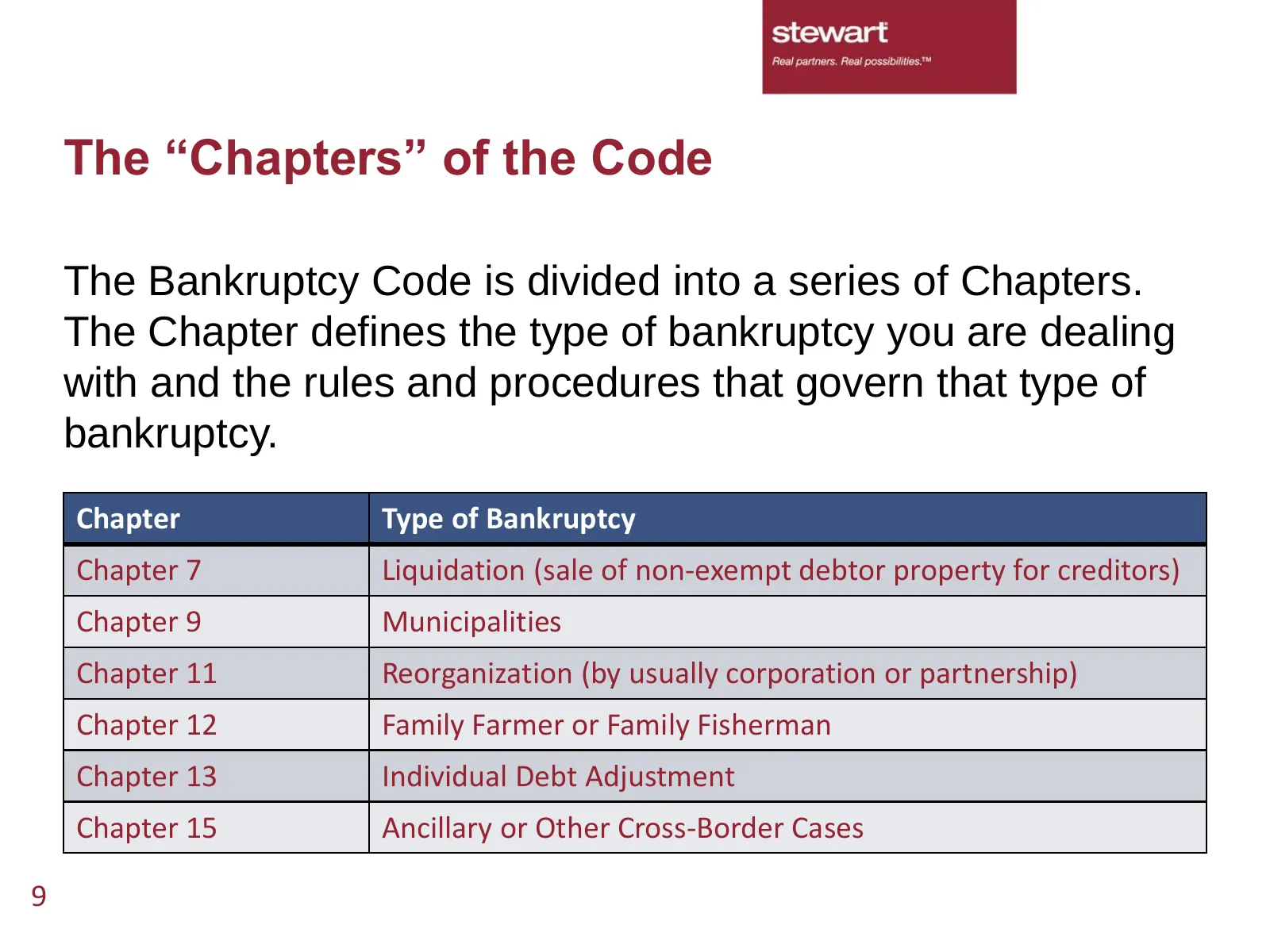
The “Chapters” of the Code The Bankruptcy Code is divided into a series of Chapters. The Chapter defines the type of bankruptcy you are dealing with and the rules and procedures that govern that type of bankruptcy. Chapter Type of Bankruptcy Chapter 7 Liquidation (sale of non-exempt debtor property
Slide 10: The Chapters of the Bankruptcy Code
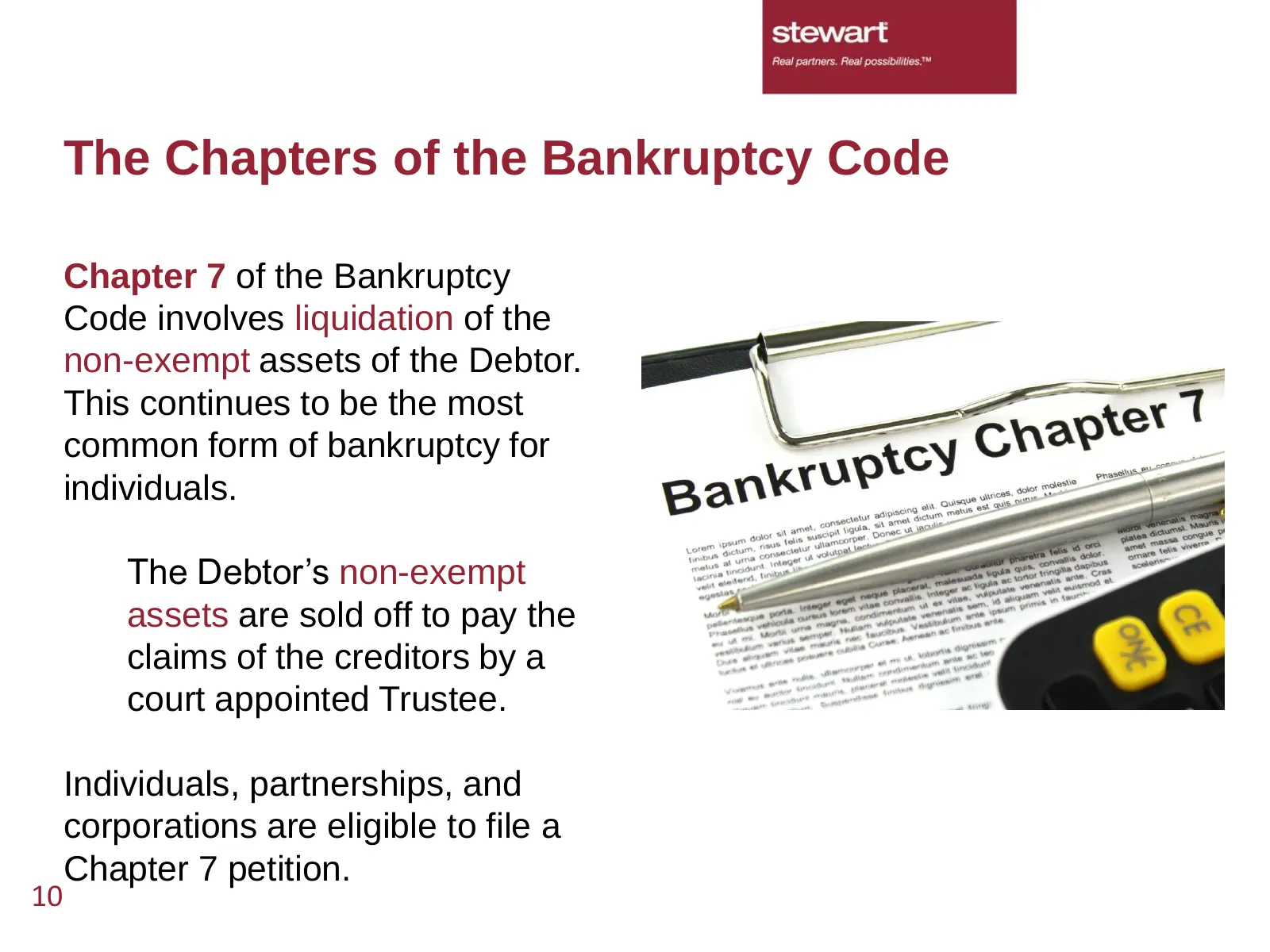
The Chapters of the Bankruptcy Code Chapter 7 of the Bankruptcy Code involves liquidation of the non-exempt assets of the Debtor. This continues to be the most common form of bankruptcy for individuals. The Debtor’s non-exempt assets are sold off to pay the claims of the creditors by a court appoint
Slide 11: The Chapters of the Bankruptcy Code: Chapter 9
The Chapters of the Bankruptcy Code Chapter 9 – Reorganization for Municipalities Allows a “financially distressed municipality” (a political subdivision or a public agency or instrumentality of the state) to adjust its debts. If you ever encounter this, give us a call. 11
Slide 12: The Chapters of the Bankruptcy Code
The Chapters of the Bankruptcy Code Chapter 11 - “Reorganization” - allows an individual, corporation or partnership to retain some of their assets and to use income to pay off some existing creditors. Chapter 11 bankruptcy by individuals is rare; it is used principally by businesses. Plan and Confi
Slide 13: The Chapters of the Bankruptcy Code
The Chapters of the Bankruptcy Code Chapter 12 is another reorganization chapter, but is limited to family farmers and fishermen with at least 80% of their income and 80% of their debts from farming or fishing. The Debtor must submit and have approved by the bankruptcy court a “Plan of Reorganizatio
Slide 14: The Chapters of the Bankruptcy Code
The Chapters of the Bankruptcy Code Chapter 13 is the reorganization chapter for individuals with regular income. The Debtor is eligible for Ch.13 if their unsecured debts are less than $394,725.00 and their secured debts are less than $1,184,200. (adjusted, based on the consumer price index). The D
Slide 15: The Chapters of the Bankruptcy Code
The Chapters of the Bankruptcy Code Chapter 15 is the reorganization chapter for foreign debtors and related parties. The foreign debtor is allowed access to US Bankruptcy Courts to administer assets in the United States. 15
Slide 16: Bankruptcy Filings
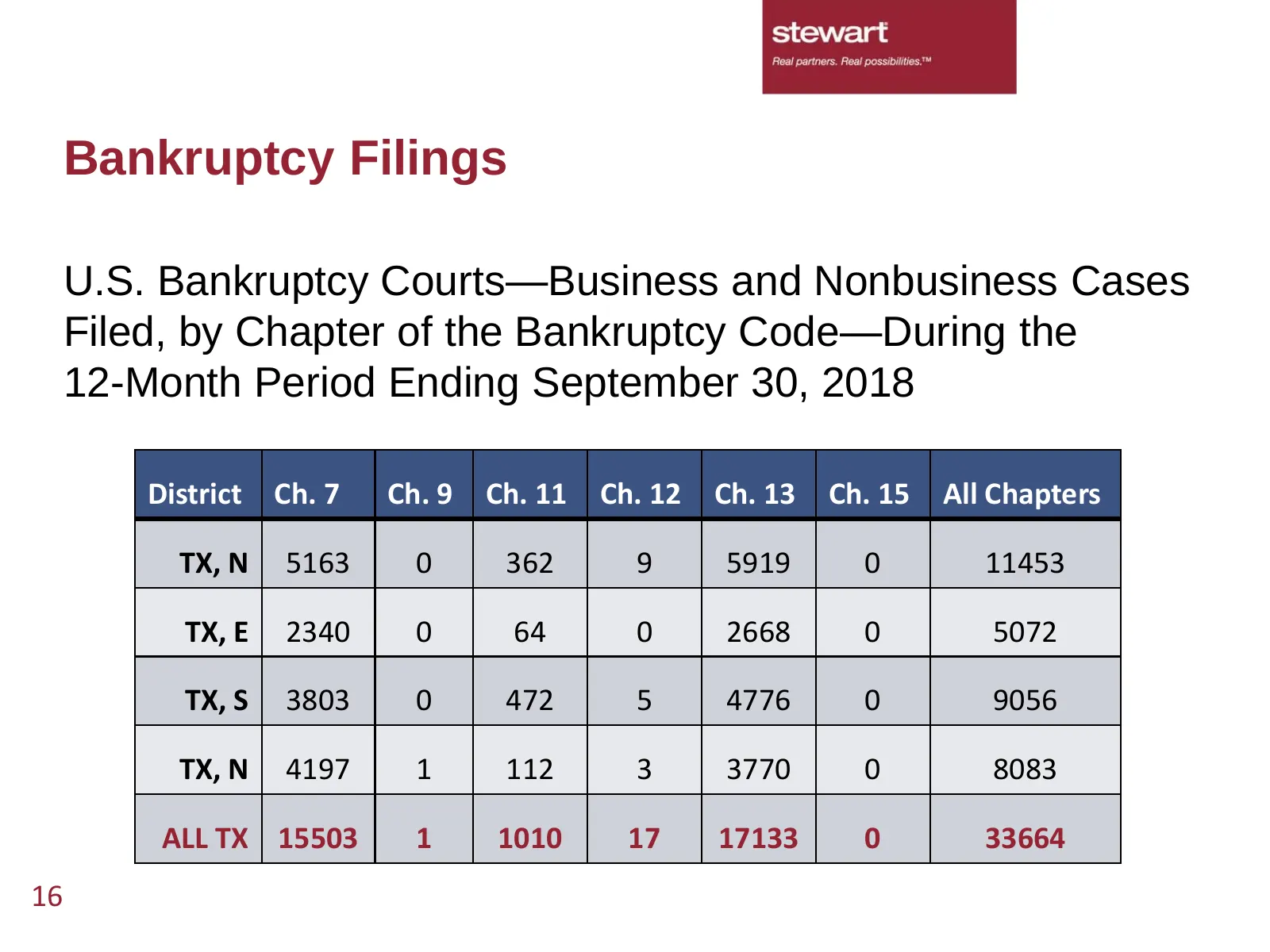
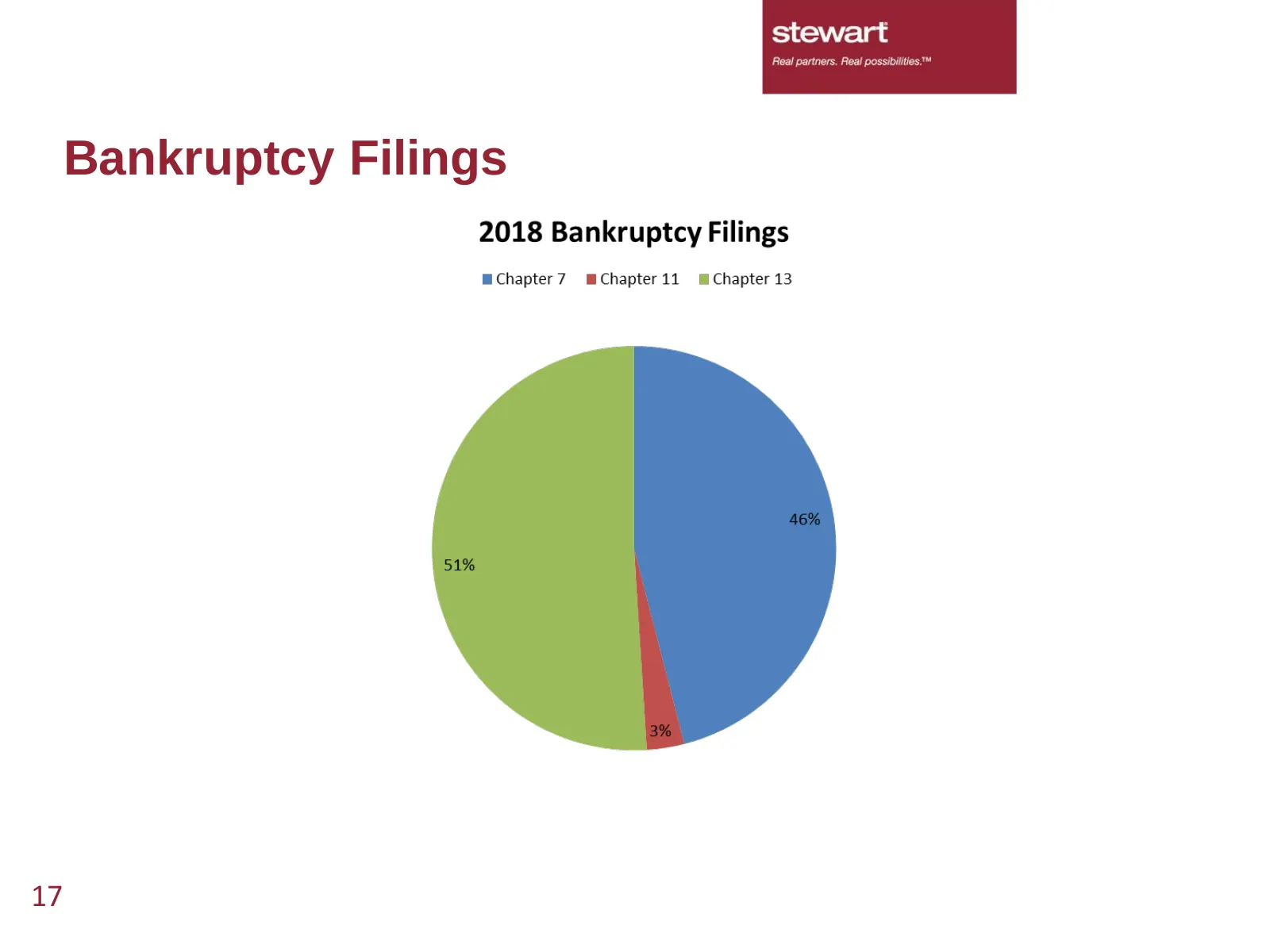
Bankruptcy Filings U.S. Bankruptcy Courts—Business and Nonbusiness Cases Filed, by Chapter of the Bankruptcy Code—During the 12-Month Period Ending September 30, 2018 District Ch. 7 Ch. 9 Ch. 11 Ch. 12 Ch. 13 Ch. 15 All Chapters TX, N 5163 0 362 9 5919 0 11453 TX, E 2340 0 64 0 2668 0 5072 TX, S 380
Slide 17: Bankruptcy Filings
17 Bankruptcy Filings 2018 Bankruptcy Filings @Chapter7 mChapter11 Chapter 13
Slide 18: Commencement of Proceedings
Commencement of Proceedings Voluntary Proceeding A voluntary proceeding is commenced by the filing of the petition. The commencement constitutes an order for relief. Involuntary Proceeding An involuntary proceeding may be commenced only under Chapter 7 (liquidations) or under Chapter 11 (reorganizat
Slide 19: Commencement of Proceedings
Commencement of Proceedings Death or Insanity of Debtor Once the estate is created, no interests in property of the estate remain in the debtor. Therefore, if the debtor dies or becomes insane after the commencement of the case, then only exempt property, abandoned property, or certain property acqu
Slide 20: The Automatic Stay—section 362(a)
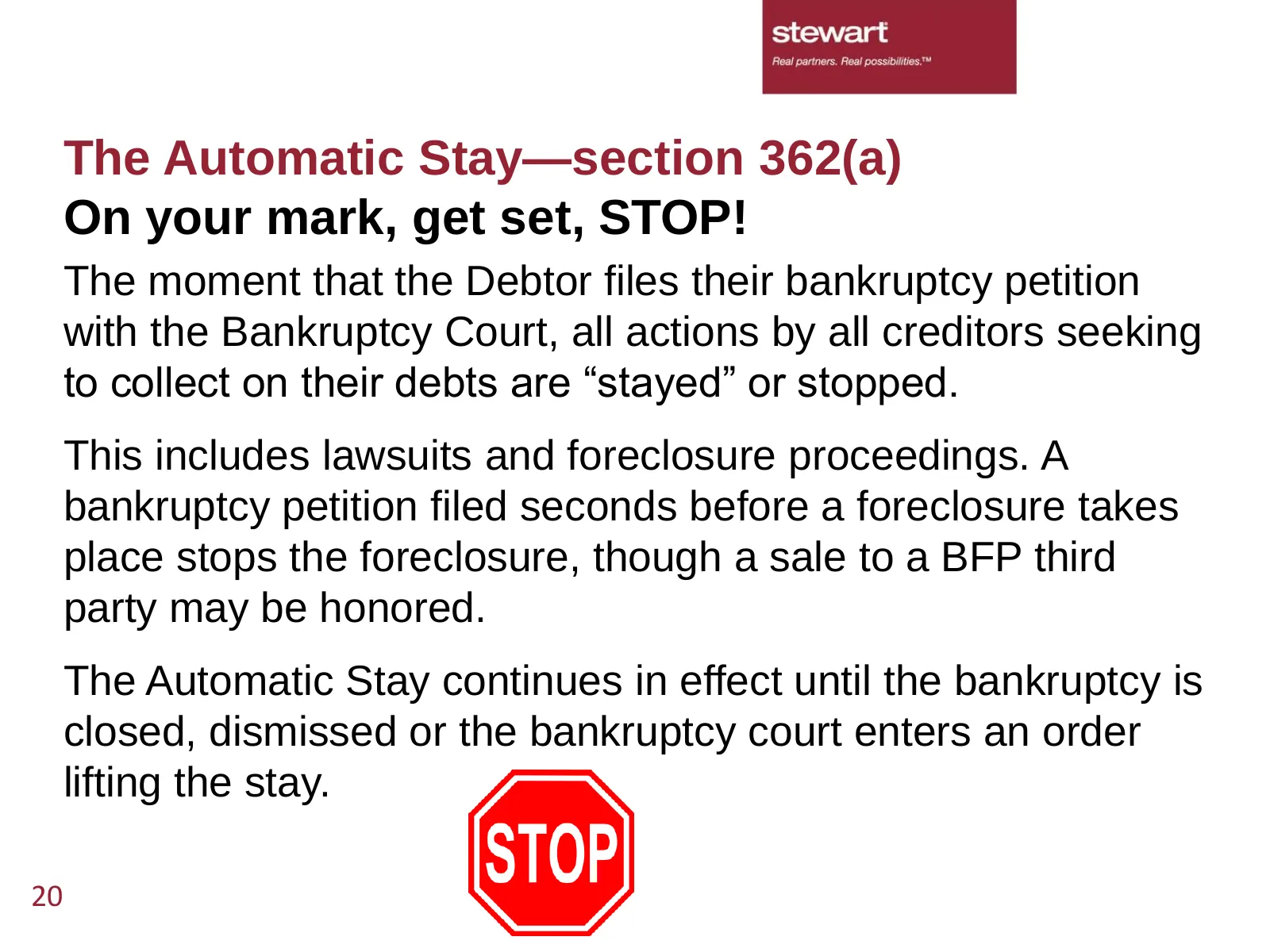
The Automatic Stay—section 362(a) On your mark, get set, STOP! The moment that the Debtor files their bankruptcy petition with the Bankruptcy Court, all actions by all creditors seeking to collect on their debts are “stayed” or stopped. This includes lawsuits and foreclosure proceedings. A bankruptc
Slide 21: The Estate and Exemptions
The “Estate” and “Exemptions” The Estate is all of the property of the Debtor, which is identified on the Schedules of the bankruptcy petition. Debtor(s) may claim certain property as Exempt, or not part of the Bankruptcy Estate. There are Federal Exemptions and State Exemptions, each with limitatio
Slide 22: Leases and Contracts
Leases and Contracts The interest of the debtor in a lease or contract (as lessor, lessee, purchaser, or seller) vests in the estate upon the filing of the bankruptcy. Company Policy: Insuring a purchase money mortgage: If the debtor enters a contract to purchase property before the bankruptcy comme
Slide 23: Community Property
Community Property If only one of the spouses files a bankruptcy petition and that debtor- spouse owns community property, then the community property under the sole or joint management of the debtor and other community property which is liable for claims against the debtor (to the extent of liabili
Slide 24: Exempt Property
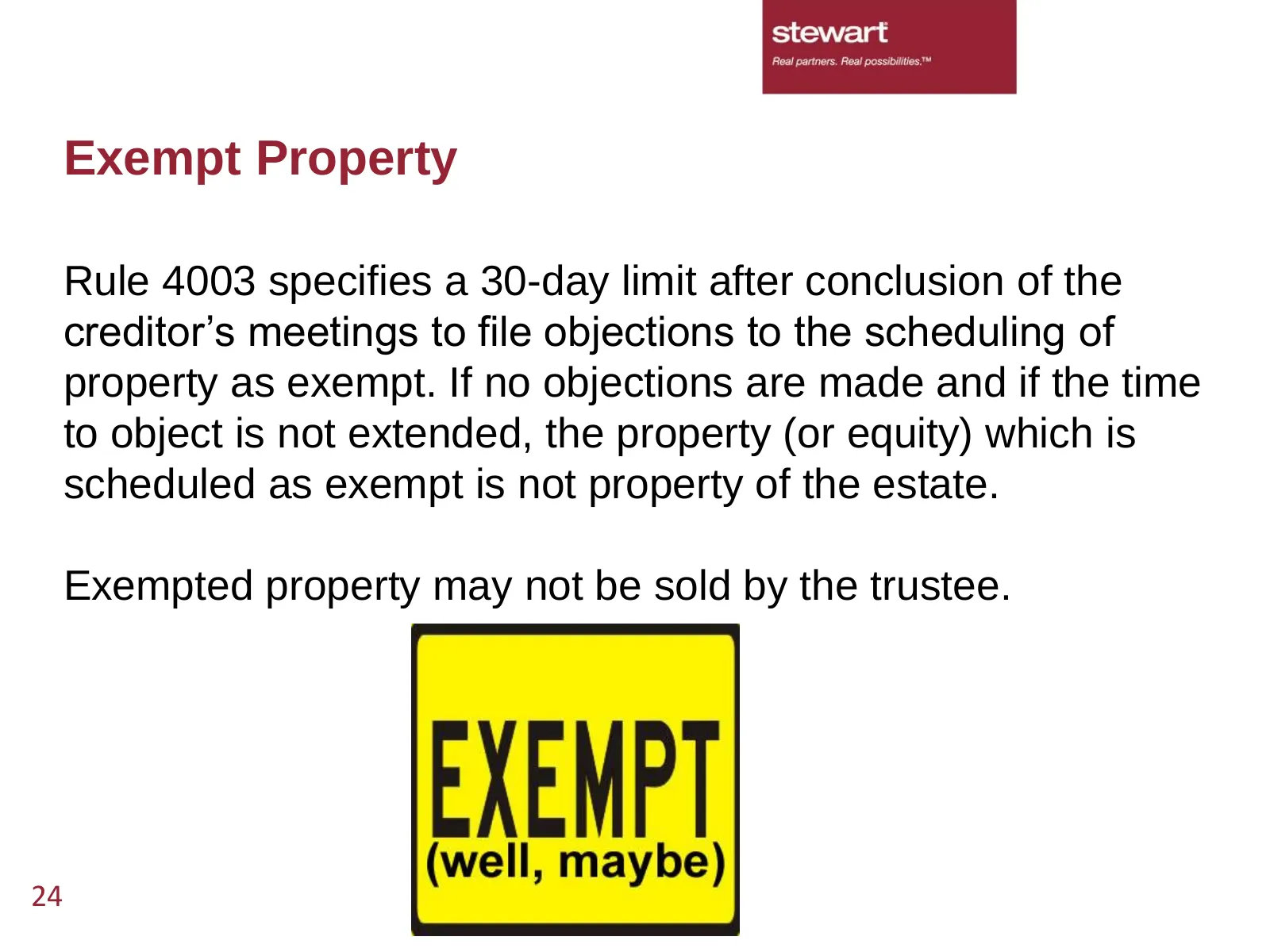
Exempt Property Rule 4003 specifies a 30-day limit after conclusion of the creditor’s meetings to file objections to the scheduling of property as exempt. If no objections are made and if the time to object is not extended, the property (or equity) which is scheduled as exempt is not property of the
Slide 25: Abandoned Property
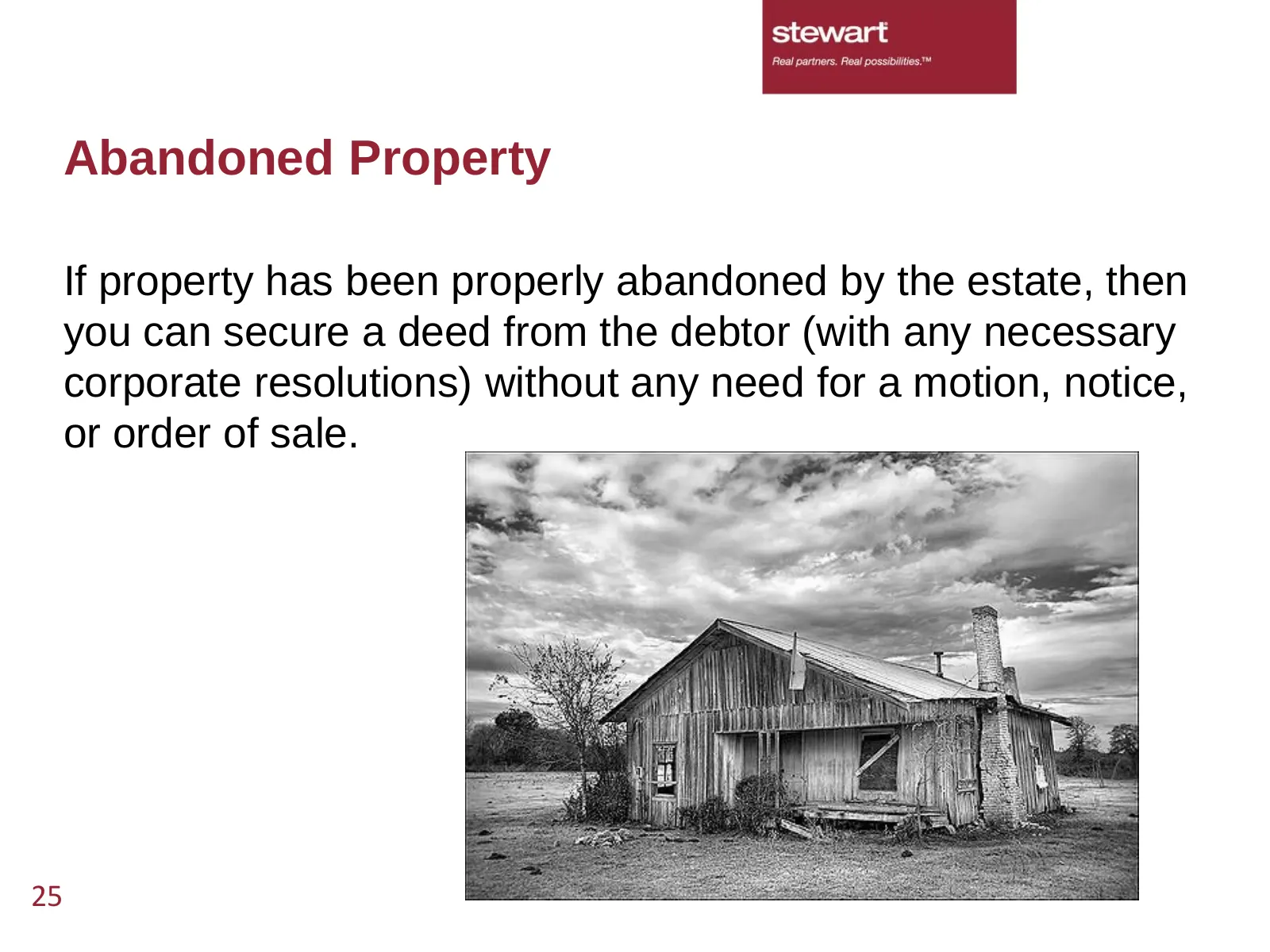
Abandoned Property If property has been properly abandoned by the estate, then you can secure a deed from the debtor (with any necessary corporate resolutions) without any need for a motion, notice, or order of sale. 25
Slide 26: Abandoned Property
Abandoned Property What is Abandoned Property? All of debtor’s non-exempt property goes into the bankruptcy estate. The Trustee may decide that a piece of property in the estate is not worth selling, and would abandon the property so that it goes back to the debtor. Example: Debtor owns a non-homest
Slide 27: Unscheduled Property
Unscheduled Property The property of the debtor vests in the estate and is subject to the bankruptcy proceeding regardless of whether it is listed on the schedules and regardless of whether schedules are actually filed. If the property is not scheduled, the case is closed, and the property is not ot
Slide 28: After-Acquired Interests
After-Acquired Interests Any property acquired by the debtor by gift, devise, or inheritance, or as a result of a property settlement agreement in a divorce within 180 days after the filing of the bankruptcy shall become property of the estate. Any property acquired during the bankruptcy as proceeds
Slide 29: Who can sell property during bankruptcy?
Who can sell property during bankruptcy? In a Chapter 7 proceeding, the court appointed Trustee is in charge of the estate. The Trustee retains control of the non- exempt property, but can only sell by court order. However, 30 days after the Meeting of the Creditors has concluded*, if there are no o
Slide 30: Who can sell property during bankruptcy?
Who can sell property during bankruptcy? In a Chapter 11 proceeding any sale prior to confirmation of the Plan of Reorganization will require a court order. For volume real estate sellers, such as builders, the court may enter an order allowing the Debtor to continue sales in the ordinary course of
Slide 31: Who can sell property during bankruptcy?
Who can sell property during bankruptcy? During a Chapter 13 proceeding, any sale prior to confirmation of the Plan of Reorganization will require a court order. The DIP can sell exempt property (homestead) without further court order. Once the Plan has been confirmed, and if the Plan provides for t
Slide 32: Discharge and Liens
Discharge and Liens Most people believe that a bankruptcy discharge of the Debtor means that all liens against the debtor’s property cease being liens following the debtor's discharge and case closure. A discharge means that the debtor is relieved of the personal obligation to pay the discharged deb
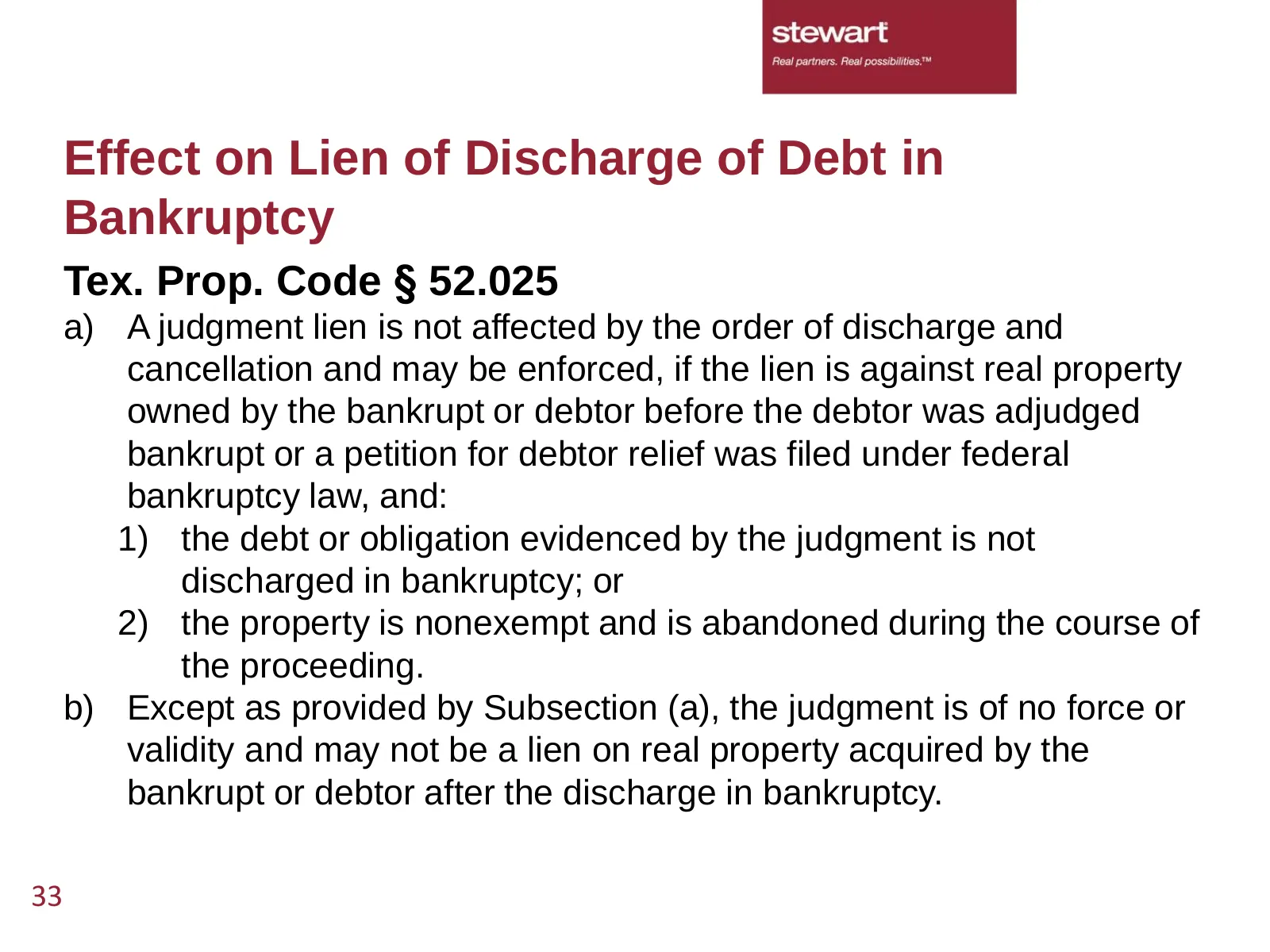
Slide 33: Effect on Lien of Discharge of Debt in Bankruptcy
Effect on Lien of Discharge of Debt in Bankruptcy Tex. Prop. Code § 52.025 a) A judgment lien is not affected by the order of discharge and cancellation and may be enforced, if the lien is against real property owned by the bankrupt or debtor before the debtor was adjudged bankrupt or a petition for
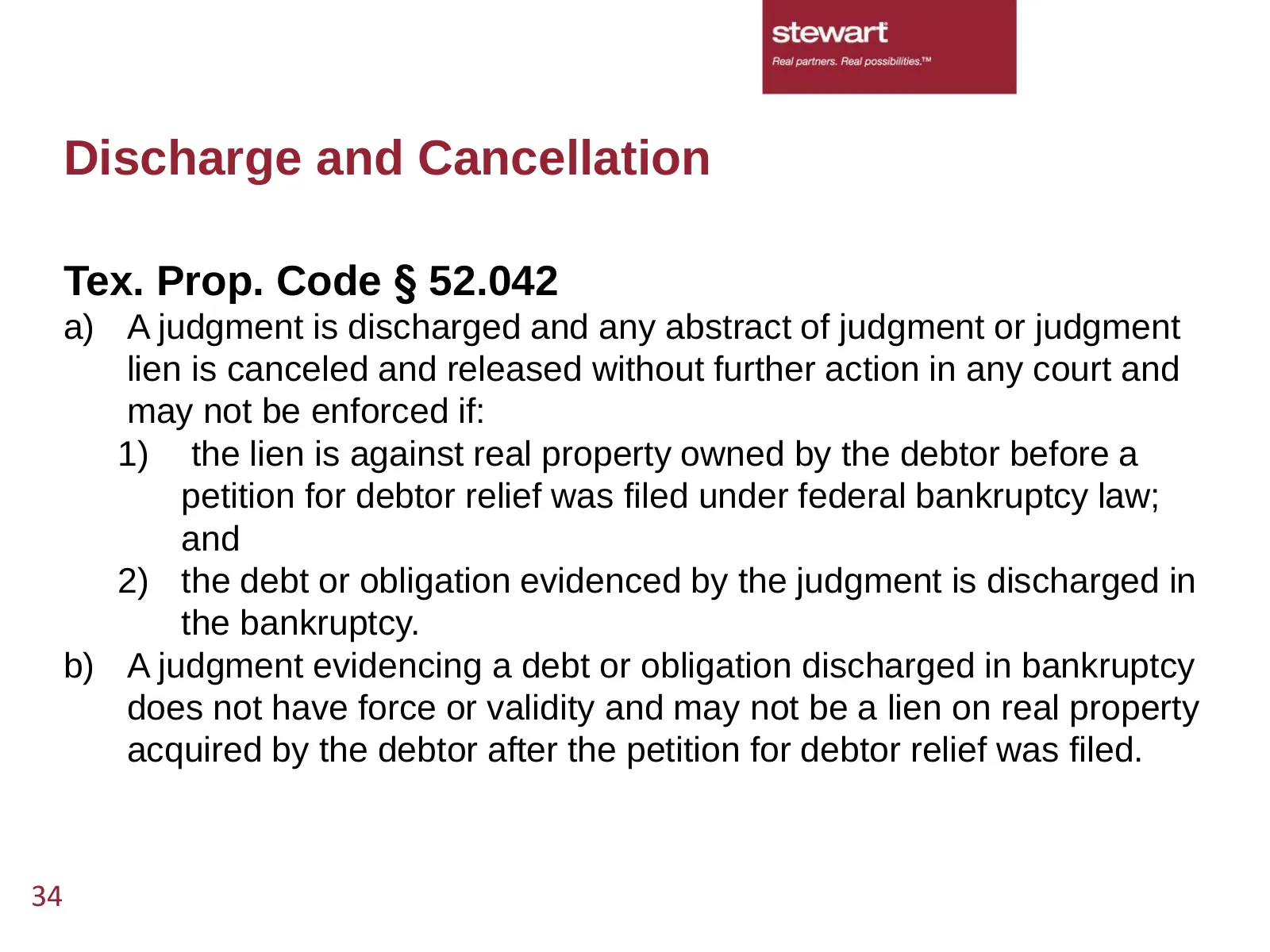
Slide 34: Discharge and Cancellation
Discharge and Cancellation Tex. Prop. Code § 52.042 a) A judgment is discharged and any abstract of judgment or judgment lien is canceled and released without further action in any court and may not be enforced if: 1) the lien is against real property owned by the debtor before a petition for debtor
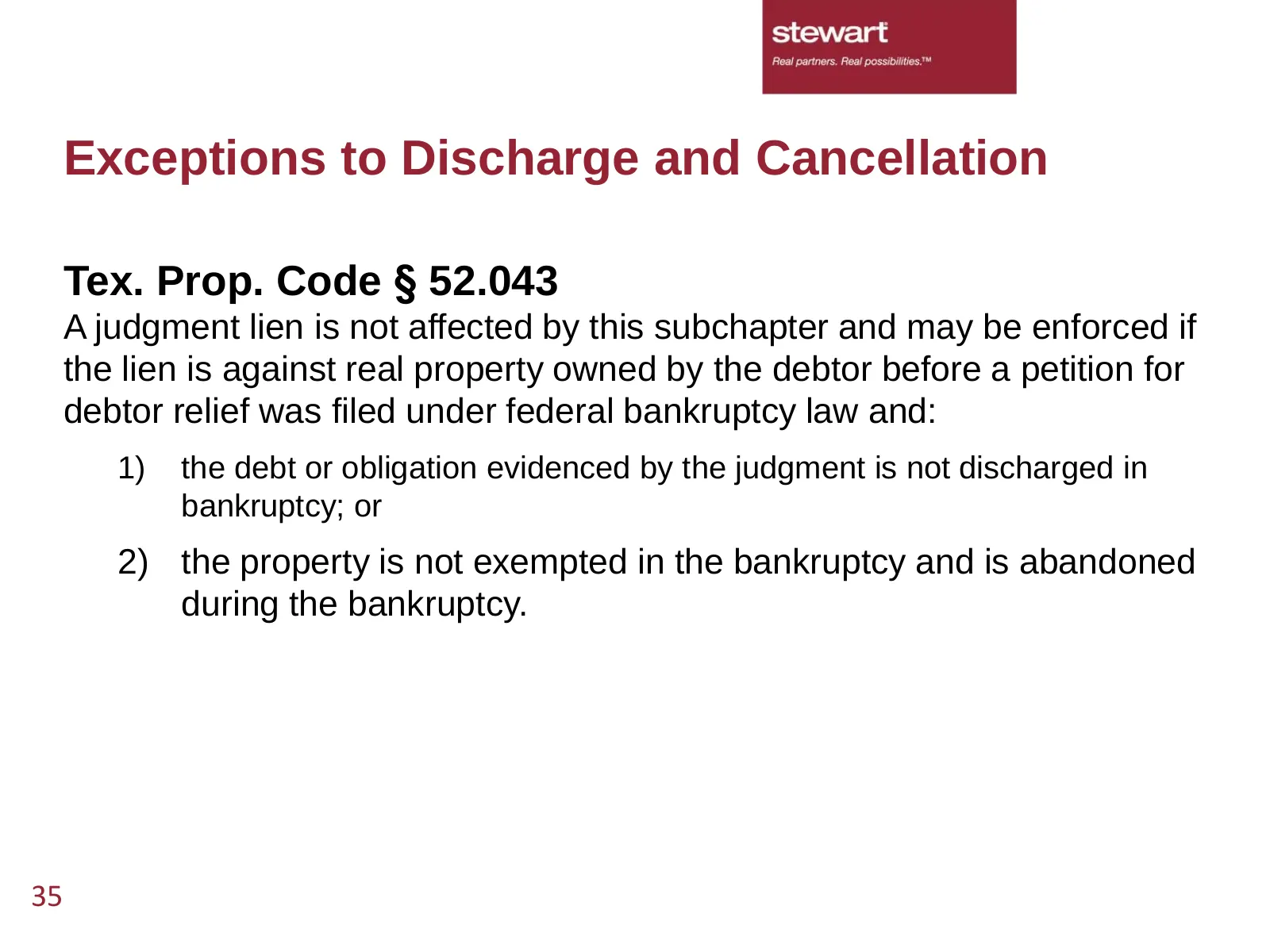
Slide 35: Exceptions to Discharge and Cancellation
Exceptions to Discharge and Cancellation Tex. Prop. Code § 52.043 A judgment lien is not affected by this subchapter and may be enforced if the lien is against real property owned by the debtor before a petition for debtor relief was filed under federal bankruptcy law and: 1) the debt or obligation
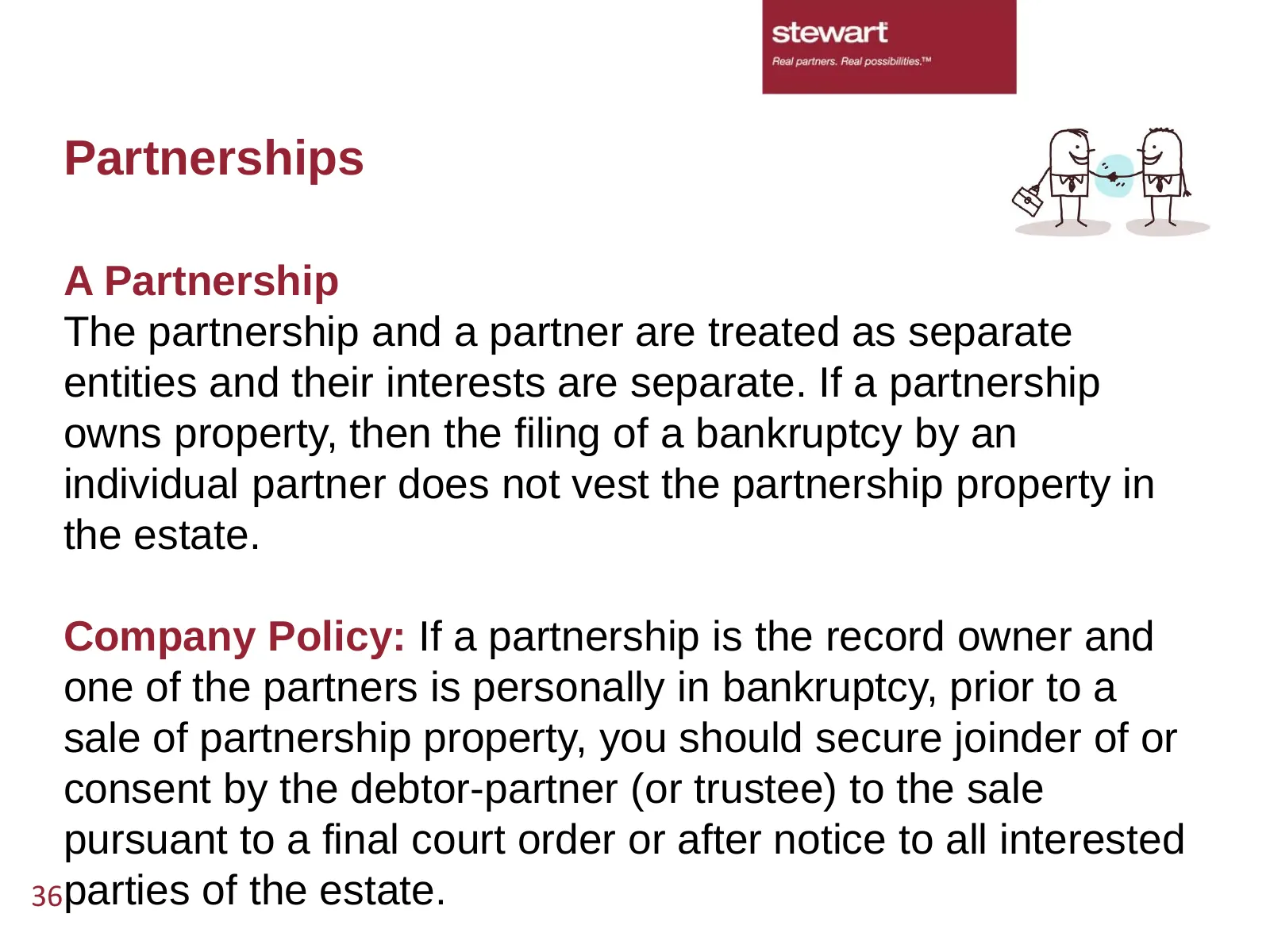
Slide 36: Partnerships
Partnerships A Partnership The partnership and a partner are treated as separate entities and their interests are separate. If a partnership owns property, then the filing of a bankruptcy by an individual partner does not vest the partnership property in the estate. Company Policy: If a partnership
Slide 37: Partnerships: Foreclosure
Partnerships Foreclosure The estate of a partner consists only of the partner’s personal property interest in the partnership. Thus, the automatic stay does not prevent foreclosure of a lien against the partnership property merely because a partner files a bankruptcy. Company Policy: Foreclosure on
Slide 38: Trustee and Trusts
Trustee and Trusts If the debtor has title to property as a trustee (of a private trust), the estate will succeed to the property, subject to the interests of the beneficiaries. The estate cannot exercise the fiduciary powers of the trustee (of a private trust). Company Policy: Require abandonment o
Slide 39: Loans During Bankruptcy
Loans During Bankruptcy In a Chapter 7 proceeding, 30 days after the conclusion of the Creditors’ Meeting, the Exempt property is no longer part of the estate and the Debtor can use it as collateral for loans. Unless specifically provided for in the Plan, new loans in a Chapter 11 or 13 bankruptcy w
Slide 40: Finality—Appeals
Finality—Appeals Any judgment, order or decree of bankruptcy court may be appealed ‒ To district court; or ‒ to 3 judge bankruptcy panel (on consent of all parties) Appellant must file notice of appeal w/in 10 days of the date of entry of judgment, order or decree appealed from (may be extended by c
Slide 41: Sales After Bankruptcy
Sales After Bankruptcy Does the owner/former debtor actually own the property and can they sell it? Property claimed as Exempt with no creditor objections is returned to the Debtor’s control can be sold. Non-exempt Property that was listed on the Schedules of the Bankruptcy Petition but revealed as
Slide 42: Sales After Bankruptcy
Sales After Bankruptcy Voluntary Lien A lien on property which arises by consent or contract of the debtor such as a mortgage lien. Involuntary Lien A lien on property which arises without the consent of the debtor such as a judgment lien. 42
Slide 43: Sales After Bankruptcy
Sales After Bankruptcy What happened to the Voluntary Liens against the property? Unless the voluntary liens avoided by court hearing and order, the voluntary liens are still against the property. Occasionally disclosed property wasn’t dealt with in the bankruptcy. The Debtors thought the lender wou
Slide 44: Sales After Bankruptcy
Sales After Bankruptcy What happened to the Involuntary Liens against the Debtor/Property? Federal Tax Liens are not discharged by filing bankruptcy. We require releases from the IRS. State Tax Liens: the debt can be discharged in bankruptcy if the State is scheduled as one of the creditors on the o
Slide 45: Limit on Filing
Limit on Filing A debtor is generally not entitled to a discharge if the debtor was granted a discharge in a case commenced within six years before the date of filing of the current case. This time limit does not apply if the prior case was a Chapter 12 or Chapter 13 proceeding, and payments totaled
Slide 46: Foreclosure Do-Over
Foreclosure Do-Over Southern Bank of Lauderdale County v. IRS, 770 F.2d 1001, 1985 U.S. App. LEXIS 23060, 85-2 U.S. Tax Cas. (CCH) P9670, 56 A.F.T.R.2d (RIA) 5952 Mortgagees failed to provide notice to Internal Revenue Service and subsequently purchased the properties at foreclosure that were subjec
Slide 47: Contact Info
Contact Info Be careful out there! Victor A. Davis Underwriting Counsel Stewart Title Guaranty Company Houston, Texas 800-292-5712 | 713-625-8767 victor.davis@stewart.com 47
Slide 48: CE Certificate or CLE Credit requirements
Per the TDI and the State Bar, in order to obtain a CE Certificate or CLE Credit you must: – listen to the webinar for a minimum of 55 minutes – obtain the password (provided at the end of the presentation) – follow the instructions as given 48
Slide 49: To Receive CE Credit
To Receive CE Credit Each individual seeking credit hours must send their own certificate request to: CEcertificate@stewart.com Please include the following information: • Provide only this Presentation Name in the Subject Line of your e-mail – “Basic Bankruptcy” In the body of your e-mail: • Name o
Slide 50: Recordings and Certificates
Recordings www.stewart.com/texas Under “Texas TIPS” tab • Posted online 10 days after live presentation • Other current courses available Certificates • Processing can take up to 10 business days. • Contact us if you haven’t received your certificate after the allotted processing time. CEcertificate
Slide 51: Next Texas TIPS webinar: Alternatives to Probate
Join us for the next Texas TIPS webinar! March 21, 2019 Alternatives to Probate Zoiliss Rios For Questions/Comments Email john.rothermel@stewart.com or heidi.junge@stewart.com 51
Slide 52: stewart
stewart Real partners. Real possibilities.™
Source: Internet Archive copy of stewart.com
More decks from Stewart Information Services Corporation
 Q2 2026 Earnings Presentation13 slides · Jul 23, 2026
 Investor Presentation (2024)16 slides · 2024
 Title Tenets Webinar Series (March 2023)17 slides · Mar 24, 2023
 Title Tenets Webinar Series (November 2022)27 slides · Nov 11, 2022
 Investor Presentation (November 2019)51 slides · Nov 21, 2019
 Investor Presentation (May 2019)41 slides · May 16, 2019