Quanterix Corporation · NASDAQ:QTRX
Quanterix — Technical Presentation (June 2015)
24 slides from Quanterix's technical presentation, Jun 9, 2015
Slide 1: Homebrew Assay Development Case Studies
Homebrew Assay Development Case Studies: Case 1: A Closer Look at Biomarker Assay Specificity Case 2: Developing a Competitive Biomarker Assay – Work in Progress Elizabeth Dreher & Alison Joyce: Pfizer Inc. Elizabeth.Dreher@Pfizer.com; Alison.Joyce@Pfizer.com June 9th, 2015 Quanterix User Group Meet
Slide 2: Case 1: A Closer Look at Biomarker Assay Specificity
Homebrew Assay Development Case Studies: Case 1: A Closer Look at Biomarker Assay Specificity
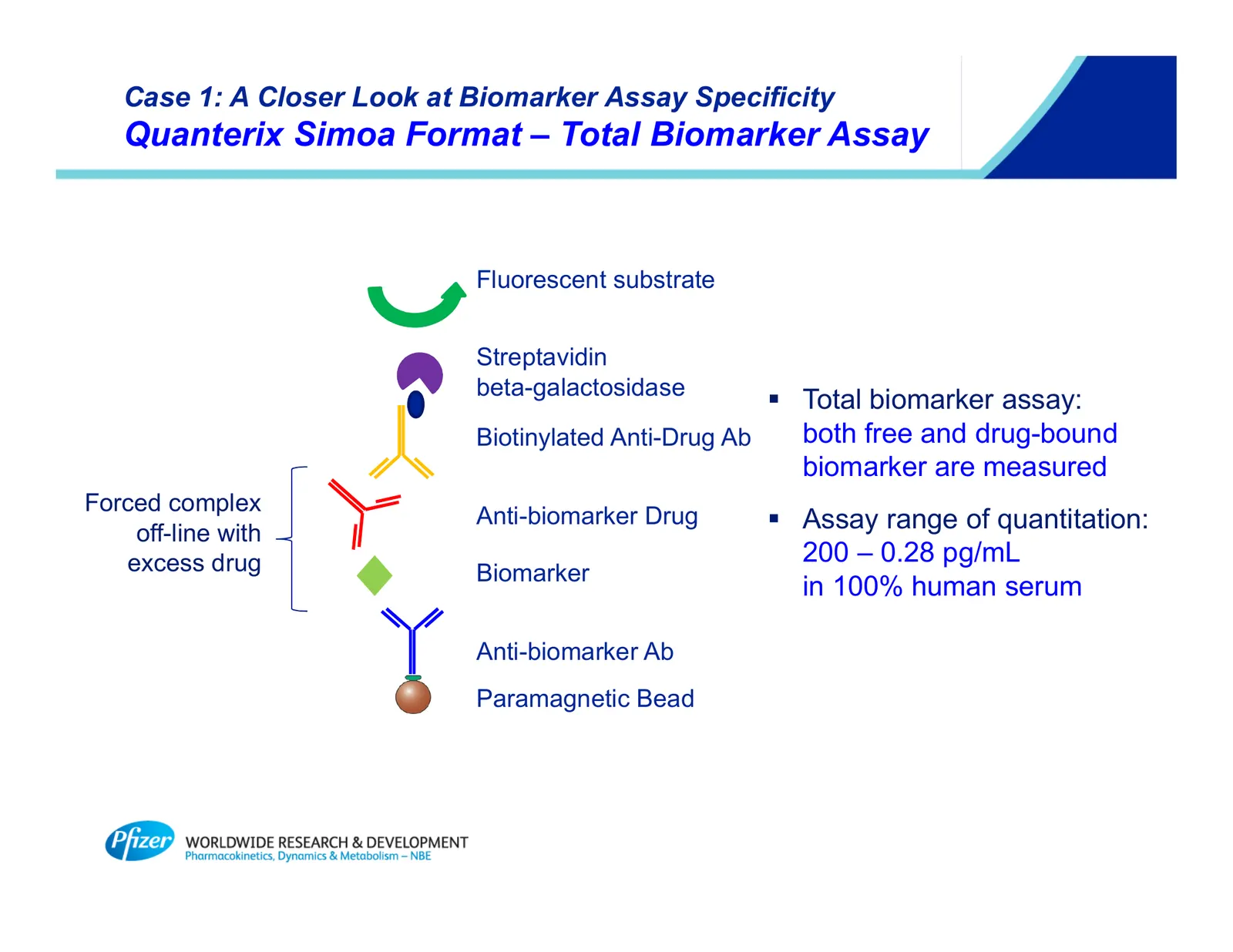
Slide 3: Quanterix Simoa Format – Total Biomarker Assay
Case 1: A Closer Look at Biomarker Assay Specificity Quanterix Simoa Format – Total Biomarker Assay Fluorescent substrate Streptavidin beta-galactosidase Total biomarker assay: Biotinylated Anti-Drug Ab both free and drug-bound biomarker are measured Forced complex Anti-biomarker Drug Assay rang
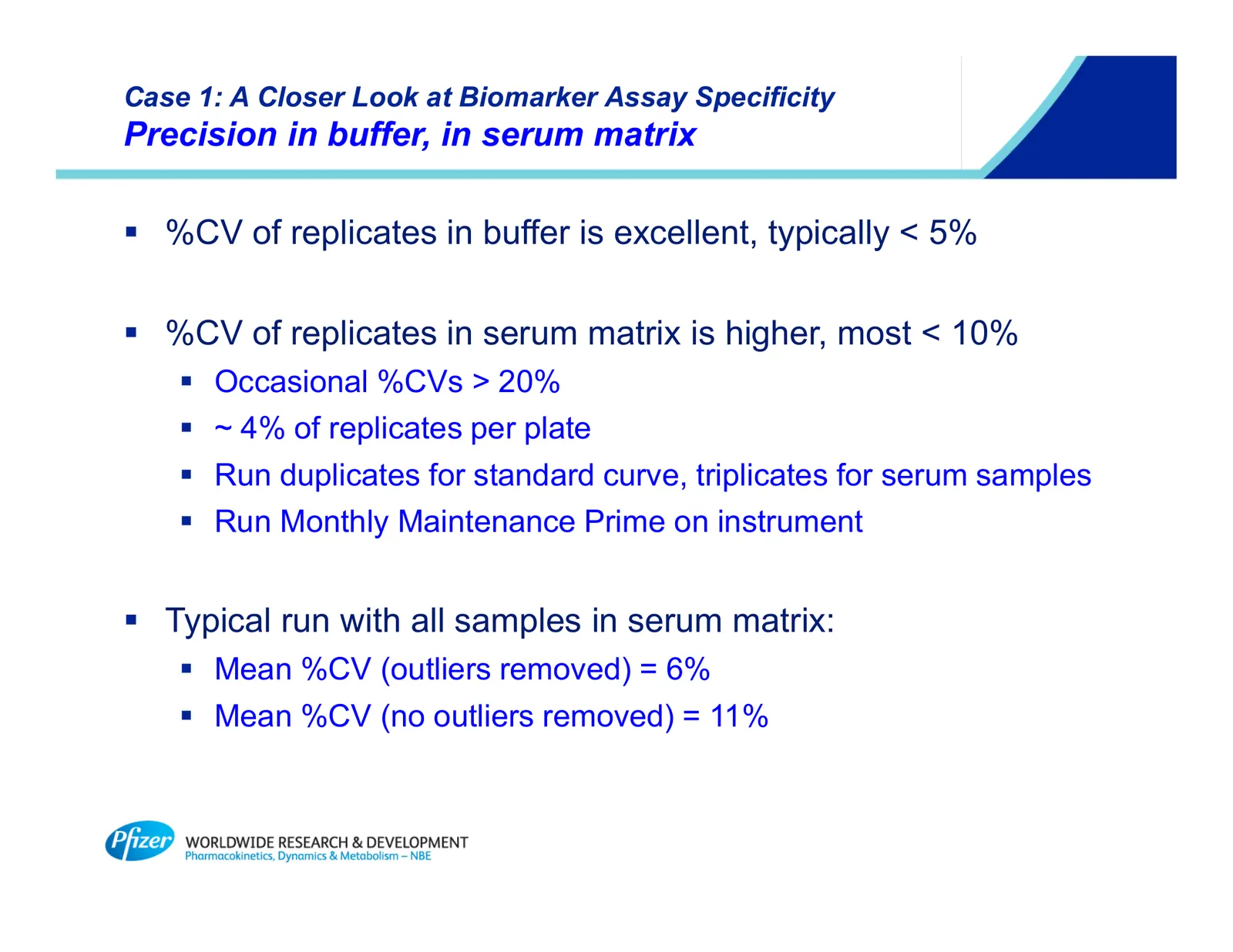
Slide 4: Precision in buffer, in serum matrix
Case 1: A Closer Look at Biomarker Assay Specificity Precision in buffer, in serum matrix %CV of replicates in buffer is excellent, typically < 5% %CV of replicates in serum matrix is higher, most < 10% Occasional %CVs > 20% ~ 4% of replicates per plate Run duplicates for standard curve, t
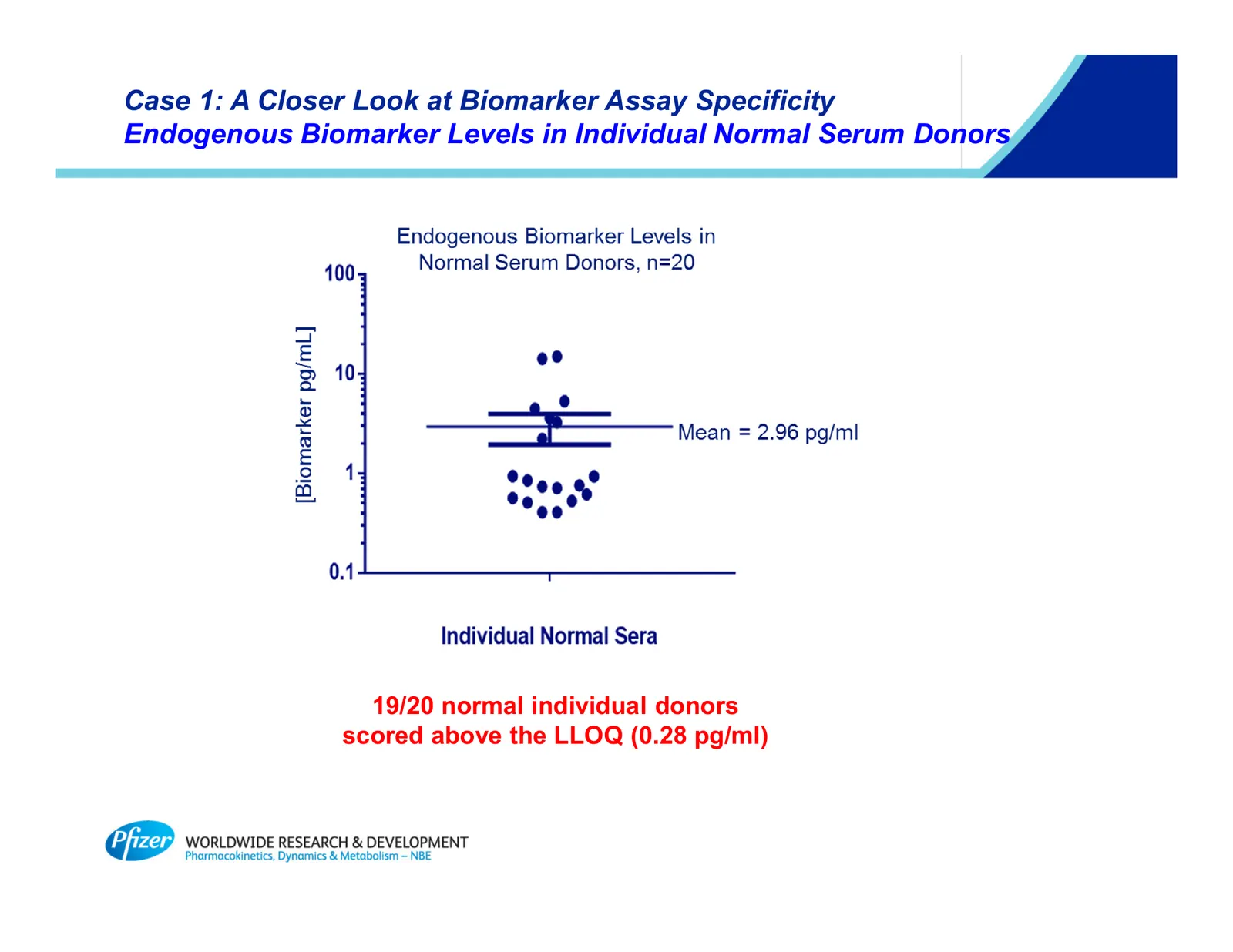
Slide 5: Endogenous Biomarker Levels in Individual Normal Serum Donors
Case 1: A Closer Look at Biomarker Assay Specificity Endogenous Biomarker Levels in Individual Normal Serum Donors 19/20 normal individual donors scored above the LLOQ (0.28 pg/ml)
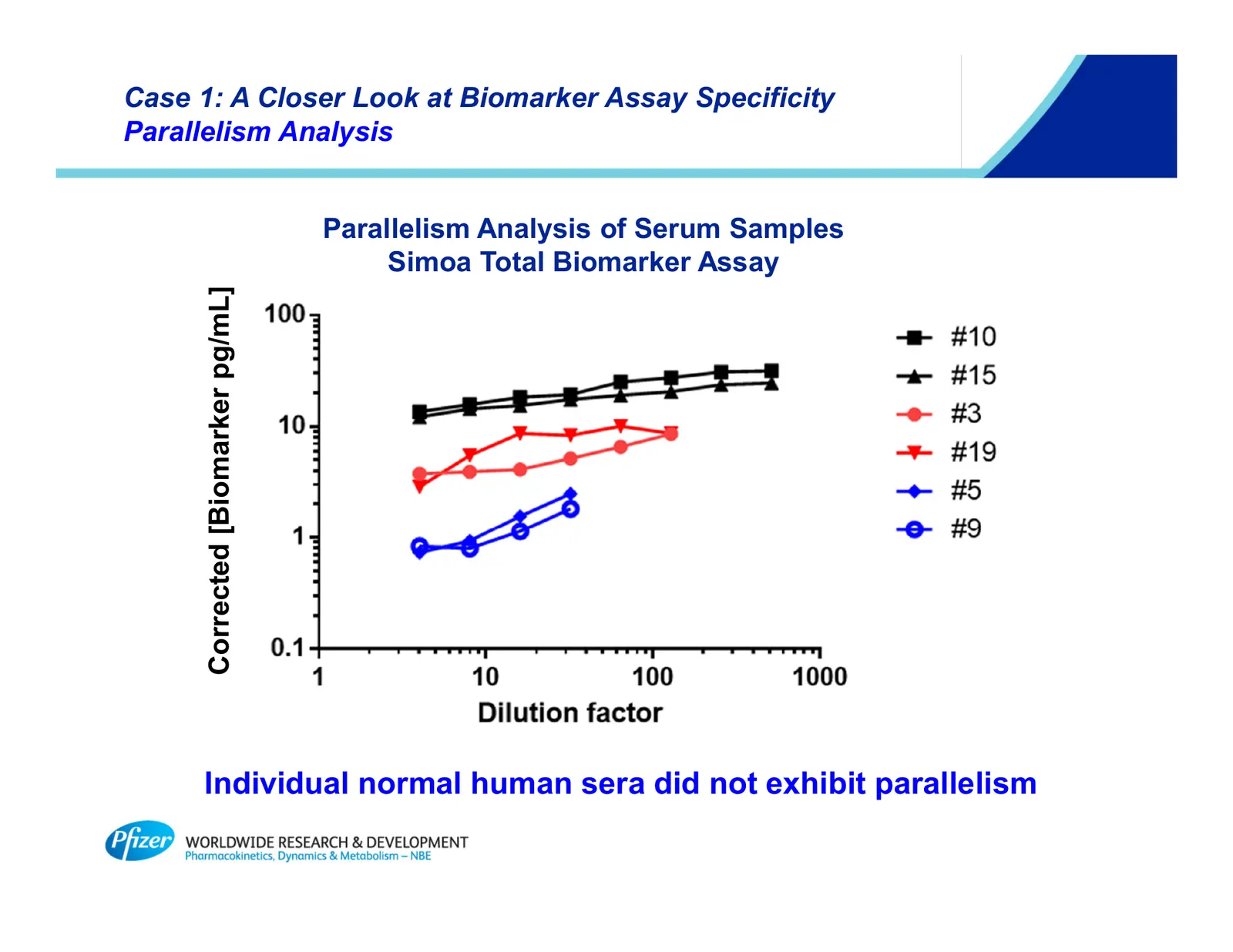
Slide 6: Parallelism Analysis of Serum Samples
Case 1: A Closer Look at Biomarker Assay Specificity Parallelism Analysis Parallelism Analysis of Serum Samples Simoa Total Biomarker Assay Corrected [Biomarker pg/mL] Individual normal human sera did not exhibit parallelism
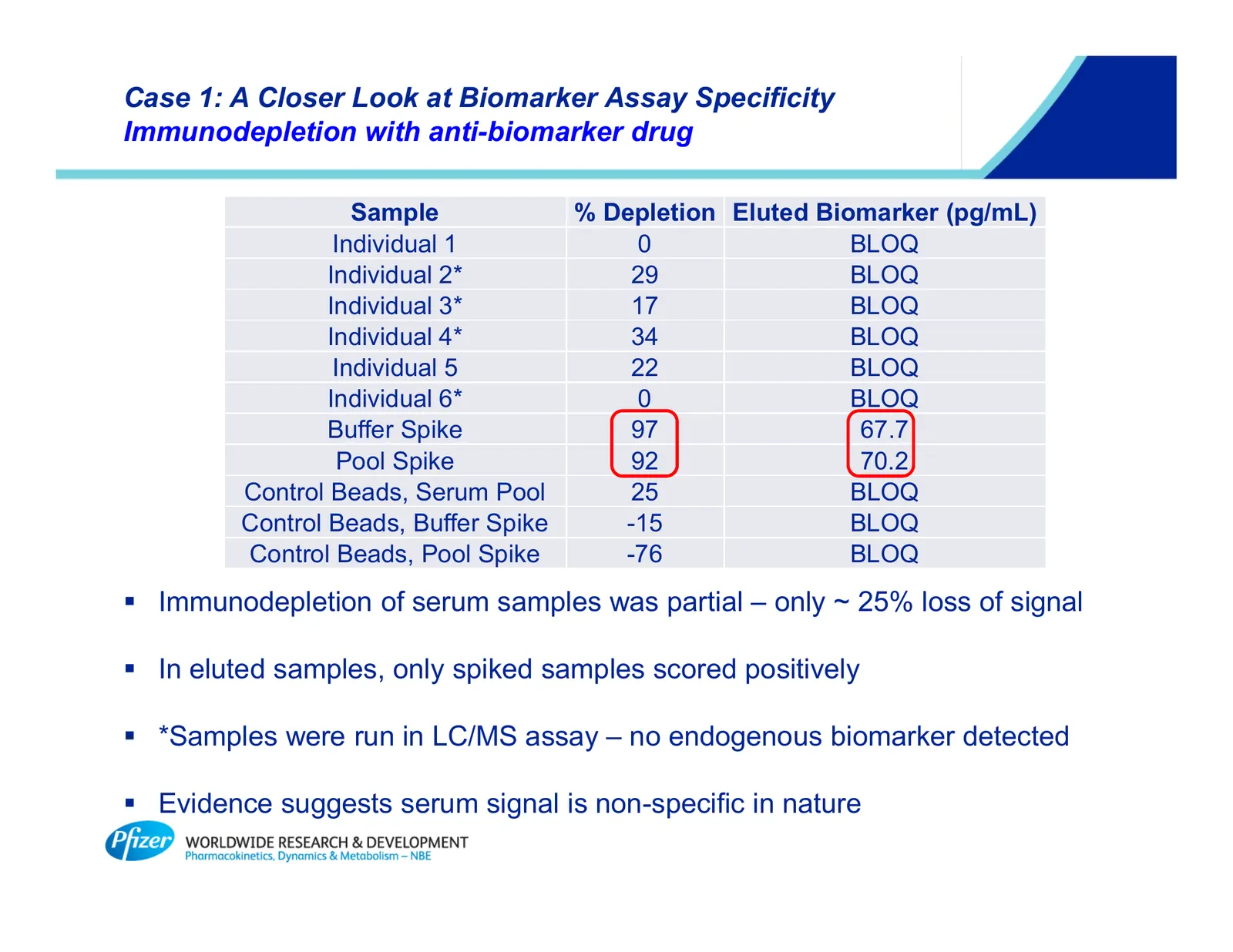
Slide 7: Immunodepletion with anti-biomarker drug
Case 1: A Closer Look at Biomarker Assay Specificity Immunodepletion with anti-biomarker drug Sample % Depletion Eluted Biomarker (pg/mL) Individual 1 0 BLOQ Individual 2* 29 BLOQ Individual 3* 17 BLOQ Individual 4* 34 BLOQ Individual 5 22 BLOQ Individual 6* 0 BLOQ Buffer Spike 97 67.7 Pool Spike 92
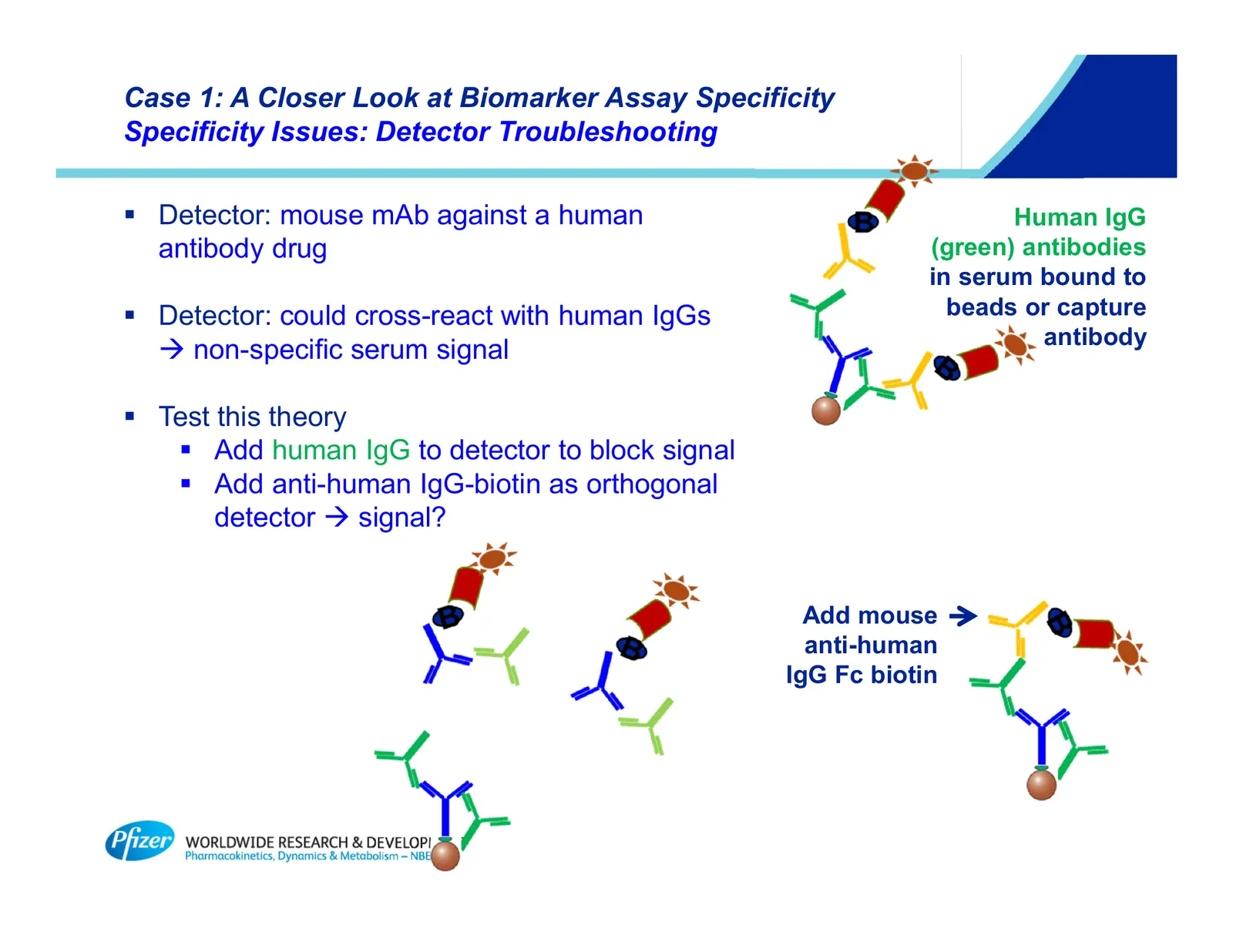
Slide 8: Specificity Issues: Detector Troubleshooting
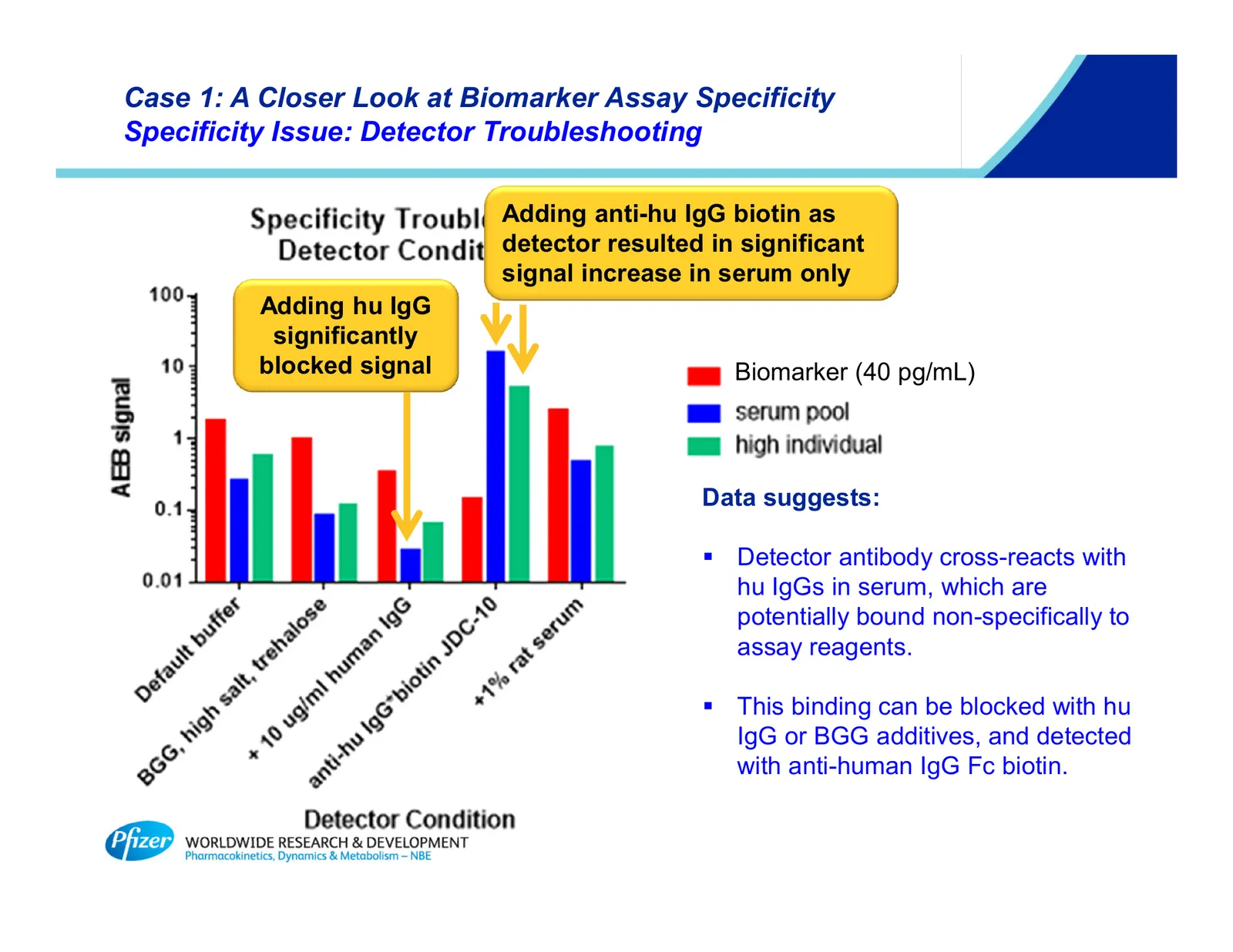
Case 1: A Closer Look at Biomarker Assay Specificity Specificity Issues: Detector Troubleshooting Detector: mouse mAb against a human Human IgG antibody drug (green) antibodies in serum bound to Detector: could cross-react with human IgGs beads or capture antibody non-specific serum signal T
Slide 9: Specificity Issue: Detector Troubleshooting
Case 1: A Closer Look at Biomarker Assay Specificity Specificity Issue: Detector Troubleshooting Adding anti-hu IgG biotin as detector resulted in significant signal increase in serum only Adding hu IgG significantly blocked signal Biomarker (40 pg/mL) Data suggests: Detector antibody cross-reacts
Slide 10: Specificity Issue: Comparison of Old v New Detector Conditions
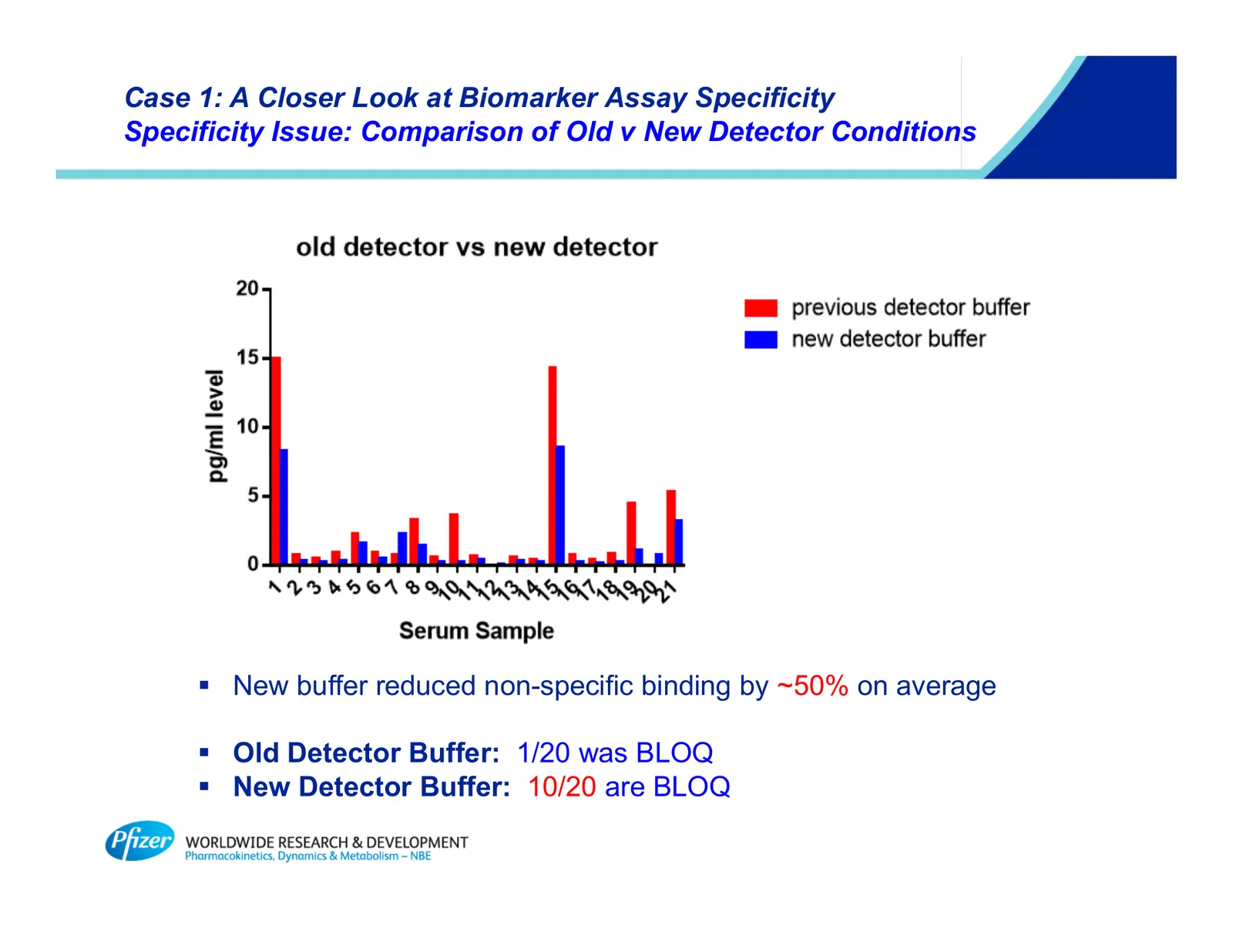
Case 1: A Closer Look at Biomarker Assay Specificity Specificity Issue: Comparison of Old v New Detector Conditions New buffer reduced non-specific binding by ~50% on average Old Detector Buffer: 1/20 was BLOQ New Detector Buffer: 10/20 are BLOQ
Slide 11: Specificity Issue: Rising Above the Noise
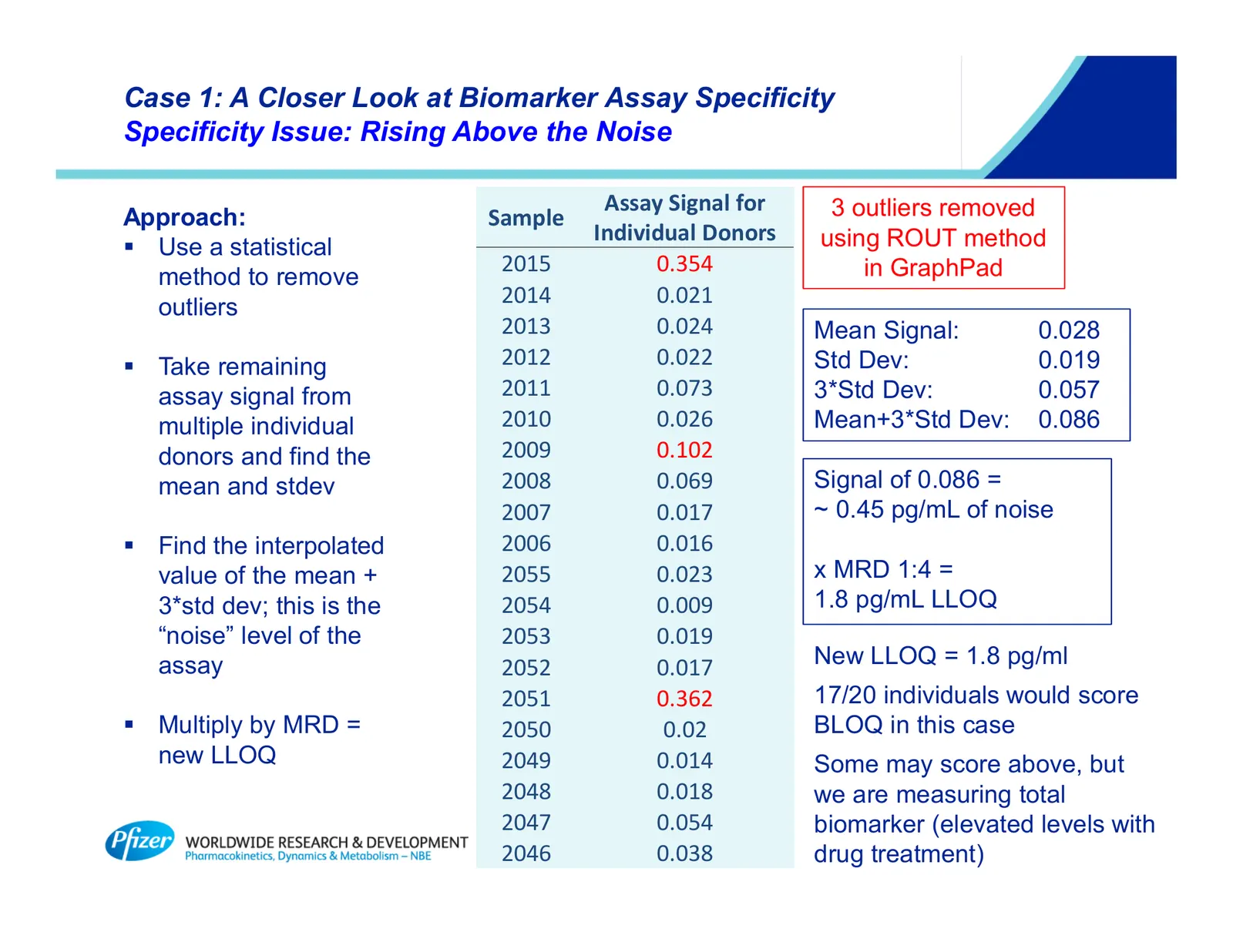
Case 1: A Closer Look at Biomarker Assay Specificity Specificity Issue: Rising Above the Noise Assay Signal for 3 outliers removed Approach: Sample Individual Donors using ROUT method Use a statistical 2015 0.354 in GraphPad method to remove 2014 0.021 outliers 2013 0.024 Mean Signal: 0.028 Take
Slide 12: Specificity Issue: Old v New LLOQ
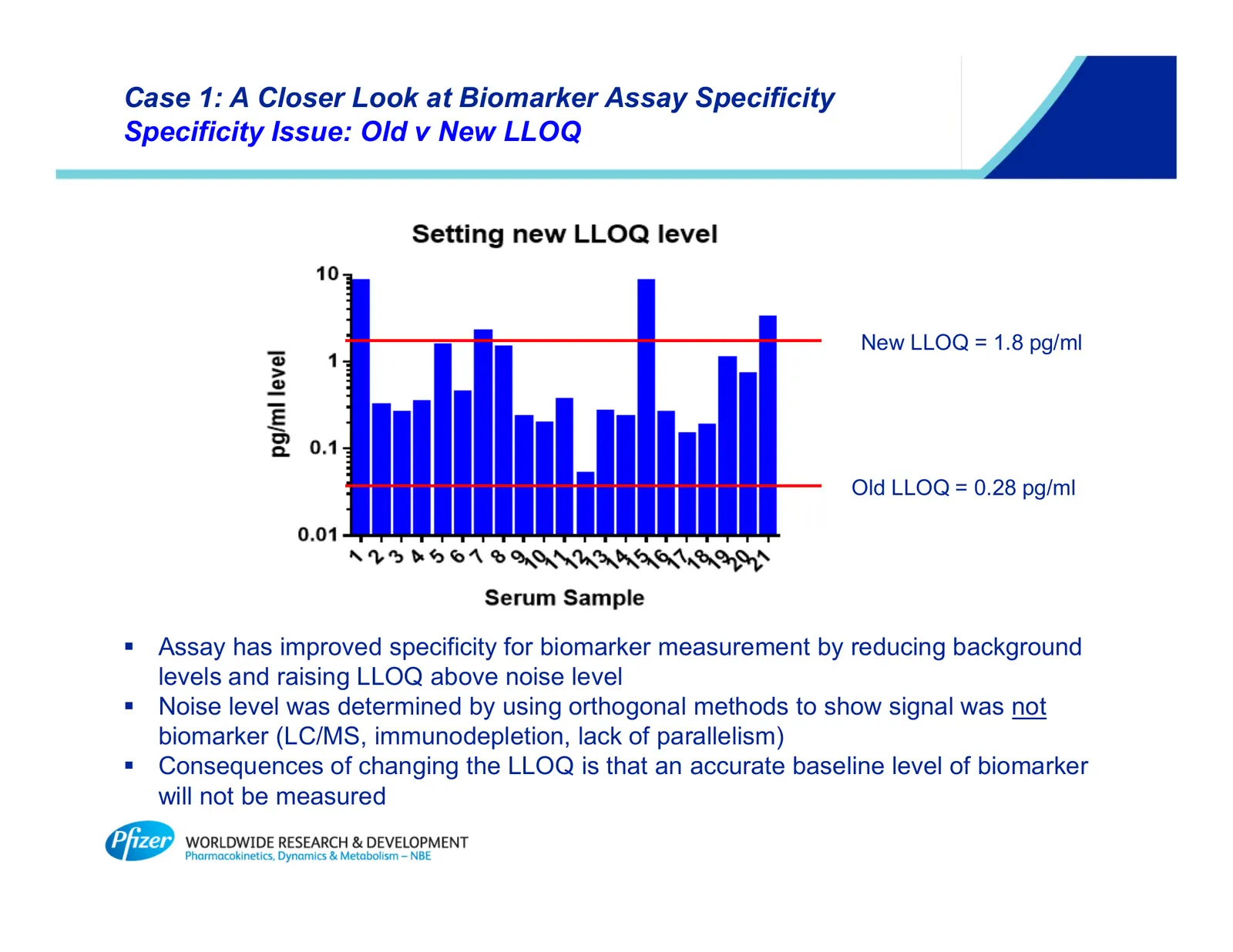
Case 1: A Closer Look at Biomarker Assay Specificity Specificity Issue: Old v New LLOQ New LLOQ = 1.8 pg/ml Old LLOQ = 0.28 pg/ml Assay has improved specificity for biomarker measurement by reducing background levels and raising LLOQ above noise level Noise level was determined by using orthogon
Slide 13: Case 2: Developing a Competitive Biomarker Assay
Homebrew Assay Development Case Studies: Case 2: Developing a Competitive Biomarker Assay – Work in Progress
Slide 14: Competitive Biomarker Homebrew Assay
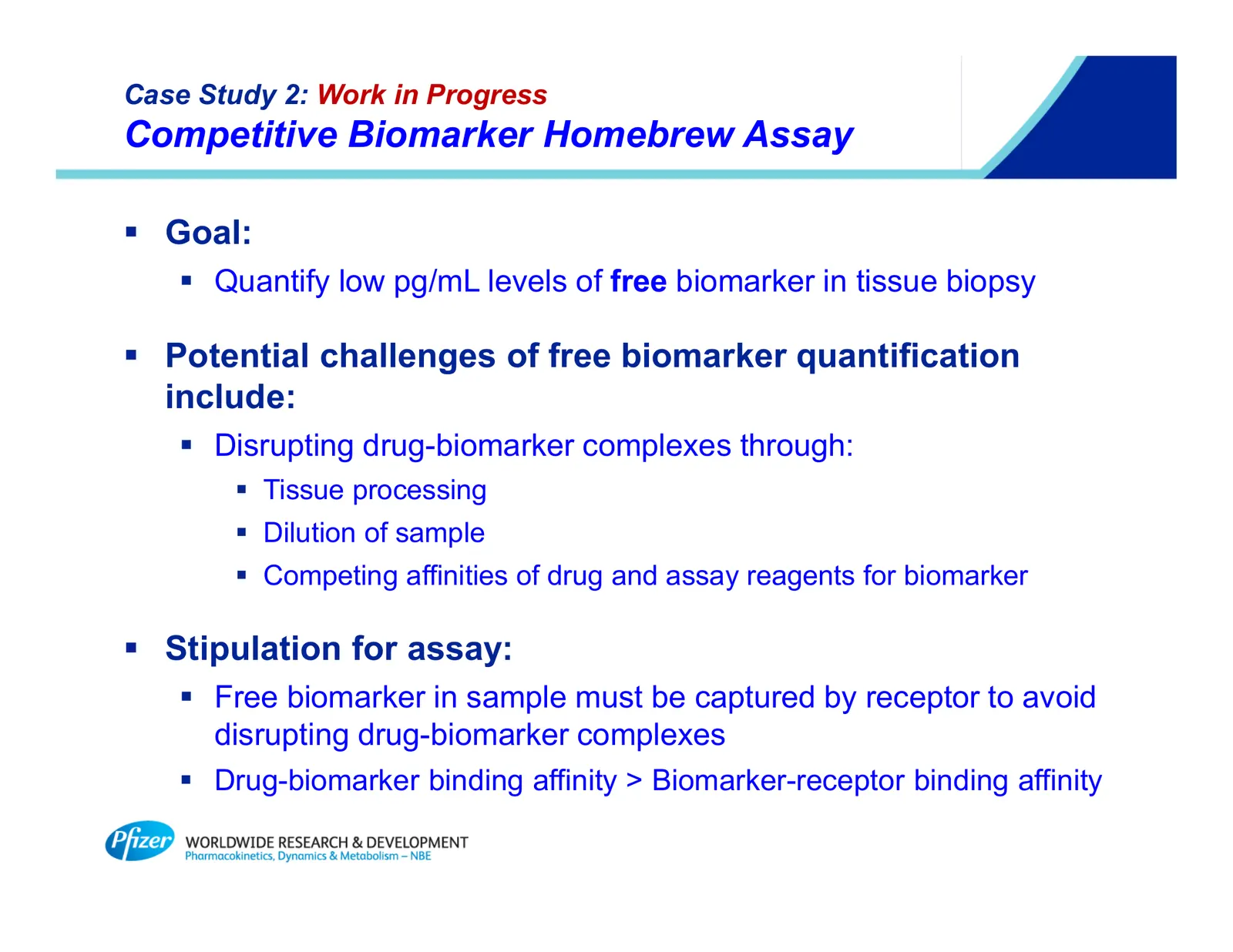
Case Study 2: Work in Progress Competitive Biomarker Homebrew Assay Goal: Quantify low pg/mL levels of free biomarker in tissue biopsy Potential challenges of free biomarker quantification include: Disrupting drug-biomarker complexes through: Tissue processing Dilution of sample Compet
Slide 15: Initial Assay Format: Plate-Based LBA
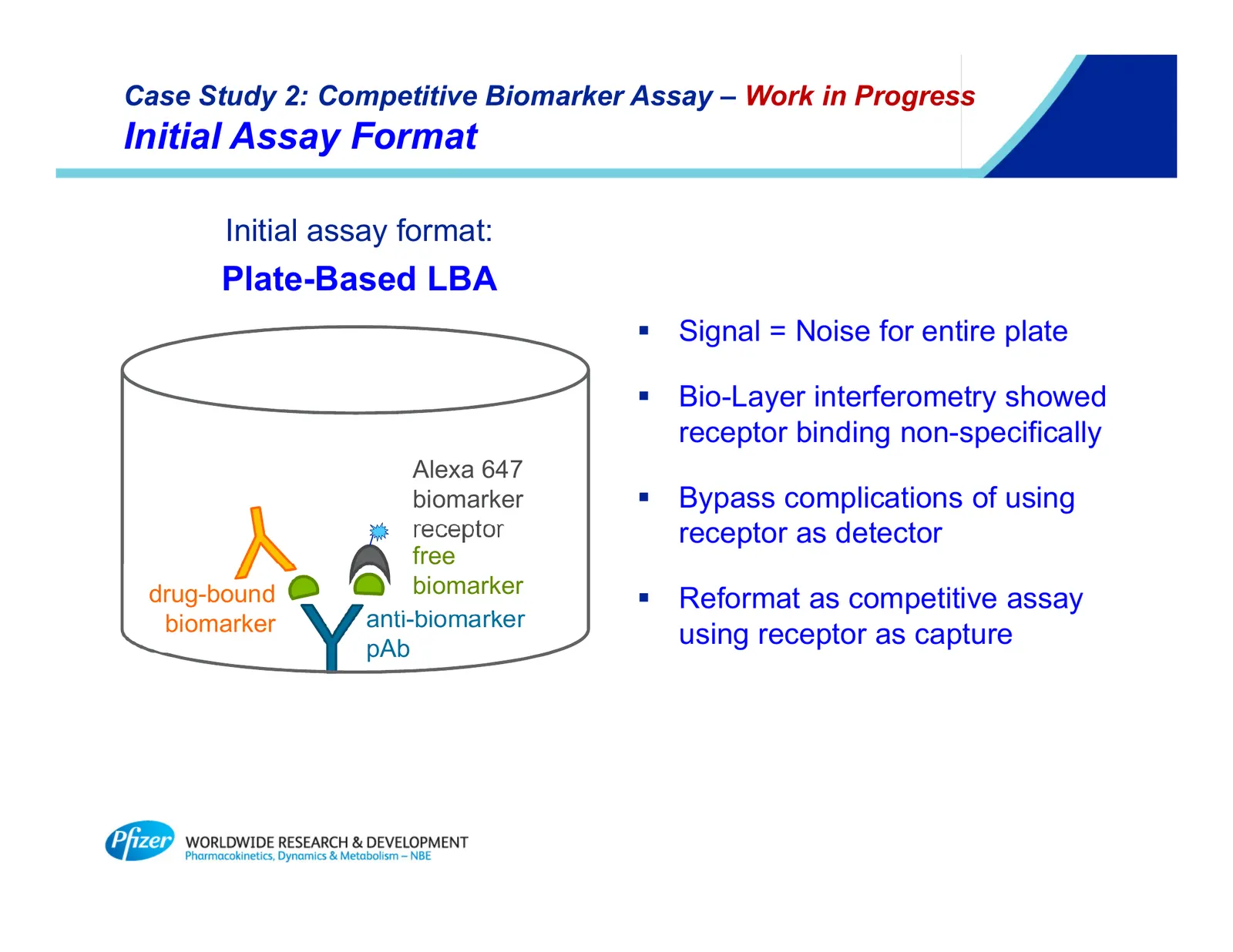
Case Study 2: Competitive Biomarker Assay – Work in Progress Initial Assay Format Initial assay format: Plate-Based LBA Signal = Noise for entire plate Bio-Layer interferometry showed receptor binding non-specifically Alexa 647 biomarker Bypass complications of using receptor receptor as detec
Slide 16: Why the need for Simoa assay format?
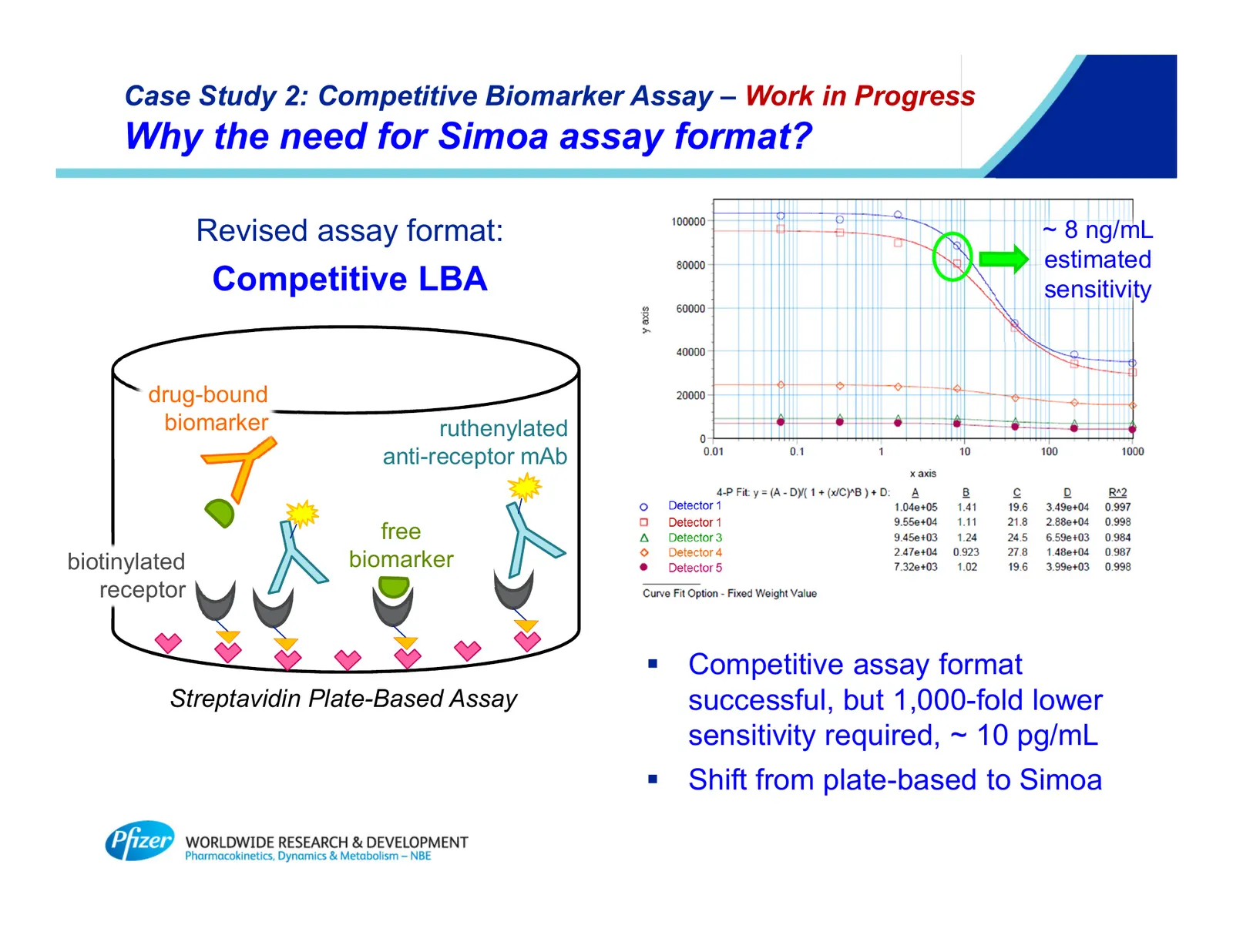
Case Study 2: Competitive Biomarker Assay – Work in Progress Why the need for Simoa assay format? Revised assay format: ~ 8 ng/mL estimated Competitive LBA sensitivity drug-bound biomarker ruthenylated anti-receptor mAb free biotinylated biomarker receptor Competitive assay format Streptavidin Pla
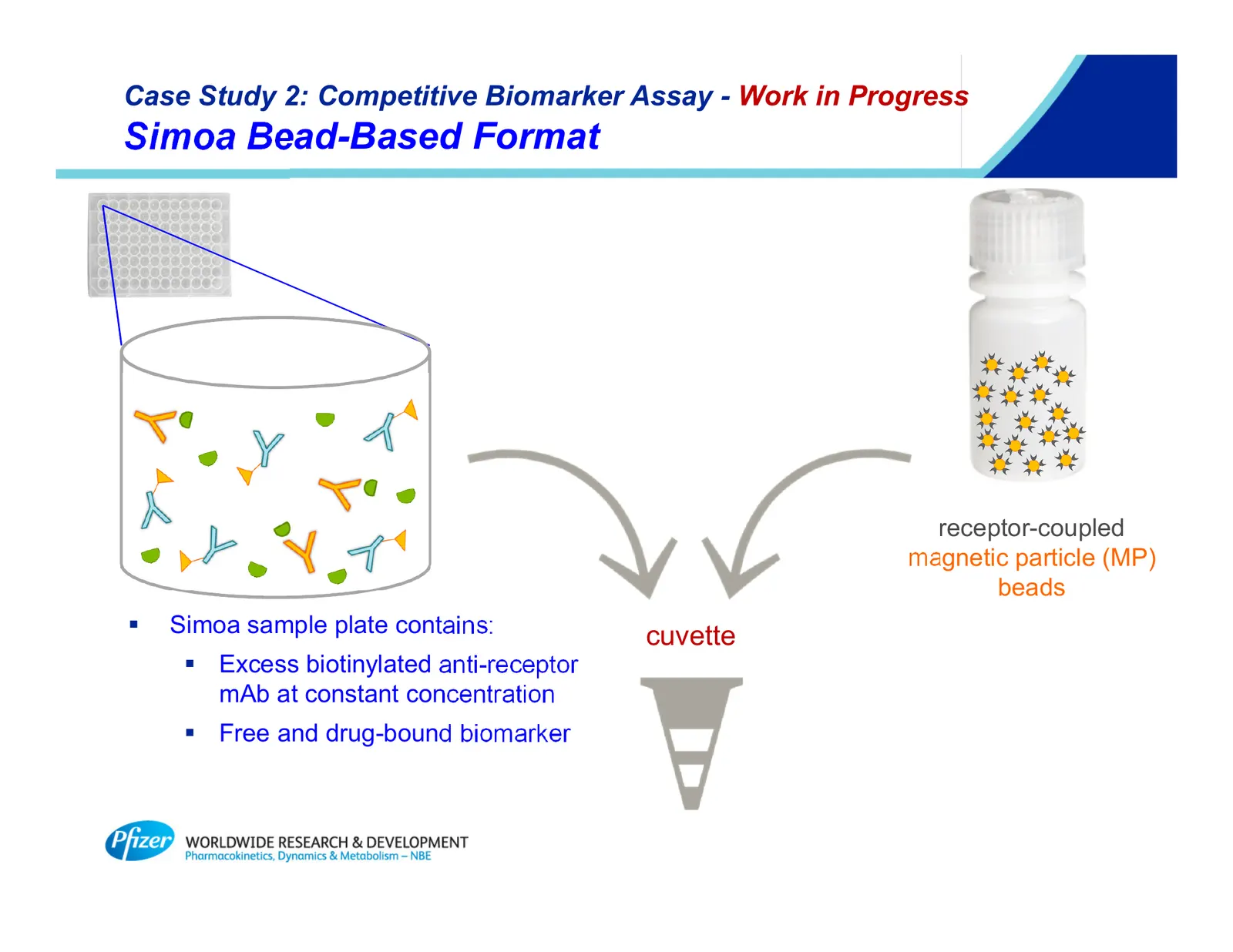
Slide 17: Simoa Bead-Based Format
Case Study 2: Competitive Biomarker Assay - Work in Progress Simoa Bead-Based Format receptor-coupled magnetic particle (MP) beads Simoa sample plate contains: cuvette Excess biotinylated anti-receptor mAb at constant concentration Free and drug-bound biomarker
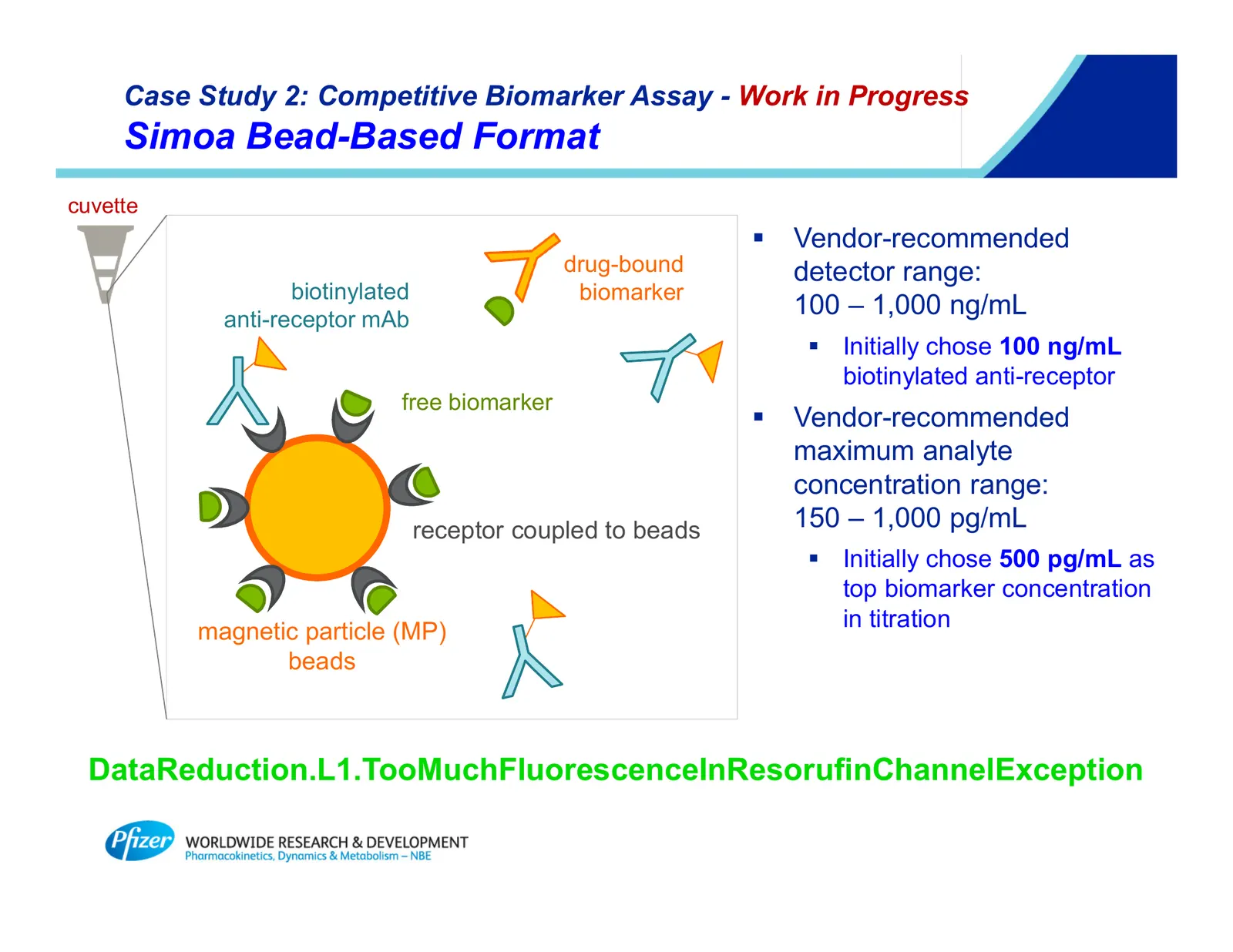
Slide 18: Simoa Bead-Based Format
Case Study 2: Competitive Biomarker Assay - Work in Progress Simoa Bead-Based Format cuvette Vendor-recommended drug-bound detector range: biotinylated biomarker anti-receptor mAb 100 – 1,000 ng/mL Initially chose 100 ng/mL biotinylated anti-receptor free biomarker Vendor-recommended maximum a
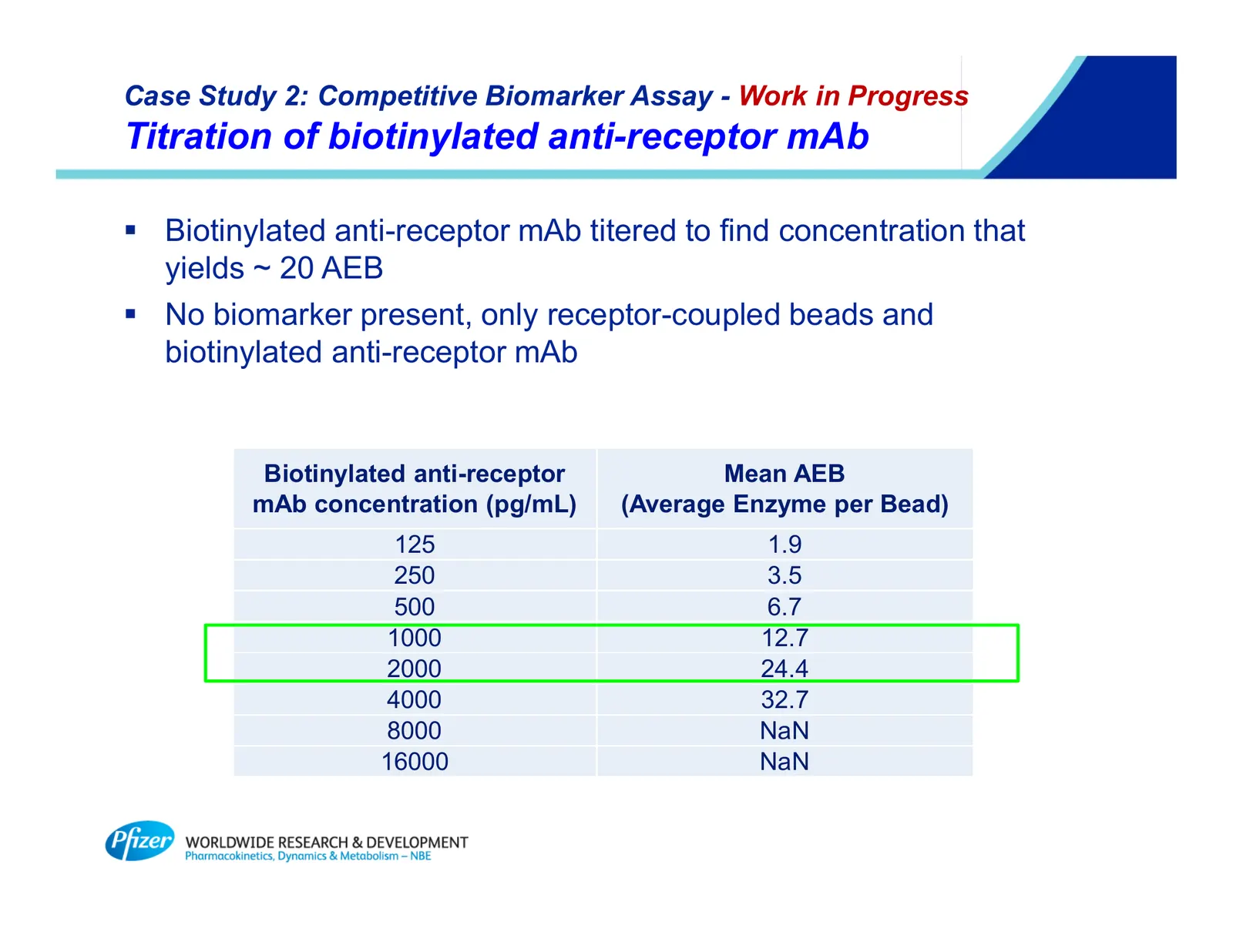
Slide 19: Titration of biotinylated anti-receptor mAb
Case Study 2: Competitive Biomarker Assay - Work in Progress Titration of biotinylated anti-receptor mAb Biotinylated anti-receptor mAb titered to find concentration that yields ~ 20 AEB No biomarker present, only receptor-coupled beads and biotinylated anti-receptor mAb Biotinylated anti-recept
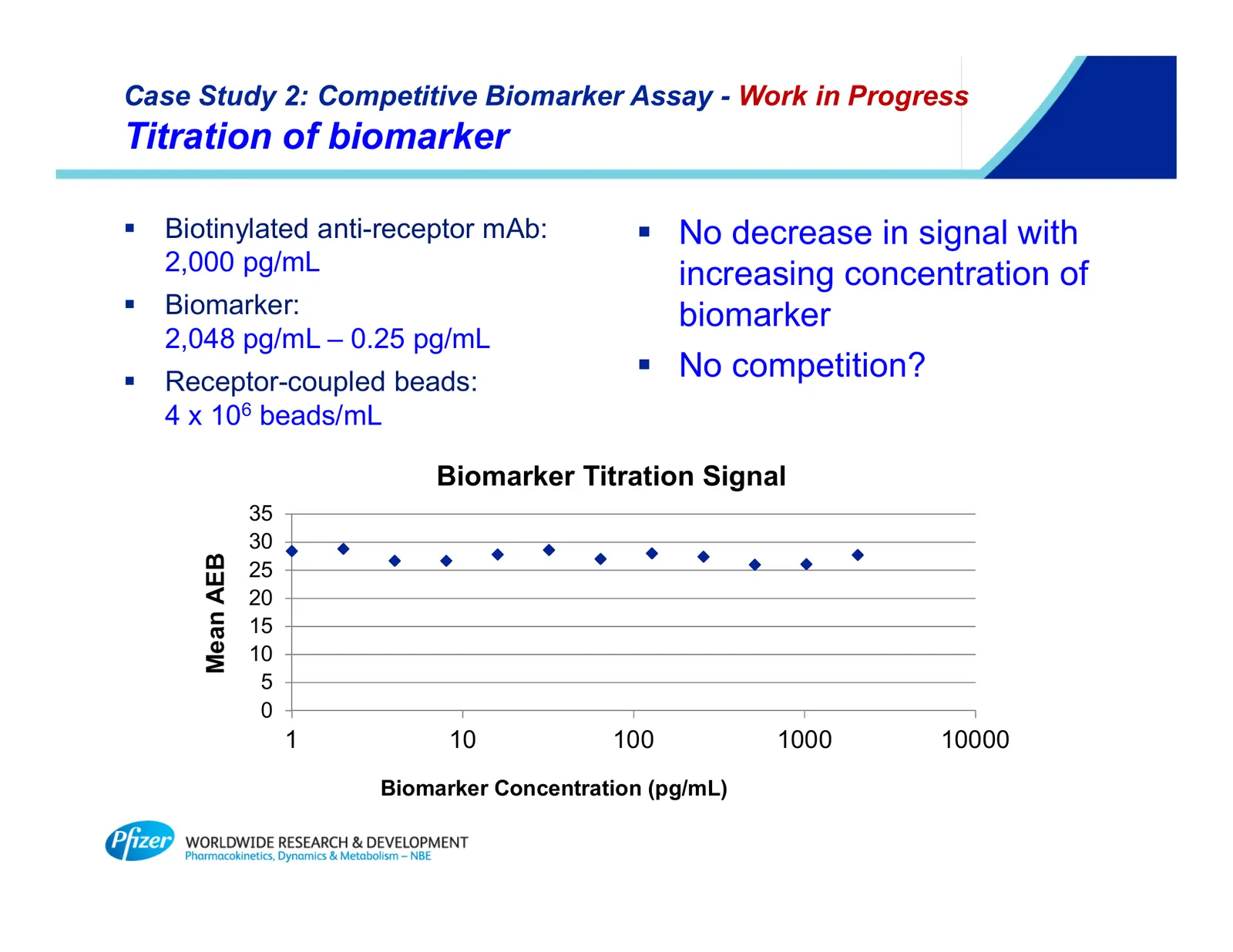
Slide 20: Titration of biomarker
Case Study 2: Competitive Biomarker Assay - Work in Progress Titration of biomarker Biotinylated anti-receptor mAb: No decrease in signal with 2,000 pg/mL increasing concentration of Biomarker: biomarker 2,048 pg/mL – 0.25 pg/mL Receptor-coupled beads: No competition? 4 x 10⁶ beads/mL Biom
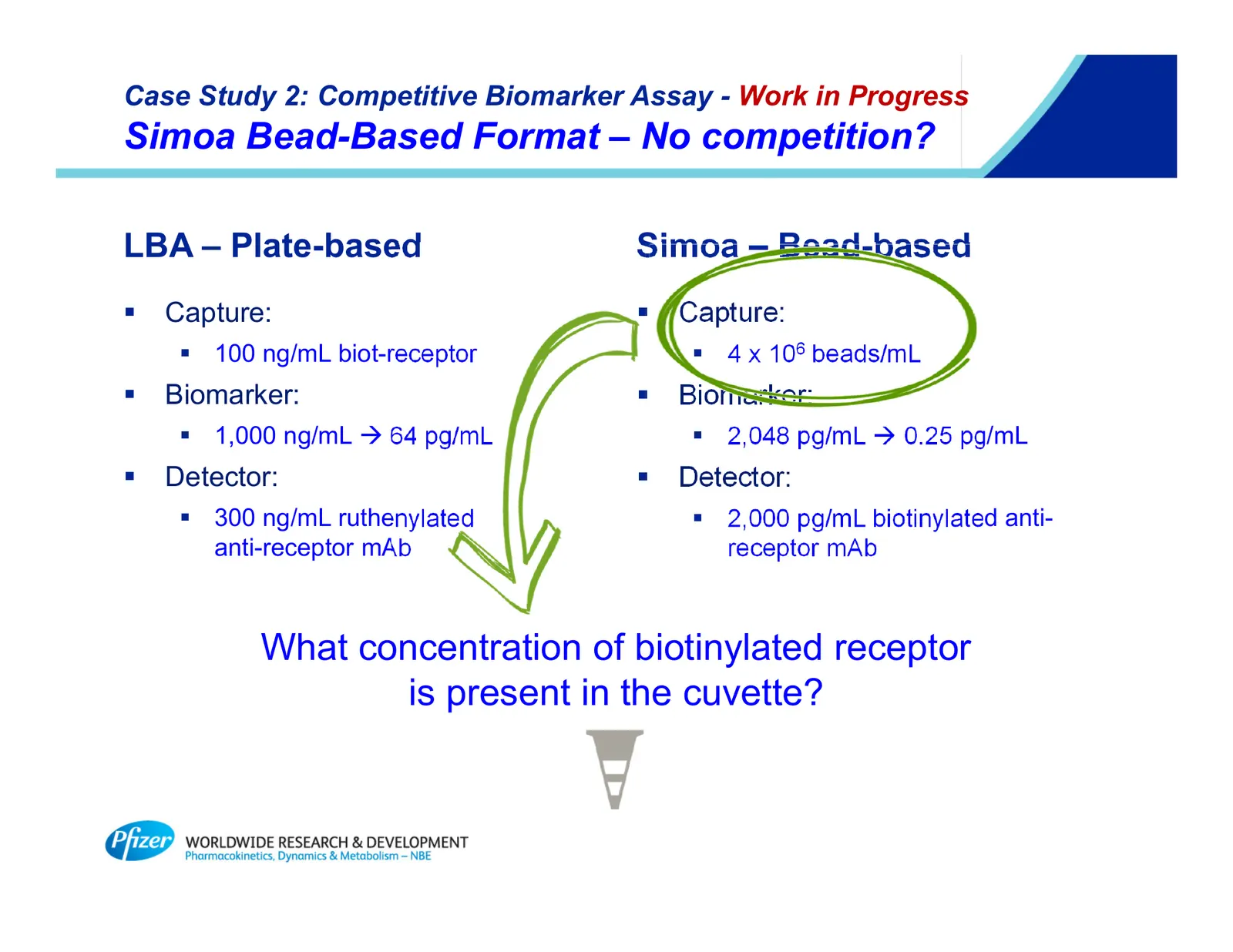
Slide 21: Simoa Bead-Based Format – No competition?
Case Study 2: Competitive Biomarker Assay - Work in Progress Simoa Bead-Based Format – No competition? LBA – Plate-based Simoa – Bead-based Capture: Capture: 100 ng/mL biot-receptor 4 x 10⁶ beads/mL Biomarker: Biomarker: 1,000 ng/mL 64 pg/mL 2,048 pg/mL 0.25 pg/mL Detector: D
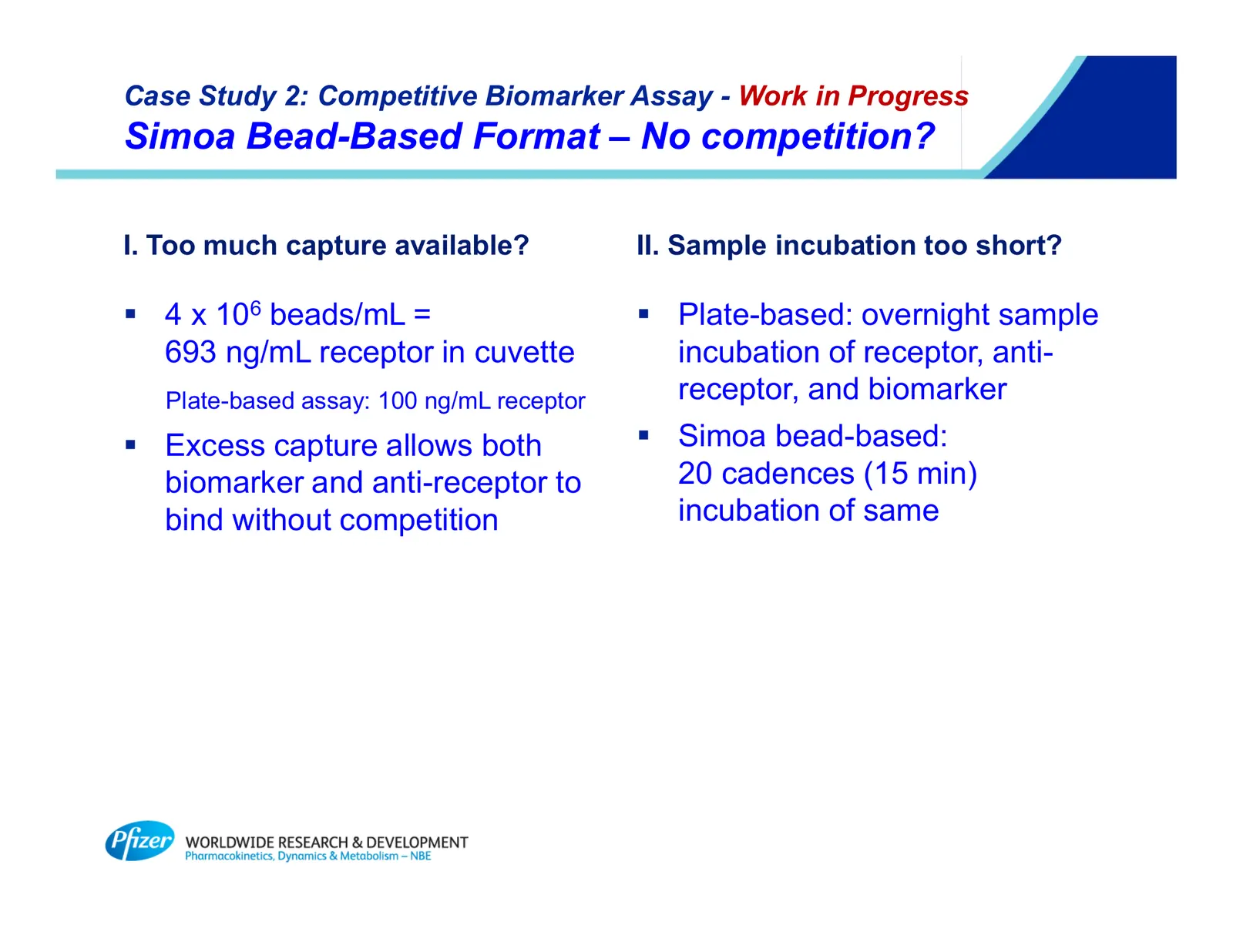
Slide 22: Simoa Bead-Based Format – No competition?
Case Study 2: Competitive Biomarker Assay - Work in Progress Simoa Bead-Based Format – No competition? I. Too much capture available? II. Sample incubation too short? 4 x 10⁶ beads/mL = Plate-based: overnight sample 693 ng/mL receptor in cuvette incubation of receptor, anti- Plate-based assay: 1
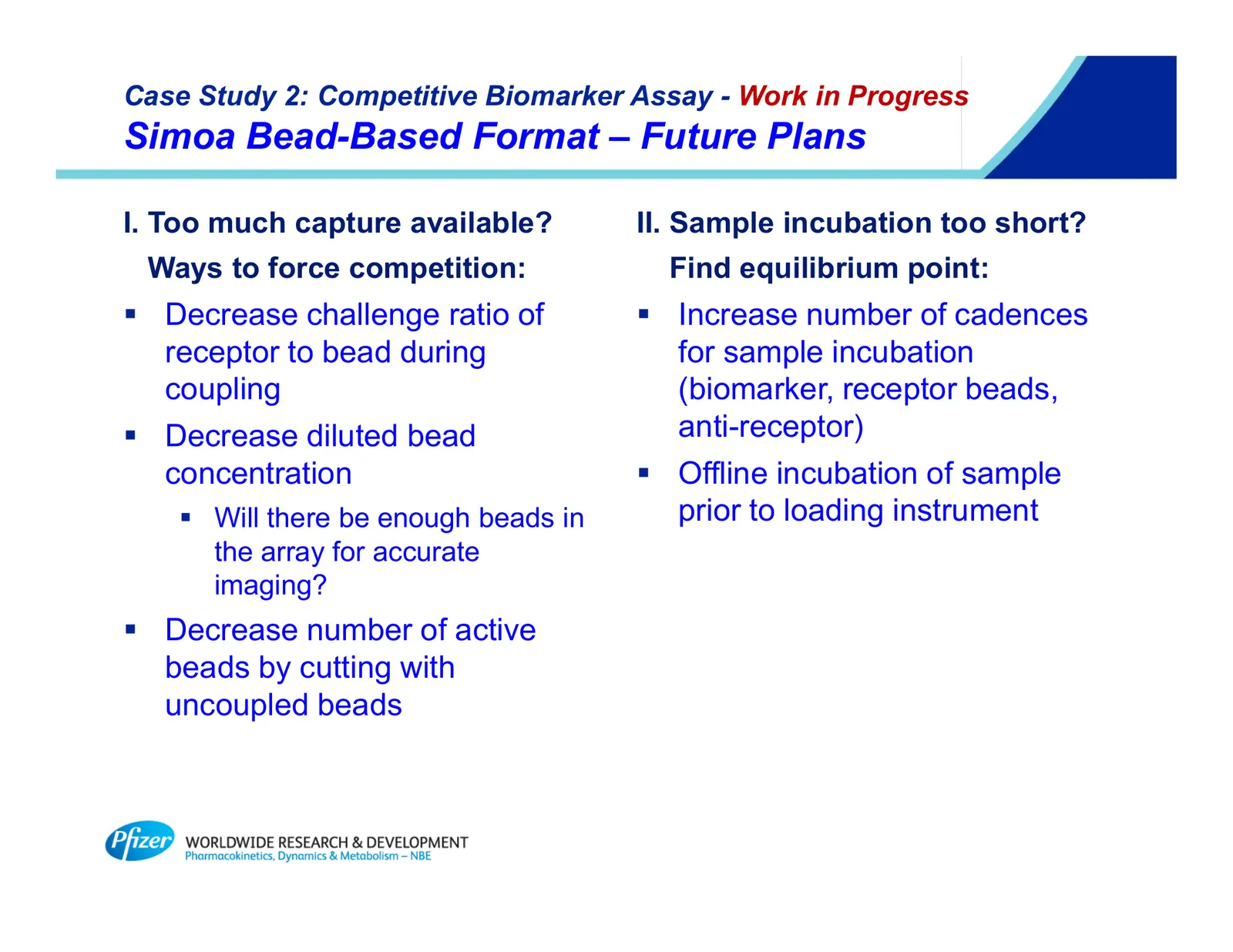
Slide 23: Simoa Bead-Based Format – Future Plans
Case Study 2: Competitive Biomarker Assay - Work in Progress Simoa Bead-Based Format – Future Plans I. Too much capture available? II. Sample incubation too short? Ways to force competition: Find equilibrium point: Decrease challenge ratio of Increase number of cadences receptor to bead during f
Slide 24: Acknowledgements
Acknowledgements Pfizer PDM-NBE Sheldon Leung Alison Joyce Joe Palandra Hendrik Neubert Terri Caiazzo Boris Gorovits Chris Lepsy Marion Kasaian Martin Dowty Jenny Zhang Quanterix Purvish Patel Huy Le
Source: Internet Archive copy of quanterix.com
More decks from Quanterix Corporation
 Q3 2026 Earnings Presentation21 slides · Nov 9, 2026
 Q2 2026 Earnings Presentation21 slides · Aug 10, 2026
 Q1 2026 Earnings Presentation17 slides · May 6, 2026
 FY2025 Earnings Presentation14 slides · Mar 2, 2026
 Q3 2025 Earnings Presentation11 slides · Nov 10, 2025
 Q2 2025 Earnings Presentation12 slides · Aug 7, 2025