Infinity Pharmaceuticals, Inc. · OTC:INFIQ
Infinity Pharmaceuticals — Merger or Acquisition (August 2006)
46 slides from Infinity Pharmaceuticals's merger presentation, Aug 17, 2006

Slide 1: Introduction to Infinity
Introduction to Infinity August 16, 2006

Slide 2: Overview
Overview Founded in late 2001 (~5 years old) Team – Recognized biotechnology investor, business and R&D leaders – ~115 employees (~55 PhD / MDs) Alliance and Financing Strategy – Small molecule technology access alliances with Amgen, J&J and Novartis – Bcl-2 product alliance with Novartis – Public f
Slide 3: Our Team: ~115 full-time employees
Our Team: ~115 full-time employees Infinity headcount Biology/Clinical/Regulatory Chemistry Management & other (~55 MD or PhDs) R&D Total Total G&A Well-balanced Moderate near-term growth anticipated – Primarily in “downstream” disciplines (i.e. clinical, regulatory, CMC/ADME/tox)
Slide 4: Overview
Overview Founded in late 2001 (~5 years old) Team – Recognized biotechnology investor, business and R&D leaders – ~115 employees (~55 PhD / MDs) Alliance and Financing Strategy – Small molecule technology access alliances with Amgen, J&J and Novartis – Bcl-2 product alliance with Novartis – Public f
Slide 5: DOS Small Molecule Technology: Discovery and Alliance Engine
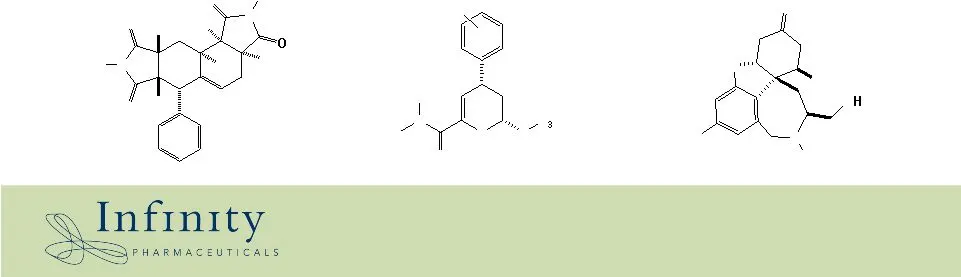
DOS Small Molecule Technology: Discovery and Alliance Engine Innovative small molecule platform, diversity oriented synthesis (DOS), enables the creation of novel, “natural product-like” synthetic drug candidates Potential to access previously “undruggable” drug targets Unique asset for: – Internal
Slide 6: Small Molecule Technology Access Alliances
Diversity Oriented Synthesis (DOS) 2004 – 2006: > $65 million upfront/committed cash Additional milestone and royalty potential No license of proprietary Infinity product rights Small Molecule Technology Access Alliances
Slide 7: Early product pipeline: Bcl-2 alliance with Novartis
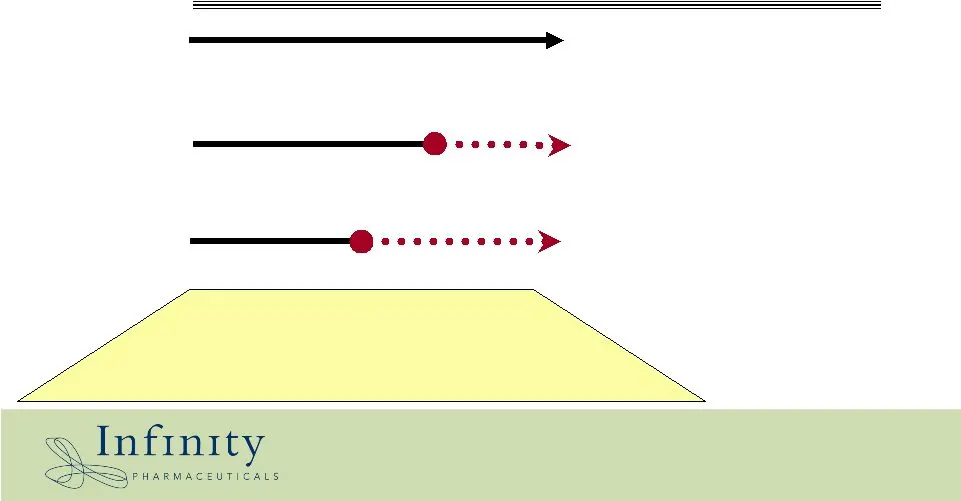
Total payments >$400M Early product pipeline: Bcl-2 alliance with Novartis Joint discovery of novel Bcl-2 targeted cancer drugs Infinity participation in clinical development (at NVS expense) COLLABORATION Infinity participation in US sales effort (at NVS expense) $30M Upfront & committed funds FINA
Slide 8: Alliance and financing strategy: value retention
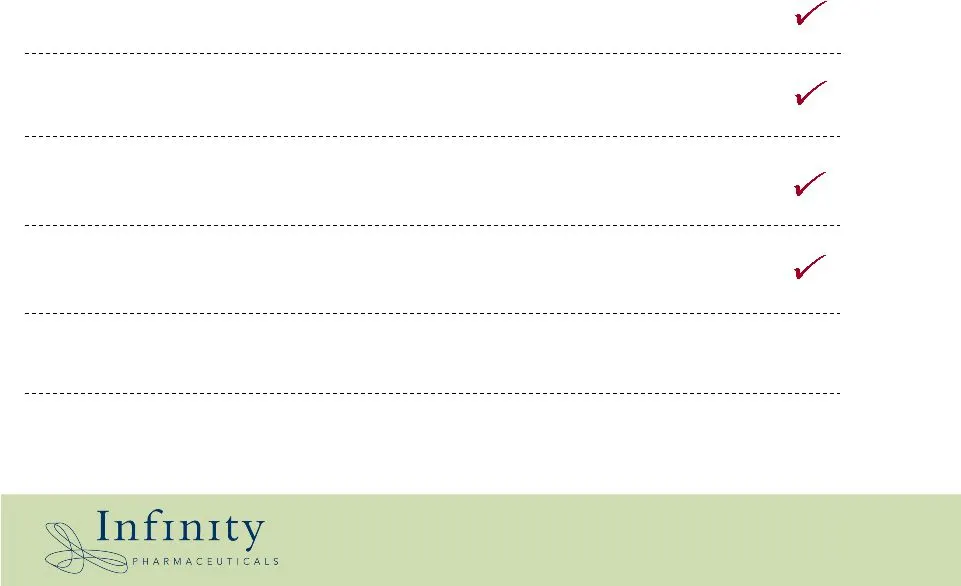
Discovery Preclinical Start Clinical Trials Hsp90 (IPI-504) Bcl2/Bcl-xL 2005 2007/2008* 100% owned 100% owned Novartis Non-exclusive – Amgen – Novartis – J&J Small molecule drug technologies Alliance and financing strategy: value retention Hedgehog Pathway (IPI-609) 2007* *Planned
Slide 9: Status of Reverse Merger
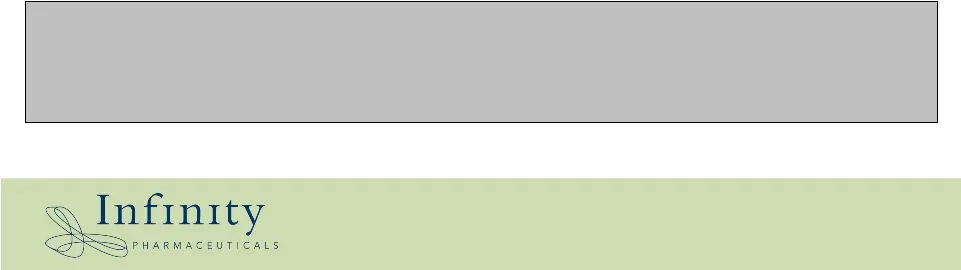
Status of Reverse Merger Announce merger File Initial S4 S-4 is Declared Effective S-4 mailed to DPI and IPI Stockholders Stockholder meeting/vote scheduled Deal Closes, INFI publicly traded April 12, 2006 July 11, 2006 August 7, 2006 August 9-10, 2006 September 12, 2006 Following successful vote
Slide 10: Overview
Overview Founded in late 2001 (~5 years old) Team – Recognized biotechnology investor, business and R&D leaders – ~115 employees (~55 PhD / MDs) Alliance and Financing Strategy – Small molecule technology access alliances with Amgen, J&J and Novartis – Bcl-2 product alliance with Novartis – Public f
Slide 11: Novel Hsp90 inhibitor
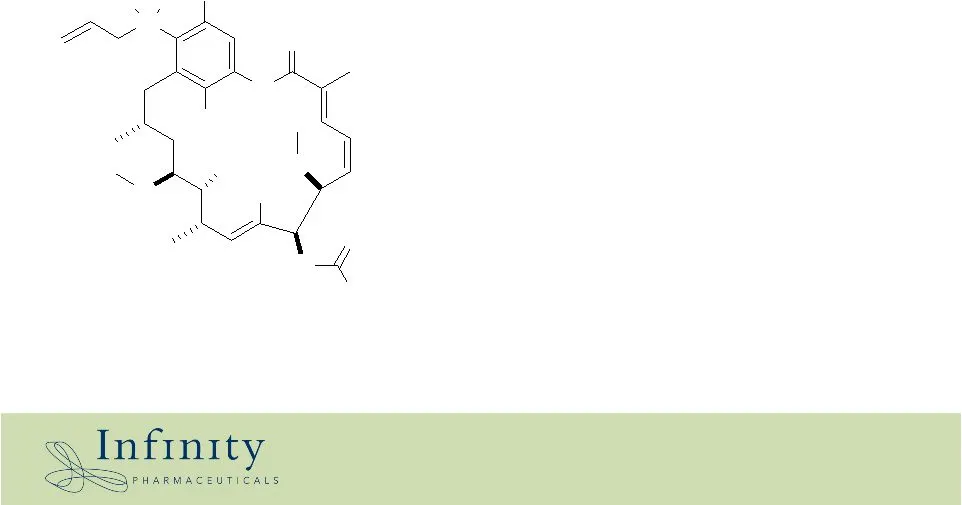
Novel Hsp90 inhibitor Currently in 2 Phase I clinical trials: GIST Multiple myeloma Ready for Phase II in 2007 Both IV (water-soluble) and oral formulations Infinity’s lead clinical product: IPI-504 (Hsp90 inhibitor) Cl - IPI-504 OH N H N OH O OH Me O O O O NH H H +
Slide 12: Heat Shock Protein (Hsp90) is an emerging cancer target
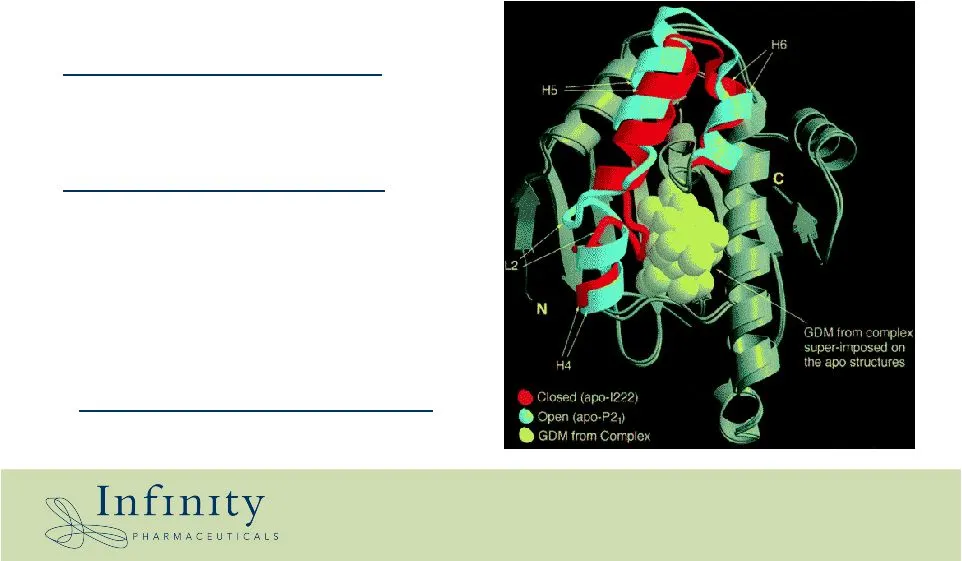
Heat Shock Protein 90 (Hsp90) is an emerging cancer target Hsp90 in cancer cells differs from Hsp90 in normal cells* Function of Hsp90 in cancer cells General chaperone function – essential for protein homeostasis Specific chaperone function – stabilization of oncogenic proteins in key cell signalin
Slide 13: Dependence on Hsp90
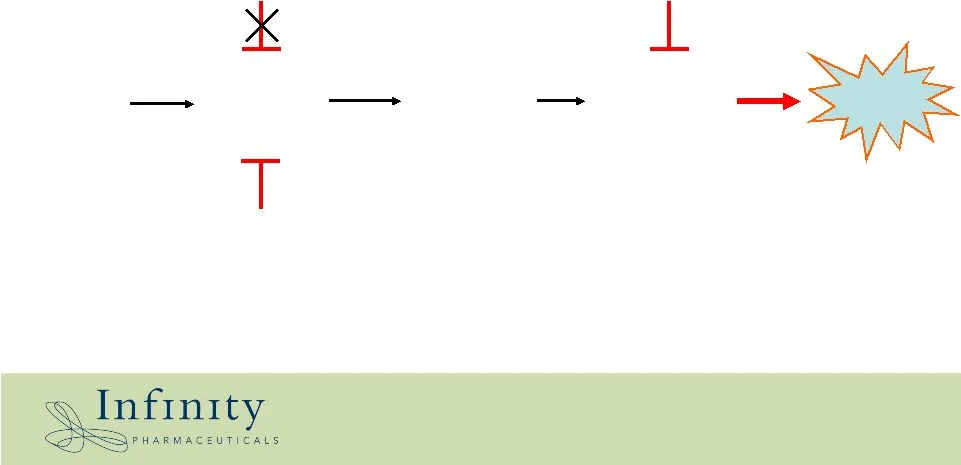
Dependence on Hsp90 Apoptosis Tyrosine kinase inhibitor (e.g Gleevec, Tarceva) Oncogene Cancer cell survival & proliferation Resistance mutations Hsp90 inhibitor Targeting specific oncogenic Hsp90 client proteins Hsp90 inhibitor
Slide 14: The emerging world of targeted cancer therapies
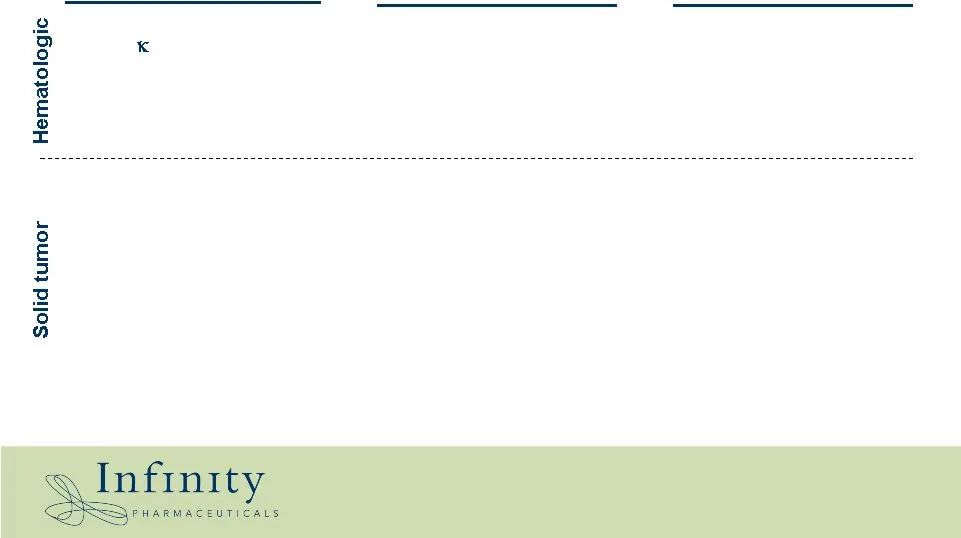
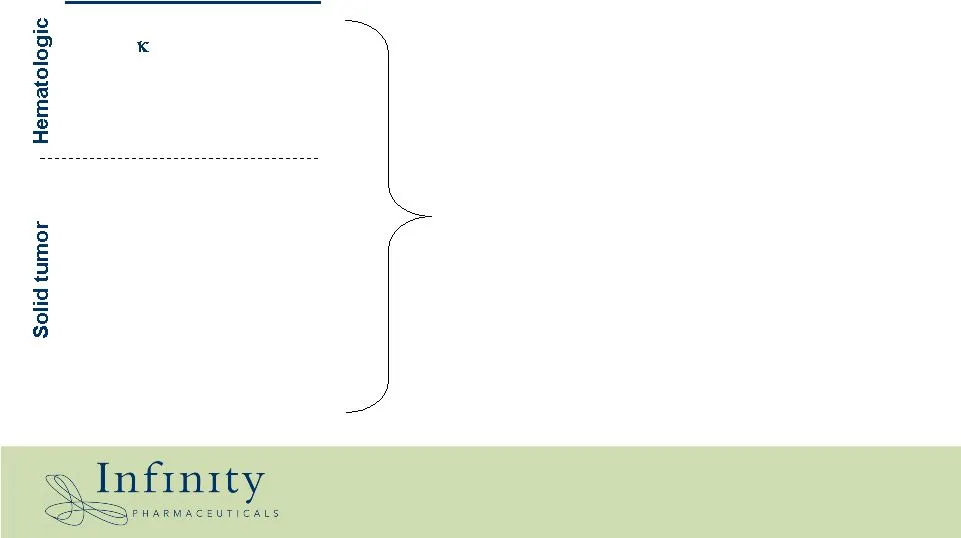
Velcade Gleevec / dasatinib Investigational Gleevec / Sutent Herceptin Tarceva / Erbitux Sorafenib / Sutent Sorafenib Investigational Targeted therapy The emerging world of targeted cancer therapies Indication Myeloma CML AML GIST Breast (HER2+) NSCLC Renal cell Melanoma Prostate (PTEN -/-) NF- B Bc
Slide 15: The emerging world of targeted cancer therapies
The emerging world of targeted cancer therapies NF- B Bcr-Abl Flt3 c-Kit HER2 EGFR VEGFR / HIF-1a b-Raf p-Akt Molecular Target All are clients of Hsp90 Inhibiting Hsp90 affects the stability of these targets
Slide 16: History of Geldanamycin analogs
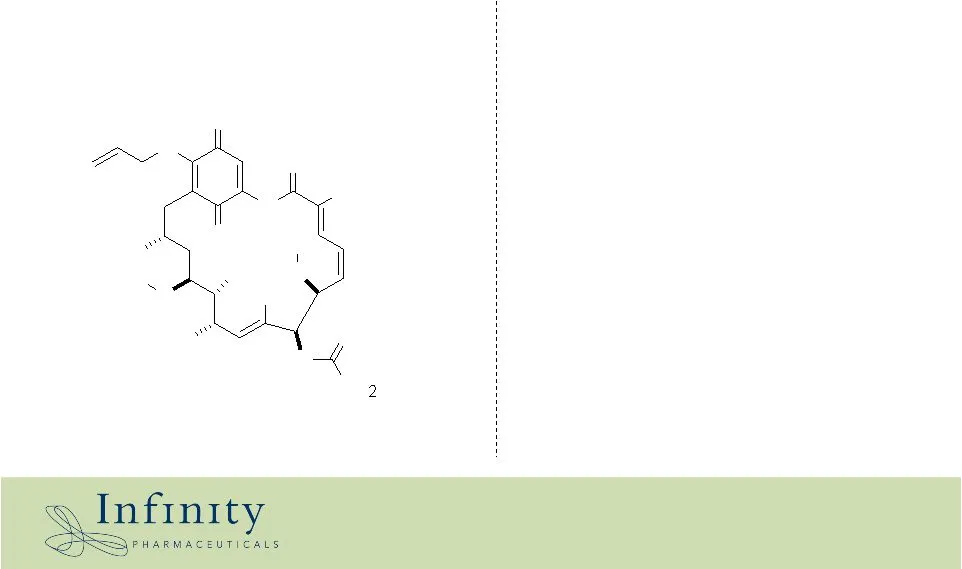
History of Geldanamycin analogs 17-AAG is a semi-synthetic natural product, derived from Geldanamycin 17-AAG activity: – Potent & selective inhibitor of Hsp90 – Well-tolerated in humans (>400 patients tested in multiple Phase I trials) – Removed chemical reactivity of geldanamycin Problems: – Highly
Slide 17: Novel chemical entity
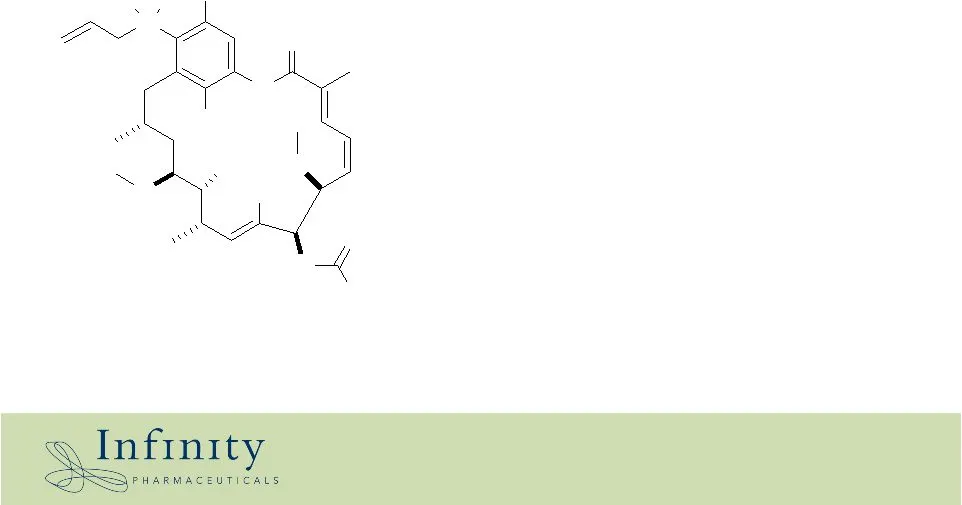
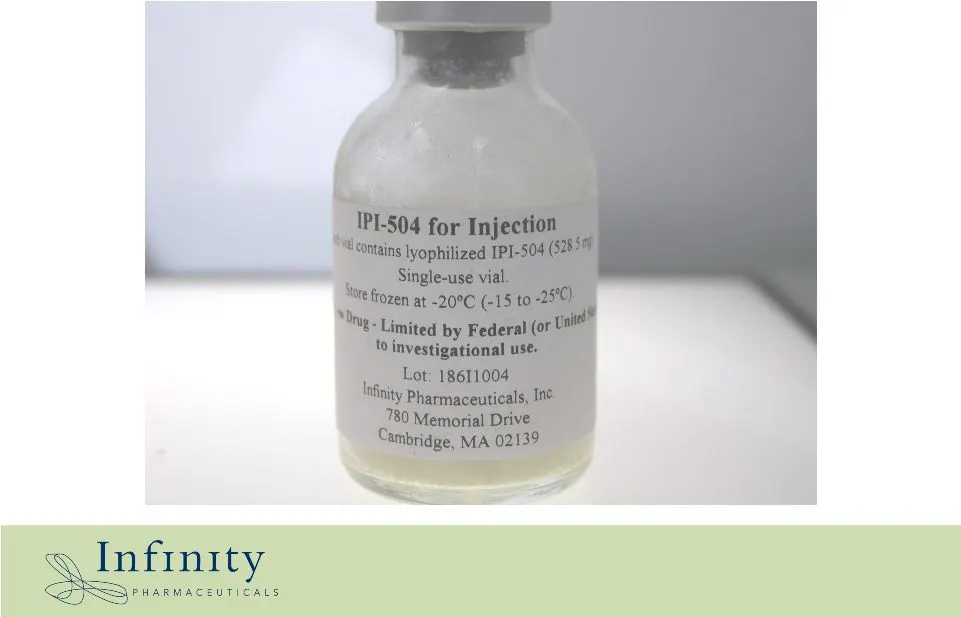
Novel chemical entity Patient-friendly formulations – IV in two Phase I trials – Oral under development Broad therapeutic potential Strong intellectual property position Phase II planned for 2007 Cl - Infinity’s lead clinical product: IPI-504 (HSP90 inhibitor) IPI-504 OH N H N OH O OH Me O O O O NH
Slide 18: SSS rh anmaceuricats
SSS rh anmaceuricats

Slide 19: IPI-504 competitive landscape for IV formulation
IPI-504 competitive landscape for IV formulation POTENCY DELIVERY CHEMICAL PROPERTIES MTD COMPOUND COMPANY 17-DMAG KOS-1022 ~25-50 nM IV 60–120 min Chemically reactive alkylating agent <24 mg/m ² Kosan 17-AAG KOS-953 ~25-50 nM IV 60-120 min in Cremophor Special tubing Steroid pretreatment Emulsion c

Slide 20: IPI-504 competitive landscape for PO formulations
IPI-504 competitive landscape for PO formulations IPI-504 (same molecule as IV) 17-DMAG CNF-2024 Small Molecule Small Molecule Small Molecule Compound Company Phase of Development Infinity Kosan Biogen Idec Serenex Novartis / Vernalis Synta Pre-clinical Phase I Phase I Preclinical Preclinical Precli

Slide 21: Intellectual property protection for IPI-504
Intellectual property protection for IPI-504 Composition of matter Formulations (IV and PO) Methods of making Methods of using Infinity has broad patent applications pending for IPI-504
Slide 22: Highly responsive to Hsp90 inhibition
Highly responsive to Hsp90 inhibition T315I T790M T670I Preclinical evidence of potential as salvage therapy BCR-ABL EGFR KIT Hsp90 Client Disease Drug CML NSCLC GIST Gleevec, Dasatinib Tarceva, Iressa Gleevec, Sutent Kinase Inhibitor Resistance Mutation
Slide 23: CML / Bcr-Abl
CML / Bcr-Abl Wild-type protein Bcr Abl Non-cancer related Protein status Entity Function Hsp90- dependent Gain-of-function mutant Bcr-Abl fusion Constitutively activated signaling Drug-resistant mutant Bcr-Abl (T315I) TKI-resistant kinase
Slide 24: Gleevec-refractory primary CML cells sensitive to IPI-504
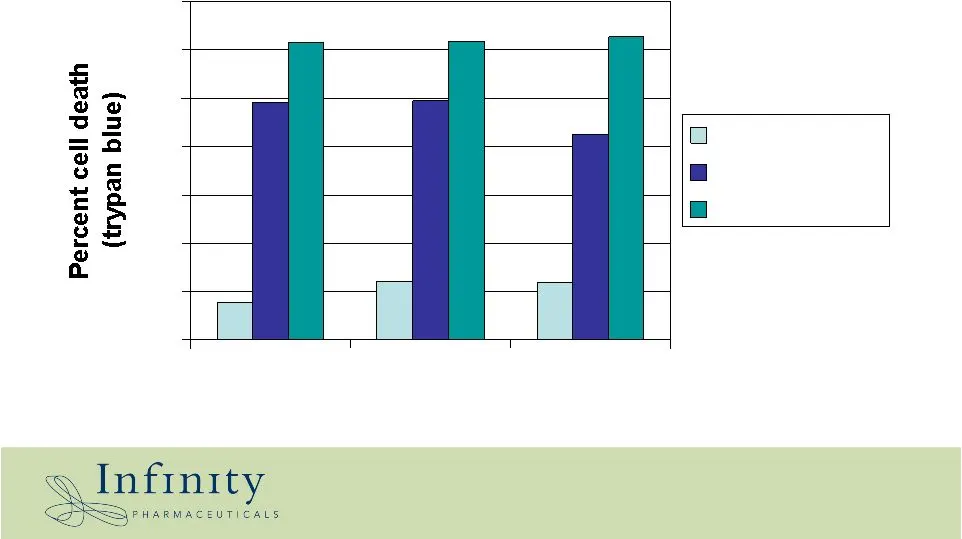
Gleevec-refractory primary CML cells sensitive to IPI-504 Pt 1 Pt 2 (T315I) Pt 3 Control 0.5 uM IPI-504 2.0 uM IPI-504 Collaboration: Kapil Bhalla, Moffitt Cancer Center
Slide 25: Oral IPI-504: survival benefit in Gleevec-resistant T315I CML model
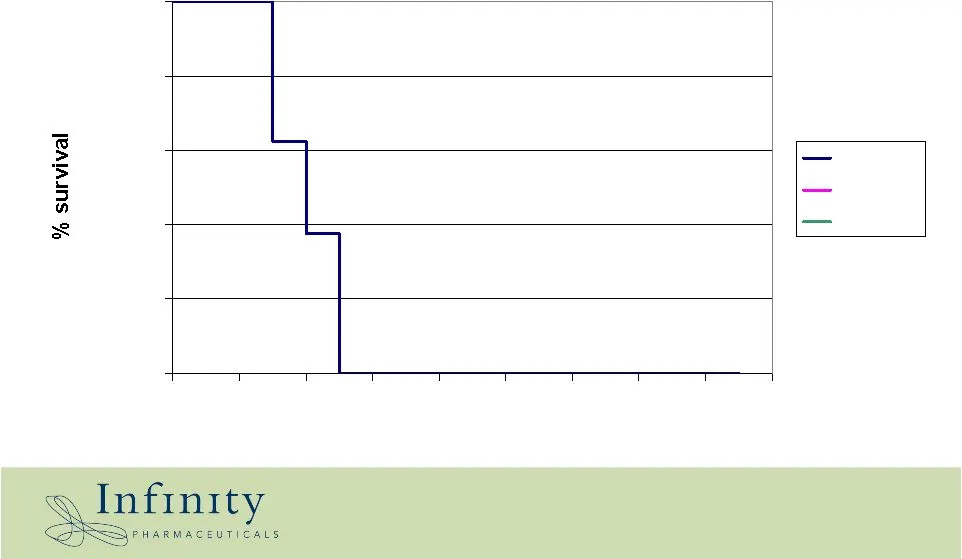
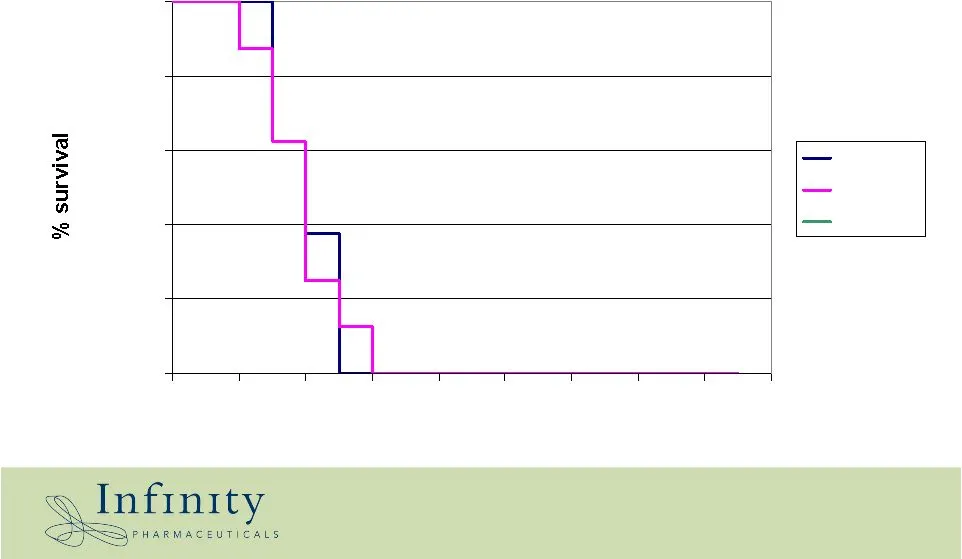
Placebo Gleevec IPI-504 0.0% 20.0% 40.0% 60.0% 80.0% 100.0% Days Oral IPI-504: survival benefit in Gleevec-resistant T315I CML transplantation model Collaboration: Shauguang Li, Jackson Labs Gleevec 2x daily, 100 mg/kg IPI-504 oral MWF, 100 mg/kg ( p =0.001)
Slide 26: Oral IPI-504: survival benefit in Gleevec-resistant T315I CML model
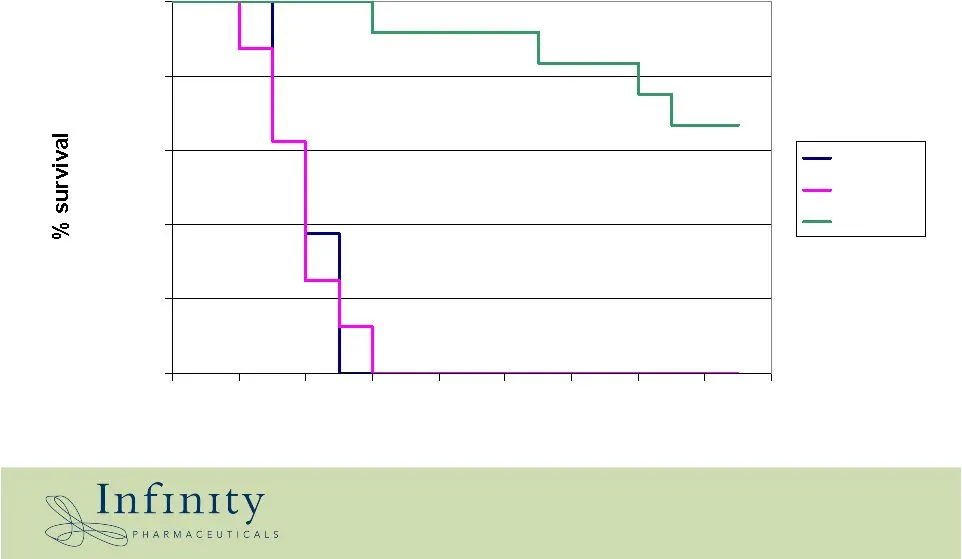
Placebo Gleevec IPI-504 0.0% 20.0% 40.0% 60.0% 80.0% 100.0% Days Oral IPI-504: survival benefit in Gleevec-resistant T315I CML transplantation model Collaboration: Shauguang Li, Jackson Labs Gleevec 2x daily, 100 mg/kg IPI-504 oral MWF, 100 mg/kg ( p =0.001)
Slide 27: Oral IPI-504: survival benefit in Gleevec-resistant T315I CML model
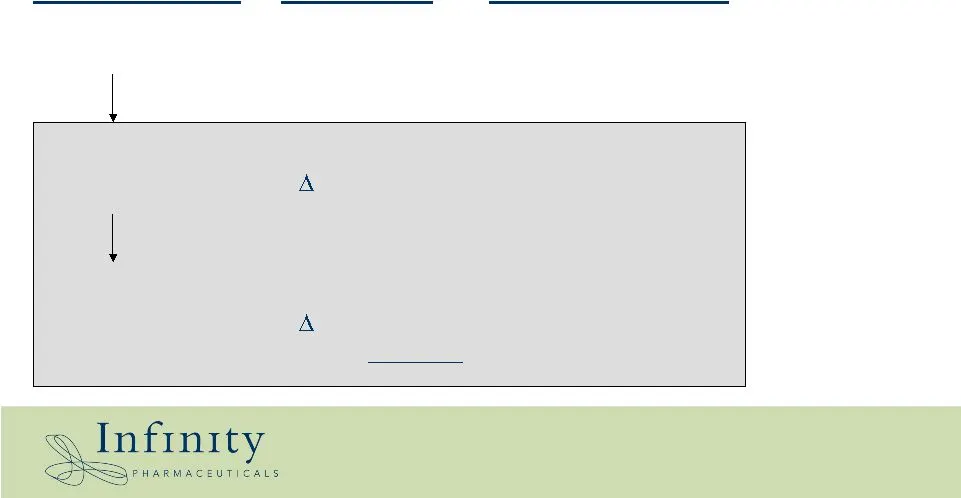
Placebo Gleevec IPI-504 0.0% 20.0% 40.0% 60.0% 80.0% 100.0% Days Oral IPI-504: survival benefit in Gleevec-resistant T315I CML transplantation model Collaboration: Shauguang Li, Jackson Labs Gleevec 2x daily, 100 mg/kg IPI-504 oral MWF, 100 mg/kg ( p =0.001)
Slide 28: NSCLC / EGFR
NSCLC / EGFR Wild-type protein EGFR Ligand-dependent RTK Protein status Entity Function Hsp90- dependent Gain-of-function mutant EGFR ( exon19 or L858R) Ligand- hypersensitive RTK Drug-resistant mutant EGFR ( exon19 or L858R + T790M) TKI-resistant, ligand hypersensitive RTK
Slide 29: NSCLC xenograft with T790M EGFR resistance mutation
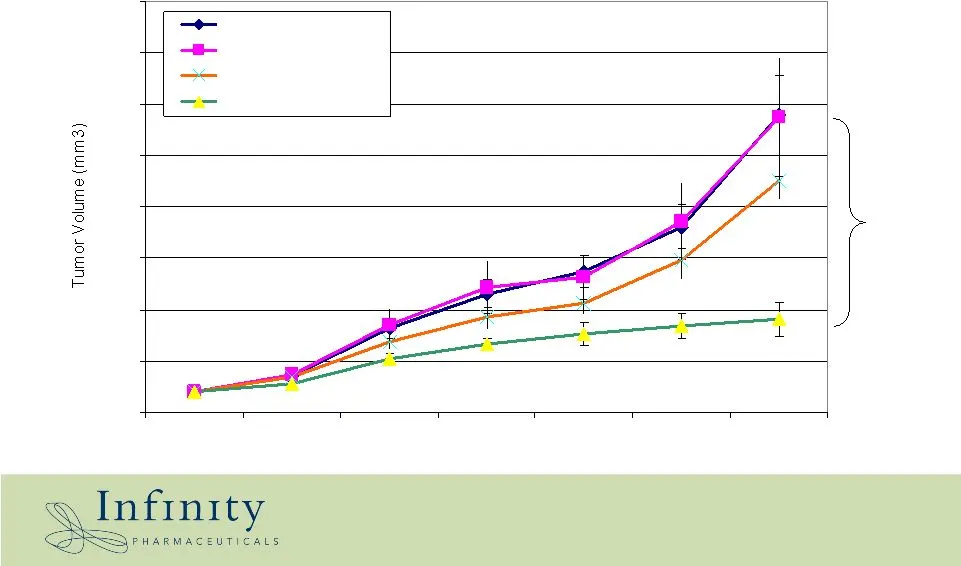
1000 1500 2000 2500 3000 3500 4000 Days Post-Implant IPI-504 Vehicle, IP Gefitinib Vehicle, PO 100mpk Gefitinib, PO 100mpk IPI-504, IP 100mpk IPI-504 2X weekly IP; 100mpk Gefitinib daily PO for weeks 21% difference in tumor volumes between vehicle and Gefitinib treated groups ( p =0.54) 69% differen
Slide 30: GIST / Kit
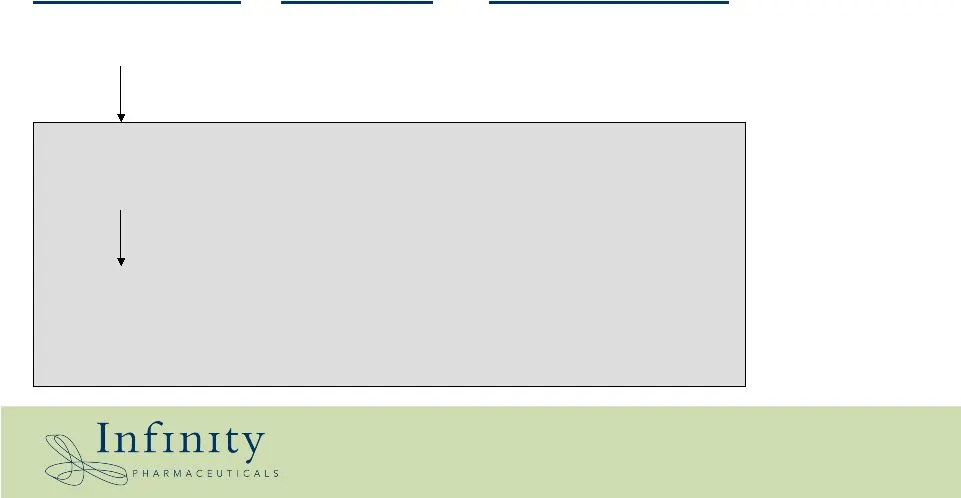
GIST / Kit Wild-type protein Kit Ligand-dependent RTK Protein status Entity Function Hsp90- dependent Gain-of-function mutant c-Kit Ligand-independent RTK Drug-resistant mutant c-Kit (T670I) TKI-resistant, ligand-independent RTK
Slide 31: GIST: Gleevec-resistant cells more sensitive to IPI-504
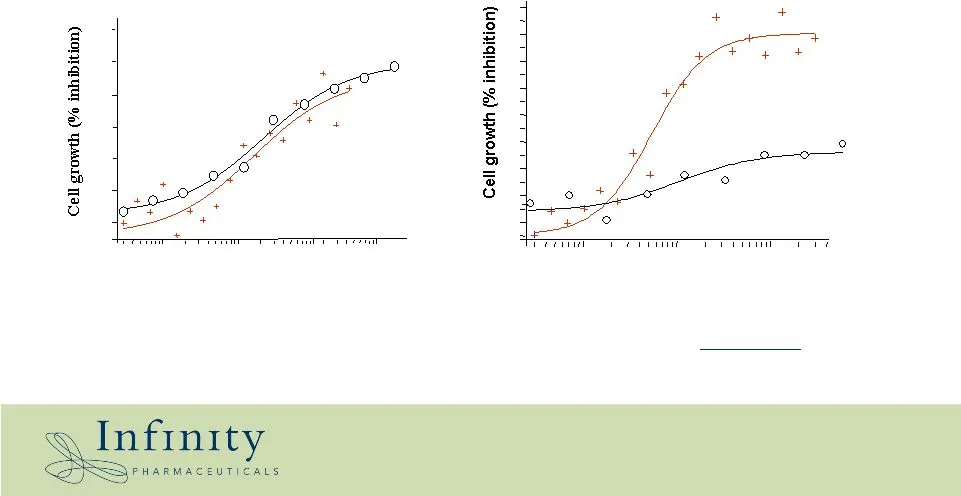
GIST: Gleevec-resistant cells more sensitive to IPI-504 GIST 882* Gleevec-Sensitive (primary: exon 13, K642E) 1000 10000 Compounds concentrations (nM) 1000 10000 10000 Compounds concentrations (nM) IPI-504 : EC50 = 121 +/- 21 nM IM : EC50 = 147 +/- 42 nM Gleevec- Resistant (primary: exon 11, V560D +
Slide 32: Current ongoing phase I clinical trials
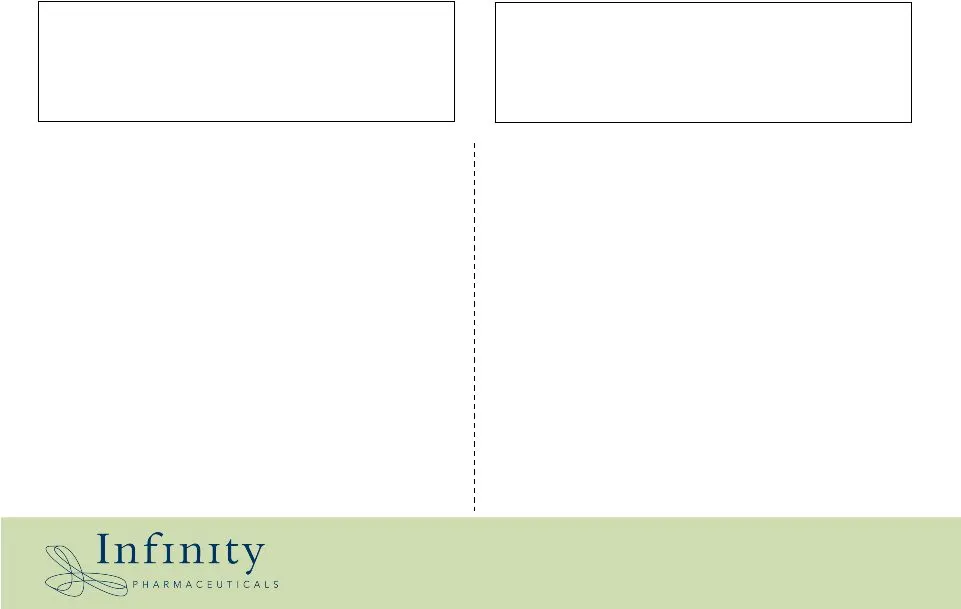
Principal Investigator: Dr. George Demetri, DFCI Objectives: Safety, PK, dose-ranging Establish Phase II dose Surrogate marker of response: PET scans Solid Tumor Gastrointestinal Stromal Tumors (Gleevec-resistant) Schedule / status: Days 1, 4, 8, 11 of 21 day Continuing dose escalation Current ongoi
Slide 33: Phase I dose escalation for IPI-504 (GIST)
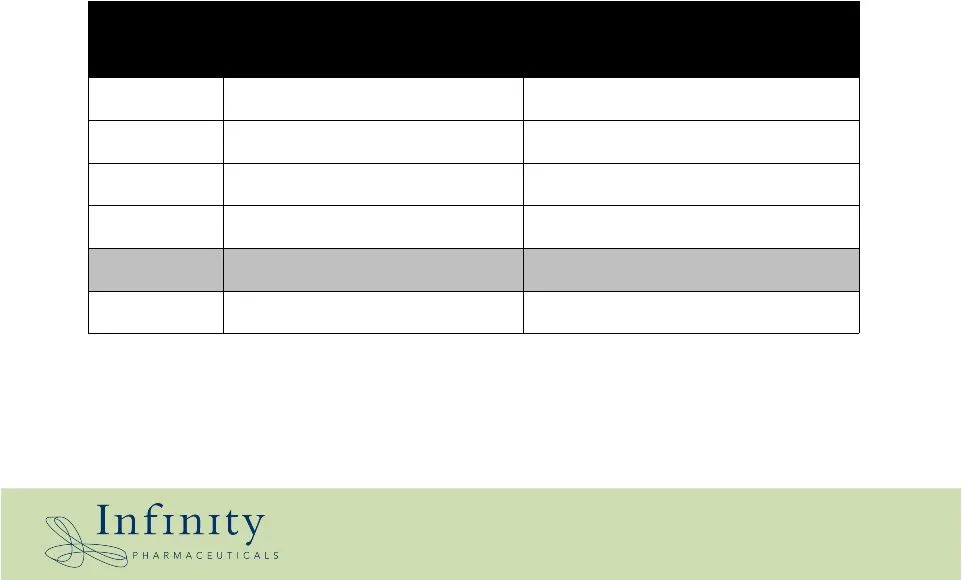
Escalation over previous dose Dose (mg/m2) Group Phase I dose escalation for IPI-504 (GIST) 1 cycle = 21 days 4 doses (days 1, 4, 8, 11 followed by 10 days off) Phase I schedule 25% 33% 33% 50% 66% 100%

Slide 34: Near-term sequence of additional clinical indications
Near-term sequence of additional clinical indications (2006/2007) Resistance Mutation Disease PI T. Lynch T. Kipp, CLL consortium Matsui, Smith / Bhalla NSCLC CLL CML Tarceva-R (T790M ) Zap-70 T315I Focused trials would determine IPI-504 activity in patients with known resistance to targeted therapy

Slide 35: Overview
Overview Founded in late 2001 (~5 years old) Team – Recognized biotechnology investor, business and R&D leaders – ~115 employees (~55 PhD / MDs) Alliance and Financing Strategy – Small molecule technology access alliances with Amgen, J&J and Novartis – Bcl-2 product alliance with Novartis – Public f
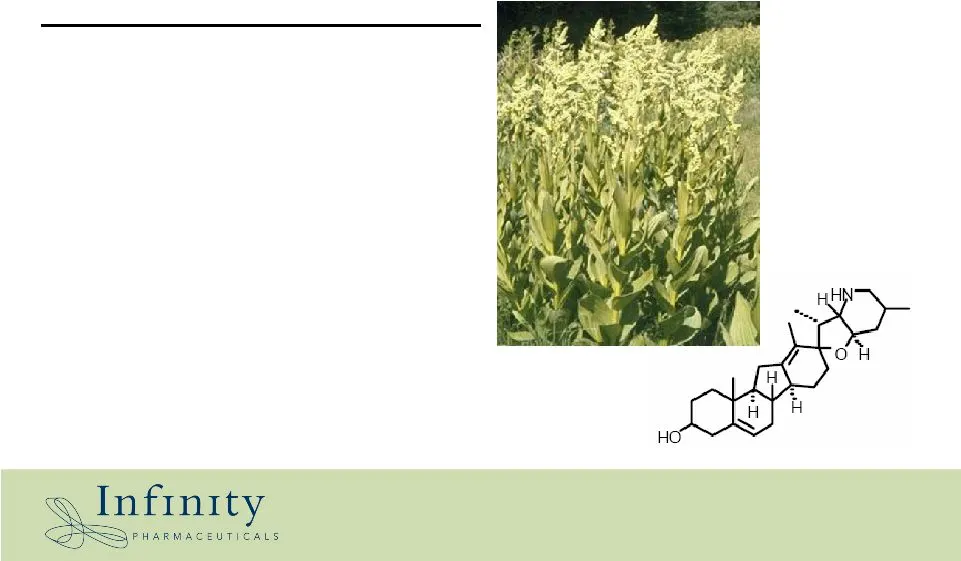
Slide 36: History of cyclopamine – chemical discovery
History of cyclopamine – chemical discovery 1950’s Lambs born in Idaho with cyclopic features (defect in development of left-right asymmetry) USDA determines that pregnant ewes grazed on the plant Veratrum californicum Cyclopamine identified as the teratogenic substance in V. californicum Purified c
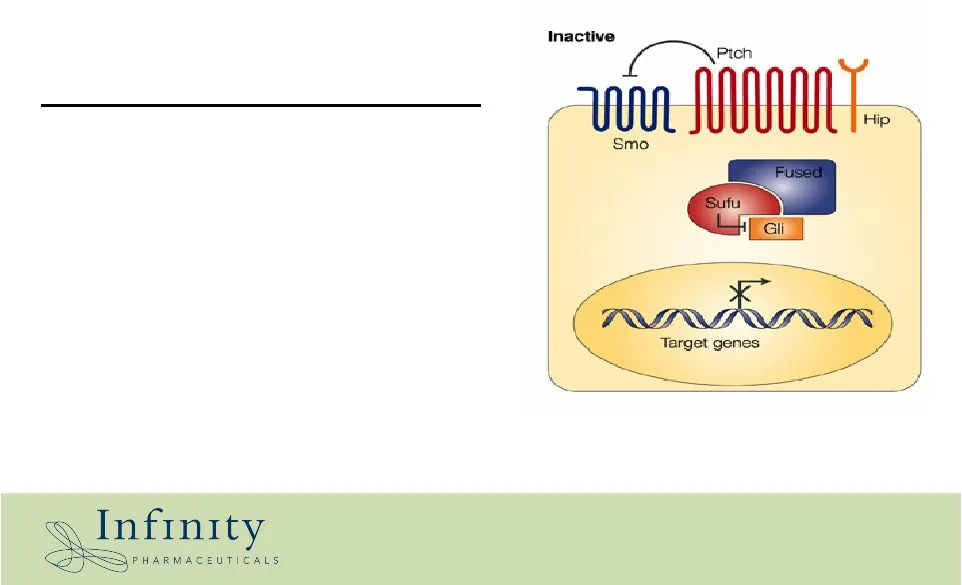
Slide 37: History of hedgehog – genetics
History of hedgehog – genetics 40 years later (1980’s to today) Genes are discovered that control embryonic development and pattern formation One such gene is called “hedgehog” Hedgehog mutations in the Drosophila fruit fly result in cyclopia Hedgehog function in humans related to development of the
Slide 38: Cyclopamine chemistry meets hedgehog genetics
Cyclopamine chemistry meets hedgehog genetics Chemistry The chemical cyclopamine results in cyclopic animals Genetics Mutation of hedgehog pathway results in cyclopic animals Might the chemical cyclopamine interact with genes in the hedgehog pathway? YES
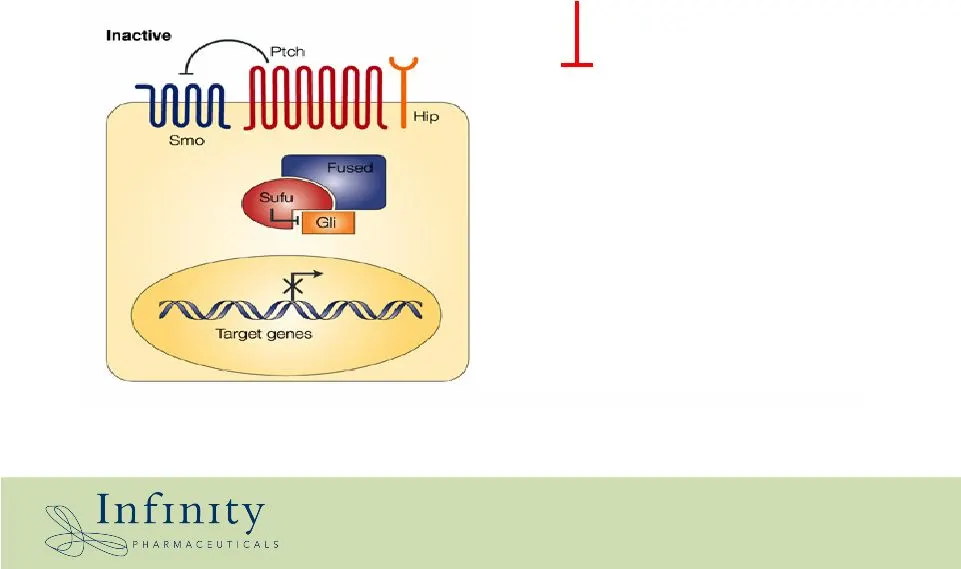
Slide 39: Cyclopamine is a smoothened antagonist
Cyclopamine is a smoothened antagonist *Chen et al., 2002 G&D 16:2743 Cyclopamine Normal Cancer
Slide 40: Cancers have hijacked components of the hedgehog pathway
Cancers have hijacked components of the hedgehog pathway # ON = active repressor of Smo * Mutation in Patched Hahn et al ., 1996, Cell 85: 841 Bale & Yu, 2001, Human Molec. Genetic . 10: 757 (review) Berman et al ., 2002 Science 297: 1559 Berman et al., 2003 Nature 425: 846 Kayed et al., 2004 Int. J
Slide 41: Cyclopamine validates Hedgehog as a cancer target
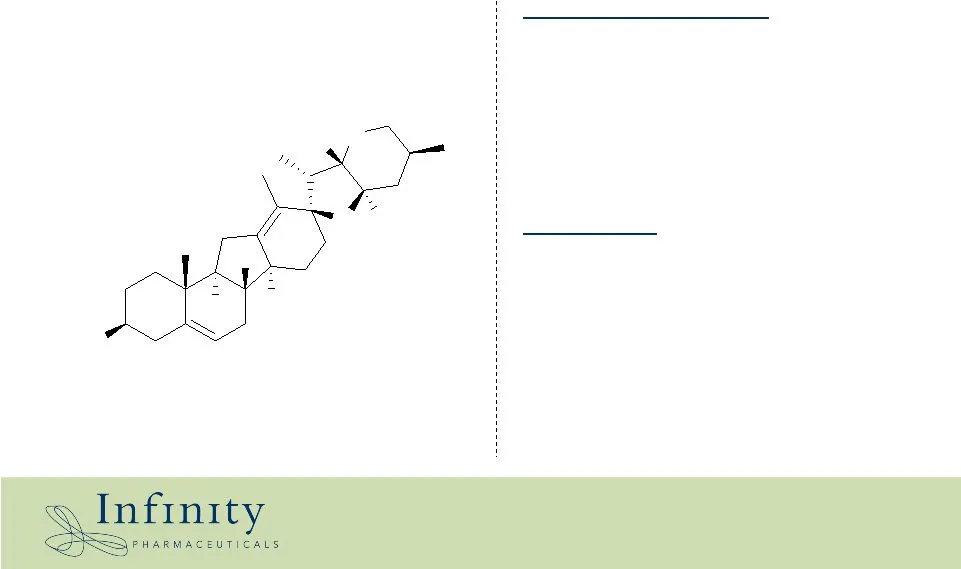
Cyclopamine validates Hedgehog as a cancer target Cyclopamine is a plant natural product produced by Veratrum californicum Cyclopamine activity: Potent inhibitor of Smoothened Highly active in pancreatic, prostate, small cell lung cancer animal models Drawbacks: Insoluble Caustic formulations Off-pa
Slide 42: Infinity's lead Hedgehog pathway inhibitors
Infinity’s lead Hedgehog pathway inhibitors Novel candidates based on cyclopamine On mechanism Superior to cyclopamine: – More chemically stable – More potent – More soluble Most advanced candidate (IPI-609) in late-preclinical development – First in man 2007 – i.v., s.c., or oral formulations – Bet
Slide 43: IPI-609 efficacious in PC-3 prostate xenograft
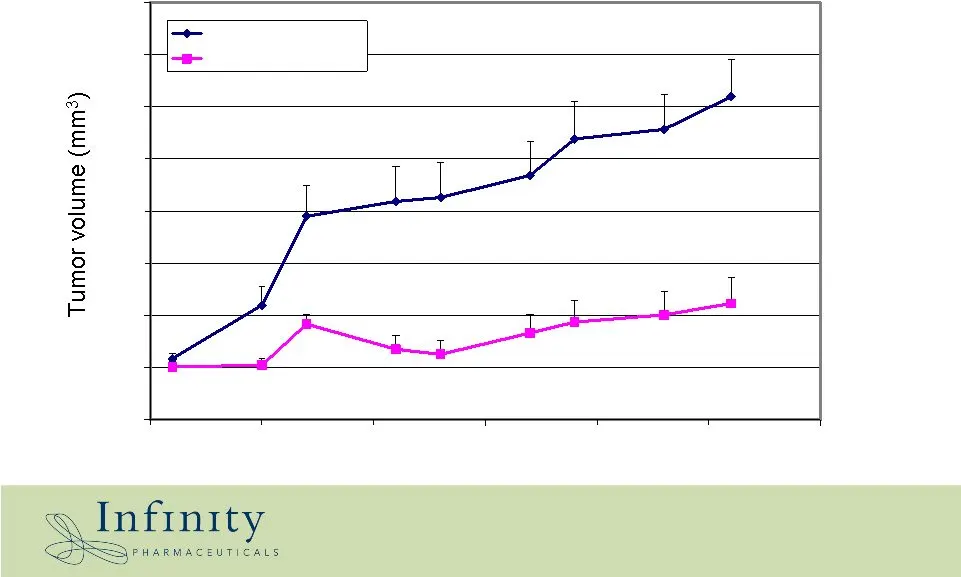
1000 1200 1400 1600 Days Vehicle IPI-609 10 mpk/day IPI-609 efficacious in PC-3 prostate xenograft
Slide 44: IPI-609 slows tumor growth rates
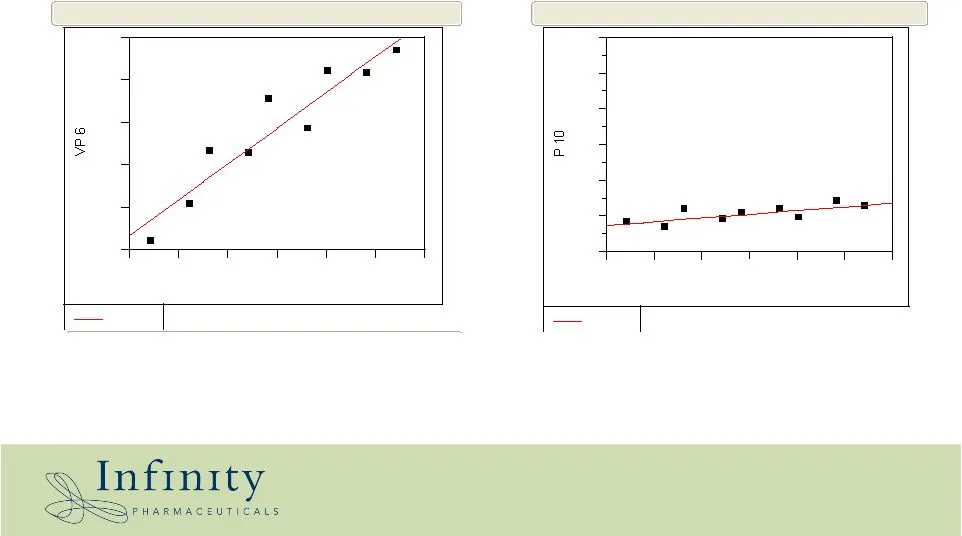
IPI-609 slows tumor growth rates 1000 1200 Day Linear Fit Bivariate Fit of P 10 By Day 1000 1200 Day Linear Fit Bivariate Fit of VP 6 By Day Median vehicle-treated animals Median IPI-609 treated animals
Slide 45: Principal Investigator relationships established
Key Principal Investigator relationships established Pancreatic cancer Manuel Hidalgo, MD Johns Hopkins (PCRT – Dan Van Hoff, MD) Small cell lung cancer Charles Rudin, MD Johns Hopkins Prostate cancer Phil Kantoff, MD DFCI Howard Scher, MD MSKCC Chris Logothetis, MD MD Anderson Prostate Consortium B
Slide 46: Product Pipeline: 2006/Early 2007 Goals and Anticipated News Flow
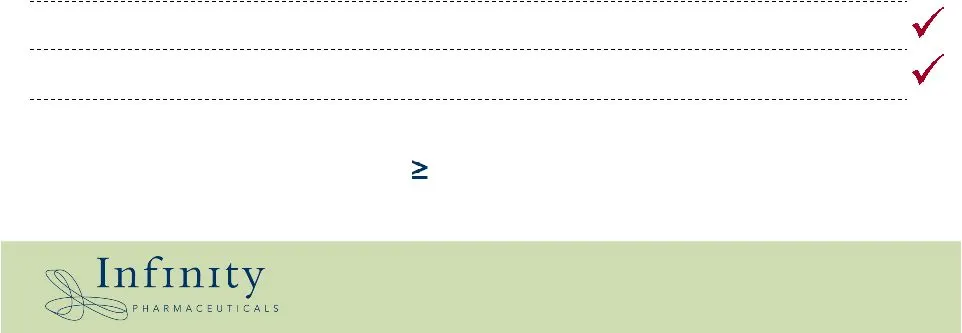
Product Pipeline – IPI-504: Complete Phase I trials Publish First Clinical Data – IPI-504: Expect to initiate Phase II in 2007 – Hedgehog Pathway: Expect to initiate Phase I in 2007 Successful alliance execution (Novartis, J&J, Amgen) At least one new corporate alliance Financing event – Year-end ca
Source: SEC EDGAR · 425 filed Aug 17, 2006
More decks from Infinity Pharmaceuticals, Inc.
 Merger or Acquisition (June 2023)89 slides · Jun 20, 2023
 Merger or Acquisition (February 2023)39 slides · Feb 23, 2023
 Technical Presentation (July 2021)54 slides · Jul 27, 2021
 Technical Presentation (February 2021)53 slides · Feb 11, 2021
 SABCS 2020 Investor Event32 slides · Dec 9, 2020
 Corporate Update (January 2016)47 slides · Jan 11, 2016