Quanterix Corporation · NASDAQ:QTRX
Quanterix — Technical Presentation (October 2015)
18 slides from Quanterix's technical presentation, Oct 29, 2015

Slide 1: Jessica Gill, RN, PhD, NIH Brain Injury Branch
Jessica Gill, RN, PhD National Institutes of Health National Institutes of Nursing Research Chief of Brain Injury Branch
Slide 2: Traumatic Brain Injuries (TBIs)
Traumatic Brain Injuries (TBIs) • TBIs are common in civilians • In military, TBIs are common, often multiple, and include a combination of blast, and contusion injuries • TBIs are the signature injuries of the conflicts in Iraq and Afghanistan • As veterans age, TBIs, and chronic symptoms are a con
Slide 3: The Need for Biomarkers in TBI
The Need for Biomarkers in TBI • Predictive • Prognostic • Pharmaco-dynamic • Differences in acute and chronic biomarkers • Use of Simoa
Slide 4: Chronic Traumatic Encephalopathy (CTE)
Chronic Traumatic Encephalopathy (CTE) • CTE appears similar to Alzheimer's Disease in symptoms and plaques • Plaques include both tau and amyloid depositions that compromise functioing • Alzheimer’s Disease is linked to higher tau and amyloid beta in the CSF
Slide 5: Madigan Army Medical Center Study
Madigan Army Medical Center Study • Total sample= 202 • Military personnel within 16 months of deployment • 128 had one or more TBIs • 64% had more than 1 TBI, and 24% had more than 3 TBIs • 71 had PTSD
Slide 6: Demographics and Clinical Features
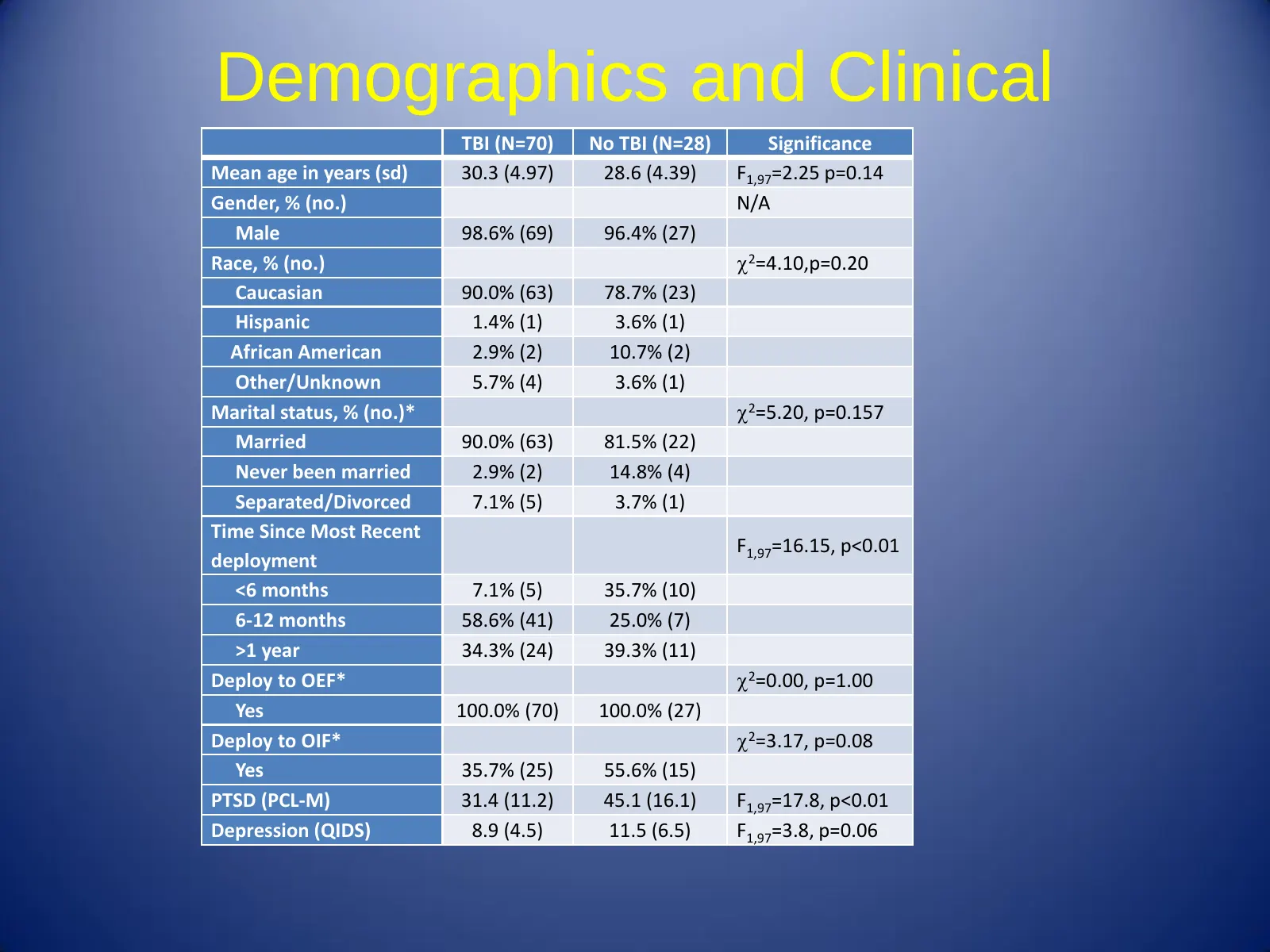
Demographics and Clinical TBI (N=70) No TBI (N=28) Significance Features Mean age in years (sd) Gender, % (no.) 30.3 (4.97) 28.6 (4.39) F1,97=2.25 p=0.14 N/A Male 98.6% (69) 96.4% (27) Race, % (no.) 2=4.10,p=0.20 Caucasian 90.0% (63) 78.7% (23) Hispanic 1.4% (1) 3.6% (1) African American 2.9% (2) 1
Slide 7: Total Tau is Higher in TBI+ Military Personnel
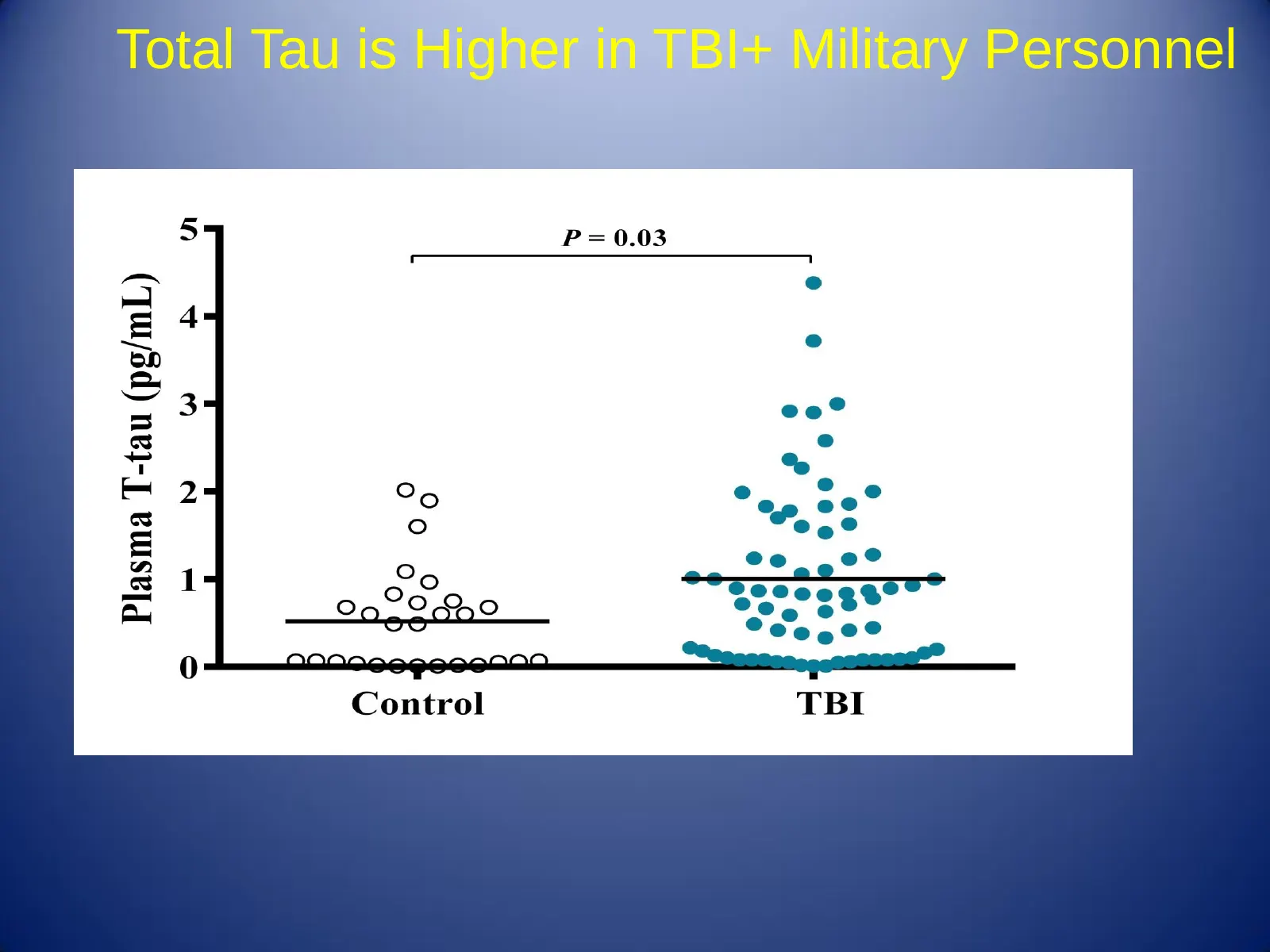
Total Tau is Higher in TBI+ Military Personnel
Slide 8: Multiple TBIs are Related to Higher Total Tau
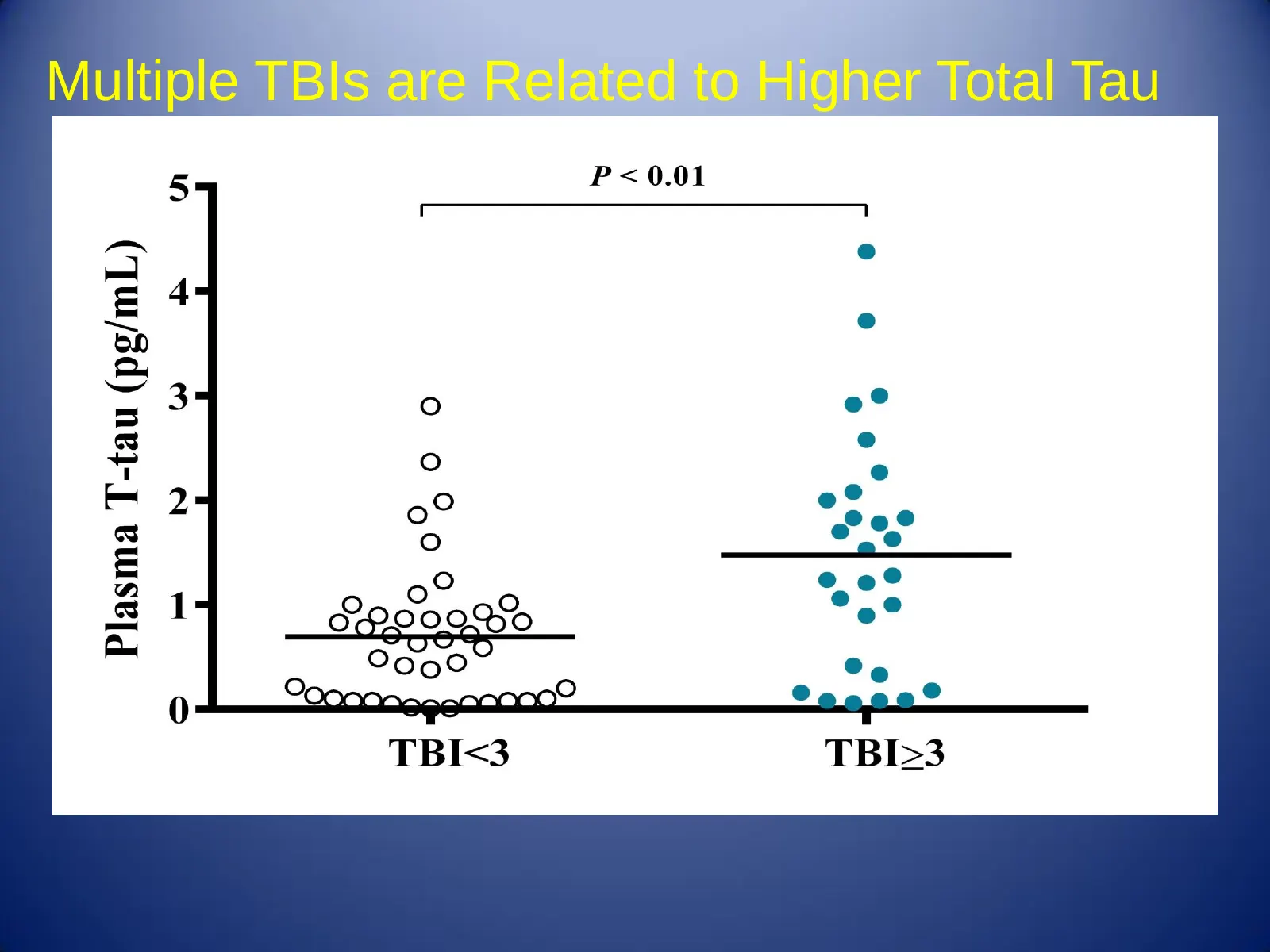
Multiple TBIs are Related to Higher Total Tau
Slide 9: Higher Total Tau Relates to Chronic Symptoms
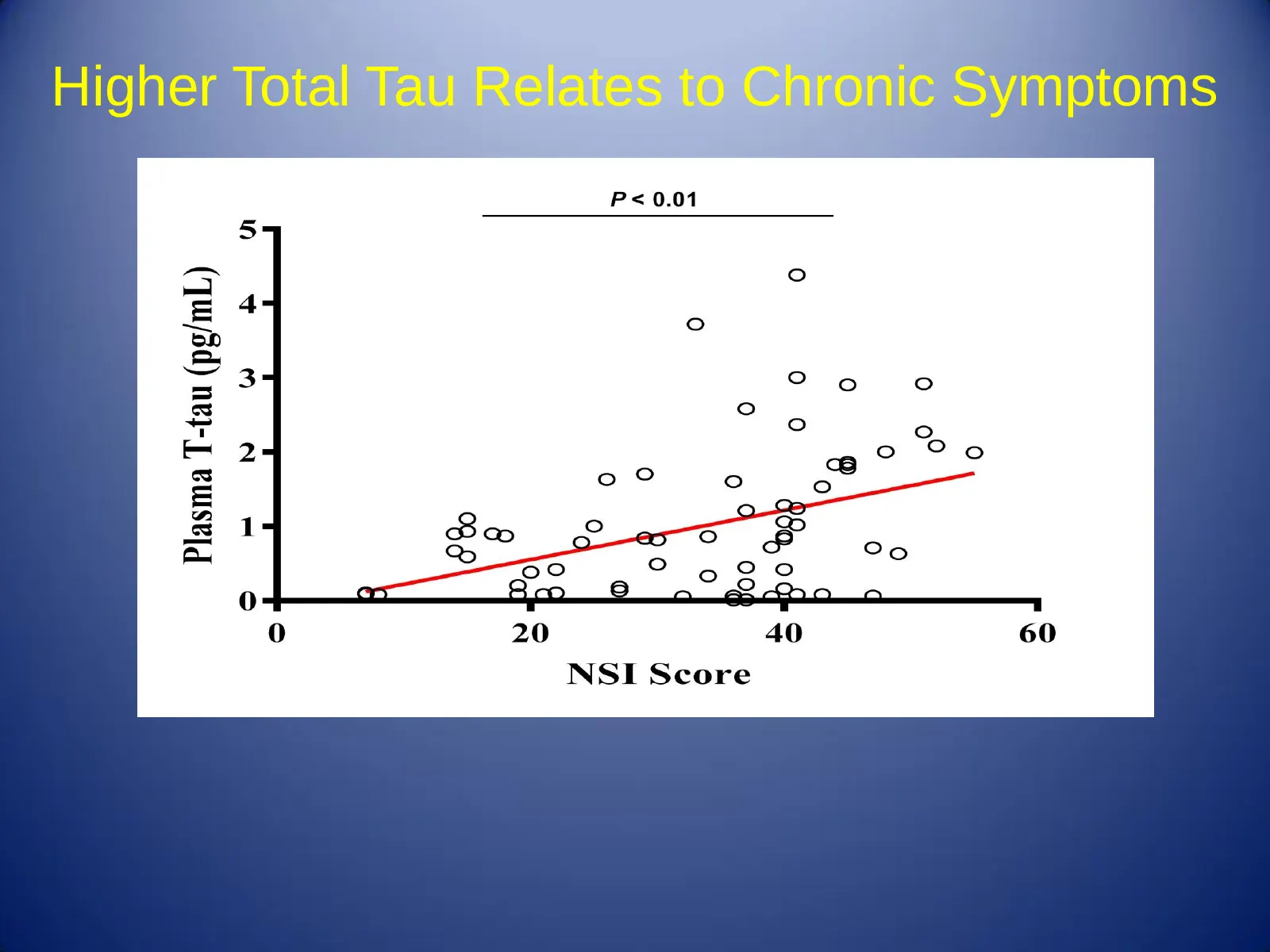
Higher Total Tau Relates to Chronic Symptoms
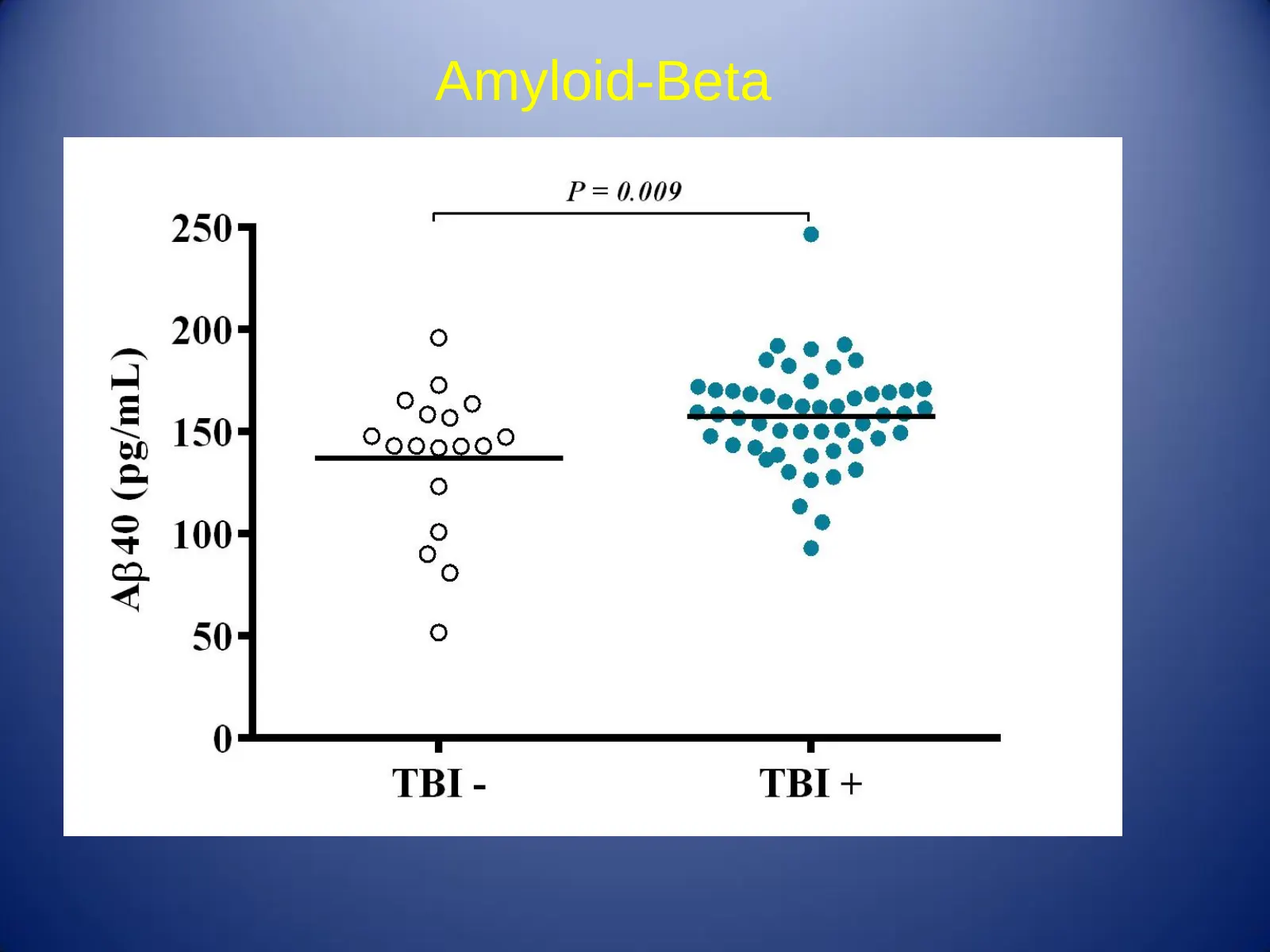
Slide 10: Amyloid-Beta
Amyloid-Beta P=0.009 N —) —) =) £ ob = > + am <
Slide 11: Summary
Summary • Total tau and amyloid-beta 40 are elevated even years following a TBI in military personnel who are young • These elevations may contribute to chronic symptoms and risk for chronic traumatic encephalopathy (CTE)
Slide 12: Blast and Military
Blast and Military • Within 6 hours of a blast that required medical care, a plasma sample was collected • 24 hours following the blast, a plasma sample was collected • Controls deployed in Afghanistan were collected at the same time-points and matched on age, gender, rank and duration of deployment
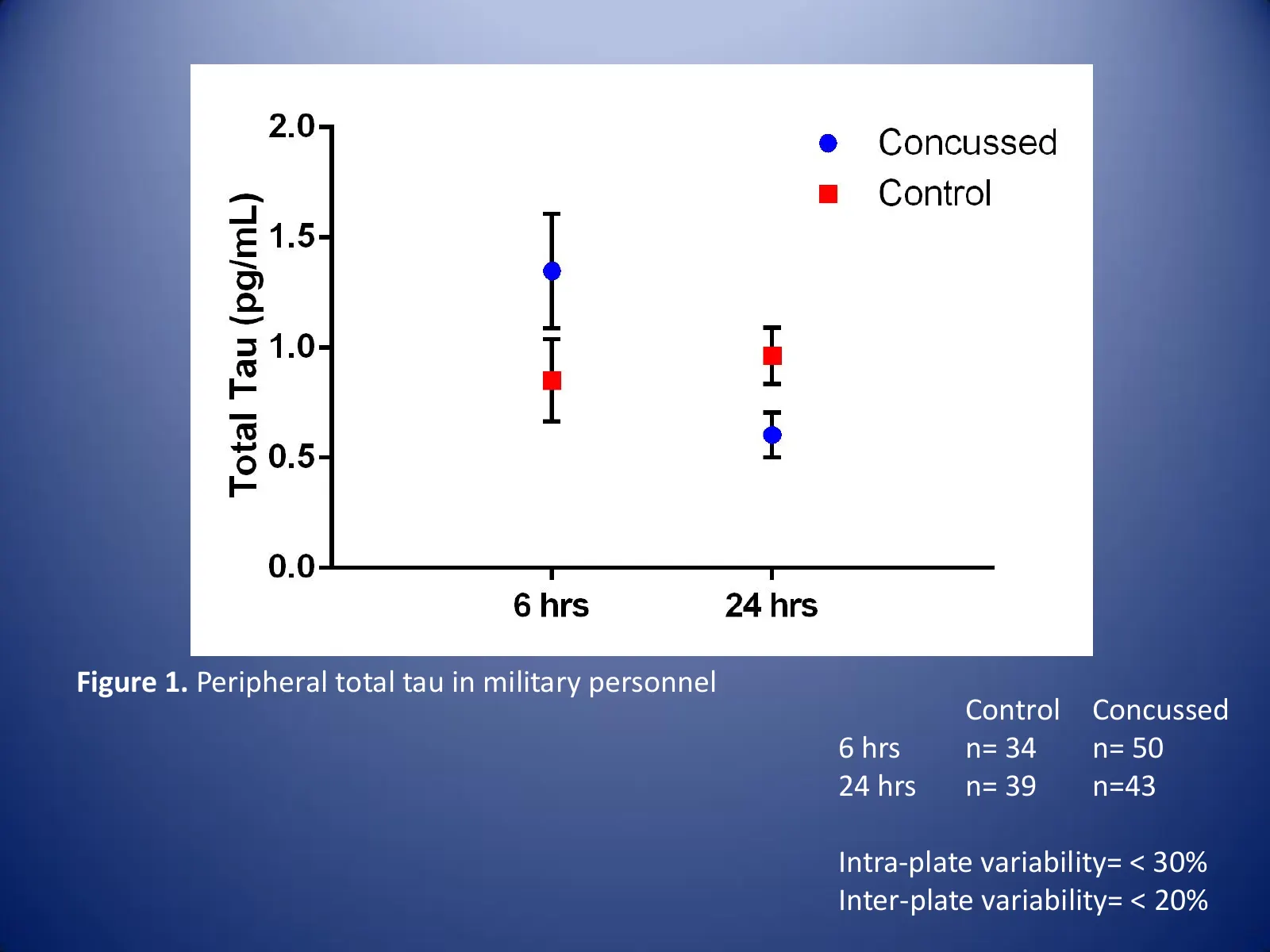
Slide 13: Figure 1. Peripheral total tau in military personnel
Figure 1. Peripheral total tau in military personnel Control Concussed 6 hrs n= 34 n= 50 24 hrs n= 39 n=43 Intra-plate variability= < 30% Inter-plate variability= < 20%
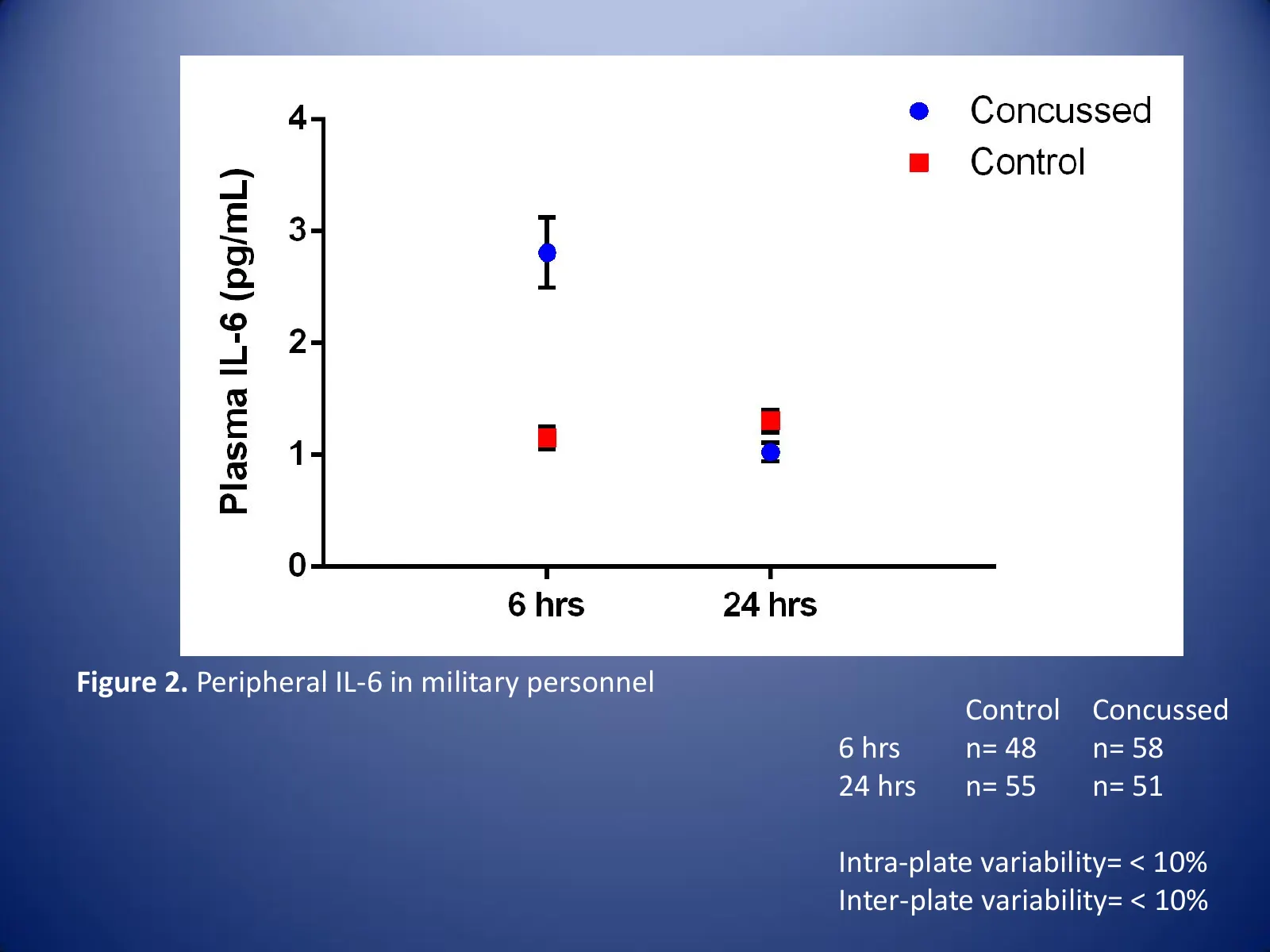
Slide 14: Figure 2. Peripheral IL-6 in military personnel
Figure 2. Peripheral IL-6 in military personnel Control Concussed 6 hrs n= 48 n= 58 24 hrs n= 55 n= 51 Intra-plate variability= < 10% Inter-plate variability= < 10%
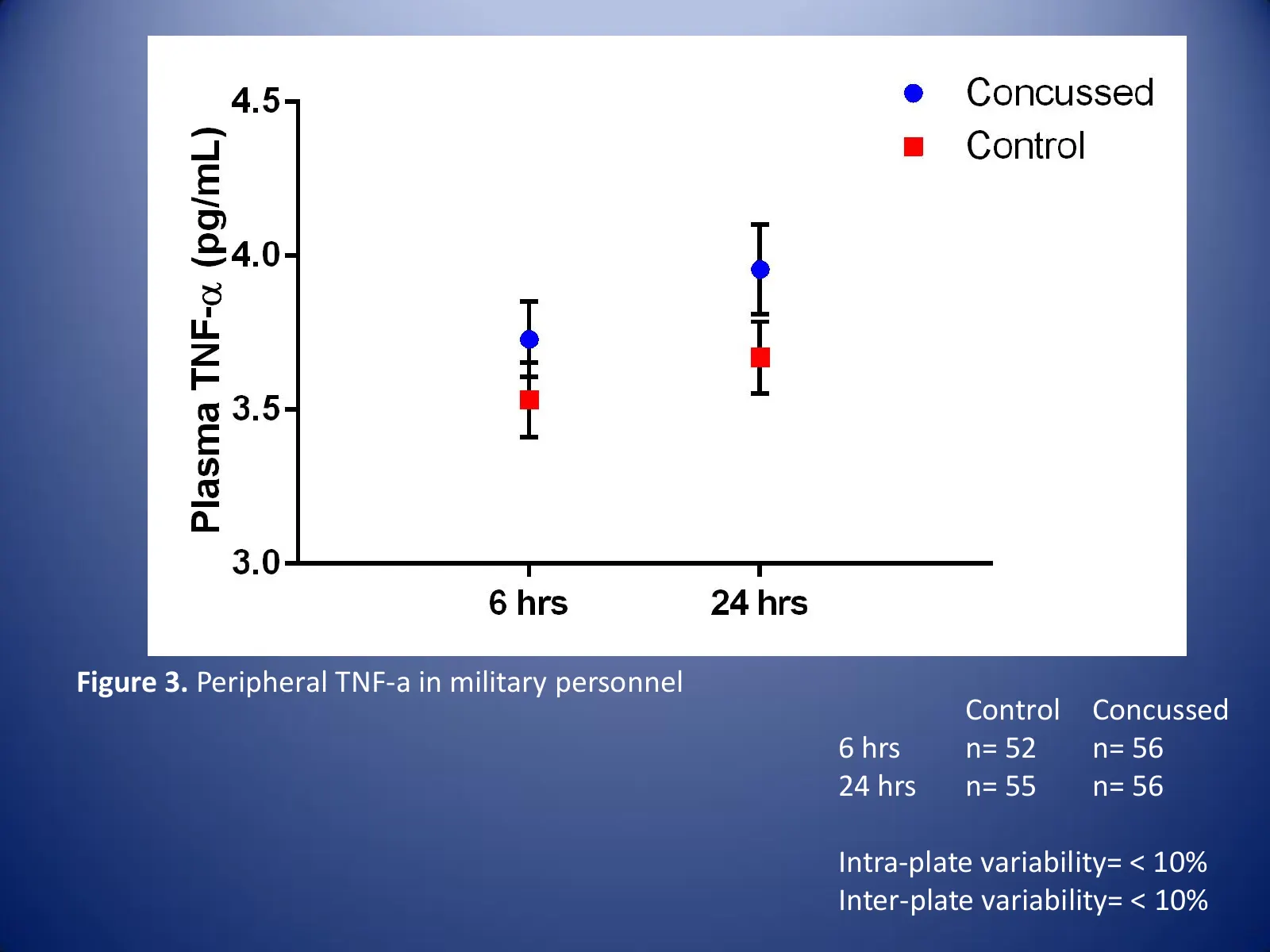
Slide 15: Figure 3. Peripheral TNF-a in military personnel
Figure 3. Peripheral TNF-a in military personnel Control Concussed 6 hrs n= 52 n= 56 24 hrs n= 55 n= 56 Intra-plate variability= < 10% Inter-plate variability= < 10%
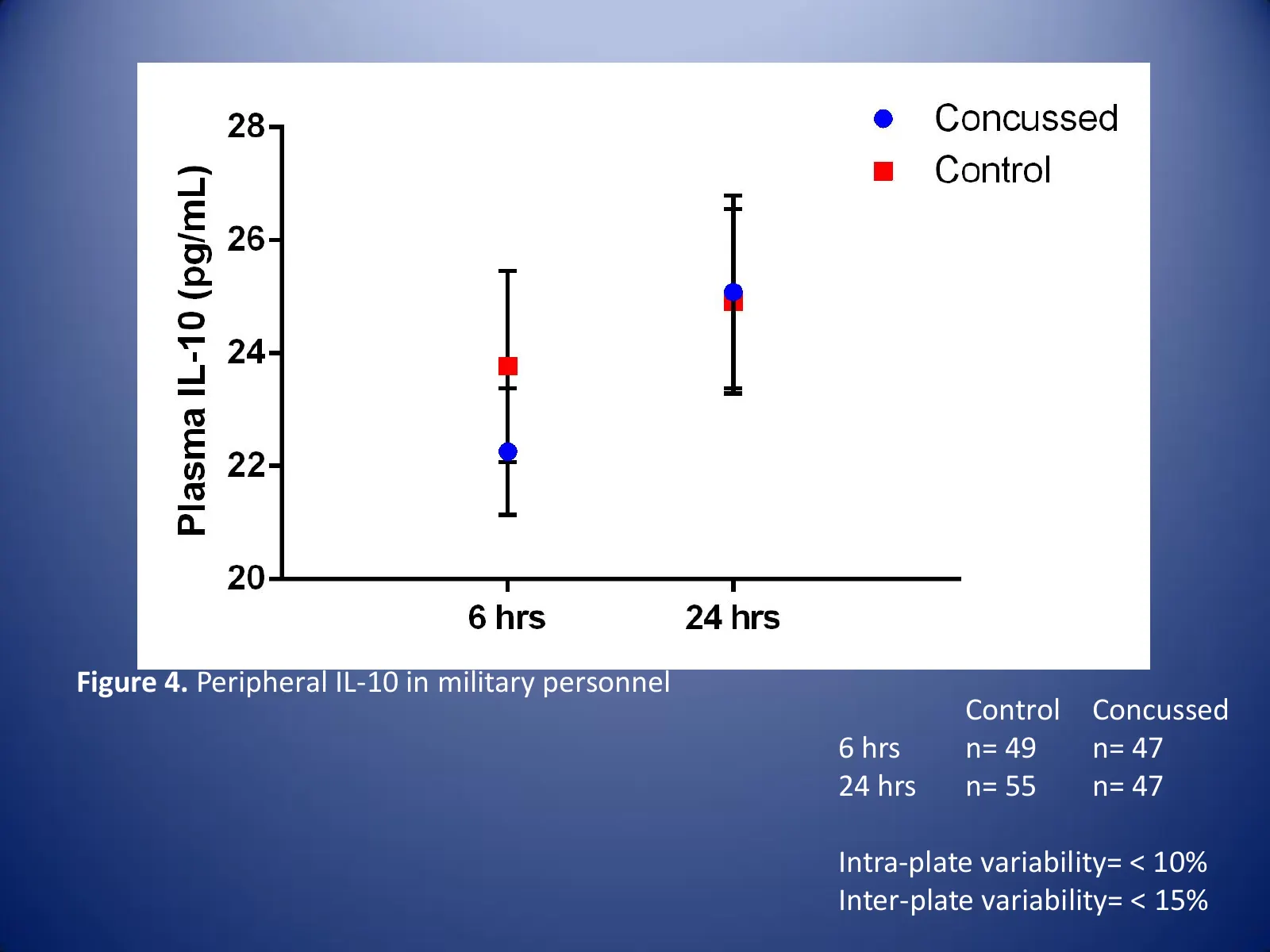
Slide 16: Figure 4. Peripheral IL-10 in military personnel
Figure 4. Peripheral IL-10 in military personnel Control Concussed 6 hrs n= 49 n= 47 24 hrs n= 55 n= 47 Intra-plate variability= < 10% Inter-plate variability= < 15%
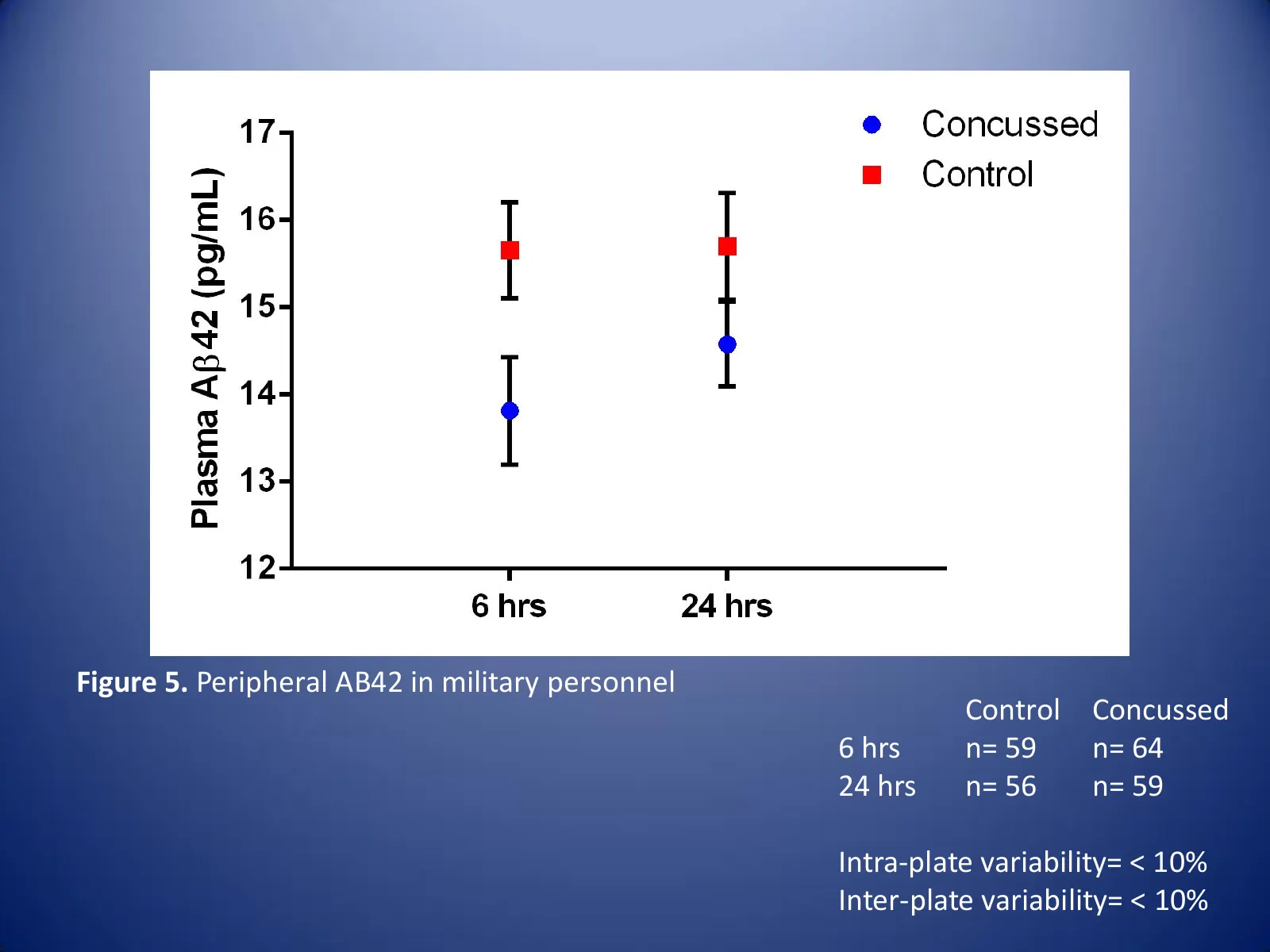
Slide 17: Figure 5. Peripheral AB42 in military personnel
Figure 5. Peripheral AB42 in military personnel Control Concussed 6 hrs n= 59 n= 64 24 hrs n= 56 n= 59 Intra-plate variability= < 10% Inter-plate variability= < 10%
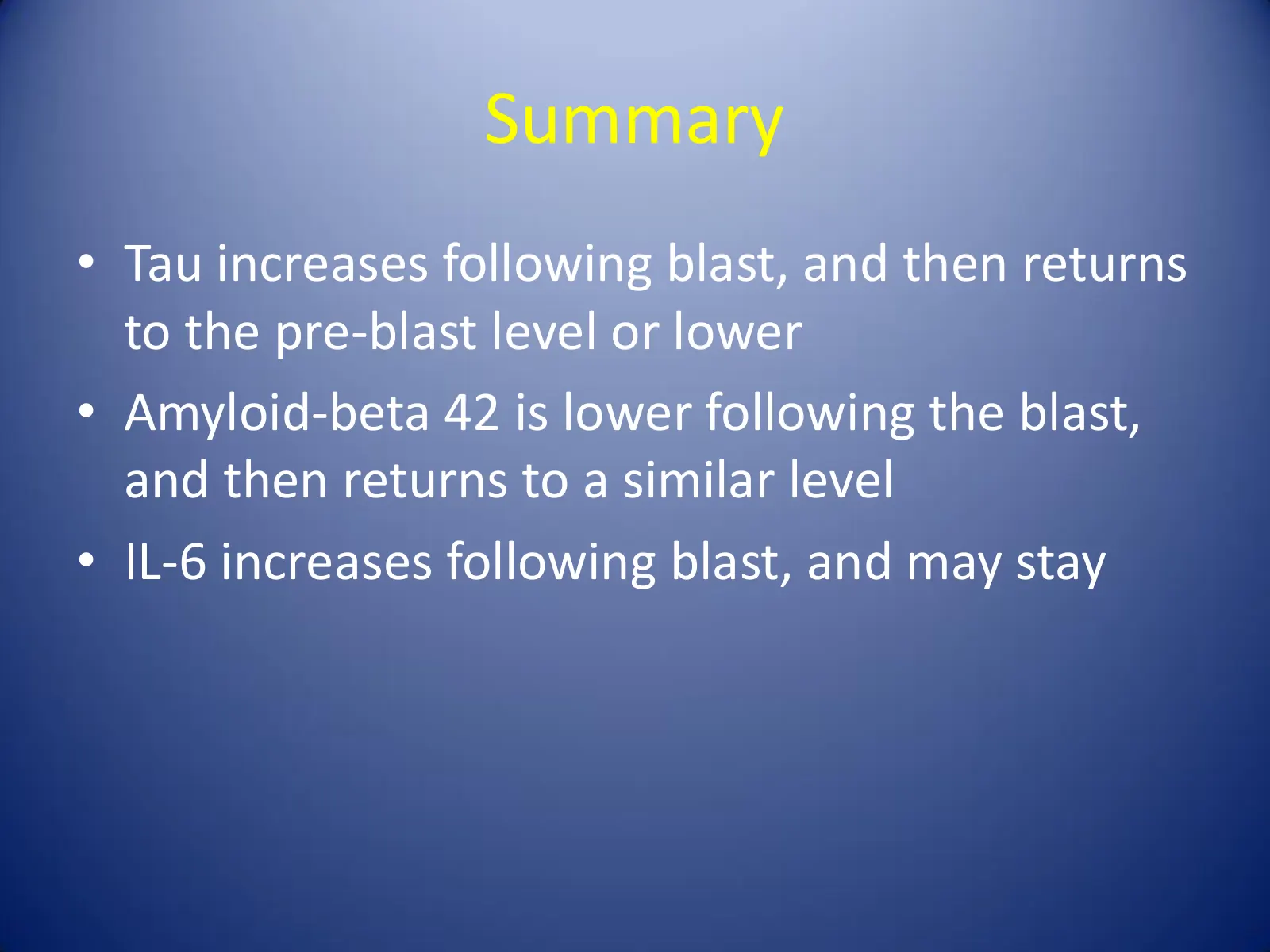
Slide 18: Summary
Summary • Tau increases following blast, and then returns to the pre-blast level or lower • Amyloid-beta 42 is lower following the blast, and then returns to a similar level • IL-6 increases following blast, and may stay
Source: Internet Archive copy of quanterix.com
More decks from Quanterix Corporation
 Q3 2026 Earnings Presentation21 slides · Nov 9, 2026
 Q2 2026 Earnings Presentation21 slides · Aug 10, 2026
 Q1 2026 Earnings Presentation17 slides · May 6, 2026
 FY2025 Earnings Presentation14 slides · Mar 2, 2026
 Q3 2025 Earnings Presentation11 slides · Nov 10, 2025
 Q2 2025 Earnings Presentation12 slides · Aug 7, 2025