Analog Devices, Inc. · NASDAQ:ADI
Analog Devices — Technical Presentation (2008)
45 slides from Analog Devices's technical presentation, Dec 30, 2008
Slide 1: Lockbox Secure Technology on Blackfin Processors
The World Leader in High Performance Signal Processing Solutions Lockbox™ Secure Technology on Blackfin® Processors Presented by: Phil Giordano Senior Applications Engineer 1
Slide 2: About This Module
About This Module This presentation will familiarize the reader with the features, benefits, and high level operation of Lockbox secure technology on Blackfin processors. Prerequisites: Familiarity with security and cryptography concepts. Experience with embedded processors or systems. 2 Lockbox Sec
Slide 3: Module Outline
Module Outline 1. Introduction • Defining Security Needs/Requirements • Lockbox Secure Technology on Blackfin processors 2. Security Features on Blackfin 3. One-Time-Programmable (OTP) Memory 4. Authentication Process on Blackfin 5. Debug and Test Features 6. Summary and Conclusion 7. Resources and
Slide 4: Defining Security Needs/Requirements
Defining Security Needs/Requirements • What are you trying to protect (i.e., code? data?)? • What/Whom are you trying to protect it against? • Who are typical adversaries (i.e., registered end users? hackers? competition?)? • What are the resources available to them? (i.e., typical consumer? well-fu
Slide 5: Lockbox Secure Technology on Blackfin Processors
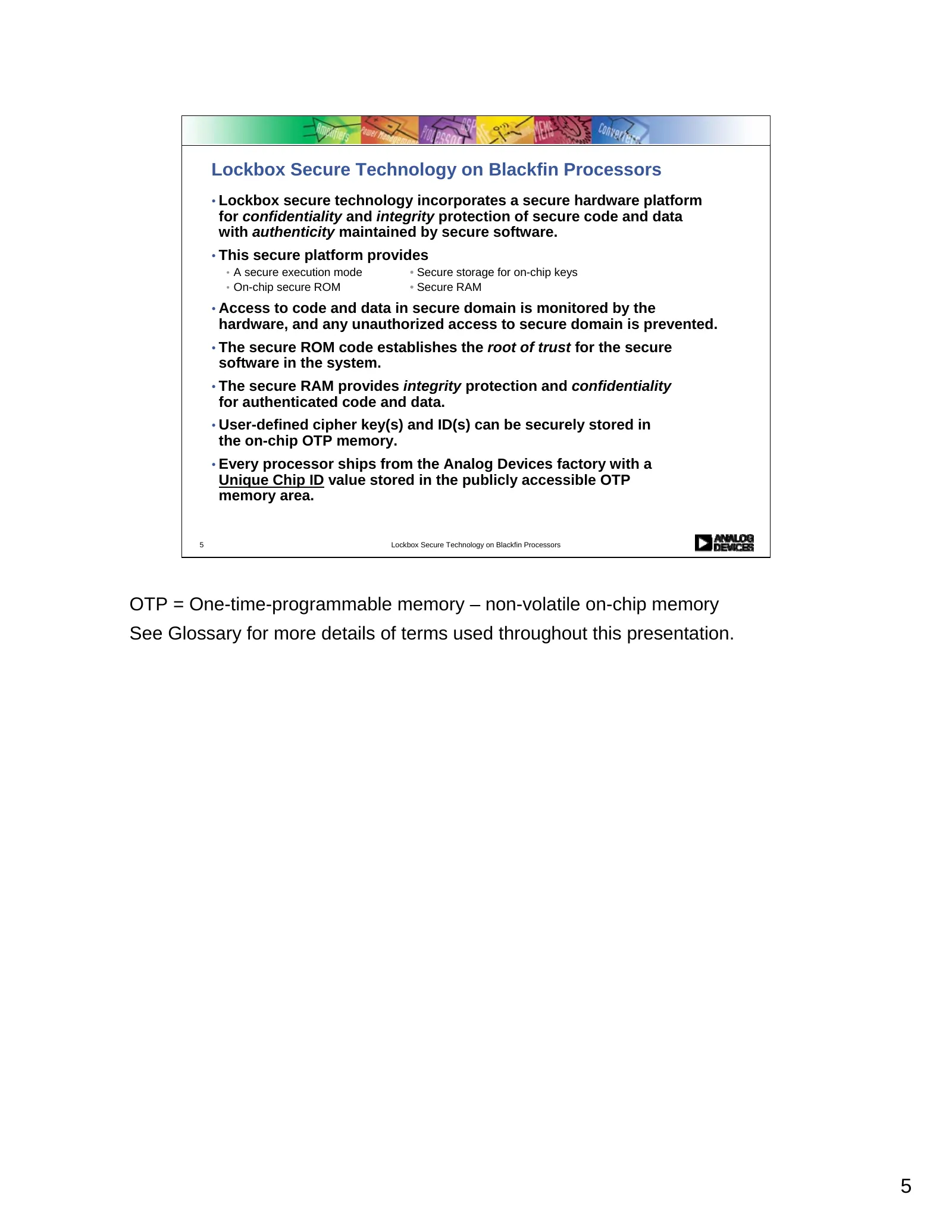
Lockbox Secure Technology on Blackfin Processors • Lockbox secure technology incorporates a secure hardware platform for confidentiality and integrity protection of secure code and data with authenticity maintained by secure software. • This secure platform provides • A secure execution mode • Secur
Slide 6: Lockbox Secure Technology Benefits
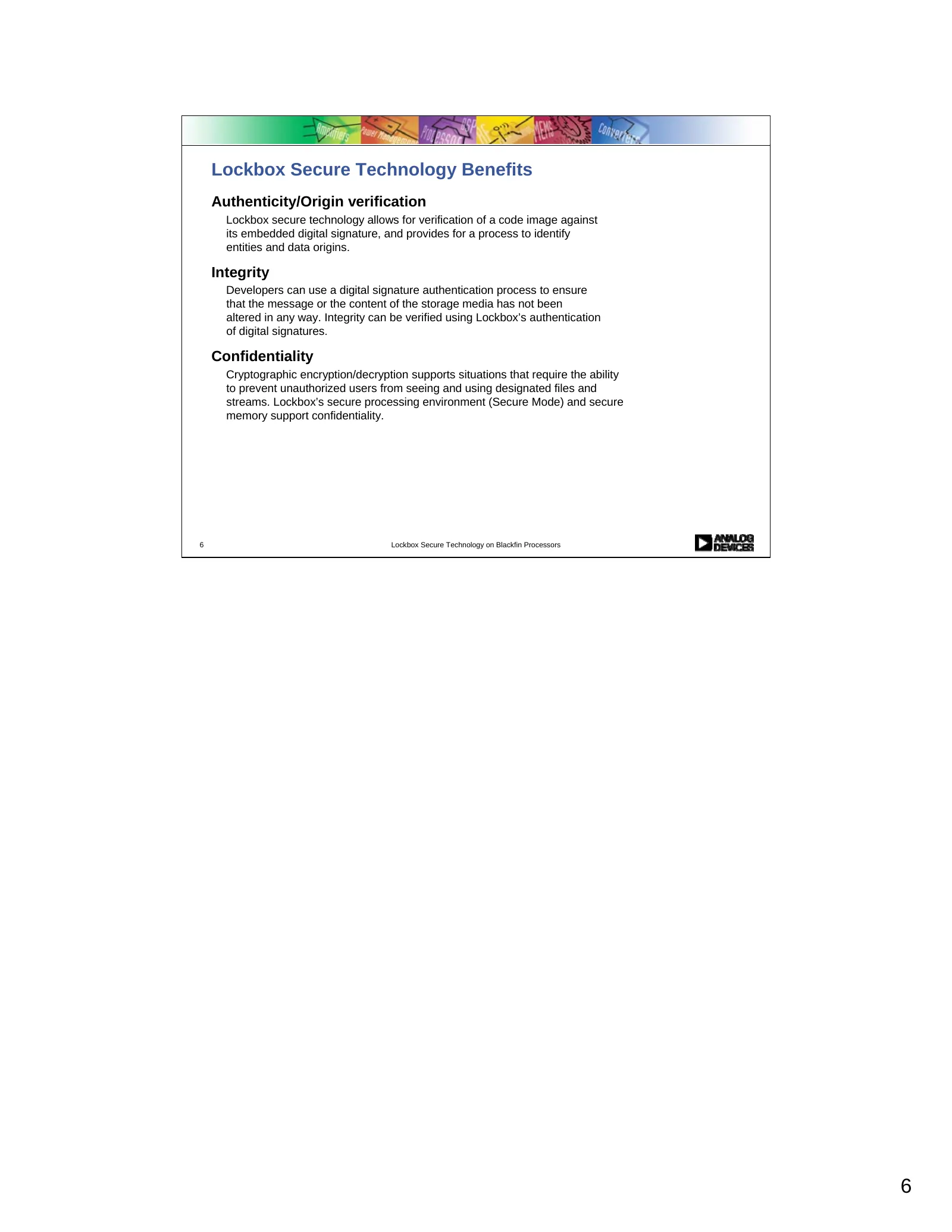
Lockbox Secure Technology Benefits Authenticity/Origin verification Lockbox secure technology allows for verification of a code image against its embedded digital signature, and provides for a process to identify entities and data origins. Integrity Developers can use a digital signature authenticat
Slide 7: Lockbox Secure Technology Benefits (continued)
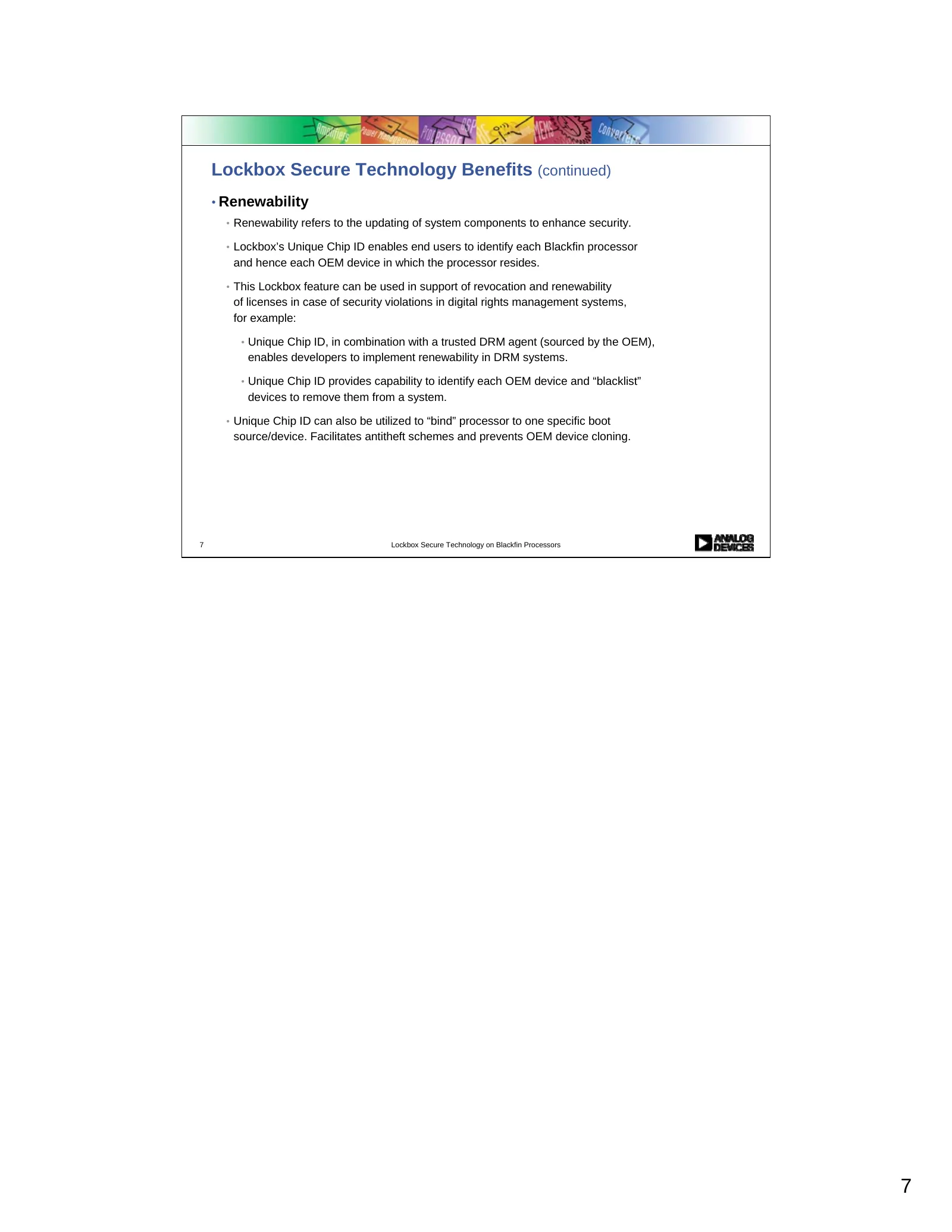
Lockbox Secure Technology Benefits (continued) • Renewability • Renewability refers to the updating of system components to enhance security. • Lockbox’s Unique Chip ID enables end users to identify each Blackfin processor and hence each OEM device in which the processor resides. • This Lockbox feat
Slide 8: Security Features on Blackfin
Security Features on Blackfin 8 Lockbox Secure Technology on Blackfin Processors 8
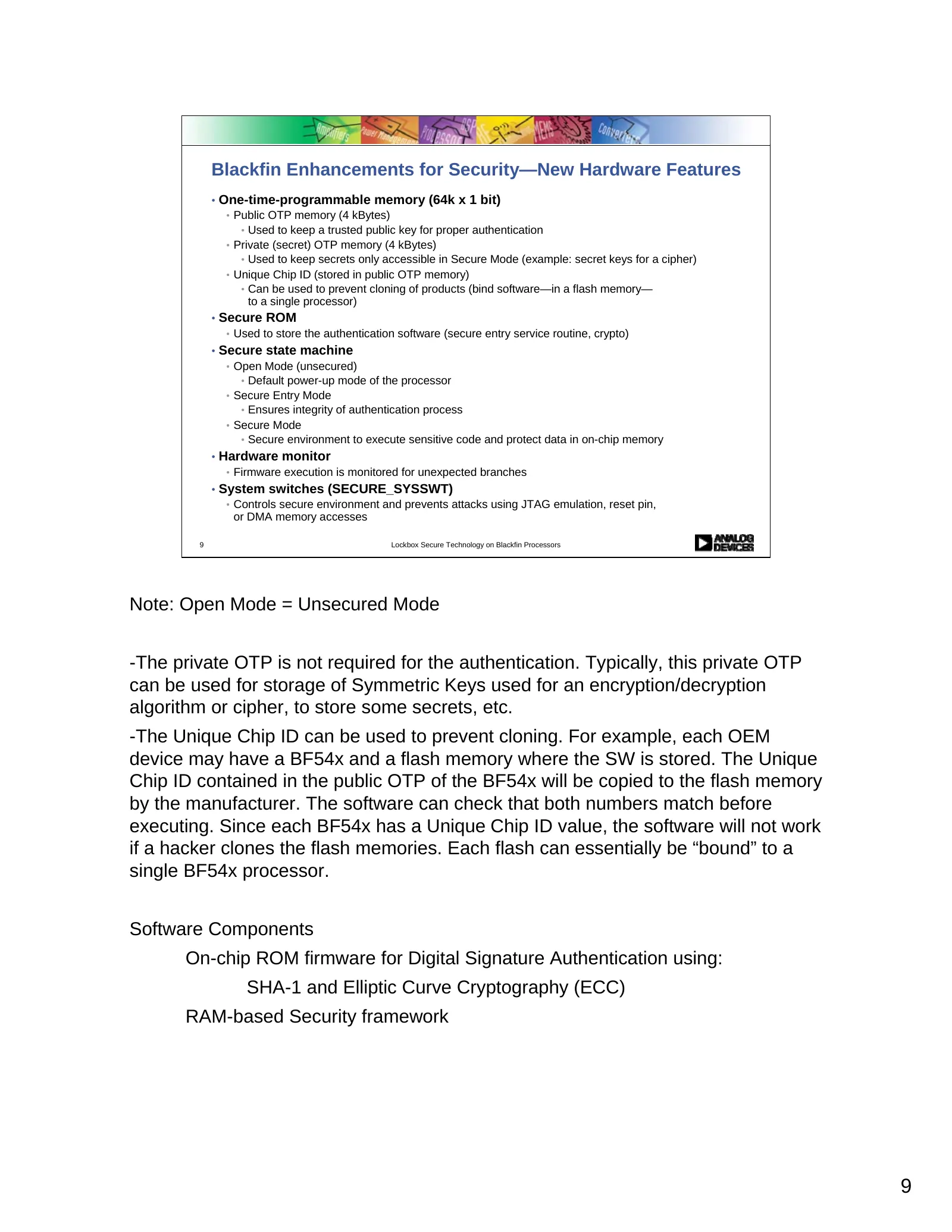
Slide 9: Blackfin Enhancements for Security—New Hardware Features
Blackfin Enhancements for Security—New Hardware Features • One-time-programmable memory (64k x 1 bit) • Public OTP memory (4 kBytes) • Used to keep a trusted public key for proper authentication • Private (secret) OTP memory (4 kBytes) • Used to keep secrets only accessible in Secure Mode (example:
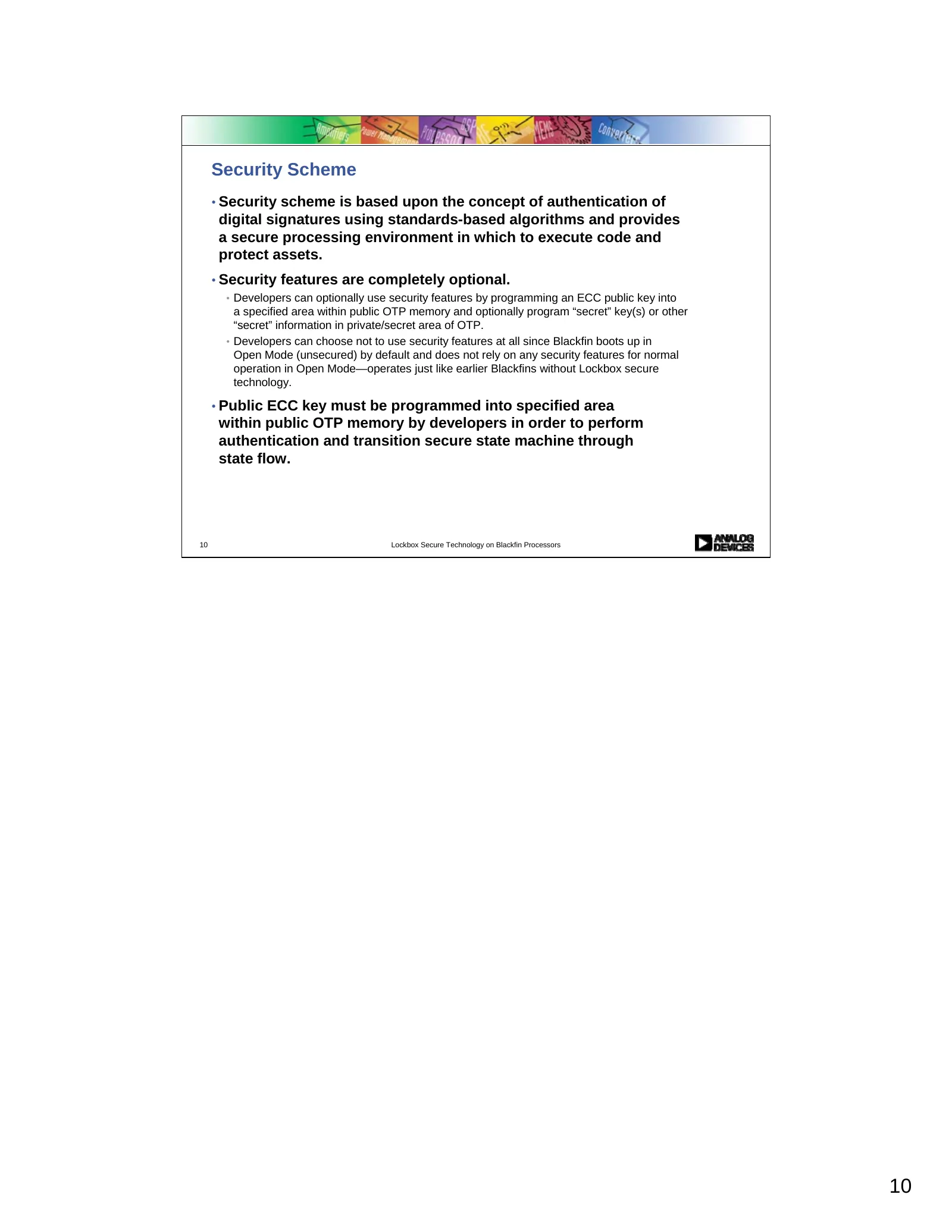
Slide 10: Security Scheme
Security Scheme • Security scheme is based upon the concept of authentication of digital signatures using standards-based algorithms and provides a secure processing environment in which to execute code and protect assets. • Security features are completely optional. • Developers can optionally use
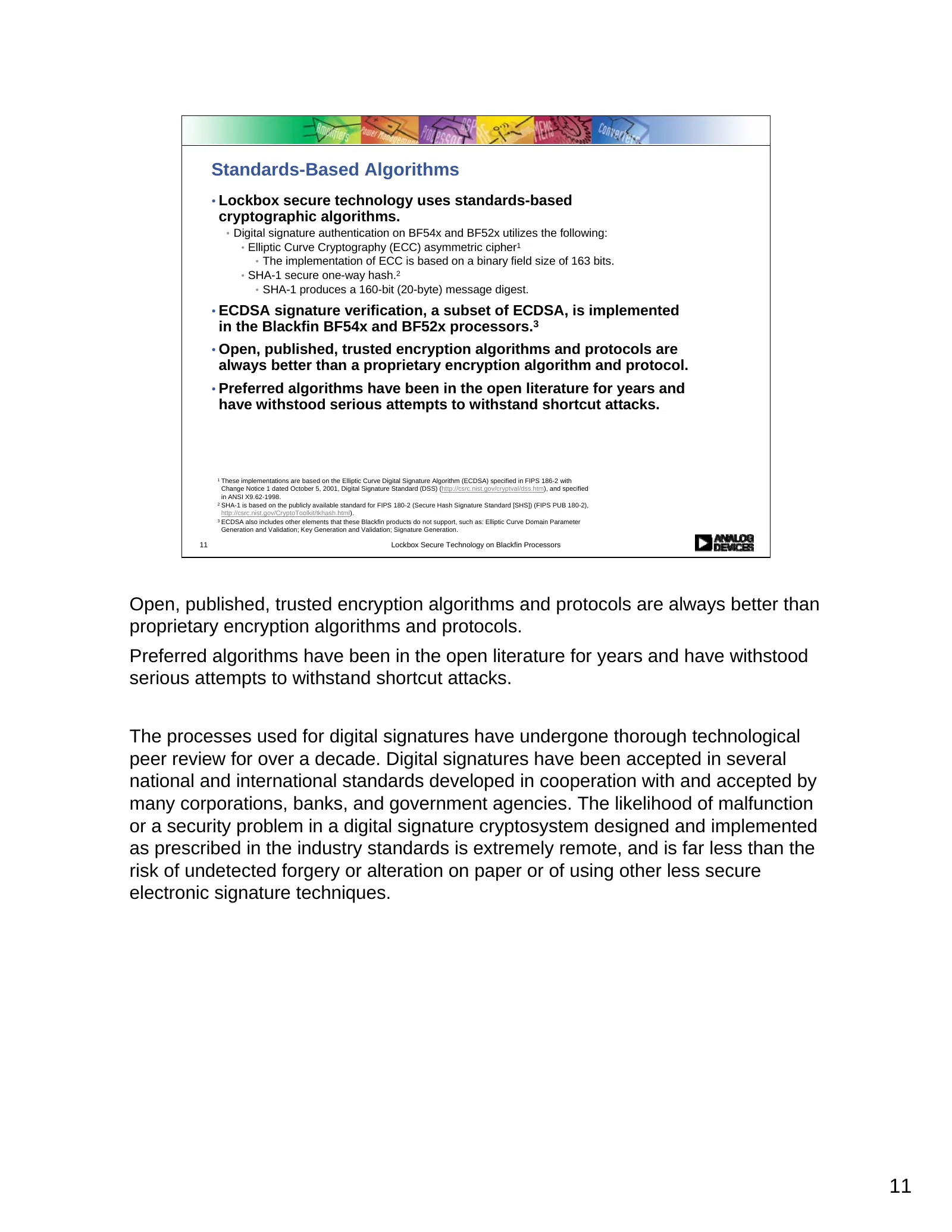
Slide 11: Standards-Based Algorithms
Standards-Based Algorithms • Lockbox secure technology uses standards-based cryptographic algorithms. • Digital signature authentication on BF54x and BF52x utilizes the following: • Elliptic Curve Cryptography (ECC) asymmetric cipher1 • The implementation of ECC is based on a binary field size of 16
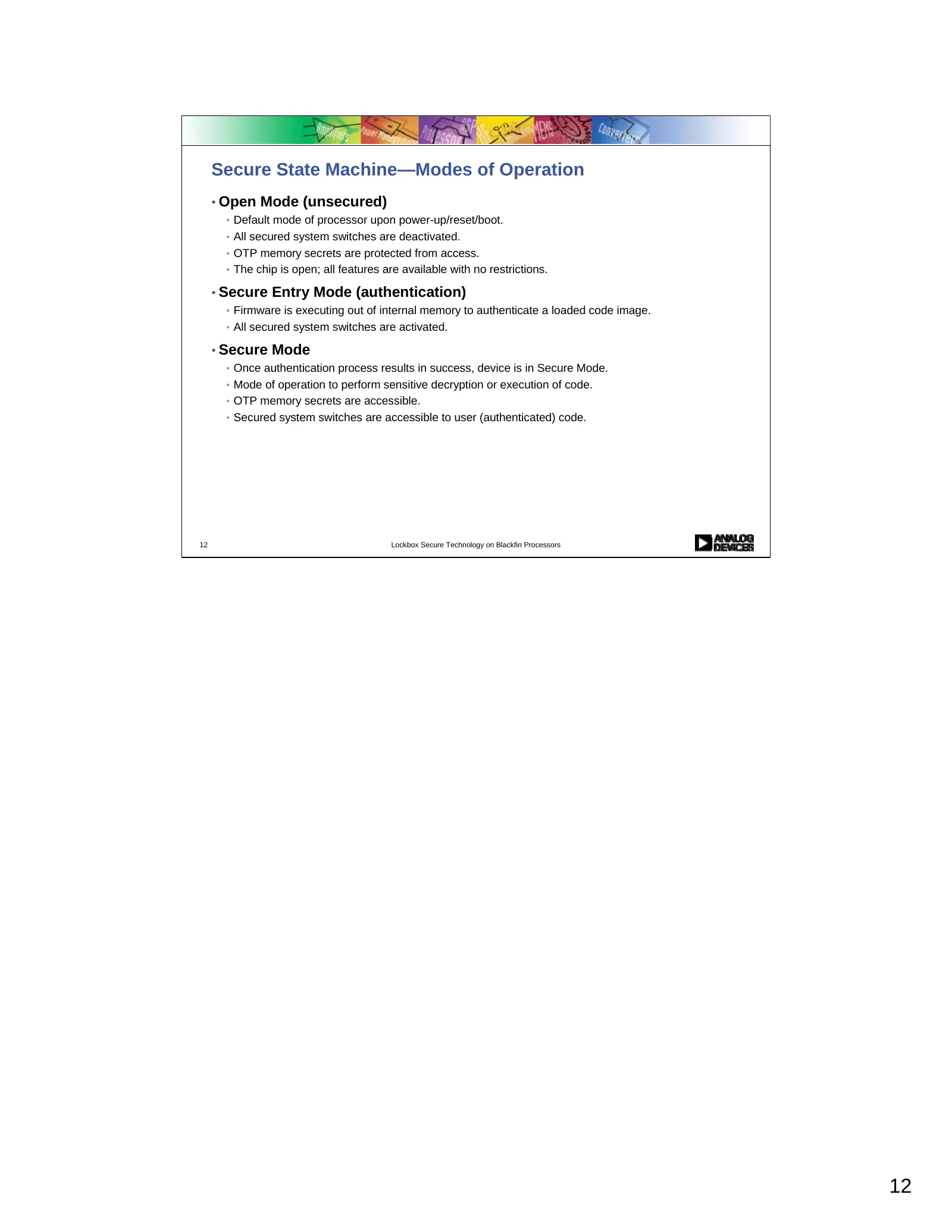
Slide 12: Secure State Machine—Modes of Operation
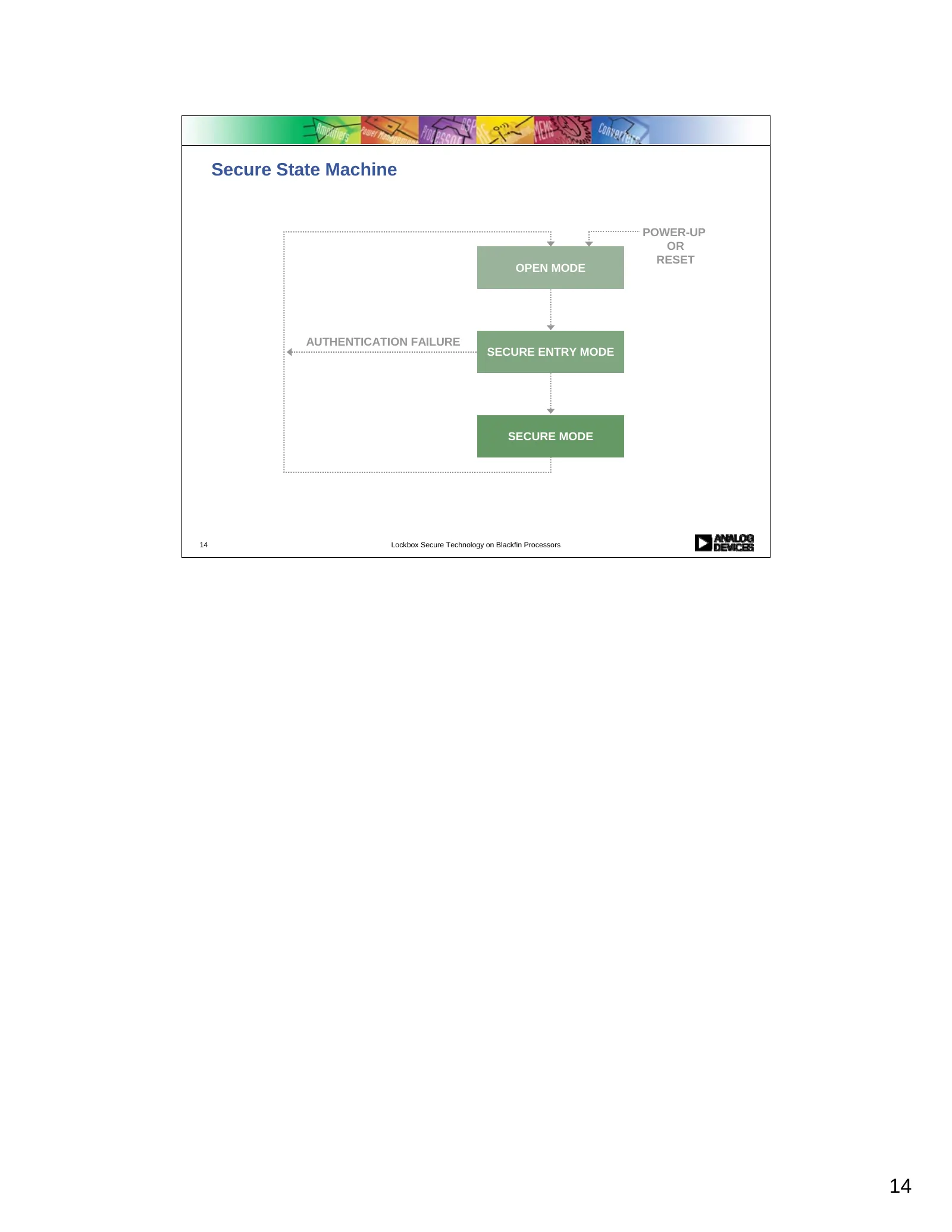
Secure State Machine—Modes of Operation • Open Mode (unsecured) • Default mode of processor upon power-up/reset/boot. • All secured system switches are deactivated. • OTP memory secrets are protected from access. • The chip is open; all features are available with no restrictions. • Secure Entry Mod
Slide 13: Secure System Switches (SECURE_SYSSWT)
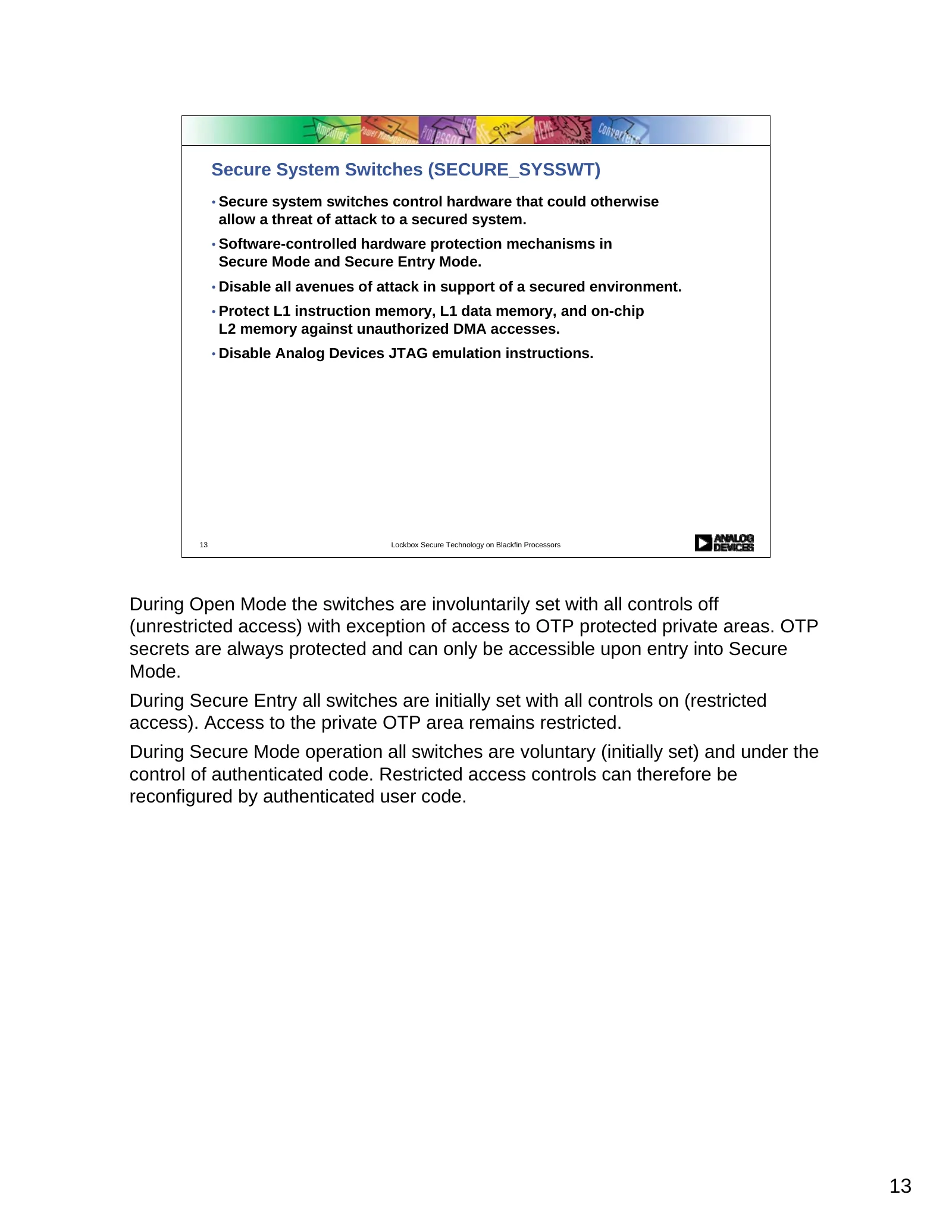
Secure System Switches (SECURE_SYSSWT) • Secure system switches control hardware that could otherwise allow a threat of attack to a secured system. • Software-controlled hardware protection mechanisms in Secure Mode and Secure Entry Mode. • Disable all avenues of attack in support of a secured envir
Slide 14: Secure State Machine
Secure State Machine POWER-UP OR RESET OPEN MODE AUTHENTICATION FAILURE SECURE ENTRY MODE SECURE MODE 14 Lockbox Secure Technology on Blackfin Processors 14
Slide 15: One-Time-Programmable (OTP) Memory
One-Time-Programmable (OTP) Memory 15 Lockbox Secure Technology on Blackfin Processors 15
Slide 16: One-Time-Programmable (OTP) Memory
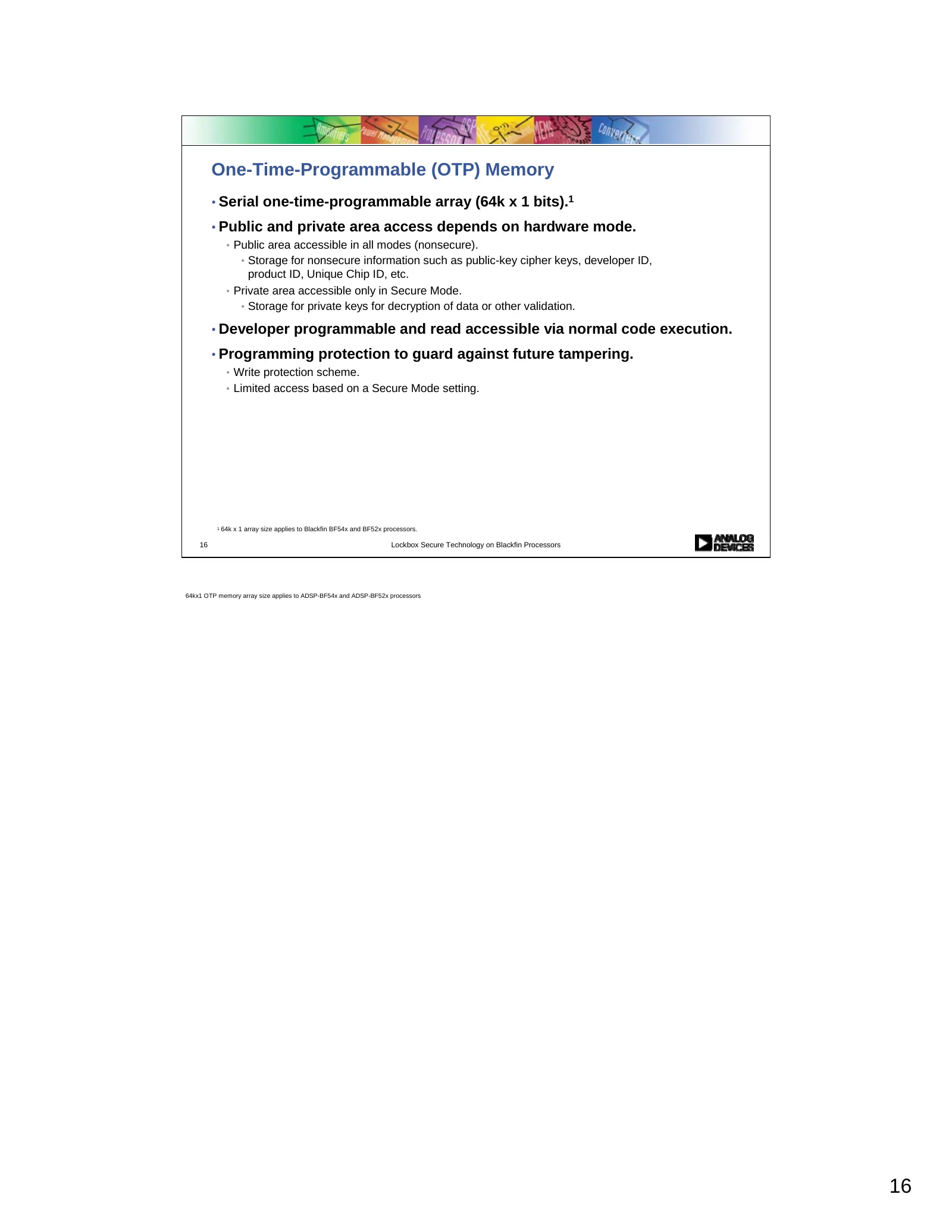
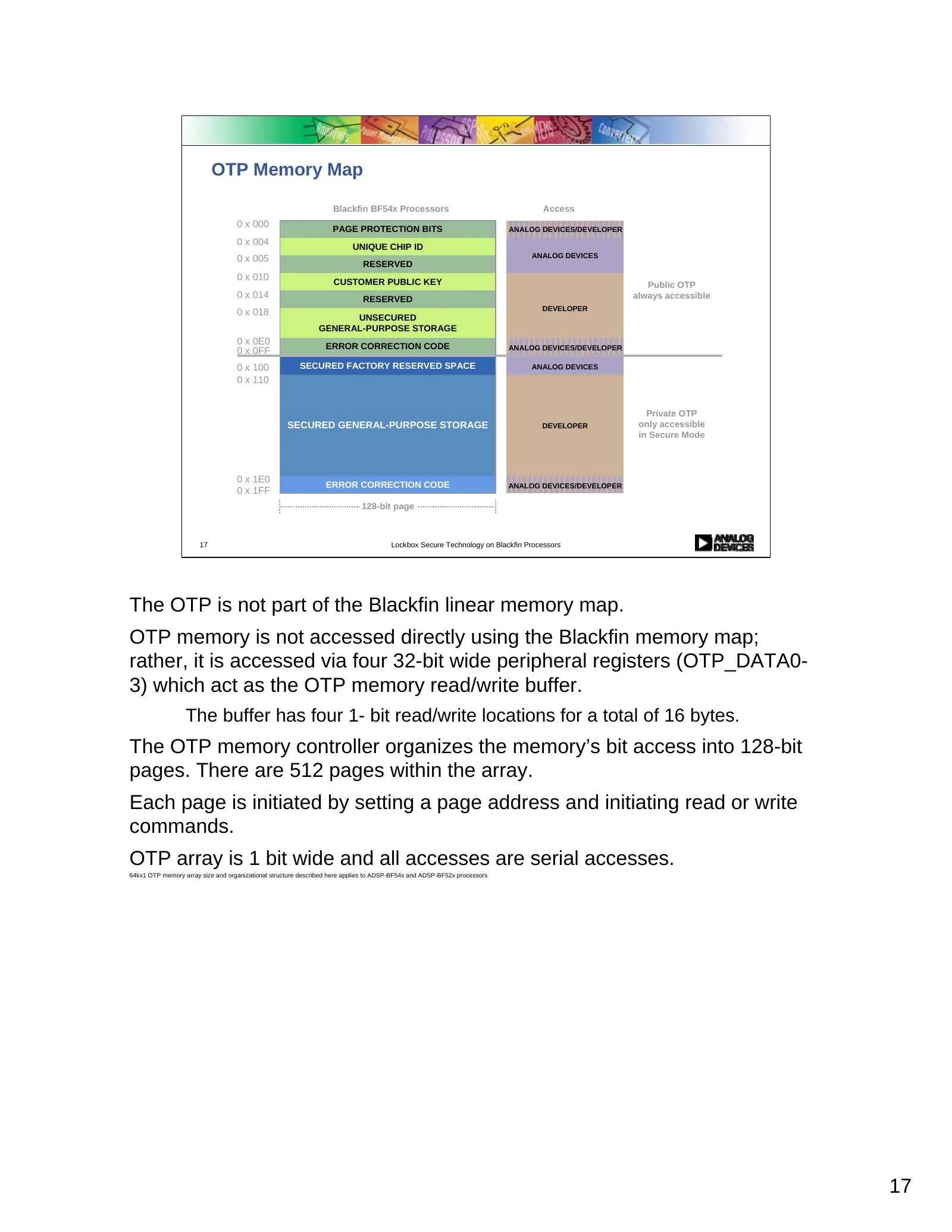
One-Time-Programmable (OTP) Memory • Serial one-time-programmable array (64k x 1 bits).1 • Public and private area access depends on hardware mode. • Public area accessible in all modes (nonsecure). • Storage for nonsecure information such as public-key cipher keys, developer ID, product ID, Unique
Slide 17: OTP Memory Map
OTP Memory Map Blackfin BF54x Processors Access 0 x 000 PAGE PROTECTION BITS ANALOG DEVICES/DEVELOPER 0 x 004 UNIQUE CHIP ID ANALOG DEVICES 0 x 005 RESERVED 0 x 010 CUSTOMER PUBLIC KEY Public OTP 0 x 014 RESERVED always accessible DEVELOPER 0 x 018 UNSECURED GENERAL-PURPOSE STORAGE 0 x 0E0 ERROR COR
Slide 18: One-Time-Programmable (OTP) Memory
One-Time-Programmable (OTP) Memory • 4 kB of public OTP memory = 256 pages x 16 bytes • 4 kB of private OTP memory = 256 pages x 16 bytes • OTP memory accesses utilize error correction to ensure data integrity. • Hamming code: Single error correction, double error detection. • Each 64-bit page has 8
Slide 19: Firmware and On-chip ROM
Firmware and On-chip ROM • Security is managed by firmware stored in on-chip ROM. • Hardware extensions help to protect secrets. • Supports digital signature authentication and secure state machine flow through open (nonsecure), Secure Entry, and Secure Mode states. • Blackfin BF54x processors • 64
Slide 20: Authentication Process on Blackfin
Authentication Process on Blackfin 20 Lockbox Secure Technology on Blackfin Processors 20
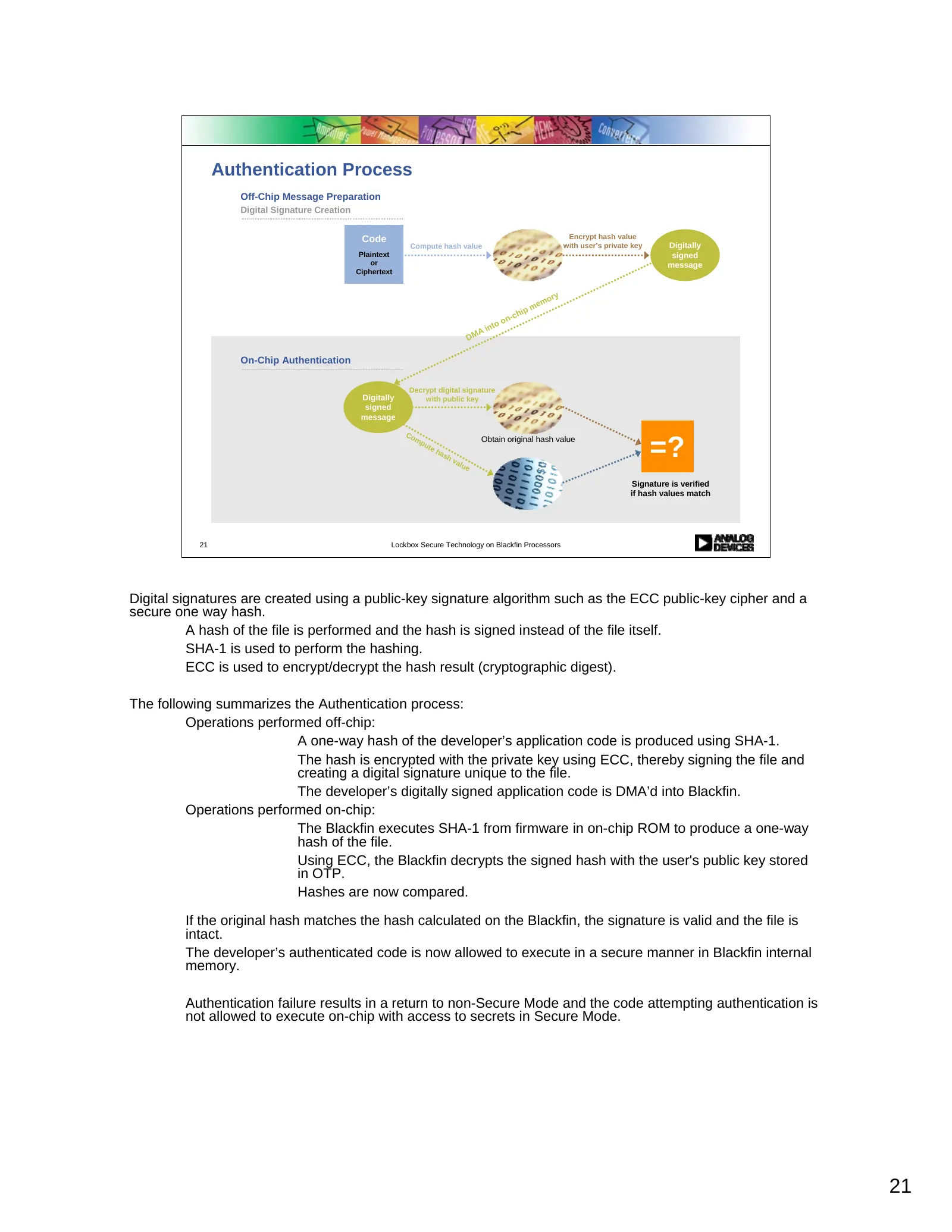
Slide 21: Authentication Process
Authentication Process Off-Chip Message Preparation Digital Signature Creation Code Encrypt hash value Compute hash value with user’s private key Digitally Plaintext signed or message Ciphertext ry mo me ip -ch o on A int DM On-Chip Authentication Decrypt digital signature Digitally with public key
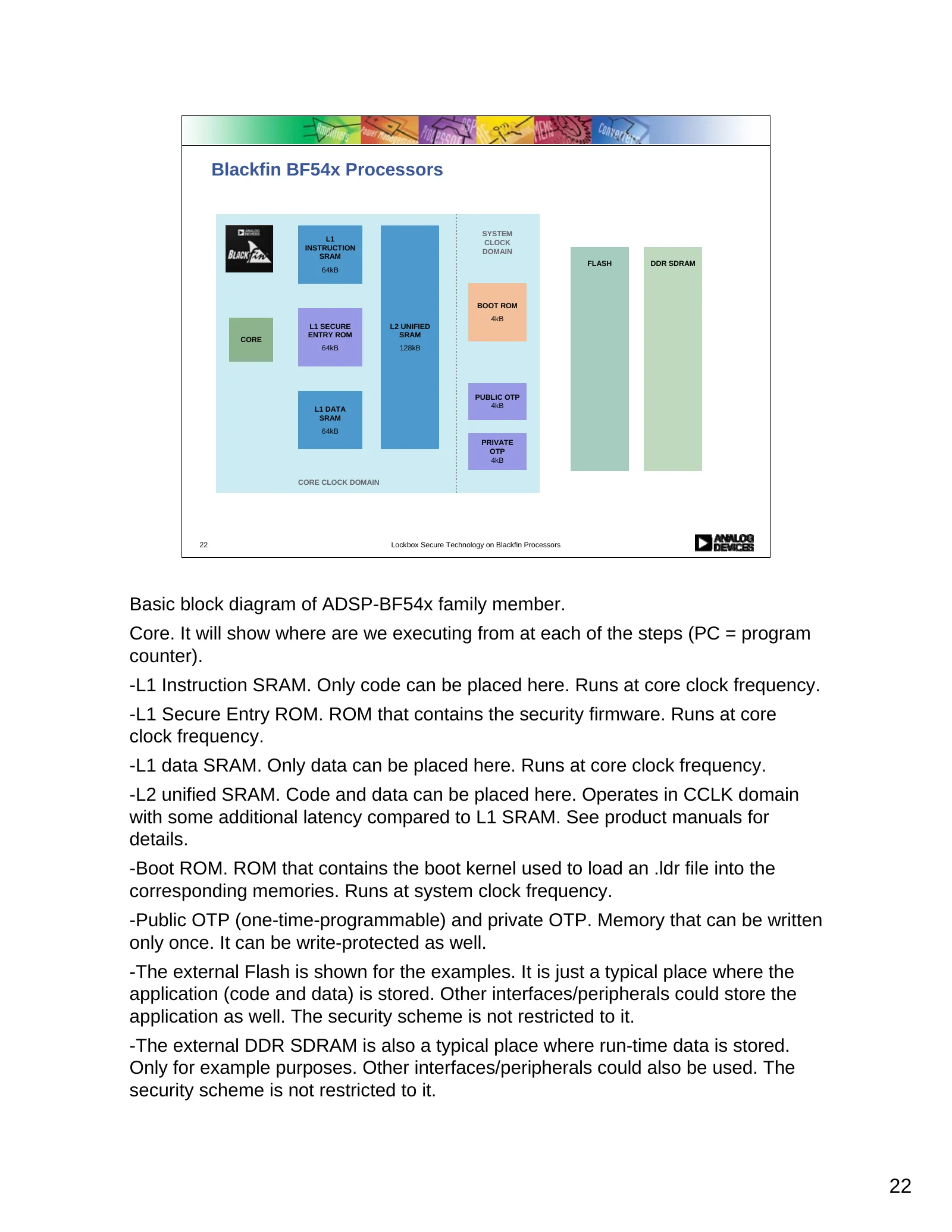
Slide 22: Blackfin BF54x Processors
Blackfin BF54x Processors SYSTEM L1 CLOCK INSTRUCTION DOMAIN SRAM FLASH DDR SDRAM 64kB BOOT ROM 4kB L1 SECURE L2 UNIFIED ENTRY ROM SRAM CORE 64kB 128kB PUBLIC OTP L1 DATA 4kB SRAM 64kB PRIVATE OTP 4kB CORE CLOCK DOMAIN 22 Lockbox Secure Technology on Blackfin Processors Basic block diagram of ADSP-B
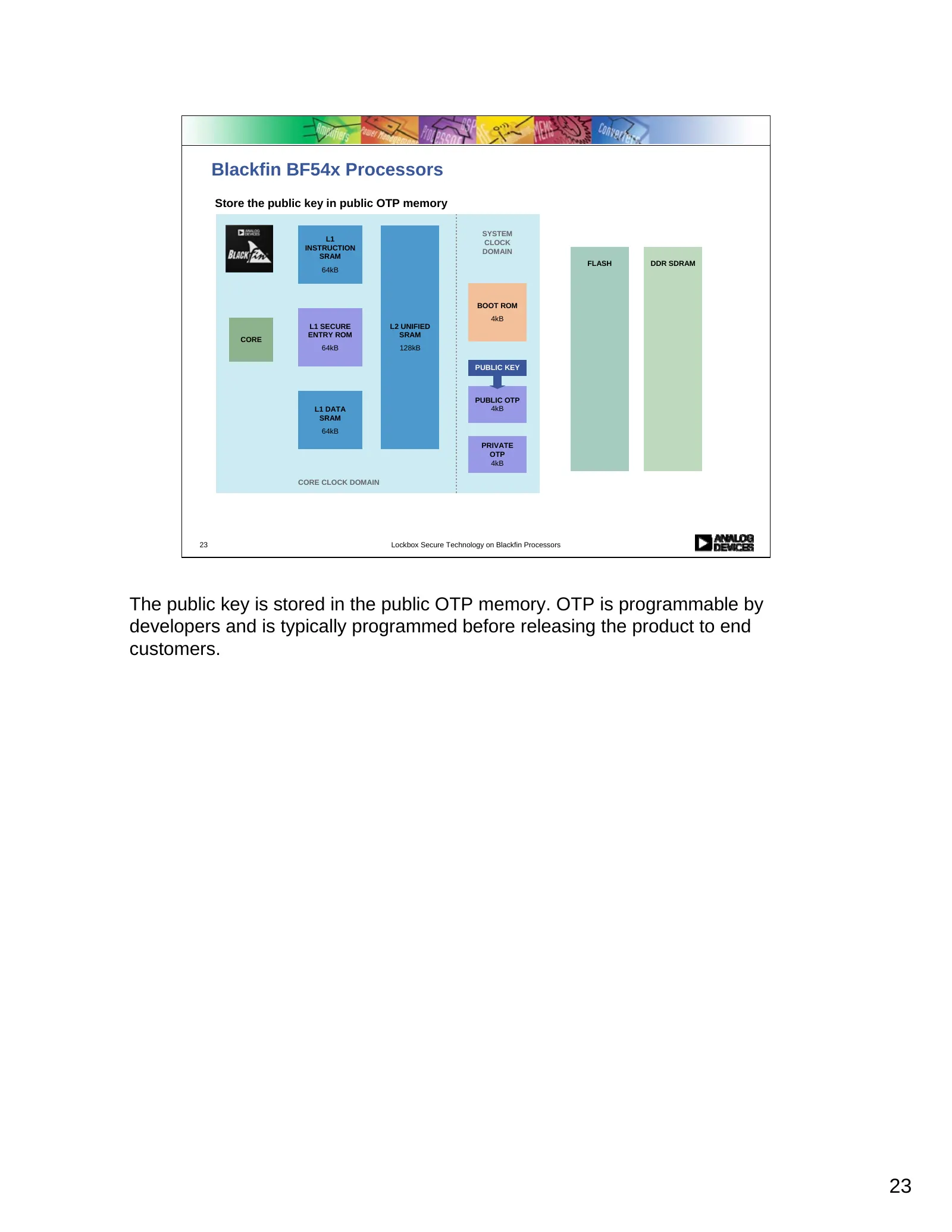
Slide 23: Store the public key in public OTP memory
Blackfin BF54x Processors Store the public key in public OTP memory SYSTEM L1 CLOCK INSTRUCTION DOMAIN SRAM FLASH DDR SDRAM 64kB BOOT ROM 4kB L1 SECURE L2 UNIFIED ENTRY ROM SRAM CORE 64kB 128kB PUBLIC KEY PUBLIC OTP L1 DATA 4kB SRAM 64kB PRIVATE OTP 4kB CORE CLOCK DOMAIN 23 Lockbox Secure Technology
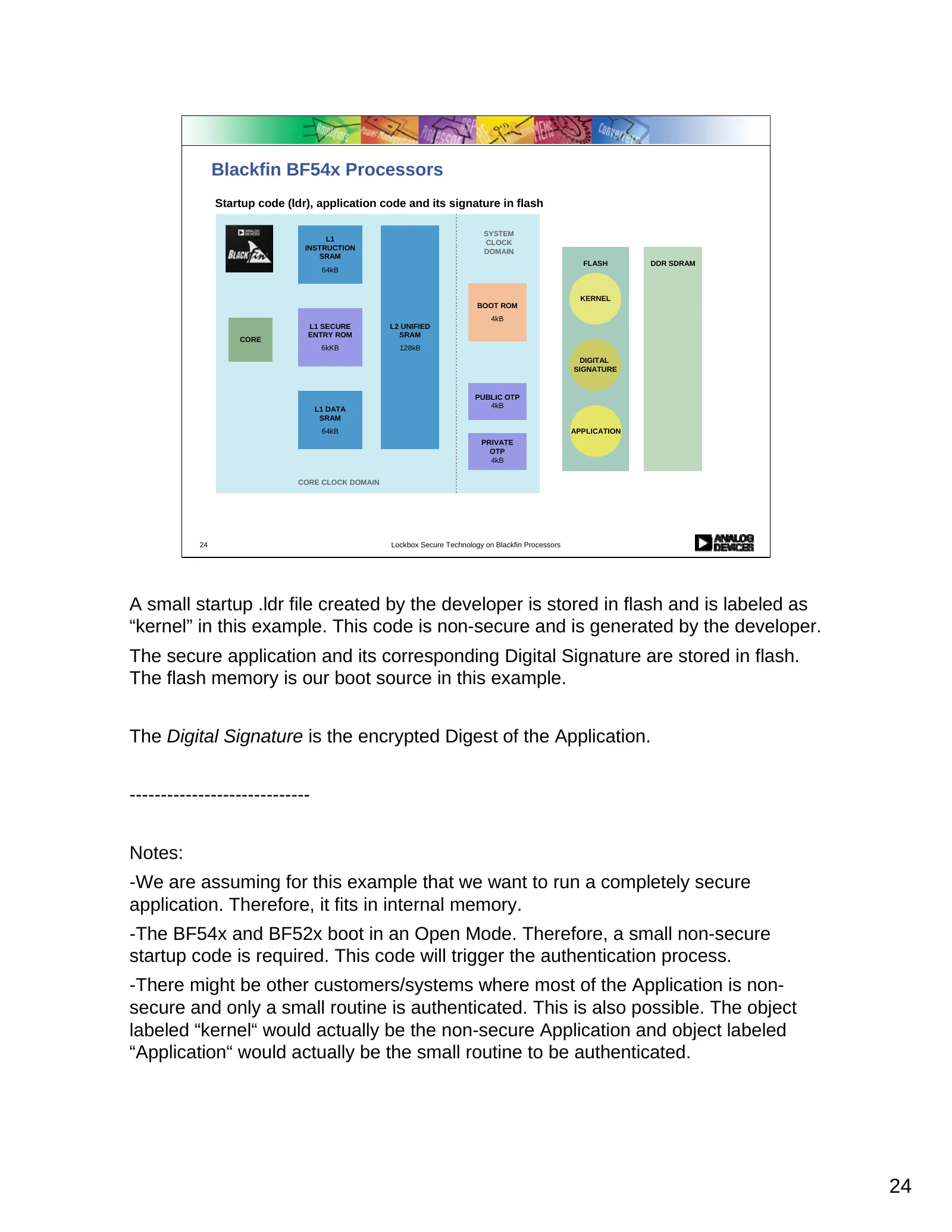
Slide 24: Startup code, application code and its signature in flash
Blackfin BF54x Processors Startup code (ldr), application code and its signature in flash SYSTEM L1 CLOCK INSTRUCTION DOMAIN SRAM FLASH DDR SDRAM 64kB KERNEL BOOT ROM 4kB L1 SECURE L2 UNIFIED ENTRY ROM SRAM CORE 6kKB 128kB DIGITAL SIGNATURE PUBLIC OTP L1 DATA 4kB SRAM 64kB APPLICATION PRIVATE OTP 4k
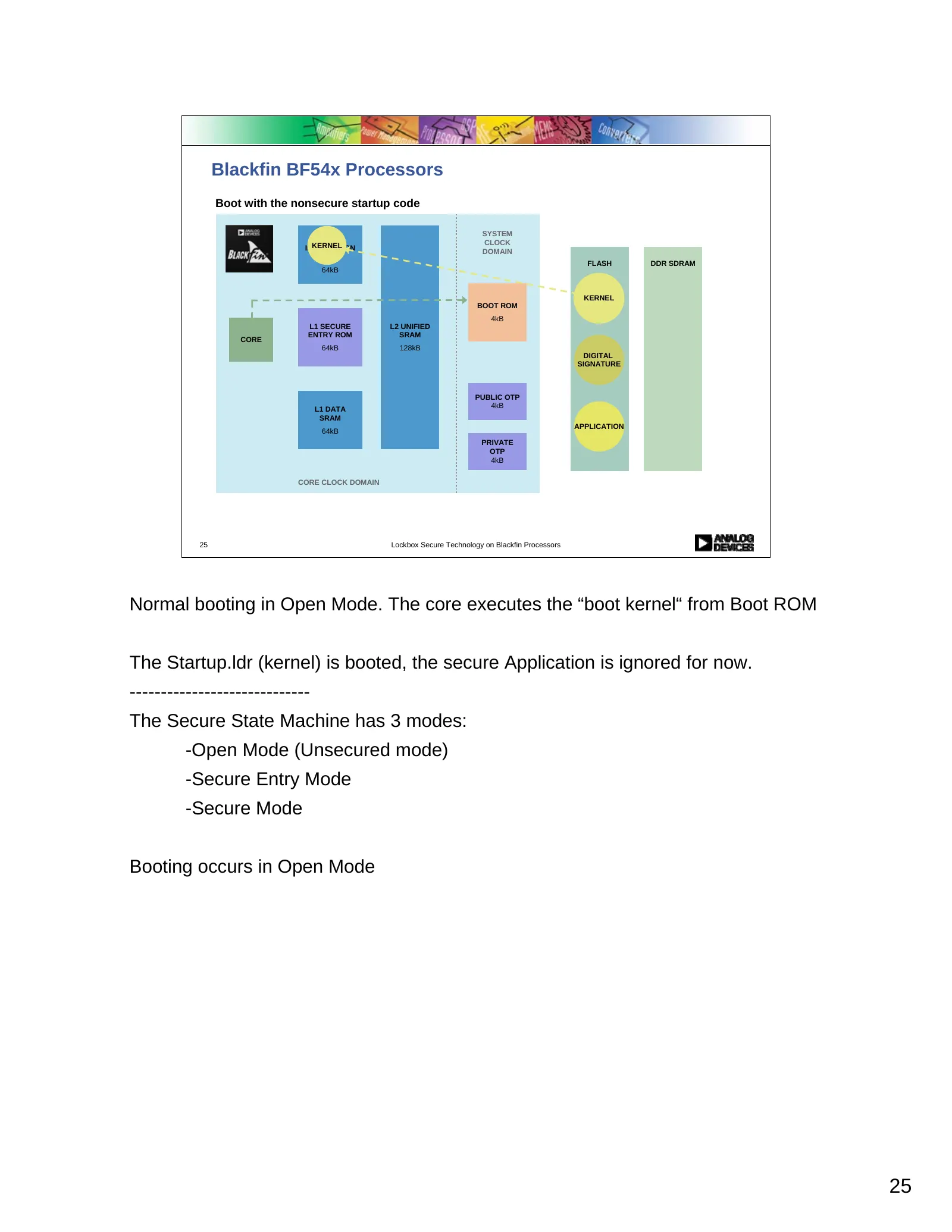
Slide 25: Boot with the nonsecure startup code
Blackfin BF54x Processors Boot with the nonsecure startup code SYSTEM L1 CLOCK KERNEL INSTRUCTION DOMAIN SRAM FLASH DDR SDRAM 64kB KERNEL BOOT ROM 4kB L1 SECURE L2 UNIFIED ENTRY ROM SRAM CORE 64kB 128kB DIGITAL SIGNATURE PUBLIC OTP L1 DATA 4kB SRAM APPLICATION 64kB PRIVATE OTP 4kB CORE CLOCK DOMAIN
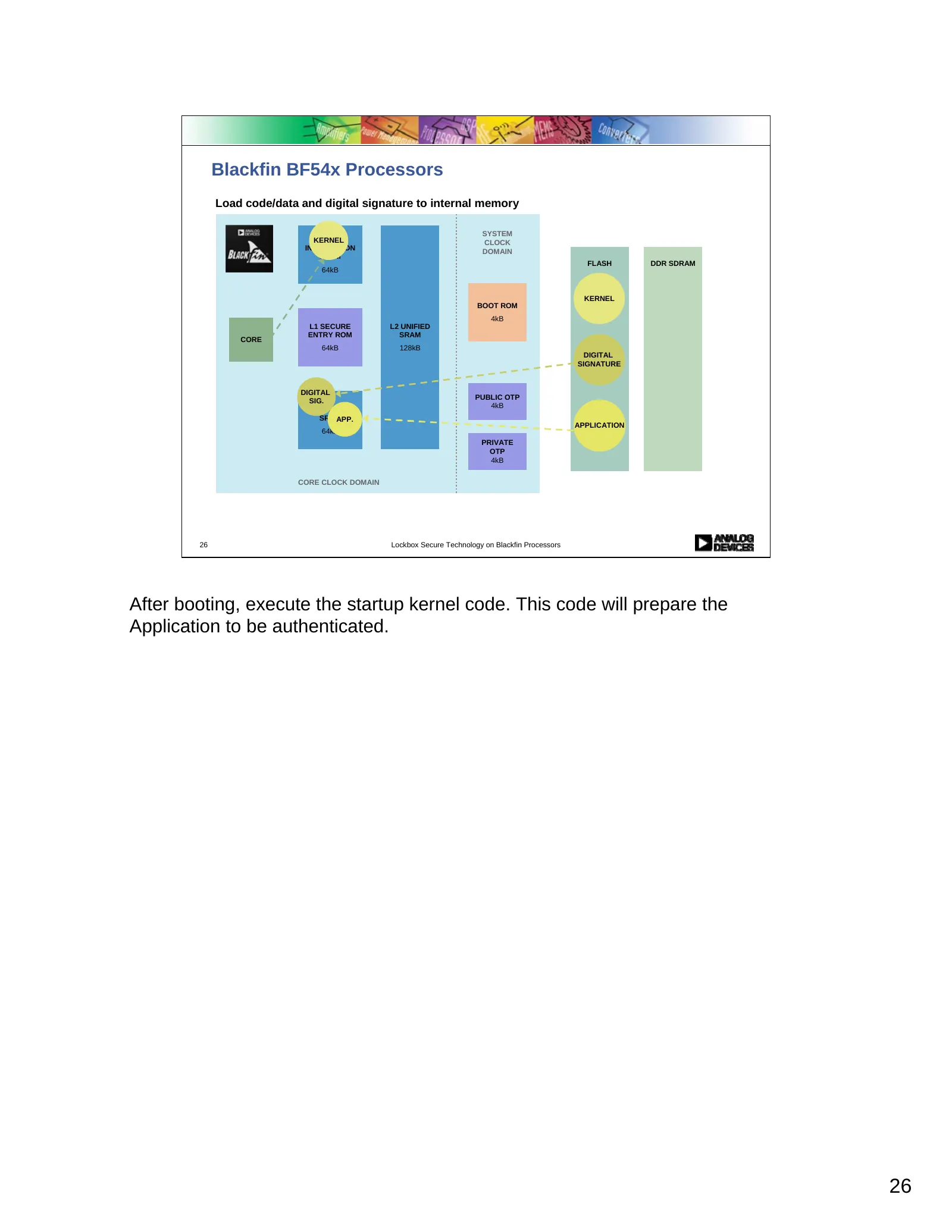
Slide 26: Load code/data and digital signature to internal memory
Blackfin BF54x Processors Load code/data and digital signature to internal memory SYSTEM L1 KERNEL CLOCK INSTRUCTION DOMAIN SRAM FLASH DDR SDRAM 64kB KERNEL BOOT ROM 4kB L1 SECURE L2 UNIFIED ENTRY ROM SRAM CORE 64kB 128kB DIGITAL SIGNATURE DIGITAL PUBLIC OTP SIG. L1 DATA 4kB SRAM APP. APPLICATION 64
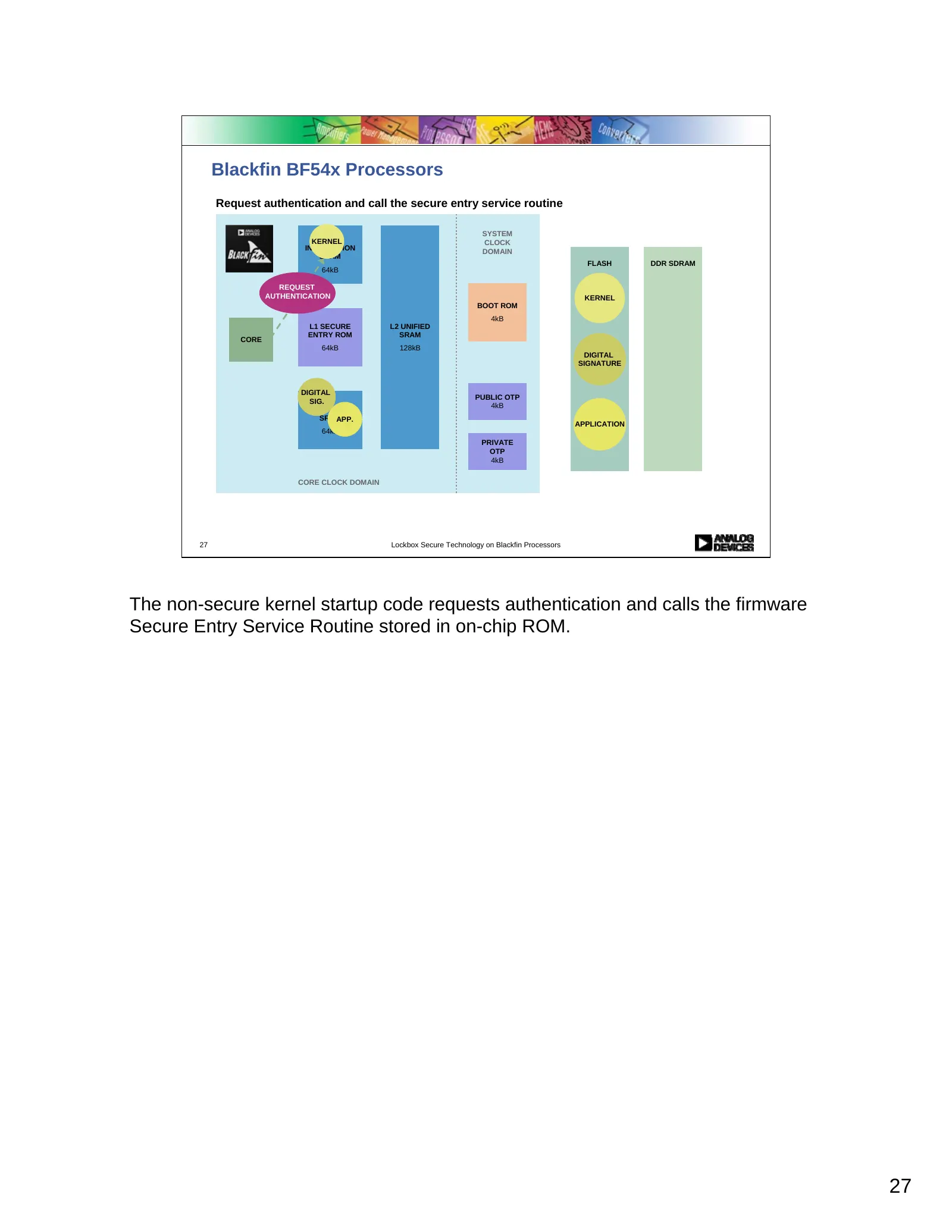
Slide 27: Request authentication and call the secure entry service routine
Blackfin BF54x Processors Request authentication and call the secure entry service routine SYSTEM L1 KERNEL CLOCK INSTRUCTION DOMAIN SRAM FLASH DDR SDRAM 64kB REQUEST AUTHENTICATION KERNEL BOOT ROM 4kB L1 SECURE L2 UNIFIED ENTRY ROM SRAM CORE 64kB 128kB DIGITAL SIGNATURE DIGITAL PUBLIC OTP SIG. L1 D
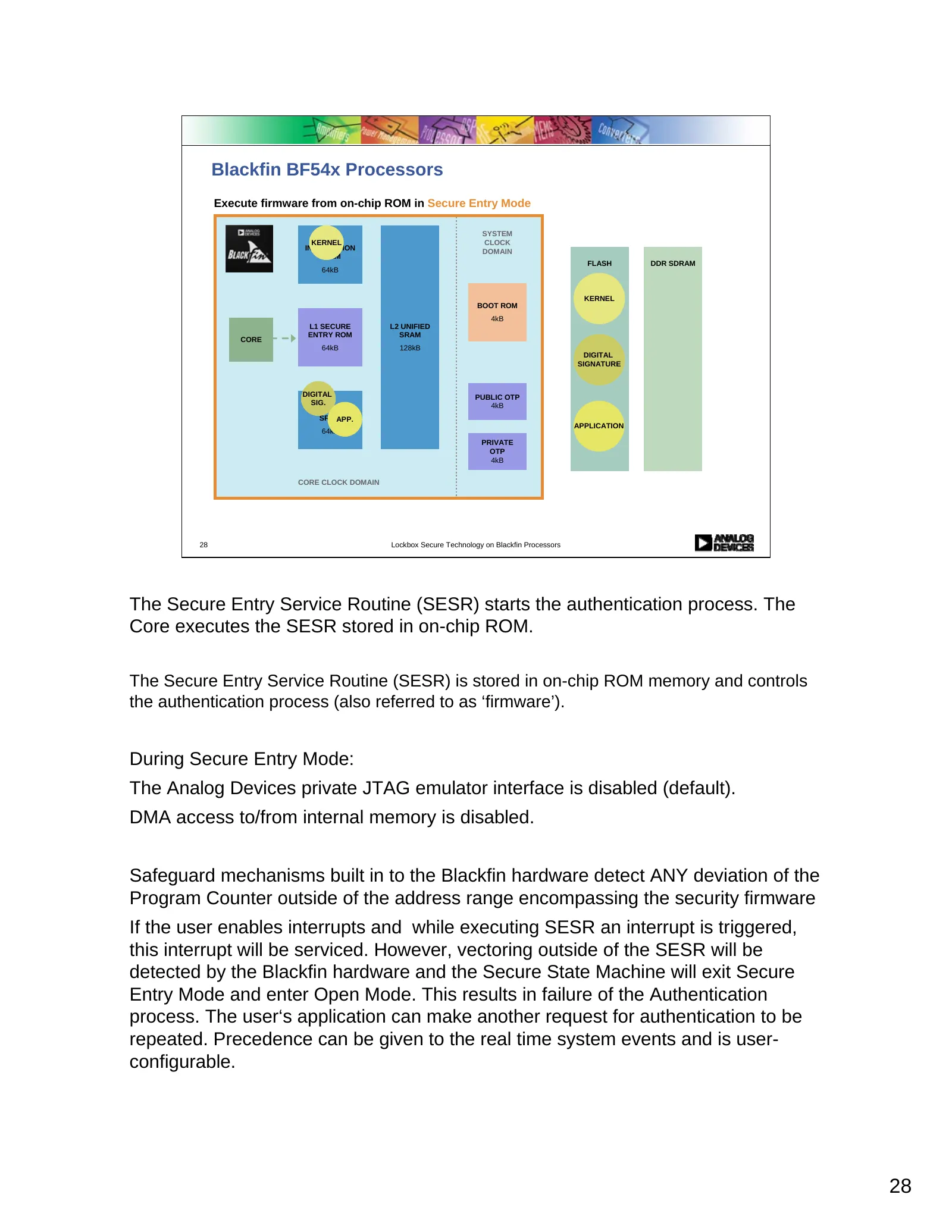
Slide 28: Execute firmware from on-chip ROM in Secure Entry Mode
Blackfin BF54x Processors Execute firmware from on-chip ROM in Secure Entry Mode SYSTEM L1 KERNEL CLOCK INSTRUCTION DOMAIN SRAM FLASH DDR SDRAM 64kB KERNEL BOOT ROM 4kB L1 SECURE L2 UNIFIED ENTRY ROM SRAM CORE 64kB 128kB DIGITAL SIGNATURE DIGITAL PUBLIC OTP SIG. 4kB L1 DATA SRAMAPP. APPLICATION 64kB
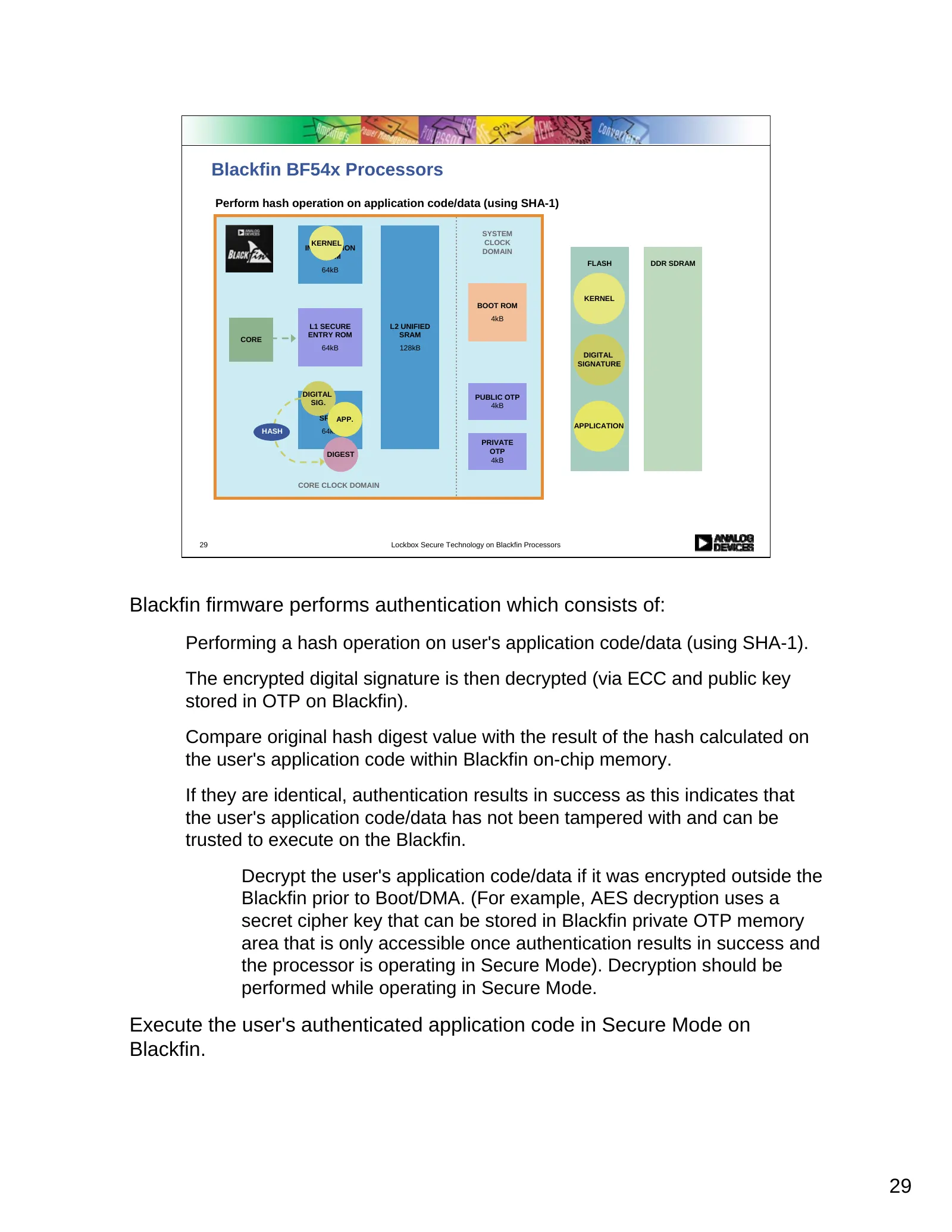
Slide 29: Perform hash operation on application code/data (using SHA-1)
Blackfin BF54x Processors Perform hash operation on application code/data (using SHA-1) SYSTEM L1 CLOCK KERNEL INSTRUCTION DOMAIN SRAM FLASH DDR SDRAM 64kB KERNEL BOOT ROM 4kB L1 SECURE L2 UNIFIED ENTRY ROM SRAM CORE 64kB 128kB DIGITAL SIGNATURE DIGITAL PUBLIC OTP SIG. 4kB L1 DATA SRAMAPP. APPLICATI
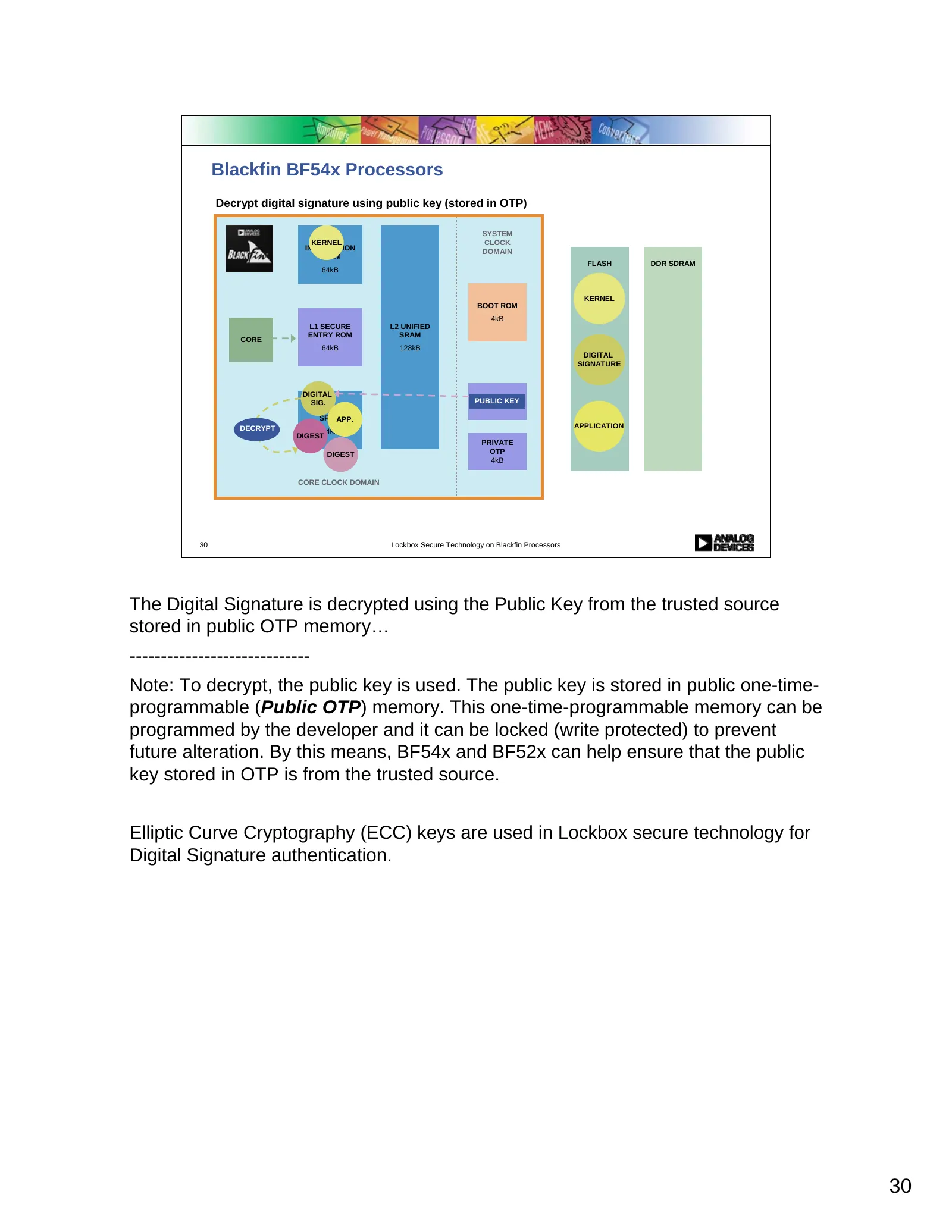
Slide 30: Decrypt digital signature using public key
Blackfin BF54x Processors Decrypt digital signature using public key (stored in OTP) SYSTEM L1 KERNEL CLOCK INSTRUCTION DOMAIN SRAM FLASH DDR SDRAM 64kB KERNEL BOOT ROM 4kB L1 SECURE L2 UNIFIED ENTRY ROM SRAM CORE 64kB 128kB DIGITAL SIGNATURE DIGITAL PUBLIC OTP SIG. PUBLIC KEY L1 DATA 4kB SRAMAPP. D
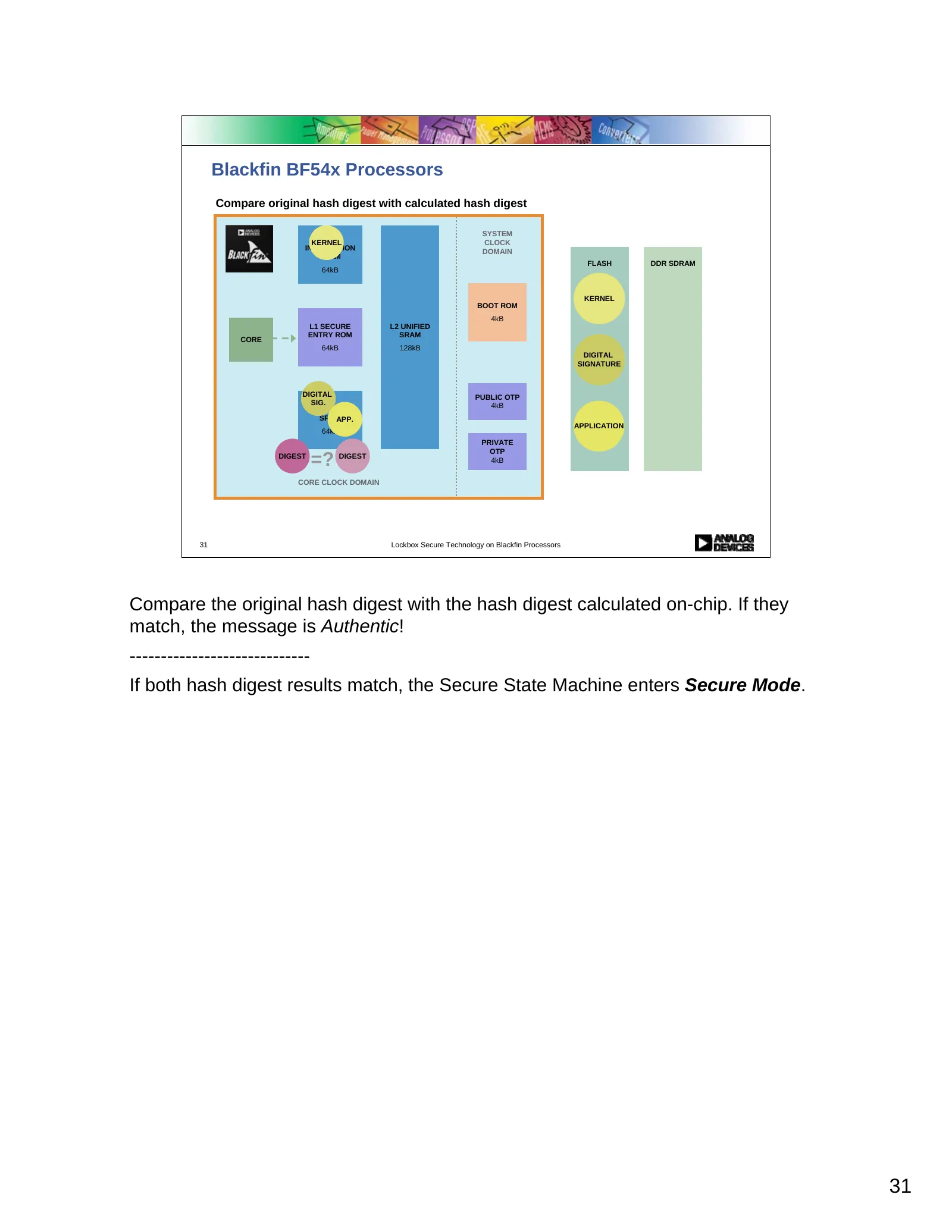
Slide 31: Compare original hash digest with calculated hash digest
Blackfin BF54x Processors Compare original hash digest with calculated hash digest SYSTEM L1 KERNEL CLOCK INSTRUCTION DOMAIN SRAM FLASH DDR SDRAM 64kB KERNEL BOOT ROM 4kB L1 SECURE L2 UNIFIED ENTRY ROM SRAM CORE 64kB 128kB DIGITAL SIGNATURE DIGITAL PUBLIC OTP SIG. 4kB L1 DATA SRAMAPP. APPLICATION 64
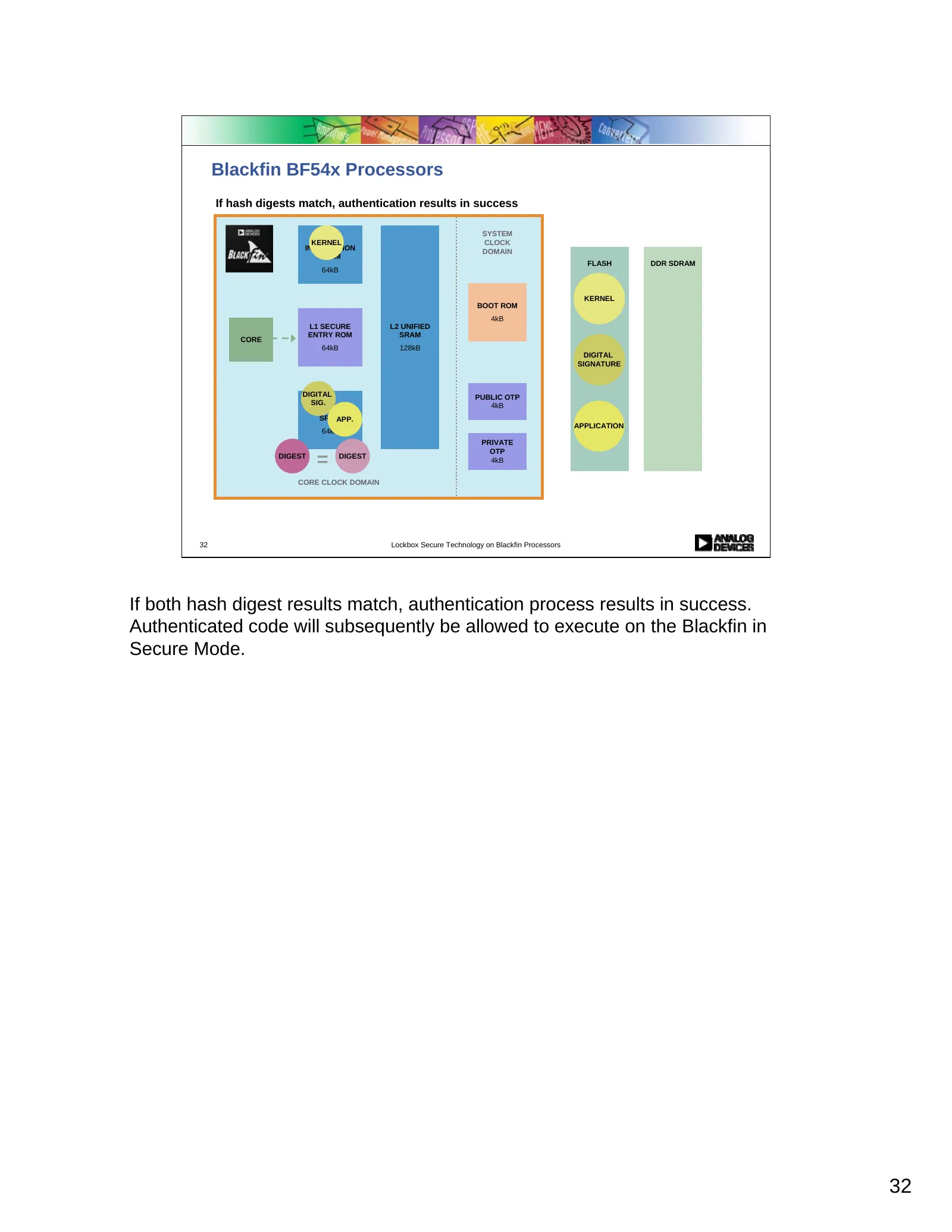
Slide 32: If hash digests match, authentication results in success
Blackfin BF54x Processors If hash digests match, authentication results in success SYSTEM L1 KERNEL CLOCK INSTRUCTION DOMAIN SRAM FLASH DDR SDRAM 64kB KERNEL BOOT ROM 4kB L1 SECURE L2 UNIFIED ENTRY ROM SRAM CORE 64kB 128kB DIGITAL SIGNATURE DIGITAL PUBLIC OTP SIG. 4kB L1 DATA SRAMAPP. APPLICATION 64
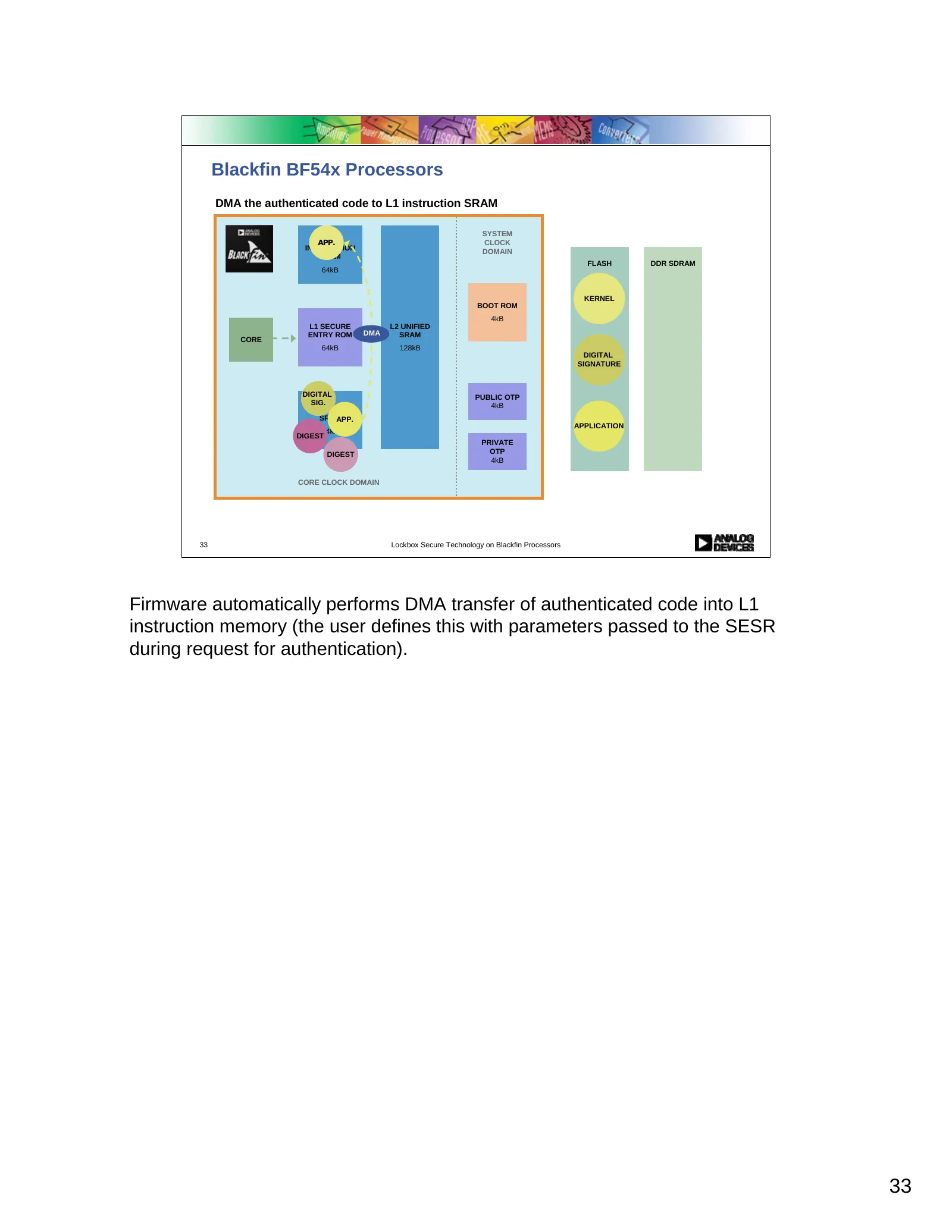
Slide 33: DMA the authenticated code to L1 instruction SRAM
Blackfin BF54x Processors DMA the authenticated code to L1 instruction SRAM SYSTEM L1 APP. CLOCK INSTRUCTION DOMAIN SRAM FLASH DDR SDRAM 64kB KERNEL BOOT ROM 4kB L1 SECURE L2 UNIFIED ENTRY ROM DMA SRAM CORE 64kB 128kB DIGITAL SIGNATURE DIGITAL PUBLIC OTP SIG. 4kB L1 DATA SRAMAPP. APPLICATION 64kB DI
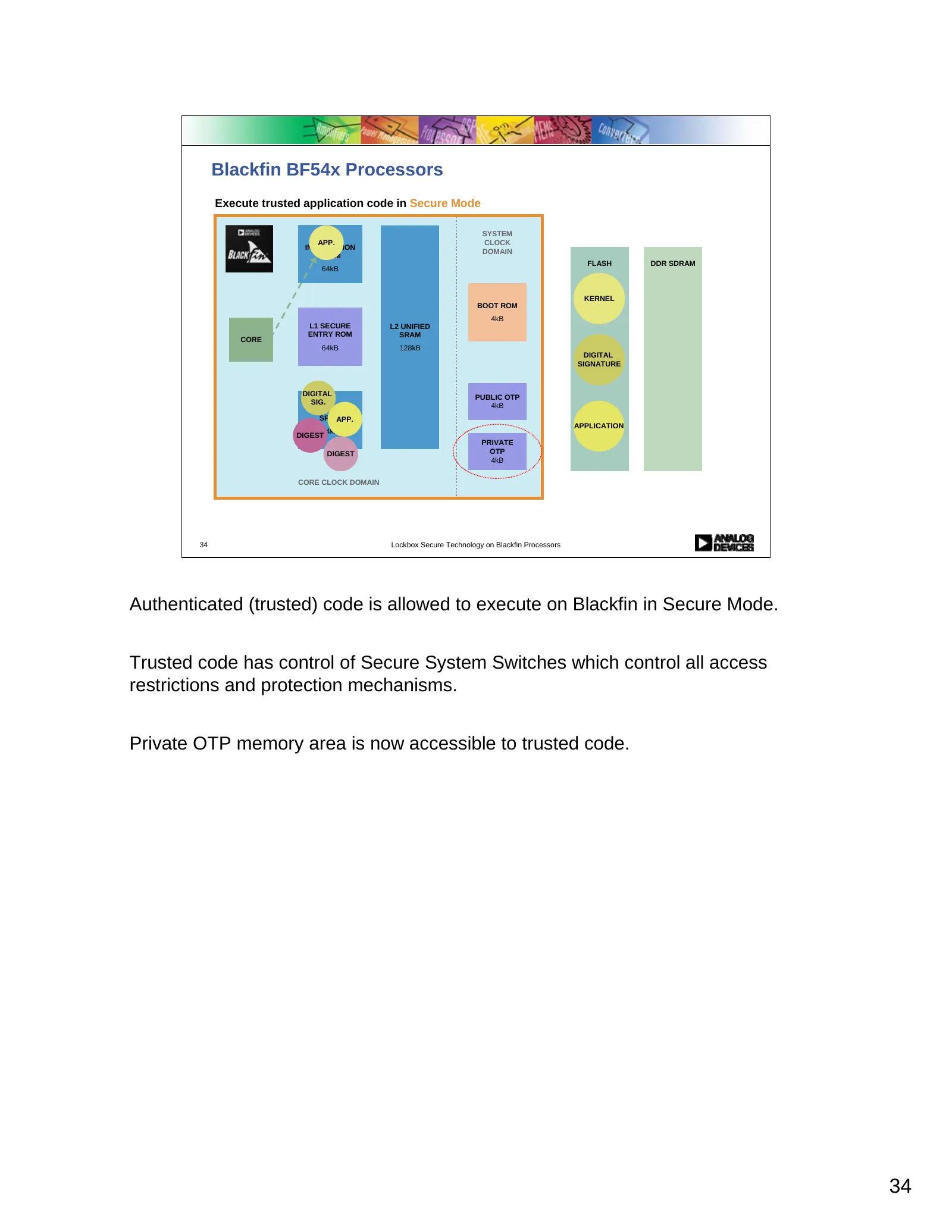
Slide 34: Execute trusted application code in Secure Mode
Blackfin BF54x Processors Execute trusted application code in Secure Mode SYSTEM L1 APP. CLOCK INSTRUCTION DOMAIN SRAM FLASH DDR SDRAM 64kB KERNEL BOOT ROM 4kB L1 SECURE L2 UNIFIED ENTRY ROM SRAM CORE 64kB 128kB DIGITAL SIGNATURE DIGITAL PUBLIC OTP SIG. 4kB L1 DATA SRAMAPP. APPLICATION 64kB DIGEST P
Slide 35: Debug and Test Features
Debug and Test Features 35 Lockbox Secure Technology on Blackfin Processors 35
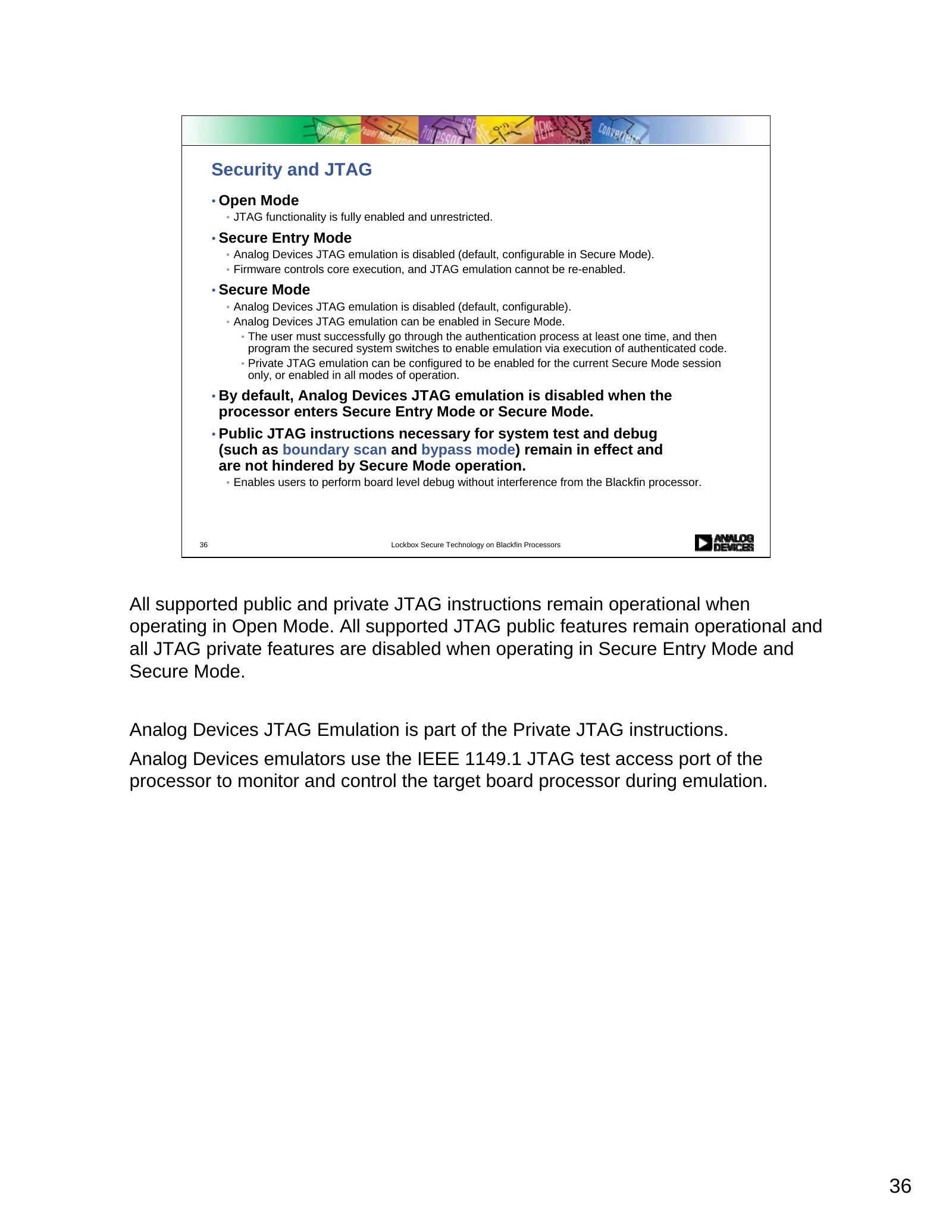
Slide 36: Security and JTAG
Security and JTAG • Open Mode • JTAG functionality is fully enabled and unrestricted. • Secure Entry Mode • Analog Devices JTAG emulation is disabled (default, configurable in Secure Mode). • Firmware controls core execution, and JTAG emulation cannot be re-enabled. • Secure Mode • Analog Devices JT
Slide 37: Summary and Conclusion
Summary and Conclusion 37 Lockbox Secure Technology on Blackfin Processors 37
Slide 38: Flexible and Robust Security Scheme
Flexible and Robust Security Scheme • Security scheme is based upon the concept of authentication of digital signatures using standards-based algorithms and provides a secure processing environment in which to execute code and protect assets. • Mixture of hardware and software mechanisms combine to
Slide 39: Conclusion
Conclusion • Lockbox secure technology on Blackfin processors offers a flexible, programmable platform for securing code and data. • Lockbox provides publicly accessible, user-programmable OTP memory that enables developers to program their own device IDs and helps to ensure that these device IDs re
Slide 40: Resources and References
Resources and References 40 Lockbox Secure Technology on Blackfin Processors 40
Slide 41: Resources and References
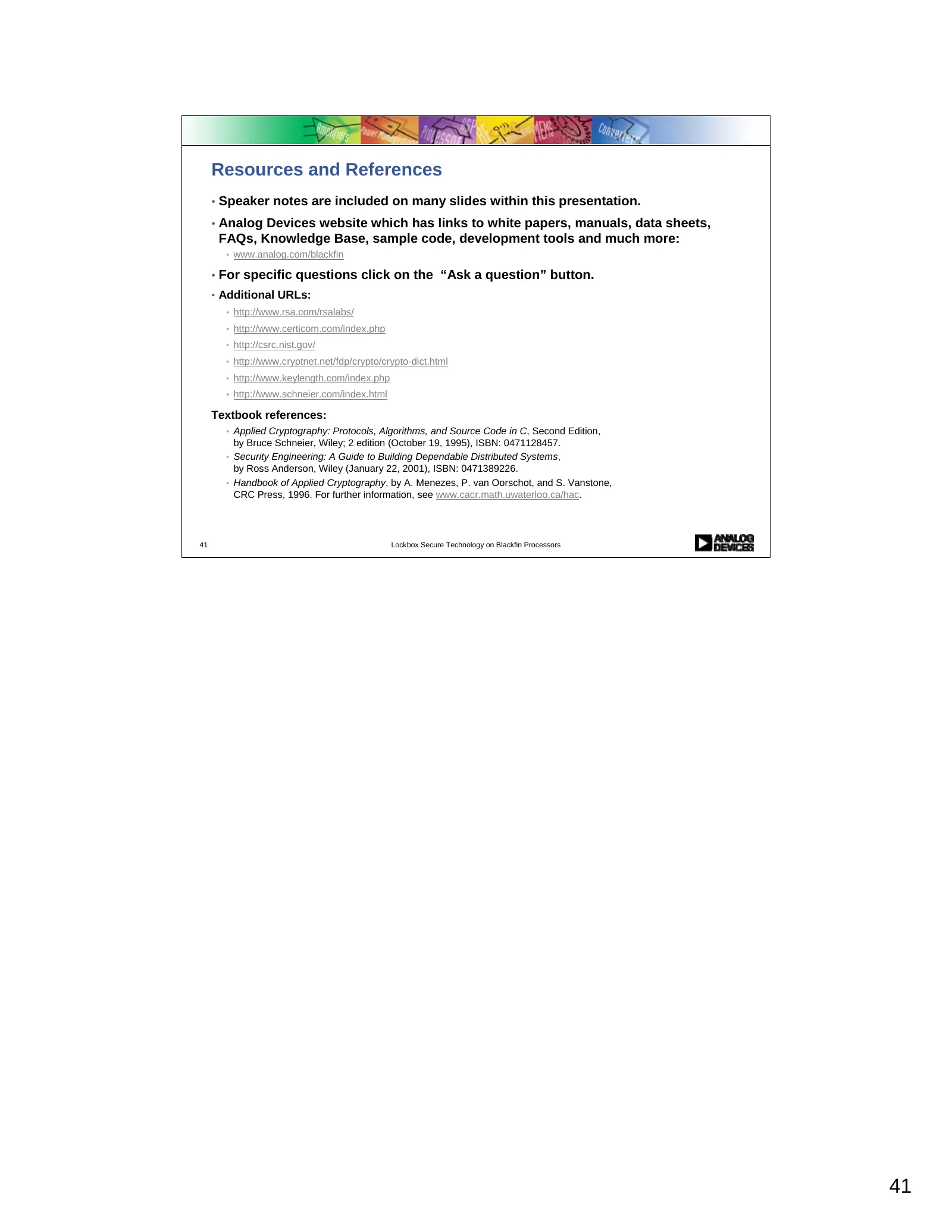
Resources and References • Speaker notes are included on many slides within this presentation. • Analog Devices website which has links to white papers, manuals, data sheets, FAQs, Knowledge Base, sample code, development tools and much more: • www.analog.com/blackfin • For specific questions click
Slide 42: Cryptography Made Easy
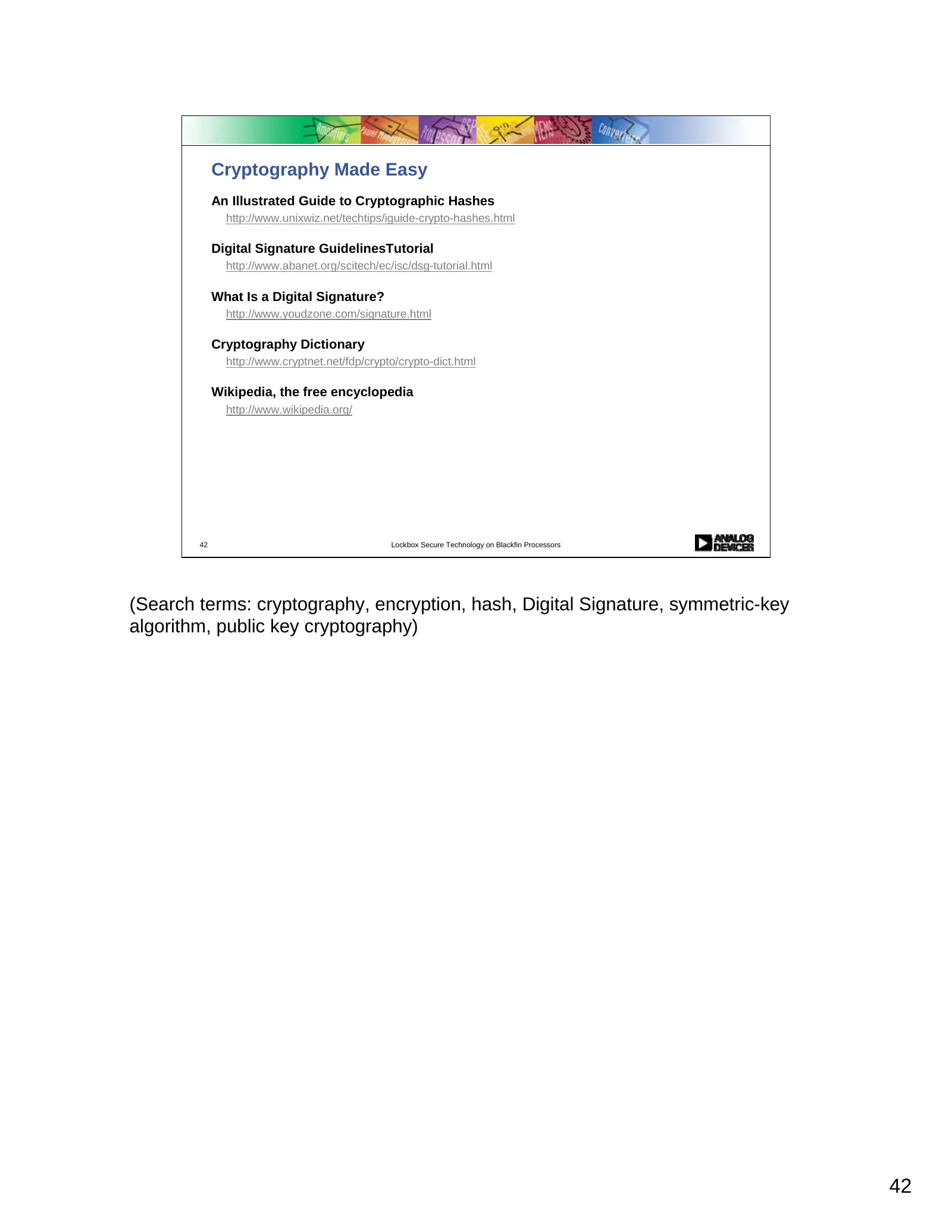
Cryptography Made Easy An Illustrated Guide to Cryptographic Hashes http://www.unixwiz.net/techtips/iguide-crypto-hashes.html Digital Signature GuidelinesTutorial http://www.abanet.org/scitech/ec/isc/dsg-tutorial.html What Is a Digital Signature? http://www.youdzone.com/signature.html Cryptography D
Slide 43: Glossary
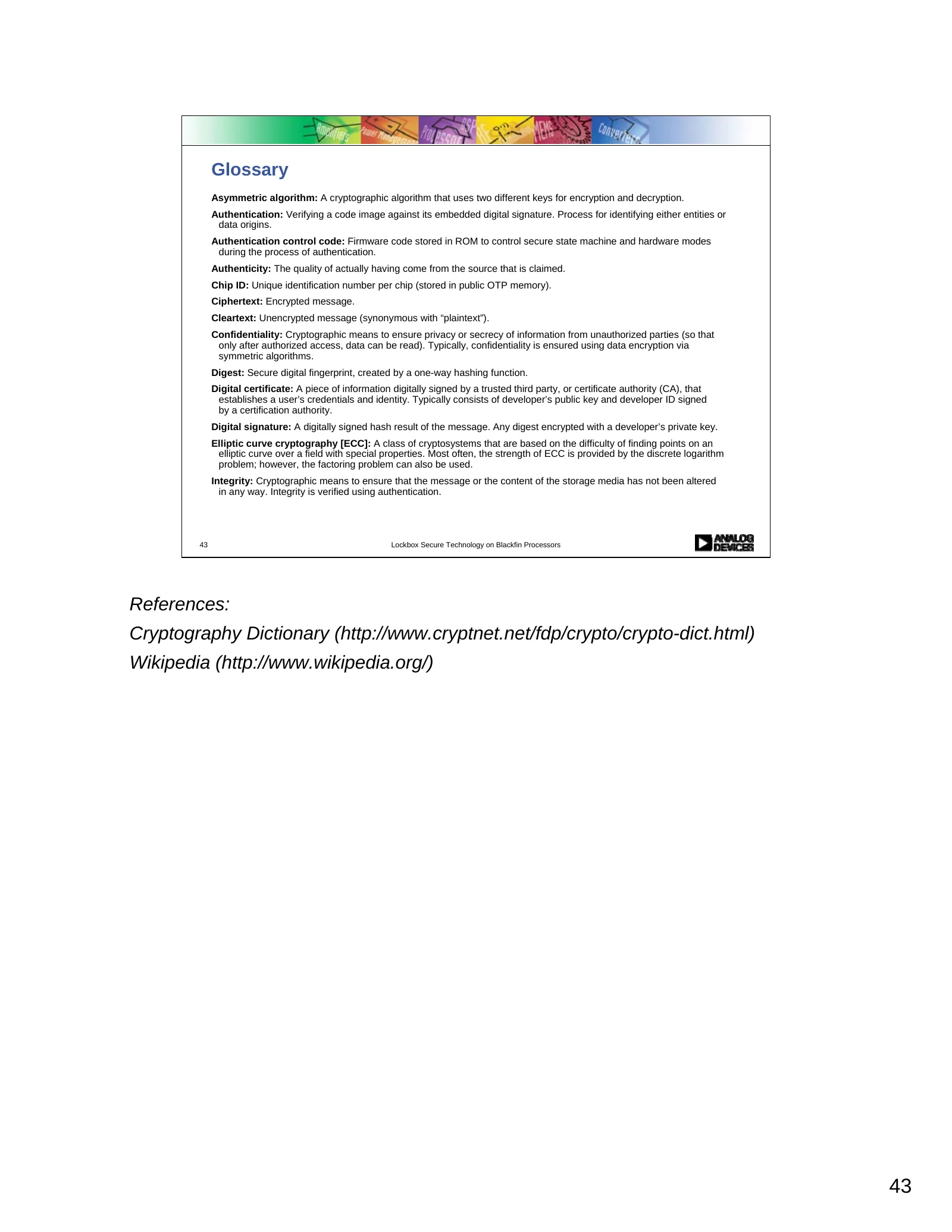
Glossary Asymmetric algorithm: A cryptographic algorithm that uses two different keys for encryption and decryption. Authentication: Verifying a code image against its embedded digital signature. Process for identifying either entities or data origins. Authentication control code: Firmware code stor
Slide 44: Glossary
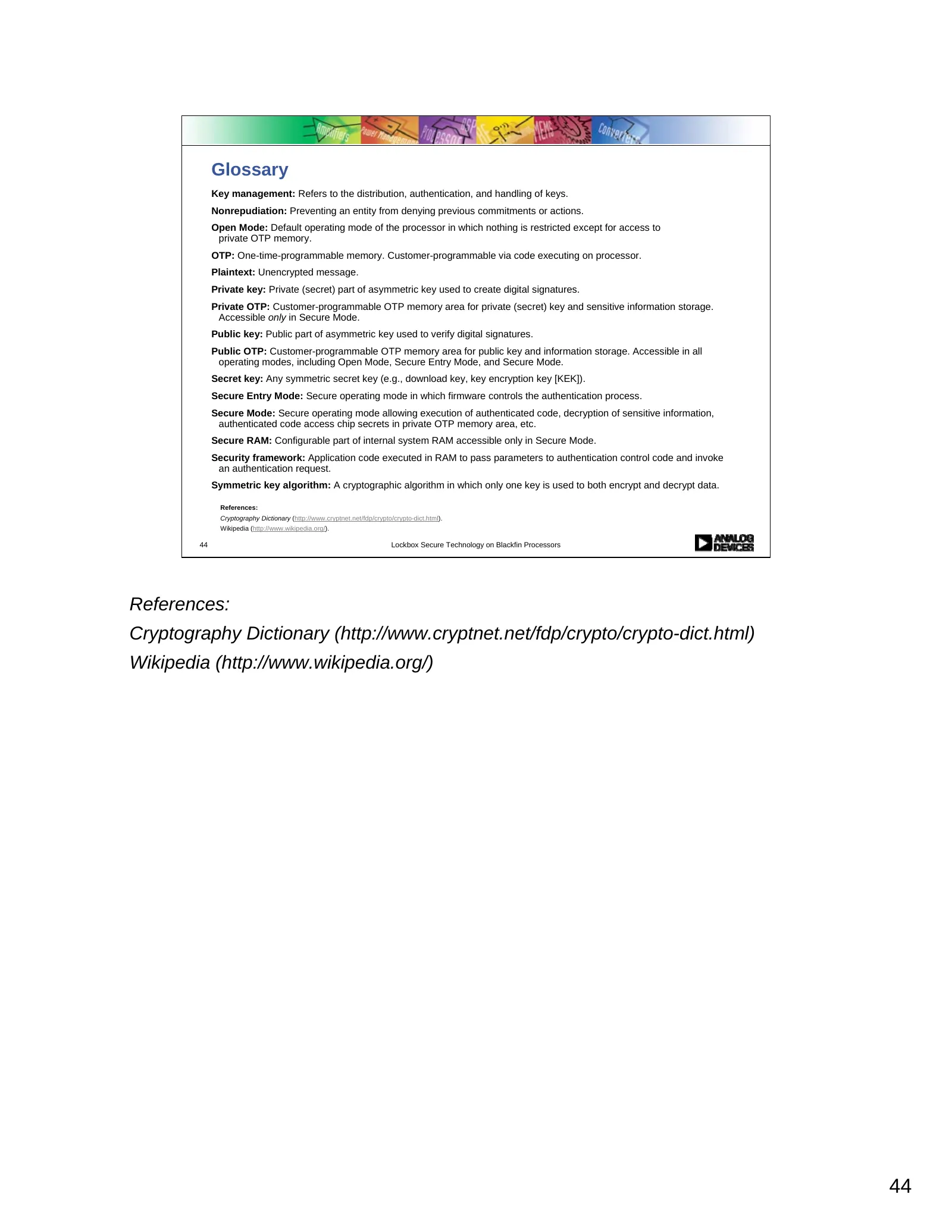
Glossary Key management: Refers to the distribution, authentication, and handling of keys. Nonrepudiation: Preventing an entity from denying previous commitments or actions. Open Mode: Default operating mode of the processor in which nothing is restricted except for access to private OTP memory. OTP
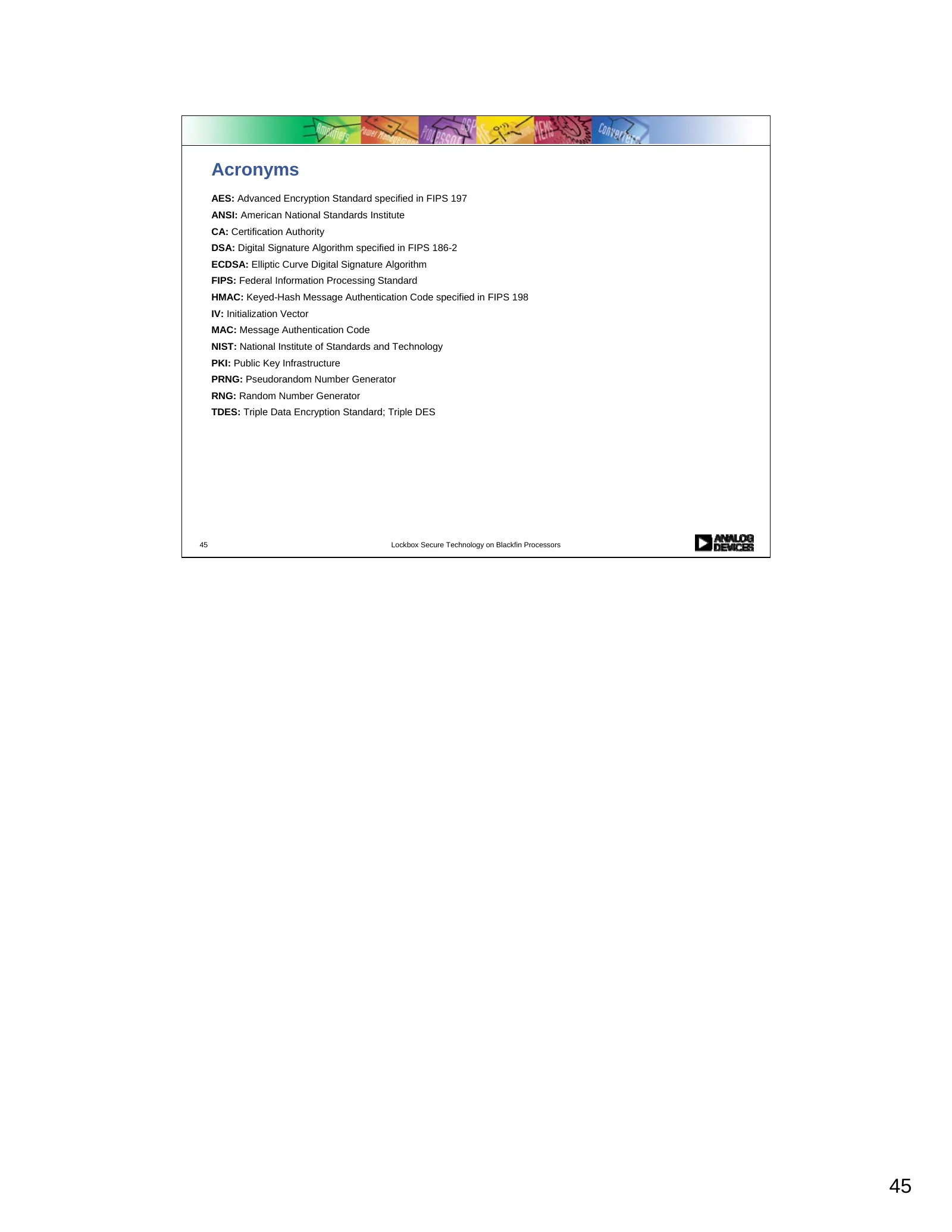
Slide 45: Acronyms
Acronyms AES: Advanced Encryption Standard specified in FIPS 197 ANSI: American National Standards Institute CA: Certification Authority DSA: Digital Signature Algorithm specified in FIPS 186-2 ECDSA: Elliptic Curve Digital Signature Algorithm FIPS: Federal Information Processing Standard HMAC: Keye
Source: Internet Archive copy of analog.com
More decks from Analog Devices, Inc.
 Proxy Contest (February 2026)6 slides · Feb 9, 2026
 Investor Presentation (September 2025)11 slides · Sep 19, 2025
 Investor Presentation (September 2024)14 slides · Sep 27, 2024
 Technical Presentation (May 2024)97 slides · May 30, 2024
 Shareholder Meeting (February 2024)18 slides · Feb 29, 2024
 Investor Presentation (October 2023)12 slides · October 2023