Day One Biopharmaceuticals Inc
Day One Biopharmaceuticals — Investor Presentation (January 2024)
39 slides from Day One Biopharmaceuticals's investor presentation, Jan 8, 2024

Slide 1: Day One Biopharmaceuticals: Targeted Therapies for People of All Ages
Exhibit 99.2 Day One Biopharmaceuticals Targeted Therapies for People of All Ages January 2024 1
Slide 2: Disclaimer
Disclaimer This presentation and the accompanying oral commentary contain forward-looking statements that are based on our management’s beliefs and assumptions and on information currently available to our management. Forward-looking statements are inherently subject to risks and uncertainties, some
Slide 3: Cancer Therapies for People of All Ages
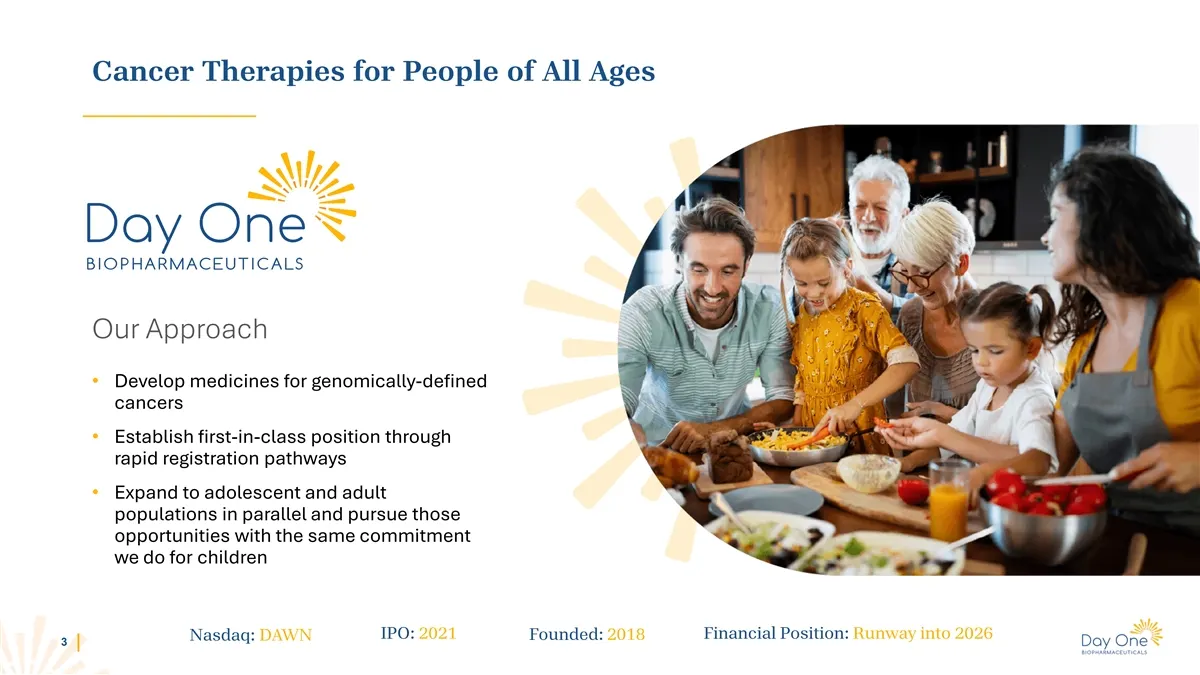
Cancer Therapies for People of All Ages Our Approach • Develop medicines for genomically-defined cancers • Establish first-in-class position through rapid registration pathways • Expand to adolescent and adult populations in parallel and pursue those opportunities with the same commitment we do for
Slide 4: Our Pipeline
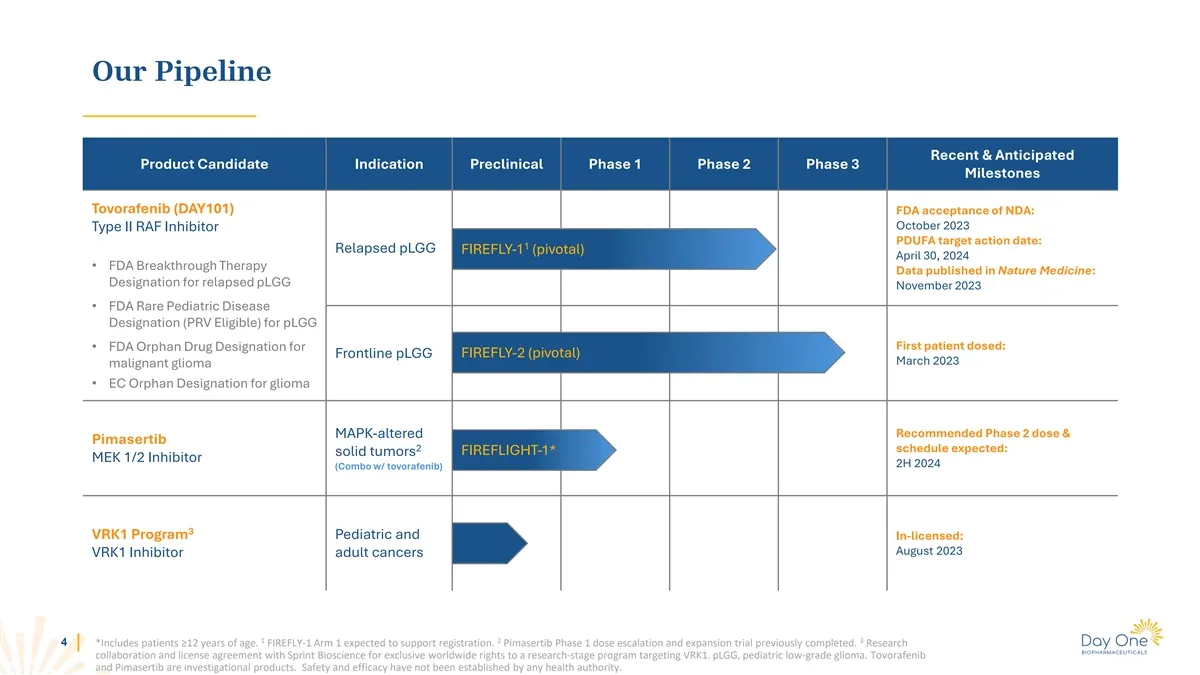
Our Pipeline Recent & Anticipated Product Candidate Indication Preclinical Phase 1 Phase 2 Phase 3 Milestones Tovorafenib (DAY101) FDA acceptance of NDA: October 2023 Type II RAF Inhibitor PDUFA target action date: 1 Relapsed pLGG FIREFLY-1 (pivotal) April 30, 2024 • FDA Breakthrough Therapy Data pu

Slide 5: Tovorafenib (DAY101) Type II RAF Inhibitor
Tovorafenib (DAY101) Type II RAF Inhibitor 5
Slide 6: Kids like Sawyer spend most of their childhood as patients rather than children
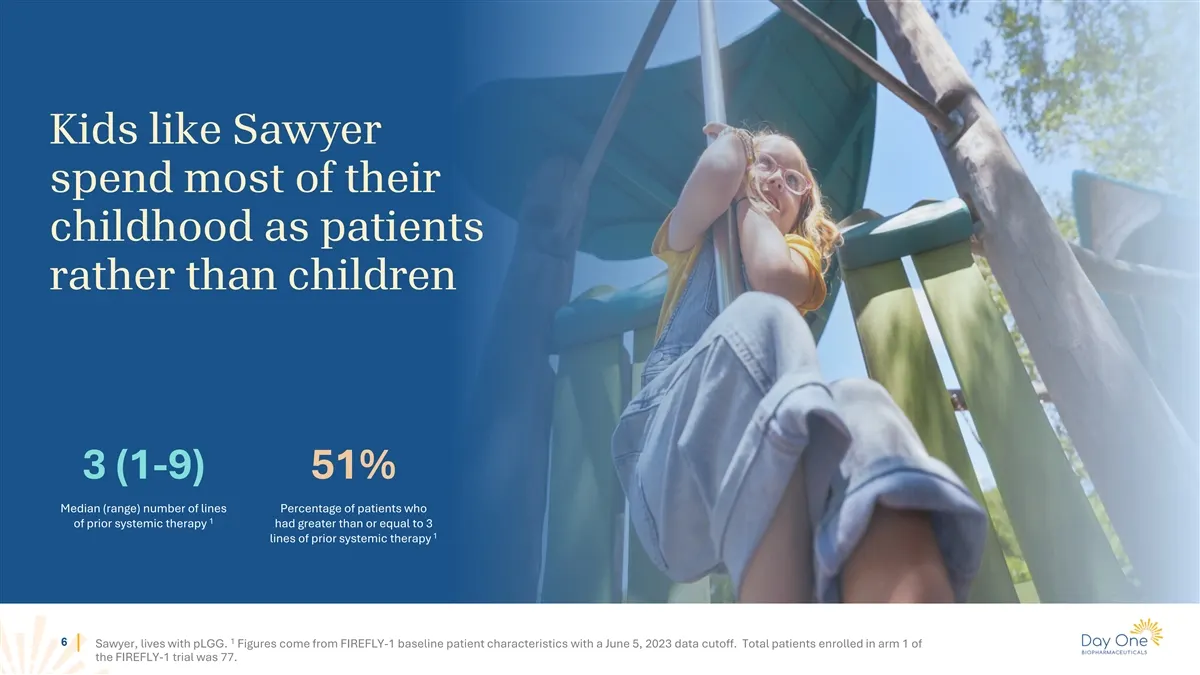
Kids like Sawyer spend most of their childhood as patients rather than children 3 (1-9) 51% Median (range) number of lines Percentage of patients who 1 of prior systemic therapy had greater than or equal to 3 1 lines of prior systemic therapy 1 6 Sawyer, lives with pLGG. Figures come from FIREFLY-1
Slide 7: Pediatric Low-Grade Glioma: The Most Common Type of Brain Tumor in Children
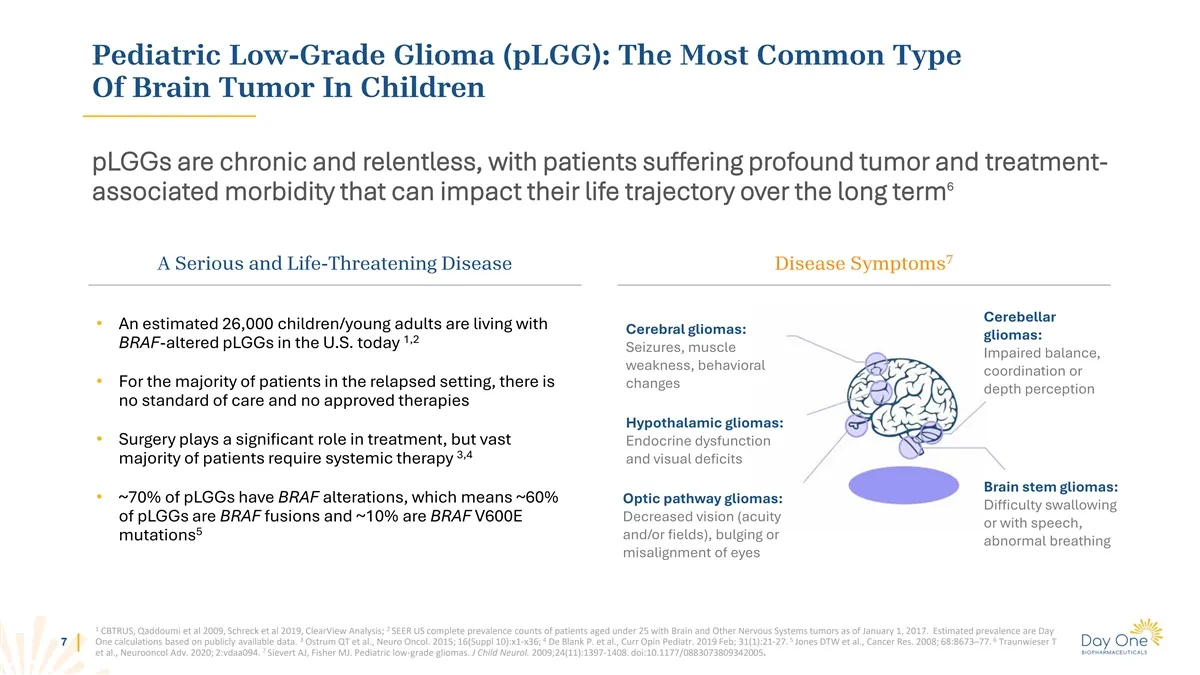
Pediatric Low-Grade Glioma (pLGG): The Most Common Type Of Brain Tumor In Children pLGGs are chronic and relentless, with patients suffering profound tumor and treatment- 6 associated morbidity that can impact their life trajectory over the long term 7 A Serious and Life-Threatening Disease Disease
Slide 8: Conventional Treatments Can Be Disruptive To Childhood
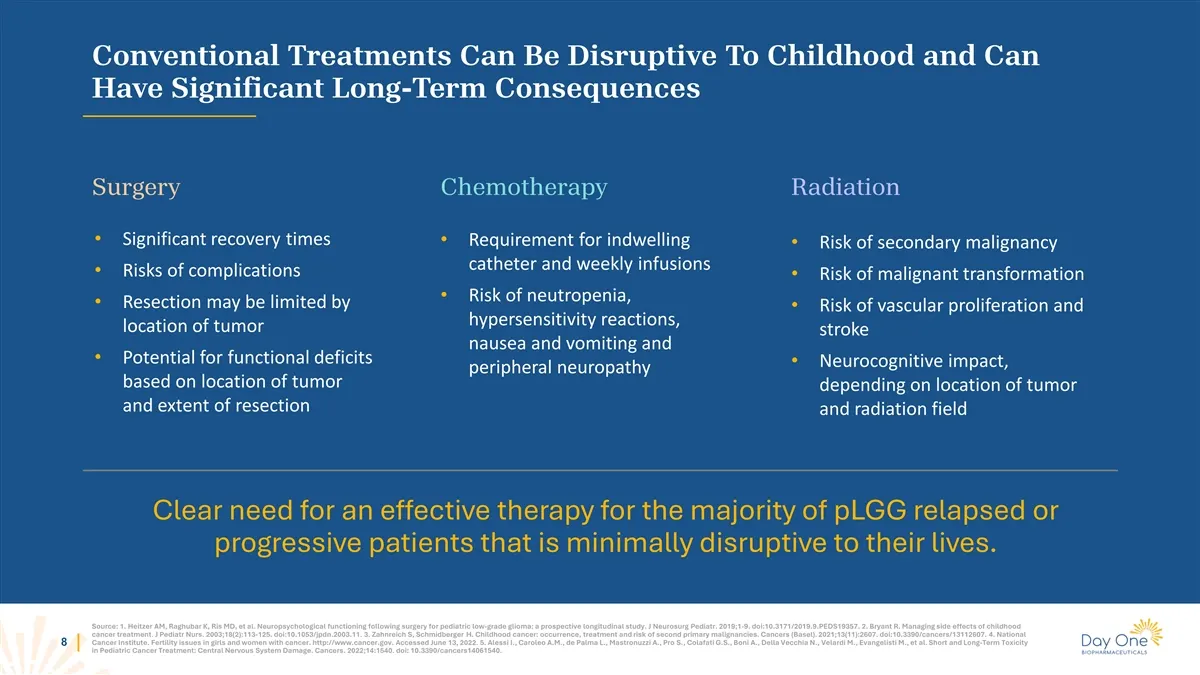
Conventional Treatments Can Be Disruptive To Childhood and Can Have Significant Long-Term Consequences Surgery Chemotherapy Radiation • Significant recovery times • Requirement for indwelling • Risk of secondary malignancy catheter and weekly infusions • Risks of complications • Risk of malignant tr
Slide 9: Tovorafenib Inhibits Both BRAF Fusions And BRAF V600 Mutations
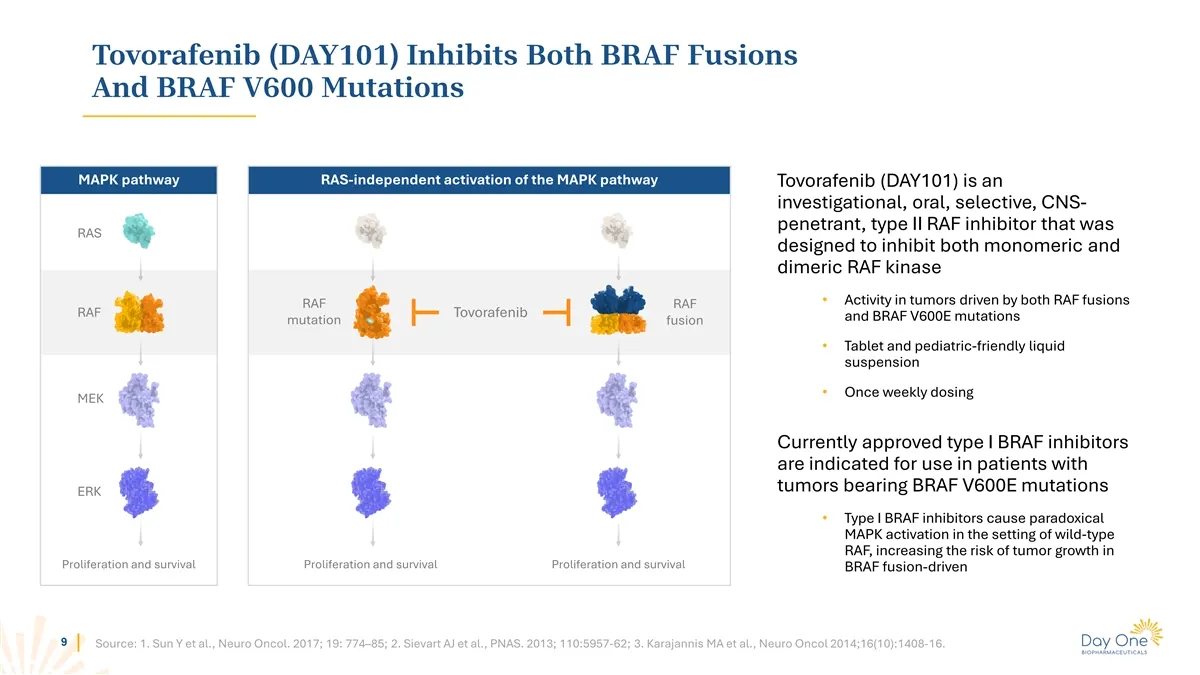
Tovorafenib (DAY101) Inhibits Both BRAF Fusions And BRAF V600 Mutations MAPK pathway RAS-independent activation of the MAPK pathway Tovorafenib (DAY101) is an investigational, oral, selective, CNS- penetrant, type II RAF inhibitor that was RAS designed to inhibit both monomeric and dimeric RAF kinas
Slide 10: Pivotal Phase Trial Of Tovorafenib In Relapsed Or Progressive pLGG (FIREFLY-1)
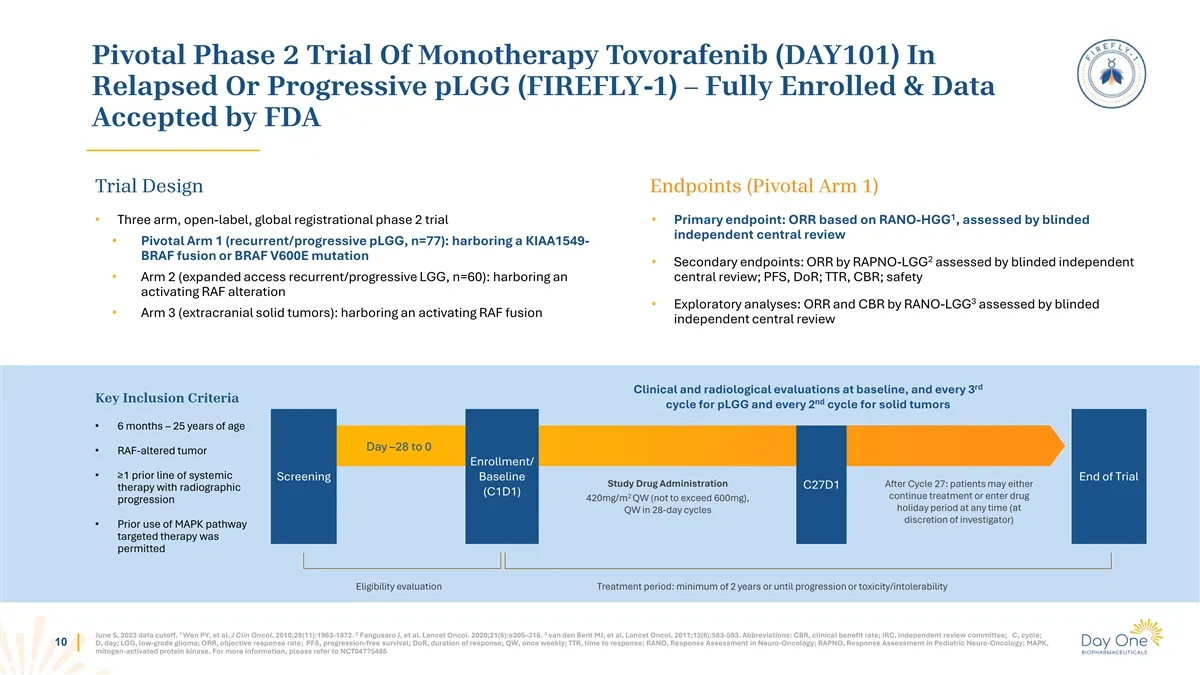
Pivotal Phase 2 Trial Of Monotherapy Tovorafenib (DAY101) In Relapsed Or Progressive pLGG (FIREFLY-1) – Fully Enrolled & Data Accepted by FDA Trial Design Endpoints (Pivotal Arm 1) 1 • Three arm, open-label, global registrational phase 2 trial • Primary endpoint: ORR based on RANO-HGG , assessed by
Slide 11: Data from Pivotal Phase FIREFLY-1 Trial
Data from Pivotal Phase 2 FIREFLY-1 Trial June 5, 2023 data cutoff 11
Slide 12: FIREFLY-1 Baseline Patient Characteristics
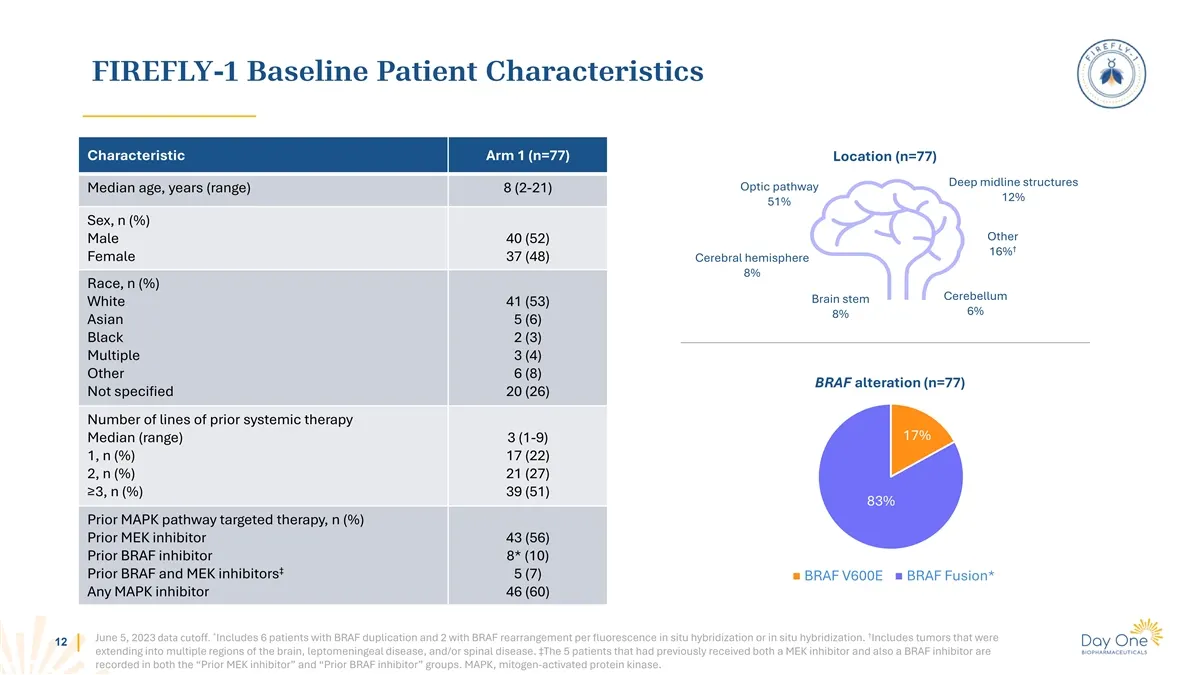
FIREFLY-1 Baseline Patient Characteristics Characteristic Arm 1 (n=77) Location (n=77) Deep midline structures Optic pathway Median age, years (range) 8 (2-21) 12% 51% Sex, n (%) Other Male 40 (52) † 16% Female 37 (48) Cerebral hemisphere 8% Race, n (%) Cerebellum Brain stem White 41 (53) 6% 8% Asia
Slide 13: Tumor Response To Tovorafenib Using RAPNO-LGG, RANO-LGG and RANO-HGG
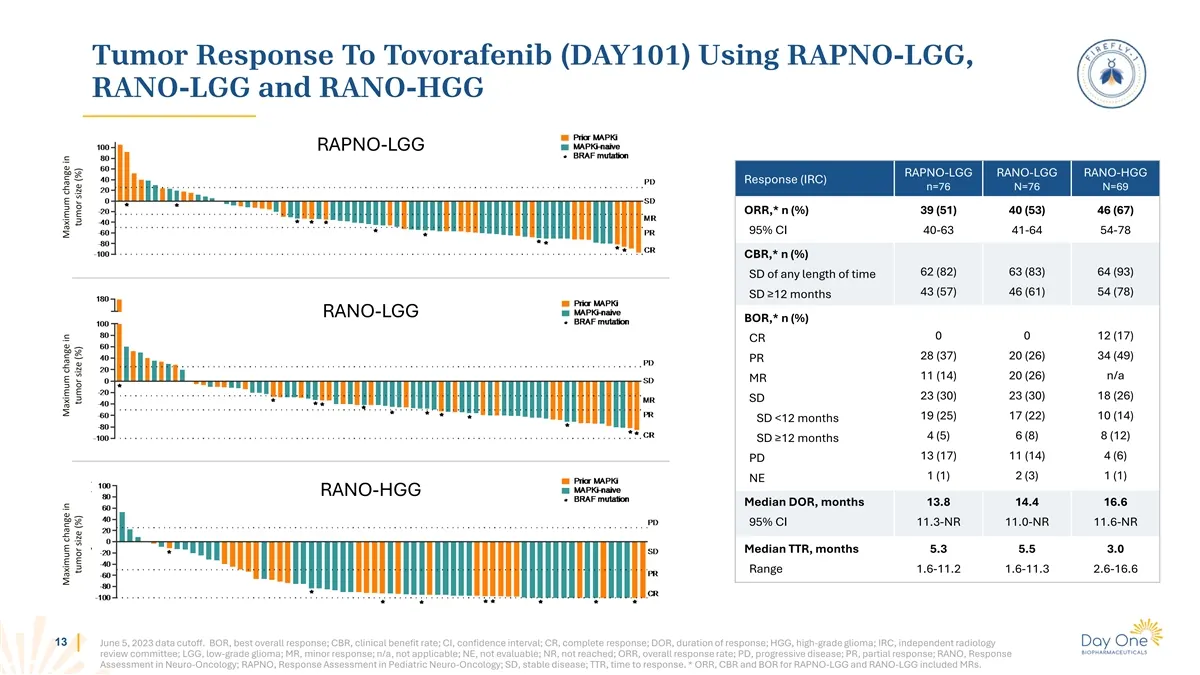
Tumor Response To Tovorafenib (DAY101) Using RAPNO-LGG, RANO-LGG and RANO-HGG RAPNO-LGG RAPNO-LGG RANO-LGG RANO-HGG Response (IRC) n=76 N=76 N=69 ORR,* n (%) 39 (51) 40 (53) 46 (67) 95% CI 40-63 41-64 54-78 CBR,* n (%) 62 (82) 63 (83) 64 (93) SD of any length of time 43 (57) 46 (61) 54 (78) SD ≥12 m
Slide 14: Duration Of Tovorafenib Therapy For Patients With RAPNO-LGG Evaluable Lesions
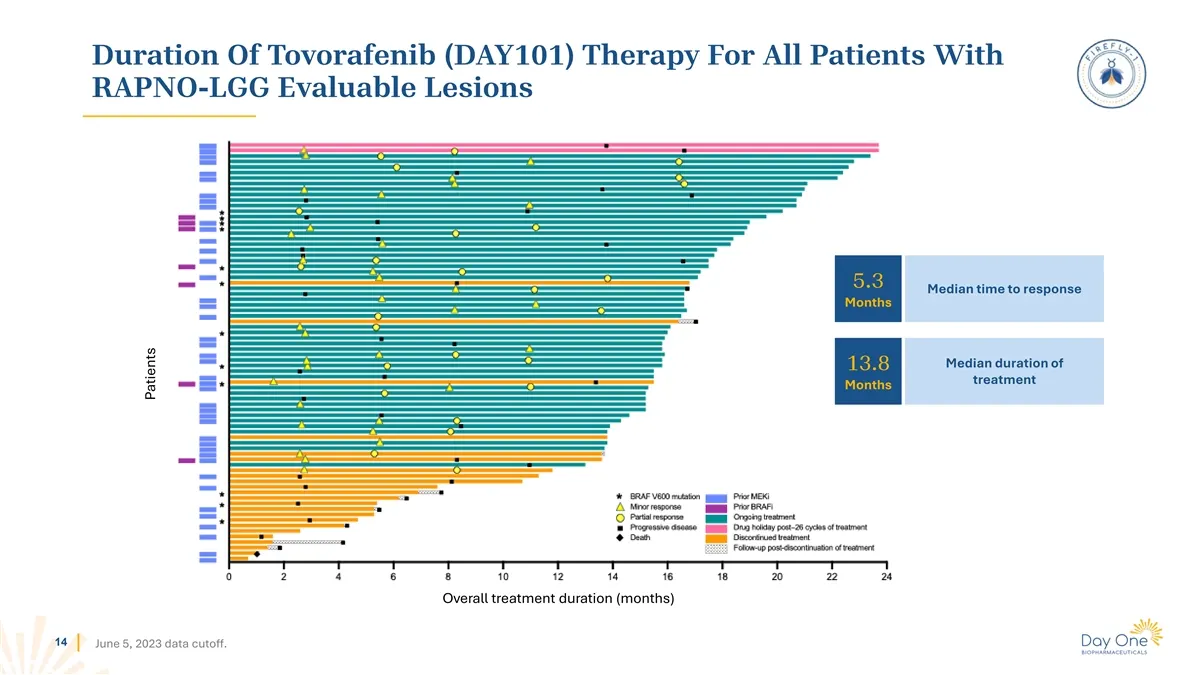
Duration Of Tovorafenib (DAY101) Therapy For All Patients With RAPNO-LGG Evaluable Lesions 5.3 Median time to response Months Median duration of 13.8 treatment Months Overall treatment duration (months) 14 June 5, 2023 data cutoff. Patients
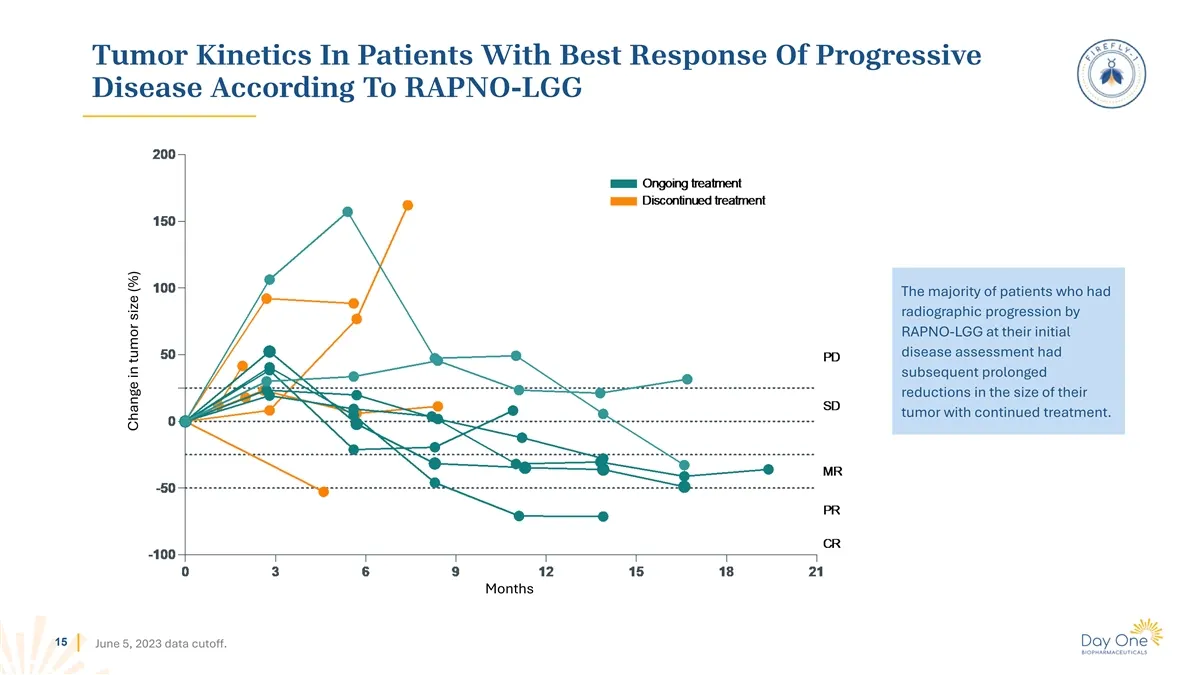
Slide 15: Tumor Kinetics In Patients With Best Response Of Progressive Disease
Tumor Kinetics In Patients With Best Response Of Progressive Disease According To RAPNO-LGG The majority of patients who had radiographic progression by RAPNO-LGG at their initial disease assessment had subsequent prolonged reductions in the size of their tumor with continued treatment. Months 15 Ju
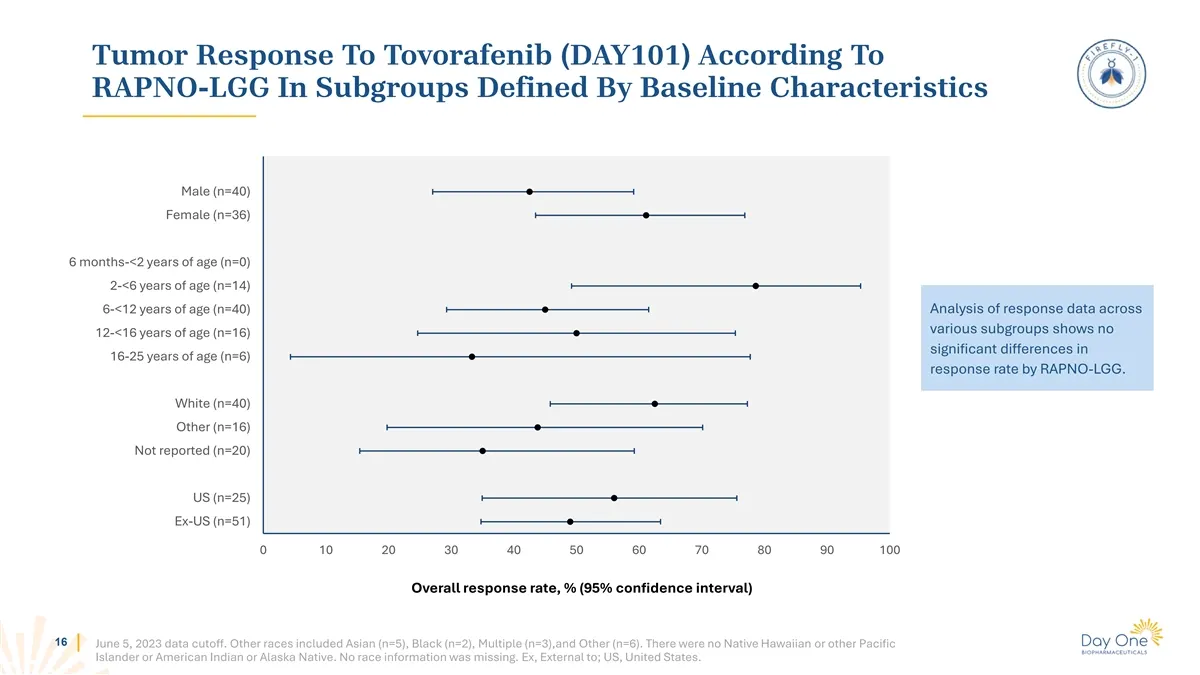
Slide 16: Tumor Response According To RAPNO-LGG In Subgroups
Tumor Response To Tovorafenib (DAY101) According To RAPNO-LGG In Subgroups Defined By Baseline Characteristics Male (n=40) Female (n=36) 6 months-<2 years of age (n=0) 2-<6 years of age (n=14) 6-<12 years of age (n=40) Analysis of response data across various subgroups shows no 12-<16 years of age (
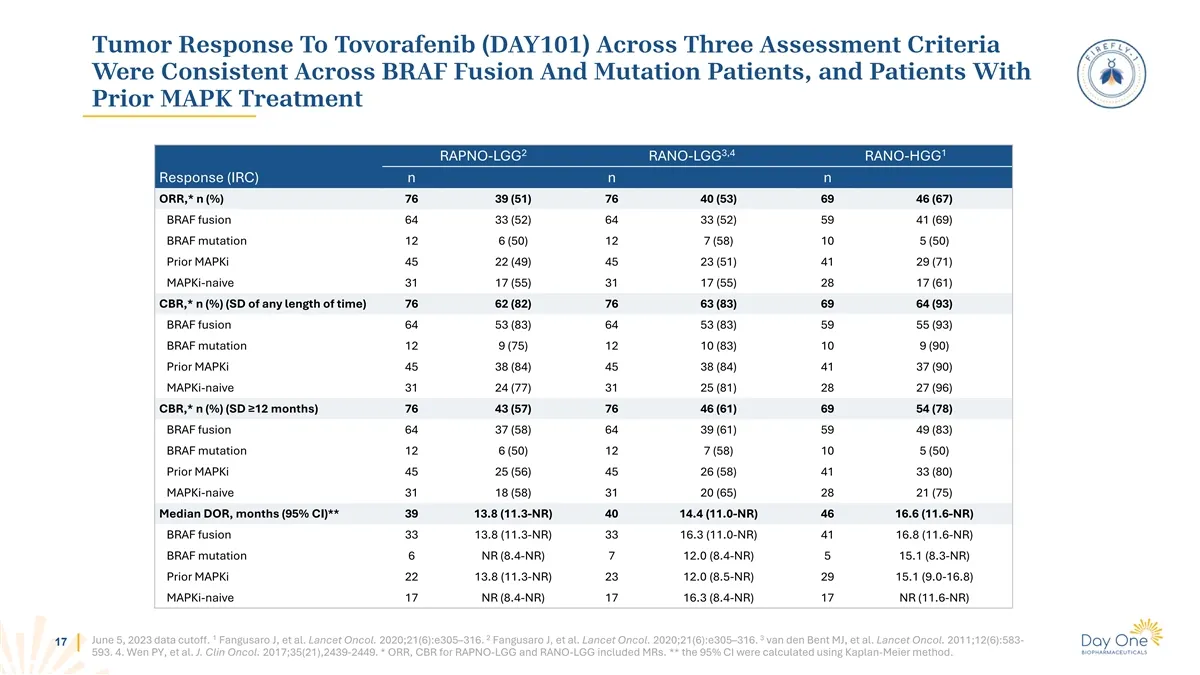
Slide 17: Tumor Response Across Three Assessment Criteria Consistent Across Subgroups
Tumor Response To Tovorafenib (DAY101) Across Three Assessment Criteria Were Consistent Across BRAF Fusion And Mutation Patients, and Patients With Prior MAPK Treatment 2 3,4 1 RAPNO-LGG RANO-LGG RANO-HGG Response (IRC) n n n ORR,* n (%) 76 39 (51) 76 40 (53) 69 46 (67) BRAF fusion 64 33 (52) 64 33
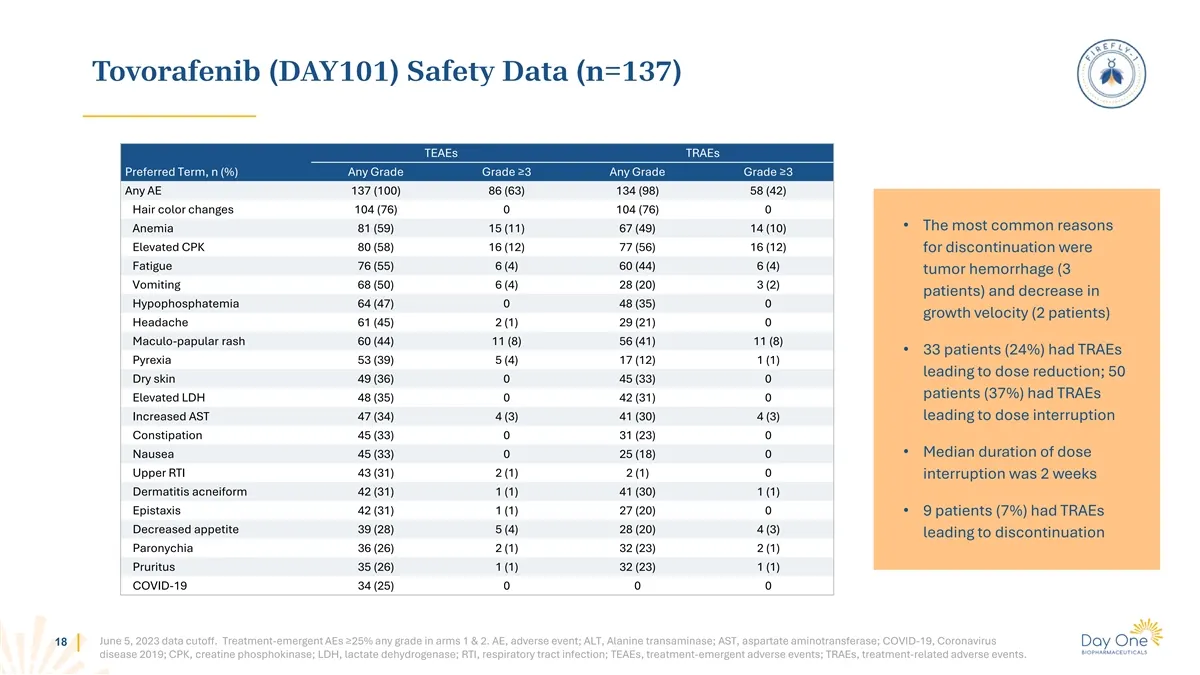
Slide 18: Tovorafenib Safety Data (n=137)
Tovorafenib (DAY101) Safety Data (n=137) TEAEs TRAEs Preferred Term, n (%) Any Grade Grade ≥3 Any Grade Grade ≥3 Any AE 137 (100) 86 (63) 134 (98) 58 (42) Hair color changes 104 (76) 0 104 (76) 0 • The most common reasons Anemia 81 (59) 15 (11) 67 (49) 14 (10) Elevated CPK 80 (58) 16 (12) 77 (56) 16

Slide 19: Estimated BRAF-Altered pLGG Patient Population In The U.S.
Estimated BRAF-Altered pLGG Patient Population In The U.S. ~26,000 Prevalence of Systemically- ~2,000-3,000 Treated Patients 1-5 ~1,100 Under 25 Recurrent/Progressive Total Addressable Incidence of Patient Population Treatment- 6 per Year Eligible Frontline 4,5 Patients The estimated addressable poo
Slide 20: Preparing for a Successful Launch
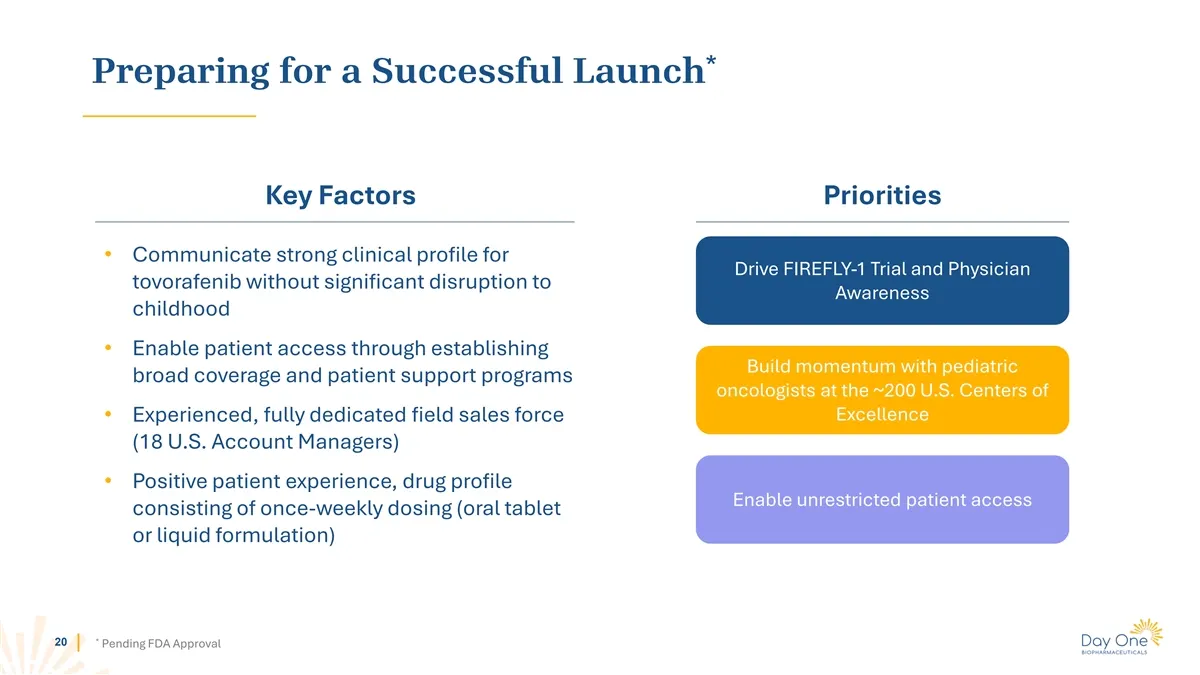
* Preparing for a Successful Launch Key Factors Priorities • Communicate strong clinical profile for Drive FIREFLY-1 Trial and Physician tovorafenib without significant disruption to Awareness childhood • Enable patient access through establishing Build momentum with pediatric broad coverage and pat
Slide 21: Key Takeaways From FIREFLY-1 Data And Next Steps
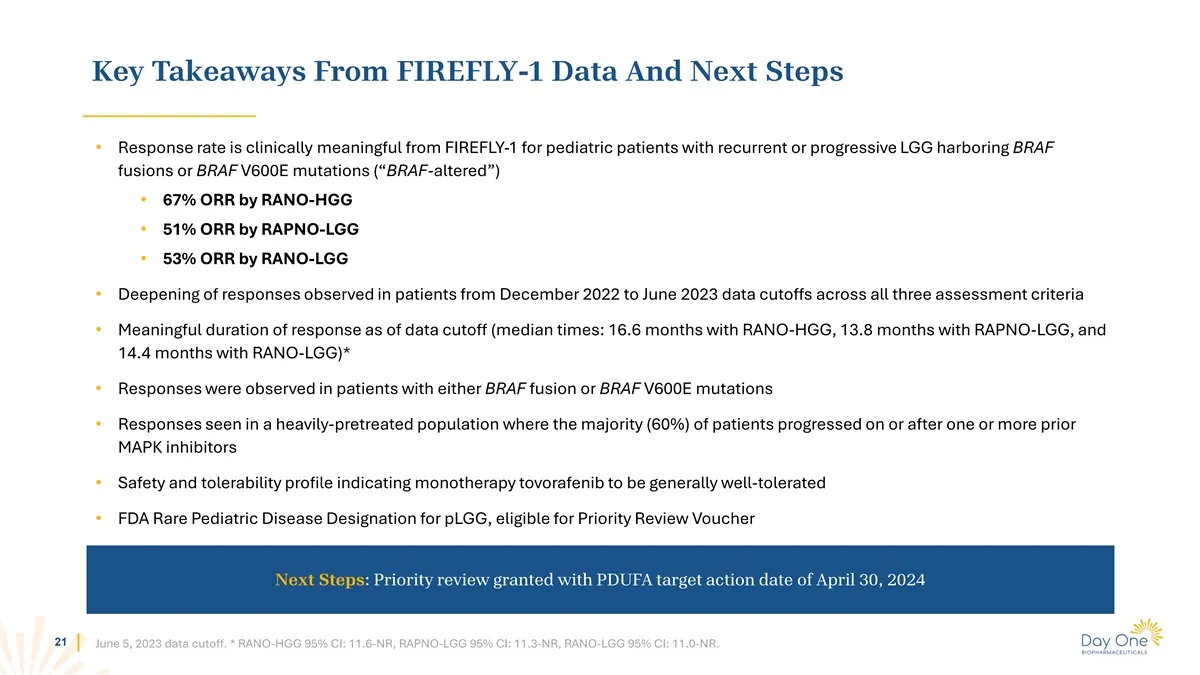
Key Takeaways From FIREFLY-1 Data And Next Steps • Response rate is clinically meaningful from FIREFLY-1 for pediatric patients with recurrent or progressive LGG harboring BRAF fusions or BRAF V600E mutations (“BRAF-altered”) • 67% ORR by RANO-HGG • 51% ORR by RAPNO-LGG • 53% ORR by RANO-LGG • Deepe

Slide 22: FIREFLY-2 / LOGGIC Pivotal Phase Trial in Frontline pLGG
FIREFLY-2 / LOGGIC Pivotal Phase 3 Trial of Tovorafenib (DAY101) in Frontline pLGG 22
Slide 23: FIREFLY-2/LOGGIC Pivotal Phase Trial In Frontline pLGG
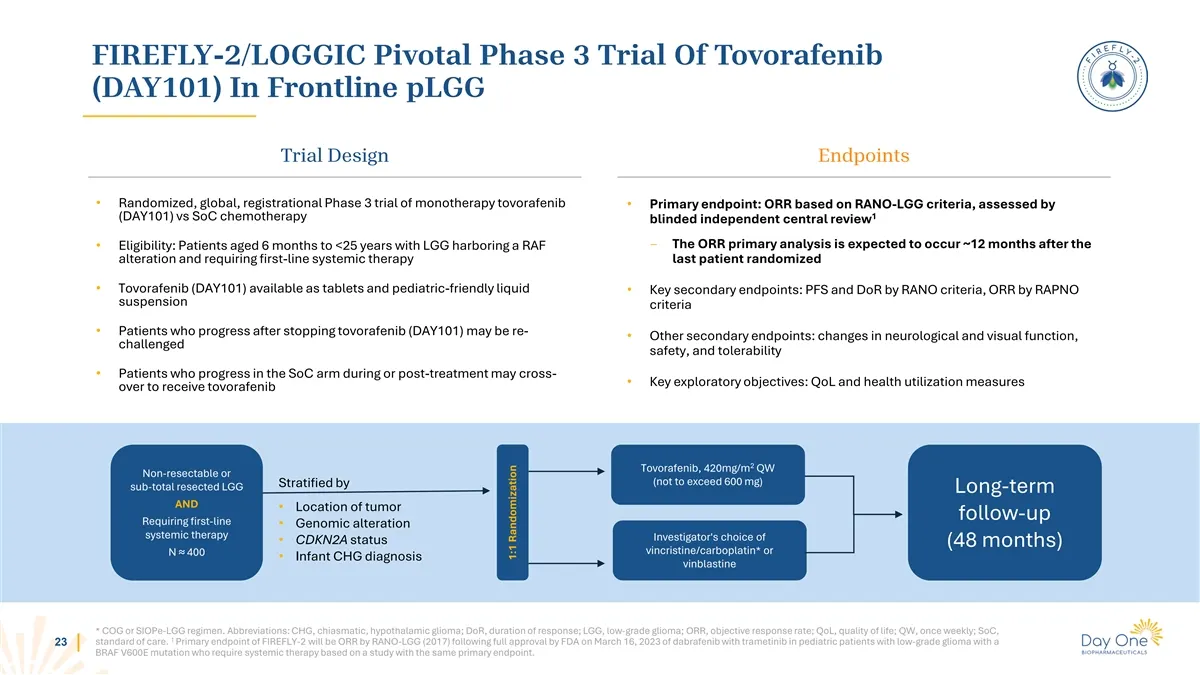
FIREFLY-2/LOGGIC Pivotal Phase 3 Trial Of Tovorafenib (DAY101) In Frontline pLGG Trial Design Endpoints • Randomized, global, registrational Phase 3 trial of monotherapy tovorafenib • Primary endpoint: ORR based on RANO-LGG criteria, assessed by 1 (DAY101) vs SoC chemotherapy blinded independent cen

Slide 24: FIRELIGHT-1 Phase 1b/2 Trials of Tovorafenib with Pimasertib
FIRELIGHT-1 Phase 1b/2 Trials Evaluating Tovorafenib (DAY101) as a Combination with Pimasertib 24
Slide 25: Pimasertib: Investigational Allosteric MEK1/2 Inhibitor
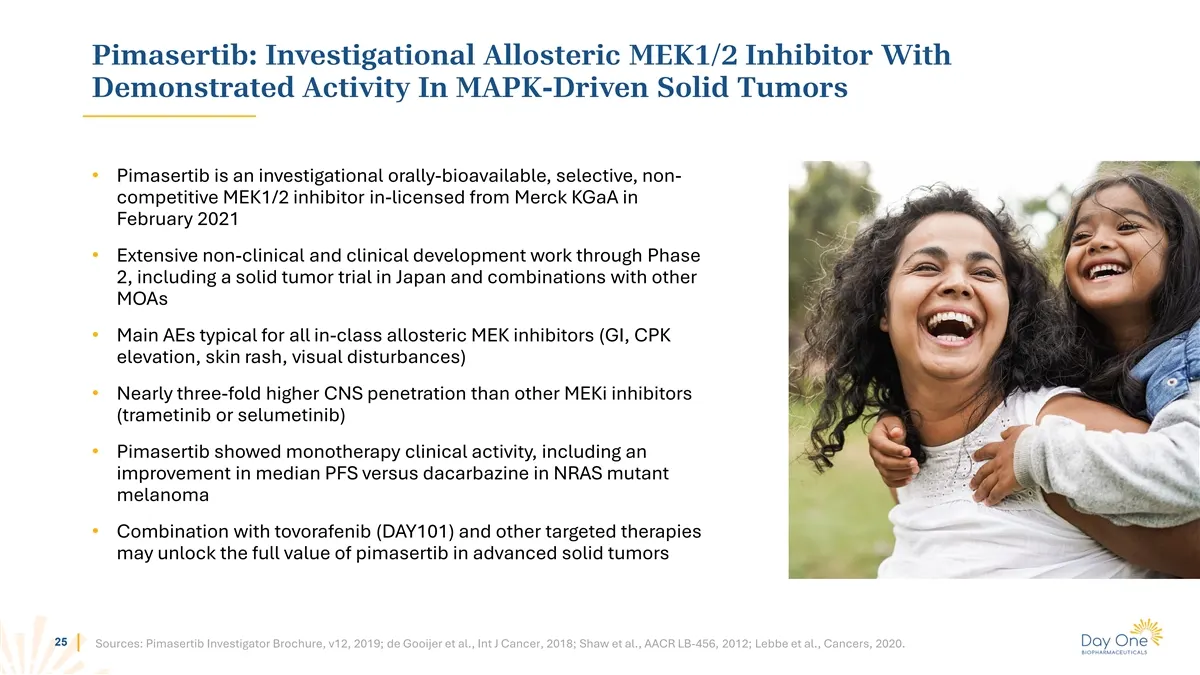
Pimasertib: Investigational Allosteric MEK1/2 Inhibitor With Demonstrated Activity In MAPK-Driven Solid Tumors • Pimasertib is an investigational orally-bioavailable, selective, non- competitive MEK1/2 inhibitor in-licensed from Merck KGaA in February 2021 • Extensive non-clinical and clinical devel
Slide 26: Vertical MAPK Pathway Inhibition With Tovorafenib And Pimasertib
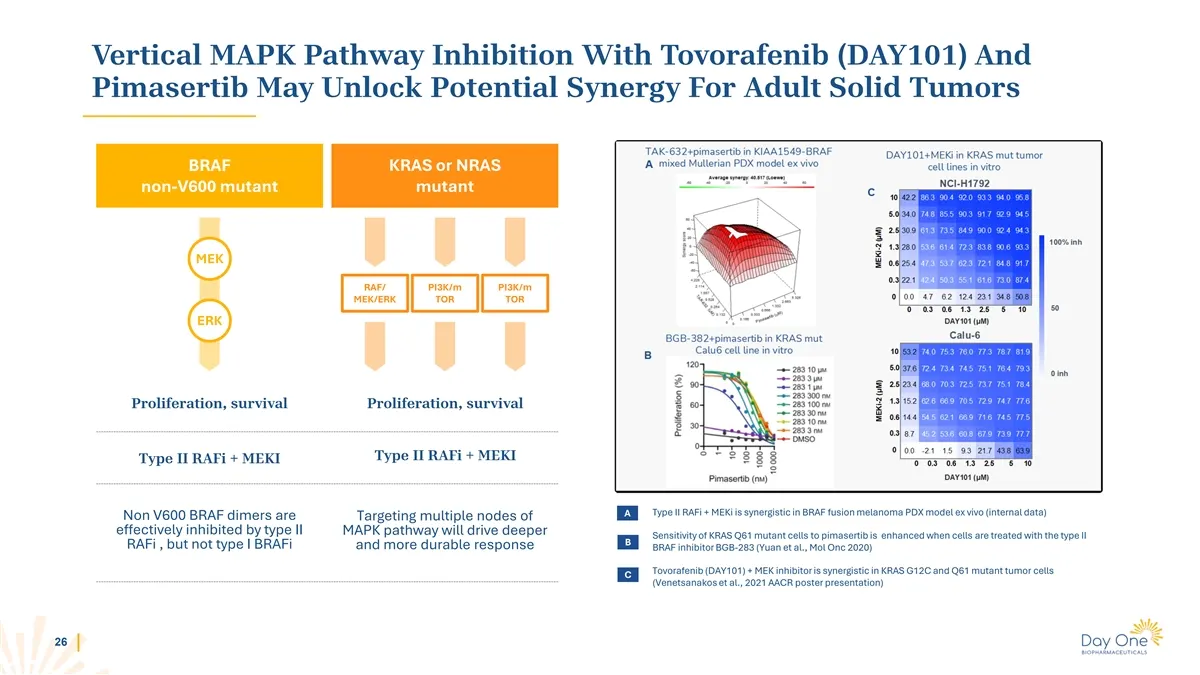
Vertical MAPK Pathway Inhibition With Tovorafenib (DAY101) And Pimasertib May Unlock Potential Synergy For Adult Solid Tumors BRAF KRAS or NRAS non-V600 mutant mutant MEK RAF/ PI3K/m PI3K/m MEK/ERK TOR TOR ERK Proliferation, survival Proliferation, survival Type II RAFi + MEKI Type II RAFi + MEKI A
Slide 27: Tovorafenib / Pimasertib Combination In Solid Tumors (FIRELIGHT-1)
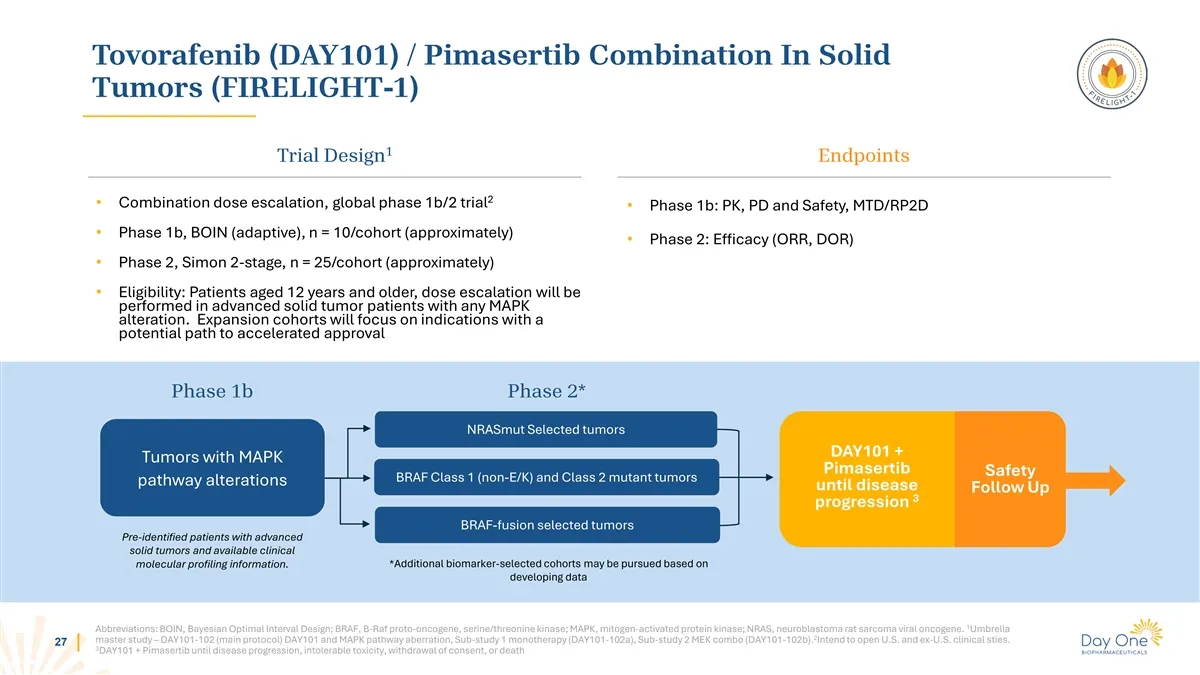
Tovorafenib (DAY101) / Pimasertib Combination In Solid Tumors (FIRELIGHT-1) 1 Trial Design Endpoints 2 • Combination dose escalation, global phase 1b/2 trial • Phase 1b: PK, PD and Safety, MTD/RP2D • Phase 1b, BOIN (adaptive), n = 10/cohort (approximately) • Phase 2: Efficacy (ORR, DOR) • Phase 2, S

Slide 28: Summary
Summary 28
Slide 29: Financial Summary: DAWN
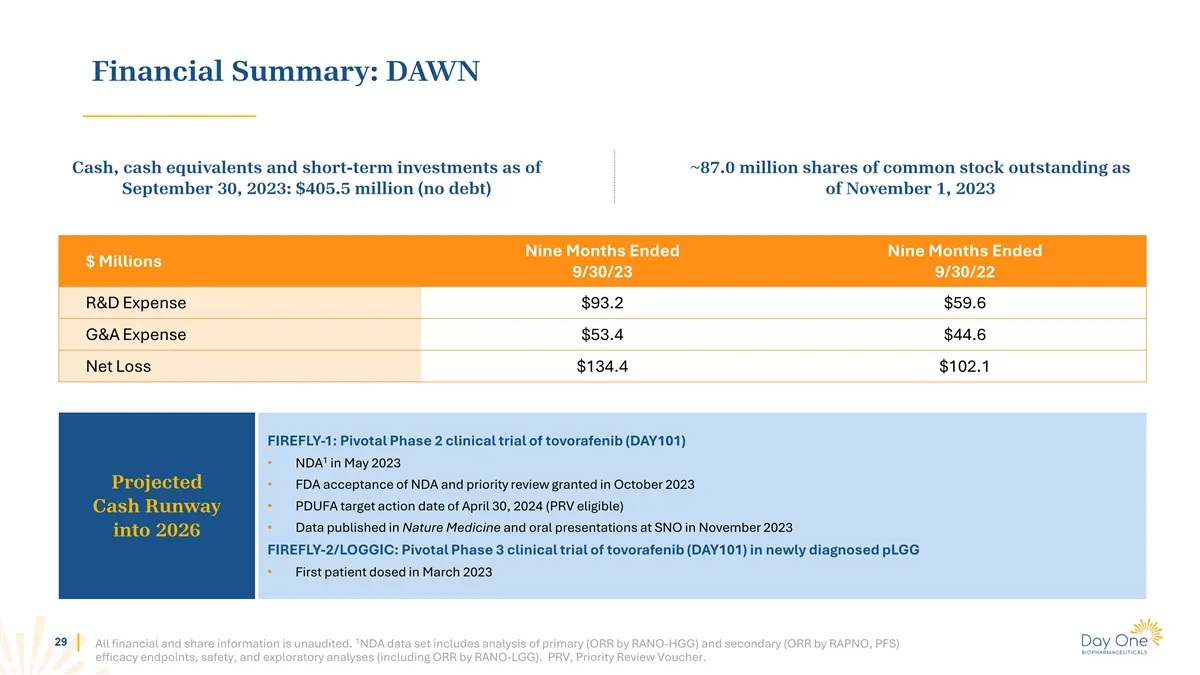
Financial Summary: DAWN Cash, cash equivalents and short-term investments as of ~87.0 million shares of common stock outstanding as September 30, 2023: $405.5 million (no debt) of November 1, 2023 Nine Months Ended Nine Months Ended $ Millions 9/30/23 9/30/22 R&D Expense $93.2 $59.6 G&A Expense $53.
Slide 30: 2023 Key Accomplishments
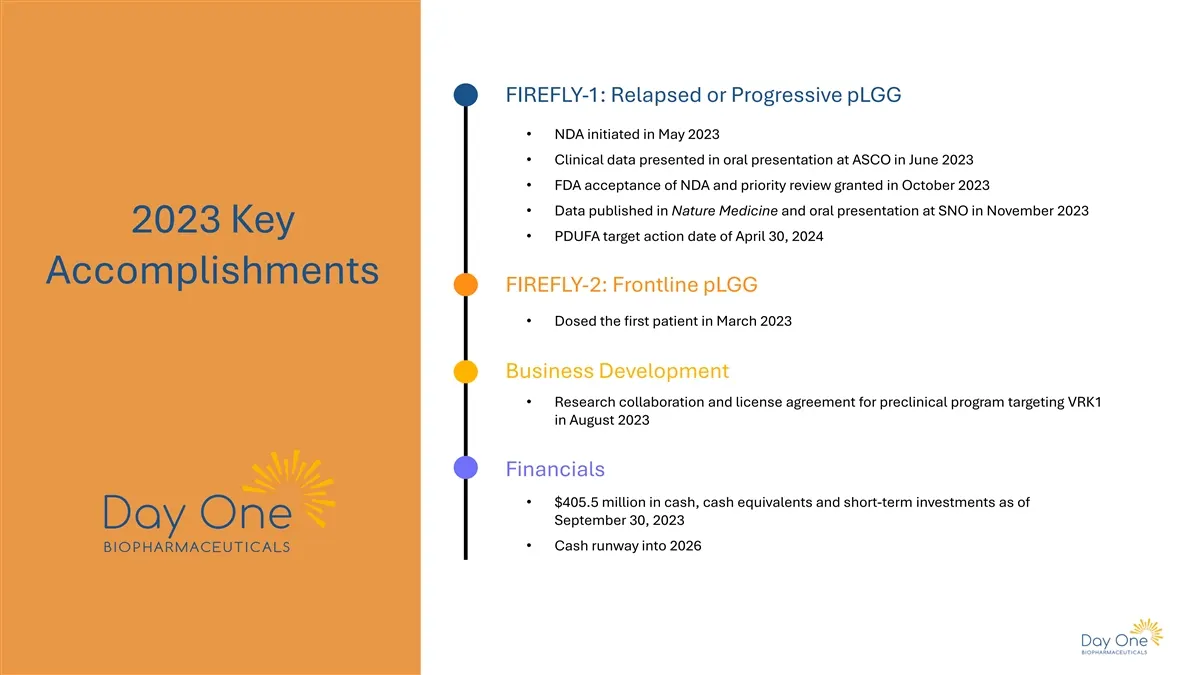
FIREFLY-1: Relapsed or Progressive pLGG • NDA initiated in May 2023 • Clinical data presented in oral presentation at ASCO in June 2023 • FDA acceptance of NDA and priority review granted in October 2023 • Data published in Nature Medicine and oral presentation at SNO in November 2023 2023 Key • PDU
Slide 31: Priorities as we Expand into a Commercial-Stage Company
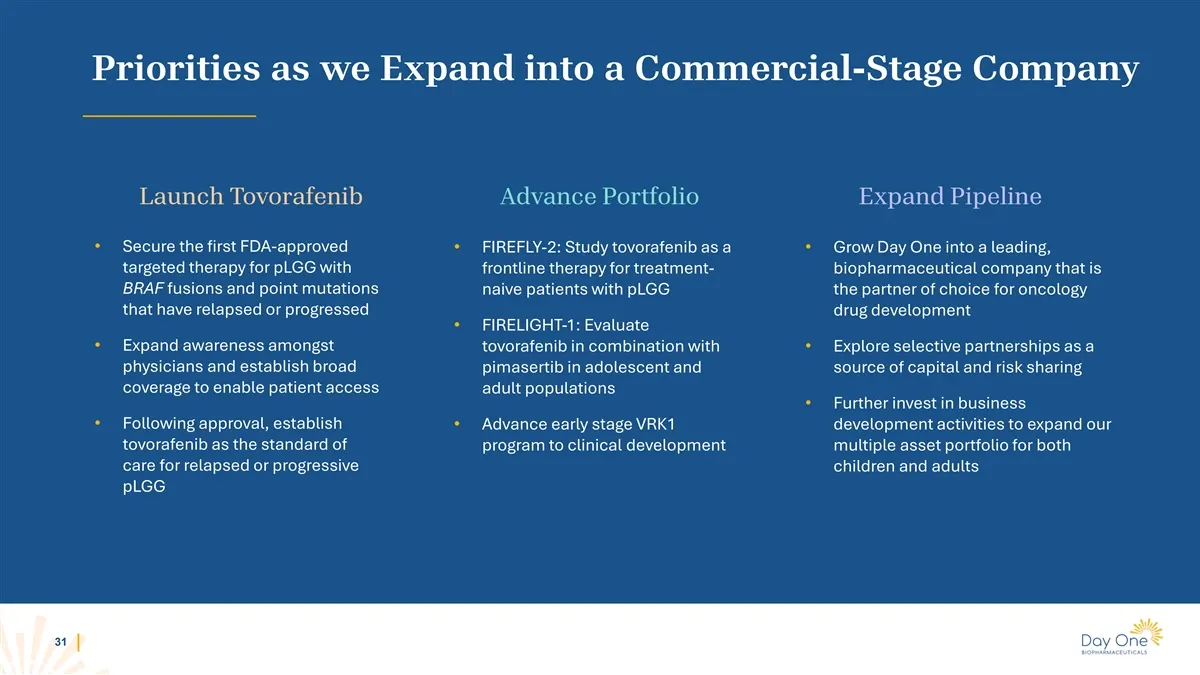
Priorities as we Expand into a Commercial-Stage Company Launch Tovorafenib Advance Portfolio Expand Pipeline • Secure the first FDA-approved • FIREFLY-2: Study tovorafenib as a • Grow Day One into a leading, targeted therapy for pLGG with frontline therapy for treatment- biopharmaceutical company th

Slide 32: Appendix
a oS] oO | o a <x
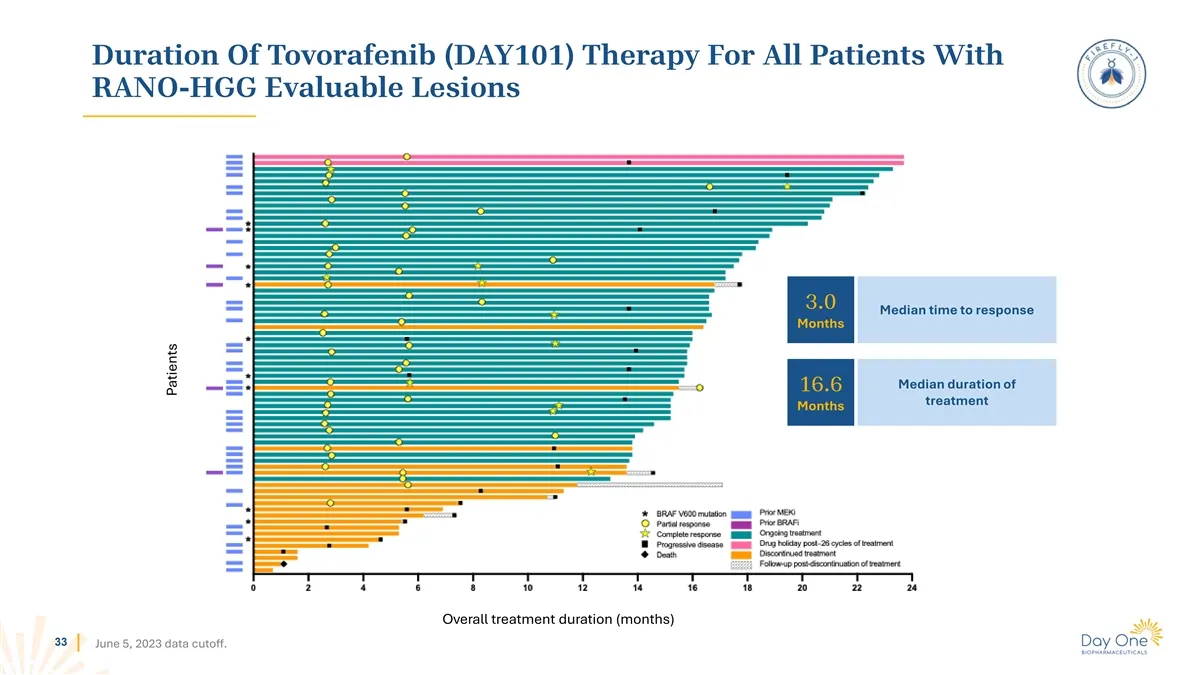
Slide 33: Duration Of Tovorafenib Therapy For Patients With RANO-HGG Evaluable Lesions
Duration Of Tovorafenib (DAY101) Therapy For All Patients With RANO-HGG Evaluable Lesions 3.0 Median time to response Months Median duration of 16.6 treatment Months Overall treatment duration (months) 33 June 5, 2023 data cutoff. Patients
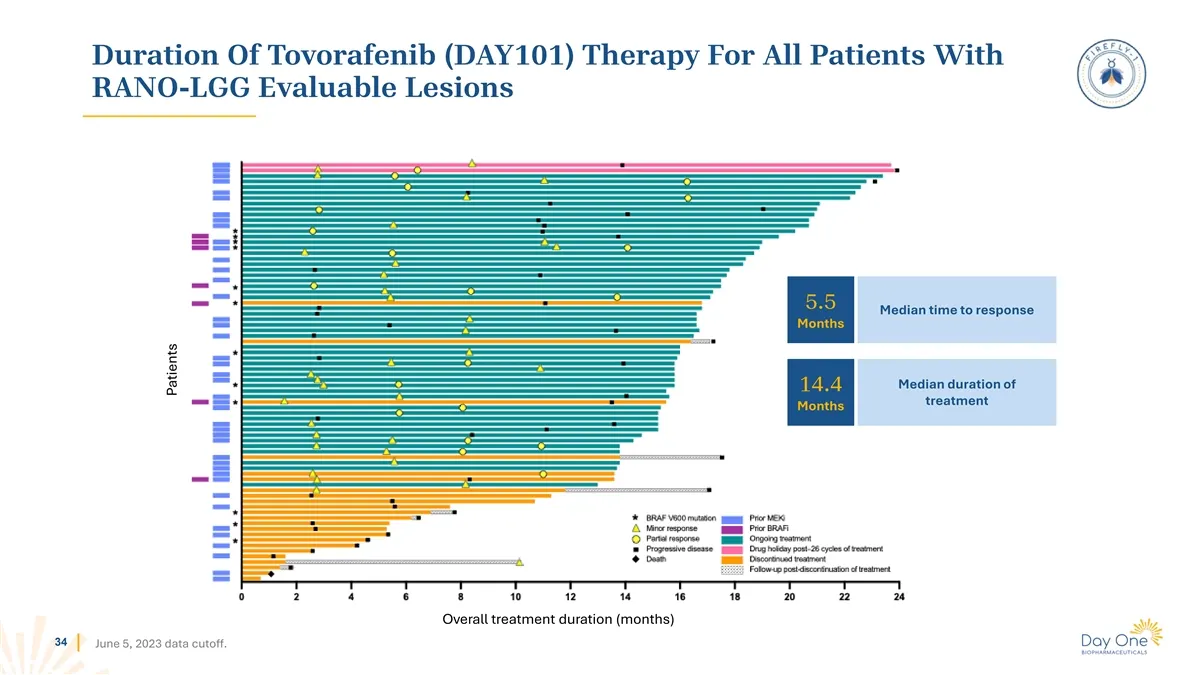
Slide 34: Duration Of Tovorafenib Therapy For Patients With RANO-LGG Evaluable Lesions
Duration Of Tovorafenib (DAY101) Therapy For All Patients With RANO-LGG Evaluable Lesions 5.5 Median time to response Months Median duration of 14.4 treatment Months Overall treatment duration (months) 34 June 5, 2023 data cutoff. Patients
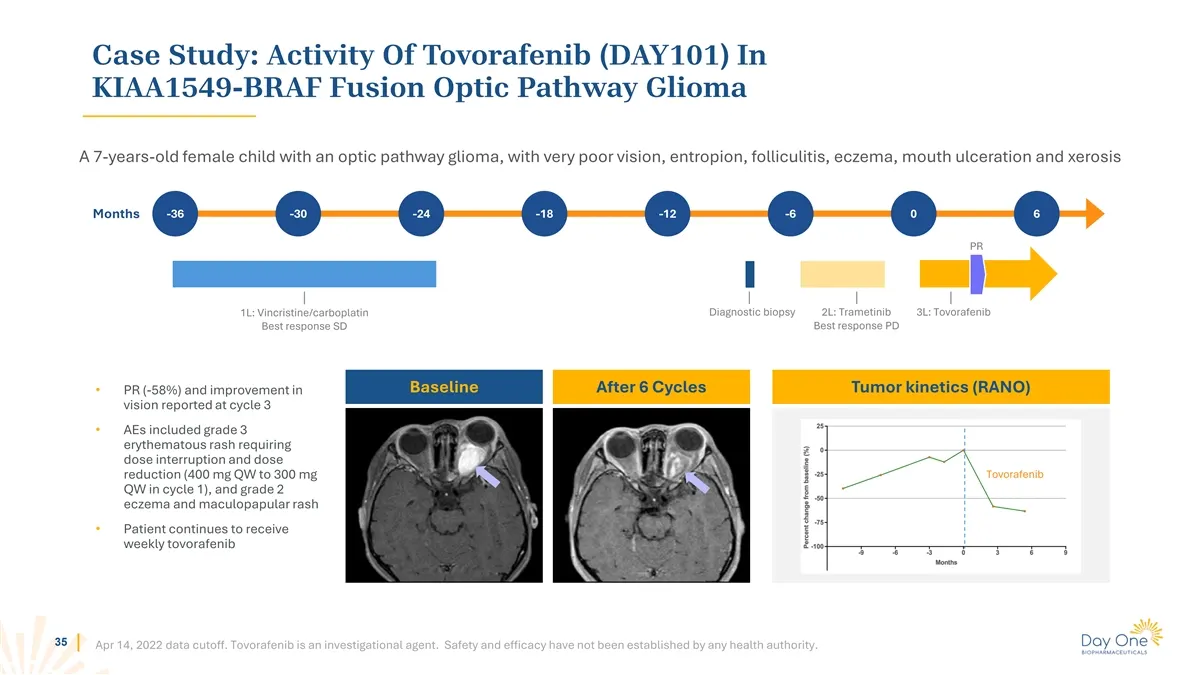
Slide 35: Case Study: Tovorafenib In KIAA1549-BRAF Fusion Optic Pathway Glioma
Case Study: Activity Of Tovorafenib (DAY101) In KIAA1549-BRAF Fusion Optic Pathway Glioma A 7-years-old female child with an optic pathway glioma, with very poor vision, entropion, folliculitis, eczema, mouth ulceration and xerosis -36 -30 -24 -18 -12 -6 0 6 Months PR 1L: Vincristine/carboplatin Dia
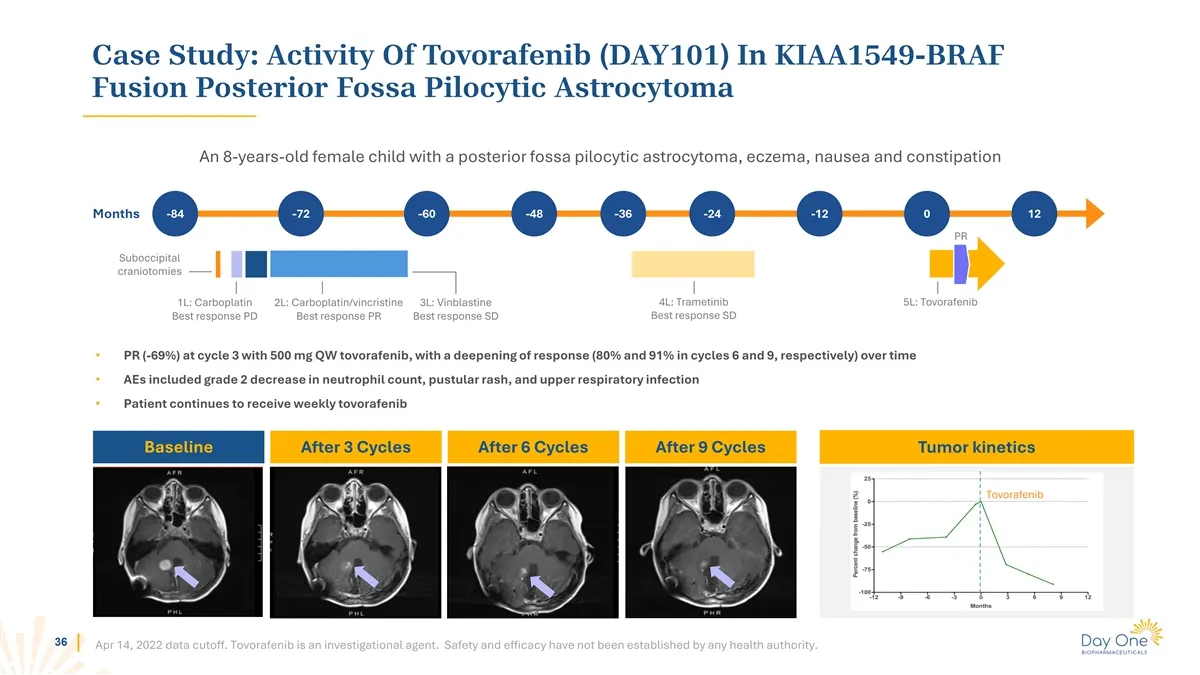
Slide 36: Case Study: Tovorafenib In KIAA1549-BRAF Fusion Posterior Fossa Pilocytic Astrocytoma
Case Study: Activity Of Tovorafenib (DAY101) In KIAA1549-BRAF Fusion Posterior Fossa Pilocytic Astrocytoma An 8-years-old female child with a posterior fossa pilocytic astrocytoma, eczema, nausea and constipation -84 -72 -60 -48 -36 -24 -12 0 12 Months PR Suboccipital craniotomies 1L: Carboplatin 2L
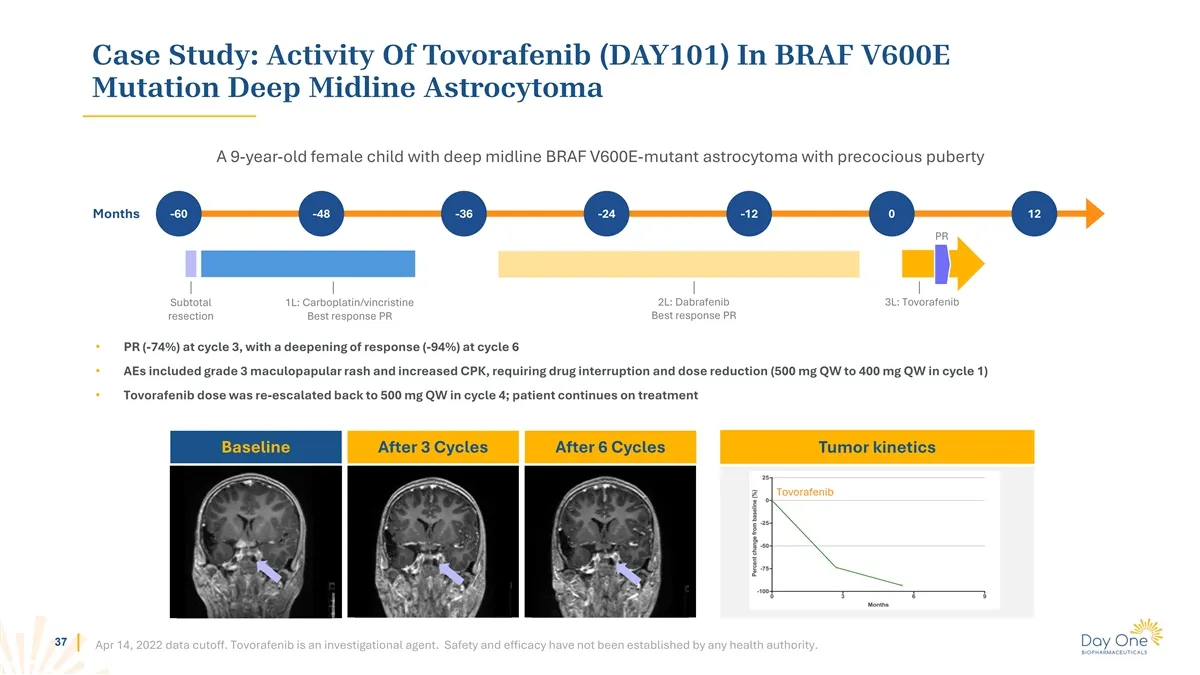
Slide 37: Case Study: Tovorafenib In BRAF V600E Mutation Deep Midline Astrocytoma
Case Study: Activity Of Tovorafenib (DAY101) In BRAF V600E Mutation Deep Midline Astrocytoma A 9-year-old female child with deep midline BRAF V600E-mutant astrocytoma with precocious puberty -60 -48 -36 -24 -12 0 12 Months PR Subtotal 1L: Carboplatin/vincristine 2L: Dabrafenib 3L: Tovorafenib Best r
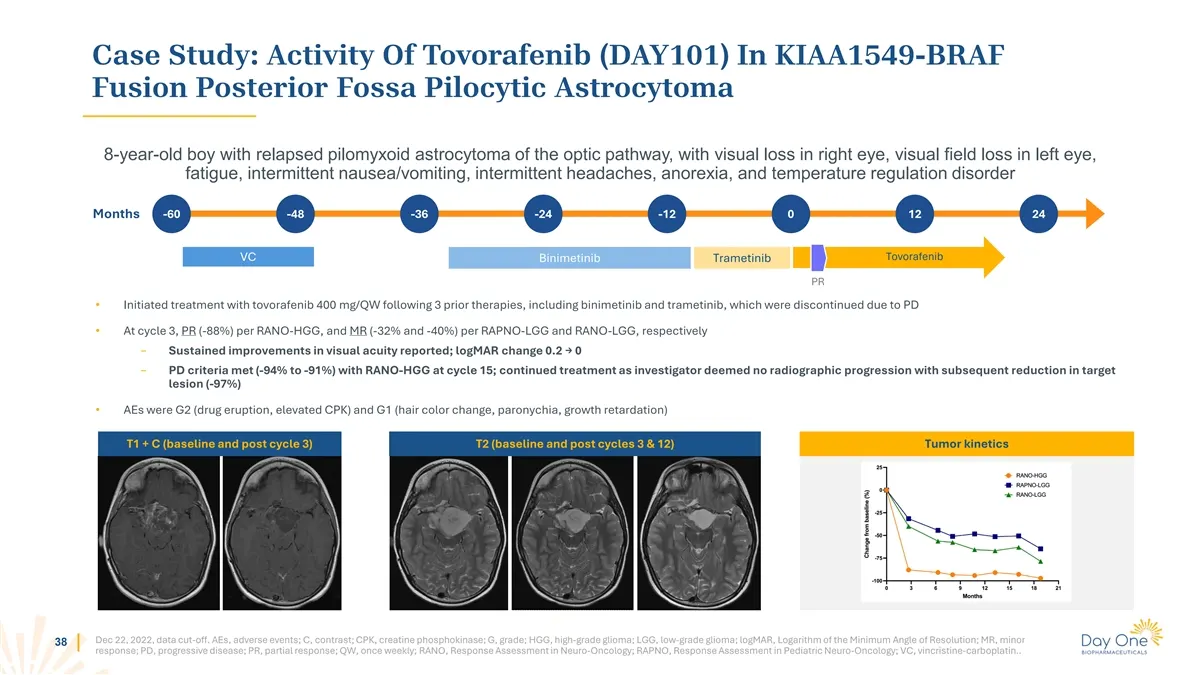
Slide 38: Case Study: Tovorafenib In KIAA1549-BRAF Fusion Posterior Fossa Pilocytic Astrocytoma
Case Study: Activity Of Tovorafenib (DAY101) In KIAA1549-BRAF Fusion Posterior Fossa Pilocytic Astrocytoma 8-year-old boy with relapsed pilomyxoid astrocytoma of the optic pathway, with visual loss in right eye, visual field loss in left eye, fatigue, intermittent nausea/vomiting, intermittent heada
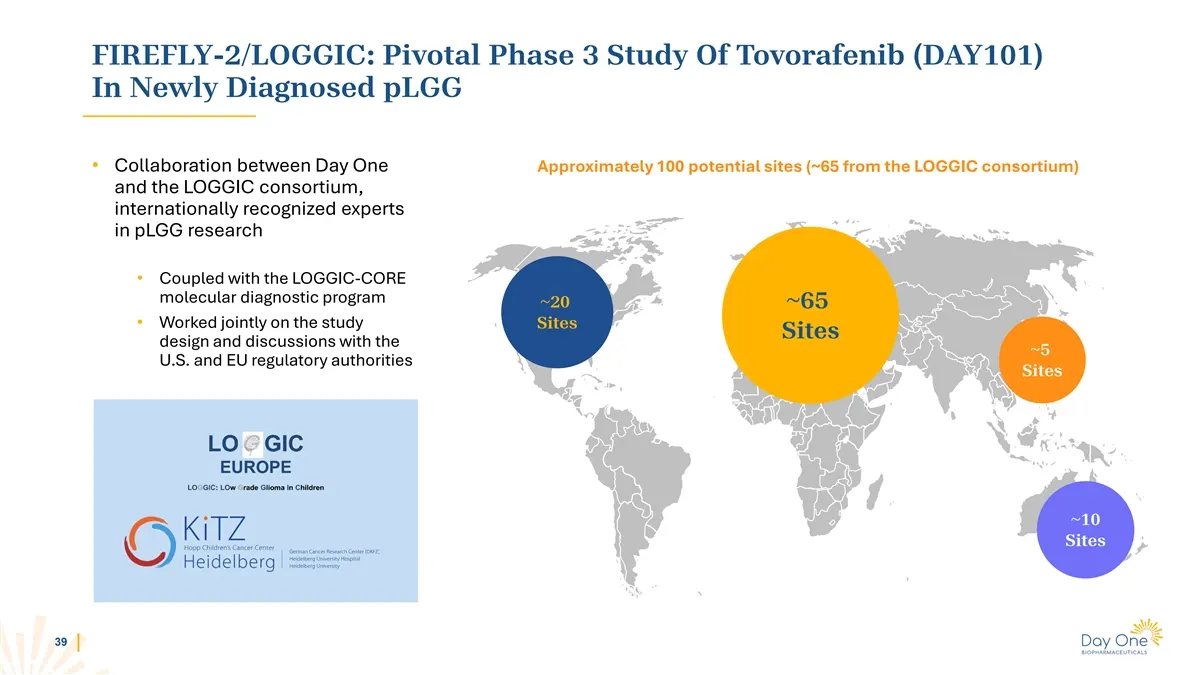
Slide 39: FIREFLY-2/LOGGIC: Pivotal Phase Study In Newly Diagnosed pLGG
FIREFLY-2/LOGGIC: Pivotal Phase 3 Study Of Tovorafenib (DAY101) In Newly Diagnosed pLGG • Collaboration between Day One Approximately 100 potential sites (~65 from the LOGGIC consortium) and the LOGGIC consortium, internationally recognized experts in pLGG research • Coupled with the LOGGIC-CORE mol
Source: SEC EDGAR · 8-K filed Jan 8, 2024
More decks from Day One Biopharmaceuticals Inc
 Investor Presentation (March 2026)43 slides · Mar 2, 2026
 FY2025 Earnings Presentation20 slides · Feb 24, 2026
 Q4 2025 Earnings Presentation43 slides · February 2026
 Investor Presentation (January 2026)45 slides · Jan 12, 2026
 44th Annual J.P. Morgan Healthcare Conference (January 2026)21 slides · Jan 12, 2026
 Investor Presentation (January 2026)44 slides · Jan 6, 2026