Everest Textile Co., Ltd. · TWSE:1460
Everest Textile — 2013 China and Asia Textile Forum
47 slides from Everest Textile's conference presentation, Jan 25, 2013
Slide 1: Fulfilling Corporate Social Responsibility of Suppliers: Everest SustainAbility Model
Fulfilling Corporate Social Responsibility of Suppliers --Everest SustainAbility Model-- 2013.01.25 Everest Sustainability Model 1 Speaker: Roger Yeh, President, Everest Textile Energy Saving, Environmental Protection and Love for the Earth
Slide 2: About Everest
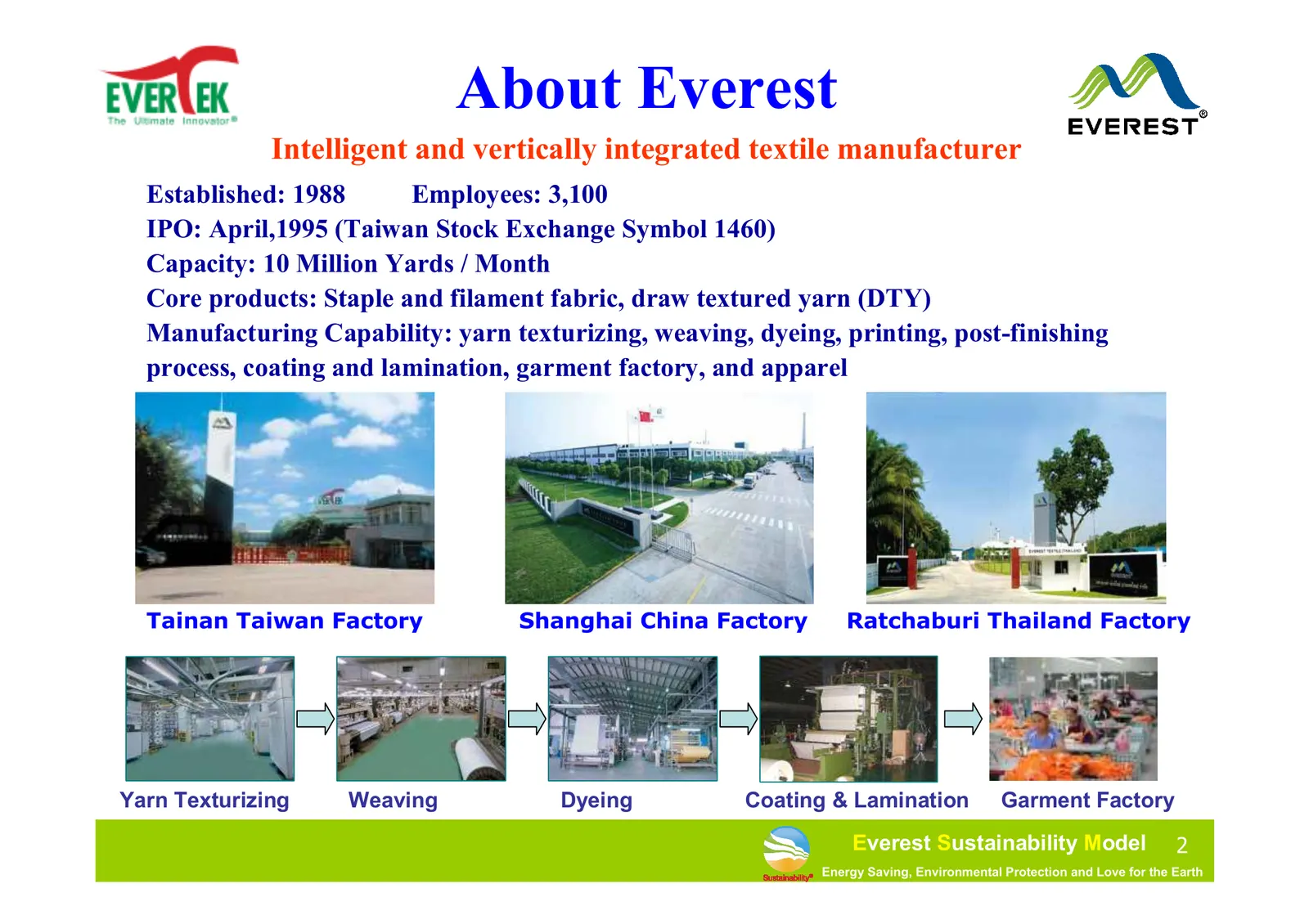
About Everest Intelligent and vertically integrated textile manufacturer Established: 1988 Employees: 3,100 IPO: April,1995 (Taiwan Stock Exchange Symbol 1460) Capacity: 10 Million Yards / Month Core products: Staple and filament fabric, draw textured yarn (DTY) Manufacturing Capability: yarn textur
Slide 3: Global Network
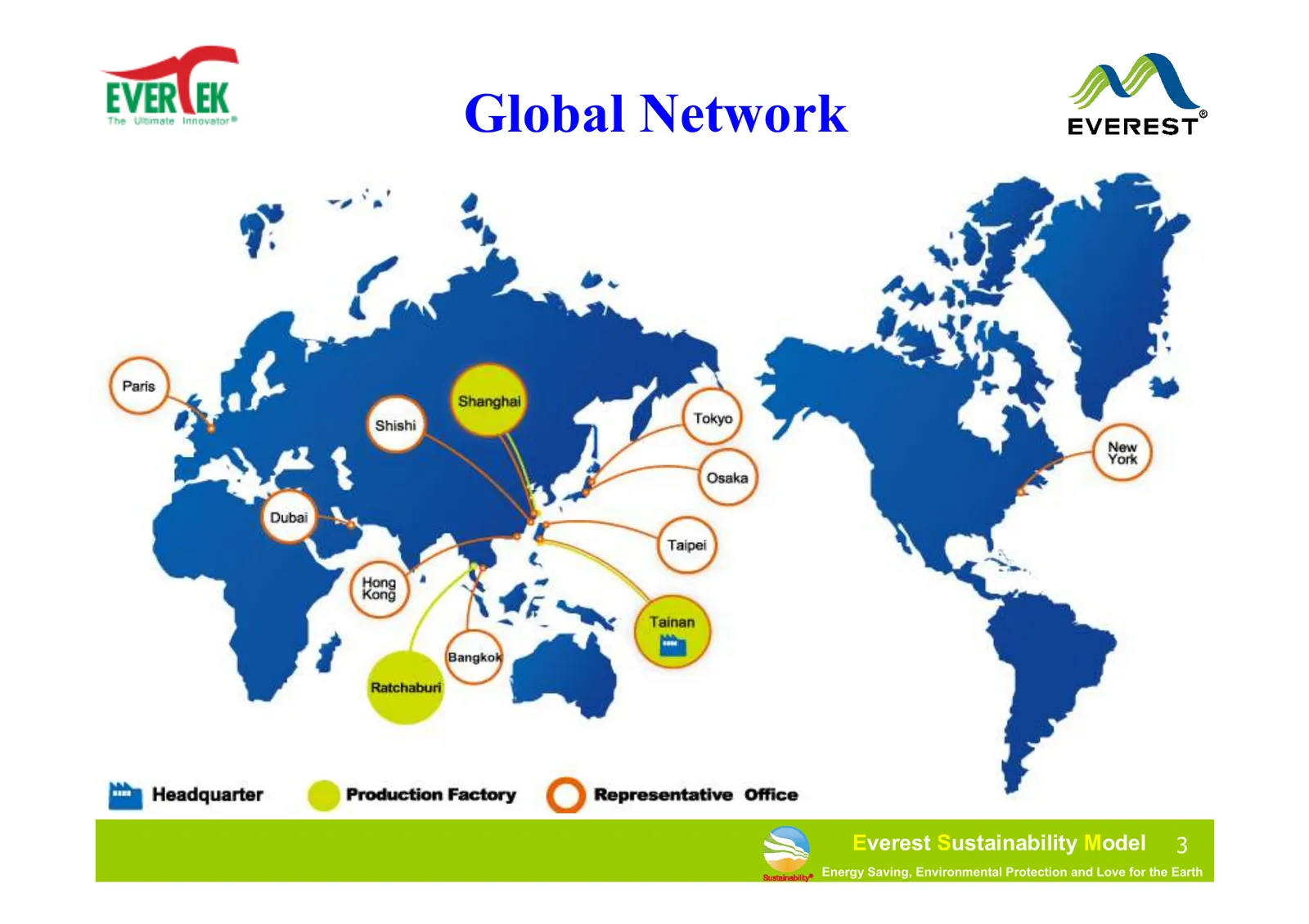
Global Network Everest Sustainability Model 3 Energy Saving, Environmental Protection and Love for the Earth
Slide 4: Our Brand Customers
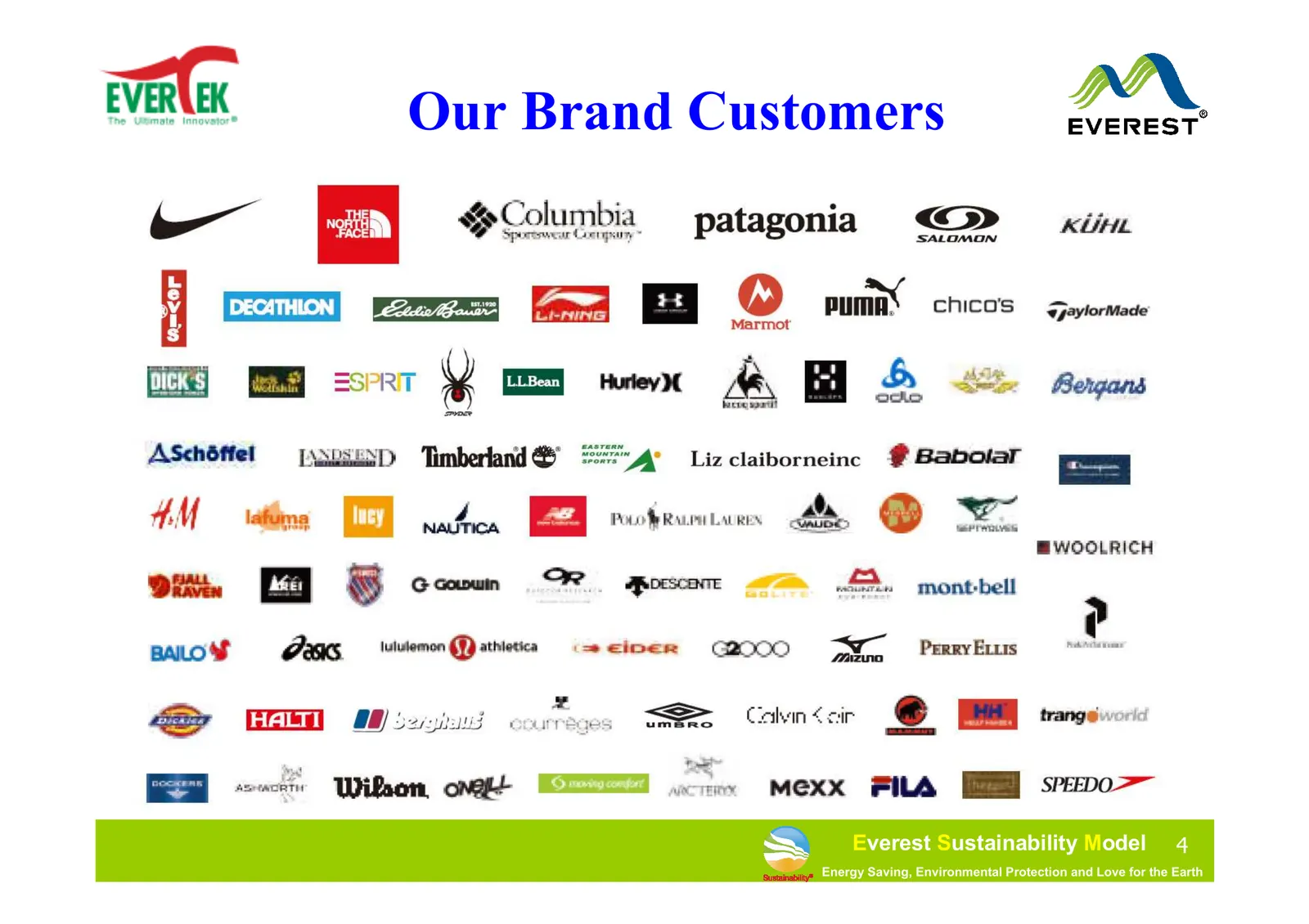
Our Brand Customers Everest Sustainability Model 4 Energy Saving, Environmental Protection and Love for the Earth
Slide 5: Our Mission
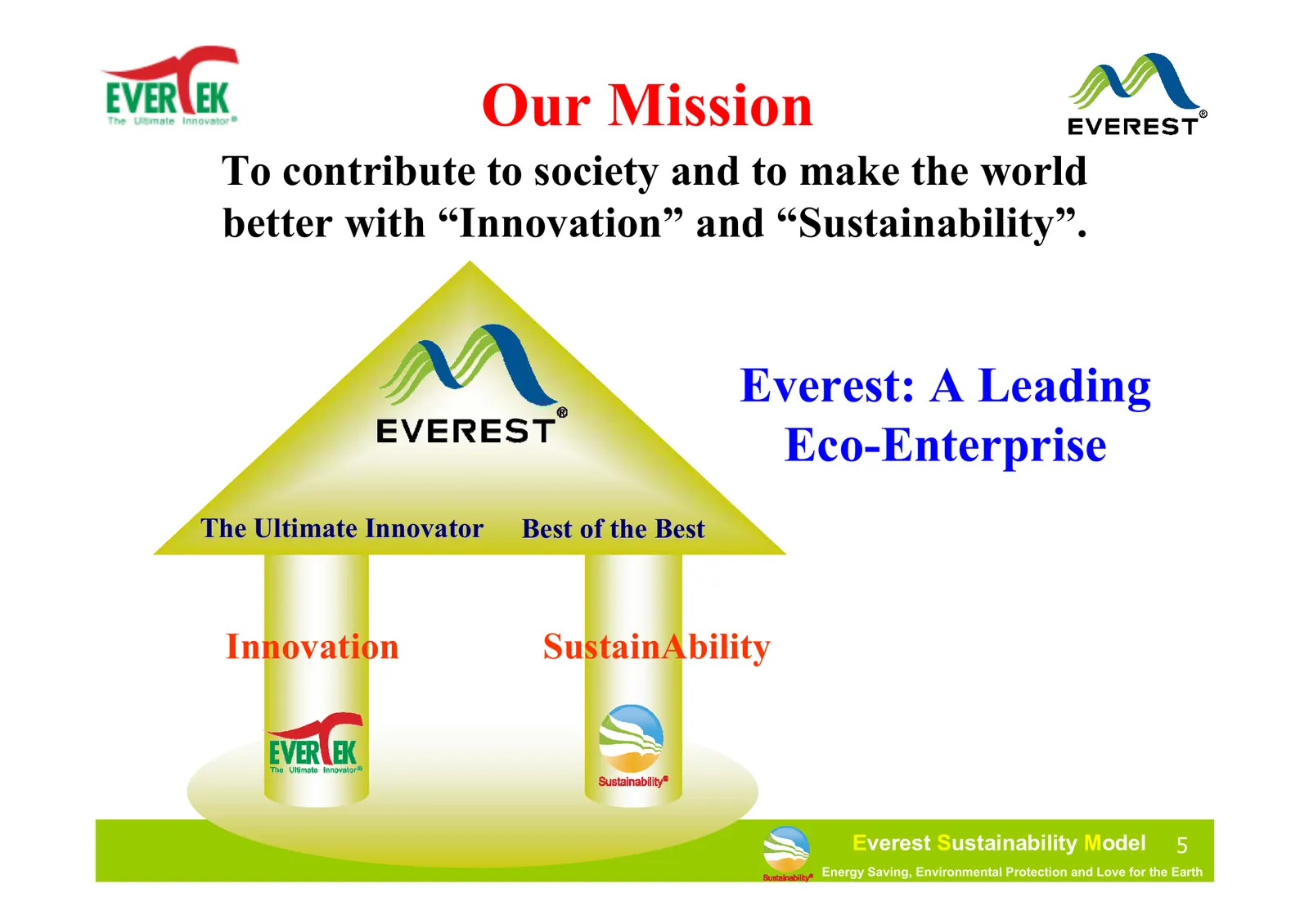
Our Mission To contribute to society and to make the world better with “Innovation” and “Sustainability”. Everest: A Leading Eco-Enterprise The Ultimate Innovator Best of the Best Innovation SustainAbility Everest Sustainability Model 5 Energy Saving, Environmental Protection and Love for the Earth
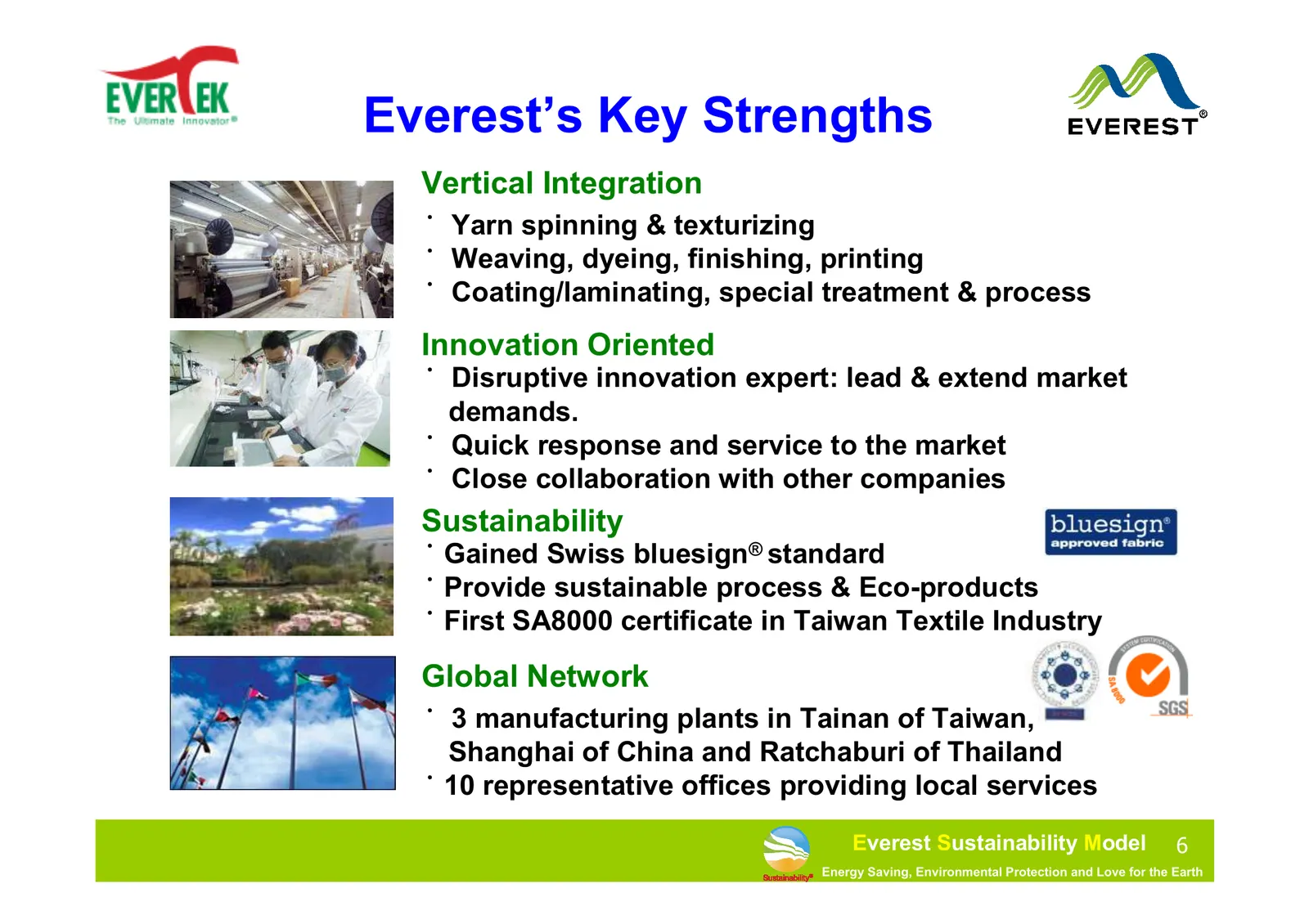
Slide 6: Everest's Key Strengths
Everest’s Key Strengths Vertical Integration ˙ Yarn spinning & texturizing ˙ Weaving, dyeing, finishing, printing ˙ Coating/laminating, special treatment & process Innovation Oriented ˙ Disruptive innovation expert: lead & extend market demands. ˙ Quick response and service to the market ˙ Close col
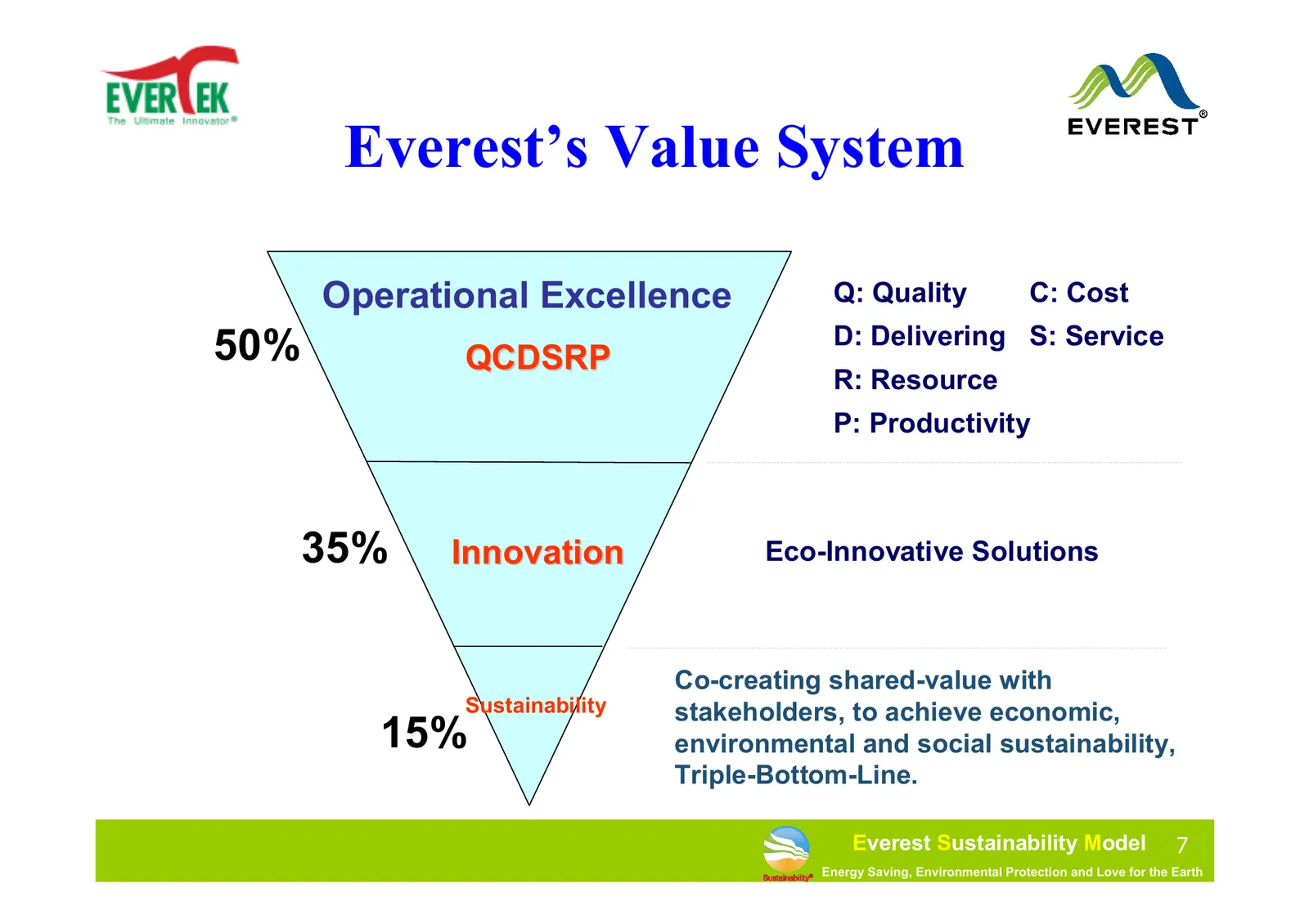
Slide 7: Everest's Value System
Everest’s Value System Operational Excellence Q: Quality C: Cost D: Delivering S: Service 50% QCDSRP R: Resource P: Productivity 35% Innovation Eco-Innovative Solutions Co-creating shared-value with Sustainability stakeholders, to achieve economic, 15% environmental and social sustainability, Triple
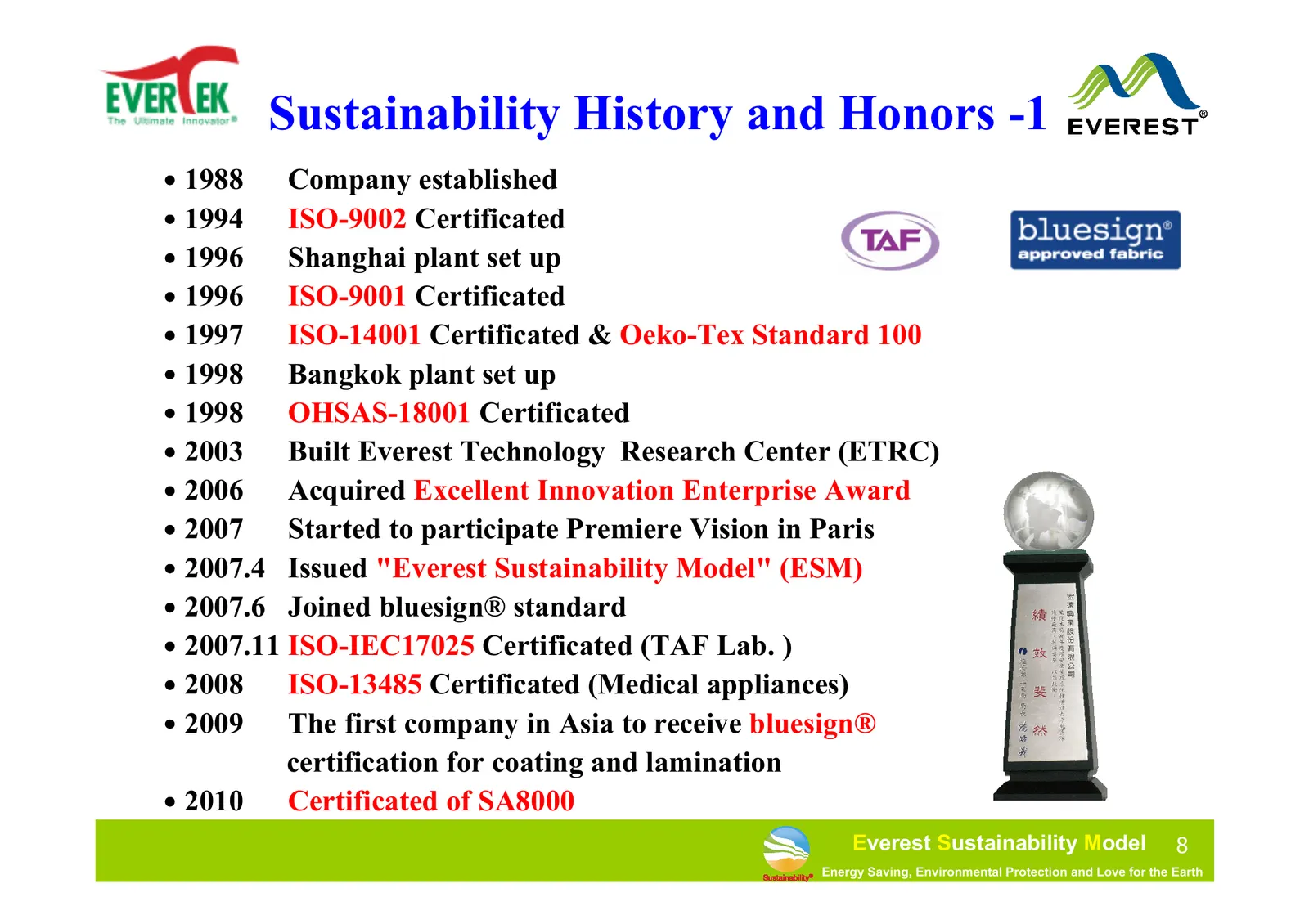
Slide 8: Sustainability History and Honors -1
Sustainability History and Honors -1 ˙1988 Company established ˙1994 ISO-9002 Certificated ˙1996 Shanghai plant set up ˙1996 ISO-9001 Certificated ˙1997 ISO-14001 Certificated & Oeko-Tex Standard 100 ˙1998 Bangkok plant set up ˙1998 OHSAS-18001 Certificated ˙2003 Built Everest Technology Research Ce
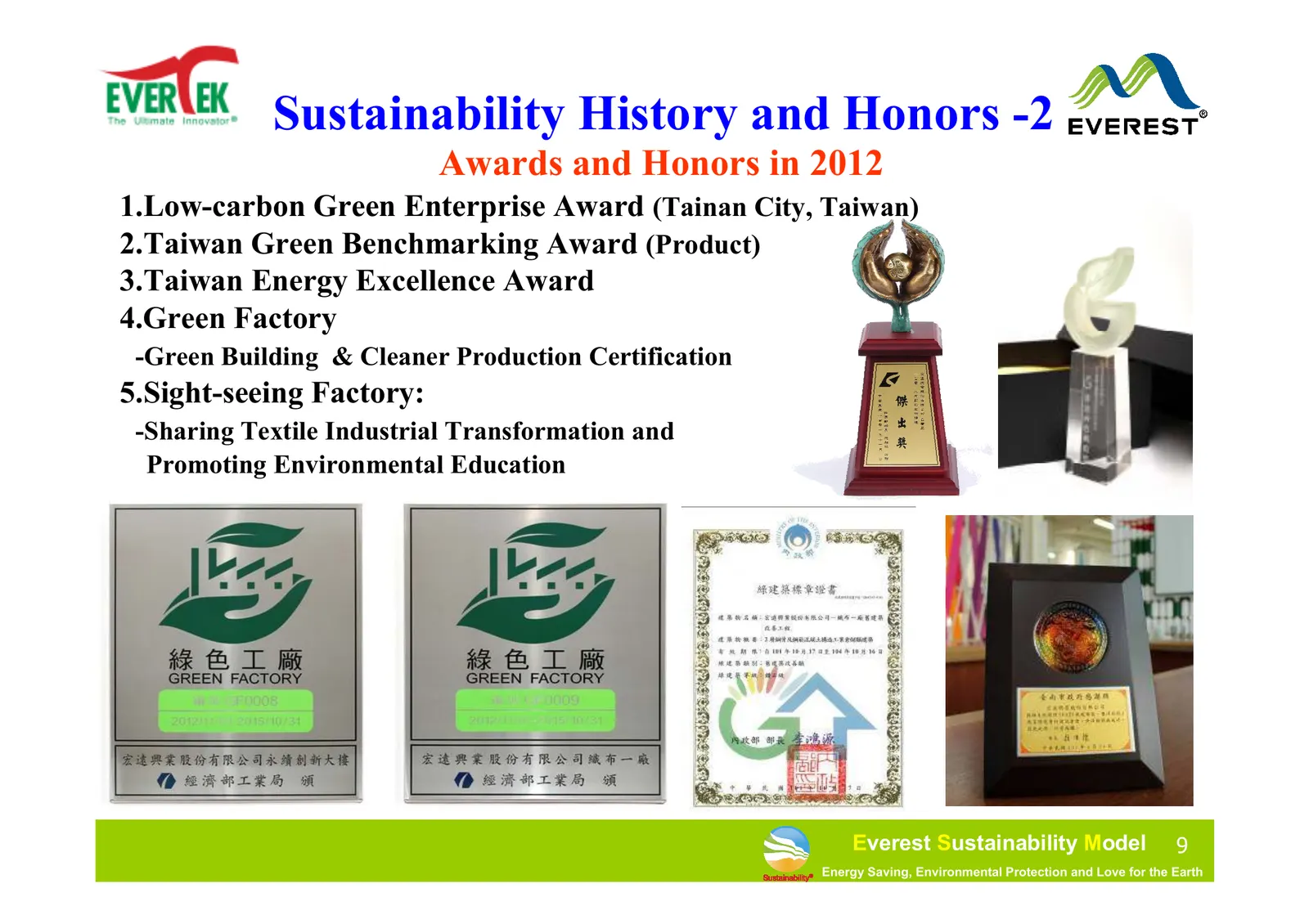
Slide 9: Sustainability History and Honors -2
Sustainability History and Honors -2 Awards and Honors in 2012 1.Low-carbon Green Enterprise Award (Tainan City, Taiwan) 2.Taiwan Green Benchmarking Award (Product) 3.Taiwan Energy Excellence Award 4.Green Factory -Green Building & Cleaner Production Certification 5.Sight-seeing Factory: -Sharing Te
Slide 10: Swiss bluesign certificate
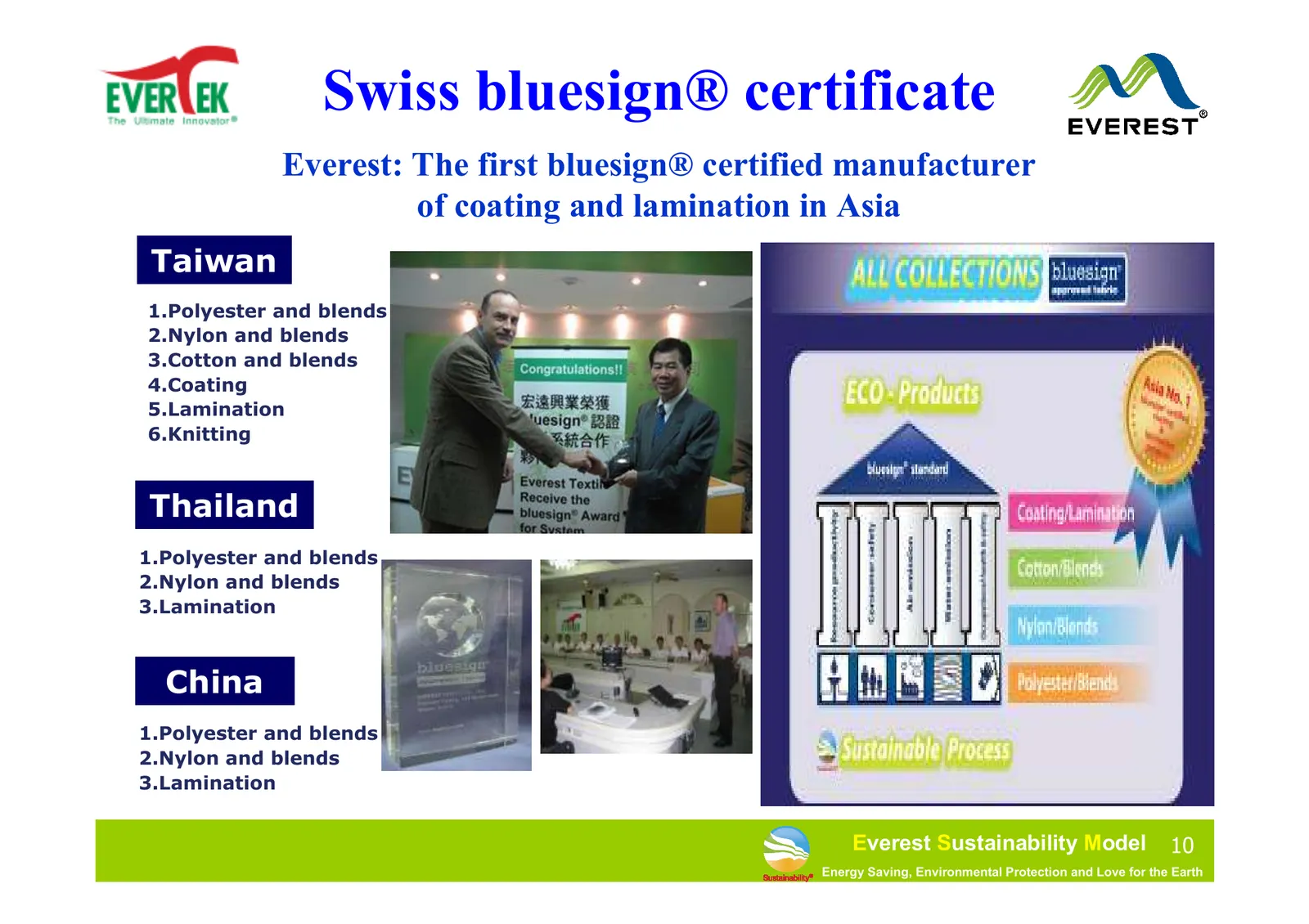
Swiss bluesign® certificate Everest: The first bluesign® certified manufacturer of coating and lamination in Asia Taiwan 1.Polyester and blends 2.Nylon and blends 3.Cotton and blends 4.Coating 5.Lamination 6.Knitting Thailand 1.Polyester and blends 2.Nylon and blends 3.Lamination China 1.Polyester a
Slide 11: SA8000 Certification
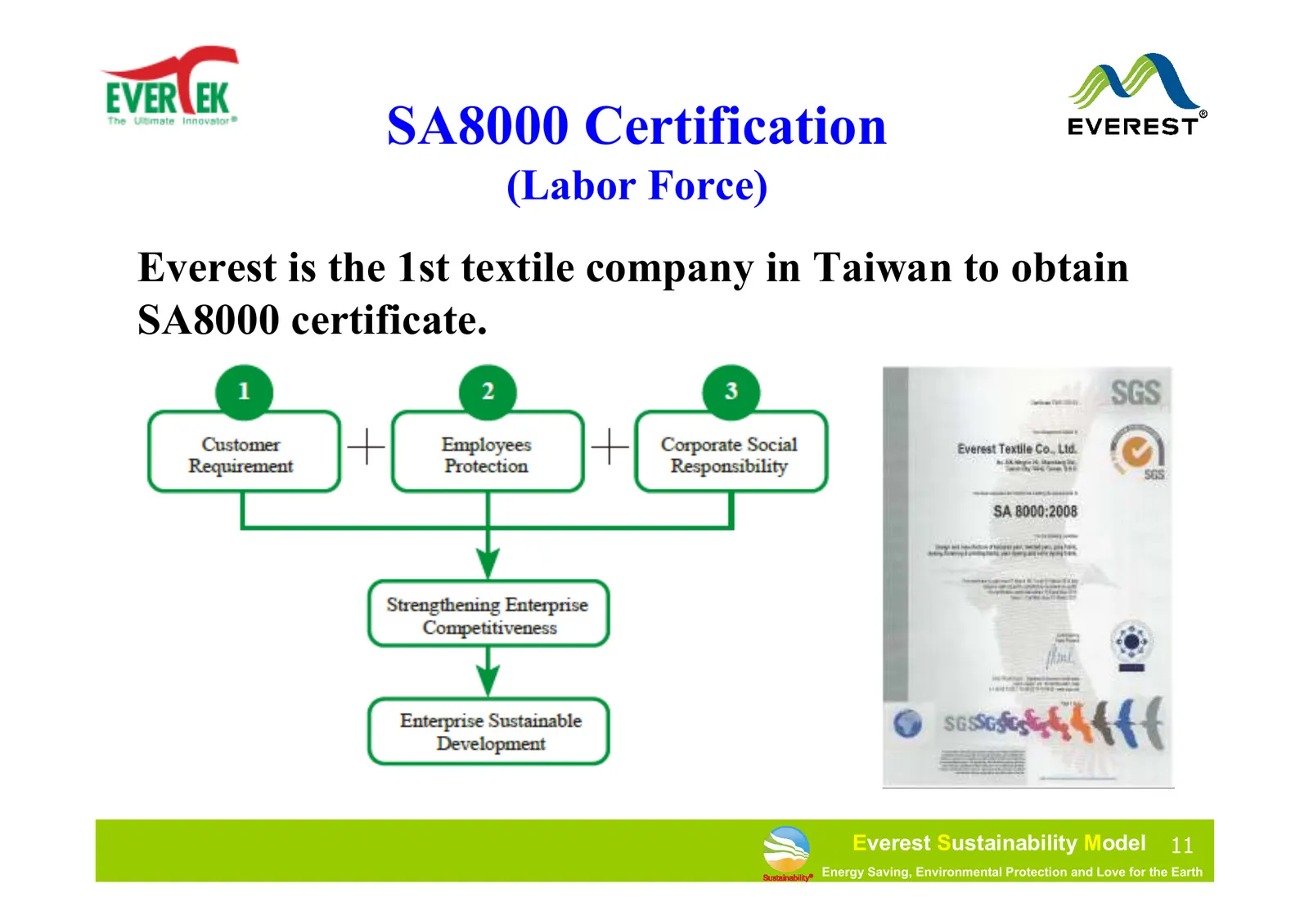
SA8000 Certification (Labor Force) Everest is the 1st textile company in Taiwan to obtain SA8000 certificate. Everest Sustainability Model 11 Energy Saving, Environmental Protection and Love for the Earth
Slide 12: Why CSR? Why Sustainability?
Why CSR? Why Sustainability? From CSR: Corporate Social Responsibility To CSR: Corporate Sustainability Reporting Everest Sustainability Model 12 Energy Saving, Environmental Protection and Love for the Earth
Slide 13: Everest SustainAbility Model (ESM)
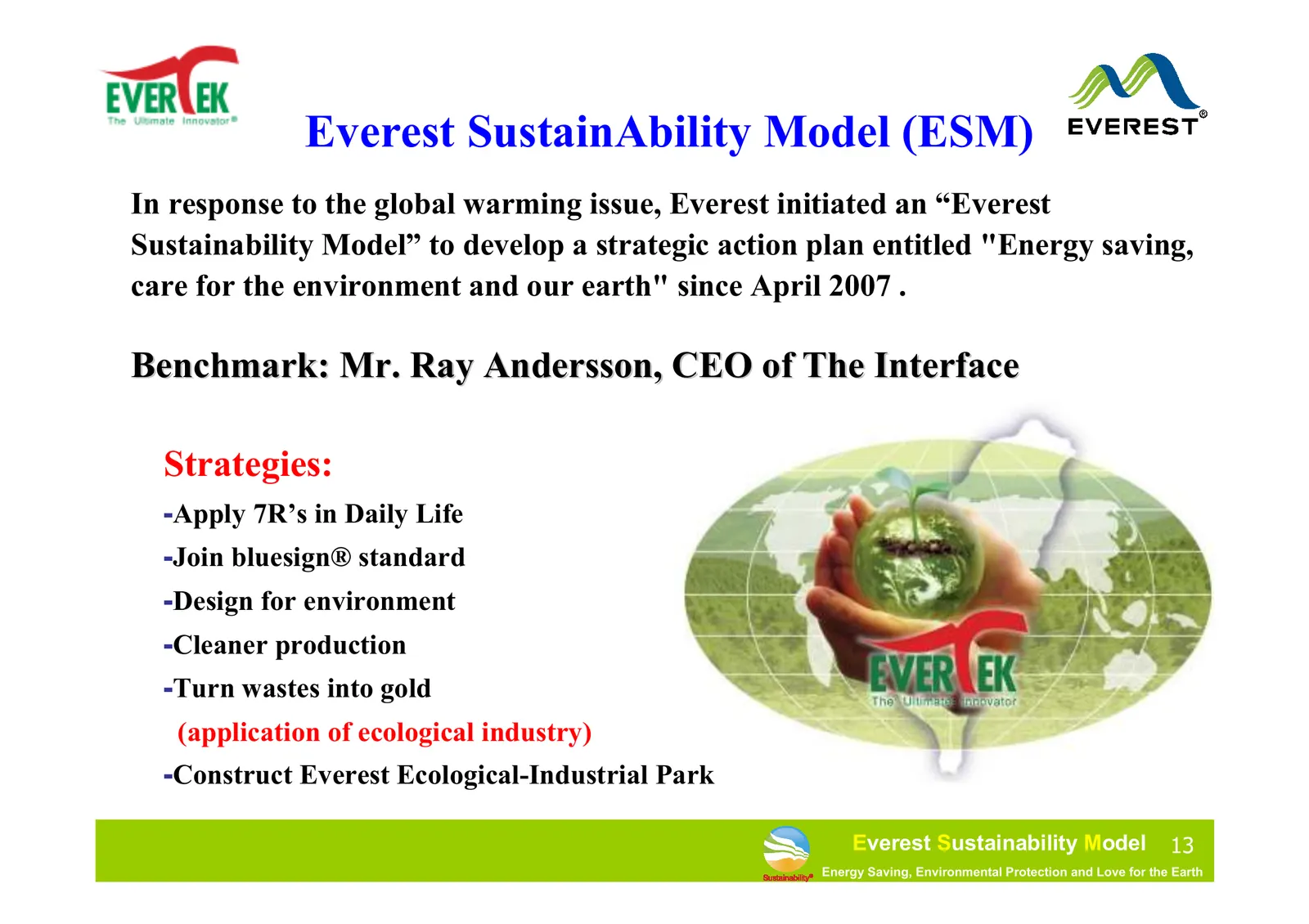
Everest SustainAbility Model (ESM) In response to the global warming issue, Everest initiated an “Everest Sustainability Model” to develop a strategic action plan entitled "Energy saving, care for the environment and our earth" since April 2007 . Benchmark: Mr. Ray Andersson, CEO of The Interface St
Slide 14: Everest's Philosophy on Everest SustainAbility Model
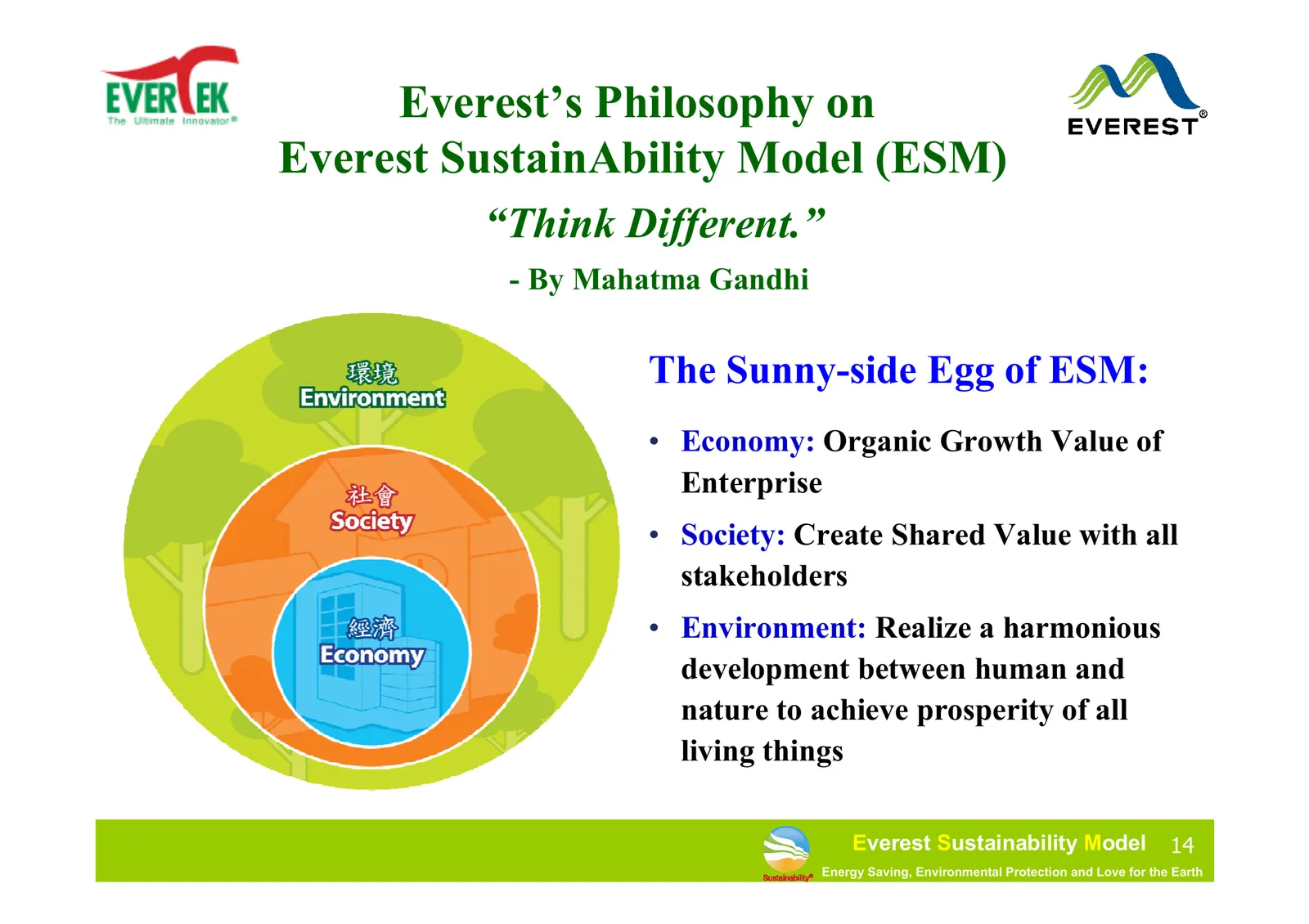
Everest’s Philosophy on Everest SustainAbility Model (ESM) “Think Different.” - By Mahatma Gandhi The Sunny-side Egg of ESM: • Economy: Organic Growth Value of Enterprise • Society: Create Shared Value with all stakeholders • Environment: Realize a harmonious development between human and nature to
Slide 15: Self-Disclosure
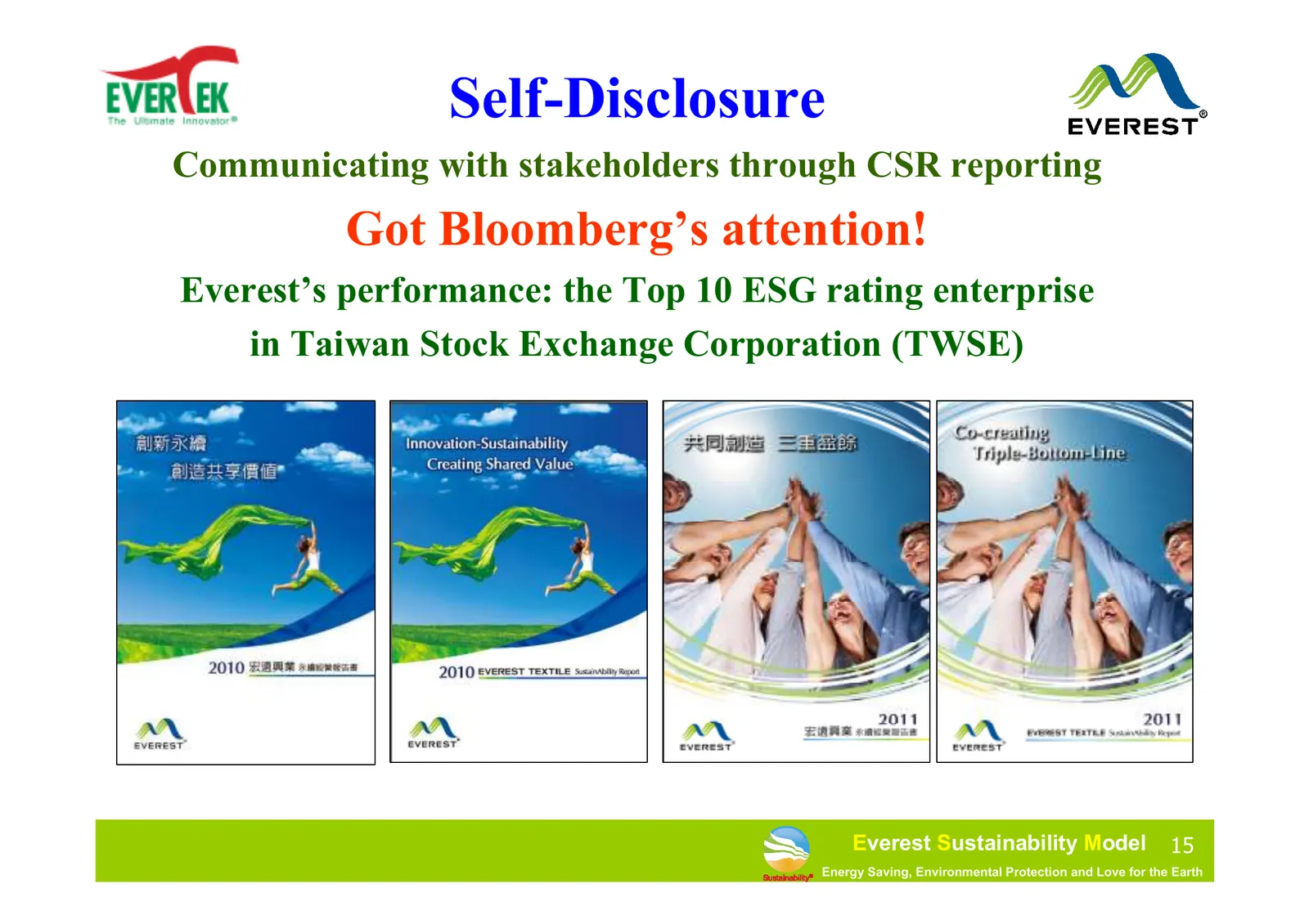
Self-Disclosure Communicating with stakeholders through CSR reporting Got Bloomberg’s attention! Everest’s performance: the Top 10 ESG rating enterprise in Taiwan Stock Exchange Corporation (TWSE) Everest Sustainability Model 15 Energy Saving, Environmental Protection and Love for the Earth
Slide 16: Implementations of ESM
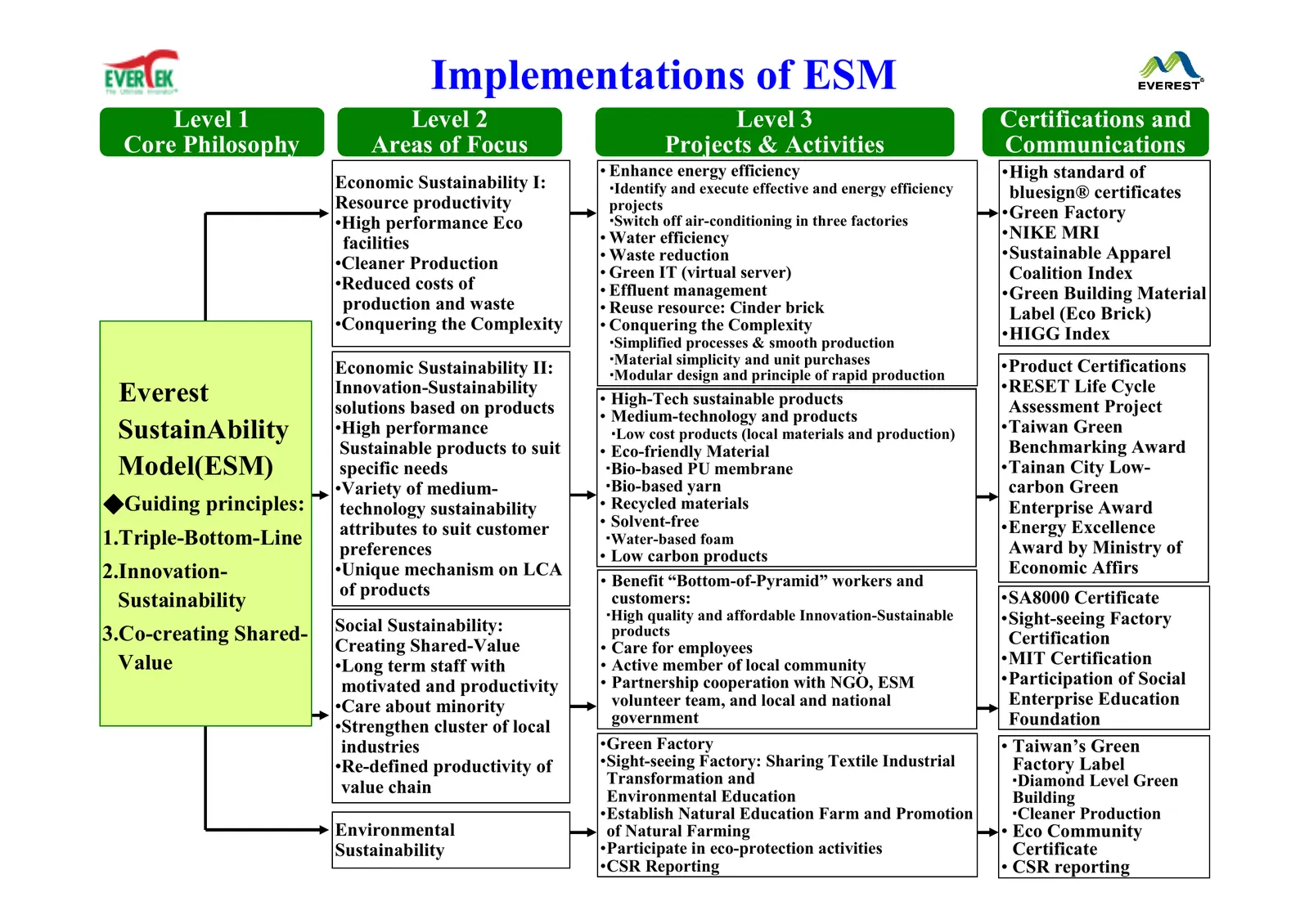
Implementations of ESM Level 1 Level 2 Level 3 Certifications and Core Philosophy Areas of Focus Projects & Activities Communications • Enhance energy efficiency •High standard of Economic Sustainability I: Identify and execute effective and energy efficiency bluesign® certificates Resource producti
Slide 17: Community Donation & Participation
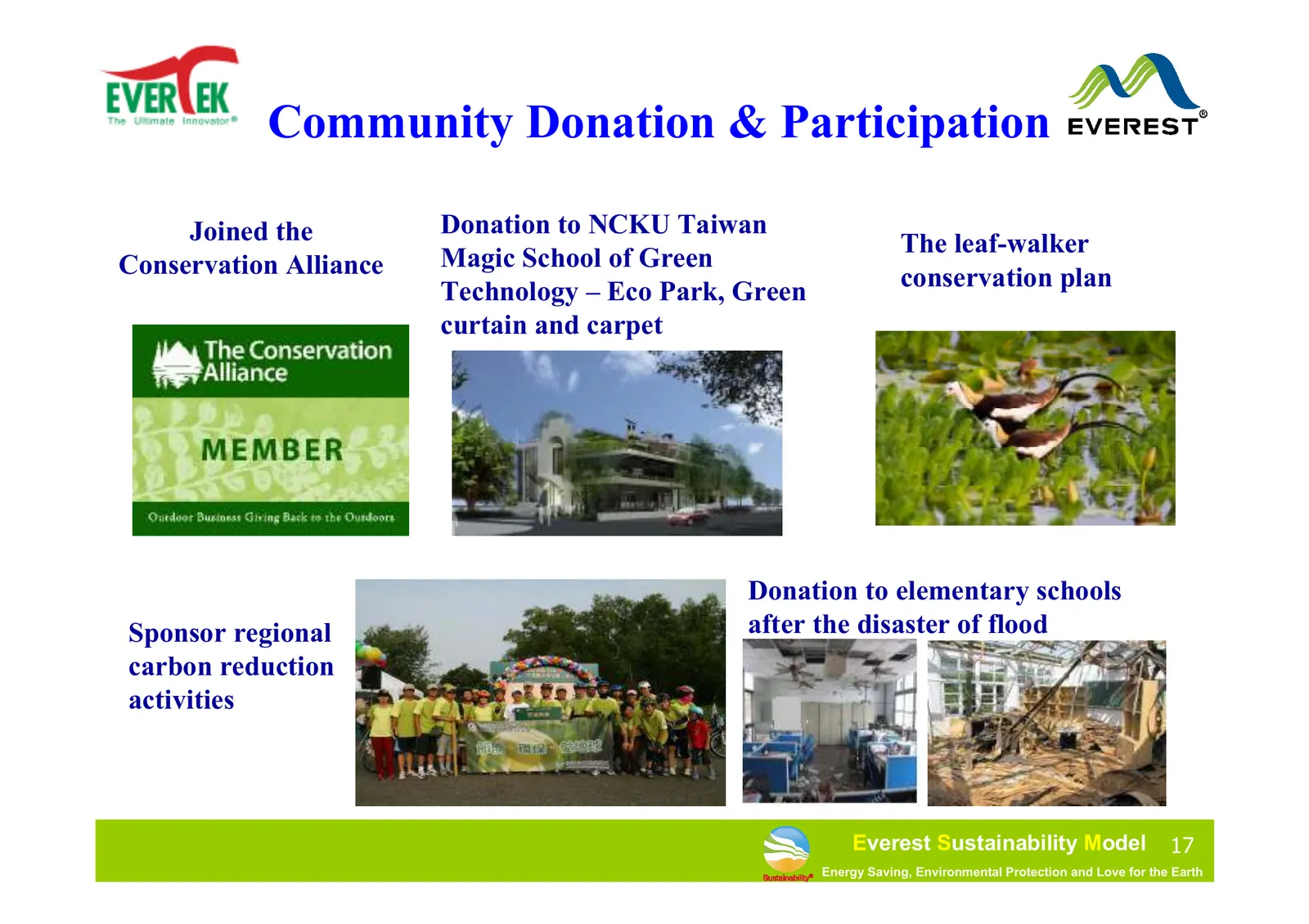
Community Donation & Participation Joined the Donation to NCKU Taiwan The leaf-walker Conservation Alliance Magic School of Green conservation plan Technology – Eco Park, Green curtain and carpet Donation to elementary schools Sponsor regional after the disaster of flood carbon reduction activities
Slide 18: Everest Textile Eco-Industrial Park, ETIP
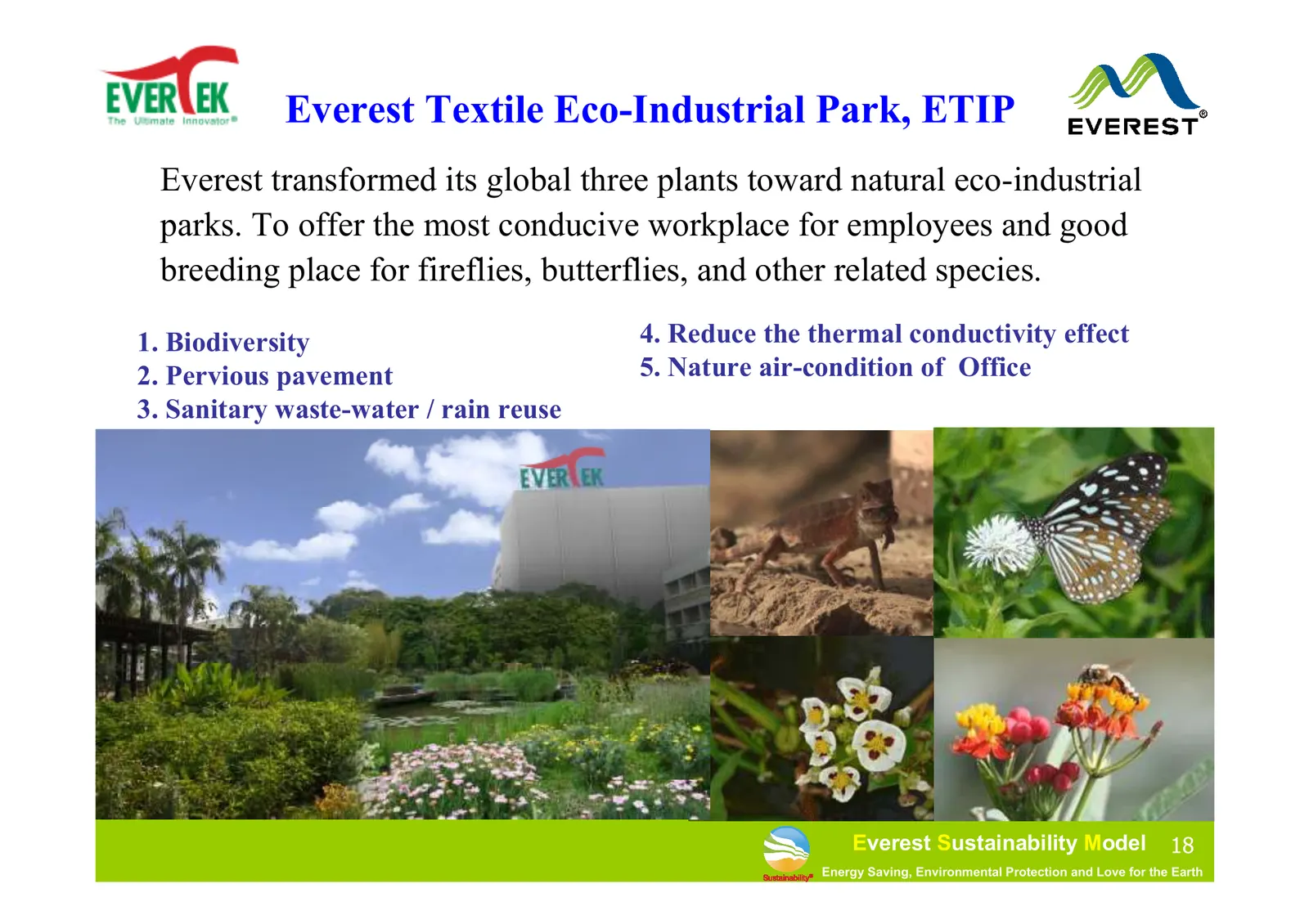
Everest Textile Eco-Industrial Park, ETIP Everest transformed its global three plants toward natural eco-industrial parks. To offer the most conducive workplace for employees and good breeding place for fireflies, butterflies, and other related species. 1. Biodiversity 4. Reduce the thermal conducti
Slide 19: Environmental Conservation
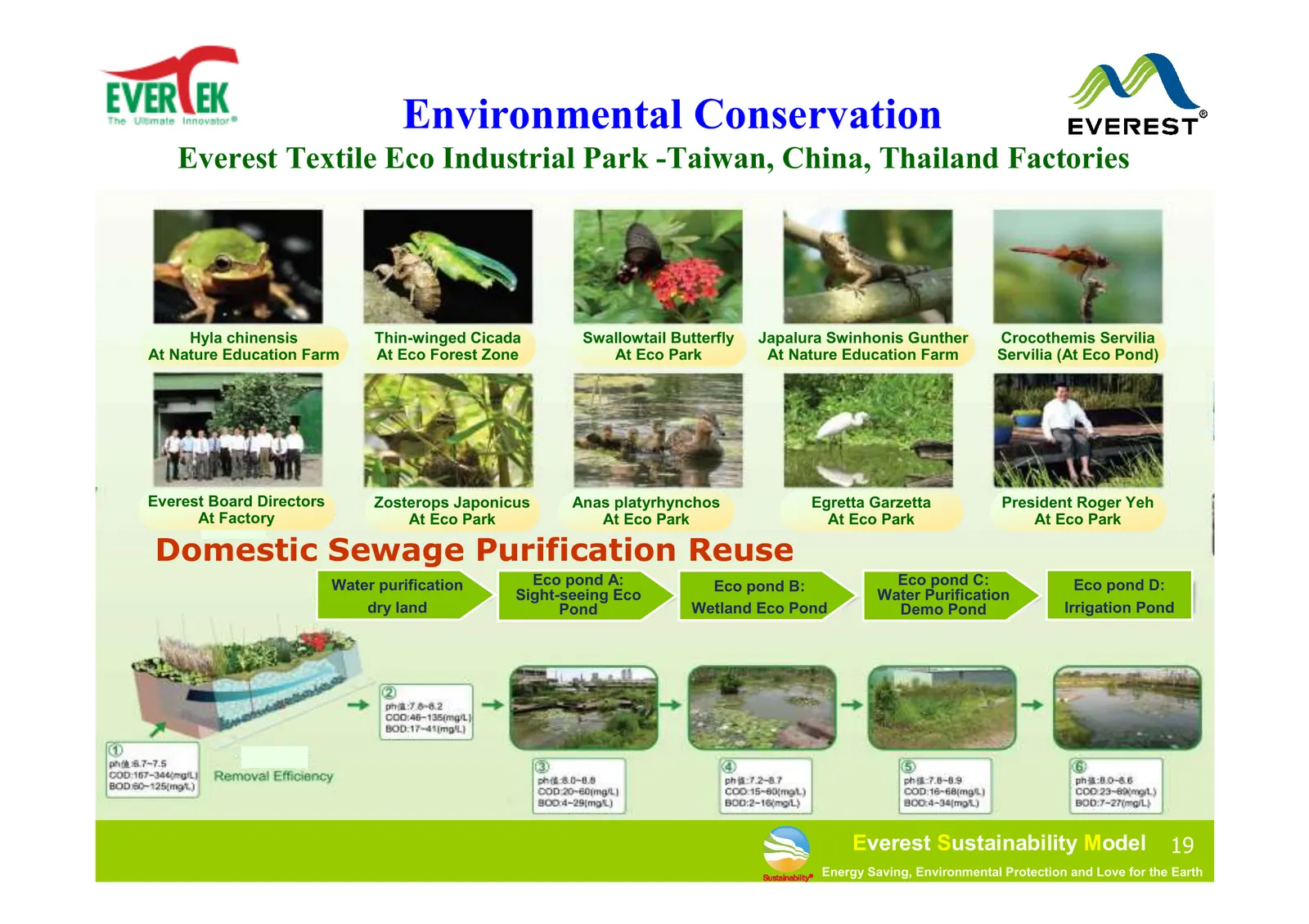
Environmental Conservation Everest Textile Eco Industrial Park -Taiwan, China, Thailand Factories Hyla chinensis Thin-winged Cicada Swallowtail Butterfly Japalura Swinhonis Gunther Crocothemis Servilia At Nature Education Farm At Eco Forest Zone At Eco Park At Nature Education Farm Servilia (At Eco
Slide 20: Natural Agriculture Educational Farm
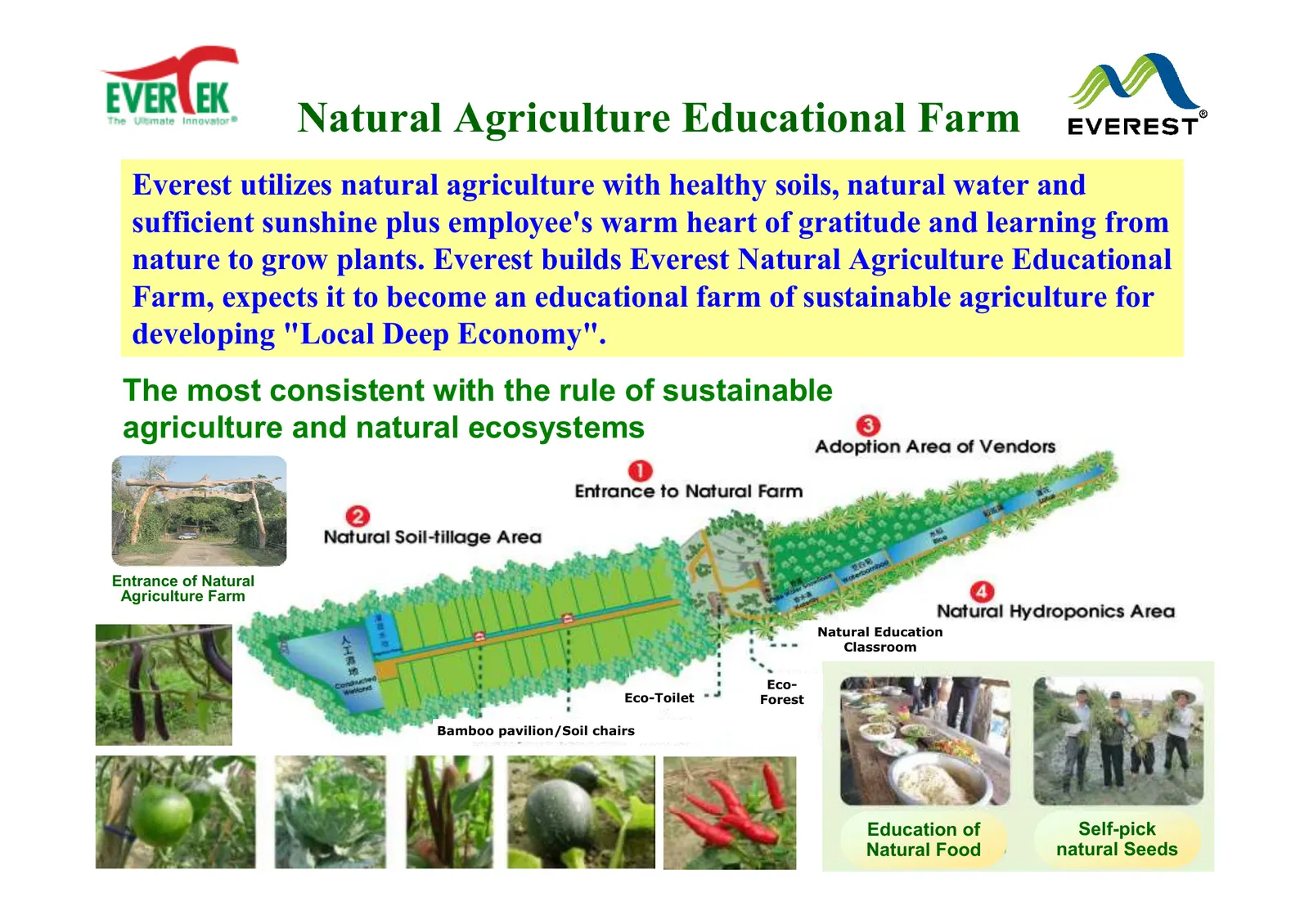
Natural Agriculture Educational Farm Everest utilizes natural agriculture with healthy soils, natural water and sufficient sunshine plus employee's warm heart of gratitude and learning from nature to grow plants. Everest builds Everest Natural Agriculture Educational Farm, expects it to become an ed
Slide 21: Benefits from Learning from the Nature
Benefits from Learning from the Nature Everest Sustainability Model 21 Energy Saving, Environmental Protection and Love for the Earth
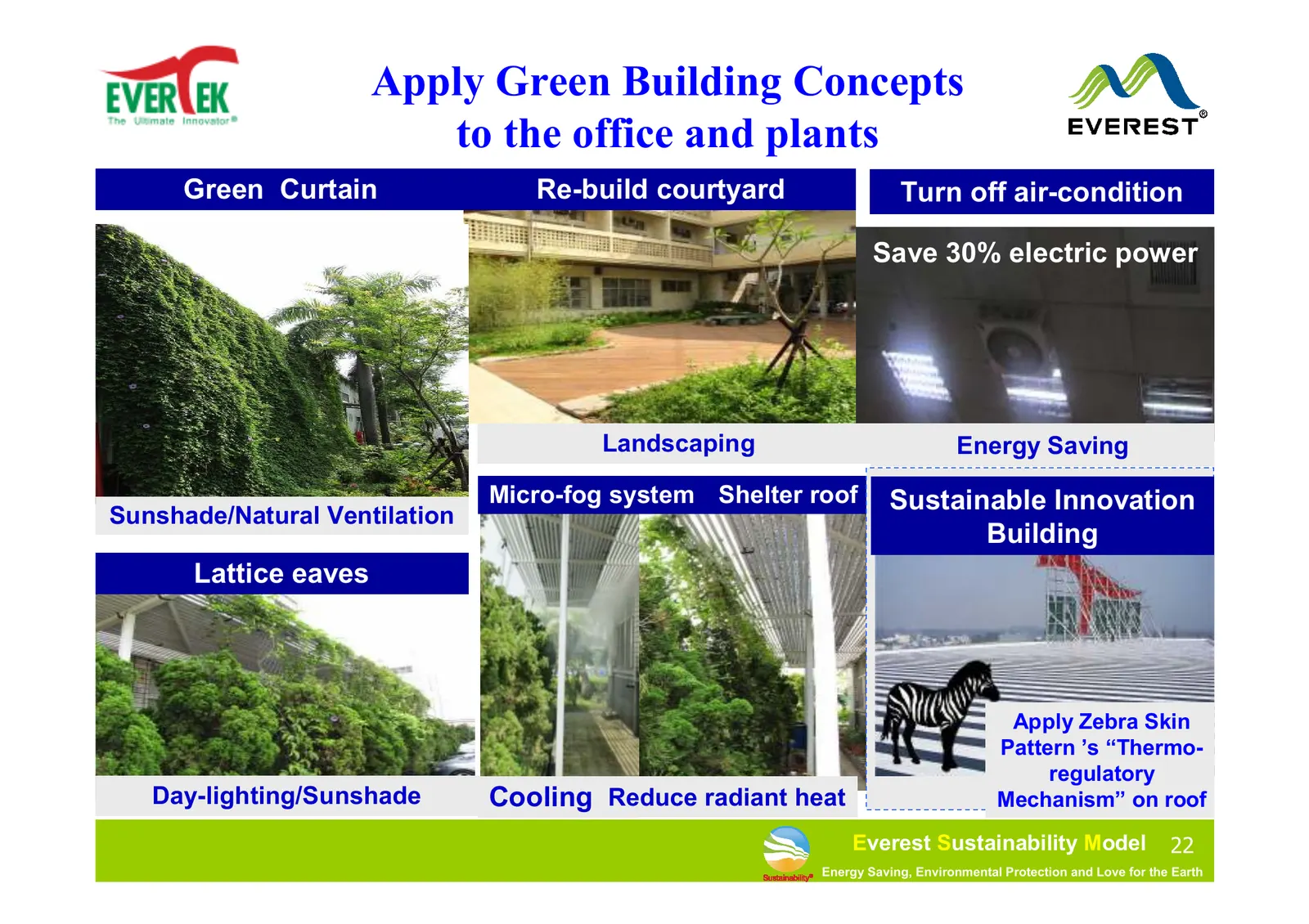
Slide 22: Apply Green Building Concepts to the office and plants
Apply Green Building Concepts to the office and plants Green Curtain Re-build courtyard Turn off air-condition Save 30% electric power Landscaping Energy Saving Micro-fog system Shelter roof Sustainable Innovation Sunshade/Natural Ventilation Building Lattice eaves Apply Zebra Skin Pattern ’s “Therm
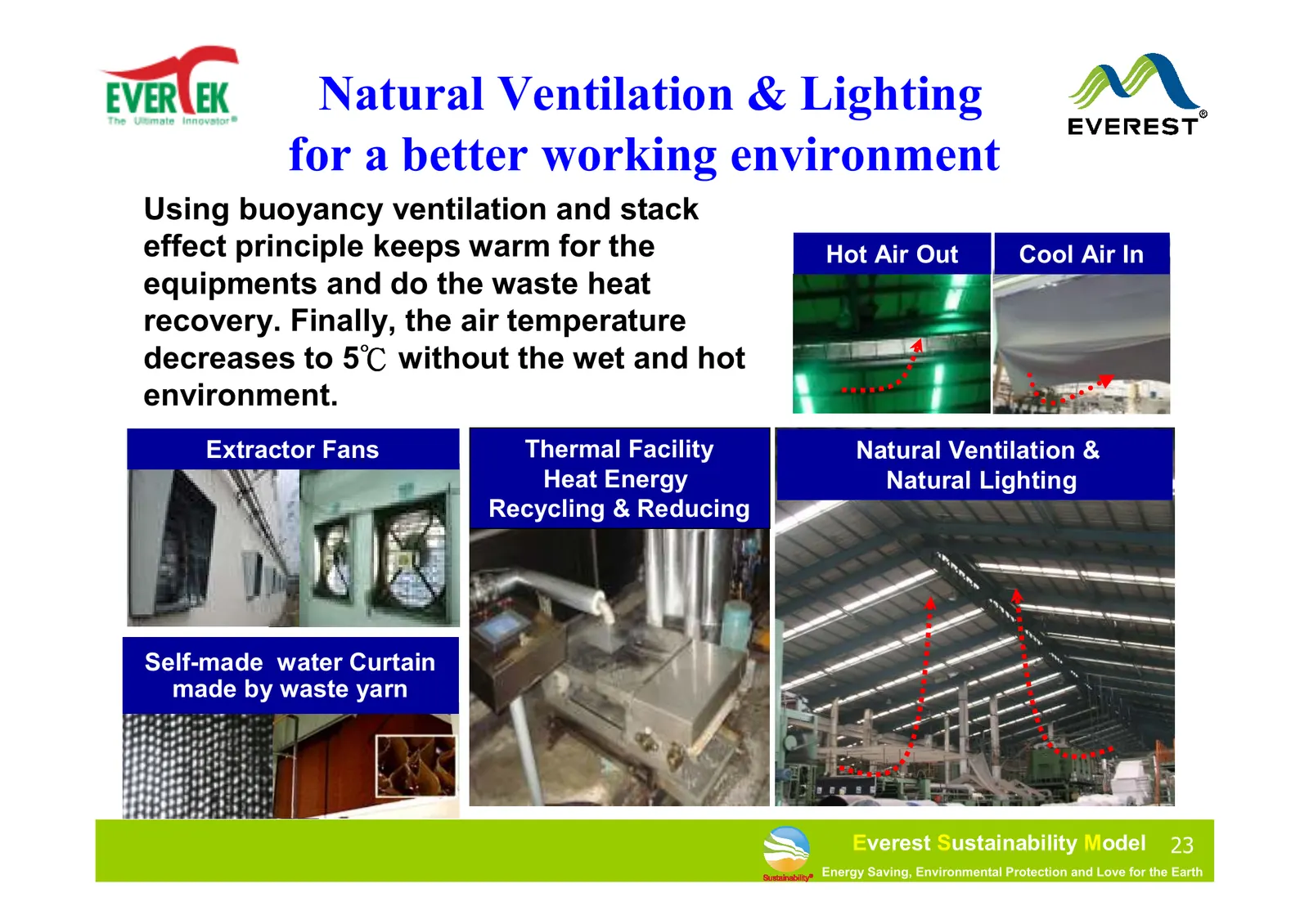
Slide 23: Natural Ventilation & Lighting for a better working environment
Natural Ventilation & Lighting for a better working environment Using buoyancy ventilation and stack effect principle keeps warm for the Hot Air Out Cool Air In equipments and do the waste heat recovery. Finally, the air temperature decreases to 5℃ ℃ without the wet and hot environment. Extractor Fa
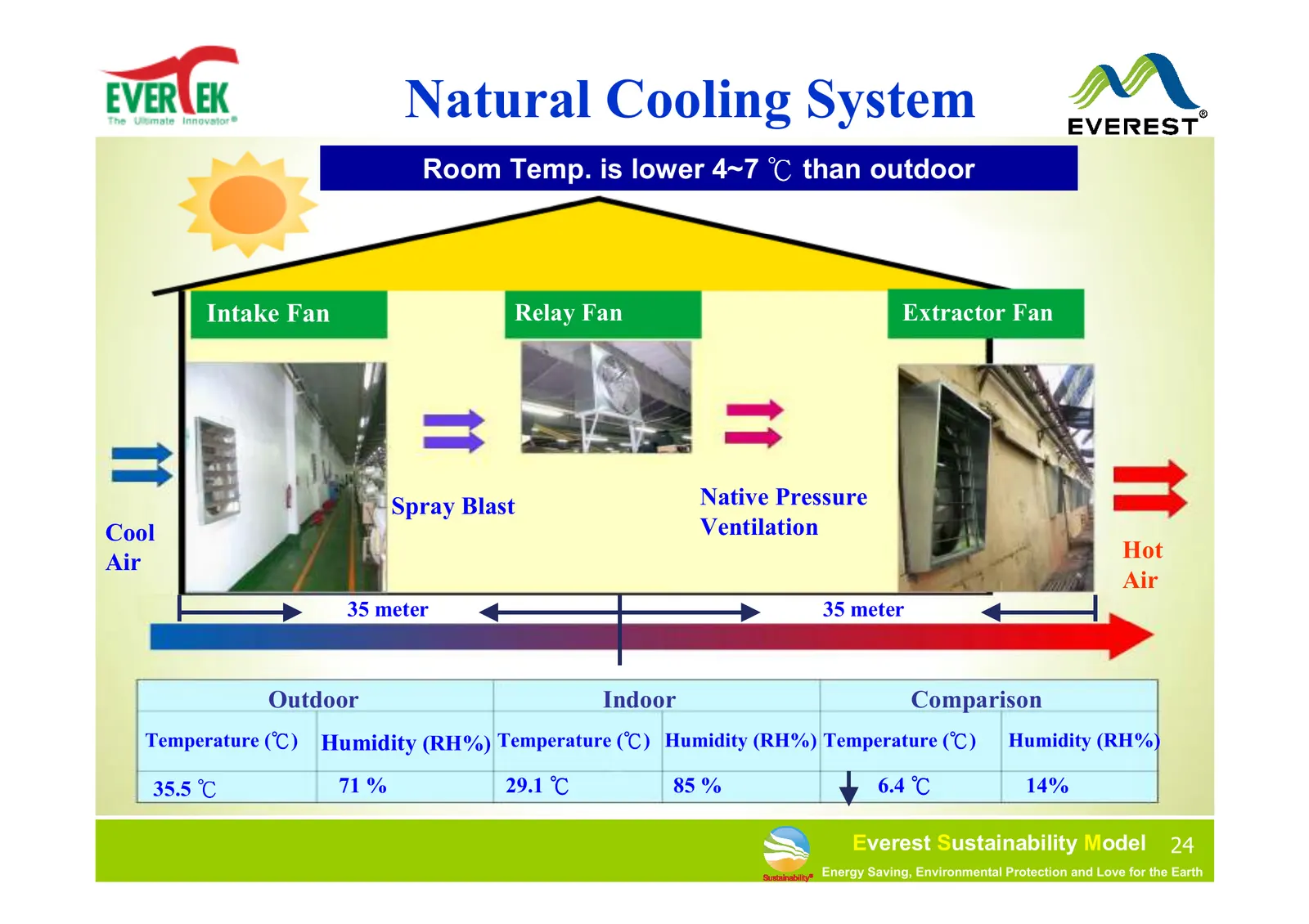
Slide 24: Natural Cooling System
Natural Cooling System Room Temp. is lower 4~7 ℃ than outdoor Intake Fan Relay Fan Extractor Fan Spray Blast Native Pressure Cool Ventilation Air Hot Air 35 meter 35 meter Outdoor Indoor Comparison ℃) Temperature (℃ ℃) Humidity (RH%) Temperature (℃ Humidity (RH%) Temperature (℃ ℃) Humidity (RH%) 35.
Slide 25: What issues we are facing NOW?
What issues we are facing NOW? Everest Sustainability Model 25 Energy Saving, Environmental Protection and Love for the Earth
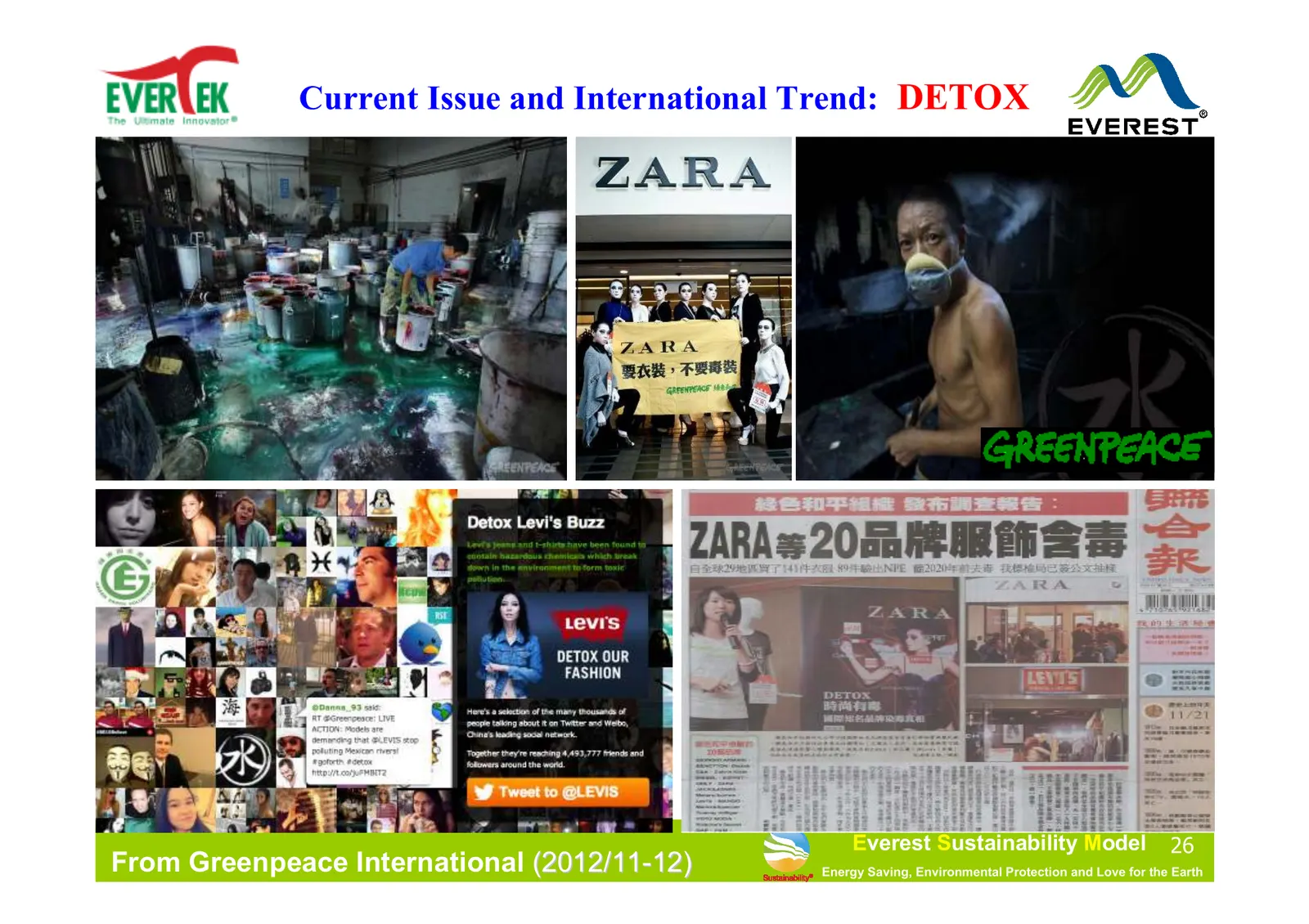
Slide 26: Current Issue and International Trend: DETOX
Current Issue and International Trend: DETOX Everest Sustainability Model 26 From Greenpeace International (2012/11-12) Energy Saving, Environmental Protection and Love for the Earth
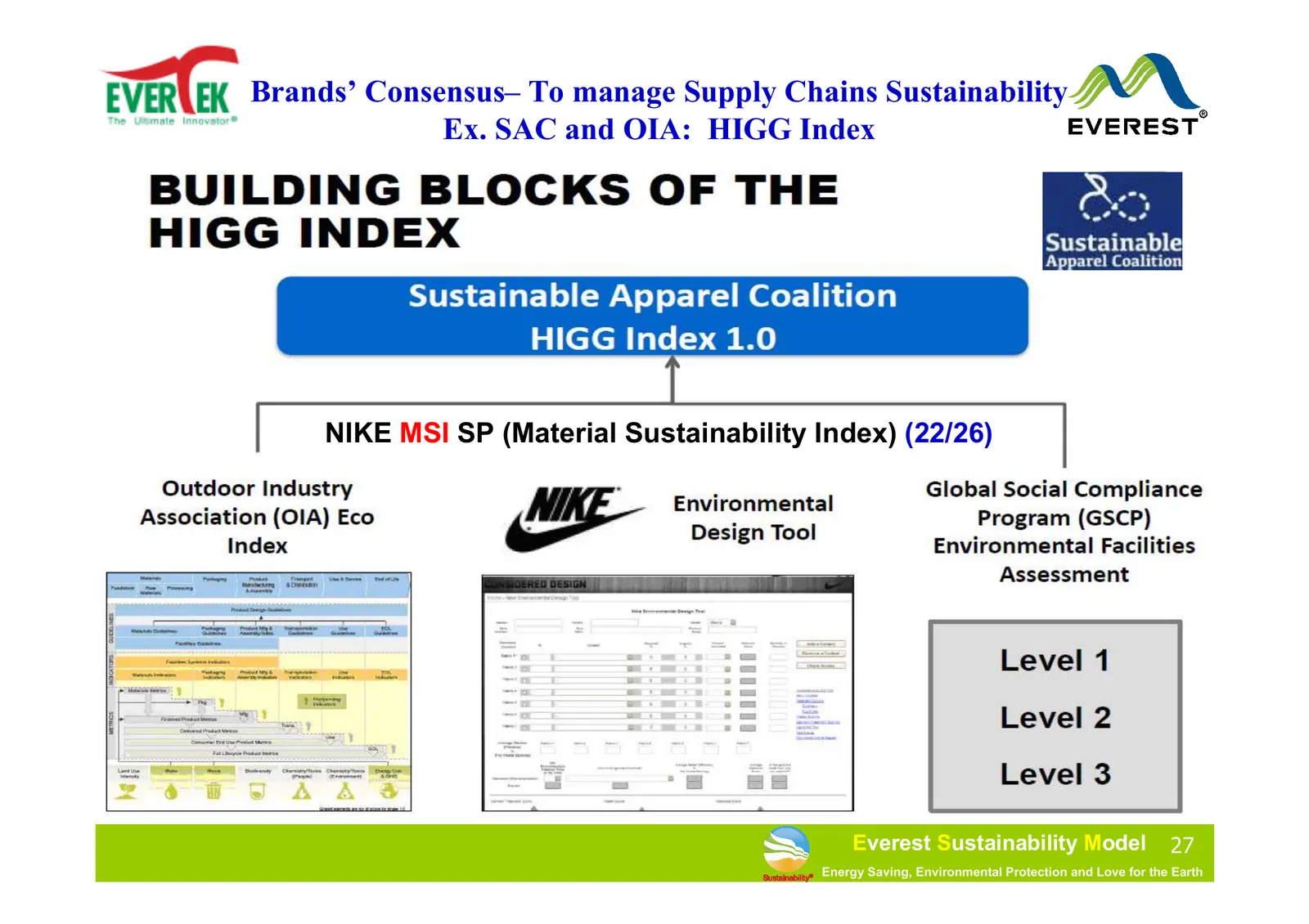
Slide 27: Brands' Consensus – To manage Supply Chains Sustainability
Brands’ Consensus– To manage Supply Chains Sustainability Ex. SAC and OIA: HIGG Index NIKE MSI SP (Material Sustainability Index) (22/26) Everest Sustainability Model 27 Energy Saving, Environmental Protection and Love for the Earth
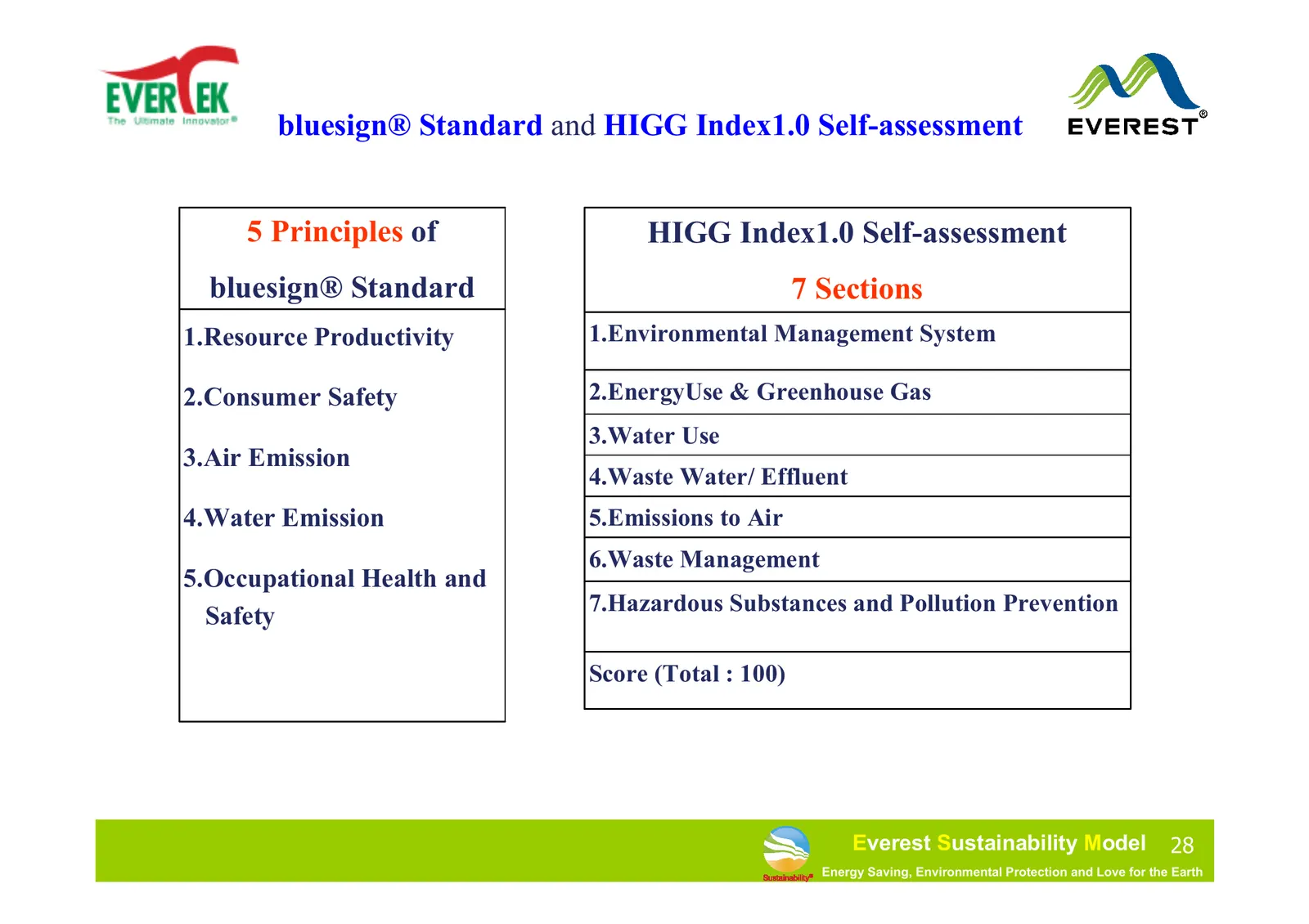
Slide 28: bluesign Standard and HIGG Index 1.0 Self-assessment
bluesign® Standard and HIGG Index1.0 Self-assessment 5 Principles of HIGG Index1.0 Self-assessment bluesign® Standard 7 Sections 1.Resource Productivity 1.Environmental Management System 2.Consumer Safety 2.EnergyUse & Greenhouse Gas 3.Water Use 3.Air Emission 4.Waste Water/ Effluent 4.Water Emissio
Slide 29: Thinking and Practice from Product's Lifecycle Perspective
Thinking and Practice from Product’s Lifecycle Perspective Good for Resource Productivity and Cost-saving Everest Sustainability Model 29 Energy Saving, Environmental Protection and Love for the Earth
Slide 30: Application of MIPS -1
Application of MIPS -1 MIPS: Material Input Per Unit of Service • ...... more than 90% of the non-renewable materials used are wasted on the way to making products available to the end-user. • Despite progress being made in individual sectors, the state of the environmental health as a whole has wea
Slide 31: Application of MIPS -2
Application of MIPS -2 • In stead of spending money on technical efforts for cleaning up wastes and emissions, this approach puts the emphasis on saving money by saving natural resources. It can be achieved in two different ways. First, we can dematerialise existing products and production processes
Slide 32: Everest's Practice on Eco-Enterprise
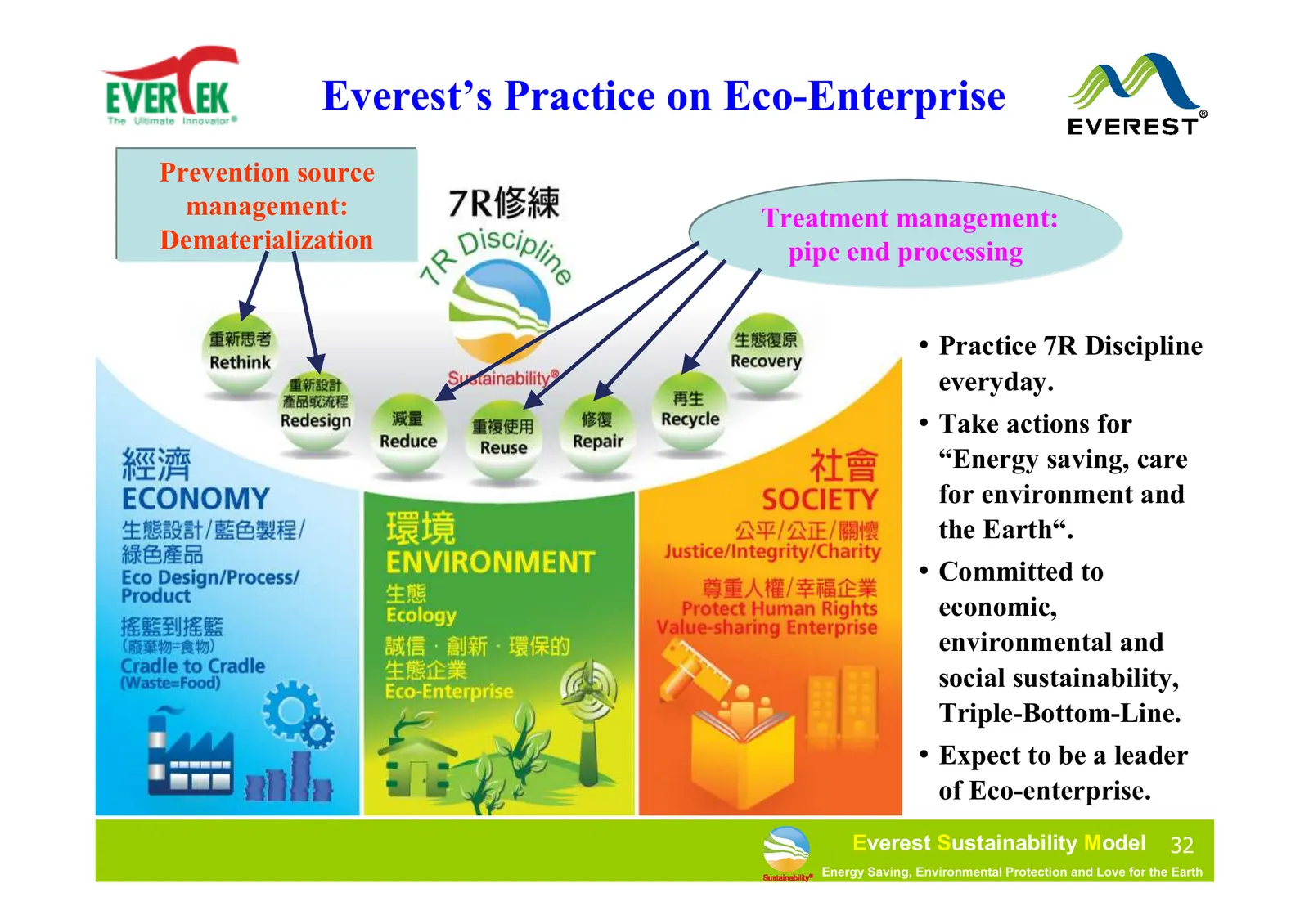
Everest’s Practice on Eco-Enterprise Prevention source management: Treatment management: Dematerialization pipe end processing • Practice 7R Discipline everyday. • Take actions for “Energy saving, care for environment and the Earth“. • Committed to economic, environmental and social sustainability,
Slide 33: Achieve Zero Emission 2020
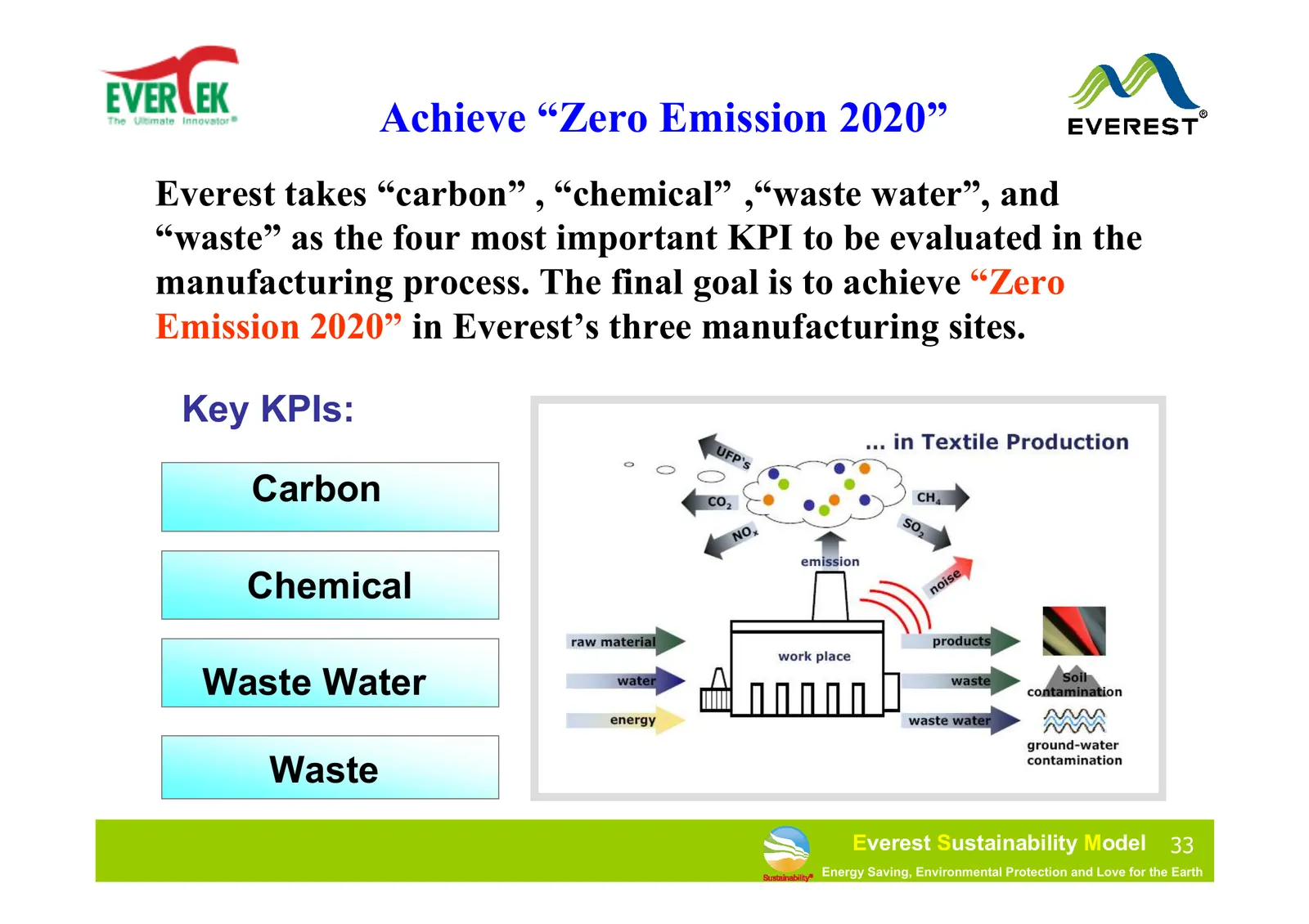
Achieve “Zero Emission 2020” Everest takes “carbon” , “chemical” ,“waste water”, and “waste” as the four most important KPI to be evaluated in the manufacturing process. The final goal is to achieve “Zero Emission 2020” in Everest’s three manufacturing sites. Key KPIs: Carbon Chemical Waste Water Wa
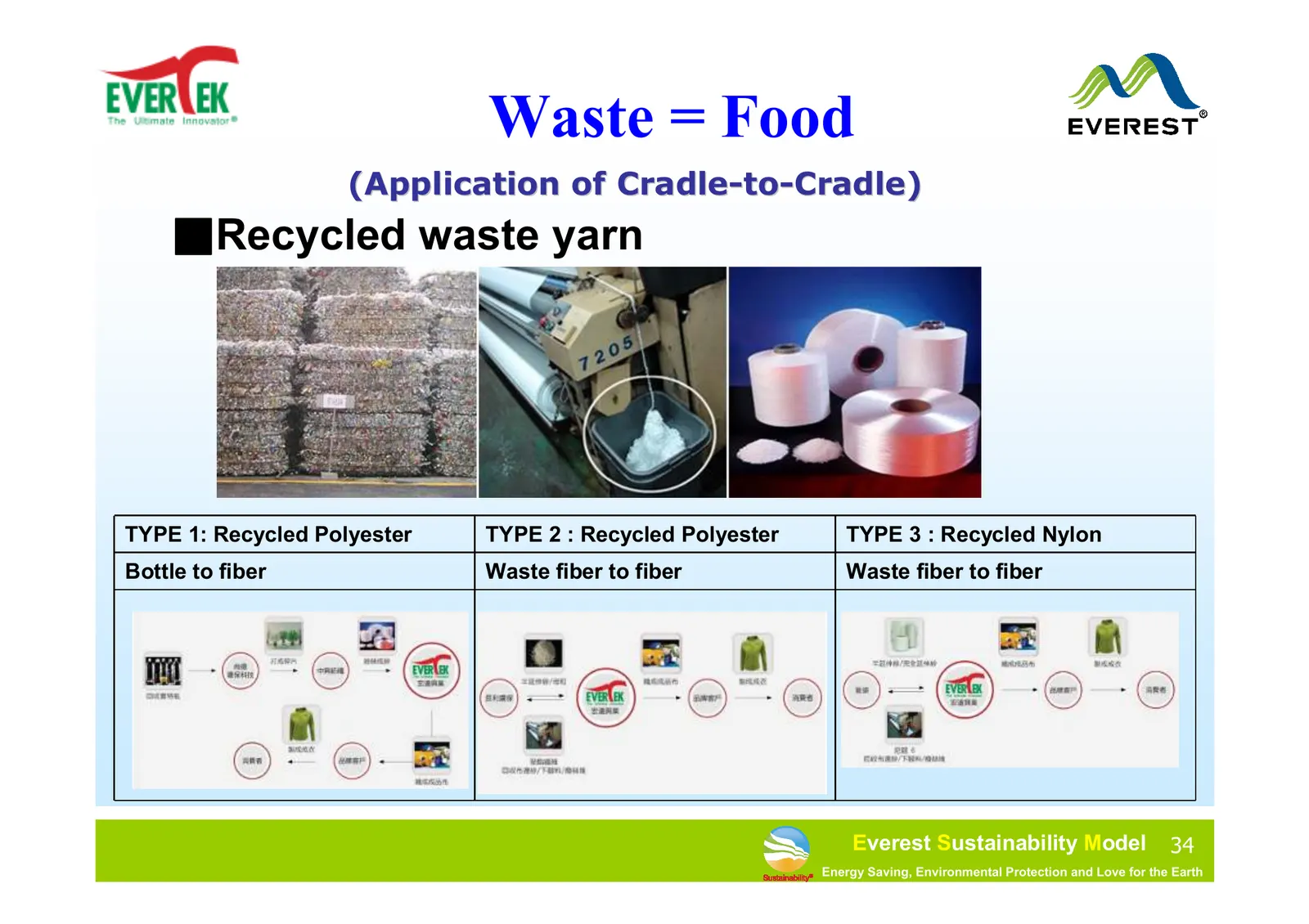
Slide 34: Waste = Food
Waste = Food (Application of Cradle-to-Cradle) ▓Recycled waste yarn TYPE 1: Recycled Polyester TYPE 2 : Recycled Polyester TYPE 3 : Recycled Nylon Bottle to fiber Waste fiber to fiber Waste fiber to fiber Everest Sustainability Model 34 Energy Saving, Environmental Protection and Love for the Earth
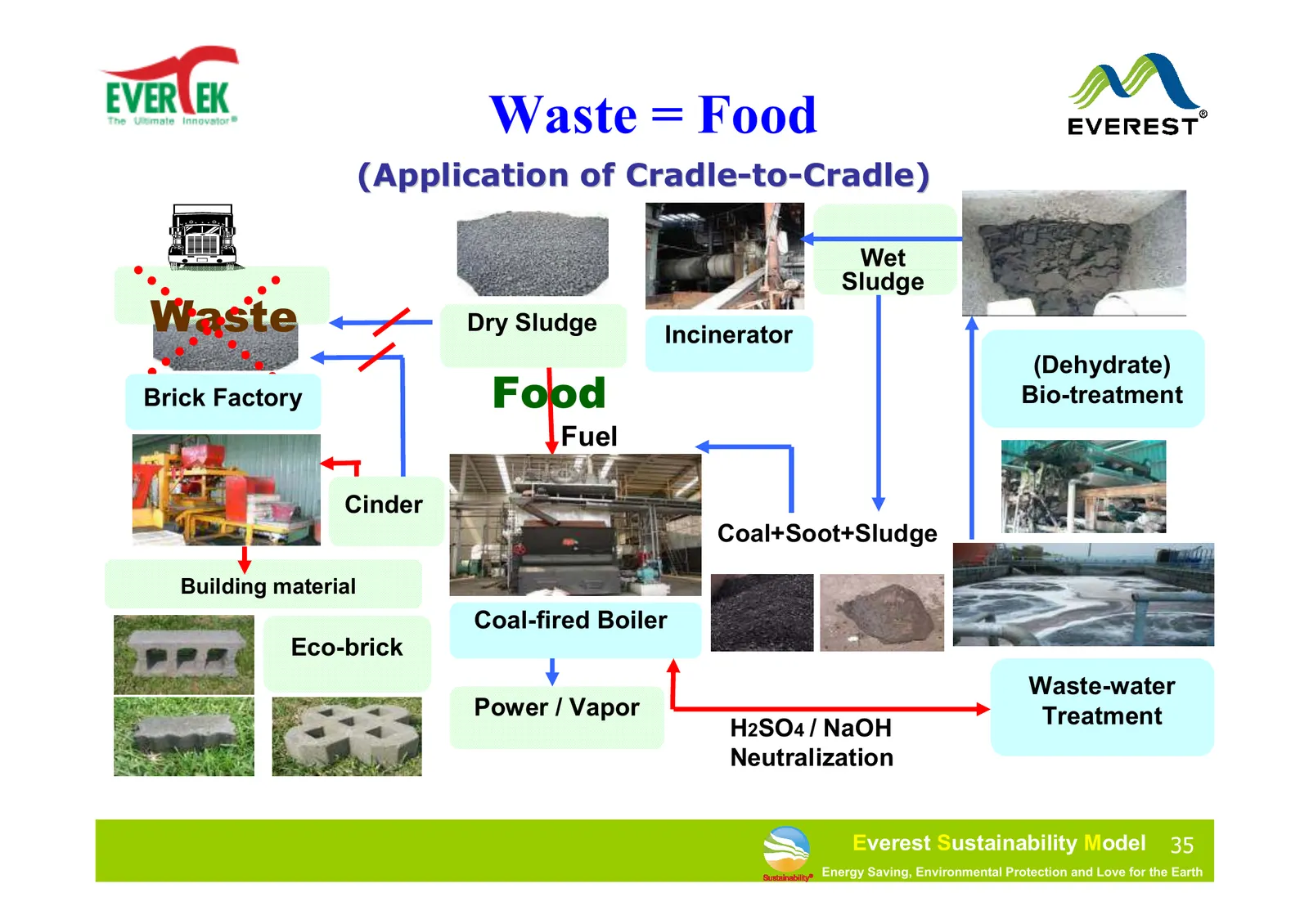
Slide 35: Waste = Food
Waste = Food (Application of Cradle-to-Cradle) Wet Sludge Waste Dry Sludge Incinerator (Dehydrate) Brick Factory Food Bio-treatment Fuel Cinder Coal+Soot+Sludge Building material Coal-fired Boiler Eco-brick Waste-water Power / Vapor Treatment H2SO4 / NaOH Neutralization Everest Sustainability Model
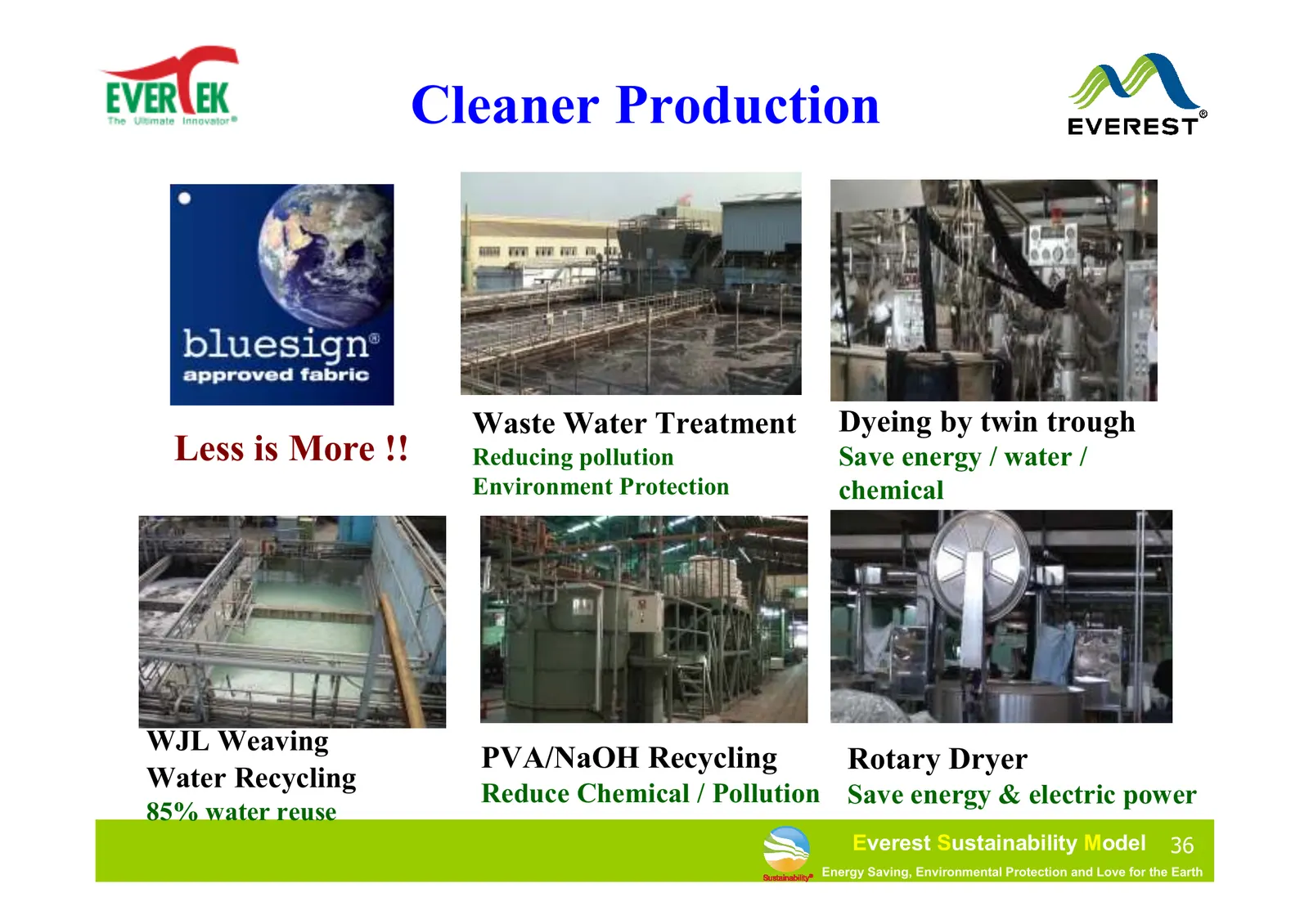
Slide 36: Cleaner Production
Cleaner Production Waste Water Treatment Dyeing by twin trough Less is More !! Reducing pollution Save energy / water / Environment Protection chemical WJL Weaving PVA/NaOH Recycling Rotary Dryer Water Recycling Reduce Chemical / Pollution Save energy & electric power 85% water reuse Everest Sustain
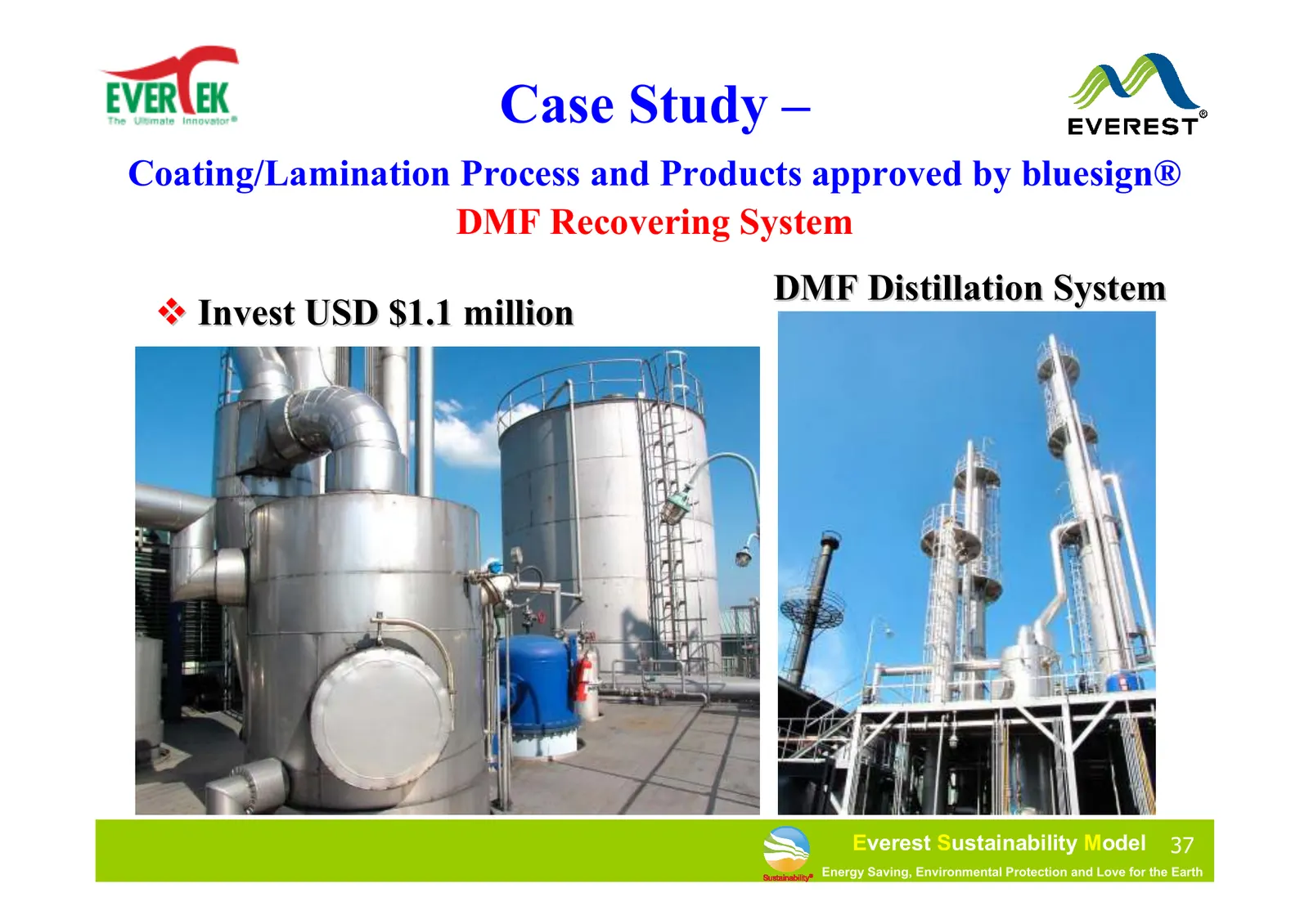
Slide 37: Case Study – Coating/Lamination Process approved by bluesign
Case Study – Coating/Lamination Process and Products approved by bluesign® DMF Recovering System DMF Distillation System Invest USD $1.1 million Everest Sustainability Model 37 Energy Saving, Environmental Protection and Love for the Earth
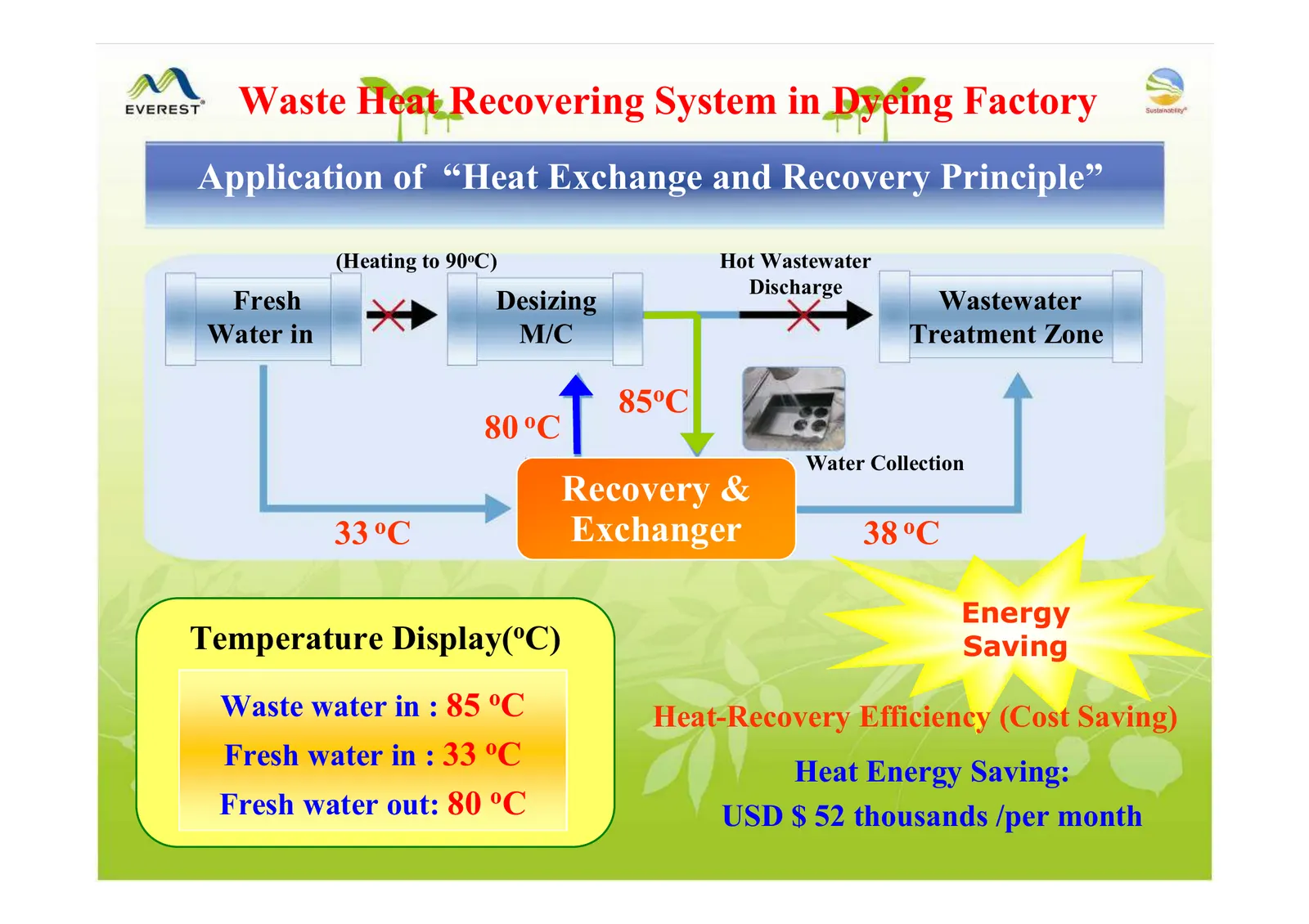
Slide 38: Waste Heat Recovering System in Dyeing Factory
Waste Heat Recovering System in Dyeing Factory Application of “Heat Exchange and Recovery Principle” (Heating to 90oC) Hot Wastewater Discharge Fresh Desizing Wastewater Water in M/C Treatment Zone 85oC 80 oC Water Collection Recovery & 33 oC Exchanger 38 oC Energy Temperature Display(oC) Saving Was
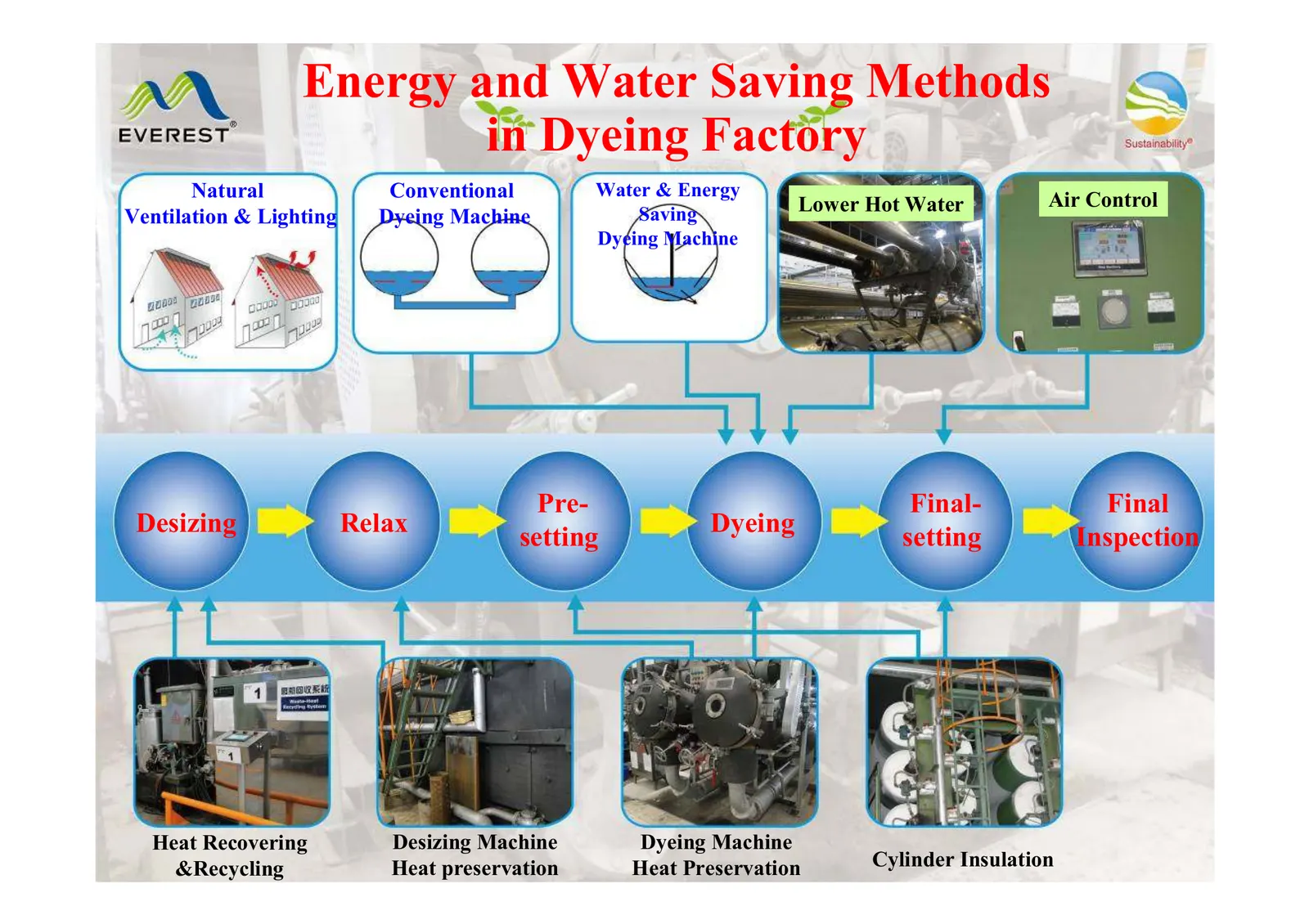
Slide 39: Energy and Water Saving Methods in Dyeing Factory
Energy and Water Saving Methods in Dyeing Factory Natural Conventional Water & Energy Lower Hot Water Air Control Ventilation & Lighting Dyeing Machine Saving Dyeing Machine Pre- Final- Final Desizing Relax setting Dyeing setting Inspection Heat Recovering Desizing Machine Dyeing Machine &Recycling
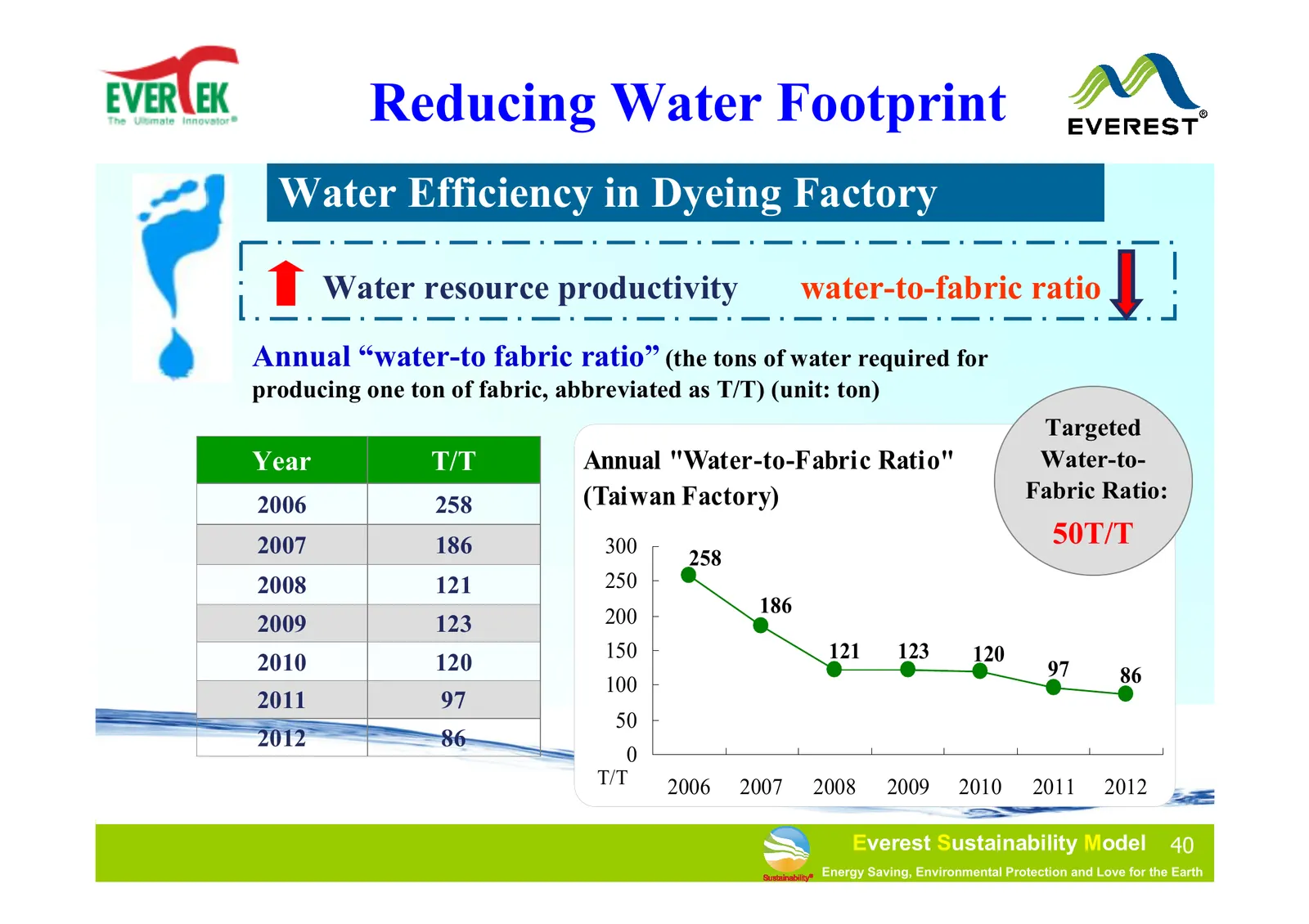
Slide 40: Reducing Water Footprint
Reducing Water Footprint Water Efficiency in Dyeing Factory Water resource productivity water-to-fabric ratio Annual “water-to fabric ratio” (the tons of water required for producing one ton of fabric, abbreviated as T/T) (unit: ton) Targeted Year T/T Annual "Water-to-Fabric Ratio" Water-to- (Taiwan
Slide 41: A Responsible and Reliable supplier: Everest
A Responsible and Reliable supplier: Everest ---What’s going on? What’s next?--- Everest Sustainability Model 41 Energy Saving, Environmental Protection and Love for the Earth
Slide 42: Everest Sustainability Model
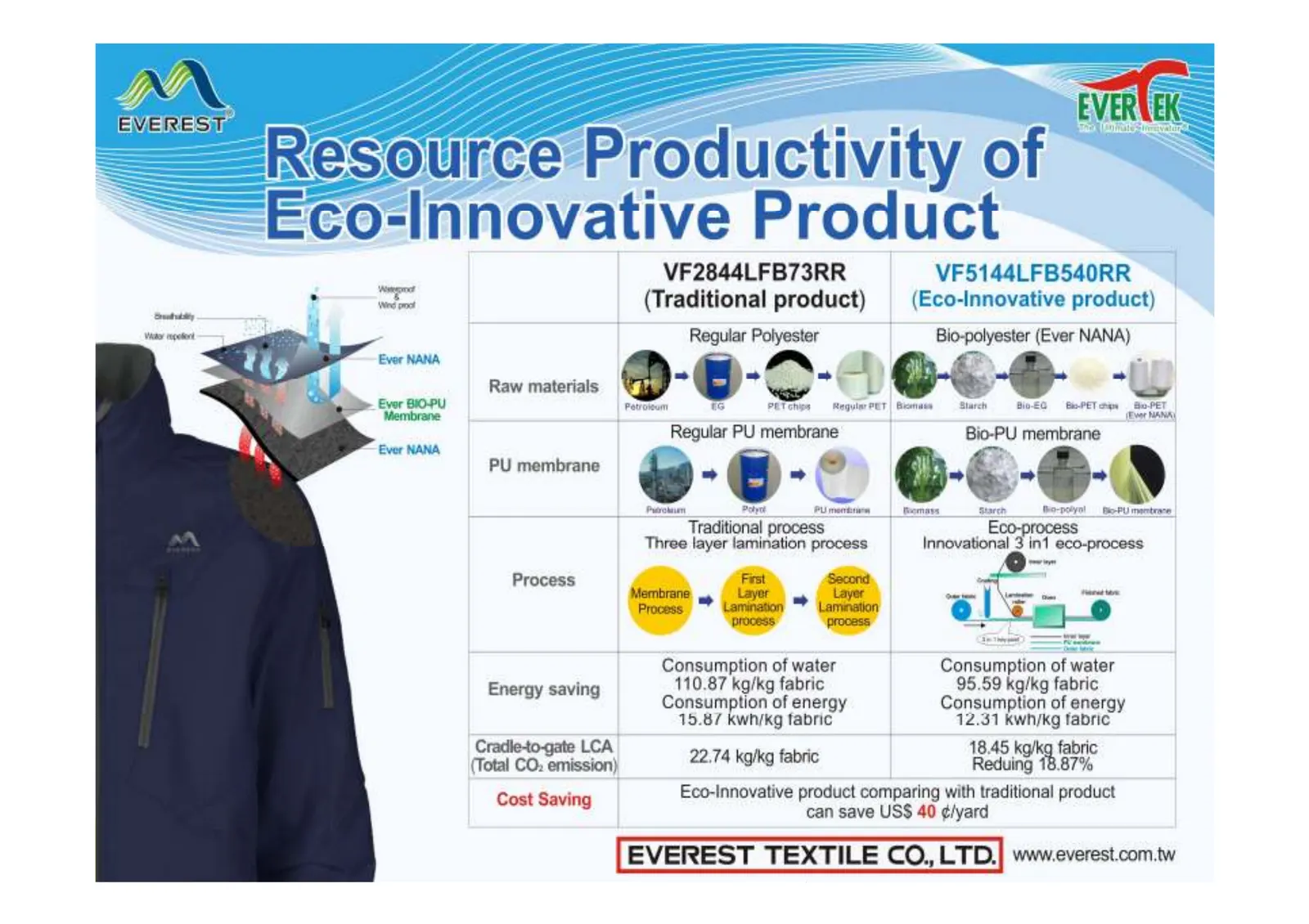
Everest Sustainability Model 42 Energy Saving, Environmental Protection and Love for the Earth
Slide 43: More Advanced Re-ESM Programs
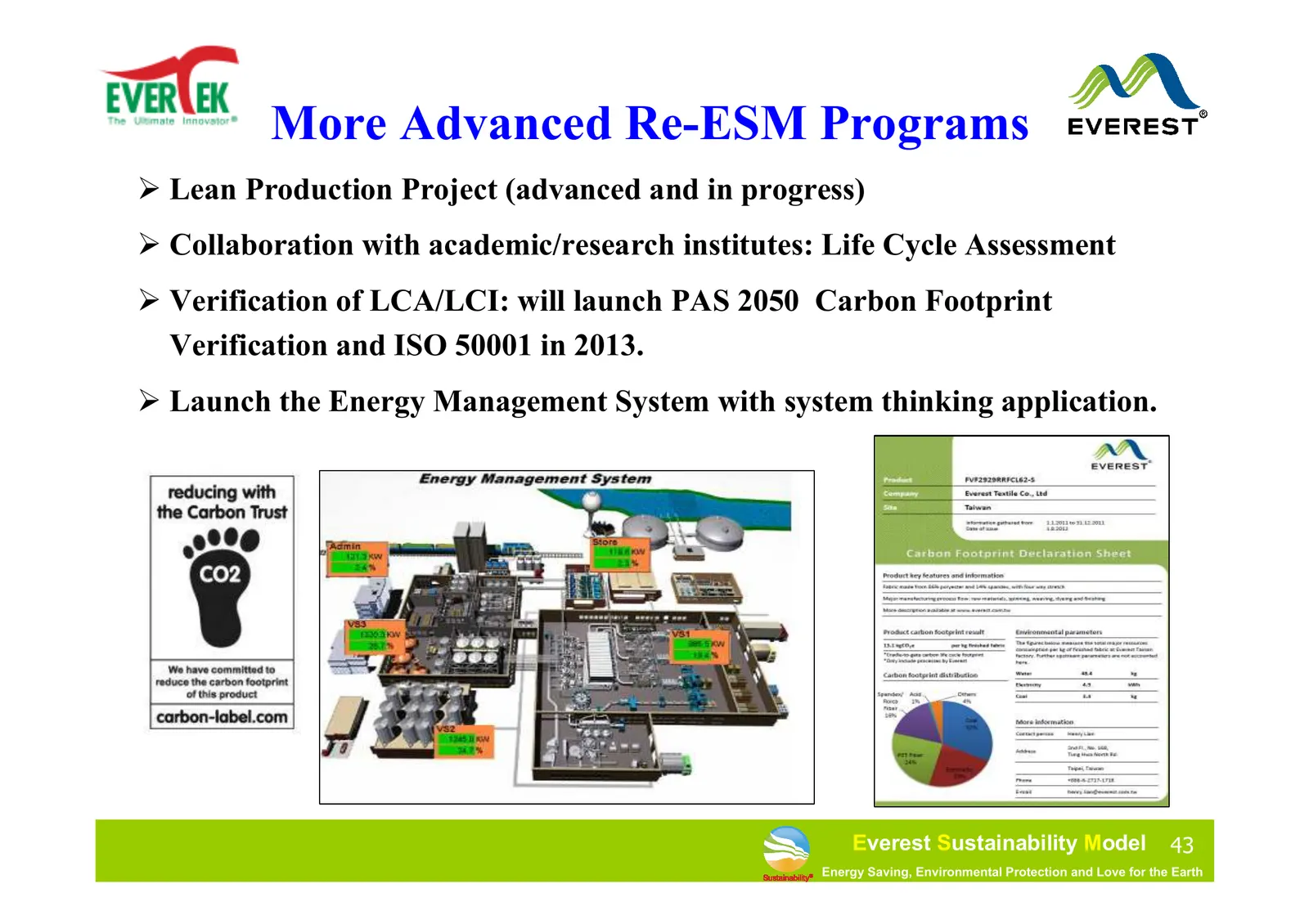
More Advanced Re-ESM Programs Lean Production Project (advanced and in progress) Collaboration with academic/research institutes: Life Cycle Assessment Verification of LCA/LCI: will launch PAS 2050 Carbon Footprint Verification and ISO 50001 in 2013. Launch the Energy Management System with system t
Slide 44: Apply and Integrate Int'l Standards/Index to enhance Everest Sustainability
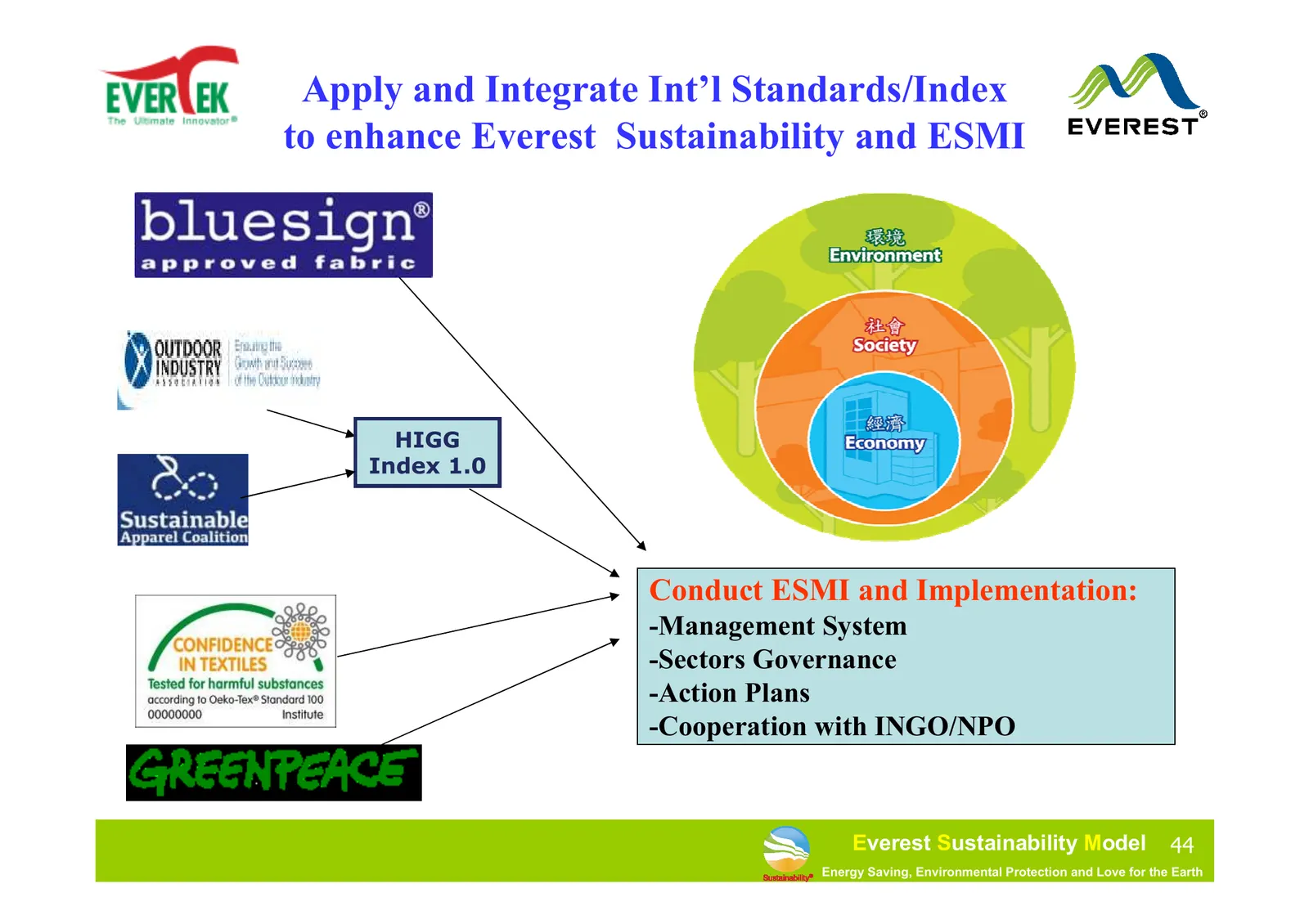
Apply and Integrate Int’l Standards/Index to enhance Everest Sustainability and ESMI HIGG Index 1.0 Conduct ESMI and Implementation: -Management System -Sectors Governance -Action Plans -Cooperation with INGO/NPO Everest Sustainability Model 44 Energy Saving, Environmental Protection and Love for th
Slide 45: Closer Interaction and cooperation with INGOs
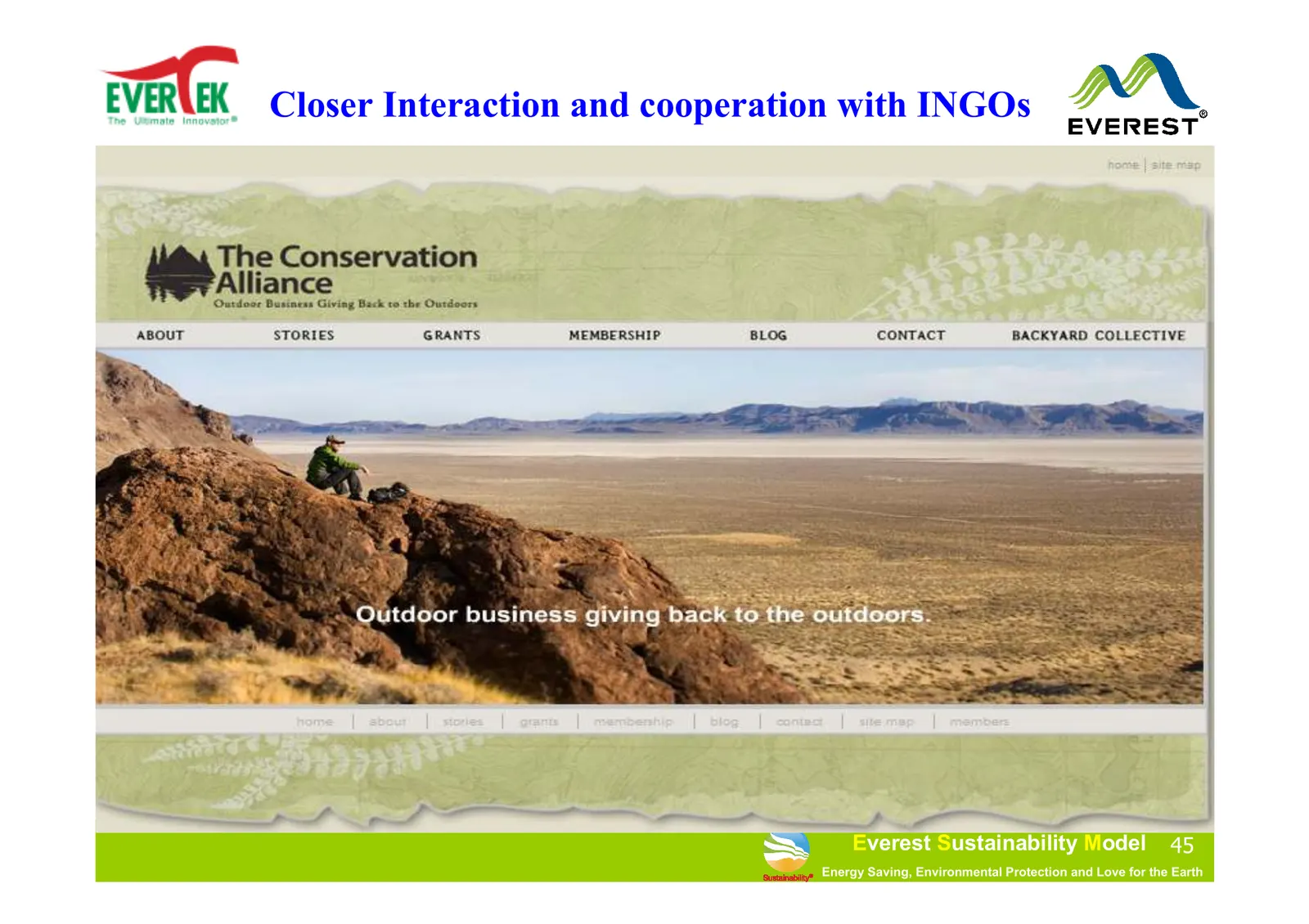
Closer Interaction and cooperation with INGOs 深化與國際專業組織和網絡的互動 以美國The Conservation Alliance為例 Everest Sustainability Model 45 Energy Saving, Environmental Protection and Love for the Earth
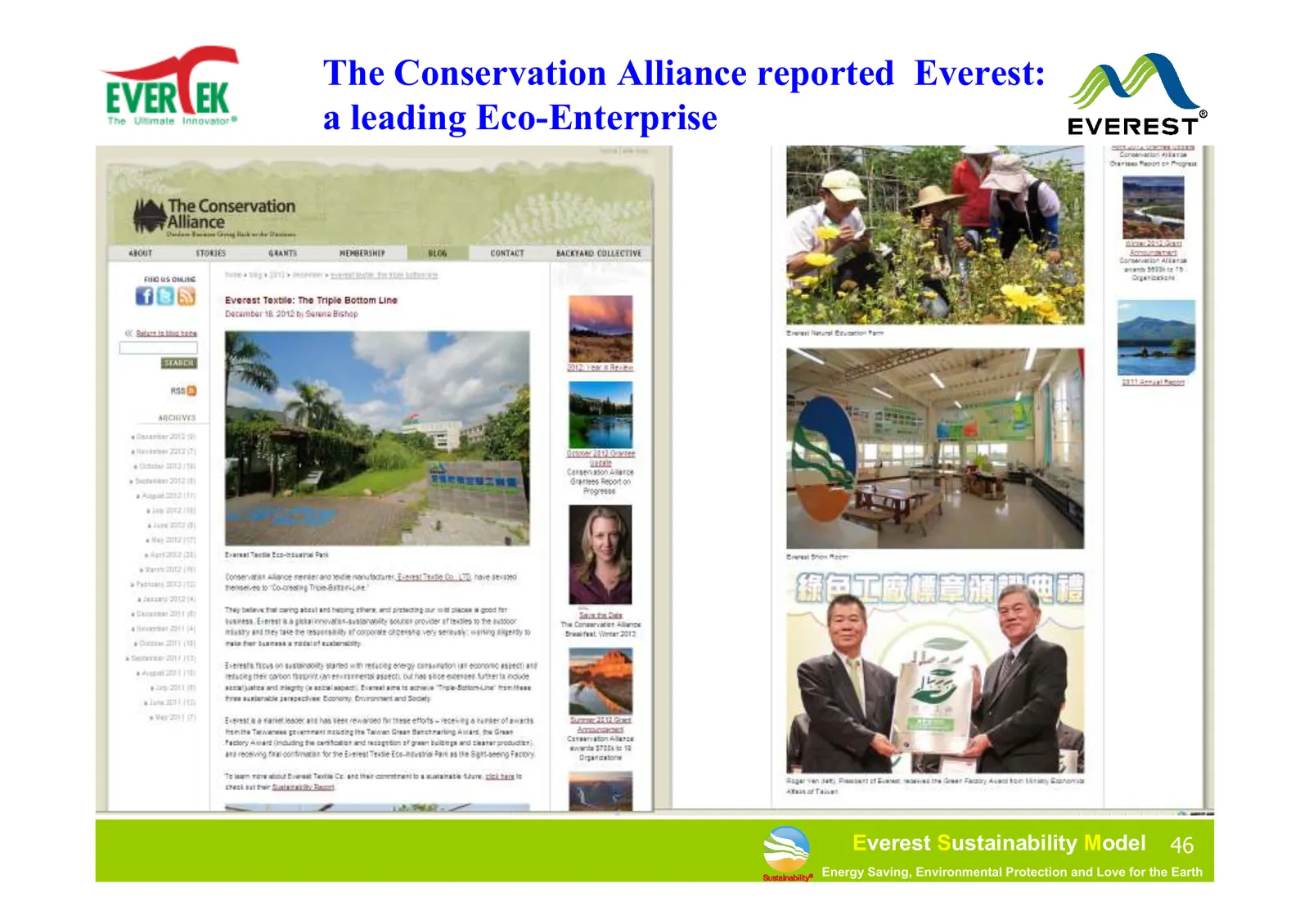
Slide 46: The Conservation Alliance reported Everest: a leading Eco-Enterprise
The Conservation Alliance reported Everest: a leading Eco-Enterprise Everest Sustainability Model 46 Energy Saving, Environmental Protection and Love for the Earth
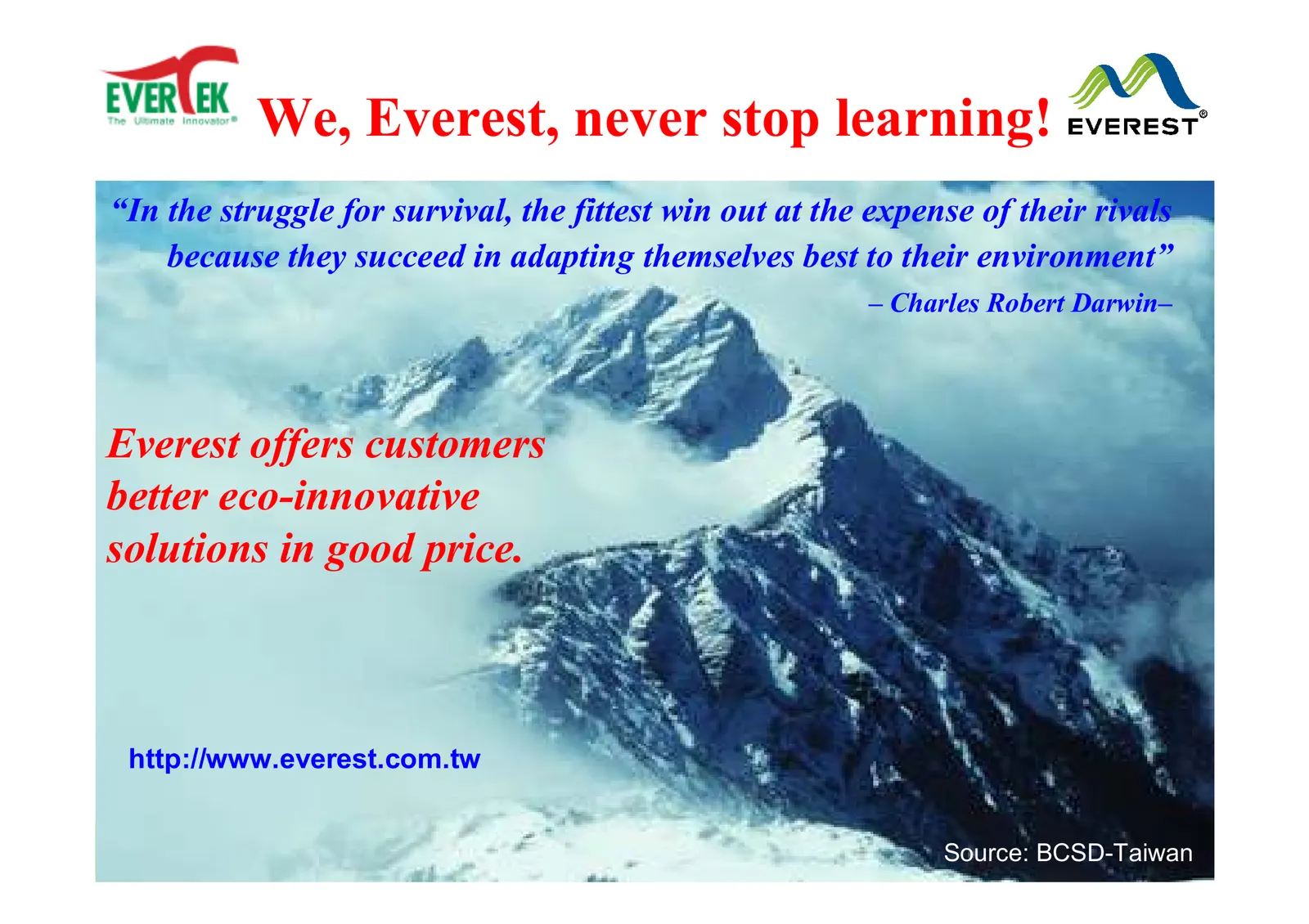
Slide 47: We, Everest, never stop learning!
We, Everest, never stop learning! “In the struggle for survival, the fittest win out at the expense of their rivals because they succeed in adapting themselves best to their environment” – Charles Robert Darwin– Everest offers customers better eco-innovative solutions in good price. http://www.evere
Source: Internet Archive copy of everest.com.tw