Molina Healthcare Inc · NYSE:MOH
Molina Healthcare — Investor Presentation (2020)
40 slides from Molina Healthcare's investor presentation, Oct 31, 2020
Slide 1: Molina Medicare Model of Care
Molina Medicare Model of Care Provider Network| Molina Healthcare | 2020 By: MHI Training Team MHTPS_MOCTraining_2020
Slide 2: Course Overview
Course Overview • The Model of Care (MOC) is Molina Healthcare’s documentation of the CMS directed plan for delivering coordinated care and case management to members with both Medicare and Medicaid. • The Centers for Medicare and Medicaid Services (CMS) require that all Molina providers receive bas
Slide 3: Learning Objectives
Learning Objectives Upon completion of the training, participants will be able to: • Describe the Molina Model of Care • List the four categories of the MOC • List which members the MOC applies to • Describe provider responsibilities for ICT • Describe provider responsibilities for MOC activities
Slide 4: What is “Model of Care”?
What is “Model of Care”? Models of Care (MOCs) are considered by CMS to be a vital quality improvement tool and integral component for ensuring that the unique needs of each member enrolled in a dual program (Medicare and Medicaid eligible) are identified and addressed. Molina Model of Care: A docum
Slide 5: Model of Care: Defined
Model of Care: Defined The plan for delivering our integrated care management program to members with special needs. CMS sets guidelines for: • Member and family centered health care • Assessment and care management of members • Communication among members, caregivers, and providers • Use of an Inte
Slide 6: MOC Comprised of 4 Categories
MOC Comprised of 4 Categories The MOC is comprised of the following clinical and non-clinical categories: 1. Description of the Dual Population 2. Care Coordination 3. Provider Network 4. MOC Quality Measurement & Performance Improvement
Slide 7: Four Elements of Integrated Care Program
Four Elements of Integrated Care Program 1. Description of Population • The ability to define and analyze our target population of dual eligible members. 2. Care Coordination • Specifically defined staff structure and roles, including oversight functions. • Performing Health Risk Assessments upon in
Slide 8: Four Elements of Integrated Care Program (cont’d)
Four Elements of Integrated Care Program(cont’d) 3. Provider Network • Establish a provider network with specialized expertise that supports the target population • Monitor provider utilization of Clinical practice guidelines and protocols • Ensure and track that MOC training is provided for all sta
Slide 9: Element 1: Description of the Dual Population
Element 1 DESCRIPTION OF THE DUAL POPULATION
Slide 10: What members fall under the Model of Care?
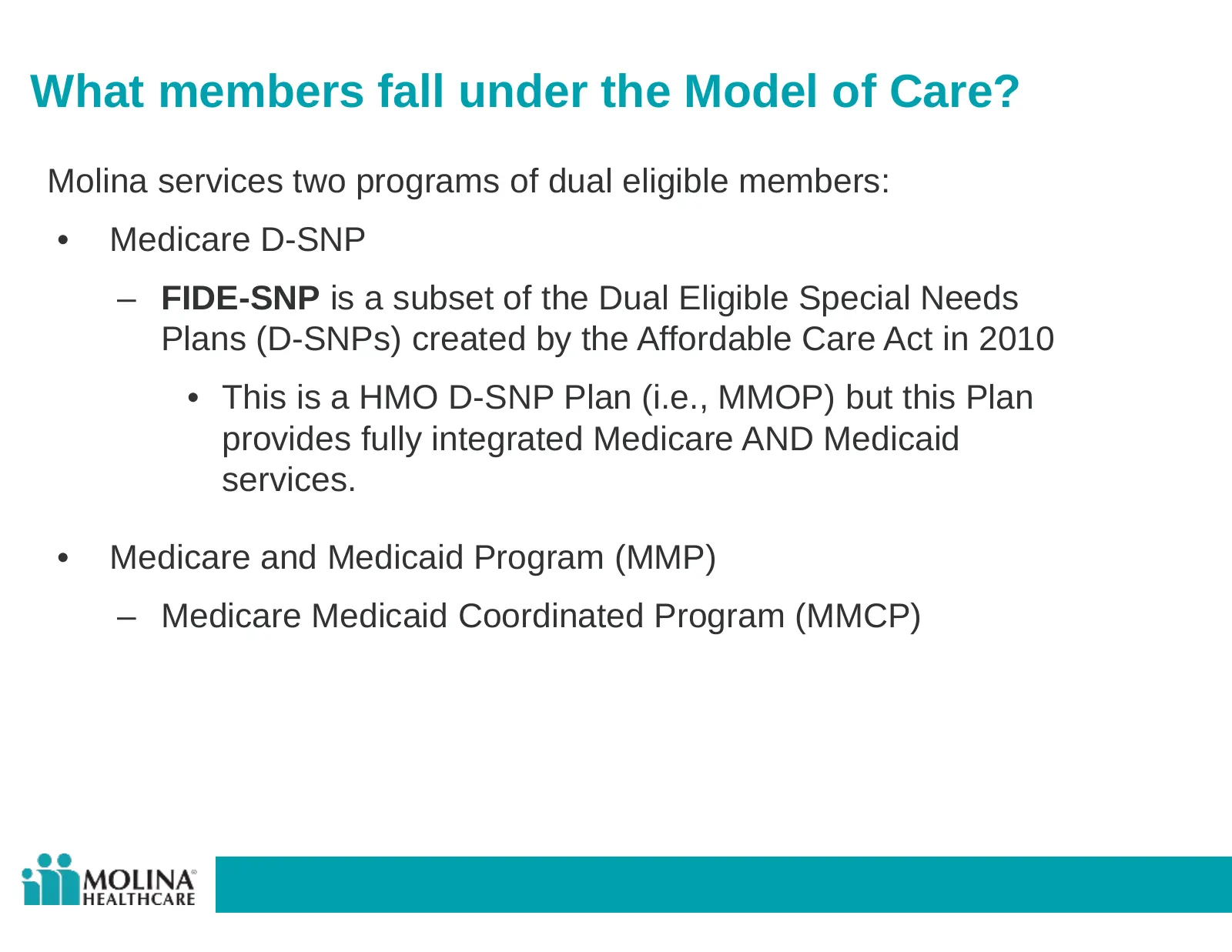
What members fall under the Model of Care? Molina services two programs of dual eligible members: • Medicare D-SNP – FIDE-SNP is a subset of the Dual Eligible Special Needs Plans (D-SNPs) created by the Affordable Care Act in 2010 • This is a HMO D-SNP Plan (i.e., MMOP) but this Plan provides fully
Slide 11: D-SNP
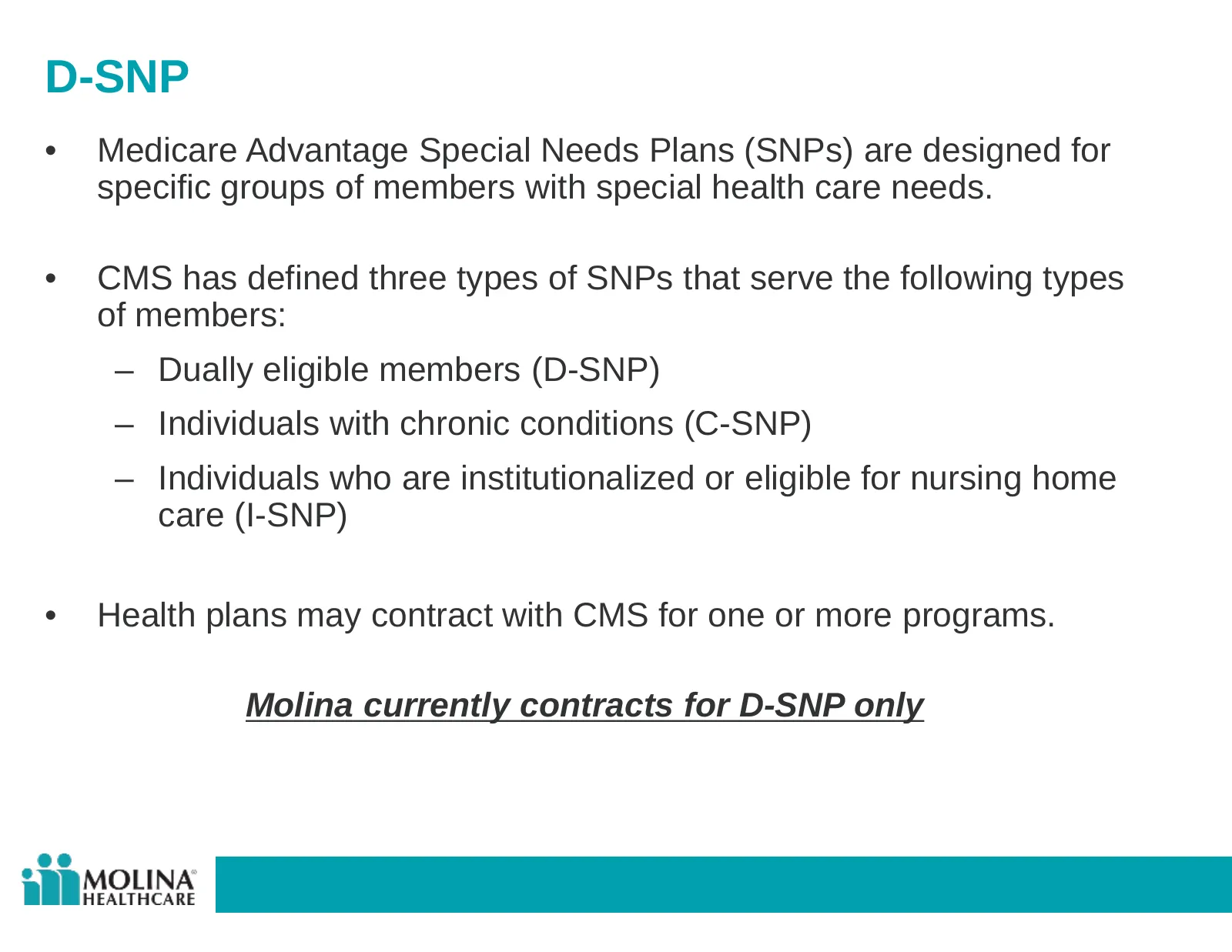
D-SNP • Medicare Advantage Special Needs Plans (SNPs) are designed for specific groups of members with special health care needs. • CMS has defined three types of SNPs that serve the following types of members: – Dually eligible members (D-SNP) – Individuals with chronic conditions (C-SNP) – Individ
Slide 12: Medicare SNPs
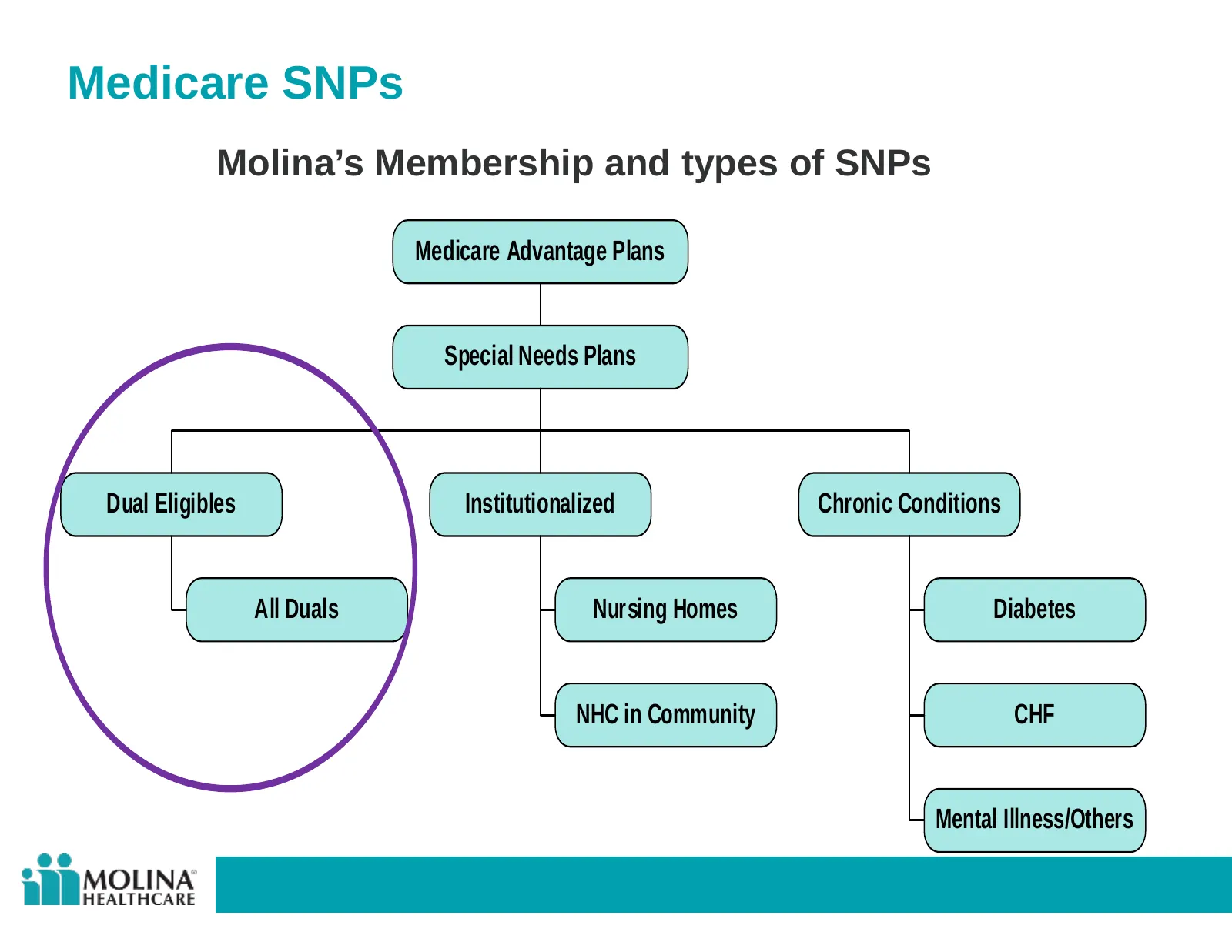
Medicare SNPs Molina’s Membership and types of SNPs Medicare Advantage Plans Special Needs Plans Dual Eligibles Institutionalized Chronic Conditions All Duals Nursing Homes Diabetes NHC in Community CHF Mental Illness/Others
Slide 13: MMP
MMP Also known as Molina Dual Options or Medicare-Medicaid Coordinated Plan (MMCP) for Idaho New 3 way program between CMS, Medicaid and Molina as defined in Section 2602 of the Affordable Care Act Purpose: • Improve quality, reduce costs, and improve the member experience by coordinating service de
Slide 14: Analyzing the Population
Analyzing the Population • On an annual basis, Molina performs a population Needs Assessment to identify the characteristics and needs of the dual eligible member population. • A detailed profile of the medical, social, cognitive, environmental, living conditions, and co-morbidities associated with
Slide 15: Element 2: Care Coordination
ELEMENT 2 CARE COORDINATION Element 2 Care Coordination
Slide 16: Defined Staff Structure
Defined Staff Structure Molina’s MOC program has developed staff structure and roles to meet the needs of dual eligible plan members. Staff Roles include but are not limited to: • Administrative Staff: Member Services Team that serves as a member’s initial point of contact and main source of informa
Slide 17: Administrative and Clinical Oversight Staff
Administrative and Clinical Oversight Staff • Quality Improvement Team: monitors and evaluates MOC activities to help improve the MOC program. • Credentialing department: responsible for ensuring physicians are fully credentialed. • Human Resources team: responsible for ensuring ongoing monitoring i
Slide 18: Core Program Components
Core Program Components Molina utilizes identified tools to improve the quality of care our members receive. The tools include: • Health Risk Assessments • Member Triage • Individualized Care Plans • Interdisciplinary Care Team • Transitions of Care By utilizing these tools we strive to achieve the
Slide 19: Care Management
Care Management Molina Case Managers coordinate the member’s care with the Interdisciplinary Care Team (ICT) which includes designated Molina staff, the member and their family/caregiver, doctors, specialists, vendors, and anyone involved in the member’s care based on the member’s preference of who
Slide 20: Health Risk Assessment (HRA)
Health Risk Assessment (HRA) Health Risk Assessment: Every dual member is evaluated with a comprehensive Health Risk Assessment (HRA) upon enrollment, and at minimum annually, or more frequently with any significant change in condition or transition of care. Frequency: • HRA are conducted within 90
Slide 21: Health Risk Assessment (HRA) cont.
Health Risk Assessment (HRA) cont. The HRA is the primary tool used for risk stratifying members. This helps efficiently identify the level of care and interventions required for the member. The results of the HRA are discussed with the member, when engaged, to jointly develop the member’s Individua
Slide 22: Model of Care – Member Triage
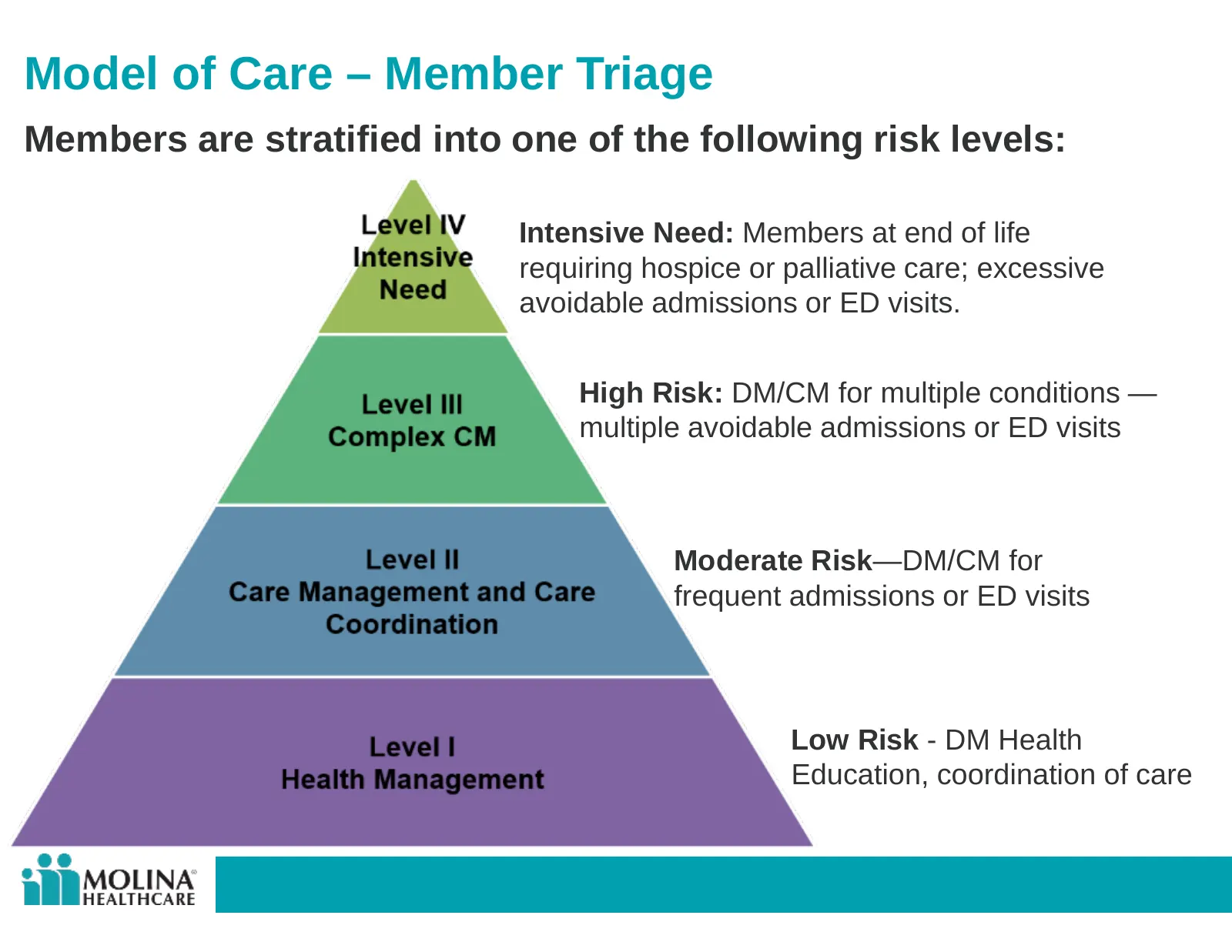
Model of Care – Member Triage Members are stratified into one of the following risk levels: Intensive Need: Members at end of life requiring hospice or palliative care; excessive avoidable admissions or ED visits. High Risk: DM/CM for multiple conditions — multiple avoidable admissions or ED visits
Slide 23: Individualized Care Plans
Individualized Care Plans The results of the HRA are discussed with the member, when engaged, to jointly develop the member’s Individualized Care Plan (ICP) and prioritize identified needs and member goals. The Case Manager’s work with the member to develop and implement member-centric care plans ba
Slide 24: Individualized Care Plans cont.
Individualized Care Plans cont. When engaged, the member’s agreement with the ICP is documented. As core members of the Interdisciplinary Care Team (ICT), all ICPs that are developed or have a significant update must be sent to the Primary Care Provider (PCP) and the member to allow for additional f
Slide 25: Interdisciplinary Care Team (ICT)
Interdisciplinary Care Team (ICT) The core participants of the ICT include the Member, Primary Care Provider (PCP), and Healthcare Services (HCS) staff (e.g. Case Manager, Health Manager). The HCS staff may collaborate with members of the ICT informally through methods such as mail, phone, email and
Slide 26: Interdisciplinary Care Team (ICT) cont.
Interdisciplinary Care Team (ICT) cont. The ICT is built around the member’s preferences and decisions are made collaboratively and with respect to the member’s right to self- direct care. Family members and caregiver participation is encouraged and promoted, with the member’s permission. Molina HCS
Slide 27: Provider ICT Responsibilities
Provider ICT Responsibilities • Actively communicate with: o Molina Case Managers o ICT participants o Members and their representatives • Accept invitations to attend formal meetings of the ICT to discuss member’s care and needs whenever possible • Review and provide feedback to Molina Case Manager
Slide 28: Transitions of Care
Transitions of Care The Molina Transitions of Care (TOC) Program is a Molina developed, patient–centered program designed to improve quality and health outcomes for members, especially those with complex care needs. During an episode of illness, members may receive care in multiple settings often re
Slide 29: Transition of Care (ToC) cont.
Transition of Care (ToC) cont. Inpatient Care Coordination Clinical Staff: • Coordinate with facilities to assist members in the hospital or in a skilled nursing facility to access care at the appropriate level • Work with the facility and member or the member’s representative, the case manager and
Slide 30: Managing Transitions of Care (ToC) cont.
Managing Transitions of Care (ToC) cont. The TOC program supports our members as they transition from an inpatient level of care back to the community for up to 30 days post discharge. Member support may include: • Outreach while in the facility to introduce the program and provide contact informati
Slide 31: Element 3: Provider Network
ELEMENT 3 PROVIDER NETWORK
Slide 32: Provider Network
Provider Network The Molina MOC program maintains a network of providers and facilities that has a special expertise in the care of Dual Eligible members. Molina’s network is designed to provide access to medical, behavioral, and psycho-social services for the dual population. Molina determines prov
Slide 33: Provider Network Cont.
Provider Network Cont. Molina monitors how network providers utilize appropriate clinical practice guidelines and nationally recognized protocols appropriate to the duals population. Molina monitors how providers maintain continuity of care using care transition protocols. Molina provides initial an
Slide 34: Element 4: Quality Measurement & Performance Improvement
ELEMENT 4 QUALITY MEASUREMENT & PERFORMANCE IMPROVEMENT
Slide 35: Quality Measurement & Performance Improvement
Quality Measurement & Performance Improvement Molina employs a comprehensive overall quality performance improvement plan across all of Molina’s departments and functions in collaboration with its provider network. The Quality Improvement plan ensures Molina’s ability to measure and evaluate the eff
Slide 36: Quality Measurement/ Performance Improvement cont.
Quality Measurement/ Performance Improvement cont. Molina’s MOC has established and defined the following goals, in alignment with the Quality Improvement Program and the Quality Performance Improvement Plan, and objectives that support the delivery of care to Molina Medicare members: • Design and m
Slide 37: Quality Measurement/ Performance Improvement (cont)
Quality Measurement/ Performance Improvement (cont) • Ensure program relevance through understanding of member demographics and epidemiological data and provide services and interventions that address the diverse cultural, ethnic, racial and linguistic needs of our member. • Coordinate state and fed
Slide 38: Quality Measurement/ Performance Improvement cont’d
Quality Measurement/ Performance Improvement cont’d • Optimize the use of Medicare, Medicaid, and other State/County resources. • Provide whole-person integrated care management and care coordination. • Reduce institutional (skilled and unskilled nursing facility, state hospital,) placements. • Impr
Slide 39: Summary
Summary The CMS MOC guidelines requires all of us to work together for the benefit of our members by: • Enhancing communication between members, physicians, providers and Molina. • Interdisciplinary approach to the member’s individualized needs. • Comprehensive coordination with all care partners. •
Slide 40: Thank You
Thank You Thank you for your participation in this annual MOC training. We appreciate your willingness to collaborate with Molina. Please complete the attestation form and return to Molina Healthcare. If you have any questions please contact the Provider Service Department. 40
Source: Internet Archive copy of molinahealthcare.com
More decks from Molina Healthcare Inc
 Investor Presentation (August 2026)31 slides · August 2026
 Investor Day (May 2026)76 slides · May 8, 2026
 Investor Presentation (January 2026)54 slides · January 2026
 Investor Presentation (2026)56 slides · 2026
 Investor Presentation (June 2025)29 slides · Jun 30, 2025
 Molina Healthcare of Illinois — MHIL 2025 Provider Orientation Webinar70 slides · Mar 20, 2025