Infineon Technologies AG · XETR:IFX
Infineon Technologies — DSLcon Europe 2000
33 slides from Infineon Technologies's conference presentation, Oct 31, 2000
Slide 1: SHDSL - The advanced symmetrical DSL-Technology
SHDSL - The advanced symmetrical DSL-Technology Sascha Lindecke Senior Marketing Manager Symmetric DSL Infineon Technologies P.O. Box 800949 D-81609 Munich/Germany Phone: +49 89 234-27258 DSLcon Europe 2000 Fax: +49 89 234-22120 S. Lindecke Tuesday, October 31, 2000 sascha.lindecke@infineon.com DSLc
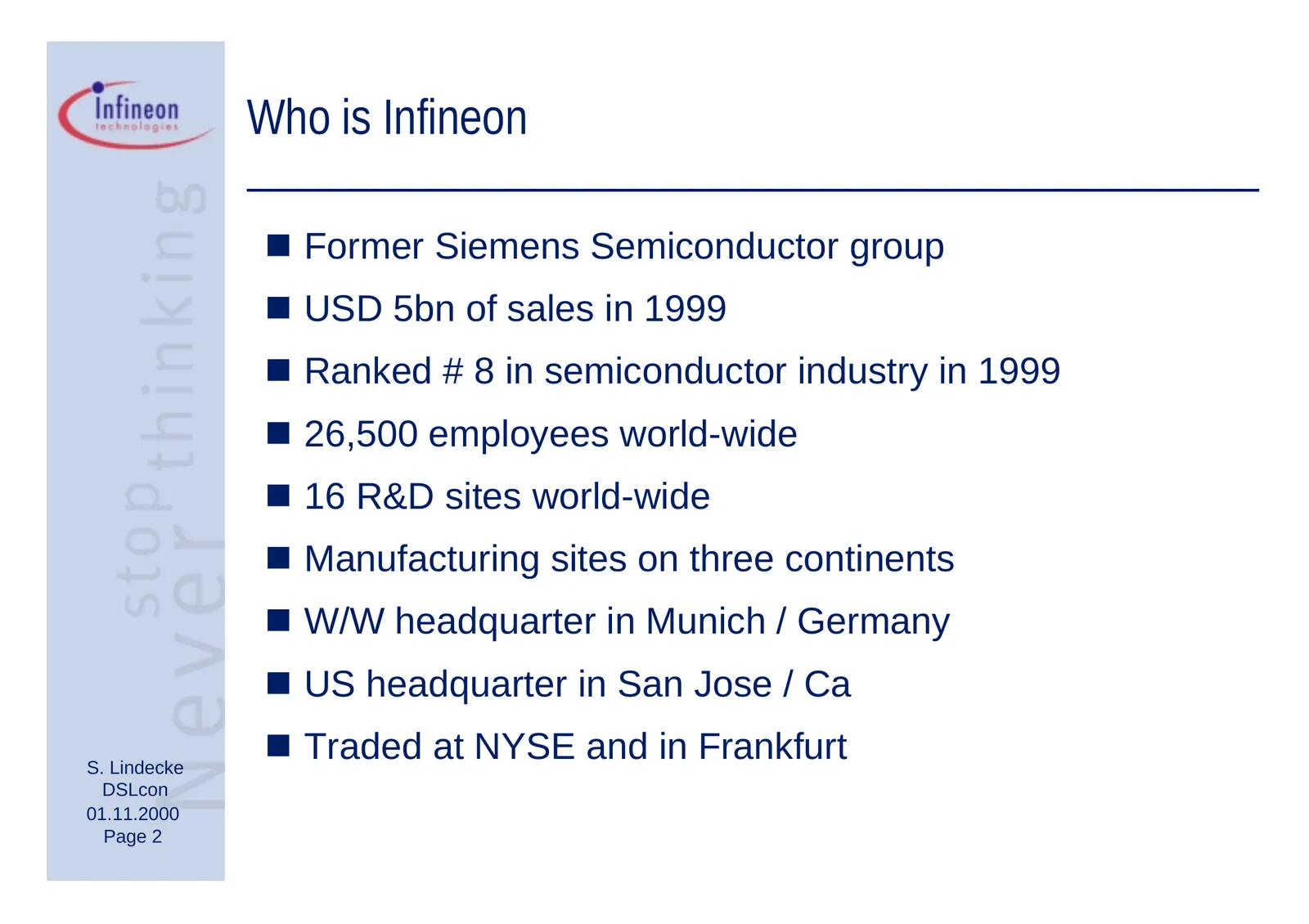
Slide 2: Who is Infineon
Who is Infineon Former Siemens Semiconductor group USD 5bn of sales in 1999 Ranked # 8 in semiconductor industry in 1999 26,500 employees world-wide 16 R&D sites world-wide Manufacturing sites on three continents W/W headquarter in Munich / Germany US headquarter in San Jose / Ca S. Lindecke Traded
Slide 3: Today's Agenda
Today’s Agenda What is SHDSL and how does it work How is it related to other DSL technologies Standardization and interoperability The benefits of SHDSL How does it influence the network structure S. Lindecke DSLcon 01.11.2000 Page 3
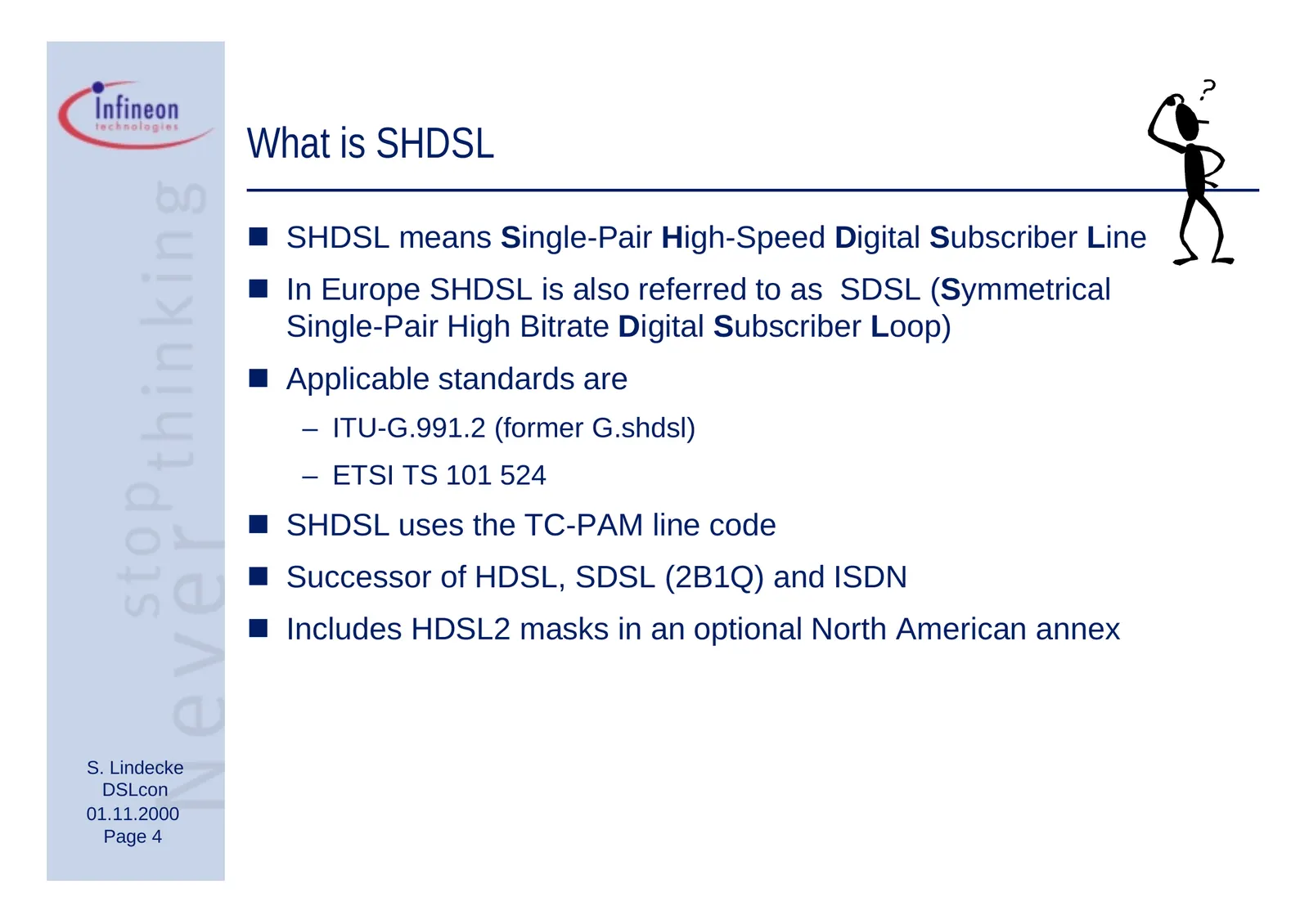
Slide 4: What is SHDSL
What is SHDSL SHDSL means Single-Pair High-Speed Digital Subscriber Line In Europe SHDSL is also referred to as SDSL (Symmetrical Single-Pair High Bitrate Digital Subscriber Loop) Applicable standards are – ITU-G.991.2 (former G.shdsl) – ETSI TS 101 524 SHDSL uses the TC-PAM line code Successor of H
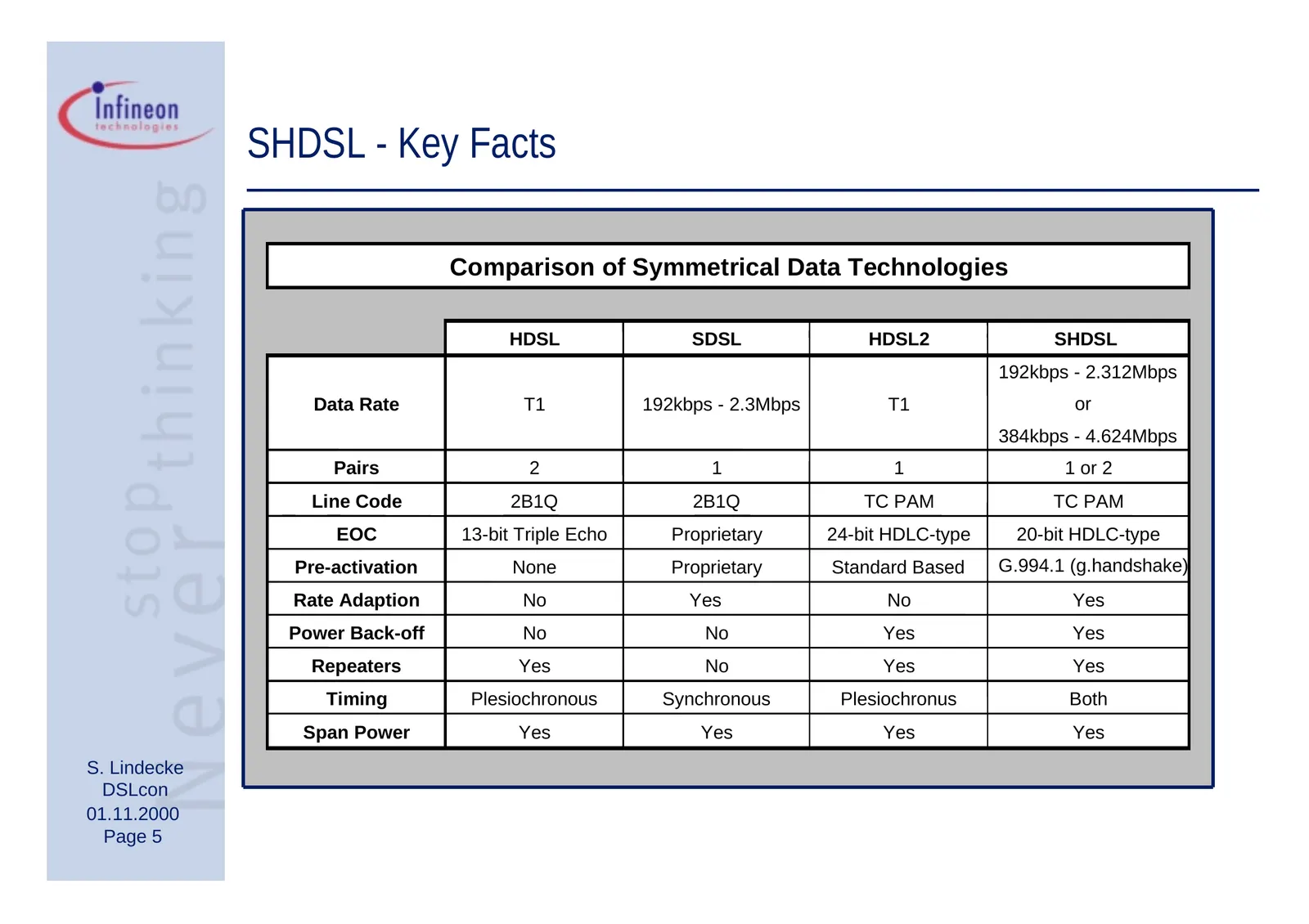
Slide 5: SHDSL - Key Facts
SHDSL - Key Facts Comparison of Symmetrical Data Technologies HDSL SDSL HDSL2 SHDSL 192kbps - 2.312Mbps Data Rate T1 192kbps - 2.3Mbps T1 or 384kbps - 4.624Mbps Pairs 2 1 1 1 or 2 Line Code 2B1Q 2B1Q TC PAM TC PAM EOC 13-bit Triple Echo Proprietary 24-bit HDLC-type 20-bit HDLC-type Pre-activation No
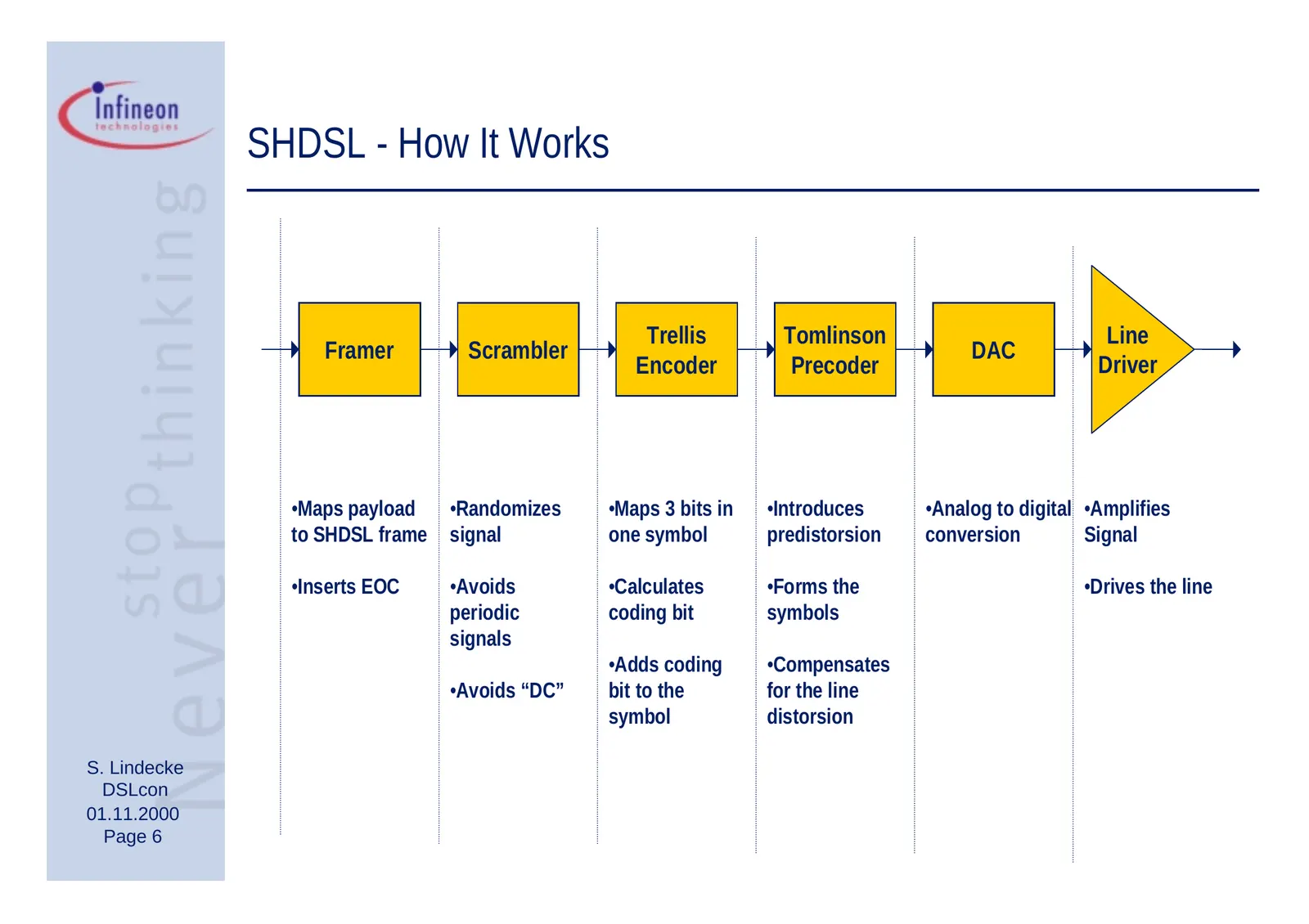
Slide 6: SHDSL - How It Works
SHDSL - How It Works Trellis Tomlinson Line Framer Scrambler DAC Encoder Precoder Driver •Maps payload •Randomizes •Maps 3 bits in •Introduces •Analog to digital •Amplifies to SHDSL frame signal one symbol predistorsion conversion Signal •Inserts EOC •Avoids •Calculates •Forms the •Drives the line p
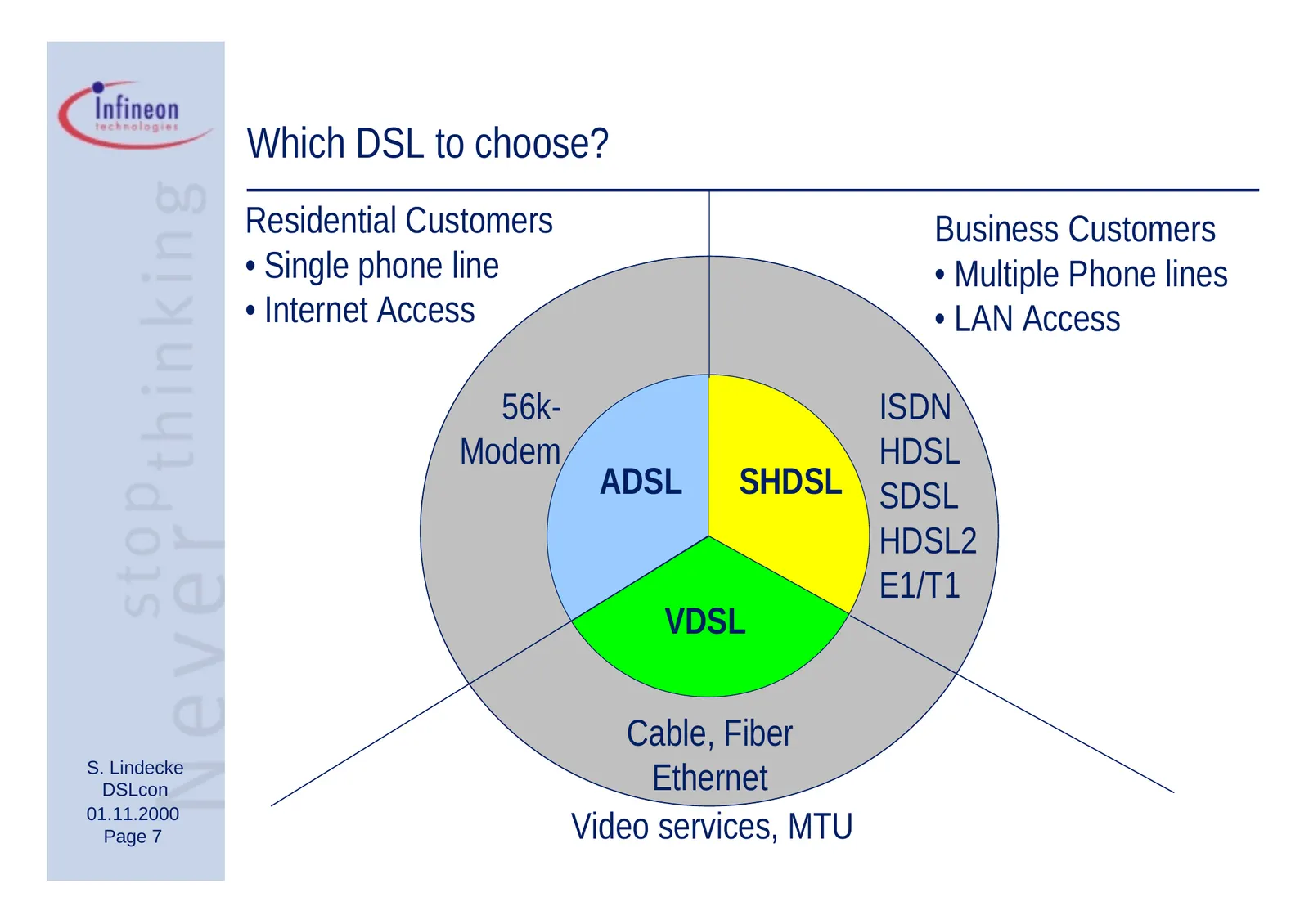
Slide 7: Which DSL to choose?
Which DSL to choose? Residential Customers Business Customers • Single phone line • Multiple Phone lines • Internet Access • LAN Access 56k- ISDN Modem HDSL ADSL SHDSL SDSL HDSL2 E1/T1 VDSL Cable, Fiber S. Lindecke DSLcon Ethernet 01.11.2000 Page 7 Video services, MTU
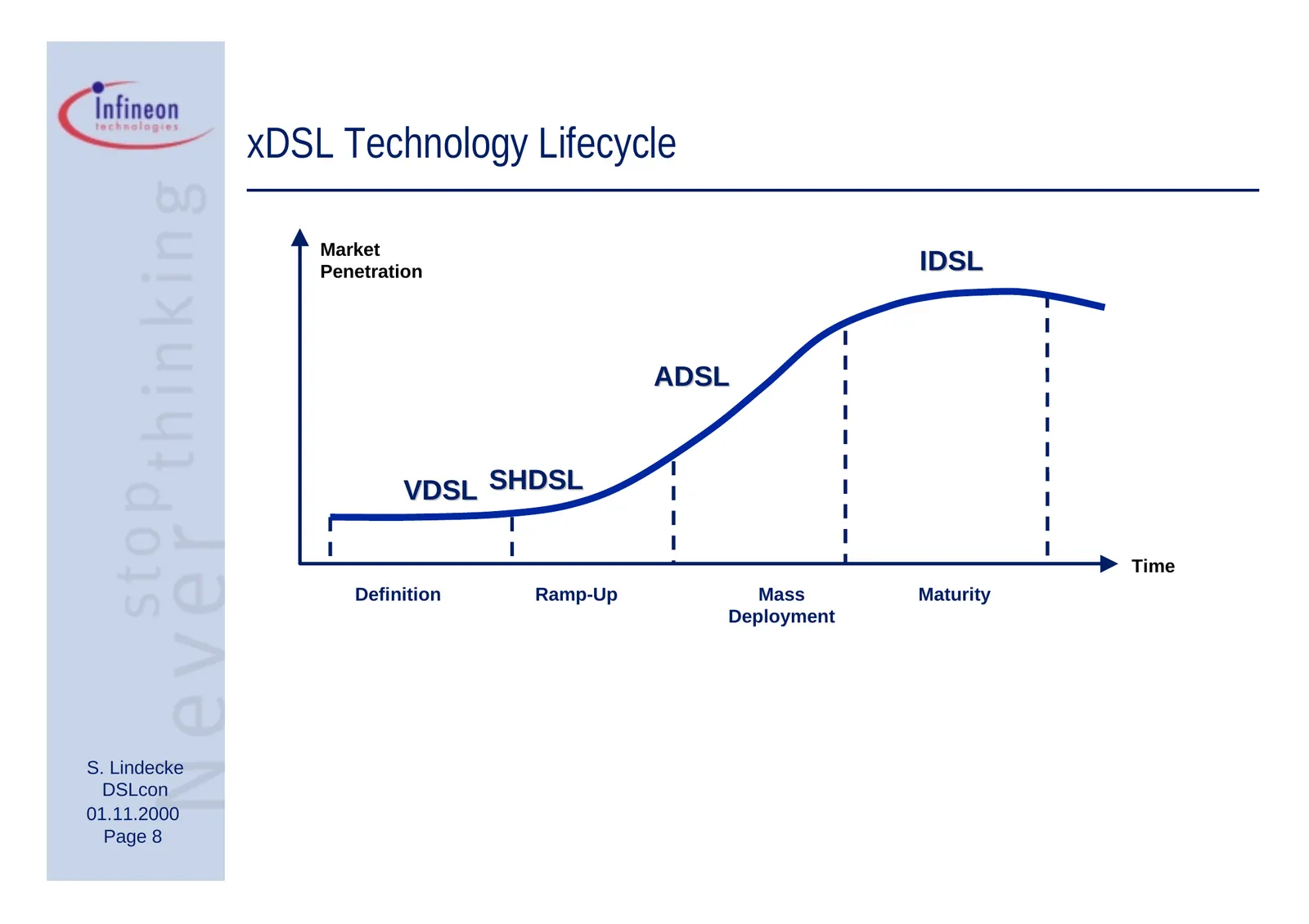
Slide 8: xDSL Technology Lifecycle
xDSL Technology Lifecycle Market Penetration IDSL ADSL VDSL SHDSL Time Definition Ramp-Up Mass Maturity Deployment S. Lindecke DSLcon 01.11.2000 Page 8
Slide 9: SHDSL Technology Lifecycle
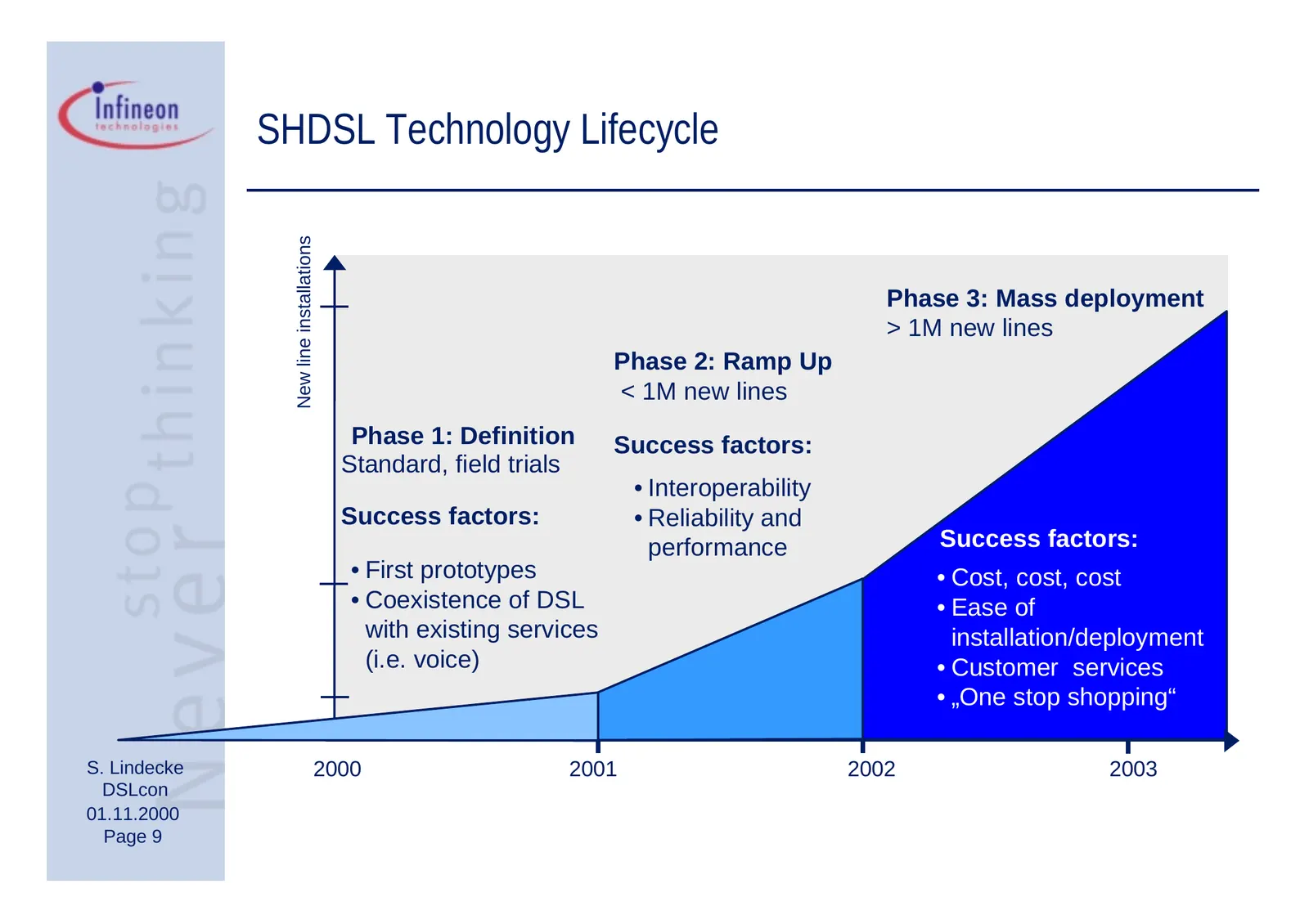
SHDSL Technology Lifecycle New line installations Phase 3: Mass deployment > 1M new lines Phase 2: Ramp Up < 1M new lines Phase 1: Definition Success factors: Standard, field trials • Interoperability Success factors: • Reliability and performance Success factors: • First prototypes • Cost, cost, co
Slide 10: Evolution Of Transmission Infrastructure
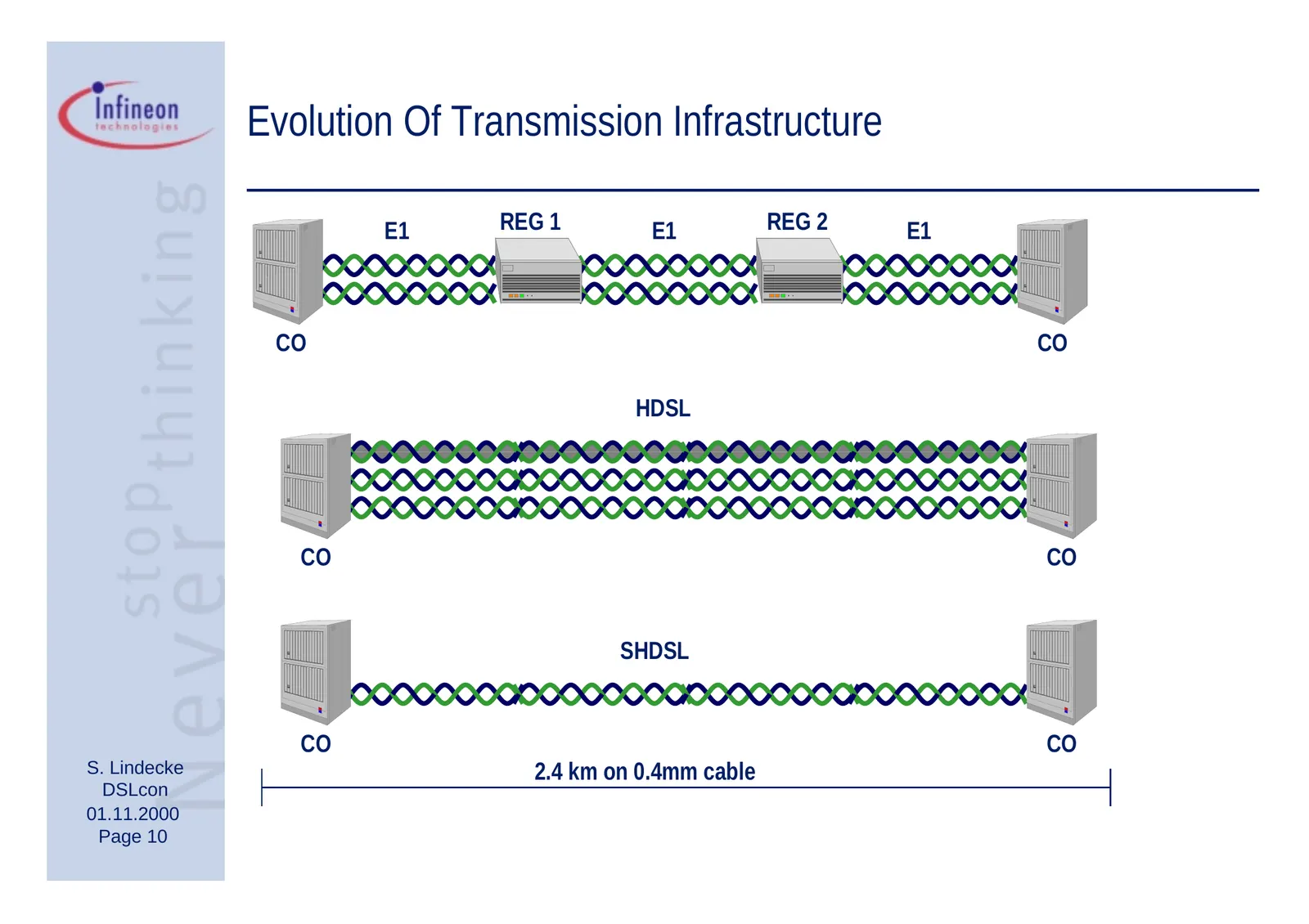
Evolution Of Transmission Infrastructure E1 REG 1 E1 REG 2 E1 CO CO HDSL CO CO SHDSL CO CO S. Lindecke 2.4 km on 0.4mm cable DSLcon 01.11.2000 Page 10
Slide 11: Evolution Of Subscriber Access
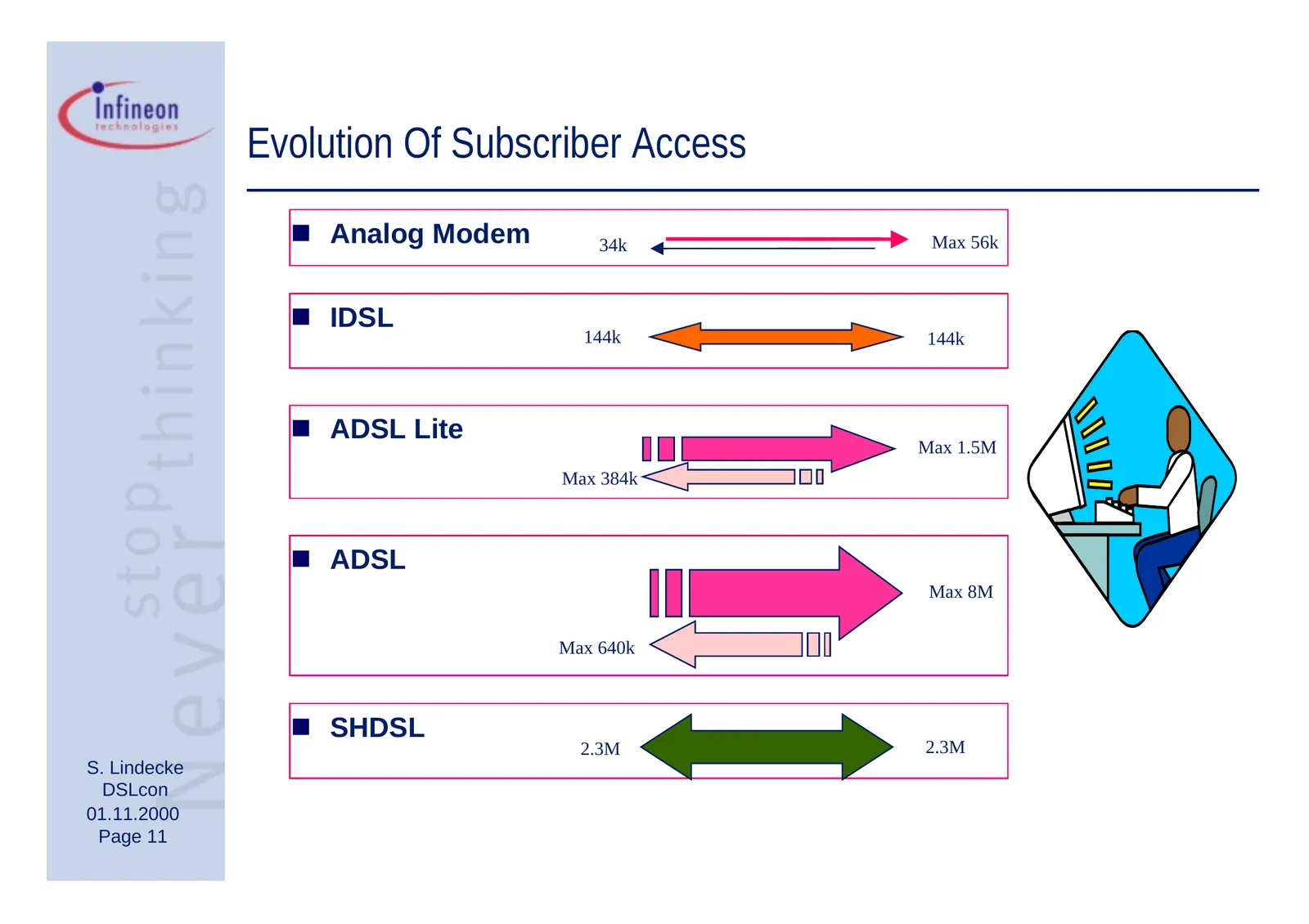
Evolution Of Subscriber Access Analog Modem 34k Max 56k IDSL 144k 144k ADSL Lite Max 1.5M Max 384k ADSL Max 8M Max 640k SHDSL 2.3M 2.3M S. Lindecke DSLcon 01.11.2000 Page 11
Slide 12: SHDSL vs. ADSL: Voice transmission capability
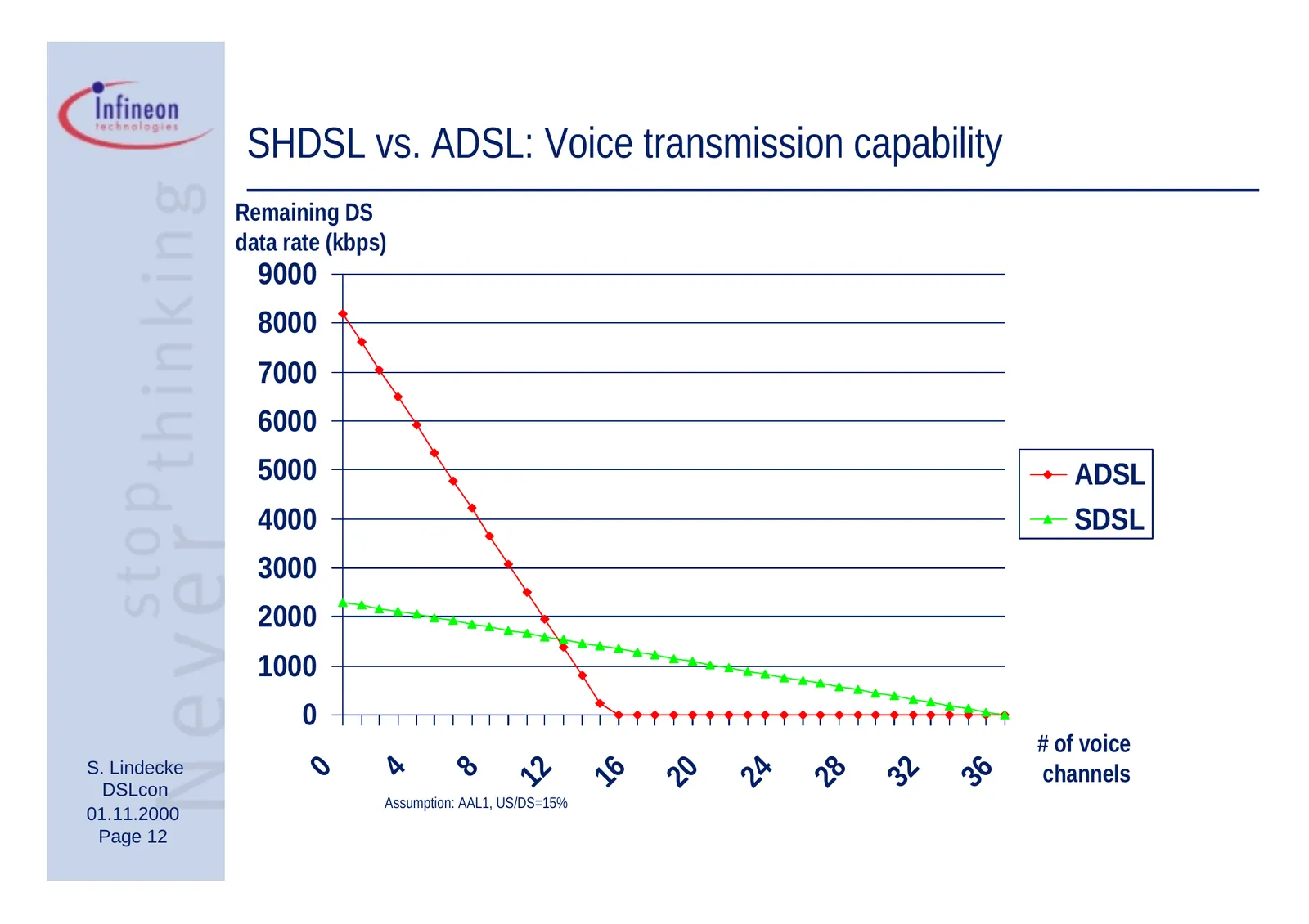
SHDSL vs. ADSL: Voice transmission capability Remaining DS data rate (kbps) 9000 8000 7000 6000 5000 ADSL 4000 SDSL 3000 2000 1000 0 # of voice S. Lindecke channels 0 4 8 12 16 20 24 28 32 36 DSLcon Assumption: AAL1, US/DS=15% 01.11.2000 Page 12
Slide 13: Competitive Edge Of SHDSL
Competitive Edge Of SHDSL Flexibility – Creates new business models – Allows entry to competitor’s markets – Allows to updating the service without new installation Easy deployment – Spectral compatibility eases approval issues – Spectral compatibility allows management of the bundle – Standardizati
Slide 14: Flexibility
Flexibility Scalable bit rate allows tailor-made access – Customer pays only the bandwidth he needs Bandwidth for voice and data can be dynamically allocated – Unused voice channels can carry data Usage in TDM, ATM or even mixed environment possible – Fits DSLAMs as well as Loop Carriers Service can
Slide 15: Which new services can be offered with SHDSL?
Which new services can be offered with SHDSL? Business Subscribers – Combined Multichannel voice plus data service – Videoconferencing together with other services – Web page hosting – Remote LAN Access – Leased lines with customer specific data rates – Telemedicine Residential Users – Long reach fo
Slide 16: Easy deployment
Easy deployment Standardization – allows mass deployment – guarantees interoperability Interoperability – Working group founded at UNH – Addressed by DSL-Forum Spectral compatibility – Lower bandwidth than HDSL at comparable data rate Higher cross talk on higher frequencies – Fits always under the I
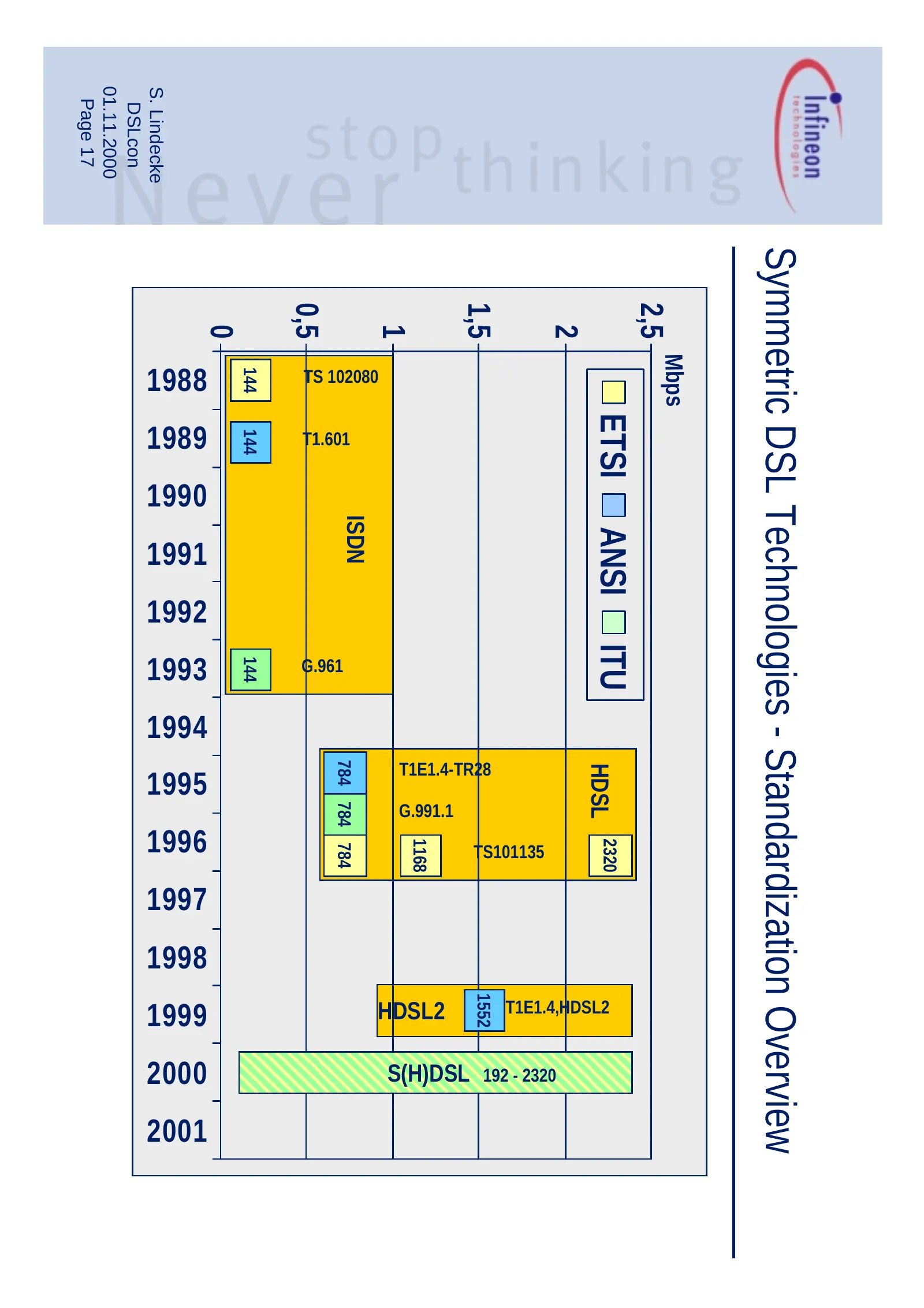
Slide 17: Symmetric DSL Technologies - Standardization Overview
Symmetric DSL Technologies - Standardization Overview Mbps 2,5 ETSI ANSI ITU HDSL 2320 T1E1.4,HDSL2 2 S(H)DSL 192 - 2320 TS101135 1,5 1552 T1E1.4-TR28 G.991.1 HDSL2 1168 1 TS 102080 ISDN 784 784 784 T1.601 G.961 0,5 144 144 144 0 1988 1989 1990 1991 1992 1993 1994 1995 1996 1997 1998 1999 2000 2001
Slide 18: Standardization Status
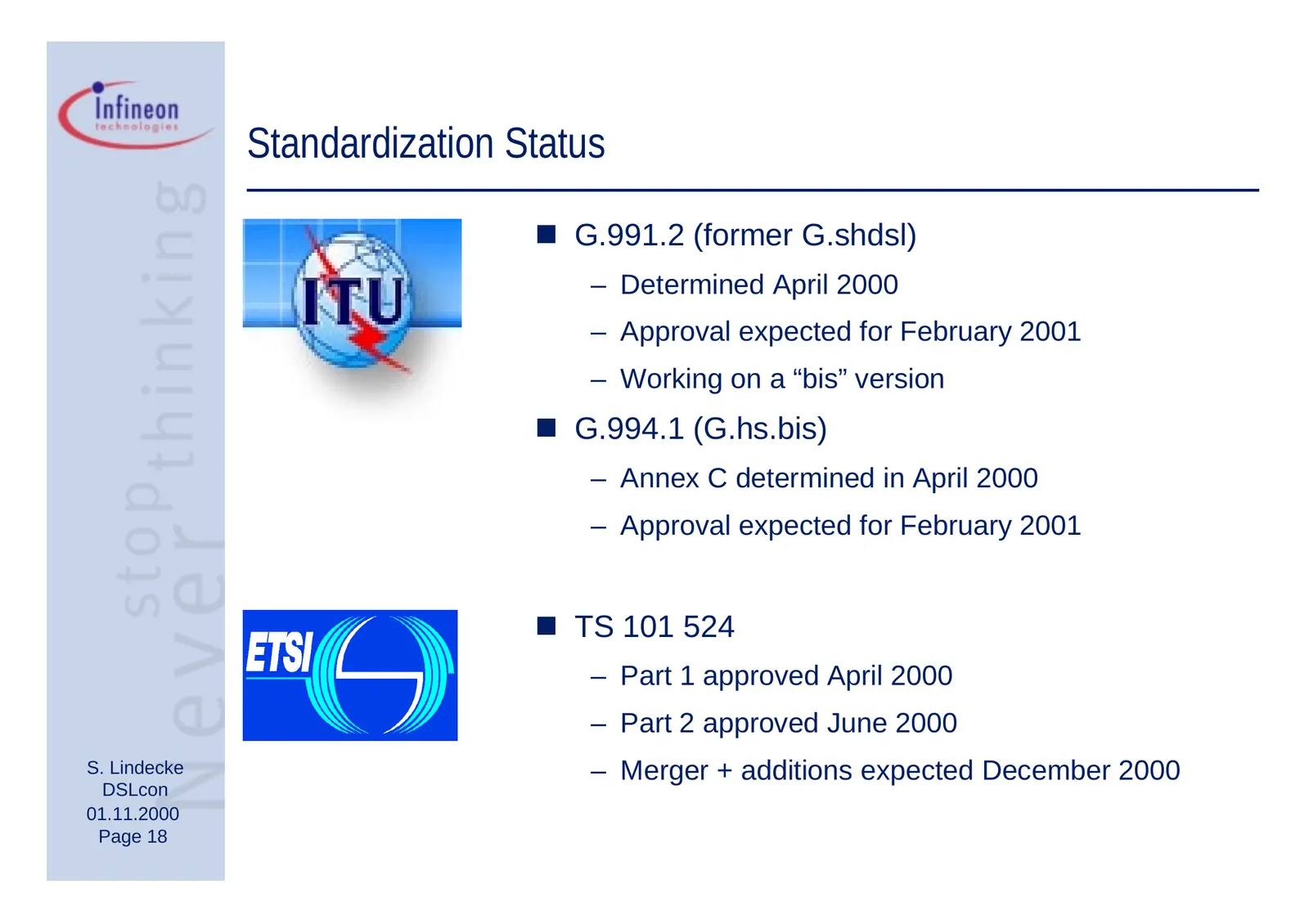
Standardization Status G.991.2 (former G.shdsl) – Determined April 2000 – Approval expected for February 2001 – Working on a “bis” version G.994.1 (G.hs.bis) – Annex C determined in April 2000 – Approval expected for February 2001 TS 101 524 – Part 1 approved April 2000 – Part 2 approved June 2000 S
Slide 19: Interoperability Status
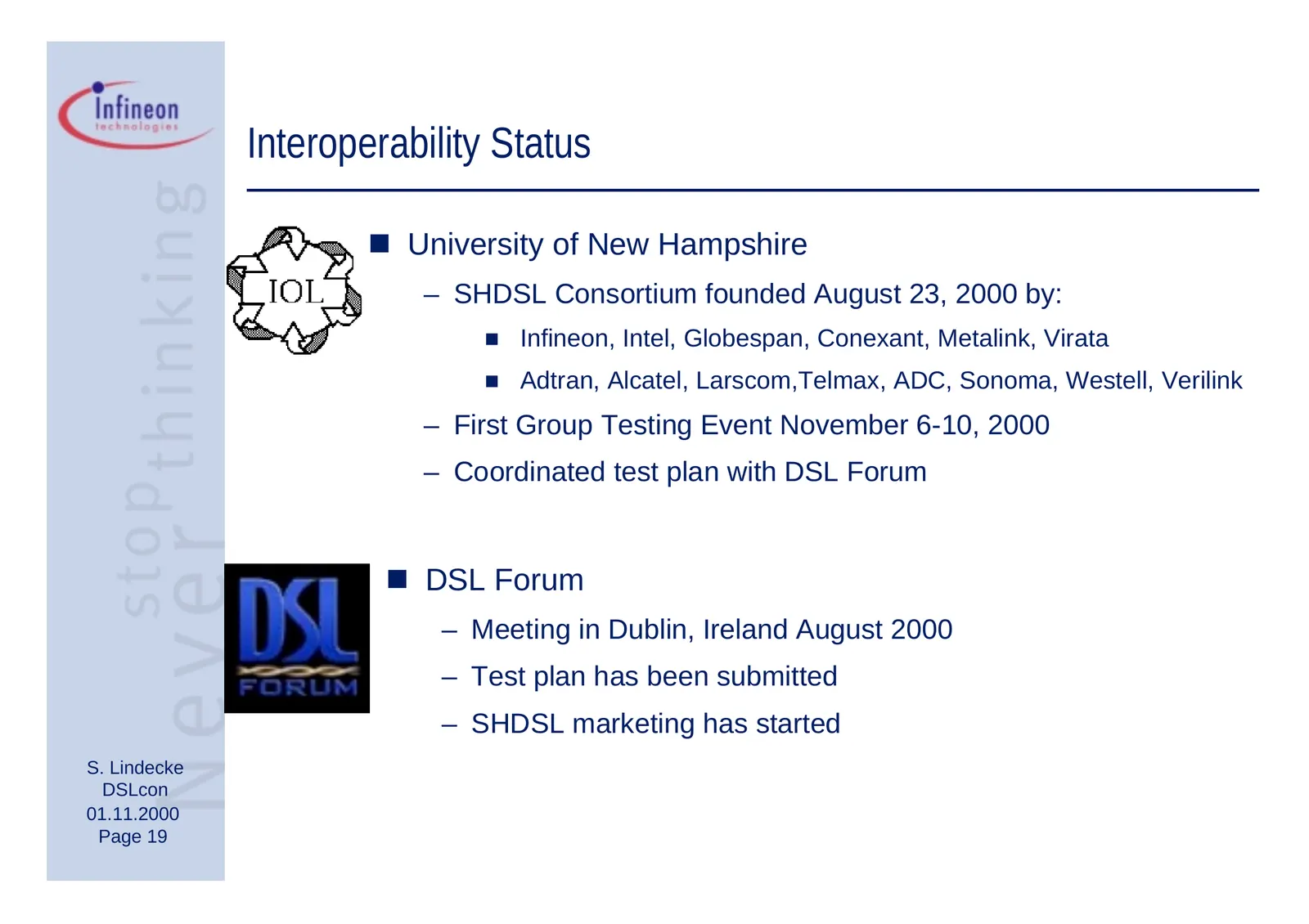
Interoperability Status University of New Hampshire – SHDSL Consortium founded August 23, 2000 by: Infineon, Intel, Globespan, Conexant, Metalink, Virata Adtran, Alcatel, Larscom,Telmax, ADC, Sonoma, Westell, Verilink – First Group Testing Event November 6-10, 2000 – Coordinated test plan with DSL F
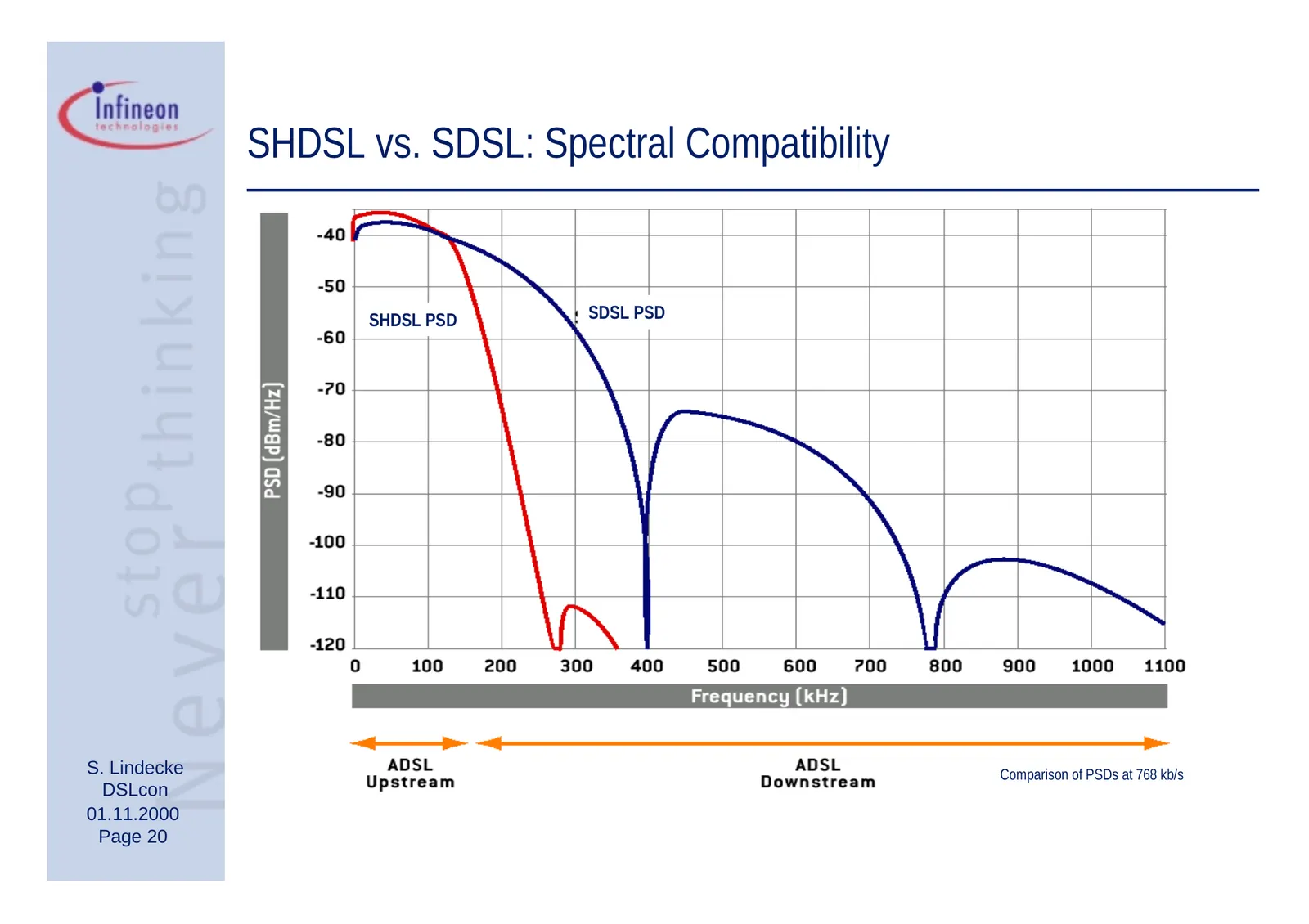
Slide 20: SHDSL vs. SDSL: Spectral Compatibility
SHDSL vs. SDSL: Spectral Compatibility SHDSL PSD SDSL PSD S. Lindecke Comparison of PSDs at 768 kb/s DSLcon 01.11.2000 Page 20
Slide 21: FSAN position on the PSD proposal for SHDSL in WD18
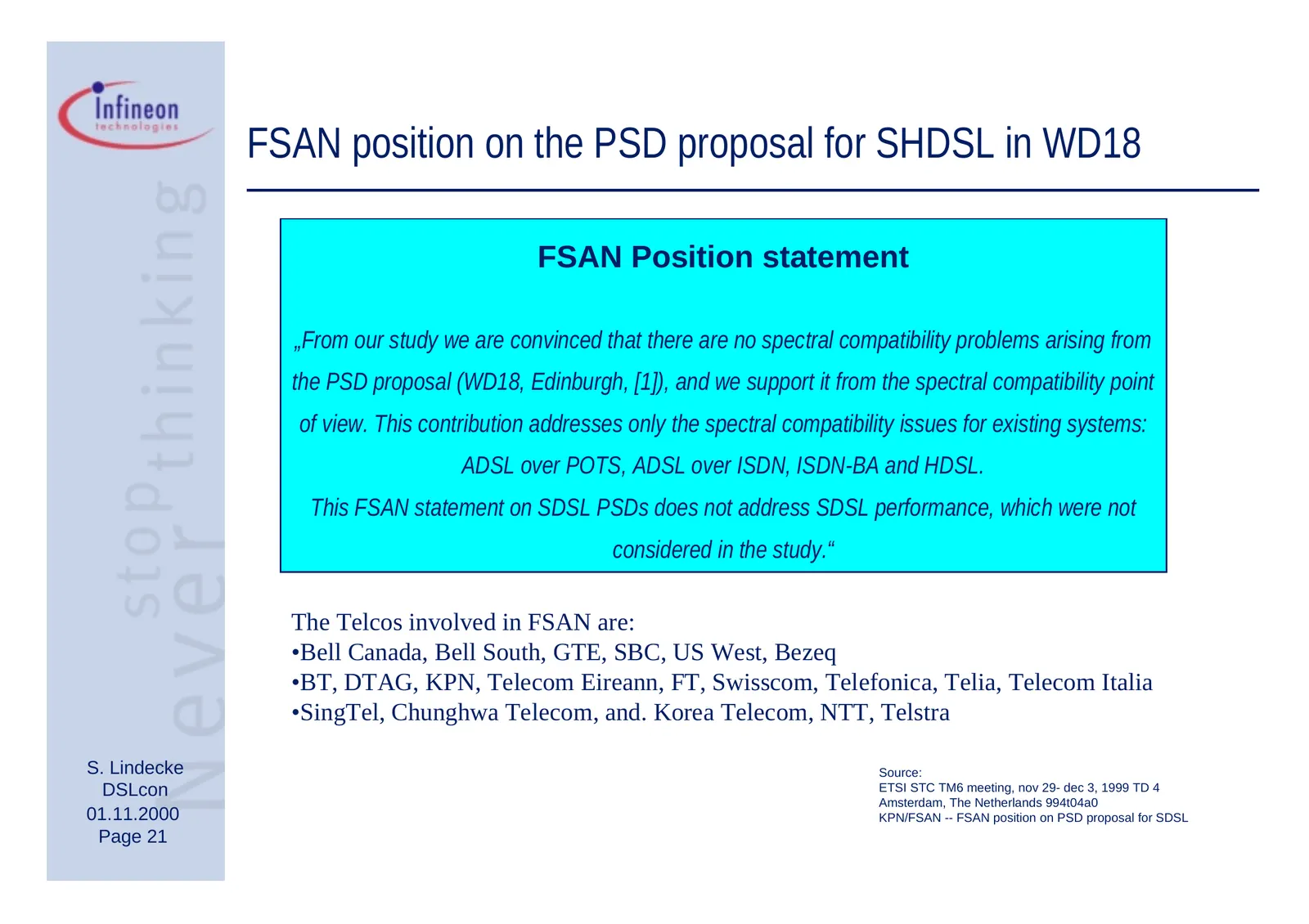
FSAN position on the PSD proposal for SHDSL in WD18 FSAN Position statement „From our study we are convinced that there are no spectral compatibility problems arising from the PSD proposal (WD18, Edinburgh, [1]), and we support it from the spectral compatibility point of view. This contribution addr
Slide 22: Cost Efficiency
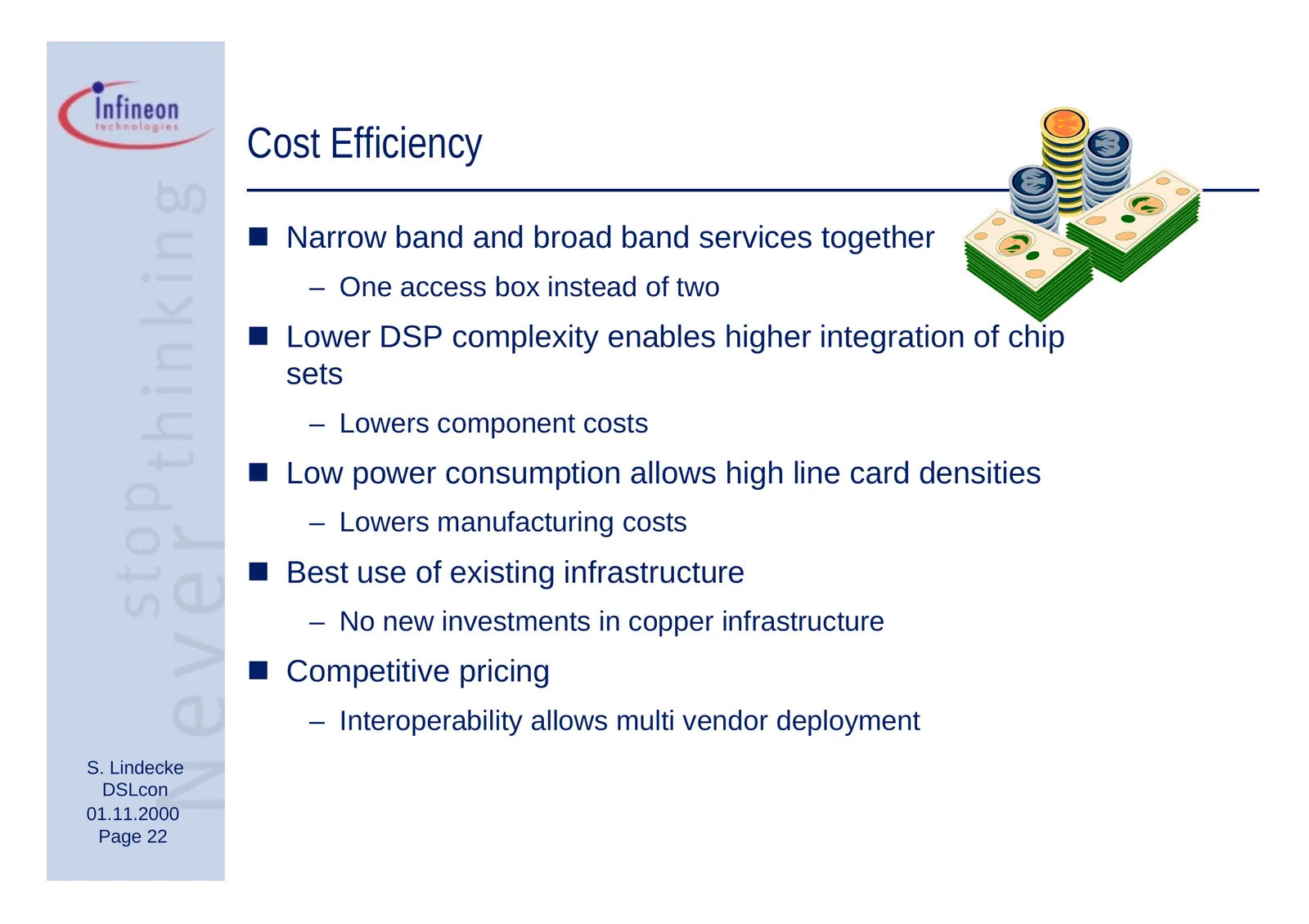
Cost Efficiency Narrow band and broad band services together – One access box instead of two Lower DSP complexity enables higher integration of chip sets – Lowers component costs Low power consumption allows high line card densities – Lowers manufacturing costs Best use of existing infrastructure –
Slide 23: SHDSL vs. SDSL: Performance
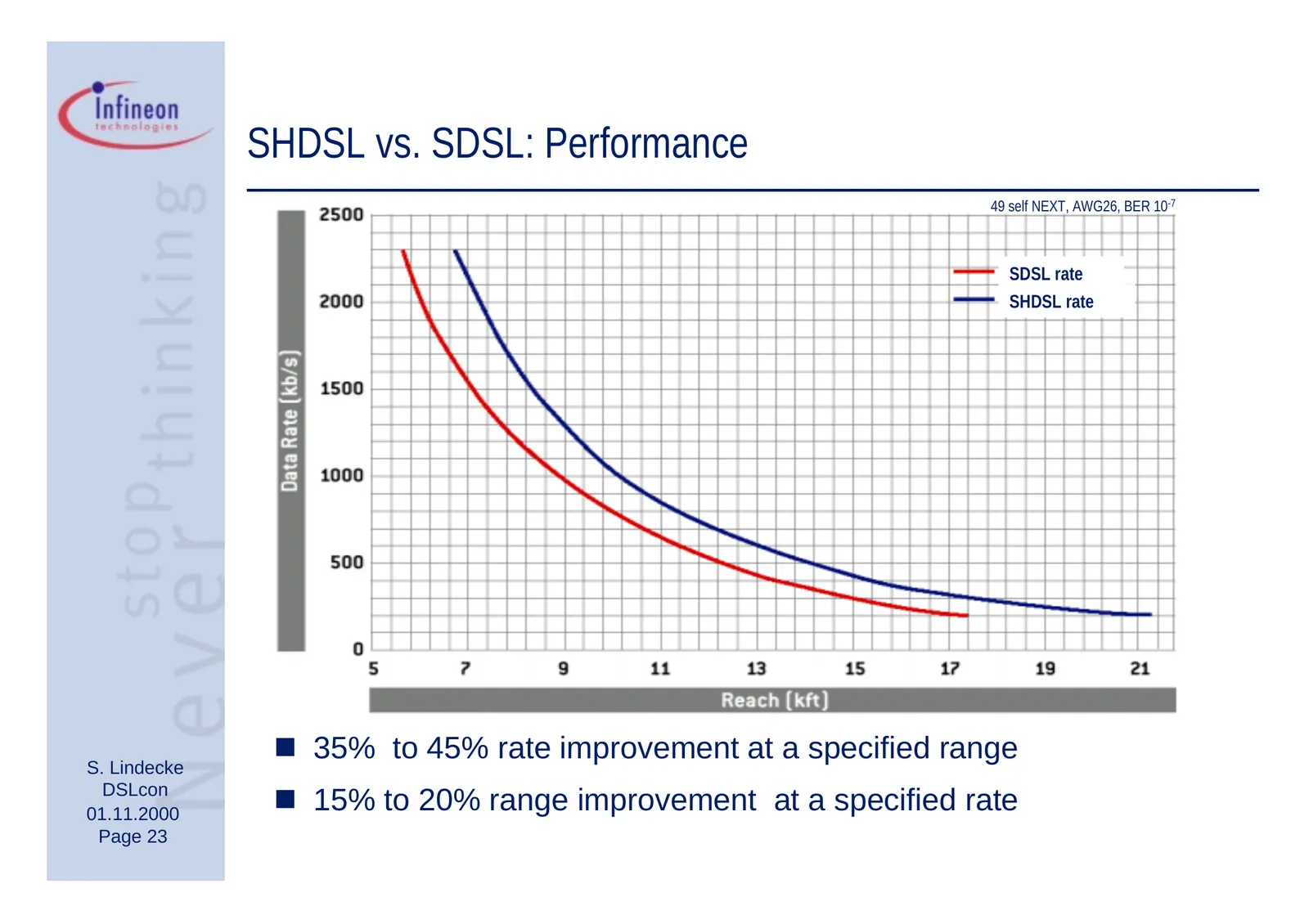
SHDSL vs. SDSL: Performance 49 self NEXT, AWG26, BER 10-7 SDSL rate SHDSL rate 35% to 45% rate improvement at a specified range S. Lindecke DSLcon 01.11.2000 15% to 20% range improvement at a specified rate Page 23
Slide 24: Flexibility: Mix Of Voice And Data Services
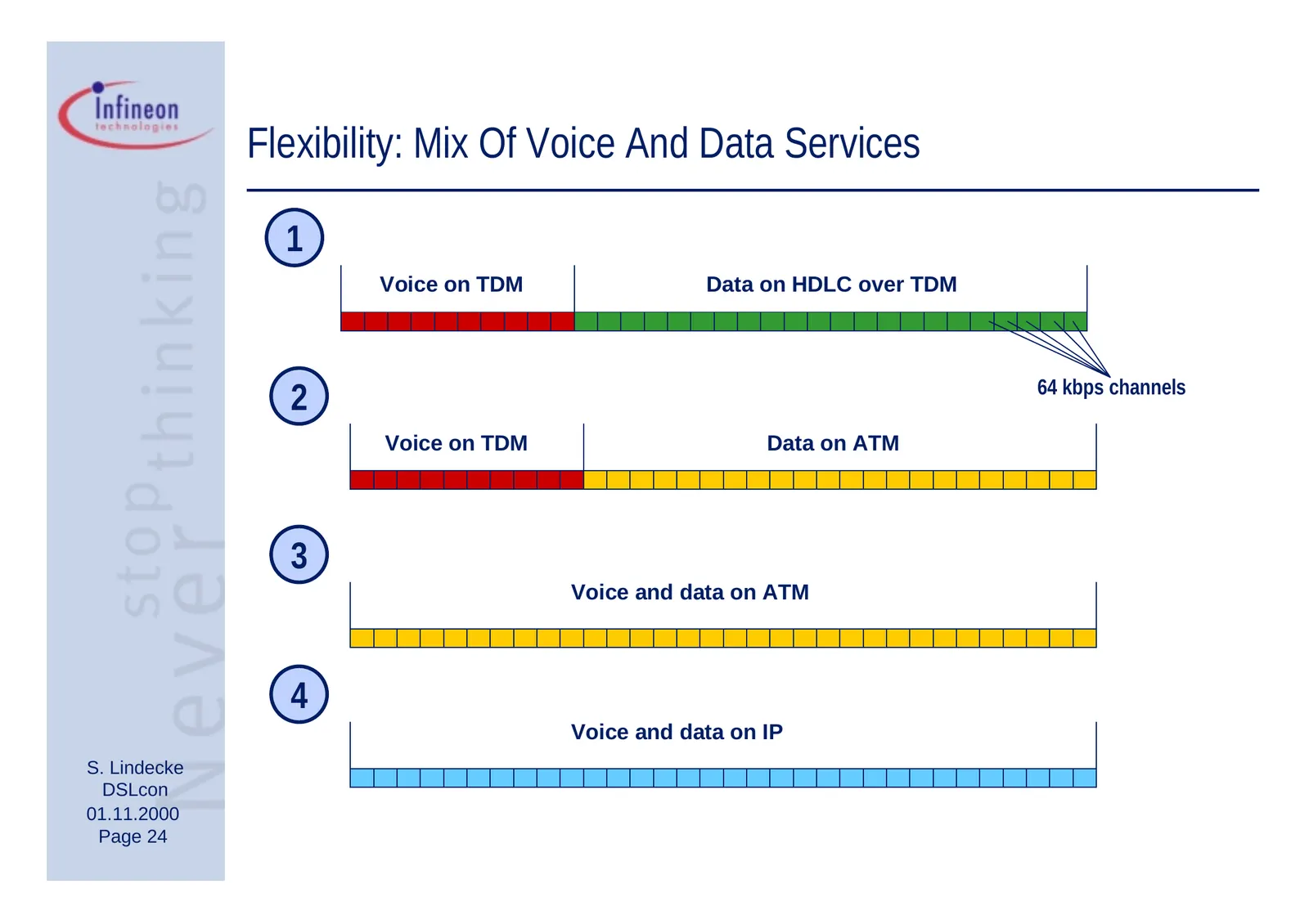
Flexibility: Mix Of Voice And Data Services 1 Voice on TDM Data on HDLC over TDM 64 kbps channels 2 Voice on TDM Data on ATM 3 Voice and data on ATM 4 Voice and data on IP S. Lindecke DSLcon 01.11.2000 Page 24
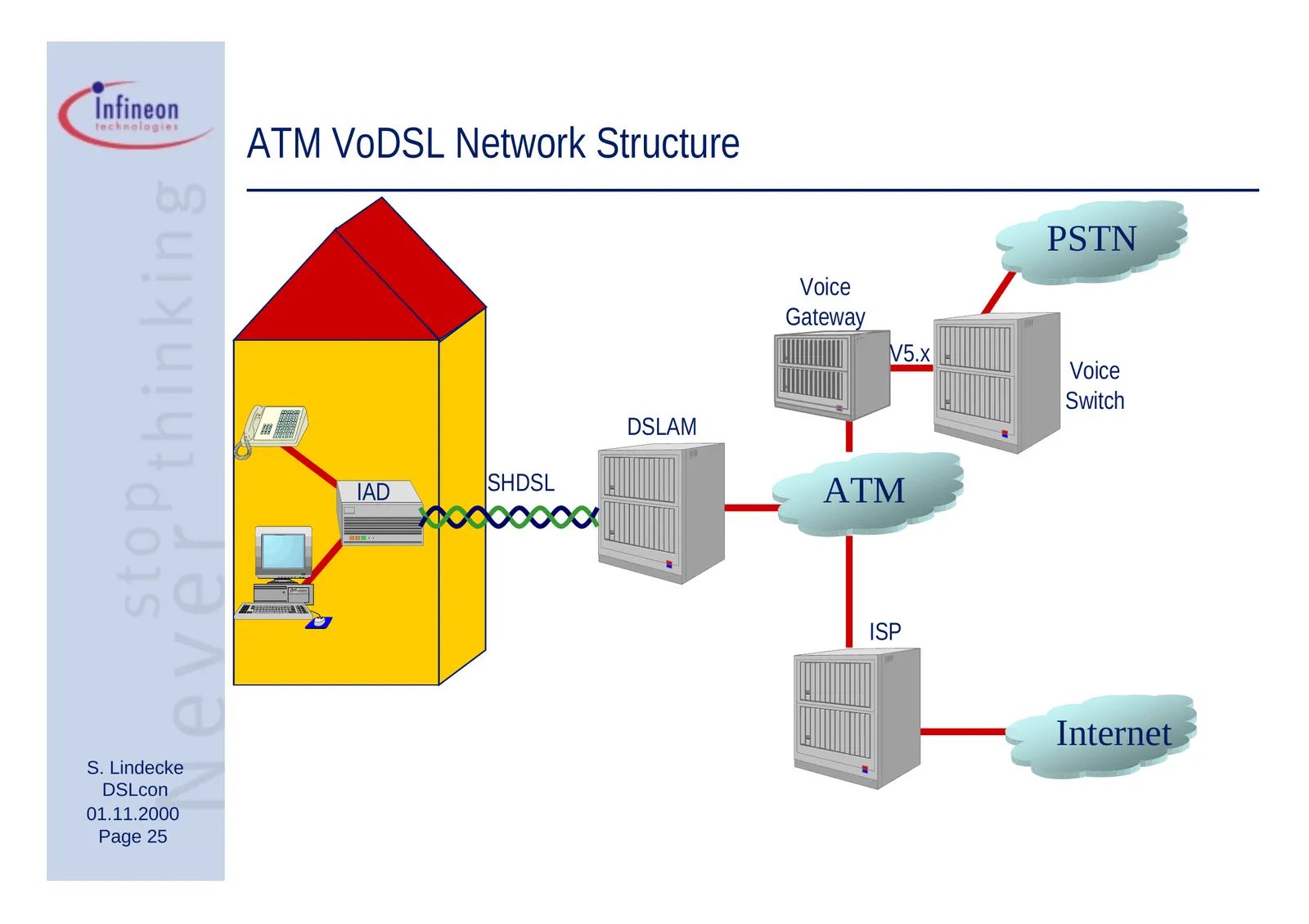
Slide 25: ATM VoDSL Network Structure
ATM VoDSL Network Structure PSTN Voice Gateway V5.x Voice Switch DSLAM IAD SHDSL ATM ISP Internet S. Lindecke DSLcon 01.11.2000 Page 25
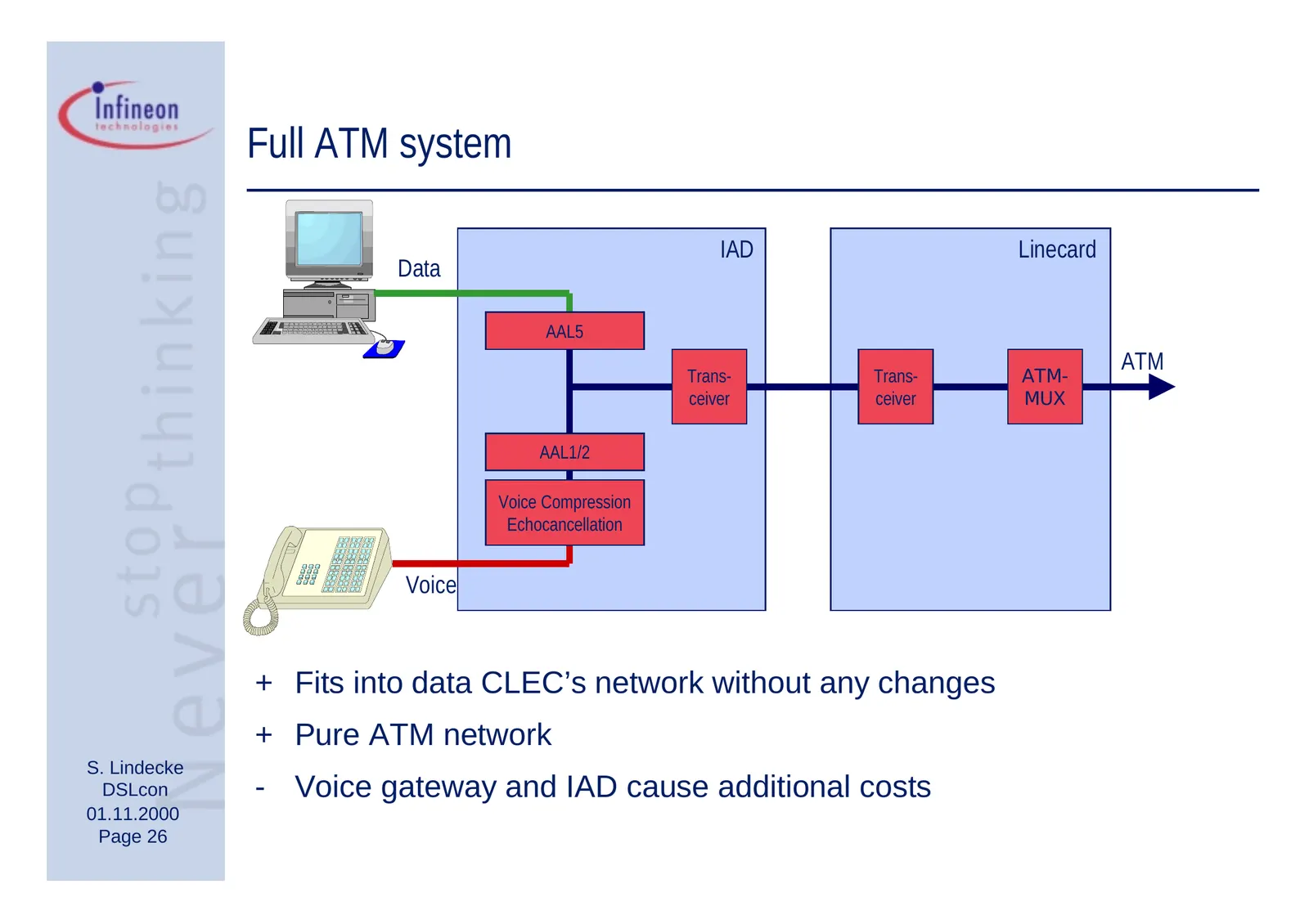
Slide 26: Full ATM system
Full ATM system IAD Linecard Data AAL5 ATM Trans- Trans- ATM- ceiver ceiver MUX AAL1/2 Voice Compression Echocancellation Voice + Fits into data CLEC’s network without any changes + Pure ATM network S. Lindecke DSLcon - Voice gateway and IAD cause additional costs 01.11.2000 Page 26
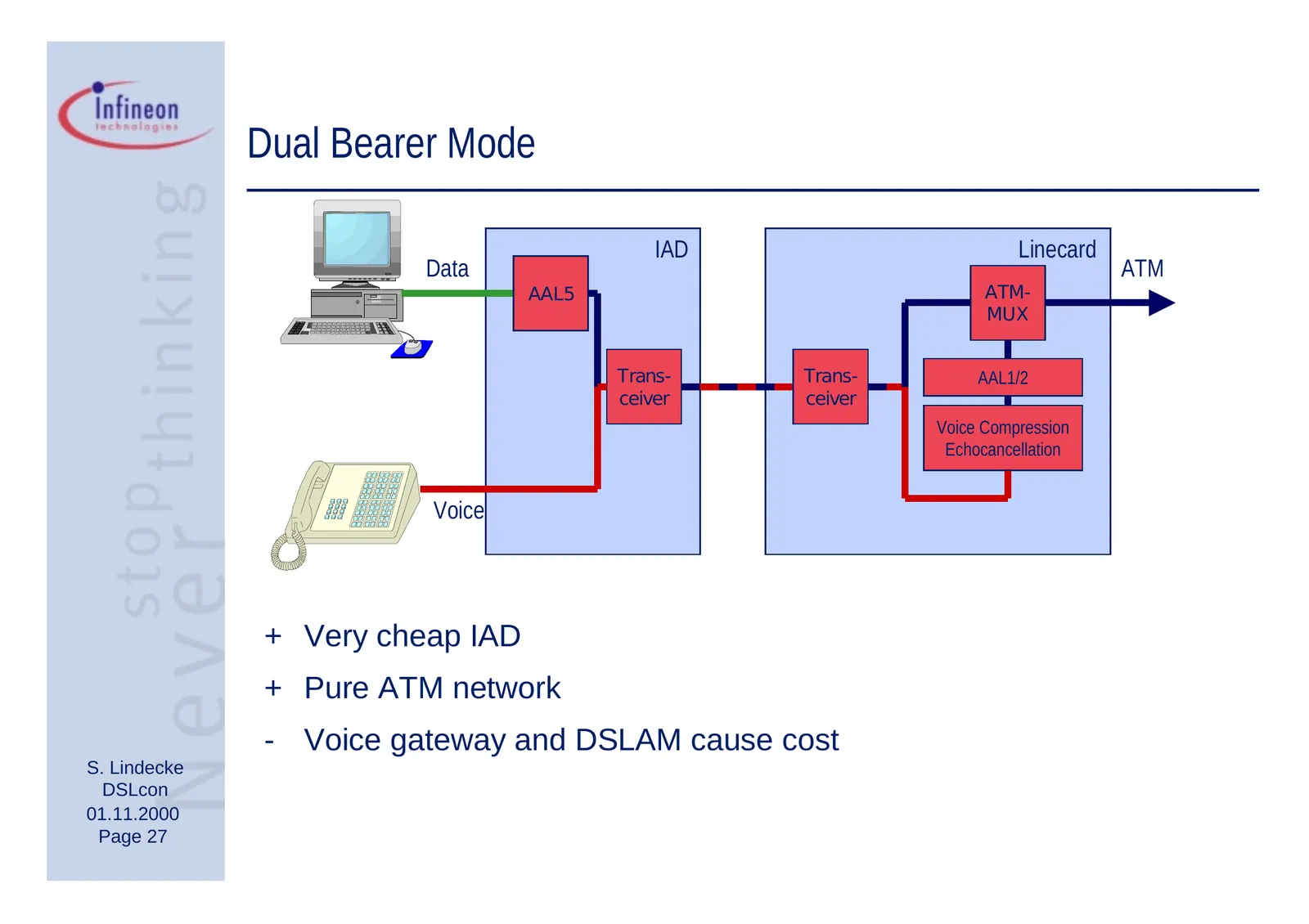
Slide 27: Dual Bearer Mode
Dual Bearer Mode IAD Linecard Data ATM AAL5 ATM- MUX Trans- Trans- AAL1/2 ceiver ceiver Voice Compression Echocancellation Voice + Very cheap IAD + Pure ATM network - Voice gateway and DSLAM cause cost S. Lindecke DSLcon 01.11.2000 Page 27
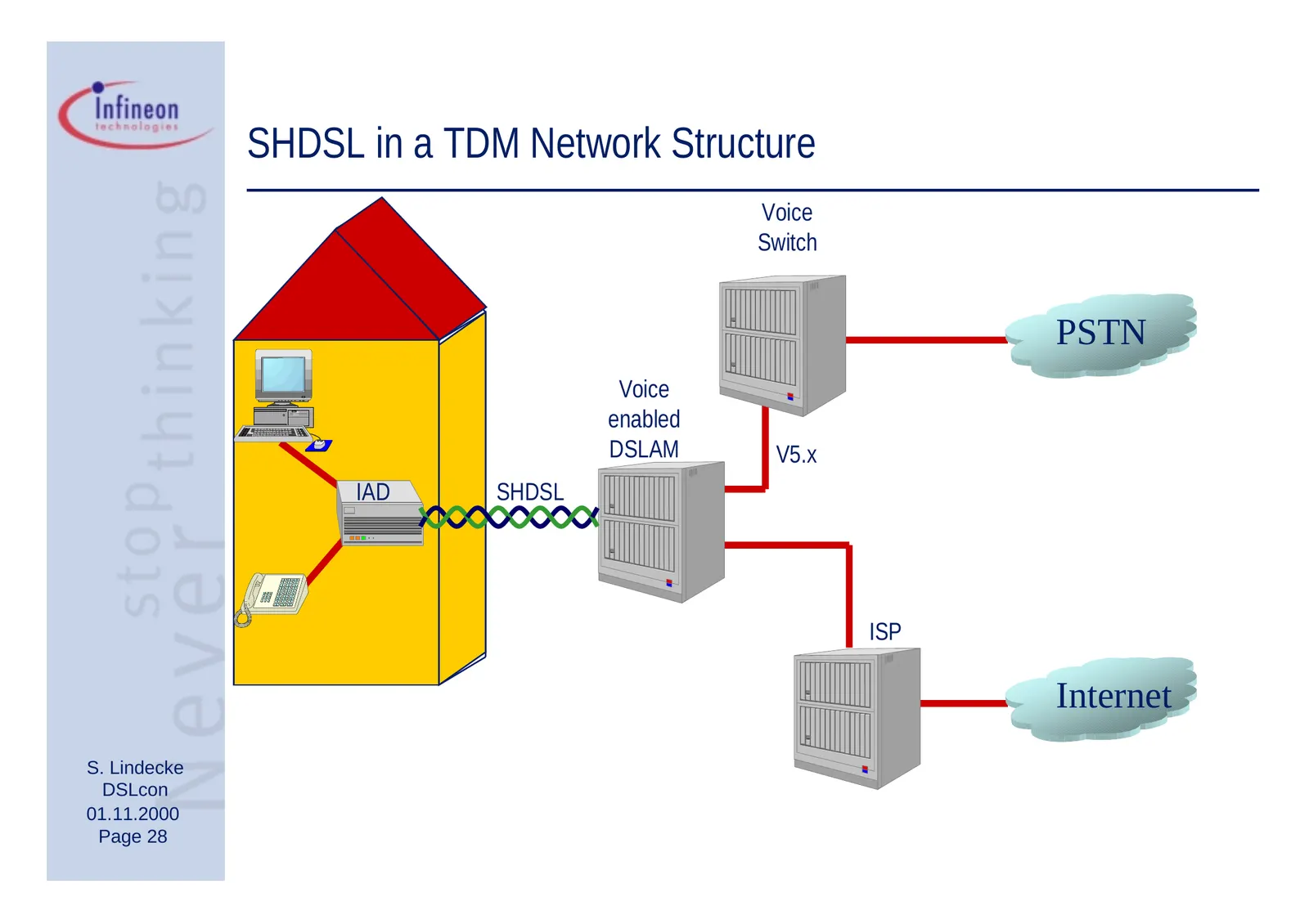
Slide 28: SHDSL in a TDM Network Structure
SHDSL in a TDM Network Structure Voice Switch PSTN Voice enabled DSLAM V5.x IAD SHDSL ISP Internet S. Lindecke DSLcon 01.11.2000 Page 28
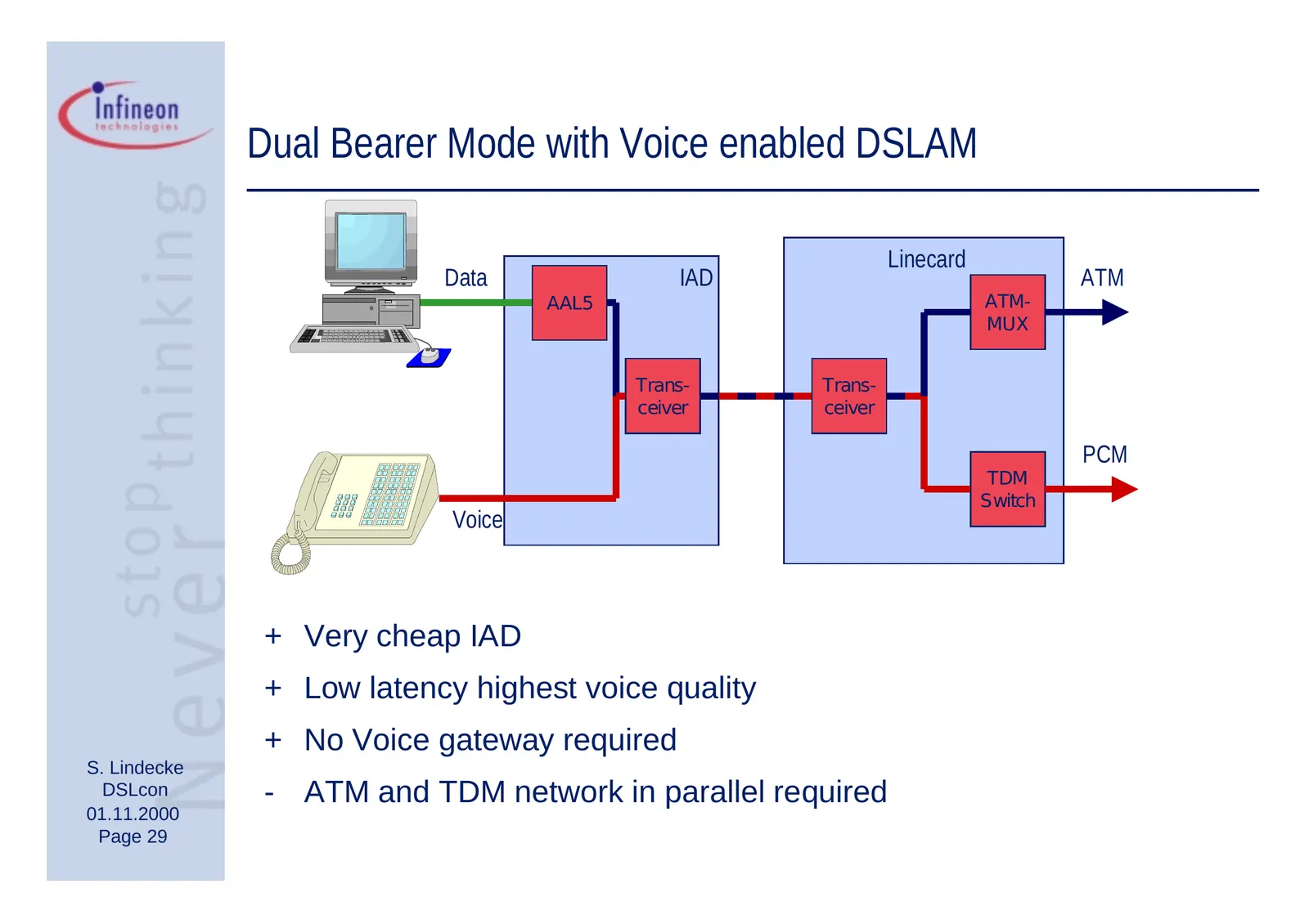
Slide 29: Dual Bearer Mode with Voice enabled DSLAM
Dual Bearer Mode with Voice enabled DSLAM Linecard Data IAD ATM AAL5 ATM- MUX Trans- Trans- ceiver ceiver PCM TDM Switch Voice + Very cheap IAD + Low latency highest voice quality + No Voice gateway required S. Lindecke DSLcon - ATM and TDM network in parallel required 01.11.2000 Page 29
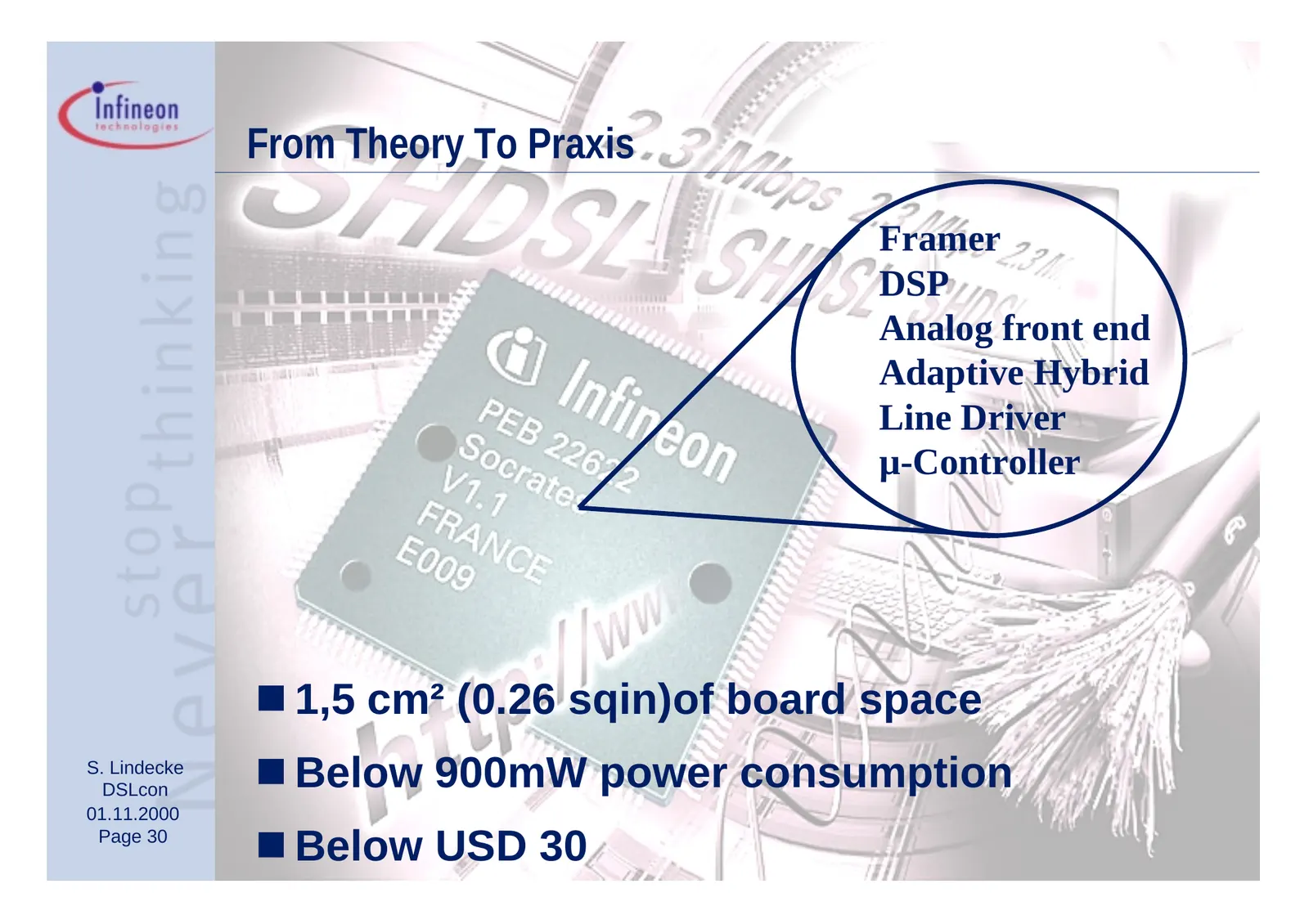
Slide 30: From Theory To Praxis
From Theory To Praxis Framer DSP Analog front end Adaptive Hybrid Line Driver µ-Controller 1,5 cm² (0.26 sqin)of board space S. Lindecke DSLcon Below 900mW power consumption 01.11.2000 Page 30 Below USD 30
Slide 31: Summary
Summary SHDSL offers the ultimate combination of – Flexibility – Cost – Reach – Power consumption Spectral compatibility makes it easy to deploy in networks Standardization guarantees interoperability It‘s available NOW!! For more information check out www.shdsl.org which is brought to you by Infine
Slide 32: Conclusion
Conclusion “Totally boring success - G.shdsl taking over Initial chips shipping, everyone knows it's the future” DSLprime 9/26 S. Lindecke DSLcon 01.11.2000 Page 32
Slide 33: Questions and Answers
Questions and Answers S. Lindecke DSLcon 01.11.2000 Page 33
Source: Internet Archive copy of infineon.com
More decks from Infineon Technologies AG
 Q4 2026 Earnings Presentation67 slides · Nov 10, 2026
 DA5 Consortium — Technical Presentation (September 2026)36 slides · Sep 21, 2026
 ESG Presentation (September 2026)35 slides · September 2026
 Q3 FY2026 Earnings Presentation16 slides · Aug 5, 2026
 Q3 2026 Earnings Presentation86 slides · Aug 5, 2026
 Technical Presentation (August 2026)41 slides · August 2026